SmarterEd

Aussie Maths & Science Teachers: Save your time with SmarterEd

  • Login
  • Get Help
  • About

Calculus, 2ADV C3 2024 HSC 19

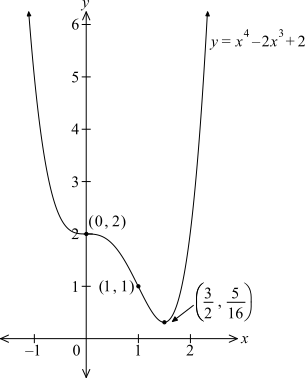
Sketch the curve  \(y=x^4-2 x^3+2\)  by first finding all stationary points, checking their nature, and finding the points of inflection.   (5 marks)

--- 26 WORK AREA LINES (style=lined) ---
Show Answers Only

Show Worked Solution
\(y\) \( = x^4-2 x^3+2\)
\(y^{\prime}\) \( = 4 x^3-6 x^2 =2 x^2(2 x-3)\)
\(y^{\prime\prime}\) \( = 12 x^2-12 x =12 x(x-1)\)

 
\(\text{SP’s when}\ \ y^{′}=0:\)

\(2 x^2(2 x-3) =0 \ \Rightarrow \ \ x =0\ \ \text{or}\ \ \dfrac{3}{2}\)

\(\text{At}\ \ x=0, \ y^{\prime \prime} =0\)

\begin{array} {|c|c|c|c|}
\hline
\rule{0pt}{2.5ex} x \rule[-1ex]{0pt}{0pt} & -1 & \ \ \ \ 0\ \ \ \  & 1 \\
\hline
\rule{0pt}{2.5ex} y^{′} \rule[-1ex]{0pt}{0pt} & -10 & 0 & -5 \\
\hline
\end{array}
   
\(\rightarrow\ \text{Horizontal POI at}\ (0,2)\)

   
\(\text{At}\ \ x=\dfrac{3}{2}:\)

\(\ y^{\prime \prime} =12 \times \dfrac{3}{2}\left(\dfrac{3}{2}-1\right)=9 \gt 0, \ \ y=\Bigg(\dfrac{3}{2}\Bigg)^{4}-2\Bigg(\dfrac{3}{2}\Bigg)^{3}+2=\dfrac{5}{16}\)
  

\(\rightarrow \text{MIN at}\ \left(\dfrac{3}{2}, \dfrac{5}{16}\right)\)
 

\(\text{POI when}\ \ y^{\prime \prime}=0:\)

\(12 x(x-1)=0 \ \rightarrow\ \  x=1\ \ \text{or}\ \ x=0\ \text{(see above)}\)

\(\text{Test concavity change at}\ \ x=1:\)

\begin{array} {|c|c|c|c|}
\hline
\rule{0pt}{2.5ex} x \rule[-1ex]{0pt}{0pt} & \dfrac{1}{2} & \ \ \ \ 1\ \ \ \  &  \dfrac{3}{2} \\
\hline
\rule{0pt}{2.5ex} y^{\prime \prime} \rule[-1ex]{0pt}{0pt} & \ \ -3\ \  & 0 & \ \ \ 9\ \ \  \\
\hline
\end{array}

\(\Rightarrow\ \text{POI at}\ (1,1)\)
 

Filed Under: Curve Sketching, Curve Sketching Tagged With: Band 4, smc-7225-20-Degree 4, smc-969-20-Degree 4

Calculus, 2ADV C3 2016 HSC 13a

Consider the function  `y = 4x^3-x^4.`

  1. Find the two stationary points and determine their nature.   (4 marks)

    --- 8 WORK AREA LINES (style=lined) ---

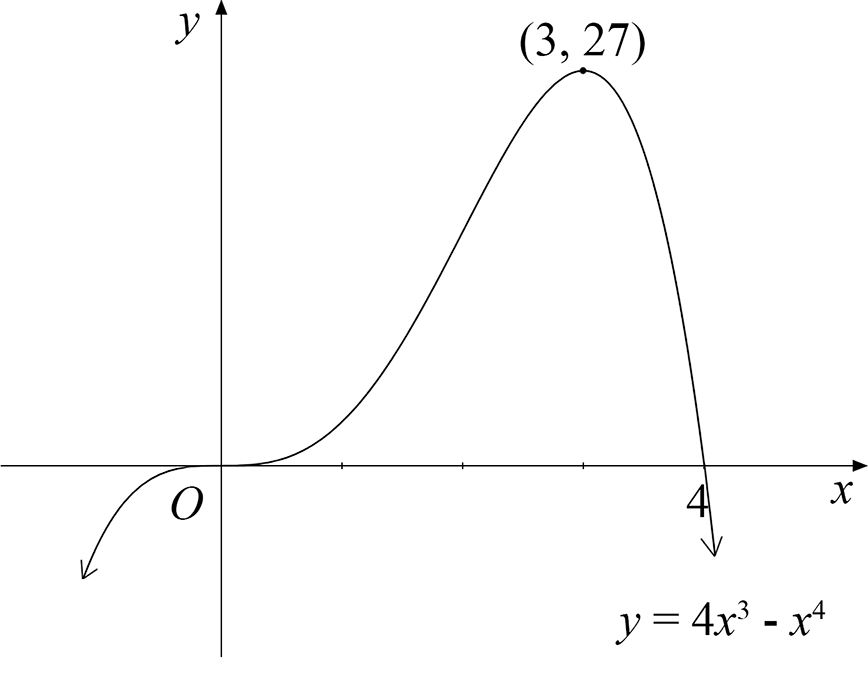
  2. Sketch the graph of the function, clearly showing the stationary points and the `x` and `y` intercepts.   (2 marks)

    --- 8 WORK AREA LINES (style=blank) ---

Show Answers Only

a.    `text{P.I. at (0, 0) and Max at (3, 27)}`

b.
     ext2-hsc-2016-13bi

Show Worked Solution
a.     `y` `= 4x^3-x^4`
  `y^{prime}` `= 12x^2-4x^3`
  `y^{primeprime}` `= 24x-12x^2`


`text(S.P.’s when)\ \ y^{prime} = 0,`

`12x^2-4x^3` `= 0`
 `4x^2 (3-x)` `= 0`

`:. x = 0 or 3`

  
`text(When)\ \ x = 0,\ \ y^{primeprime}(0) = 0`

`:.\ text(P.I. at)\ \ (0, 0)`
  

`text(When)\ \ x = 3,`

`y^{primeprime} (3) = 24(3)-12 (9) =-36 < 0`

`:.\ text(MAX)\ \ text(at)\ \ (3, 27)`
   

b.     ext2-hsc-2016-13bi

Filed Under: Curve Sketching, Curve Sketching, Curve Sketching and The Primitive Function Tagged With: Band 3, Band 4, smc-7225-20-Degree 4, smc-969-20-Degree 4

Calculus, 2ADV C3 2007 HSC 6b

Let  \(f (x) =x^4-4x^3\).

  1. Find the coordinates of the points where the curve crosses the axes.   (2 marks)

    --- 4 WORK AREA LINES (style=lined) ---

  2. Find the coordinates of the stationary points and determine their nature.   (4 marks)

    --- 8 WORK AREA LINES (style=lined) ---

  3. Find the coordinates of the points of inflection.   (1 mark)

    --- 2 WORK AREA LINES (style=lined) ---

  4. Sketch the graph of  \(y = f (x)\), indicating clearly the intercepts, stationary points and points of inflection.   (3 marks)

    --- 8 WORK AREA LINES (style=lined) ---

Show Answers Only

a.    \((0, 0)\ , \ (4, 0)\)

b.    \(\text{Minimum S.P. at}\ (3,-27)\)

c.    \((0, 0)\ \text{and}\ (2, 16)\)

d. 
     

Show Worked Solution

a.   \(f (x) = x^4-4x^3\)

\(\text{Cuts}\ x \text{-axis when}\ f(x) = 0\)

\(x^4-4x\) \(= 0\)
\(x^3 (x-4)\) \(= 0\)

\(x = 0\ \text{or}\ 4\)

\(\therefore\  \text{Cuts the}\ x\text{-axis at}\ (0, 0)\ ,\ (4, 0)\)
  

\(\text{Cuts the}\ y\text{-axis when}\ x = 0\)

\(\therefore\ \text{Cuts the}\ y \text{-axis at}\ (0, 0)\)
  

b.    \(f(x) = x^4-4x^3\)

\(f^{\prime}(x) = 4x^3-12x^2\)

\(f^{\prime\prime}(x) = 12x^2-24x\)
  

\(\text{S.P.’s when}\ f^{\prime}(x) = 0\)

\(4x^3-12x^2\) \(= 0\)
\(4x^2 (x-3)\) \(= 0\)

\(x = 0\ \text{or}\ 3\)

  
\(\text{When}\ x = 0\)

\(f(0) = 0\)

\(f^{\prime\prime}(0) = 0\)
  

\(\begin{array}{|c|c|c|c|} \hline \ \ x\ \  & \ \ -0.5 \ \ & \ \ 0 \ \  & \ \  0.5 \ \ \rule[-1.1ex]{0pt}{3.4ex} \\ \hline \  f^{\prime\prime}(x) \  & \ \ >0 \ \ & \ \ 0 \ \ & \ \ <0 \ \ \rule[-1.1ex]{0pt}{3.4ex} \\ \hline \end{array}\)

  
\(\text{Since concavity changes, a P.I.}\)

\(\text{occurs at}\ (0, 0)\)
  

\(\text{When}\ x = 3\)

\(f (3)\) \(= 3^4-4\times 3^3\)
  \(=-27\)
\(f^{\prime\prime}(3)\) \(= 12\times 3^2-24\times 3\)
  \(= 36 > 0\)

  
\(\therefore\ \text{Minimum S.P. at}\ (3,-27)\)
  

c.    \(\text{P.I. when}\ f^{\prime\prime}(x) = 0\)

\(12x^2-24x\) \(= 0\)
\(12x(x-2)\) \(= 0\)

\(x = 0\ \text{or}\ 2\)

  
\(\text{P.I. at}\ (0, 0)\ \ \ \text{(from(b))}\)
  

\(\text{When}\ x = 2\)

\(\begin{array}{|c|c|c|c|} \hline \ \ x\ \  & \ \ 1.5 \ \ & \ \ 2 \ \  & \ \  2.5 \ \ \rule[-1.1ex]{0pt}{3.4ex} \\ \hline \  f^{\prime\prime}(x) \  & \ \ <0 \ \ & \ \ 0 \ \ & \ \ >0 \ \ \rule[-1.1ex]{0pt}{3.4ex} \\ \hline \end{array}\)

\(\text{Since concavity changes, a P.I.}\)

\(\text{occurs when}\ x = 2\)  

\(f (2)\) \(= 2^4-4\times 2^3\)
  \(= 16\)

  
\(\therefore\ \text{P.I.’s at}\ (0, 0)\ \text{and}\ (2, 16)\)
  

d.    

2UA HSC 2007 6b

Filed Under: Curve Sketching, Curve Sketching, Curve Sketching and The Primitive Function Tagged With: Band 3, Band 4, smc-7225-20-Degree 4, smc-969-20-Degree 4

Calculus, 2ADV C3 2008 HSC 8a

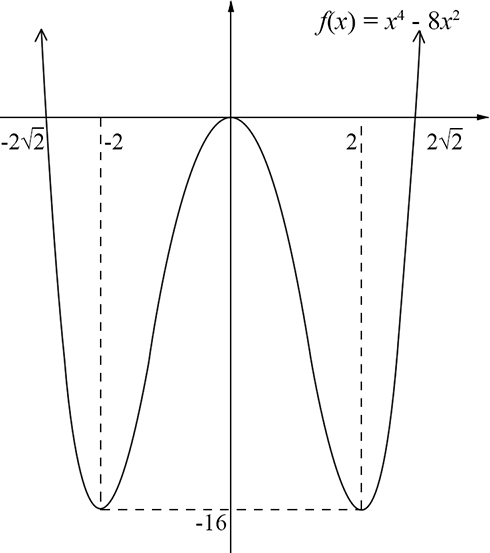
Let  `f(x) = x^4-8x^2`.

  1. Find the coordinates of the points where the graph of  `y = f(x)`  crosses the axes.   (2 marks)

    --- 5 WORK AREA LINES (style=lined) ---

  2. Show that  `f(x)`  is an even function.   (1 mark)

    --- 2 WORK AREA LINES (style=lined) ---

  3. Find the coordinates of the stationary points of  `f(x)`  and determine their nature.   (4 marks)

    --- 8 WORK AREA LINES (style=lined) ---

  4. Sketch the graph of  `y = f(x)`.   (1 mark)

    --- 8 WORK AREA LINES (style=lined) ---

Show Answers Only

a.    `(-2 sqrt 2,0), (2 sqrt 2, 0)`

b.    `text(Proof)\ \ text{(See Worked Solutions)}`

c.    `text(S.P.s at)\ (0,0), (2,-16), (-2,-16)`

d.     

  1. 2UA HSC 2008 8ai
Show Worked Solution
a.     `f(x) = x^4-8x^2`

`y text(-intercept when)\ x = 0`

`:.\ text(Cuts)\ y\ text(axis at)\ (0,0)`

`x\ text(-intercept when)\ f(x) = 0`

`x^4-8x^2` `= 0`
`x^2 (x^2-8)` `= 0`

`x^2-8 = 0\ \ \ \ \ text(or)\ \ \ \ \ x = 0`

`x^2` `= 8`
`x` `= +- sqrt 8 = +- 2 sqrt 2`

  
`:.\ text(Cuts)\ x text(-axis at)\ (-2 sqrt 2,0),\ \ text(and)\ \ (2 sqrt 2, 0)`

`text{(Note that it only touches}\ xtext{-axis at (0,0))}`
  

b.     `f(x)` `= x^4-8x^2`
  `f(-x)` `= (-x)^4-8(-x)^2`
    `= x^4-8x^2`
    `= f(x)`

  
`:.\ f(x)\ text(is an even function.)`
  

c.     `f(x)` `= x^4 – 8x^2`
  `f^{prime}(x)` `= 4x^3 – 16x`
  `f^{primeprime}(x)` `=12x^2-16`

  
`text(S.P.  when)\ \ f^{prime(x) = 0`

`4x^3-16x` `= 0`
`4x (x^2-4)` `= 0`
`x^2-4` `=0\ \ \ \ \ x = 0`
`x^2` `= 4`
`x` `= +-2`
`text(At)\ x=2\ \ `  `f(x)`  `=(2)^4-8(2)^2 =-16`
  `f^{primeprime}(x)` `=12(2^2)-16>0`

`:.\ text{MIN at (-2,-16)},\ \ \ (f(x)\ text(is even))`


`text(At)\ x=0\ \ `  `f(x)`  `=(0)^4-8(0)^2 = 0`
  `f^{primeprime}(x)` `=12(0^2)-16<0`

`:.\ text{MAX at (0,0)}`


d.    

Filed Under: Curve Sketching, Curve Sketching, Curve Sketching and The Primitive Function Tagged With: Band 4, Band 5, smc-7225-20-Degree 4, smc-969-20-Degree 4

Calculus, 2ADV C3 2012 HSC 14a

A function is given by  `f(x) = 3x^4 + 4x^3-12x^2`. 

  1. Find the coordinates of the stationary points of  `f(x)`  and determine their nature.   (3 marks)

    --- 6 WORK AREA LINES (style=lined) ---

  2. Hence, sketch the graph  `y = f(x)`   showing the stationary points.   (2 marks)

    --- 8 WORK AREA LINES (style=lined) ---

  3. For what values of  `x`  is the function increasing?   (1 mark)

    --- 2 WORK AREA LINES (style=lined) ---

  4. For what values of  `k`  will  `f(x) = 3x^4 + 4x^3-12x^2 + k = 0`  have no solution?   (1 mark)

    --- 2 WORK AREA LINES (style=lined) ---

Show Answers Only

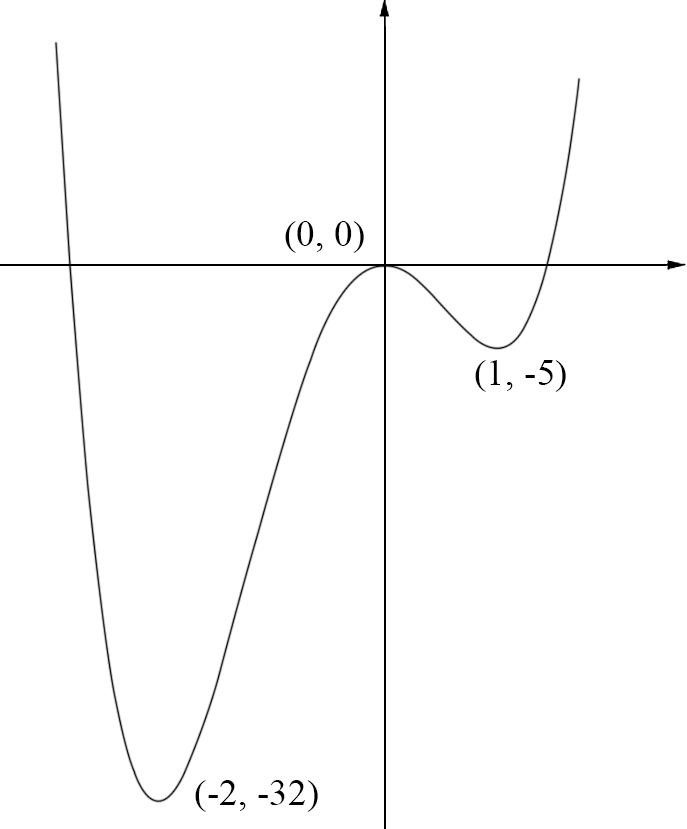
a.    `text{MAX at (0,0), MINs at (1, –5) and (–2, –32)}`

b.    
        2UA HSC 2012 14ai
 

c.    `f(x)\ text(is increasing for)\ -2 < x < 0\ text(and)\ x > 1`

d.    `text(No solution when)\ k > 32`

Show Worked Solution
a.     `f(x)` `= 3x^4 + 4x^3-12x^2`
  `f^{prime}(x)` `= 12x^3 + 12x^2-24x`
  `f^{primeprime}(x)` `= 36x^2 + 24x-24`

  
`text(Stationary points when)\ f^{prime}(x) = 0`

`12x^3 + 12x^2-24x` `=0`
`12x(x^2 + x-2)` `=0`
`12x (x+2) (x-1)` `=0`


`:.\ text(Stationary points at)\ x=0,\ 1\ text(or)\ -2`
  

`text(When)\ x=0,\ \ \ \ f(0)=0`

`f^{primeprime}(0)= -24 < 0`

`:.\ text{MAX at  (0,0)}`
  

`text(When)\ x=1`

`f(1)` `= 3+4-12 = -5`
`f^{primeprime}(1)` `= 36 + 24-24 = 36 > 0`

`:.\ text{MIN at}\  (1,-5)`

`text(When)\ x=–2`

`f(-2)` `=3(-2)^4 + 4(-2)^3-12(-2)^2`
  `= 48-32-48`
  `= -32`
`f^{primeprime}(-2)` `= 36(-2)^2 + 24(-2)-24`
  `=144-48-24 = 72 > 0`

  
`:.\ text{MIN at  (–2, –32)}`
  

b.     2UA HSC 2012 14ai
♦ Mean mark (c) 42%
MARKER’S COMMENT: Be careful to use the correct inequality signs, and not carelessly include ≥ or ≤ by mistake.

  
c.    `f(x)\ text(is increasing for)`

`-2 < x < 0\ text(and)\ x > 1`
  

d.    `text(Find)\ k\ text(such that)`

♦♦♦ Mean mark (d) 12%.

`3x^4 + 4x^3-12x^2 + k = 0\ text(has no solution)`

`k\ text(is the vertical shift of)\ \ y = 3x^4 + 4x^3-12x^2`

`->\ text(No solution if it does not cross the)\ x text(-axis.)`

`:.\ text(No solution when)\ k > 32`

Filed Under: Curve Sketching, Curve Sketching, Curve Sketching and The Primitive Function Tagged With: Band 4, Band 5, Band 6, page-break-before-solution, smc-7225-20-Degree 4, smc-7225-50-Increasing/Decreasing Intervals, smc-969-20-Degree 4, smc-969-50-Increasing/Decreasing Intervals

Copyright © 2014–2026 SmarterEd.com.au · Log in