SmarterEd

Aussie Maths & Science Teachers: Save your time with SmarterEd

  • Login
  • Get Help
  • About

Calculus, 2ADV C3 2025 HSC 16

Consider the function  \(f(x)=\dfrac{x^2}{e^x}\).

  1. Find the stationary points of the function and determine their nature.   (4 marks)

    --- 14 WORK AREA LINES (style=lined) ---

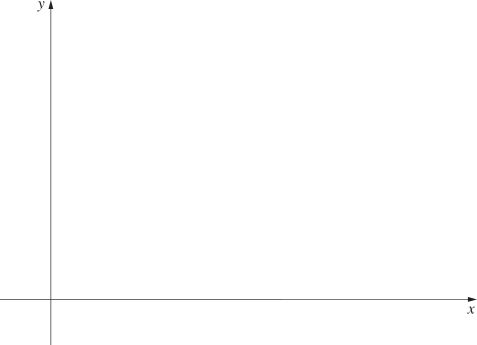
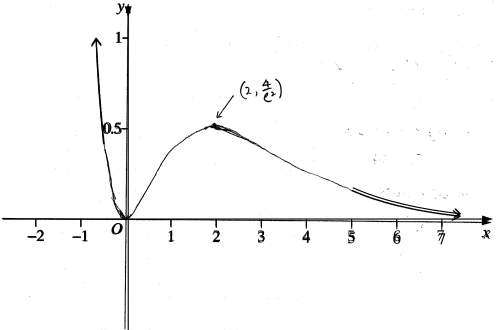
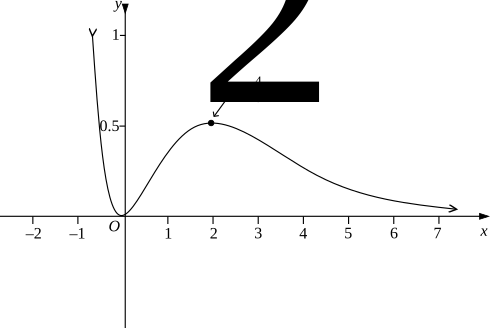
  2. A partially completed graph of  \(f(x)=\dfrac{x^2}{e^x}\)  is shown.
  3. Use your answer from part (a) to complete the graph.   (1 mark)

    --- 0 WORK AREA LINES (style=lined) ---


Show Answers Only

a.   \(\text{MIN at}\ \ (0,0)\)

\(\text{MAX at}\ \ \left(2,\dfrac{4}{e^2}\right)\)

b.   
     

Show Worked Solution
a.     \(f(x)\) \(=\dfrac{x^2}{e^x}\)
  \(f^{\prime}(x)\) \(=2 x \cdot e^x-e^x \cdot x^2\)
    \(=\dfrac{x e^x(2-x)}{e^{2 x}}\)
    \(=\dfrac{x(2-x)}{e^x}\)

 
\(\text{Find} \ x\ \text{when} \ \ f^{\prime}(x)=0:\)

\(x(2-x)=0\)

\(x=0 \ \text {or} \ 2\)

\(\text{When} \ \ x=0 \ \Rightarrow \ f(0)=0\)

\(\text {When}\ \  x=2 \ \Rightarrow \ f(2)=\dfrac{4}{e^2}\)

\(\text {Checking nature of SP’s:}\)

\begin{array}{|c|c|c|c|c|c|}
\hline x & -1 & 0 & 1 & 2 & 3 \\
\hline f^{\prime}(x) & -3 e & 0 & \dfrac{1}{e} & 0 & -\dfrac{3}{e^3} \\
\hline
\end{array}

\(\therefore \ \text{MIN at}\ \ (0,0)\)

\(\quad \ \ \text{MAX at}\ \ \left(2,\dfrac{4}{e^2}\right)\)
 

b.
     

Filed Under: Curve Sketching, Curve Sketching Tagged With: Band 4, smc-7225-30-Other Graphs, smc-969-30-Other Graphs

Calculus, 2ADV C3 2024 HSC 19

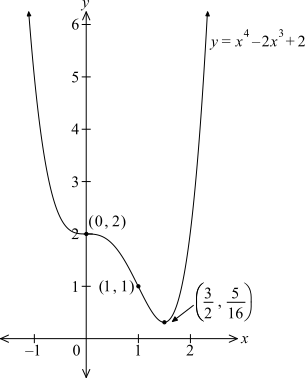
Sketch the curve  \(y=x^4-2 x^3+2\)  by first finding all stationary points, checking their nature, and finding the points of inflection.   (5 marks)

--- 26 WORK AREA LINES (style=lined) ---

Show Answers Only

Show Worked Solution
\(y\) \( = x^4-2 x^3+2\)  
\(y^{\prime}\) \( = 4 x^3-6 x^2 =2 x^2(2 x-3)\)  
\(y^{\prime\prime}\) \( = 12 x^2-12 x =12 x(x-1)\)  

 
\(\text{SP’s when}\ \ y^{′}=0:\)

\(2 x^2(2 x-3) =0 \ \Rightarrow \ \ x =0\ \ \text{or}\ \ \dfrac{3}{2}\)

\(\text{At}\ \ x=0, \ y^{\prime \prime} =0\)

\begin{array} {|c|c|c|c|}
\hline
\rule{0pt}{2.5ex} x \rule[-1ex]{0pt}{0pt} & -1 & \ \ \ \ 0\ \ \ \  & 1 \\
\hline
\rule{0pt}{2.5ex} y^{′} \rule[-1ex]{0pt}{0pt} & -10 & 0 & -5 \\
\hline
\end{array}

\(\Rightarrow\ \text{Horizontal POI at}\ (0,2)\)
 

\(\text{At}\ \ x=\dfrac{3}{2}:\)

\(\ y^{\prime \prime} =12 \times \dfrac{3}{2}\left(\dfrac{3}{2}-1\right)=9 \gt 0, \ \ y=\Bigg(\dfrac{3}{2}\Bigg)^{4}-2\Bigg(\dfrac{3}{2}\Bigg)^{3}+2=\dfrac{5}{16}\)

\(\Rightarrow \text{MIN at}\ \left(\dfrac{3}{2}, \dfrac{5}{16}\right)\)
 

\(\text{POI when}\ \ y^{″}=0:\)

\(12 x(x-1)=0 \ \Rightarrow\ \  x=1\ \ \text{or}\ \ x=0\ \text{(see above)}\)

\(\text{Test concavity change at}\ \ x=1:\)

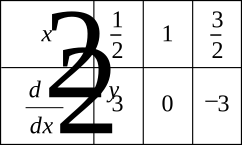
\begin{array} {|c|c|c|c|}
\hline
\rule{0pt}{2.5ex} x \rule[-1ex]{0pt}{0pt} & \dfrac{1}{2} & \ \ \ \ 1\ \ \ \  &  \dfrac{3}{2} \\
\hline
\rule{0pt}{2.5ex} y^{″} \rule[-1ex]{0pt}{0pt} & \ \ -3\ \  & 0 & \ \ \ 9\ \ \  \\
\hline
\end{array}

\(\Rightarrow\ \text{POI at}\ (1,1)\)
 

Filed Under: Curve Sketching, Curve Sketching Tagged With: Band 4, smc-7225-20-Degree 4, smc-969-20-Degree 4

Calculus, 2ADV C3 2023 HSC 30

Let  \(f(x)=e^{-x} \sin x\).

  1. Find the coordinates of the stationary points of \(f(x)\) for  \(0\leq x\leq 2\pi\). You do NOT need to check the nature of the stationary points.  (3 marks)

    --- 6 WORK AREA LINES (style=lined) ---

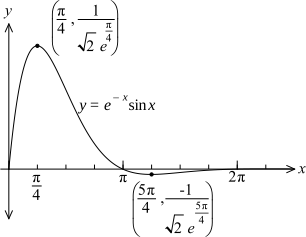
  2. Without using any further calculus, sketch the graph of  \(y=f(x)\), for  \(0\leq x\leq 2\pi\), showing stationary points and intercepts.  (2 marks)


--- 0 WORK AREA LINES (style=lined) ---

Show Answers Only

a.    \( \Big(\dfrac{\pi}{4},\dfrac{1}{\sqrt2 \times e^{\frac{\pi}{4}}}\Big)\ \text{and}\  \Big(\dfrac{5\pi}{4},\dfrac{-1}{\sqrt2 \times e^{\frac{5\pi}{4}}}\Big)\)

b.    
         

Show Worked Solution

a.    \(f(x)=e^{-x} \sin x\)

\(f^{′}(x)=e^{-x} \cos x-e^{-x} \sin x = e^{-x}( \cos x-\sin x) \)

\(\text{SPs when}\ f^{′}(x)=0: \)

\(e^{-x}=0\ \ \rightarrow \ \text{no solution} \)

\(\cos x-\sin x\) \(=0\)  
\(1-\tan x\) \(=0\)  
\(\tan\) \(=1\)  
Mean mark (a) 54%.

\(x=\dfrac{\pi}{4}, \dfrac{5\pi}{4} \)
 

\(f(\dfrac{\pi}{4})=e^{-\frac{\pi}{4}}\sin \frac{\pi}{4}=\dfrac{1}{\sqrt2 \times e^{\frac{\pi}{4}}} \)

\(f(\dfrac{5\pi}{4})=e^{-\frac{5\pi}{4}}\sin \frac{5\pi}{4}=\dfrac{-1}{\sqrt2 \times e^{\frac{5\pi}{4}}} \)
 

\(\therefore\ \text{SPs at}\ \Big(\dfrac{\pi}{4},\dfrac{1}{\sqrt2 \times e^{\frac{\pi}{4}}}\Big)\ \text{and}\  \Big(\dfrac{5\pi}{4},\dfrac{-1}{\sqrt2 \times e^{\frac{5\pi}{4}}}\Big)\)

 
b.
    \(\ x\text{-intercepts at}\ \ x=0, \pi,\ 2\pi \)


♦♦ Mean mark (b) 34%.

Filed Under: Curve Sketching, Curve Sketching, Graphs and Applications Tagged With: Band 4, Band 5, smc-7225-30-Other Graphs, smc-966-10-Exponential graphs, smc-969-30-Other Graphs

Calculus, 2ADV C3 2022 HSC 27

Let  `f(x)=xe^(-2x)`.

It is given that  `f^(′)(x)=e^(-2x)-2xe^(-2x)`.

  1. Show that  `f^(″)(x)=4(x-1)e^(-2x)`.  (2 marks)

    --- 4 WORK AREA LINES (style=lined) ---

  2. Find any stationary points of  `f(x)`  and determine their nature.  (2 marks)

    --- 6 WORK AREA LINES (style=lined) ---

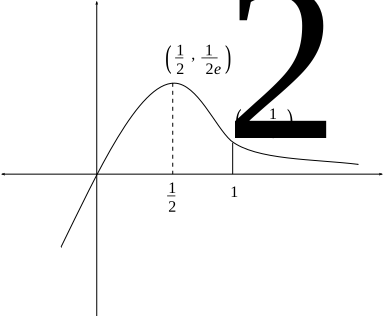
  3. Sketch the curve  `y=x e^{-2 x}`, showing any stationary points, points of inflection and intercepts with the axes.  (3 marks)

    --- 8 WORK AREA LINES (style=lined) ---

Show Answers Only
  1. `text{Proof (See Worked Solutions)}`
  2. `text{Max S.P. at}\ \ (1/2, 1/(2e))`
  3.  
Show Worked Solution

a.   `f^(′)(x)=e^(-2x)-2xe^(-2x)`

`f^(″)(x)` `=-2e^(-2x)-[2x(-2)e^(-2x)+2e^(-2x)]`  
  `=-2e^(-2x)+4xe^(-2x)-2e^(-2x)`  
  `=4xe^(-2x)-4e^(-2x)`  
  `=4(x-1)e^(-2x)\ \ text{… as required}`  


b.   `text{S.P.’s occur when}\ \ f^(′)(x)=0`

`e^(-2x)-2xe^(-2x)` `=0`  
`e^(-2x)(1-2x)` `=0`  

 
`e^(-2x)=0\ \ =>\ \ text{No solution}`

`1-2x=0\ \ =>\ \ x=1/2`

`f^(″)(1/2)` `=4(1/2-1)e^(-2xx1/2)`  
  `=-2e^(-1)<0\ \ =>\ text{MAX}`  

 
`f(1/2)=1/2e^(-1)=1/(2e)`
 

c.   `text{POI occurs when}\ \ f^(″)(x)=0`

`f^(″)(x)=4(x-1)e^(-2x)=0\ \ =>\ \ x=1`

`text{Test for change in concavity:}`

`f^(″)(0)=4(0-1)e^0=-4`

`f^(″)(2)=4(2-1)e^(-4)>0\ \ =>\ text{Concavity changes}`

`:.\ text{POI exists at}\ \ (1,1/e^2)`

`text{As}\ \ x->oo\ \ =>\ \ y->0^+`


Mean mark part (c) 54%.

Filed Under: Curve Sketching, Curve Sketching, Graphs and Applications Tagged With: Band 3, Band 4, smc-7225-30-Other Graphs, smc-966-10-Exponential graphs, smc-969-30-Other Graphs

Calculus, 2ADV C3 2022 HSC 22

Find the global maximum and minimum values of  `y=x^(3)-6x^(2)+8`, where  `-1 <= x <= 7`.   (4 marks)

--- 8 WORK AREA LINES (style=lined) ---

Show Answers Only

`text{Global max = 57}`

`text{Global min = – 24}`

Show Worked Solution
`y` `=x^3-6x^2+8`  
`dy/dx` `=3x^2-12x`  
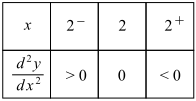
`(d^2y)/(dx^2)` `=6x-12`  

 
`text{SP’s when}\ \ dy/dx=0:`

`3x^2-12x` `=0`  
`3x(x-4)` `=0`  

 
`x=0\ \ text{or}\ \ 4`

`text{When}\ \ x=0,\ \ y=8,\ \ (d^2y)/(dx^2)<0`

`=>\ text{Local Max at}\ \ (0,8)`

`text{When}\ \ x=4,\ \ y=4^3-6(4^2)+8=-24,\ \ (d^2y)/(dx^2)>0`

`=>\ text{Local Min at}\ \ (4,-24)`
 

`text{Check ends of domain:}`

`text{When}\ \ x=-1,\ \ y=-1-6+8=1`

`text{When}\ \ x=7,\ \ y=7^3-6(7^2)+8=57`

`:.\ text{Global max = 57}`

`:.\ text{Global min = – 24}`

Filed Under: Curve Sketching, Curve Sketching Tagged With: Band 4, smc-7225-10-Cubic, smc-7225-60-Range defined, smc-969-10-Cubic, smc-969-60-Range defined

Calculus, 2ADV C3 2020 HSC 16

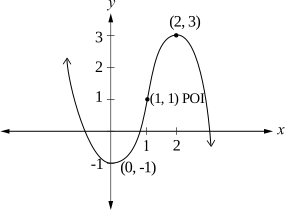
Sketch the graph of the curve  `y = −x^3 + 3x^2 - 1`, labelling the stationary points and point of inflection. Do NOT determine the `x`-intercepts of the curve.  (4 marks)

Show Answers Only

Show Worked Solution
`y` `= −x^3 + 3x^2 – 1`
`(dy)/(dx)` `= −3x^2 + 6x`
`(d^2y)/(dx^2)` `= −6x + 6`

 
`text(SP’s when)\ (dy)/(dx) = 0`

`−3x^2 + 6x` `= 0`
`−3x(x – 2)` `= 0`

`x = 0\ \ text(or)\ \ 2`

 
`text(When)\ \ x = 0,`

`y = −1`

`(d^2 y)/(dx^2) = 6 > 0`

 
`:. text(MIN at)\ \ (0, −1)`
 

`text(When)\ \ x = 2,`

`y` `= −8 + 12 – 1 = 3`
`(d^2y)/(dx^2)` `= −6 xx 2 + 6 = −6 < 0`

 
`:. text(MAX at)\ \ (2, 3)`
 

`(d^2y)/(dx^2) = 0\ text(when)`

`−6x + 6` `= 0`
`x` `= 1`

 
`text(Checking change of concavity)`

`text(Concavity changes either side of)\ x = 1`

`:. text(POI at)\ (1, 1)`
 

Filed Under: Curve Sketching, Curve Sketching Tagged With: Band 4, smc-7225-10-Cubic, smc-969-10-Cubic

Calculus, 2ADV C3 2019 MET1 4

Given the function  `f(x) = log_e (x-3) + 2`,

  1. State the domain and range of `f(x)`.  (1 mark)

    --- 1 WORK AREA LINES (style=lined) ---

  2. i.  Find the equation of the tangent to the graph of  `f(x)` at  `(4, 2)`.  (2 marks)

    --- 4 WORK AREA LINES (style=lined) ---


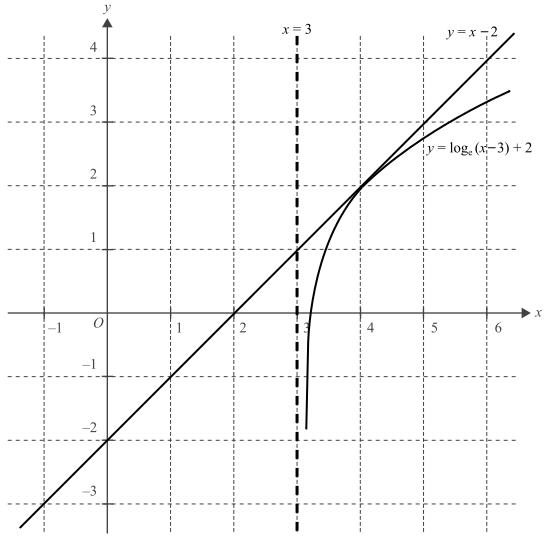
    ii. On the axes below, sketch the graph of the function  `f(x)`, labelling any asymptote with its equation.


        Also draw the tangent to the graph of  `f(x)`  at  `(4, 2)`.  (4 marks)
     

--- 0 WORK AREA LINES (style=lined) ---

Show Answers Only
  1. `x >3`


    `y in R`

  2. i.  `y = x-2`


    ii. `text(See Worked Solutions)`

Show Worked Solution
a.   `text(Domain)` `: \ x > 3`
  `text(Range)` `: \ y in R`


b.i.   `g(x)` `= log_e (x-3) + 2`
  `g^{\prime}(x)` `= 1/(x-3)`
  `g^{\prime}(4)` `= 1`

 
`text(Equation of tangent),\ m = 1\ \ text(through)\ (4, 2):`

`y-2` `= 1(x-4)`
`y` `= x-2`


b.ii.  

Filed Under: Curve Sketching, Curve Sketching, Graphs and Applications Tagged With: Band 3, Band 4, Band 5, smc-7225-30-Other Graphs, smc-966-40-Log graphs, smc-969-30-Other Graphs

Calculus, 2ADV C3 2019 HSC 14b

The derivative of a function  `y = f(x)`  is given by  `f^{′}(x) = 3x^2 + 2x-1`.

  1. Find the `x`-values of the two stationary points of  `y = f(x)`, and determine the nature of the stationary points.  (2 marks)

    --- 6 WORK AREA LINES (style=lined) ---

  2. The curve passes through the point  `(0, 4)`.


    Find an expression for  `f(x)`.  (2 marks)

    --- 4 WORK AREA LINES (style=lined) ---

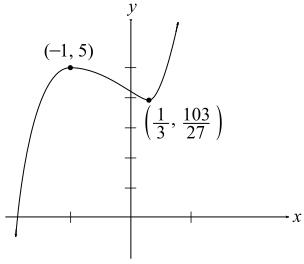
  3. Hence sketch the curve, clearly indicating the stationary points.  (2 marks)

    --- 8 WORK AREA LINES (style=lined) ---

  4. For what values of `x` is the curve concave down?  (1 mark)

    --- 2 WORK AREA LINES (style=lined) ---

Show Answers Only
  1. `x = 1/3\ \ text{(min)}`
    `x = -1\ \ text{(max)}`
  2. `f(x) = x^3 + x^2-x + 4`
  3. `text(See Worked Solution)`
  4. `x < -1/3`
Show Worked Solution

a.    `f^{′}(x) = 3x^2 + 2x-1`

`f^{″}(x) = 6x + 2`

`text(S.P.’s when)\ \ f^{′}(x) = 0`

`3x^2 + 2x-1` `= 0`
`(3x-1)(x + 1)` `= 0`

 
`x = 1/3 or -1`

`text(When)\ x = 1/3,`

`f^{″}(x) = 4 > 0 =>\ text(MIN)`
 

`text(When)\ x = -1,`

`f^{″}(x)= -4 < 0 =>\ text(MAX)`


b.    `f(x)` `= int f^{′}(x)\ dx`
    `= int 3x^2 + 2x-1\ dx`
    `= x^3 + x^2-x + c`

 
`(0, 4)\ \ text(lies on)\ \ f(x)\ \ =>\ \ c = 4`

`:. f(x) = x^3 + x^2-x + 4`


c.    `text(When)\ \ x = -1,\ \ y = 5`
  `text(When)\ \ x = 1/3,\ \ y = 103/27`


d.   `text(Concave down when)\ f^{″}(x) < 0`

♦ Mean mark 36%.

`6x + 2` `< 0`
`6x` `< -2`
`x` `< -1/3`

Filed Under: Curve Sketching, Curve Sketching Tagged With: Band 3, Band 5, smc-7225-10-Cubic, smc-7225-40-Concavity Intervals, smc-969-10-Cubic, smc-969-40-Concavity Intervals

Calculus, 2ADV C3 2018 HSC 13a

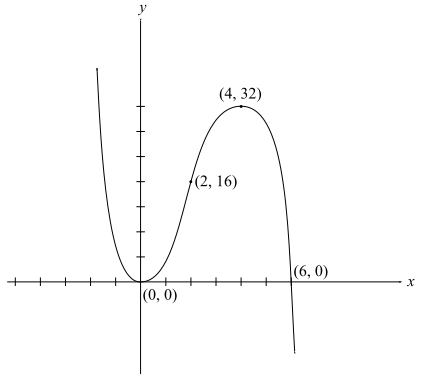
Consider the curve  `y = 6x^2 - x^3`.

  1. Find the stationary points and determine their nature.  (3 marks)

    --- 6 WORK AREA LINES (style=lined) ---

  2. Given that the point  (2,16)  lies on the curve, show that it is a point of inflection.  (2 marks)

    --- 4 WORK AREA LINES (style=lined) ---

  3. Sketch the curve, showing the stationary points, the point of inflection and the `x` and `y` intercepts.  (2 marks)

    --- 8 WORK AREA LINES (style=lined) ---

Show Answers Only
  1. `text(MIN at)\ (0, 0);\ text(MAX at)\ (4, 32)`
  2. `text(Proof)\ \ text{(See Worked Solutions)}`
  3. `text(See Worked Solutions)`
Show Worked Solution

i.    `y = 6x^2 – x^3`

`(dy)/(dx) = 12x – 3x^2`

`(d^2y)/(dx^2) = 12 – 6x`
 

`text(S.P.s occur when)\ \ (dy)/(dx) = 0`

`12x – 3x^2 = 0`

`3x(4 – x) = 0`

`x = 0 or 4`
 

`text(When)\ \ x = 0,\ (d^2y)/(dx^2) > 0`

`:.\ text(MIN at)\ (0, 0)`
 

`text(When)\ \ x = 4,\ (d^2y)/(dx^2) < 0`

`:.\ text(MAX at)\ (4, 32)`


ii.  `text(P.I. occur when)\ \ (d^2y)/(dx^2) = 0,`

`12 – 6x` `= 0`
`x` `= 2`

 
`text(When)\ \ x = 2,\ y = 16`

 
`text(S)text(ince the concavity changes)`

`=>\ text(P.I. occurs at)\ \ (2, 16)`


iii.  

Filed Under: Curve Sketching, Curve Sketching, Curve Sketching and The Primitive Function Tagged With: Band 3, Band 4, smc-7225-10-Cubic, smc-969-10-Cubic

Calculus, 2ADV C3 2017 HSC 13b

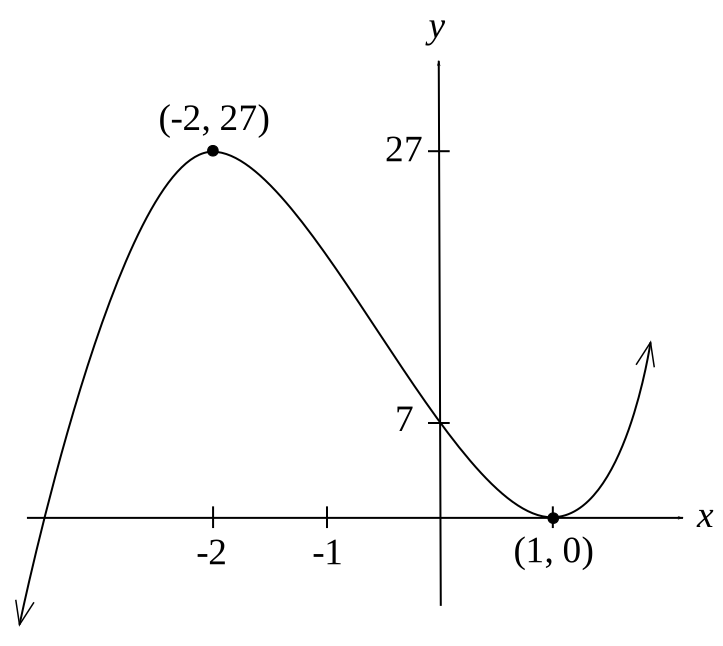
Consider the curve  `y = 2x^3 + 3x^2 - 12x + 7`.

  1. Find the stationary points of the curve and determine their nature.  (4 marks)

    --- 8 WORK AREA LINES (style=lined) ---

  2. Sketch the curve, labelling the stationary points.  (2 marks)

    --- 8 WORK AREA LINES (style=lined) ---

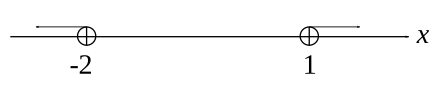
  3. Hence, or otherwise, find the values of `x` for which `(dy)/(dx)` is positive.  (1 mark)

    --- 1 WORK AREA LINES (style=lined) ---

Show Answers Only
  1. `text(maximum at)\ (-2, 27)`


    `text(minimum at)\ (1, 0)`

  2.    
  3. `x < -2 and x > 1`
Show Worked Solution
i.   `y` `= 2x^3 + 3x^2 – 12x + 7`
  `(dy)/(dx)` `= 6x^2 + 6x – 12`
  `(d^2y)/(dx^2)` `= 12x + 6`


`text(S.P. when)\ (dy)/(dx)` `= 0`
`6x^2 + 6x – 12` `= 0`
`x^2 + x – 2` `= 0`
`(x + 2) (x – 1)` `= 0`

 
`x = -2 or 1`
 

`text(When)\ \ x = –2, (d^2y)/(dx^2) < 0`

`:.\ text(MAX at)\ (–2, 27)`
 

`text(When)\ \ x = 1, (d^2y)/(dx^2) > 0`

`:.\ text(MIN at)\ (1, 0)`


ii.  


iii.  `text(Solution 1)`

`text(From graph, gradient is positive for)`

`x < –2 and x > 1`

`:. (dy)/(dx) > 0\ \ text(for)\ \ x < –2 and x > 1`


`text(Solution 2)`

`(dy)/(dx) > 0`

`6x^2 + 6x – 12` `> 0`
`(x + 2) (x – 1)` `> 0`


`:. x < –2 and x > 1`

Filed Under: Curve Sketching, Curve Sketching, Curve Sketching and The Primitive Function Tagged With: Band 3, Band 4, smc-7225-10-Cubic, smc-7225-50-Increasing/Decreasing Intervals, smc-969-10-Cubic, smc-969-50-Increasing/Decreasing Intervals

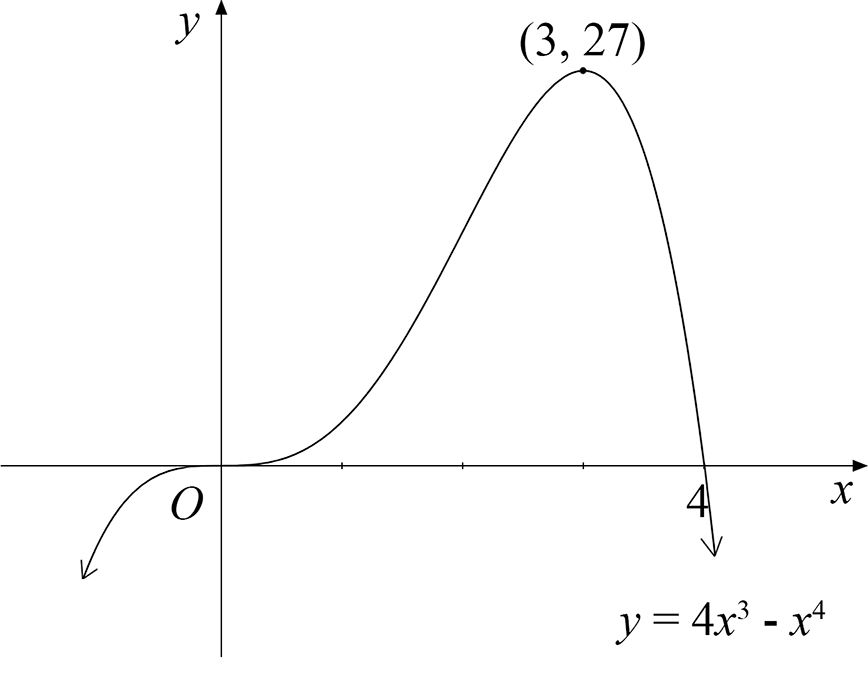
Calculus, 2ADV C3 2016 HSC 13a

Consider the function  `y = 4x^3 - x^4.`

  1. Find the two stationary points and determine their nature.  (4 marks)

    --- 8 WORK AREA LINES (style=lined) ---

  2. Sketch the graph of the function, clearly showing the stationary points and the `x` and `y` intercepts.  (2 marks)

    --- 8 WORK AREA LINES (style=lined) ---

Show Answers Only

a.   `text{P.I. at (0, 0) and Max at (3, 27)}`

b.
 ext2-hsc-2016-13bi

Show Worked Solution
a.      `y` `= 4x^3 – x^4`
  `y prime` `= 12x^2 – 4x^3`
  `y″` `= 24x – 12x^2`


`text(S.P.’s when)\ \ y prime = 0,`

`12x^2 – 4x^3` `= 0`
 `4x^2 (3 – x)` `= 0`
`:. x = 0 or 3`


`text(When)\ \ x = 0,\ \ y″ (0) = 0`

`:.\ text(P.I. at)\ \ (0, 0)`


`text(When)\ \ x = 3,`

`y″ (3) = 24(3) – 12 (9) = -36 < 0`

`:.\ text(MAX)\ \ text(at)\ \ (3, 27)`


b.     ext2-hsc-2016-13bi

Filed Under: Curve Sketching, Curve Sketching, Curve Sketching and The Primitive Function Tagged With: Band 3, Band 4, smc-7225-20-Degree 4, smc-969-20-Degree 4

Calculus, 2ADV C3 2004 HSC 9c

Consider the function  `f(x) = (log_e x)/x`, for  `x > 0`.

  1. Show that the graph of  `y = f(x)`  has a stationary point at  `x = e`.  (2 marks)

    --- 6 WORK AREA LINES (style=lined) ---

  2. By considering the gradient on either side of  `x = e`, or otherwise, show that the stationary point is a maximum.  (1 mark)

    --- 2 WORK AREA LINES (style=lined) ---

  3. Use the fact that the maximum value of  `f(x)`  occurs at  `x = e`  to deduce that  `e^x ≥ x^e`  for all  `x > 0`.  (2 marks)

    --- 6 WORK AREA LINES (style=lined) ---

Show Answers Only

a.    `text(Proof)\ \ text{(See Worked Solutions)}`

b.    `text(Proof)\ \ text{(See Worked Solutions)}`

c.    `text(Proof)\ \ text{(See Worked Solutions)}`

Show Worked Solution

a.    `f(x) = (log_e x)/x, text(for)\ x > 0`

`text(Using the quotient rule,)`

`f′(u/v)` `=(u′v-uv′)/v^2`
`f′(x)` `= (x · d/(dx) (log_e x) − log_e x · d/(dx) (x))/(x^2)`
  `= (x(1/x) − log_e x · 1)/(x^2)`
  `= (1 − log_e x)/(x^2)`


`text(SP’s occur when)\ \ f′(x)=0`

`(1 − log_e x)/(x^2)` `= 0`
`1 − log_e x` `= 0`
`log_e x` `= 1`
`:. x` `= e`


`:. text(There is a stationary point at)\ \ x = e.`


b.    

Geometry and Calculus, 2UA 2004 HSC 9c Answer

`text(When)\ \ x < e, log_e x<1\ \ \ text{(from graph)}`

`1 − log_e x` `> 0`
`(1 − log_e x)/(x^2)` `> 0`
`:. f′(x)` `> 0`


`text(When)\ x > e, log_e x>1\ \ \ text{(from graph)}`

`1 − log_e x` `< 0`
`(1 − log_e x)/(x^2)` `< 0`
`:. f′(x)` `< 0`


`:.\ text(The stationary point at)\ \ x = e\ \ text(is a maximum.)`


c.     `f(e)` `= (log_e x)/e`
    `= 1/e`

`:. f(x)\ \ text(has a maximum value at)\ \ (e,1/e)`

MARKER’S COMMENT: Very challenging for most students. Successful students recognised the link to part (ii).


`:. (log_e x)/x` `≤ 1/e`
`log_e x` `≤ x/e`
`e log_e x` `≤ x`
`log_e x^e` `≤ x`
`e^(log_e x^e)` `≤ e^x`
`x^e` `≤ e^x\ \ \ text{(using}\ e^(log x) = x)`
`:. e^x` `≥ x^e \ \ \ text{(for}\ \ x > 0text{)}`

Filed Under: Applied Calculus (L&E), Curve Sketching, Curve Sketching, Curve Sketching and The Primitive Function Tagged With: Band 4, Band 6, smc-7225-30-Other Graphs, smc-969-30-Other Graphs

Calculus, 2ADV C3 2007 HSC 6b

Let  `f (x) =x^4 - 4x^3`.

  1. Find the coordinates of the points where the curve crosses the axes.  (2 marks)

    --- 4 WORK AREA LINES (style=lined) ---

  2. Find the coordinates of the stationary points and determine their nature.  (4 marks)

    --- 8 WORK AREA LINES (style=lined) ---

  3. Find the coordinates of the points of inflection.  (1 mark)

    --- 2 WORK AREA LINES (style=lined) ---

  4. Sketch the graph of  `y = f (x)`, indicating clearly the intercepts, stationary points and points of inflection.  (3 marks)

    --- 8 WORK AREA LINES (style=lined) ---

Show Answers Only

a.    `(0, 0)\ , \ (4, 0)`

b.    `text(Minimum S.P. at)\ (3,\ text(-27))`

c.    `(0, 0) and (2, 16)`

d. 
   

Show Worked Solution

a.   `f (x) = x^4 – 4x^3`

`text(Cuts)\ x text(-axis when)\ f(x) = 0`

`x^4 – 4x` `= 0`
`x^3 (x – 4)` `= 0`

`x = 0 or 4`

`:. text(Cuts the)\ x text(-axis at)\ (0, 0)\ ,\ (4, 0)`


`text(Cuts the)\ y text(-axis when)\ x = 0`

`:. text(Cuts the)\ y text(-axis at)\ (0, 0)`


b.    `f(x) = x^4 – 4x^3`

`f prime (x) = 4x^3 – 12x^2`

`f″ (x) = 12x^2 – 24x`


`text(S.P.’s when)\ f prime (x) = 0`

`4x^3 – 12x^2` `= 0`
`4x^2 (x – 3)` `= 0`

`x = 0 or 3`

`text(When)\ x = 0`

`f(0) = 0`

`f″(0) = 0`

`text(S)text(ince concavity changes, a P.I.)`

`text(occurs at)\ (0, 0)`


`text(When)\ x = 3`

`f (3)` `= 3^4 – 4 xx 3^3`
  `= -27`
`f″ (3)` `= 12 xx 3^2 – 24 xx 3`
  `= 36 > 0`


`:. text(Minimum S.P. at)\ (3,\ text(–27))`


c.    `text(P.I. when)\ f″(x) = 0`

`12x^2 – 24x` `= 0`
`12x(x – 2)` `= 0`

`x = 0 or 2`

`text(P.I. at)\ (0, 0)\ \ \ text{(from(ii))}`


`text(When)\ x = 2`

`text(S)text(ince concavity changes, a P.I.)`

`text(occurs when)\ x = 2`

`f (2)` `= 2^4 – 4 xx 2^3`
  `= 16`


`:. text(P.I.’s at)\ (0, 0) and (2, 16)`


d.    

2UA HSC 2007 6b

Filed Under: Curve Sketching, Curve Sketching, Curve Sketching and The Primitive Function Tagged With: Band 3, Band 4, smc-7225-20-Degree 4, smc-969-20-Degree 4

Calculus, 2ADV C3 2015 HSC 13c

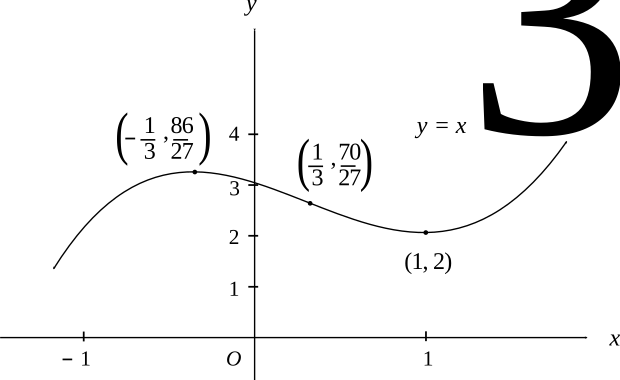
Consider the curve  `y = x^3 − x^2 − x + 3`.

  1. Find the stationary points and determine their nature.   (4 marks)

    --- 8 WORK AREA LINES (style=lined) ---

  2. Given that the point  `P (1/3, 70/27)`  lies on the curve, prove that there is a point of inflection at  `P`.  (2 marks)

    --- 5 WORK AREA LINES (style=lined) ---

  3. Sketch the curve, labelling the stationary points, point of inflection and `y`-intercept.  (2 marks)

    --- 8 WORK AREA LINES (style=lined) ---

Show Answers Only

a.    `text(MAX at)\ (-1/3, 86/27); \ text(MIN at)\ (1, 2)`

b.    `text(Proof)\ \ text{(See Worked Solutions)}`

c.
   

Show Worked Solution
a.     `y` `= x^3 – x^2 – x + 3`
  `(dy)/(dx)` `= 3x^2 – 2x – 1`
  `(d^2y)/(dx^2)` `= 6x – 2`

`text(S.P.’s when)\ (dy)/(dx) = 0`

`3x^2 – 2x – 1` `= 0`
`(3x + 1) (x – 1)` `= 0`

`x = -1/3 or 1`


`text(When)\ \ x = -1/3`

`f(-1/3)` `= (-1/3)^3 – (-1/3)^2 – (-1/3) + 3`
  `= -1/27 – 1/9 + 1/3 + 3`
  `= 86/27`
`f″(-1/3)` `= (6 xx -1/3) – 2 = -4 < 0`

`:.\ text(MAX at)\ \ (-1/3, 86/27)`


`text(When)\ \ x = 1`

`f(1)` `= 1^3 – 1^2 – 1 + 3 =2`
`f″(1)` `= (6 xx 1) – 2 = 4 > 0`

`:.\ text(MIN at)\ \ (1, 2)`


b.    `(d^2y)/(dx^2) = 0\ \ text(when)`

`6x-2` `=0`
`x` `=1/3`


`text(Checking change of concavity)`

`text(Concavity changes either side of)\ x = 1/3`

`:.\ (1/3, 70/27)\ \ text(is a P.I.)`


c.    `text(When)\ \ x` `= 0`
`y` `= 3`

Filed Under: Curve Sketching, Curve Sketching, Curve Sketching and The Primitive Function Tagged With: Band 3, Band 4, smc-7225-10-Cubic, smc-969-10-Cubic

Calculus, 2ADV C3 2004 HSC 4b

Consider the function  `f(x) = x^3 − 3x^2`.

  1. Find the coordinates of the stationary points of the curve  `y = f(x)`  and determine their nature.   (3 marks)

    --- 6 WORK AREA LINES (style=lined) ---

  2. Sketch the curve showing where it meets the axes.   (2 marks)

    --- 8 WORK AREA LINES (style=lined) ---

  3. Find the values of  `x`  for which the curve  `y = f(x)`  is concave up.   (2 marks)

    --- 5 WORK AREA LINES (style=lined) ---

Show Answers Only

a.    `text(MAX at)\ (0,0),\ \ text(MIN at)\ (2,-4)`

b. 

    Geometry and Calculus, 2UA 2004 HSC 4b Answer

c.    `f(x)\ text(is concave up when)\ x>1`

Show Worked Solution
a.     `f(x)` `= x^3 – 3x^2`
  `f'(x)` `= 3x^2 – 6x`
  `f″(x)` `= 6x – 6`


`text(S.P.’s  when)\ \ f'(x) = 0`

`3x^2 – 6x` `= 0`
`3x (x – 2)` `= 0`
`x` `= 0\ \ text(or)\ \ 2`


`text(When)\ x = 0`

`f(0)` `= 0`
`f″(0)` `= 0 – 6 = -6 < 0`
`:.\ text(MAX at)\ (0,0)`


`text(When)\ x = 2`

`f(2)` `= 2^3 – (3 xx 4) = -4`
`f″(2)` `= (6 xx 2) – 6 = 6 > 0`
`:.\ text(MIN at)\ (2, -4)`


b.     `f(x) = x^3 – 3x^2\ text(meets the)\ x text(-axis when)\ f(x) = 0`
`x^3 – 3x^2` `= 0`
`x^2 (x-3)` `= 0`
`x` `= 0\ \ text(or)\ \ 3`

 Geometry and Calculus, 2UA 2004 HSC 4b Answer

c.     `f(x)\ text(is concave up when)`
`f″(x)` `>0`
`6x – 6` `>0`
`6x` `>6`
`x` `>1`


`:. f(x)\ text(is concave up when)\ \ x>1`

Filed Under: Curve Sketching, Curve Sketching, Curve Sketching and The Primitive Function Tagged With: Band 3, Band 4, Band 5, page-break-before-solution, smc-7225-10-Cubic, smc-7225-40-Concavity Intervals, smc-969-10-Cubic, smc-969-40-Concavity Intervals

Calculus, 2ADV C3 2005 HSC 4b

A function  `f(x)`  is defined by  `f(x) = (x + 3)(x^2- 9)`.

  1. Find all solutions of  `f(x) = 0`  (2 marks)

    --- 4 WORK AREA LINES (style=lined) ---

  2. Find the coordinates of the turning points of the graph of  `y = f(x)`, and determine their nature.  (3 marks)

    --- 8 WORK AREA LINES (style=lined) ---

  3. Hence sketch the graph of  `y = f(x)`, showing the turning points and the points where the curve meets the `x`-axis.  (2 marks)

    --- 8 WORK AREA LINES (style=lined) ---

  4. For what values of `x` is the graph of  `y = f(x)`  concave down?  (1 mark)

    --- 2 WORK AREA LINES (style=lined) ---

Show Answers Only

a.    `−3 or 3`

b.    `text{53.2 cm  (to 1 d.p.)}`

c.    `text(See worked solutions)`

d.    `x < −1`

Show Worked Solutions
a.     `f(x)` `= (x + 3)(x^2 − 9)`
    `= (x + 3)(x +3)(x − 3)`
  `:. f(x)` `= 0\ text(when)\ \ x=–3\ text(or)\ 3`


b.     `f (x)` `= (x +3)(x^2 − 9)`
    `= x^3 − 9x + 3x^2 − 27`
    `= x^3 + 3x^2 − 9x − 27`
  `f′(x)` `= 3x^2 + 6x − 9`
  `f″(x)` `= 6x + 6`


`text(S.P.’s  when)\ \ f′(x) = 0`

`3x^2 + 6x − 9` `= 0`
`3(x^2 + 2x − 3)` `= 0`
`3(x − 1)(x + 3)` `= 0`


`text(At)\ x =1`

`f(1)` `= (4)(−8)=−32`
 `f″(1)` `= 6 + 6=12>0`
`:.\ text(MIN at)\ (1, −32)` 


`text(At)\ x = −3`

`f(-3)` `= 0`
`f″(−3)` `= (6 xx −3) + 6 = −12 <0`
`:.\ text(MAX at)\ (−3, 0)`


c.     Geometry and Calculus, 2UA 2005 HSC 4b Answer


d.    `f(x)\ \ text(is concave down when)`

`f″(x)` `< 0`
`6x + 6` `< 0`
`6x` `< −6`
`x` `< −1`

Filed Under: Curve Sketching, Curve Sketching, Curve Sketching and The Primitive Function Tagged With: Band 3, Band 4, smc-7225-10-Cubic, smc-7225-40-Concavity Intervals, smc-969-10-Cubic, smc-969-40-Concavity Intervals

Calculus, 2ADV C3 2006 HSC 5a

A function  `f(x)`  is defined by  `f(x) =2x^2(3-x)`.

  1. Find the coordinates of the turning points of  `y =f(x)`  and determine their nature.  (3 marks)

    --- 6 WORK AREA LINES (style=lined) ---

  2. Find the coordinates of the point of inflection.  (1 mark)

    --- 2 WORK AREA LINES (style=lined) ---

  3. Hence sketch the graph of  `y =f(x)`, showing the turning points, the point of inflection and the points where the curve meets the `x`-axis.  (3 marks)

    --- 8 WORK AREA LINES (style=lined) ---

  4. What is the minimum value of  `f(x)`  for  `–1 ≤ x ≤4`?  (1 mark)

    --- 2 WORK AREA LINES (style=lined) ---

Show Answers Only

a.    `text(Min)\ (0, 0),\ text(Max)\ (2, 8)`

b.    `text(P.I. at)\ (1, 4)`

c.
   

d.    `-32`

Show Worked Solution
a.    `f(x)` `= 2x^2 (3-x)`
  `= 6x^2-2x^3`
`f^{prime} (x)` `= 12x-6x^2`
`f^{″}(x)` `= 12-12x`


`text(S.P.’s when)\ f^{′}(x) = 0`

`12x-6x^2` `= 0`
`6x(2-x)` `= 0`

`x = 0 or 2`

`text(When)\ x = 0`

`f(0)` `= 0`
`f^{″}(0)` `= 12-0 = 12 > 0`
`:.\ text(MIN at)\ (0, 0)`


`text(When)\ x = 2`

`f(2)` `= 2 xx 2^2 (3-2)` `= 8`
`f^{″}(2)` `= 12-(12 xx 2)` `= -12 < 0`
`:.\ text(MAX at)\ (2, 8)`


b.    `text(P.I. when)\ f^{″}(x) = 0`

`12-12x` `= 0`
`12x` `= 12`
`x` `= 1`
`f^{″}(0.5)` `=6>0`
`f^{″}(1.5)` `=-6<0`

`text(S)text(ince concavity changes)\ \ =>\  text(P.I. exists)` 

`f(1)` `= 2 xx 1^2(3-1)`
  `= 4`

`:.\ text(P.I. at)\ (1, 4)`


c.    `f(x)\ text(meets)\ x text(-axis when)\ f(x) = 0`

`2x^2 xx (3-x) = 0`

`x = 0 or 3`

2UA HSC 2006 5a


d.   `text(The graph clearly shows that in the given range)`

`-1<= x<=4,\ text(the minimum will occur when)\ x = 4`

`:.\ text(Minimum` `= 2 xx 4^2 (3-4)`
  `= -32`

Filed Under: Curve Sketching, Curve Sketching, Curve Sketching and The Primitive Function Tagged With: Band 3, Band 4, smc-7225-10-Cubic, smc-7225-60-Range defined, smc-969-10-Cubic, smc-969-60-Range defined

Calculus, 2ADV C3 2008 HSC 8a

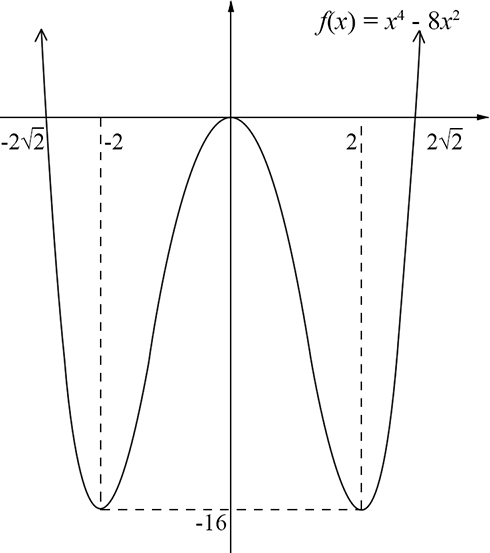
Let  `f(x) = x^4 − 8x^2`.

  1. Find the coordinates of the points where the graph of  `y = f(x)`  crosses the axes.  (2 marks)

    --- 5 WORK AREA LINES (style=lined) ---

  2. Show that  `f(x)`  is an even function.   (1 mark)

    --- 2 WORK AREA LINES (style=lined) ---

  3. Find the coordinates of the stationary points of  `f(x)`  and determine their nature.   (4 marks)

    --- 8 WORK AREA LINES (style=lined) ---

  4. Sketch the graph of  `y = f(x)`.   (1 mark)

    --- 8 WORK AREA LINES (style=lined) ---

Show Answers Only

a.    `(-2 sqrt 2,0), (2 sqrt 2, 0)`

b.    `text(Proof)\ \ text{(See Worked Solutions)}`

c.    `text(S.P.s at)\ (0,0), (2,-16), (-2,-16)`

d.    

  1. 2UA HSC 2008 8ai
Show Worked Solution
a.     `f(x) = x^4 – 8x^2`

`y text(-intercept when)\ x = 0`

`:.\ text(Cuts)\ y\ text(axis at)\ (0,0)`

`x\ text(-intercept when)\ f(x) = 0`

`x^4 – 8x^2` `= 0`
`x^2 (x^2 – 8)` `= 0`

`x^2 – 8 = 0\ \ \ \ \ text(or)\ \ \ \ \ x = 0`

`x^2` `= 8`
`x` `= +- sqrt 8 = +- 2 sqrt 2`


`:.\ text(Cuts)\ x text(-axis at)\ (-2 sqrt 2,0),\ \ text(and)\ \ (2 sqrt 2, 0)`

`text{(Note that it only touches}\ xtext{-axis at (0,0))}`


b.     `f(x)` `= x^4 – 8x^2`
  `f(–x)` `= (–x)^4 – 8(–x)^2`
    `= x^4 – 8x^2`
    `= f(x)`


`:.\ f(x)\ text(is an even function.)`


c.     `f(x)` `= x^4 – 8x^2`
  `f'(x)` `= 4x^3 – 16x`
  `f″(x)` `=12x^2-16`


`text(S.P.  when)\ \ f'(x) = 0`

`4x^3 – 16x` `= 0`
`4x (x^2 – 4)` `= 0`
`x^2 – 4` `=0\ \ \ \ \ x = 0`
`x^2` `= 4`
`x` `= +-2`
`text(At)\ x=2\ \ `  `f(x)`  `=(2)^4 – 8(2)^2 = -16`
  `f″(x)` `=12(2^2)-16>0`

`:.\ text{MIN at (2, –16)}`

`:.\ text{MIN at (–2, –16)},\ \ \ (f(x)\ text(is even))`


`text(At)\ x=0\ \ `  `f(x)`  `=(0)^4 – 8(0)^2 = 0`
  `f″(x)` `=12(0^2)-16<0`

`:.\ text{MAX at (0,0)}`


d.    

Filed Under: Curve Sketching, Curve Sketching, Curve Sketching and The Primitive Function Tagged With: Band 4, Band 5, smc-7225-20-Degree 4, smc-969-20-Degree 4

Calculus, 2ADV C3 2009 HSC 10

`text(Let)\ \ f(x) = x-(x^2)/2 + (x^3)/3`

  1. Show that the graph of  `y = f(x)`  has no turning points.   (2 marks)

    --- 4 WORK AREA LINES (style=lined) ---

  2. Find the point of inflection of  `y = f(x)`.   (1 mark)

    --- 3 WORK AREA LINES (style=lined) ---

  3. i. Show that `1-x + x^2-1/(1 + x) = (x^3)/(1 + x)`  for  `x !=-1`.   (1 mark)

    --- 2 WORK AREA LINES (style=lined) ---


    ii. Let  `g(x) = ln (1 + x)`.


        Use the result in part c.i. to show that  `f^{prime} (x) >= g ^{prime}(x)`  for all  `x >= 0`.   (2 marks)

    --- 5 WORK AREA LINES (style=lined) ---

  1. Sketch the graphs of  `y = f(x)`  and  `y = g(x)`  for  `x >= 0`.    (2 marks)

    --- 8 WORK AREA LINES (style=lined) ---

  2. Show that  `d/(dx) [(1 + x) ln (1 + x)-(1 + x)] = ln (1 + x)`.   (2 marks)

    --- 5 WORK AREA LINES (style=lined) ---

  3. Find the area enclosed by the graphs of  `y = f(x)`  and  `y = g(x)`, and the straight line  `x = 1`.   (2 marks)

    --- 5 WORK AREA LINES (style=lined) ---

Show Answers Only

a.    `text{Proof  (See Worked Solutions)}`

b.    `(1/2, 5/12)`

c.i.  `text{Proof  (See Worked Solutions)}`

c.ii. `text{Proof  (See Worked Solutions)}` 

d.   

 Geometry and Calculus, 2UA 2009 HSC 10 Answer

e.    `text{Proof  (See Worked Solutions)}`

f.    `1 5/12-2ln2\ \ text(u²)`

Show Worked Solution
a.    `f(x) = x\ – (x^2)/2 + (x^3)/3`
♦♦ Mean mark 28% for all of Q10 (note that data for each question part is not available).
 

`text(Turning points when)\ f^{prime} (x) = 0`

`f^{prime}(x) = 1-x + x^2`

`x^2-x + 1 = 0`

`text(S)text(ince)\ \ Delta` `= b^2-4ac`
  `= (-1)^2-4 xx 1 xx 1`
  `= -3 < 0 => text(No solution)`

 
`:.\ f(x)\ text(has no turning points)`


b.     `text(P.I. when)\ f^{prime prime}(x) = 0`
`f^{prime prime}(x)` `=-1 + 2x = 0`
`2x` `= 1`
`x` `= 1/2`

`text(Check for change in concavity)`

`f^{prime prime}(1/4)` `=-1/2 < 0`
`f^{prime prime}(3/4)` `= 1/2 > 0`

`=>\ text(Change in concavity)`

`:.\ text(P.I. at)\ \ x = 1/2`


`f(1/2)` `= 1/2-((1/2)^2)/2 + ((1/2)^3)/3`
  `= 1/2-1/8 + 1/24`
  `= 5/12`

`:.\ text(Point of Inflection at)\ (1/2, 5/12)`
  

c.i.    `text(Show)\ 1- x + x^2-1/(1 + x) = (x^3)/(1 + x),\ \ \ x !=-1` 
`text(LHS)` `= (1+x)/(1+x)-(x(1+x))/(1+x) + (x^2(1+x))/((1+x))-1/(1+x)`
  `= (1 + x-x-x^2 + x^2 + x^3-1)/(1+x)`
  `= (x^3)/(1+x)\ \ \ text(… as required)`


c.ii.  `text(Let)\ g(x) = ln(1+x)`
  `g^{prime} (x) = 1/(1 + x)`
`f^{prime} (x)-g^{prime} (x)` `= 1-x + x^2-1/(1+x)`
  `= (x^3)/(1 + x)\ \ text{(using part (i))}`

`text(S)text(ince)\ (x^3)/(1 + x) >= 0\ text(for)\ x >= 0`

`f^{prime}(x)-g^{prime}(x) >= 0`

`f^{prime}(x) >= g^{prime}(x)\ text(for)\ x >= 0`

MARKER’S COMMENT: When 2 graphs are drawn on the same set of axes, you must label them. 
 

d.    

Geometry and Calculus, 2UA 2009 HSC 10 Answer

e.     `text(Show)\ d/(dx) [(1 + x) ln (1 + x)-(1 + x)] = ln (1 + x)`
  `text(Using)\ d/(dx) uv=uv^{prime}+vu^{prime}`
`text(LHS)` `= (1+x) xx 1/(1 + x) + ln(1+x)xx1 +-1`
  `= 1+ ln(1+x)-1`
  `= ln(1+x)`
  `=\ text(RHS    … as required)`


f.     `text(Area)` `= int_0^1 f(x)-g(x)\ dx`
    `= int_0^1 (x-(x^2)/2 + (x^3)/3-ln(x+1))\ dx`
    `= [x^2/2-x^3/6 + (x^4)/12-(1 + x) ln (1+x) + (1+x)]_0^1`
    `text{(using part (e) above)}`
    `= [(1/2-1/6 + 1/12-(2)ln2 + 2)-(ln1 + 1)]`
    `= 5/12-2ln2 + 2-1`
    `= 1 5/12-2 ln 2\ \ text(u²)`

Filed Under: Applied Calculus (L&E), Area Under Curves, Areas Under Curves, Areas Under Curves, Curve Sketching, Curve Sketching, Curve Sketching and The Primitive Function Tagged With: Band 4, Band 5, Band 6, smc-7131-60-Other, smc-7225-10-Cubic, smc-7225-30-Other Graphs, smc-969-10-Cubic, smc-969-30-Other Graphs, smc-975-60-Other

Calculus, 2ADV C3 2010 HSC 6a

Let  `f(x) = (x + 2)(x^2 + 4)`.

  1. Show that the graph  `y=f(x)`  has no stationary points.   (2 marks)

    --- 5 WORK AREA LINES (style=lined) ---

  2. Find the values of  `x`  for which the graph  `y=f(x)`  is concave down, and the values for which it is concave up.    (2 marks)

    --- 5 WORK AREA LINES (style=lined) ---

  3. Sketch the graph  `y=f(x)`,  indicating the values of the  `x`  and  `y` intercepts.   (2 marks)

    --- 8 WORK AREA LINES (style=lined) ---

Show Answers Only

a.    `text(Proof)  text{(See Worked Solutions)}`

b.    `f(x)\ text(is concave down when)\ x < -2/3`


c.    `f(x)\ text(is concave up when)\ x > -2/3`


Show Worked Solution

a.    `text(Need to show no  S.P.’s)`

`f(x)` `= (x+2)(x^2 + 4)`
  `=x^3 + 2x^2 + 4x + 8`
`f prime (x)` `= 3x^2 + 4x + 4`


`text(S.P.s  occur when)\ \ f prime (x) =0,`

`3x^2 + 4x + 4 =0`

`Delta` `= b^2\ – 4ac`
  `=4^2\ – (4 xx 3 xx 4)`
  `=16\ – 48`
  `= -32 < 0`


`text(S)text(ince)\ \ Delta < 0,\ \ text(No Solution)`

`:.\ text(No  S.P.’s  for)\ \ f(x)`


b.    `f(x)\ text(is concave down when)\ f″(x) < 0`

MARKER’S COMMENT: The significance of the sign of the second derivative was not well understood by most students.

`f″(x) = 6x + 4`

`=> 6x + 4` `< 0`
`6x` `< -4`
`x` `< -2/3`

`:.\ f(x)\ text(is concave down when)\ x < -2/3`

`f(x)\ text(is concave up when)\ f″(x) > 0`

`f″(x) = 6x + 4`

`=> 6x + 4` `> 0`
`6x` `> -4`
`x` `> -2/3`

`:. f(x)\ text(is concave up when)\ x > -2/3`


♦♦ Mean mark 33%.
MARKER’S COMMENT: Students are reminded to bring a ruler to the exam and use it to draw the axes for graphing and to help with an appropriate scale.

c.    `y text(-intercept) =2 xx4=8`

`x text(-intercept)=–2` 


Filed Under: Curve Sketching, Curve Sketching, Curve Sketching and The Primitive Function Tagged With: Band 4, Band 5, smc-7225-10-Cubic, smc-7225-40-Concavity Intervals, smc-969-10-Cubic, smc-969-40-Concavity Intervals

Calculus, 2ADV C3 2012 HSC 14a

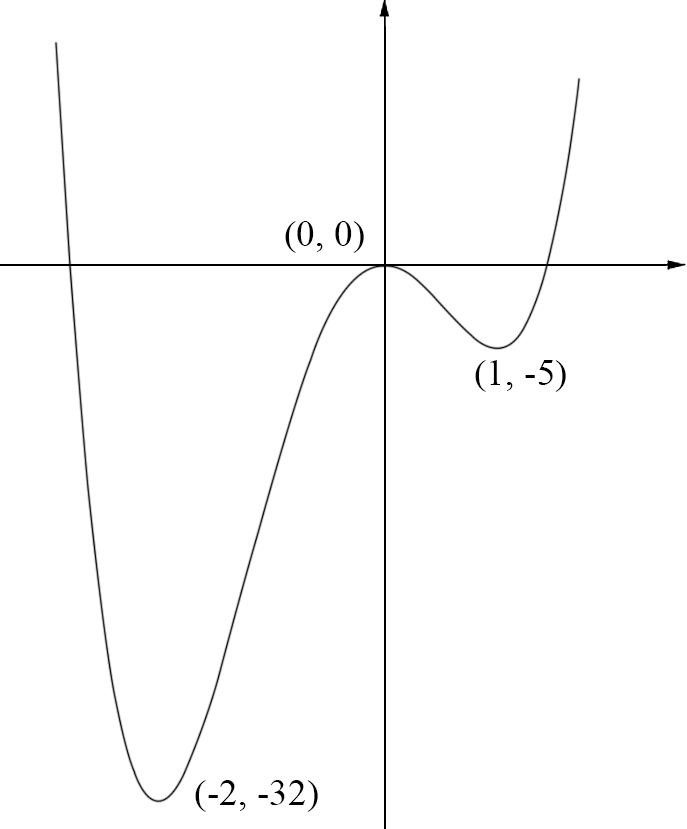
A function is given by  `f(x) = 3x^4 + 4x^3-12x^2`. 

  1. Find the coordinates of the stationary points of  `f(x)`  and determine their nature.   (3 marks)

    --- 6 WORK AREA LINES (style=lined) ---

  2. Hence, sketch the graph  `y = f(x)`   showing the stationary points.   (2 marks)

    --- 8 WORK AREA LINES (style=lined) ---

  3. For what values of  `x`  is the function increasing?   (1 mark)

    --- 2 WORK AREA LINES (style=lined) ---

  4. For what values of  `k`  will  `f(x) = 3x^4 + 4x^3-12x^2 + k = 0`  have no solution?   (1 mark)

    --- 2 WORK AREA LINES (style=lined) ---

Show Answers Only

a.    `text{MAX at (0,0), MINs at (1, –5) and (–2, –32)}`

b.    
        2UA HSC 2012 14ai
 

c.    `f(x)\ text(is increasing for)\ -2 < x < 0\ text(and)\ x > 1`

d.    `text(No solution when)\ k > 32`

Show Worked Solution
a.     `f(x)` `= 3x^4 + 4x^3-12x^2`
  `f^{′}(x)` `= 12x^3 + 12x^2-24x`
  `f^{″}(x)` `= 36x^2 + 24x-24`


`text(Stationary points when)\ f^{′}(x) = 0`

`12x^3 + 12x^2-24x` `=0`
`12x(x^2 + x-2)` `=0`
`12x (x+2) (x-1)` `=0`


`:.\ text(Stationary points at)\ x=0,\ 1\ text(or)\ -2`
 

`text(When)\ x=0,\ \ \ \ f(0)=0`
`f^{″}(0)` `= -24 < 0`
`:.\ text{MAX at  (0,0)}`


`text(When)\ x=1`

`f(1)` `= 3+4-12 = -5`
`f^{″}(1)` `= 36 + 24-24 = 36 > 0`
`:.\ text{MIN at}\  (1,-5)`


`text(When)\ x=–2`

`f(-2)` `=3(-2)^4 + 4(-2)^3-12(-2)^2`
  `= 48-32-48`
  `= -32`
`f^{″}(-2)` `= 36(-2)^2 + 24(-2)-24`
  `=144-48-24 = 72 > 0`
`:.\ text{MIN at  (–2, –32)}`


b.     2UA HSC 2012 14ai
♦ Mean mark 42%
MARKER’S COMMENT: Be careful to use the correct inequality signs, and not carelessly include ≥ or ≤ by mistake.


c.    `f(x)\ text(is increasing for)`
  `-2 < x < 0\ text(and)\ x > 1`


d.    `text(Find)\ k\ text(such that)`

♦♦♦ Mean mark 12%.

`3x^4 + 4x^3-12x^2 + k = 0\ text(has no solution)`

`k\ text(is the vertical shift of)\ \ y = 3x^4 + 4x^3-12x^2`

`=>\ text(No solution if it does not cross the)\ x text(-axis.)`

`:.\ text(No solution when)\ k > 32`

Filed Under: Curve Sketching, Curve Sketching, Curve Sketching and The Primitive Function Tagged With: Band 4, Band 5, Band 6, page-break-before-solution, smc-7225-20-Degree 4, smc-7225-50-Increasing/Decreasing Intervals, smc-969-20-Degree 4, smc-969-50-Increasing/Decreasing Intervals

Calculus, 2ADV C3 2011 HSC 7a

Let  `f(x) = x^3-3x + 2`. 

  1. Find the coordinates of the stationary points of  `y = f(x)`, and determine their nature.   (3 marks)

    --- 8 WORK AREA LINES (style=lined) ---

  2. Hence, sketch the graph  `y = f(x)`  showing all stationary points and the  `y`-intercept.   (2 marks)

    --- 8 WORK AREA LINES (style=lined) ---

Show Answers Only

a.     `text(MIN at)\ \ (1,0);\ text(MAX at)\ \ (–1,4)`

b.    

    Geometry and Calculus, 2UA 2011 HSC 7a

Show Worked Solution
a.     `f(x)` `= x^3-3x + 2`
  `f^{′}(x)` `= 3x^2-3`
  `f^{″}(x)` `=6x`


`text(Stationary points when)\ f prime (x) = 0`

`3x^2-3` `=0`
`3 (x^2-1)` `= 0`
`:. x^2` `=1`
`x` `=+- 1`

 
`text(When)\ x = 1`

`f(1)` `= 1-3 + 2 = 0`
`f^{″}(1)` `= 6 > 0` 
`:.\ text(MIN S.P. at)\ \ (1,0)`


`text(When)\ \ x= -1`

`f(–1)` `= -1 + 3 + 2 = 4`
`f^{″}(–1)` `= –6 < 0`
`:.\ text(MAX S.P. at)\ \ (–1,4)`
MARKER’S COMMENT: Graphs should be large (around ½ page), axes drawn with a ruler, with intercepts and turning points clearly shown. The scale can be different on each axe for clarity, as shown in the Worked Solution.


b.     `y = x^3-3x + 2`
  `y text(-intercept) = 2`

Geometry and Calculus, 2UA 2011 HSC 7a

Filed Under: Curve Sketching, Curve Sketching, Curve Sketching and The Primitive Function Tagged With: Band 3, smc-7225-10-Cubic, smc-969-10-Cubic

Copyright © 2014–2026 SmarterEd.com.au · Log in