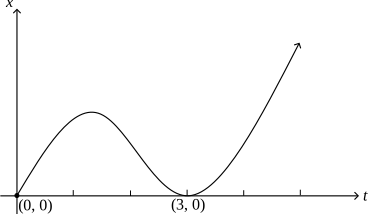
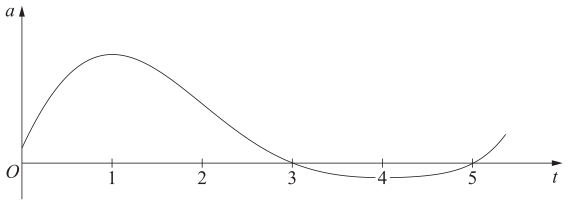
The displacement \(x\) metres from the origin at time, \(t\) seconds, of a particle travelling in a straight line is given by \(x=t^3-9 t^2+9 t, \quad t \geqslant 0\) --- 5 WORK AREA LINES (style=lined) --- --- 0 WORK AREA LINES (style=lined) --- --- 6 WORK AREA LINES (style=lined) ---
Calculus, 2ADV C1 EQ-Bank 5
A magpie plague hit Raymond Terrace this year but was eventually brought under control. A bird researcher estimated that the magpie population \(M\), in hundreds, \(t\) months after 1st January, was given by \(M=7+20t-3t^2\)
- Find the magpie population on 1st March. (1 mark)
--- 3 WORK AREA LINES (style=lined) ---
- At what rate was the population changing at this time? (1 mark)
--- 3 WORK AREA LINES (style=lined) ---
- In what month does the magpie population start to decrease? (2 marks)
--- 5 WORK AREA LINES (style=lined) ---
Calculus, 2ADV C1 EQ-Bank 2 MC
The displacement of a particle is given by \(x=3t^{3}-6t^{2}-15\) . The acceleration is zero at:
- \(t=\dfrac{2}{3}\)
- \(t=\dfrac{4}{3}\)
- \(t=\dfrac{5}{2}\)
- \(\text{never}\)
Calculus, 2ADV C1 2019 HSC 8 MC
Calculus, 2ADV C1 SM-Bank 3
The displacement `x` metres from the origin at time `t` seconds of a particle travelling in a straight line is given by
`x = 2t^3 - t^2 - 3t + 11` when `t >= 0`
- Calculate the velocity when `t = 2`. (1 mark)
--- 2 WORK AREA LINES (style=lined) ---
- When is the particle stationary? (2 marks)
--- 4 WORK AREA LINES (style=lined) ---
Calculus, 2ADV C1 SM-Bank 11
A particle is moving along the `x`-axis. Its velocity `v` at time `t` is given by
`v = sqrt(20t - 2t^2)` metres per second
Find the acceleration of the particle when `t = 4`.
Express your answer as an exact value in its simplest form. (3 marks)
--- 6 WORK AREA LINES (style=lined) ---
Calculus, 2ADV C1 2008 HSC 6b
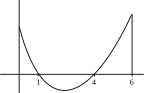
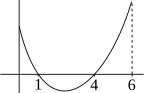
The graph shows the velocity of a particle, `v` metres per second, as a function of time, `t` seconds.
- What is the initial velocity of the particle? (1 mark)
--- 1 WORK AREA LINES (style=lined) ---
- When is the velocity of the particle equal to zero? (1 mark)
--- 1 WORK AREA LINES (style=lined) ---
- When is the acceleration of the particle equal to zero? (1 mark)
--- 1 WORK AREA LINES (style=lined) ---
Calculus, 2ADV C1 2018 HSC 12d
The displacement of a particle moving along the `x`-axis is given by
`x = t^3/3 - 2t^2 + 3t,`
where `x` is the displacement from the origin in metres and `t` is the time in seconds, for `t >= 0`.
- What is the initial velocity of the particle? (1 mark)
--- 2 WORK AREA LINES (style=lined) ---
- At which times is the particle stationary? (2 marks)
--- 3 WORK AREA LINES (style=lined) ---
- Find the position of the particle when the acceleration is zero. (2 marks)
--- 4 WORK AREA LINES (style=lined) ---
Calculus, 2ADV C1 2017 HSC 10 MC
Calculus, 2ADV C1 2006 HSC 8a
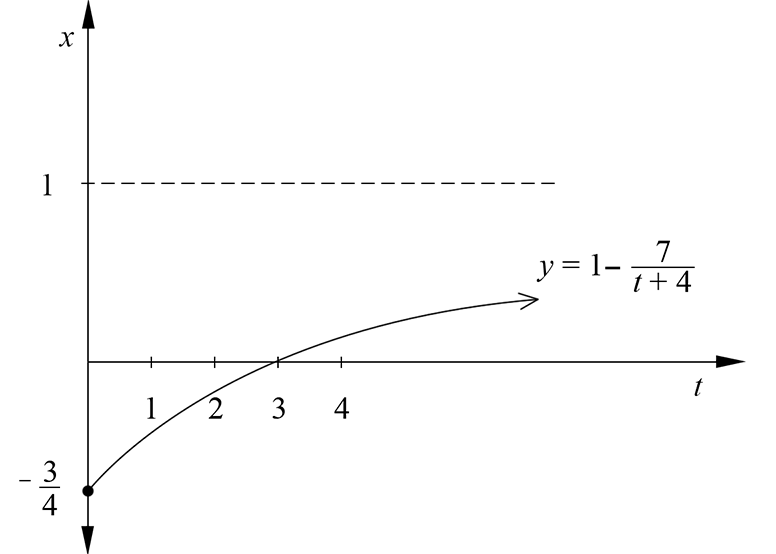
A particle is moving in a straight line. Its displacement, `x` metres, from the origin, `O`, at time `t` seconds, where `t ≥ 0`, is given by `x = 1 - 7/(t + 4)`.
- Find the initial displacement of the particle. (1 mark)
--- 1 WORK AREA LINES (style=lined) ---
- Find the velocity of the particle as it passes through the origin. (3 marks)
--- 5 WORK AREA LINES (style=lined) ---
- Show that the acceleration of the particle is always negative. (1 mark)
--- 2 WORK AREA LINES (style=lined) ---
- Sketch the graph of the displacement of the particle as a function of time. (2 marks)
--- 8 WORK AREA LINES (style=lined) ---
Calculus, 2ADV C1 2014 HSC 13c
The displacement of a particle moving along the `x`-axis is given by
`x = t - 1/(1 + t)`,
where `x` is the displacement from the origin in metres, `t` is the time in seconds, and `t >= 0`.
- Show that the acceleration of the particle is always negative. (2 marks)
--- 4 WORK AREA LINES (style=lined) ---
- What value does the velocity approach as `t` increases indefinitely? (1 mark)
--- 2 WORK AREA LINES (style=lined) ---
Calculus, 2ADV C1 2014 HSC 9 MC
The graph shows the displacement `x` of a particle moving along a straight line as a function of time `t`.
Which statement describes the motion of the particle at the point `P`?
- The velocity is negative and the acceleration is positive.
- The velocity is negative and the acceleration is negative.
- The velocity is positive and the acceleration is positive.
- The velocity is positive and the acceleration is negative.