SmarterEd

Aussie Maths & Science Teachers: Save your time with SmarterEd

  • Login
  • Get Help
  • About

Statistics, STD1 EQ-Bank 30

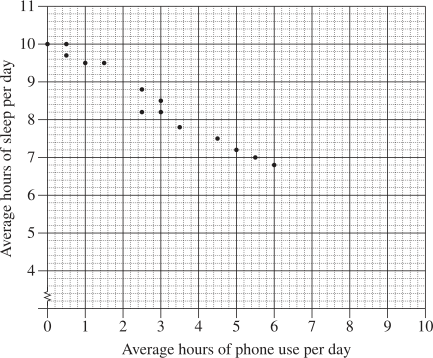
A teacher surveyed the students in her Year 8 class to investigate the relationship between the number of hours of phone use per day and the number of hours of sleep per day.

The results are shown on the scatter plot below.
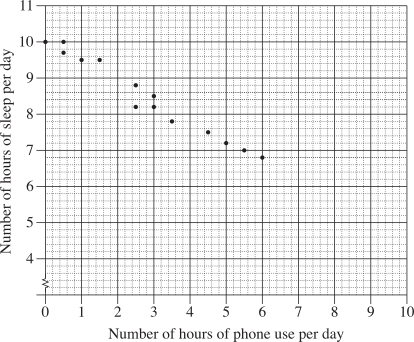
 

  1. The data for two new students, Alinta and Birrani, are shown in the table.
  2. \begin{array}{|l|c|c|}
    \hline
    & \rule{0pt}{2.5ex}\text{Number of hours of} & \text{Number of hours} \\
    \rule[-1ex]{0pt}{0pt}& \text { phone use per day } & \text {of sleep per day} \\
    \hline
    \rule{0pt}{2.5ex}\text{Alinta } \rule[-1ex]{0pt}{0pt}& 4 & 8 \\
    \hline
    \rule{0pt}{2.5ex}\text{Birrani} \quad \ \  \rule[-1ex]{0pt}{0pt}& 0 & 10.5 \\
    \hline
    \end{array}
  3. Plot their results on the scatter plot.   (2 marks)

    --- 0 WORK AREA LINES (style=lined) ---

  4. By first drawing a line of best fit by eye on the scatter plot, estimate the number of hours of sleep per day for a student who uses the phone for 2 hours per day.   (2 marks)

    --- 2 WORK AREA LINES (style=lined) ---

Show Answers Only

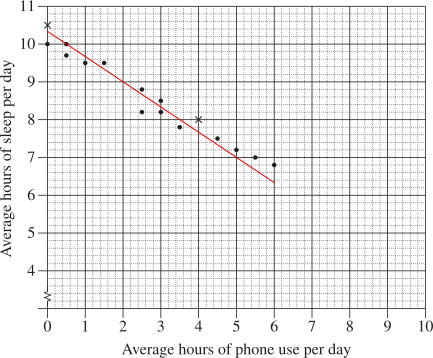
a.
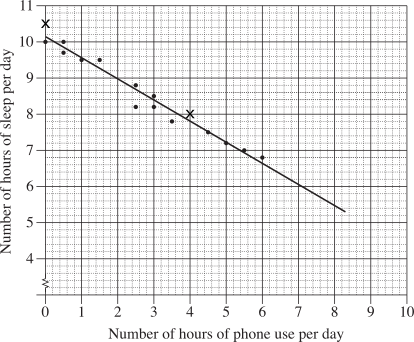


b.   \(\text{Using the line of best fit added to the diagram in part (a):}\)

\(\text{2 hours of phone use per day}\ \ \Rightarrow\ \ \text{9 hours of sleep per day.}\)

Show Worked Solution

a.


b.   \(\text{Using the line of best fit added to the diagram in part (a):}\)

\(\text{2 hours of phone use per day}\ \ \Rightarrow\ \ \text{9 hours of sleep per day}\)
Filed Under: Lines of Best Fit and Scatter Plots Tagged With: Band 3, Band 4, smc-6884-10-Lines of Best Fit

Statistics, STD2 EQ-Bank 27

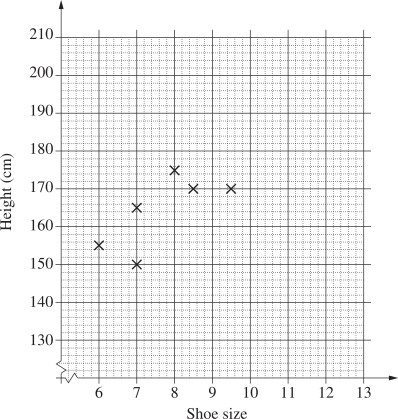
The shoe size and height of ten students were recorded.

\begin{array} {|l|c|c|}
\hline \rule{0pt}{2.5ex} \text{Shoe size} \rule[-1ex]{0pt}{0pt} & \text{6} & \text{7} & \text{7} & \text{8} & \text{8.5} & \text{9.5} & \text{10} & \text{11} & \text{12} & \text{12} \\
\hline \rule{0pt}{2.5ex} \text{Height} \rule[-1ex]{0pt}{0pt} & \text{155} & \text{150} & \text{165} & \text{175} & \text{170} & \text{170} & \text{190} & \text{185} & \text{200} & \text{195} \\
\hline
\end{array}

  1. Identify the dependent variable.   (1 mark)

    --- 1 WORK AREA LINES (style=lined) ---

  2. Complete the scatter plot AND draw a line of fit by eye.   (2 marks)
     
     
  3. Use the line of fit to estimate the height difference between a student who wears a size 7.5 shoe and one who wears a size 9 shoe.   (1 mark)

    --- 1 WORK AREA LINES (style=lined) ---

Show Answers Only

a.    `text{Height is the dependent variable (y-axis variable).}`

b.    `text(See Worked Solutions.)`

c.    `13\ text{cm  (or close given LOBF drawn)}`

Show Worked Solution

a.    `text{Height is the dependent variable (y-axis variable).}`

b.    
      2UG 2015 28e Answer

c.    `text{Shoe size 7½ gives a height estimate of 162 cm (see graph).}`

`text{Shoe size 9 gives a height estimate of 175 cm (see graph).}`

`text(Height difference)= 175-162= 13\ text{cm  (or close given LOBF)}`

Filed Under: Lines of Best Fit and Scatter Plots Tagged With: Band 3, Band 4, smc-6884-20-Scatterplot from Table

Statistics, STD2 EQ-Bank 25

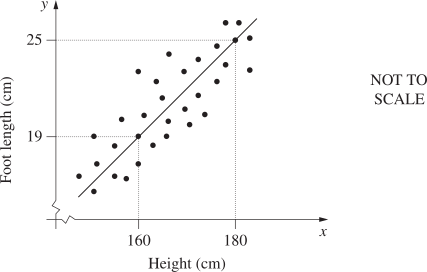
Each member of a group of males had his height and foot length measured and recorded. The results were graphed and a line of fit drawn.
 

  1. Identify the independent variable.   (1 mark)

    --- 1 WORK AREA LINES (style=lined) ---

  2. Why does the value of the `y`-intercept have no meaning in this situation?   (1 mark)

    --- 2 WORK AREA LINES (style=lined) ---

  3. George is 10 cm taller than his brother Harry. Use the line of fit to estimate the difference in their foot lengths.  (1 mark)

    --- 2 WORK AREA LINES (style=lined) ---

Show Answers Only

a.    `text{Height is the independent variable (x-axis variable).}`
 

b.    `text(The y-intercept occurs when)\ x = 0.\ text(It has no meaning to have)`

`text(a height of 0 cm.)`
  

c.    `text(A 20 cm height difference results in a foot length difference of 6 cm.)`

`text(A 10 cm height difference means George should have a 3 cm longer foot.)`

Show Worked Solution

a.    `text{Height is the independent variable (x-axis variable).}`
 

b.    `text(The y-intercept occurs when)\ x = 0.\ text(It has no meaning to have)`

`text(a height of 0 cm.)`
  

c.    `text(A 20 cm height difference results in a foot length difference of 6 cm.)`

`text(A 10 cm height difference means George should have a 3 cm longer foot.)`

Filed Under: Lines of Best Fit and Scatter Plots Tagged With: Band 3, Band 4, Band 5, smc-6884-10-Lines of Best Fit

Statistics, STD1 S3 2025 HSC 15

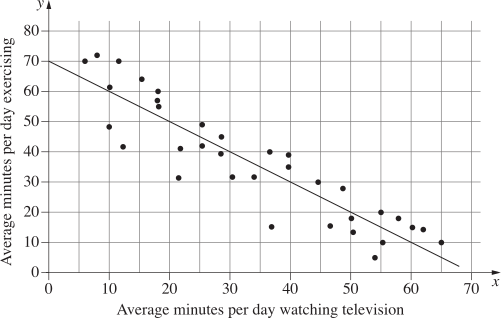
A researcher is using the statistical investigation process to investigate a possible relationship between average number of minutes per day a person spends watching television, and the average number of minutes per day the person spends exercising.

  1. State the statistical question being posed.   (1 mark)

    --- 3 WORK AREA LINES (style=lined) ---

Participants were asked to record the number of minutes they spent watching television each day and the number of minutes they spent exercising each day. The averages for each participant were recorded and graphed, and a line of best fit was included.
 

  1. From the graph, identify the dependent variable.   (1 mark)

    --- 1 WORK AREA LINES (style=lined) ---

  2. Describe the bivariate dataset in terms of its form and direction.   (2 marks)

    --- 3 WORK AREA LINES (style=lined) ---

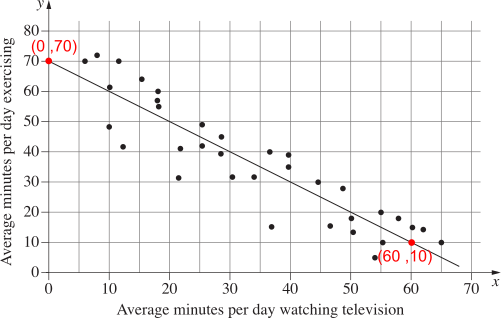
  3. The points \((0, 70)\) and \((60, 10)\) lie on the line of best fit. By first plotting these points on the graph, find the gradient and the \(y\)-intercept of the line of best fit.   (3 marks)

    --- 10 WORK AREA LINES (style=lined) ---

  4. Explain why it is NOT appropriate to extrapolate the line of best fit to predict the average number of minutes of exercise per day for someone who watches an average of 2 hours of television per day.   (1 mark)

    --- 4 WORK AREA LINES (style=lined) ---

Show Answers Only

a.    \(\text{How does the average daily time spent watching television}\)

\(\text{relate to the average daily time spent exercising?}\)
 

b.    \(\text{Dependent variable: Average minutes per day exercising, or }y.\)
 

c.    \(\text{Form:  Linear}\)

\(\text{Direction:  Negative}\)
 

d.   \(\text{Gradient}=-1\)
 

e.    \(\text{The extrapolation of the graph past 70 minutes produces}\)

\(\text{negative average minutes per day exercising (impossible).}\)

Show Worked Solution

a.    \(\text{How does the average daily time spent watching television}\)

\(\text{relate to the average daily time spent exercising?}\)
 

b.    \(\text{Dependent variable:}\)

\(\text{Average minutes per day exercising, or }y.\)


♦♦♦ Mean mark (b) 21%.

c.    \(\text{Form:  Linear}\)

\(\text{Direction:  Negative}\)


♦♦ Mean mark (c) 45%.
d. 


\(y-\text{intercept = 70}\)

\(\text{Gradient}=\dfrac{\text{rise}}{\text{run}}=\dfrac{-60}{60}=-1\)


♦♦♦ Mean mark (d) 30%.

e.    \(\text{The extrapolation of the graph past 70 minutes produces}\)

\(\text{negative average minutes per day exercising (impossible).}\)


♦♦♦♦ Mean mark (e) 14%.

Filed Under: Lines of Best Fit and Scatter Plots, S3 Further Statistical Analysis (Y12) Tagged With: Band 4, Band 5, Band 6, smc-1113-10-Line of Best Fit, smc-1113-50-Gradient, smc-1113-60-Limitations, smc-1113-80-Investigation Process, smc-6884-10-Lines of Best Fit, smc-6884-30-Limitations

Statistics, STD1 S3 2023 HSC 19

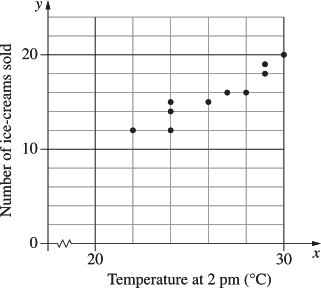
The scatterplot shows the number of ice-creams sold, \(y\), at a shop over a ten-day period, and the temperature recorded at 2 pm on each of these days.
 

  1. The data are modelled by the equation of the line of best fit given below.

\(y=0.936 x-8.929\), where \(x\) is the temperature.

  1. Sam used a particular temperature with this equation and predicted that 23 ice-creams would be sold.
  2. What was the temperature used by Sam, to the nearest degree?  (2 marks)

    --- 4 WORK AREA LINES (style=lined) ---

  3. In using the equation to make the prediction in part (a), was Sam interpolating or extrapolating? Justify your answer.  (2 marks)

    --- 3 WORK AREA LINES (style=lined) ---

Show Answers Only

a.    \(34^{\circ}\text{ (nearest degree)}\)

b.    \(\text{See worked solutions}\)

Show Worked Solution

a.             \(y\) \(=0.936x-8.929\)
\(23\) \(=0.936x-8.929\)
\(0.936x\) \(=23+8.929\)
\(x\) \(=\dfrac{31.921}{0.936}\)
  \(=34.112\ldots ^{\circ}\)
  \(= 34^{\circ}\text{ (nearest degree)}\)

♦♦ Mean mark (a) 31%.

b.     \(\text{Sam is extrapolating as 34°C is outside the range of data}\)

\(\text{points shown on the graph (i.e. temp between 0 and 30°C).}\)


♦♦ Mean mark (b) 33%.

Filed Under: Bivariate Data, Lines of Best Fit and Scatter Plots, S3 Further Statistical Analysis (Y12) Tagged With: Band 5, num-title-ct-coreb, num-title-qs-hsc, smc-1113-10-Line of Best Fit, smc-5022-10-Line of best fit graphs, smc-5022-28-LOBF equations, smc-5022-70-Inter/extrapolating, smc-6884-10-Lines of Best Fit

Statistics, STD1 S3 2022 HSC 23

A teacher surveyed the students in her Year 8 class to investigate the relationship between the average number of hours of phone use per day and the average number of hours of sleep per day.

The results are shown on the scatterplot below.
 

  1. The data for two new students, Alinta and Birrani, are shown in the table below. Plot their results on the scatterplot.  (2 marks)

\begin{array} {|l|c|c|}
\hline
  & \textit{Average hours of} & \textit{Average hours of} \\ & \textit{phone use per day} & \textit{sleep per day} \\
\hline
\rule{0pt}{2.5ex} \text{Alinta} \rule[-1ex]{0pt}{0pt} & 4 & 8 \\
\hline
\rule{0pt}{2.5ex} \text{Birrani} \rule[-1ex]{0pt}{0pt} & 0 & 10.5 \\
\hline
\end{array}

  1. By first fitting the line of best fit by eye on the scatterplot, estimate the average number of hours of sleep per day for a student who uses the phone for an average of 2 hours per day.  (2 marks)

    --- 2 WORK AREA LINES (style=lined) ---

Show Answers Only
  1.  
  2. 9 hours (see LOBF in diagram above)
Show Worked Solution

a.     \(\text{New data points are marks with a × on the diagram below.}\)
 

b.   \(\text{9 hours (see LOBF in diagram above)}\)

Filed Under: Bivariate Data, Lines of Best Fit and Scatter Plots, S3 Further Statistical Analysis (Y12) Tagged With: Band 4, num-title-ct-coreb, num-title-qs-hsc, smc-1113-10-Line of Best Fit, smc-1113-20-Scatterplot from Table, smc-5022-10-Line of best fit graphs, smc-5022-20-Scatterplot from table, smc-6884-10-Lines of Best Fit, smc-6884-20-Scatterplot from Table

Statistics, STD1 S3 2022 HSC 16

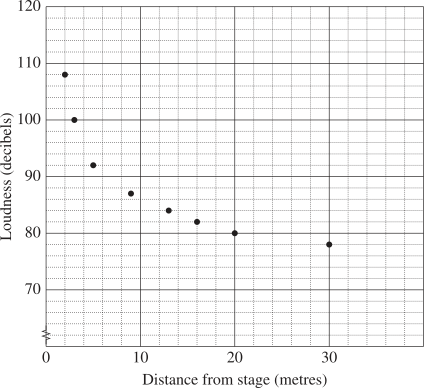
A concert organiser is interested in the relationship between the distance from the stage, in metres, and the loudness of the sound measured in decibels.

The data the concert organiser collected is shown on the graph.
 

  1. Is the relationship between distance and loudness linear or non-linear?  (1 mark)

    --- 1 WORK AREA LINES (style=lined) ---

  2. Based on this dataset, at approximately what distance from the stage would the sound be at 90 decibels?  (1 mark)

    --- 1 WORK AREA LINES (style=lined) ---

Show Answers Only
  1. `text{Non-linear}`
  2. `text{6 metres}`
Show Worked Solution

a.   The graph is not a straight line, therefore, non-linear.

b.   Distance =  6 metres.

→ Intersection of line of best fit and horizontal line at decibels (y-axis) = 90


♦ Mean mark part (b) 46%.

Filed Under: Lines of Best Fit and Scatter Plots, S3 Further Statistical Analysis (Y12) Tagged With: Band 4, Band 5, smc-1113-10-Line of Best Fit, smc-6884-10-Lines of Best Fit

Statistics, STD1 S3 2021 HSC 18

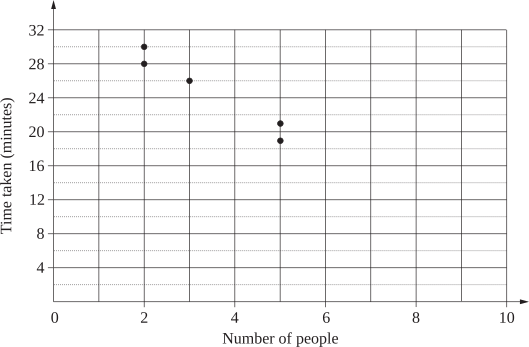
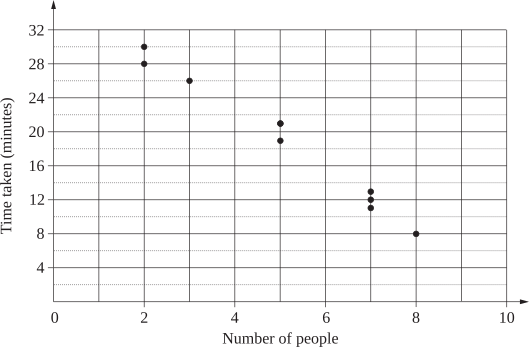
People are placed into groups to complete a puzzle. There are 9 different groups.

The table shows the number of people in each group and the amount of time, in minutes, for each group to complete the puzzle.

\begin{array} {|l|c|c|c|c|c|c|c|c|c|}
\hline
\rule{0pt}{2.5ex} \textit{Number of people} \rule[-1ex]{0pt}{0pt} & 2 & 2 & 3 & 5 & 5 & 7 & 7 & 7 & 8 \\
\hline
\rule{0pt}{2.5ex} \textit{Time taken (min)} \rule[-1ex]{0pt}{0pt} & 28 & 30 & 26 & 19 & 21 & 12 & 13 & 11 & 8 \\
\hline
\end{array}

  1. Complete the scatterplot by adding the last four points from the table.  (2 marks)
     
       
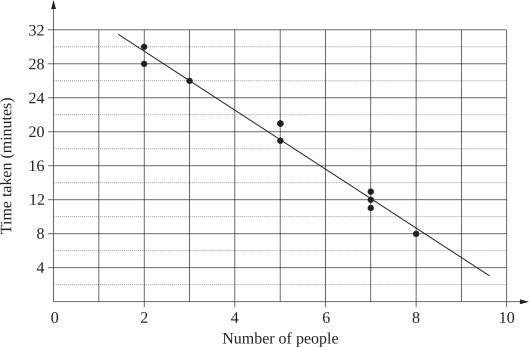
  2. Add a line of best fit by eye to the graph in part (a).  (1 mark)
  3. The graph in part (a) shows the association between the time to complete the puzzle and the number of people in the group.
  4. Identify the form (linear or non-linear), the direction and the strength of the association.  (3 marks)

    --- 3 WORK AREA LINES (style=lined) ---

  5. Calculate the mean of the time taken to complete the puzzle for the three groups of size 7 observed in the dataset.  (1 mark)

    --- 1 WORK AREA LINES (style=lined) ---

Show Answers Only
  1.  
       
  2.  
       
  3. `text(The association is linear, negative and strong.)`
  4. `12\ text(minutes)`
Show Worked Solution

a.

b.


c.    `text(Form: linear)`

♦ Mean mark (c) 50%.

`text{Direction: negative}`

`text{Strength: strong}`
 

d. `text{Mean time (7 people)}` `= (12 + 13 + 11)/3`
    `= 12\ text(minutes)`

Filed Under: Lines of Best Fit and Scatter Plots, S3 Further Statistical Analysis (Y12) Tagged With: Band 3, Band 4, Band 5, smc-1113-10-Line of Best Fit, smc-1113-20-Scatterplot from Table, smc-1113-30-Correlation, smc-6884-10-Lines of Best Fit, smc-6884-20-Scatterplot from Table

Statistics, STD1 S3 2020 HSC 22

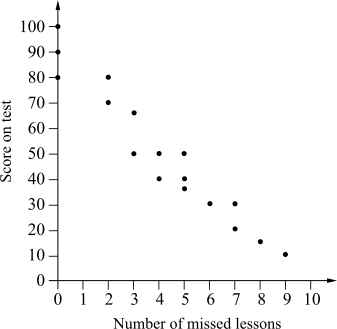
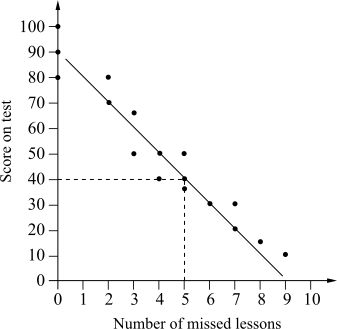
A group of students sat a test at the end of term. The number of lessons each student missed during the term and their score on the test are shown on the scatterplot.


  1. Describe the strength and direction of the linear association observed in this dataset.  (2 marks)

    --- 5 WORK AREA LINES (style=lined) ---

  2. Calculate the range of the test scores for the students who missed no lessons.  (1 mark)

    --- 1 WORK AREA LINES (style=lined) ---

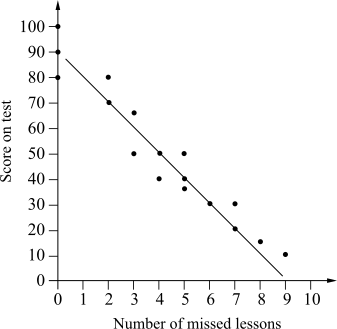
  3. Draw a line of the best fit in the scatterplot above.  (1 mark)
  4. Meg did not sit the test. She missed five lessons.


    Use the line of the best fit drawn in part (c) to estimate Meg's score on this test. (1 mark)

    --- 1 WORK AREA LINES (style=lined) ---

  5. John also did not sit the test and he missed 16 lessons.


    Is it appropriate to use the line of the best fit to estimate his score on the test? Briefly explain your answer. (1 mark)

    --- 2 WORK AREA LINES (style=lined) ---

Show Answers Only

a.    \(\text{Strength : strong}\)

\(\text{Direction : negative} \)

b.    \(\text{Range}\ = \text{high}-\text{low}\ = 100-80=20\)
 

c.   

d. 


e.    \(\text{John’s missed days are too extreme and the LOBF is not}\)

\(\text{appropriate. The model would estimate a negative score for}\)

\(\text{John which is impossible.}\)

Show Worked Solution

a.    \(\text{Strength : strong}\)

\(\text{Direction : negative} \)

♦ Mean mark (a) 45%.
♦♦ Mean mark (b) 31%.

b.    \(\text{Range}\ = \text{high}-\text{low}\ = 100-80=20\)
 

c.   

d. 


\(\therefore\ \text{Meg’s estimated score = 40}\)
 

e.    \(\text{John’s missed days are too extreme and the LOBF is not}\)

\(\text{appropriate. The model would estimate a negative score for}\)

\(\text{John which is impossible.}\)

♦ Mean mark (e) 38%.

Filed Under: Bivariate Data, Lines of Best Fit and Scatter Plots, S3 Further Statistical Analysis (Y12) Tagged With: Band 4, Band 5, num-title-ct-coreb, num-title-qs-hsc, smc-1113-10-Line of Best Fit, smc-1113-60-Limitations, smc-5022-10-Line of best fit graphs, smc-5022-25-Draw LOBF, smc-5022-30-Correlation, smc-5022-60-Limitations, smc-6884-10-Lines of Best Fit, smc-6884-30-Limitations

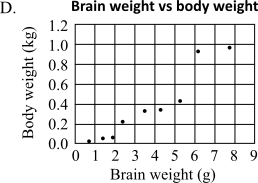
Statistics, STD1 S3 2020 HSC 4 MC

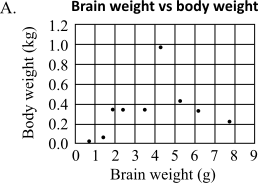
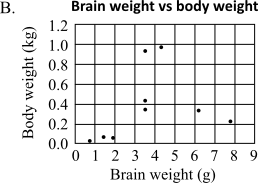
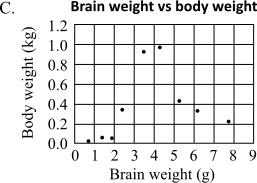
The table shows the average brain weight (in grams) and average body weight (in kilograms) of nine different mammals.

\begin{array} {|l|c|c|c|c|c|c|c|c|}
\hline
\rule{0pt}{2.5ex} \textit{Brain weight (g)} \rule[-1ex]{0pt}{0pt} & 0.7 & 0.4 & 1.9 & 2.4 & 3.5 & 4.3 & 5.3 & 6.2 & 7.8 \\
\hline
\rule{0pt}{2.5ex} \textit{Body weight (kg)} \rule[-1ex]{0pt}{0pt} & 0.02 &0.06 & 0.05 & 0.34 & 0.93 & 0.97 & 0.43 & 0.33 & 0.22 \\
\hline
\end{array}

Which of the following is the correct scatterplot for this dataset?


Show Answers Only

`C`

Show Worked Solution

`text{Consider data point} \ (1.9, 0.05)`

`→ \ text{Eliminate} \ A \ text{(too high)}`

`→ \ text{Eliminate} \ D \ text{(should be below 2nd data point)}`
 

`text{Consider data point} \ (2.4, 0.34)`

`→ \ text{Eliminate} \ B \ text{(not on graph)}` 

`=> \ C`

Filed Under: Bivariate Data, Lines of Best Fit and Scatter Plots, S3 Further Statistical Analysis (Y12) Tagged With: Band 4, num-title-ct-coreb, num-title-qs-hsc, smc-1113-20-Scatterplot from Table, smc-5022-20-Scatterplot from table, smc-6884-20-Scatterplot from Table

Statistics, STD1 S3 2019 HSC 27

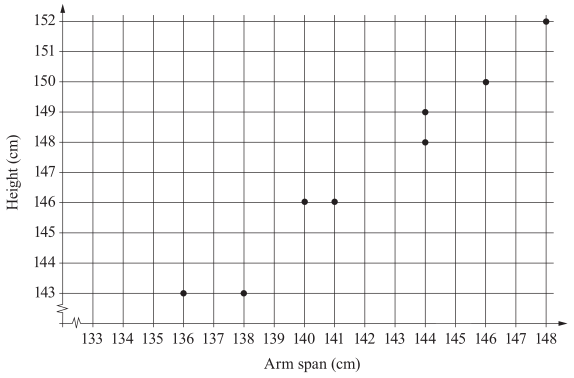
A set of bivariate data is collected by measuring the height and arm span of eight children. The graph shows a scatterplot of these measurements.
 

  1. On the graph, draw a line of best fit by eye.  (1 mark)

    --- 0 WORK AREA LINES (style=lined) ---

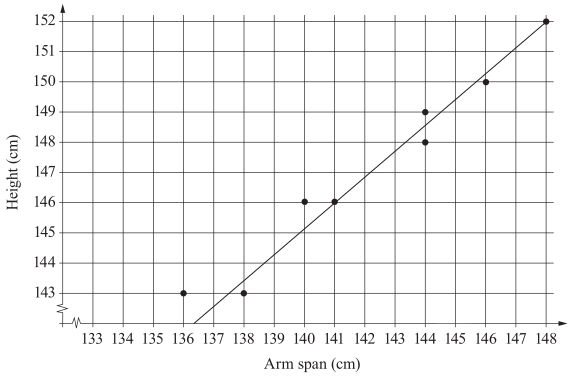
  2. Robert is a child from the class who was absent when the measurements were taken. He has an arm span of 147 cm. Using your line of best fit from part (a), estimate Robert’s height.  (1 mark)

    --- 1 WORK AREA LINES (style=lined) ---

Show Answers Only
  1.   
  2. `text(Robert’s height ≈ 151.1 cm)`
Show Worked Solution

a.     
       

♦ Mean mark (a) 38%.

b.   `text(Robert’s height ≈ 151.1 cm)`

`text{(Answers can vary slightly depending on line of best fit drawn).}`

Filed Under: Lines of Best Fit and Scatter Plots, S3 Further Statistical Analysis (Y12) Tagged With: Band 4, Band 5, num-title-ct-coreb, num-title-qs-hsc, smc-1113-10-Line of Best Fit, smc-5022-10-Line of best fit graphs, smc-5022-25-Draw LOBF, smc-6884-10-Lines of Best Fit

Algebra, STD2 A2 2017 HSC 3 MC

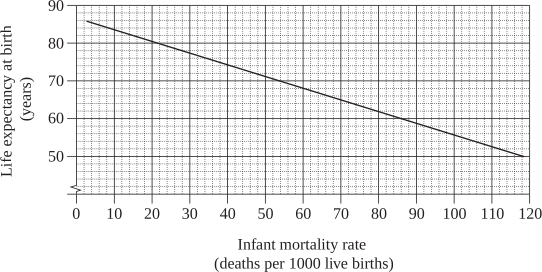
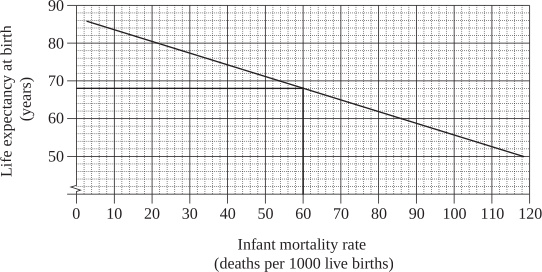
The graph shows the relationship between infant mortality rate (deaths per 1000 live births) and life expectancy at birth (in years) for different countries.
 

What is the life expectancy at birth in a country which has an infant mortality rate of 60?

  1. 68 years
  2. 69 years
  3. 86 years
  4. 88 years
Show Answers Only

\(A\)

Show Worked Solution

\(\text{When infant mortality rate is 60, life expectancy}\)

\(\text{at birth is 68 years (see below).}\)
 

\(\Rightarrow A\)

Filed Under: Applications of Linear Relationships, Applications of Linear Relationships, Applications: Currency, Fuel and Other Problems, Applications: Currency, Fuel and Other Problems, Bivariate Data, Life Expectancy, Linear Applications, Lines of Best Fit and Scatter Plots, S3 Further Statistical Analysis (Y12) Tagged With: Band 3, common-content, num-title-ct-coreb, num-title-qs-hsc, smc-1001-10-Line of Best Fit, smc-1113-10-Line of Best Fit, smc-1119-30-Other Linear Applications, smc-5022-10-Line of best fit graphs, smc-6256-30-Other Linear Applications, smc-6513-30-Other Linear Applications, smc-6884-10-Lines of Best Fit, smc-793-30-Other Linear Applications

Copyright © 2014–2026 SmarterEd.com.au · Log in