SmarterEd

Aussie Maths & Science Teachers: Save your time with SmarterEd

  • Login
  • Get Help
  • About

v1 Algebra, STD2 A4 2021 HSC 35

A toy store releases a limited edition LEGO set for $20 each. At this price, 3000 LEGO sets are sold each week and the revenue is  `3000 xx 20=$60\ 000`.

The toy store considers increasing the price. For every dollar price increase, 15 fewer LEGO sets will be sold.

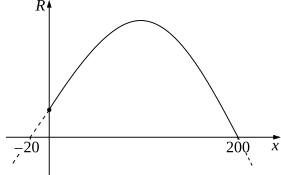
If the toy store charges `(20+x)` dollars for each LEGO set, a quadratic model for the revenue raised, `R`, from selling them is

`R=-15x^2+2700x+60\ 000`
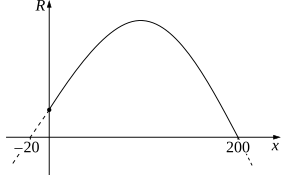


  1. What price should be charged per LEGO set to maximise the revenue?   (2 marks)

    --- 4 WORK AREA LINES (style=lined) ---

  2. How many LEGO sets are sold when the revenue is maximised?   (2 marks)

    --- 4 WORK AREA LINES (style=lined) ---

  3. Find the value of the intercept of the parabola with the vertical axis.   (1 mark) 

    --- 2 WORK AREA LINES (style=lined) ---
Show Answers Only

a.   `$110`

b.    `1650`

c.   `$60\ 000`

Show Worked Solution

a.   `text{Highest revenue}\ (R_text{max})\ text(occurs halfway between)\ \ x= -20 and x=200.`

`text{Midpoint}\ =(-20 + 200)/2 = 90`

`:.\ text(Price of LEGO set for)\ R_text(max)`

`=90 + 20`

`=$110`
 

b.  `text{LEGO sets sold when}\ R_{max}`

`=3000-(90 xx 15)`

`=1650`
 

c.   `ytext(-intercept → find)\ R\ text(when)\ \ x=0:`

`R` `= -15(0)^2 + 2700(0) + 60\ 000`
  `=$60\ 000`

Filed Under: Non-Linear: Exponential/Quadratics (Std 2-X) Tagged With: Band 5, Band 6, smc-830-20-Quadratics

v1 Algebra, STD2 A4 2017 HSC 28e

Sage brings 60 cartons of unpasteurised milk to the market each week. Each carton currently sells for $4 and at this price, all 60 cartons are sold each weekend.

Sage considers increasing the price to see if the total income can be increased.

It is assumed that for each $1 increase in price, 6 fewer cartons will be sold.

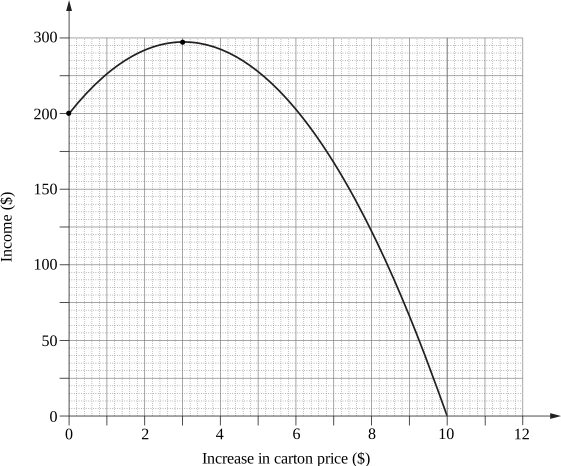
A graph showing the relationship between the increase in price per carton and the income is shown below.


  1. What price per carton should be charged to maximise the income?   (1 mark)

    --- 1 WORK AREA LINES (style=lined) ---

  2. What is the number of cartons sold when the income is maximised?   (1 mark)

    --- 1 WORK AREA LINES (style=lined) ---

  3. The cost of running the market stall is $40 plus $1.50 per carton sold.

    Calculate Sage's profit when the income earned from a day selling at the market is maximised.   (2 marks)

--- 4 WORK AREA LINES (style=lined) ---

Show Answers Only

a.   `$7`

b.   `42`

c.   `$191`

Show Worked Solution

a.   `text(Graph is highest when increase = $3)`

`:.\ text(Carton price)\ = 4 + 3= $7`
 

b.   `text(Cartons sold)\ =60-(3 xx 6)=42`
  

c.   `text{Cost}\ = 42 xx 1.50 + 40 = $103`

`:.\ text(Profit when income is maximised)`

`= (42 xx 7)-103`

`= $191`

Filed Under: Non-Linear: Exponential/Quadratics (Std 2-X) Tagged With: Band 4, Band 5, num-title-ct-coreb, num-title-qs-hsc, smc-4443-70-Other applications, smc-830-20-Quadratics

v1 Algebra, STD2 A4 2009 HSC 28c

The brightness of a lamp \((L)\) is measured in lumens and varies directly with the square of the voltage \((V)\) applied, which is measured in volts.

When the lamp runs at 7 volts, it produces 735 lumens.

What voltage is required for the lamp to produce 1820 lumens? Give your answer correct to one decimal place.   (3 marks)

--- 6 WORK AREA LINES (style=lined) ---

Show Answers Only

 `11.2\ \text(volts)`

Show Worked Solution
♦♦ Mean mark 22%
TIP: Establishing `L=k V^2` is the key part of solving this question.

`L prop V^2\ \ => \ \ L=kV^2`

`text(Find)\ k\ \text{given}\ L = 735\ \text{when}\ V = 7:`

`735` `= k xx 7^2`
`:. k` `= 735/49=15`

 
`text(Find)\ V\ text(when)\ L = 1820:`

`1820` `= 15 xx V^2`
`V^2` `= 1820/15=121.33…`
`V` `= sqrt{121.33} = 11.2\ text(volts)\ \ text{(to 1 d.p.)}`

Filed Under: Non-Linear: Exponential/Quadratics (Std 2-X) Tagged With: Band 5, num-title-ct-patha, num-title-qs-hsc, smc-4239-40-a prop other, smc-830-20-Quadratics, smc-830-60-Proportional

v1 Algebra, STD2 A4 2021 HSC 24

A population of Tasmanian devils, `D`, is to be modelled using the function  `D = 650 (0.8)^t`, where `t` is the time in years.

  1. What is the initial population?   (1 mark)

    --- 2 WORK AREA LINES (style=lined) ---
  2. Find the population after 2 years.   (1 mark)

    --- 2 WORK AREA LINES (style=lined) ---

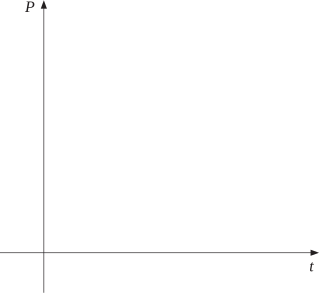
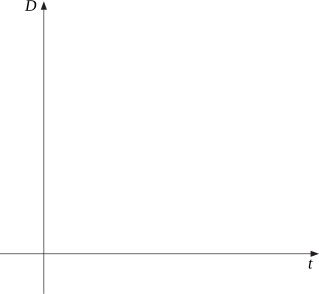
  3. On the axes below, draw the graph of the population against time, in the period  `t = 0`  to  `t = 6`.   (2 marks)
      

    --- 0 WORK AREA LINES (style=lined) ---

Show Answers Only

a.   `650`

b.   `416`

c.   `text{See Worked Solutions}`

Show Worked Solution

a.   `text{Initial population occurs when}\ \  t = 0:`

`D=650(0.8)^0=650 xx 1= 650`
 

b.    `text{Find} \ D \ text{when} \ \ t = 5: `

`D= 650 (0.8)^2= 416`

♦ Mean mark (c) 48%.

 
c. 
 `\text{At}\ t=6:`

`D=650(0.8)^6=170.39…`
 

Filed Under: Non-Linear: Exponential/Quadratics (Std 2-X) Tagged With: Band 3, Band 4, Band 5, num-title-ct-coreb, num-title-qs-hsc, smc-4444-40-Population, smc-830-30-Exponential

v1 Algebra, STD2 A4 EO-Bank 1

Taylor discovers that for a Spotted stingray, its mass is directly proportional to the square of its wingspan.

One Spotted stingray has a wingspan of 60 cm and a mass of 5400 grams.

What is the expected wingspan of a Spotted stingray with a mass of 9.6 kg?   (3 marks)

--- 6 WORK AREA LINES (style=lined) ---

Show Answers Only

`80.0\ text{cm}`

Show Worked Solution

`text(Mass) prop text(wingspan)^2\ \ =>\ \ m = kw^2`

`text(Find)\ k:`

`5400` `= k xx 60^2`
`k` `= 5400/60^2= 1.5`

 
`text(Find)\ w\ text(when)\ \ m = 9600:`

`9600` `= 1.5 xx w^2`
`w^2` `= 9600/1.5=6400`
`:. w` `= 80\ text{cm}`

Filed Under: Non-Linear: Exponential/Quadratics (Std 2-X) Tagged With: Band 4, smc-830-20-Quadratics, smc-830-60-Proportional

v1 Algebra, STD2 A4 2023 HSC 22

The stopping distance of a motor bike, in metres, is directly proportional to the square of its speed in km/h, and can be represented by the equation

`text{stopping distance}\ = k xx text{(speed)}^2`

where `k` is the constant of variation.

The stopping distance for a motor bike travelling at 40 km/h is 16 m.

  1. Find the value of `k`.  (2 marks)

    --- 4 WORK AREA LINES (style=lined) ---

  2. What is the stopping distance when the speed of the motor bike is 80 km/h?  (1 mark)

    --- 2 WORK AREA LINES (style=lined) ---
Show Answers Only

a.    `k=0.01`

b.    `64.0\ text{m}`

Show Worked Solution

a.  `text{stopping distance}\ = k xx text{(speed)}^2`

`16` `=k xx 40^2`  
`k` `=16/40^2=0.001`  

 
b.    `text{Find stopping distance}\ (d)\ text{when speed = 80 km/h:}`

`d=0.01 xx 80^2=64.0\ text{m}`

Filed Under: Non-Linear: Exponential/Quadratics (Std 2-X) Tagged With: Band 4, smc-830-20-Quadratics, smc-830-60-Proportional

v1 Algebra, STD2 A4 2013 HSC 22 MC

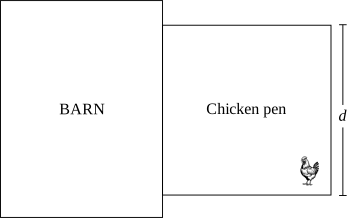
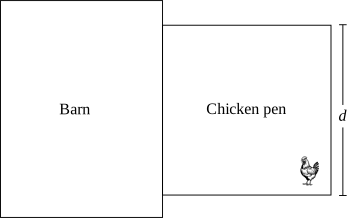
Jevin wants to build a rectangular chicken pen. He has 32 metres of fencing and will use a barn wall as one side of the pen. The width of the pen is \(d\) metres.
 

Which equation gives the area, \(P\), of the chicken pen?

  1. \(P = 16d-d^2\)
  2. \(P = 32d-d^2\)
  3. \(P = 16d-\dfrac{d^2}{2}\)
  4. \(P = 16d-2d^2\) 
Show Answers Only

\(C\)

Show Worked Solution
♦♦♦ Mean mark 24% (lowest mean of any MC question in 2013 exam)

\(\text{Length of pen}\ = \dfrac{1}{2}(32-d)\)

\(\text{Area}\ =d \times \dfrac{1}{2}(32-d)=16d-\dfrac{d^2}{2}\)

 \(\Rightarrow C\)

Filed Under: Non-Linear: Exponential/Quadratics (Std 2-X) Tagged With: Band 6, smc-830-20-Quadratics

v1 Algebra, STD2 A4 2021 HSC 10 MC

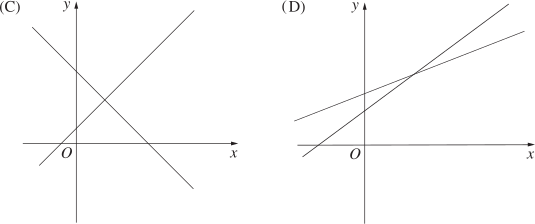
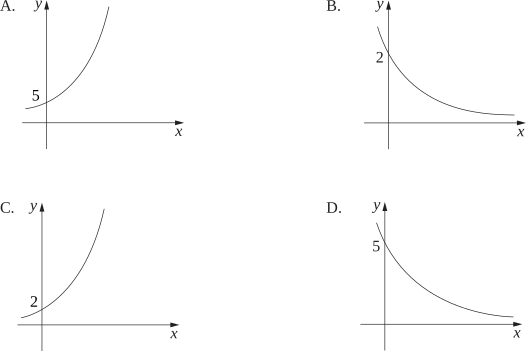
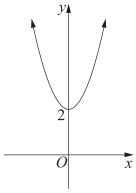
Which of the following best represents the graph of  \(y = 5 (0.4)^{x}\) ?
 

Show Answers Only

\(D\)

Show Worked Solution

\(\text{By elimination:}\)

♦ Mean mark 41%.

\(\text{When}\  x = 0, \ y = 5 \times (0.4)^0 = 5\)

\(\rightarrow\ \text{Eliminate B and C} \)

\(\text{As}\ \ x \rightarrow \infty, \ y \rightarrow 0 \)

\(\rightarrow\ \text{Eliminate A} \)

\(\Rightarrow D\)

Filed Under: Non-Linear: Exponential/Quadratics (Std 2-X) Tagged With: 2adv-std2-common, Band 5, common-content, num-title-ct-coreb, num-title-qs-hsc, smc-4444-10-Identify graphs, smc-830-10-Identify Graphs, smc-830-30-Exponential

v1 Algebra, STD2 A4 2008 HSC 4 MC

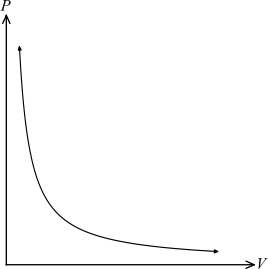
Which graph best represents  \(y = \dfrac{2}{x}\) ?
 

Show Answers Only

\(B\)

Show Worked Solution

\(y = \dfrac{2}{x}\ \text{does not touch either axis (inverse graph)}.\)

\(\Rightarrow B\)

Filed Under: Exponential/Quadratic (Projectile), Exponentials, Non-Linear: Exponential/Quadratics (Std 2-X) Tagged With: Band 4, num-title-ct-corea, num-title-qs-hsc, smc-4444-10-Identify graphs, smc-830-10-Identify Graphs

v1 Algebra, STD2 A4 2019 HSC 33

The time taken for a student to type an assignment varies inversely with their typing speed.

It takes the student 180 minutes to finish the assignment when typing at 40 words per minute.

  1. Calculate the length of the assignment in words.   (1 mark)

    --- 5 WORK AREA LINES (style=lined) ---

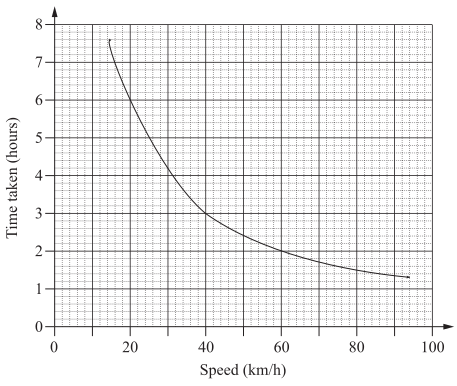
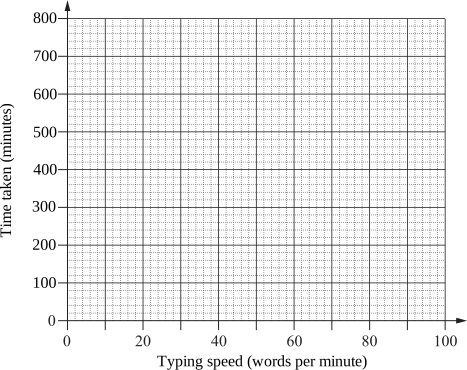
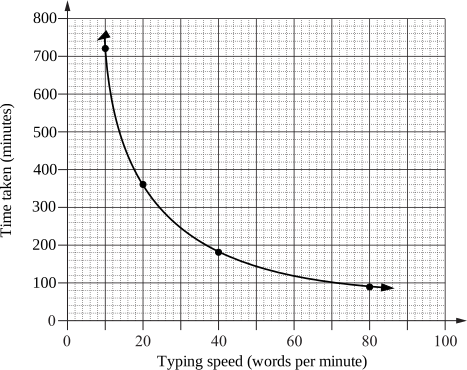
  2. By first plotting four points, draw the curve that shows the time taken to complete the assignment at different constant typing speeds.   (3 marks)


--- 0 WORK AREA LINES (style=lined) ---

Show Answers Only

a.   `7200\ text(words)`

b.   
     

Show Worked Solution

a.   `text{Assignment length}\ = 180 xx 40=7200\ \text{words}`

b.   `text{Time} (T) prop 1/{\text{Typing speed}\ (S)} \ \ =>\ \ T = k/S`
 

\begin{array} {|c|c|c|c|c|}
\hline
\rule{0pt}{2.5ex} \ \ T\ \  \rule[-1ex]{0pt}{0pt} & 720 & 360 & 180 & 90 \\
\hline
\rule{0pt}{2.5ex} S \rule[-1ex]{0pt}{0pt} & 10 & 20 & 40 & 80 \\
\hline
\end{array}

Filed Under: Non-Linear: Inverse and Other Problems (Std 2-X) Tagged With: Band 3, Band 4, num-title-ct-patha, num-title-qs-hsc, smc-4239-30-a prop 1/b, smc-795-10-Inverse

v1 Algebra, STD2 A4 2004 HSC 28a

A fitness index, `F`, is calculated by dividing a person’s weight, `w`, in kilograms by the square of the person’s height, `h`, in metres.

  1. Albert is 160 cm and weighs 76.8 kg. Calculate Albert’s health rating.   (1 mark)

    --- 3 WORK AREA LINES (style=lined) ---

  2. In the next few years, Albert expects to grow 20 cm taller. By then he wants her fitness index to be 23. How much weight should he gain or lose to achieve this? Justify your answer with mathematical calculations.   (2 marks)

    --- 5 WORK AREA LINES (style=lined) ---

Show Answers Only

a.   `30`

b.   `text(Albert needs to gain 4.2 kg)`

Show Worked Solution

a.   `\text{160 cm = 1.60 m.}`

`text(When)\ w = 76.8 and h = 1.60:`

`F=w/h^2 = 76.8/1.60^2 = 30`
 

b.   `text(Find)\ w\ text(given)\ F= 25 and h = 1.80:`

`25` `= w/1.8^2`
`w` `= 25 xx 1.8^2`
  `= 81\ text(kg)`


`:.\ text(Weight Albert should gain)`

`= 81-76.8`

`= 4.2\ text(kg)`

Filed Under: Non-Linear: Inverse and Other Problems (Std 2-X) Tagged With: Band 5, Band 6, smc-795-10-Inverse

v1 Algebra, STD2 A4 2014 HSC 29a

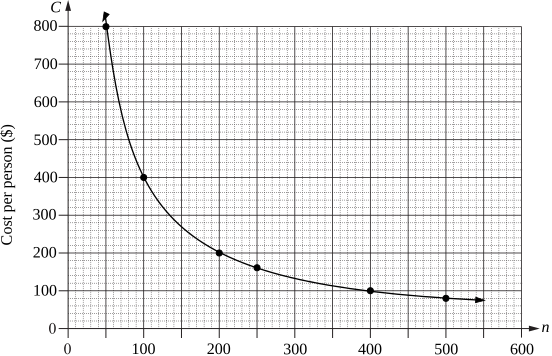
A golf club hires an entire course for a charity event at a total cost of `$40\ 000`. The cost will be shared equally among the players, so that `C` (in dollars) is the cost per player when `n` players attend.

  1. Complete the table below by filling in the three missing values.   (1 mark)
    \begin{array} {|l|c|c|c|c|c|c|}
    \hline
    \rule{0pt}{2.5ex}\text{Number of players} (n) \rule[-1ex]{0pt}{0pt} & \ 50\ & \ 100 \ & 200 \ & 250 \ & 400\ & 500 \ \\
    \hline
    \rule{0pt}{2.5ex}\text{Cost per person} (C)\rule[-1ex]{0pt}{0pt} &  &  &  & 160 & 100\ & 80 \ \\
    \hline
    \end{array}
  2. Using the values from the table, draw the graph showing the relationship between `n` and `C`.   (2 marks)
     
  3. What equation represents the relationship between `n` and `C`?   (1 mark)

    --- 1 WORK AREA LINES (style=lined) ---

  4. Give ONE limitation of this equation in relation to this context.   (1 mark)

    --- 2 WORK AREA LINES (style=lined) ---
  5. Is it possible for the cost per person to be $94? Support your answer with appropriate calculations.   (1 mark)

    --- 4 WORK AREA LINES (style=lined) ---

Show Answers Only

a.   

\begin{array} {|l|c|c|c|c|c|c|}
\hline
\rule{0pt}{2.5ex}\text{Number of players} (n) \rule[-1ex]{0pt}{0pt} & \ 500\ & \ 1000 \ & 1500 \ & 2000 \ & 2500\ & 3000 \ \\
\hline
\rule{0pt}{2.5ex}\text{Cost per person} (C)\rule[-1ex]{0pt}{0pt} & 240 & 120 & 80 & 60 & 48\ & 40 \ \\
\hline
\end{array}
 

b. 

c.   `C = (40\ 000)/n`

`n\ text(must be a whole number)`
 

d.    `text(Limitations can include:)`

  `•\ n\ text(must be a whole number)`

  `•\ C > 0`
 

e.   `text(If)\ C = 94:`

`94` `= (120\ 000)/n`
`94n` `= 120\ 000`
`n` `= (120\ 000)/94`
  `= 1276.595…`

 
`:.\ text(C)text(ost cannot be $94 per person, because)\ n\ text(isn’t a whole number.)`

Show Worked Solution

a.   

\begin{array} {|l|c|c|c|c|c|c|}
\hline
\rule{0pt}{2.5ex}\text{Number of players} (n) \rule[-1ex]{0pt}{0pt} & \ 50\ & \ 100 \ & 200 \ & 250 \ & 400\ & 500 \ \\
\hline
\rule{0pt}{2.5ex}\text{Cost per person} (C)\rule[-1ex]{0pt}{0pt} & 800 & 400 & 200 & 160 & 100\ & 80 \ \\
\hline
\end{array}

b.   


c.   `C = (40\ 000)/n`


TIP: Limitations require looking at possible restrictions of both the domain and range.

d.   `text(Limitations can include:)`

  `•\ n\ text(must be a whole number)`

  `•\ C > 0`
 

e.   `text(If)\ C = 120`

`120` `= (40\ 000)/n`
`120n` `= 40\ 000`
`n` `= (40\ 000)/120`
  `= 333.33..`

  
`:.\ text{Cost cannot be $120 per person because the required}\ n\ \text{is not a whole number.}`

Filed Under: Non-Linear: Inverse and Other Problems (Std 2-X) Tagged With: Band 4, Band 5, Band 6, num-title-ct-pathc, num-title-qs-hsc, smc-4445-60-Hyperbola applications, smc-795-10-Inverse, smc-795-30-Limitations

v1 Algebra, STD2 A4 EO-Bank 2

The number of chairs that can be placed around a circular stage varies inversely with the space left between each chair.

There will be 72 chairs if the distance between them is 0.5 metres.

  1. How many chairs can be placed if the distance between them is 0.9 metres?   (2 marks)

    --- 4 WORK AREA LINES (style=lined) ---
  2. What is the spacing between chairs if 90 chairs are placed around the stage?   (1 mark)

    --- 1 WORK AREA LINES (style=lined) ---
Show Answers Only

a.   40 chairs

b.   0.4 metres

Show Worked Solution

a.   `c \prop 1/d\ \ =>\ \ c=k/d`

`72` `= k/0.5`
`k` `= 0.5 xx 72 = 36`

 
`text(Find)\ c\ text(when)\ \ d = 0.9:`

`c=36/0.9=40\ \text{chairs}`
 

b.   `text(Find)\ d\ text(when)\ \ c = 90:`

`90` `= 36/d`
`d` `= 36/90`
  `= 0.4\ text(metres)`

Filed Under: Non-Linear: Inverse and Other Problems (Std 2-X) Tagged With: Band 5, smc-795-10-Inverse, smc-795-40-Proportional

v1 Algebra, STD2 A4 2022 HSC 24

A chef believes that the time it takes to defrost a turkey (`D` hours) varies inversely with the room temperature (`T^\circ \text{C}`). The chef observes that at a room temperature of `20^\circ \text{C}`, it takes 15 hours for the turkey to fully defrost.

  1. Find the equation relating `D` and `T`.   (2 marks)

    --- 4 WORK AREA LINES (style=lined) ---
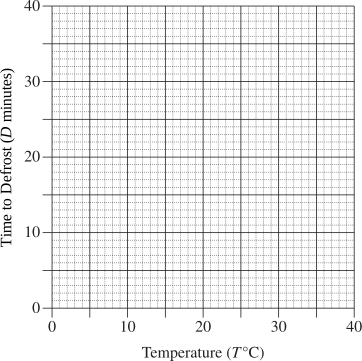
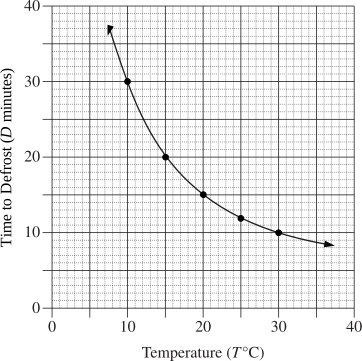
  2. By first completing this table of values, graph the relationship between temperature and time.   (2 marks)

\begin{array} {|l|c|c|c|c|c|}
\hline
\rule{0pt}{2.5ex} \ \ T\ \  \rule[-1ex]{0pt}{0pt} & \ \ \ 10\ \ \  & \ \ 15\ \ \  & \ \ \ 20\ \ \  & \ \ \ 25\ \ \ & \ \ \ 30\ \ \ \\
\hline
\rule{0pt}{2.5ex} \ \ D\ \  \rule[-1ex]{0pt}{0pt} & \ \ \ \  & \ \ \  & \ \ \ \  & \ \ \ \ & \ \ \ \\
\hline
\end{array}


--- 0 WORK AREA LINES (style=lined) ---

Show Answers Only

a.   `D \prop 1/T\ \ =>\ \ D=k/T`

  `15` `=k/20`
  `k` `=15 xx 20=300`

 
`:.D=300/T`

b.   

\begin{array} {|l|c|c|c|c|c|}
\hline
\rule{0pt}{2.5ex} \ \ T\ \  \rule[-1ex]{0pt}{0pt} & \ \ \ 10\ \ \  & \ \ 15\ \ \  & \ \ \ 20\ \ \  & \ \ \ 25\ \ \ & \ \ \ 30\ \ \ \\
\hline
\rule{0pt}{2.5ex} \ \ D\ \  \rule[-1ex]{0pt}{0pt} & \ \ \ 30\ \ \  & \ \ 20\ \ \  & \ \ \ 15\ \ \  & \ \ \ 12\ \ \ & \ \ \ 10\ \ \ \\
\hline
\end{array}


Show Worked Solution

a.   `D \prop 1/T\ \ =>\ \ D=k/T`

  `15` `=k/20`
  `k` `=15 xx 20=300`

 
`:.D=300/T`

b.   

\begin{array} {|l|c|c|c|c|c|}
\hline
\rule{0pt}{2.5ex} \ \ D\ \  \rule[-1ex]{0pt}{0pt} & \ \ \ 10\ \ \  & \ \ 15\ \ \  & \ \ \ 20\ \ \  & \ \ \ 25\ \ \ & \ \ \ 30\ \ \ \\
\hline
\rule{0pt}{2.5ex} \ \ T\ \ \rule[-1ex]{0pt}{0pt} & 30 & 20 & 15 & 12 & 10  \\
\hline
\end{array}


Filed Under: Non-Linear: Inverse and Other Problems (Std 2-X) Tagged With: 2adv-std2-common, Band 5, num-title-ct-pathc, num-title-qs-hsc, smc-4445-60-Hyperbola applications, smc-795-10-Inverse

v1 Algebra, STD2 A4 2018 HSC 29c

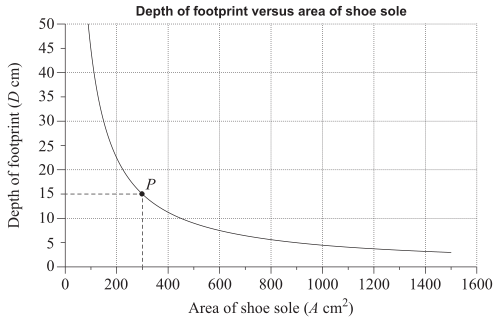
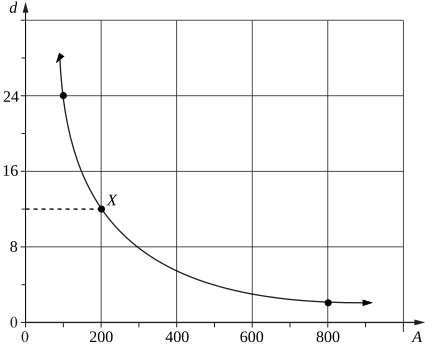
Snowhound makes snow shoes of various sizes. In its design phase, Snowhound collect data on the different footprint depths of snow shoes of different sizes, all worn by the same person.

 The footprint depth (`d` cm) is then graphed against the area of the sole of the snow shoe (`A` cm).


  1. The graph shape shows that `d` is inversely proportional to `A`. The point `X` lies on the graph.


    Find the equation relating `d` and `A`.  (2 marks)

    --- 4 WORK AREA LINES (style=lined) ---
  2. A man from this group walks in snow and the depth of his footprint is 5 cm.


    Use your equation from part (a) to calculate the area of his shoe sole.  (1 mark)

    --- 1 WORK AREA LINES (style=lined) ---
Show Answers Only

a.   `D = 4500/A`

b.   `480\ text(cm)^2`

Show Worked Solution

a.   `d prop 1/A \ =>\ d = k/A`

`text(When)\ D = 12, A = 200:`

`12` `= k/200`
`k` `= 12 xx 200 = 2400`
`:. d` `=2400/A`


b.    `5` `= 2400/A`
  `:. A` `= 2400/5= 480\ text(cm)^2`

Filed Under: Non-Linear: Inverse and Other Problems (Std 2-X) Tagged With: Band 5, smc-795-10-Inverse, smc-795-40-Proportional

v1 Algebra, STD2 A4 2011 HSC 28a

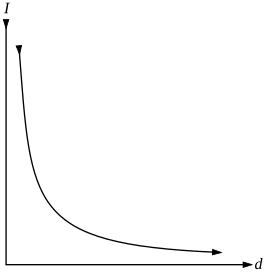
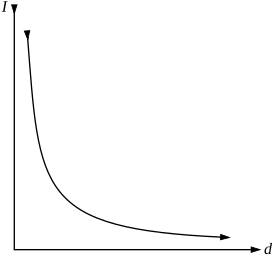
The intensity of light, `I`, from a lamp varies inversely with the square of the distance, `d`, from the lamp.

  1. Write an equation relating `I`, `d` and `k`, where `k` is a constant.    (1 mark)

    --- 2 WORK AREA LINES (style=lined) ---
  2. It is known that `I = 20` when `d = 2`.


    By finding the value of the constant, `k`, find the value of `I` when `d = 5`.    (2 marks)

    --- 4 WORK AREA LINES (style=lined) ---
  3. Sketch a graph to show how `I` varies for different values of `d`.


    Use the horizontal axis to represent distance and the vertical axis to represent light intensity.   (2 marks)

    --- 8 WORK AREA LINES (style=lined) ---

Show Answers Only

a.   `I = k/d^2`

b.   `P = 1 1/2`

c.   
         

Show Worked Solution

a.   `I prop 1/d\ \ =>\ \ I=k/d^2`
 

b.  `text(When)\ I=20, d=2:`

`20` `= k/2^2`
`k` `=4 xx 20=80`

 
`text(Find)\ I\ text(when)\ d = 5:`

`I=80/5^2=16/5`
 

c.

Filed Under: Non-Linear: Inverse and Other Problems (Std 2-X) Tagged With: Band 5, num-title-ct-patha, num-title-qs-hsc, smc-4239-30-a prop 1/b, smc-795-10-Inverse, smc-795-40-Proportional

v1 Algebra, STD2 A4 2021 HSC 13 MC

The time taken to harvest a field varies inversely with the number of workers employed.

It takes 12 workers 36 hours to harvest the field.

Working at the same rate, how many hours would it take 27 workers to harvest the same field?

  1. 12
  2. 16
  3. 24
  4. 54
Show Answers Only

`B`

Show Worked Solution

`text{Time to harvest}\ (T) prop 1/text{Number of workers (W)}`

`T=k/W`

`text(When)\ \ T=36, W=12:`

`36=k/12\ \ =>\ \ k=36 xx 12 = 432`  
 

`text{Find}\ T\ text(when)\ \ W=27:`

`T=432/27=16\ \text{hours}`

 `=>  B`

Filed Under: Non-Linear: Inverse and Other Problems (Std 2-X) Tagged With: Band 5, smc-795-10-Inverse, smc-795-40-Proportional

v1 Algebra, STD2 A4 2007 HSC 15 MC

If the speed `(s)` of a journey varies inversely with the time `(t)` taken, which formula correctly expresses `s` in terms of `t` and `k`, where `k` is a constant?

  1. `s = k/t`
  2. `s = kt`
  3. `s = k + t`
  4. `s = t/k`
Show Answers Only

`A`

Show Worked Solution

`s prop 1/t \ \ => \ s = k/t`

`=>  A`

Filed Under: Non-Linear: Inverse and Other Problems (Std 2-X) Tagged With: Band 4, num-title-ct-patha, num-title-qs-hsc, smc-4239-30-a prop 1/b, smc-795-10-Inverse, smc-795-40-Proportional

v1 Algebra, STD2 A4 2010 HSC 13 MC

The time taken to charge a battery varies inversely with the charging voltage. At 24 volts \((V)\) it takes 15 hours to fully charge a battery.

How long will it take the same battery to fully charge at 40 volts?

  1. 8 hours
  2. 9 hours
  3. 10.5 hours
  4. 12 hours
Show Answers Only

`B`

Show Worked Solution
 
♦ Mean mark 50% 

`text{Time to charge}\ (T) prop 1/text(Voltage) \ => \ T=k/V`

`text(When) \ T=15, V = 24:`

`15=k/24\ \ => \ k=15 xx 24=360` 
   

`text{Find}\ T\ text{when}\ \ V= 40:}`

`T=360/40=9\ \text{hours}`

 `=>  B`

Filed Under: Non-Linear: Inverse and Other Problems (Std 2-X) Tagged With: Band 5, num-title-ct-patha, num-title-qs-hsc, smc-4239-30-a prop 1/b, smc-795-10-Inverse, smc-795-40-Proportional

v1 Algebra, STD2 A4 2024 HSC 9 MC

The time taken to fill a swimming pool varies inversely with the number of hoses being used.

Using 4 hoses, it takes 18 hours to fill the pool.

How many hours would it take 9 hoses to fill the same pool?

  1. 6
  2. 7.5
  3. 8
  4. 12
Show Answers Only

\(C\)

Show Worked Solution

\(T \propto \dfrac{1}{H} \ \Rightarrow \ \ T=\dfrac{k}{H}\)

\(\text {Find}\ k\ \text{given}\ \  T=18\ \ \text {when}\ \ H=4 \text {:}\)

\(18=\dfrac{k}{4} \ \Rightarrow\ \ k=72\)
 

\(\text {Find}\ T \ \text {if}\ \ H=9:\)

\(T=\dfrac{72}{9}=8 \text { hours}\)

\(\Rightarrow C\)

Filed Under: Non-Linear: Inverse and Other Problems (Std 2-X) Tagged With: Band 4, smc-795-10-Inverse, smc-795-40-Proportional

v1 Algebra, STD2 A4 2022 HSC 9 MC

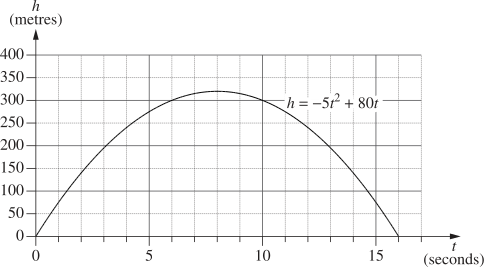
An object is projected vertically into the air. Its height, \(h\) metres, above the ground after \(t\) seconds is given by  \(h=-5 t^2+80 t\).
 

How far does the object travel in the first 10 seconds?

  1. 300 metres
  2. 320 metres
  3. 340 metres
  4. 480 metres
Show Answers Only

\(C\)

Show Worked Solution

\(\text{By symmetry (or graph), object reaches max height at}\ \ t=8\ \text{seconds.}\)

\(\text{Find}\ h\ \text{when}\ \ t=8:\)

\(h=-5 \times 8^2-10 \times 8= 320 \)

\(\text{When}\ \ t=10\ \ \Rightarrow\ \ h=300\ \text{(from graph)}\)

\(\therefore\ \text{Total distance}\ = 320 + 20=340\ \text{metres}\)

\(\Rightarrow C\)

Filed Under: Non-Linear: Exponential/Quadratics (Std 2-X) Tagged With: Band 5, num-title-ct-coreb, num-title-qs-hsc, smc-4443-60-Projectiles, smc-830-20-Quadratics

v1 Algebra, STD2 A4 2018 HSC 4 MC

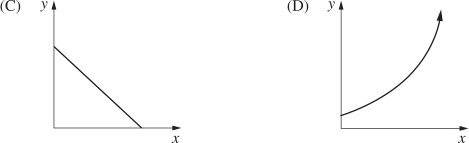
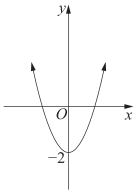
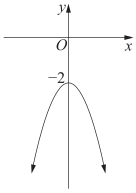
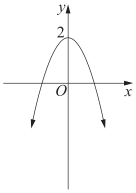
Which graph best represents the equation  \(y = 2-x^2\) ?
 

A. B.
C. D.
Show Answers Only

\(D\)

Show Worked Solution

\(y = 2-x^2\)

\(y\text{-intercept}\ = -2\ \ \text{(when}\ x = 0)\)

\(\text{Quadratic is concave down (sad) with vertex at}\ (0,2). \)

\(\Rightarrow A\)

Filed Under: Non-Linear: Exponential/Quadratics (Std 2-X) Tagged With: Band 3, num-title-ct-corea, num-title-qs-hsc, smc-4443-10-Identify graphs, smc-830-10-Identify Graphs

v1 Algebra, STD2 A4 2010 HSC 24b

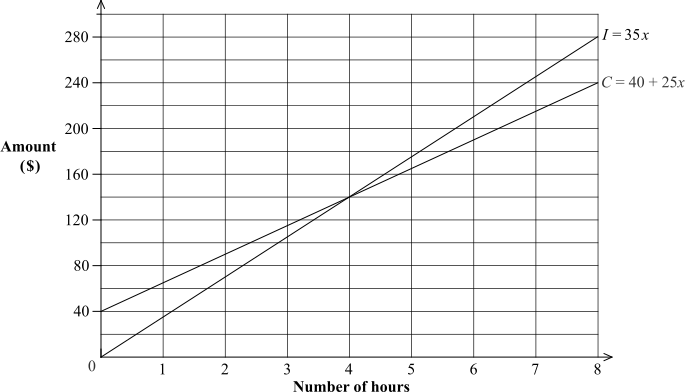
Damo hires paddle boats in summertime as part of his water sports business. To calculate the cost,  \(C\), in dollars, of hiring  \(x\) paddle boats, he uses the equation  \(C=40+25x\).

He hires the paddle boats for $35 per hour and determines his income,  \(I\), in dollars, using the equation  \(I=35x\).
 

Use the graph to solve the two equations simultaneously for \(x\) and explain the significance of this solution for Damo's business.   (2 marks)

--- 4 WORK AREA LINES (style=lined) ---
Show Answers Only

\(x=4\ \ \text{See worked solution}\)

Show Worked Solution

\(\text{From the graph, intersection occurs at}\ x=4\)

\(\rightarrow\ \text{Break-even point occurs at}\ x=4\)

\(\text{i.e. when 4 hours of paddle board hire occurs}\)

\(\text{Income}\) \(=35\times 4=$140\ \ \text{is equal to}\)
\(\text{Costs}\) \(=40+(25\times 4)=$140\)

\(\text{If}\ <4\ \text{hours of board hire}\ \rightarrow\ \text{LOSS for business}\)

\(\text{If}\ >4\ \text{hours of board hire}\ \rightarrow\ \text{PROFIT}\)


♦ Mean mark 36%.
MARKER’S COMMENT: The intersection on the graph is the same point at which the two simultaneous equations are solved for the given value of \(x\).

Filed Under: Simultaneous Equations and Applications (Std 2-X) Tagged With: Band 5, smc-5237-40-Cost/Revenue

v1 Algebra, STD2 A4 SM-Bank 4

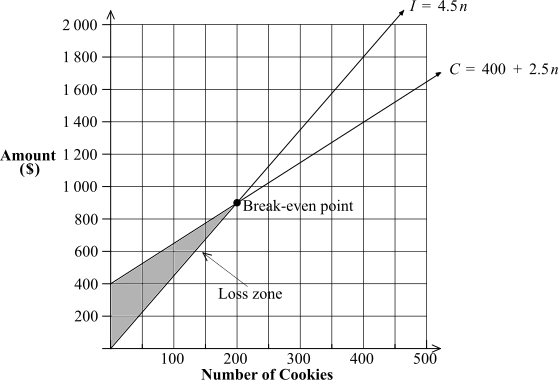
Bec is a baker and makes cookies to sell every week.

The cost of making \(n\) cookies, $\(C\),  can be calculated using the equation

\(C=400+2.5n\)

Bec sells the cookies for $4.50 each, and her income is calculated using the equation

\(I=450n\)

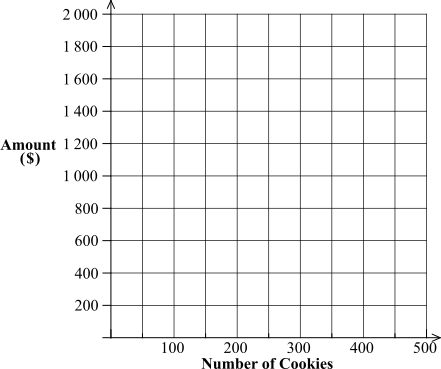
  1. On the grid above, draw the graphs of  \(C\) and \(I\).  (2 marks)

    --- 0 WORK AREA LINES (style=lined) ---
  2. On the graph, label the breakeven point and the loss zone.  (2 marks)

    --- 0 WORK AREA LINES (style=lined) ---
Show Answers Only

(i) and (ii)

Show Worked Solution
i.   


ii.  \(\text{Loss zone occurs when}\ C > I,\ \text{which is shaded}\)

\(\text{in the diagram above.}\)

Filed Under: Simultaneous Equations and Applications (Std 2-X) Tagged With: Band 4, Band 5, smc-5237-40-Cost/Revenue

v1 Algebra, STD2 A4 2005 HSC 28b

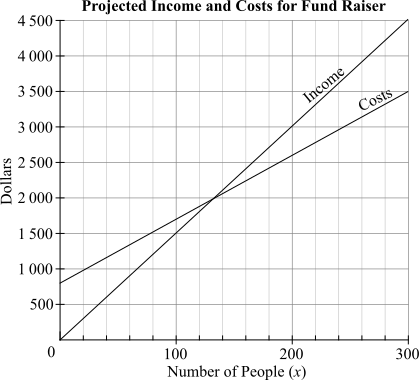
Jake and Preston are planning a fund-raising event at the local swim centre. They can have access to the giant pool float for $550 and the party room hire for $250. A sausage sizzle and drinks will cost them $9 per person.

  1. Write a formula for the cost ($C) of running the event for \(x\) people. (1 mark)

    --- 2 WORK AREA LINES (style=lined) ---
The graph shows planned income and costs when the ticket price is $15. 
  

  1. Estimate the minimum number of people needed at the fund raising event to cover the costs.  (1 mark)

    --- 1 WORK AREA LINES (style=lined) ---
  2. How much profit will be made if 200 people attend the fund raiser? (1 mark)

    --- 2 WORK AREA LINES (style=lined) ---
Jake and Preston have 300 tickets to sell. They want to make a profit of $1510.

  1. What should be the price of a ticket, assuming all 300 tickets will be sold?  (3 marks)

    --- 6 WORK AREA LINES (style=lined) ---
Show Answers Only
  1. \(C=800+9x\)
  2. \(\text{Approximately }135\)
  3. \($400\)
  4. \($16.70\)
Show Worked Solution
i.    \($C\) \(=550+250+(9\times x)\)
    \(=800+9x\)


ii.  \(\text{Using the graph intersection}\)

\(\text{Approximately 135 people are needed}\)

\(\text{to cover the costs.}\)


iii.  \(\text{If 200 people attend}\)

\(\text{Income}\) \(=200\times $15\)
  \(=$3000\)
\(\text{Costs}\) \(=800+(9\times 200)\)
  \(=$2600\)


\(\therefore\ \text{Profit}\) \(=3000-2600\)
  \(=$400\)


iv.  \(\text{Costs when}\ x=300:\)

\(C\) \(=800+(9\times 300)\)
  \(=$3500\)


\(\text{Income required to make }$1510\ \text{profit}\)

\(=3500+1510\)

\(=$5010\)
 

\(\therefore\ \text{Price per ticket}\) \(=\dfrac{5010}{300}\)
  \(=$16.70\)

Filed Under: Simultaneous Equations and Applications (Std 2-X) Tagged With: Band 4, Band 5, smc-5237-40-Cost/Revenue

v1 Algebra, STD2 A4 2020 HSC 24

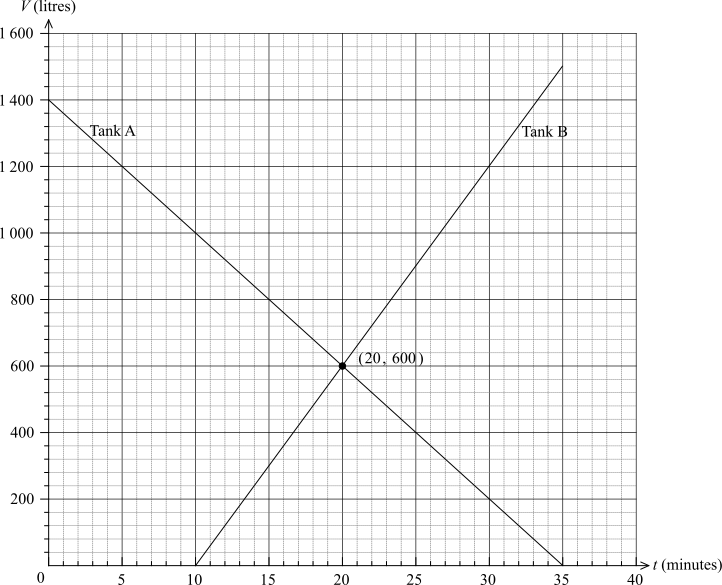
There are two tanks at an industrial plant, Tank A and Tank B. Initially, Tank A holds 2520 litres of liquid fertiliser and Tank B is empty.

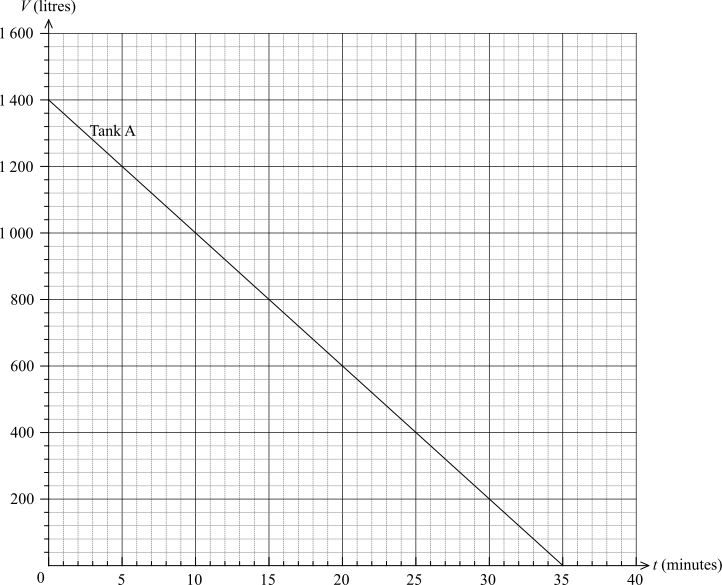
  1. Tank A begins to empty liquid fertiliser into a transport vehicle at a constant rate of 40 litres per minute.


    The volume of liquid fertiliser in Tank A is modelled by  \(V=1400-40t\)  where \(V\) is the volume in litres and  \(t\) is the time in minutes from when the tank begins to drain the fertiliser.


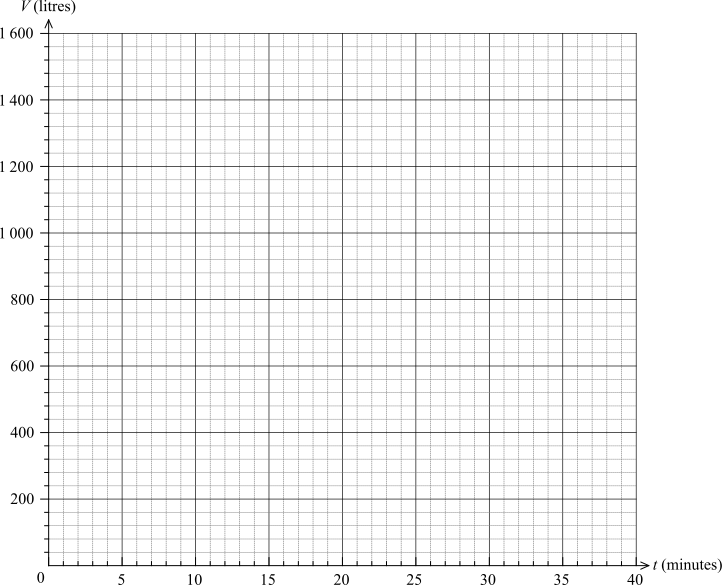
    On the grid below, draw the graph of this model and label it as Tank A.   (1 mark)


  2. Tank B remains empty until  \(t=10\)  when liquid fertiliser is added to it at a constant rate of 60 litres per minute.
    By drawing a line on the grid (above), or otherwise, find the value of  \(t\)  when the two tanks contain the same volume of liquid fertiliser.  (2 marks)

    --- 2 WORK AREA LINES (style=lined) ---
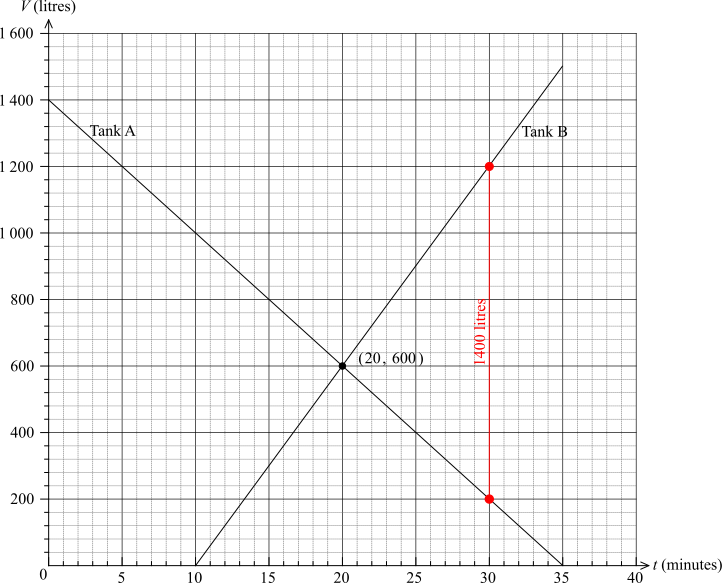
  3. Using the graphs drawn, or otherwise, find the value of  \(t\)  (where  \(t > 0\)) when the total volume of liquid fertiliser in the two tanks is 1400 litres.  (1 mark)

    --- 1 WORK AREA LINES (style=lined) ---
Show Answers Only
  1.  \(\text{Tank} \ A \ \text{will pass through (0, 1400) and (35, 0)}\)
      
  2. \(20 \ \text{minutes}\)
  3. \(30 \ \text{minutes}\)
Show Worked Solution

a.     \(\text{Tank} \ A \ \text{will pass through (0, 1400) and (35, 0)}\)


b.   \(\text{Tank} \ B \ \text{will pass through (10, 0) and (30, 1200)}\)  


\(\text{By inspection, the two graphs intersect at} \ \ t = 20 \ \text{minutes}\)

c.   \(\text{Strategy 1}\)

\(\text{By inspection of the graph, consider} \ \ t = 30\)

\(\text{Tank A} = 200 \ \text{L} , \ \text{Tank B} =1200 \ \text{L}\)

\(\therefore\ \text{Total volume = 1400 L when  t = 30}\)
  

\(\text{Strategy 2}\)

\(\text{Total Volume}\) \(=\text{Tank A} + \text{Tank B}\)
\(1400\) \(=1400-40t+(t-10)\times 60\)
\(1400\) \(=1400-40t+60t-600\)
\(20t\) \(= 600\)
\(t\) \(= 30 \ \text{minutes}\)

♦♦ Mean mark part (c) 22%.

Filed Under: Simultaneous Equations and Applications (Std 2-X) Tagged With: Band 3, Band 4, Band 5, smc-5237-10-Find intersection, smc-5237-20-Other SE Applications, smc-5237-40-Sketch Linear Equations

v1 Algebra, STD2 A4 2019 HSC 36

A small business makes and dog kennels.

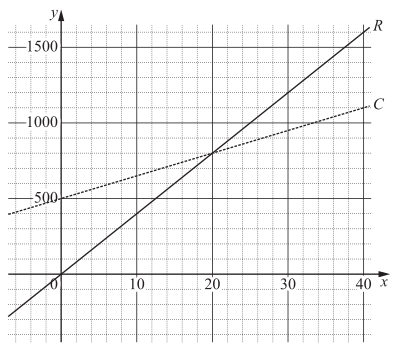
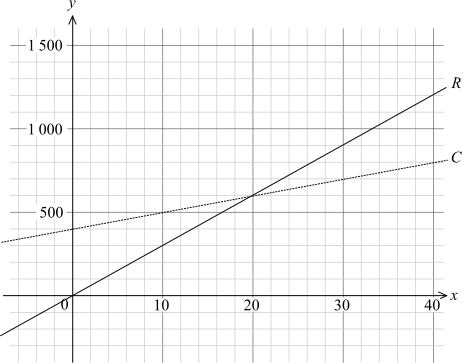
Technology was used to draw straight-line graphs to represent the cost of making the dog kennels \((C)\) and the revenue from selling dog kennels \((R)\). The \(x\)-axis displays the number of dog kennels and the \(y\)-axis displays the cost/revenue in dollars.


  1. How many dog kennels need to sold to break even?  (1 mark)

    --- 1 WORK AREA LINES (style=lined) ---
  2. By first forming equations for cost `(C)` and revenue `(R)`, determine how many dog kennels need to be sold to earn a profit of $2500.  (3 marks)

    --- 6 WORK AREA LINES (style=lined) ---
Show Answers Only
  1. \(20\)
  2. \(145\)
Show Worked Solution

a.  \(20\ \ (x\text{-value at intersection})\)


b.   \(\text{Find equations of both lines}:\)

\((0, 400)\ \text{and}\ (20, 600)\ \text{lie on}\ \ C\)

\(\text{gradient}_C = \dfrac{600-400}{20-0}=10\)

\(\rightarrow\ C=400+10x\)
   

\((0,0)\ \text{and}\ (20, 600)\ \text{lie on}\ \ R\)

\(\text{gradient}_R =\dfrac{600-0}{20-0}=30\)

\(\rightarrow\ R=30x\)
 

\(\text{Profit} = R-C\)

\(\text{Find}\ \ x\ \text{when Profit }= $2500:\)

\(2500\) \(=30x-(400+10x)\)
\(20x\) \(=2900\)
\(x\) \(=145\)

  
\(\therefore\ 145\ \text{dog kennels need to be sold to earn }$2500\ \text{profit}\)


♦♦ Mean mark 28%.

Filed Under: Simultaneous Equations and Applications (Std 2-X) Tagged With: Band 3, Band 5, smc-5237-40-Cost/Revenue

v1 Algebra, STD2 A4 2020 VCAA 3

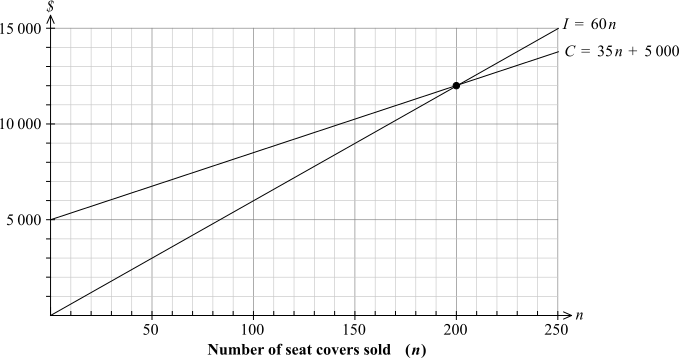
Noah's business manufactures car seat covers.

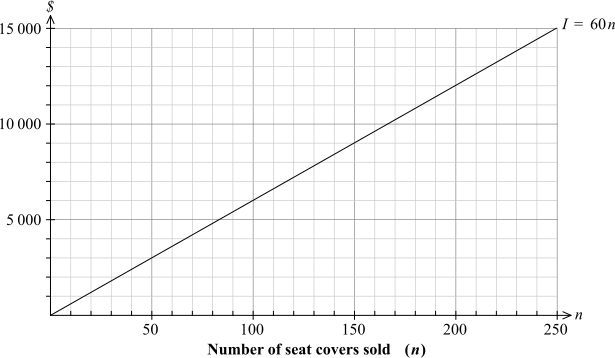
The monthly oncome, \(I\), in dollars, from selling \(n\) seat covers is given by

\(I=60n\)

This relationship is shown on the graph below.
 

The monthly cost, \(C\), in dollars, of making \(n\) seat covers is given by

\(C=35n+5000\)

  1. On the graph above, sketch the monthly cost, \(C\), of making \(n\) seat covers.   (1 mark) 
  2. Find the number of seat covers that need to be sold in order to break even and state the profit made at this point.   (2 marks)

    --- 3 WORK AREA LINES (style=lined) ---

Show Answers Only

a.


b.   \(\text{200 seat covers and zero profit at this point}\)

Show Worked Solution

a.   \(\text{Draw graph through points (0, 5000) and (250, 13 750)}\)


b.    \(C=35n+5000\ \text{and }I=60n\)

\(\text{Break-even occurs when} \ \ I=C\)
  

\(\text{Method 2: Graphically}\)

\(\text{Point of intersection is }\rightarrow (200, 12\ 000)\)
  

\(\text{Method 2: Algebraically}\)

\(\text{Solve for} \ n:\)

\(60n\) \(=35n+5000\)
\(25n\) \(=5000\)
\(n\) \(=200\)

  
  \(\therefore\ \text{200 seat covers must be sold to break even}\)

\(\text{and the profit at this point is zero}\)

Filed Under: Simultaneous Equations and Applications (Std 2-X) Tagged With: Band 4, smc-5237-40-Cost/Revenue, smc-5237-40-Sketch Linear Equations

v1 Algebra, STD2 A4 EQ-Bank 8

Two farmers, River and Jacqueline, sold organic honey at the the local market.

River sold his 500 gram jars of honey for $8 each and Jacqueline sold her 200 gram jars of honey for $4 each. In the first hour, their total combined sales were $40.

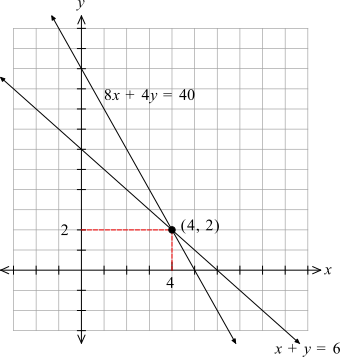
If River sold \(x\) jars of honey and Jacqueline sold \(y\) jars of honey, then the following equation can be formed:

\(8x+4y=40\)

In the first hour, the friends sold a total of 6 jars of honey between them.

Find the number of jars of honey each of the friends sold during this time by forming a second equation and solving the simultaneous equations graphically.  (5 marks)

Show Answers Only

\(\text{River sold 4 and Jacqueline sold 2.}\)

Show Worked Solution
\(\text{Graphing}\ \ 8x + 4y\) \(=40\)
\(y\) \(=-2x+10\)

 
\(y\text{-intercept}\ = (0, 10)\)

\(x\text{-intercept}\ = (5, 0)\)

\(\text{Gradient}\ = -2\)
 

\(\text{Second equation:}\)

\(x+y=6\)

\(\text{From the graph,}\)

\(\text{River sold 4 and Jacqueline sold 2.}\)

Filed Under: Simultaneous Equations and Applications (Std 2-X) Tagged With: Band 4, smc-5237-20-Other SE Applications, smc-5237-40-Sketch Linear Equations

v1 Algebra, STD2 A4 SM-Bank 7

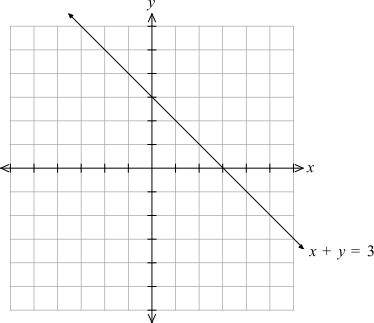
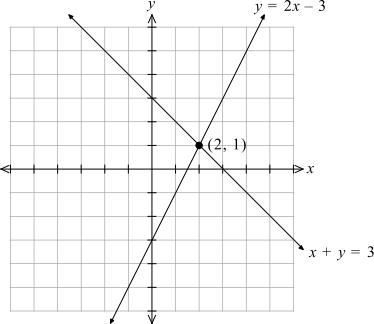
The graph of the line  \(x+y=3\)  is shown.


By graphing  \(y=2x-3\)  on the same grid, find the point of intersection of  \(x+y=3\) and  \(y=2x-3\).  (3 marks)

--- 1 WORK AREA LINES (style=lined) ---
Show Answers Only

\((2, 1)\)

Show Worked Solution

\(\text{Graphing}\ y=2x-3:\)

\(y\text{-intercept }=-3\)

\(\text{Gradient }=2\)


\(\therefore\ \text{Point of intersection is (2, 1).}\)

Filed Under: Simultaneous Equations and Applications (Std 2-X) Tagged With: Band 4, smc-5237-10-Find intersection, smc-5237-40-Sketch Linear Equations

v1 Algebra, STD2 A4 SM-Bank 6

A student was asked to solve the following simultaneous equations.

\(y=2x-5\)

\(x-2y+2=0\)

After graphing the equations, the student found the point of intersection to be \((4,3)\)?

Is the student correct? Support your answer with calculations.  (2 marks)

--- 5 WORK AREA LINES (style=lined) ---
Show Answers Only

\(\text{See Worked Solutions}\)

Show Worked Solution

\(\text{If the student is correct, the co-ordinates will}\)

\(\text{satisfy both equations.}\)

\(\text{Substitute (4, 3) into}\ \ y=2x-5\)

\(\text{LHS}\) \(=3\)
\(\text{RHS}\) \(= 2(4)-5\)
  \(=3\)

  
\(\therefore\ \text{LHS = RHS}\)
 

\(\text{Substitute (4, 3) into}\ \ x-2y+2=0\)

\(\text{LHS}\) \(=4-2(3)+2\)
  \(=0\)
  \(\ =\ \text{RHS}\)

  
\(\rightarrow\ (4,3)\ \text{satisfies both equations.}\)

\(\therefore\ \text{Student is correct.}\)

Filed Under: Simultaneous Equations and Applications (Std 2-X) Tagged With: Band 4, smc-5237-10-Find intersection

v1 Algebra, STD2 A4 2014 HSC 26d

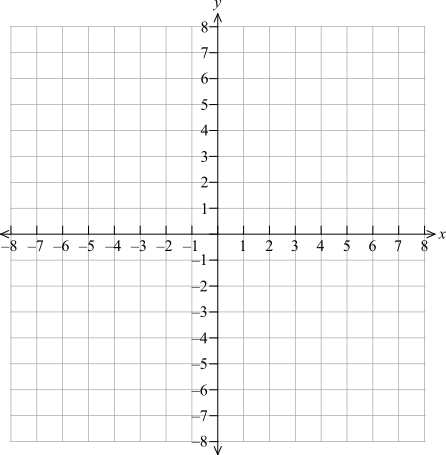
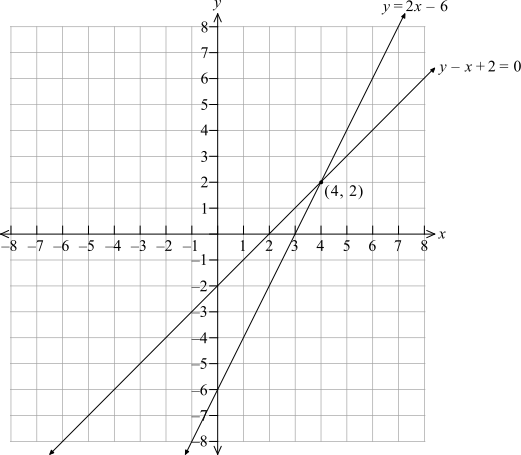
Draw each graph on the grid below and hence solve the simultaneous equations.   (3 marks)

\(y=2x-6\)

\(y-x+2=0\)
 

--- 6 WORK AREA LINES (style=lined) ---
Show Answers Only

\(x=4,\ y=2\)

Show Worked Solution

\(\text{Solution is at the intersection:}\ \ x=4,\ y=2\)

Filed Under: Simultaneous Equations and Applications (Std 2-X) Tagged With: Band 4, smc-5237-10-Find intersection, smc-5237-40-Sketch Linear Equations

v1 Algebra, STD2 A4 SM-Bank 27

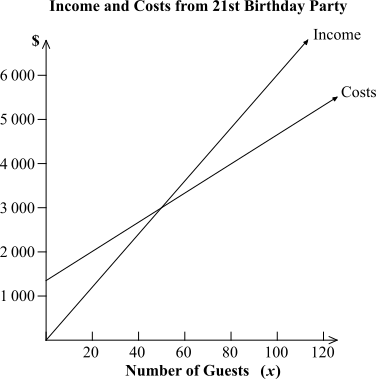
Morgan and Beau are to host a 21st birthday party for their friend's Zac and Peattie. They can hire a function room for $900 and a DJ for $450. Drinks will cost them $33 per person.

  1. Write a formula for the cost (\($C\)) of holding the birthday party for  \(x\)  people.   (1 mark)

    --- 1 WORK AREA LINES (style=lined) ---
  2. The graph below shows the planned income and costs if they charge $60 per person. Estimate the number of friends they need to invite to break even.   (1 mark)


    --- 1 WORK AREA LINES (style=lined) ---
  3. How much money will Morgan and Beau have to purchase a travel voucher as a group gift if 90 people attend the party?   (1 mark)

    --- 2 WORK AREA LINES (style=lined) ---
Show Answers Only
  1. \($C=1350+33x\)
  2. \(50\)
  3. \($1080\)
Show Worked Solution
i.    \(\text{Fixed Costs}\) \(=900+450\)
    \(=$1350\)

 
\(\text{Variable Costs}=$33x\)

\(\therefore\ $C=1350+33x\)


ii.   \(\text{From the graph}\)
  \(\text{Costs = Income when}\ x=50\)
  \(\text{(i.e. where lines intersect)}\)


\(\text{Algebraically}\)  
\(\text{Income }\) \(=\ \text{Costs}\)
\(60x\) \(=1350+33x\)
\(27x\) \(=1350\)
\(x\) \(=50\)


\(\therefore\ \text{Breakeven when }50\ \text{people attend}\)

  
iii. 
\(\text{When}\ \ x=90:\)

\(\text{Income}\) \(=90\times 60\)  
  \(=$5400\)  


\($C\) \(=1350+33\times 90\)
  \(=$4320\)


\(\therefore\ \text{Travel Voucher}\) \(=5400-4320\)
  \(=$1080\)

Filed Under: Simultaneous Equations and Applications (Std 2-X) Tagged With: Band 4, smc-5237-40-Cost/Revenue

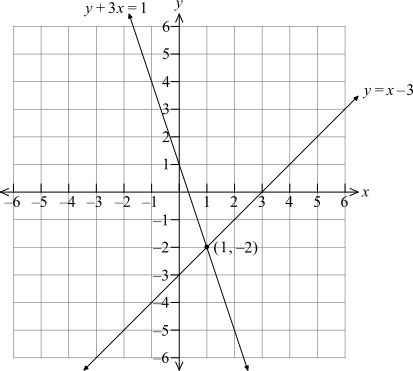
v1 Algebra, STD2 A4 2018 HSC 27b

\(y\) \(=x-3\)
\(y+3x\) \(=1\)

 
Draw these two linear graphs on the number plane below and determine their intersection.  (3 marks)


--- 2 WORK AREA LINES (style=lined) ---
 
Show Answers Only

\((1,-2)\)

Show Worked Solution

\(\text{Table of values:}\ \ y=x-3\)

\begin{array} {|c|c|c|c|c|}
\hline x & -2 & -1 & 0 & \colorbox{lightblue}{  1  } \\
\hline \ \ y \ \ & \ \ -5  \ \ & \ \ -4  \ \ & \ \ -3  \ \ & \ \colorbox{lightblue}{ – 2} \\ 
\hline \end{array}

 
\(\text{Table of values:}\ \ y+3x=1 \ \rightarrow \ y=-3x+1\)

\begin{array} {|c|c|c|c|c|}
\hline x & -1 & 0 & \colorbox{lightblue}{ 1 } & 2 \\
\hline \ \ y \ \ & \ \ \ 4\ \ \ & \ \ \ 1\ \ \ & \ \colorbox{lightblue}{ – 2} & \ \ -5 \ \ \\ 
\hline \end{array}


\(\text{From graph (and table), intersection occurs}\)

\(\text{at}\ \ (1, -2).\)

Filed Under: Simultaneous Equations and Applications (Std 2-X) Tagged With: Band 4, smc-5237-10-Find intersection, smc-5237-40-Sketch Linear Equations

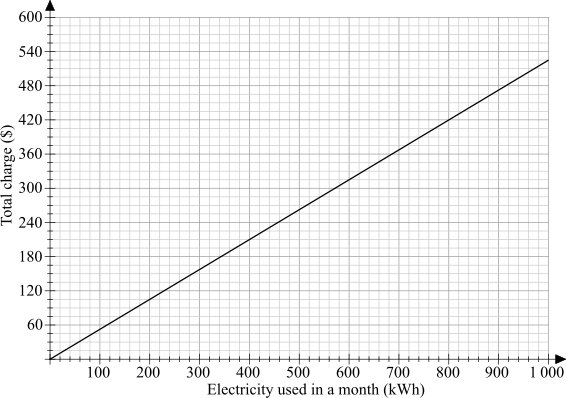
v1 Algebra, STD2 A4 2023 HSC 21

Electricity provider \(A\) charges 30 cents per kilowatt hour (kWh) for electricity, plus a fixed monthly charge of $90.

  1. Complete the table showing Provider \(A\)'s monthly charges for different levels of electricity usage.   (1 mark)

    \begin{array} {|l|c|}
    \hline
    \rule{0pt}{2.5ex} \textit{Electricity used in a month (kWh)} \rule[-1ex]{0pt}{0pt} & \ \ 0 \ \ & \ \ 400 \ \ & \ \ 1000 \ \ \\
    \hline
    \rule{0pt}{2.5ex} \textit{Monthly Charge (\$)} \rule[-1ex]{0pt}{0pt} & \ \ 90 \ \ & \ \ 210 \ \ & \ \ 390 \ \ \\
    \hline
    \end{array}

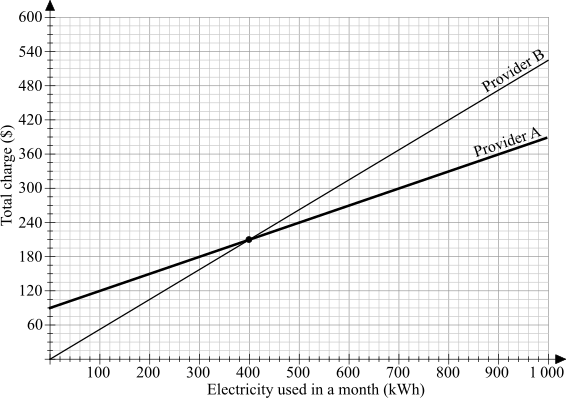
Provider \(B\) charges 52.5 cents per kWh, with no fixed monthly charge. The graph shows how Provider \(B\)'s charges vary with the amount of electricity used in a month.


  1. On the grid above, graph Provider \(A\)'s charges from the table in part (a).   (1 mark)
  2. Use the two graphs to determine the number of kilowatt hours per month for which Provider \(A\) and Provider \(B\) charge the same amount.   (1 mark)

    --- 1 WORK AREA LINES (style=lined) ---
  3. A customer uses an average of 600 kWh per month.
  4. Which provider, \(A\) or \(B\), would be the cheaper option and by how much?   (2 marks)

    --- 4 WORK AREA LINES (style=lined) ---
Show Answers Only

a.    \(\text{When kWh} =400\)

\(\text{Monthly charge}\ =$90+0.30\times 400=$210\)

\begin{array} {|l|c|}
\hline
\rule{0pt}{2.5ex} \textit{Electricity used in a month (kWh)} \rule[-1ex]{0pt}{0pt} & \ \ 0 \ \ & \ \ 400 \ \ & \ 1000 \ \\
\hline
\rule{0pt}{2.5ex} \textit{Monthly Charge (\$)} \rule[-1ex]{0pt}{0pt} & \ \ 90 \ \ & \ \ 210 \ \ & \ \ 390 \ \ \\
\hline
\end{array}

b.    
         

c.    \(\text{400 kWh}\)

d.    \(\text{Provider}\ A\ \text{is cheaper by \$45.}\)

Show Worked Solution

a.   \(\text{When kWh} =400\)

\(\text{Monthly charge}\ =$90+0.30\times 400=$210\)

\begin{array} {|l|c|}
\hline
\rule{0pt}{2.5ex} \textit{Electricity used in a month (kWh)} \rule[-1ex]{0pt}{0pt} & \ \ 0 \ \ & \ \ 400 \ \ & \ 1000 \ \\
\hline
\rule{0pt}{2.5ex} \textit{Monthly Charge (\$)} \rule[-1ex]{0pt}{0pt} & \ \ 90 \ \ & \ \ 210 \ \ & \ \ 390 \ \ \\
\hline
\end{array}

b. 


c.    \(A_{\text{charge}} = B_{\text{charge}}\ \text{at intersection.}\)

\(\therefore\ \text{Same charge at 400 kWh}\)
 

d.    \(\text{Cost at 600 kWh:}\)

\(\text{Method 1: Using graph}\rightarrow\ $315-270=$45\)

\(\text{Method 2: Algebraically}:\)

\(\text{Provider}\ A: \ 90 + 0.30 \times 600 = $270\)

\(\text{Provider}\ B: \ 0.525 \times 600 = $315\)

\(\therefore \text{Provider}\ A\ \text{is cheaper by \$45.}\)

Filed Under: Simultaneous Equations and Applications (Std 2-X) Tagged With: Band 3, Band 4, smc-5237-20-Other SE Applications, smc-5237-40-Sketch Linear Equations

v1 Algebra, STD2 A4 2018 HSC 27d

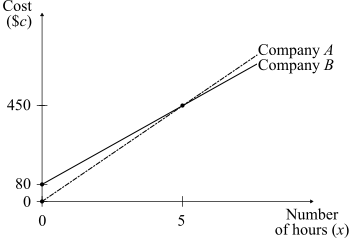
The graph displays the cost (\($c\)) charged by two companies for the hire of a jetski for \(x\) hours.


Both companies charge $450 for the hire of a jetski for 5 hours.

  1. What is the hourly rate charged by Company A?  (1 mark)

    --- 1 WORK AREA LINES (style=lined) ---
  2. Company B charges an initial booking fee of $80.


    Write a formula, in the of  \(c=b+mx\), for the cost of hiring a jetski from Company B for \(x\) hours.  (2 marks)

    --- 4 WORK AREA LINES (style=lined) ---

  3. A jetski is hired for 7 hours from Company B.


    Calculate how much cheaper this is than hiring from Company A.  (2 marks)

    --- 4 WORK AREA LINES (style=lined) ---

Show Answers Only
  1. \($90\)
  2. \(c=80+74x\)
  3. \($32\)
Show Worked Solution
i.    \(\text{Hourly rate}\ (A)\) \(=\dfrac{450}{5}\)
    \(=$90\)


ii.   \(m=\text{hourly rate}\)

\(\text{Find}\ m,\ \text{given}\ c = 450,\ \text{when}\ \ x = 5\ \text{and}\ \ b = 80\)

\(450\) \(=80+m\times 5\)
\(5m\) \(=370\)
\(m\) \(=\dfrac{370}{5}=74\)

\(\therefore\ c=80+74x\)
 

iii.    \(\text{Cost}\ (A)\) \(=90\times 7=$630\)
  \(\text{Cost}\ (B)\) \(=80+74\times 7=$598\)

 
\(\therefore\ \text{Company}\ B’\text{s hiring cost is }$32\ \text{cheaper.}\)

Filed Under: Simultaneous Equations and Applications (Std 2-X) Tagged With: Band 3, Band 4, smc-5237-40-Cost/Revenue

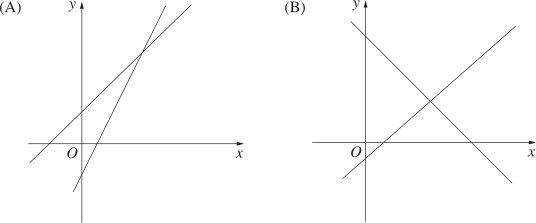
v1 Algebra, STD2 A4 2004 HSC 16 MC

Uri drew a correct diagram that gave the solution to the simultaneous equations

\(y=2x+3\)  and  \(y=x+4\).

Which diagram did he draw?
  

Show Answers Only

\(D\)

Show Worked Solution

\(\text{By elimination:}\)

\(y=2x+3\ \text{cuts the }y \text{-axis at}\ 3\)

\(\rightarrow\ \text{Eliminate be A and B}\)


\(y=x+4\ \text{cuts the }y\text{-axis at}\ 4\)

\(\text{AND has a positive gradient}\)

\(\rightarrow\ \text{Eliminate C}\)

\(\Rightarrow D\)

Filed Under: Simultaneous Equations and Applications (Std 2-X) Tagged With: Band 5, smc-5237-10-Find intersection

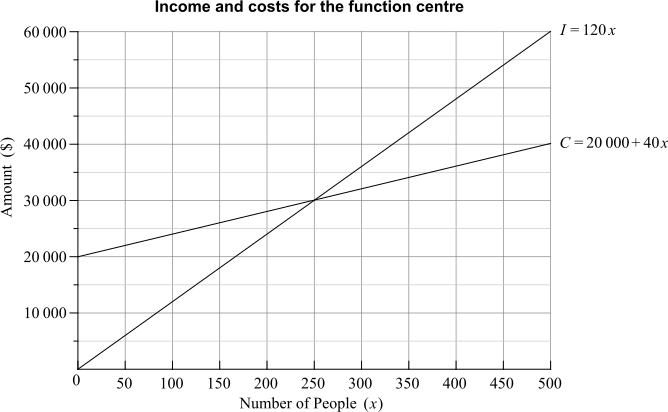
v1 Algebra, STD2 A4 2011 HSC 20 MC

A function centre hosts events for up to 500 people. The cost \(C\), in dollars, for the centre
to host an event, where \(x\) people attend, is given by:

\(C=20\ 000+40x\)

The centre charges $120 per person. Its income \(I\), in dollars, is given by:

\(I=120x\)
 

How much greater is the income of the function centre when 500 people attend an event, than its income at the breakeven point?

  1. \($10\ 000\)
  2. \($20\ 000\)
  3. \($30\ 000\)
  4. \($40\ 000\)
Show Answers Only

\(C\)

Show Worked Solution

\(\text{When}\ x=500,\ I=120\times 500=$60\ 000\)

\(\text{Breakeven when}\ \ x=250\ \ \text{(from graph)}\)

\(\text{When}\ \ x=250,\ I=120\times 250=$30\ 000\)

\(\text{Difference}\) \(=60\ 000-30\ 000\)
  \(=$30\ 000\)

 
\(\Rightarrow C\)


♦ Mean mark 50%
COMMENT: Students can read the income levels directly off the graph to save time and then check with the equations given.

Filed Under: Simultaneous Equations and Applications (Std 2-X) Tagged With: Band 5, smc-5237-40-Cost/Revenue

v1 Algebra, STD2 A4 SM-Bank 7 MC

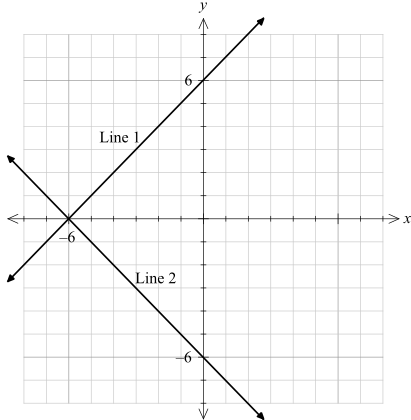
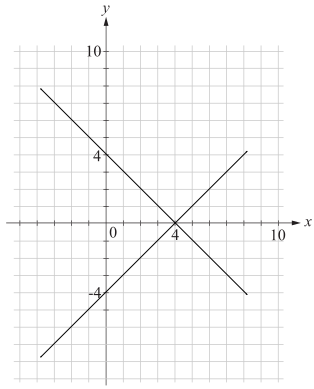
A computer application was used to draw the graphs of the equations

\(x+y=-6\)  and  \(x-y=-6\)

Part of the screen is shown.

Which row of the table correctly matches the equations with the lines drawn and identifies the solution when the equations are solved simultaneously?

\begin{align*}
\begin{array}{c|c}
\text{ } \\
\textbf{ A. } \\
\textbf{ B. } \\
\textbf{ C. } \\
\textbf{ D. }
\end{array}
\begin{array}{|c|c|c|}
\hline
\ x+y=-6 & x-y=-6 & \text{Solution} \\
\hline
\text{Line 1} & \text{Line 2} & x=-6,\ y=0 \\
\hline
\text{Line 1} & \text{Line 2} & x=-6, y=-6 \\
\hline
\text{Line 2} & \text{Line 1} & x=-6,\  y=0 \\
\hline
\text{Line 2} & \text{Line 1} & x=-6, y=-6 \\
\hline
\end{array}
\end{align*}

Show Answers Only

\(C\)

Show Worked Solution

\(\text{Line 1:} \ \ x-y=-6\)

\(\text{Line 2:} \ \ x+y=-6\)

\(\text{Intersection at} \ (-6, 0).\)

\(\Rightarrow C\)

Filed Under: Simultaneous Equations and Applications (Std 2-X) Tagged With: Band 4, smc-5237-10-Find intersection

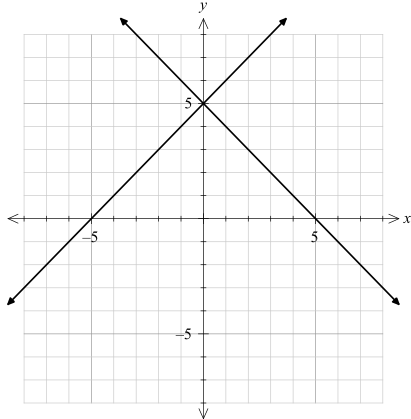
v1 Algebra, STD2 A4 SM-Bank 6 MC

A computer application was used to draw the graphs of the equations

\(x-y=-5\)  and  \(x+y=5\)

Part of the screen is shown.

What is the solution when the equations are solved simultaneously?

  1. \(x=5,\ y=5\)
  2. \(x=5,\ y=0\)
  3. \(x=-5,\ y=0\)
  4. \(x=0,\ y=5\)
Show Answers Only

\(D\)

Show Worked Solution

\(\text{Solution occurs at the intersection of the two lines.}\)

\(\Rightarrow D\)

Filed Under: Simultaneous Equations and Applications (Std 2-X) Tagged With: Band 3, smc-5237-10-Find intersection

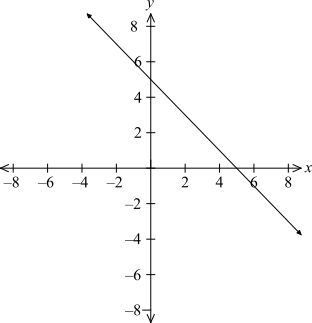
v1 Algebra, STD2 A4 2017 HSC 17 MC

The graph of the line with equation  \(y=5-x\)  is shown.


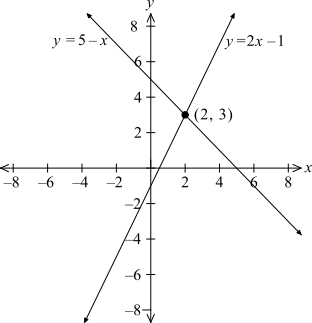
When the graph of the line with equation  \(y=2x-1\)  is also drawn on this number plane, what will be the point of intersection of the two lines?

  1. \((0, 5)\)
  2. \((1, 2)\)
  3. \((2, 3)\)
  4. \((5, 0)\)
Show Answers Only

\(C\)

Show Worked Solution

\(\text{Method 1: Graphically}\)

\(\text{From graph, intersection is at} (2,3)\)


\(\text{Method 2: Algebraically}\)

\(y\) \(=5-x\) \(…\ (1)\)
\(y\) \(=2x-1\) \(…\ (2)\)

 
\(\text{Substitute (2) into (1)}\)

\(2x-1\) \(=5-x\)
\(3x\) \(=6\)
\(x\) \(=2\)

 
\(\text{When}\ \ x=2,\ y=5-2=3\)

\(\Rightarrow C\)

Filed Under: Linear Equations and Basic Graphs (Std 2-X), Simultaneous Equations and Applications (Std 2-X) Tagged With: Band 4, smc-5237-10-Find intersection, smc-5240-30-Sketch line, smc-5240-50-Other

Copyright © 2014–2025 SmarterEd.com.au · Log in