SmarterEd

Aussie Maths & Science Teachers: Save your time with SmarterEd

  • Login
  • Get Help
  • About

Financial Maths, STD2 2020 HSC 37 (Adapted)

Estelle deposits a single lump sum into an account that earns 3% per annum compound interest.

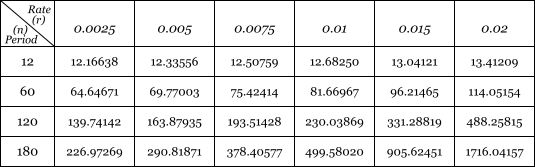
Present value interest factors for an annuity of $1 for various interest rates \((r)\) and numbers of periods \((N)\) are shown in the table.
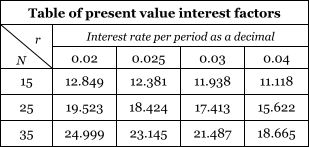
  

From this account, Estelle plans to make the following withdrawals.

  • $2000 at the end of each year for the first 15 years (the first withdrawal is one year after the deposit).
  • $5000 at the end of each year for a further 10 years, that is, in years 16 to 25.

Find the smallest lump sum Estelle must deposit so that both sets of withdrawals can be made.   (3 marks)

--- 9 WORK AREA LINES (style=lined) ---
Show Answers Only

\(\text{Lump sum required}=\$51\,251\)

Show Worked Solution

\(\text{Annuity 1:}\ \ PV\ \text{of}\ \ \$2000\ \text{annuity for 15 years at}\ r=0.03\)

\(\Rightarrow PV\ \text{factor}=11.938\)

\(\therefore\ PV\ \text{Annuity 1}=11.938\times 2000=\$23\,876\)
  

\(\text{Annuity 2:}\ \ PV\ \text{of}\ \ \$5000\ \text{annuity for years 16−25 at}\ r=0.03\)

\(PV\ \text{Annuity 2}\) \(=PV(25\ \text{years})-PV(15\ \text{years})\)  
  \(=5000\times 17.413-5000\times 11.938\)  
  \(=5000\times(17.413-11.938)\)  
  \(=\$27\,375\)  

 
\(\therefore\ \text{Lump sum required}=23\,876+27\,375=\$51\,251\)

Filed Under: Annuities (Y12-X) Tagged With: adapted, Band 6, smc-7701-20-PV of $1 Annuity Table

Financial Maths, STD2 2025 HSC 34 (Adapted)

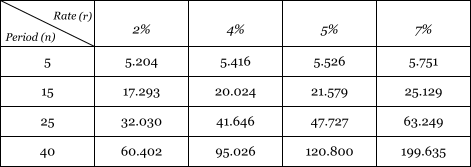
The table shows future value interest factors for an annuity of $1.
   

Larry invests a single amount of $18 000 for 5 years at 9% per annum, compounding monthly.

Tobias wants to end up with the same amount as Larry by using an annuity. He will pay a fixed sum into an account at the end of each month for 5 years, with the account also paying 9% per annum, compounding monthly.

Using the table, work out how much Tobias must deposit each month.   (3 marks)

--- 8 WORK AREA LINES (style=lined) ---
Show Answers Only

\(\$373.65\)

Show Worked Solution

\(r=\dfrac{0.09}{12}=0.0075,\ \ n=12\times 5=60\)

\(\text{Larry’s investment:}\)

\(FV=18\,000(1+0.0075)^{60}=28\,182.26\)
  

\(\text{Tobias’s investment:}\)

\(\text{Annuity factor:}\ 75.42414\)

\(\text{Annuity}\times 75.42414\) \(=\$28\,182.26\)
\(\text{Annuity}\) \(=\dfrac{28\,182.26}{75.42414}=\$373.65\)

Filed Under: Annuities (Y12-X) Tagged With: adapted, Band 5, smc-7701-10-FV of $1 Annuity Table, smc-7701-50-Find Contribution/Payment

Financial Maths, STD2 2023 HSC 25 (Adapted)

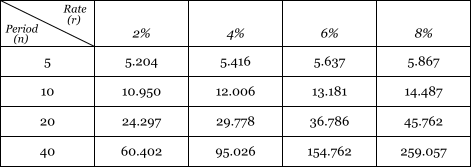
A table of future value interest factors for an annuity of $1 is shown.


  1. Sue wants to save $180 000 over the next 5 years. The account pays 8% per annum, compounding annually.
  2. Using the table, find the amount Sue should contribute each year, to the nearest dollar.   (2 marks)

    --- 4 WORK AREA LINES (style=lined) ---
  3. Instead, Sue decides to contribute $7500 every three months for 5 years into an account paying 8% per annum, compounding quarterly.
  4. Using the table, find how much Sue will have at the end of 5 years.   (3 marks)

    --- 6 WORK AREA LINES (style=lined) ---
Show Answers Only

a.    \(\$30\,680\)

b.    \(\$182\,227.50\)

Show Worked Solution

a.    \(\text{Applicable interest rate}=8\%\)

\(\text{Compounding periods}=5\times 1=5\)

\(\Rightarrow\ \text{Factor}=5.867\)

\(\therefore\ \text{Contribution (annual)}=\dfrac{180\,000}{5.867}=\$30\,680\ \text{(nearest dollar)}\)
 

b.    \(\text{Applicable interest rate}=\dfrac{8\%}{4}=2\%\ \text{per quarter}\)

\(\text{Compounding periods}=5\times 4=20\)

\(\Rightarrow\ \text{Factor}=24.297\)

\(\therefore\ \text{Total (after 5 years)}=7500\times 24.297=\$182\,227.50\)

Filed Under: Annuities (Y12-X) Tagged With: adapted, Band 4, smc-7701-10-FV of $1 Annuity Table, smc-7701-50-Find Contribution/Payment

Financial Maths, STD2 2025 HSC 18 (Adapted)

The table shows future value interest factors for an annuity of $1.
  

A scholarship fund receives a contribution of $4000 at the end of each year for 15 years. The fund earns 5% per annum, compounded annually.

Using the table, calculate the value of the fund at the end of 15 years.   (2 marks)

--- 5 WORK AREA LINES (style=lined) ---
Show Answers Only

\(\$86\,316\)

Show Worked Solution

\(r=5\%\ \text{annually}\)

\(\text{Compounding periods}=15\)

\(\text{Annuity factor}=21.579\)

\(\therefore\ FV\ \text{(annuity)}=4000\times 21.579=\$86\,316\)

Filed Under: Annuities (Y12-X) Tagged With: adapted, Band 3, smc-7701-10-FV of $1 Annuity Table

Financial Maths, STD2 2018 HSC 26c (Adapted)

Sofia contributes $175 to an annuity at the end of every month and plans to keep this up for 3 years.

Ignoring interest, how much will Sofia have paid into the annuity in total over the 3 years?   (1 mark)

--- 2 WORK AREA LINES (style=lined) ---
Show Answers Only

\(\text{Total contributed}=\$6300\)

Show Worked Solution

\(\text{Total contributed}=3\times 12\times 175=\$6300\)

Filed Under: Annuities (Y12-X) Tagged With: adapted, Band 3, smc-7701-40-No Table

Financial Maths, STD2 2013 23 MC (Adapted)

Elias opens a savings account that pays 4% per annum, compounded quarterly. At the end of every quarter he deposits $800, beginning one quarter after the account is opened, and continues for the following 18 months.

How much is in Elias’s account at the end of the 18 months?

  1. $4800.00
  2. $4921.61
  3. $4970.83
  4. $5095.30
Show Answers Only

\(B\)

Show Worked Solution

\(\text{Interest: 4% p.a.}\ \ \Rightarrow\ \  \text{1% per quarter}\)

\(\text{18 months}=6\ \text{end-of-quarter deposits}\)

\(\text{Value of 1st deposit}=800(1.01)^5=840.81\)

\(\text{Value of 2nd deposit}=800(1.01)^4=832.48\)

\(\text{Value of 3rd deposit}=800(1.01)^3=824.24\)

\(\text{Value of 4th deposit}=800(1.01)^2=816.08\)

\(\text{Value of 5th deposit}=800(1.01)^1=808.00\)

\(\text{Value of 6th deposit}=800\)
   

\(\therefore\ \text{Amount in account}\)

\(=840.81+832.48+824.24+816.08+808.00+800.00\)

\(=\$4921.61\)

\(\Rightarrow B\)

Filed Under: Annuities (Y12-X) Tagged With: adapted, Band 5, smc-7701-40-No Table

Financial Maths, STD2 2016 HSC 17 MC (Adapted)

A credit card balance of $920 is outstanding for 20 days. Compound interest is charged at 0.041% per day, with no interest-free period.

Which calculation gives the amount of interest charged on this balance?

  1. \(920\times 0.00041\times 20\)
  2. \(920(1.00041)^{20}\)
  3. \(920(1.00041)^{20}-920\)
  4. \(920(1+0.00041\times 20)\)
Show Answers Only

\(C\)

Show Worked Solution
  • C is correct: compound interest \(=\) total owing \(-\) principal \(=920(1.00041)^{20}-920\).

Other options:

  • A is incorrect: this is simple interest \((Prn)\), not compound interest.
  • B is incorrect: this gives the total amount owing, not the interest.
  • D is incorrect: this gives the total owing using simple interest.

\(\Rightarrow C\)

Filed Under: Credit Cards (Y12-X) Tagged With: adapted, Band 5, smc-7729-10-Interest on Purchases

Financial Maths, STD2 2019 HSC 27 (Adapted)

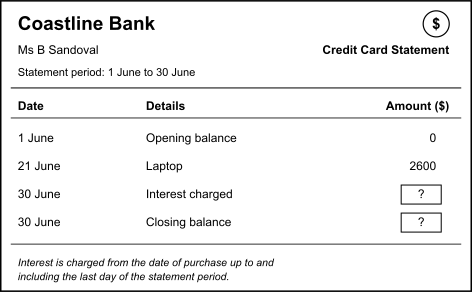
Bianca has a credit card that offers no interest-free period. At the end of each month, interest is added to the account at 19.5% per annum, compounded daily. Interest is worked out from the day a purchase is made (included) through to the last day of the month (included).

Part of Bianca’s June statement is shown below, with two figures left blank.


For this account, the minimum payment is set at 3% of the closing balance on 30 June.

Find the minimum payment, giving your answer to the nearest cent.   (3 marks)

--- 7 WORK AREA LINES (style=lined) ---
Show Answers Only

\(\text{Minimum payment}=\$78.42\)

Show Worked Solution

\(\text{Days of interest}\ (n)=\ \text{21 June – 30 June}=10\)

\(\text{Daily interest rate}\ (r)=\dfrac{0.195}{365}=0.0005342\ldots\)

\(\text{Closing balance}=2600(1+0.0005342\ldots)^{10}=\$2613.92\)

\(\text{Minimum payment}\) \(=\dfrac{3}{100}\times 2613.92\)
  \(=78.4176\ldots\)
  \(=\$78.42\ \text{(nearest cent)}\)

Filed Under: Credit Cards (Y12-X) Tagged With: adapted, Band 5, smc-7729-10-Interest on Purchases, smc-7729-30-Minimum Payments

Financial Maths, STD2 2025 HSC 27 (Adapted)

Noor buys a lounge suite for $650 on 3 April using a credit card. The card has an interest-free period of 30 days from and including the date of purchase. Interest is charged on purchases, compounding daily at a rate of 16.8% per annum, from and including the day following the interest-free period.

No other purchases were made on this credit card.

The account was paid in full on 20 May.

What was the total interest charged when the account was paid in full?   (3 marks)

--- 7 WORK AREA LINES (style=lined) ---
Show Answers Only

\(\text{Interest charged}=\$5.41\)

Show Worked Solution

\(\text{Total days (3 April to 20 May)}=28+20=48\)

\(\text{Interest-free days}=30\)

\(\text{Days accruing interest}\ (n)=48-30=18\)

\(\text{Daily interest rate}\ (r)=\dfrac{0.168}{365}=0.00046027\ldots\)

\(\text{Amount owing}=650(1+0.00046027\ldots)^{18}=\$655.41\)

\(\therefore\ \text{Interest charged}=655.41-650=\$5.41\)

Filed Under: Credit Cards (Y12-X) Tagged With: adapted, Band 4, smc-7729-10-Interest on Purchases, smc-7729-50-Interest Free Periods

Financial Maths, STD2 2020 HSC 22 (Adapted)

Diego pays a $600 car repair bill using his credit card. The card charges interest at 18.6% per annum, compounded daily, and has no interest-free period.

Twenty days after the purchase, Diego makes a part-payment of $300.

Determine how much Diego still owes after making the $300 part-payment.   (3 marks)

--- 6 WORK AREA LINES (style=lined) ---
Show Answers Only

\(\text{Amount owing}=\$306.14\)

Show Worked Solution

\(\text{Days of interest}\ (n)=20\)

\(\text{Daily interest rate}\ (r)=\dfrac{18.6\%}{365}=\dfrac{0.186}{365}=0.00050959\ldots\)

\(\text{Amount owing}\ (FV)\) \(=PV(1+r)^n-300\)
  \(=600(1+0.00050959\ldots)^{20}-300\)
  \(=606.14-300\)
  \(=\$306.14\)

Filed Under: Credit Cards (Y12-X) Tagged With: adapted, Band 4, smc-7729-10-Interest on Purchases, smc-7729-40-Repayments and Fees

Financial Maths, STD2 F1 2014 HSC 13 MC (Adapted)

Mark works as a car salesperson. His commission is based on a sliding scale of 5% on the first $3000 of his sales, 3% on the next $1500, and 1.5% thereafter.

What is Mark’s commission when his total sales are $6,250? 

  1. $202.75
  2. $210.50
  3. $216.25
  4. $221.25
Show Answers Only

`D`

Show Worked Solution

`text(Commission)`

`= (3000 xx text(5%)) + (1500 xx text(3%)) + (6250-4500) xx text(1.5%)`

`= (3000 xx 0.05) + (1500 xx 0.03) + (1750 xx 0.015)`

`= 150 + 45 + 26.25`

`= 221.25`
 

`=> D`

Filed Under: Earning Money and Budgeting (Std 2-X), Ways of Earning (Y11-X) Tagged With: adapted, Band 3, num-title-ct-corea, num-title-qs-hsc, smc-1126-20-Commission, smc-4331-20-Commission, smc-7722-20-Commission, smc-810-20-Commission

Algebra, STD2 A1 2012 HSC 15 MC (Adapted)

A car takes 5 hours to complete a journey when travelling at 75 km/h.

How long would the same journey take if the car were travelling at 100 km/h?

  1. 37.5 minutes
  2. 1 hour and 20 minutes
  3. 3 hours and 45 minutes
  4. 4 hours and 15 minutes
Show Answers Only

\(C\)

Show Worked Solution

\(T=\dfrac{D}{S}\)

\(\text{Since}\ \ \ T = 5\ \ \text{when}\ \ \ S = 75\)

\(5\) \(=\dfrac{D}{75}\)
\(D\) \(=5\times 75\)
  \(=375\ \text{km}\)


\(\text{Find}\ \ T\ \ \text{when}\ \ \ S = 100\ \ \text{ and}\ \ \ D = 375\)

\(T\) \(=\dfrac{375}{100}\)
  \(=3.75\ \text{hours}\)
  \(=3\ \text{hrs}\ \ 45\ \text{minutes}\)

  
\(\Rightarrow C\)

Filed Under: Applications: BAC, D=SxT and Medication (Y11-X), Applications: BAC, Medication and D=SxT (Std 2-X) Tagged With: adapted, Band 4, smc-5234-20-\(d=s\times t\), smc-7713-20-\(D=S \times T\)

Algebra, STD2 A1 2011 HSC 21 MC (Adapted)

A train departs from Town A at 4.00 pm to travel to Town B. Its average speed for the journey is 80 km/h, and it arrives at 6.00 pm. A second train departs from Town A at 4.30 pm and arrives at Town B at 6.10 pm.

What is the average speed of the second train?

  1. 96 km/h
  2. 114 km/h
  3. 224 km/h
  4. 280 km/h
Show Answers Only

\(A\)

Show Worked Solution

\(\text{1st train:}\)

\(\text{Travels 2hrs at 80km/h}\)

\(\text{Distance}\) \(=\text{Speed}\times\text{Time}\)
  \(=80\times 2\)
  \(=160\ \text{km}\)

 
\(\text{2nd train:}\)

\(\text{Travels 160 km in 1 hr 40 min}\ \rightarrow\ \dfrac{5}{3}\ \text{hrs}\)

\(\text{Speed}\) \(=\dfrac{\text{Distance}}{\text{Time}}\)
  \(=160\ ÷\ \dfrac{5}{3}\)
  \(=160\times \dfrac{3}{5}\)
  \(=96\ \text{km/h}\)

\(\Rightarrow A\)


♦♦ Mean mark 49%.

Filed Under: Applications: BAC, D=SxT and Medication (Y11-X), Applications: BAC, Medication and D=SxT (Std 2-X) Tagged With: adapted, Band 5, smc-5234-20-\(d=s\times t\), smc-7713-20-\(D=S \times T\)

Algebra, STD2 A1 2009 HSC 16 MC (Adapted)

The time for a train to travel a certain distance varies inversely with its speed.

Which of the following graphs shows this relationship?


Show Answers Only

\(C\)

Show Worked Solution
\(T\) \(\propto \dfrac{1}{S}\)
\(T\) \(=\dfrac{k}{S}\)

 
\(\text{By elimination:}\)

\(\text{As   Speed} \uparrow \ \text{, Time}\downarrow\ \Rightarrow\ \text{cannot be A or B}\)

\(\text{D  is incorrect because it graphs a linear relationship}\)

\(\Rightarrow C\)


♦♦ Mean mark 38%.

Filed Under: Applications: BAC, D=SxT and Medication (Y11-X), Applications: BAC, Medication and D=SxT (Std 2-X), Linear Equations and Basic Graphs (Std 2-X), Linear Modelling and Basic Graphs (Y11-X) Tagged With: adapted, Band 5, smc-5234-20-\(d=s\times t\), smc-5240-50-Other, smc-7713-20-\(D=S \times T\), smc-7715-50-Other

Algebra, STD2 A1 2014 HSC 4 MC (Adapted)

Young’s formula below is used to calculate the required dosages of medicine for children aged 1–12 years.
  

 \(\text{Dosage}=\dfrac{\text{age of child (in years)}\ \times\ \text{adult dosage}}{\text{age of child (in years)}\ +\ 12}\)
  

How much of the medicine should be given to an 18-month-old child in a 24-hour period if each adult dosage is 27 mL? The medicine is to be taken every 8 hours by both adults and children.

  1. 3 mL
  2. 6 mL
  3. 9 mL
  4. 12 mL
Show Answers Only

\(C\)

Show Worked Solution

\(\text{Age of child} = 18\ \text{months}=1.5\ \text{years}\)

\(\text{Dosage}\) \(=\dfrac{1.5\times 27}{1.5+12}\)
  \(=3\ \text{mL}\)

 
\(\text{Dosage every 8 hrs}\)

\(\therefore\ \text{In 24 hours, medicine given} = 3\times 3=9\ \text{mL}\)
  
\(\Rightarrow C\)


♦♦ Mean mark 42%.

Filed Under: Applications: BAC, D=SxT and Medication (Y11-X), Applications: BAC, Medication and D=SxT (Std 2-X) Tagged With: adapted, Band 5, smc-5234-30-Medication Formulae, smc-7713-40-Medication

Algebra, STD2 A1 2015 HSC 23 MC (Adapted)

The number of ‘standard drinks’ in various glasses of wine is shown.
  

Number of standard drinks
White Wine Red Wine
small glass large glass small glass large glass
0.9 1.4 1.0 1.5
 

A woman weighing 58 kg drinks two small glasses of white wine and three small glasses of red wine between 7 pm and 11 pm.

Using the formula for calculating blood alcohol below, what would be her blood alcohol content (\(BAC\)) estimate at 11 pm, correct to three decimal places?
 

\(BAC_{\text{Female}}=\dfrac{10N-7.5H}{5.5M}\)
 

where    \(N\) is the number of standard drinks consumed

\(H\) is the number of hours drinking

\(M\) is the person's mass in kilograms
 

  1. 0.013
  2. 0.023
  3. 0.046
  4. 0.056
Show Answers Only

\(D\)

Show Worked Solution
\(N\) \(=2\times 0.9 + 3\times 1\)
  \(=4.8\ \text{standard drinks}\)
\(H\) \(=4\ \text{hours}\)
\(M\) \(=58\ \text{kg}\)


\(BAC_f\) \(=\dfrac{10\times 4.8-7.5\times 4}{5.5\times 58}\)
  \(=0.05642\dots\)

  
\(\Rightarrow D\)

Filed Under: Applications: BAC, D=SxT and Medication (Y11-X), Applications: BAC, Medication and D=SxT (Std 2-X) Tagged With: adapted, Band 4, smc-5234-10-BAC, smc-7713-10-BAC

Algebra, STD2 A1 2016 HSC 10 MC (Adapted)

Anika drinks two small bottles of wine over a four-hour period. Each of these bottles contains 2.4 standard drinks. Anika weighs 55 kg.

Using the formula below, what is Anika's approximate blood alcohol content (\(BAC\)) at the end of this period?
 

\(BAC_{\text{Female}}=\dfrac{10N - 7.5H}{5.5M}\)
 

where    \(N\) is the number of standard drinks consumed

\(H\) is the number of hours drinking

\(M\) is the person's mass in kilograms
 

  1. 0.013
  2. 0.060
  3. 0.0013
  4. 0.0060
Show Answers Only

\(B\)

Show Worked Solution
\(BAC_f\) \(=\dfrac{10N – 7.5H}{5.5M}\)
  \(=\dfrac{10(2\times 2.4) – 7.5\times 4}{5.5\times 55}\)
  \(= 0.0595\dots\approx 0.060\)

 
\(\Rightarrow B\)

Filed Under: Applications: BAC, D=SxT and Medication (Y11-X), Applications: BAC, Medication and D=SxT (Std 2-X) Tagged With: adapted, Band 4, smc-5234-10-BAC, smc-7713-10-BAC

Algebra, STD2 A1 2017 HSC 2 MC (Adapted)

A car is travelling at 85 km/h.

How far will it travel in 3 hours and 30 minutes?

  1. \(24.3\ \text{km}\)
  2. \(25.8\ \text{km}\)
  3. \(280.5\ \text{km}\)
  4. \(297.5\ \text{km}\)
Show Answers Only

\(D\)

Show Worked Solution
\(\text{Distance}\) \(=85\times 3.5\)
  \(=297.5\ \text{km}\)

\(\Rightarrow D\)

Filed Under: Applications: BAC, D=SxT and Medication (Y11-X), Applications: BAC, Medication and D=SxT (Std 2-X) Tagged With: adapted, Band 3, smc-5234-20-\(d=s\times t\), smc-7713-20-\(D=S \times T\)

Algebra, STD2 A1 2017 HSC 19 MC (Adapted)

Young’s formula, shown below, is used to calculate the dosage of medication for children aged 1−12 years based on the adult dosage.

\(D=\dfrac{yA}{y + 12}\)

where    \(D\)   = dosage for children aged 1−12 years
\(y\)   = age of child (in years)
\(A\)   = Adult dosage

 
A child’s dosage is calculated to be 15 mg, based on an adult dosage of 30 mg.

How old is the child in years?

  1. 6
  2. 8
  3. 10
  4. 12
Show Answers Only

\(D\)

Show Worked Solution
\(D\) \(=\dfrac{yA}{y+12}\)
\(15\) \(=\dfrac{30y}{y+12}\)
\(15(y+12)\) \(=30y\)
\(15y+180\) \(=30y\)
\(15y\) \(=180\)
\(y\) \(=12\)

  
\(\Rightarrow D\)

Filed Under: Applications: BAC, D=SxT and Medication (Y11-X), Applications: BAC, Medication and D=SxT (Std 2-X) Tagged With: adapted, Band 4, smc-5234-30-Medication Formulae, smc-7713-40-Medication

Algebra, STD2 A1 2015 HSC 26b (Adapted)

Clark’s formula is used to determine the dosage of medicine for children.
 

\(\text{Dosage}=\dfrac{\text{weight in kg × adult dosage}}{70}\)
 

The adult daily dosage of a medicine contains 1750 mg of a particular drug.

A child who weighs 30 kg is to be given tablets each containing 125 mg of this drug.

How many tablets should this child be given daily?    (2 marks)

--- 4 WORK AREA LINES (style=lined) ---
Show Answers Only

\(6\)

Show Worked Solution
\(\text{Dosage}\) \(=\dfrac{30\times 1750}{70}\)
  \(=750\ \text{mg}\)

  
\(\text{Number of tablets per day}\)

\(=\dfrac{\text{Dosage}}{\text{mg per tablet}}\)

\(=\dfrac{750}{125}\)

\(=6\)
  

\(\therefore\ \text{The child should be given 6 tablets per day.}\)

Filed Under: Applications: BAC, D=SxT and Medication (Y11-X), Applications: BAC, Medication and D=SxT (Std 2-X) Tagged With: adapted, Band 3, smc-5234-30-Medication Formulae, smc-7713-40-Medication

Algebra, STD2 A1 2020 HSC 3 MC (Adapted)

The distance between the Yarra Valley and Ballarat is 150 km. A person travels from the Yarra Valley to Ballarat at an average speed of 90 km/h.

How long does it take the person to complete the journey?

  1.  60 minutes
  2.  66 minutes
  3.  1 hour 30 minutes
  4.  1 hour 40 minutes
Show Answers Only

\(D\)

Show Worked Solution
\(\text{Time}\) \(=\dfrac{\text{Distance}}{\text{Speed}}\)
  \(=\dfrac{150}{90}\)
  \(=1.\dot{6}\ \text{hours}\)
  \(=1\ \text{hour}\ 40\ \text{minutes}\)

 
\(\Rightarrow D\)

Filed Under: Applications: BAC, D=SxT and Medication (Y11-X), Applications: BAC, Medication and D=SxT (Std 2-X) Tagged With: adapted, Band 3, smc-5234-20-\(d=s\times t\), smc-7713-20-\(D=S \times T\)

Algebra, STD2 A1 2020 HSC 13 MC (Adapted)

When Stuart stops drinking alcohol at 11:30 pm, he has a blood alcohol content (BAC) of 0.08625.

The number of hours required for a person to reach zero BAC after they stop consuming alcohol is given by the formula:

\(\text{Time}=\dfrac{BAC}{0.015}\).

At what time on the next day should Stuart expect his BAC to be 0.05?

  1.  1:33 am
  2.  1:55 am
  3.  2:15 am
  4.  5:15 am
Show Answers Only

\(B\)

Show Worked Solution

\(\text{Time from  0.08625 → 0}\ BAC\)

\(=\dfrac{0.08625}{0.015}\)

\(=5.75\ \text{hours}\)
 

\(\text{Time from  0.08625 → 0.05}\ BAC\)

\(=\dfrac{(0.08625 – 0.05)}{0.08625}\times 5.75\) 

\(=\dfrac{29}{69}\times 5.75\)

\(=2.41\dot{6}=2\ \text{h}\ 25\ \text{min}\)
 

\(\therefore\ \text{Time}\) \(=11:30\ \text{pm} \ + 2 \ \text{h} \ 25 \ \text{min}\)
  \(=1:55\ \text{am}\)

 
\(\Rightarrow B\)


♦♦♦ Mean mark 17%.
COMMENT: The rates aspect of this question proved extremely challenging.

Filed Under: Applications: BAC, D=SxT and Medication (Y11-X), Applications: BAC, Medication and D=SxT (Std 2-X) Tagged With: adapted, Band 6, smc-5234-10-BAC, smc-7713-10-BAC

Algebra, STD2 A1 2010 HSC 24a (Adapted)

Margie tried to solve this equation and made a mistake in Line 2. 

\begin{array}{rl}
3(m+3)-2(m+4)=-5\ &\ \ \ \text{Line 1} \\
3m+9-2m+8=-5\ &\ \ \ \text{Line 2} \\
m+17=-5\ &\ \ \ \text{Line 3} \\
m=-12& \ \ \ \text{Line 4}
\end{array}

  1. Copy the equation in Line 1. Rewrite Line 2 correcting her mistake.   (1 mark)

    --- 2 WORK AREA LINES (style=lined) ---
  2. Continue your solution showing the correct working for Lines 3 and 4 to solve this equation for \(m\).   (1 mark)

    --- 2 WORK AREA LINES (style=lined) ---

Show Answers Only
a.     \(3(m+3)-2(m+4)\) \(=-5\ \ \ \ \ \ \text{Line}\ 1\)
  \(3m+9-2m-8\) \(=-5\ \ \ \ \ \ \text{Line}\ 2\)
b.     \(m+1\) \(=-5\)
  \(m\) \(=-6\)
Show Worked Solution
a.     \(3(m+3)-2(m+4)\) \(=-5\ \ \ \ \ \ \text{Line}\ 1\)
  \(3m+9-2m-8\) \(=-5\ \ \ \ \ \ \text{Line}\ 2\)


b.     \(m+1\) \(=-5\ \ \ \ \ \ \text{Line}\ 3\)
  \(m\) \(=-6\ \ \ \ \ \ \text{Line}\ 4\)

Filed Under: Substitution and Other Equations (Std 2-X), Substitution and Other Equations (Y11-X) Tagged With: adapted, Band 4, smc-5233-15-Find the Mistake, smc-7712-40-Find the Mistake

Algebra, STD2 A1 2013 HSC 29a (Adapted)

Jeremy tried to solve this equation and made a mistake in Line 2. 

\(\dfrac{M+3}{2}-\dfrac{2M-1}{5}\) \(=1\) \(\text{... Line 1}\)
\(5M+15-4M-2\) \(=10\) \(\text{... Line 2}\)
\(M+13\) \(=10\) \(\text{... Line 3}\)
\(M\) \(=-3\) \(\text{... Line 4}\)

  
Copy the equation in Line 1 and continue your solution to solve this equation for \(M\).

Show all lines of working.   (2 marks)

--- 4 WORK AREA LINES (style=lined) ---
Show Answers Only
\(\dfrac{M+3}{2}-\dfrac{2M-1}{5}\) \(=1\) `text(… Line 1)`
\(5M+15-4M+2\) \(=10\) `text(… Line 2)`
\(M+17\) \(=10\) `text(… Line 3)`
\(M\) \(=-7\) `text(… Line 4)`
Show Worked Solution
♦♦ Mean mark 27%
STRATEGY: The RHS of the equation increases from 1 to 10 (from Line 1 to Line 2), indicating both sides must have been multiplied by 10.
\(\dfrac{M+3}{2}-\dfrac{2M-1}{5}\) \(=1\) `text(… Line 1)`
\(5M+15-4M+2\) \(=10\) `text(… Line 2)`
\(M+17\) \(=10\) `text(… Line 3)`
\(M\) \(=-7\) `text(… Line 4)`

Filed Under: Substitution and Other Equations (Std 2-X), Substitution and Other Equations (Y11-X) Tagged With: adapted, Band 5, smc-5233-15-Find the Mistake, smc-7712-40-Find the Mistake

Algebra, STD2 A1 2010 HSC 7 MC (Adapted)

If  \(M=-8\), what is the value of  \(\dfrac{4M^2+3M}{8}\)

  1. \(-1027\)
  2. \(-35\)
  3. \(29\)
  4. \(125\)
Show Answers Only

\(C\)

Show Worked Solution
 ♦♦ Only 31% of students answered correctly!
\(\dfrac{4M^2+3M}{8}\) \(=\dfrac{4\times (-8)^2+3\times (-8)}{8}\)
  \(=\dfrac{4\times 64-24}{8}\)
  \(=\dfrac{232}{8}\)
  \(=29\)

  
\(\Rightarrow C\)

Filed Under: Substitution and Other Equations (Std 2-X), Substitution and Other Equations (Y11-X) Tagged With: adapted, Band 5, smc-5233-10-Substitute, smc-7712-10-Substitute

Algebra, STD2 A1 2009 HSC 25a (Adapted)

Simplify  \(10-3(x+4)\).   (2 marks)

--- 3 WORK AREA LINES (style=lined) ---
Show Answers Only

 \(-3x-2\)

Show Worked Solution
♦ Mean mark 47%
\(10-3(x+4)\) \(=10-3x-12\)
  \(=-3x-2\)

Filed Under: Substitution and Other Equations (Std 2-X), Substitution and Other Equations (Y11-X) Tagged With: adapted, Band 4, smc-5233-5-Other Equations, smc-7712-50-Other Equations

Algebra, STD2 A1 2014 HSC 26c (Adapted)

Solve the equation  \(\dfrac{4x-3}{5}-6=7-6x\).   (3 marks)

--- 5 WORK AREA LINES (style=lined) ---
Show Answers Only

 \(x=2\)

Show Worked Solution
\(\dfrac{4x-3}{5}-6\) \(=7-6x\)
\(4x-3-5\times 6\) \(=5(7-6x)\)
\(4x-3-30\) \(=35-30x\)
\(34x\) \(=68\)
\(\therefore\ x\) \(=2\)

Filed Under: Substitution and Other Equations (Std 2-X), Substitution and Other Equations (Y11-X) Tagged With: adapted, Band 4, smc-5233-30-Algebraic Fractions, smc-7712-30-Algebraic Fractions

Algebra, STD2 A1 2008 HSC 9 MC (Adapted)

What is the value of  \(\sqrt{\dfrac{2x + y}{5x}}\)  if  \(x=5.1\)  and  \(y=3.7\), correct to 2 decimal places? 

  1. \(0.13\)
  2. \(0.74\)
  3. \(3.74\)
  4. \(3.80\)  
Show Answers Only

\(B\)

Show Worked Solution
\(\sqrt{\dfrac{2x+y}{5x}}\) \(=\sqrt{\dfrac{2\times 5.1+3.7}{5\times 5.1}}\)
  \(=\sqrt{\dfrac{13.9}{25.5}}\)
  \(= 0.7383\dots\)

\(\Rightarrow B\)

Filed Under: Substitution and Other Equations (Std 2-X), Substitution and Other Equations (Y11-X) Tagged With: adapted, Band 4, smc-5233-10-Substitute, smc-7712-10-Substitute

Algebra, STD2 A1 2007 HSC 24b (Adapted)

The distance in kilometres (\(D\)) of an observer from the centre of a thunderstorm can be estimated by counting the number of seconds (\(t\)) between seeing the lightning and first hearing the thunder.

Use the formula  \(D=\dfrac{t}{3}\)  to estimate the number of seconds between seeing the lightning and hearing the thunder if the storm is 2.1 km away.   (1 mark)

--- 3 WORK AREA LINES (style=lined) ---
Show Answers Only

\(6.3\ \text{seconds}\)

Show Worked Solution

\(D=\dfrac{t}{3}\)

\(\text{When}\ \ D = 2.1,\)

\(\dfrac{t}{3}\) \(=2.1\)
\(t\) \(=6.3\ \text{seconds}\)

Filed Under: Substitution and Other Equations (Std 2-X), Substitution and Other Equations (Y11-X) Tagged With: adapted, Band 3, smc-5233-20-Rearrange and substitute, smc-7712-20-Rearrange and Substitute

Algebra, STD2 A1 2007 HSC 28b (Adapted)

This shape is made up of two right-angled triangle and a regular hexagon.
 

The area of a regular hexagon can be estimated using the formula  \(A=2.598S^2\)  where \(S\) is the hexagon's side-length.

Calculate the total area of the shape using this formula.   (3 marks)

--- 6 WORK AREA LINES (style=lined) ---

Show Answers Only

\(619.6\ \text{cm}^2\)

Show Worked Solution

\(\text{Area}=2.598S^2\)

\(\text{Using Pythagoras}\)

\(S^2= 10^2+10^2=200\)

\(S=\sqrt{200}\)

\(A=2.598\times (\sqrt {200})^2=519.6\ \text{cm}^2\)

\(\text{Area of Δ}\ =\dfrac{1}{2}bh=\dfrac{1}{2}\times 10\times 10=50 \ \text{cm}^2\)

\(\therefore\ \text{Total Area}\ =519.6+50+50=619.6\ \text{cm}^2\)

Filed Under: Substitution and Other Equations (Std 2-X), Substitution and Other Equations (Y11-X) Tagged With: adapted, Band 6, smc-5233-10-Substitute, smc-7712-10-Substitute

Algebra, STD2 A1 2005 HSC 2 MC (Adapted)

What is the value of  \(\dfrac{x-y}{6}\), if  \(x=184\)  and  \(y=46\)?

  1. \(6\)
  2. \(23\)
  3. \(176\)
  4. \(552\)
Show Answers Only

\(B\)

Show Worked Solution

\(\dfrac{x-y}{6}=\dfrac{184-46}{6}=23\) 

\(\Rightarrow B\)

Filed Under: Substitution and Other Equations (Std 2-X), Substitution and Other Equations (Y11-X) Tagged With: adapted, Band 2, smc-5233-10-Substitute, smc-7712-10-Substitute

Algebra, STD2 A1 2006 HSC 2 MC (Adapted)

If  \(V=\dfrac{4}{3}\pi r^3\), what is the value of  \(V\) when  \(r = 5\), correct to two decimal places?

  1. \(20.94\)
  2. \(53.05\)
  3. \(104.72\)
  4. \(523.60\)
Show Answers Only

\(D\)

Show Worked Solution

\(V =\dfrac{4}{3}\pi r^3\)

\(\text{When}\  r = 2,\)

\(V\) \(=\dfrac{4}{3}\pi\times 5^3\)
  \(=523.598\dots\)

 
\(\Rightarrow D\)

Filed Under: Substitution and Other Equations (Std 2-X), Substitution and Other Equations (Y11-X) Tagged With: adapted, Band 2, smc-5233-10-Substitute, smc-7712-10-Substitute

Algebra, STD2 A1 2004 HSC 3 MC (Adapted)

If  \(K=Ft^3\), \(F=9\) and  \(t=0.829\), what is the value of \(K\) correct to three significant figures?

  1. \(5.12\)
  2. \(5.127\)
  3. \(5.128\)
  4. \(5.13\)
Show Answers Only

\(D\)

Show Worked Solution
\(K\) \(=Ft^3\)
  \(=9\times 0.829^3\)
  \(=5.1275\dots\)
  \(=5.13\ \text{(3 sig figures)}\)

 
\(\Rightarrow D\)

Filed Under: Substitution and Other Equations (Std 2-X), Substitution and Other Equations (Y11-X) Tagged With: adapted, Band 3, smc-5233-10-Substitute, smc-7712-10-Substitute

Algebra, STD2 A1 2005 HSC 14 MC (Adapted)

Using the formula  \(d=6t^3-5\), Marcia tried to find the value of  \(t\)  when \(d=389\).

Here is her solution. She has made one mistake.
 

Which line does NOT follow correctly from the previous line?

  1. \(\text{Line}\ A\)
  2. \(\text{Line}\ B\)
  3. \(\text{Line}\ C\)
  4. \(\text{Line}\ D\)
Show Answers Only

\(B\)

Show Worked Solution
\(d\) \(=6t^3-5\)  
\(389\) \(=6t^3-5\ \ \ \) \(\dots\text{ Line A}\)
\(394\) \(=6t^3\) \(\dots\text{ Line B}\)

  
\(\therefore\ \text{Line}\ B\ \text{does not follow on correctly.}\)

\(\Rightarrow B\)

Filed Under: Substitution and Other Equations (Std 2-X), Substitution and Other Equations (Y11-X) Tagged With: adapted, Band 4, smc-5233-15-Find the Mistake, smc-7712-40-Find the Mistake

Algebra, STD2 A1 2015 HSC 2 MC (Adapted)

Which of the following is  \(5m+4y-m-6y\)  in its simplest form?

  1. \(4m+10y\)
  2. \(4m-2y\)
  3. \(6m+10y\)
  4. \(6m-2y\)
Show Answers Only

\(B\)

Show Worked Solution
\(5m+4y-m-6y\) \(=5m-m+4y-6y\)
  \(=4m-2y\)

\(\Rightarrow B\)

Filed Under: Substitution and Other Equations (Std 2-X), Substitution and Other Equations (Y11-X) Tagged With: adapted, Band 3, smc-5233-5-Other Equations, smc-7712-50-Other Equations

Algebra, STD2 A1 2015 HSC 24 MC (Adapted)

Consider the equation  \(\dfrac{5x}{2}-3=\dfrac{3x}{5}+1\).

Which of the following would be a correct step in solving this equation?

  1. \(\dfrac{5x}{2}-2=\dfrac{3x}{5}\)
  2. \(\dfrac{10x}{4}-4=\dfrac{6x}{5}\)
  3. \(\dfrac{5x}{2}=\dfrac{3x}{5}+4\)
  4. \(5x-3=\dfrac{6x}{5}+2\)
Show Answers Only

\(C\)

Show Worked Solution
\(\dfrac{5x}{2}-3\) \(=\dfrac{3x}{5}+1\)
\(\dfrac{5x}{2}-3+3\) \(=\dfrac{3x}{5}+1+3\)
\(\dfrac{5x}{2}\) \(=\dfrac{3x}{5}+4\)

 
\(\Rightarrow C\)

Filed Under: Substitution and Other Equations (Std 2-X), Substitution and Other Equations (Y11-X) Tagged With: adapted, Band 4, smc-5233-30-Algebraic Fractions, smc-7712-30-Algebraic Fractions

Algebra, STD2 A1 2015 HSC 28d (Adapted)

The formula  \(C=\dfrac{5}{9}(F-32)\)  is used to convert temperatures between degrees Fahrenheit \((F)\) and degrees Celsius \((C)\).

Convert 18°C to the equivalent temperature in Fahrenheit.   (2 marks)

--- 5 WORK AREA LINES (style=lined) ---

Show Answers Only

\(64.4\ \text{degrees}\ F\)

Show Worked Solution
\(C\) \(=\dfrac{5}{9}(F-32)\)
\(F-32\) \(=\dfrac{9}{5}C\)
\(F\)  \(=\dfrac{9}{5}C+32\)

 
\(\text{When}\ \ C = 18,\)

\(F\)  \(=\dfrac{9}{5}\times 18+32\)
  \(=64.4\ \text{degrees}\ F\)

Filed Under: Formula Rearrange (Std 2-X), Formula Rearrange (Y11-X), Substitution and Other Equations (Std 2-X), Substitution and Other Equations (Y11-X) Tagged With: adapted, Band 4, eo-derivative (HSC), smc-5232-10-Linear, smc-5233-20-Rearrange and substitute, smc-7695-10-Linear, smc-7712-20-Rearrange and Substitute

Algebra, STD2 A1 2017 HSC 7 MC (Adapted)

It is given that  \(I=\dfrac{3}{2}MR^2\).

What is the value of  \(I\) when  \(M =19.12\) and  \(R = 1.02\), correct to two decimal places?

  1. \(13.26\)
  2. \(29.84\)
  3. \(119.35\)
  4. \(570.52\)
Show Answers Only

\(B\)

Show Worked Solution
\(I\) \(=\dfrac{3}{2}\times 19.12\times 1.02^2\)
  \(=29.84\)


\(\Rightarrow B\)

Filed Under: Substitution and Other Equations (Std 2-X), Substitution and Other Equations (Y11-X) Tagged With: adapted, Band 2, smc-5233-10-Substitute, smc-7712-10-Substitute

Algebra, STD2 A1 2017 HSC 9 MC (Adapted)

What is the value of  \(x\)  in the equation  \(\dfrac{4-x}{7}=2\)?

  1. \(-14\)
  2. \(-10\)
  3. \(10\)
  4. \(14\)
Show Answers Only

\(B\)

Show Worked Solution
\(\dfrac{4-x}{7}\) \(=2\)
\(4-x\) \(=14\)
\(x\) \(=4-14\)
\(\therefore\ x\) \(=-10\)

  
\(\Rightarrow B\)

Filed Under: Substitution and Other Equations (Std 2-X), Substitution and Other Equations (Y11-X) Tagged With: adapted, Band 3, smc-5233-5-Other Equations, smc-7712-50-Other Equations

Algebra, STD2 A1 2016 HSC 5 MC (Adapted)

Which expression is equivalent to  \(2(7x-3)+5\)?

  1. \(14x-1\)
  2. \(14x-8\)
  3. \(14x-11\)
  4. \(14x+2\)
Show Answers Only

\(A\)

Show Worked Solution

\(2(7x-3)+5\)

\(=14x-6+5\)

\(=14x-1\)  
  

\(\Rightarrow A\)

Filed Under: Substitution and Other Equations (Std 2-X), Substitution and Other Equations (Y11-X) Tagged With: adapted, Band 4, smc-5233-5-Other Equations, smc-7712-50-Other Equations

Algebra, STD2 A1 2018 HSC 28b (Adapted)

Solve the equation  \(\dfrac{3x}{4}+1=\dfrac{5x+1}{3}\), leaving your answer as a fraction.   (3 marks)

--- 6 WORK AREA LINES (style=lined) ---

Show Answers Only

\(\dfrac{8}{11}\)

Show Worked Solution

♦ Mean mark 35%.

\(\underbrace{\dfrac{3x}{4} + 1}_\text{multiply x 12}\) \(=\underbrace{\dfrac{5x+1}{3}}_\text{multiply x 12}\)
\(9x+12\) \(=20x+4\)
\(11x\) \(=8\)
\(x\) \(=\dfrac{8}{11}\)

Filed Under: Substitution and Other Equations (Std 2-X), Substitution and Other Equations (Y11-X) Tagged With: adapted, Band 5, smc-5233-30-Algebraic Fractions, smc-7712-30-Algebraic Fractions

Algebra, STD2 A1 2021 HSC 29 (Adapted)

Solve  \(x+\dfrac{x-3}{4}=5\), leaving your answer as a fraction.   (2 marks)

--- 5 WORK AREA LINES (style=lined) ---

Show Answers Only

\(\dfrac{23}{5}\)

Show Worked Solution

♦ Mean mark 40%.
\(x+\dfrac{x-3}{4}\) \(=5\)
\(4x+x-3\) \(=20\)
\(5x\) \(=23\)
\(x\) \(=\dfrac{23}{5}\)

Filed Under: Substitution and Other Equations (Std 2-X), Substitution and Other Equations (Y11-X) Tagged With: adapted, Band 5, smc-5233-30-Algebraic Fractions, smc-7712-30-Algebraic Fractions

Algebra, STD1 A1 2020 HSC 18 (Adapted)

The distance, \(d\) metres, travelled by a car slowing down from \(u\) km/h to \(v\) km/h can be obtained using the formula

\(v^2=u^2-100 d\)

What distance does a car travel while slowing down from 100 km/h to 70 km/h?   (2 marks)

--- 5 WORK AREA LINES (style=lined) ---

Show Answers Only

\(51\ \text{metres}\)

Show Worked Solution

\(u=100 \ , \ v=70\)

\(v^2\) \(=u^2-100d\)
\(70^2\) \(=100^2-100d\)
\(100d\) \(=100^2-70^2\)
\(\therefore\ d\) \(=\dfrac{100^2-70^2}{100}\)
  \(=51\ \text{metres}\)

Filed Under: Substitution and Other Equations (Std 2-X), Substitution and Other Equations (Y11-X) Tagged With: adapted, Band 4, smc-5233-20-Rearrange and substitute, smc-7712-20-Rearrange and Substitute

Algebra, STD2 A1 2004 HSC 11 MC (Adapted)

If  \(m = 8n^2\), what is a possible value of \(n\) when  \(m=7200\)?

  1. \(0.03\)
  2. \(30\)
  3. \(240\)
  4. \(900\)
Show Answers Only

\(B\)

Show Worked Solution
\(m\) \(=8n^2\)
\(n^2\) \(=\dfrac{m}{8}\)
\(n\) \(=\pm\sqrt{\dfrac{m}{8}}\)

 
\(\text{When}\ m=7200:\)

\(n\) \(=\pm\sqrt{\dfrac{7200}{8}}\)
  \(=\pm 30\)

 
\(\Rightarrow B\)

Filed Under: Formula Rearrange (Std 2-X), Formula Rearrange (Y11-X), Substitution and Other Equations (Std 2-X), Substitution and Other Equations (Y11-X) Tagged With: adapted, Band 4, eo-unique, smc-5232-20-Non-Linear, smc-5233-20-Rearrange and substitute, smc-7695-20-Non-Linear, smc-7712-20-Rearrange and Substitute

Algebra, STD1 A1 2019 HSC 34 (Adapted)

Given the formula  \(D=\dfrac{B(x+1)}{18}\), calculate the value of  \(x\)  when  \(D=90\)  and  \(B=400\).   (3 marks)

--- 6 WORK AREA LINES (style=lined) ---

Show Answers Only

\(3.05\)

Show Worked Solution

\(\text{Make}\ x\ \text{the subject:}\)

\(D\) \(=\dfrac{B(x+1)}{18}\)
\(18D\) \(=B(x+1)\)
\(x+1\) \(=\dfrac{18D}{B}\)
\(x\) \(=\dfrac{18D}{B}-1\)
\(\text{When }\) \(D=90, B=400\)
\(\therefore\ x\) \(=\dfrac{18\times 90}{400}-1=3.05\)

Filed Under: Formula Rearrange (Std 2-X), Formula Rearrange (Y11-X), Substitution and Other Equations (Std 2-X), Substitution and Other Equations (Y11-X) Tagged With: adapted, Band 4, eo-derivative (HSC), smc-5232-10-Linear, smc-5233-20-Rearrange and substitute, smc-7695-10-Linear, smc-7712-20-Rearrange and Substitute, std2-std1-common

Copyright © 2014–2026 SmarterEd.com.au · Log in