Determine the component of \(\textbf{a} = 2\textbf{i}-\textbf{j} + 3\textbf{k}\) that is perpendicular to \(\textbf{b} = \textbf{i} + \textbf{j}-\textbf{k}.\) (3 marks)
--- 8 WORK AREA LINES (style=lined) ---
Aussie Maths & Science Teachers: Save your time with SmarterEd
Determine the component of \(\textbf{a} = 2\textbf{i}-\textbf{j} + 3\textbf{k}\) that is perpendicular to \(\textbf{b} = \textbf{i} + \textbf{j}-\textbf{k}.\) (3 marks)
--- 8 WORK AREA LINES (style=lined) ---
\(\textbf{a}-\operatorname{proj}_{\textbf{b}}\textbf{a}=\left(\begin{array}{c}2 \\ -1 \\ 3\end{array}\right)+\dfrac{2}{3}\left(\begin{array}{c}1 \\ 1 \\ -1\end{array}\right)=\left(\begin{array}{c}2 \frac{2}{3} \\ -\frac{1}{3} \\ 2 \frac{1}{3}\end{array}\right)\)
\(\textbf{a}=\left(\begin{array}{c}2 \\ -1 \\ 3\end{array}\right), \ \textbf{b}=\left(\begin{array}{c}1 \\ 1 \\ -1\end{array}\right)\)
\(\textbf{a} \cdot \textbf{b}=2-1-3=-2\)
\(\abs{\textbf{b}}^2=1^2+1^2+(-1)^2=3\)
\(\text{Projection of} \ \textbf{a} \ \text{in the direction of} \ \textbf{b}\):
\(\operatorname{proj}_{\textbf{b}} \textbf{a}=\left(\dfrac{\textbf{a} \cdot \textbf{b}}{\abs{\textbf{b}}^2}\right) \textbf{b}=-\dfrac{2}{3}\left(\begin{array}{c}1 \\ 1 \\ -1\end{array}\right)\)
\(\text {Component of} \ \textbf{a} \ \text {that is perpendicular to} \ \textbf{b}\):
\(\textbf{a}-\operatorname{proj}_{\textbf{b}}\textbf{a}=\left(\begin{array}{c}2 \\ -1 \\ 3\end{array}\right)+\dfrac{2}{3}\left(\begin{array}{c}1 \\ 1 \\ -1\end{array}\right)=\left(\begin{array}{c}2 \frac{2}{3} \\ -\frac{1}{3} \\ 2 \frac{1}{3}\end{array}\right)\)
If \(\underset{\sim}{u}=2 \underset{\sim}{i}-2 j+\underset{\sim}{k}\) and \(\underset{\sim}{v}=3 \underset{\sim}{i}-6 j+2 \underset{\sim}{k}\), the projection of \(\underset{\sim}{v}\) onto \(\underset{\sim}{u}\) is
\(D\)
\(\underset{\sim}{u}=\left(\begin{array}{c}2 \\ -2 \\ 1\end{array}\right), \ \ \underset{\sim}{v}=\left(\begin{array}{c}3 \\ -6 \\ 2\end{array}\right)\)
\(\underset{\sim}{u} \cdot \underset{\sim}{v}=6+12+2=20\)
\(\abs{\underset{\sim}{u}}^2=2^2+(-2)^2+1^2=9\)
\(\operatorname{proj}_{\underset{\sim}{u}} \underset{\sim}{v}=\left(\dfrac{\underset{\sim}{u} \cdot \underset{\sim}{v}}{\abs{\underset{\sim}{u}}^2}\right) \underset{\sim}{u}=\dfrac{20}{9}\left(\begin{array}{c}2 \\ -2 \\ 1\end{array}\right)\)
\(\Rightarrow D\)
Given that \(\overrightarrow{OP}=\left(\begin{array}{c}-3 \\ 1 \\ -1\end{array}\right)\) and \(\overrightarrow{O Q}=\left(\begin{array}{c}2 \\ 5 \\ -3\end{array}\right)\), what is \(\overrightarrow{P Q}\) ?
\(C\)
\(\overrightarrow{PQ}=\overrightarrow{O Q}-\overrightarrow{O P}=\left(\begin{array}{c}2 \\ 5 \\ -3\end{array}\right)-\left(\begin{array}{c}-3 \\ 1 \\ -1\end{array}\right)=\left(\begin{array}{c}5 \\ 4 \\ -2\end{array}\right)\)
\(\Rightarrow C\)
Given the vectors \(\textbf{a} = \textbf{i}+3\textbf{j}\) and \(\textbf{b} =4\textbf{i} +2\textbf{j}\), find the projection of \(\textbf{a}\) onto \(\textbf{b}\). (2 marks)
--- 6 WORK AREA LINES (style=lined) ---
\(\operatorname{proj}_{\textbf{b}}\textbf{a}=\left(\dfrac{\textbf{a} \cdot \textbf{b}}{\abs{\textbf{b}}^2}\right) \textbf{b}=\left(\dfrac{10}{20}\right) \textbf{b}=\dfrac{1}{2} \displaystyle \binom{4}{2}=\binom{2}{1}\)
\(\displaystyle \textbf{a}=\binom{1}{3}, \ \ \textbf{b}=\binom{4}{2}\)
\(\textbf{a}\cdot \textbf{b}=1 \times 4+3 \times 2=10\)
\(\abs{\textbf{b}}^2=4^2+2^2=20\)
\(\operatorname{proj}_{\textbf{b}}\textbf{a}=\left(\dfrac{\textbf{a} \cdot \textbf{b}}{\abs{\textbf{b}}^2}\right) \textbf{b}=\left(\dfrac{10}{20}\right) \textbf{b}=\dfrac{1}{2} \displaystyle \binom{4}{2}=\binom{2}{1}\)
Let \(\underset{\sim}{a}=2 \underset{\sim}{i}-3 j+\underset{\sim}{k}\) and \(\underset{\sim}{b}=\underset{\sim}{i}+m j-\underset{\sim}{k}\), where \(m\) is an integer. The vector resolute of \(\underset{\sim}{a}\) in the direction of \(\underset{\sim}{b}\) is \(-\dfrac{11}{18}(\underset{\sim}{i}+m\underset{\sim}{j}-\underset{\sim}{k})\). --- 9 WORK AREA LINES (style=lined) --- --- 3 WORK AREA LINES (style=lined) ---
a. \(m=4\) b. \(\left(\begin{array}{c}2 \frac{11}{18} \\ -\frac{5}{9} \\ \frac{7}{18}\end{array}\right)\)
a. \(\underset{\sim}{a}=\left(\begin{array}{c}2 \\ -3 \\ 1\end{array}\right), \quad \underset{\sim}{b}=\left(\begin{array}{c}1 \\ m \\ -1\end{array}\right)\) \(\underset{\sim}{b} \cdot \underset{\sim}{a}=2-3 m-1=1-3 m\) \(\abs{\underset{\sim}{b}}=\sqrt{1^2+m^2+(-1)^2}=\sqrt{2+m^2}\) \(\operatorname{proj}_{\underset{\sim}{b}}\underset{\sim}{a}=\left(\dfrac{\underset{\sim}{a} \cdot \underset{\sim}{b}}{\abs{b}^2}\right) \underset{\sim}{b}=\dfrac{1-3 m}{2+m^2}\, \underset{\sim}{b}\) \(\text{Equating projection vectors:}\) b. \(\text{Component of \(\underset{\sim}{a}\) perpendicular to \(\underset{\sim}{b}\):}\) \(\underset{\sim}{a}-\operatorname{proj}_{\underset{\sim}{b}} \underset{\sim}{a}=\left(\begin{array}{c}2 \\ -3 \\ 1\end{array}\right)+\dfrac{11}{18}\left(\begin{array}{c}1 \\ 4 \\ -1\end{array}\right)=\left(\begin{array}{c}2 \frac{11}{18} \\ -\frac{5}{9} \\ \frac{7}{18}\end{array}\right)\)
\(\dfrac{1-3 m}{m^2+2}\)
\(=-\dfrac{11}{18}\)
\(18-54 m\)
\(=-11 m^2-22\)
\(11 m^2-54 m+40\)
\(=0\)
\((11 m-10)(m-4)\)
\(=0\)
\(\therefore m=4\ \left(m \neq \frac{10}{11}, m \in Z\right)\)
Let `underset ~a = 3 underset ~i-2 underset ~j + m underset ~k` and `underset ~b = 2 underset ~i-underset ~j + 3 underset ~k`, where `m in R`.
Find the value(s) of `m` such that the projection of `underset ~a` onto `underset ~b` has magnitude `sqrt 14`. (3 marks)
--- 10 WORK AREA LINES (style=lined) ---
`m = -22/3, 2`
\(\underset{\sim}{a}=\left(\begin{array}{c}3 \\ -2 \\ m\end{array}\right), \quad \underset{\sim}{b}=\left(\begin{array}{c}2 \\ -1 \\ 3\end{array}\right)\)
\(\underset{\sim}{a} \cdot \underset{\sim}{b}=6+2+3 m=8+3 m\)
\(\abs{\underset{\sim}{b}}=\sqrt{2^2+(-1)^2+3^2}=\sqrt{14}\)
\(\text{Since magnitude of projection}=\sqrt{14}\):
\(\abs{\operatorname{proj}_{\underset{\sim}{b}} \underset{\sim}{a}}=\dfrac{\abs{\underset{\sim}{a} \cdot \underset{\sim}{b}}}{\abs{\underset{\sim}{b}}}=\dfrac{\abs{8+3 m}}{\sqrt{14}}=\sqrt{14}\)
| \(\abs{8+3 m}\) | \(=14\) |
| \(8+3 m\) | \(= \pm 14\) |
| \(3 m\) | \(=-8 \pm 14\) |
| \(m\) | \(=-\dfrac{22}{3}, 2\) |
Consider the vectors `underset ~a =-underset ~i-2 underset ~j + 3 underset ~k` and `underset ~b = 2 underset ~i + c underset ~j + underset ~k`.
Find the value of `c` if the angle between `underset ~a` and `underset ~b` is `pi/3`. (4 marks)
--- 12 WORK AREA LINES (style=lined) ---
`c = -3`
| `underset ~a ⋅ underset ~b` | `= -1 xx 2 + (-2) xx c + 3 xx 1` |
| `= -2-2c + 3` | |
| `= 1-2c` |
| `1-2c` | `= sqrt((-1)^2 + (-2)^2 + 3^3) *sqrt(2^2 + c^2 + 1^2) xx cos (pi/3)` |
| `1-2c` | `= 1/2(sqrt 14 ⋅ sqrt(5 + c^2))` |
| `2-4c` | `= sqrt(14(5 + c^2))` |
| `(2-4c)^2` | `= 14(5 + c^2)` |
| `4-16c + 16c^2` | `= 70 + 14c^2` |
| `2c^2-16c-66` | `= 0` |
| `c^2-8c-33` | `= 0` |
| `(c-11)(c + 3)` | `= 0` |
`c = 11 or c = -3`
`text(S)text(ince)\ \ 2-4c = sqrt(15(5 + c^2))`
`2-4c > 0\ \ =>\ \ c<2`
`:. c = -3`
Consider the vectors \(\underset{\sim}{ a }=3 \underset{\sim}{ j }+3 \underset{\sim}{ k }\) and \(\underset{\sim}{ b }=2 \underset{\sim}{ i }-\underset{\sim}{ j }-2 \underset{\sim}{ k }\). Find the angle between \(\underset{\sim}{ a }\) and \(\underset{\sim}{ b }\). (2 marks) --- 6 WORK AREA LINES (style=lined) --- \(\theta=\dfrac{3 \pi}{4}\left(\text{or} \ 135^{\circ}\right)\) \(\underset{\sim}{a}=\left(\begin{array}{l}0 \\ 3 \\ 3\end{array}\right) \Rightarrow \abs{\underset{\sim}{a}}=\sqrt{18}=3 \sqrt{2}\) \(\underset{\sim}{b}=\left(\begin{array}{c}2 \\ -1 \\ -2\end{array}\right) \Rightarrow\abs{\underset{\sim}{b}}=\sqrt{9}=3\) \(\cos \theta=\dfrac{\underset{\sim}{a} \cdot \underset{\sim}{b}}{\abs{\underset{\sim}{a}} \cdot \abs{\underset{\sim}{b}}}=\dfrac{-3-6}{3 \sqrt{2} \times 3}=-\dfrac{1}{\sqrt{2}}\) \(\therefore \theta=\cos ^{-1}\left(-\dfrac{1}{\sqrt{2}}\right)=\dfrac{3 \pi}{4}\left(\text{or} \ 135^{\circ}\right)\)
Consider the vector `underset ~a = sqrt 3 underset ~i-underset ~j-sqrt 2 underset ~k`, where `underset ~i, underset ~j` and `underset ~k` are unit vectors in the positive directions of the `x, y` and `z` axes respectively. --- 4 WORK AREA LINES (style=lined) --- --- 5 WORK AREA LINES (style=lined) --- --- 3 WORK AREA LINES (style=lined) ---
a. `1/sqrt 6 (sqrt 3 underset ~i-underset ~j-sqrt 2 underset ~k)` b. `theta = 45^@` c. `m = 6 + 5 sqrt 2`
a. `|underset ~a|= sqrt((sqrt 3)^2 + (-1)^2 + (-sqrt 2)^2)= sqrt 6` `hat underset ~a= underset ~a/|underset ~a|= 1/sqrt 6 (sqrt 3 underset ~i-underset ~j-sqrt 2 underset ~k)` b. `x text{-axis vectors include}\ (1,0,0).` `underset ~a ⋅ underset ~i = ((\sqrt3),(-1),(-\sqrt2))((1),(0),(0))=\sqrt3`
`underset ~a ⋅ underset ~i`
`= |underset ~a||underset ~i| cos theta= sqrt 6 cos theta`
`sqrt 3`
`= sqrt 6 cos theta`
`cos theta`
`=1/sqrt 2`
`:. theta`
`= 45^@`
c. `underset ~a ⋅ underset ~b = sqrt 3 (2 sqrt 3) + (-1)(m) + (-sqrt 2)(-5) = 0`
`6-m + 5 sqrt 2`
`=0`
`:. m`
`=6 + 5 sqrt 2`
--- 4 WORK AREA LINES (style=lined) ---
--- 3 WORK AREA LINES (style=lined) ---
i. \(\text{Unit vector of the direction vector:}\)
\(\dfrac{2 \underset{\sim}{i}-2 \underset{\sim}{j}+\underset{\sim}{k}}{\abs{2 \underset{\sim}{i}-2 \underset{\sim}{j}+\underset{\sim}{k}}} = \dfrac{2 \underset{\sim}{i}-2 \underset{\sim}{j}+\underset{\sim}{k}}{\sqrt{2^2+(-2)^2 + 1^2}} = \dfrac{1}{3} \left( 2 \underset{\sim}{i}-2 \underset{\sim}{j}+\underset{\sim}{k} \right)\)
\(\text{Since \({\underset{\sim}{F}}_1\) has magnitude 12:}\)
\({\underset{\sim}{F}}_1=12 \times \dfrac{1}{3}\left(\begin{array}{c}2 \\ -2 \\ 1\end{array}\right)=\left(\begin{array}{c}8 \\ -8 \\ 4\end{array}\right)\)
\({\underset{\sim}{F}}_1=8\underset{\sim}{i}-8 \underset{\sim}{j}+4 \underset{\sim}{k}\)
ii. \({\underset{\sim}{F}}_3={\underset{\sim}{F}}_1+{\underset{\sim}{F}}_2=\left(\begin{array}{c}8 \\ -8 \\ 4\end{array}\right)+\left(\begin{array}{c}-6 \\ 12 \\ 4\end{array}\right)=\left(\begin{array}{l}2 \\ 4 \\ 8\end{array}\right)\)
\({\underset{\sim}{F}}_3=2 \underset{\sim}{i}+4 \underset{\sim}{j}+8 \underset{\sim}{k}\)
iii. \({\underset{\sim}{F}}_3 \cdot d=\left(\begin{array}{l}2 \\ 4 \\ 8\end{array}\right)\left(\begin{array}{l}1 \\ 1 \\ 2\end{array}\right)=2+4+16=22\)
i. \(\text{Unit vector of the direction vector:}\)
\(\dfrac{2 \underset{\sim}{i}-2 \underset{\sim}{j}+\underset{\sim}{k}}{\abs{2 \underset{\sim}{i}-2 \underset{\sim}{j}+\underset{\sim}{k}}} = \dfrac{2 \underset{\sim}{i}-2 \underset{\sim}{j}+\underset{\sim}{k}}{\sqrt{2^2+(-2)^2 + 1^2}} = \dfrac{1}{3} \left( 2 \underset{\sim}{i}-2 \underset{\sim}{j}+\underset{\sim}{k} \right)\)
\(\text{Since \({\underset{\sim}{F}}_1\) has magnitude 12:}\)
\({\underset{\sim}{F}}_1=12 \times \dfrac{1}{3}\left(\begin{array}{c}2 \\ -2 \\ 1\end{array}\right)=\left(\begin{array}{c}8 \\ -8 \\ 4\end{array}\right)\)
\({\underset{\sim}{F}}_1=8\underset{\sim}{i}-8 \underset{\sim}{j}+4 \underset{\sim}{k}\)
ii. \({\underset{\sim}{F}}_3={\underset{\sim}{F}}_1+{\underset{\sim}{F}}_2=\left(\begin{array}{c}8 \\ -8 \\ 4\end{array}\right)+\left(\begin{array}{c}-6 \\ 12 \\ 4\end{array}\right)=\left(\begin{array}{l}2 \\ 4 \\ 8\end{array}\right)\)
\({\underset{\sim}{F}}_3=2 \underset{\sim}{i}+4 \underset{\sim}{j}+8 \underset{\sim}{k}\)
iii. \({\underset{\sim}{F}}_3 \cdot d=\left(\begin{array}{l}2 \\ 4 \\ 8\end{array}\right)\left(\begin{array}{l}1 \\ 1 \\ 2\end{array}\right)=2+4+16=22\)
Find the angle between the two vectors \(\underset{\sim}{u}=\left(\begin{array}{c}1 \\ 2 \\ -2\end{array}\right)\) and \(\underset{\sim}{v}=\left(\begin{array}{c}4 \\ -4 \\ 7\end{array}\right)\), giving your answer in radians, correct to 1 decimal place. (2 marks) --- 5 WORK AREA LINES (style=lined) --- \(\theta=2.3^c \ \ \text{(1 d.p.)}\) \(\underset{\sim}{u}=\left(\begin{array}{c}1 \\ 2 \\ -2\end{array}\right),\abs{\underset{\sim}{u}}=\sqrt{1+4+4}=3\) \(\underset{\sim}{v}=\left(\begin{array}{c}4 \\ -4 \\ 7\end{array}\right),\abs{\underset{\sim}{v}}=\sqrt{16+16+49}=9\) \(\cos \theta=\dfrac{\underset{\sim}{u} \cdot \underset{\sim}{v}}{|\underset{\sim}{u}||\underset{\sim}{v}|}=\dfrac{1 \times 4-2 \times 4-2 \times 7}{3 \times 9}=-\dfrac{2}{3}\) \(\theta=\cos ^{-1}\left(-\dfrac{2}{3}\right)=2.30 \ldots=2.3^c \ \ \text{(1 d.p.)}\)
A triangle is formed in three-dimensional space with vertices `A(1,-1,2)`, `B(0,2,-1)` and `C(2,1,1)`.
Find the size of `/_ABC`, giving your answer to the nearest degree. (3 marks)
--- 8 WORK AREA LINES (style=lined) ---
`33°`
`vec(BA)=((1),(-1),(2))-((0),(2),(-1))=((1),(-3),(3))`
`abs(vec(BA))=sqrt(1^2+3^2+3^2)=sqrt19`
`vec(BC)=((2),(1),(1))-((0),(2),(-1))=((2),(-1),(2))`
`abs(vec(BC))=sqrt(2^2+1^2+2^2)=sqrt9=3`
`vec(BA)*vec(BC)=1xx2+ -3xx-1+3xx2=11`
`cos/_ABC=(vec(BA)*vec(BC))/(abs{vec(BA)}abs{vec(BC)})=11/(3sqrt19)`
`:./_ABC=cos^(-1)(11/(3sqrt19))=32.733…=33°\ \ text{(nearest degree)}`
Consider the two vectors `underset~u = 2 underset~i-underset~j + 3 underset~k` and `underset~v = p underset~i + underset~j + 2 underset~k`.
For what values of `p` are `underset~u-underset~v` and `underset~u + underset~v` perpendicular? (3 marks)
--- 8 WORK AREA LINES (style=lined) ---
`p= ± 3`
`underset~u-underset~v = ((-2),(-1),(3))-((p),(1),(2)) = ((-2-p),(-2),(1))`
`underset~u + underset~v = ((-2),(-1),(3)) + ((p),(1),(2)) = ((p-2),(0),(5))`
`⊥ \ text{when} \ \ (underset~u-underset~v) · (underset~u + underset~v ) = 0 :`
`((-2-p),(-2),(1)) · ((p-2),(0),(5)) = 0`
| `-(p + 2)(p-2) + 5` | `= 0` |
| `-(p^2-4) + 5` | `= 0` |
| `-p^2 + 9` | `= 0` |
| `p^2` | `= 9` |
| `p` | `= ± 3` |
The vector \(\underset{\sim}{a}\) is \(\left(\begin{array}{l}1 \\ 2 \\ 3\end{array}\right)\) and the vector \(\underset{\sim}{b}\) is \(\left(\begin{array}{c}2 \\ 0 \\ -4\end{array}\right)\). --- 4 WORK AREA LINES (style=lined) --- --- 6 WORK AREA LINES (style=lined) --- i. \(\left(\begin{array}{c}-1 \\ 0 \\ 2\end{array}\right)\) ii. \(\underset{\sim}{a}-\dfrac{\underset{\sim}{a} \cdot \underset{\sim}{b}}{\underset{\sim}{b} \cdot \underset{\sim}{b}}\, \underset{\sim}{b}=\left(\begin{array}{l}1 \\ 2 \\ 3\end{array}\right)-\left(\begin{array}{c}-1 \\ 0 \\ 2\end{array}\right)=\left(\begin{array}{l}2 \\ 2 \\ 1\end{array}\right)\) \( \left(\underset{\sim}{a}-\dfrac{\underset{\sim}{a} \cdot \underset{\sim}{b}}{\underset{\sim}{b} \cdot \underset{\sim}{b}}\underset{\sim}{b}\right)\left(\begin{array}{c}-1 \\ 0 \\ 2\end{array}\right)=\left(\begin{array}{l}2 \\ 2 \\ 1\end{array}\right)\left(\begin{array}{c}-1 \\ 0 \\ 2\end{array}\right) = -2+0+2=0\) \(\therefore\ \text {Vectors are perpendicular.}\) i. \(\underset{\sim}{a}=\left(\begin{array}{l}1 \\ 2 \\ 3\end{array}\right), \quad \underset{\sim}{b}=\left(\begin{array}{c}2 \\ 0 \\ -4\end{array}\right)\) \(\dfrac{\underset{\sim}{a} \cdot \underset{\sim}{b}}{\underset{\sim}{b} \cdot \underset{\sim}{b}}\, \underset{\sim}{b}=\dfrac{2+0-12}{4+0+16}\left(\begin{array}{c}2 \\ 0 \\ -4\end{array}\right)=-\dfrac{1}{2}\left(\begin{array}{c}2 \\ 0 \\ -4\end{array}\right)=\left(\begin{array}{c}-1 \\ 0 \\ 2\end{array}\right)\) \( \left(\underset{\sim}{a}-\dfrac{\underset{\sim}{a} \cdot \underset{\sim}{b}}{\underset{\sim}{b} \cdot \underset{\sim}{b}}\,\underset{\sim}{b}\right)\left(\begin{array}{c}-1 \\ 0 \\ 2\end{array}\right)=\left(\begin{array}{l}2 \\ 2 \\ 1\end{array}\right)\left(\begin{array}{c}-1 \\ 0 \\ 2\end{array}\right) = -2+0+2=0\)
ii. \(\underset{\sim}{a}-\dfrac{\underset{\sim}{a} \cdot \underset{\sim}{b}}{\underset{\sim}{b} \cdot \underset{\sim}{b}}\, \underset{\sim}{b}=\left(\begin{array}{l}1 \\ 2 \\ 3\end{array}\right)-\left(\begin{array}{c}-1 \\ 0 \\ 2\end{array}\right)=\left(\begin{array}{l}2 \\ 2 \\ 1\end{array}\right)\)
\(\therefore\ \text{Vectors are perpendicular.}\)
Find the angle between the vectors
\(\underset{\sim}{a}=\underset{\sim}{i}+2 \underset{\sim}{j}-3 \underset{\sim}{k}\)
\(\underset{\sim}{b}=-\underset{\sim}{i}+4 \underset{\sim}{j}+2 \underset{\sim}{k}\),
giving your answer to the nearest degree. (3 marks)
--- 8 WORK AREA LINES (style=lined) ---
\(87^{\circ} \)
\[\underset{\sim}{a}=\left(\begin{array}{c} 1 \\ 2 \\ -3 \end{array}\right),\ \ \underset{\sim}{b}=\left(\begin{array}{c} -1 \\ 4 \\ 2 \end{array}\right) \]
\(\Big{|} \underset{\sim}{a} \Big{|} = \sqrt{1+4+9} = \sqrt{14} \)
\(\Big{|} \underset{\sim}{b} \Big{|} = \sqrt{1+16+4} = \sqrt{21} \)
\( \underset{\sim}{a} \cdot \underset{\sim}{b} = -1 + 8-6=1 \)
| \(\cos\ \theta \) | \(=\dfrac{\underset{\sim}{a} \cdot \underset{\sim}{b}}{\Big{|}\underset{\sim}{a}\Big{|} \cdot \Big{|}\underset{\sim}{b}\Big{|}} \) | |
| \(=\dfrac{1}{\sqrt{294}} \) | ||
| \( \theta\) | \(=\cos ^{-1} \Big{(}\dfrac{1}{\sqrt{294}}\Big{)} \) | |
| \(=86.65…\) | ||
| \(=87^{\circ} \) |
Find the angle between the vectors `underset~a = ((2),(0),(4))` and `underset~b = ((-3),(1),(2))`, giving the angle in degrees correct to 1 decimal place. (3 marks)
`83.1^@`
`underset~a = ((2),(0),(4)) \ , \ |underset~a| \ = sqrt{2^2 + 4^2} = sqrt20`
`underset~b = ((-3),(1),(2)) \ , \ |underset~b| \ = sqrt{(-3)^2 + 1^2 + 2^2} = sqrt14`
| `underset~a * underset~b` | `= ((2),(0),(4)) ((-3),(1),(2)) = – 6 + 0 + 8 = 2` |
| `underset~a * underset~b` | `= |underset~a| |underset~b| \ cos theta` |
| `2` | `= sqrt20 sqrt14 \ cos theta` |
| `cos theta` | `= 2/sqrt280` |
| `theta` | `= cos^(-1) (1/sqrt70)` |
| `= 83.1^@ \ text{(1 d.p,)}` |
What is the length of the vector `- underset~i + 18 underset~j - 6 underset~k`?
`B`
| `text{Length}` | `= | – underset~i + 18 underset~j – 6 underset~k \ |` |
| `= sqrt{(-1)^2 + 18^2 + (-6)^2}` | |
| `= sqrt{361}` | |
| `= 19` |
Two vectors are given by `underset ~a = 4 underset ~i + m underset ~j - 3 underset ~k` and `underset ~b = −2 underset ~i + n underset ~j - underset ~k`, where `m`, `n in R^+`.
If `|\ underset ~a\ | = 10` and `underset ~a` is perpendicular to `underset ~b`, determine the exact values of `m` and `n`. (3 marks)
--- 8 WORK AREA LINES (style=lined) ---
`m=5sqrt3, \ n=\sqrt{3}/3`
`text(Using)\ \ |\ underset ~a\ | = 10:`
| `10` | `= sqrt(4^2 + m^2 + (-3)^2)` |
| `100` | `=m^2+75` |
| `m^2` | `= 25` |
| `m` | `=5sqrt3\ \ (m in R^+)` |
`text(S)text(ince)\ \ underset ~a _|_ underset ~b\ \ =>\ \ underset ~a xx underset ~b=0`
| `0` | `=4 xx (−2) + mn + (−3) xx (−1)` |
| `0` | `=n xx 5sqrt3-5` |
| `n` | `=5/(5\sqrt{3})` |
| `n` | `=1/\sqrt{3}=\sqrt{3}/3` |
The distance from the origin to the point `P(7,−1,5sqrt2)` is
`B`
| `d` | `= sqrt((7-0)^2 + (−1-0)^2 + (5sqrt2-0)^2)` |
| `= sqrt(49 + 1 + 25 xx 2)` | |
| `= 10` |
`=> B`
The distance between the points `P(−2 ,4, 3)` and `Q(1, −2, 1)` is
`A`
| `d` | `= sqrt((-2-1)^2 + (4-(-2))^2 + (3-1)^2)` |
| `= sqrt(9 + 36 + 4)` | |
| `= 7` |
`=> A`
The vectors `underset~a = 2underset~i + m underset~j-3underset~k` and `underset~b = m^2underset~i-underset~j + underset~k` are perpendicular for
`D`
`underset ~a ⊥ underset ~b\ \ =>\ \ underset ~a ⋅ underset ~b=0`
| `underset ~a ⋅ underset ~b` | `= 2m^2 + m(-1) + (-3)(1)` |
| `0` | `= 2m^2-m-3` |
| `0` | `= (2m-3)(m + 1)` |
`:. m = 3/2, quad m = -1`
`=> D`
Let point `M` have coordinates `(a, 1,-2)` and let point `N` have coordinates `(-3, b,-1)`.
If the coordinates of the midpoint of `vec(MN)` are `(-5, 3/2, c)` and `a, b` and `c` are real constants, the the values of `a, b` and `c` are respectively
`D`
`M = 1/2 ([(a),(1),(−2)] + [(−3),(b),(−1)]) = 1/2 [(a-3),(1 + b),(−3)]`
| `1/2(a-3)` | `= −5` |
| `a-3` | `= −10` |
| `a` | `= −7` |
| `1/2(1 + b)` | `= 3/2` |
| `1 + b` | `= 3` |
| `b` | `= 2` |
| `c` | `= −3/2` |
`=>D`
The angle between the vectors `3underset~i + 6underset~j-2underset~k` and `2underset~i-2underset~j + underset~k`, correct to the nearest tenth of a degree, is
`C`
`|3underset~i + 6underset~j-2underset~k| = sqrt(9 + 36 + 4) = sqrt49 = 7`
`|2underset~i-2underset~j + underset~k| = sqrt(4 + 4 + 1) = sqrt9 = 3`
`(3underset~i + 6underset~j-2underset~k) * (2underset~i-2underset~j + underset~k)`
`= 3 xx 2 + 6 xx (−2) + (−2) xx 1`
`= 6-12-2`
`= -8`
| `costheta` | `= ((3tildei + 6tildej-2tildek).(2tildei-2tildej + tildek))/(|\ 3tildei + 6tildej-2tildek\ ||\ 2tildei-2tildej + tildek\ |)= -8/21` |
| `:. theta | `= cos^(−1)(−8/12)~~ 112.4^@` |
`=> C`
The vectors \(\underset{\sim}{a}, \underset{\sim}{b}\) and \(\underset{\sim}{c}\) have magnitudes 3, 5 and 7 respectively.
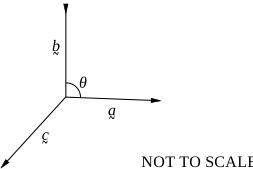
Given that \(\underset{\sim}{a}+\underset{\sim}{b}+\underset{\sim}{c}=\underset{\sim}{0}\), what is the size of angle \(\theta\) between \(\underset{\sim}{a}\) and \(\underset{\sim}{b}\) ?
\(B\)
\(\text{Find}\ \theta\ \text{using:}\ \ \cos\,\theta = \dfrac{\underset{\sim}{a} \cdot \underset{\sim}{b}}{\abs{\underset{\sim}{a}} \, \abs{\underset{\sim}{b}}}\)
\(\underset{\sim}{a}+\underset{\sim}{b}+\underset{\sim}{c}=0 \ \Rightarrow\ \underset{\sim}{a}+\underset{\sim}{b}=-\underset{\sim}{c}\)
\(\abs{\underset{\sim}{a}+\underset{\sim}{b}}=\abs{-\underset{\sim}{c}}=7\)
| \(\abs{\underset{\sim}{a}+\underset{\sim}{b}}^2\) | \(=(\underset{\sim}{a}+\underset{\sim}{b})(\underset{\sim}{a}+\underset{\sim}{b})=49\) |
| \(49\) | \(=\underset{\sim}{a} \cdot \underset{\sim}{a}+2 a \cdot \underset{\sim}{b}+\underset{\sim}{b} \cdot \underset{\sim}{b}\) |
| \(49\) | \(=\abs{\underset{\sim}{a}}^2+2 a \cdot b+\abs{\underset{\sim}{b}}^2\) |
| \(49\) | \(=9+2 \underset{\sim}{a} \cdot \underset{\sim}{b}+25\) |
| \(2 \underset{\sim}{a} \cdot \underset{\sim}{b}\) | \(=15\) |
| \(\underset{\sim}{a} \cdot \underset{\sim}{b}\) | \(=\dfrac{15}{2}\) |
| \(\cos \theta\) | \(=\dfrac{\frac{15}{2}}{3 \times 5}=\dfrac{1}{2}\) |
| \(\therefore \theta\) | \(=\dfrac{\pi}{3}\) |
\(\Rightarrow B\)
The hands of an analogue clock are \(OA\) and \(OB\),
where \(A\) is \(\left(\sin \left(\dfrac{\pi t}{360}\right), \cos \left(\dfrac{\pi t}{360}\right)\right), B\) is \(\left(2 \sin \left(\dfrac{\pi t}{30}\right), 2 \cos \left(\dfrac{\pi t}{30}\right)\right)\),
\(O\) is the origin, and \(t \geq 0\) is the number of minutes past midnight.
Find the values of \(t\) when the hands are perpendicular for the first and second time after midnight. Give your answers to 3 decimal places. (3 marks)
--- 12 WORK AREA LINES (style=lined) ---
\(t=16.364, 49.091 \ \text{mins}\).
\(\text{Express \(OA\) and \(OB\) as vectors:}\)
\(\overrightarrow{O A}=\displaystyle \binom{\sin \left(\frac{\pi t}{360}\right)}{\cos \left(\frac{\pi t}{360}\right)}, \quad \overrightarrow{O B}=\displaystyle \binom{2\, \sin \left(\frac{\pi t}{30}\right)}{2\, \cos \left(\frac{\pi t}{30}\right)}\)
\(\text{When hands are perpendicular,} \ \ \overrightarrow{OA} \cdot \overrightarrow{OB}=0:\)
\(\sin \left(\dfrac{\pi t}{360}\right) \times 2\, \sin \left(\dfrac{\pi t}{30}\right)+\cos \left(\dfrac{\pi t}{360}\right) \times 2\, \cos \left(\dfrac{\pi t}{30}\right)=0\)
| \(\cos \left(\dfrac{\pi t}{30}-\dfrac{\pi t}{360}\right)\) | \(=0\) |
| \(\cos \left(\dfrac{11 \pi t}{360}\right)\) | \(=0\) |
\(\dfrac{11 \pi t}{360}=\dfrac{\pi}{2}, \dfrac{3 \pi}{2}\)
\(t=\dfrac{\pi}{2} \times \dfrac{360}{11 \pi}=16.364 \ \text{mins}\)
\(t=\dfrac{3 \pi}{2} \times \dfrac{360}{11 \pi}=49.091 \ \text{mins}\).
For what value of \(m\) is the vector \(\displaystyle \binom{1}{m}\) parallel to the vector \(\displaystyle \binom{2}{6}\)? (1 mark)
--- 5 WORK AREA LINES (style=lined) ---
\(m=3\)
\(\text{If vectors are parallel:}\)
\(\displaystyle \binom{2}{6}=k\binom{1}{m} \ \Rightarrow \ k=2\)
| \(2m\) | \(=6\) |
| \(m\) | \(=3\) |
The projection of \(\underset{\sim}{u}\) onto \(\underset{\sim}{v}\) is given by \(\left(\dfrac{\underset{\sim}{u} \cdot \underset{\sim}{v}}{|\underset{\sim}{v}|^2}\right) \underset{\sim}{v}\).
What is the projection of \(\underset{\sim}{u}=\underset{\sim}{i}+2 \underset{\sim}{j}\) onto \(\underset{\sim}{v}=2 \underset{\sim}{i}-3 \underset{\sim}{j}\) ?
\(B\)
\(\underset{\sim}{u}=\displaystyle\binom{1}{2},|\underset{\sim}{u}|=\sqrt{1^2+2^2}=\sqrt{5}\)
\(\underset{\sim}{v}=\displaystyle \binom{2}{-3},|\underset{\sim}{v}|=\sqrt{2^2+(-3)^2}=\sqrt{13}\)
| \(\operatorname{proj}_{\underset{\sim}{v}}{\underset{\sim}{u}}\) | \(=\dfrac{\underset{\sim}{u} \cdot \underset{\sim}{v}}{|\underset{\sim}{v}|^2} \times \underset{\sim}{v}\) |
| \(=\dfrac{2-6}{13}(\underset{\sim}{2i}-3\underset{\sim}{j})\) | |
| \(=-\dfrac{4}{13}(\underset{\sim}{2i}-3\underset{\sim}{j})\) |
\(\Rightarrow B\)
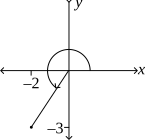
Find the direction of \(\overrightarrow{BA}\) given,
\(\overrightarrow{OA}=\dbinom{-1}{2}\) and \(\overrightarrow{OB}=\dbinom{1}{5}\)
\(\Rightarrow D\)
Given \(\overrightarrow{OP}=2\underset{\sim}{i}-3\underset{\sim}{j}, \ \overrightarrow{P Q}=-\underset{\sim}{i}+2 \underset{\sim}{j}\), find the expression for \(\overrightarrow{O Q}.\) (2 marks) --- 3 WORK AREA LINES (style=lined) --- \(\overrightarrow{O Q}=\underset{\sim}{i}-\underset{\sim}{j}\)
\(\overrightarrow{PQ}\)
\(=\overrightarrow{OQ}-\overrightarrow{OP}\)
\(\displaystyle\binom{-1}{2}\)
\(=\displaystyle\binom{x}{y}-\displaystyle\binom{2}{-3}\)
\(\displaystyle\binom{x}{y}\)
\(=\displaystyle\binom{-1}{2}+\displaystyle\binom{2}{-3}=\binom{1}{-1}\)
\(\therefore \overrightarrow{O Q}=\underset{\sim}{i}-\underset{\sim}{j}\)
Which of the following vectors is perpendicular to \(\displaystyle \binom{3}{-2}\) and has a magnitude of 3?
\(\Rightarrow D\)
\(\text{If} \ \perp \ \Rightarrow \text {dot product}=0:\)
\(\displaystyle \binom{3}{-2}\binom{-3}{2}=-9-4=-13 \neq 0 \quad \text{(Eliminate A and B)}\)
\(\text{Consider Option D:}\)
\(\displaystyle \frac{3}{\sqrt{13}}\left(\frac{2}{3}\right)=\binom{\frac{6}{\sqrt{13}}}{\frac{9}{\sqrt{13}}} \)
\(\text{Magnitude }=\sqrt{\left(\frac{6}{\sqrt{13}}\right)^2+\left(\frac{9}{\sqrt{13}}\right)^2}=\sqrt{\dfrac{36+81}{13}}=3\)
\(\Rightarrow D\)
Evaluate \(\abs{\underset{\sim}{u}+\underset{\sim}{w}}\underset{\sim}{v}\) given \(\underset{\sim}{u}=\displaystyle\binom{2}{1}, \underset{\sim}{v}=\binom{1}{3}\) and \(\underset{\sim}{w}=\displaystyle\binom{-4}{3}\)
\(\Rightarrow C\)
\(\displaystyle \underset{\sim}{u}+\underset{\sim}{w}=\binom{2}{1}+\binom{-4}{3}=\binom{-2}{4} \Rightarrow \abs{\underset{\sim}{u}+\underset{\sim}{w}}=\sqrt{4+16}=\sqrt{20}\)
\(\displaystyle \abs{\underset{\sim}{u}+\underset{\sim}{w}} \underset{\sim}{v}=\sqrt{20}\binom{1}{3}=\binom{\sqrt{20}}{3 \sqrt{20}}\)
\(\Rightarrow C\)
The vector \(\underset{\sim}{a}\) is \(\displaystyle \binom{1}{3}\) and the vector \(\underset{\sim}{b}\) is \(\displaystyle\binom{2}{-1}\). The projection of a vector \(\underset{\sim}{x}\) onto the vector \(\underset{\sim}{a}\) is \(k \underset{\sim}{a}\), where \(k\) is a real number. The projection of the vector \(\underset{\sim}{x}\) onto the vector \(\underset{\sim}{b}\) is \(p \underset{\sim}{b}\), where \(p\) is a real number. Find the vector \(\underset{\sim}{x}\) in terms of \(k\) and \(p\). (4 marks) --- 12 WORK AREA LINES (style=lined) --- \(\underset{\sim}{x}=\dfrac{5}{7} \displaystyle \binom{2 k+3 p}{4 k-p}\) \(\underset{\sim}{a}=\displaystyle \binom{1}{3}, \ \abs{\underset{\sim}{a}}=\sqrt{1^2+3^2}=\sqrt{10}\) \(\underset{\sim}{b}=\displaystyle \binom{2}{-1}, \ \abs{\underset{\sim}{b}}=\sqrt{2^2+(-1)^2}=\sqrt{5}\) \(\text{Let } \underset{\sim}{x}=\displaystyle \binom{x_1}{x_2}\) \(\operatorname{proj}_{\underset{\sim}{a}} \underset{\sim}{x}=\dfrac{\underset{\sim}{x} \cdot \underset{\sim}{a}}{|\underset{\sim}{a}|^2} \underset{\sim}{a}=\dfrac{x_1+3 x_2}{10} \cdot \underset{\sim}{a}\) \(k=\dfrac{x_1+3 x_2}{10} \ \Rightarrow \ x_1+3 x_2=10 k\ \ldots\ (1)\) \(\operatorname{proj}_{\underset{\sim}{b}} \underset{\sim}{x}=\dfrac{\underset{\sim}{b} \cdot \underset{\sim}{x}}{|\underset{\sim}{b}|^2} b=\dfrac{2 x_1-x_2}{5} \cdot \underset{\sim}{b}\) \(p=\dfrac{2 x_1-x_2}{5} \ \Rightarrow \ 2 x_1-x_2=5 p\ \ldots\\ (2)\) \(\text {Multiply } (2) \times 3\) \(6 x_1-3 x_2=15 p\ \ldots\ (3)\) \((1)+(3)\) \(2 x_1+6 x_2=20 k\ \ldots\ (4)\) \(\text {Subtract} (4)-(2)\)
\(7 x_1\)
\(=10 k+15 p\)
\(x_1\)
\(=\dfrac{1}{7}(10 k+15)\)
\(\text {Multiply } (1) \times 2\)
\(7x_2\)
\(=20 k-5 p\)
\(x_2\)
\(=\dfrac{1}{7}(20 k-5 p)\)
\(\therefore \underset{\sim}{x}=\displaystyle \frac{1}{7}\binom{10 k+15 p}{20 k-5 p}=\frac{5}{7}\binom{2 k+3 p}{4 k-p}\)
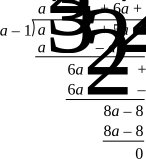
The vectors \(\displaystyle \binom{a^2}{2}\) and \(\displaystyle \binom{a+5}{a-4}\) are perpendicular. Find the possible values of \(a\). (3 marks) --- 5 WORK AREA LINES (style=lined) --- \(x=1,-4 \text { or }-2\) \(\text{If vectors are }\perp:\) \(\displaystyle\binom{a^2}{2} \cdot\binom{a+5}{a-4}=0\) \(a^3+5 a^2+2 a-8=0\) \(\text{Test for roots:}\) \(1^3+5 \times 1^2+2\times 1-8=0 \, \checkmark\) \((a-1) \text{ is a factor.}\) \(\text{By polynomial long division:}\) \((a-1)\left(a^2+6 a+8\right)=0\) \((a-1)(a+4)(a+2)=0\) \(\therefore x=1,-4 \text { or }-2\)
Consider the vectors \(\underset{\sim}{a}=3 \underset{\sim}{i}+2 \underset{\sim}{j}\) and \(\underset{\sim}{b}=-\underset{\sim}{i}+4 \underset{\sim}{j}\). --- 3 WORK AREA LINES (style=lined) --- --- 3 WORK AREA LINES (style=lined) --- i. \(\displaystyle \binom{7}{0}\) ii. \(5\) i. \(\underset{\sim}{a}=3 \underset{\sim}{i}+2 \underset{\sim}{j}, \ \underset{\sim}{b}=-\underset{\sim}{i}+4 \underset{\sim}{j}\) \(2 \underset{\sim}{a}-\underset{\sim}{b}=2 \displaystyle \binom{3}{2}-\binom{-1}{4}=\binom{6}{4}-\binom{-1}{4}=\binom{7}{0}\) ii. \(\underset{\sim}{a} \cdot \underset{\sim}{b}=\displaystyle\binom{3}{2}\binom{-1}{4}=3 \times(-1)+2 \times 4=5\).
Which of the following vectors is perpendicular to \(3 \underset{\sim}{i}+2 \underset{\sim}{j}-5 \underset{\sim}{k}\) ?
\(D\)
\(\text{Consider option}\ D:\)
\[\underset{\sim}{a} \cdot \underset{\sim}{b}=\left(\begin{array}{c} 3 \\ 2 \\ -5 \end{array}\right) \left(\begin{array}{c} 3 \\ -2 \\ 1 \end{array}\right) = 9-4-5=0 \]
\(\Rightarrow D\)
Given the two non-zero vectors \(\underset{\sim}{a}\) and \(\underset{\sim}{b}\), let \(\underset{\sim}{c}\) be the projection of \(\underset{\sim}{a}\) onto \(\underset{\sim}{b}\).
What is the projection of \(10 \underset{\sim}{a}\) onto \(2 \underset{\sim}{b}\) ?
\(C\)
\(\underset{\sim}c=\text{proj}_{\underset{\sim}b}\underset{\sim}a =\dfrac{\underset{\sim}a \cdot \underset{\sim}b}{|b|^2} \underset{\sim}b \)
| \(\text{proj}_{2\underset{\sim}b} 10\underset{\sim}a \) | \(=\dfrac{10\underset{\sim}a \cdot 2\underset{\sim}b}{\big{|}2\underset{\sim}b\big{|}^2} 2\underset{\sim}b \) | |
| \(=\dfrac{20 \times 2}{2^2} \Bigg{(}\dfrac{\underset{\sim}a \cdot \underset{\sim}b}{|\underset{\sim}b|^2} \underset{\sim}b \Bigg{)} \) | ||
| \(=10 \underset{\sim}c \) |
\(\Rightarrow C\)
The vectors `\vec{u}` and `\vec{v}` are not parallel. The vector `\vec{p}` is the projection of `\vec{u}` onto the vector `\vec{v}`.
The vector `\vec{p}` is parallel to `\vec{v}` so it can be written `\lambda_0 \vec{v}` for some real number `\lambda_0`. (Do NOT prove this.)
Prove that `|\vec{u}-\lambda \vec{v}|` is smallest when `\lambda=\lambda_0` by showing that, for all real numbers `\lambda,\|\vec{u}-\lambda_0 \vec{v}\| \leq|\vec{u}-\lambda \vec{v}|`. (3 marks)
--- 8 WORK AREA LINES (style=lined) ---
`text{Proof (See Worked Solutions)}`
| `overset(->)p` | `=text{proj}_(overset(->)v)overset(->)u` | |
| `lambda_0 overset(->)v` | `=(overset(->)u*overset(->)v)/(|overset(->)v|^2) overset(->)v` | |
| `lambda_0` | `=(overset(->)u*overset(->)v)/(|overset(->)v|^2 )\ \ \ …\ (1)` |
`text{Show}\ \ |\vec{u}-\lambda_0 \vec{v}\| \leq|\vec{u}-\lambda \vec{v}| :`
`|\vec{u}-\lambda \vec{v}\|^2 -|\vec{u}-\lambda_0 \vec{v}|^2`
`=(vec{u}-\lambda \vec{v})*(vec{u}-\lambda \vec{v})-(vec{u}-\lambda_0 \vec{v})*(vec{u}-\lambda_0 \vec{v})`
`=vec{u}*vec{u}-2lambda vec{u}*vec{v}+lambda^2vec{v}*vec{v}-(vec{u}*vec{u}-2lambda_0vec{u}*vec{v}+lambda_0^2vec{v}*vec{v})`
`=-2lambdavec{u}*vec{v}+lambda^2|vec{v}|^2+2lambda_0vec{u}*vec{v}-lambda_0^2|vec{v}|^2`
`=|vec{v}|^2(lambda^2-lambda_0^2)-2vec{u}*vec{v}(lambda-lambda_0)`
`=|vec{v}|^2(lambda-lambda_0)[lambda+lambda_0-2(vec{u}*vec{v})/|vec{v}|^2]`
`=|vec{v}|^2(lambda-lambda_0)[lambda+lambda_0-2lambda_0]\ \ \ text{(see (1))}`
`=|vec{v}|^2(lambda-lambda_0)^2>=0`
`text{S}text{ince}\ \ |\vec{u}-\lambda \vec{v}\|^2 -|\vec{u}-\lambda_0 \vec{v}|^2>=0`
`=>\ |\vec{u}-\lambda_0 \vec{v}|^2<=|\vec{u}-\lambda \vec{v}\|^2 `
`=>\ |\vec{u}-\lambda_0 \vec{v}|<=|\vec{u}-\lambda \vec{v}\| \ \ text{… as required}`
`:. |\vec{u}-\lambda \vec{v}|\ \ text{is smallest when}\ \ lambda=\lambda_0`
The vectors `underset~u=([a],[2])` and `underset~v=([a-7],[4a-1])` are perpendicular.
What are the possible values of `a`? (2 marks)
--- 5 WORK AREA LINES (style=lined) ---
`a=1, -2`
`text{If}\ \ underset~u ⊥ underset~v:`
| `([a],[2])*([a-7],[4a-1])` | `=0` | |
| `a(a-7)+2(4a-1)` | `=0` | |
| `a^2-7a+8a-2` | `=0` | |
| `a^2+a-2` | `=0` | |
| `(a+2)(a-1)` | `=0` |
`:.a=1\ \ text{or}\ \ -2`
For the vectors `underset~u= underset~i- underset~j` and `underset~v=2 underset~i+ underset~j`, evaluate each of the following.
--- 2 WORK AREA LINES (style=lined) ---
i. `underset~u= ((1),(-1)),\ \ underset~v= ((2),(1))`
| `underset~u+3 underset~v` | `=((1),(-1))+3((2),(1))` | |
| `=((1+3xx2),(-1+3xx1))` | ||
| `=((7),(2))` |
| ii. | `underset~u * underset~v` | `=((1),(-1))*((2),(1))` |
| `=1xx2+(-1)xx1` | ||
| `=1` |
The angle between two unit vectors `underset~a` and `underset~b` is `theta` and `|underset~a+ underset~b| < 1`.
Which of the following best describes the possible range of values of `theta` ?
`D`
`text{By Elimination:}`
`text{Consider}\ \ underset~a=((1),(0)) and underset~b=((-1),(0))`
`|underset~a+ underset~b| =0 < 1\ \ and\ \ theta=pi`
`text{→ Eliminate A and B}`
`text{Consider}\ \ theta=(2pi)/3 and underset~a=((1),(0)),\ \ underset~b=((costheta),(sintheta))`
`underset~a+underset~b=((1+cos((2pi)/3)),(sin((2pi)/3)))=((1/2),(sqrt3/2))`
`|underset~a+ underset~b|^2 = (1/2)^2+(sqrt3/2)^2=1`
`:. theta !=(2pi)/3`
`text{→ Eliminate C}`
`=>D`
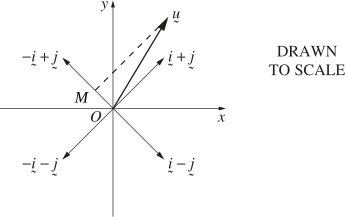
The following diagram shows the vector `underset∼u` and the vectors `underset∼i+underset∼j,-underset∼i+ underset∼j,-underset∼i- underset∼j` and `underset∼i-underset∼j`.
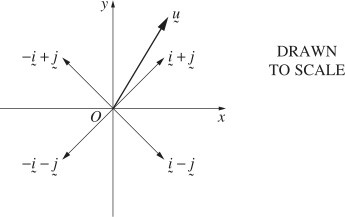
Which statement regarding this diagram could be true?
`B`
Consider the vectors `underset~a = x underset~i + underset~j, \ underset~b = underset~i - underset~j` and `underset~c = underset~i + x underset~j`.
Given that `theta` is the angle between `underset~a` and `underset~b`, and `phi` is the angle between `underset~b` and `underset~c, cos(theta) cos (phi)` is
`D`
`underset~a = x underset~i – underset~j, \ underset~b = underset~i – underset~j, \ underset~c = underset~i + x underset~j`
`underset~a · underset~b = |underset~a||underset~b|costheta`
`costheta = (x – 1)/(sqrt(x^2 + 1)sqrt2)`
`cos phi = (underset~b · underset~c)/(|underset~b||underset~c|) = (1 – x)/(sqrt2 sqrt(1 + x^2))`
| `costheta · cos phi` | `= ((x – 1)(1 – x))/(2(1 + x^2))` |
| `= -((x – 1)^2)/(2(1 + x^2))` |
`=>\ D`
Find `(underset~i + 6underset~j) + (2underset~i - 7underset~j)`. (1 mark)
`3underset~i – underset~j`
`((1),(6)) + ((2),(-7)) = ((3),(-1)) = 3underset~i – underset~j`
For the two vectors `overset->(OA)` and `overset->(OB)` it is know that
`overset->(OA) · overset->(OB) < 0`
Which of the following statements MUST be true?
`B`
`overset->(OA) · overset->(OB) < 0`
| `|overset->(OA)||overset->(OB)| cos theta` | `< 0` |
| `cos theta` | `< 0` |
`text(If)\ \ cos theta < 0, theta\ \ text{is in 2nd quadrant (obtuse).}`
`=> B`
Given that `overset->(OP) = ((-3),(1))` and `overset->(OQ) = ((2),(5))`, what is `overset->(PQ)`?
`C`
| `overset->(PQ)` | `= overset->(OQ) – overset->(OP)` |
| `= ((2),(5))-((-3),(1))` | |
| `= ((5),(4))` |
`=>\ C`
For what values(s) of `a` are the vectors `((a),(−1))` and `((2a - 3),(2))` perpendicular? (3 marks)
`a = −1/2\ text(or)\ 2`
| `((a),(−1)) · ((2a – 3),(2))` | `= 0` |
| `a(2a – 3) + (−1) xx 2` | `= 0` |
| `2a^2 – 3a – 2` | `= 0` |
| `(2a + 1)(a – 2)` | `= 0` |
`:. a = −1/2\ \ text(or)\ \ 2`
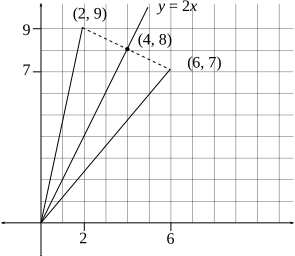
The projection of the vector `((6),(7))` onto the line `y = 2x` is `((4),(8))`.
The point `(6, 7)` is reflected in the line `y = 2x` to a point `A`.
What is the position vector of the point `A`?
`B`
Maria starts at the origin and walks along all of the vector `2underset~i + 3underset~j`, then walks along all of the vector `3underset~i - 2underset~j` and finally along all of the vector `4underset~i - 3underset~j`.
How far from the origin is she?
`B`
| `underset~v` | `= ((2),(3)) + ((3),(−2)) + ((4),(−3))` |
| `= ((9),(−2))` |
| `|underset~v|` | `= sqrt(9^2 + (−2)^2)` |
| `= sqrt85` |
`=>B`
The vectors `underset~a = 6underset~i + 2underset~j, \ underset~b = underset~i - 5underset~j` and `underset~c = 4underset~i + 4underset~j`
Find the values of `m` and `n` such that `m underset~a + n underset~b = underset~c`. (2 marks)
--- 6 WORK AREA LINES (style=lined) ---
`n= −1/2`
`m = 3/4`
`m underset~a + n underset~b= underset~c`
| `m((6),(2)) + n((1),(−5))` | `= ((4),(4))` |
`6m + n = 4\ \ …\ (1)`
`2m – 5n = 4\ \ …\ (2)`
`text(Multiply)\ (2) xx 3`
`6m – 15n = 12\ \ …\ (3)`
`text(Subtract)\ \ (1) – (3)`
`16n = –8 \ => \ n= −1/2`
`text(Substitute)\ \ n = –1/2\ \ text{into (2):}`
| `2m + 5/2` | `= 4` |
| `m` | `= 3/4` |
`:. m=3/4, \ n= −1/2`
Using vectors, calculate the acute angle between the line that passes through `A(1, 3)` and `B(2,–6)` and the line that passes through `C(1, 5)` and `D(3,–2)`.
Give your answer correct to one decimal place. (2 marks)
--- 6 WORK AREA LINES (style=lined) ---
`9.6°`
`underset~a = ((1),(3)), \ underset~b = ((2),(−6)), \ underset~c = ((1),(5)), \ underset~d = ((3),(−2))`
| `overset(->)(AB)` | `= underset~b – underset~a = ((2),(−6)) – ((1),(3)) = ((1),(−9))` |
| `overset(->)(CD)` | `= underset~d – underset~c = ((3),(−2)) – ((1),(5)) = ((2),(−7))` |
| `costheta` | `= (overset(->)(AB) · overset(->)(CD))/(|overset(->)(AB)| · |overset(->)(CD)|)` |
| `= (2 + 63)/(sqrt82 · sqrt53)` | |
| `= 0.985…` |
| `:. theta` | `=cos^(-1) 0.985…` |
| `= 9.605…` | |
| `= 9.6°\ \ (text(to 1 d.p.))` |
Let the vectors `underset~a=4 underset~i - underset~j, \ underset~ b = 3underset~i+2 underset~j` and `underset~c=-2 underset~i +5underset~j`.
--- 3 WORK AREA LINES (style=lined) ---
`text{Proof (See Worked Solution)}`
a. `underset~a=((4),(-1)),\ \ underset~b=((3),(2)),\ \ underset~c=((-2),(5))`
`(underset~b+underset~c) = ((3),(2)) + ((-2),(5)) = ((1),(7))`
| `underset~a*(underset~b+underset~c)` | `=((4),(-1)) *((1),(7))` | |
| `=(4 xx 1) -(1 xx 7)` | ||
| `=-3` |
| b. | `underset~a * underset~b + underset~a * underset~c` | `=((4),(-1)) *((3),(2)) + ((4),(-1))*((-2),(5))` |
| `=(4 xx 3) -(1 xx 2) + (4xx-2) -(1 xx 5)` | ||
| `=-3` | ||
| `=underset~a*(underset~b+underset~c)` |
What is the angle between the vectors `((2),(1))` and `((-4),(2))`?
A. `cos^(-1)(0.06)`
B. `cos^(-1)(–0.06)`
C. `cos^(-1)(0.6)`
D. `cos^(-1)(–0.6)`
`D`
| `cos theta` | `=(underset~a * underset~b)/(|underset~a||underset~b|)` | |
| `=(-8+2)/(sqrt(2^2+1^2) xx sqrt((-4)^2+2^2)` | ||
| `=(-6)/(sqrt5 sqrt20)` | ||
| `=-0.6` | ||
| `:. theta` | `= cos^(-1) (-0.6)` |
`=> D`
If `theta` is the angle between `underset~a = underset~i + 3j` and `underset~b = 3underset~i + underset~j`, then find the exact value of `cos 2theta`. (2 marks)
--- 6 WORK AREA LINES (style=lined) ---
`−7/25`
`underset~a = [(1),(3)],\ \ underset~b = [(3),(1)]`
`|underset~a| = sqrt(1^2 + 3^2) = sqrt10`
`|underset~b| = sqrt(3^2 + 1^2) = sqrt10`
`cos theta= (1 xx 3 + 3 xx 1)/(sqrt10 sqrt10)= 3/5`
| `cos2theta` | `= 2cos^2theta – 1` |
| `= 2(3/5)^2 – 1` | |
| `= −7/25` |
Two vectors are given by `underset~a = 2underset~i + m underset~j` and `underset~b = −5underset~i + n underset~j` where `m, n > 0`.
If `|underset~a| = 3` and `underset~a` is perpendicular to `underset~b`, find the values of `m` and `n`. (2 marks)
--- 6 WORK AREA LINES (style=lined) ---
`2sqrt5`
`underset~a = [(2),(m)],\ \ underset~b = [(−5),(n)]`
`text(Using)\ |underset~a| = 3:`
| `3` | `= sqrt(2^2 + m^2)` |
| `m^2` | `= 5` |
| `:.m` | `= sqrt5,\ \ \ (m > 0)` |
`text(S)text(ince)\ underset~a ⊥ underset~b:`
| `a · b` | `= 0` |
| `2xx −5 + mn` | `= 0` |
| `sqrt5 n` | `= 10` |
| `n` | `= 10/sqrt5` |
| `= 2sqrt5` |
Relative to a fixed origin, the points `A`, `B` and `C` are defined respectively by the position vectors `underset~a = −underset~i - underset~j, \ underset~b = 3underset~i + 2underset~j` and `underset~c = −aunderset~i + 2underset~j`, where `a` is a real constant.
If the magnitude of angle `ABC` is `pi/3`, find `a`. (3 marks)
--- 10 WORK AREA LINES (style=lined) ---
`−3`
`text(Angle between)\ overset(->)(BA)\ text(and)\ overset(->)(BC) = pi/3`
| `overset(->)(BA)` | `= overset(->)(OA) – overset(->)(OB)` |
| `= [(−1),(−1)] – [(3),(2)] = [(−4),(−3)]` |
| `overset(->)(BC)` | `= overset(->)(OC) – overset(->)(OB)` |
| `= [(−a),(2)] – [(3),(2)] = [(−a−3),(0 )]` |
| `overset(->)(BA) · overset(->)(BC)` | `= [(−4),(−3)] · [(−a −3),(0 )]` |
| `= 4a + 12` |
`overset(->)(BA) · overset(->)(BC) = |overset(->)(BA)| · |overset(->)(BC)|costheta`
| `4a + 12` | `= sqrt((−4)^2 + (−3)^2) · sqrt((-a-3)^2) · cos\ pi/3` |
| `4a + 12` | `= 5(-a-3) · 1/2` |
| `4a + 12` | `= -(5a)/2-15/2` |
| `(13a)/2` | `= -39/2` |
| `:.a` | `= -3` |
Consider the vector `underset~a = underset~i + sqrt3underset~j`, where `underset~i` and `underset~j` are unit vectors in the positive direction of the `x` and `y` axes respectively.
--- 2 WORK AREA LINES (style=lined) ---
--- 6 WORK AREA LINES (style=lined) ---
Given that `underset~b` is perpendicular to `underset~a`, find the value of `underset~m`. (1 mark)
--- 4 WORK AREA LINES (style=lined) ---
a. `1/2(underset~i + sqrt3underset~j)`
b. `60°`
c. `2sqrt3`
a. `underset~a = underset~i + sqrt3underset~j`
`|underset~a| = sqrt(1 + (sqrt(3))^2) = 2`
`overset^a = (underset~a)/(|underset~a|) = 1/2(underset~i + sqrt3underset~j)`
b. `text(Solution 1)`
`underset~a\ =>\ text(Position vector from)\ \ O\ \ text{to}\ \ (1, sqrt3)`
| `tan theta` | `=sqrt3` | |
| `:. theta` | `=60°` | |
`text(Solution 2)`
`text(Angle with)\ xtext(-axis = angle with)\ \ underset~b = underset~i`
`underset~a · underset~i = 1 xx 1 = 1`
| `underset~a · underset~i` | `= |underset~a||underset~i|costheta` |
| `1` | `= 2 xx 1 xx costheta` |
| `costheta` | `= 1/2` |
| `:. theta` | `= 60°` |
c. `underset~b = m underset~i – 2underset~j`
`underset~a · underset~b = [(1),(sqrt3)] · [(m),(−2)] = m – 2sqrt3`
`text(S)text(ince)\ underset~a ⊥ underset~b:`
| `m – 2sqrt3` | `= 0` |
| `m` | `= 2sqrt3` |
Consider the following vectors
`overset(->)(OA) = 2underset~i + 2underset~j,\ \ overset(->)(OB) = 3underset~i - underset~j,\ \ overset(->)(OC) = 5underset~i + 3underset~j`
--- 3 WORK AREA LINES (style=lined) ---
a. `underset~i – 3underset~j`
b. `text(See Worked Solutions)`
c. `2sqrt5`
a. `text(Find)\ overset(->)(AB):`
`overset(->)(OA) = [(2),(2)],\ \ overset(->)(OB)[(3),(−1)]`
| `overset(->)(AB)` | `= overset(->)(OB) – overset(->)(OA)` |
| `= [(3),(−1)] – [(2),(2)]` | |
| `= [(1),(−3)]` | |
| `= underset~i – 3underset~j` |
| b. | `overset(->)(AC)` | `= overset(->)(OC) – overset(->)(OA)` |
| `= [(5),(3)] – [(2),(2)]` | ||
| `= [(3),(1)]` | ||
| `= 3underset~i + underset~j` |
| `overset(->)(AB) · overset(->)(AC)` | `= 1 xx 3 + −3 xx 1=0` |
`=> AB ⊥ AC`
`:. DeltaABC\ text(has a right angle at)\ A.`
c. `overset(->)(BC)\ text(is the hypotenuse)`
| `overset(->)(BC)` | `= overset(->)(OC) – overset(->)(OB)` |
| `= [(5),(3)] – [(3),(−1)]` | |
| `= [(2),(4)]` |
| `|overset(->)(BC)|` | `=\ text(length of hypotenuse)` |
| `= sqrt(2^2 + 4^2)` | |
| `= sqrt(20)` | |
| `= 2sqrt5` |
The vectors `underset~a = 2underset~i + m underset~j` and `underset~b = m^2underset~i-underset~j` are perpendicular for
`D`
`underset ~a ⊥ underset ~b\ \ =>\ \ underset ~a ⋅ underset ~b=0`
| `underset ~a ⋅ underset ~b` | `= 2m^2 + m(-1)` |
| `0` | `= 2m^2-m` |
| `0` | `= m(2m-1)` |
`:. m = 0, quad m = 1/2`
`=> D`
Consider the vectors
`underset~a = 6underset~i + 2underset~j,\ \ underset~b = 2underset~i - m underset~j`
--- 2 WORK AREA LINES (style=lined) ---
--- 5 WORK AREA LINES (style=lined) ---
--- 2 WORK AREA LINES (style=lined) ---
a. `[(6),(4 + 3m)]`
b. `±sqrt14`
c. `6`
| a. | `2underset~a – 3underset~b` | `= 2[(6),(2)] – 3[(2),(−m)]` |
| `= [(12),(4)] – [(6),(−3m)]` | ||
| `= [(6),(4 + 3m)]` |
b. `underset~a = [(6),(2)], \ \ underset~b = [(2),(−m)]`
| `|underset~b|` | `= sqrt(4 + m^2)` |
| `3sqrt2` | `= sqrt(4 + m^2)` |
| `18` | `= 4 + m^2` |
| `m^2` | `= 14` |
| `m` | `= ±sqrt14` |
c. `text(If)\ \ underset~a ⊥ underset~b \ => \ underset~a · underset~b = 0`
| `6 xx 2 + 2 xx – m` | `= 0` |
| `2m` | `= 12` |
| `:. m` | `= 6` |
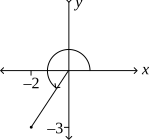
Consider the vectors, `underset~a = overset(->)(OA)` where `|OA| = 5` and `underset~b = overset(->)(OB)` where `|OB| = 7`.
If `angleAOB = 30°`, find `text(proj)_(underset~b)underset~a` as a multiple of `underset~b`. (2 marks)
`(5sqrt3)/14 · underset~b`
`underset~overset^b = (underset~b)/(|OB|) = (underset~b)/7`
| `text(proj)_underset~bunderset~a` | `= (|underset~a|\ cos30°) · underset~overset^b` |
| `= 5 xx sqrt3/2 xx (underset~b)/7` | |
| `= (5sqrt3)/14 · underset~b` |