SmarterEd

Aussie Maths & Science Teachers: Save your time with SmarterEd

  • Login
  • Get Help
  • About

HMS, BM EQ-Bank 581

Discuss the application of blocked and random practice methods for athletes at different stages of learning a team sport like netball.   (6 marks)

--- 18 WORK AREA LINES (style=lined) ---

Show Answers Only

*PEEL – Solution is structured using separate PEEL methods for each side of the argument; [P] Identify the point, [E] expand on the point with a link to question asked, [Ev] apply evidence/examples, [L] linking sentence back to question.

Blocked practice benefits early-stage netball learners:

  • [P] Blocked practice suits cognitive-stage players learning basic skills.
  • [E] Beginners need repetition without task-switching complexity to develop fundamental techniques correctly.
  • [Ev] In this practice method, new players could practice 50 chest passes in a row to establish proper hand positioning and release.
  • [L] Therefore, blocked practice provides the consistency needed for initial skill acquisition.
     
  • [P] Associative-stage players still benefit from some blocked practice.
  • [E] Repeating specific movements helps refine technique weaknesses while building confidence.
  • [Ev] Players struggling with shooting accuracy would practice many goal shots from the same position using this method.
  • [L] Thus, blocked practice remains useful for targeted skill improvement at intermediate levels.

Random practice better prepares advanced players:

  • [P] Random practice develops game-ready skills in autonomous players.
  • [E] Constantly switching between passing, shooting, and defending mirrors actual match demands.
  • [Ev] Elite players train with drills combining unexpected passes, defensive pressure, and quick shooting decisions.
  • [L] This variability ensures skills transfer effectively to competitive games.
     
  • [P] Random practice produces superior long-term retention.
  • [E] Although blocked practice shows faster initial improvement, random practice creates lasting skill development.
  • [Ev] Players practicing varied skills retain abilities better after off-season breaks than those using blocked methods.
  • [L] Therefore, random practice provides more durable learning outcomes for advanced netball players.
Show Worked Solution

*PEEL – Solution is structured using separate PEEL methods for each side of the argument; [P] Identify the point, [E] expand on the point with a link to question asked, [Ev] apply evidence/examples, [L] linking sentence back to question.

Blocked practice benefits early-stage netball learners:

  • [P] Blocked practice suits cognitive-stage players learning basic skills.
  • [E] Beginners need repetition without task-switching complexity to develop fundamental techniques correctly.
  • [Ev] In this practice method, new players could practice 50 chest passes in a row to establish proper hand positioning and release.
  • [L] Therefore, blocked practice provides the consistency needed for initial skill acquisition.
     
  • [P] Associative-stage players still benefit from some blocked practice.
  • [E] Repeating specific movements helps refine technique weaknesses while building confidence.
  • [Ev] Players struggling with shooting accuracy would practice many goal shots from the same position using this method.
  • [L] Thus, blocked practice remains useful for targeted skill improvement at intermediate levels.

Random practice better prepares advanced players:

  • [P] Random practice develops game-ready skills in autonomous players.
  • [E] Constantly switching between passing, shooting, and defending mirrors actual match demands.
  • [Ev] Elite players train with drills combining unexpected passes, defensive pressure, and quick shooting decisions.
  • [L] This variability ensures skills transfer effectively to competitive games.
     
  • [P] Random practice produces superior long-term retention.
  • [E] Although blocked practice shows faster initial improvement, random practice creates lasting skill development.
  • [Ev] Players practicing varied skills retain abilities better after off-season breaks than those using blocked methods.
  • [L] Therefore, random practice provides more durable learning outcomes for advanced netball players.


Filed Under: Practice methods Tagged With: Band 5, Band 6, smc-5924-30-Blocked/random, smc-5924-60-X-topic SOL

HMS, BM EQ-Bank 580

Explain how a basketball coach could use the whole-part-whole method to teach an effective jump shot to high school athletes.   (4 marks)

--- 12 WORK AREA LINES (style=lined) ---

Show Answers Only

Sample Answer

  • The coach first demonstrates the complete jump shot and has athletes practice it (whole). Such demonstration allows students to understand the overall movement and objective.
  • Next, they identify specific technique issues and breaks the skill into components. These include foot positioning, ball grip, arm extension and follow-through (part).
  • The coach then provides separate practice sessions for each component with specific feedback. Individual practice enables targeted improvement of specific weaknesses.
  • After component mastery, the coach reintegrates the full jump shot movement (whole). Full integration ensures smooth transitions between all elements.
  • This coaching approach is effective because it provides context before component practice. Athletes consequently synthesise improved parts into refined whole movements.
Show Worked Solution

Sample Answer 

  • The coach first demonstrates the complete jump shot and has athletes practice it (whole). Such demonstration allows students to understand the overall movement and objective.
  • Next, they identify specific technique issues and breaks the skill into components. These include foot positioning, ball grip, arm extension and follow-through (part).
  • The coach then provides separate practice sessions for each component with specific feedback. Individual practice enables targeted improvement of specific weaknesses.
  • After component mastery, the coach reintegrates the full jump shot movement (whole). Full integration ensures smooth transitions between all elements.
  • This coaching approach is effective because it provides context before component practice. Athletes consequently synthesise improved parts into refined whole movements.

Filed Under: Practice methods Tagged With: Band 4, Band 5, smc-5924-20-Whole/part

HMS, BM EQ-Bank 579

Outline the benefits of whole practice for an athlete in the autonomous stage of learning.   (3 marks)

--- 7 WORK AREA LINES (style=lined) ---

Show Answers Only

Sample Answer

  • Whole practice suits autonomous-stage athletes who have already mastered individual components and can effectively integrate all skill elements simultaneously, maintaining natural flow and timing.
  • Autonomous learners possess the ability to handle complex integrated movements, allowing them to refine the entire skill sequence under competition-like conditions.
  • This practice method enables autonomous athletes to focus on strategic applications and performance optimisation rather than basic technique development.
Show Worked Solution

Sample Answer 

  • Whole practice suits autonomous-stage athletes who have already mastered individual components and can effectively integrate all skill elements simultaneously, maintaining natural flow and timing.
  • Autonomous learners possess the ability to handle complex integrated movements, allowing them to refine the entire skill sequence under competition-like conditions.
  • This practice method enables autonomous athletes to focus on strategic applications and performance optimisation rather than basic technique development.

Filed Under: Practice methods Tagged With: Band 3, smc-5924-20-Whole/part, smc-5924-60-X-topic SOL

HMS, BM EQ-Bank 578

Describe how a tennis coach could implement distributed practice when teaching the serve to a beginner player.   (4 marks)

--- 10 WORK AREA LINES (style=lined) ---

Show Answers Only

Sample Answer

  • The coach would structure short practice periods focusing on specific serve components like grip, stance, ball toss and swing technique, interspersed with planned rest periods.
  • During rest periods, the coach could provide demonstrations and feedback while the beginner mentally processes instructions. This would suit cognitive stage learners who need time to understand any new movements.
  • The coach could alternate between serve practice and other less demanding skills like forehand groundstrokes. Physical and mental fatigue that beginners experience quickly can be avoided using these methods.
  • This distributed approach would maintain the beginner’s concentration and prevent technique deterioration due to fatigue, allowing proper skill development without overwhelming the learner.
Show Worked Solution

Sample Answer 

  • The coach would structure short practice periods focusing on specific serve components like grip, stance, ball toss and swing technique, interspersed with planned rest periods.
  • During rest periods, the coach could provide demonstrations and feedback while the beginner mentally processes instructions. This would suit cognitive stage learners who need time to understand any new movements.
  • The coach could alternate between serve practice and other less demanding skills like forehand groundstrokes. Physical and mental fatigue that beginners experience quickly can be avoided using these methods.
  • This distributed approach would maintain the beginner’s concentration and prevent technique deterioration due to fatigue, allowing proper skill development without overwhelming the learner.

Filed Under: Practice methods Tagged With: Band 4, smc-5924-10-Massed/Distributed, smc-5924-60-X-topic SOL

HMS, BM EQ-Bank 577

To what extent should practice methods be modified based on the characteristics of the learner and the nature of the skill being taught. In your response, refer to at least two different practice methods.   (8 marks)

--- 22 WORK AREA LINES (style=lined) ---

Show Answers Only

Position Statement:

  • Practice methods should be modified to a significant extent based on learner characteristics and skill nature.
  • This extensive modification is justified by attention span differences, skill complexity variations, and physical demands.

Strongest Evidence:

  • Learner characteristics fundamentally alter practice effectiveness.
  • Children with short attention spans require distributed practice with frequent breaks, while motivated adults thrive with 45-minute massed sessions.
  • Young tennis players need 10-minute skill blocks versus adults managing continuous practice.
  • Skill nature equally demands major modifications.
  • Open skills like basketball require random practice for decision-making development.
  • Closed skills like golf putting need blocked practice for consistency.
  • High-fatigue activities like sprinting mandate distributed practice regardless of learner type.

Limitations:

  • Some standardised elements can remain consistent across learners.
  • Basic safety protocols and fundamental movement patterns apply universally.
  • However, these limited similarities are overshadowed by the need for individualisation.
  • Even when teaching the same skill, a nervous beginner requires part practice while a confident learner benefits from whole practice.
  • Physical maturity, prior experience, and cognitive ability create such diverse learning needs that significant modification becomes essential.

Reaffirmation:

  • The evidence overwhelmingly supports significant practice modification.
  • Coaches who extensively adapt methods based on learner traits and skill demands achieve superior outcomes.
  • Therefore, practice methods must be modified to a significant extent, progressing from part/blocked for beginners to whole/random for advanced learners.
Show Worked Solution

Position Statement:

  • Practice methods should be modified to a significant extent based on learner characteristics and skill nature.
  • This extensive modification is justified by attention span differences, skill complexity variations, and physical demands.

Strongest Evidence:

  • Learner characteristics fundamentally alter practice effectiveness.
  • Children with short attention spans require distributed practice with frequent breaks, while motivated adults thrive with 45-minute massed sessions.
  • Young tennis players need 10-minute skill blocks versus adults managing continuous practice.
  • Skill nature equally demands major modifications.
  • Open skills like basketball require random practice for decision-making development.
  • Closed skills like golf putting need blocked practice for consistency.
  • High-fatigue activities like sprinting mandate distributed practice regardless of learner type.

Limitations:

  • Some standardised elements can remain consistent across learners.
  • Basic safety protocols and fundamental movement patterns apply universally.
  • However, these limited similarities are overshadowed by the need for individualisation.
  • Even when teaching the same skill, a nervous beginner requires part practice while a confident learner benefits from whole practice.
  • Physical maturity, prior experience, and cognitive ability create such diverse learning needs that significant modification becomes essential.

Reaffirmation:

  • The evidence overwhelmingly supports significant practice modification.
  • Coaches who extensively adapt methods based on learner traits and skill demands achieve superior outcomes.
  • Therefore, practice methods must be modified to a significant extent, progressing from part/blocked for beginners to whole/random for advanced learners.

Filed Under: Practice methods Tagged With: Band 5, Band 6, smc-5924-10-Massed/Distributed, smc-5924-20-Whole/part

HMS, BM EQ-Bank 576

A soccer coach is using two different practice methods for a player transitioning from the associative to autonomous stage:

  • Method 1 (Blocked practice): The player practices free kicks for 20 minutes, followed by 20 minutes of dribbling drills, then 20 minutes of passing exercises.
  • Method 2 (Random practice): The player participates in small-sided games where they must continuously switch between dribbling, passing, shooting, and defensive skills in response to changing game situations.

Discuss the effectiveness of blocked versus random practice for this soccer player transitioning from the associative to autonomous stage of learning.   (8 marks)

--- 22 WORK AREA LINES (style=lined) ---

Show Answers Only

*PEEL – Solution is structured using separate PEEL methods for each side of the argument; [P] Identify the point, [E] expand on the point with a link to question asked, [Ev] apply evidence/examples, [L] linking sentence back to question.

Random practice (Method 2) is more effective for this transition:

  • [P] Random practice better prepares players for real game demands.
  • [E] Small-sided games force players to switch between skills unpredictably, matching actual match conditions.
  • [Ev] Players must instantly change from dribbling past defenders to executing a through-pass when teammates create space.
  • [L] Therefore, random practice develops the adaptability needed for autonomous performance.
     
  • [P] Random practice enhances decision-making alongside skill execution.
  • [E] Players approaching autonomous stage need to select appropriate skills quickly while maintaining their technique.
  • [Ev] In small-sided games, players choose between shooting or passing based on defensive positioning.
  • [L] This simultaneous skill selection and execution accelerates autonomous stage development.

Blocked practice (Method 1) has limited effectiveness at this stage:

  • [P] Blocked practice provides insufficient challenge for transitioning players.
  • [E] Repetitive drills don’t develop the quick skill-switching required in matches.
  • [Ev] Practicing free kicks for 20 minutes straight doesn’t prepare players for taking one crucial kick under pressure.
  • [L] Thus, blocked practice fails to bridge the gap to autonomous performance.
     
  • [P] While blocked practice may reinforce technique, it has limited transitional effectiveness.
  • [E] Skills practiced in isolation don’t automatically combine during matches.
  • [Ev] Perfect passing in drills doesn’t guarantee successful passes under defensive pressure.
  • [L] Therefore, blocked practice becomes less effective as players approach autonomous stage.
Show Worked Solution

*PEEL – Solution is structured using separate PEEL methods for each side of the argument; [P] Identify the point, [E] expand on the point with a link to question asked, [Ev] apply evidence/examples, [L] linking sentence back to question.

Random practice (Method 2) is more effective for this transition:

  • [P] Random practice better prepares players for real game demands.
  • [E] Small-sided games force players to switch between skills unpredictably, matching actual match conditions.
  • [Ev] Players must instantly change from dribbling past defenders to executing a through-pass when teammates create space.
  • [L] Therefore, random practice develops the adaptability needed for autonomous performance.
     
  • [P] Random practice enhances decision-making alongside skill execution.
  • [E] Players approaching autonomous stage need to select appropriate skills quickly while maintaining their technique.
  • [Ev] In small-sided games, players choose between shooting or passing based on defensive positioning.
  • [L] This simultaneous skill selection and execution accelerates autonomous stage development.

Blocked practice (Method 1) has limited effectiveness at this stage:

  • [P] Blocked practice provides insufficient challenge for transitioning players.
  • [E] Repetitive drills don’t develop the quick skill-switching required in matches.
  • [Ev] Practicing free kicks for 20 minutes straight doesn’t prepare players for taking one crucial kick under pressure.
  • [L] Thus, blocked practice fails to bridge the gap to autonomous performance.
     
  • [P] While blocked practice may reinforce technique, it has limited transitional effectiveness.
  • [E] Skills practiced in isolation don’t automatically combine during matches.
  • [Ev] Perfect passing in drills doesn’t guarantee successful passes under defensive pressure.
  • [L] Therefore, blocked practice becomes less effective as players approach autonomous stage.

Filed Under: Practice methods Tagged With: Band 4, Band 5, smc-5924-30-Blocked/random

HMS, BM EQ-Bank 575

Compare part practice and whole practice methods, and explain which would be most effective for a novice swimmer learning the butterfly stroke.   (4 marks)

--- 10 WORK AREA LINES (style=lined) ---

Show Answers Only

Sample Answer

Similarities:

  • Both part and whole practice methods aim to develop skill proficiency through repetition and require appropriate feedback to be effective.

Differences:

  • Part practice breaks complex movements into discrete components practiced separately, allowing learners to master each element before combining them.
  • Whole practice involves practicing the complete skill as one unit, helping learners understand how components work together.
  • For a novice swimmer learning butterfly, part practice would be more effective as they could focus on arm movement, leg kick, breathing, and timing separately.
  • Part practice reduces cognitive overload, allowing novices to develop coordination and strength for each component before attempting the complex full stroke.

Show Worked Solution

Sample Answer 

Similarities:

  • Both part and whole practice methods aim to develop skill proficiency through repetition and require appropriate feedback to be effective.

Differences:

  • Part practice breaks complex movements into discrete components practiced separately, allowing learners to master each element before combining them.
  • Whole practice involves practicing the complete skill as one unit, helping learners understand how components work together.
  • For a novice swimmer learning butterfly, part practice would be more effective as they could focus on arm movement, leg kick, breathing, and timing separately.
  • Part practice reduces cognitive overload, allowing novices to develop coordination and strength for each component before attempting the complex full stroke.

Filed Under: Practice methods Tagged With: Band 4

HMS, BM EQ-Bank 574

Describe how massed practice can be effective for an athlete in the autonomous stage of learning.   (3 marks)

--- 7 WORK AREA LINES (style=lined) ---

Show Answers Only

Sample Answer

  • Massed practice allows autonomous-stage athletes to refine their already-automated movements through continuous repetition without breaks.
  • Highly motivated athletes in the autonomous stage possess the mental focus and physical conditioning to maintain quality performance during extended practice periods.
  • For discrete skills like basketball free throws, massed practice suits autonomous athletes who can maintain consistent technique while making subtle refinements through consecutive repetitions.
Show Worked Solution

Sample Answer 

  • Massed practice allows autonomous-stage athletes to refine their already-automated movements through continuous repetition without breaks.
  • Highly motivated athletes in the autonomous stage possess the mental focus and physical conditioning to maintain quality performance during extended practice periods.
  • For discrete skills like basketball free throws, massed practice suits autonomous athletes who can maintain consistent technique while making subtle refinements through consecutive repetitions.

Filed Under: Practice methods Tagged With: Band 3, smc-5924-10-Massed/Distributed

HMS, BM EQ-Bank 573 MC

A swimming coach is teaching the butterfly stroke using the following approach:

  • First, students practice just the dolphin kick with a kickboard
  • Next, they practice the arm movement while standing in shallow water
  • Then, they practice the breathing technique separately
  • Finally, they attempt to combine all elements into the complete stroke

For which stage of learning would this part practice approach be MOST appropriate?

  1. Cognitive stage
  2. Associative stage
  3. Autonomous stage
  4. Elite stage
Show Answers Only

\(A\)

Show Worked Solution
  • A is correct: Cognitive stage learners need skills broken into parts

Other Options:

  • B is incorrect: Associative learners combine part and whole practice
  • C is incorrect: Autonomous learners use whole method
  • D is incorrect: “Elite stage” not a recognised learning stage

Filed Under: Practice methods Tagged With: Band 3, smc-5924-20-Whole/part, smc-5924-60-X-topic SOL

HMS, BM EQ-Bank 572 MC

A volleyball coach is implementing a new practice methods as follows:

  • Players rotate through serving, setting, spiking, and defensive drills in an unpredictable sequence, with each skill being practised multiple times but never consecutively.

Which statement BEST explains why this new method (random practice) is more beneficial for elite volleyball players preparing for competition?

  1. It allows athletes to master individual skills in isolation before competition
  2. It reduces physical fatigue compared to blocked practice
  3. It more closely simulates the unpredictable nature of competitive environments
  4. It provides more opportunities for coaches to give specific feedback
Show Answers Only

\(C\)

Show Worked Solution
  • C is correct: Random practice simulates unpredictable competition environments

Other Options:

  • A is incorrect: Mastering in isolation is blocked practice benefit
  • B is incorrect: Random practice doesn’t necessarily reduce fatigue
  • D is incorrect: Random practice makes specific feedback more challenging

Filed Under: Practice methods Tagged With: Band 5, smc-5924-30-Blocked/random, smc-5924-60-X-topic SOL

HMS, BM EQ-Bank 570 MC

A novice gymnast is learning a complex balance beam routine. Her coach breaks down the routine into smaller segments, having her practise the mount first, then the middle section, and finally the dismount, before attempting the entire routine.

This is an example of which practice method?

  1. Massed practice
  2. Part practice
  3. Random practice
  4. Blocked practice
Show Answers Only

\(B\)

Show Worked Solution
  • B is correct: Part practice involves breaking complex skills into smaller components

Other Options:

  • A is incorrect: Massed practice is continuous with minimal breaks
  • C is incorrect: Random practice mixes different skills unpredictably
  • D is incorrect: Blocked practice repeats one skill before moving to another

Filed Under: Practice methods Tagged With: Band 2, smc-5924-20-Whole/part, smc-5924-50-Identify method

HMS, BM EQ-Bank 569 MC

During basketball training, Coach Liam has his players practise free throws for 20 minutes continuously, followed by layups for 20 minutes, then three-point shots for another 20 minutes.

Which practice method is Coach Liam primarily using?

  1. Distributed practice
  2. Whole practice
  3. Blocked practice
  4. Random practice
Show Answers Only

\(C\)

Show Worked Solution
  • C is correct: Blocked practice repeats one skill before moving to another

Other Options:

  • A is incorrect: Distributed practice involves rest periods between sessions
  • B is incorrect: Whole practice is practicing complete skill, not sequencing
  • D is incorrect: Random practice would mix skills throughout session

Filed Under: Practice methods Tagged With: Band 3, smc-5924-30-Blocked/random, smc-5924-50-Identify method

HMS, BM EQ-Bank 568

Basketball involves various skills that can be classified according to their motor characteristics.

  1. Select TWO basketball skills and classify each according to whether they are:
    • gross or fine motor skills
    • open or closed skills
    • discrete, serial or continuous skills   (2 marks) 

--- 6 WORK AREA LINES (style=lined) ---

  1. For ONE of the skills you classified in part (a), explain how its motor characteristics influence specific training methods that would be used when coaching developing players.   (4 marks)

    --- 12 WORK AREA LINES (style=lined) ---

Show Answers Only

a.   Two basketball skills (of many possibilities):

Skill 1: Free throw shooting:

  • Gross motor skill (involves large muscle groups though with fine control elements)
  • Closed skill (stable, predictable environment)
  • Discrete skill (clear beginning and end)

Skill 2: Dribbling past defenders:

  • Gross motor skill (involves large muscle groups)
  • Open skill (changing, unpredictable environment with defenders)
  • Continuous skill (ongoing without clear beginning/end during execution)

 
b. 
  Free throw shooting

As a closed skill:

  • Consistent practice environment allows for blocked practice (repetition without variation)
  • Example: Secondary school players practicing 20 consecutive shots with focus on technique

As a discrete skill:

  • Pre-performance routine development is essential
  • Example: Local club coaches teaching consistent pre-shot sequence (e.g., three dribbles, deep breath)

As a gross motor skill:

  • Whole body coordination required despite precision elements
  • Example: Junior players learning to align feet, hips and shoulders before developing arm action

Progressive training approach:

  • Begin with technique focus in non-fatigued state
  • Add pressure elements gradually (fatigue, noise, time constraints)
  • Example: Representative team players practising free throws after sprint drills to simulate game conditions

OR

Dribbling past defenders

As an open skill:

  • Variable practice environments are essential
  • Example: Primary school players progressing from stationary dribbling to moving against passive then active defenders

As a continuous skill:

  • Focus on maintaining technique during extended execution
  • Example: Community club players practicing sustained dribbling under increasing pressure without breaks

As a gross motor skill:

  • Coordination of multiple body segments while in motion
  • Example: Junior players developing coordinated hand-eye control while maintaining proper running mechanics

Progressive training approach:

  • Begin with basic technique in closed environments (no defenders)
  • Gradually introduce decision-making elements and defensive pressure
  • Example: State-level players practicing against multiple defensive scenarios with increasing complexity and intensity
Show Worked Solution

a.   Two basketball skills (of many possibilities):

Skill 1: Free throw shooting:

  • Gross motor skill (involves large muscle groups though with fine control elements)
  • Closed skill (stable, predictable environment)
  • Discrete skill (clear beginning and end)

Skill 2: Dribbling past defenders:

  • Gross motor skill (involves large muscle groups)
  • Open skill (changing, unpredictable environment with defenders)
  • Continuous skill (ongoing without clear beginning/end during execution)

 
b. 
  Free throw shooting

As a closed skill:

  • Consistent practice environment allows for blocked practice (repetition without variation)
  • Example: Secondary school players practicing 20 consecutive shots with focus on technique

As a discrete skill:

  • Pre-performance routine development is essential
  • Example: Local club coaches teaching consistent pre-shot sequence (e.g., three dribbles, deep breath)

As a gross motor skill:

  • Whole body coordination required despite precision elements
  • Example: Junior players learning to align feet, hips and shoulders before developing arm action

Progressive training approach:

  • Begin with technique focus in non-fatigued state
  • Add pressure elements gradually (fatigue, noise, time constraints)
  • Example: Representative team players practising free throws after sprint drills to simulate game conditions

OR

Dribbling past defenders

As an open skill:

  • Variable practice environments are essential
  • Example: Primary school players progressing from stationary dribbling to moving against passive then active defenders

As a continuous skill:

  • Focus on maintaining technique during extended execution
  • Example: Community club players practicing sustained dribbling under increasing pressure without breaks

As a gross motor skill:

  • Coordination of multiple body segments while in motion
  • Example: Junior players developing coordinated hand-eye control while maintaining proper running mechanics

Progressive training approach:

  • Begin with basic technique in closed environments (no defenders)
  • Gradually introduce decision-making elements and defensive pressure
  • Example: State-level players practicing against multiple defensive scenarios with increasing complexity and intensity

Filed Under: Characteristics of skills Tagged With: Band 3, Band 5, smc-5922-10-Open/Closed, smc-5922-20-Gross/Fine, smc-5922-30-Discrete/Serial/Continuous, smc-5922-80-X-topic

HMS, BM EQ-Bank 567

Describe the main characteristics of continuous skills and explain why they present unique challenges for beginners.   (3 marks)

--- 7 WORK AREA LINES (style=lined) ---

Show Answers Only

Sample Answer

  • Continuous skills involve repetitive movement patterns with no definite beginning or end during execution, such as cycling or rowing, requiring sustained application of technique throughout the performance duration.
  • These skills present unique challenges for beginners because they demand simultaneous development of technical efficiency and physical conditioning, making fatigue management a significant factor in early skill acquisition.
  • Continuous skills require establishment of appropriate movement rhythm and pacing, which beginners often struggle to maintain, leading to inconsistent technique application as seen in novice runners who frequently alter their stride pattern and pace during longer distances.
Show Worked Solution

Sample Answer

  • Continuous skills involve repetitive movement patterns with no definite beginning or end during execution, such as cycling or rowing, requiring sustained application of technique throughout the performance duration.
  • These skills present unique challenges for beginners because they demand simultaneous development of technical efficiency and physical conditioning, making fatigue management a significant factor in early skill acquisition.
  • Continuous skills require establishment of appropriate movement rhythm and pacing, which beginners often struggle to maintain, leading to inconsistent technique application as seen in novice runners who frequently alter their stride pattern and pace during longer distances.

Filed Under: Characteristics of skills Tagged With: Band 3, smc-5922-30-Discrete/Serial/Continuous

HMS, BM EQ-Bank 566

How does the classification of a skill as fine or gross motor affect skill acquisition and retention for both recreational and elite athletes. Provide specific examples in your response.   (6 marks)

--- 18 WORK AREA LINES (style=lined) ---

Show Answers Only

*Cause-and-effect language that directly addresses the “How” (unofficial) keyword is bolded in the answer below.

  • Fine motor skills require longer acquisition periods because precision demands necessitate extensive neural programming. Recreational archers need 6-12 months to develop consistent release technique due to complex finger coordination. Further, elite dart players spend years perfecting their throw. This demonstrates the time investment needed for precision.
  • Gross motor skills are acquired rapidly since they build on existing movements. Basketball players learn layups in weeks because the action uses familiar running and jumping patterns. This leads to faster progress than less natural actions required in sports like archery or darts.
  • Practice structure also differ due to attention demands. Fine motor skills, used in activities like golf putting, benefit from short daily sessions as concentration fades quickly. Conversely, swimmers train for 90 minutes because large muscle groups handle extended work. In this way, session length must match skill demands.
  • Feedback requirements vary because of movement complexity. Archery coaches focus on finger position which enables precise corrections. Rugby coaches address overall tackling form since movement patterns matter more than minute details.
  • Fine motor skills can deteriorate quickly under pressure because stress disrupts control, causing issue such as putting yips. In contrast, swimmers maintain stroke technique under pressure as gross patterns remain stable. This clearly demonstrates the different retention characteristics between skill types.
Show Worked Solution

*Cause-and-effect language that directly addresses the “How” (unofficial) keyword is bolded in the answer below.

  • Fine motor skills require longer acquisition periods because precision demands necessitate extensive neural programming. Recreational archers need 6-12 months to develop consistent release technique due to complex finger coordination. Further, elite dart players spend years perfecting their throw. This demonstrates the time investment needed for precision.
  • Gross motor skills are acquired rapidly since they build on existing movements. Basketball players learn layups in weeks because the action uses familiar running and jumping patterns. This leads to faster progress than less natural actions required in sports like archery or darts.
  • Practice structure also differ due to attention demands. Fine motor skills, used in activities like golf putting, benefit from short daily sessions as concentration fades quickly. Conversely, swimmers train for 90 minutes because large muscle groups handle extended work. In this way, session length must match skill demands.
  • Feedback requirements vary because of movement complexity. Archery coaches focus on finger position which enables precise corrections. Rugby coaches address overall tackling form since movement patterns matter more than minute details.
  • Fine motor skills can deteriorate quickly under pressure because stress disrupts control, causing issue such as putting yips. In contrast, swimmers maintain stroke technique under pressure as gross patterns remain stable. This clearly demonstrates the different retention characteristics between skill types.

Filed Under: Characteristics of skills Tagged With: Band 4, Band 5, smc-5922-20-Gross/Fine

HMS, BM EQ-Bank 565

Explain how the open or closed nature of skills affects practice methods for developing movement efficiency.   (4 marks)

--- 10 WORK AREA LINES (style=lined) ---

Show Answers Only

Sample Answer

  • Closed skills like bowling in cricket benefit from consistent practice environments focusing on technique refinement through repetition, enabling athletes to develop highly efficient movement patterns through minimal variation in practice conditions.
  • Open skills such as returning a serve in tennis require variable practice methods that incorporate decision-making elements, with deliberate exposure to different stimuli developing both movement efficiency and adaptability.
  • The transfer from practice to performance differs significantly, with closed skills showing more direct transfer when technical efficiency is established through consistent repetition, while open skills require progressive introduction of contextual variability to develop efficient adaptability.
  • Practice feedback for closed skills typically focuses on movement consistency and technical parameters, whereas open skill feedback emphasises decision-making quality and movement adaptability while maintaining core technique elements.
Show Worked Solution

Sample Answer

  • Closed skills like bowling in cricket benefit from consistent practice environments focusing on technique refinement through repetition, enabling athletes to develop highly efficient movement patterns through minimal variation in practice conditions.
  • Open skills such as returning a serve in tennis require variable practice methods that incorporate decision-making elements, with deliberate exposure to different stimuli developing both movement efficiency and adaptability.
  • The transfer from practice to performance differs significantly, with closed skills showing more direct transfer when technical efficiency is established through consistent repetition, while open skills require progressive introduction of contextual variability to develop efficient adaptability.
  • Practice feedback for closed skills typically focuses on movement consistency and technical parameters, whereas open skill feedback emphasises decision-making quality and movement adaptability while maintaining core technique elements.

Filed Under: Characteristics of skills Tagged With: Band 4, smc-5922-10-Open/Closed

HMS, BM EQ-Bank 564

Outline the key characteristics of gross motor skills and provide THREE examples from different sports.   (3 marks)

--- 7 WORK AREA LINES (style=lined) ---

Show Answers Only

Sample Answer

  • Gross motor skills utilise large muscle groups and require coordinated whole-body movements
  • They typically produce significant force as seen in activities like tackling in rugby where the legs, core, and upper body work together.
  • These skills often form the foundation for more complex sport movements and are generally less precise than fine motor skills.
  • This is demonstrated in running technique which forms the basis for many sport-specific movement patterns.
  • Examples of gross motor skills include:-
    • the butterfly stroke in swimming which requires coordinated movement of the arms, legs, and torso;
    • a basketball layup involving whole-body coordination while moving at speed;
    • the long jump which utilises powerful leg muscles and full-body momentum.
Show Worked Solution

Sample Answer

  • Gross motor skills utilise large muscle groups and require coordinated whole-body movements
  • They typically produce significant force as seen in activities like tackling in rugby where the legs, core, and upper body work together.
  • These skills often form the foundation for more complex sport movements and are generally less precise than fine motor skills.
  • This is demonstrated in running technique which forms the basis for many sport-specific movement patterns.
  • Examples of gross motor skills include:-
    • the butterfly stroke in swimming which requires coordinated movement of the arms, legs, and torso;
    • a basketball layup involving whole-body coordination while moving at speed;
    • the long jump which utilises powerful leg muscles and full-body momentum.

Filed Under: Characteristics of skills Tagged With: Band 3, smc-5922-20-Gross/Fine

HMS, BM EQ-Bank 563

Analyse how the classification of skills as discrete, serial or continuous affects the practice methods and performance strategies for elite athletes. Use specific examples from different sports in your response.   (12 marks)

--- 30 WORK AREA LINES (style=lined) ---

Show Answers Only

*Recommended words/phrases to convey relationships and implications are bolded.

Overview Statement

  • Skill classification as discrete, serial, or continuous determines practice design and performance strategies for elite athletes.
  • These classifications interact with training methods, feedback timing, and mental preparation to shape optimal development pathways.

Discrete Skills and Practice

  • Discrete skills have a clear beginning and end when practiced. This enables concentrated repetition with immediate feedback.
  • For example, basketball free throws use blocked practice initially for technique refinement. This can result in 200+ repetitions per session focusing on consistent motor patterns.
  • Similarly, Olympic weightlifters perform multiple clean and jerks with identical weight.
  • These training patterns show discrete skills benefit from high-volume, focused practice.
  • Consequently, coaches can provide detailed feedback after each attempt. This combination means that athletes develop precise, repeatable movements through intensive repetition.

Serial Skills and Transitional Complexity

  • Serial skills involve complex actions. This creates practice demands that must focus on transitioning actions.
  • Figure skaters must master individual jumps before connecting them into combinations while gymnasts spend extensive time linking tumbling passes smoothly.
  • This shows how part-practice leads to whole-practice progressions.
  • The relationship between individual elements and transitions determines overall performance quality.
  • Therefore, coaches emphasise rhythm development across complete sequences.
  • This interaction demonstrates why serial skills require both component mastery and flow.

Continuous Skills and Endurance Factors

  • The need for continuous skill in any activity influences how coaches must design their practice sessions.
  • Marathon runners use long training runs that develop technique maintenance under fatigue while swimmers employ progressive distance sets that build endurance.
  • These practice methods benefit from concurrent feedback during performance. Rowing coaches, for example, provide real-time corrections from alongside boats.
  • As a result, athletes learn to self-monitor technique while maintaining rhythm.
  • This reveals that continuous skills demand sustained quality in training sessions over extended periods.

Implications and Synthesis

  • These classifications form a framework that shapes all aspects of elite training design.
  • Discrete skills enable pressure-proofing through repeated single executions.
  • Serial skills require anxiety management for transitional elements.
  • Continuous skills depend on pacing strategies and efficiency under fatigue.
  • The significance is that understanding skill classification transforms generic training into targeted preparation.
  • Coaches who match methods to skill types achieve superior athlete development.
Show Worked Solution

*Recommended words/phrases to convey relationships and implications are bolded.

Overview Statement

  • Skill classification as discrete, serial, or continuous determines practice design and performance strategies for elite athletes.
  • These classifications interact with training methods, feedback timing, and mental preparation to shape optimal development pathways.

Discrete Skills and Practice

  • Discrete skills have a clear beginning and end when practiced. This enables concentrated repetition with immediate feedback.
  • For example, basketball free throws use blocked practice initially for technique refinement. This can result in 200+ repetitions per session focusing on consistent motor patterns.
  • Similarly, Olympic weightlifters perform multiple clean and jerks with identical weight.
  • These training patterns show discrete skills benefit from high-volume, focused practice.
  • Consequently, coaches can provide detailed feedback after each attempt. This combination means that athletes develop precise, repeatable movements through intensive repetition.

Serial Skills and Transitional Complexity

  • Serial skills involve complex actions. This creates practice demands that must focus on transitioning actions.
  • Figure skaters must master individual jumps before connecting them into combinations while gymnasts spend extensive time linking tumbling passes smoothly.
  • This shows how part-practice leads to whole-practice progressions.
  • The relationship between individual elements and transitions determines overall performance quality.
  • Therefore, coaches emphasise rhythm development across complete sequences.
  • This interaction demonstrates why serial skills require both component mastery and flow.

Continuous Skills and Endurance Factors

  • The need for continuous skill in any activity influences how coaches must design their practice sessions.
  • Marathon runners use long training runs that develop technique maintenance under fatigue while swimmers employ progressive distance sets that build endurance.
  • These practice methods benefit from concurrent feedback during performance. Rowing coaches, for example, provide real-time corrections from alongside boats.
  • As a result, athletes learn to self-monitor technique while maintaining rhythm.
  • This reveals that continuous skills demand sustained quality in training sessions over extended periods.

Implications and Synthesis

  • These classifications form a framework that shapes all aspects of elite training design.
  • Discrete skills enable pressure-proofing through repeated single executions.
  • Serial skills require anxiety management for transitional elements.
  • Continuous skills depend on pacing strategies and efficiency under fatigue.
  • The significance is that understanding skill classification transforms generic training into targeted preparation.
  • Coaches who match methods to skill types achieve superior athlete development.

Filed Under: Characteristics of skills Tagged With: Band 5, Band 6, smc-5922-30-Discrete/Serial/Continuous

HMS, BM EQ-Bank 562

Compare and contrast self-paced and externally paced skills, using examples from individual and team sports to illustrate your answer.   (5 marks)

--- 15 WORK AREA LINES (style=lined) ---

Show Answers Only

Sample Answer

  • Self-paced skills such as a golf swing allow the performer complete control over when to initiate the movement, whereas externally paced skills like a football goalkeeper saving a penalty must respond to external timing dictated by the opponent’s actions.
  • Learning progression typically occurs more rapidly with self-paced skills as beginners can concentrate fully on technique without time pressure, which explains why novice golfers can develop basic putting skills more quickly than novice tennis players can master returning serves.
  • The psychological pressure differs significantly, with self-paced skills creating potential for overthinking and anxiety during pre-performance routines, as evident in elite golfers who sometimes experience “yips” when putting, whereas externally paced skills create pressure through required rapid decision-making.
  • Practice methods differ, with self-paced skills benefiting from consistent repetition focusing on technique refinement, while externally paced skills require variable practice conditions that develop reaction time and anticipation.
  • In team sports, players must often transition between self-paced skills (like a free kick in soccer) and externally paced skills (like intercepting a pass), requiring adaptable attentional focus and timing capabilities that elite athletes develop through specialised training.
Show Worked Solution

Sample Answer

  • Self-paced skills such as a golf swing allow the performer complete control over when to initiate the movement, whereas externally paced skills like a football goalkeeper saving a penalty must respond to external timing dictated by the opponent’s actions.
  • Learning progression typically occurs more rapidly with self-paced skills as beginners can concentrate fully on technique without time pressure, which explains why novice golfers can develop basic putting skills more quickly than novice tennis players can master returning serves.
  • The psychological pressure differs significantly, with self-paced skills creating potential for overthinking and anxiety during pre-performance routines, as evident in elite golfers who sometimes experience “yips” when putting, whereas externally paced skills create pressure through required rapid decision-making.
  • Practice methods differ, with self-paced skills benefiting from consistent repetition focusing on technique refinement, while externally paced skills require variable practice conditions that develop reaction time and anticipation.
  • In team sports, players must often transition between self-paced skills (like a free kick in soccer) and externally paced skills (like intercepting a pass), requiring adaptable attentional focus and timing capabilities that elite athletes develop through specialised training.

Filed Under: Characteristics of skills Tagged With: Band 4, Band 5, smc-5922-40-Self and externally paced

HMS, BM EQ-Bank 561

Explain how the classification of swimming freestyle in a pool differs from swimming in the ocean according to the characteristics of motor skills.   (5 marks)

--- 15 WORK AREA LINES (style=lined) ---

Show Answers Only

Sample Answer

  • Swimming freestyle in a pool is classified as a closed skill because the environment is stable with controlled water temperature, no currents, and clear lane markings.
  • Ocean swimming is an open skill requiring constant adaptation to waves, currents, and changing conditions.
  • Both activities are continuous skills as they involve repetitive movement patterns with no defined beginning or end during execution, though ocean swimming requires more frequent technique adjustments due to environmental variability.
  • Pool swimming is primarily self-paced during practise as the swimmer controls the timing of movements, but becomes externally paced during competitions when responding to starting signals and maintaining pace with competitors.
  • Ocean swimming requires greater gross motor coordination due to the need for more powerful movements to overcome natural water resistance and environmental challenges compared to the more technically refined movements possible in controlled pool conditions.
Show Worked Solution

Sample Answer

  • Swimming freestyle in a pool is classified as a closed skill because the environment is stable with controlled water temperature, no currents, and clear lane markings.
  • Ocean swimming is an open skill requiring constant adaptation to waves, currents, and changing conditions.
  • Both activities are continuous skills as they involve repetitive movement patterns with no defined beginning or end during execution, though ocean swimming requires more frequent technique adjustments due to environmental variability.
  • Pool swimming is primarily self-paced during practise as the swimmer controls the timing of movements, but becomes externally paced during competitions when responding to starting signals and maintaining pace with competitors.
  • Ocean swimming requires greater gross motor coordination due to the need for more powerful movements to overcome natural water resistance and environmental challenges compared to the more technically refined movements possible in controlled pool conditions.

Filed Under: Characteristics of skills Tagged With: Band 4, smc-5922-10-Open/Closed

HMS, BM EQ-Bank 560

Using the example of a basketball free throw, identify THREE ways it can be classified according to the characteristics of motor skills.   (3 marks)

--- 7 WORK AREA LINES (style=lined) ---

Show Answers Only

Sample Answer

  • A basketball free throw is classified as a discrete skill because it has a clear beginning when the player receives the ball and a definite end when the ball is released toward the basket.
  • It is categorised as a closed skill as it is performed in a stable environment where conditions such as distance to the basket, basket height, and ball size remain constant.
  • The free throw is self-paced because the player controls when to release the ball, having up to 10 seconds to shoot after receiving it from the referee.
Show Worked Solution

Sample Answer

  • A basketball free throw is classified as a discrete skill because it has a clear beginning when the player receives the ball and a definite end when the ball is released toward the basket.
  • It is categorised as a closed skill as it is performed in a stable environment where conditions such as distance to the basket, basket height, and ball size remain constant.
  • The free throw is self-paced because the player controls when to release the ball, having up to 10 seconds to shoot after receiving it from the referee.

Filed Under: Characteristics of skills Tagged With: Band 3, smc-5922-70-Combinations

HMS, BM EQ-Bank 559 MC

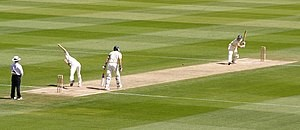
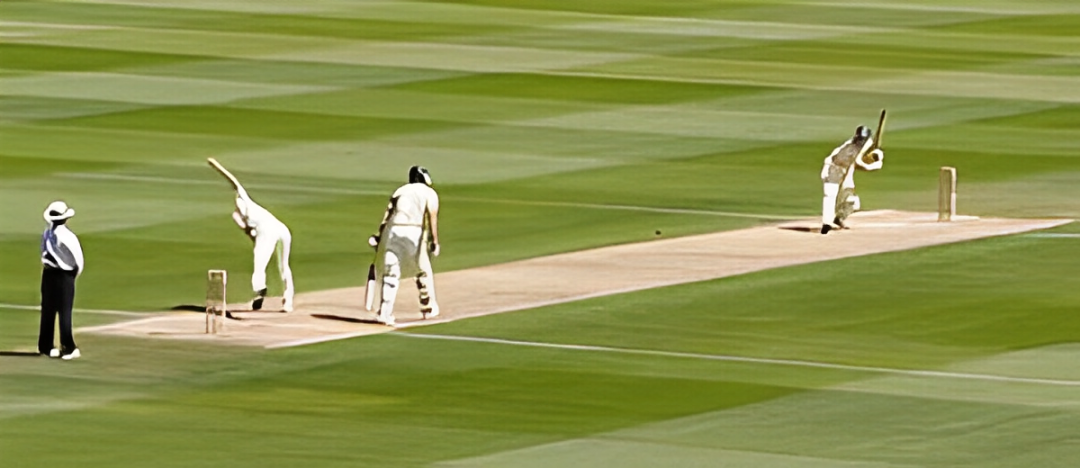
The image below shows a cricket batter facing a fast bowler.

Which skill classification would MOST accurately describe the batter's action in this scenario?

  1. Closed, self-paced, discrete
  2. Open, self-paced, continuous
  3. Closed, externally paced, serial
  4. Open, externally paced, discrete
Show Answers Only

\(D\)

Show Worked Solution
  • D is correct: The batter must adapt to the varying delivery from the bowler (open), the timing is determined by when and how the ball is bowled (externally paced), and the batting stroke has a clear beginning and end (discrete).

Other Options:

  • A is incorrect: Batting occurs in a changing environment due to variations in bowling (open, not closed) and the timing is determined by the bowler’s delivery (externally paced, not self-paced).
  • B is incorrect: Batting involves distinct actions with clear beginning and end points (discrete, not continuous).
  • C is incorrect: The environment is constantly changing based on the bowler’s delivery (open, not closed) and batting is primarily a discrete skill rather than a sequence of movements (not serial).

Filed Under: Characteristics of skills Tagged With: Band 3, smc-5922-70-Combinations

HMS, BM EQ-Bank 558 MC

A gymnast performs a floor routine combining tumbling runs, leaps, and balance elements into a choreographed sequence set to music.

According to the characteristics of motor skills, which row in the table correctly identifies ALL classifications for this activity?

\begin{align*}
\begin{array}{l}
\rule{0pt}{2.5ex} \ \rule[-1ex]{0pt}{0pt}& \\
\rule{0pt}{2.5ex}\textbf{A.}\rule[-1ex]{0pt}{0pt}\\
\rule{0pt}{2.5ex}\textbf{B.}\rule[-1ex]{0pt}{0pt}\\
\rule{0pt}{2.5ex}\textbf{C.}\rule[-1ex]{0pt}{0pt}\\
\rule{0pt}{2.5ex}\textbf{D.}\rule[-1ex]{0pt}{0pt}\\
\end{array}
\begin{array}{|l|l|l|l|}
\hline
\rule{0pt}{2.5ex}\textbf{Muscle Group}\rule[-1ex]{0pt}{0pt}& \textbf{Environment}\rule[-1ex]{0pt}{0pt}& \textbf{Timing}\rule[-1ex]{0pt}{0pt}& \textbf{Movement } \\
\textbf{Size} &  & \textbf{Control} & \textbf{Continuity} \\
\hline
\rule{0pt}{2.5ex}\text{Gross}\rule[-1ex]{0pt}{0pt}&\text{Closed}\rule[-1ex]{0pt}{0pt}&\text{Self-paced}\rule[-1ex]{0pt}{0pt}&\text{Serial}\\
\hline
\rule{0pt}{2.5ex}\text{Gross}\rule[-1ex]{0pt}{0pt}& \text{Open}\rule[-1ex]{0pt}{0pt}&\text{Self-paced}\rule[-1ex]{0pt}{0pt}&\text{Continuous}\\
\hline
\rule{0pt}{2.5ex}\text{Fine}\rule[-1ex]{0pt}{0pt}& \text{Closed}\rule[-1ex]{0pt}{0pt}&\text{Externally Paced}\rule[-1ex]{0pt}{0pt}&\text{Serial} \\
\hline
\rule{0pt}{2.5ex}\text{Fine}\rule[-1ex]{0pt}{0pt}& \text{Open}\rule[-1ex]{0pt}{0pt}&\text{Externally Paced}\rule[-1ex]{0pt}{0pt}&\text{Serial} \\
\hline
\end{array}
\end{align*}

Show Answers Only

\(A\)

Show Worked Solution
  • A is correct: A gymnastics floor routine primarily uses large muscle groups (gross), occurs in a stable environment (closed), the gymnast controls the timing (self-paced), and consists of discrete elements performed in sequence (serial).

Other Options:

  • B is incorrect: The environment in gymnastics floor routines is stable with consistent conditions (closed, not open).
  • C is incorrect: Gymnastics primarily uses large muscle groups (gross, not fine), the gymnast controls timing (self-paced, not externally paced), and consists of discrete elements in sequence (serial, not continuous).
  • D is incorrect: Gymnastics uses large muscle groups (gross, not fine), occurs in a stable environment (closed, not open), and the gymnast controls timing (self-paced, not externally paced).

Filed Under: Characteristics of skills Tagged With: Band 6, smc-5922-70-Combinations

HMS, BM EQ-Bank 557 MC

The table shows characteristics of four different sport skills.

Sport Skill    Environment  Pacing Beginning and End
W Stable Self-determined   Clear start and finish
X Changing External factors  Ongoing with no clear endpoints  
Y Changing Self-determined  Series of connected movements
Z Stable External factors  Clear start and finish

Which sport skill would BEST exemplify classification W?

  1. Returning a serve in tennis
  2. Rugby lineout throw
  3. Free throw in basketball
  4. Freestyle swimming in a race
Show Answers Only

\(C\)

Show Worked Solution
  • C is correct: Performed in a stable environment (closed), the player controls when to shoot (self-paced), and the action has a clear beginning and end (discrete).

Other Options:

  • A is incorrect: Returning a serve is externally paced (timing determined by opponent’s serve) and occurs in a changing environment (open).
  • B is incorrect: While a lineout throw has a clear beginning and end, the environment includes opponents and timing is influenced by referee whistles (not fully self-determined).
  • D is incorrect: Freestyle swimming is a continuous skill without clear beginning and end points during execution.

Filed Under: Characteristics of skills Tagged With: Band 5, smc-5922-70-Combinations

HMS, BM EQ-Bank 556 MC

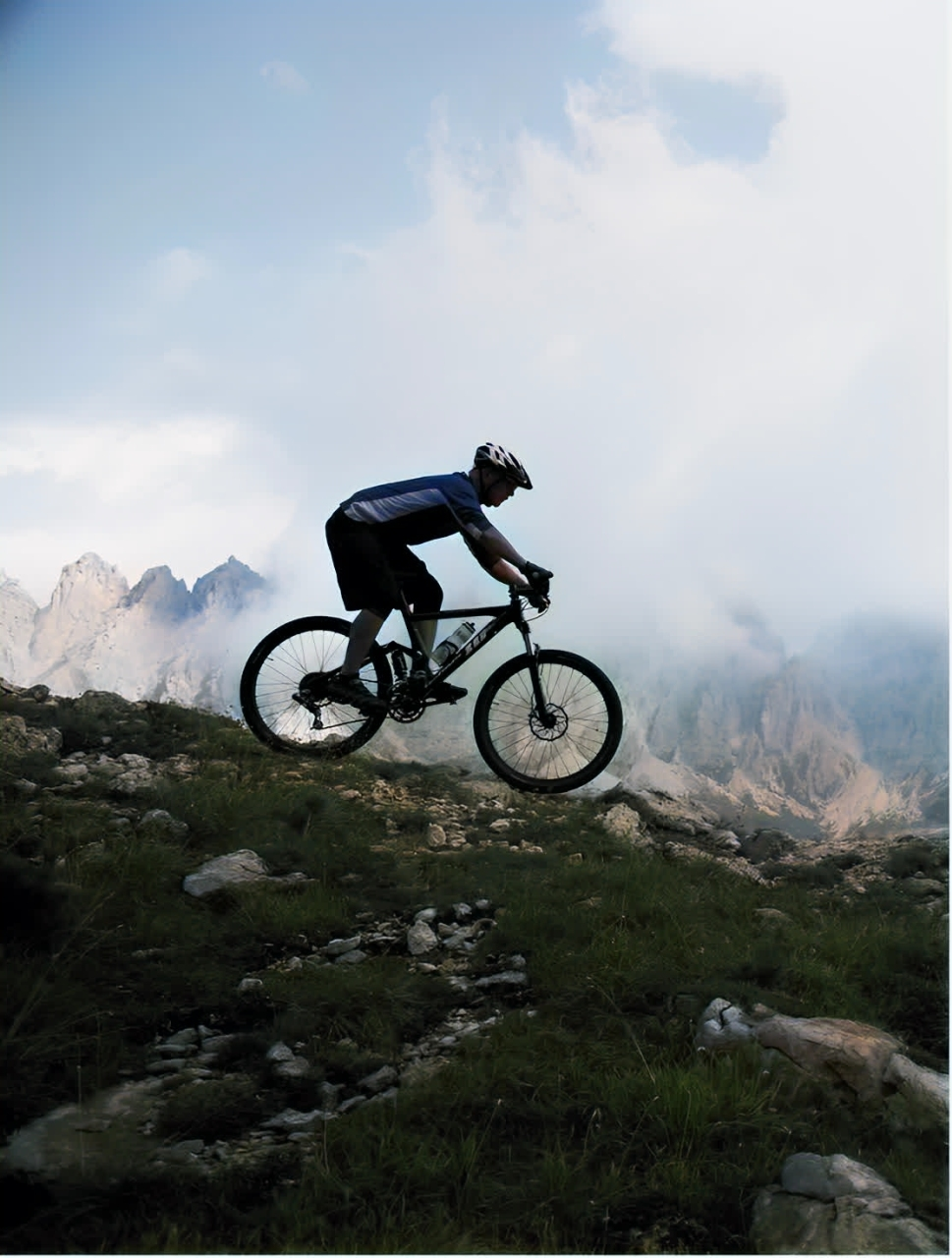
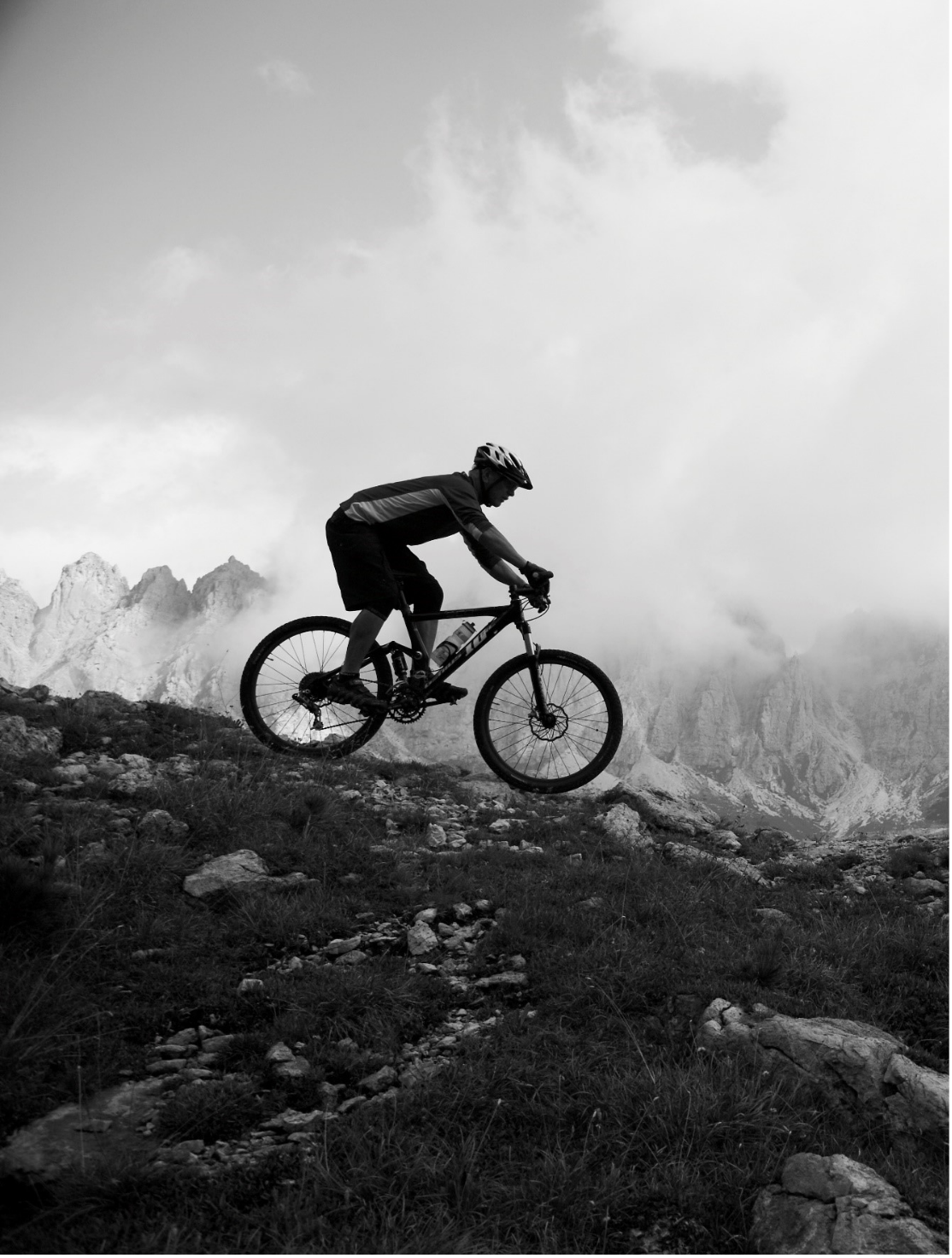
The image below shows a mountain bike rider navigating a rocky downhill trail.

Based on this activity, which classification is MOST accurate for this skill?

  1. Open, externally paced, continuous
  2. Open, self-paced, continuous
  3. Closed, externally paced, serial
  4. Closed, self-paced, serial
Show Answers Only

\(A\)

Show Worked Solution
  • A is correct: Mountain biking on a rocky trail occurs in an unstable environment that requires constant adaptation (open), the timing is influenced by the terrain features (externally paced), and the riding motion consists of ongoing adjustments without clear beginning or end points (continuous).

Other Options:

  • B is incorrect: While mountain biking is open and continuous, the timing of movements is dictated by approaching terrain features rather than being fully controlled by the rider (externally paced, not self-paced).
  • C is incorrect: The environment is unstable (open, not closed), and the skill involves ongoing movements rather than a sequence of discrete skills (continuous, not serial).
  • D is incorrect: The environment is unstable (open, not closed), and the skill does not consist of discrete elements combined in sequence (continuous, not serial).

Filed Under: Characteristics of skills Tagged With: Band 4, smc-5922-70-Combinations

HMS, BM EQ-Bank 555 MC

A netball player catches the ball, pivots, and passes to a teammate during a match.

Which of the following best describes this skill according to motor characteristics?

  1. Fine motor, closed, self-paced
  2. Gross motor, open, externally paced
  3. Fine motor, open, externally paced
  4. Gross motor, closed, self-paced
Show Answers Only

\(B\)

Show Worked Solution
  • B is correct: Catching, pivoting and passing involves large muscle groups (gross motor), occurs in a changing environment with defenders (open), and timing is influenced by opponents’ positions and movements (externally paced).

Other Options:

  • A is incorrect: Netball passing primarily uses large muscle groups (gross motor, not fine motor) and occurs in a changing environment (open, not closed).
  • C is incorrect: Netball passing primarily uses large muscle groups (gross motor, not fine motor).
  • D is incorrect: Netball passing occurs in a changing environment (open, not closed) and timing is influenced by game conditions (externally paced, not self-paced).

Filed Under: Characteristics of skills Tagged With: Band 3, smc-5922-70-Combinations

HMS, BM EQ-Bank 554

Explain how temporal patterning develops across the three stages of skill acquisition for a gymnast learning a complex floor routine.   (5 marks)

--- 15 WORK AREA LINES (style=lined) ---

Show Answers Only

*Language highlighting the cause-effect relationship is bolded in the answer below.

  • In the cognitive stage, gymnasts learn skills separately because they cannot process multiple movements simultaneously. Every skill needs full conscious attention, which leads to fragmented performances.
  • During early associative stage, gymnasts connect movements as skills become familiar. However, timing remains inconsistent due to incomplete motor programming, causing awkward transitions.
  • In advanced associative stage, flow improves because practice strengthens neural pathways. Coach feedback enables timing refinements, resulting in smoother sequences.
  • The autonomous stage brings major changes when movements merge into flowing sequences. These work as single motor programs because neural consolidation is complete. Gymnasts develop consistent rhythm as a result of automated patterns.
  • Movements flow naturally since conscious control isn’t needed. Consequently, gymnasts adapt to different environments, maintaining timing despite surface changes because skills are deeply embedded.
  • Expert gymnasts fix errors instantly while maintaining flow, thereby preventing routine disruption. This demonstrates true mastery through unconscious competence.
Show Worked Solution

*Language highlighting the cause-effect relationship is bolded in the answer below.

  • In the cognitive stage, gymnasts learn skills separately because they cannot process multiple movements simultaneously. Every skill needs full conscious attention, which leads to fragmented performances.
  • During early associative stage, gymnasts connect movements as skills become familiar. However, timing remains inconsistent due to incomplete motor programming, causing awkward transitions.
  • In advanced associative stage, flow improves because practice strengthens neural pathways. Coach feedback enables timing refinements, resulting in smoother sequences.
  • The autonomous stage brings major changes when movements merge into flowing sequences. These work as single motor programs because neural consolidation is complete. Gymnasts develop consistent rhythm as a result of automated patterns.
  • Movements flow naturally since conscious control isn’t needed. Consequently, gymnasts adapt to different environments, maintaining timing despite surface changes because skills are deeply embedded.
  • Expert gymnasts fix errors instantly while maintaining flow, thereby preventing routine disruption. This demonstrates true mastery through unconscious competence.

Filed Under: Stages of learning Tagged With: Band 5, Band 6, smc-5921-40-Comparing SOL

HMS, BM EQ-Bank 553

Analyse how an understanding of the stages of skill acquisition should inform a coach's approach to developing a seasonal training program for a basketball team.   (8 marks)

--- 22 WORK AREA LINES (style=lined) ---

Show Answers Only

*Language that helps to highlight relationships and draw out implications is bolded throughout the answer below.

Overview Statement

  • Understanding skill acquisition stages influences how coaches structure seasonal basketball programs.
  • Key relationships include assessment-training alignment, practice progression, and feedback evolution that determine program effectiveness.

Assessment and Training Design

  • Preseason skill assessments directly affect how coaches design individualised training programs.
  • Identifying each player’s stage enables targeted skill development approaches.
  • A point guard showing autonomous dribbling but cognitive shooting requires different training methods.
  • This reveals that one-size-fits-all programs fail to address diverse skill levels.
  • Therefore, differentiated training based on assessment leads to optimal development.
  • This means that coaches must continuously evaluate and adjust programs.

Practice Complexity

  • Practice structure depends on players’ movement through skill stages across the season.
  • Early season blocked practice supports cognitive learners mastering basic techniques.
  • Variable practice challenges autonomous players with game-like scenarios later.
  • Cognitive learners repeat chest passes identically while advanced players face defensive pressure.
  • This pattern shows practice must evolve with player development.
  • Consequently, static training programs can prevent skill advancement.

Implications and Synthesis

  • These relationships form a dynamic system requiring constant coach adaptation.
  • Assessment connects to practice design which influences feedback strategies.
  • This creates a progressive training environment matching player development.
  • The significance is that understanding skill stages transforms coaching from rigid schedules to responsive programming.
  • Coaches who apply this knowledge achieve better player development and team performance.
Show Worked Solution

*Language that helps to highlight relationships and draw out implications is bolded throughout the answer below.

Overview Statement

  • Understanding skill acquisition stages influences how coaches structure seasonal basketball programs.
  • Key relationships include assessment-training alignment, practice progression, and feedback evolution that determine program effectiveness.

Assessment and Training Design

  • Preseason skill assessments directly affect how coaches design individualised training programs.
  • Identifying each player’s stage enables targeted skill development approaches.
  • A point guard showing autonomous dribbling but cognitive shooting requires different training methods.
  • This reveals that one-size-fits-all programs fail to address diverse skill levels.
  • Therefore, differentiated training based on assessment leads to optimal development.
  • This means that coaches must continuously evaluate and adjust programs.

Practice Complexity

  • Practice structure depends on players’ movement through skill stages across the season.
  • Early season blocked practice supports cognitive learners mastering basic techniques.
  • Variable practice challenges autonomous players with game-like scenarios later.
  • Cognitive learners repeat chest passes identically while advanced players face defensive pressure.
  • This pattern shows practice must evolve with player development.
  • Consequently, static training programs can prevent skill advancement.

Implications and Synthesis

  • These relationships form a dynamic system requiring constant coach adaptation.
  • Assessment connects to practice design which influences feedback strategies.
  • This creates a progressive training environment matching player development.
  • The significance is that understanding skill stages transforms coaching from rigid schedules to responsive programming.
  • Coaches who apply this knowledge achieve better player development and team performance.

Filed Under: Stages of learning Tagged With: Band 5, Band 6, smc-5921-40-Comparing SOL

HMS, BM EQ-Bank 552

Evaluate the role of error detection and correction across the three stages of skill acquisition.   (8 marks)

--- 22 WORK AREA LINES (style=lined) ---

Show Answers Only

*Recommended “Evaluation” language is highlighted in bold throughout the answer below.

Evaluation Statement

  • Error detection and correction is highly effective throughout skill acquisition when methods match learner stages.
  • This evaluation examines how detection abilities develop and whether correction strategies suit each stage.

Learner Capability Development

  • Error detection shows progressive improvement across stages, strongly meeting individual learning needs.
  • Evidence supporting this includes cognitive learners being unable to identify errors without external help. For example, novice tennis players won’t notice incorrect grip until coaches demonstrate proper technique
  • Associative learners partially fulfil detection needs by recognising errors but struggling with corrections.
  • Autonomous performers achieve optimal self-detection and can adjust their techniques mid-performance.
  • A critical strength is this natural progression from dependence to independence. Learners gradually develop comprehensive self-monitoring skills as they progress through stages
  • The evidence indicates that this development pattern is superior to forced progression

Correction Strategy Effectiveness

  • Using stage-appropriate correction methods proves highly effective for skill development
  • Cognitive learners require direct step-by-step instruction from coaches.
  • Associative learners benefit from guided questioning that promotes problem-solving.
  • Autonomous performers adequately fulfil their needs with self-regulation and minimal intervention.
  • While strong in structured environments, this shows limitations when coaches misread learner stages. Insufficient assessment can hinder rather than help progress.
  • Although effective for clear stage identification, it proves less suitable for borderline learners.

Final Evaluation

  • Weighing these factors shows error detection and correction systems are highly valuable for skill acquisition.
  • The strengths in progressive capability development outweigh occasional strategy mismatches.
  • The overall evaluation demonstrates that stage-appropriate approaches achieve optimal learning efficiency.
  • Implications suggest coaches need strong assessment skills to identify learner stages accurately and some flexibility as learners transition between stages.


Show Worked Solution

*Recommended “Evaluation” language is highlighted in bold throughout the answer below.

Evaluation Statement

  • Error detection and correction is highly effective throughout skill acquisition when methods match learner stages.
  • This evaluation examines how detection abilities develop and whether correction strategies suit each stage.

Learner Capability Development

  • Error detection shows progressive improvement across stages, strongly meeting individual learning needs.
  • Evidence supporting this includes cognitive learners being unable to identify errors without external help. For example, novice tennis players won’t notice incorrect grip until coaches demonstrate proper technique
  • Associative learners partially fulfil detection needs by recognising errors but struggling with corrections.
  • Autonomous performers achieve optimal self-detection and can adjust their techniques mid-performance.
  • A critical strength is this natural progression from dependence to independence. Learners gradually develop comprehensive self-monitoring skills as they progress through stages
  • The evidence indicates that this development pattern is superior to forced progression

Correction Strategy Effectiveness

  • Using stage-appropriate correction methods proves highly effective for skill development
  • Cognitive learners require direct step-by-step instruction from coaches.
  • Associative learners benefit from guided questioning that promotes problem-solving.
  • Autonomous performers adequately fulfil their needs with self-regulation and minimal intervention.
  • While strong in structured environments, this shows limitations when coaches misread learner stages. Insufficient assessment can hinder rather than help progress.
  • Although effective for clear stage identification, it proves less suitable for borderline learners.

Final Evaluation

  • Weighing these factors shows error detection and correction systems are highly valuable for skill acquisition.
  • The strengths in progressive capability development outweigh occasional strategy mismatches.
  • The overall evaluation demonstrates that stage-appropriate approaches achieve optimal learning efficiency.
  • Implications suggest coaches need strong assessment skills to identify learner stages accurately and some flexibility as learners transition between stages.

Filed Under: Stages of learning Tagged With: Band 4, Band 5, smc-5921-40-Comparing SOL

HMS, BM EQ-Bank 551

Discuss how the concept of information processing affects progression through the stages of skill acquisition.   (6 marks)

--- 18 WORK AREA LINES (style=lined) ---

Show Answers Only

Sample Answer

  • During the cognitive stage, learners use most of their mental capacity just to understand basic movements. This creates a bottleneck that stops them from noticing other things around them.
  • Working memory is limited in the cognitive stage. Learners need simple instructions and feedback. In the autonomous stage, athletes can handle complex tactical information while performing skills.
  • Attentional narrowing happens in the cognitive stage. Learners must focus only on their own movements. They cannot watch opponents or think about strategy at the same time.
  • Motor programs develop through repeated practice in the associative stage. This gradually reduces the mental effort needed for basic movements. More mental resources become available for decision making.
  • Chunking happens as learners reach the autonomous stage. Complex movement sequences become single units in the brain. They no longer think about separate parts of the movement.
  • Automatic processing occurs in the autonomous stage. Athletes can process multiple things at once like technique, opponent position, and strategy. This parallel processing is impossible in the cognitive stage where learners handle one thing at a time.
Show Worked Solution

Sample Answer 

  • During the cognitive stage, learners use most of their mental capacity just to understand basic movements. This creates a bottleneck that stops them from noticing other things around them.
  • Working memory is limited in the cognitive stage. Learners need simple instructions and feedback. In the autonomous stage, athletes can handle complex tactical information while performing skills.
  • Attentional narrowing happens in the cognitive stage. Learners must focus only on their own movements. They cannot watch opponents or think about strategy at the same time.
  • Motor programs develop through repeated practice in the associative stage. This gradually reduces the mental effort needed for basic movements. More mental resources become available for decision making.
  • Chunking happens as learners reach the autonomous stage. Complex movement sequences become single units in the brain. They no longer think about separate parts of the movement.
  • Automatic processing occurs in the autonomous stage. Athletes can process multiple things at once like technique, opponent position, and strategy. This parallel processing is impossible in the cognitive stage where learners handle one thing at a time.

Filed Under: Stages of learning Tagged With: Band 5, Band 6, smc-5921-40-Comparing SOL

HMS, BM EQ-Bank 550

Explain how a coach should modify teaching approaches at each stage of skill acquisition when teaching a volleyball spike.   (5 marks)

--- 16 WORK AREA LINES (style=lined) ---

Show Answers Only

*Language highlighting the cause-effect relationship is bolded in the answer below.

  • During the cognitive stage, coaches should break the volleyball spike into parts because learners cannot process complex movements. Use clear demonstrations and standing spikes to reduce cognitive overload.
  • Teaching in the associative stage focuses on refining timing as basic movements are understood. Structured repetition with predictable sets allows players to make technique consistent, which leads to smoother execution.
  • For autonomous learners, coaches create game-like scenarios with defensive pressure since skills are automatic. Players decide spike direction while maintaining technique. This develops decision-making that enables match performance.
  • Feedback approaches change as learners progress. Immediate guidance in cognitive stage because beginners cannot self-correct. Delayed, question-based feedback in autonomous stage promotes self-assessment, thereby creating independent learners.
  • Practice activities increase in complexity due to growing competence. Begin with isolated drills in cognitive stage. Progress to pattern practice in associative stage, then competitive simulations in autonomous stage which prepares players for real games.
Show Worked Solution

*Language highlighting the cause-effect relationship is bolded in the answer below.

  • During the cognitive stage, coaches should break the volleyball spike into parts because learners cannot process complex movements. Use clear demonstrations and standing spikes to reduce cognitive overload.
  • Teaching in the associative stage focuses on refining timing as basic movements are understood. Structured repetition with predictable sets allows players to make technique consistent, which leads to smoother execution.
  • For autonomous learners, coaches create game-like scenarios with defensive pressure since skills are automatic. Players decide spike direction while maintaining technique. This develops decision-making that enables match performance.
  • Feedback approaches change as learners progress. Immediate guidance in cognitive stage because beginners cannot self-correct. Delayed, question-based feedback in autonomous stage promotes self-assessment, thereby creating independent learners.
  • Practice activities increase in complexity due to growing competence. Begin with isolated drills in cognitive stage. Progress to pattern practice in associative stage, then competitive simulations in autonomous stage which prepares players for real games.

Filed Under: Stages of learning Tagged With: Band 3, Band 4, smc-5921-40-Comparing SOL

HMS, BM EQ-Bank 549

Compare the focus of attention for learners in the cognitive and autonomous stages when learning to serve in tennis.   (4 marks)

--- 10 WORK AREA LINES (style=lined) ---

Show Answers Only

Sample Answer

  • In the cognitive stage, the learner’s attention focuses primarily on what to do, such as proper grip, ball toss height, and basic movement sequence, while the autonomous performer’s attention shifts to strategic elements such as opponent positioning and serve placement.
  • Cognitive stage learners require conscious control of each component movement in the serving motion, whereas autonomous performers execute the entire service motion as a single fluid sequence without conscious attention to individual elements.
  • Error detection differs significantly, with cognitive stage learners often unable to identify why their serve fails without external feedback, while autonomous performers can detect and correct errors as they occur during the movement.
  • The cognitive stage server focuses exclusively on basic execution under ideal conditions, whereas the autonomous stage server can adapt their serve to different environmental factors such as wind conditions or match situations.
Show Worked Solution

Sample Answer 

  • In the cognitive stage, learners focus on basic elements like grip and ball toss height. Autonomous performers shift their attention to strategic elements such as opponent positioning and serve placement.
  • Cognitive stage learners must consciously control each component of the serving motion. Autonomous performers execute the entire service motion as one fluid sequence without thinking about individual parts.
  • Error detection differs significantly between stages. Cognitive learners often can’t identify why their serve fails without external feedback. Autonomous performers can detect and correct errors as they occur during the movement.
  • Cognitive stage servers focus only on basic execution under ideal conditions. Autonomous stage servers can adapt their serve to different factors like wind conditions or match situations.

Filed Under: Stages of learning Tagged With: Band 3, Band 4, smc-5921-10-Cognitive, smc-5921-30-Autonomous, smc-5921-40-Comparing SOL

HMS, BM EQ-Bank 548

Analyse how elite and recreational athletes might progress differently through the stages of skill acquisition when learning a complex movement skill.   (8 marks)

--- 22 WORK AREA LINES (style=lined) ---

Show Answers Only

*Language that helps to highlight relationships and draw out implications is bolded throughout the answer below.

Overview Statement

  • Elite and recreational athletes progress through skill acquisition stages at different rates and depths.
  • Key components include learning capacity, practice patterns, and transfer abilities that interact to create distinct pathways.

Learning Capacity and Transfer Relationship

  • Superior information processing enables elite athletes to move through the cognitive stage rapidly.
  • This capacity is connected to their ability to transfer existing skills to new movements. For example, elite gymnasts grasp new vaults after few demonstrations while recreational gymnasts need multiple sessions.
  • This reveals that prior experience accelerates learning for elites.
  • Consequently, elite athletes bypass basic coordination struggles that recreational athletes must overcome.

Practice Patterns and Stage Progression

  • Deliberate daily practice influences how deeply athletes progress through stages.
  • Elite swimmers who train 20+ hours weekly progress through to the autonomous stage much faster than recreational swimmers whose 2-3 casual sessions cannot achieve skill automation.
  • This pattern shows elite athletes reaching unconscious competence while recreational athletes plateau at associative stage.
  • In this way, practice quantity and quality determine final skill ceiling.

Implications and Synthesis

  • These relationships form a compounding system where initial advantages multiply over time.
  • Superior learning capacity combines with intensive practice to create exponential skill development.
  • This means that the gap between elite and recreational athletes widens progressively.
  • The significance is that early identification and development programs can maximise athletic potential.
  • Understanding these differences enables coaches to set realistic expectations and tailor programs appropriately.
Show Worked Solution

*Language that helps to highlight relationships and draw out implications is bolded throughout the answer below.

Overview Statement

  • Elite and recreational athletes progress through skill acquisition stages at different rates and depths.
  • Key components include learning capacity, practice patterns, and transfer abilities that interact to create distinct pathways.

Learning Capacity and Transfer Relationship

  • Superior information processing enables elite athletes to move through the cognitive stage rapidly.
  • This capacity is connected to their ability to transfer existing skills to new movements. For example, elite gymnasts grasp new vaults after few demonstrations while recreational gymnasts need multiple sessions.
  • This reveals that prior experience accelerates learning for elites.
  • Consequently, elite athletes bypass basic coordination struggles that recreational athletes must overcome.

Practice Patterns and Stage Progression

  • Deliberate daily practice influences how deeply athletes progress through stages.
  • Elite swimmers who train 20+ hours weekly progress through to the autonomous stage much faster than recreational swimmers whose 2-3 casual sessions cannot achieve skill automation.
  • This pattern shows elite athletes reaching unconscious competence while recreational athletes plateau at associative stage.
  • In this way, practice quantity and quality determine final skill ceiling.

Implications and Synthesis

  • These relationships form a compounding system where initial advantages multiply over time.
  • Superior learning capacity combines with intensive practice to create exponential skill development.
  • This means that the gap between elite and recreational athletes widens progressively.
  • The significance is that early identification and development programs can maximise athletic potential.
  • Understanding these differences enables coaches to set realistic expectations and tailor programs appropriately.

Filed Under: Stages of learning Tagged With: Band 5, Band 6, smc-5921-40-Comparing SOL

HMS, BM EQ-Bank 547

Describe the role of feedback in the cognitive stage of learning a new swimming stroke.   (3 marks)

--- 7 WORK AREA LINES (style=lined) ---

Show Answers Only

Sample Answer

  • In the cognitive stage, immediate corrective feedback helps swimmers understand what adjustments are needed since they often cannot recognise their own errors in technique or body positioning.
  • Visual feedback through demonstrations or video replays creates clear mental images of proper technique, allowing swimmers to compare their performance against the model.
  • Positive reinforcement of successful attempts builds confidence and motivation to persist through initial difficulties, encouraging swimmers to continue practising despite experiencing discomfort or awkwardness.
Show Worked Solution

Sample Answer 

  • In the cognitive stage, immediate corrective feedback helps swimmers understand what adjustments are needed since they often cannot recognise their own errors in technique or body positioning.
  • Visual feedback through demonstrations or video replays creates clear mental images of proper technique, allowing swimmers to compare their performance against the model.
  • Positive reinforcement of successful attempts builds confidence and motivation to persist through initial difficulties, encouraging swimmers to continue practising despite experiencing discomfort or awkwardness.

Filed Under: Stages of learning Tagged With: Band 2, Band 3, smc-5921-10-Cognitive

HMS, BM EQ-Bank 546

Explain how practice methods should differ between the associative and autonomous stages of skill acquisition.   (4 marks)

--- 11 WORK AREA LINES (style=lined) ---

Show Answers Only

*Language highlighting the cause-effect relationship is bolded in the answer below.

  • In the associative stage, practice should focus on refining timing patterns through repetitive drills because learners need consistency. Controlled environments help develop body awareness which leads to reduced errors.
  • Feedback during associative practice targets specific technical adjustments since learners can now detect basic mistakes. Autonomous stage feedback focuses on performance outcomes as technique is already automated, therefore enabling strategic development.
  • Autonomous stage practice includes pressure situations to simulate competition demands. This challenges performers to maintain technique while attending to external factors, thereby preparing them for real performance.
  • The associative stage requires moderate-intensity practice because cognitive load remains high. Autonomous practice integrates random elements that force adaptation, which develops flexible skill application. This results in robust performance capabilities under varied conditions.
Show Worked Solution

*Language highlighting the cause-effect relationship is bolded in the answer below.

  • In the associative stage, practice should focus on refining timing patterns through repetitive drills because learners need consistency. Controlled environments help develop body awareness which leads to reduced errors.
  • Feedback during associative practice targets specific technical adjustments since learners can now detect basic mistakes. Autonomous stage feedback focuses on performance outcomes as technique is already automated, therefore enabling strategic development.
  • Autonomous stage practice includes pressure situations to simulate competition demands. This challenges performers to maintain technique while attending to external factors, thereby preparing them for real performance.
  • The associative stage requires moderate-intensity practice because cognitive load remains high. Autonomous practice integrates random elements that force adaptation, which develops flexible skill application. This results in robust performance capabilities under varied conditions.

Filed Under: Stages of learning Tagged With: Band 4, Band 5, smc-5921-40-Comparing SOL

HMS, BM EQ-Bank 545

Outline the key characteristics of the cognitive stage of skill acquisition.   (6 marks)

--- 6 WORK AREA LINES (style=lined) ---

Show Answers Only

Sample Answer

  • The cognitive stage is characterised by the learner developing initial understanding of what the skill requires, with frequent large errors and inefficient movement patterns.
  • Learners in this stage need clear demonstrations and explicit instructions focusing on key aspects of the skill rather than complex details to avoid information overload.
  • Success experiences are essential during this stage to build confidence, often requiring modified practice environments or breaking skills into smaller components.
Show Worked Solution

Sample Answer 

  • The cognitive stage is characterised by the learner developing initial understanding of what the skill requires, with frequent large errors and inefficient movement patterns.
  • Learners in this stage need clear demonstrations and explicit instructions focusing on key aspects of the skill rather than complex details to avoid information overload.
  • Success experiences are essential during this stage to build confidence, often requiring modified practice environments or breaking skills into smaller components.

Filed Under: Stages of learning Tagged With: Band 3, Band 4, smc-5921-10-Cognitive

HMS, BM EQ-Bank 544 MC

Read the following description of a golfer's performance:

"During tournament play, the golfer executes their swing naturally without mentally tracking each movement component. While maintaining consistent swing mechanics, they actively evaluate factors such as wind direction, green contours, and strategic positioning. Their technique remains stable even when facing high-pressure situations in championship rounds."

Which practice approach would be MOST appropriate for this golfer's continued development?

  1. Providing basic demonstrations of proper swing technique
  2. Using video analysis to identify and correct technical flaws
  3. Implementing competitive simulations with varying course conditions
  4. Focusing on repetitive drills to develop muscle memory
Show Answers Only

\(C\)

Show Worked Solution
  • C is correct: The athlete is clearly in the autonomous stage where practice should emphasise adaptation to varying competitive conditions to further develop performance under tournament pressure.

Other Options:

  • A is incorrect: Basic demonstrations are appropriate for the cognitive stage, not an athlete performing with fluid, efficient movements.
  • B is incorrect: Detailed technical analysis is more suitable for the associative stage when refining technique, not the autonomous stage described.
  • D is incorrect: Repetitive drills to develop muscle memory are most appropriate for the associative stage, while this athlete already demonstrates automatic execution.

Filed Under: Stages of learning Tagged With: Band 5, smc-5921-30-Autonomous

HMS, BM EQ-Bank 543 MC

A swimming coach wants to design appropriate practice activities for athletes at different stages of learning the butterfly stroke.

Which practice approach is MOST appropriate for swimmers in the associative stage?

  1. Providing video analysis focusing on temporal patterning of arm and leg coordination
  2. Creating race-simulation drills with competitors in adjacent lanes
  3. Using demonstrations and simple verbal cues to develop basic stroke understanding
  4. Implementing pressure situations that mimic competition stress levels
Show Answers Only

\(A\)

Show Worked Solution
  • A is correct: The associative stage emphasises temporal patterning and refining movement coordination, making video analysis of arm-leg coordination most appropriate.

Other Options:

  • B is incorrect: Race simulations with competitors would be more suitable for the autonomous stage where swimmers can attend to other elements besides technique.
  • C is incorrect: Demonstrations and simple verbal cues target the cognitive stage where basic understanding is being developed.
  • D is incorrect: Pressure situations mimicking competition are most appropriate for the autonomous stage to help adapt skills to competitive environments.

Filed Under: Stages of learning Tagged With: Band 4, smc-5921-20-Associative

HMS, BM EQ-Bank 542 MC

A basketball player demonstrates the following behaviours during practice:

  1. Can shoot free throws without consciously thinking about technique
  2. Consistently maintains proper shooting form even when fatigued
  3. Simultaneously reads defensive positioning while dribbling
  4. Automatically adjusts technique when shots are missing

Which skill acquisition stage is the player demonstrating?

  1. Early cognitive stage
  2. Late cognitive stage
  3. Associative stage
  4. Autonomous stage
Show Answers Only

\(D\)

Show Worked Solution
  • D is correct: Performing without conscious thought, maintaining technique under fatigue, attending to other cues (defensive positioning), and automatically making adjustments are all characteristics of the autonomous stage.

Other Options:

  • A and B incorrect: Any cognitive stage would involve conscious focus on technique and inability to attend to other aspects simultaneously.
  • C is incorrect: The associative stage would still require conscious attention to technique execution rather than automatic adjustments.

Filed Under: Stages of learning Tagged With: Band 5, smc-5921-45-Identify stage

HMS, BM EQ-Bank 541 MC

The table below shows characteristics of different skill acquisition stages.

Focus Error Recognition   Movement Efficiency  
How to do the skill     Can identify errors  Moderately Efficient

Which stage of skill acquisition is being described?

  1. Cognitive stage
  2. Associative stage
  3. Autonomous stage
  4. Preparatory stage
Show Answers Only

\(B\)

Show Worked Solution
  • B is correct: Focusing on “how to do the skill,” being able to identify errors, and moderately efficient movements are key characteristics of the associative stage.

Other Options:

  • A is incorrect: The cognitive stage focuses on “what to do” with limited error recognition and inefficient movement.
  • C is incorrect: The autonomous stage would show automatic movement execution with high efficiency.
  • D is incorrect: “Preparatory stage” is not a recognised stage in the three-stage process of skill acquisition.

Filed Under: Stages of learning Tagged With: Band 2, smc-5921-45-Identify stage

HMS, BM EQ-Bank 540 MC

A tennis coach observes that a beginner player frequently makes large errors when attempting a forehand stroke, struggles to coordinate the footwork with the arm movement, and requires regular demonstrations to understand the technique.

In which stage of skill acquisition is this tennis player most likely to be?

  1. Cognitive stage
  2. Associative stage
  3. Autonomous stage
  4. Refinement stage
Show Answers Only

\(A\)

Show Worked Solution
  • A is correct: Frequent large errors, coordination difficulties, and reliance on demonstrations are key characteristics of the cognitive stage where learners are understanding what to do.

Other Options:

  • B is incorrect: The associative stage would show fewer and smaller errors with improved coordination.
  • C is incorrect: The autonomous stage would display automatic execution with minimal errors.
  • D is incorrect: “Refinement stage” is not a recognised stage in the three-stage process of skill acquisition.

Filed Under: Stages of learning Tagged With: Band 3, smc-5921-45-Identify stage

HMS, BM EQ-Bank 539

Explain how a tennis coach might adapt training approaches when working with learners who have different conceptual abilities.   (5 marks)

--- 15 WORK AREA LINES (style=lined) ---

Show Answers Only

*Language highlighting the cause-effect relationship is bolded in the answer below.

Answers could any of the following points:

  • Learners who visualise well benefit from mental practice because they can process tactical information internally. They should imagine tactical situations before trying them. This works by using their strength in thinking about movements.
  • Learners who struggle to visualise need more physical demonstrations. The reason for this is that they cannot create accurate mental images from verbal instructions alone. As a result, coaches should move their bodies to show correct technique.
  • Video analysis should match learner abilities. This occurs because slow-motion replays help poor visualisers see details they miss in real-time. Consequently, strong visualisers can analyse their own performance effectively on video.
  • Training should progress at different speeds. This is due to strong visualisers processing information faster than others. Therefore, they can move quickly through skill stages while others need more practice time.
  • Feedback must suit the learner. This relationship results in visualisers responding well to verbal cues that create mental pictures. In contrast, others need hands-on guidance which enables them to feel correct movements.
  • Practice design should match abilities. Initially, start with simple decisions for weak visualisers, then gradually increase complexity. This process ensures appropriate challenge levels for all learners.
  • Coaches should help all players improve visualisation skills. This combination enables development of both mental and physical abilities together. Hence, using imagery exercises alongside physical training maximises overall improvement.
Show Worked Solution

*Language highlighting the cause-effect relationship is bolded in the answer below.

Answers could any of the following points:

  • Learners who visualise well benefit from mental practice because they can process tactical information internally. They should imagine tactical situations before trying them. This works by using their strength in thinking about movements.
  • Learners who struggle to visualise need more physical demonstrations. The reason for this is that they cannot create accurate mental images from verbal instructions alone. As a result, coaches should move their bodies to show correct technique.
  • Video analysis should match learner abilities. This occurs because slow-motion replays help poor visualisers see details they miss in real-time. Consequently, strong visualisers can analyse their own performance effectively on video.
  • Training should progress at different speeds. This is due to strong visualisers processing information faster than others. Therefore, they can move quickly through skill stages while others need more practice time.
  • Feedback must suit the learner. This relationship results in visualisers responding well to verbal cues that create mental pictures. In contrast, others need hands-on guidance which enables them to feel correct movements.
  • Practice design should match abilities. Initially, start with simple decisions for weak visualisers, then gradually increase complexity. This process ensures appropriate challenge levels for all learners.
  • Coaches should help all players improve visualisation skills. This combination enables development of both mental and physical abilities together. Hence, using imagery exercises alongside physical training maximises overall improvement.

Filed Under: Characteristics of learners Tagged With: Band 5, Band 6, smc-5534-15-Ability

HMS, BM EQ-Bank 538

Analyse how the CHAPP framework (Confidence, Heredity, Ability, Personality, Prior experience) provides coaches with a comprehensive approach to understanding individual differences in skill acquisition.   (8 marks)

--- 22 WORK AREA LINES (style=lined) ---

Show Answers Only

*Recommended words/phrases to convey relationships and implications are bolded.

Overview Statement

  • The CHAPP framework provides coaches with five interconnected components that influence skill acquisition.
  • These elements interact to create unique learning profiles, with implications for coaching approaches.

Confidence and Prior Experience

  • Confidence interplays with prior experience to create a fertile ground for a learner to acquire new skills.
  • Positive past experiences generate high confidence, which enables learners to attempt challenging tasks.
  • For example, a gymnast with a successful tumbling background shows confidence learning new aerial skills.
  • This reveals that early positive experiences create an accelerated ability for skill development.
  • Conversely, negative prior experiences lead to low confidence that prevents risk-taking.
  • Therefore, coaches must assess both factors together when introducing new skills.

Heredity and Ability

  • Physical heredity determines baseline capabilities while ability influences how quickly athletes reach their potential.
  • Natural speed (heredity) combines with learning capacity (ability) to set skill ceilings.
  • A naturally fast runner with high ability masters complex sprint techniques rapidly.
  • Consequently, coaches must distinguish between unchangeable heredity and abilities that can be developed.
  • This means that training programs need different expectations for different combinations.

Implications and Synthesis

  • CHAPP components form an integrated system where personality moderates how other factors express themselves.
  • This is shown by the fact that identical training can produce vastly different results across athletes.
  • The framework enables coaches to identify whether struggles result from confidence, physical limits, or learning difficulties.
  • The significance is that comprehensive assessment using all five components creates truly individualised coaching.
  • Understanding these interactions transforms coaching from one-size-fits-all to targeted development.
Show Worked Solution

*Recommended words/phrases to convey relationships and implications are bolded.

Overview Statement

  • The CHAPP framework provides coaches with five interconnected components that influence skill acquisition.
  • These elements interact to create unique learning profiles, with implications for coaching approaches.

Confidence and Prior Experience

  • Confidence interplays with prior experience to create a fertile ground for a learner to acquire new skills.
  • Positive past experiences generate high confidence, which enables learners to attempt challenging tasks.
  • For example, a gymnast with a successful tumbling background shows confidence learning new aerial skills.
  • This reveals that early positive experiences create an accelerated ability for skill development.
  • Conversely, negative prior experiences lead to low confidence that prevents risk-taking.
  • Therefore, coaches must assess both factors together when introducing new skills.

Heredity and Ability

  • Physical heredity determines baseline capabilities while ability influences how quickly athletes reach their potential.
  • Natural speed (heredity) combines with learning capacity (ability) to set skill ceilings.
  • A naturally fast runner with high ability masters complex sprint techniques rapidly.
  • Consequently, coaches must distinguish between unchangeable heredity and abilities that can be developed.
  • This means that training programs need different expectations for different combinations.

Implications and Synthesis

  • CHAPP components form an integrated system where personality moderates how other factors express themselves.
  • This is shown by the fact that identical training can produce vastly different results across athletes.
  • The framework enables coaches to identify whether struggles result from confidence, physical limits, or learning difficulties.
  • The significance is that comprehensive assessment using all five components creates truly individualised coaching.
  • Understanding these interactions transforms coaching from one-size-fits-all to targeted development.

Filed Under: Characteristics of learners Tagged With: Band 5, Band 6

HMS, BM EQ-Bank 537

Evaluate how a coach can address differences in heredity characteristics when teaching a team sport.   (8 marks)

--- 22 WORK AREA LINES (style=lined) ---

Show Answers Only

*Recommended words/phrases for “Evaluation” questions are highlighted in bold throughout the answer below.

Evaluation Statement

  • Coaching strategies are highly effective when addressing heredity differences in team sports.
  • This evaluation examines how well coaches match players to positions and adapt training to individual differences in team sports.

Position Allocation 

  • Placing players in positions that match their inherited traits strongly meets the goal of maximising team performance.
  • Evidence supporting this includes basketball coaches placing taller players in rebounding roles while shorter, quick players excel at point guard. Further, players with natural speed advantages suit wing positions in rugby.
  • A critical strength is maximising each player’s genetic advantages for team benefit. This approach achieves the best results by matching physical traits to position demands.
  • Overwhelming evidence indicates that teams using heredity-based positioning show superior competitive outcomes.

Individualised Training 

  • Personalised training modifications adequately fulfil diverse athlete development needs.
  • Athletes with different muscle fibre types require varied recovery periods between sessions. For example, fast-twitch dominant players need longer rest after sprints than slow-twitch athletes.
  • While strong in preventing overtraining, this shows limitations when coaches lack genetic testing resources.
  • Technique adjustments for different body types prove highly effective for skill development.
  • Although effective for individual progress, it proves less suitable for maintaining team cohesion.

Final Evaluation

  • Weighing these factors shows addressing heredity differences is highly valuable for team success.
  • The effects on improved performance outweigh resource and cohesion challenges.
  • The overall evaluation demonstrates coaches who embrace genetic diversity create stronger teams.
  • Implications suggest that coaches need further investment in their training so they are more able to identify heredity differences to help all players reach their potential.
Show Worked Solution

*Recommended words/phrases for “Evaluation” questions are highlighted in bold throughout the answer below.

Evaluation Statement

  • Coaching strategies are highly effective when addressing heredity differences in team sports.
  • This evaluation examines how well coaches match players to positions and adapt training to individual differences in team sports.

Position Allocation 

  • Placing players in positions that match their inherited traits strongly meets the goal of maximising team performance.
  • Evidence supporting this includes basketball coaches placing taller players in rebounding roles while shorter, quick players excel at point guard. Further, players with natural speed advantages suit wing positions in rugby.
  • A critical strength is maximising each player’s genetic advantages for team benefit. This approach achieves the best results by matching physical traits to position demands.
  • Overwhelming evidence indicates that teams using heredity-based positioning show superior competitive outcomes.

Individualised Training 

  • Personalised training modifications adequately fulfil diverse athlete development needs.
  • Athletes with different muscle fibre types require varied recovery periods between sessions. For example, fast-twitch dominant players need longer rest after sprints than slow-twitch athletes.
  • While strong in preventing overtraining, this shows limitations when coaches lack genetic testing resources.
  • Technique adjustments for different body types prove highly effective for skill development.
  • Although effective for individual progress, it proves less suitable for maintaining team cohesion.

Final Evaluation

  • Weighing these factors shows addressing heredity differences is highly valuable for team success.
  • The effects on improved performance outweigh resource and cohesion challenges.
  • The overall evaluation demonstrates coaches who embrace genetic diversity create stronger teams.
  • Implications suggest that coaches need further investment in their training so they are more able to identify heredity differences to help all players reach their potential.

Filed Under: Characteristics of learners Tagged With: Band 4, Band 5, smc-5534-10-Heredity

HMS, BM EQ-Bank 536

Discuss how age as a characteristic of a learner affects skill acquisition and influences coaching approaches.   (6 marks)

--- 18 WORK AREA LINES (style=lined) ---

Show Answers Only

*PEEL – Solution is structured using separate PEEL methods for each side of the argument; [P] Identify the point, [E] expand on the point with a link to question asked, [Ev] apply evidence/examples, [L] linking sentence back to question.

Age positively influences skill acquisition:

  • [P] Children’s neuroplasticity improves their motor learning capacity.
  • [E] Young learners’ developing nervous systems adapt quickly to new movement patterns, making skill acquisition more efficient.
  • [Ev] A 7-year-old learning tennis develops coordination patterns faster than adults starting the same sport.
  • [L] Therefore, age-appropriate coaching capitalising on neuroplasticity accelerates skill development in children.
     
  • [P] Adults possess superior cognitive processing for complex skills.
  • [E] Mature learners understand abstract concepts and strategic elements better than children.
  • [Ev] Adult basketball players grasp defensive zone strategies more readily than youth players.
  • [L] Thus, age brings cognitive advantages that coaches can leverage for tactical skill development.

Age negatively affects skill acquisition:

  • [P] Physical decline in older adults limits skill performance.
  • [E] Reduced reaction time and flexibility restrict movement execution and learning of dynamic skills.
  • [Ev] A 50-year-old learning gymnastics faces greater physical barriers than younger learners.
  • [L] Consequently, age-related physical changes require modified coaching approaches emphasising technique over power.
     
  • [P] Children’s limited attention spans hinder sustained practice.
  • [E] Young learners struggle with repetitive drills needed for skill automation.
  • [Ev] 8-year-olds typically maintain focus for only 15-20 minutes versus adults’ 45-60 minutes.
  • [L] Therefore, coaches must adapt practice structures to accommodate age-related attention limitations.
Show Worked Solution

*PEEL – Solution is structured using separate PEEL methods for each side of the argument; [P] Identify the point, [E] expand on the point with a link to question asked, [Ev] apply evidence/examples, [L] linking sentence back to question.

Age positively influences skill acquisition:

  • [P] Children’s neuroplasticity improves their motor learning capacity.
  • [E] Young learners’ developing nervous systems adapt quickly to new movement patterns, making skill acquisition more efficient.
  • [Ev] A 7-year-old learning tennis develops coordination patterns faster than adults starting the same sport.
  • [L] Therefore, age-appropriate coaching capitalising on neuroplasticity accelerates skill development in children.
     
  • [P] Adults possess superior cognitive processing for complex skills.
  • [E] Mature learners understand abstract concepts and strategic elements better than children.
  • [Ev] Adult basketball players grasp defensive zone strategies more readily than youth players.
  • [L] Thus, age brings cognitive advantages that coaches can leverage for tactical skill development.

Age negatively affects skill acquisition:

  • [P] Physical decline in older adults limits skill performance.
  • [E] Reduced reaction time and flexibility restrict movement execution and learning of dynamic skills.
  • [Ev] A 50-year-old learning gymnastics faces greater physical barriers than younger learners.
  • [L] Consequently, age-related physical changes require modified coaching approaches emphasising technique over power.
     
  • [P] Children’s limited attention spans hinder sustained practice.
  • [E] Young learners struggle with repetitive drills needed for skill automation.
  • [Ev] 8-year-olds typically maintain focus for only 15-20 minutes versus adults’ 45-60 minutes.
  • [L] Therefore, coaches must adapt practice structures to accommodate age-related attention limitations.

Filed Under: Characteristics of learners Tagged With: Band 5, Band 6, smc-5534-60-Identify characteristics

HMS, BM EQ-Bank 535

Describe how a coach should modify teaching approaches to accommodate learners with different levels of confidence in volleyball.   (5 marks)

--- 15 WORK AREA LINES (style=lined) ---

Show Answers Only

Sample Answer

  • For low-confidence learners, the coach should implement gradual skill progressions with modified equipment such as lighter balls or lower nets to ensure early success experiences that build self-belief.
  • The coach should adjust feedback styles, providing more frequent positive reinforcement for less confident athletes while offering more direct technical feedback to highly confident learners.
  • Practice activities should be structured to ensure appropriate challenge levels, with less confident learners facing achievable challenges before progressing to more complex situations.
  • Teaching approaches should emphasise process goals rather than outcome goals for less confident learners, focusing on technique execution rather than competitive success.
  • The coach should create supportive learning environments where mistakes are framed as learning opportunities, particularly important for developing confidence in hesitant learners.
Show Worked Solution

Sample Answer 

  • For low-confidence learners, the coach should implement gradual skill progressions with modified equipment such as lighter balls or lower nets to ensure early success experiences that build self-belief.
  • The coach should adjust feedback styles, providing more frequent positive reinforcement for less confident athletes while offering more direct technical feedback to highly confident learners.
  • Practice activities should be structured to ensure appropriate challenge levels, with less confident learners facing achievable challenges before progressing to more complex situations.
  • Teaching approaches should emphasise process goals rather than outcome goals for less confident learners, focusing on technique execution rather than competitive success.
  • The coach should create supportive learning environments where mistakes are framed as learning opportunities, particularly important for developing confidence in hesitant learners.

Filed Under: Characteristics of learners Tagged With: Band 3, Band 4, smc-5534-05-Confidence

HMS, BM EQ-Bank 534

Compare how personality traits influence skill acquisition in two different sports.   (4 marks)

--- 12 WORK AREA LINES (style=lined) ---

Show Answers Only

Sample Answer

  • In gymnastics, a willingness to take risks is essential for attempting complex movements like somersaults, whereas in team sports like soccer, cooperativeness is more critical for developing coordinated tactical patterns with teammates.
  • A determined personality facilitates progress in individual sports like swimming where repetitive practice is required, while in interactive sports like tennis, adaptability and quick decision-making are more valuable personality traits.
  • High levels of motivation directly influence practice quality and consistency in both sports, but manifestation differs—swimmers require intrinsic motivation for solitary training while rugby players might draw motivation from team dynamics.
  • Enthusiasm affects learning differently across sports, with gymnastics rewarding cautious, methodical progression through skills, whereas basketball may favor enthusiastic experimentation with new techniques during gameplay.
Show Worked Solution

Sample Answer 

  • In gymnastics, a willingness to take risks is essential for attempting complex movements like somersaults, whereas in team sports like soccer, cooperativeness is more critical for developing coordinated tactical patterns with teammates.
  • A determined personality facilitates progress in individual sports like swimming where repetitive practice is required, while in interactive sports like tennis, adaptability and quick decision-making are more valuable personality traits.
  • High levels of motivation directly influence practice quality and consistency in both sports, but manifestation differs—swimmers require intrinsic motivation for solitary training while rugby players might draw motivation from team dynamics.
  • Enthusiasm affects learning differently across sports, with gymnastics rewarding cautious, methodical progression through skills, whereas basketball may favor enthusiastic experimentation with new techniques during gameplay.

Filed Under: Characteristics of learners Tagged With: Band 3, Band 4, smc-5534-20-Personality

HMS, BM EQ-Bank 533

Analyse how ability as a characteristic of a learner affects movement skill acquisition for both recreational and elite athletes.   (8 marks)

--- 24 WORK AREA LINES (style=lined) ---

Show Answers Only

Sample Answer

  • Sense acuity significantly differentiates elite from recreational athletes, allowing elite performers to rapidly interpret visual cues and feedback, resulting in quicker technical corrections and skill refinement.
  • Elite athletes often possess superior reaction time, enabling them to respond more quickly to stimuli during skill learning and performance, which accelerates the transition from cognitive to autonomous stages of learning.
  • Problem-solving abilities allow elite athletes to better understand complex skill components and make adjustments without extensive external guidance, whereas recreational athletes may need more explicit instruction and feedback.
  • Perceptual abilities enable elite athletes to anticipate movement patterns and make decisions before events occur, as seen when basketball players predict rebound trajectories, while recreational athletes typically react after visual confirmation.
  • Information processing speed varies significantly between elite and recreational athletes, with elite performers able to filter relevant from irrelevant cues more efficiently during skill acquisition.
  • Elite athletes can often transfer learning between skill contexts more readily due to superior cognitive abilities, allowing them to recognise similarities between new skills and previously learned movements.
  • Neural adaptations occur more rapidly in athletes with superior ability, allowing them to develop motor programs and movement automaticity with fewer practice trials than recreational athletes.
  • The interaction between physical and cognitive abilities creates compound advantages for elite athletes throughout the skill acquisition process, widening the performance gap beyond what might be expected from physical attributes alone.
Show Worked Solution

Sample Answer 

  • Sense acuity significantly differentiates elite from recreational athletes, allowing elite performers to rapidly interpret visual cues and feedback, resulting in quicker technical corrections and skill refinement.
  • Elite athletes often possess superior reaction time, enabling them to respond more quickly to stimuli during skill learning and performance, which accelerates the transition from cognitive to autonomous stages of learning.
  • Problem-solving abilities allow elite athletes to better understand complex skill components and make adjustments without extensive external guidance, whereas recreational athletes may need more explicit instruction and feedback.
  • Perceptual abilities enable elite athletes to anticipate movement patterns and make decisions before events occur, as seen when basketball players predict rebound trajectories, while recreational athletes typically react after visual confirmation.
  • Information processing speed varies significantly between elite and recreational athletes, with elite performers able to filter relevant from irrelevant cues more efficiently during skill acquisition.
  • Elite athletes can often transfer learning between skill contexts more readily due to superior cognitive abilities, allowing them to recognise similarities between new skills and previously learned movements.
  • Neural adaptations occur more rapidly in athletes with superior ability, allowing them to develop motor programs and movement automaticity with fewer practice trials than recreational athletes.
  • The interaction between physical and cognitive abilities creates compound advantages for elite athletes throughout the skill acquisition process, widening the performance gap beyond what might be expected from physical attributes alone.

Filed Under: Stages of learning Tagged With: Band 5, Band 6, smc-5921-40-Comparing SOL

HMS, BM EQ-Bank 532

Describe how confidence influences skill acquisition in a novice swimmer.   (3 marks)

--- 7 WORK AREA LINES (style=lined) ---

Show Answers Only

Sample Answer

  • A confident novice swimmer is more likely to attempt new skills like submersion or floating without fear, creating more learning opportunities and practice repetitions.
  • Confidence enables the swimmer to focus on technique rather than anxiety, allowing them to process coaching instructions more effectively and make technical corrections.
  • Early success builds a positive self-image, creating a cycle where confidence leads to greater effort and persistence through challenges, accelerating the learning process when difficulties are encountered.
Show Worked Solution

Sample Answer 

  • A confident novice swimmer is more likely to attempt new skills like submersion or floating without fear, creating more learning opportunities and practice repetitions.
  • Confidence enables the swimmer to focus on technique rather than anxiety, allowing them to process coaching instructions more effectively and make technical corrections.
  • Early success builds a positive self-image, creating a cycle where confidence leads to greater effort and persistence through challenges, accelerating the learning process when difficulties are encountered.

Filed Under: Characteristics of learners Tagged With: Band 2, Band 3, smc-5534-05-Confidence

HMS, BM EQ-Bank 531

Explain how heredity characteristics influence an athlete's potential performance ceiling in track and field events.   (4 marks)

--- 10 WORK AREA LINES (style=lined) ---

Show Answers Only

Sample Answer

  • Muscle fibre composition significantly determines performance potential, with a higher percentage of fast-twitch fibres benefiting explosive events like sprinting and jumping, while slow-twitch fibres favor endurance events like marathon running.
  • Somatotype influences event suitability, with ectomorphic (linear) body types advantaged in high jump, mesomorphic (muscular) builds suited to sprinting, and endomorphic types potentially better suited to shot put or hammer throw.
  • Height and limb length create biomechanical advantages in specific events, such as longer strides for tall sprinters or greater leverage for javelin throwers with longer arms.
  • These heredity characteristics establish a performance ceiling that cannot be exceeded regardless of training quality or intensity, explaining why some recreational athletes cannot reach elite levels despite proper technique and dedicated training.
Show Worked Solution

Sample Answer 

  • Muscle fibre composition significantly determines performance potential, with a higher percentage of fast-twitch fibres benefiting explosive events like sprinting and jumping, while slow-twitch fibres favor endurance events like marathon running.
  • Somatotype influences event suitability, with ectomorphic (linear) body types advantaged in high jump, mesomorphic (muscular) builds suited to sprinting, and endomorphic types potentially better suited to shot put or hammer throw.
  • Height and limb length create biomechanical advantages in specific events, such as longer strides for tall sprinters or greater leverage for javelin throwers with longer arms.
  • These heredity characteristics establish a performance ceiling that cannot be exceeded regardless of training quality or intensity, explaining why some recreational athletes cannot reach elite levels despite proper technique and dedicated training.

Filed Under: Characteristics of learners Tagged With: Band 4, Band 5, smc-5534-10-Heredity

HMS, BM EQ-Bank 530

Outline how an athlete's prior experience can both positively and negatively affect skill acquisition in a new sport.   (3 marks)

--- 7 WORK AREA LINES (style=lined) ---

Show Answers Only

Sample Answer

  • Prior experience can positively accelerate learning through transfer of similar movement patterns or strategic concepts, such as a basketball player adapting quickly to netball due to similar passing and defensive skills.
  • Basic motor skills developed in previous sports (coordination, balance, agility) create a foundation that allows athletes to adapt more readily to new movement demands.
  • Prior negative experiences, particularly injuries, can create hesitation or altered technique, potentially inhibiting optimal skill acquisition as the athlete may avoid movements associated with past trauma.
Show Worked Solution

Sample Answer 

  • Prior experience can positively accelerate learning through transfer of similar movement patterns or strategic concepts, such as a basketball player adapting quickly to netball due to similar passing and defensive skills.
  • Basic motor skills developed in previous sports (coordination, balance, agility) create a foundation that allows athletes to adapt more readily to new movement demands.
  • Prior negative experiences, particularly injuries, can create hesitation or altered technique, potentially inhibiting optimal skill acquisition as the athlete may avoid movements associated with past trauma.

Filed Under: Characteristics of learners Tagged With: Band 3, Band 4, smc-5534-25-Prior experience

HMS, BM EQ-Bank 529 MC

The table below compares personality traits typically observed in elite and recreational athletes.

Elite Athletes Recreational Athletes
High competitive drive Participation-focused
Strong determination Enjoyment oriented
Consistent dedication to training Balance with other life priorities  
Willing to take performance risks   Socially motivated
High achievement motivation Less driven to perfect skills

Based on this comparison, which statement most accurately explains how personality traits differ between elite and recreational athletes?

  1. Elite athletes prioritise winning while recreational athletes prioritise participation
  2. Recreational athletes have better visualisation skills than elite athletes
  3. Elite athletes have less dedication than recreational athletes
  4. Recreational athletes take more risks in practice than elite athletes
Show Answers Only

\(A\)

Show Worked Solution
  • A is correct: The table indicates elite athletes have “high competitive drive” and “high achievement motivation” (focused on performance excellence), while recreational athletes are “participation-focused” and “enjoyment-oriented.”

Other Options:

  • B is incorrect: The table doesn’t mention visualisation skills for either group.
  • C is incorrect: The table explicitly shows elite athletes have “consistent dedication to training” while recreational athletes “balance with other life priorities.”
  • D is incorrect: The table indicates elite athletes are “willing to take performance risks” while recreational athletes are more “socially motivated.”

Filed Under: Characteristics of learners Tagged With: Band 5, smc-5534-20-Personality

HMS, BM EQ-Bank 528 MC

A basketball coach is working with a player who recently experienced a severe ankle injury. Despite having physically recovered, the player hesitates when performing layups and avoids jumping in traffic under the basket.

Which characteristic of the learner is most directly impacting skill performance in this scenario?

  1. Prior experience
  2. Heredity
  3. Ability
  4. Confidence
Show Answers Only

\(A\)

Show Worked Solution
  • A is correct: Includes past injuries that can negatively impact current performance, even after physical recovery.

Other Options:

  • B is incorrect: Heredity refers to inherited traits, not experiences that affect performance.
  • C is incorrect: Ability refers to how easily one learns skills, not psychological impacts of past experiences.
  • D is incorrect: While confidence is affected, the root cause is the negative prior experience of injury.

Filed Under: Characteristics of learners Tagged With: Band 4, smc-5534-60-Identify characteristics

HMS, BM EQ-Bank 527 MC

Four soccer players display the following characteristics:

Player W: Has exceptional field vision and problem-solving during game situations
Player X: Possesses high levels of dedication and willingness to take risks to improve
Player Y: Has a tall, lean build with a high percentage of fast-twitch muscle fibres
Player Z: Shows outstanding cooperation with team mates and listens attentively to coaching

Which TWO players' characteristics would be classified as non-modifiable learner characteristics?

  1. Players W and X
  2. Players X and Z
  3. Players Y and Z
  4. Players W and Y
Show Answers Only

\(D\)

Show Worked Solution

Consider Option D:

  • Player W demonstrates natural ability in field vision and problem-solving (cognitive abilities)
  • Player Y shows physical heredity traits (body type and muscle fibre composition)
  • Both of which are non-modifiable characteristics.

Other Options:

  • A is incorrect: Player X’s dedication and risk-taking are personality traits which can be developed.
  • B is incorrect: Both Player X’s dedication and Player Z’s cooperation are modifiable personality traits.
  • C is incorrect: While Player Y has non-modifiable physical traits, Player Z’s cooperation and listening skills are modifiable personality traits.

Filed Under: Characteristics of learners Tagged With: Band 5, smc-5534-60-Identify characteristics

HMS, BM EQ-Bank 526 MC

Which of the following factors would be classified as a heredity characteristic that influences skill acquisition?

  1. Training experience
  2. Confidence level
  3. Muscle fibre composition
  4. Motivation to learn
Show Answers Only

\(C\)

Show Worked Solution
  • C is correct: The relative percentage of fast-twitch to slow-twitch muscle fibres is an inherited characteristic that cannot be changed.

Other Options:

  • A is incorrect: Training experience is acquired, not inherited.
  • B is incorrect: Confidence develops through successful experiences and is not inherited.
  • D is incorrect: Motivation is a personality trait developed through social interactions and experiences, not inherited.

Filed Under: Characteristics of learners Tagged With: Band 2, smc-5534-10-Heredity

HMS, BM EQ-Bank 525 MC

A beginner swimmer is learning the backstroke. The coach notices the student has good coordination and readily visualises movements before attempting them. The coach concludes this will help with skill acquisition.

Which characteristic of the learner is the coach most directly referring to?

  1. Prior experience
  2. Conceptual ability
  3. Ability in sense acuity
  4. Personality traits
Show Answers Only

\(B\)

Show Worked Solution
  • B is correct: Conceptual ability refers to the ability to visualise a movement and make it materialise, which is exactly what the swimmer is demonstrating.

Other Options:

  • A is incorrect: Prior experience relates to previously learned skills, not the ability to visualise new movements.
  • C is incorrect: Sense acuity relates to gathering cues from instructional situations, not specifically visualisation.
  • D is incorrect: Personality traits relate to behavioral characteristics like motivation and cooperation, not visualisation abilities.

Filed Under: Characteristics of learners Tagged With: Band 3, smc-5534-60-Identify characteristics

HMS, BM EQ-Bank 523

Compare and contrast how different approaches to testing muscular power would be appropriate for three distinct population groups: adolescent athletes, recreational adult fitness participants, and elderly individuals.   (6 marks)

--- 20 WORK AREA LINES (style=lined) ---

Show Answers Only

Sample Answer

Similarities across population groups:

  • All three groups require power testing that considers safety as the primary concern. 
  • All participants benefit from baseline measurements that track improvements over time.
  • Each group needs results compared to people of similar age rather than the same standards for everyone.
  • All groups require tests that match their functional movement patterns and daily activity demands.

Differences between population groups:

  • Adolescent athletes suit moderate to high intensity tests like medicine ball chest throws, or for fitter adolescents, vertical jump tests that both measure explosive power relevant to sports performance. These tests accommodate rapid physical development and can safely challenge strength and power during growth periods.
  • Recreational adult fitness participants benefit from moderate-intensity tests such as standing broad jump or standing medicine ball throws. These assessments balance challenge with safety while relating to functional fitness goals.
  • Elderly individuals require low-impact functional tests like chair stand assessments or modified step-ups. These tests prioritise safety and independence-related movements over maximal power output.
  • The key difference lies in testing intensity, with adolescent athletes tolerating highest intensity, recreational adults requiring moderate challenge, and elderly individuals needing minimal risk approaches.
Show Worked Solution

Sample Answer

Similarities across population groups:

  • All three groups require power testing that considers safety as the primary concern. 
  • All participants benefit from baseline measurements that track improvements over time.
  • Each group needs results compared to people of similar age rather than the same standards for everyone.
  • All groups require tests that match their functional movement patterns and daily activity demands.

Differences between population groups:

  • Adolescent athletes suit moderate to high intensity tests like medicine ball chest throws, or for fitter adolescents, vertical jump tests that both measure explosive power relevant to sports performance. These tests accommodate rapid physical development and can safely challenge strength and power during growth periods.
  • Recreational adult fitness participants benefit from moderate-intensity tests such as standing broad jump or standing medicine ball throws. These assessments balance challenge with safety while relating to functional fitness goals.
  • Elderly individuals require low-impact functional tests like chair stand assessments or modified step-ups. These tests prioritise safety and independence-related movements over maximal power output.
  • The key difference lies in testing intensity, with adolescent athletes tolerating highest intensity, recreational adults requiring moderate challenge, and elderly individuals needing minimal risk approaches.

Filed Under: Fitness testing Tagged With: Band 3, Band 4, smc-5637-50-Skill related

HMS, BM EQ-Bank 521

"Skill-related components of fitness are more important than health-related components for overall quality of life."

Critically evaluate this statement, considering different population groups and contexts. Support your argument with relevant examples and evidence.   (12 marks)

--- 30 WORK AREA LINES (style=lined) ---

Show Answers Only

Sample Answer

Critical Position Statement

  • This statement proves fundamentally flawed as it oversimplifies fitness components’ complex relationship with quality of life.
  • Relative importance varies significantly across populations and contexts, making universal claims inappropriate.

Health-Related Components: Foundation for Quality of Life

  • Health-related components provide essential foundations across all populations.
  • Cardiorespiratory endurance directly correlates with reduced mortality risk and improved daily function.
  • Muscular strength proves critical for functional independence, particularly preventing age-related decline.
  • Body composition impacts metabolic health, influencing chronic disease risk.
  • These components deliver universal benefits regardless of athletic participation.

Skill-Related Components: Context-Dependent Value

  • Skill-related components demonstrate highly variable importance depending on context.
  • Athletes require agility and coordination for competitive success and career longevity.
  • Children developing balance and coordination show improved confidence and activity participation.
  • However, these benefits prove population-specific rather than universal.
  • Sedentary adults gain minimal quality improvement from reaction time compared to cardiorespiratory gains.

Population-Specific Considerations

  • Young athletes legitimately prioritise skill components for sport performance.
  • Older adults find balance increasingly critical for fall prevention.
  • Occupational athletes require both component types equally for job safety.
  • Clinical populations must prioritise health components for disease management.
  • This variation invalidates blanket statements about component superiority.

Critical Synthesis

  • The statement ignores how both types of components work together.
  • Agility training improves coordination while also building cardiovascular fitness.
  • Balance exercises strengthen muscles while improving body awareness.
  • Quality of life needs different approaches for different people and goals.
  • The statement creates a false choice between components that actually support each other.
  • Evidence strongly shows both types are needed, not one over the other.
Show Worked Solution

Sample Answer

Critical Position Statement

  • This statement proves fundamentally flawed as it oversimplifies fitness components’ complex relationship with quality of life.
  • Relative importance varies significantly across populations and contexts, making universal claims inappropriate.

Health-Related Components: Foundation for Quality of Life

  • Health-related components provide essential foundations across all populations.
  • Cardiorespiratory endurance directly correlates with reduced mortality risk and improved daily function.
  • Muscular strength proves critical for functional independence, particularly preventing age-related decline.
  • Body composition impacts metabolic health, influencing chronic disease risk.
  • These components deliver universal benefits regardless of athletic participation.

Skill-Related Components: Context-Dependent Value

  • Skill-related components demonstrate highly variable importance depending on context.
  • Athletes require agility and coordination for competitive success and career longevity.
  • Children developing balance and coordination show improved confidence and activity participation.
  • However, these benefits prove population-specific rather than universal.
  • Sedentary adults gain minimal quality improvement from reaction time compared to cardiorespiratory gains.

Population-Specific Considerations

  • Young athletes legitimately prioritise skill components for sport performance.
  • Older adults find balance increasingly critical for fall prevention.
  • Occupational athletes require both component types equally for job safety.
  • Clinical populations must prioritise health components for disease management.
  • This variation invalidates blanket statements about component superiority.

Critical Synthesis

  • The statement ignores how both types of components work together.
  • Agility training improves coordination while also building cardiovascular fitness.
  • Balance exercises strengthen muscles while improving body awareness.
  • Quality of life needs different approaches for different people and goals.
  • The statement creates a false choice between components that actually support each other.
  • Evidence strongly shows both types are needed, not one over the other.

Filed Under: Fitness testing Tagged With: Band 5, Band 6, smc-5637-50-Skill related

HMS, BM EQ-Bank 520

How can skill-related fitness testing be modified to meet the needs of adolescent athletes compared to elite athletes.   (5 marks)

--- 18 WORK AREA LINES (style=lined) ---

Show Answers Only

Sample Answer

  • Skill-related fitness testing is modified for adolescent athletes through age-appropriate protocols which ensures safe and valid assessment. This process involves reducing test intensity and duration because adolescents have developing musculoskeletal systems. For example, agility tests use wider turning angles which prevents excessive joint stress while still measuring directional change ability.
  • Elite athletes require sport-specific modifications which leads to more precise performance data. This occurs by incorporating game-like conditions into tests because elite performance demands highly specific assessments. Therefore, a tennis player’s agility test includes racquet movements which creates more valid results for their sport.
  • Test instructions are modified through simplified language for adolescents which enables better understanding and compliance. Conversely, elite athletes receive detailed technical feedback because they can process complex information. This difference ensures each group maximises test validity.
  • Recovery periods between tests are extended for adolescents which allows complete physiological recovery. This modification occurs because younger athletes have less developed energy systems. Meanwhile, elite athletes follow shorter recovery protocols which replicates competition demands.
Show Worked Solution

Sample Answer

  • Skill-related fitness testing is modified for adolescent athletes through age-appropriate protocols which ensures safe and valid assessment. This process involves reducing test intensity and duration because adolescents have developing musculoskeletal systems. For example, agility tests use wider turning angles which prevents excessive joint stress while still measuring directional change ability.
  • Elite athletes require sport-specific modifications which leads to more precise performance data. This occurs by incorporating game-like conditions into tests because elite performance demands highly specific assessments. Therefore, a tennis player’s agility test includes racquet movements which creates more valid results for their sport.
  • Test instructions are modified through simplified language for adolescents which enables better understanding and compliance. Conversely, elite athletes receive detailed technical feedback because they can process complex information. This difference ensures each group maximises test validity.
  • Recovery periods between tests are extended for adolescents which allows complete physiological recovery. This modification occurs because younger athletes have less developed energy systems. Meanwhile, elite athletes follow shorter recovery protocols which replicates competition demands.

Filed Under: Fitness testing Tagged With: Band 2, Band 3, smc-5637-50-Skill related

HMS, BM EQ-Bank 522

Evaluate the impact of balance and coordination on injury prevention during physical activity. Use specific examples from different sports to support your answer and discuss how these components could be incorporated into training programs to reduce injury risk.   (8 marks)

--- 26 WORK AREA LINES (style=lined) ---

Show Answers Only

Sample Answer

Evaluation Statement

  • Balance and coordination are highly effective in preventing sports injuries across different activities.
  • These fitness components demonstrate significant impact on athlete safety and injury reduction.

Criterion 1: Movement Control and Stability

  • Balance proves highly valuable in maintaining stable body positions during athletic movements.
  • AFL players with well-developed balance show fewer injuries when marking and landing from jumps.
  • Netball players benefit from superior balance during shooting and defensive movements.
  • Soccer players with good balance experience fewer falls and ankle injuries during tackles.
  • Basketball players demonstrate reduced landing injuries when balance training is included regularly.
  • Research demonstrates substantial injury reduction when balance training programmes are implemented consistently.

Criterion 2: Body Awareness and Coordination

  • Coordination demonstrates excellent injury prevention through enhanced movement control and body awareness.
  • Rugby league players with superior coordination adopt safer body positions during contact situations.
  • Body awareness training (proprioception) shows measurable reduction in re-injury rates for athletes.
  • Soccer players benefit from improved coordination when controlling the ball under pressure.
  • Enhanced coordination allows athletes to react more effectively to unexpected movements or contact.
  • Well-coordinated movements reduce strain on joints and muscles during complex sporting actions.

Final Evaluation

  • Overall assessment shows balance and coordination training is highly effective for injury prevention.
  • Evidence strongly supports including these components in all training programmes for athlete safety.
  • Success requires sport-specific exercises that challenge balance and coordination progressively.
  • These fitness components prove most beneficial when integrated into regular warm-up routines.
Show Worked Solution

Sample Answer

Evaluation Statement

  • Balance and coordination are highly effective in preventing sports injuries across different activities.
  • These fitness components demonstrate significant impact on athlete safety and injury reduction.

Criterion 1: Movement Control and Stability

  • Balance proves highly valuable in maintaining stable body positions during athletic movements.
  • AFL players with well-developed balance show fewer injuries when marking and landing from jumps.
  • Netball players benefit from superior balance during shooting and defensive movements.
  • Soccer players with good balance experience fewer falls and ankle injuries during tackles.
  • Basketball players demonstrate reduced landing injuries when balance training is included regularly.
  • Research demonstrates substantial injury reduction when balance training programmes are implemented consistently.

Criterion 2: Body Awareness and Coordination

  • Coordination demonstrates excellent injury prevention through enhanced movement control and body awareness.
  • Rugby league players with superior coordination adopt safer body positions during contact situations.
  • Body awareness training (proprioception) shows measurable reduction in re-injury rates for athletes.
  • Soccer players benefit from improved coordination when controlling the ball under pressure.
  • Enhanced coordination allows athletes to react more effectively to unexpected movements or contact.
  • Well-coordinated movements reduce strain on joints and muscles during complex sporting actions.

Final Evaluation

  • Overall assessment shows balance and coordination training is highly effective for injury prevention.
  • Evidence strongly supports including these components in all training programmes for athlete safety.
  • Success requires sport-specific exercises that challenge balance and coordination progressively.
  • These fitness components prove most beneficial when integrated into regular warm-up routines.

Filed Under: Fitness testing Tagged With: Band 4, Band 5, smc-5637-50-Skill related

  • « Previous Page
  • 1
  • …
  • 6
  • 7
  • 8
  • 9
  • 10
  • …
  • 14
  • Next Page »

Copyright © 2014–2026 SmarterEd.com.au · Log in