SmarterEd

Aussie Maths & Science Teachers: Save your time with SmarterEd

  • Login
  • Get Help
  • About

HMS, BM EQ-Bank 57

Analyse how the structure of the respiratory and circulatory systems work together to support performance in a rock climber during a difficult ascent.  (8 marks)

--- 22 WORK AREA LINES (style=lined) ---

Show Answers Only

Sample Answer

Overview Statement

  • Rock climbing demands unique respiratory and circulatory adaptations due to body positioning and sustained muscle contractions.
  • Key components include respiratory muscles, capillary networks, heart structure, and blood flow regulation.
  • Performance depends on how these systems adapt to climbing-specific challenges.

Respiratory Adaptations During Compression

  • The diaphragm and intercostal muscles must function despite chest compression against rock faces.
  • Enhanced respiratory muscle strength enables breathing in restricted positions.
  • Chest wall flexibility allows sufficient lung expansion even when compressed.
  • Such adaptations ensure adequate oxygen intake throughout challenging postures.

Capillary Networks and Grip Endurance

  • Extensive capillarisation in forearm muscles meets extreme grip demands during climbing.
  • Dense capillary networks deliver oxygen during sustained isometric contractions.
  • Blood flow increases dramatically in active forearm muscles during difficult holds.
  • Vascular density directly influences grip endurance and climbing duration.

Heart Structure and Positional Changes

  • The four-chamber heart structure coordinates with rapid positional changes during climbing.
  • One-way valves prevent blood pooling when transitioning to inverted positions.
  • Rapid cardiovascular adjustments maintain circulation from vertical to overhang positions.
  • Structural features ensure continuous oxygen delivery regardless of body orientation.

Integrated System Response

  • Pulmonary circulation adapts to varied thoracic pressures during climbing movements.
  • Systemic circulation prioritises blood flow through intermittent vessel dilation and constriction.
  • Recovery between moves allows repayment of oxygen debt from sustained holds.
  • Combined adaptations determine overall climbing performance and ascent sustainability.
Show Worked Solution

Sample Answer

Overview Statement

  • Rock climbing demands unique respiratory and circulatory adaptations due to body positioning and sustained muscle contractions.
  • Key components include respiratory muscles, capillary networks, heart structure, and blood flow regulation.
  • Performance depends on how these systems adapt to climbing-specific challenges.

Respiratory Adaptations During Compression

  • The diaphragm and intercostal muscles must function despite chest compression against rock faces.
  • Enhanced respiratory muscle strength enables breathing in restricted positions.
  • Chest wall flexibility allows sufficient lung expansion even when compressed.
  • Such adaptations ensure adequate oxygen intake throughout challenging postures.

Capillary Networks and Grip Endurance

  • Extensive capillarisation in forearm muscles meets extreme grip demands during climbing.
  • Dense capillary networks deliver oxygen during sustained isometric contractions.
  • Blood flow increases dramatically in active forearm muscles during difficult holds.
  • Vascular density directly influences grip endurance and climbing duration.

Heart Structure and Positional Changes

  • The four-chamber heart structure coordinates with rapid positional changes during climbing.
  • One-way valves prevent blood pooling when transitioning to inverted positions.
  • Rapid cardiovascular adjustments maintain circulation from vertical to overhang positions.
  • Structural features ensure continuous oxygen delivery regardless of body orientation.

Integrated System Response

  • Pulmonary circulation adapts to varied thoracic pressures during climbing movements.
  • Systemic circulation prioritises blood flow through intermittent vessel dilation and constriction.
  • Recovery between moves allows repayment of oxygen debt from sustained holds.
  • Combined adaptations determine overall climbing performance and ascent sustainability.
Filed Under: Respiratory and circulatory systems Tagged With: Band 5, Band 6, smc-5523-10-Structure-function

HMS, BM EQ-Bank 56

Explain how the heart's structure supports blood flow during a 400 metre sprint.   (6 marks)

--- 18 WORK AREA LINES (style=lined) ---

Show Answers Only

Sample Answer

  • The heart’s four-chamber structure separates oxygenated and deoxygenated blood, which ensures muscles receive only oxygen-rich blood during sprinting.
  • The left ventricle’s thick muscular walls enable powerful contractions, therefore generating high pressure to pump blood throughout the body.
  • During a 400m sprint, these thick walls allow stroke volumes to double, resulting in increased oxygen delivery to working muscles.
  • Four one-way valves slam shut between beats, which prevents backflow despite rapid heart rates during sprinting.
  • This valve function is crucial because it maintains forward blood flow even when heart rate increases dramatically.
  • Coronary arteries branch immediately from the aorta, consequently prioritising oxygen delivery to the heart muscle during extreme demand.
  • The aorta’s elastic nature allows it to stretch with each contraction then recoil, which maintains blood pressure between beats.
  • Atrial chambers act as primer pumps, ensuring ventricles fill completely despite shortened filling time.
  • As a result, this coordinated structure enables cardiac output to increase five-fold during maximal sprinting.
Show Worked Solution

Sample Answer

  • The heart’s four-chamber structure separates oxygenated and deoxygenated blood, which ensures muscles receive only oxygen-rich blood during sprinting.
  • The left ventricle’s thick muscular walls enable powerful contractions, therefore generating high pressure to pump blood throughout the body.
  • During a 400m sprint, these thick walls allow stroke volumes to double, resulting in increased oxygen delivery to working muscles.
  • Four one-way valves slam shut between beats, which prevents backflow despite rapid heart rates during sprinting.
  • This valve function is crucial because it maintains forward blood flow even when heart rate increases dramatically.
  • Coronary arteries branch immediately from the aorta, consequently prioritising oxygen delivery to the heart muscle during extreme demand.
  • The aorta’s elastic nature allows it to stretch with each contraction then recoil, which maintains blood pressure between beats.
  • Atrial chambers act as primer pumps, ensuring ventricles fill completely despite shortened filling time.
  • As a result, this coordinated structure enables cardiac output to increase five-fold during maximal sprinting.

Filed Under: Respiratory and circulatory systems Tagged With: Band 4, Band 5, smc-5523-10-Structure-function

HMS, BM EQ-Bank 55

Explain how the diaphragm's structure supports efficient movement during a tennis serve.  (4 marks)

--- 12 WORK AREA LINES (style=lined) ---

Show Answers Only

Sample Answer

  • The diaphragm’s dome-shaped muscle structure enables rapid breathing adjustments during a tennis serve.
  • During forceful contractions, the muscle flattens downward, which expands chest cavity volume for increased air intake.
  • This increased volume allows more oxygen to enter the lungs, providing fuel for the explosive serve movement.
  • The diaphragm attaches firmly to the lower ribs and spine, creating stability during powerful upper body rotation.
  • These anchor points prevent breathing disruption while the torso twists during serving.
  • As a result, stable attachment maintains breathing efficiency throughout the complex serve motion.
  • The structural design therefore supports both rapid oxygen intake and core stability during the serve.
Show Worked Solution

Sample Answer

  • The diaphragm’s dome-shaped muscle structure enables rapid breathing adjustments during a tennis serve.
  • During forceful contractions, the muscle flattens downward, which expands chest cavity volume for increased air intake.
  • This increased volume allows more oxygen to enter the lungs, providing fuel for the explosive serve movement.
  • The diaphragm attaches firmly to the lower ribs and spine, creating stability during powerful upper body rotation.
  • These anchor points prevent breathing disruption while the torso twists during serving.
  • As a result, stable attachment maintains breathing efficiency throughout the complex serve motion.
  • The structural design therefore supports both rapid oxygen intake and core stability during the serve.

Filed Under: Respiratory and circulatory systems Tagged With: Band 4, smc-5523-10-Structure-function

HMS, BM EQ-Bank 54 MC

During a netball game, which sequence accurately shows how the respiratory and circulatory systems work together in the goal shooter's muscles?

  1. Decreased lung capacity → slower blood flow → reduced oxygen to muscles
  2. Steady breathing rate → reduced heart rate → increased muscle oxygen
  3. Increased breathing rate → enhanced blood flow → greater oxygen delivery
  4. Rapid breathing → decreased circulation → higher muscle oxygen
Show Answers Only

\(C\)

Show Worked Solution
  • C is correct: It shows correct relationship between systems during sport-specific movement.

Other options:

  • All other options contain physiologically incorrect relationships.

Filed Under: Respiratory and circulatory systems Tagged With: Band 5, smc-5523-10-Structure-function

HMS, BM EQ-Bank 53 MC

During steady-state running, which statement correctly identifies how the respiratory and circulatory systems structure enables oxygen delivery to working leg muscles?

  1. Bronchioles constrict while capillaries dilate in muscles
  2. Alveoli and surrounding capillaries maximize gas exchange
  3. Airways narrow while blood vessels expand in lungs
  4. Bronchi expand while blood flow decreases to muscles
Show Answers Only

\(B\)

Show Worked Solution
  • B is correct: It correctly shows the structural relationship enabling efficient gas exchange

Incorrect Options:

  • A: Bronchioles don’t constrict during exercise
  • C: Airways don’t narrow during exercise
  • D: Blood flow increases not decreases to muscles

Filed Under: Respiratory and circulatory systems Tagged With: Band 4, smc-5523-10-Structure-function

HMS, BM EQ-Bank 52 MC

A volleyball player performs a jump serve. Which respiratory system change enables efficient movement?

  1. Decreased gas exchange at the site of alveoli
  2. Reduced breathing rate during acceleration
  3. Increased pulmonary ventilation as muscles activate
  4. Slower respiratory rate with muscle contraction
Show Answers Only

\(C\)

Show Worked Solution

C is correct: Gaseous exchange increases in alveoli. This links increased ventilation with muscle activation for movement

Other options:

  • Other options incorrectly suggest decreases/reductions during activity

Filed Under: Respiratory and circulatory systems Tagged With: Band 3, smc-5523-10-Structure-function

HMS, BM EQ-Bank 51 MC

A swimmer needs to reduce drag force during freestyle. Which combination of biomechanical applications would be MOST effective for safe and efficient movement through water?

  1. Streamlined body position and high elbow recovery
  2. High head position and wide arm recovery
  3. Crossed leg kick and streamlined body position
  4. Wide arm recovery and crossed leg kick
Show Answers Only

\(A\)

Show Worked Solution
  • A is correct: Streamlined body reduces frontal resistance while high elbow recovery minimises drag.

Other Options:

  • B is incorrect: High head position increases drag and disrupts body alignment.
  • C is incorrect: Crossed legs create turbulence that negates streamlining benefits.
  • D is incorrect: Both wide arm recovery and crossed legs increase water resistance.

Filed Under: Fluid Mechanics and Force, Safe and efficient movement Tagged With: Band 4, smc-5522-20-Human movement, smc-5879-20-Fluid resistance

HMS, BM EQ-Bank 50

Explain how the biomechanical principles of force and fluid mechanics interrelate with the musculoskeletal system to enable safe diving entry into water.   (5 marks)

--- 15 WORK AREA LINES (style=lined) ---

Show Answers Only

Sample Answer

  • The musculoskeletal system generates force through coordinated muscle contractions in legs and core during springboard compression. The reason for this is that muscles work in sequence from larger leg muscles to smaller stabilisers. Such sequencing creates optimal force transfer through aligned joints for maximum upward propulsion.
  • Joint angles at takeoff directly influence force direction and body trajectory. Consequently, properly flexed knees and extended ankles enable force to travel through the skeletal system efficiently. At a deeper level, correct alignment produces the parabolic flight path needed for safe entry angles.
  • During flight, core muscles maintain rigid body alignment to prepare for water entry. More specifically, muscular tension transforms the body into a streamlined projectile. In turn, streamlining reduces surface area contacting water and minimises impact forces through fluid dynamics principles.
  • Arms positioned overhead with biceps covering ears create a wedge shape for initial water penetration. It functions through allowing hands to break water surface tension first. Following this, the wedge generates a cavity for the body to follow, which significantly reduces deceleration forces on spine and joints.
  • The musculoskeletal system absorbs remaining impact forces through controlled muscle tension and joint positioning. Hence, slightly flexed joints and engaged muscles distribute forces throughout the body rather than concentrating them. To put it simply, force distribution prevents injury while maintaining the streamlined position essential for safe entry.
Show Worked Solution

Sample Answer

  • The musculoskeletal system generates force through coordinated muscle contractions in legs and core during springboard compression. The reason for this is that muscles work in sequence from larger leg muscles to smaller stabilisers. Such sequencing creates optimal force transfer through aligned joints for maximum upward propulsion.
  • Joint angles at takeoff directly influence force direction and body trajectory. Consequently, properly flexed knees and extended ankles enable force to travel through the skeletal system efficiently. At a deeper level, correct alignment produces the parabolic flight path needed for safe entry angles.
  • During flight, core muscles maintain rigid body alignment to prepare for water entry. More specifically, muscular tension transforms the body into a streamlined projectile. In turn, streamlining reduces surface area contacting water and minimises impact forces through fluid dynamics principles.
  • Arms positioned overhead with biceps covering ears create a wedge shape for initial water penetration. It functions through allowing hands to break water surface tension first. Following this, the wedge generates a cavity for the body to follow, which significantly reduces deceleration forces on spine and joints.
  • The musculoskeletal system absorbs remaining impact forces through controlled muscle tension and joint positioning. Hence, slightly flexed joints and engaged muscles distribute forces throughout the body rather than concentrating them. To put it simply, force distribution prevents injury while maintaining the streamlined position essential for safe entry.

Filed Under: Fluid Mechanics and Force Tagged With: Band 4, Band 5, smc-5879-20-Fluid resistance, smc-5879-50-Body absorbing force

HMS, BM EQ-Bank 49

Explain how TWO biomechanical principles can be applied to improve movement efficiency for a person using a prosthetic leg.   (4 marks)

--- 10 WORK AREA LINES (style=lined) ---

Show Answers Only

Sample Answer – ANY 2 of the following:

Centre of gravity positioning:

  • Prosthetic alignment adjusts centre of gravity to compensate for missing mass. This occurs because proper positioning balances weight.
  • As a result, less muscular effort maintains balance. Therefore, users walk longer distances without fatigue.

Lever principles:

  • The prosthetic foot acts as a lever during push-off phase.
  • This works by creating mechanical advantage through optimal positioning.
  • Consequently, force transfer efficiency increases through the prosthetic, enabling reduced energy for forward progression.

Force absorption:

  • Carbon fibre springs absorb impact forces during heel strike.
  • This happens when material compresses on ground contact.
  • Following this, energy storage and return minimises jarring so that comfortable movement continues over extended periods.

Momentum conservation:

  • Lightweight prosthetic components maintain momentum between steps more effectively than heavier designs.
  • The reason for this is reduced mass requires less acceleration muscle force.
  • Subsequently, the swing phase uses less muscle effort, resulting in significantly improved walking endurance.
Show Worked Solution

Sample Answer – ANY 2 of the following:

Centre of gravity positioning:

  • Prosthetic alignment adjusts centre of gravity to compensate for missing mass. This occurs because proper positioning balances weight.
  • As a result, less muscular effort maintains balance. Therefore, users walk longer distances without fatigue.

Lever principles:

  • The prosthetic foot acts as a lever during push-off phase.
  • This works by creating mechanical advantage through optimal positioning.
  • Consequently, force transfer efficiency increases through the prosthetic, enabling reduced energy for forward progression.

Force absorption:

  • Carbon fibre springs absorb impact forces during heel strike.
  • This happens when material compresses on ground contact.
  • Following this, energy storage and return minimises jarring so that comfortable movement continues over extended periods.

Momentum conservation:

  • Lightweight prosthetic components maintain momentum between steps more effectively than heavier designs.
  • The reason for this is reduced mass requires less acceleration muscle force.
  • Subsequently, the swing phase uses less muscle effort, resulting in significantly improved walking endurance.

Filed Under: Safe and efficient movement Tagged With: Band 4, smc-5522-15-Movement efficiency

HMS, BM EQ-Bank 48 MC

Which adaptation would BEST improve movement efficiency for a person with limited lower limb mobility using a wheelchair?

  1. Increased arm length
  2. Higher seat position
  3. Forward tilted seat
  4. Lower center of gravity
Show Answers Only

\(D\)

Show Worked Solution
  • D is correct: Lower center of gravity improves stability and reduces energy needed for movement control.

Other Options:

  • A is incorrect: Longer reach doesn’t improve wheelchair propulsion efficiency.
  • B is incorrect: Higher seat position decreases stability and increases effort required.
  • C is incorrect: Forward tilt shifts weight forward, requiring more energy to maintain balance.

Filed Under: Safe and efficient movement Tagged With: Band 4, smc-5522-15-Movement efficiency

HMS, BM EQ-Bank 47 MC

For a person using crutches, which biomechanical principle is MOST important for energy efficient movement?

  1. Angular momentum
  2. Base of support
  3. Projectile motion
  4. Fluid resistance
Show Answers Only

\(B\)

Show Worked Solution
  • B is correct: A stable and appropriate base of support enables efficient force transfer and reduces energy expenditure

Other Options:

  • A is incorrect: Not primary principle in crutch gait efficiency
  • C is incorrect: No projectiles involved in crutch walking
  • D is incorrect: Not relevant to crutch-assisted movement

Filed Under: Safe and efficient movement Tagged With: Band 4, smc-5522-15-Movement efficiency

HMS, BM EQ-Bank 47

Explain how balance and stability principles contribute to safe lifting technique.   (4 marks)

--- 10 WORK AREA LINES (style=lined) ---

Show Answers Only

Sample Answer

  • A wide base of support with feet shoulder-width apart increases lateral stability during lifting.
  • Greater stability prevents sideways tipping when handling uneven loads, reducing the risk of dropping objects or falling.
  • Keeping the centre of gravity low by bending the knees maintains balance throughout the lift.
  • Low positioning allows controlled movement without sudden shifts that could cause back strain or loss of control.
  • Even weight distribution across both feet ensures balanced force transmission through the legs and spine.
  • Balanced distribution prevents asymmetrical loading that leads to muscle strain and joint stress on one side.
  • Engaging core muscles throughout the lift stabilises the spine and pelvis.
  • Strong muscular support creates a rigid trunk that prevents dangerous spinal flexion and maintains safe alignment during load transfer.
Show Worked Solution

Sample Answer

  • A wide base of support with feet shoulder-width apart increases lateral stability during lifting.
  • Greater stability prevents sideways tipping when handling uneven loads, reducing the risk of dropping objects or falling.
  • Keeping the centre of gravity low by bending the knees maintains balance throughout the lift.
  • Low positioning allows controlled movement without sudden shifts that could cause back strain or loss of control.
  • Even weight distribution across both feet ensures balanced force transmission through the legs and spine.
  • Balanced distribution prevents asymmetrical loading that leads to muscle strain and joint stress on one side.
  • Engaging core muscles throughout the lift stabilises the spine and pelvis.
  • Strong muscular support creates a rigid trunk that prevents dangerous spinal flexion and maintains safe alignment during load transfer.

Filed Under: Safe and efficient movement Tagged With: Band 4, smc-5522-10-Safe movement, smc-5522-20-Human movement

HMS, BM EQ-Bank 46

How does correct joint alignment help to prevent injury during weight-bearing activities.   (5 marks)

--- 18 WORK AREA LINES (style=lined) ---

Show Answers Only

Sample Answer

Force Distribution Through Joint Surfaces

  • Correct alignment positions bones so that weight-bearing forces spread evenly across entire joint surface.
  • This even distribution occurs because aligned bones create uniform contact between joint surfaces.
  • As a result, cartilage experiences balanced compression rather than concentrated pressure points, preventing localised wear and degradation of specific cartilage areas.
  • Misalignment creates high-stress zones which leads to damaged cartilage and eventual osteoarthritis.

Ligament and Tendon Protection

  • Proper joint positioning maintains ligaments and tendons within optimal length ranges by keeping anatomical relationships correct.
  • This positioning enables these structures to handle loads at appropriate angles.
  • Consequently, ligaments avoid overstretching which prevents tears and chronic laxity.
  • Correct alignment ensures tendons track smoothly through anatomical pathways by maintaining proper bone positions.
  • This smooth tracking prevents friction and inflammation from abnormal movement patterns.

Muscular Efficiency and Support

  • Joint alignment enables muscles to operate at ideal length-tension relationships through optimal positioning.
  • This positioning allows maximum force production while minimising energy expenditure.
  • As a result, efficient muscle function provides dynamic stabilisation during activities.
  • Well-aligned joints create balanced muscle activation where opposing groups share loads appropriately.
  • This balanced activation prevents single muscles from overworking which reduces strain injury risk.
  • Proper positioning eliminates compensatory movements thereby preventing cascade effects throughout kinetic chain.
Show Worked Solution

Sample Answer

Force Distribution Through Joint Surfaces

  • Correct alignment positions bones so that weight-bearing forces spread evenly across entire joint surface.
  • This even distribution occurs because aligned bones create uniform contact between joint surfaces.
  • As a result, cartilage experiences balanced compression rather than concentrated pressure points, preventing localised wear and degradation of specific cartilage areas.
  • Misalignment creates high-stress zones which leads to damaged cartilage and eventual osteoarthritis.

Ligament and Tendon Protection

  • Proper joint positioning maintains ligaments and tendons within optimal length ranges by keeping anatomical relationships correct.
  • This positioning enables these structures to handle loads at appropriate angles.
  • Consequently, ligaments avoid overstretching which prevents tears and chronic laxity.
  • Correct alignment ensures tendons track smoothly through anatomical pathways by maintaining proper bone positions.
  • This smooth tracking prevents friction and inflammation from abnormal movement patterns.

Muscular Efficiency and Support

  • Joint alignment enables muscles to operate at ideal length-tension relationships through optimal positioning.
  • This positioning allows maximum force production while minimising energy expenditure.
  • As a result, efficient muscle function provides dynamic stabilisation during activities.
  • Well-aligned joints create balanced muscle activation where opposing groups share loads appropriately.
  • This balanced activation prevents single muscles from overworking which reduces strain injury risk.
  • Proper positioning eliminates compensatory movements thereby preventing cascade effects throughout kinetic chain.

Filed Under: Safe and efficient movement Tagged With: Band 5, Band 6, smc-5522-10-Safe movement, smc-5522-20-Human movement

HMS, BM EQ-Bank 45

Compare the biomechanical principles involved in safe pushing versus pulling movements.   (5 marks)

--- 15 WORK AREA LINES (style=lined) ---

Show Answers Only

Sample Answer

Force Direction and Body Position

Similarities

  • Both movements require staggered stances to create stable base of support

Differences

  • Pushing directs force away from body requiring forward lean, while pulling brings force toward body needing backward lean.
  • Foot positioning varies
    • pushing uses rear leg drive with forward stance
    • pulling anchors through front leg in backward stance.

Muscle Activation Patterns

Similarities

  • Both require core muscle engagement for spinal stability and protection.

Differences

  • Pushing engages anterior muscles (pectorals, anterior deltoids, triceps) while pulling activates posterior muscles (latissimus dorsi, rhomboids, biceps).
  • Joint stress varies
    • pushing loads anterior shoulder structures
    • pulling stresses posterior shoulder and elbow differently

Centre of Gravity and Balance Requirements

Similarities

  • Pushing shifts centre of gravity forward beyond base of support, while pulling positions it behind force application point.
  • Fall risks differ
    • pushing risks forward falls if force releases suddenly
    • pulling risks backward falls
  • Spinal protection varies
    • pushing prevents hyperextension
    • pulling guards against excessive flexion
Show Worked Solution

Sample Answer

Force Direction and Body Position

Similarities

  • Both movements require staggered stances to create stable base of support

Differences

  • Pushing directs force away from body requiring forward lean, while pulling brings force toward body needing backward lean.
  • Foot positioning varies
    • pushing uses rear leg drive with forward stance
    • pulling anchors through front leg in backward stance.

Muscle Activation Patterns

Similarities

  • Both require core muscle engagement for spinal stability and protection.

Differences

  • Pushing engages anterior muscles (pectorals, anterior deltoids, triceps) while pulling activates posterior muscles (latissimus dorsi, rhomboids, biceps).
  • Joint stress varies
    • pushing loads anterior shoulder structures
    • pulling stresses posterior shoulder and elbow differently

Centre of Gravity and Balance Requirements

Similarities

  • Pushing shifts centre of gravity forward beyond base of support, while pulling positions it behind force application point.
  • Fall risks differ
    • pushing risks forward falls if force releases suddenly
    • pulling risks backward falls
  • Spinal protection varies
    • pushing prevents hyperextension
    • pulling guards against excessive flexion

Filed Under: Safe and efficient movement Tagged With: Band 4, Band 5, smc-5522-20-Human movement

HMS, BM EQ-Bank 44

Describe TWO ways muscle pairs work together to produce safe movement.   (3 marks)

--- 8 WORK AREA LINES (style=lined) ---

Show Answers Only

Sample Answer – ANY 2 of the following

Agonist/antagonist relationship controls movement speed 

  • When the agonist muscle contracts to create movement, the antagonist muscle relaxes in a controlled manner.
  • Coordinated action as described prevents jerky movements and allows precise control of speed, protecting joints from sudden impacts.

Co-contraction provides joint stability –

  • Both muscles in a pair contract simultaneously to stabilise a joint during movement.
  • Such co-activation creates muscular tension around the joint, preventing excessive movement that could damage ligaments, and maintaining safe joint alignment.

Balanced strength prevents muscle imbalances

  • Equal strength development in muscle pairs ensures forces are distributed evenly across joints.
  • This balance prevents one muscle from overpowering its partner, reducing strain on connective tissues and maintaining proper joint mechanics during movement.

Coordinated action produces smooth movement

  • Muscle pairs work in precise timing sequences, with one gradually activating as the other deactivates.
  • Transitioning smoothly between muscle contractions eliminates abrupt force changes that could tear muscle fibres or strain tendons.
Show Worked Solution

Agonist/antagonist relationship controls movement speed 

  • When the agonist muscle contracts to create movement, the antagonist muscle relaxes in a controlled manner.
  • Coordinated action as described prevents jerky movements and allows precise control of speed, protecting joints from sudden impacts.

Co-contraction provides joint stability –

  • Both muscles in a pair contract simultaneously to stabilise a joint during movement.
  • Such co-activation creates muscular tension around the joint, preventing excessive movement that could damage ligaments, and maintaining safe joint alignment.

Balanced strength prevents muscle imbalances

  • Equal strength development in muscle pairs ensures forces are distributed evenly across joints.
  • This balance prevents one muscle from overpowering its partner, reducing strain on connective tissues and maintaining proper joint mechanics during movement.

Coordinated action produces smooth movement

  • Muscle pairs work in precise timing sequences, with one gradually activating as the other deactivates.
  • Transitioning smoothly between muscle contractions eliminates abrupt force changes that could tear muscle fibres or strain tendons.

Filed Under: Safe and efficient movement, Skeletal and muscular systems Tagged With: Band 4, smc-5521-25-Muscle relationships, smc-5522-15-Movement efficiency, smc-5522-20-Human movement

HMS, BM EQ-Bank 43

Describe how biomechanical principles influence the safe execution of a landing from a jump.   (4 marks)

--- 10 WORK AREA LINES (style=lined) ---

Show Answers Only

Sample Answer

Force absorption 

  • Quadriceps, hamstrings and calf muscles contract eccentrically during landing.
  • This controlled lengthening prevents sudden joint compression and distributes forces.

Joint flexion 

  • Ankles, knees and hips bend simultaneously upon ground contact.
  • This flexion increases absorption time and transforms peak forces into manageable loads.

Base of support

  • Feet positioned shoulder-width apart provide lateral stability during landing.
  • This wider stance prevents sideways falling and enables balanced force distribution through both legs.

Centre of gravity

  • Deep knee bend lowers the body’s centre of gravity toward ground.
  • Athletes maintain better equilibrium when mass is positioned lower.
  • Positioning the body in this way enhances balance control reducing fall risk.
Show Worked Solution

Sample Answer

Force absorption 

  • Quadriceps, hamstrings and calf muscles contract eccentrically during landing.
  • This controlled lengthening prevents sudden joint compression and distributes forces.

Joint flexion 

  • Ankles, knees and hips bend simultaneously upon ground contact.
  • This flexion increases absorption time and transforms peak forces into manageable loads.

Base of support

  • Feet positioned shoulder-width apart provide lateral stability during landing.
  • This wider stance prevents sideways falling and enables balanced force distribution through both legs.

Centre of gravity

  • Deep knee bend lowers the body’s centre of gravity toward ground.
  • Athletes maintain better equilibrium when mass is positioned lower.
  • Positioning the body in this way enhances balance control reducing fall risk.

Filed Under: Safe and efficient movement Tagged With: Band 5, smc-5522-10-Safe movement, smc-5522-15-Movement efficiency, smc-5522-20-Human movement

HMS, BM EQ-Bank 42

Explain the relationship between force and safe movement when performing a pushing action.   (4 marks)

--- 10 WORK AREA LINES (style=lined) ---

Show Answers Only

Sample Answer

  • Applying force in line with the intended movement direction prevents twisting forces on the spine and joints.
  • This alignment reduces shear stress on vertebral discs and ligaments, preventing acute injuries during pushing.
  • A wide, staggered stance creates a stable base of support that allows force to transfer efficiently through the body.
  • Such stability prevents loss of balance and falling, which could cause impact injuries
  • Engaging large muscle groups like pectorals, deltoids and triceps distributes the pushing load across multiple areas.
  • Force distribution prevents any single muscle from overloading, reducing strain injuries.
  • Maintaining neutral spine position while pushing ensures forces travel through the strongest part of the vertebral column.
  • Proper posture prevents disc compression and muscle spasms common with poor technique.
Show Worked Solution

Sample Answer

  • Applying force in line with the intended movement direction prevents twisting forces on the spine and joints.
  • This alignment reduces shear stress on vertebral discs and ligaments, preventing acute injuries during pushing.
  • A wide, staggered stance creates a stable base of support that allows force to transfer efficiently through the body.
  • Such stability prevents loss of balance and falling, which could cause impact injuries
  • Engaging large muscle groups like pectorals, deltoids and triceps distributes the pushing load across multiple areas.
  • Force distribution prevents any single muscle from overloading, reducing strain injuries.
  • Maintaining neutral spine position while pushing ensures forces travel through the strongest part of the vertebral column.
  • Proper posture prevents disc compression and muscle spasms common with poor technique.

Filed Under: Safe and efficient movement Tagged With: Band 4, smc-5522-10-Safe movement, smc-5522-20-Human movement

HMS, BM EQ-Bank 41

Outline how the principle of stability relates to safe movement in a standing position.  (3 marks)

--- 6 WORK AREA LINES (style=lined) ---

Show Answers Only

Sample Answer

  • A wider base of support increases stability by creating a larger area for the body’s weight to be distributed.
  • This extended support base reduces the risk of falling when standing.
  • Keeping the centre of gravity low and within the base of support maintains balance.
  • Proper balance prevents dangerous tilting or loss of equilibrium.
  • Aligning body weight directly over the base ensures forces are distributed evenly through joints.
  • Even force distribution reduces strain on ankles, knees and hips during prolonged standing.
Show Worked Solution

Sample Answer

  • A wider base of support increases stability by creating a larger area for the body’s weight to be distributed.
  • This extended support base reduces the risk of falling when standing.
  • Keeping the centre of gravity low and within the base of support maintains balance.
  • Proper balance prevents dangerous tilting or loss of equilibrium.
  • Aligning body weight directly over the base ensures forces are distributed evenly through joints.
  • Even force distribution reduces strain on ankles, knees and hips during prolonged standing.

Filed Under: Safe and efficient movement Tagged With: Band 3, smc-5522-20-Human movement

HMS, BM EQ-Bank 40 MC

When lifting a heavy box, which force application ensures safest movement?

  1. Unilateral force through spine
  2. Rapid jerking motion
  3. Force directed through legs
  4. Twisted lifting position
Show Answers Only

\(C\)

Show Worked Solution
  • C is correct: Using leg muscles with straight back distributes force safely

Other Options:

  • A is incorrect: Dangerous spinal loading
  • B is incorrect: Unsafe rapid movement
  • D is incorrect: Unsafe spinal position

Filed Under: Safe and efficient movement Tagged With: Band 4, smc-5522-10-Safe movement

HMS, BM EQ-Bank 39 MC

In which movement does balance have the GREATEST impact on safe execution?

  1. Bench press
  2. Bicep curl
  3. Seated row
  4. Handstand
Show Answers Only

\(D\)

Show Worked Solution
  • D is correct: Handstand requires precise balance over center of gravity for safety

Other Options:

  • A is incorrect: Supported by bench, balance less critical
  • B is incorrect: Supported standing/seated position
  • C is incorrect: Fully supported seated position

Filed Under: Safe and efficient movement Tagged With: Band 3, smc-5522-20-Human movement

HMS, BM EQ-Bank 38 MC

During a squat, which biomechanical principle is MOST important for maintaining safety? 

  1. Fluid mechanics
  2. Base of support
  3. Projectile motion
  4. Angular momentum
Show Answers Only

\(B\)

Show Worked Solution
  • B is correct: Wider base of support increases stability and prevents falling during squats.

Other Options:

  • A is incorrect: Fluid mechanics applies to movement through water/air, not squatting
  • C is incorrect: No projectile motion occurs in stationary squats
  • D is incorrect: Angular momentum is not the primary safety principle in squatting

Filed Under: Safe and efficient movement Tagged With: Band 3, smc-5522-15-Movement efficiency

HMS, BM EQ-Bank 37

Describe TWO characteristics and functions of fast twitch muscle fibres.   (3 marks)

--- 8 WORK AREA LINES (style=lined) ---

Show Answers Only

Sample Answer – ANY 2 of the following

  • Fewer mitochondria: Contains limited mitochondria compared to slow-twitch fibres. Relies on anaerobic energy production rather than oxygen-dependent pathways.
  • Rapid contraction: Contracts quickly to generate explosive force. Enables powerful movements but for short durations only.
  • Quick fatigue: Depletes energy rapidly due to anaerobic metabolism. Limits sustained activity to approximately 10 seconds of maximum effort.
  • Larger diameter: Fast-twitch fibres are larger than slow-twitch fibres. Greater size enables more forceful contractions for explosive movements like jumping and sprinting.
Show Worked Solution

Sample Answer

  • Fewer mitochondria: Contains limited mitochondria compared to slow-twitch fibres. Relies on anaerobic energy production rather than oxygen-dependent pathways.
  • Rapid contraction: Contracts quickly to generate explosive force. Enables powerful movements but for short durations only.
  • Quick fatigue: Depletes energy rapidly due to anaerobic metabolism. Limits sustained activity to approximately 10 seconds of maximum effort.
  • Larger diameter: Fast-twitch fibres are larger than slow-twitch fibres. Greater size enables more forceful contractions for explosive movements like jumping and sprinting.

Filed Under: Skeletal and muscular systems Tagged With: Band 4, smc-5521-25-Muscle relationships, smc-5521-40-Muscle fibres

HMS, BM EQ-Bank 36

Explain the relationship between muscle fibre types and the production of movement.   (4 marks)

--- 8 WORK AREA LINES (style=lined) ---

Show Answers Only

Sample Answer

  • Muscle fibres have different structural characteristics that determine their function in movement production.
  • Type I fibres contain abundant mitochondria and myoglobin, which enable them to use oxygen efficiently for sustained contractions. As a result, these fibres are recruited for endurance movements like distance running.
  • Type II fibres are larger with fewer mitochondria. Due to their structure, they rely on anaerobic energy systems. Consequently, they produce powerful, explosive movements but fatigue quickly.
  • The reason for selective recruitment is that the nervous system activates specific fibre types based on movement demands. Therefore, slow movements primarily use Type I fibres, while explosive movements recruit Type II fibres. Such coordination ensures the body produces appropriate movements efficiently.
Show Worked Solution

Sample Answer

  • Muscle fibres have different structural characteristics that determine their function in movement production.
  • Type I fibres contain abundant mitochondria and myoglobin, which enable them to use oxygen efficiently for sustained contractions. As a result, these fibres are recruited for endurance movements like distance running.
  • Type II fibres are larger with fewer mitochondria. Due to their structure, they rely on anaerobic energy systems. Consequently, they produce powerful, explosive movements but fatigue quickly.
  • The reason for selective recruitment is that the nervous system activates specific fibre types based on movement demands. Therefore, slow movements primarily use Type I fibres, while explosive movements recruit Type II fibres. Such coordination ensures the body produces appropriate movements efficiently.

Filed Under: Skeletal and muscular systems Tagged With: Band 4, smc-5521-40-Muscle fibres

HMS, BM EQ-Bank 35

Compare the basic characteristics of fast and slow twitch muscle fibres.   (4 marks)

--- 10 WORK AREA LINES (style=lined) ---

Sample Answer

Similarities

  • Both fibre types exist in all skeletal muscles and contract through the sliding action of actin and myosin filaments.

Differences

  • Contraction speed differs: Fast-twitch fibres contract quickly for explosive movements, whereas slow-twitch fibres contract slowly for sustained activities.
  • Energy systems vary: Fast-twitch fibres rely on anaerobic metabolism, while slow-twitch fibres use aerobic metabolism efficiently.
  • Structural differences exist: Fast-twitch fibres are larger with fewer mitochondria, in contrast to slow-twitch fibres which are smaller with abundant mitochondria.
  • Fatigue resistance contrasts: Fast-twitch fibres fatigue rapidly, however slow-twitch fibres resist fatigue during prolonged exercise.
[/mr_a][/su_spoiler]
Show Worked Solution

Sample Answer

Similarities

  • Both fibre types exist in all skeletal muscles and contract through the sliding action of actin and myosin filaments.

Differences

  • Contraction speed differs: Fast-twitch fibres contract quickly for explosive movements, whereas slow-twitch fibres contract slowly for sustained activities.
  • Energy systems vary: Fast-twitch fibres rely on anaerobic metabolism, while slow-twitch fibres use aerobic metabolism efficiently.
  • Structural differences exist: Fast-twitch fibres are larger with fewer mitochondria, in contrast to slow-twitch fibres which are smaller with abundant mitochondria.
  • Fatigue resistance contrasts: Fast-twitch fibres fatigue rapidly, however slow-twitch fibres resist fatigue during prolonged exercise.

Filed Under: Skeletal and muscular systems Tagged With: Band 4, smc-5521-40-Muscle fibres

HMS, BM EQ-Bank 34

Outline TWO structural characteristics of slow twitch muscle fibres.  (3 marks)

--- 6 WORK AREA LINES (style=lined) ---

Show Answers Only

Answers could include TWO of the following:

Slow twitch fibres have:

  • Abundant mitochondria
    • They contain numerous mitochondria throughout the muscle fibre to support aerobic metabolism.
    • These organelles enable efficient ATP production through oxidative pathways, allowing sustained energy generation for prolonged endurance activities.
  • Rich blood supply:
    • Possess an extensive capillary network surrounding each fibre, providing continuous oxygen delivery for aerobic respiration.
    • This vascular density supports the high oxygen demands of endurance activities and contributes to their red appearance.
  • High myoglobin content:
    • Store significant amounts of myoglobin, an oxygen-binding protein within the muscle fibres.
    • This gives them their characteristic red colour and provides an oxygen reserve for sustained aerobic metabolism during prolonged activities.
  • Smaller diameter:
    • Slow twitch fibres have a smaller cross-sectional area compared to fast-twitch fibres.
    • While this limits maximum force production, the smaller size allows for more efficient oxygen diffusion throughout the fibre, enhancing endurance capacity.
Show Worked Solution

Answers could include TWO of the following:

Slow twitch fibres have:

  • Abundant mitochondria
    • They contain numerous mitochondria throughout the muscle fibre to support aerobic metabolism.
    • These organelles enable efficient ATP production through oxidative pathways, allowing sustained energy generation for prolonged endurance activities.
  • Rich blood supply:
    • Possess an extensive capillary network surrounding each fibre, providing continuous oxygen delivery for aerobic respiration.
    • This vascular density supports the high oxygen demands of endurance activities and contributes to their red appearance.
  • High myoglobin content:
    • Store significant amounts of myoglobin, an oxygen-binding protein within the muscle fibres.
    • This gives them their characteristic red colour and provides an oxygen reserve for sustained aerobic metabolism during prolonged activities.
  • Smaller diameter:
    • Slow twitch fibres have a smaller cross-sectional area compared to fast-twitch fibres.
    • While this limits maximum force production, the smaller size allows for more efficient oxygen diffusion throughout the fibre, enhancing endurance capacity.

Filed Under: Skeletal and muscular systems Tagged With: Band 3, smc-5521-40-Muscle fibres

HMS, BM EQ-Bank 33 MC

Which statement about Type I (slow twitch) muscle fibres' physiological adaptations is INCORRECT?

  1. They have high oxidative capacity
  2. They produce rapid, powerful contractions
  3. They have high fatigue resistance
  4. They support endurance activities
Show Answers Only

\(B\)

Show Worked Solution
  • B is correct: Type I (slow twitch) muscle fibres do not produce rapid, powerful contractions – this is a characteristic of Type II (fast twitch) muscle fibres.

Other Options:

  • All other options are correct statements about Type I (slow twitch) muscle fibres.

Filed Under: Skeletal and muscular systems Tagged With: Band 4, smc-5521-40-Muscle fibres

HMS, BM EQ-Bank 32 MC

Which characteristic best describes Type IIb (fast twitch) muscle fibres?

  1. High mitochondrial density
  2. Slow contraction speed
  3. Rapid force production
  4. High fatigue resistance
Show Answers Only

\(C\)

Show Worked Solution
  • C is correct: Type IIb fibres produce rapid, powerful contractions.

Other Options:

  • A is incorrect: Characteristic of Type I (slow twitch) fibres.
  • B is incorrect: Type IIb fibres have fast contraction speeds
  • D is incorrect: Type IIb fibres fatigue quickly

Filed Under: Skeletal and muscular systems Tagged With: Band 5, smc-5521-40-Muscle fibres

HMS, BM EQ-Bank 31

Explain the role of major muscles in performing a deadlift.
  

In your response, identify the types of muscle contractions occurring and explain how these muscles work together to execute the movement safely.   (5 marks)

--- 18 WORK AREA LINES (style=lined) ---

Show Answers Only

Sample Answer

  • During the lifting phase, multiple muscle groups work simultaneously. Erector spinae muscles contract isometrically, maintaining a rigid spine position. This prevents dangerous spinal flexion under load. Meanwhile, gluteus maximus and hamstrings perform concentric contractions to extend the hips. Similarly, quadriceps contract concentrically to extend the knees.
  • These coordinated actions create the upward force needed to lift the weight. The reason for simultaneous activation is load distribution – sharing the work prevents any single muscle group from overloading. Additionally, trapezius muscles contract isometrically to stabilise the shoulder girdle and maintain bar position.
  • In the lowering phase, the same muscles perform eccentric contractions. This controlled lengthening prevents the weight from dropping suddenly. Hamstrings and glutes gradually lengthen while maintaining tension, which protects the lower back from sudden loading.
  • Throughout both phases, core muscles (rectus abdominis, transverse abdominis) maintain isometric contraction. This continuous bracing protects the spine and enables efficient force transfer. Therefore, coordinated muscle contractions ensure both effective lifting and injury prevention.
Show Worked Solution

Sample Answer

  • During the lifting phase, multiple muscle groups work simultaneously. Erector spinae muscles contract isometrically, maintaining a rigid spine position. This prevents dangerous spinal flexion under load. Meanwhile, gluteus maximus and hamstrings perform concentric contractions to extend the hips. Similarly, quadriceps contract concentrically to extend the knees.
  • These coordinated actions create the upward force needed to lift the weight. The reason for simultaneous activation is load distribution – sharing the work prevents any single muscle group from overloading. Additionally, trapezius muscles contract isometrically to stabilise the shoulder girdle and maintain bar position.
  • In the lowering phase, the same muscles perform eccentric contractions. This controlled lengthening prevents the weight from dropping suddenly. Hamstrings and glutes gradually lengthen while maintaining tension, which protects the lower back from sudden loading.
  • Throughout both phases, core muscles (rectus abdominis, transverse abdominis) maintain isometric contraction. This continuous bracing protects the spine and enables efficient force transfer. Therefore, coordinated muscle contractions ensure both effective lifting and injury prevention.

Filed Under: Skeletal and muscular systems Tagged With: Band 5, Band 6, smc-5521-15-Muscle contractions, smc-5521-30-Major muscles

HMS, BM EQ-Bank 30

Explain how the hamstring muscle group and quadriceps work together during a running stride. In your answer, refer to types of muscle contractions.   (4 marks)

--- 8 WORK AREA LINES (style=lined) ---

Show Answers Only

Sample Answer

  • During the running stride, the hamstrings and quadriceps demonstrate the antagonistic relationship between muscle groups.
  • As the leg drives forward, the quadriceps contract concentrically to extend the knee. This causes the hamstrings to undergo eccentric contraction to control the movement, preventing hyperextension.
  • During the recovery phase, the hamstrings contract concentrically to flex the knee. As a result, the quadriceps must lengthen eccentrically to control this flexion.
  • This alternating pattern occurs because when one muscle group acts as the agonist (contracting), the opposing muscle must act as the antagonist (lengthening). Therefore, this coordinated action enables controlled movement and efficient force production throughout the running stride.
Show Worked Solution

Sample Answer

  • During the running stride, the hamstrings and quadriceps demonstrate the antagonistic relationship between muscle groups.
  • As the leg drives forward, the quadriceps contract concentrically to extend the knee. This causes the hamstrings to undergo eccentric contraction to control the movement, preventing hyperextension.
  • During the recovery phase, the hamstrings contract concentrically to flex the knee. As a result, the quadriceps must lengthen eccentrically to control this flexion.
  • This alternating pattern occurs because when one muscle group acts as the agonist (contracting), the opposing muscle must act as the antagonist (lengthening). Therefore, this coordinated action enables controlled movement and efficient force production throughout the running stride.

Filed Under: Skeletal and muscular systems Tagged With: Band 4, smc-5521-15-Muscle contractions, smc-5521-30-Major muscles

HMS, BM EQ-Bank 29

Name THREE major muscles of the upper body and outline their primary functions.   (3 marks)

--- 6 WORK AREA LINES (style=lined) ---

Show Answers Only

Sample Answer

Deltoid:

  • Located covering the shoulder joint, this muscle primarily abducts the arm (raises it laterally).
  • Also assists with flexion and extension depending on which portion contracts.

Pectoralis major:

  • Large chest muscle responsible for horizontal adduction of the arm (bringing arms together).
  • Also performs internal rotation and assists with arm flexion.

Latissimus dorsi:

  • Broad back muscle that extends, adducts and internally rotates the arm at the shoulder joint.
  • Essential for pulling movements.
Show Worked Solution

Sample Answer

Deltoid:

  • Located covering the shoulder joint, this muscle primarily abducts the arm (raises it laterally).
  • Also assists with flexion and extension depending on which portion contracts.

Pectoralis major:

  • Large chest muscle responsible for horizontal adduction of the arm (bringing arms together).
  • Also performs internal rotation and assists with arm flexion.

Latissimus dorsi:

  • Broad back muscle that extends, adducts and internally rotates the arm at the shoulder joint.
  • Essential for pulling movements.

Filed Under: Skeletal and muscular systems Tagged With: Band 3, smc-5521-30-Major muscles

HMS, BM EQ-Bank 28 MC

During a push-up, the pectoralis major:

  1. Contracts eccentrically during the downward phase and concentrically during the upward phase.
  2. Contracts concentrically during the downward phase and eccentrically during the upward phase.
  3. Acts as a stabiliser throughout the entire movement.
  4. Works as an antagonist to the deltoid muscle.
Show Answers Only

\(A\)

Show Worked Solution
  • A is correct: Pectoralis major contracts eccentrically lowering, concentrically pushing up.

Other Options:

  • B is incorrect: Reverses the contraction types
  • C is incorrect: Pectoralis major is a prime mover, not stabiliser
  • D is incorrect: Both muscles work together as agonists

Filed Under: Skeletal and muscular systems Tagged With: Band 4, smc-5521-15-Muscle contractions, smc-5521-30-Major muscles

HMS, BM EQ-Bank 27 MC

Which pair of muscles work together in an agonist-antagonist relationship?

  1. Deltoid and trapezius
  2. Biceps and gastrocnemius
  3. Triceps and biceps brachii
  4. Quadriceps and deltoid
Show Answers Only

\(C\)

Show Worked Solution
  • C is correct: Biceps and triceps are antagonists at the elbow – biceps flexes, triceps extends.

Other Options:

  • A is incorrect: Work in different regions, not antagonistic
  • B is incorrect: Work at different joints (elbow vs ankle)
  • D is incorrect: Work at different joints (knee vs shoulder)

Filed Under: Skeletal and muscular systems Tagged With: Band 3, smc-5521-25-Muscle relationships, smc-5521-30-Major muscles

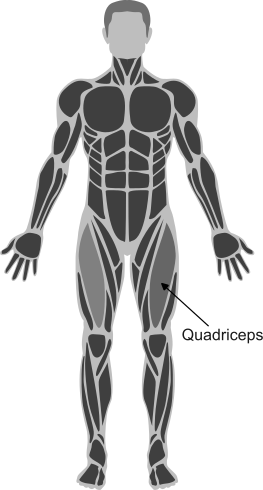
HMS, BM EQ-Bank 26 MC

The muscle group indicated in the image below is primarily responsible for:

  1. Hip flexion
  2. Knee extension
  3. Knee flexion
  4. Hip extension
Show Answers Only

\(B\)

Show Worked Solution
  • B is correct. The quadriceps are the primary knee extensors

Other Options:

  • A is Incorrect: Hip flexion is primarily performed by the iliopsoas
  • C is Incorrect: Knee flexion is performed by the hamstrings
  • D is Incorrect: Hip extension is primarily performed by the gluteus maximus and hamstrings

Filed Under: Skeletal and muscular systems Tagged With: Band 2, smc-5521-30-Major muscles

HMS, BM EQ-Bank 25

A volleyball player performs a spike at the net. Describe the sequence of joint actions that occur at the shoulder and elbow during this movement.  (3 marks)

--- 6 WORK AREA LINES (style=lined) ---

Show Answers Only

Sample answer

  • The volleyball spike begins with the shoulder joint in extension as the arm is drawn back behind the body.
  • As the arm moves forward to contact the ball, the shoulder undergoes flexion while simultaneously the elbow joint moves from flexion to extension.
  • The power generated through this coordinated sequence of joint actions enables the player to strike the ball with force while maintaining control through the movement.
Show Worked Solution

Sample answer

  • The volleyball spike begins with the shoulder joint in extension as the arm is drawn back behind the body.
  • As the arm moves forward to contact the ball, the shoulder undergoes flexion while simultaneously the elbow joint moves from flexion to extension.
  • The power generated through this coordinated sequence of joint actions enables the player to strike the ball with force while maintaining control through the movement.

Filed Under: Skeletal and muscular systems Tagged With: Band 4, smc-5521-10-Joint actions

HMS, BM EQ-Bank 24

Outline how the structure of ball and socket joints enables a greater range of movement than hinge joints. Support your response with examples.  (3 marks)

--- 6 WORK AREA LINES (style=lined) ---

Show Answers Only

Sample answer

Ball-and-socket joints

  • Feature a spherical head fitting into a cup-shaped socket, enabling multi-directional movement.
  • This structure permits flexion, extension, abduction, adduction and rotation.

Hinge joints

  • Have cylindrical surfaces allowing movement in only one plane – flexion and extension.

Examples:

  • The shoulder (ball-and-socket) allows arm movement in all directions for throwing.
  • The elbow (hinge) only bends and straightens, providing stability for lifting.
Show Worked Solution

Sample answer

Ball-and-socket joints

  • Feature a spherical head fitting into a cup-shaped socket, enabling multi-directional movement.
  • This structure permits flexion, extension, abduction, adduction and rotation.

Hinge joints

  • Have cylindrical surfaces allowing movement in only one plane – flexion and extension.

Examples:

  • The shoulder (ball-and-socket) allows arm movement in all directions for throwing.
  • The elbow (hinge) only bends and straightens, providing stability for lifting.

Filed Under: Skeletal and muscular systems Tagged With: Band 4, smc-5521-10-Joint actions, smc-5521-15-Muscle contractions, smc-5521-35-Structure/function

HMS, BM EQ-Bank 23 MC

During a biceps curl, what occurs at the elbow joint?

  1. The biceps contracts concentrically as the primary agonist
  2. The triceps contracts concentrically as the primary agonist
  3. The biceps and triceps contract simultaneously
  4. The triceps relaxes while the biceps stabilises
Show Answers Only

\(A\)

Show Worked Solution
  • A is correct: The biceps contracts concentrically as the agonist, producing elbow flexion to lift the weight.

Other options:

  • B is incorrect: The triceps extends the elbow, not flexes it.
  • C is incorrect: Reciprocal inhibition prevents simultaneous contraction
  • D is incorrect: The biceps contracts, not stabilises

Filed Under: Skeletal and muscular systems Tagged With: Band 3, smc-5521-25-Muscle relationships

HMS, BM EQ-Bank 22

Describe how the coordination of joint actions at the hip, knee and ankle contributes to the generation of power in a vertical jump. Use biomechanical principles in your response.   (3 marks)

--- 8 WORK AREA LINES (style=lined) ---

Show Answers Only

Sample Answer

Preparation phase:

  • Concurrent flexion at hips, knees and ankles lowers the centre of gravity. This creates a countermovement, initiating the stretch-shortening cycle in leg muscles to store elastic energy.

Propulsive phase:

  • Sequential triple extension follows a proximal-to-distal pattern – hips extend first, then knees, finally ankles. This kinetic chain transfers force upward, with each joint adding velocity to the movement.
  • Ground reaction forces peak when all joints extend together. Coordinated timing maximises vertical impulse at take-off.
Show Worked Solution

Sample Answer

Preparation phase:

  • Concurrent flexion at hips, knees and ankles lowers the centre of gravity. This creates a countermovement, initiating the stretch-shortening cycle in leg muscles to store elastic energy.

Propulsive phase:

  • Sequential triple extension follows a proximal-to-distal pattern – hips extend first, then knees, finally ankles. This kinetic chain transfers force upward, with each joint adding velocity to the movement.
  • Ground reaction forces peak when all joints extend together. Coordinated timing maximises vertical impulse at take-off.

Filed Under: Skeletal and muscular systems Tagged With: Band 5, smc-5521-10-Joint actions

HMS, BM EQ-Bank 21

Outline the joint actions that occur at the knee and ankle when performing a squat.  (3 marks)

--- 6 WORK AREA LINES (style=lined) ---

Show Answers Only

Sample Answer

Downward phase:

  • The knee joint undergoes flexion as the femur-tibia angle decreases.
  • Simultaneously, the ankle performs dorsiflexion with the foot tilting upward toward the shin.

Upward phase:

  • The knee extends, increasing the joint angle to straighten the leg.
  • The ankle undergoes plantarflexion to push through the foot.

Joint actions:

  • These coordinated joint actions enable controlled body lowering and raising throughout the squat movement.
Show Worked Solution

Sample Answer

Downward phase:

  • The knee joint undergoes flexion as the femur-tibia angle decreases.
  • Simultaneously, the ankle performs dorsiflexion with the foot tilting upward toward the shin.

Upward phase:

  • The knee extends, increasing the joint angle to straighten the leg.
  • The ankle undergoes plantarflexion to push through the foot.

Joint actions:

  • These coordinated joint actions enable controlled body lowering and raising throughout the squat movement.

Filed Under: Skeletal and muscular systems Tagged With: Band 3, smc-5521-10-Joint actions

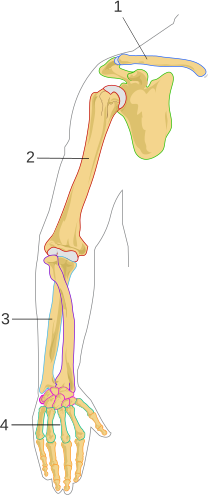
HMS, BM EQ-Bank 20 MC

The diagram below shows bones labelled 1, 2, 3 and 4, of the upper limb.


Which row correctly lists the bones for 1, 2, 3 and 4?

\begin{align*}
\begin{array}{l}
\rule{0pt}{2.5ex} \ \rule[-1ex]{0pt}{0pt}& \\
\rule{0pt}{2.5ex}\textbf{A.}\rule[-1ex]{0pt}{0pt}\\
\rule{0pt}{2.5ex}\textbf{B.}\rule[-1ex]{0pt}{0pt}\\
\rule{0pt}{2.5ex}\textbf{C.}\rule[-1ex]{0pt}{0pt}\\
\rule{0pt}{2.5ex}\textbf{D.}\rule[-1ex]{0pt}{0pt}\\
\end{array}
\begin{array}{|c|c|c|c|}
\hline
\rule{0pt}{2.5ex}\textbf{1}\rule[-1ex]{0pt}{0pt}& \textbf{2}& \textbf{3}& \textbf{4} \\
\hline
\rule{0pt}{2.5ex}\text{Scapula}\rule[-1ex]{0pt}{0pt}&\ \ \text{Humerus}\ \ &\text{Ulna}&\text{Phalanges}\\
\hline
\rule{0pt}{2.5ex}\text{Clavicle}\rule[-1ex]{0pt}{0pt}& \text{Ulna}&\quad \text{Radius}\quad &\text{Phalanges}\\
\hline
\rule{0pt}{2.5ex}\ \ \text{Humerus}\rule[-1ex]{0pt}{0pt}\ \ & \text{Radius} &\text{Ulna}&\text{Metacarpals} \\
\hline
\rule{0pt}{2.5ex}\text{Clavicle}\rule[-1ex]{0pt}{0pt}& \text{Humerus}&\text{Ulna}&\text{Metacarpals} \\
\hline
\end{array}
\end{align*}

Show Answers Only

\(D\)

Show Worked Solution

D is correct: 

1. Clavicle – long bone that attaches the shoulder girdle and the vertebral column.

2. Humerus – long bone in upper arm joining the elbow to the shoulder.

3. Ulna – longest bone in the forearm on the little finger side.

4. Metacarpals – long bones in hand between the carpals and phalanges

\(\Rightarrow D\)

Filed Under: Skeletal and muscular systems Tagged With: Band 4, smc-5521-20-Bones/synovial joints

HMS, BM EQ-Bank 19

Describe how the structural differences between the hip joint and shoulder joint reflect their contrasting functional requirements in human movement.   (3 marks)

--- 6 WORK AREA LINES (style=lined) ---

Show Answers Only

Sample Answer

Hip joint:

  • Features a deep acetabulum (socket) that encloses most of the femoral head, with short, strong ligaments providing robust support. This stable structure reflects its primary function of weight-bearing during standing and locomotion.

Shoulder joint:

  • Has a shallow glenoid cavity with loose joint capsule and longer ligaments. This flexible structure allows extensive multi-directional movement required for reaching, throwing, and overhead activities.

Structural Differences:

  • These directly match functional needs: stability for weight-bearing (hip) versus mobility for upper limb activities (shoulder).
Show Worked Solution

Sample Answer

Hip joint:

  • Features a deep acetabulum (socket) that encloses most of the femoral head, with short, strong ligaments providing robust support. This stable structure reflects its primary function of weight-bearing during standing and locomotion.

Shoulder joint:

  • Has a shallow glenoid cavity with loose joint capsule and longer ligaments. This flexible structure allows extensive multi-directional movement required for reaching, throwing, and overhead activities.

Structural Differences:

  • These directly match functional needs: stability for weight-bearing (hip) versus mobility for upper limb activities (shoulder).

Filed Under: Skeletal and muscular systems Tagged With: Band 5, smc-5521-20-Bones/synovial joints

HMS, BM EQ-Bank 18

Using an example from the shoulder girdle, explain how the arrangement of bones and joints allows for effective throwing movements.   (3 marks)

--- 6 WORK AREA LINES (style=lined) ---

Show Answers Only
  • The shoulder girdle’s ball-and-socket joint connects the rounded head of the humerus to the shallow glenoid cavity of the scapula. This arrangement creates extensive mobility through multi-directional movement.
  • During the wind-up, the shoulder extends and externally rotates, which allows the arm to move behind the body. This backward positioning stores elastic energy in anterior muscles.
  • In the forward phase, the shallow socket permits rapid shoulder flexion and internal rotation. Combined with the scapula’s mobility on the ribcage, this generates maximum throwing velocity through an extended range of motion.
Show Worked Solution
  • The shoulder girdle’s ball-and-socket joint connects the rounded head of the humerus to the shallow glenoid cavity of the scapula. This arrangement creates extensive mobility through multi-directional movement.
  • During the wind-up, the shoulder extends and externally rotates, which allows the arm to move behind the body. This backward positioning stores elastic energy in anterior muscles.
  • In the forward phase, the shallow socket permits rapid shoulder flexion and internal rotation. Combined with the scapula’s mobility on the ribcage, this generates maximum throwing velocity through an extended range of motion.

Filed Under: Skeletal and muscular systems Tagged With: Band 4, smc-5521-20-Bones/synovial joints

HMS, BM EQ-Bank 17

Outline THREE types of synovial joints in the human body and provide an example of where each is located.  (3 marks)

--- 6 WORK AREA LINES (style=lined) ---

Show Answers Only

Sample Answer – ANY 3 of the following

  • Hinge joint: Allows flexion and extension in one plane only. Located at the elbow and knee.
  • Ball-and-socket joint: Permits movement in all planes including rotation. Found at the shoulder and hip.
  • Pivot joint: Enables rotational movement around a single axis. Located between the atlas and axis vertebrae in the neck.
  • Gliding joint: Permits movement in two planes (flexion/extension and abduction/adduction). Located at the wrist between radius and carpals.
  • Condyloid joint: Allows flexion and extension in one plane only. Located at the elbow and knee.
  • Saddle joint: Allows movement in two planes but no rotation. Found at the base of the thumb.
Show Worked Solution

Sample Answer – ANY 3 of the following

  • Hinge joint: Allows flexion and extension in one plane only. Located at the elbow and knee.
  • Ball-and-socket joint: Permits movement in all planes including rotation. Found at the shoulder and hip.
  • Pivot joint: Enables rotational movement around a single axis. Located between the atlas and axis vertebrae in the neck.
  • Gliding joint: Permits movement in two planes (flexion/extension and abduction/adduction). Located at the wrist between radius and carpals.
  • Condyloid joint: Allows flexion and extension in one plane only. Located at the elbow and knee.
  • Saddle joint: Allows movement in two planes but no rotation. Found at the base of the thumb.

Filed Under: Skeletal and muscular systems Tagged With: Band 4, smc-5521-20-Bones/synovial joints

HMS, BM EQ-Bank 16 MC

Which sequence correctly describes the quadriceps muscle action and knee joint movement when performing a squat?

\begin{align*}
\begin{array}{l}
\rule{0pt}{2.5ex} \ \rule[-1ex]{0pt}{0pt}& \\
\rule{0pt}{2.5ex}\textbf{A.}\rule[-1ex]{0pt}{0pt}\\
\rule{0pt}{2.5ex}\textbf{B.}\rule[-1ex]{0pt}{0pt}\\
\rule{0pt}{2.5ex}\textbf{C.}\rule[-1ex]{0pt}{0pt}\\
\rule{0pt}{2.5ex}\textbf{D.}\rule[-1ex]{0pt}{0pt}\\
\end{array}
\begin{array}{|l|l|l|}
\hline
\rule{0pt}{2.5ex}\textbf{Descent Phase}\rule[-1ex]{0pt}{0pt}& \textbf{Bottom Position}& \textbf{Ascent Phase} \\
\hline
\rule{0pt}{2.5ex}\text{Eccentric}\rule[-1ex]{0pt}{0pt}&\text{Isometric }&\text{Concentric}\\
\hline
\rule{0pt}{2.5ex}\text{Concentric}\rule[-1ex]{0pt}{0pt}& \text{Isometric concentric}&\text{Eccentric}\\
\hline
\rule{0pt}{2.5ex}\text{Isometric}\rule[-1ex]{0pt}{0pt}& \text{Eccentric}&\text{Concentric} \\
\hline
\rule{0pt}{2.5ex}\text{Concentric}\rule[-1ex]{0pt}{0pt}& \text{Eccentric}&\text{Isometric} \\
\hline
\end{array}
\end{align*}

Show Answers Only

\(A\)

Show Worked Solution

A is correct: Quadriceps contract eccentrically (descent), isometrically (bottom), then concentrically (ascent).

\(\Rightarrow A\)

Filed Under: Skeletal and muscular systems Tagged With: Band 4, smc-5521-10-Joint actions, smc-5521-15-Muscle contractions

HMS, BM EQ-Bank 15 MC

Which type of muscular contraction is occurring in the quadriceps when descending into a squat?

  1. Isometric contraction
  2. Eccentric contraction
  3. Concentric contraction
  4. Dynamic contraction
Show Answers Only

\(B\)

Show Worked Solution

B is correct: During descent, the quadriceps lengthen under tension to control movement – this is eccentric contraction.

\(\Rightarrow B\)

Filed Under: Skeletal and muscular systems Tagged With: Band 3, smc-5521-10-Joint actions, smc-5521-15-Muscle contractions

HMS, BM EQ-Bank 14 MC

Which row correctly identifies the action of performing a bicep curl? 

\begin{align*}
\begin{array}{l}
\rule{0pt}{2.5ex} \ \rule[-1ex]{0pt}{0pt}& \\
\rule{0pt}{2.5ex}\textbf{A.}\rule[-1ex]{0pt}{0pt}\\
\rule{0pt}{2.5ex}\textbf{B.}\rule[-1ex]{0pt}{0pt}\\
\rule{0pt}{2.5ex}\textbf{C.}\rule[-1ex]{0pt}{0pt}\\
\rule{0pt}{2.5ex}\textbf{D.}\rule[-1ex]{0pt}{0pt}\\
\end{array}
\begin{array}{|l|l|l|}
\hline
\rule{0pt}{2.5ex}\textbf{Agonist Muscle}\rule[-1ex]{0pt}{0pt}& \textbf{Muscular Contraction}& \textbf{Joint Action} \\
\hline
\rule{0pt}{2.5ex}\text{Biceps brachii}\rule[-1ex]{0pt}{0pt}&\text{Isometric eccentric}&\text{Elbow extension}\\
\hline
\rule{0pt}{2.5ex}\text{Biceps brachii}\rule[-1ex]{0pt}{0pt}& \text{Isometric concentric}&\text{Elbow flexion}\\
\hline
\rule{0pt}{2.5ex}\text{Triceps brachii}\rule[-1ex]{0pt}{0pt}& \text{Isometric concentric}&\text{Elbow flexion} \\
\hline
\rule{0pt}{2.5ex}\text{Triceps brachii}\rule[-1ex]{0pt}{0pt}& \text{Isometric eccentric}&\text{Elbow extension} \\
\hline
\end{array}
\end{align*}

Show Answers Only

\(B\)

Show Worked Solution

B is correct: During the upward (concentric) phase of a bicep curl:

  • The biceps brachii is the agonist muscle.
  • It contracts concentrically (shortens) to generate force.
  • This produces elbow flexion to lift the weight.

\(\Rightarrow B\)

Filed Under: Skeletal and muscular systems Tagged With: Band 3, smc-5521-10-Joint actions, smc-5521-15-Muscle contractions

HMS, BM EQ-Bank 6 MC

When performing a heavy deadlift, which biomechanical principle is MOST important for preventing lower back injury?

  1. Maintaining neutral spine alignment
  2. Increasing lifting speed
  3. Narrowing the base of support
  4. Rotating the trunk during lift
Show Answers Only

\(A\)

Show Worked Solution
  • A is correct: Neutral spine distributes forces evenly along vertebrae, preventing injury

Other Options:

  • B is incorrect: Rapid lifting increases injury risk through uncontrolled forces
  • C is incorrect: Narrow base reduces stability and increases fall risk
  • D is incorrect: Trunk rotation during lifting can cause disc herniation

Filed Under: Safe and efficient movement Tagged With: Band 4, smc-5522-10-Safe movement, smc-5522-20-Human movement

HMS, BM EQ-Bank 5 MC

A marathon runner is competing in a 42.2 kilometre event.

What is the likely duration their body will predominantly use the aerobic energy system?

  1. 90 seconds
  2. 10 minutes
  3. 60 minutes
  4. 180 minutes
Show Answers Only

\(D\)

Show Worked Solution
  • D is correct: Marathon running (2-4 hours) requires sustained aerobic energy production

Other Options:

  • A is incorrect: 90 seconds is glycolytic system duration
  • B is incorrect: 10 minutes is too short for marathon distance
  • C is incorrect: 60 minutes would only cover partial marathon distance

Filed Under: Energy systems Tagged With: Band 4, smc-5528-20-Duration/intensity/recovery

HMS, BM 2022 HSC 9 MC

During a game of touch football, a skilled player successfully passes the ball in a high-pressure situation.

Which of the following identifies the types of feedback the player is most likely to have experienced?

  1. Intrinsic, delayed and knowledge of results
  2. Extrinsic, delayed and knowledge of results
  3. Intrinsic, concurrent and knowledge of performance
  4. Extrinsic, concurrent and knowledge of performance
Show Answers Only

\( C \)

Show Worked Solution
  • C is correct: Player feels ball contact and body position during performance.

Other Options:

  • A is incorrect: Feedback occurs during performance, not delayed.
  • B is incorrect: Internal body sensations, not external sources.
  • D is incorrect: Internal sensations from player, not external sources.

♦ Mean mark 50%.

Filed Under: Stages of learning Tagged With: Band 5, smc-5921-90-Identify type of feedback

HMS, BM 2022 HSC 1 MC

An athlete's body is using the lactic acid energy system.

What is the likely duration of their performance while using this system?

  1. 6 seconds
  2. 60 seconds
  3. 6 minutes
  4. 60 minutes
Show Answers Only

\(B\)

Show Worked Solution
  • B is correct: 60 seconds falls within the glycolytic/lactic acid system’s typical duration (10 seconds to 2 minutes)

Other Options:

  • A is incorrect: 6 seconds – Too short, this would be ATP-PCr system
  • C is incorrect: 6 minutes – Too long, would have shifted to primarily aerobic system
  • D is incorrect: 60 minutes – Far too long, this is deeply into aerobic system

Filed Under: Energy systems Tagged With: Band 4, smc-5528-20-Duration/intensity/recovery

HMS, BM 2022 HSC 7 MC

Which of the following is an example of an athlete using negative, intrinsic motivation?

  1. Receiving criticism from their coach to help them improve
  2. Ignoring social media comments from club supporters after a loss
  3. Seeking to avoid repeating the feeling of despair following a defeat
  4. Training harder to enhance their chances of selection in a representative team
Show Answers Only

\(C\)

Show Worked Solution
  • C is correct: Avoiding despair feeling is internally driven negative motivation

Other Options:

  • A is incorrect: Coach criticism is external feedback, not intrinsic.
  • B is incorrect: Ignoring comments is coping strategy, not motivation.
  • D is incorrect: Selection goal is positive motivation, not negative.

Filed Under: Psych–Movement–Performance interplay Tagged With: Band 4, smc-5536-10-Motivation

Functions, 2ADV F1 EQ-Bank 19

Find `a` and `b` such that `a,b` are real numbers and

`(6sqrt3-sqrt5)/(2sqrt5)= a + b sqrt15`.   (2 marks)

--- 4 WORK AREA LINES (style=lined) ---

Show Answers Only

`a= -1/2, \ b=3/5`

Show Worked Solution
`(6sqrt3-sqrt5)/(2sqrt5)` `=(6sqrt3-sqrt5)/(2sqrt5) xx (2sqrt5)/(2sqrt5)`  
  `=(2sqrt5(6sqrt3-sqrt5))/(4 xx5)`  
  `=(12sqrt15-10)/20`  
  `=- 1/2 + 3/5 sqrt15`  

 
`:. a= -1/2, \ b=3/5`

Filed Under: Algebraic Techniques, Algebraic Techniques, Skeletal and muscular systems Tagged With: Band 3, smc-6213-30-Surd Denominators, smc-983-30-Surd Denominators

Functions, 2ADV F1 EQ-Bank 18

Find `a`  and  `b`  such that  `a,b`  are real numbers and 

`(sqrt3-2)/(2sqrt3)= a + b sqrt3`.   (2 marks)

--- 4 WORK AREA LINES (style=lined) ---

Show Answers Only

 `a = 1/2, \ b = -1/3`

Show Worked Solution
`(sqrt3-2)/(2sqrt3)` `= (sqrt3-2)/(2sqrt3) xx (2sqrt3)/(2sqrt3)`
  `= (2sqrt3(sqrt3-2))/(4 xx 3)`
  `= (6-4sqrt3)/12`
  `=1/2-1/3 sqrt3`

 
`:.\ a = 1/2, \ b = – 1/3`

Filed Under: Algebraic Techniques, Algebraic Techniques, Skeletal and muscular systems Tagged With: Band 3, smc-6213-30-Surd Denominators, smc-983-30-Surd Denominators

Functions, 2ADV F1 EQ-Bank 17

Find `a` and `b` such that  `a, b`  are real numbers and

`(8-sqrt27)/(2sqrt3) = a + bsqrt3`.   (2 marks)

Show Answers Only

`:. a =-3/2, \ b = 4/3`

Show Worked Solution
`(8-sqrt27)/(2sqrt3) xx (2sqrt3)/(2sqrt3)` `=(2sqrt3(8-3sqrt3))/(2sqrt3)^2`
  `= (16sqrt3-18)/12`
  `= -3/2 + 4/3sqrt3`

 
`:. a = -3/2, \ b = 4/3`

Filed Under: Algebraic Techniques, Algebraic Techniques, Skeletal and muscular systems Tagged With: Band 3, smc-6213-30-Surd Denominators, smc-983-30-Surd Denominators

  • « Previous Page
  • 1
  • …
  • 12
  • 13
  • 14

Copyright © 2014–2026 SmarterEd.com.au · Log in