SmarterEd

Aussie Maths & Science Teachers: Save your time with SmarterEd

  • Login
  • Get Help
  • About

HMS, TIP EQ-Bank 257

Outline the main structural changes that occur in muscle fibres during the hypertrophy process following strength training.   (3 marks)

--- 9 WORK AREA LINES (style=lined) ---

Show Answers Only
  • Muscle hypertrophy refers to the increase in muscle size due to growth in muscle fibres.
  • The process involves enlargement of cross-sectional muscle area following strength training demands.
  • Structural changes include an increase in actin and myosin filaments within the muscle cells.
  • Myofibrils within muscle fibres also enlarge to support enhanced muscle contraction.
  • Connective tissues that support muscle contraction strengthen during the hypertrophy process.
  • These adaptations occur when muscles are challenged beyond their normal capacity through progressive resistance training.
Show Worked Solution
  • Muscle hypertrophy refers to the increase in muscle size due to growth in muscle fibres.
  • The process involves enlargement of cross-sectional muscle area following strength training demands.
  • Structural changes include an increase in actin and myosin filaments within the muscle cells.
  • Myofibrils within muscle fibres also enlarge to support enhanced muscle contraction.
  • Connective tissues that support muscle contraction strengthen during the hypertrophy process.
  • These adaptations occur when muscles are challenged beyond their normal capacity through progressive resistance training.

Filed Under: Physiological adaptations and improved performance Tagged With: Band 2, smc-5461-30-Muscular adaptations

HMS, TIP EQ-Bank 256

Analyse how heart rate, stroke volume and oxygen uptake adaptations work together to improve cardiovascular performance in endurance athletes.   (6 marks)

--- 18 WORK AREA LINES (style=lined) ---

Show Answers Only

Overview Statement

  • Heart rate, stroke volume and oxygen uptake adaptations interact systematically to enhance cardiovascular efficiency and endurance performance.

Component Relationship 1

  • Resting heart rate decreases while stroke volume increases as the heart becomes more efficient through training adaptations.
  • This relationship enables greater blood pumping capacity as the heart fills more completely during diastole phase.
  • Evidence shows trained athletes develop resting heart rates below 40 beats per minute with significantly increased stroke volume.
  • The interaction means enhanced cardiac output through improved heart efficiency rather than increased heart rate.

Component Relationship 2

  • Stroke volume improvements connect to oxygen uptake enhancements through better oxygen delivery to working muscles.
  • Increased blood plasma volume results in greater ventricular filling and improved elastic recoil for enhanced pumping.
  • These adaptations affect VO2 max by improving oxygen transport efficiency throughout the cardiovascular system.
  • The relationship demonstrates superior oxygen delivery capacity during maximal exercise efforts.

Implications and Synthesis

  • These cardiovascular adaptations work together to optimise endurance performance through enhanced oxygen transport efficiency.
  • The significance shows integrated physiological improvements rather than isolated system changes.
Show Worked Solution

Overview Statement

  • Heart rate, stroke volume and oxygen uptake adaptations interact systematically to enhance cardiovascular efficiency and endurance performance.

Component Relationship 1

  • Resting heart rate decreases while stroke volume increases as the heart becomes more efficient through training adaptations.
  • This relationship enables greater blood pumping capacity as the heart fills more completely during diastole phase.
  • Evidence shows trained athletes develop resting heart rates below 40 beats per minute with significantly increased stroke volume.
  • The interaction means enhanced cardiac output through improved heart efficiency rather than increased heart rate.

Component Relationship 2

  • Stroke volume improvements connect to oxygen uptake enhancements through better oxygen delivery to working muscles.
  • Increased blood plasma volume results in greater ventricular filling and improved elastic recoil for enhanced pumping.
  • These adaptations affect VO2 max by improving oxygen transport efficiency throughout the cardiovascular system.
  • The relationship demonstrates superior oxygen delivery capacity during maximal exercise efforts.

Implications and Synthesis

  • These cardiovascular adaptations work together to optimise endurance performance through enhanced oxygen transport efficiency.
  • The significance shows integrated physiological improvements rather than isolated system changes.

Filed Under: Physiological adaptations and improved performance Tagged With: Band 4, smc-5461-10-Cardio adaptations, smc-5461-20-Energy responses, smc-5461-30-Muscular adaptations

HMS, TIP EQ-Bank 255

Explain how the principle of progressive overload stimulates muscle hypertrophy and the role of warm-up and cool-down in supporting this adaptation process.   (4 marks)

--- 12 WORK AREA LINES (style=lined) ---

Show Answers Only
  • Progressive overload involves gradually increasing workout intensity by increasing resistance, repetitions or training volume over time.
  • This consistent overload causes structural changes in muscle including increased actin and myosin filaments, myofibrils and connective tissues.
  • The challenge beyond normal capacity results in muscle fibres adapting and growing larger to handle increased demands.
  • Warm-up increases blood flow to muscles and prepares them for training intensity while reducing injury risk.
  • Cool-down helps remove waste products from muscles and aids recovery between sessions.
  • Therefore progressive overload with proper warm-up and cool-down supports optimal muscle hypertrophy development.
Show Worked Solution
  • Progressive overload involves gradually increasing workout intensity by increasing resistance, repetitions or training volume over time.
  • This consistent overload causes structural changes in muscle including increased actin and myosin filaments, myofibrils and connective tissues.
  • The challenge beyond normal capacity results in muscle fibres adapting and growing larger to handle increased demands.
  • Warm-up increases blood flow to muscles and prepares them for training intensity while reducing injury risk.
  • Cool-down helps remove waste products from muscles and aids recovery between sessions.
  • Therefore progressive overload with proper warm-up and cool-down supports optimal muscle hypertrophy development.

Filed Under: Physiological adaptations and improved performance Tagged With: Band 3, smc-5461-30-Muscular adaptations

HMS, TIP EQ-Bank 254

Explain how different types of training lead to specific adaptations in slow twitch and fast twitch muscle fibres that improve athletic performance.   (4 marks)

--- 12 WORK AREA LINES (style=lined) ---

Show Answers Only
  • Aerobic training targets slow twitch fibres by providing sustained, moderate-intensity exercise stimulus.
  • This training causes increased mitochondrial number and size, enhancing the muscle’s oxygen utilisation capacity.
  • Enhanced capillary density develops around slow twitch fibres, improving oxygen and nutrient delivery during endurance activities.
  • Anaerobic training stimulates fast twitch fibres through high-intensity, explosive exercise demands.
  • This results in muscle hypertrophy and enhanced glycolytic enzyme activity for rapid energy production.
  • Therefore specific training adaptations optimise each fibre type’s contribution to different athletic performance requirements.
Show Worked Solution
  • Aerobic training targets slow twitch fibres by providing sustained, moderate-intensity exercise stimulus.
  • This training causes increased mitochondrial number and size, enhancing the muscle’s oxygen utilisation capacity.
  • Enhanced capillary density develops around slow twitch fibres, improving oxygen and nutrient delivery during endurance activities.
  • Anaerobic training stimulates fast twitch fibres through high-intensity, explosive exercise demands.
  • This results in muscle hypertrophy and enhanced glycolytic enzyme activity for rapid energy production.
  • Therefore specific training adaptations optimise each fibre type’s contribution to different athletic performance requirements.

Filed Under: Physiological adaptations and improved performance Tagged With: Band 3, smc-5461-30-Muscular adaptations

HMS, TIP EQ-Bank 253

Compare how aerobic training adaptations in slow twitch muscle fibres differ from strength training adaptations in fast twitch muscle fibres.   (5 marks)

--- 15 WORK AREA LINES (style=lined) ---

Show Answers Only

Similarities

  • Both fibre types undergo progressive overload adaptations when consistently challenged through appropriate training stimuli.
  • Each fibre type experiences increased protein synthesis and enhanced metabolic enzyme activity specific to their energy requirements.
  • Both demonstrate improved muscle contraction effectiveness and enhanced neuromuscular coordination following systematic training programs.

Differences

  • Aerobic training in slow twitch fibres develops increased mitochondrial number and size for enhanced oxygen utilisation.
  • These adaptations improve capillary density around muscle fibres and increase myoglobin content for better oxygen storage.
  • Slow twitch fibres enhance oxidative enzyme activity to support sustained aerobic energy production during endurance activities.
  • Strength training in fast twitch fibres creates muscle hypertrophy through increased actin and myosin filament development.
  • Fast twitch adaptations include enhanced glycolytic enzyme activity for rapid anaerobic energy production during explosive movements.
  • These fibres develop greater cross-sectional area and improved neural recruitment patterns for maximum force generation.
  • Therefore each fibre type adapts specifically to match the training demands and energy system requirements of different activities.
Show Worked Solution

Similarities

  • Both fibre types undergo progressive overload adaptations when consistently challenged through appropriate training stimuli.
  • Each fibre type experiences increased protein synthesis and enhanced metabolic enzyme activity specific to their energy requirements.
  • Both demonstrate improved muscle contraction effectiveness and enhanced neuromuscular coordination following systematic training programs.

Differences

  • Aerobic training in slow twitch fibres develops increased mitochondrial number and size for enhanced oxygen utilisation.
  • These adaptations improve capillary density around muscle fibres and increase myoglobin content for better oxygen storage.
  • Slow twitch fibres enhance oxidative enzyme activity to support sustained aerobic energy production during endurance activities.
  • Strength training in fast twitch fibres creates muscle hypertrophy through increased actin and myosin filament development.
  • Fast twitch adaptations include enhanced glycolytic enzyme activity for rapid anaerobic energy production during explosive movements.
  • These fibres develop greater cross-sectional area and improved neural recruitment patterns for maximum force generation.
  • Therefore each fibre type adapts specifically to match the training demands and energy system requirements of different activities.

Filed Under: Physiological adaptations and improved performance Tagged With: Band 4, smc-5461-30-Muscular adaptations

HMS, TIP EQ-Bank 252

Outline the main characteristics that distinguish slow twitch muscle fibres from fast twitch muscle fibres in terms of their structure and function.   (3 marks)

--- 9 WORK AREA LINES (style=lined) ---

Show Answers Only
  • Slow twitch fibres contract slowly and sustain activity for extended periods without fatigue.
  • They are efficient at using oxygen to generate energy through aerobic metabolism pathways.
  • Slow twitch fibres contain high numbers of mitochondria and increased myoglobin content for oxygen storage.
  • Fast twitch fibres contract quickly and generate high power output but fatigue rapidly.
  • They rely primarily on anaerobic energy systems for fuel during explosive movements.
  • Fast twitch fibres have lower mitochondrial density but greater glycolytic enzyme activity for rapid energy production.
Show Worked Solution
  • Slow twitch fibres contract slowly and sustain activity for extended periods without fatigue.
  • They are efficient at using oxygen to generate energy through aerobic metabolism pathways.
  • Slow twitch fibres contain high numbers of mitochondria and increased myoglobin content for oxygen storage.
  • Fast twitch fibres contract quickly and generate high power output but fatigue rapidly.
  • They rely primarily on anaerobic energy systems for fuel during explosive movements.
  • Fast twitch fibres have lower mitochondrial density but greater glycolytic enzyme activity for rapid energy production.

Filed Under: Physiological adaptations and improved performance Tagged With: Band 2, smc-5461-30-Muscular adaptations

HMS, TIP EQ-Bank 251

Justify why haemoglobin level improvements are more significant for endurance performance than improvements in lung capacity following aerobic training programs.   (6 marks)

--- 18 WORK AREA LINES (style=lined) ---

Show Answers Only

Position Statement

  • Haemoglobin level improvements prove more significant for endurance performance than lung capacity changes.
  • This is due to their direct impact on oxygen transport efficiency.

Haemoglobin Significance

  • Haemoglobin levels increase substantially with endurance training, enhancing the blood’s total oxygen-carrying capacity.
  • Evidence demonstrates that red blood cells contain numerous haemoglobin molecules capable of carrying large oxygen quantities to working muscles.
  • Research shows the majority of oxygen transport occurs through haemoglobin binding rather than plasma dissolution, making haemoglobin the primary oxygen carrier.
  • Training at altitude further enhances haemoglobin production through increased erythropoietin hormone release, demonstrating its critical importance for performance.

Lung Capacity Limitations

  • Total lung capacity remains relatively unchanged with training, showing only small improvements in vital capacity and tidal volume.
  • Studies indicate that healthy lungs already possess sufficient capacity for oxygen intake, making lung capacity less limiting for performance.
  • Research reveals that oxygen delivery to muscles depends more on circulatory efficiency than respiratory capacity in trained athletes.

Reinforcement

  • While lung function supports performance, haemoglobin improvements provide the critical oxygen transport capacity essential for sustained endurance efforts.
  • Therefore haemoglobin adaptations represent the primary physiological limitation and improvement opportunity for endurance athletes seeking performance gains.
Show Worked Solution

Position Statement

  • Haemoglobin level improvements prove more significant for endurance performance than lung capacity changes.
  • This is due to their direct impact on oxygen transport efficiency.

Haemoglobin Significance

  • Haemoglobin levels increase substantially with endurance training, enhancing the blood’s total oxygen-carrying capacity.
  • Evidence demonstrates that red blood cells contain numerous haemoglobin molecules capable of carrying large oxygen quantities to working muscles.
  • Research shows the majority of oxygen transport occurs through haemoglobin binding rather than plasma dissolution, making haemoglobin the primary oxygen carrier.
  • Training at altitude further enhances haemoglobin production through increased erythropoietin hormone release, demonstrating its critical importance for performance.

Lung Capacity Limitations

  • Total lung capacity remains relatively unchanged with training, showing only small improvements in vital capacity and tidal volume.
  • Studies indicate that healthy lungs already possess sufficient capacity for oxygen intake, making lung capacity less limiting for performance.
  • Research reveals that oxygen delivery to muscles depends more on circulatory efficiency than respiratory capacity in trained athletes.

Reinforcement

  • While lung function supports performance, haemoglobin improvements provide the critical oxygen transport capacity essential for sustained endurance efforts.
  • Therefore haemoglobin adaptations represent the primary physiological limitation and improvement opportunity for endurance athletes seeking performance gains.

Filed Under: Physiological adaptations and improved performance Tagged With: Band 5, smc-5461-20-Energy responses

HMS, TIP EQ-Bank 250

Discuss the effectiveness of training thresholds for developing different energy system adaptations in endurance athletes.   (5 marks)

--- 15 WORK AREA LINES (style=lined) ---

Show Answers Only

For Training Thresholds

  • [P] Training thresholds provide effective guidelines for targeting specific energy system adaptations in endurance athletes.
  • [E] Working within aerobic threshold zones enables systematic development of cardiovascular efficiency and fat oxidation capacity.
  • [Ev] Research demonstrates that training at 60-85% maximum heart rate optimises mitochondrial adaptations and capillary density improvements.
  • [L] Therefore threshold-based training effectively develops the aerobic base essential for endurance performance.

Against Single Threshold Approaches

  • [P] Relying exclusively on predetermined thresholds limits comprehensive energy system development in competitive athletes.
  • [E] Individual physiological responses vary significantly, making standardised threshold percentages potentially inappropriate for some athletes.
  • [Ev] Studies show lactate and anaerobic thresholds occur at different intensities between individuals despite similar fitness levels.
  • [L] Consequently maintaining rigid thresholds may prevent optimal training adaptations in certain athletes.

Balanced Approach

  • [P] Combining threshold guidelines with individualised monitoring provides the most effective energy system development strategy.
  • [E] This approach allows coaches to adjust training intensities based on physiological responses rather than predetermined percentages.
  • [Ev] Evidence indicates personalised threshold training produces superior VO2 max and lactate clearance improvements.
  • [L] Therefore adaptable threshold use optimises energy system adaptations for diverse endurance athletes.
Show Worked Solution

For Training Thresholds

  • [P] Training thresholds provide effective guidelines for targeting specific energy system adaptations in endurance athletes.
  • [E] Working within aerobic threshold zones enables systematic development of cardiovascular efficiency and fat oxidation capacity.
  • [Ev] Research demonstrates that training at 60-85% maximum heart rate optimises mitochondrial adaptations and capillary density improvements.
  • [L] Therefore threshold-based training effectively develops the aerobic base essential for endurance performance.

Against Single Threshold Approaches

  • [P] Relying exclusively on predetermined thresholds limits comprehensive energy system development in competitive athletes.
  • [E] Individual physiological responses vary significantly, making standardised threshold percentages potentially inappropriate for some athletes.
  • [Ev] Studies show lactate and anaerobic thresholds occur at different intensities between individuals despite similar fitness levels.
  • [L] Consequently maintaining rigid thresholds may prevent optimal training adaptations in certain athletes.

Balanced Approach

  • [P] Combining threshold guidelines with individualised monitoring provides the most effective energy system development strategy.
  • [E] This approach allows coaches to adjust training intensities based on physiological responses rather than predetermined percentages.
  • [Ev] Evidence indicates personalised threshold training produces superior VO2 max and lactate clearance improvements.
  • [L] Therefore adaptable threshold use optimises energy system adaptations for diverse endurance athletes.

Filed Under: Physiological adaptations and improved performance Tagged With: Band 4, smc-5461-20-Energy responses

HMS, TIP EQ-Bank 249

Explain how progressive overload training leads to improvements in oxygen uptake and the body's ability to deliver oxygen to working muscles during aerobic exercise.   (4 marks)

--- 12 WORK AREA LINES (style=lined) ---

Show Answers Only
  • Progressive overload training creates increased demand on the cardiovascular and respiratory systems during exercise.
  • This stimulus causes adaptations including enhanced stroke volume and improved cardiac output for greater blood circulation.
  • The training stress results in increased number and size of mitochondria within muscle cells for enhanced oxygen utilisation.
  • Improved capillary density develops around muscle fibres, enabling more efficient oxygen delivery to working tissues.
  • These adaptations lead to higher VO2 max values and improved endurance performance during sustained aerobic activities.
  • Consequently athletes can maintain higher intensities for longer periods without experiencing excessive fatigue.
Show Worked Solution
  • Progressive overload training creates increased demand on the cardiovascular and respiratory systems during exercise.
  • This stimulus causes adaptations including enhanced stroke volume and improved cardiac output for greater blood circulation.
  • The training stress results in increased number and size of mitochondria within muscle cells for enhanced oxygen utilisation.
  • Improved capillary density develops around muscle fibres, enabling more efficient oxygen delivery to working tissues.
  • These adaptations lead to higher VO2 max values and improved endurance performance during sustained aerobic activities.
  • Consequently athletes can maintain higher intensities for longer periods without experiencing excessive fatigue.

Filed Under: Physiological adaptations and improved performance Tagged With: Band 3, smc-5461-20-Energy responses

HMS, TIP 2012 HSC 20 MC

Which physiological adaptations occur in athletes when regularly training at submaximal levels to improve their aerobic performance?

  1. Increased cardiac output, decreased stroke volume and muscle atrophy
  2. Increased cardiac output, increased lung capacity and muscle hypertrophy
  3. Decreased resting heart rate, decreased haemoglobin levels and increased oxygen uptake
  4. Decreased resting heart rate, increased stroke volume and increased haemoglobin levels
Show Answers Only

\(D\)

Show Worked Solution
  • D is correct: Aerobic training decreases resting heart rate, increases stroke volume and haemoglobin.

Other Options:

  • A is incorrect: Stroke volume increases with aerobic training, not decreases.
  • B is incorrect: Aerobic training causes muscle adaptations, not significant hypertrophy.
  • C is incorrect: Haemoglobin levels increase with aerobic training, not decrease.

Filed Under: Physiological adaptations and improved performance Tagged With: Band 4, smc-5461-10-Cardio adaptations

HMS, TIP 2013 HSC 25

Describe the effect of stroke volume and cardiac output on aerobic performance.   (3 marks)

--- 9 WORK AREA LINES (style=lined) ---

Show Answers Only
  • Stroke volume is the amount of blood pumped from the heart per beat. Increased stroke volume delivers more oxygen-rich blood to working muscles during each heartbeat, improving aerobic capacity.
  • Cardiac output is the total blood volume pumped per minute, calculated by multiplying stroke volume and heart rate. Higher cardiac output increases oxygen delivery to muscles, enabling sustained aerobic activity.
  • Both adaptations result from aerobic training, allowing athletes to maintain higher exercise intensities for longer periods whilst reducing heart rate at submaximal workloads.
Show Worked Solution
  • Stroke volume is the amount of blood pumped from the heart per beat. Increased stroke volume delivers more oxygen-rich blood to working muscles during each heartbeat, improving aerobic capacity.
  • Cardiac output is the total blood volume pumped per minute, calculated by multiplying stroke volume and heart rate. Higher cardiac output increases oxygen delivery to muscles, enabling sustained aerobic activity.
  • Both adaptations result from aerobic training, allowing athletes to maintain higher exercise intensities for longer periods whilst reducing heart rate at submaximal workloads.

Filed Under: Physiological adaptations and improved performance Tagged With: Band 4, smc-5461-10-Cardio adaptations

HMS, TIP 2014 HSC 12 MC

What is cardiac output?

  1. The volume of blood ejected by the heart per minute
  2. The volume of blood sent to the lungs for oxygenation
  3. The volume of deoxygenated blood returning to the heart
  4. The volume of blood sent by the left ventricle of the heart during each contraction
Show Answers Only

\(A\)

Show Worked Solution
  • A is correct: Cardiac output is the total volume of blood pumped by the heart per minute.

Other Options:

  • B is incorrect: This describes pulmonary circulation not cardiac output.
  • C is incorrect: This describes venous return not cardiac output.
  • D is incorrect: This describes stroke volume not total cardiac output.

Filed Under: Physiological adaptations and improved performance Tagged With: Band 4, smc-5461-10-Cardio adaptations

HMS, TIP 2015 HSC 19 MC

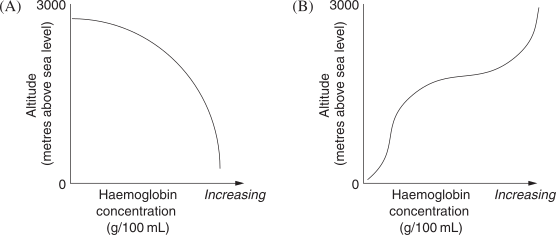
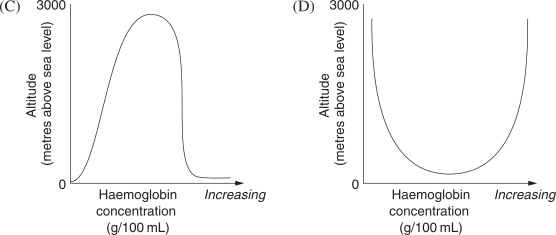
Which of the following graphs is most likely to represent an athlete's haemoglobin concentration while training at different altitudes for up to four weeks?


Show Answers Only

\(B\)

Show Worked Solution
  • B is correct: Haemoglobin increases at higher altitude as physiological adaptation.

Other Options:

  • A is incorrect: Altitude training increases not decreases haemoglobin levels.
  • C is incorrect: Body adapts to altitude by increasing haemoglobin concentration.
  • D is incorrect: Haemoglobin shows consistent increase not random fluctuation.

Filed Under: Physiological adaptations and improved performance Tagged With: Band 4, smc-5461-10-Cardio adaptations

HMS, TIP 2015 HSC 5 MC

The physiological adaptation that is likely to occur from progressively overloading a strength-training program is an increase in

  1. muscle hypertrophy.
  2. cardiac muscle capacity.
  3. muscle contraction speed.
  4. the number of fast twitch muscle fibres.
Show Answers Only

\(A\)

Show Worked Solution
  • A is correct: Progressive overload in strength training causes muscle hypertrophy.

Other Options:

  • B is incorrect: Cardiac adaptations occur primarily with aerobic training.
  • C is incorrect: Contraction speed relates to power training, not hypertrophy.
  • D is incorrect: Fibre type numbers are genetically determined, not trainable.

Filed Under: Physiological adaptations and improved performance Tagged With: Band 3, smc-5461-30-Muscular adaptations

HMS, TIP 2016 HSC 20 MC

Which of the following adaptations is increased by long-term aerobic training?

  1. Fat metabolism
  2. ATP resynthesis
  3. Protein metabolism
  4. Fast-twitch fibre recruitment
Show Answers Only

\(A\)

Show Worked Solution
  • A is correct: Aerobic training enhances the body’s ability to metabolise fats for energy.

Other Options:

  • B is incorrect: ATP resynthesis improves but fat metabolism is more specific.
  • C is incorrect: Protein metabolism isn’t a primary adaptation to aerobic training.
  • D is incorrect: Aerobic training develops slow-twitch fibres, not fast-twitch recruitment.

♦♦♦ Mean mark 40%.

Filed Under: Physiological adaptations and improved performance Tagged With: Band 5, smc-5461-10-Cardio adaptations

HMS, TIP 2016 HSC 8 MC

Compared to an untrained person, a trained endurance athlete is likely to have a

  1. lower resting heart rate.
  2. higher resting heart rate.
  3. increased fast-twitch fibre concentration.
  4. decreased fast-twitch fibre concentration.
Show Answers Only

\(A\)

Show Worked Solution
  • A is correct: Endurance training strengthens the heart, reducing resting heart rate.

Other Options:

  • B is incorrect: Training decreases resting heart rate, doesn’t increase it.
  • C is incorrect: Endurance training develops slow-twitch fibres, not fast-twitch.
  • D is incorrect: While relatively decreased, absolute numbers don’t significantly change.

Filed Under: Physiological adaptations and improved performance Tagged With: Band 3, smc-5461-10-Cardio adaptations

HMS, TIP 2016 HSC 4 MC

What is the likely effect of a heavy and low-repetition strength training program using free weights?

  1. Muscle atrophy
  2. Muscle hypertrophy
  3. Increased muscular endurance
  4. Increased slow-twitch muscle fibre concentration
Show Answers Only

\(B\)

Show Worked Solution
  • B is correct: Heavy, low-repetition training causes muscle fibres to increase in size.

Other Options:

  • A is incorrect: This would cause muscle growth, not muscle wasting.
  • C is incorrect: High repetitions develop endurance, not heavy low reps.
  • D is incorrect: Heavy training develops fast-twitch fibres, not slow-twitch.

Filed Under: Physiological adaptations and improved performance Tagged With: Band 4, smc-5461-30-Muscular adaptations

HMS, TIP 2017 HSC 26

Explain the physiological adaptations an individual develops in response to the different principles of training. Use examples to support your answer.   (8 marks)

--- 24 WORK AREA LINES (style=lined) ---

Show Answers Only

  • Progressive overload directly triggers cardiovascular adaptations in trained athletes. This occurs because gradually increasing training intensity forces the heart to work harder over time. As a result, stroke volume increases as the heart becomes stronger and pumps more blood per beat. For instance, when a cyclist progressively increases weekly mileage, their resting heart rate decreases significantly. This demonstrates why endurance athletes develop enlarged left ventricles and improved cardiac efficiency.
  • The principle of specificity generates targeted muscular adaptations based on training type performed. This happens because muscles adapt specifically to the demands placed upon them during exercise. Consequently, resistance training causes muscle hypertrophy whilst endurance training increases mitochondrial density. A clear example is powerlifters developing increased fast-twitch muscle fibres for explosive movements. In contrast, marathon runners develop enhanced slow-twitch fibres for sustained aerobic performance.
  • Training thresholds produce specific metabolic adaptations when athletes train at appropriate intensities. This works by challenging energy systems at their optimal training zones for maximum adaptation. Therefore, training above the anaerobic threshold improves lactate buffering capacity and tolerance. Evidence of this includes sprint athletes who can maintain higher lactate concentrations without performance decline. This explains why proper intensity prescription maximises physiological improvements.

Show Worked Solution

  • Progressive overload directly triggers cardiovascular adaptations in trained athletes. This occurs because gradually increasing training intensity forces the heart to work harder over time. As a result, stroke volume increases as the heart becomes stronger and pumps more blood per beat. For instance, when a cyclist progressively increases weekly mileage, their resting heart rate decreases significantly. This demonstrates why endurance athletes develop enlarged left ventricles and improved cardiac efficiency.
  • The principle of specificity generates targeted muscular adaptations based on training type performed. This happens because muscles adapt specifically to the demands placed upon them during exercise. Consequently, resistance training causes muscle hypertrophy whilst endurance training increases mitochondrial density. A clear example is powerlifters developing increased fast-twitch muscle fibres for explosive movements. In contrast, marathon runners develop enhanced slow-twitch fibres for sustained aerobic performance.
  • Training thresholds produce specific metabolic adaptations when athletes train at appropriate intensities. This works by challenging energy systems at their optimal training zones for maximum adaptation. Therefore, training above the anaerobic threshold improves lactate buffering capacity and tolerance. Evidence of this includes sprint athletes who can maintain higher lactate concentrations without performance decline. This explains why proper intensity prescription maximises physiological improvements.

♦♦♦ Mean mark 43%.

Filed Under: Physiological adaptations and improved performance Tagged With: Band 5, smc-5460-05-Adaptations, smc-5460-10-Thresholds

HMS, TIP 2018 HSC 14 MC

Athletes are training for a 14 -kilometre fun run.

Which combination of physiological adaptations are they aiming to achieve?

  1. Increased stroke volume, reduced resting heart rate, increased lactate tolerance
  2. Reduced stroke volume, reduced resting heart rate, increased haemoglobin levels
  3. Increased stroke volume, increased muscle hypertrophy, reduced lactate tolerance
  4. Reduced stroke volume, reduced muscle hypertrophy, increased haemoglobin levels
Show Answers Only

\(A\)

Show Worked Solution

  • A is correct: Endurance training increases stroke volume, reduces resting heart rate, and improves lactate tolerance.

Other Options:

  • B is incorrect: Endurance training increases stroke volume, not reduces it.
  • C is incorrect: Endurance training doesn’t focus on muscle hypertrophy or reduce lactate tolerance.
  • D is incorrect: Endurance training increases stroke volume and doesn’t reduce muscle mass significantly.

Filed Under: Physiological adaptations and improved performance Tagged With: Band 4, smc-5461-10-Cardio adaptations, smc-5461-20-Energy responses

HMS, TIP 2019 HSC 27

An athlete is participating in a 12-week aerobic training program.

Analyse how progressive overload and training thresholds can result in physiological adaptations for the athlete.   (8 marks)

--- 24 WORK AREA LINES (style=lined) ---

Show Answers Only

Overview Statement

  • Progressive overload and training thresholds interact to create systematic stress that triggers cardiovascular and respiratory adaptations over 12 weeks.

Component Relationship 1 – Progressive Overload and Cardiovascular Adaptations

  • Progressive overload involves gradually increasing training frequency, intensity, and duration throughout the program. This systematic increase places greater demands on the cardiovascular system each week.
  • As a result, the heart muscle strengthens and stroke volume increases significantly. The left ventricle enlarges to pump more blood per contraction.
  • Consequently, resting heart rate decreases as the heart becomes more efficient. Cardiac output improves during exercise, enabling enhanced oxygen delivery to working muscles.
  • This relationship demonstrates how progressive stress leads to superior cardiovascular function.

Component Relationship 2 – Training Thresholds and Respiratory Adaptations

  • Training thresholds ensure exercise intensity remains between aerobic and anaerobic zones throughout the program. This targeted intensity optimises oxygen utilisation without excessive lactate accumulation.
  • Therefore, respiratory muscles strengthen and lung capacity increases. Oxygen uptake improves as alveoli become more efficient at gas exchange.
  • This connection between threshold training and respiratory adaptation results in enhanced endurance capacity and delayed fatigue onset.

Implications and Synthesis

  • These interactions create a synergistic effect where cardiovascular and respiratory improvements work together.
  • The combined adaptations significantly enhance athletic performance and exercise tolerance.

Show Worked Solution

Overview Statement

  • Progressive overload and training thresholds interact to create systematic stress that triggers cardiovascular and respiratory adaptations over 12 weeks.

Component Relationship 1 – Progressive Overload and Cardiovascular Adaptations

  • Progressive overload involves gradually increasing training frequency, intensity, and duration throughout the program. This systematic increase places greater demands on the cardiovascular system each week.
  • As a result, the heart muscle strengthens and stroke volume increases significantly. The left ventricle enlarges to pump more blood per contraction.
  • Consequently, resting heart rate decreases as the heart becomes more efficient. Cardiac output improves during exercise, enabling enhanced oxygen delivery to working muscles.
  • This relationship demonstrates how progressive stress leads to superior cardiovascular function.

Component Relationship 2 – Training Thresholds and Respiratory Adaptations

  • Training thresholds ensure exercise intensity remains between aerobic and anaerobic zones throughout the program. This targeted intensity optimises oxygen utilisation without excessive lactate accumulation.
  • Therefore, respiratory muscles strengthen and lung capacity increases. Oxygen uptake improves as alveoli become more efficient at gas exchange.
  • This connection between threshold training and respiratory adaptation results in enhanced endurance capacity and delayed fatigue onset.

Implications and Synthesis

  • These interactions create a synergistic effect where cardiovascular and respiratory improvements work together.
  • The combined adaptations significantly enhance athletic performance and exercise tolerance.

♦♦♦♦ Mean mark 39%.

Filed Under: Physiological adaptations and improved performance, Principles of training Tagged With: Band 5, smc-5460-10-Thresholds, smc-5461-10-Cardio adaptations

HMS, TIP 2020 HSC 20 MC

An athlete participated in an 8-week training program.

The table shows the physiological adaptations for the athlete at the completion of the training program.

\begin{array} {|l|l|}
\hline
\rule{0pt}{2.5ex}\ \ \ \ \textit{Physiological adaptation}\ \ \rule[-1ex]{0pt}{0pt} & \ \ \ \textit{Results for the athlete}\\
\hline
\rule{0pt}{2.5ex}\text{Resting heart rate}\rule[-1ex]{0pt}{0pt} & \text{Decreased}\\
\hline
\rule{0pt}{2.5ex}\text{Stroke volume}\rule[-1ex]{0pt}{0pt} & \text{Substantially increased}\\
\hline
\rule{0pt}{2.5ex}\text{Cardiac output}\rule[-1ex]{0pt}{0pt} & \text{Increased}\\
\hline
\rule{0pt}{2.5ex}\text{Muscle hypertrophy}\rule[-1ex]{0pt}{0pt} & \text{No significant change}\\
\hline
\rule{0pt}{2.5ex}\text{Fast/slow twitch muscle fibres }\rule[-1ex]{0pt}{0pt} & \text{Increased number of capillaries}\\
\ & \text{in slow twitch muscle fibres}\\
\hline
\end{array}

Which of the following shows the most likely features of the training program?

  1. Anaerobic interval training for 30 minutes, 3 sessions per week, gradually increasing the work-rest ratio each week
  2. Aerobic continuous training for 60 minutes, at an intensity of 80% maximum heart rate, progressively increasing the number of sessions each week
  3. Aerobic circuit training for 30 minutes, at an intensity of 90% maximum heart rate, progressively decreasing the number of sessions each week
  4. Aerobic interval training for 60 minutes, 4 sessions per week, at an intensity of 60% maximum heart rate, progressively increasing the work-rest ratio within each session
Show Answers Only

\(B\)

Show Worked Solution
  • B is correct: Aerobic adaptations indicate continuous training at moderate-high intensity with progression.

Other Options:

  • A is incorrect: Anaerobic training wouldn’t produce these cardiovascular adaptations.
  • C is incorrect: 90% intensity too high for sustained training, decreasing sessions illogical.
  • D is incorrect: 60% intensity too low for substantial adaptations shown.

♦♦ Mean mark 47%.

Filed Under: Physiological adaptations and improved performance Tagged With: Band 5, smc-5461-10-Cardio adaptations

HMS, TIP 2020 HSC 15 MC

Which group of physiological adaptations is likely to occur in athletes who have participated in an aerobic training program at sub-maximal levels for 8 weeks?

  1. Increased cardiac output, decreased stroke volume, muscle atrophy
  2. Increased cardiac output, increased lung capacity, muscle hypertrophy
  3. Decreased resting heart rate, increased stroke volume, increased haemoglobin level
  4. Decreased resting heart rate, increased oxygen uptake, decreased haemoglobin level
Show Answers Only

\(C\)

Show Worked Solution
  • C is correct: Aerobic training decreases resting heart rate, increases stroke volume and haemoglobin.

Other Options:

  • A is incorrect: Stroke volume increases not decreases with aerobic training.
  • B is incorrect: Aerobic training causes muscle endurance not hypertrophy adaptations.
  • D is incorrect: Haemoglobin level increases not decreases with aerobic training.

Filed Under: Physiological adaptations and improved performance Tagged With: Band 4, smc-5461-10-Cardio adaptations, smc-5461-30-Muscular adaptations

HMS, TIP 2021 HSC 17 MC

The table shows the features of training programs A and B. An untrained individual is considering participating in one of these programs for a period of 8 weeks.

Which of the following statements best compares a physiological adaptation the individual would most likely experience from these programs?

  1. Program B will result in a greater increase to stroke volume than Program A.
  2. Program A will result in a greater increase to stroke volume than Program B.
  3. Program A will result in a more significant decrease to resting heart rate than Program B.
  4. Program B will result in a more significant increase to resting heart rate than Program A.
Show Answers Only

\(A\)

Show Worked Solution
  • A is correct: Higher intensity and volume in Program B creates greater adaptations.

Other Options:

  • B is incorrect: Program A has lower intensity and frequency.
  • C is incorrect: Program B’s higher demands produce greater heart rate reduction.
  • D is incorrect: Training decreases not increases resting heart rate.

Filed Under: Physiological adaptations and improved performance Tagged With: Band 4, smc-5461-10-Cardio adaptations

HMS, TIP 2023 HSC 27

Analyse the relationship between ONE physiological adaptation and improved performance. Provide examples to support your answer.   (8 marks)

--- 30 WORK AREA LINES (style=lined) ---

Show Answers Only

Sample answer – Increased Stroke Volume (Other adaptations are possible)

Overview Statement

  • Increased stroke volume represents a critical cardiovascular adaptation that directly correlates with enhanced endurance performance. This relationship demonstrates how physiological changes create measurable performance improvements across multiple sporting contexts.

Component Relationship 1: Adaptation Mechanism and Efficiency

  • Increased stroke volume develops from ventricular enlargement and strengthened heart walls which enables greater blood ejection per heartbeat. This adaptation occurs because endurance training creates cardiac overload, forcing the heart muscle to adapt like skeletal muscle. Enhanced ventricular filling capacity combines with stronger myocardial contractions to produce more efficient oxygen delivery. For example, a triathlete with increased stroke volume can maintain race pace at lower heart rates than pre-training. This relationship means cardiac efficiency allows sustained higher intensities without reaching maximum heart rate, directly extending competitive endurance capacity.

Component Relationship 2: Recovery and Performance Sustainability

  • Increased stroke volume significantly affects recovery between high-intensity efforts which influences overall performance quality. Athletes with greater stroke volume demonstrate faster return to resting heart rates between intervals. This enhanced recovery enables more complete energy system replenishment between plays in sports like soccer and basketball. Marathon runners benefit because improved oxygen delivery delays fatigue onset by better meeting muscular oxygen demands. The relationship shows that stroke volume works synergistically with other adaptations like increased capillarisation, creating comprehensive improvements in oxygen transport systems.

Implications and Synthesis

  • These relationships reveal that stroke volume adaptation functions as a cornerstone physiological change that amplifies multiple performance benefits. The interconnected nature demonstrates how single adaptations create cascading performance improvements across endurance sporting demands.
Show Worked Solution

Sample answer – Increased Stroke Volume (Other adaptations are possible)

Overview Statement

  • Increased stroke volume represents a critical cardiovascular adaptation that directly correlates with enhanced endurance performance. This relationship demonstrates how physiological changes create measurable performance improvements across multiple sporting contexts.

Component Relationship 1: Adaptation Mechanism and Efficiency

  • Increased stroke volume develops from ventricular enlargement and strengthened heart walls which enables greater blood ejection per heartbeat. This adaptation occurs because endurance training creates cardiac overload, forcing the heart muscle to adapt like skeletal muscle. Enhanced ventricular filling capacity combines with stronger myocardial contractions to produce more efficient oxygen delivery. For example, a triathlete with increased stroke volume can maintain race pace at lower heart rates than pre-training. This relationship means cardiac efficiency allows sustained higher intensities without reaching maximum heart rate, directly extending competitive endurance capacity.

Component Relationship 2: Recovery and Performance Sustainability

  • Increased stroke volume significantly affects recovery between high-intensity efforts which influences overall performance quality. Athletes with greater stroke volume demonstrate faster return to resting heart rates between intervals. This enhanced recovery enables more complete energy system replenishment between plays in sports like soccer and basketball. Marathon runners benefit because improved oxygen delivery delays fatigue onset by better meeting muscular oxygen demands. The relationship shows that stroke volume works synergistically with other adaptations like increased capillarisation, creating comprehensive improvements in oxygen transport systems.

Implications and Synthesis

  • These relationships reveal that stroke volume adaptation functions as a cornerstone physiological change that amplifies multiple performance benefits. The interconnected nature demonstrates how single adaptations create cascading performance improvements across endurance sporting demands.

♦♦ Mean mark 43%.

Filed Under: Physiological adaptations and improved performance Tagged With: Band 5, smc-5461-10-Cardio adaptations

HMS, TIP 2023 HSC 17 MC

The following graph represents aerobic and anaerobic threshold training zones.

Which letter on the graph represents the minimum intensity for an athlete to train to produce a physiological improvement in performance?

  1. W
  2. X
  3. Y
  4. Z
Show Answers Only

\(B\)

Show Worked Solution
  • B is correct: Position X represents the aerobic threshold, the minimum intensity required for physiological adaptations.

Other Options:

  • A is incorrect: Position W is below the aerobic threshold and won’t produce significant adaptations.
  • C is incorrect: Position Y is higher intensity than needed for minimum improvement.
  • D is incorrect: Position Z represents anaerobic threshold, beyond minimum requirement.

♦♦♦ Mean mark 36%.

Filed Under: Physiological adaptations and improved performance Tagged With: Band 5, smc-5461-10-Cardio adaptations

HMS, TIP 2023 HSC 2 MC

A 12 -minute run can be used as a test to measure oxygen uptake.

To achieve the most valid and reliable results, the test should be performed

  1. multiple times on different running surfaces.
  2. at the same time of day using hand-held stopwatches.
  3. under varied levels of fatigue on a synthetic athletic track.
  4. on a synthetic athletic track using electronic timing equipment.
Show Answers Only

\(D\)

Show Worked Solution
  • D is correct: Using a standardised surface with electronic timing provides the most valid and reliable measurement for oxygen uptake testing.

Other Options:

  • A is incorrect: Different running surfaces introduce variables that reduce reliability.
  • B is incorrect: Hand-held stopwatches introduce human error, reducing reliability.
  • C is incorrect: Varied fatigue levels would significantly impact results and reduce validity.

Filed Under: Physiological adaptations and improved performance Tagged With: Band 4, smc-5461-10-Cardio adaptations

HMS, TIP 2024 HSC 20 MC

Which row of the table correctly identifies the physiological adaptations that are the result of training slow twitch muscle fibres?

\begin{align*}
\begin{array}{l}
\rule{0pt}{2.5ex} \ \rule[-1ex]{0pt}{0pt}& \\
\rule{0pt}{2.5ex}\textbf{A.}\rule[-1ex]{0pt}{0pt}\\
\rule{0pt}{2.5ex}\textbf{B.}\rule[-1ex]{0pt}{0pt}\\
\rule{0pt}{2.5ex}\textbf{C.}\rule[-1ex]{0pt}{0pt}\\
\rule{0pt}{2.5ex}\textbf{D.}\rule[-1ex]{0pt}{0pt}\\
\end{array}
\begin{array}{|c|c|}
\hline
\rule{0pt}{2.5ex}\textit{Muscle Size}\rule[-1ex]{0pt}{0pt}& \textit{Capillary Supply} & \textit{Rate of fatigue} & \textit{Oxidative capacity} \\
\hline
\rule{0pt}{2.5ex}\text{Small}\rule[-1ex]{0pt}{0pt}&\text{High}&\text{Low}&\text{High}\\
\hline
\rule{0pt}{2.5ex}\text{Small}\rule[-1ex]{0pt}{0pt}&\text{Low}&\text{High}&\text{High}\\
\hline
\rule{0pt}{2.5ex}\text{choice}\rule[-1ex]{0pt}{0pt}&\text{Low}&\text{High}&\text{Low}\\
\hline
\rule{0pt}{2.5ex}\text{choice}\rule[-1ex]{0pt}{0pt}&\text{High}&\text{Low}&\text{Low}\\
\hline
\end{array}
\end{align*}

Show Answers Only

\(A\)

Show Worked Solution
  • A is correct: Slow twitch muscle fibres have small size, high capillary supply, low rate of fatigue and high oxidative capacity, making them ideal for endurance activities.

Other Options:

  • B is incorrect: Slow twitch fibres have high (not low) capillary supply.
  • C is incorrect: Slow twitch fibres have small (not large) size, low (not high) fatigue rate, and high (not low) oxidative capacity.
  • D is incorrect: Slow twitch fibres have small (not large) size and high (not low) oxidative capacity.

Filed Under: Physiological adaptations and improved performance Tagged With: Band 4, smc-5461-30-Muscular adaptations

HMS, BM EQ-Bank 785

Evaluate the effectiveness of different anaerobic interval training methods for improving 200 metre sprint performance. In your response, consider the specific physiological adaptations and training outcomes associated with each method.   (8 marks)

--- 24 WORK AREA LINES (style=lined) ---

Show Answers Only

Evaluation Statement:

  • Different anaerobic interval training methods show varying effectiveness for 200m sprint performance improvement.
  • Short sprint intervals prove highly effective, medium distance intervals demonstrate moderate effectiveness, whilst longer intervals show limited effectiveness for specific performance enhancement.

Short Sprint Intervals (30-60m):

  • Short sprint intervals demonstrate superior effectiveness for developing ATP-PCr system capacity essential for 200m performance. Training at near-maximal intensity with complete recovery targets the alactic energy system without lactate interference.
  • These intervals produce optimal adaptations including enhanced phosphocreatine power output and improved neuromuscular coordination at race speeds.
  • Evidence supporting effectiveness includes development of explosive acceleration phases crucial for 200m racing. The strength is direct transfer to competition demands through race-specific speed development.

Medium Distance Intervals (100-150m):

  • Medium intervals show moderate effectiveness by bridging speed and speed endurance requirements through dual energy system targeting. Training at high intensity with moderate recovery periods develops both ATP-PCr and glycolytic capacity simultaneously.
  • Evidence indicates these intervals enhance lactate tolerance whilst maintaining race-pace speeds. However, limitations include less specific adaptation compared to shorter intervals and potential compromise between speed and endurance development.

Final Evaluation:

  • The assessment reveals short sprint intervals are most effective for 200m performance due to specific energy system targeting and neuromuscular adaptations.
  • While medium intervals provide valuable support, longer intervals show minimal effectiveness for sprint-specific improvement.
  • Overall, the evidence demonstrates training specificity determines effectiveness for 200m sprint performance enhancement.
Show Worked Solution

Evaluation Statement:

  • Different anaerobic interval training methods show varying effectiveness for 200m sprint performance improvement.
  • Short sprint intervals prove highly effective, medium distance intervals demonstrate moderate effectiveness, whilst longer intervals show limited effectiveness for specific performance enhancement.

Short Sprint Intervals (30-60m):

  • Short sprint intervals demonstrate superior effectiveness for developing ATP-PCr system capacity essential for 200m performance. Training at near-maximal intensity with complete recovery targets the alactic energy system without lactate interference.
  • These intervals produce optimal adaptations including enhanced phosphocreatine power output and improved neuromuscular coordination at race speeds.
  • Evidence supporting effectiveness includes development of explosive acceleration phases crucial for 200m racing. The strength is direct transfer to competition demands through race-specific speed development.

Medium Distance Intervals (100-150m):

  • Medium intervals show moderate effectiveness by bridging speed and speed endurance requirements through dual energy system targeting. Training at high intensity with moderate recovery periods develops both ATP-PCr and glycolytic capacity simultaneously.
  • Evidence indicates these intervals enhance lactate tolerance whilst maintaining race-pace speeds. However, limitations include less specific adaptation compared to shorter intervals and potential compromise between speed and endurance development.

Final Evaluation:

  • The assessment reveals short sprint intervals are most effective for 200m performance due to specific energy system targeting and neuromuscular adaptations.
  • While medium intervals provide valuable support, longer intervals show minimal effectiveness for sprint-specific improvement.
  • Overall, the evidence demonstrates training specificity determines effectiveness for 200m sprint performance enhancement.

Filed Under: Physiological adaptations and improved performance Tagged With: Band 5, Band 6, smc-5461-10-Cardio adaptations, smc-5461-20-Energy responses, smc-5461-30-Muscular adaptations

Copyright © 2014–2025 SmarterEd.com.au · Log in