SmarterEd

Aussie Maths & Science Teachers: Save your time with SmarterEd

  • Login
  • Get Help
  • About

Quadratics, SMB-015

The diagram shows the curve with equation  `y = x^2-7x + 10`. The curve intersects the `x`-axis at points `A and B`. The point `C` on the curve has the same `y`-coordinate as the `y`-intercept of the curve.


  1. Find the `x`-coordinates of points `A and B.`  (2 marks)

    --- 4 WORK AREA LINES (style=lined) ---

  2. Write down the coordinates of `C.`  (2 marks)

    --- 4 WORK AREA LINES (style=lined) ---
Show Answers Only
  1. `A = 2,\ \ B = 5`
  2. `(7, 10)`
Show Worked Solution
i.    `y` `= x^2-7x + 10`
  `= (x-2) (x-5)`

 
`:.x = 2 or 5`

`:.\ \ x text(-coordinate of)\ \ A = 2`

`x text(-coordinate of)\ \ B = 5`


ii.    `y\ text(intercept occurs when)\ \ x = 0`

`=>y text(-intercept) = 10`
 

`C\ text(occurs at intercept:)`

`y` `= x^2-7x + 10` `\ \ \ \ \ text{…  (1)}`
`y` `= 10` `\ \ \ \ \ text{…  (2)}`

 
`(1) = (2)`

`x^2-7x + 10` `= 10`
`x^2-7x` `= 10`
`x (x-7)` `= 10`

 
`x = 0 or 7`

`:.\ C\ \ text(is)\ \ (7, 10)`

Filed Under: Quadratics Tagged With: num-title-ct-pathc, num-title-qs-hsc, smc-4443-55-Intersections

Quadratics, SMB-014

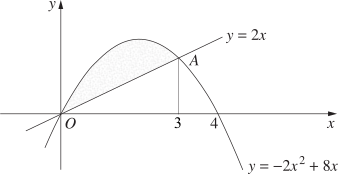
The parabola  `y = −2x^2 + 8x`  and the line  `y = 2x`  intersect at the origin and at the point  `A`.
 

Find the  `x`-coordinate of the point `A`.    (2 marks)

--- 5 WORK AREA LINES (style=lined) ---

Show Answers Only

`x=3`

Show Worked Solution
i.  

`x\text(-coordinate of)\ A:`

`y` `= 2x\ \ \ \ \ …\ text{(i)}`
`y` `= -2x^2 + 8x\ \ \ \ \ …\ text{(ii)}`

 
`text(Subst)\ y = 2x\ text{from (i) into (ii):}`

`-2x^2 + 8x` `= 2x`
`-2x^2 + 6x` `= 0`
`-2x (x-3)` `= 0`

  
`:.\ x = 0\ text(or)\ 3`

`:.\ x\text(-coordinate of)\ A\ text(is 3)`

Filed Under: Quadratics Tagged With: num-title-ct-pathc, smc-4443-55-Intersections

Quadratics, SMB-013

Factorise the parabola described by the equation  `y=-x^2-x+12`  and find its vertex.  (3 marks)

--- 6 WORK AREA LINES (style=lined) ---

Show Answers Only

`y=(3-x)(x+4)`

`text{Vertex}\ = (-1/2,12 1/4)`

Show Worked Solution
`y` `=-x^2-x+12`  
  `=-(x^2+x-12)`  
  `=-(x+4)(x-3)`  
  `=(3-x)(x+4)`  


`text{Solutions at}\ \ x=3, -4`

 `text{Line of symmetry at mid-point of solutions.}`

  `x=(3+(-4))/2=-1/2`
 

`text{Substitute}\ \ x=-1/2\ \ text{into}\ \ y=-x^2-x+12`

`y=-1/4+1/2+12=12 1/4`

`:.\ text{Vertex}\ = (-1/2,12 1/4)`

Filed Under: Quadratics Tagged With: num-title-ct-pathc, smc-4443-50-Find vertex

Quadratics, SMB-012

  1. Factorise  `y=x^2-8x+15`  (1 mark)

    --- 2 WORK AREA LINES (style=lined) ---

  2. Find the vertex of the parabola with equation  `y=x^2-8x+15`  (2 marks)

    --- 4 WORK AREA LINES (style=lined) ---
Show Answers Only
  1. `y=(x-5)(x-3)`
  2. `text{Vertex}\ = (4,-1)`
Show Worked Solution
i.   `y` `=x^2-8x+15`  
  `=(x-5)(x-3)`  


ii.    `text{Solutions at}\ \ x=3,5.`

 `text{Line of symmetry at mid-point of solutions.}`

  `x=(3+5)/2=4`
 

`text{Substitute}\ \ x=4\ \ text{into}\ \ y=x^2-8x+15`

`y=4^2-8xx4+15=-1`

`:.\ text{Vertex}\ = (4,-1)`

Filed Under: Quadratics Tagged With: num-title-ct-pathc, smc-4443-50-Find vertex

Quadratics, SMB-011

  1. Factorise  `y=2x^2+5x-3`  (1 mark)

    --- 2 WORK AREA LINES (style=lined) ---

  2. Find the vertex of the parabola with equation  `y=2x^2+5x-3`  (2 marks)

    --- 4 WORK AREA LINES (style=lined) ---
Show Answers Only
  1. `y=(2x-1)(x+3)`
  2. `text{Vertex}\ = (-5/4,-49/8)`
Show Worked Solution
i.   `y` `=2x^2+5x-3`  
  `=(2x-1)(x+3)`  


ii.    `text{Solutions at}\ \ x=1/2,-3.`

 `text{Line of symmetry at mid-point of solutions.}`

  `x=(1/2+(-3))/2=-5/4`
 

`text{Substitute}\ \ x=-5/4\ \ text{into}\ \ y=2x^2+5x-3`

`y=2xx(-5/4)^2-5xx5/4-3=-49/8`

`:.\ text{Vertex}\ = (-5/4,-49/8)`

Filed Under: Quadratics Tagged With: num-title-ct-pathc, smc-4443-50-Find vertex

Quadratics, SMB-010

  1. Factorise  `y=6-x-x^2`  (2 marks)

    --- 4 WORK AREA LINES (style=lined) ---
  2. Find the vertex of the parabola with equation  `y=6-x-x^2`  (2 marks)

    --- 5 WORK AREA LINES (style=lined) ---
Show Answers Only
  1. `y=(2-x)(x+3)`
  2. `text{Vertex}\ = (-1/2,6 1/4)`
Show Worked Solution
i.   `y` `=6-x-x^2`  
  `=-(x^2+x-6)`  
  `=-(x-2)(x+2)`  
  `=(2-x)(x+3)`  


ii.    `text{Solutions at}\ \ x=2,-3.`

 `text{Line of symmetry at mid-point of solutions.}`

  `x=(2+(-3))/2=-1/2`
 

`text{Substitute}\ \ x=-1/2\ \ text{into}\ \ y=6-x-x^2`

`y=6+1/2-1/4=6 1/4`

`:.\ text{Vertex}\ = (-1/2,6 1/4)`

Filed Under: Quadratics Tagged With: num-title-ct-pathc, smc-4443-50-Find vertex

Quadratics, SMB-009

By completing the square, find the coordinates of the vertex of the parabola with equation

  `y=x^2-3x+1`  (3 marks)

Show Answers Only

`(3/2,-5/4)`

Show Worked Solution
`y` `=x^2-3x+1`  
  `=x^2-3x+9/4-5/4`  
  `=(x-3/2)^2-5/4`  

 
`:.\ text{Vertex}\ = (3/2,-5/4)`

Filed Under: Quadratics Tagged With: num-title-ct-pathc, smc-4443-50-Find vertex

Quadratics, SMB-008

By completing the square, find the coordinates of the vertex of the parabola with equation

  `y=x^2+8x+9`  (3 marks)

Show Answers Only

`(-4,-7)`

Show Worked Solution
`y` `=x^2+8x+9`  
  `=x^2+8x+16-7`  
  `=(x+4)^2-7`  

 
`:.\ text{Vertex}\ = (-4,-7)`

Filed Under: Quadratics Tagged With: num-title-ct-pathc, smc-4443-50-Find vertex

Quadratics, SMB-007

By completing the square, find the coordinates of the vertex of the parabola with equation

  `y=x^2-6x-4`  (3 marks)

Show Answers Only

`(3,-13)`

Show Worked Solution
`y` `=x^2-6x-4`  
  `=x^2-6x+9-13`  
  `=(x-3)^2-13`  

 
`:.\ text{Vertex}\ = (3,-13)`

Filed Under: Quadratics Tagged With: num-title-ct-pathc, smc-4443-50-Find vertex

Quadratics, SMB-006

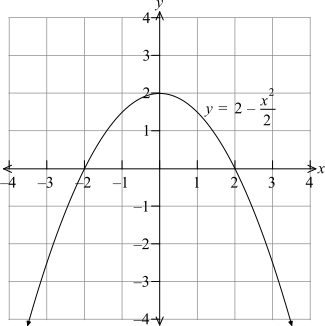
  1. Complete the table of values for the equation  `y=2-x^2/2`.  (1 mark)

\begin{array} {|l|c|c|c|c|}
\hline
\rule{0pt}{2.5ex} x \rule[-1ex]{0pt}{0pt} & -2 & -1 & \ \ 0\ \  & \ \ 1\ \  & \ \ 2 \ \  \\
\hline
\rule{0pt}{2.5ex} y \rule[-1ex]{0pt}{0pt} &   &  & 2 &  &  0 \\
\hline
\end{array}

  1. Sketch the graph  `y=2-x^2/2`  (2 marks)  


  2. For what range of `x`-values is the parabola concave up?  (1 mark)

    --- 2 WORK AREA LINES (style=lined) ---
Show Answers Only

i.   

\begin{array} {|l|c|c|c|c|}
\hline
\rule{0pt}{2.5ex} x \rule[-1ex]{0pt}{0pt} & -2 & -1 & \ \ 0\ \  & \ \ 1\ \  & \ \ 2 \ \  \\
\hline
\rule{0pt}{2.5ex} y \rule[-1ex]{0pt}{0pt} & 0  & \frac{3}{2} & 2 & \frac{3}{2} &  0 \\
\hline
\end{array}

ii. 


iii.   `text{The parabola is concave down for all values of}\ x.`

`=>\ text{There are no values of}\ x\ text{where the graph is concave up.}`

Show Worked Solution

i.   

\begin{array} {|l|c|c|c|c|}
\hline
\rule{0pt}{2.5ex} x \rule[-1ex]{0pt}{0pt} & -2 & -1 & \ \ 0\ \  & \ \ 1\ \  & \ \ 2 \ \  \\
\hline
\rule{0pt}{2.5ex} y \rule[-1ex]{0pt}{0pt} & 0  & \frac{3}{2} & 2 & \frac{3}{2} &  0 \\
\hline
\end{array}

ii. 


iii.   `text{The parabola is concave down for all values of}\ x.`

`=>\ text{There are no values of}\ x\ text{where the graph is concave up.}`

Filed Under: Quadratics Tagged With: num-title-ct-coreb, smc-4443-20-Sketch graphs

Quadratics, SMB-005

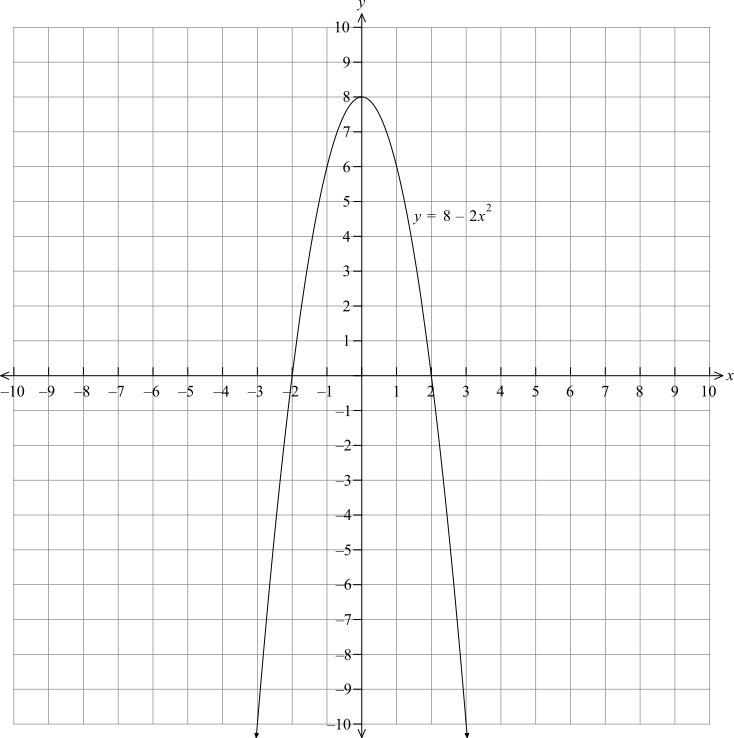
  1. Complete the table of values for the equation  `y=8-2x^2`.  (1 mark)

\begin{array} {|l|c|c|c|c|c|c|}
\hline
\rule{0pt}{2.5ex} x \rule[-1ex]{0pt}{0pt} & -3 & -2 & -1 & \ \ 0\ \  & \ \ 1\ \  & \ \ 2\ \ & \ \ 3 \ \  \\
\hline
\rule{0pt}{2.5ex} y \rule[-1ex]{0pt}{0pt} &  &   & 6 &  &  &  & -10  \\
\hline
\end{array}

  1. Sketch the graph  `y=8-2x^2`  (2 marks) 
      
  2. For what range of `x`-values is the parabola concave down?  (1 mark)

    --- 2 WORK AREA LINES (style=lined) ---
Show Answers Only

i.   

\begin{array} {|l|c|c|c|c|c|c|}
\hline
\rule{0pt}{2.5ex} x \rule[-1ex]{0pt}{0pt} & -3 & -2 & -1 & \ \ 0\ \  & \ \ 1\ \  & \ \ 2\ \ & \ \ 3 \ \  \\
\hline
\rule{0pt}{2.5ex} y \rule[-1ex]{0pt}{0pt} & -10 & 0  & 6 & 8 & 6 & 0 & -10  \\
\hline
\end{array}

ii. 


iii.   `text{The parabola is concave down for all values of}\ x.`

Show Worked Solution

i.   

\begin{array} {|l|c|c|c|c|c|c|}
\hline
\rule{0pt}{2.5ex} x \rule[-1ex]{0pt}{0pt} & -3 & -2 & -1 & \ \ 0\ \  & \ \ 1\ \  & \ \ 2\ \ & \ \ 3 \ \  \\
\hline
\rule{0pt}{2.5ex} y \rule[-1ex]{0pt}{0pt} & -10 & 0  & 6 & 8 & 6 & 0 & -10  \\
\hline
\end{array}

ii. 


iii.   `text{The parabola is concave down for all values of}\ x.`

Filed Under: Quadratics Tagged With: num-title-ct-coreb, smc-4443-20-Sketch graphs

Quadratics, SMB-004

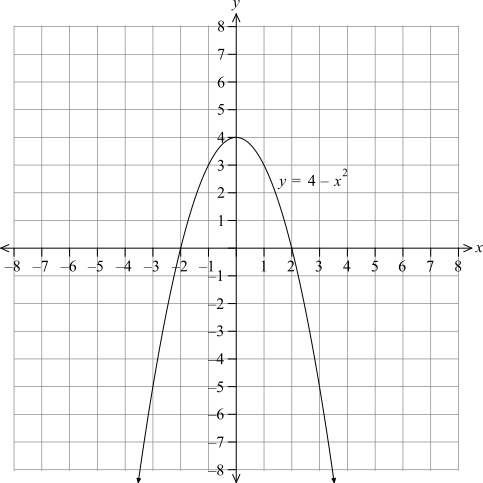
  1. Complete the table of values for the equation  `y=4-x^2`.  (1 mark)

\begin{array} {|l|c|c|c|c|c|}
\hline
\rule{0pt}{2.5ex} x \rule[-1ex]{0pt}{0pt} & -2 & -1 & \ \ 0\ \  & \ \ 1\ \  & \ \ 2\ \  \\
\hline
\rule{0pt}{2.5ex} y \rule[-1ex]{0pt}{0pt} &  &   &  & 3 &  \\
\hline
\end{array}

  1. Sketch the graph  `y=4-x^2`  (2 marks)  
      
  2. What are the coordinates of the vertex of the parabola?  (1 mark)

    --- 2 WORK AREA LINES (style=lined) ---
Show Answers Only


Show Worked Solution

i.   

\begin{array} {|l|c|c|c|c|c|}
\hline
\rule{0pt}{2.5ex} x \rule[-1ex]{0pt}{0pt} & -2 & -1 & \ \ 0\ \  & \ \ 1\ \  & \ \ 2\ \  \\
\hline
\rule{0pt}{2.5ex} y \rule[-1ex]{0pt}{0pt} & 0 & 3  & 4 & 3 & 0 \\
\hline
\end{array}

ii. 


iii.   `text{Vertex at (0,4)}`

Filed Under: Quadratics Tagged With: num-title-ct-coreb, smc-4443-20-Sketch graphs

Quadratics, SMB-003

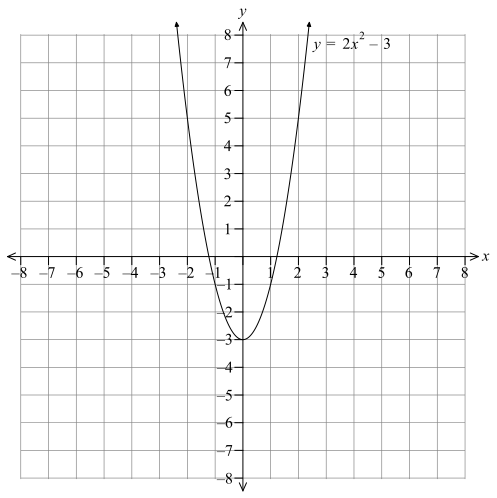
By completing the table of values, sketch the graph of  `y=2x^2-3`.  (3 marks)

\begin{array} {|l|c|c|c|c|c|}
\hline
\rule{0pt}{2.5ex} x \rule[-1ex]{0pt}{0pt} & -2 & -1 & \ \ 0\ \  & \ \ 1\ \  & \ \ 2\ \  \\
\hline
\rule{0pt}{2.5ex} y \rule[-1ex]{0pt}{0pt} &  &   &  & -1 &  \\
\hline
\end{array}


--- 0 WORK AREA LINES (style=lined) ---
Show Answers Only

\begin{array} {|l|c|c|c|c|c|}
\hline
\rule{0pt}{2.5ex} x \rule[-1ex]{0pt}{0pt} & -2 & -1 & \ \ 0\ \  & \ \ 1\ \  & \ \ 2\ \  \\
\hline
\rule{0pt}{2.5ex} y \rule[-1ex]{0pt}{0pt} & 5 & -1  & -3 & -1 & 5 \\
\hline
\end{array}

Show Worked Solution

\begin{array} {|l|c|c|c|c|c|}
\hline
\rule{0pt}{2.5ex} x \rule[-1ex]{0pt}{0pt} & -2 & -1 & \ \ 0\ \  & \ \ 1\ \  & \ \ 2\ \  \\
\hline
\rule{0pt}{2.5ex} y \rule[-1ex]{0pt}{0pt} & 5 & -1  & -3 & -1 & 5 \\
\hline
\end{array}

Filed Under: Quadratics Tagged With: num-title-ct-coreb, smc-4443-20-Sketch graphs

Quadratics, SMB-002

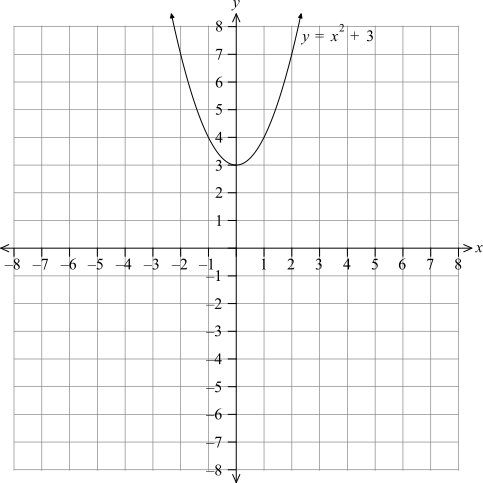
By completing the table of values, sketch the graph of  `y=x^2+3`.  (3 marks)

\begin{array} {|l|c|c|c|c|c|}
\hline
\rule{0pt}{2.5ex} x \rule[-1ex]{0pt}{0pt} & -2 & -1 & \ \ 0\ \  & \ \ 1\ \  & \ \ 2\ \  \\
\hline
\rule{0pt}{2.5ex} y \rule[-1ex]{0pt}{0pt} &  &   &  & 4 &  \\
\hline
\end{array}


--- 0 WORK AREA LINES (style=lined) ---
Show Answers Only

\begin{array} {|l|c|c|c|c|c|}
\hline
\rule{0pt}{2.5ex} x \rule[-1ex]{0pt}{0pt} & -2 & -1 & \ \ 0\ \  & \ \ 1\ \  & \ \ 2\ \  \\
\hline
\rule{0pt}{2.5ex} y \rule[-1ex]{0pt}{0pt} & 7 & 4  & 3 & 4 & 7 \\
\hline
\end{array}

Show Worked Solution

\begin{array} {|l|c|c|c|c|c|}
\hline
\rule{0pt}{2.5ex} x \rule[-1ex]{0pt}{0pt} & -2 & -1 & \ \ 0\ \  & \ \ 1\ \  & \ \ 2\ \  \\
\hline
\rule{0pt}{2.5ex} y \rule[-1ex]{0pt}{0pt} & 7 & 4  & 3 & 4 & 7 \\
\hline
\end{array}

Filed Under: Quadratics Tagged With: num-title-ct-corea, smc-4443-20-Sketch graphs

Quadratics, SMB-001

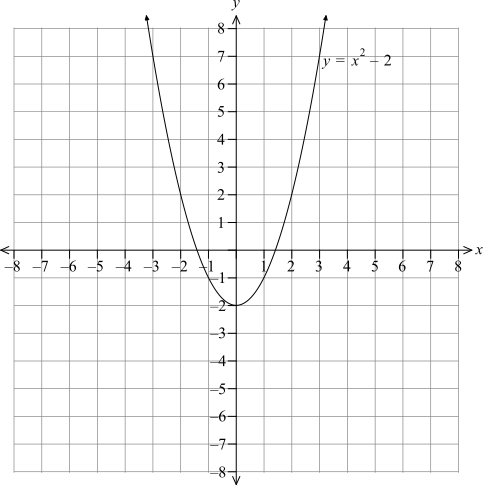
By completing the table of values, sketch the graph of  `y=x^2-2`.  (3 marks)

\begin{array} {|l|c|c|c|c|c|}
\hline
\rule{0pt}{2.5ex} x \rule[-1ex]{0pt}{0pt} & -2 & -1 & \ \ 0\ \  & \ \ 1\ \  & \ \ 2\ \  \\
\hline
\rule{0pt}{2.5ex} y \rule[-1ex]{0pt}{0pt} &  & -1  &  &  &  \\
\hline
\end{array}


--- 0 WORK AREA LINES (style=lined) ---
Show Answers Only

Show Worked Solution

\begin{array} {|l|c|c|c|c|c|}
\hline
\rule{0pt}{2.5ex} x \rule[-1ex]{0pt}{0pt} & -2 & -1 & \ \ 0\ \  & \ \ 1\ \  & \ \ 2\ \  \\
\hline
\rule{0pt}{2.5ex} y \rule[-1ex]{0pt}{0pt} & 2 & -1  & 0 & -1 & 2 \\
\hline
\end{array}

Filed Under: Quadratics Tagged With: num-title-ct-corea, smc-4443-20-Sketch graphs

Algebra, STD1 A3 2019 HSC 9 MC

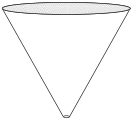
The container shown is initially full of water.
 

Water leaks out of the bottom of the container at a constant rate.

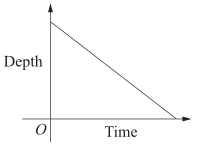
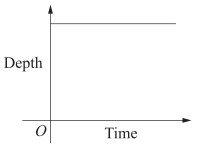
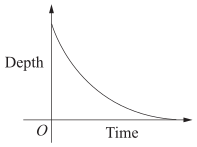
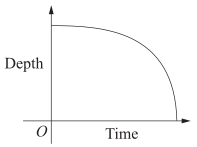
Which graph best shows the depth of water in the container as time varies?
 

A. B.
C. D.
Show Answers Only

`D`

Show Worked Solution

`text(Depth will decrease slowly at first and accelerate.)`

`=> D`

Filed Under: Non-Linear: Inverse and Other Problems (Std 2), Quadratics, Variation and Rates of Change Tagged With: Band 5, num-title-ct-pathb, num-title-qs-hsc, smc-4239-60-Variable rates of change, smc-795-20-Other Relationship

Algebra, STD2 A4 2022 HSC 9 MC

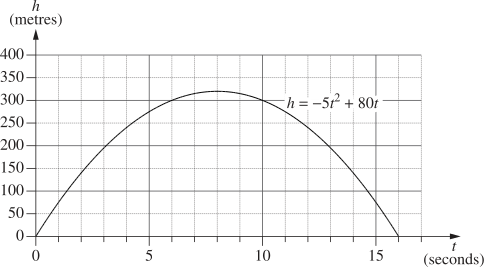
An object is projected vertically into the air. Its height, `h` metres, above the ground after `t` seconds is given by  `h=-5 t^2+80 t`.
 

For how long is the object at a height of 300 metres or more above the ground?

  1. 4 seconds
  2. 6 seconds
  3. 8 seconds
  4. 10 seconds
Show Answers Only

`A`

Show Worked Solution

`text{Object reaches 300 m when}\ \ t=6\ text{seconds.}`

`text{Object drops back below 300 m when}\ \ t=10\ text{seconds.}`

`text{Time at 300 m or above}\ = 10-6=4\ text{seconds}`

`=>A`

Filed Under: Non-Linear: Exponential/Quadratics (Std 2), Quadratics Tagged With: Band 3, num-title-ct-coreb, num-title-qs-hsc, smc-4443-60-Projectiles, smc-830-20-Quadratics

Algebra, STD2 A4 2020 HSC 19

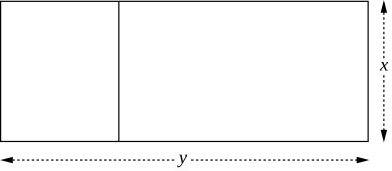
A fence is to be built around the outside of a rectangular paddock. An internal fence is also to be built.

The side lengths of the paddock are `x` metres and `y` metres, as shown in the diagram.


A total of 900 metres of fencing is to be used. Therefore  `3x + 2y = 900`.
 
The area, `A`, in square metres, of the rectangular paddock is given by  `A =450x - 1.5x^2`.

The graph of this equation is shown.
  

  1. If the area of the paddock is `30 \ 000\ text(m)^2`, what is the largest possible value of `x`?   (1 mark)

    --- 2 WORK AREA LINES (style=lined) ---
  2. Find the values of `x` and `y` so that the area of the paddock is as large as possible.   (2 marks)

    --- 4 WORK AREA LINES (style=lined) ---
  3. Using your value from part (b), find the largest possible area of the paddock.   (1 mark)

    --- 2 WORK AREA LINES (style=lined) ---
Show Answers Only
  1. `200 \ text(m)`
  2. `x = 150 \ text(m and) \ y = 225 \ text(m)`
  3. `33 \ 750 \ text(m)^2`
Show Worked Solution

a.     `text(From the graph, an area of)\ 30\ 000\ text(m)^2`

♦ Mean mark part (a) 39%.

  `text(can have an)\ x text(-value of)\ \ x=100 or 200\ text(m.)`

`:. x_text(max) = 200 text(m)`
 

b.    `A_text(max) \ text(occurs when) \ \ x = 150`

♦♦ Mean mark part (b) 34%.

`text(Substitute)\ \ x=150\ \ text(into)\ \ 3x + 2y = 900:`

`3 xx 150 + 2y` `= 900`
`2y` `= 450`
`y` `= 225`

 
`therefore \ text(Maximum area when) \ \ x = 150 \ text(m  and) \ \ y = 225 \ text(m)`

♦ Mean mark part (c) 40%.
c.    `A_(max)` `= xy`
    `= 150 xx 225`
    `= 33 \ 750 \ text(m)^2`

Filed Under: Non-Linear: Exponential/Quadratics (Std 2), Quadratics Tagged With: Band 5, num-title-ct-coreb, num-title-qs-hsc, smc-4443-70-Other applications, smc-830-20-Quadratics

Algebra, STD2 A4 2018 HSC 4 MC

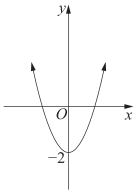
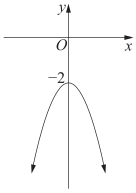
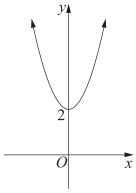
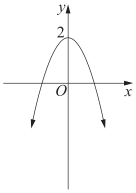
Which graph best represents the equation  `y = x^2-2`?
 

A. B.
C. D.
Show Answers Only

`A`

Show Worked Solution

`y = x^2-2`

`ytext(-intercept) = -2\ \ \ (text(when) = 0)`

`text(Quadratic is positive with vertex at)\ \ y = -2`

`=>A`

Filed Under: Non-Linear: Exponential/Quadratics (Std 2), Quadratics Tagged With: Band 3, num-title-ct-corea, num-title-qs-hsc, smc-4443-10-Identify graphs, smc-830-10-Identify Graphs

Algebra, STD2 A4 2014 HSC 3 MC

The diagram shows the graph of an equation.
  

 Which of the following equations does the graph best represent?

  1. `y = 3/x + 1`
  2. `y = 3^x + 1`
  3. `y = 3x^2 + 1`
  4. `y = 3x^3 + 1`
Show Answers Only

`C`

Show Worked Solution

`text(Graph is a parabola that passes through)\ (0, 1).`

`=>  C`

Filed Under: Exponential/Quadratic (Projectile), Exponentials, Non-Linear: Exponential/Quadratics (Std 2), Quadratics Tagged With: Band 4, num-title-ct-coreb, num-title-qs-hsc, smc-4443-10-Identify graphs, smc-4444-10-Identify graphs, smc-830-10-Identify Graphs

Algebra, STD2 A4 2012 HSC 30b

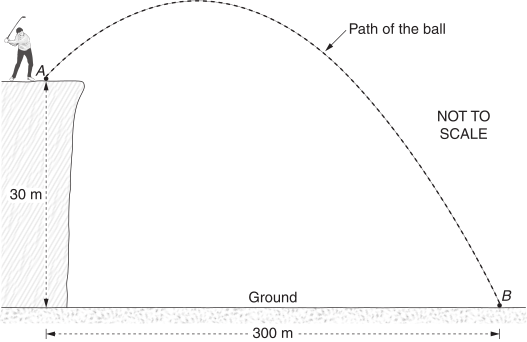
A golf ball is hit from point `A` to point `B`, which is on the ground as shown. Point `A` is 30 metres above the ground and the horizontal distance from point `A` to point `B` is  300 m.
 

The path of the golf ball is modelled using the equation 

`h = 30 + 0.2d-0.001d^2` 

where 

`h` is the height of the golf ball above the ground in metres, and 

`d` is the horizontal distance of the golf ball from point `A` in metres.

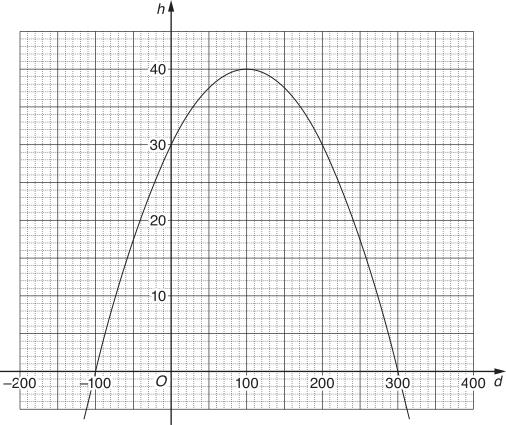
The graph of this equation is drawn below.


  1. What is the maximum height the ball reaches above the ground?    (1 mark)

    --- 1 WORK AREA LINES (style=lined) ---
  2. There are two occasions when the golf ball is at a height of 35 metres.


    What horizontal distance does the ball travel in the period between these two occasions?   (1 mark)

    --- 2 WORK AREA LINES (style=lined) ---
  3. What is the height of the ball above the ground when it still has to travel a horizontal distance of 50 metres to hit the ground at point `B`?   (1 mark)

    --- 2 WORK AREA LINES (style=lined) ---
  4. Only part of the graph applies to this model.


    Find all values of `d` that are not suitable to use with this model, and explain why these values are not suitable.   (2 marks)

    --- 4 WORK AREA LINES (style=lined) ---

Show Answers Only
  1. `40 text(m)`
  2. `140 text(m)`
  3. `text(17.5 m)`
  4. `d < 0\ text(and)\ d>300`
Show Worked Solution

i.   `text(Max height) = 40 text(m)`

COMMENT: With a mean mark of 92% in (i), a classic example of low hanging fruit in later questions.


ii.   `text(From graph)`

`h = 35\ text(when)\ x = 30\ text(and)\ x = 170`

`:.\ text(Horizontal distance)` `= 170-30`
  `= 140\ text(m)`


iii.   `text(Ball hits ground at)\ x = 300`

MARKER’S COMMENT: Responses for (iii) in the range  `17<=\ h\ <=18`  were deemed acceptable estimates read off the graph.

`=>text(Need to find)\ y\ text(when)\ x = 250`

`text(From graph,)\ y = 17.5 text(m)\ text(when)\ x = 250`

`:.\ text(Height of ball is 17.5 m at a horizontal)`

`text(distance of 50m before)\ B.`


iv.   `text(Values of)\ d\ text(not suitable).`

♦♦♦ Mean mark (iv) 12%
MARKER’S COMMENT: Many students did not refer to the domain `d>300` as unsuitable to the model.

`text(If)\ d < 0 text(, it assumes the ball is hit away)`

`text(from point)\ B text(. This is not the case in our)`

`text(example.)`

`text(If)\ d > 300 text(,)\ h\ text(becomes negative which is)`

`text(not possible given the ball cannot go)`

`text(below ground level.)`

Filed Under: Exponential/Quadratic (Projectile), Non-Linear: Exponential/Quadratics (Std 2), Quadratics Tagged With: Band 2, Band 4, Band 6, num-title-ct-coreb, num-title-qs-hsc, page-break-before-question, smc-4443-60-Projectiles, smc-830-20-Quadratics, smc-830-50-Limitations

Copyright © 2014–2025 SmarterEd.com.au · Log in