The fastest land mammal, the cheetah, can travel at 104 km/h. The slowest land mammal, the three-toed sloth, travels at 2.4 m/min.
Approximately how many times faster is the cheetah than the sloth?
- \(43\)
- \(722\)
- \(1385\)
- \(2600\)
Aussie Maths & Science Teachers: Save your time with SmarterEd
The fastest land mammal, the cheetah, can travel at 104 km/h. The slowest land mammal, the three-toed sloth, travels at 2.4 m/min.
Approximately how many times faster is the cheetah than the sloth?
The network shows the lengths of the paths between some exhibits at a zoo.
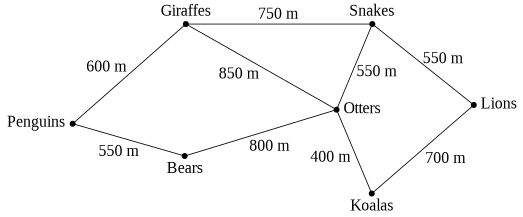
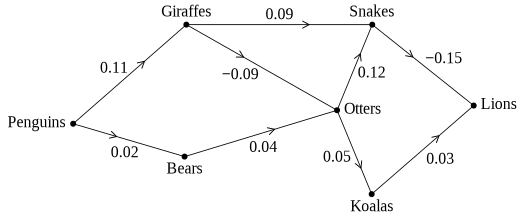
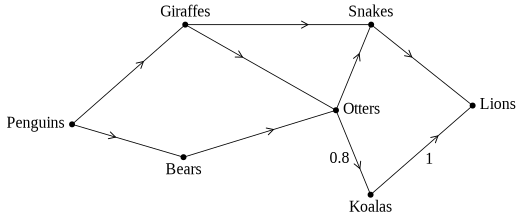
Nikolai is visiting the penguins and wants to visit the lions. The shortest path Nikolai can take is Penguins—Giraffes—Snakes—Lions.
--- 2 WORK AREA LINES (style=lined) ---
--- 2 WORK AREA LINES (style=lined) ---
--- 9 WORK AREA LINES (style=lined) ---
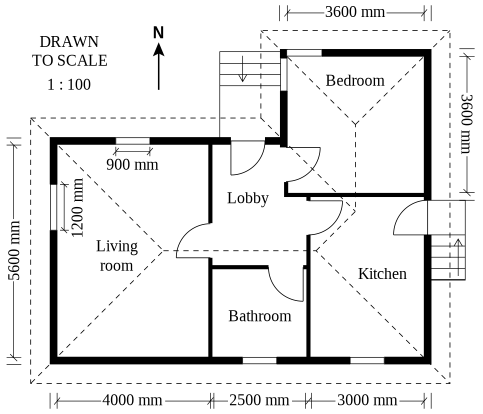
The floor plan of a house has been drawn using a scale of \(1:100\).
--- 2 WORK AREA LINES (style=lined) ---
--- 6 WORK AREA LINES (style=lined) ---
Two shops are selling chicken nuggets. The table provides relevant information.
\begin{array}[t]{|c|c|c|}
\hline \rule{0pt}{2.5ex}\quad \textit{Shop} \quad \rule[-1ex]{0pt}{0pt}& \ \ \textit{Weight}\ \ & \ \ \textit{Price} \ \ \\
\hline \rule{0pt}{2.5ex}\text{A} \rule[-1ex]{0pt}{0pt}& \text{400 g} & \$12.40 \\
\hline \rule{0pt}{2.5ex}\text{B} \rule[-1ex]{0pt}{0pt}& \text{500 g} & \$16.00 \\
\hline
\end{array}
Which shop gives the lowest price per 100 grams? Justify your answer with calculations. (2 marks)
--- 7 WORK AREA LINES (style=lined) ---
Ramon took 1.25 hours to travel the length of a freeway. The length of the freeway is 100 km.
--- 4 WORK AREA LINES (style=lined) ---
--- 4 WORK AREA LINES (style=lined) ---
Paint is sold in two sizes at a local shop.
Mina needs to purchase 80 litres of paint.
Calculate the amount of money Mina will save by purchasing only ten-litre cans of paint rather than only four-litre cans of paint. (2 marks)
--- 7 WORK AREA LINES (style=lined) ---
Vijay’s heart rate before and after his morning run is shown.
\begin{array} {|l|l|}
\hline
\rule{0pt}{2.5ex} \text{Before run} \rule[-1ex]{0pt}{0pt} & \text{72 beats per minute} \\
\hline
\rule{0pt}{2.5ex} \text{After run} \rule[-1ex]{0pt}{0pt} & \text{126 beats per minute} \\
\hline
\end{array}
What is the percentage increase in Vijay’s heart rate? (2 marks)
--- 5 WORK AREA LINES (style=lined) ---
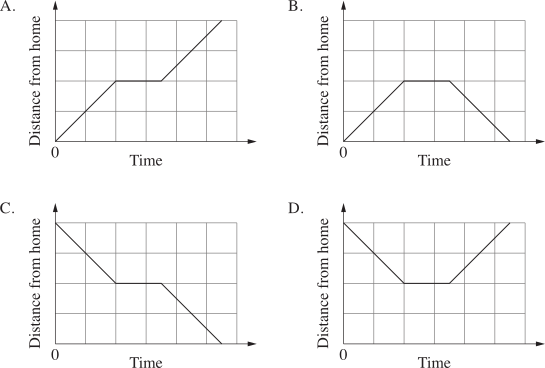
Mario drives from his home to his friend’s house. He watches a movie at his friend’s house and then drives home.
Which distance−time graph best represents Mario’s complete journey?
The travel graph shows the distance of a runner from a town.
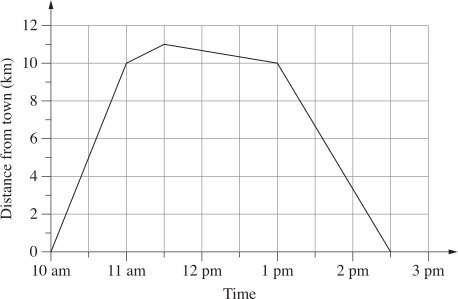
Between what times was the runner travelling at their greatest speed?
Wombats can run at a speed of 40 km/h over short distances.
At this speed, how many seconds would it take a wombat to run 150 metres? (3 marks)
--- 8 WORK AREA LINES (style=lined) ---
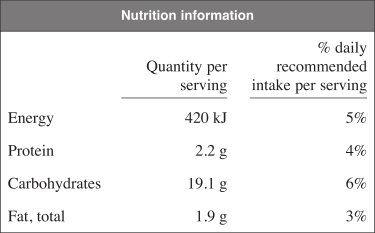
The nutrition label for a food item is shown. Based on the information on this label, what is the daily recommended intake of carbohydrates, to the nearest gram? (2 marks) --- 5 WORK AREA LINES (style=lined) ---
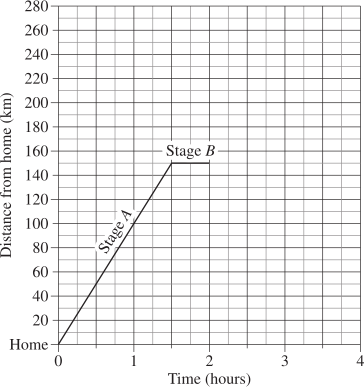
The distance-time graph shows the first two stages of a car journey from home to a holiday house.
--- 2 WORK AREA LINES (style=lined) ---
--- 2 WORK AREA LINES (style=lined) ---
--- 4 WORK AREA LINES (style=lined) ---
a. \(100\text{ km/h}\)
b. \(30\text{ minutes}\)
c.
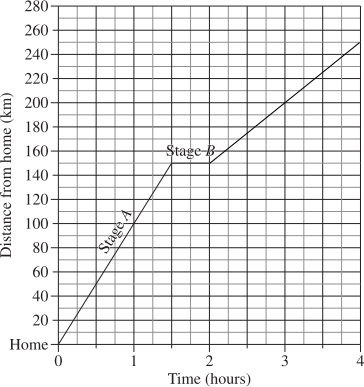
a. \(S=\dfrac{D}{T}=\dfrac{150}{1.5}=100\ \text{km/h}\)
b. \(\text{Stage}\ B=1.5\rightarrow 2\text{ hours}=30\text{ minutes}\)
c. \(\text{Position after 2 hours at 50km/h}=(150+2\times 50 , 2 + 2) = (250 , 4)\)
A tap is dripping at the rate of 4 mL per minute.
Which expression shows how many litres this would amount to in one year?
A delivery truck was valued at $65 000 when new. The value of the truck depreciates at a rate of 22 cents per kilometre travelled.
What is the value of the truck after it has travelled a total distance of 132 600 km?
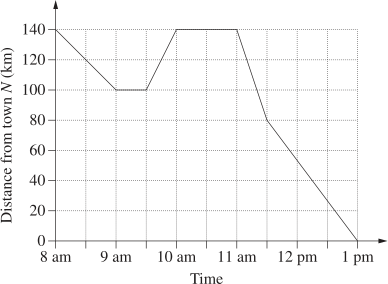
The travel graph displays Jamie's trip which began at town `M` at 8 am and finished at town `N`.
--- 2 WORK AREA LINES (style=lined) ---
--- 2 WORK AREA LINES (style=lined) ---
--- 2 WORK AREA LINES (style=lined) ---
--- 4 WORK AREA LINES (style=lined) ---
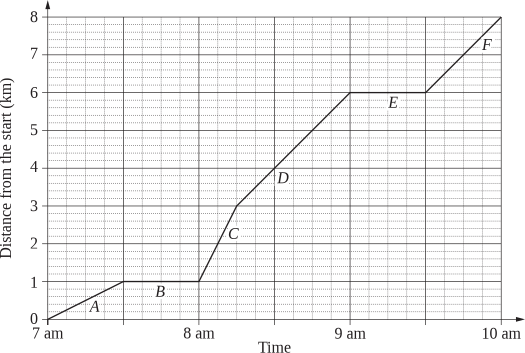
Sue walks along a trail, starting at 7 am and finishing at 10 am. The travel graph shows Sue’s journey from the start to the finish. The journey has been broken into six sections, `A`, `B`, `C`, `D`, `E` and `F`.
--- 2 WORK AREA LINES (style=lined) ---
--- 4 WORK AREA LINES (style=lined) ---
--- 6 WORK AREA LINES (style=lined) ---
a. `B\ text(and)\ E`
b. `text(S)text(ection)\ C.\ text(Slope is the steepest.)`
c. `text(8:30 am – 9:15 am)`
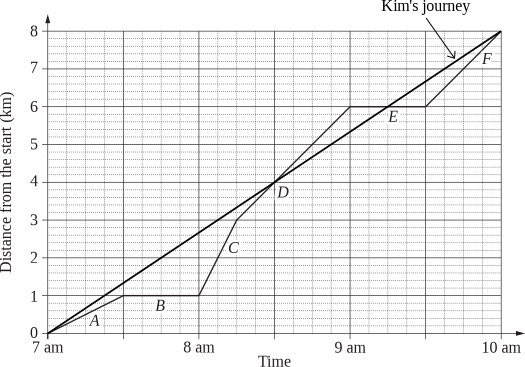
a. `B\ text(and)\ E\ text{(The horizontal sections of the graph)}`
b. `text(Fastest travel occurs when the slope is the steepest.)`
`:. text(S)text(ection)\ C`
c.
`text(Sue was ahead when her graph is higher than Kim’s.)`
`:.\ text(She was ahead between 8:30 am – 9:15 am)`
A tap is leaking water. It leaks 1 drop every 4 seconds, and 15 of these drops make up 1 mL.
--- 6 WORK AREA LINES (style=lined) ---
--- 2 WORK AREA LINES (style=lined) ---
Chocolate of a particular brand can be bought in three different sizes.
Option 1: 100 grams for $1.50
Option 2: 300 grams for $4.20
Option 3: 500 grams for $7.25
Which option gives the lowest price per 100 grams? Justify your answer with calculations. (2 marks)
Two painters each provide a quote for painting an area of 1500 square metres. Painter A charges $100 per 30 square metres. Painter B charges $80 per hour and bases their quote on painting 25 square metres per hour.
Calculate how much will be saved by choosing the cheaper quote. (3 marks)
--- 6 WORK AREA LINES (style=lined) ---
A refreshment stand at the market sells its iced tea in four different sizes.

Showing calculations, find which serving size offers the cheapest iced tea. (2 marks)
--- 4 WORK AREA LINES (style=lined) ---
A brand of pasta is sold in two different packets.
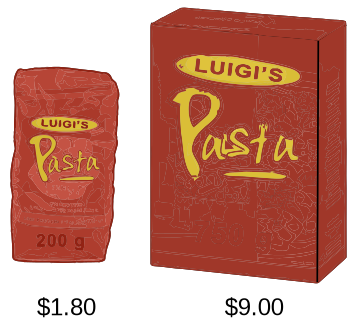
What is the difference in the price per kilogram of these two packets?
Reece looks at the price of four sunscreens.

Which sunscreen is the cheapest per litre? Show your calculations. (2 marks)
--- 4 WORK AREA LINES (style=lined) ---
The travel graph displays Nikau's car trip along a straight road from home and back again. The trip has been broken into four separate sections: `A`, `B`, `C` and `D`.
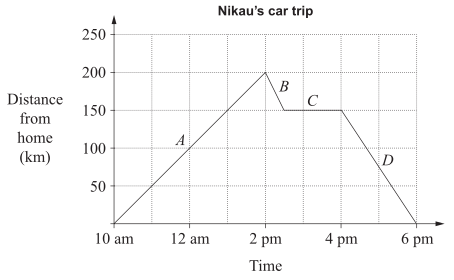
--- 1 WORK AREA LINES (style=lined) ---
--- 1 WORK AREA LINES (style=lined) ---
Which expression can be used to convert a speed of 3 metres per minute to a speed in centimetres per second?
Sugar is sold in four different sized packets.
Which is the best buy?
A car travels 350 km on 40 L of petrol.
What is its fuel consumption?
Jenny used her mobile phone while she was overseas for one month.
Her mobile phone plan has a base monthly cost of $50. While overseas, she is also charged 33 cents per SMS message sent and 26 cents per MB of data used.
During her month overseas, Jenny sent 120 SMS messages and used 1400 MB of data.
What was her mobile phone bill for the month overseas? (2 marks)
A field diagram of a block of land has been drawn to scale. The shaded region `ABFG` is covered in grass.
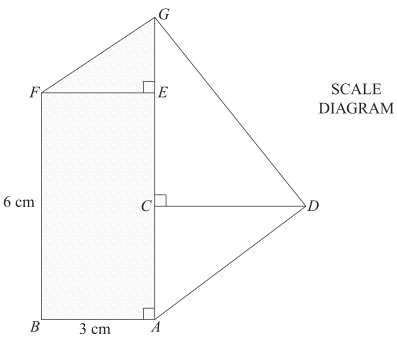
The actual length of `AG` is 24 m.
--- 1 WORK AREA LINES (style=lined) ---
--- 6 WORK AREA LINES (style=lined) ---
The driving distance from Alex's home to his work is 20 km. He drives to and from work five times each week. His car uses fuel at the rate of 8 L/100 km.
How much fuel does he use driving to and from work each week?
Bikram runs a hot yoga studio.
If it costs 34 cents for 1-kilowatt (1000 watts) for 1 hour, how much does it cost him to run three 3200-watt heaters from 9:00 am to 12:30 pm on a single day? (Give your answer to the nearest cent) (2 marks)
--- 4 WORK AREA LINES (style=lined) ---
Toby’s mobile phone plan costs $20 per month, plus the cost of all calls. Calls are charged at the rate of 70 cents per 30 seconds, or part thereof. There is also a call connection fee of 50c per call.
Here is a record of all his calls in July.
\begin{array} {|l|l|}
\hline \textit{Date} & \textit{Call Duration}\\
\hline 5\ \text{July} & 20\ \text{seconds} \\
\hline 12\ \text{July} & 40\ \text{seconds} \\
\hline 23\ \text{July} & 2\ \text{minutes}\ 15\ \text{seconds} \\
\hline \end{array}
How much is Toby’s mobile phone bill for July? (2 marks)
Kate is comparing two different models of car. Car A uses fuel at the rate of 9 L/100 km. Car B uses 3.5 L/100 km.
Suppose Kate plans on driving 8000 km in the next year.
How much less fuel will she use driving car B instead of car A?
Peta’s car uses fuel at the rate of 5.9 L /100 km for country driving and 7.3 L /100 km for city driving. On a trip, she drives 170 km in the country and 25 km in the city.
Calculate the amount of fuel she used on this trip. (2 marks)
--- 4 WORK AREA LINES (style=lined) ---
Calls on a mobile phone plan are charged at the rate of 54 cents per 30 seconds, or part thereof.
What is the cost of a call lasting 2 minutes and 15 seconds?
The concentration of a drug in a certain medication is 100 mg / 5 mL. A patient is prescribed 2000 mg of the drug.
How much medication should be given to the patient?
An old washing machine uses 130 L of water per load. A new washing machine uses 50 L per load.
How much water is saved each year if two loads of washing are done each week using the new machine?
A patient requires 2400 mL of fluid to be delivered at a constant rate by means of a drip over 12 hours. Each mL of fluid is equivalent to 15 drops.
How many drops per minute need to be delivered? (2 marks)
--- 4 WORK AREA LINES (style=lined) ---
An alcoholic drink has 5.5% alcohol by volume. The label on a 375 mL bottle says it contains 1.6 standard drinks.
--- 1 WORK AREA LINES (style=lined) ---
Express this as a rate in millilitres per minute, correct to one decimal place. (2 marks)
--- 4 WORK AREA LINES (style=lined) ---
Xuso is comparing the costs of two different ways of travelling to university.
Xuso’s motorcycle uses one litre of fuel for every 17 km travelled. The cost of fuel is $1.67/L and the distance from her home to the university car park is 34 km. The cost of travelling by bus is $36.40 for 10 single trips.
Which way of travelling is cheaper and by how much? Support your answer with calculations. (2 marks)
--- 4 WORK AREA LINES (style=lined) ---
Heather’s car uses fuel at the rate of 6.6 L per 100 km for long-distance driving and 8.9 L per 100 km for short-distance driving.
She used the car to make a journey of 560 km, which included 65 km of short-distance driving.
Approximately how much fuel did Heather’s car use on the journey?
A child who weighs 14 kg needs to be given 15 mg of paracetamol for every 2 kg of body weight.
Every 10 mL of a particular medicine contains 120 mg of paracetamol.
What is the correct dosage of this medicine for the child?
A patient is to receive 1.8 L of pain killer medication by intravenous drip that will take 1.5 hours to administer.
Given 1 mL = 4 drops, calculate the amount of drops per minute the machine must be set on. (2 marks)
--- 5 WORK AREA LINES (style=lined) ---
The diagram shows the shape and dimensions of a terrace which is to be tiled.
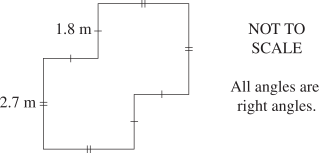
--- 5 WORK AREA LINES (style=lined) ---
Find the total cost of the boxes of tiles required for the terrace. (2 marks)
--- 4 WORK AREA LINES (style=lined) ---
| a. | 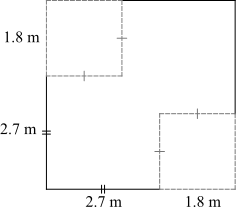 |
| `text(Area)` | `=\ text(Area of big square – Area of 2 cut-out squares` |
| `= (2.7 + 1.8) xx (2.7 + 1.8)\-2 xx (1.8 xx 1.8)` | |
| `= 20.25\-6.48= 13.77\ text(m²)` |
b. `text(Tiles required)= (110 text{%}) xx 13.77= 15.147\ text(m)^2`
`=>\ text(16 boxes are needed)`
`:.\ text(Total cost of boxes)=16 xx $55= $880`