Which of the following could be classified as discrete data?
- Colour of a car
- Time taken to swim 200 m
- Temperature of an ice block
- Number of children in a class
Aussie Maths & Science Teachers: Save your time with SmarterEd
Which of the following could be classified as discrete data?
Freddie organised a function at work. He surveyed the staff about their preferences.
He asked them about their payment preference (cash or electronic payment) and their budget preference (less than $50 or more than $50).
The variables in this survey, payment preference and budget preference, are
Shoppers are invited to complete an online survey.
What type of sampling is this?
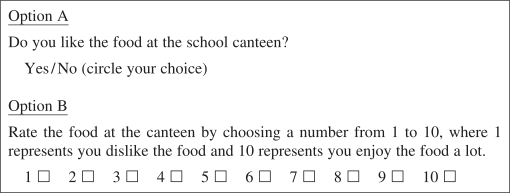
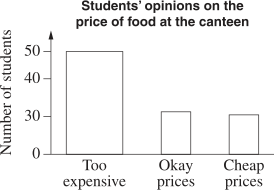
Kim wants to investigate what students think about the food that is sold at the school's canteen. Kim decides to use a survey to interview a sample group of students to find out their opinions on a number of different issues.
--- 4 WORK AREA LINES (style=lined) ---
--- 4 WORK AREA LINES (style=lined) ---
A survey of which of the following would provide data that are both categorical and nominal?
A survey question is shown.
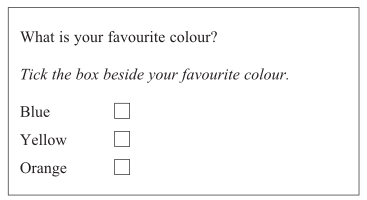
Give TWO reasons why this survey may be considered to be poorly designed. (2 marks)
--- 3 WORK AREA LINES (style=lined) ---
A survey asked the following question for students born in Australia:
"Which State or Territory were you born in?"
How would the responses be classified?
A survey asked the following question.
'How many brothers do you have?'
How would the responses be classified?
A factory’s quality control department has tested every 50th item produced for possible defects.
What type of sampling has been used?
A. Random
B. Stratified
C. Systematic
D. Numerical
Which set of data is classified as categorical and nominal?
On a school report, a student’s record of completing homework is graded using the following codes.
C = consistently
U = usually
S = sometimes
R = rarely
N = never
What type of data is this?
Vicki wants to investigate the number of hours spent on homework by students at her high school.
--- 2 WORK AREA LINES (style=lined) ---
The responses are shown in the frequency table.

What is the mean amount of time spent on homework? (2 marks)
--- 4 WORK AREA LINES (style=lined) ---
a. `text(A valid method would be using a stratified sample.)`
`text(The number of students sampled in each year is)`
`text(proportional to the size of each year.)`
| b. |  |
| `text(Mean)` | `= text(Sum of Scores) / text(Total scores)` |
| `= 1455/200` | |
| `= 7.275\ text(hours)` |
Ms Wigginson decided to survey a sample of 10% of the students at her school.
The school enrolment is shown in the table.

She surveyed the same number of students in each year group.
How would the numbers of students surveyed in Year 10 and Year 11 have changed if Ms Wigginson had chosen to use a stratified sample based on year groups?
A study on the mobile phone usage of NSW high school students is to be conducted.
Data is to be gathered using a questionnaire.
The questionnaire begins with the three questions shown.

--- 1 WORK AREA LINES (style=lined) ---
--- 2 WORK AREA LINES (style=lined) ---
Describe a method that could be used to obtain a representative stratified sample. (1 mark)
--- 2 WORK AREA LINES (style=lined) ---
--- 2 WORK AREA LINES (style=lined) ---
The Australian Bureau of Statistics provides the NSW government with data on the age of residents living in different areas across the state. After analysing this data, the government makes decisions relating to the provision of services or facilities.
Give an example of a possible decision the government might make and describe how the data might justify this decision. (2 marks)
--- 4 WORK AREA LINES (style=lined) ---
Jamie wants to know how many songs were downloaded legally from the internet in the last 12 months by people aged 18–25 years. He has decided to conduct a statistical inquiry.
After he collects the data, which of the following shows the best order for the steps he should take with the data to complete his inquiry?
The eye colours of a sample of children were recorded.
When analysing this data, which of the following could be found?
Greg needs to conduct a statistical inquiry into how much time people aged 18–25 years have spent accessing social media websites in the last two weeks. He has decided to survey a sample of students from his university.
The process of statistical inquiry includes the following steps, which are NOT in order.

--- 4 WORK AREA LINES (style=lined) ---
At which step in the process would he have drawn this graph? (1 mark)

--- 2 WORK AREA LINES (style=lined) ---
Handmade chocolates are checked for size and shape. Every 30th chocolate is sampled.
Which term best describes this type of sampling?
A high school has 100 students in each year group, Year 7 to Year 12. A survey is to be conducted to determine the average number of text messages sent per month by students at the school.
Which of the following would provide the most representative sample for this survey?