SmarterEd

Aussie Maths & Science Teachers: Save your time with SmarterEd

  • Login
  • Get Help
  • About

PHYSICS, M6 EQ-Bank 21

A current of 4.0 A flows in a wire that is placed in a magnetic field of 0.75 T. The wire is 0.80 m long and is at an angle of 45° to the field.
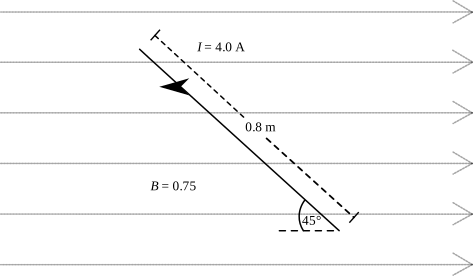


Calculate the force on the wire.  (2 marks)

--- 4 WORK AREA LINES (style=lined) ---

Show Answers Only

`1.7\ text{N out of the page.}`

Show Worked Solution
`F` `=lIB sin theta`  
  `=0.8 xx4.0 xx0.75 xx sin 45^(@)`  
  `=1.7\ text{N out of the page.}`  

Filed Under: The Motor Effect Tagged With: Band 3, smc-3694-20-Force on Current-Carrying Conductor

PHYSICS, M6 EQ-Bank 24

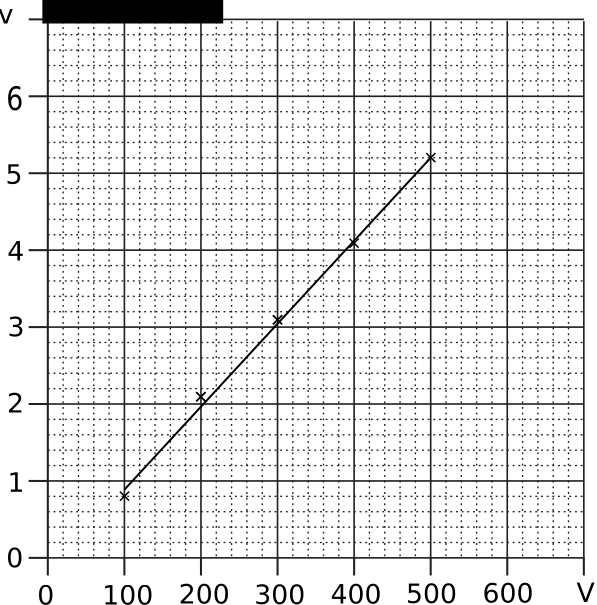
Negatively charged particles were accelerated from rest between a pair of parallel metal plates. The potential difference between the plates was varied, and the final velocity of the particles was measured for each variation.
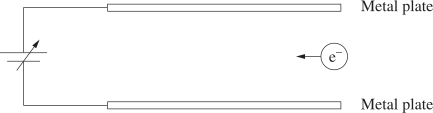
 

The data in the table show the potential difference between the plates and the square of the corresponding final velocity of the particles.

\begin{array}{|c|c|}
\hline
\rule{0pt}{2.5ex}\textit{Potential difference}\ \text{(V)} \rule[-1ex]{0pt}{0pt}&\quad v^2\left(\times 10^9 \, \text{m}^2\, \text{s}^{-2}\right) \quad \\
\hline
\rule{0pt}{2.5ex}100\rule[-1ex]{0pt}{0pt}&0.8\\
\hline
\rule{0pt}{2.5ex}200\rule[-1ex]{0pt}{0pt}& 2.1\\
\hline
\rule{0pt}{2.5ex}300\rule[-1ex]{0pt}{0pt}& 3.1 \\
\hline
\rule{0pt}{2.5ex}400\rule[-1ex]{0pt}{0pt}& 4.1 \\
\hline
\rule{0pt}{2.5ex}500\rule[-1ex]{0pt}{0pt}& 5.2 \\
\hline
\end{array}

  1. Plot the data on the grid provided and draw a line of best fit.


--- 0 WORK AREA LINES (style=lined) ---

  1. A student hypothesised that the charged particles are electrons. Justify whether the student's hypothesis is correct or not. Support your answer using the data provided and relevant calculations.

    --- 10 WORK AREA LINES (style=lined) ---

Show Answers Only

a.   


b.    The gradient of the line = `(v^2)/(V)`

Calculate the gradient (choose values close to limits):

`text{gradient}` `=((5.2-0.9) xx10^(9))/(500-100)`  
  `=1.1 xx10^7  text{m}^2  text{s}^(-2)  text{V}^(-1)`  

 
The change in kinetic energy is equal to the work done by the electric field on the charged particles:

`W` `=Delta K`  
`qV` `=(1)/(2)mv^2`  
`(V^2)/(v)` `=(2q)/(m)`  

 
Charge to mass ratio of the particles:

`(q)/(m)` `=(V^2)/(2v)`  
  `=(text{gradient})/(2)`  
  `=5.4 xx10^6  text{C kg}^(-1)`  

 
 Charge to mass ratio of an electron:

`(q)/(m)` `=(1.602 xx10^(-19))/(9.109 xx10^(-31))`  
  `=1.8 xx10^(11)  text{C kg}^(-1)`  

  
Therefore, the charged particles are not electrons.

Show Worked Solution

a.   


b.    The gradient of the line = `(v^2)/(V)`

Calculate the gradient (choose values close to limits):

`text{gradient}` `=((5.2-0.9) xx10^(9))/(500-100)`  
  `=1.1 xx10^7  text{m}^2  text{s}^(-2)  text{V}^(-1)`  

 
The change in kinetic energy is equal to the work done by the electric field on the charged particles:

`W` `=Delta K`  
`qV` `=(1)/(2)mv^2`  
`(V^2)/(v)` `=(2q)/(m)`  

 
Charge to mass ratio of the particles:

`(q)/(m)` `=(V^2)/(2v)`  
  `=(text{gradient})/(2)`  
  `=5.4 xx10^6  text{C kg}^(-1)`  

 
 Charge to mass ratio of an electron:

`(q)/(m)` `=(1.602 xx10^(-19))/(9.109 xx10^(-31))`  
  `=1.8 xx10^(11)  text{C kg}^(-1)`  

  
Therefore, the charged particles are not electrons.

Filed Under: Charged Particles, Conductors and Electric/Magnetic Fields Tagged With: Band 3, Band 5, smc-3693-20-EF Strength, smc-3693-35-Kinematic/Work Calcs

PHYSICS, M6 EQ-Bank 22

An 'electron gun' like that used by JJ Thomson is shown.
 

Electrons leave the cathode and are accelerated towards the anode.

  1. Show that the acceleration of the electrons as they just leave the cathode is  `4 × 10^(16) \ text{m s}^(-2)`.   (2 marks)

    --- 5 WORK AREA LINES (style=lined) ---

  1. Calculate the velocity of an electron as it reaches the anode.   (2 marks)

    --- 5 WORK AREA LINES (style=lined) ---

Show Answers Only
  1. `4 xx10^(16)  text{m s}^(-2)`
  2. `4 xx10^7  text{m s}^(-1)`
Show Worked Solution

a.   The force on the electrons is given by  `F=qE`.

The electric field strength is given by  `E=(V)/(d)`:

`F` `=(Vq)/(d)`  
`a` `=(F)/(m)`  
  `=(Vq)/(dm)`  

 
Calculate the acceleration:

`a` `=(Vq)/(dm)`  
  `=(5000 xx1.602 xx10^(-19))/(0.02 xx9.109 xx10^(-31))`  
  `=4 xx10^(16)  text{m s}^(-2)`  


b.    Using kinematic equations:

`v^(2)` `=u^(2)+2as`  
`v` `=sqrt(2as),\ \ \ (u=0)`  
  `=sqrt(2xx4xx10^(16)xx0.02)`  
  `=4 xx10^7  text{m s}^(-1)`   

Filed Under: Charged Particles, Conductors and Electric/Magnetic Fields Tagged With: Band 3, Band 4, smc-3693-10-Charged Particles in EF

PHYSICS, M6 EQ-Bank 2 MC

What is the role of a transformer at a power station?

  1. To reduce heating in the transmission lines by stepping up the current
  2. To reduce heating in the transmission lines by stepping up the voltage
  3. To increase heating in the transmission lines by stepping up the current
  4. To increase heating in the transmission lines by stepping up the voltage
Show Answers Only

`B`

Show Worked Solution
  • At a power station, heating is reduced to decrease power loss.
  • This is done by stepping up the voltage, which decreases transmission current and lowers heating loss consistent with  `P_(loss)=I^2R`

`=>B`

Filed Under: Electromagnetic Induction Tagged With: Band 3, smc-3705-80-Energy Distribution

PHYSICS, M6 EQ-Bank 2 MC

A student performed an experiment using two identical, current-carrying metal rods connected to a power supply. Rod `A` was placed at different distances from Rod `B`, and the measurements on the electronic balance were recorded.

 

What is the dependent variable in this experiment?

  1. The current in `A`
  2. The length of the rods
  3. The mass recorded on the balance
  4. The distance between the two rods
Show Answers Only

`C`

Show Worked Solution
  • The dependent variable is the variable which is being measured.
  • In this experiment, the mass recorded on the balance is measured.

`=>C`

Filed Under: The Motor Effect Tagged With: Band 3, smc-3694-30-Force Between Current-Carrying Conductors

BIOLOGY, M8 EQ-Bank 14

  1. Identify a disorder or disease, and describe how it affects the normal function of an organ.   (2 marks)

    --- 4 WORK AREA LINES (style=lined) ---

  2. Evaluate the effectiveness of a technology in managing the disorder or disease described in part (a).   (4 marks)

    --- 10 WORK AREA LINES (style=lined) ---

Show Answers Only

a.   Polycystic kidney disease

  • A disease in which cysts grow in the kidney.
  • This interferes with filtration and overtime, adversely affects the overall function of the kidney.

Other disorders/disease can include

  • Astigmatism, myopia or hyperopia.
  • Single sided deafness, hearing loss.

b.   Use of technology in treating polycystic kidney disease

  • Polycystic kidney disease will often progress in patients until kidney failure has occurred.
  • When 80% of kidney function is lost and a transplant cannot be found, dialysis is often the only viable option.
  • There are two types of dialysis, both of which replace the function of the kidney and clean the blood.
    • Haemodialysis is where blood is removed from the body and passed through a dialysis machine. The main component of the machine runs a special fluid known as dialysate countercurrent to the blood next to a permeable membrane. This allows the blood to effectively remove the toxins into the dialyse by diffusion. While this is extremely effective, it involves multiple visits per week and is very time consuming for the patients.
    • Peritoneal dialysis involves the flushing of dialysate directly into the abdominal cavity through a catheter. The peritoneal membrane then acts as the filter and blood is cleaned via diffusion. The dialysate containing the waste products then exits the body into another section of the catheter. In contrast to haemodialysis, this method requires a more involved initial surgery but provides the benefit of patients being able to do this by themselves at night.
  • Both forms of dialysis are extremely effective in replacing kidney function. Despite being time consuming and uncomfortable, they allow patients suffering from polycystic kidney disease to survive for extended periods, during which a transplant may become available.

Other technologies can include

  • Glasses.
  • Any form of hearing aid dependent on the ear disease/disorder, including standard hearing aids, bone conduction implants or cochlear implant.
Show Worked Solution

a.   Polycystic kidney disease

  • A disease in which cysts grow in the kidney.
  • This interferes with filtration and overtime, adversely affects the overall function of the kidney.

Other disorders/disease can include

  • Astigmatism, myopia or hyperopia.
  • Single sided deafness, hearing loss.

b.   Use of technology in treating polycystic kidney disease

  • Polycystic kidney disease will often progress in patients until kidney failure has occurred.
  • When 80% of kidney function is lost and a transplant cannot be found, dialysis is often the only viable option.
  • There are two types of dialysis, both of which replace the function of the kidney and clean the blood.
    • Haemodialysis is where blood is removed from the body and passed through a dialysis machine. The main component of the machine runs a special fluid known as dialysate countercurrent to the blood next to a permeable membrane. This allows the blood to effectively remove the toxins into the dialyse by diffusion. While this is extremely effective, it involves multiple visits per week and is very time consuming for the patients.
    • Peritoneal dialysis involves the flushing of dialysate directly into the abdominal cavity through a catheter. The peritoneal membrane then acts as the filter and blood is cleaned via diffusion. The dialysate containing the waste products then exits the body into another section of the catheter. In contrast to haemodialysis, this method requires a more involved initial surgery but provides the benefit of patients being able to do this by themselves at night.
  • Both forms of dialysis are extremely effective in replacing kidney function. Despite being time consuming and uncomfortable, they allow patients suffering from polycystic kidney disease to survive for extended periods, during which a transplant may become available.

Other technologies can include

  • Glasses.
  • Any form of hearing aid dependent on the ear disease/disorder, including standard hearing aids, bone conduction implants or cochlear implant.

Filed Under: Technologies and Disorders Tagged With: Band 3, Band 4, Band 5, smc-3663-10-Kidneys

BIOLOGY, M7 EQ-Bank 23

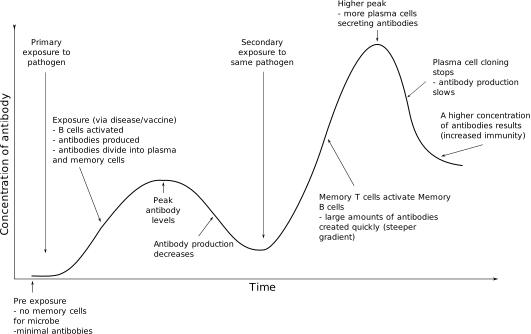
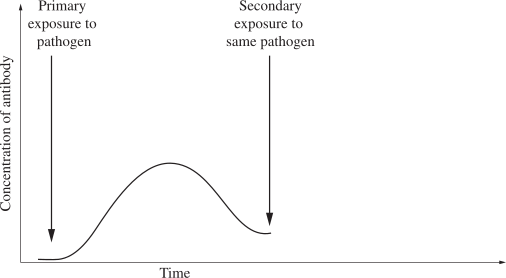
The diagram shows the immune response after primary exposure to a pathogen.
 

--- 2 WORK AREA LINES (style=blank) ---

  1. On the diagram, continue the graph to show the immune response upon secondary exposure to the same pathogen.   (2 marks)
  2. Using annotations on the diagram, explain the shape of the entire graph.   (4 marks)

    --- 0 WORK AREA LINES (style=lined) ---

Show Answers Only

a. & b.

Show Worked Solution

a. & b.

Filed Under: Immunity and Responses to Pathogens Tagged With: Band 3, Band 4, Band 5, smc-3657-25-Antibodies

BIOLOGY, M8 EQ-Bank 5 MC

Which of the following is an example of an educational program to reduce the incidence of skin cancer?

  1. An advertising campaign on TV to promote sun safety
  2. Making sunscreen freely available at pools and beaches
  3. Increasing the availability of free skin checks
  4. Providing free training to doctors to help them diagnose skin cancers
Show Answers Only

`A`

Show Worked Solution

By Elimination

  • Options C and D primarily increase the chances of diagnosing skin cancer rather than constituting an educational program.
  • Making sunscreen freely available will reduce the risk of skin cancer but is not an educational campaign.
  • The advertising campaign promotes safe lifestyle decisions surrounding sun safety (e.g. the benefits of using sunscreen, wearing a hat) that will reduce the likelihood of individuals getting skin cancer when following the advice.

`=>A`

Filed Under: Prevention Tagged With: Band 3, smc-3662-11-Educational Programs

BIOLOGY, M8 EQ-Bank 4 MC

An investigation was undertaken to examine the cause of lactose intolerance, a non-infectious condition found in some humans who cannot digest milk. The investigation found variation in the occurrence of lactose intolerance in human populations from different parts of the world.

What is this investigation an example of?

  1. A study of ecosystems
  2. A microbiological study
  3. An epidemiological study
  4. A study of the human immune system
Show Answers Only

`=>C`

Show Worked Solution
  • An epidemiological study is one which studies diseases which affect many people by gathering and analysing a large collection of data related to incidence and mortality, while comparing it to varying factors, such as location and age.

`=>C` 

Filed Under: Epidemiology Tagged With: Band 3, smc-3661-20-Evaluating the Method

BIOLOGY, M8 EQ-Bank 1 MC

What is the main focus of the study of epidemiology?

  1. Skin diseases
  2. Changes in the characteristics of a species
  3. Factors involved in the occurrence, prevalence and spread of disease
  4. How the body maintains its functions in response to variations in the environment
Show Answers Only

`C`

Show Worked Solution

→ The nature of an epidemiological study reveals evidence for factors involved in disease incidence and mortality.

`=>C`

Filed Under: Uncategorized Tagged With: Band 3, smc-3660-11-Environmental/Nutritional, smc-3660-20-Genetic/Cancer

BIOLOGY, M8 EQ-Bank 2 MC

The diagram shows a homeostatic mechanism in a mammal.
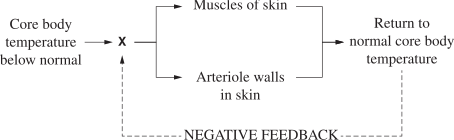
 

Which row of the table describes what happens to the muscles and the arteriole walls in the skin when the core body temperature is below normal?
 

Show Answers Only

`B`

Show Worked Solution

→ When the body is cold, it contracts to raise epidermal hairs (also known as goosebumps) which generates heat, closes skin pores and traps a layer of heat close to the skin.

→ The contraction of arteries (also known as vasoconstriction) helps conserve heat by minimising heat loss from the skin.

`=>B`

Filed Under: Uncategorized Tagged With: Band 3, smc-3659-15-Temperature

BIOLOGY, M7 EQ-Bank 12

A practical investigation is to be carried out to test for the microbes found in food.

Complete the table to show how to minimise risks that are likely to arise in carrying out this investigation.   (3 marks)
 

--- 0 WORK AREA LINES (style=lined) ---

Show Answers Only

\begin{array} {|l|l|l|}
\hline \textit{Risk} & \textit{Procedure to minimise it} \\
\hline \text{Infection} & \text{Wear gloves.} \\
\hline \text{Growth of pathogenic} & \text{Incubate < 35° to prevent these microbes from growing.} \\
\hline \text{Cross-contamination} & \text{Sanitise bench and equipment.} \\
\hline \end{array}

Show Worked Solution

\begin{array} {|l|l|l|}
\hline \textit{Risk} & \textit{Procedure to minimise it} \\
\hline \text{Infection} & \text{Wear gloves.} \\
\hline \text{Growth of pathogenic} & \text{Incubate < 35° to prevent these microbes from growing.} \\
\hline \text{Cross-contamination} & \text{Sanitise bench and equipment.} \\
\hline \end{array}

Filed Under: Causes of Infectious Disease Tagged With: Band 3, smc-3655-50-Microbial Tests

BIOLOGY, M7 EQ-Bank 2 MC

The runny nose and coughing that is symptomatic of having a cold is an example of the body's response to a pathogen.

How does this response protect the body?

  1. By heating the body to try to kill the virus
  2. By trying to spread the virus to other people
  3. By preventing the virus from entering the body
  4. By attempting to rapidly expel the virus from the airways
Show Answers Only

`D`

Show Worked Solution
  • These symptoms are the body’s response to many illnesses and are methods to remove the virus from airways.

`=>D`

Filed Under: Immunity and Responses to Pathogens Tagged With: Band 3, smc-3657-30-Innate Response (2nd Line)

BIOLOGY, M6 EQ-Bank 22

The flow chart illustrates the effect of a point mutation on an organism.
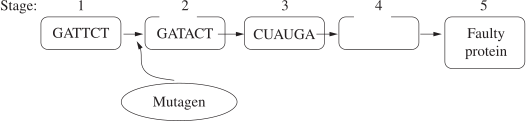
 

  1. Outline the series of events from stages 2 to 4 that resulted in the faulty protein.   (3 marks)

    --- 5 WORK AREA LINES (style=lined) ---

  2. Describe how a type of mutagen may have caused the changes observed in stage 2.   (2 marks)

    --- 5 WORK AREA LINES (style=lined) ---

  3. Given the information in the chart shown, describe the effect caused by the mutation in stage 4 and the effect this would have on the organism.   (3 marks)


    --- 6 WORK AREA LINES (style=lined) ---

Show Answers Only

a.    Events causing faulty protein:

  • Stage 2: A mutagen causes a point mutation in the DNA.
  • Stage 3: The mutated DNA transcription into mRNA.
  • Stage 4: The translation of the mRNA into a polypeptide chain which is not functional due to the mutation.

b.    Possible causes of Stage 2 observed changes:

  • High frequency photons including gamma and X-rays are regarded as ionising radiation due to their extremely high energy.
  • They can interfere with DNA undergoing replication causing misalignment and a possible substation change.
  • High energy gamma radiation may also cause mutation when directly striking a nitrogenous base.  

Answers could also include

  • Chemical mutagens (alkylating, delaminating and structurally similar chemicals).
  • Carcinogenic metals/elements (radon, cadmium)

c.   Effects of Stage 4 mutation:

  • When considering the above sequence as 2 codons, the chart shows us that this mutation results in an arginine amino becoming a stop codon.
  • This mutation will hence cause a premature termination of the polypeptide and result in a non-functional polypeptide/protein it forms a part of.
  • Due to the severity of this type of mutation it usually results in extensive health complications for affected individuals.
Show Worked Solution

a.    Events causing faulty protein:

  • Stage 2: A mutagen causes a point mutation in the DNA.
  • Stage 3: The mutated DNA transcription into mRNA.
  • Stage 4: The translation of the mRNA into a polypeptide chain which is not functional due to the mutation.

b.    Possible causes of Stage 2 observed changes:

  • High frequency photons including gamma and X-rays are regarded as ionising radiation due to their extremely high energy.
  • They can interfere with DNA undergoing replication causing misalignment and a possible substation change.
  • High energy gamma radiation may also cause mutation when directly striking a nitrogenous base.  

Answers could also include

  • Chemical mutagens (alkylating, delaminating and structurally similar chemicals).
  • Carcinogenic metals/elements (radon, cadmium)

c.   Effects of Stage 4 mutation:

  • When considering the above sequence as 2 codons, the chart shows us that this mutation results in an arginine amino becoming a stop codon.
  • This mutation will hence cause a premature termination of the polypeptide and result in a non-functional polypeptide/protein it forms a part of.
  • Due to the severity of this type of mutation it usually results in extensive health complications for affected individuals.

Filed Under: Mutation Tagged With: Band 3, Band 4, Band 5, smc-3652-30-Point Mutations, smc-3652-60-Mutagens

BIOLOGY, M6 EQ-Bank 3 MC

A New Zealand research team inserted a single gene into an onion to reduce the activity of the enzyme that makes your eyes water, resulting in an onion that you can cut without crying.

Which term best describes this team's process?

  1. Cloning
  2. Artificial pollination
  3. Genetic engineering
  4. Artificial insemination
Show Answers Only

`C`

Show Worked Solution
  • Manually altering an organisms genome (such as in transgenic organisms) is referred to as genetic engineering.

`=>C`

Filed Under: Genetic Technologies Tagged With: Band 3, smc-3654-05-Transgenic Organisms, smc-3654-20-Agriculture

BIOLOGY, M6 EQ-Bank 1 MC

A student was doing a literature review on biotechnology and wanted to see how biotechnology research could positively benefit people who suffered from Type 1 diabetes. He found several potential measures that were being explored to help people with diabetes.

Which of the following measures does NOT use biotechnology?

  1. Gene therapy in which genetic information is introduced into the cells of the pancreas
  2. The screening of genes to inform potential parents of the risk of their child developing Type 1 diabetes
  3. The use of auto-monitoring insulin pumps that can detect when a patient's insulin levels are dropping too low
  4. Collecting survey data on the prevalence of Type 1 diabetes in different communities to ensure insulin supplies are maintained at sufficient levels
Show Answers Only

`D`

Show Worked Solution

By Elimination

  • Gene therapy, auto monitoring insulin and screening and all examples of biotechnology. Option D is an epidemiological study (Eliminate A, B and C).

`=>D`

Filed Under: Biotechnology Tagged With: Band 3, smc-3653-20-Evaluating Genetic Technology

BIOLOGY, M5 EQ-Bank 24

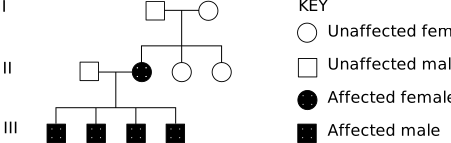
A non-infectious disease was observed in a mother and her four sons who live with her. She has no daughters. The father of these children does not have the disease and does not live with them. The woman's parents and her two sisters who live overseas do not have the disease.

A geneticist suspects that the disease is inherited.

  1. Draw the family pedigree for this disease.   (3 marks)


  2. From the evidence, what indicates that the disease could be the result of a recessive allele and not be sex-linked?   (2 marks)

    --- 4 WORK AREA LINES (style=lined) ---

Show Answers Only

a.   


b.   Evidence disease is recessive and not sex-linked:

  • Generation 1 parents do not have the disease but it is present in their daughter, meaning it must be recessive.
  • If the disease was sex-linked, the same daughter who has the disease must have a father with the disease, however this is not the case.
Show Worked Solution

a.   


b.   Evidence disease is recessive and not sex-linked:

  • Generation 1 parents do not have the disease but it is present in their daughter, meaning it must be recessive.
  • If the disease was sex-linked, the same daughter who has the disease must have a father with the disease, however this is not the case.

Filed Under: Genetic Variation / Inheritance Tagged With: Band 3, Band 4, smc-3648-10-Pedigrees, smc-3648-30-Sex Linkage, smc-3648-35-Autosomal

BIOLOGY, M5 EQ-Bank 21

There are some significant differences in the form that DNA has in prokaryotic and eukaryotic cells.

In the space provided draw a labelled diagram demonstrating the difference in the form of DNA between prokaryotic and eukaryotic cells.   (3 marks)

 

--- 0 WORK AREA LINES (style=lined) ---
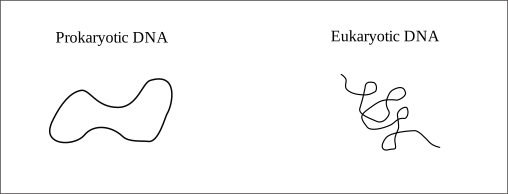
Show Answers Only

Show Worked Solution

Points to note on images:

  • Prokaryotic DNA is in the form of a loop
  • Eukaryotic DNA has two loose ends and is tightly coiled in the body

Filed Under: DNA and Polypeptide Synthesis Tagged With: Band 3, smc-3650-40-Eukaryotes and Prokaryotes

BIOLOGY, M5 EQ-Bank 23

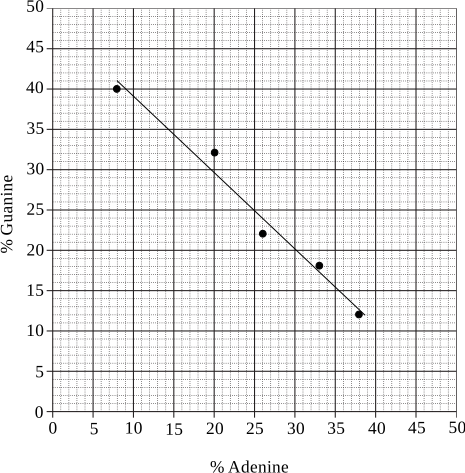
Students conducted preliminary experiments to analyse the DNA base composition of five different individuals.

The table shows the experimental data collected.
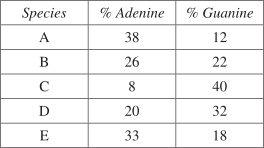
 

  1. On the grid provided, plot the % Guanine against % Adenine of the individuals analysed and draw a suitable line of best fit.   (3 marks)


  2. Identify the relationship shown by the data.   (1 mark)

    --- 2 WORK AREA LINES (style=lined) ---

  3. Explain the relationship shown by the data.   (3 marks)

    --- 8 WORK AREA LINES (style=lined) ---

Show Answers Only

a.   
       

b.  Relationship: As the % of Adenine increases, the % of Guanine decreases.

c.   Adenine/Guanine relationship

→ Because Adenine pairs with Thymine and Cytosine pairs with Guanine occurring to DNA base pairing rules, each should directly correlate to each other and account for the same % within the DNA composition of any species.

→ There are the only 4 components that make up all DNA composition. This also means that when comparing % of bases that do not pair, such as Adenine and Guanine, they must combine to form 50% of all DNA. This is evident when looking at individuals A and B, as well as C, D and E which are only off by 1-2%, most likely due to human error.

→ This always explains the relationship where an increase in Adenine (and Thymine) % will result in a decrease in Guanine (and Cytosine) % as the A and T pairs now occupy more space in the genome.

Show Worked Solution

a.   
       

b.  Relationship: As the % of Adenine increases, the % of Guanine decreases.

c.   Adenine/Guanine relationship

→ Because Adenine pairs with Thymine and Cytosine pairs with Guanine occurring to DNA base pairing rules, each should directly correlate to each other and account for the same % within the DNA composition of any species.

→ There are the only 4 components that make up all DNA composition. This also means that when comparing % of bases that do not pair, such as Adenine and Guanine, they must combine to form 50% of all DNA. This is evident when looking at individuals A and B, as well as C, D and E which are only off by 1-2%, most likely due to human error.

→ This always explains the relationship where an increase in Adenine (and Thymine) % will result in a decrease in Guanine (and Cytosine) % as the A and T pairs now occupy more space in the genome.

Filed Under: Uncategorized Tagged With: Band 3, Band 4, Band 5, smc-3649-10-DNA Structure

BIOLOGY, M5 EQ-Bank 22

  1. The following data shows the average amount of Human Chorionic Gonadotropin (hCG) produced by pregnant women.
      
    \begin{array}{|c|c|}
    \hline \rule{0pt}{2.5ex}\text {Weeks of pregnancy} \rule[-1ex]{0pt}{0pt} & h C G\,\text{(ng/mL)} \\
    \hline \rule{0pt}{2.5ex}0 \rule[-1ex]{0pt}{0pt}& 0 \\
    \hline \rule{0pt}{2.5ex}4 \rule[-1ex]{0pt}{0pt}& 85 \\
    \hline \rule{0pt}{2.5ex}8 \rule[-1ex]{0pt}{0pt}& 185 \\
    \hline \rule{0pt}{2.5ex}12 \rule[-1ex]{0pt}{0pt}& 185 \\
    \hline \rule{0pt}{2.5ex}16 \rule[-1ex]{0pt}{0pt}& 80 \\
    \hline \rule{0pt}{2.5ex}20 \rule[-1ex]{0pt}{0pt}& 65 \\
    \hline \rule{0pt}{2.5ex}24 \rule[-1ex]{0pt}{0pt}& 60 \\
    \hline \rule{0pt}{2.5ex}28 \rule[-1ex]{0pt}{0pt}& 65 \\
    \hline \rule{0pt}{2.5ex}32 \rule[-1ex]{0pt}{0pt}& 75 \\
    \hline \rule{0pt}{2.5ex}36 \rule[-1ex]{0pt}{0pt}& 65 \\
    \hline \rule{0pt}{2.5ex}40 \rule[-1ex]{0pt}{0pt}& 35 \\
    \hline
    \end{array}

      
    Use the information provided to graph the levels of hCG in a normal pregnancy.   (3 marks)
     
  2. Describe the role and changes in levels of a hormone in pregnancy.   (3 marks)

    --- 5 WORK AREA LINES (style=lined) ---

Show Answers Only

a.  Levels of hCG in a normal pregnancy
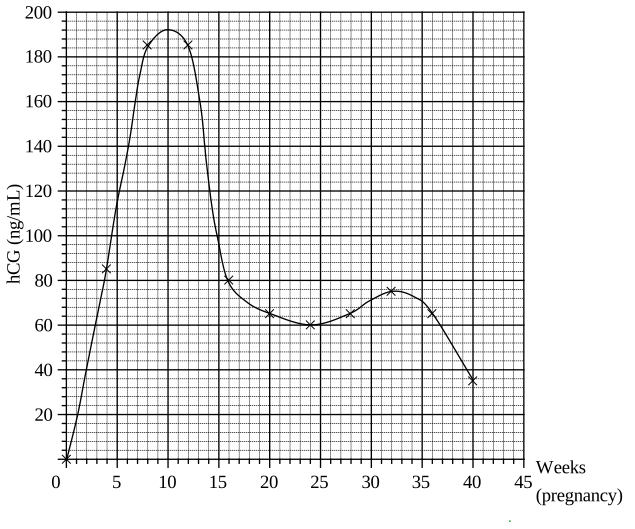
b.   The role and changes in levels of hormones in pregnancy.

  •  Progesterone is a sex hormone which is initially secreted by the corpus leuteum after ovulation to thicken the endometrium for implantation.
  • Once the placenta has developed, it then increases the progesterone levels which maintain the pregnancy.
  • Progesterone levels eventually drop in the last stage of pregnancy to facilitate delivery.

Answers could also include information about other hormones including:

  • Oestrogen
  • hCG
Show Worked Solution

a.  Levels of hCG in a normal pregnancy

b.    The role and changes in levels of hormones in pregnancy.

  •  Progesterone is a sex hormone which is initially secreted by the corpus leuteum after ovulation to thicken the endometrium for implantation.
  • Once the placenta has developed, it then increases the progesterone levels which maintain the pregnancy.
  • Progesterone levels eventually drop in the last stage of pregnancy to facilitate delivery.
      

Answers could also include information about other hormones including:

  • Oestrogen
  • hCG

Filed Under: Reproduction Tagged With: Band 3, Band 4, smc-3647-05-Human/Mammal, smc-3647-50-Hormones

BIOLOGY, M5 EQ-Bank 2 MC

A student completed a genetics exercise by preparing a Punnett square. `T` represents a dominant allele and `t` represents a recessive allele.
 

What were the likely genotypes of these parents?

  1. Both parents were homozygous.
  2. Both parents were heterozygous.
  3. Parent 1 was homozygous, Parent 2 was heterozygous.
  4. Parent 1 was heterozygous, Parent 2 was homozygous.
Show Answers Only

`B`

Show Worked Solution
  • Genotype ratio `1:2:1` is a typical Mendelian ratio of a cross between 2 heterozygous parents.

`=>B`

Filed Under: Genetic Variation / Inheritance Tagged With: Band 3, smc-3648-20-Punnet Squares, smc-3648-35-Autosomal

BIOLOGY, M5 EQ-Bank 4 MC

A student constructed a model of meiosis as shown. However, there is an error in the model.
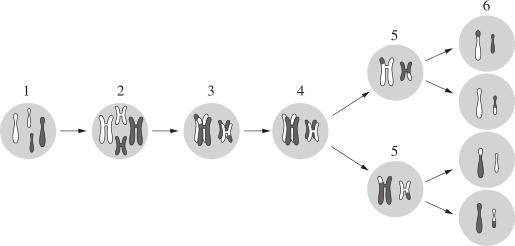
 

Which aspect of this model does NOT fit with observations of meiosis?

  1. Separation of chromatids has not been shown in the model.
  2. The chromosomes have not independently assorted in stage 2 .
  3. The chromosomes in stage 4 should have duplicated before stage 5 .
  4. The chromosomes have undergone crossing over before sister chromosome alignment in stage 3 .
Show Answers Only

`D`

Show Worked Solution
  • Stage 4 and 5 have to switch to fix the error. All other aspects are correct.

`=>D`

Filed Under: Cell Replication Tagged With: Band 3, smc-3649-20-Meiosis

PHYSICS, M8 EQ-Bank 22

Einstein's equation `E = mc^(2)`  is one of the most important equations in the history of physics.

Justify this statement.   (7 marks)

--- 14 WORK AREA LINES (style=lined) ---

Show Answers Only

Position Statement

  • Einstein’s equation `E=mc^2` is among physics’ most important equations because it reveals mass-energy equivalence and explains fundamental processes from atomic to cosmic scales.

Nuclear Applications

  • The equation explains energy from nuclear fission and fusion processes. It shows how tiny amounts of matter convert to enormous energy in nuclear reactions.
  • The mass defect in atoms directly relates to binding energy through `E=mc^2` and this principle drives nuclear reactors that power cities and nuclear weapons.
  • These applications are responsible for revolutionising both energy production and global politics.

Cosmic and Particle Physics

  • Stars produce energy by converting mass to energy through fusion reactions. The Sun converts 4 million tonnes of mass to energy every second using this principle
  • Particle accelerators create new particles by converting kinetic energy into mass. This allows scientists to study fundamental matter structure and discover new particles.
  • Furthermore, mass dilation near light speed also follows from this mass-energy relationship.

Reinforcement

  • While other equations like Newton’s gravity law are important, they lack the broad applicability of `E=mc^2`.
  • No other single equation explains phenomena from subatomic particles to stellar processes.
  • The equation unified our understanding of matter and energy as different forms of the same thing.
  • This justifies calling `E=mc^2` one of history’s most important physics equations.
Show Worked Solution

Position Statement

  • Einstein’s equation `E=mc^2` is among physics’ most important equations because it reveals mass-energy equivalence and explains fundamental processes from atomic to cosmic scales.

Nuclear Applications

  • The equation explains energy from nuclear fission and fusion processes. It shows how tiny amounts of matter convert to enormous energy in nuclear reactions.
  • The mass defect in atoms directly relates to binding energy through `E=mc^2` and this principle drives nuclear reactors that power cities and nuclear weapons.
  • These applications are responsible for revolutionising both energy production and global politics.

Cosmic and Particle Physics

  • Stars produce energy by converting mass to energy through fusion reactions. The Sun converts 4 million tonnes of mass to energy every second using this principle
  • Particle accelerators create new particles by converting kinetic energy into mass. This allows scientists to study fundamental matter structure and discover new particles.
  • Furthermore, mass dilation near light speed also follows from this mass-energy relationship.

Reinforcement

  • While other equations like Newton’s gravity law are important, they lack the broad applicability of `E=mc^2`.
  • No other single equation explains phenomena from subatomic particles to stellar processes.
  • The equation unified our understanding of matter and energy as different forms of the same thing.
  • This justifies calling `E=mc^2` one of history’s most important physics equations.

Filed Under: Light and Special Relativity, Origins of Elements, Properties of the Nucleus Tagged With: Band 3, Band 4, Band 5, smc-3699-80-E = mc^2, smc-3700-60-Mass-Energy Equivalence, smc-3703-20-Conservation of Mass-Energy

PHYSICS, M8 EQ-Bank 3 MC

A 5-gram sample of radioactive strontium-90 decayed over time. The graph shows the mass of strontium-90 remaining from the initial sample as a function of time.
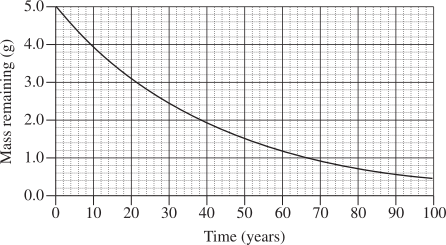
 

What is the approximate value of the decay constant, in `\text{year}^(-1)`, for strontium-90?

  1. 0.006
  2. 0.011
  3. 0.014
  4. 0.025
Show Answers Only

`D`

Show Worked Solution
  • From the graph, the half life (mass = 2.5 g) is approximately 29 years.
  •    `lambda=(ln2)/(t_((1)/(2)))=(ln2)/(29)=0.0239\ text{year}^(-1)`

 `=>D`

Filed Under: Properties of the Nucleus Tagged With: Band 3, smc-3703-40-Radioactive Decay

PHYSICS, M8 EQ-Bank 4 MC

Which of the following is true in relation to Millikan's oil drop experiment?

\begin{align*}
\begin{array}{l}
\rule{0pt}{2.5ex} \ \rule[-1ex]{0pt}{0pt}& \\
\rule{0pt}{2.5ex}\textbf{A.}\\
\text{}\rule[-1ex]{0pt}{0pt}&\text{}\\
\rule{0pt}{2.5ex}\textbf{B.}\\
\text{}\rule[-1ex]{0pt}{0pt}&\text{}\\
\rule{0pt}{2.5ex}\textbf{C.}\rule[-1ex]{0pt}{0pt}\\
\rule{0pt}{2.5ex}\textbf{D.}\rule[-1ex]{0pt}{0pt}\\
\end{array}
\begin{array}{|l|l|}
\hline
\rule{0pt}{2.5ex}\textit{Aim of the experiment}\rule[-1ex]{0pt}{0pt}& \textit{Type of field used in experiment} \\
\hline
\rule{0pt}{2.5ex}\text{Measure the charge-to-mass} &\text{Electric and magnetic}\\
\text{ratio of electrons}\rule[-1ex]{0pt}{0pt}&\text{}\\
\hline
\rule{0pt}{2.5ex}\text{Measure the charge-to-mass} & \text{Magnetic}\\
\text{ratio of electrons}\rule[-1ex]{0pt}{0pt}&\text{}\\
\hline
\rule{0pt}{2.5ex}\text{Measure the charge of electrons}\rule[-1ex]{0pt}{0pt}& \text{Electric and magnetic} \\
\hline
\rule{0pt}{2.5ex}\text{Measure the charge of electrons}\rule[-1ex]{0pt}{0pt}& \text{Electric} \\
\hline
\end{array}
\end{align*}

Show Answers Only

\(D\)

Show Worked Solution
  • Millikan’s experiment involved levitating oil drops in an electric field in order to measure the charge on an electron.

\(\Rightarrow D\)

Filed Under: Structure of the Atom Tagged With: Band 3, smc-3701-20-Millikan

PHYSICS, M8 EQ-Bank 2 MC

After DC voltage was applied to an apparatus containing hydrogen gas, the hydrogen separated into streams of oppositely charged particles.

What could be concluded from this observation?

  1. Hydrogen gas conducts electricity.
  2. Hydrogen is the simplest element.
  3. Hydrogen atoms have components.
  4. Hydrogen atoms have a neutral charge.
Show Answers Only

`C`

Show Worked Solution
  • The separation shows that hydrogen atoms contain both positive (protons) and negative (electrons) components.

`=>C`

Filed Under: Structure of the Atom Tagged With: Band 3, smc-3701-10-Cathode Rays and Thomson

PHYSICS, M8 EQ-Bank 1 MC

A Hertzsprung-Russell diagram is shown.
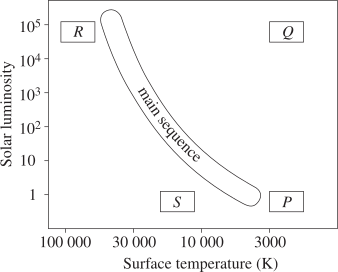
 

In which region would a star have the same surface temperature as a star on the main sequence?

  1. `P`
  2. `Q`
  3. `R`
  4. `S`
Show Answers Only

`D`

Show Worked Solution
  • Using the `x`-axis of the Hertzsprung-Russel diagram, `S` is the only region in which stars have the same surface temperature as a star on the main sequence.

`=>D`

Filed Under: Origins of Elements Tagged With: Band 3, smc-3700-10-H-R Diagrams

PHYSICS, M5 EQ-Bank 4 MC

A torque is applied to a nut, using a wrench.
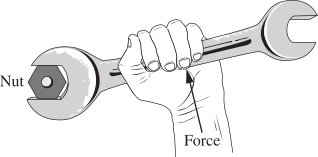
 

Which change will increase the magnitude of applied torque?

  1. Increasing the angle between the applied force and the wrench
  2. Decreasing the angle between the applied force and the wrench
  3. Increasing the distance between the nut and the point of application of the force
  4. Decreasing the distance between the nut and the point of application of the force
Show Answers Only

`C`

Show Worked Solution
  • `tau = rF sin theta`
  • Increasing the distance (`r`) between the point of application of the force and the nut will increase applied torque.

`=>C`

Filed Under: Circular Motion Tagged With: Band 3, smc-3691-60-Torque

Proof, EXT2 P2 EQ-Bank 11

A sequence is given by the recursive formula

`a_1=10, \ a_(n+1)=3a_n+4`  for  `n>=1`

Using mathematical induction to show the formula for the general term of the sequence is

`a_n=4(3^n)-2`   (3 marks)

--- 8 WORK AREA LINES (style=lined) ---

Show Answers Only

`text{Proof (See Worked Solution)}`

Show Worked Solution

`text{Prove true for}\ \ n=1:`

`text{LHS}\ =a_1=10`

`text{RHS}\ =4(3^1)-2=10=\ text{LHS}`

`:.\ text{True for}\ \ n=1`
 

`text{Assume true for}\ \ n=k:`

`a_k=4(3^k)-2\ \ text{… (1)}`
 

`text{Prove true for}\ \ n=k+1:`

`text{i.e.}\ a_(k+1)=4(3^(k+1))-2`

`a_(k+1)` `=3a_k+4`  
  `=3[4(3^k)-2]+4`  
  `=4*3^k*3-6+4`  
  `=4(3^(k+1))-2`  
  `=\ text{RHS}`  

 
`:.\ text{True for}\ \ n=k+1`

`:.\ text{Since true for} \ n=1,\ text{by PMI, true for integers} \ n>=1.`

Filed Under: Induction, P2 Induction (Ext2) Tagged With: Band 3, smc-1044-60-Recursive, smc-5115-60-Recursive

Calculus, EXT1 C3 EQ-Bank 12

Solve  `dy/dx=2x^2-3x`  given that when  `x=3`, `y=-1`.   (2 marks)

--- 5 WORK AREA LINES (style=lined) ---

Show Answers Only
  1. `y=2/3x^3-3/2x^2-11/2`
Show Worked Solution
`dy/dx` `=2x^2-3x`  
`1\ dy` `=2x^2-3x\ dx`  
`int1\ dy` `=int2x^2-3x\ dx`  
`y` `=2/3x^3-3/2x^2+c`  

 
`text{When}\ \ x=3,\ y=-1:`

`-1` `=2/3 3^3-3/2 3^2+c`  
`c` `=-11/2`  

 
`:.y=2/3x^3-3/2x^2-11/2`

Filed Under: Equations and Slope Fields Tagged With: Band 3, smc-1197-45-dy/dx=f(x)

Calculus, EXT1 C3 EQ-Bank 8

A researcher estimates the number of brumbies in a National Park after `t` years can be modelled by the equation

`B(t)=(18\ 000)/(1+4e^(-t))`

  1. Sketch the function `B(t)` over the first four years of the research.   (2 marks)

    --- 8 WORK AREA LINES (style=lined) ---

  2. Calculate when the brumby population should reach 13 000, giving your answer to 2 decimal places.   (1 mark)

    --- 6 WORK AREA LINES (style=lined) ---

  3. Show that  `B^(′)(t)=(72\ 000e^t)/(e^t+4)^2`   (2 marks)

    --- 6 WORK AREA LINES (style=lined) ---

  4. What is the maximum growth rate of the brumby population?   (3 marks)

    --- 10 WORK AREA LINES (style=lined) ---

Show Answers Only
  1.  
     
  2. `2.34\ text{years}`
  3. `text{Proof (See Worked Solutions}`
  4. `4500\ text{brumbies per year}`
Show Worked Solution

i.   

ii.   `text {Find}\ t\ text{when}\ \ B(t)=13\ 000`

`13\ 000` `=(18\ 000)/(1+4e^(-t))`  
`13\ 000(1+4e^(-t))` `=18\ 000`  
`1+4e^(-t)` `=18/13`  
`4e^(-t)` `=5/13`  
`e^(-t)` `=5/52`  
`-t` `=ln(5/52)`  
`t` `=2.34\ text{years (2 d.p.)}`  


 iii.   `text{Show}\ \ B^(′)(t)=(72\ 000e^t)/(e^t+4)^2`

`B(t)=18\ 000(1+4e^(-t))^(-1)`

`B^(′)(t)` `=-1*-1*4e^(-t)*18\ 000(1+4e^(-t))^-2`  
  `=(72\ 000)/(e^t(1+4e^(-t))^2)`  
  `=(72\ 000)/(e^t(1+4/e^t)^2)`  
  `=(72\ 000)/(e^t((e^t+4)/e^t)^2)`  
  `=(72\ 000)/(e^t/(e^t)^2*(e^t+4)^2)`  
  `=(72\ 000e^t)/(e^t+4)^2\ \ text{… as required}`  


iv.  `B^(′)(t)=72\ 000e^t(e^t+4)^(-2)`

`text{Using product rule:}`

`B^(′′)(t)` `=72\ 000e^t(e^t+4)^(-2)+(-2e^t)(e^t+4)^(-3)72\ 000e^t`  
  `=72\ 000e^t(1/(e^t+4)^2-(2e^t)/(e^t+4)^3)`  
  `=72\ 000e^t((e^t+4-2e^t)/(e^t+4)^3)`  
  `=72\ 000e^t((4-e^t)/(e^t+4)^3)`  

 
`text{Find}\ t\ text{when}\ \ B^(′′)(t)=0:`

`4-e^t` `=0`  
`e^t` `=4`  
`t` `=ln4`  
  `=1.386…\ text{years}`  

 
`text{Checking concavity changes:}`

`text{Since}\ e^t>0, (e^t+4)^3>0\ \ text{for all}\ t:`

`text{At}\ t=1, 4-e^1=1.28>0\ \ =>\ \ B^(′′)(1)>0`

`text{At}\ t=2, 4-e^2=-3.4<0\ \ =>\ \ B^(′′)(2)<0`

 
`B^(′)(ln4)=\ text{Max growth rate}`

`B^(′)(ln4)` `=(72\ 000e^(ln4))/(e^(ln4)+4)^2`  
  `=(72\ 000xx4)/((4+4)^2)`  
  `=4500\ text{brumbies per year}`  

Filed Under: Applications of Differential Equations Tagged With: Band 3, Band 4, Band 5, smc-1198-30-Quantity

Calculus, EXT1 C3 EQ-Bank 6

The population of Myna birds in a national park is decreasing at a rate proportional to the population at that time.

  1. Write a differential equation that describes the situation.   (1 mark)

    --- 2 WORK AREA LINES (style=lined) ---

  2. If the population was originally 1300 and decreased to 1040 after 5 years, find the expected population after 10 years.  (3 marks)

    --- 8 WORK AREA LINES (style=lined) ---

Show Answers Only
  1. `(dN)/(dt) = -kN`
  2. `832`
Show Worked Solution

i.   `text{Let}\ (dN)/(dt)=\ text{rate of change of bird population at time}\ t\ text{years.}`

`(dN)/(dt) prop N`

`(dN)/(dt) = -kN\ \ (k>0,\ text{decreasing population)}`
 

ii.    `(dN)/(dt)` `=-kN`
  `1/N* (dN)/(dt)` `=-k`
  `int1/N\ dN` `=-intk\ dt`
  `ln absN` `=-kt+c`
  `N` `=e^(-kt+c)`
    `=e^(-kt)*e^c`
    `=Ae^(-kt)\ \ \ text{(where}\ A=e^c)`

 
`text{When}\ \ t=0, N=1300:`

`1300=Ae^0\ \ =>\ \ A=1300`

`N=1300e^(-kt)`
 

`text{When}\ \ t=5, N=1040:`

`1040` `=1300e^(-5k)`  
`e^(-5k)` `=1040/1300`  
`-5k` `=ln(0.8)`  
`k` `=-(ln(0.8))/(5)`  
  `=0.04462…`  

 
`text{Find}\ N\ text{when}\ \ t=10:`

`N` `=1300e^(-0.04462 xx 10)`  
  `=832\ \ text{myna birds}`  

Filed Under: Applications of Differential Equations Tagged With: Band 3, Band 4, smc-1198-30-Quantity

Proof, EXT2 P2 EQ-Bank 2

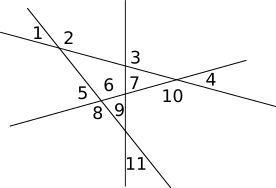
`n` lines are drawn in a 2-dimensional plane such that no three lines are concurrent and no two lines are parallel.

`S_n` is the number of regions into which these lines divide the plane with the diagram illustrating that `S_3=7`
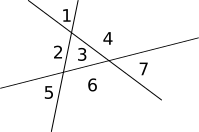
 

  1. In a similar way, draw diagrams that illustrate `S_1, S_2` and `S_4`.  (1 mark)

    --- 10 WORK AREA LINES (style=lined) ---

  2. Using the results in part (i), make a conjecture about the general formula for `S_n`.  (2 marks)

    --- 8 WORK AREA LINES (style=lined) ---

  3. Use mathematical induction to prove the formula from part (ii).  (3 marks)

    --- 12 WORK AREA LINES (style=lined) ---

Show Answers Only
  1. `text{See Worked Solutions}`
  2. `S_n=(n^2+n+2)/2`
  3. `text{See Worked Solutions}`
Show Worked Solution

i.       `S_1=2`                        `S_2=4`


   `S_4=11`


ii.   `text{Consider the pattern above:}`

`S_1=2,\ \ S_2=S_1+2`

`S_3=S_2+3,\ …\ , S_n=S_(n-1)+n`

`S_n` `=S_(n-1)+n`  
  `=S_(n-2)+(n-1)+n`  
  `=S_(n-3)+(n-2)+(n-1)+n`  
  `vdots`  
  `=S_1+(2+3+…+(n-1)+n)`  
  `=S_0+(1+2+…+(n-1)+n)`  
  `=1+(1+2+…+(n-1)+n)`  

 
`=>text{AP where}\ \ a=1, l=n, n=n`

`S_n` `=1+n/2(1+n)`  
  `=(2+n(n+1))/2`  
  `=(n^2+n+2)/2`  


iii.   `text{Prove}\ \ S_n=(n^2+n+2)/2\ \ text{for}\ \ n>=0`

`text{If}\ \ n=1`

`text{LHS}\ =S_1=2`

`text{RHS}\ = (1^2+1+2)/2=2=\ text{LHS}`

`:.\ text{True for}\ n=1.`
 

`text{Assume true for}\ \ n=k:`

`text{i.e.}\ S_k=(k^2+k+2)/2`

`text{Prove true for}\ \ n=k+1:`

`text{i.e.}\ S_(k+1)=((k+1)^2+(k+1)+2)/2=(k^2+3k+4)/2`
 

`text{Consider the line}\ d_4\ text{added below that crosses 3 existing lines}`

`text{and creates 4 new regions.}`
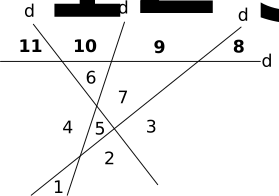
`text{Similarly, the line}\ d_(k+1)\ text{will cross}\ k\ text{existing lines and}`

`text{create}\ (k+1)\ text{new regions.}`

`S_(k+1)` `=S_k+k+1`  
  `=(k^2+k+2)/2+k+1`  
  `=(k^2+k+2+2k+2)/2`  
  `=(k^2+3k+4)/2`  
  `=\ text{RHS}`  

 
`:.\ text{True for}\ \ n=k+1`

`:.\ text{Since true for}\ n=1,\ text{by PMI, true for integers}\ n>=1`

Filed Under: Induction, P2 Induction (Ext2) Tagged With: Band 3, Band 4, Band 5, smc-1044-65-Geometry, smc-5115-65-Geometry

Vectors, EXT2 V1 EQ-Bank 14

Use vector methods to find the coordinates of the point that divides the interval joining the points  `A(7,-3,0)`  and  `B(2,2,-10)`  in the ratio `2:3`.  (3 marks)

--- 5 WORK AREA LINES (style=lined) ---

Show Answers Only

`(5,-1,-4)`

Show Worked Solution

`text{Method 1}`

`text{Let}\ \ underset~c =\ text{position vector of the dividing point}`

`underset~c` `=((7),(-3),(0)) + 2/5((2-7),(2-(-3)),(-10-0))`  
  `=((7),(-3),(0)) + ((-2),(2),(-4))`  
  `=((5),(-1),(-4))`  

 
`text{Method 2}`

`underset~c` `=((2),(2),(-10)) + 3/5((7-2),(-3-2),(0-(-10)))`  
  `=((2),(2),(-10)) + ((3),(-3),(6))`  
  `=((5),(-1),(-4))`  

Filed Under: Vectors and Geometry Tagged With: Band 3, smc-1210-55-Ratios

Vectors, EXT2 V1 EQ-Bank 12

Two planes are flying in directions given by the vectors  `-200underset~i+400underset~j-3underset~k`  and  `300underset~i+250underset~j+underset~k`.

A person in the flight control centre is plotting their paths on a map.

Calculate the acute angle between their projected flight paths, giving your answer correct to one decimal place.  (2 marks)

--- 5 WORK AREA LINES (style=lined) ---

Show Answers Only

`76.8°`

Show Worked Solution

`text{Let}\ \ underset~a=-200underset~i+400underset~j-3underset~k,\ \ underset~b=300underset~i+250underset~j+underset~k`

`underset~a*underset~b=((-200),(400),(-3))((300),(250),(1))=-60\ 000+100\ 000-3=39\ 997`

`abs(underset~a)=sqrt(200^2+400^2+9)=447.2236…`

`abs(underset~b)=sqrt(300^2+250^2+1)=390.5137…`

`costheta` `=(39\ 997)/(447.2236xx390.5137)`  
  `=0.2291`  
`:.theta` `=76.8°\ \ text{(to 1 d.p.)}`  

Filed Under: Basic Concepts and Arithmetic Tagged With: Band 3, smc-1195-20-Angles Between Vectors

Vectors, EXT2 V1 EQ-Bank 9

A parallelogram is formed by joining the points  `P(-2,1,4), Q(1,4,5), R(0,2,3)` and `S(a,b,c)`.

Use vector methods to find `a,b` and `c`.  (2 marks)

--- 6 WORK AREA LINES (style=lined) ---

Show Answers Only

`a=-3, b=-1, c=2`

Show Worked Solution

`text{Opposite sides of a parallelogram are equal and parallel.}`

`=> vec(PQ)=vec(SR)`
 

`vec(PQ)=((1+2),(4-1),(5-4))=((3),(3),(1))`
 

`vec(SR)=((-a),(2-b),(3-c))`
 

`text{Equating coordinates:}`

`-a=3\ \ =>\ \ a=-3`

`2-b=3\ \ =>\ \ b=-1`

`3-c=1\ \ =>\ \ c=2`

Filed Under: Basic Concepts and Arithmetic, Vectors and Geometry Tagged With: Band 3, smc-1210-30-Quadrilateral, smc-1210-70-3D problems

Vectors, EXT2 V1 EQ-Bank 7

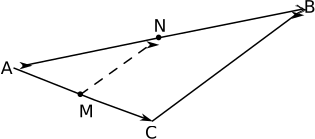
In triangle `ABC`, `M` is the midpoint of `AC` and `N` is the midpoint of `AB`.

Use vector methods to prove that

  1. `MN=1/2CB`   (2 marks)

    --- 5 WORK AREA LINES (style=lined) ---

  2. `MN` is parallel to `CB`   (1 mark)

    --- 3 WORK AREA LINES (style=lined) ---

Show Answers Only
  1. `text(See Worked Solution)`
  2. `text(See Worked Solution)`
Show Worked Solution

i.   
     

`vec(AC)+vec(CB)+vec(BA)=0\ \ \ text{(resultant vector ends at starting point)}`

`vec(CB)=-(vec(AC)+vec(BA))`
 

`text(S)text(ince)\ M\ text (and)\ N\ text(are midpoints:)`

`vec(MN)` `=-1/2vec(AC)-1/2vec(BA)`  
  `=-1/2(vec(AC)+vec(AB))`  
  `=1/2vec(CB)\ \ text(… as required)`  


ii.   `text{If}\ \ vec(u) = kvec(v)\ \ (k\ text{scalar})\ \ =>\ \ vec(u)\ text{||}\ vec(v)`

`vec(MN)=1/2vec(CB)\ \ text{(see (i))`

`:.MN\ text{||}\ RCB`

Filed Under: Vectors and Geometry Tagged With: Band 3, smc-1210-40-Triangle, smc-1210-60-2D problems

Vectors, EXT2 V1 EQ-Bank 6

Use vector methods to find the coordinates of the point that divides the interval joining the points  `A(-1,3,2)`  and  `B(7,-1,-6)`  in the ratio `1:3`.  (3 marks)

--- 4 WORK AREA LINES (style=lined) ---

Show Answers Only

`(1,2,0)`

Show Worked Solution

`text{Method 1}`

`text{Let}\ \ underset~c =\ text{position vector of the dividing point}`

`underset~c` `=((-1),(3),(2)) + 1/4((7-(-1)),(-1-3),(-6-2))`  
  `=((-1),(3),(2)) + ((2),(-1),(-2))`  
  `=((1),(2),(0))`  

 
`text{Method 2}`

`underset~c` `=((7),(-1),(-6)) + 3/4((-1-7),(3-(-1)),(2-(-6)))`  
  `=((7),(-1),(-6)) + ((-6),(3),(6))`  
  `=((1),(2),(0))`  

Filed Under: Basic Concepts and Arithmetic Tagged With: Band 3, smc-1210-55-Ratios

Vectors, EXT2 V1 EQ-Bank 5

Use two vector methods to locate the midpoint of the interval joining the points  `A(3,-2,1)`  and  `B(5,4,-3)`.  (3 marks)

--- 4 WORK AREA LINES (style=lined) ---

Show Answers Only

`(4,-1,-1)`

Show Worked Solution

`text{Method 1}`

`text{Let}\ \ underset~c =\ text{position vector of the midpoint}`

`underset~c` `=((3),(-2),(1)) + 1/2((5-3),(4-(-2)),(-3-1))`  
  `=((3),(-2),(1)) + ((1),(3),(-2))`  
  `=((4),(1),(-1))`  

 
`text{Method 2}`

`underset~c` `=((5),(4),(-3)) + 1/2((3-5),(-2-4),(1-(-3)))`  
  `=((5),(4),(-3)) + ((-1),(-3),(2))`  
  `=((4),(1),(-1))`  

Filed Under: Vectors and Geometry Tagged With: Band 3, smc-1210-55-Ratios

Vectors, EXT2 V1 EQ-Bank 3

If  `underset ~a = 3 underset ~i-underset ~j`  and  `underset ~b = −2 underset ~i + 6 underset ~j + 2underset ~k`

  1. Calculate  `underset ~a-1/2underset ~b`   (2 marks)

    --- 3 WORK AREA LINES (style=lined) ---

  2. Find  `hat underset ~b`   (2 marks)

    --- 4 WORK AREA LINES (style=lined) ---

Show Answers Only
  1. `((4),(-4),(-1))`
  2.  `hat underset~b=((-sqrt11)/11, (3sqrt11)/11, sqrt11/11)`
Show Worked Solution
i.    `underset~a-1/2underset~b` `=((3),(-1),(0))-1/2((-2),(6),(2))`
    `=((3),(-1),(0))-((-1),(3),(1))`
    `=((4),(-4),(-1))`


ii.    `hat underset~b = underset~b/{abs(underset~b)}`

`abs(underset~b)=sqrt((-2)^2+6^2+2^2)=sqrt44=2sqrt11`

`hat underset~b` `=1/(2sqrt11)(-2,6,2)`  
  `=((-1)/sqrt11, 3/sqrt11, 1/sqrt11)`  
  `=((-sqrt11)/11, (3sqrt11)/11, sqrt11/11)`  

Filed Under: Basic Concepts and Arithmetic Tagged With: Band 2, Band 3, smc-1195-40-Unit Vectors and Projections

BIOLOGY, M7 2014 HSC 5 MC

In which of the following cases would bacteria be described as pathogens?

  1. Bacteria reducing lung function in mammals
  2. Bacteria in the human gut assisting digestion
  3. Bacteria producing insulin as a result of genetic engineering
  4. Bacteria in the mouth preventing growth of harmful bacteria
Show Answers Only

`A`

Show Worked Solution
  • A pathogen is a biological agent of disease.
  • Bacteria ‘A’ is the only one which fits the criteria of a pathogen.

`=>A`

Filed Under: Causes of Infectious Disease Tagged With: Band 3, smc-3655-10-Classifying Pathogens

PHYSICS, M5 EQ-Bank 5 MC

An object is projected upwards from the ground, and follows a path as represented in the diagram.
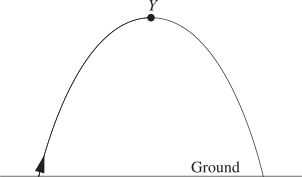
 

Which of the following describes the projectile's horizontal and vertical acceleration at point `Y` ?

  1. Both the horizontal and vertical acceleration are zero.
  2. Both the horizontal and vertical acceleration are `9.8 \ text{m s}^(-2)`.
  3. The horizontal acceleration is `9.8 \ text{m s}^(-2)` and the vertical acceleration is zero.
  4. The horizontal acceleration is zero and the vertical acceleration is `9.8 \ text{m s}^(-2)`.
Show Answers Only

`D`

Show Worked Solution
  • There are no horizontal forces acting on the ball throughout its flight, so its horizontal acceleration is always zero.
  • The ball experiences a net downwards force due to gravity. This results in a constant vertical acceleration of `9.8  text{m s}^(-2)` downwards.

`=>D`

Filed Under: Projectile Motion Tagged With: Band 3, smc-3690-90-Velocity and Acceleration

PHYSICS, M5 EQ-Bank 1 MC

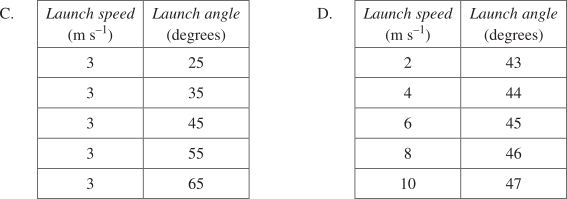
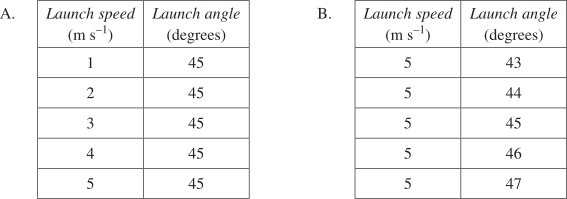
Some students were testing the hypothesis that launching a projectile at an angle of 45° will give the maximum horizontal range.

Which experimental setup will best test the hypothesis?
 

Show Answers Only

`C`

Show Worked Solution

By Elimination:

  • In this experiment horizontal range is the dependent variable and launch angle is the independent variable. So, launch angle must be varied (eliminate `A`).
  • To be a valid experiment, the independent variable, i.e. the launch angle, must be the only variable which changes (eliminate `D`).
  • Between `B` and `C`, `C` has a larger range of angles tested, whereas `B` uses too narrow a range of angles to make a valid conclusion.

`=>C`

Filed Under: Projectile Motion Tagged With: Band 3, smc-3690-10-Projectile Motion Models, smc-3690-25-Range

ENGINEERING, AE 2017 HSC 6 MC

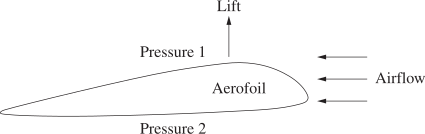
The diagram shows an aerofoil.
 

Which condition needs to be achieved for lift to occur?

  1. Pressure 1<Pressure 2
  2. Pressure 1= Pressure 2
  3. Pressure 1> Pressure 2
  4. Pressure 1+ Pressure 2=0
Show Answers Only

`A`

Show Worked Solution
  • For a net upwards force, the force from pressure below (pushing up) must exceed the force from pressure above (pushing down).
  • Therefore Pressure 1<Pressure 2.

`=A>`

Filed Under: Mechanics and Hydraulics Tagged With: Band 3, smc-3724-10-Lift/Drag, smc-3724-20-Key forces, smc-3724-70-Pressure

ENGINEERING, TE 2017 HSC 2 MC

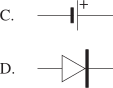
Which of the following is the circuit symbol for a diode?
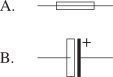
 

Show Answers Only

`D`

Show Worked Solution

`=>D`

Filed Under: Electricity/Electronics Tagged With: Band 3, smc-3730-50-Circuits

ENGINEERING, CS 2018 HSC 23b

The steel used in the chassis members was tested.

The load–extension graph represents the data collected during the testing of a specimen of the steel.
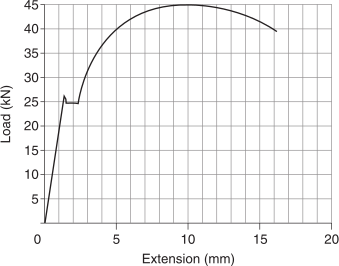
 

Before testing, the specimen was 1020 mm long with a cross-sectional area of 100 mm².

  1. Calculate Young's modulus for this steel.   (4 marks)

--- 8 WORK AREA LINES (style=lined) ---

  1. Describe the physical changes that occur in the specimen tested in part (i) when a 20 kN load is applied and then removed, compared to when a 30 kN load is applied and then removed.   (2 marks)

--- 4 WORK AREA LINES (style=lined) ---

Show Answers Only

i.   Young’s modulus

`F = 20 xx 10^3\ text{N}, l = 1020\ text{mm},  e = 1\ text{mm},  text{A} = 100\ text{mm}^2`

`E` `=(Fl)/(eA)`  
  `=(20 xx 10^3 xx1020)/(1 xx 100)`  
  `=204 xx 10^3`  
  `=204\ text{GPa}`  

ii.   

  • Elastic deformation is produced by the 20 kN load.
  • After initial stretching the specimen returns to its original length.
  • Plastic deformation is produced by the 30 kN load.
  • The specimen stays deformed subsequent to release.
Show Worked Solution

i.   Young’s modulus

`F = 20 xx 10^3\ text{N}, l = 1020\ text{mm},  e = 1\ text{mm},  text{A} = 100\ text{mm}^2`

`E` `=(Fl)/(eA)`  
  `=(20 xx 10^3 xx1020)/(1 xx 100)`  
  `=204 xx 10^3`  
  `=204\ text{GPa}`  

♦ Mean mark (i) 51%.

ii.     Elastic deformation is produced by the 20 kN load.

  • After initial stretching the specimen returns to its original length.
  • Plastic deformation is produced by the 30 kN load.
  • The specimen stays deformed subsequent to release.

Filed Under: Engineering Mechanics Tagged With: Band 3, Band 5, smc-3714-75-Young/Hooke, smc-3714-80-Stress/Strain - other, smc-3714-90-Load-ext diagram

ENGINEERING, PPT 2018 HSC 21b

Outline the benefits of using electric motors to power self-driving vehicles.   (3 marks)

--- 8 WORK AREA LINES (style=lined) ---

Show Answers Only

Successful engines should include three of the following:

  • Reduced amount of tailpipe emissions through the use of renewable energy as the power source.
  • Lighter engine construction produces a better power to weight ratio.
  • Quieter engines reduce noise pollution.
  • Technology enabling simpler integration into an automated vehicle control system.
  • Less moving parts in electric motors mean they break down less often and need less maintenance.
Show Worked Solution

Successful engines should include three of the following:

  • Reduced amount of tailpipe emissions through the use of renewable energy as the power source.
  • Lighter engine construction produces a better power to weight ratio.
  • Quieter engines reduce noise pollution.
  • Technology enabling simpler integration into an automated vehicle control system.
  • Less moving parts in electric motors mean they break down less often and need less maintenance.

Filed Under: Electricity/Electronics Tagged With: Band 3, smc-3720-40-Electrical motors, smc-3720-50-Control systems

ENGINEERING, AE 2018 HSC 17 MC

Aircraft skins can be constructed using either fibre metal laminate (FML) or sheet aircraft-grade aluminium alloy.

FML is preferred in this application because it has

  1. higher density and lower Young's modulus.
  2. higher density and improved fatigue resistance.
  3. higher strength-to-weight ratio and lower Young's modulus.
  4. higher strength-to-weight ratio and improved fatigue resistance.
Show Answers Only

`D`

Show Worked Solution
  • Higher density and lower Young’s modulus are both negative material properties for aircraft skins, as these skins should be light (lower density) and rigid (higher stiffness/Young’s modulus).
  • Additionally, fatigue resistance is important as aircraft skins are exposed to varying air pressures.

`=>D`

Filed Under: Materials Tagged With: Band 3, smc-3725-20-Metal alloys, smc-3725-50-Property comparison

ENGINEERING, PPT 2018 HSC 8 MC

In which of the following do all of the processes require plastic deformation to achieve a final shape?

  1. Brazing, casting, rolling
  2. Brazing, soldering, welding
  3. Extruding, casting, forging
  4. Extruding, pressing, rolling
Show Answers Only

`D`

Show Worked Solution
  • Brazing, casting, soldering and welding involve metal in liquid form and therefore do not require plastic deformation. (Cannot be `A`, `B` or `C`)

`=>D`

Filed Under: Materials Tagged With: Band 3, smc-3719-10-Manufacturing - Ferrous

ENGINEERING, PPT 2018 HSC 7 MC

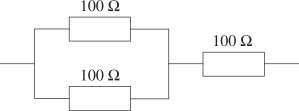
An arrangement of resistors is shown.
 

What is the total resistance of this arrangement of resistors?

  1. `33 Omega`
  2. `50 Omega`
  3. `150 Omega`
  4. `300 Omega`
Show Answers Only

`C`

Show Worked Solution
`R_(text{total})` `=R_(text{parallel}) + 100 Omega`  
`1/(R_(text{parallel}))` `= 1/R_1 + 1/R_2= 1/50`  
`R_(text{parallel})` `= 50 Omega`  

 
`:. R_(text{total})= 50 + 100= 150 Omega`

   
`=>C`

Filed Under: Electricity/Electronics Tagged With: Band 3, smc-3720-20-Circuit diagrams

ENGINEERING, CS 2018 HSC 5 MC

Two types of bridge are shown.
 

What are the two types of bridge design shown?

  1. Suspension bridge and masonry arch
  2. Suspension bridge and masonry beam
  3. Reinforced concrete arch and masonry arch
  4. Reinforced concrete arch and masonry beam
Show Answers Only

`C`

Show Worked Solution
  •  Both bridges are arch beams, therefore C is correct.
  •  In suspension bridges, the deck is suspended from above by vertical cables.
  •  Beam bridges are a simple flat beam from one side to another, neither of which are shown here.

`=>C`

Filed Under: Historical and Societal Influences Tagged With: Band 3, smc-3713-10-Structures over time

ENGINEERING, TE 2018 HSC 21d

Digital logic controls a self-driving vehicle's brakes.
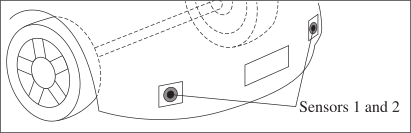
 

Brakes will be applied when all of the following conditions are met:

    • the motor is on
    • the vehicle is in motion
    • either sensor 1 or sensor 2 is activated.

Explain how the logic gates, labelled 1, 2 and 3 in the circuit below, control the vehicle's brakes.   (3 marks)
 

--- 6 WORK AREA LINES (style=lined) ---

Show Answers Only
  1. Logic gate 1 – AND – both inputs must be ON for ON output
  2. Logic gate 2 – OR – either input ON to produce ON output
  3. Logic gate 3 – AND – both inputs must be ON for ON output (ie brakes are applied)
Show Worked Solution
  1. Logic gate 1 – AND – both inputs must be ON for ON output
  2. Logic gate 2 – OR – either input ON to produce ON output
  3. Logic gate 3 – AND – both inputs must be ON for ON output (ie brakes are applied)

Filed Under: Electricity/Electronics Tagged With: Band 3, smc-3730-30-Logic gates/circuits, smc-3730-70-Transport

BIOLOGY, M8 2019 HSC 33c

A large epidemiological study was conducted. It used historical data to investigate the association between Herpes simplex virus (HSV) infection and dementia. Dementia is caused by a variety of brain illnesses. Alzheimer's disease is the most common cause of dementia.

The study used the records of 8362 patients with HSV infection and 25086 randomly selected sex- and age-matched control patients without HSV infection. Some of the patients with HSV had been treated with antiviral medication.

The graph below shows some results of the study.
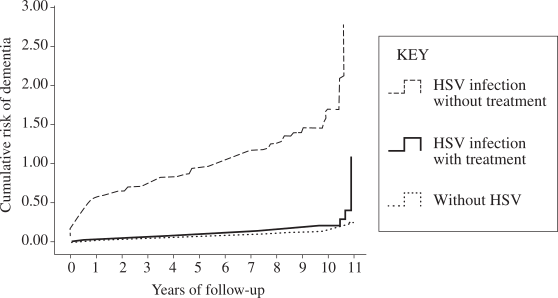
 

  1. Describe the trends shown in the data.   (3 marks)
Show Answers Only
  • The graph clearly shows that individuals with untreated HSV are at a greater risk of developing Alzheimer’s. While people without HSV or treated HSV remain relatively low up to 10 years, HSV patients can have 10 to 15 times the likelihood of developing Alzheimer’s, a trend which increases with age/time with HSV.
  • The treated HSV patients remain relatively low and almost identical to the individuals without HSV until 10 years where there is a sharp increase. However, it is still half the risk of untreated patients.
  • People without HSV have an incredibly low likelihood of obtaining Alzheimer’s, with only a very small increase in the 10 year follow up. 
Show Worked Solution

Data Trends:

  • The graph clearly shows that individuals with untreated HSV are at a greater risk of developing Alzheimer’s. While people without HSV or treated HSV remain relatively low up to 10 years, HSV patients can have 10 to 15 times the likelihood of developing Alzheimer’s, a trend which increases with age/time with HSV.
  • The treated HSV patients remain relatively low and almost identical to the individuals without HSV until 10 years where there is a sharp increase. However, it is still half the risk of untreated patients.
  • People without HSV have an incredibly low likelihood of obtaining Alzheimer’s, with only a very small increase in the 10 year follow up. 

Filed Under: Epidemiology Tagged With: Band 3, smc-3661-10-Analysing Results

ENGINEERING, TE 2019 HSC 27a

A telecommunications tower with repeater transmitters is shown. The tower is assembled from many individual parts.
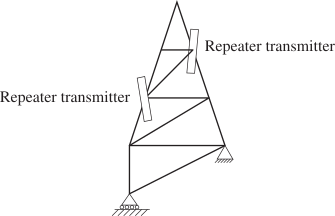
 

Explain why detailed drawings are used in the design and manufacture of these individual parts.  (2 marks)

--- 6 WORK AREA LINES (style=lined) ---

Show Answers Only
  • A scaled ‘Detail Drawing’ is required for a Structural Engineer to communicate information regarding individual parts.
  • To ensure accurate manufacture of parts that fit together during assembly, the detailed drawing would use a suitable scale so all details are apparent (eg 2:1, 5:1 and 10:1).
  • There is a high risk of inaccurately manufactured parts if detailed drawings are not provided.
Show Worked Solution
  • A scaled ‘Detail Drawing’ is required for a Structural Engineer to communicate information regarding individual parts.
  • To ensure accurate manufacture of parts that fit together during assembly, the detailed drawing would use a suitable scale so all details are apparent (eg 2:1, 5:1 and 10:1).
  • There is a high risk of inaccurately manufactured parts if detailed drawings are not provided.

Filed Under: Communication Tagged With: Band 3, smc-3731-20-Technical drawings

ENGINEERING, TE 2019 HSC 22a

A telecommunications engineer has designed a tower that is to support two mobile repeater transmitters. It is to be located in an urban community.
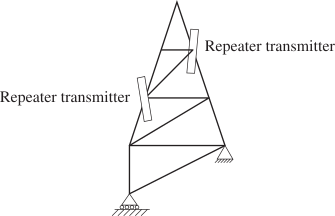
 

Outline responsibilities the engineer has when placing the tower within a local community.   (3 marks)

--- 8 WORK AREA LINES (style=lined) ---

Show Answers Only

Answers could include 3 of the following points:

  • Minimise health risks, so tower not erected near high density housing, childcare centres or schools.
  • Designed so visual pollution reduced.
  • Positioned so best possible signals are achieved and dead spots are minimised.
  • Easy accessibility for maintenance without consequences to the community.
  • Construction completed with least possible disruption to the community.
Show Worked Solution

Answers could include 3 of the following points:

  • Minimise health risks, so tower not erected near high density housing, childcare centres or schools.
  • Designed so visual pollution reduced.
  • Positioned so best possible signals are achieved and dead spots are minimised.
  • Easy accessibility for maintenance without consequences to the community.
  • Construction completed with least possible disruption to the community.

Filed Under: Scope, Historical and Societal Influences Tagged With: Band 3, smc-3728-40-Safety/Environment

ENGINEERING, CS 2019 HSC 11 MC

The table shows materials that have been used to build civil structures over time.

Which row of the table shows the use of the materials in the correct historical order?
 

Show Answers Only

`A`

Show Worked Solution

By Elimination:

  • Stainless steel must have been used after mild steel as it is an alloy of mild steel (not `C` or `D`)
  • Stone was used before iron as it did not require any processes to be formed (not `B`)

`=>A`

Filed Under: Historical and Societal Influences Tagged With: Band 3, smc-3713-30-Historical materials

ENGINEERING, PPT 2019 HSC 7 MC

A box sits on a horizontal surface. The box begins to slip when this surface is tilted to 28 degrees.

What is the coefficient of friction between the box and the surface?

  1. 0.280
  2. 0.469
  3. 0.532
  4. 0.883
Show Answers Only

`C`

Show Worked Solution

`mu = tan(phi) = tan28° = 0.532`

`=>C`

Filed Under: Mechanics Tagged With: Band 3, smc-3718-30-Friction

ENGINEERING, TE 2019 HSC 3 MC

Which AND gate shows the correct output for its given inputs?



Show Answers Only

`D`

Show Worked Solution
  • AND gates require 2 ‘high’ or ‘on’ inputs, in this case both inputs have to be 5V.

`=>D`

Filed Under: Electricity/Electronics Tagged With: Band 3, smc-3730-30-Logic gates/circuits

ENGINEERING, AE 2019 HSC 1 MC

Which Australian aeronautical innovation is commonly used to record in-flight data?

  1. Altimeter
  2. Pitot tube
  3. Black box
  4. Transponder
Show Answers Only

`C`

Show Worked Solution
  • A black box is the only option that records in flight data.

`=>C`

Filed Under: Scope, Historical and Societal Influences Tagged With: Band 3, smc-3722-10-Innovation

PHYSICS, M8 2015 HSC 33d

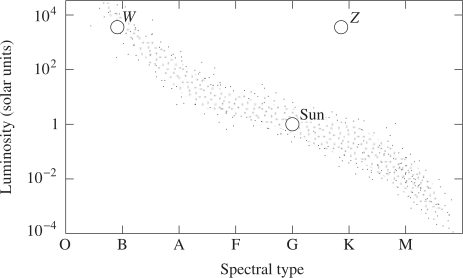
The position of the Sun, star `W` and star `Z` are shown on the H-R diagram.
 

The curves `A` and `B` show intensity versus frequency for star `W` and the Sun, measured from the same distance.
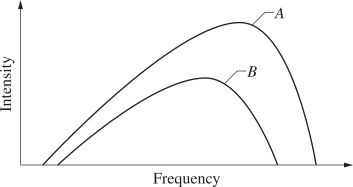
 

  1. Identify which curve (`A` or `B`) represents star `W` and justify your choice.   (2 marks)

--- 4 WORK AREA LINES (style=lined) ---

  1. Account for differences between stars `W` and `Z` that can be deduced from the H-R diagram.   (3 marks)

--- 6 WORK AREA LINES (style=lined) ---

Show Answers Only

i.    Curve A represents star `W`:

  • `W` is hotter so will emit more energy overall, and peak frequency will be higher.

ii.   Differences displayed in H-R graph:

  • Star `W` lies in the main sequence and is therefore fusing hydrogen to helium, most likely via CNO cycle as it is a large dense star.
  • Star `Z` is past main sequence and is therefore fusing larger elements.
  • Since star `Z` is cooler than `W` (refer to its H-R diagram location ) but has similar luminosity, we can deduce it is much larger than `W`.

Other possible answers could include:

  • Differences in fuel source, size and temperature of the stars.
Show Worked Solution

i.    Curve A represents star `W`:

  • `W` is hotter so will emit more energy overall, and peak frequency will be higher.

ii.   Differences displayed in H-R graph:

  • Star `W` lies in the main sequence and is therefore fusing hydrogen to helium, most likely via CNO cycle as it is a large dense star.
  • Star `Z` is past main sequence and is therefore fusing larger elements.
  • Since star `Z` is cooler than `W` (refer to its H-R diagram location ) but has similar luminosity, we can deduce it is much larger than `W`.

Other possible answers could include:

  • Differences in fuel source, size and temperature of the stars.

Filed Under: Origins of Elements Tagged With: Band 3, Band 4, smc-3700-10-H-R Diagrams, smc-3700-60-Mass-Energy Equivalence

  • « Previous Page
  • 1
  • …
  • 22
  • 23
  • 24
  • 25
  • 26
  • …
  • 57
  • Next Page »

Copyright © 2014–2025 SmarterEd.com.au · Log in