SmarterEd

Aussie Maths & Science Teachers: Save your time with SmarterEd

  • Login
  • Get Help
  • About

HMS, BM EQ-Bank 870

Explain how the blood transports oxygen and carbon dioxide in the circulatory system.   (5 marks)

--- 15 WORK AREA LINES (style=lined) ---

Show Answers Only
  • Red blood cells contain haemoglobin molecules that bind with oxygen in the lungs, which enables efficient oxygen transport.
  • Each haemoglobin can carry four oxygen molecules, therefore maximising the blood’s oxygen-carrying capacity.
  • Oxygen binds because concentration is high in the lungs and releases where concentration is low in tissues.
  • Carbon dioxide is transported through three methods, which ensures efficient waste removal from tissues.
  • Most CO₂ converts to bicarbonate ions in blood plasma, as a result of chemical reactions with water.
  • Some CO₂ binds to haemoglobin at different sites than oxygen, which allows simultaneous transport of both gases.
  • Additionally, some CO₂ dissolves directly in plasma, creating multiple pathways for removal.
  • Gas exchange occurs due to concentration gradients between blood and tissues.
  • Consequently, oxygen releases from haemoglobin in tissues while CO₂ enters blood, maintaining continuous gas exchange throughout the body.

Show Worked Solution
  • Red blood cells contain haemoglobin molecules that bind with oxygen in the lungs, which enables efficient oxygen transport.
  • Each haemoglobin can carry four oxygen molecules, therefore maximising the blood’s oxygen-carrying capacity.
  • Oxygen binds because concentration is high in the lungs and releases where concentration is low in tissues.
  • Carbon dioxide is transported through three methods, which ensures efficient waste removal from tissues.
  • Most CO₂ converts to bicarbonate ions in blood plasma, as a result of chemical reactions with water.
  • Some CO₂ binds to haemoglobin at different sites than oxygen, which allows simultaneous transport of both gases.
  • Additionally, some CO₂ dissolves directly in plasma, creating multiple pathways for removal.
  • Gas exchange occurs due to concentration gradients between blood and tissues.
  • Consequently, oxygen releases from haemoglobin in tissues while CO₂ enters blood, maintaining continuous gas exchange throughout the body.

Filed Under: Respiratory and circulatory systems Tagged With: Band 3, Band 4, smc-5523-15-Blood flow-gas exchange

HMS, HIC EQ-Bank 036 MC

According to the Australian Institute of Health and Welfare (AIHW), which age range defines "young people" in Australia?

  1. 10-19 years
  2. 12-21 years
  3. 15-24 years
  4. 18-25 years

Show Answers Only

\(C\)

Show Worked Solution

\(\Rightarrow C\)

Filed Under: Aspects of young people's lives Tagged With: Band 3, smc-5507-10-Stages of development

HMS, BM EQ-Bank 869

Describe the process of gaseous exchange at the alveolar-capillary interface.   (4 marks)

--- 8 WORK AREA LINES (style=lined) ---

Show Answers Only

Sample Answer

  • Gaseous exchange occurs through diffusion, where gases move from areas of high concentration to areas of low concentration.
  • At the alveoli, oxygen diffuses from the air sacs (where concentration is high) into the surrounding capillaries (where concentration is low).
  • Simultaneously, carbon dioxide diffuses from the capillaries (high concentration) into the alveoli (low concentration) to be exhaled.
  • This exchange is facilitated by the extremely thin walls of both alveoli and their surrounding capillaries.
  • The large surface area created by millions of alveoli enhances the diffusion rate.
  • Once in the bloodstream, oxygen binds to haemoglobin in red blood cells for transport.
  • Carbon dioxide is carried in the blood primarily as bicarbonate ions before being exhaled.
Show Worked Solution

Sample Answer

  • Gaseous exchange occurs through diffusion, where gases move from areas of high concentration to areas of low concentration.
  • At the alveoli, oxygen diffuses from the air sacs (where concentration is high) into the surrounding capillaries (where concentration is low).
  • Simultaneously, carbon dioxide diffuses from the capillaries (high concentration) into the alveoli (low concentration) to be exhaled.
  • This exchange is facilitated by the extremely thin walls of both alveoli and their surrounding capillaries.
  • The large surface area created by millions of alveoli enhances the diffusion rate.
  • Once in the bloodstream, oxygen binds to haemoglobin in red blood cells for transport.
  • Carbon dioxide is carried in the blood primarily as bicarbonate ions before being exhaled.

Filed Under: Respiratory and circulatory systems Tagged With: Band 3, smc-5523-15-Blood flow-gas exchange

HMS, BM EQ-Bank 867 MC

Which of the following correctly describes the path of deoxygenated blood through the pulmonary circulation?

  1. Left ventricle → pulmonary artery → lungs → pulmonary vein → left atrium
  2. Right ventricle → pulmonary artery → lungs → pulmonary vein → left atrium
  3. Right atrium → right ventricle → aorta → lungs → pulmonary vein → left atrium
  4. Left atrium → left ventricle → pulmonary artery → lungs → pulmonary vein
Show Answers Only

\(B\)

Show Worked Solution
  • B is correct. Deoxygenated blood flows from the right ventricle through the pulmonary artery to the lungs, where it becomes oxygenated and returns to the left atrium via the pulmonary veins.

Other Options:

  • A is incorrect: The left ventricle pumps oxygenated blood to the body, not to the lungs.
  • C is incorrect: Blood from the right ventricle goes to the lungs via the pulmonary artery, not the aorta.
  • D is incorrect: The left atrium receives oxygenated blood from the lungs and does not pump deoxygenated blood.

Filed Under: Respiratory and circulatory systems Tagged With: Band 3, smc-5523-15-Blood flow-gas exchange

HMS, BM EQ-Bank 864

Explain how the structures of the respiratory system protect the lungs from damage and infection.   (5 marks)

--- 15 WORK AREA LINES (style=lined) ---

Show Answers Only
  • Nasal hairs and mucus in the nasal cavity trap large particles and pathogens, which prevents them from entering the lungs.
  • The reason for this is the sticky mucus captures debris while hairs act as a physical barrier.
  • Blood vessels in the nasal cavity warm incoming air, therefore protecting delicate lung tissue from cold shock.
  • The pharynx contains tonsils with lymphoid tissue that identify and destroy pathogens, consequently reducing infection risk.
  • These structures work by white blood cells within tonsils actively attacking bacteria and viruses before they reach lower airways.
  • The trachea and bronchi contain cilia and mucus-producing cells that function together to move trapped particles upward.
  • This mechanism operates via rhythmic ciliary beating, which ensures particles are expelled before reaching alveoli.
  • As a result, multiple protective structures create a comprehensive defence system for the lungs.
Show Worked Solution
  • Nasal hairs and mucus in the nasal cavity trap large particles and pathogens, which prevents them from entering the lungs.
  • The reason for this is the sticky mucus captures debris while hairs act as a physical barrier.
  • Blood vessels in the nasal cavity warm incoming air, therefore protecting delicate lung tissue from cold shock.
  • The pharynx contains tonsils with lymphoid tissue that identify and destroy pathogens, consequently reducing infection risk.
  • These structures work by white blood cells within tonsils actively attacking bacteria and viruses before they reach lower airways.
  • The trachea and bronchi contain cilia and mucus-producing cells that function together to move trapped particles upward.
  • This mechanism operates via rhythmic ciliary beating, which ensures particles are expelled before reaching alveoli.
  • As a result, multiple protective structures create a comprehensive defence system for the lungs.

Filed Under: Respiratory and circulatory systems Tagged With: Band 3, Band 4, smc-5523-10-Structure-function

HMS, BM EQ-Bank 863

Describe the structure and function of the heart's chambers and valves.   (4 marks)

--- 8 WORK AREA LINES (style=lined) ---

Show Answers Only

Sample Answer

  • The heart has four chambers: two upper atria that receive blood and two lower ventricles that pump blood.
  • The right atrium receives deoxygenated blood from the body via the vena cavae.
  • The right ventricle pumps deoxygenated blood to the lungs via the pulmonary artery.
  • The left atrium receives oxygenated blood from the lungs via the pulmonary veins.
  • The left ventricle pumps oxygenated blood to the body via the aorta.
  • Four one-way valves prevent backflow: atrioventricular valves between atria and ventricles, and arterial valves at vessel exits.
Show Worked Solution

Sample Answer

  • The heart has four chambers: two upper atria that receive blood and two lower ventricles that pump blood.
  • The right atrium receives deoxygenated blood from the body via the vena cavae.
  • The right ventricle pumps deoxygenated blood to the lungs via the pulmonary artery.
  • The left atrium receives oxygenated blood from the lungs via the pulmonary veins.
  • The left ventricle pumps oxygenated blood to the body via the aorta.
  • Four one-way valves prevent backflow: atrioventricular valves between atria and ventricles, and arterial valves at vessel exits.

Filed Under: Respiratory and circulatory systems Tagged With: Band 3, smc-5523-10-Structure-function

HMS, BM EQ-Bank 861 MC

Which blood vessel is characterised by having a thick, elastic wall with layers of smooth muscle?

  1. Vein
  2. Artery
  3. Capillary
  4. Venule
Show Answers Only

\(B\)

Show Worked Solution
  • B is correct. Arteries have thick, elastic walls with layers of smooth muscle to withstand the pressure of blood being pumped from the heart.

Other Options:

  • A is incorrect: Veins have thinner walls with less elasticity and muscle than arteries.
  • C is incorrect: Capillaries have extremely thin walls (only one cell thick) to allow for exchange of materials.
  • D is incorrect: Venules are small veins that collect blood from capillaries and have thinner walls than arteries.

Filed Under: Respiratory and circulatory systems Tagged With: Band 3, smc-5523-10-Structure-function

HMS, BM EQ-Bank 856

Explain how biomechanical principles can be applied to increase movement efficiency and reduce injury risk in athletes with prosthetic limbs.   (6 marks)

--- 18 WORK AREA LINES (style=lined) ---

Show Answers Only

Sample Answer

  • The prosthetic limb acts as a lever for residual muscles. This occurs because remaining muscles pull on the prosthetic attachment to create movement.
  • As a result, proper alignment maximises force transfer efficiency. This reduces energy expenditure during running or walking significantly.
  • Carbon fibre materials store energy during ground contact. This happens when the material compresses and then springs back.
  • Consequently, this elastic energy return reduces muscular effort needed. This enables athletes to maintain speed with less fatigue.
  • Prosthetic design adjusts the athlete’s centre of gravity. This is necessary because missing limb mass alters body balance.
  • Therefore, correct positioning prevents compensatory movements. This protects the spine and opposite limb from overuse injuries.
  • Custom sockets distribute pressure evenly across residual limb. This works by spreading forces over larger surface areas.
  • This prevents pressure sores and tissue breakdown. As a result, athletes can train longer without injury interruptions.
  • Gait analysis identifies movement asymmetries between limbs. This reveals uneven forces that could cause joint damage.
  • Subsequently, prosthetic adjustments normalise stride patterns. This reduces abnormal loading that causes wear injuries over time.
Show Worked Solution

Sample Answer

  • The prosthetic limb acts as a lever for residual muscles. This occurs because remaining muscles pull on the prosthetic attachment to create movement.
  • As a result, proper alignment maximises force transfer efficiency. This reduces energy expenditure during running or walking significantly.
  • Carbon fibre materials store energy during ground contact. This happens when the material compresses and then springs back.
  • Consequently, this elastic energy return reduces muscular effort needed. This enables athletes to maintain speed with less fatigue.
  • Prosthetic design adjusts the athlete’s centre of gravity. This is necessary because missing limb mass alters body balance.
  • Therefore, correct positioning prevents compensatory movements. This protects the spine and opposite limb from overuse injuries.
  • Custom sockets distribute pressure evenly across residual limb. This works by spreading forces over larger surface areas.
  • This prevents pressure sores and tissue breakdown. As a result, athletes can train longer without injury interruptions.
  • Gait analysis identifies movement asymmetries between limbs. This reveals uneven forces that could cause joint damage.
  • Subsequently, prosthetic adjustments normalise stride patterns. This reduces abnormal loading that causes wear injuries over time.

Filed Under: Safe and efficient movement Tagged With: Band 3, Band 4, smc-5522-15-Movement efficiency

HMS, BM EQ-Bank 855

Outline how the biomechanical principle of force application can improve movement efficiency for athletes with disabilities.   (4 marks)

--- 12 WORK AREA LINES (style=lined) ---

Show Answers Only

Sample Answer

  • Wheelchair athletes apply maximum force through arms to wheel rims, generating forward momentum and speed.
  • Athletes with prosthetic limbs develop remaining muscles (quadriceps, hamstrings) to transfer force through prosthetic devices effectively.
  • Force direction understanding helps para-athletes adjust movement patterns, reducing energy waste and maximising propulsion efficiency.
  • Specialised equipment design (custom wheelchairs, prosthetics) incorporates biomechanical principles to enhance force transfer from body to ground.
  • Technical modifications include optimising push angles in wheelchairs and adjusting prosthetic alignment for better force application.
  • Training adaptations focus on strengthening specific muscle groups to compensate for missing limbs or paralysed segments.
Show Worked Solution

Sample Answer

  • Wheelchair athletes apply maximum force through arms to wheel rims, generating forward momentum and speed.
  • Athletes with prosthetic limbs develop remaining muscles (quadriceps, hamstrings) to transfer force through prosthetic devices effectively.
  • Force direction understanding helps para-athletes adjust movement patterns, reducing energy waste and maximising propulsion efficiency.
  • Specialised equipment design (custom wheelchairs, prosthetics) incorporates biomechanical principles to enhance force transfer from body to ground.
  • Technical modifications include optimising push angles in wheelchairs and adjusting prosthetic alignment for better force application.
  • Training adaptations focus on strengthening specific muscle groups to compensate for missing limbs or paralysed segments.

Filed Under: Safe and efficient movement Tagged With: Band 3, smc-5522-15-Movement efficiency

HMS, BM EQ-Bank 850

Describe how biomechanical principles can be applied to enhance safety when lifting a heavy object from the ground.   (5 marks)

--- 15 WORK AREA LINES (style=lined) ---

Show Answers Only

Sample Answer

  • Base of support – Position feet shoulder-width apart with one foot slightly forward. This wide stance provides stability and allows controlled weight shift during lifting.
  • Centre of gravity – Keep the object close to your body throughout the lift. This reduces the lever arm and minimises strain on the spine.
  • Force distribution – Bend at knees and hips rather than the waist. This engages powerful leg muscles (quadriceps, hamstrings, gluteals) instead of weaker back muscles.
  • Spinal alignment – Maintain a neutral spine by engaging core muscles. Straight back posture distributes forces evenly along vertebrae, preventing disc damage.
  • Movement control – Avoid twisting while lifting by pivoting with feet. Rotational forces combined with compression can damage ligaments and intervertebral discs.
  • Muscle activation – Contract abdominal muscles before lifting. This creates internal pressure that supports the spine like a natural weight belt.
  • Breathing technique – Exhale during the lifting phase. This maintains core stability while preventing dangerous blood pressure spikes.
Show Worked Solution

Sample Answer

  • Base of support – Position feet shoulder-width apart with one foot slightly forward. This wide stance provides stability and allows controlled weight shift during lifting.
  • Centre of gravity – Keep the object close to your body throughout the lift. This reduces the lever arm and minimises strain on the spine.
  • Force distribution – Bend at knees and hips rather than the waist. This engages powerful leg muscles (quadriceps, hamstrings, gluteals) instead of weaker back muscles.
  • Spinal alignment – Maintain a neutral spine by engaging core muscles. Straight back posture distributes forces evenly along vertebrae, preventing disc damage.
  • Movement control – Avoid twisting while lifting by pivoting with feet. Rotational forces combined with compression can damage ligaments and intervertebral discs.
  • Muscle activation – Contract abdominal muscles before lifting. This creates internal pressure that supports the spine like a natural weight belt.
  • Breathing technique – Exhale during the lifting phase. This maintains core stability while preventing dangerous blood pressure spikes.

Filed Under: Safe and efficient movement Tagged With: Band 3, Band 4, smc-5522-10-Safe movement

HMS, BM EQ-Bank 849

Explain how the biomechanical principle of force absorption enhances safety when landing from a jump.   (3 marks)

--- 9 WORK AREA LINES (style=lined) ---

Show Answers Only

Sample Answer

  • Bending knees upon landing increases absorption time. This occurs because joints flex gradually rather than stopping abruptly.
  • As a result, peak impact forces reduce significantly. This protects cartilage and ligaments from sudden damaging stress.
  • Quadriceps muscles lengthen while contracting during descent. This enables controlled deceleration which prevents jarring impacts on joints.
  • Simultaneously, ankles, knees and hips flex together. This distributes forces across multiple segments rather than one joint.
  • Therefore, no single joint bears excessive load. This reduces injury risk to bones, muscles and connective tissues.
Show Worked Solution

Sample Answer

  • Bending knees upon landing increases absorption time. This occurs because joints flex gradually rather than stopping abruptly.
  • As a result, peak impact forces reduce significantly. This protects cartilage and ligaments from sudden damaging stress.
  • Quadriceps muscles lengthen while contracting during descent. This enables controlled deceleration which prevents jarring impacts on joints.
  • Simultaneously, ankles, knees and hips flex together. This distributes forces across multiple segments rather than one joint.
  • Therefore, no single joint bears excessive load. This reduces injury risk to bones, muscles and connective tissues.

Filed Under: Safe and efficient movement Tagged With: Band 3, smc-5522-10-Safe movement

HMS, BM EQ-Bank 848 MC

Which biomechanical principle is demonstrated when a basketball player bends their knees when landing from a rebound?

  1. Increasing the speed of movement to maintain momentum
  2. Absorbing force over a larger distance to reduce impact
  3. Raising the centre of gravity to improve visibility
  4. Concentrating force on a small area to enhance control
Show Answers Only

\(B\)

Show Worked Solution
  • B is correct: Bending knees extends impact time and distance, reducing joint forces.

Other Options:

  • A is incorrect: Increasing speed during landing increases rather than reduces impact forces.
  • C is incorrect: Raising centre of gravity decreases stability during landing.
  • D is incorrect: Concentrating force on small areas increases injury risk.

Filed Under: Safe and efficient movement Tagged With: Band 3, smc-5522-10-Safe movement

HMS, BM EQ-Bank 845 MC

A student is learning to perform a squat correctly in physical education class. Which combination of biomechanical principles would most effectively enhance safety during this movement?

  1. Decreasing the base of support and raising the centre of gravity
  2. Maintaining a straight back and keeping the weight away from the body
  3. Widening the base of support and lowering the centre of gravity
  4. Bending the back and keeping the feet close together
Show Answers Only

\(C\)

Show Worked Solution
  • C is correct: Wider base of support and lower centre of gravity maximise stability and balance during squats.

Other Options:

  • A is incorrect: Decreasing base of support and raising centre of gravity reduces stability dangerously
  • B is incorrect: Keeping weight away from body creates excessive leverage on the lower back.
  • D is incorrect: Bending the back risks spinal injury and close feet reduce stability.

Filed Under: Safe and efficient movement Tagged With: Band 3, smc-5522-10-Safe movement

Data Analysis, GEN1 2024 NHT 3 MC

The dot plot below displays the number of errors made in a test, for a sample of 15 students.
 

The mean and standard deviation for the number of errors are closest to

  1. mean \(=2.60 \quad\) standard deviation \(=7.47\)
  2. mean \(=2.70 \quad\) standard deviation \(=7.47\)
  3. mean \(=8.00 \quad\) standard deviation \(=3.00\)
  4. mean \(=7.47 \quad\) standard deviation \(=2.60\)
  5. mean \(=7.47 \quad\) standard deviation \(=2.70\)
Show Answers Only

\(E\)

Show Worked Solution

\(\text{Using CAS (input dataset):}\)

\(3,3,4,5,6,7,8,8,8,9,10,10,10,10,11\)

\(\text{Mean = 7.47,}\ \ \sigma =2.70\)

\(\Rightarrow E\)

Filed Under: Summary Statistics Tagged With: Band 3, smc-468-20-Mean, smc-468-30-Std Dev

Data Analysis, GEN1 2024 NHT 2 MC

The variables exercise type (aerobic, boxing, circuit) and recovery time (short, medium, long) are

  1. a nominal variable and a numerical variable respectively.
  2. a nominal variable and an ordinal variable respectively.
  3. an ordinal variable and a nominal variable respectively.
  4. both ordinal variables.
  5. both nominal variables.
Show Answers Only

\(B\)

Show Worked Solution

\(\text{Exercise type is nominal → no ranking}\)

\(\text{Recovery time is ordinal → categories that can be ranked}\)

\(\Rightarrow B\)

Filed Under: Summary Statistics Tagged With: Band 3, smc-468-10-Data Classification

Data Analysis, GEN1 2024 NHT 1 MC

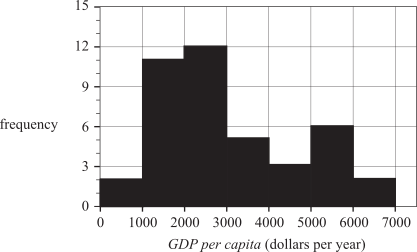
The histogram below shows the distribution of the GDP per capita (gross domestic product per capita), in dollars per year, for a sample of 41 African countries in 2021.
 

The median GDP per capita, in dollars per year, for this sample will be within the range

  1. greater than or equal to 0 but less than 1000
  2. greater than or equal to 1000 but less than 2000
  3. greater than or equal to 2000 but less than 3000
  4. greater than or equal to 3000 but less than 4000
  5. greater than or equal to 4000 but less than 5000
Show Answers Only

\(C\)

Show Worked Solution

\(\text{Median = 21st data point}\)

\(\text{21st data point occurs in the 3rd column.}\)

\(\Rightarrow C\)

Filed Under: Graphs - Histograms and Other Tagged With: Band 3, smc-644-20-Histograms

HMS, BM EQ-Bank 842

Explain how the biomechanical principle of force is applied in a sprint start, making reference to the interrelationship between muscles, bones, and joints.   (4 marks)

--- 12 WORK AREA LINES (style=lined) ---

Show Answers Only

Sample Answer

  • In a sprint start, quadriceps and hamstrings contract forcefully. This occurs because muscles must overcome inertia.
  • As a result, these muscles pull on femur and tibia bones. This causes powerful extension at hip and knee joints.
  • Simultaneously, calf muscles contract to push through the ankle. This creates additional force against the blocks.
  • Consequently, Newton’s Third Law applies. The blocks exert equal reaction force that propels the athlete forward.
  • Arm muscles work together to drive shoulder rotation. This generates momentum because arms oppose leg movement.
  • Throughout this process, core muscles stabilise the torso. This enables efficient force transfer between body segments.
Show Worked Solution

Sample Answer

  • In a sprint start, quadriceps and hamstrings contract forcefully. This occurs because muscles must overcome inertia.
  • As a result, these muscles pull on femur and tibia bones. This causes powerful extension at hip and knee joints.
  • Simultaneously, calf muscles contract to push through the ankle. This creates additional force against the blocks.
  • Consequently, Newton’s Third Law applies. The blocks exert equal reaction force that propels the athlete forward.
  • Arm muscles work together to drive shoulder rotation. This generates momentum because arms oppose leg movement.
  • Throughout this process, core muscles stabilise the torso. This enables efficient force transfer between body segments.

Filed Under: Safe and efficient movement Tagged With: Band 3, smc-5522-20-Human movement

v1 Financial Maths, STD2 F1 2011 HSC 23a

Aiden has a gross salary of $61 480. He has tax deductions of $400 for professional memberships, $1800 in work-related travel, and $500 in charitable donations.

The Medicare levy is 1.5% of his taxable income.

Calculate Aiden’s Medicare levy.   (3 marks)

--- 6 WORK AREA LINES (style=lined) ---

Show Answers Only

`$882.60`

Show Worked Solution
MARKER’S COMMENT: Clear separate steps results in less calculation errors and more marks for working when errors are made.
`text(Deductions)` `=400 + 1800 + 500`
  `=$2700`
`text(Taxable)` `= \ \text(Gross Income – deductions)`
  `=61\ 480-2700`
  `=$58\ 780`
`text(Medicare Levy)` `=\ text(1.5%)\ xx 58\ 780`
  `=$882.60`

`:.\ text(Aiden’s Medicare levy is)\ $882.60`

Filed Under: Tax and Percentage Increase/Decrease (Std 2-X) Tagged With: Band 3, smc-1125-40-Medicare Levy, smc-831-40-Medicare Levy

Statistics, SPEC2 2024 VCAA 6

A machine fills bottles with olive oil. The volume of olive oil dispensed into each bottle may be assumed to be normally distributed with mean \(\mu\) millilitres (mL) and standard deviation \(\sigma=\)4.2 mL. When the machine is working properly \(\mu=1000\).

The volume dispensed is monitored regularly by taking a random sample of nine bottles and finding the mean volume dispensed.

The machine will be paused and adjusted if the mean volume of olive oil in the nine bottles is significantly less than 1000 mL at the 5% level of significance.

When checked, a random sample of nine bottles gave a mean volume of 997.5 mL .

A one-sided statistical test is to be performed.

  1. Write down suitable null and alternative hypotheses \(H_0\) and \(H_1\) for the test.   (1 mark)

    --- 2 WORK AREA LINES (style=lined) ---

    1. Find the \(p\) value for this test correct to three decimal places.  (1 mark)

      --- 2 WORK AREA LINES (style=lined) ---

    2. Using the \(p\) value found in part b.i, state with a reason whether the machine should be paused.  (1 mark)

      --- 2 WORK AREA LINES (style=lined) ---

  2. Assuming that the mean volume dispensed by the machine each time is in fact 997 mL and not 1000 mL, find the probability of a type \(\text{II}\) error for the test using nine bottles at the 5% level of significance. Assume that the population standard deviation is 4.2 mL, and give your answer correct to two decimal places.  (2 marks)

    --- 2 WORK AREA LINES (style=lined) ---

  3. Let \(\overline{X}\) denote the sample mean of a random sample of nine bottles. As a quality-control measure, the machine will be paused if  \(\overline{X}<a\)  or if  \(\overline{X}>b\),  where  \(\operatorname{Pr}(\overline{X}<a)=0.01\)  and  \(\operatorname{Pr}(\overline{X}>b)=0.01\).
  4. Assume \(\mu=1000\) mL and \(\sigma=4.2\) mL.
  5. Find the values of \(a\) and \(b\) correct to one decimal place.  (1 mark)

    --- 2 WORK AREA LINES (style=lined) ---

A new machine is purchased, and it is observed that the volume dispensed by the new machine in 50 randomly chosen bottles provided a sample mean of 1005 mL and a sample standard deviation of 4 mL .

  1. Find a 95% confidence interval for the population mean volume dispensed by the new machine, giving values correct to one decimal place. You may assume a population standard deviation of 4 mL .  (1 mark)

    --- 2 WORK AREA LINES (style=lined) ---

  2. Forty samples, each consisting of 50 randomly chosen bottles, are taken, and a 95% confidence interval is calculated for each sample.
  3. In how many of these confidence intervals would the population mean volume dispensed by the machine be expected to lie?  (1 mark)

    --- 2 WORK AREA LINES (style=lined) ---

  4. What minimum size sample should be used so that, with 95% confidence, the sample mean is within 1 mL of the population mean volume dispensed by the new machine? Assume a population standard deviation of 4 mL.  (1 mark)

    --- 4 WORK AREA LINES (style=lined) ---

Show Answers Only

a.    \(H_0: \mu=1000, \ H_1: \mu<1000\)

b.i.  \(p \text{–value}=0.037\)

b.ii. \(p<0.05 \Rightarrow \text{Pause the machine}\)

c.   \(0.31\)

d.   \(a=996.7, b=1003.3\)

e.   \((1003.9,1006.1)\)

f.   \(38\)

g.  \(\text{Mean sample size}=62.\)

Show Worked Solution

a.    \(H_0: \mu=1000\)

\(H_1: \mu<1000\)
 

b.i.  \(\text {Sample mean:}\  \mu_{\overline{X}}=1000\)

\(\dfrac{\sigma_{\overline{X}}}{\sqrt{n}}=\dfrac{4.2}{3}=1.4\)

\(p \text{–value}=\operatorname{Pr}\left(z<\dfrac{997.5-1000}{1.4}\right)=0.037\)
 

b.ii. \(p<0.05 \Rightarrow \text{Pause the machine}\)
 

c.   \(\text{Let \(\overline{X}\)}=\text{sample mean}\)

\(\text{Null hypothesis rejected when}\ \overline{X}<c\)

\(\operatorname{Pr}\left(z<\dfrac{c-1000}{1.4}\right)=0.05\)

\(\text{Solve for \(c\):}\)

\(\dfrac{c-1000}{1.4}=-1.6449 \ \Rightarrow \ c=997.697\)

\(\text{Probability of a type II error:}\)

\(\operatorname{Pr}(\overline{X}>997.697 \mid \mu=997)=\operatorname{Pr}\left(z<\dfrac{0.697}{1.4}\right) \approx 0.31\)

♦ Mean mark (c) 50%.

d.    \(\text{Sample mean has mean}=1000, \dfrac{\sigma}{\sqrt{n}}=\dfrac{4.2}{\sqrt{9}}=1.4\)

\(\text{Solve (by CAS):}\)

\(\operatorname{Pr}\left(z<\dfrac{a-1000}{1.4}\right)=0.01 \ \Rightarrow \ a=996.7\)

\(\operatorname{Pr}\left(z>\dfrac{b-1000}{1.4}\right)=0.01 \ \Rightarrow \ b=1003.3\)
 

e.    \(\text{95% C.I.}\ (\overline{x}=1005):\)

\(\left(1005-1.96 \times \dfrac{4}{\sqrt{50}}, 1005+1.96 \times \dfrac{4}{\sqrt{50}}\right)=(1003.9,1006.1)\)
 

f.    \(\text{Expect \(95 \%\) of C.I.’s to contain population mean}\)

\(\text{Number of C.I.’s}=0.95 \times 40=38\)
 

g.    \(\text{CI. extends  \(1.96 \times \dfrac{4}{\sqrt{n}}\)  each side of the mean.}\)

\(\text{Solve for \(n\):}\ 1.96 \times \dfrac{4}{\sqrt{n}}<1\ \Rightarrow \ n \approx 61.5\)

\(\therefore \text{Mean sample size}=62.\)

♦ Mean mark (f) 51%.
♦ Mean mark (g) 46%.

Filed Under: Confidence Intervals and Hypothesis Testing (SM) Tagged With: Band 3, Band 4, Band 5, smc-1162-10-95% CI (sample), smc-1162-20-Other CI (sample), smc-1162-50-Null/Alternative hypothesis

HMS, BM EQ-Bank 835 MC

In a bicep curl, which muscle pair represents the agonist and antagonist relationship?

  1. Biceps brachii and brachialis
  2. Biceps brachii and triceps brachii
  3. Triceps brachii and deltoid
  4. Deltoid and pectoralis major
Show Answers Only

\(B\)

Show Worked Solution
  • B is correct: Biceps (agonist) flexes the elbow while triceps (antagonist) relaxes.

Other Options:

  • A is incorrect: Both are elbow flexors (synergists), not antagonists
  • C is incorrect: Work on different joints and movements
  • D is incorrect: Both act on shoulder, not as antagonists

Filed Under: Skeletal and muscular systems Tagged With: Band 3, smc-5521-25-Muscle relationships

HMS, BM EQ-Bank 832

Describe the three types of muscle contractions and provide an example of each in sporting movements.   (3 marks)

--- 9 WORK AREA LINES (style=lined) ---

Show Answers Only

Sample Answer

  • Isotonic concentric contractions shorten muscles while generating force, like biceps during a bicep curl’s lifting phase.
  • Isotonic eccentric contractions lengthen muscles under tension, like quadriceps controlling descent during a squat’s lowering phase.
  • Isometric contractions generate tension without changing muscle length, like core muscles maintaining a plank position.
Show Worked Solution

Sample Answer

  • Isotonic concentric contractions shorten muscles while generating force, like biceps during a bicep curl’s lifting phase.
  • Isotonic eccentric contractions lengthen muscles under tension, like quadriceps controlling descent during a squat’s lowering phase.
  • Isometric contractions generate tension without changing muscle length, like core muscles maintaining a plank position.

Filed Under: Skeletal and muscular systems Tagged With: Band 3, smc-5521-15-Muscle contractions

HMS, BM EQ-Bank 825

Outline the location and function of the quadriceps muscles.   (3 marks)

--- 6 WORK AREA LINES (style=lined) ---

Show Answers Only

Sample Answer

Location:

  • The quadriceps are a group of four muscles located on the anterior (front) surface of the thigh, extending from the hip to the knee.

Function:

  • Their primary role is knee extension, straightening the leg during walking, running, and jumping movements.
  • They also provide knee joint stability during weight-bearing activities.
  • Additionally, the quadriceps assist with hip flexion as one portion crosses both joints.
Show Worked Solution

Sample Answer

Location:

  • The quadriceps are a group of four muscles located on the anterior (front) surface of the thigh, extending from the hip to the knee.

Function:

  • Their primary role is knee extension, straightening the leg during walking, running, and jumping movements.
  • They also provide knee joint stability during weight-bearing activities.
  • Additionally, the quadriceps assist with hip flexion as one portion crosses both joints.

Filed Under: Skeletal and muscular systems Tagged With: Band 3, smc-5521-30-Major muscles

HMS, BM EQ-Bank 821 MC

When performing a bicep curl, which joint action occurs at the elbow as the weight is raised toward the shoulder?

  1. Extension
  2. Flexion
  3. Adduction
  4. Abduction
Show Answers Only

\(B\)

Show Worked Solution
  • B is correct: Flexion decreases the joint angle – the elbow bends during a bicep curl.

Other Options:

  • A is incorrect: Extension occurs when lowering the weight.
  • C is incorrect: Adduction is movement toward the midline.
  • D is incorrect: Abduction is movement away from the midline.

Filed Under: Skeletal and muscular systems Tagged With: Band 3, smc-5521-10-Joint actions

HMS, BM EQ-Bank 818

Describe the structure and function of the hinge joint in the knee.   (3 marks)

--- 6 WORK AREA LINES (style=lined) ---

Show Answers Only

Sample Answer

Structure:

  • The knee is a hinge joint where the femur articulates with the tibia.
  • The patella sits anteriorly, protecting the joint.
  • Strong ligaments provide stability while articular cartilage covers bone surfaces.

Function:

  • Allows flexion and extension in one plane, enabling walking, running and squatting movements.
  • The hinge design provides stability during weight-bearing while restricting lateral movement.
  • Synovial fluid lubricates the joint for smooth motion.
Show Worked Solution

Sample Answer

Structure:

  • The knee is a hinge joint where the femur articulates with the tibia.
  • The patella sits anteriorly, protecting the joint.
  • Strong ligaments provide stability while articular cartilage covers bone surfaces.

Function:

  • Allows flexion and extension in one plane, enabling walking, running and squatting movements.
  • The hinge design provides stability during weight-bearing while restricting lateral movement.
  • Synovial fluid lubricates the joint for smooth motion.

Filed Under: Skeletal and muscular systems Tagged With: Band 3, smc-5521-20-Bones/synovial joints

HMS, BM EQ-Bank 815 MC

Which of the following joints allows for rotation of the head?

  1. Hinge joint
  2. Pivot joint
  3. Gliding joint
  4. Saddle joint
Show Answers Only

\(B\)

Show Worked Solution
  • B is correct: Pivot joints at the top of the spine allow head rotation.

Other Options:

  • A is incorrect: Hinge joints allow flexion/extension only, not rotation
  • C is incorrect: Gliding joints allow sliding movements, not rotation
  • D is incorrect: Saddle joints don’t allow rotation

Filed Under: Skeletal and muscular systems Tagged With: Band 3, smc-5521-20-Bones/synovial joints

HMS, BM EQ-Bank 810

Describe the role of synovial fluid in maintaining joint health.   (3 marks)

--- 6 WORK AREA LINES (style=lined) ---

Show Answers Only

Sample Answer

Lubrication:

  • Synovial fluid acts as a lubricant, keeping joints well-oiled and moving surfaces apart.
  • This reduces friction between articular cartilages during movement.

Cushioning:

  • Forms a fluid cushion between joint surfaces, particularly important during vigorous movement when additional fluid is pumped into the joint space.

Nutrition and waste removal:

  • Provides nutrients to articular cartilage which lacks blood supply.
  • Simultaneously removes waste products, maintaining healthy cartilage and overall joint function.
Show Worked Solution

Sample Answer

Lubrication:

  • Synovial fluid acts as a lubricant, keeping joints well-oiled and moving surfaces apart.
  • This reduces friction between articular cartilages during movement.

Cushioning:

  • Forms a fluid cushion between joint surfaces, particularly important during vigorous movement when additional fluid is pumped into the joint space.

Nutrition and waste removal:

  • Provides nutrients to articular cartilage which lacks blood supply.
  • Simultaneously removes waste products, maintaining healthy cartilage and overall joint function.

Filed Under: Skeletal and muscular systems Tagged With: Band 3, smc-5521-35-Structure/function

HMS, BM EQ-Bank 808 MC

Which of the following structures provides nutrition to articular cartilage?

  1. Bone marrow
  2. Blood vessels
  3. Ligaments
  4. Synovial fluid
Show Answers Only

\(D\)

Show Worked Solution
  • D is correct: Articular cartilage receives nourishment from synovial fluid.

Other Options:

  • A is incorrect: Bone marrow produces blood cells, not cartilage nutrition
  • B is incorrect: Articular cartilage has limited blood supply
  • C is incorrect: Ligaments stabilise joints, don’t provide nutrition

Filed Under: Skeletal and muscular systems Tagged With: Band 3, smc-5521-35-Structure/function

HMS, BM EQ-Bank 806 MC

The ends of long bones contain a network of spongy tissue. Which property is essential for this spongy tissue structure?

  1. Light weight but strong structure
  2. Ability to store bone marrow
  3. Provides dense and compact tissue
  4. Protects against chipping and jarring
Show Answers Only

\(A\)

Show Worked Solution
  • A is correct: Spongy tissue provides strength while maintaining light weight for efficient movement.

Other Options:

  • B is incorrect: Not the primary function of spongy tissue
  • C is incorrect: Describes compact tissue, not spongy tissue
  • D is incorrect: Function of articular cartilage, not spongy tissue

Filed Under: Skeletal and muscular systems Tagged With: Band 3, smc-5521-35-Structure/function

PHYSICS, M2 EQ-Bank 5 MC

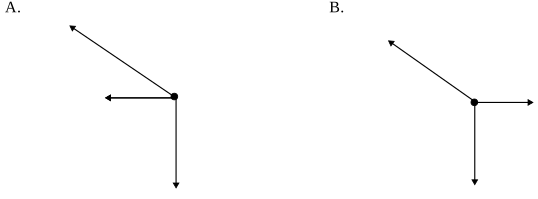
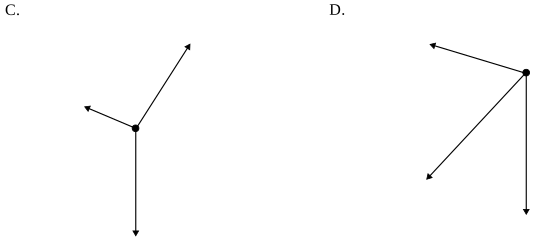
Which of the following free-body diagrams shows a block moving downhill at a constant speed?


Show Answers Only

\(C\)

Show Worked Solution
  • The three forces that act on an object when on an inclined plane are the normal force, weight force and frictional force.
  • For the block to be moving at a constant speed, the force down the plane (the component of the normal force parallel the plane) must be of equal magnitude to the frictional force which is displayed in \(C\).

\(\Rightarrow C\)

Filed Under: Forces Tagged With: Band 3, smc-4275-50-Inclined Planes

PHYSICS, M2 EQ-Bank 8

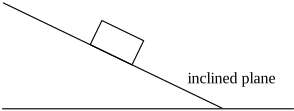
A box remains stationary on an inclined surface, as shown in the diagram.


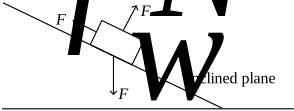
  1. On the diagram, draw and label all the forces acting on the box using vector arrows.   (2 marks)

    --- 0 WORK AREA LINES (style=lined) ---

  2. The angle of the incline is gradually increased until the box just begins to slide. Explain why the box starts to accelerate down the slope at this point.   (2 marks)

--- 4 WORK AREA LINES (style=lined) ---

Show Answers Only

a.    


b.    As the angle of incline increases:

  • The magnitude of the force down the plane increases until it overcomes the static frictional force up the plane. In this way the magnitude of the net force will be down the slope of the plane.
  • As there is a net force acting down the slope of the plane, by Newtons second law \(F=ma\), the box will begin to accelerate down the slope.
Show Worked Solution

a.    


b.    As the angle of incline increases:

  • The magnitude of the force down the plane increases until it overcomes the static frictional force up the plane. In this way the magnitude of the net force will be down the slope of the plane.
  • As there is a net force acting down the slope of the plane, by Newtons second law \(F=ma\), the box will begin to accelerate down the slope.

Filed Under: Forces Tagged With: Band 3, smc-4275-50-Inclined Planes

Vectors, SPEC2 2024 VCAA 5

Consider the points  \(A(1,-2,3)\) and \(B(2,-5,-1)\).

  1. Find a vector equation, in terms of the components \(\underset{\sim}{i}, \underset{\sim}{j}\) and \(\underset{\sim}{k}\), for the line passing through these points.   (1 mark)

    --- 3 WORK AREA LINES (style=lined) ---

  2. Consider the different line  \(L_1: r _1(t)=2 \underset{\sim}{ i }+\underset{\sim}{ j }-3 \underset{\sim}{k}+t(-\underset{\sim}{ i }+2\underset{\sim}{ j }+\underset{\sim}{ k }), t \in R\).
  3. Find the shortest distance from \(L_1\) to point \(A\).
  4. Give your answer in the form  \(\dfrac{a \sqrt{b}}{c}\)  where  \(a, b\) and \(c\) are positive integers.   (3 marks)

    --- 14 WORK AREA LINES (style=lined) ---

  5. Let \(C\) be the point \((0,2,-5)\).
  6. Find the Cartesian equation of the plane that contains the points \(A, B\) and \(C\).   (3 marks)

    --- 7 WORK AREA LINES (style=lined) ---

  7. Another plane has the Cartesian equation  \(2 x-3 y+4 z=12\).
  8. This plane intersects the coordinate axes at three points, which form the vertices of a triangle.
    1. Find the coordinates of these three points.   (1 mark)

      --- 3 WORK AREA LINES (style=lined) ---

    2. Find the area of the triangle.
    3. Give your answer in the form  \(m \sqrt{n}\)  where \(m\) and \(n\) are integers.   (2 marks)

      --- 4 WORK AREA LINES (style=lined) ---

Show Answers Only

a.    \(\underset{\sim}{r}(t)=\underset{\sim}{i}-2 \underset{\sim}{j}+3 \underset{\sim}{k}+t(\underset{\sim}{i}-3\underset{\sim}{j}-4 \underset{\sim}{k}), \quad(t \in R)\)

\(\text{or}\)

\(\underset{\sim}{r}(t)=2\underset{\sim}{i}-5 \underset{\sim}{j}-\underset{\sim}{k}+t(\underset{\sim}{i}-3\underset{\sim}{j}-4 \underset{\sim}{k}), \quad (t \in R)\)

b.  \(\text{Shortest distance}=\dfrac{5 \sqrt{66}}{6}\)

c.   \(40x+12 y+z=19\)

d.i.  \(X(6,0,0), Y(0,-4,0), Z(0,0,3)\)

d.ii.  \(\text{Area}=3 \sqrt{29}\)

Show Worked Solution

a.    \(\overrightarrow{AB}=\left(\begin{array}{c}2 \\ -5 \\ -1\end{array}\right)-\left(\begin{array}{c}1 \\ -2 \\ 3\end{array}\right)=\left(\begin{array}{c}1 \\ -3 \\ -4\end{array}\right)\)

\(\underset{\sim}{r}(t)=\underset{\sim}{i}-2 \underset{\sim}{j}+3 \underset{\sim}{k}+t(\underset{\sim}{i}-3\underset{\sim}{j}-4 \underset{\sim}{k}), \quad(t \in R)\)

\(\text{or}\)

\(\underset{\sim}{r}(t)=2\underset{\sim}{i}-5 \underset{\sim}{j}-\underset{\sim}{k}+t(\underset{\sim}{i}-3\underset{\sim}{j}-4 \underset{\sim}{k}), \quad (t \in R)\)
 

b.    \({\underset{\sim}{r}}_\text{A}=\underset{\sim}{i}-2\underset{\sim}{j}+3 \underset{\sim}{k}\)

\({\underset{\sim}{r}}_1=(2-t) \underset{\sim}{i}+(1+2 t) \underset{\sim}{j}+(t-3) \underset{\sim}{k}\)

\({\underset{\sim}{r}}_1-{\underset{\sim}{r}}_\text{A}=(1-t)\underset{\sim}{i}+(2 t+3) \underset{\sim}{j}+(t-6) \underset{\sim}{k}\)

\(\abs{{\underset{\sim}{r}}_1-{\underset{\sim}{r}}_\text{A}}=\sqrt{(1-t)^2+(2 t+3)^2+(t-6)^2}\)

\(\text{Find \(t\) when} \ \ \dfrac{d}{dt}\left(\abs{{\underset{\sim}{r}}_1-{\underset{\sim}{r}}_\text{A}}\right)=0:\)

  \(t=\dfrac{1}{6}\)

\(\therefore\ \text{Shortest distance}=\dfrac{5 \sqrt{66}}{6}\)
 

c.    \(C(0,2,-5)\)

\(\text{Plane equation:} \ \dfrac{x}{a}+\dfrac{y}{b}+\dfrac{z}{c}=1\)

\(\text{Solve:} \ \ \dfrac{1}{a}-\dfrac{2}{b}+\dfrac{3}{c}=1, \quad \dfrac{2}{a}-\dfrac{5}{b}-\dfrac{1}{c}=1, \quad \dfrac{0}{a}+\dfrac{2}{b}-\dfrac{5}{c}=1\)

\(a=\dfrac{19}{40}, \quad b=\dfrac{19}{12}, \quad c=19\)

\(\text{Equation of plane:}\)

\(\dfrac{40x}{19}+\dfrac{12y}{19}+\dfrac{z}{19}=1 \ \Rightarrow \ 40x+12 y+z=19\)
 

d.i.   \(2 x-3 y+4 z=12\)

\(2x=12\ \) \(\ \Rightarrow \ x=6\ \) \(\Rightarrow\  X(6,0,0)\)
\(-3 y=12\ \) \(\ \Rightarrow \ y=-4\ \) \(\Rightarrow\  Y(0,-4,0)\)
\(4 z=12\ \) \(\ \Rightarrow \ z=3\ \) \(\Rightarrow\  Z(0,0,3)\)
 

d.ii  \(\overrightarrow{XY}=\left(\begin{array}{c}0 \\ -4 \\ 0\end{array}\right)-\left(\begin{array}{l}6 \\ 0 \\ 0\end{array}\right)=\left(\begin{array}{c}-6 \\ -4 \\ 0\end{array}\right)\)

\(\overrightarrow{X Z}=\left(\begin{array}{l}0 \\ 0 \\ 3\end{array}\right)-\left(\begin{array}{l}6 \\ 0 \\ 0\end{array}\right)=\left(\begin{array}{c}-6 \\ 0 \\ 3\end{array}\right)\)
 
\(\text{Area}=\dfrac{1}{2}\abs{\overrightarrow{XY} \times \overrightarrow{XZ}}=\dfrac{1}{2}\abs{-12\underset{\sim}{i}+18 \underset{\sim}{j}-24 \underset{\sim}{k}}=\sqrt{261}=3 \sqrt{29}\)

Filed Under: Vector Lines, Planes and Geometry Tagged With: Band 3, Band 4, smc-1177-60-3D problems, smc-1177-80-Planes

v1 Financial Maths, STD2 F1 SM-Bank 6

Jasmine intends to keep a car purchased for $11 200 for 10 years. At the end of this time its value will be $2400.

  1. By what amount, in dollars, would the car’s value depreciate annually if Jasmine used the flat rate method of depreciation?  (1 mark)

    --- 2 WORK AREA LINES (style=lined) ---

  2. Determine the annual flat rate of depreciation correct to one decimal place.  (1 mark)

    --- 2 WORK AREA LINES (style=lined) ---

Show Answers Only
  1. `$880`
  2. `7.9\text{% (1 d.p.)}`
Show Worked Solution
i.    `\text{Depreciation}` `= 11\,200-2400`
    `=  $8800`

`:.\ \text{Annual depreciation}`

`= 8800 / 10`

`= $880`

ii.   `:.\ \text{Flat rate of depreciation}`

`= 880 / (11\ 200) \times 100\text{%}`

`= 7.857…`

`= 7.9\text{% (1 d.p.)}`

Filed Under: Simple Interest and S/L Depreciation (Std 2-X) Tagged With: Band 3, Band 4, smc-1124-20-Straight Line Depreciation, smc-808-20-Straight Line Depreciation

v1 Financial Maths, STD2 F1 SM-Bank 3

A business purchased a delivery van for $48 000.

For accounting purposes, the van is depreciated using the straight-line depreciation method.

The van is depreciated at a flat rate of 12% of the purchase price each year.

  1. By how many dollars will the van depreciate annually? (1 mark)

    --- 1 WORK AREA LINES (style=lined) ---

  2. Calculate the value of the van after two years. (1 mark)

    --- 2 WORK AREA LINES (style=lined) ---

  3. After how many years will the van be worth $14 400? (1 mark)

    --- 2 WORK AREA LINES (style=lined) ---

Show Answers Only
  1. `$5760`
  2. `$36\ 480`
  3. `6\ text(years)`
Show Worked Solution
i.    `text(Annual depreciation)` `= 12\% xx 48\ 000`
    `= $5760`

ii. `text(After 2 years,)`

`text(Value)` `= V_0-Dn`
  `= 48\ 000-(2 xx 5760)`
  `= $36\ 480`

iii. `text(Find)\ n\ text(when value = $14 400)`

`14\ 400` `= 48\ 000-5760 xx n`
`5760n` `= 33\ 600`
`:.n` `= (33\ 600) / 5760 = 6`
  `= 6\ \text{years}`

Filed Under: Simple Interest and S/L Depreciation (Std 2-X) Tagged With: Band 3, Band 4, smc-1124-20-Straight Line Depreciation, smc-808-20-Straight Line Depreciation

v1 Financial Maths, STD2 F1 2021 HSC 19

Sophie bought a set of gym equipment four years ago. It depreciated by $1800 each year using the straight-line method of depreciation. The equipment is now valued at $6200.

Find the initial value of the gym equipment.  (2 marks)

--- 4 WORK AREA LINES (style=lined) ---

Show Answers Only

`$13\ 400`

Show Worked Solution

`text{Find initial value}\ (V_0):`

`S` `=V_0-Dn`  
`6200` `=V_0-1800 xx 4`  
`V_0` `=6200 + 7200`  
  `=$13\ 400`  

Filed Under: Simple Interest and S/L Depreciation (Std 2-X) Tagged With: Band 3, num-title-ct-coreb, num-title-qs-hsc, smc-1124-20-Straight Line Depreciation, smc-4335-60-Straight-line, smc-808-20-Straight Line Depreciation

HMS, HIC EQ-Bank 031

Describe two ways that the dimensions of health interact, using specific examples to illustrate these interactions.   (5 marks)

--- 15 WORK AREA LINES (style=lined) ---

Show Answers Only

*PEEL – Solution is structured using the PEEL method; [P] Identify the point, [E] expand on the point with a link to question asked, [Ev] apply evidence/examples, [L] linking sentence back to question.*

Physical and mental health:

  • [P] Physical and mental health dimensions interact when physical activities directly influence psychological wellbeing.
  • [E] Regular physical exercise triggers the release of endorphins and neurotransmitters that act as natural mood elevators, while also reducing stress hormones like cortisol.
  • [Ev] For example, a student who begins a regular swimming routine may experience reduced anxiety levels, improved sleep patterns, and enhanced concentration for studying due to these biochemical changes.
  • [L] This demonstrates how improvements in physical health create measurable positive changes in mental health outcomes.

Social and emotional health:

  • [P] This demonstrates how improvements in physical health create measurable positive changes in mental health outcomes.
  • [E] Strong social connections offer emotional resources during difficult times, with social support networks directly influencing emotional resilience and coping capacity.
  • [Ev] For example, when someone experiences job loss, having supportive friends and family to discuss their feelings with can reduce emotional distress and prevent depression.
  • [L] This shows how improvements in physical health can lead to positive changes in mental health, demonstrating the interconnected nature of these health dimensions.

Show Worked Solution

*PEEL – Solution is structured using the PEEL method; [P] Identify the point, [E] expand on the point with a link to question asked, [Ev] apply evidence/examples, [L] linking sentence back to question.*

Physical and mental health:

  • [P] Physical and mental health dimensions interact when physical activities directly influence psychological wellbeing.
  • [E] Regular physical exercise triggers the release of endorphins and neurotransmitters that act as natural mood elevators, while also reducing stress hormones like cortisol.
  • [Ev] For example, a student who begins a regular swimming routine may experience reduced anxiety levels, improved sleep patterns, and enhanced concentration for studying due to these biochemical changes.
  • [L] This demonstrates how improvements in physical health create measurable positive changes in mental health outcomes.

Social and emotional health:

  • [P] This demonstrates how improvements in physical health create measurable positive changes in mental health outcomes.
  • [E] Strong social connections offer emotional resources during difficult times, with social support networks directly influencing emotional resilience and coping capacity.
  • [Ev] For example, when someone experiences job loss, having supportive friends and family to discuss their feelings with can reduce emotional distress and prevent depression.
  • [L] This shows how improvements in physical health can lead to positive changes in mental health, demonstrating the interconnected nature of these health dimensions.

Filed Under: Dynamic Nature of Health Tagged With: Band 3, Band 4, smc-5503-40-Interaction of dimensions

HMS, HIC EQ-Bank 027 MC

Which of the following is NOT considered one of the dimensions of health?

  1. Physical health
  2. Financial health
  3. Emotional health
  4. Spiritual health
Show Answers Only

\( B\)

Show Worked Solution
  • B is correct because financial health is not one of the five dimensions of health. While financial status may affect health, it is not classified as a health dimension itself.

Other options:

  • A, C and D are incorrect as each is recognised as one of the five dimensions of health.

Filed Under: Dynamic Nature of Health Tagged With: Band 3, smc-5503-20-Dimensions

v1 Financial Maths, STD2 F1 2005 HSC 25a

Reece is preparing his annual budget for 2006.

His expected income is:

• $90 every week as a swimming coach
• Interest earned from an investment of $4500 at a rate of 4% per annum.

His planned expenses are:

• $30 every week on transport
• $12 every week on lunches
• $48 every month on entertainment.

Reece will save his remaining income. He uses the spreadsheet below for his budget.
 

2UG-2005-25a
 

  1. Determine the values of `X`, `Y` and `Z`. (Assume there are exactly 52 weeks in a year.)  (3 marks)

    --- 5 WORK AREA LINES (style=lined) ---

At the beginning of 2006, Reece starts saving.

  1. Will Reece have saved enough money during 2006 for a deposit of $2500 on a car if he keeps to his budget? Justify your answer with suitable calculations.  (2 marks)

    --- 4 WORK AREA LINES (style=lined) ---

Show Answers Only
  1. `X =$180, Y = $1560\ text(and) \ Z = $576`
  2. `text(Reece will NOT have saved enough for a $2500deposit.)`
Show Worked Solution

i.   `text(Interest on Investment) = X`

`X` `= 4500 xx 4 text(%)`
  `= $180`

 
`text(Transport =)\ Y`

`Y` `= 52 × 30`
  `= $1560`

 
`text(Entertainment =)\ Z`

`Z` `= 48 × 12`
  `= $576`


ii.   `text(Total Income)` `= 4680 + 180`
    `= $4860`
`text(Total Expenses)` `= 1560 + 624 + 576`
  `= $2760`
`text(Savings)` `= 4860 − 2760`
  `= $2100`

 
`:.\ text(Reece will NOT have saved enough for)`

`text(a $2500 deposit.)` 

Filed Under: Simple Interest and S/L Depreciation (Std 2-X) Tagged With: Band 3, smc-1124-10-Simple Interest, smc-1126-30-Budgeting, smc-808-10-Simple Interest, smc-810-30-Budgeting

HMS, HIC EQ-Bank 023 MC

Which statement best describes the dynamic nature of health?

  1. Health is a fixed state that remains stable throughout an individual's lifetime.
  2. Health is only affected by genetic factors and cannot be modified.
  3. Health constantly changes and can be influenced by various factors throughout life.
  4. Health is primarily determined by an individual's spiritual beliefs and values.
Show Answers Only

\( C\)

Show Worked Solution
  • C is correct because health is constantly changing (dynamic) and can be influenced by various factors over time.

Other options:

  • A is incorrect because health is not a fixed state and does change over time.
  • B is incorrect because health is affected by many factors beyond genetics and can be modified.
  • D is incorrect because while spiritual beliefs and values can influence health, they are not the primary determinant.

Filed Under: Dynamic Nature of Health Tagged With: Band 3, smc-5503-50-Concept of good health

v1 Financial Maths, STD2 F1 2023 HSC 4 MC

A company car was valued at $72 000 when new. The value of the car depreciates at a rate of 18 cents per kilometre travelled.

What is the value of the car after it has travelled a total distance of 145 000 km?

  1. $45 900
  2. $31 920
  3. $25 920
  4. $16 100
Show Answers Only

`A`

Show Worked Solution
`text{Depreciation}` `=0.18 xx 145\ 000`  
  `=$26\ 100`  


`text{Car value}` `=72\ 000-26\ 100`  
  `=$45\ 900`  

 
`=>A`

Filed Under: Simple Interest and S/L Depreciation (Std 2-X) Tagged With: Band 3, smc-1124-30-Unit depreciation, smc-808-40-Unit depreciation

v1 Financial Maths, STD2 F1 2023 HSC 1 MC

An amount of $5500 is invested at a simple interest rate of 4% per annum.

How much interest is earned in the first two years?

  1. $220
  2. $280
  3. $440
  4. $5720
Show Answers Only

`C`

Show Worked Solution
`I` `=Prn`  
  `=5500 xx 4/100 xx 2`  
  `=$440`  

 
`=>C`

Filed Under: Simple Interest and S/L Depreciation (Std 2-X) Tagged With: Band 3, smc-808-10-Simple Interest

HMS, BM EQ-Bank 803 MC

After completing research on how different aerobic activities affect resting heart rate, which of the following would be the MOST logical next research question to explore?

  1. What impact do anaerobic activities have on flexibility?
  2. How does the duration of each training session affect recovery heart rate?
  3. What is the relationship between age and heart rate?
  4. Do males or females prefer running or swimming?
Show Answers Only

\(B\)

Show Worked Solution
  • B is correct: Builds directly on previous research by investigating another variable (session duration) that could influence heart rate response, maintaining the focus on physiological responses to aerobic training.

Other Options:

  • A is incorrect: Shifts focus to anaerobic activities and flexibility, losing connection to the original heart rate research.
  • C is incorrect: Focuses on age rather than training variables, moving away from investigating effects of aerobic training.
  • D is incorrect: Changes focus to preference rather than physiological responses.

Filed Under: Investigate aerobic training (EO-X) Tagged With: Band 3, smc-5533-35-Further research

HMS, BM EQ-Bank 794 MC

During a continuous aerobic training session, what is the typical immediate heart rate response when transitioning from rest to moderate exercise intensity?

  1. Heart rate gradually decreases until reaching a steady state
  2. Heart rate immediately drops then rises to a steady state
  3. Heart rate rapidly increases then plateaus at a steady state
  4. Heart rate remains consistent with resting levels for several minutes
Show Answers Only

\(C\)

Show Worked Solution
  • C is correct: Heart rate rises rapidly then reaches steady state

Other Options:

  • A is incorrect: Heart rate increases not decreases during exercise
  • B is incorrect: Heart rate doesn’t drop at exercise onset
  • D is incorrect: Heart rate increases immediately with exercise

Filed Under: Responses to training Tagged With: Band 3, smc-5532-08-Heart rate

HMS, BM EQ-Bank 786 MC

A cyclist has incorporated three 30-second maximum effort sprints with 4 minutes of active recovery between each sprint into their training program.

Which training method is the cyclist using?

  1. Continuous aerobic training
  2. Sprint Interval Training (SIT)
  3. Traditional interval training
  4. High Intensity Interval Training (HIIT)
Show Answers Only

\(B\)

Show Worked Solution
  • B is correct: Sprint Interval Training involves very short bursts (typically 30 seconds) of supramaximal intensity (all-out effort) followed by long recovery periods (usually 3-5 minutes), which matches the described workout structure.

Other Options:

  • A is incorrect: Continuous aerobic training involves sustained activity without rest periods, unlike the described workout which has distinct work and recovery intervals.
  • C is incorrect: Traditional interval training typically uses longer work intervals (1-3 minutes) at submaximal intensities, not the 30-second maximum efforts described.
  • D is incorrect: HIIT typically involves work intervals of 1 to 4 minutes at high but not maximal intensity with shorter recovery periods (usually \(1:1\) or \(1:2\) work-to-rest ratio), not the 4 minute recovery periods described.

Filed Under: Aerobic vs Anaerobic training (EO-X) Tagged With: Band 3, smc-5530-20-Anaerobic v aerobic

HMS, BM EQ-Bank 779

A netball coach is planning to implement anaerobic interval training for her team during preseason.

Outline THREE key features of anaerobic interval training.   (3 marks)

--- 6 WORK AREA LINES (style=lined) ---

Show Answers Only

Sample Answer – Any THREE of the following

  • High-intensity exercise bouts (85-95% maximum effort). Alternated with recovery periods of lower intensity or rest.
  • Work intervals typically range from 15 seconds to 2 minutes. This targets the ATP-PCr and glycolytic energy systems.
  • Rest periods allow partial but not complete recovery. Work-to-rest ratios usually between 1:1 and 1:3.
  • Produces significant lactic acid during exercise. Athletes learn to work despite this discomfort.
  • Can include sport-specific movement patterns. Matches the intensity and timing of competition demands.
  • Allows more high-intensity work than continuous training. Total volume achieved through multiple intervals.
  • Improves both aerobic and anaerobic fitness. Particularly effective for sports with varied intensity.
  • Recovery periods can be active or passive. Active recovery helps remove waste products between efforts.
Show Worked Solution

Sample Answer – Any THREE of the following

  • High-intensity exercise bouts (85-95% maximum effort). Alternated with recovery periods of lower intensity or rest.
  • Work intervals typically range from 15 seconds to 2 minutes. This targets the ATP-PCr and glycolytic energy systems.
  • Rest periods allow partial but not complete recovery. Work-to-rest ratios usually between 1:1 and 1:3.
  • Produces significant lactic acid during exercise. Athletes learn to work despite this discomfort.
  • Can include sport-specific movement patterns. Matches the intensity and timing of competition demands.
  • Allows more high-intensity work than continuous training. Total volume achieved through multiple intervals.
  • Improves both aerobic and anaerobic fitness. Particularly effective for sports with varied intensity.
  • Recovery periods can be active or passive. Active recovery helps remove waste products between efforts.

Filed Under: Aerobic vs Anaerobic training Tagged With: Band 3, smc-5530-15-Anaerobic

HMS, BM EQ-Bank 775

A long-distance runner has been incorporating continuous aerobic training into their program.

Outline the key characteristics of continuous aerobic training and identify ONE physiological benefit this would provide to the athlete.   (3 marks)

--- 6 WORK AREA LINES (style=lined) ---

Show Answers Only

Sample Answer

  • Continuous aerobic training involves steady, uninterrupted exercise. It typically uses 60-80% maximum heart rate for an extended period.
  • The activity is performed without rest intervals. Heart rate stays elevated throughout the entire session.

Any ONE of the following physiological benefits:

  • More capillaries develop in working muscles, improving oxygen delivery during long runs. This allows the runner to maintain pace for extended periods without early fatigue. The improved blood flow also helps remove waste products more efficiently.
  • Heart pumps more blood with each beat, reducing the effort needed during exercise. This means the runner’s heart rate stays lower at the same running speed. Over time, this improved efficiency allows for faster speeds at comfortable effort levels.
  • Muscles store more glycogen, providing extra energy reserves for distance events. This increased storage means runners can maintain their pace longer before hitting “the wall”. The body learns to preserve these stores by using other fuel sources first.
  • Body becomes better at using fat for fuel during long runs. This spares precious glycogen stores for when they’re really needed. Runners can therefore sustain moderate pace for hours without depleting their primary energy reserves.
  • Resting heart rate decreases significantly, showing improved cardiovascular fitness. A lower resting rate means the heart is stronger and more efficient. This allows better recovery between training sessions and indicates the body handles stress more effectively.
Show Worked Solution

Sample Answer 

  • Continuous aerobic training involves steady, uninterrupted exercise. It typically uses 60-80% maximum heart rate for an extended period.
  • The activity is performed without rest intervals. Heart rate stays elevated throughout the entire session.

Any ONE of the following physiological benefits:

  • More capillaries develop in working muscles, improving oxygen delivery during long runs. This allows the runner to maintain pace for extended periods without early fatigue. The improved blood flow also helps remove waste products more efficiently.
  • Heart pumps more blood with each beat, reducing the effort needed during exercise. This means the runner’s heart rate stays lower at the same running speed. Over time, this improved efficiency allows for faster speeds at comfortable effort levels.
  • Muscles store more glycogen, providing extra energy reserves for distance events. This increased storage means runners can maintain their pace longer before hitting “the wall”. The body learns to preserve these stores by using other fuel sources first.
  • Body becomes better at using fat for fuel during long runs. This spares precious glycogen stores for when they’re really needed. Runners can therefore sustain moderate pace for hours without depleting their primary energy reserves.
  • Resting heart rate decreases significantly, showing improved cardiovascular fitness. A lower resting rate means the heart is stronger and more efficient. This allows better recovery between training sessions and indicates the body handles stress more effectively.

Filed Under: Aerobic vs Anaerobic training Tagged With: Band 3, Band 4, smc-5530-10-Aerobic

HMS, BM EQ-Bank 771

Discuss how the ATP-PCr system efficiently produces energy for explosive movements despite its limited capacity for sustained activity.   (4 marks)

--- 10 WORK AREA LINES (style=lined) ---

Show Answers Only

Sample Answer

  • The ATP-PCr system quickly rebuilds ATP in one step by transferring phosphate from phosphocreatine to ADP, making it the fastest energy production method.
  • This system requires no oxygen or complex chemical processes, allowing immediate energy availability during explosive movements like jumping or sprinting.
  • The system provides approximately 55% of energy during maximal activities lasting 1-10 seconds without producing fatiguing by-products.
  • While highly efficient for immediate needs, capacity is limited by small phosphocreatine storage (120g) in muscle cells.
  • Training enhances efficiency by increasing storage capacity and improving ATP regeneration rates.
Show Worked Solution

Sample Answer

  • The ATP-PCr system quickly rebuilds ATP in one step by transferring phosphate from phosphocreatine to ADP, making it the fastest energy production method.
  • This system requires no oxygen or complex chemical processes, allowing immediate energy availability during explosive movements like jumping or sprinting.
  • The system provides approximately 55% of energy during maximal activities lasting 1-10 seconds without producing fatiguing by-products.
  • While highly efficient for immediate needs, capacity is limited by small phosphocreatine storage (120g) in muscle cells.
  • Training enhances efficiency by increasing storage capacity and improving ATP regeneration rates.

Filed Under: Energy systems (EO-X) Tagged With: Band 3, Band 4, smc-5528-15-ATP efficiency

HMS, BM EQ-Bank 770

Analyse the factors that determine which energy system predominates during different phases of a basketball game.   (4 marks)

--- 10 WORK AREA LINES (style=lined) ---

Show Answers Only

Sample Answer

  • During explosive movements like jumping and sprinting, the ATP-PCr system predominates due to immediate energy demands lasting 2-10 seconds.
  • Fast breaks and sustained defensive pressure rely on the glycolytic system for high-intensity efforts lasting 30-90 seconds.
  • During timeouts and low-intensity periods, the aerobic system becomes predominant, facilitating recovery and ATP-PCr replenishment.
  • Game intensity, player fitness level, and tactical demands influence which system dominates at any given moment.
  • Quarter breaks allow complete energy system recovery, resetting metabolic demands for subsequent periods.
Show Worked Solution

Sample Answer 

  • During explosive movements like jumping and sprinting, the ATP-PCr system predominates due to immediate energy demands lasting 2-10 seconds.
  • Fast breaks and sustained defensive pressure rely on the glycolytic system for high-intensity efforts lasting 30-90 seconds.
  • During timeouts and low-intensity periods, the aerobic system becomes predominant, facilitating recovery and ATP-PCr replenishment.
  • Game intensity, player fitness level, and tactical demands influence which system dominates at any given moment.
  • Quarter breaks allow complete energy system recovery, resetting metabolic demands for subsequent periods.

Filed Under: Energy systems (EO-X) Tagged With: Band 3, Band 4, smc-5528-15-ATP efficiency

HMS, BM EQ-Bank 766

A swimmer completes a 200-metre freestyle race and feels significant muscle fatigue in the final 50 metres. Analyse the physiological causes of this fatigue and how it affects performance.   (5 marks)

--- 15 WORK AREA LINES (style=lined) ---

Show Answers Only

Sample Answer

  • The 200-metre freestyle predominantly uses the glycolytic energy system, with increasing aerobic system contribution toward the end of the race.
  • The primary cause of fatigue is the accumulation of lactic acid in the working muscles, which occurs when production exceeds the rate of removal.
  • Lactic acid accumulation reduces the muscle’s ability to contract forcefully by disrupting calcium binding and cross-bridge formation in the muscle fibres.
  • The increasing acidosis in the muscle environment affects enzyme function, reducing the rate of ATP production through glycolysis.
  • The swimmer experiences a noticeable decline in stroke efficiency and power output as muscle fibre recruitment patterns change in response to fatigue.
  • Coordination and technique deteriorate in the final 50 metres as the central nervous system adapts to the changing muscle fibre capabilities.
  • The perception of effort significantly increases as the body requires increased nervous system activation to maintain the same power output with fatiguing muscles.
Show Worked Solution

Sample Answer 

  • The 200-metre freestyle predominantly uses the glycolytic energy system, with increasing aerobic system contribution toward the end of the race.
  • The primary cause of fatigue is the accumulation of lactic acid in the working muscles, which occurs when production exceeds the rate of removal.
  • Lactic acid accumulation reduces the muscle’s ability to contract forcefully by disrupting calcium binding and cross-bridge formation in the muscle fibres.
  • The increasing acidosis in the muscle environment affects enzyme function, reducing the rate of ATP production through glycolysis.
  • The swimmer experiences a noticeable decline in stroke efficiency and power output as muscle fibre recruitment patterns change in response to fatigue.
  • Coordination and technique deteriorate in the final 50 metres as the central nervous system adapts to the changing muscle fibre capabilities.
  • The perception of effort significantly increases as the body requires increased nervous system activation to maintain the same power output with fatiguing muscles.

Filed Under: Energy systems (EO-X) Tagged With: Band 3, Band 4, smc-5528-30-Causes of fatigue

HMS, BM EQ-Bank 765

Explain how causes of fatigue differ between the ATP-PCr system and the glycolytic system during high-intensity exercise.   (4 marks)

--- 10 WORK AREA LINES (style=lined) ---

Show Answers Only

Sample Answer

  • The ATP-PCr system experiences fatigue solely from phosphocreatine depletion after 10-15 seconds of maximal effort.
  • This occurs because stored PCr becomes exhausted without producing any fatiguing by-products.
  • Heat is the only by-product, which enables rapid recovery within 2 minutes.
  • Therefore, ATP-PCr fatigue is temporary and quickly reversible.
  • The glycolytic system fatigues due to lactic acid accumulation in muscle cells.
  • Lactic acid forms when glucose breaks down anaerobically, accumulating faster than removal rates.
  • As a result, the acid interferes with enzyme function and muscle contraction.
  • Consequently, glycolytic fatigue persists longer, requiring 30-60 minutes for complete recovery.
Show Worked Solution

Sample Answer 

  • The ATP-PCr system experiences fatigue solely from phosphocreatine depletion after 10-15 seconds of maximal effort.
  • This occurs because stored PCr becomes exhausted without producing any fatiguing by-products.
  • Heat is the only by-product, which enables rapid recovery within 2 minutes.
  • Therefore, ATP-PCr fatigue is temporary and quickly reversible.
  • The glycolytic system fatigues due to lactic acid accumulation in muscle cells.
  • Lactic acid forms when glucose breaks down anaerobically, accumulating faster than removal rates.
  • As a result, the acid interferes with enzyme function and muscle contraction.
  • Consequently, glycolytic fatigue persists longer, requiring 30-60 minutes for complete recovery.

Filed Under: Energy systems Tagged With: Band 2, Band 3, smc-5528-30-Causes of fatigue

HMS, BM EQ-Bank 761

Describe how fuel sources contribute to fatigue during the final stretch of a 400-metre race.  (3 marks)

--- 7 WORK AREA LINES (style=lined) ---

Show Answers Only

Sample Answer

  • The 400m relies heavily on the glycolytic system which uses glucose as fuel for the final stretch.
  • This system produces ATP quickly but creates lactic acid as a by-product.
  • Lactic acid builds up rapidly in muscles, making them increasingly acidic and reducing their ability to contract.
  • Additionally, the intense effort uses up muscle glucose stores quickly.
  • These combined effects cause severe fatigue, forcing runners to slow dramatically in the final metres.
Show Worked Solution

Sample Answer

  • The 400m relies heavily on the glycolytic system which uses glucose as fuel for the final stretch.
  • This system produces ATP quickly but creates lactic acid as a by-product.
  • Lactic acid builds up rapidly in muscles, making them increasingly acidic and reducing their ability to contract.
  • Additionally, the intense effort uses up muscle glucose stores quickly.
  • These combined effects cause severe fatigue, forcing runners to slow dramatically in the final metres.

Filed Under: Energy systems Tagged With: Band 2, Band 3, smc-5528-10-Fuel Source

HMS, BM EQ-Bank 757

Identify the fuel sources used by the three energy systems and explain why each energy system uses its particular fuel source(s).   (6 marks)

--- 15 WORK AREA LINES (style=lined) ---

Show Answers Only

Sample Answer

  • The ATP-PCr system uses phosphocreatine as fuel because PCr can rapidly donate a phosphate group to ADP to reform ATP without requiring oxygen.
  • The glycolytic (lactic acid) system uses carbohydrates in the form of glucose (from blood) and glycogen (stored in muscles) because these can be quickly broken down anaerobically to produce ATP.
  • The aerobic system can use carbohydrates, fats, and proteins as fuel sources because oxygen is available for complete breakdown of these nutrients through cellular respiration pathways.
  • PCr is used for the ATP-PCr system due to its high concentration in muscle cells (five times that of ATP) allowing for quick energy availability.
  • Carbohydrates are the only fuel source that can be metabolised without oxygen, making them essential for the glycolytic system during high-intensity activities.
  • The aerobic system’s ability to use multiple fuel sources, particularly fat during lower intensities, allows for sustained energy production during prolonged activities when oxygen supply meets demand.
Show Worked Solution

Sample Answer 

  • The ATP-PCr system uses phosphocreatine as fuel because PCr can rapidly donate a phosphate group to ADP to reform ATP without requiring oxygen.
  • The glycolytic (lactic acid) system uses carbohydrates in the form of glucose (from blood) and glycogen (stored in muscles) because these can be quickly broken down anaerobically to produce ATP.
  • The aerobic system can use carbohydrates, fats, and proteins as fuel sources because oxygen is available for complete breakdown of these nutrients through cellular respiration pathways.
  • PCr is used for the ATP-PCr system due to its high concentration in muscle cells (five times that of ATP) allowing for quick energy availability.
  • Carbohydrates are the only fuel source that can be metabolised without oxygen, making them essential for the glycolytic system during high-intensity activities.
  • The aerobic system’s ability to use multiple fuel sources, particularly fat during lower intensities, allows for sustained energy production during prolonged activities when oxygen supply meets demand.

Filed Under: Energy systems (EO-X) Tagged With: Band 2, Band 3, smc-5528-10-Fuel Source

HMS, BM EQ-Bank 756 MC

During a marathon, which statement accurately describes what happens to an athlete's fuel usage after approximately 2 hours of running?

  1. The athlete continues to rely exclusively on the ATP-PCr system
  2. The glycolytic system becomes the predominant energy provider
  3. The body shifts from predominantly using glycogen to using more fat
  4. Protein becomes the primary fuel source for ATP production
Show Answers Only

\(C\)

Show Worked Solution
  • C is correct:
    • During a marathon, after approximately 2 hours of running, glycogen stores become depleted.
    • This causes the body to shift from predominantly using glycogen to increasingly relying on fat as a fuel source.

Other Options:

  • A is incorrect: The ATP-PCr system is only predominant for activities lasting 1-10 seconds, not endurance events like marathons.
  • B is incorrect: The glycolytic system is dominant for activities lasting 30-45 seconds, not for prolonged endurance events.
  • D is incorrect: While protein can be used as a fuel source in the aerobic system, it is not the primary fuel source, even in prolonged exercise; fat becomes the primary alternative fuel once glycogen is depleted.

Filed Under: Energy systems (EO-X) Tagged With: Band 3, smc-5528-10-Fuel Source

HMS, HIC EQ-Bank 016 MC

A 50-year-old woman undergoes genetic testing and discovers she carries the BRCA1 gene mutation. Her doctor recommends more frequent breast cancer screenings as a preventative measure.

This scenario most directly relates to which determinant of health?

  1. Broad features of society
  2. Environmental factors
  3. Biomedical factors
  4. Health behaviours

Show Answers Only

\(C\)

Show Worked Solution
  • C is correct. Genetic predispositions, such as carrying the BRCA1 gene mutation, are biomedical factors. These are physiological characteristics that influence health outcomes.

Other options:

  • A is incorrect as broad features of society relate to cultural and policy aspects of health.
  • B is incorrect as environmental factors relate to external exposures rather than genetic makeup.
  • D is incorrect as health behaviours relate to actions rather than genetic characteristics.

Filed Under: Biomedical and Health Behaviours Tagged With: Band 3, smc-5803-55-Identify factor, smc-5804-50-Identify factor, smc-5806-60-Identify factor

HMS, HIC EQ-Bank 014 MC

A 45-year-old female attends her general practitioner for a check-up. The doctor notices she has gained 8kg since her last visit and recommends she increases her daily physical activity levels from 15 minutes to 30 minutes.

Which determinant of health is the doctor primarily addressing?

  1. Biomedical factors
  2. Environmental factors
  3. Health behaviours
  4. Socioeconomic characteristics

Show Answers Only

\(C\)

Show Worked Solution
  • C is correct because an increase in physical activity is a health behaviour. Physical activity is an action that individuals can choose to engage in that directly affects their health status.

Other options:

  • A is incorrect as biomedical factors relate to genetic, physiological, or pathological aspects.
  • B is incorrect as environmental factors relate to surroundings rather than individual actions.
  • D is incorrect as socioeconomic characteristics relate to social and economic standing.

Filed Under: Biomedical and Health Behaviours Tagged With: Band 3, smc-5804-50-Identify factor, smc-5805-65-Identify factor, smc-5806-60-Identify factor

HMS, BM EQ-Bank 752

Explain how HIIT classes encourage group dynamics that enhance performance.   (4 marks)

--- 10 WORK AREA LINES (style=lined) ---

Show Answers Only

Sample Answer

  • HIIT’s interval structure creates shared intensity experiences among participants. This leads to collective motivation as everyone endures the same challenging work periods together.
  • Visual peer motivation during high-intensity periods causes individuals to push harder than they would alone. Seeing others maintain effort triggers competitive responses that enhance individual performance levels.
  • Group energy and vocal encouragement results in sustained high intensity throughout the workout. Such an atmosphere generates contagious motivation that lifts everyone’s performance capacity during difficult intervals.
  • Accountability to the group prevents participants from giving up during challenging moments. Therefore, individuals maintain effort levels longer, enhancing overall workout performance and intensity.
Show Worked Solution

Sample Answer 

  • HIIT’s interval structure creates shared intensity experiences among participants. This leads to collective motivation as everyone endures the same challenging work periods together.
  • Visual peer motivation during high-intensity periods causes individuals to push harder than they would alone. Seeing others maintain effort triggers competitive responses that enhance individual performance levels.
  • Group energy and vocal encouragement results in sustained high intensity throughout the workout. Such an atmosphere generates contagious motivation that lifts everyone’s performance capacity during difficult intervals.
  • Accountability to the group prevents participants from giving up during challenging moments. Therefore, individuals maintain effort levels longer, enhancing overall workout performance and intensity.

Filed Under: Communities of exercise Tagged With: Band 3, smc-5537-20-Group Exercise Cohesion

HMS, BM EQ-Bank 750

Discuss how social media extends the community aspects of contemporary exercise beyond physical workout spaces.   (6 marks)

--- 18 WORK AREA LINES (style=lined) ---

Show Answers Only

*PEEL – Solution is structured using separate PEEL methods for each side of the argument; [P] Identify the point, [E] expand on the point with a link to question asked, [Ev] apply evidence/examples, [L] linking sentence back to question.

  • [P] Social media creates virtual communities that extend exercise groups beyond gym walls.
  • [E] Digital platforms enable members to interact continuously, not just during scheduled workouts.
  • [Ev] Exercise groups use Facebook pages and WhatsApp chats to share achievements. Members organise social gatherings and exchange nutrition tips throughout the week.
  • [L] Constant connection strengthens relationships formed during physical training sessions.
      
  • [P] However, social media can create pressure and unhealthy comparisons between members.
  • [E] Constant sharing of achievements may intimidate beginners or those progressing slower.
  • [Ev] Members might feel obligated to post workout photos or compete for likes. Focus shifts from personal health goals to digital validation seeking.
  • [L] Digital pressure can undermine the supportive community atmosphere essential for sustainable exercise habits.
      
  • [P] Nevertheless, when used mindfully, social media platforms offer valuable support networks.
  • [E] The 24/7 accessibility provides encouragement during challenging moments in fitness journeys.
  • [Ev] Members can seek advice, share struggles, and celebrate milestones together online. Virtual challenges and group goals maintain motivation between physical sessions.
  • [L] On balance, social media both enhances and complicates traditional exercise community dynamics.
Show Worked Solution

*PEEL – Solution is structured using separate PEEL methods for each side of the argument; [P] Identify the point, [E] expand on the point with a link to question asked, [Ev] apply evidence/examples, [L] linking sentence back to question.

  • [P] Social media creates virtual communities that extend exercise groups beyond gym walls.
  • [E] Digital platforms enable members to interact continuously, not just during scheduled workouts.
  • [Ev] Exercise groups use Facebook pages and WhatsApp chats to share achievements. Members organise social gatherings and exchange nutrition tips throughout the week.
  • [L] Constant connection strengthens relationships formed during physical training sessions.
      
  • [P] However, social media can create pressure and unhealthy comparisons between members.
  • [E] Constant sharing of achievements may intimidate beginners or those progressing slower.
  • [Ev] Members might feel obligated to post workout photos or compete for likes. Focus shifts from personal health goals to digital validation seeking.
  • [L] Digital pressure can undermine the supportive community atmosphere essential for sustainable exercise habits.
      
  • [P] Nevertheless, when used mindfully, social media platforms offer valuable support networks.
  • [E] The 24/7 accessibility provides encouragement during challenging moments in fitness journeys.
  • [Ev] Members can seek advice, share struggles, and celebrate milestones together online. Virtual challenges and group goals maintain motivation between physical sessions.
  • [L] On balance, social media both enhances and complicates traditional exercise community dynamics.

Filed Under: Communities of exercise Tagged With: Band 3, Band 4, smc-5537-20-Group Exercise Cohesion

HMS, BM EQ-Bank 748

Explain how contemporary forms of exercise provide accountability that enhances commitment to fitness goals.   (4 marks)

--- 10 WORK AREA LINES (style=lined) ---

Show Answers Only

Sample Answer

  • Group exercise settings create peer accountability as participants notice when others miss sessions.
  • Trainers and coaches track attendance and performance, providing external accountability
  • Workout partners often communicate outside class times about attendance, making it harder to skip sessions.
  • Public goal-setting in contemporary exercise communities means others are aware of individuals’ targets.
  • Many group fitness programs use check-ins or attendance tracking visible to the community, further enhancing accountability.
Show Worked Solution

Sample Answer 

  • Group exercise settings create peer accountability as participants notice when others miss sessions.
  • Trainers and coaches track attendance and performance, providing external accountability
  • Workout partners often communicate outside class times about attendance, making it harder to skip sessions.
  • Public goal-setting in contemporary exercise communities means others are aware of individuals’ targets.
  • Many group fitness programs use check-ins or attendance tracking visible to the community, further enhancing accountability.

Filed Under: Communities of exercise (EO-X) Tagged With: Band 3, smc-5537-20-Group Exercise Cohesion

HMS, BM EQ-Bank 744

Outline ways in which contemporary forms of exercise use modified workouts to cater for various group dynamics.   (3 marks)

--- 7 WORK AREA LINES (style=lined) ---

Show Answers Only

Sample Answer

  • Contemporary exercise classes offer scaled exercise options with different difficulty levels. Beginner, intermediate and advanced modifications accommodate varied fitness abilities in one class.
  • Modifications allow all participants to work at appropriate intensity levels. Participants still exercise together, fostering inclusion and group cohesion.
  • Trainers provide alternative movements for those with injuries or physical limitations. Everyone can complete the workout together while working at individual capacity levels.
Show Worked Solution

Sample Answer 

  • Contemporary exercise classes offer scaled exercise options with different difficulty levels. Beginner, intermediate and advanced modifications accommodate varied fitness abilities in one class.
  • Modifications allow all participants to work at appropriate intensity levels. Participants still exercise together, fostering inclusion and group cohesion.
  • Trainers provide alternative movements for those with injuries or physical limitations. Everyone can complete the workout together while working at individual capacity levels.

Filed Under: Communities of exercise Tagged With: Band 3, smc-5537-20-Group Exercise Cohesion

HMS, BM EQ-Bank 742 MC

A popular local fitness studio displays a leaderboard showing the top performers from each class. This feature primarily promotes which aspect of contemporary exercise communities?

  1. Group dynamics through exercise modifications
  2. Social interaction through extended conversations
  3. Sense of belonging through shared relaxation time
  4. Positive competitiveness to enhance performance
Show Answers Only

\(D\)

Show Worked Solution
  • D is correct: Leaderboards foster positive competitiveness by tracking and comparing performance.

Other Options:

  • A is incorrect: Leaderboards don’t directly relate to exercise modifications.
  • B is incorrect: Leaderboards don’t primarily promote extended conversations.
  • C is incorrect: Leaderboards don’t focus on relaxation time.

Filed Under: Communities of exercise Tagged With: Band 3, smc-5537-20-Group Exercise Cohesion

HMS, BM EQ-Bank 739 MC

Which of the following best describes the impact of contemporary forms of exercise on participants' commitment to fitness goals?

  1. Group exercise settings provide accountability through peers and trainers
  2. Participants typically exercise alone so they can set their own pace
  3. Digital tracking apps are the primary method of maintaining commitment
  4. Competition between participants often leads to decreased participation
Show Answers Only

\(A\)

Show Worked Solution
  • A is correct: Contemporary forms of exercise foster commitment through peer and trainer accountability.

Other Options:

  • B is incorrect: Contemporary exercise emphasises group participation rather than solo workouts.
  • C is incorrect: Digital apps are tools not the primary commitment method.
  • D is incorrect: Positive competition typically increases not decreases participation.

Filed Under: Communities of exercise Tagged With: Band 3, smc-5537-20-Group Exercise Cohesion

  • « Previous Page
  • 1
  • …
  • 7
  • 8
  • 9
  • 10
  • 11
  • …
  • 57
  • Next Page »

Copyright © 2014–2025 SmarterEd.com.au · Log in