SmarterEd

Aussie Maths & Science Teachers: Save your time with SmarterEd

  • Login
  • Get Help
  • About

MATRICES, FUR2 2013 VCAA 2

10 000 trout eggs, 1000 baby trout and 800 adult trout are placed in a pond to establish a trout population.

In establishing this population

    • eggs (`E`) may die (`D`) or they may live and eventually become baby trout (`B`)
    • baby trout (`B`) may die (`D`) or they may live and eventually become adult trout (`A`)
    • adult trout (`A`) may die (`D`) or they may live for a period of time but will eventually die.

From year to year, this situation can be represented by the transition matrix `T`, where
 

`{:(qquadqquadqquadqquadqquadtext(this year)),((qquadqquadqquadE,quad\ B,quad\ A,\ D)),(T = [(0,0,0,0),(0.4,0,0,0),(0,0.25,0.5,0),(0.6,0.75,0.5,1)]):}{:(),(),(E),(B),(A),(D):}{:(),(),(qquadtext(next year)):}`
 

  1. Use the information in the transition matrix `T` to
    1. determine the number of eggs in this population that die in the first year.   (1 mark)

      --- 2 WORK AREA LINES (style=lined) ---

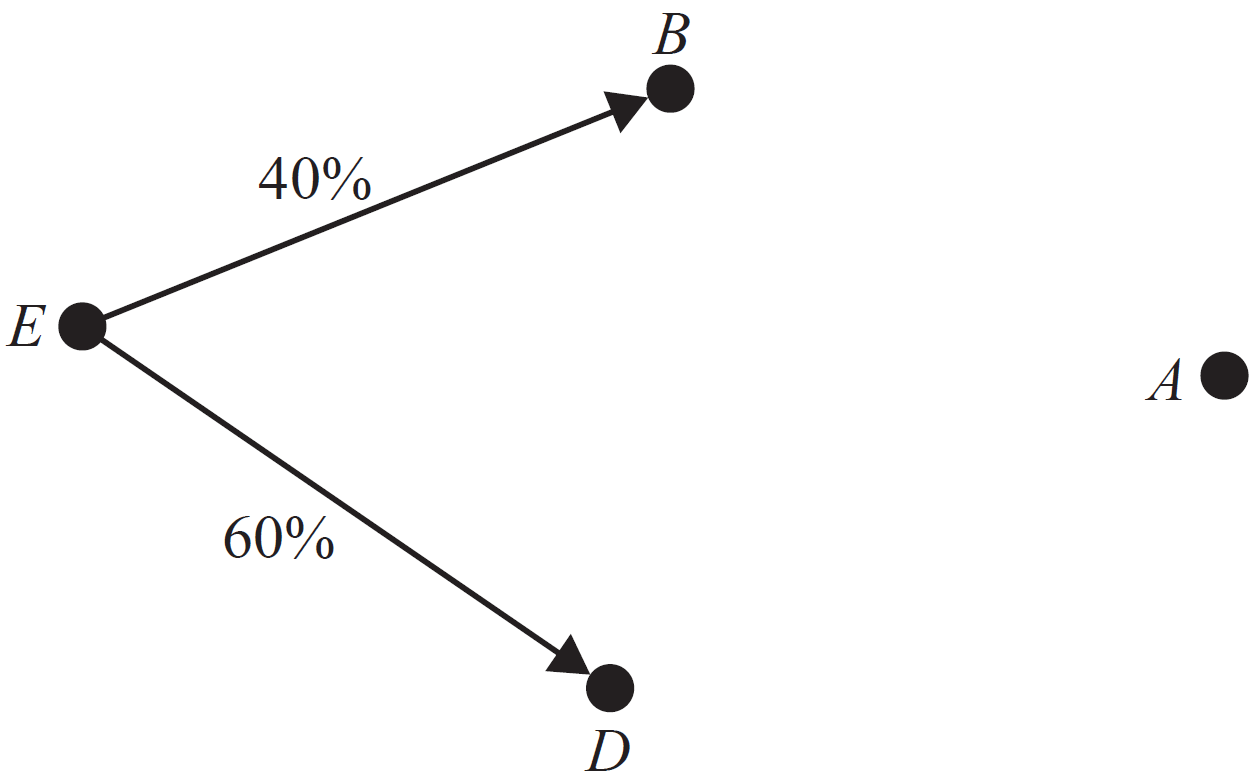
    2. complete the transition diagram below, showing the relevant percentages.   (2 marks)


      --- 0 WORK AREA LINES (style=lined) ---
          Matrices, FUR2 2013 VCAA 2_a

The initial state matrix for this trout population, `S_0`, can be written as
 

`S_0 = [(10\ 000),(1000),(800),(0)]{:(E),(B),(A),(D):}`
 

Let `S_n` represent the state matrix describing the trout population after `n` years.

  1. Using the rule  `S_n = T S_(n-1)`, determine each of the following.


    1. `S_1`   (1 mark)

      --- 3 WORK AREA LINES (style=lined) ---

    2. the number of adult trout predicted to be in the population after four years   (1 mark)

      --- 3 WORK AREA LINES (style=lined) ---

  2. The transition matrix `T` predicts that, in the long term, all of the eggs, baby trout and adult trout will die.
    1. How many years will it take for all of the adult trout to die (that is, when the number of adult trout in the population is first predicted to be less than one)?   (1 mark)

      --- 2 WORK AREA LINES (style=lined) ---

    2. What is the largest number of adult trout that is predicted to be in the pond in any one year?   (1 mark)

      --- 3 WORK AREA LINES (style=lined) ---

  3. Determine the number of eggs, baby trout and adult trout that, if added to or removed from the pond at the end of each year, will ensure that the number of eggs, baby trout and adult trout in the population remains constant from year to year.   (2 marks)

    --- 4 WORK AREA LINES (style=lined) ---

The rule  `S_n = T S_(n – 1)`  that was used to describe the development of the trout in this pond does not take into account new eggs added to the population when the adult trout begin to breed.

  1. To take breeding into account, assume that 50% of the adult trout lay 500 eggs each year.
  2. The matrix describing the population after one year, `S_1`, is now given by the new rule
  3. `S_1 = T S_0 + 500\ M\ S_0`
  4. where      `T=[(0,0,0,0),(0.40,0,0,0),(0,0.25,0.50,0),(0.60,0.75,0.50,1.0)], M=[(0,0,0.50,0),(0,0,0,0),(0,0,0,0),(0,0,0,0)]\ text(and)\ S_0=[(10\ 000),(1000),(800),(0)]`
    1. Use this new rule to determine `S_1`.   (1 mark)

      --- 4 WORK AREA LINES (style=lined) ---

  5. This pattern continues so that the matrix describing the population after `n` years, `S_n`, is given by the rule
  6.       `S_n = T\ S_(n-1) + 500\ M\ S_(n-1)`
     

    1. Use this rule to determine the number of eggs in the population after two years   (2 marks)

      --- 6 WORK AREA LINES (style=lined) ---

Show Answers Only

a.i.   `6000`

a.ii.  `text(See Worked Solutions)`

b.i.   `S_1= [(0),(4000),(650),(7150)]`

b.ii. `S_4= [(0),(0),(331.25),(11\ 468.75)]`

c.i.   `text{13 years}`

c.ii.  `1325`

d.    `text(Add 10 000 eggs, remove 3000 baby trout and add 150)`

`text(150 adult trout to keep the population constant.)`

e.i.   `S_1= [(200\ 000),(4000),(650),(7150)]`

e.ii.   `text(See Worked Solutions)`

Show Worked Solution

a.i.   `text(60% of eggs die in 1st year,)`

`:.\ text(Eggs that die in year 1)`

`= 0.60 xx 10\ 000`

`= 6000`
 

MARKER’S COMMENT: A 100% cycle drawn at `D` was a common omission. Do not draw loops and edges of 0%!
a.ii.   

Matrices-FUR2-2013-VCAA-2_a Answer

b.i.    `S_1` `= TS_0`
    `= [(0,0,0,0),(0.4,0,0,0),(0,0.25,0.5,0),(0.6,0.75,0.5,1)][(10\ 000),(1000),(800),(0)]= [(0),(4000),(650),(7150)]`


b.ii.    `S_4` `= T^4S_0`
    `= [(0,0,0,0),(0.4,0,0,0),(0,0.25,0.5,0),(0.6,0.75,0.5,1)]^4[(10\ 000),(1000),(800),(0)]= [(0),(0),(331.25),(11\ 468.75)]`


`:. 331\ text(trout is the predicted population after 4 years.)`


c.i.    `S_12 = T^12S_0 = [(0),(0),(1.29),(11\ 791)]`

`S_13 = T^13S_0 = [(0),(0),(0.65),(11\ 799)]`
 

`:.\ text{It will take 13 years (when the trout population drops below 1).}`
 

c.ii.    `S_1 = TS_0 = [(0),(4000),(650),(7150)]`

`text(After 1 year, 650 adult trout.)`

`text(Similarly,)`

`S_2 = T^2S_0 = [(0),(0),(1325),(10\ 475)]`

`S_3 = T^3S_0 = [(0),(0),(662.5),(11\ 137.5)]`

`S_4 = T^4S_0 = [(0),(0),(331),(11\ 469)]`
 

`:.\ text(Largest number of adult trout = 1325.)`
 

d.    `S_0-S_1 = [(10\ 000),(1000),(800),(0)]-[(0),(4000),(650),(7150)] = [(10\ 000),(−3000),(150),(−7150)]`


`:.\ text(Add 10 000 eggs, remove 3000 baby trout and add 150 adult)`

`text(trout to keep the population constant.)`


e.i.    `S_1` `= TS_0 + 500MS_0`
    `= [(0),(4000),(650),(7150)] + 500 xx [(0,0,0.5,0),(0,0,0,0),(0,0,0,0),(0,0,0,0)][(10\ 000),(1000),(800),(0)]`
    `= [(0),(4000),(650),(7150)] + 500[(400),(0),(0),(0)]`
    `= [(200\ 000),(4000),(650),(7150)]`


e.ii.    `S_2` `= TS_1 + 500MS_1`
   

`= [(0,0,0,0),(0.4,0,0,0),(0,0.25,0.5,0),(0.6,0.75,0.5,1)][(200\ 000),(4000),(650),(7150)]`

       `+ 500 xx [(0,0,0.5,0),(0,0,0,0),(0,0,0,0),(0,0,0,0)][(200\ 000),(4000),(650),(7150)]`

    `= [(162\ 500),(80\ 000),(1325),(130\ 475)]`

Filed Under: Transition Matrices - Modified, Transition Matrices - Regular Tagged With: Band 3, Band 4, Band 5, Band 6, page-break-before-question, smc-1893-20-State Matrix in discrete period, smc-1893-32-4x4 Matrix, smc-618-20-Matrix to Diagram, smc-618-30-State Matrix in discrete period, smc-618-62-4x4 Matrix

MATRICES, FUR2 2013 VCAA 1

Five trout-breeding ponds, `P`, `Q`, `R`, `X` and `V`, are connected by pipes, as shown in the diagram below.
 

Matrices, FUR2 2013 VCAA 1 

The matrix `W` is used to represent the information in this diagram.

`{:({:\ qquadqquadqquadPquadQquad\ Rquad\ Xquad\ V:}),(W = [(0,1,1,1,0), (1,0,0,1,0),(1,0,0,1,0),(1,1,1,0,1),(0,0,0,1,0)]):}{:(),(P),(Q),(R),(X),(V):}`

In matrix `W`

•  the 1 in column 1, row 2, for example, indicates that a pipe directly connects pond `P` and pond `Q`

•  the 0 in column 1, row 5, for example, indicates that pond `P` and pond `V` are not directly connected by a pipe.

  1. Find the sum of the elements in row 3 of matrix `W`.   (1 mark)

    --- 1 WORK AREA LINES (style=lined) ---

  2. In terms of the breeding ponds described, what does the sum of the elements in row 3 of matrix `W` represent?   (1 mark)

    --- 2 WORK AREA LINES (style=lined) ---

The pipes connecting pond `P` to pond `R` and pond `P` to pond `X` are removed.

Matrix `N` will be used to show this situation. However, it has missing elements.

  1. Complete matrix `N` below by filling in the missing elements in row 1 and column 1.   (1 mark)

    --- 0 WORK AREA LINES (style=lined) ---

        
             Matrices, FUR2 2013 VCAA 1_c

Show Answers Only
  1. `2`
  2. `text(The sum means that 2 other)`
    `text(ponds connect directly to pond)\ R.`
  3.  
    `{:({:qquadqquadqquadPquadQquadRquadXquadV:}),(N = [(0,1,0,0,0),(1,0,0,1,0),(0,0,0,1,0),(0,1,1,0,1),(0,0,0,1,0)]):}{:(),(P),(Q),(R),(X),(V):}`
Show Worked Solution

a.   `1+ 0 + 0 +1+ 0 = 2`
 

b.   `text(The sum means that 2 other ponds)`

`text(connect directly to pond)\ R.`
 

c.    `{:({:qquadqquadqquadPquadQquad\ Rquad\ Xquad\ V:}),(N = [(0,1,0,0,0),(1,0,0,1,0),(0,0,0,1,0),(0,1,1,0,1),(0,0,0,1,0)]):}{:(),(P),(Q),(R),(X),(V):}`

Filed Under: Matrix Applications Tagged With: Band 2, Band 3, Band 4, smc-619-10-Matrix from info/table, smc-619-40-Interpret Elements, smc-619-80-Communication

MATRICES, FUR1 2008 VCAA 7-9 MC

A large population of mutton birds migrates each year to a remote island to nest and breed. There are four nesting sites on the island, A, B, C and D.

Researchers suggest that the following transition matrix can be used to predict the number of mutton birds nesting at each of the four sites in subsequent years. An equivalent transition diagram is also given.
 

`{:(qquad qquad qquad qquad {:text(this year):}), (qquad qquad quad quad \ {:(A,\ \ B,\ \ C,\ D):}), (T = [(0.4, 0, 0.2, 0),(0.35, 1, 0.15, 0), (0.15, 0, 0.55, 0), (0.1, 0, 0.1, 1)] {:(A), (B), (C), (D):} quad {:text(next year):}):}`      VCAA MATRICES FUR2 2008 7i

Part 1

Two thousand eight hundred mutton birds nest at site C in 2008.

Of these 2800 mutton birds, the number that nest at site A in 2009 is predicted to be

A.    `560`

B.    `980`

C.  `1680`

D.  `2800`

E.  `3360`


Part 2

This transition matrix predicts that, in the long term, the mutton birds will

A.  nest only at site A.

B.  nest only at site B.

C.  nest only at site A and C.

D.  nest only at site B and D.

E.  continue to nest at all four sites.


Part 3

Six thousand mutton birds nest at site B in 2008.

Assume that an equal number of mutton birds nested at each of the four sites in 2007. The same transition matrix applies.

The total number of mutton birds that nested on the island in 2007 was

A.  `6000`

B.  `8000`

C.  `12\ 000`

D.  `16\ 000`

E.  `24\ 000`

Show Answers Only

`text(Part 1:)    A`

`text(Part 2:)   D`

`text(Part 3:)   D`

Show Worked Solution

`text(Part 1:)`

`text(20% of birds at site)\ A\ text(in 2008 are predicted)`

`text(to move to site)\ C.`

`:.\ text(Number of birds)`

`= 20 text(%) xx 2800`

`= 560`

`=>   A`


`text(Part 2:)`

`text(Consider)\ n\ text{large  (say}\ n = 50 text{)},`

`T^50 = [(0, 0, 0, 0), (0.75, 1, 0.66, 0), (0, 0, 0, 0), (0.25, 0, 0.33, 0)]`

`=>   D`


`text(Part 3:)`

`text(Let)\ \ x = text(mutton birds at each site in 2007)`

`text(In 2008, 6000 birds nest at)\ B.`

♦♦♦ Mean mark 25%.

`text(Using the diagram,)`

`x + 0.35x + 0.15x` `= 6000`
 `1.5x` `= 6000`
 `x` `= 4000`


`:.\ text(Total number nested in 2007)`

`= 4 xx 4000`

`= 16\ 000\ text(birds)`

`=>   D`

Filed Under: Transition Matrices - Regular Tagged With: Band 4, Band 6, smc-618-30-State Matrix in discrete period, smc-618-40-Steady State, smc-618-62-4x4 Matrix

MATRICES, FUR1 2008 VCAA 6 MC

The solution of the matrix equation  `[(0, – 3, 2), (1, 1, 1), (– 2, 0, 3)] [(x), (y), (z)] = [(11), (5), (8)]`  is

A.  `[(1), (24), (2)]` B.  `[(2), (– 1), (4)]`
       
C.  `[(2), (1), (3)]` D.  `[(– 11), (4/3), (8)]`
       
E.  `[(11), (5), (8)]`    


Show Answers Only

`B`

Show Worked Solution

`[(0, – 3, 2), (1, 1, 1), (– 2, 0, 3)] [(x), (y), (z)]= [(11), (5), (8)]`

`:. [(x), (y), (z)]` `= [(0, – 3, 2), (1, 1, 1), (– 2, 0, 3)]^-1 [(11), (5), (8)]`
  `= [(2), (– 1), (4)]`

 
`=>   B`

Filed Under: Simultaneous Equations Tagged With: Band 4, smc-617-40-Inverse Matrix to solve equation

MATRICES, FUR1 2008 VCAA 4 MC

Matrix `A` is a `1 xx 3` matrix.

Matrix `B` is a `3 xx 1` matrix.

Which one of the following matrix expressions involving `A` and `B` is defined?

A.  `A + 1/3 B`

B.  `2B xx 3A`

C.  `A^2 B`

D.  `B^-1`

E.  `B - A`

Show Answers Only

`B`

Show Worked Solution

`text(Consider)\ B,`

`underset (3 xx 1) (2B) xx underset (1 xx 3) (3A)`

`text(S) text(ince the number of columns in)`

`text(matrix)\ 2B\ text(equals the number of)`

`text(rows in matrix)\ 3A,\ text(their product)`

`text(is defined.)`

`=>   B`

Filed Under: Matrix Calculations Tagged With: Band 4, smc-616-20-Order / (Un)Defined, smc-616-40-Powers/Inverse

MATRICES, FUR1 2008 VCAA 3 MC

The cost prices of three different electrical items in a store are $230, $290 and $310 respectively.

The selling price of each of these three electrical items is 1.3 times the cost price plus a commission of $20 for the salesman.

A matrix that lists the selling price of each of these three electrical items is determined by evaluating

A.  `1.3 xx [(230), (290), (310)] + [20]`

B.  `1.3 xx [(230), (290), (310)] + 1.3 xx 20`

C.  `1.3 xx [(230), (290), (310)] + [(20), (20), (20)]`

D.  `1.3 xx [(230), (290), (310)] + 1.3 xx [(20), (20), (20)]`

E.  `1.3 xx [(230 + 20), (290 + 20), (310 + 20)]`

Show Answers Only

`C`

Show Worked Solution

`=>   C`

Filed Under: Matrix Applications Tagged With: Band 4, smc-619-30-Matrix product and interpretation

MATRICES, FUR1 2008 VCAA 2 MC

Apples cost $3.50 per kg, bananas cost $4.20 per kg and carrots cost $1.89 per kg.

Ashley buys 3 kg of apples, 2 kg of bananas and 1 kg of carrots.

A matrix product to calculate the total cost of these items is
 

A.  `[(3), (2), (1)] [(3.50), (4.20), (1.89)]`

B.  `[(3, 2, 1)] [(3.50, 4.20, 1.89)]`

C.  `[(3.50 xx 2, 4.20 xx 3, 1.89 xx 1)]`

D.  `[(3), (2), (1)] [(3.50, 4.20, 1.89)]`

E.  `[(3.50, 4.20, 1.89)] [(3), (2), (1)]`

Show Answers Only

`E`

Show Worked Solution

`text(The “total” cost must be a 1 × 1 matrix,)`

`[(3.50, 4.20, 1.89)] [(3), (2), (1)]`

`= [3.50 xx 3 + 4.20 xx 2 + 1.89 xx 1]`

`= [20.79]`

`=>   E`

Filed Under: Matrix Applications Tagged With: Band 4, smc-619-20-Matrix product from table

MATRICES, FUR1 2009 VCAA 9 MC

`T =[[0.8,0.3],[0.2,0.7]]`  is a transition matrix.

`S_3 = [[1150],[850]]`  is a state matrix.

If  `S_3 = TS_2`,  then  `S_2`  equals

A.   `[[1000],[1000]]`

B.   `[[1090],[940]]`

C.   `[[1100],[900]]`

D.   `[[1150],[850]]`

E.   `[[1175],[825]]`

Show Answers Only

`C`

Show Worked Solution
`S_3` `= TS_2`
`:. S_2` `= T^(−1)S_3`
  `= [(0.8,0.3),(0.2,0.7)]^(−1)[(1150),(850)]`
  `= [(1.4,−0.6),(−0.4,1.6)][(1150),(850)]`
  `= [(1100),(900)]`

`=>  C`

Filed Under: Transition Matrices - Regular Tagged With: Band 4, smc-618-30-State Matrix in discrete period, smc-618-60-2x2 Matrix

MATRICES, FUR1 2009 VCAA 5 MC

`A`, `B`, `C`, `D` and `E` are five intersections joined by roads as shown in the diagram below.

Some of these roads are one-way only.
 

MATRICES, FUR1 2009 VCAA 5 MC

The matrix below indicates the direction that cars can travel along each of these roads.

In this matrix

    • 1 in column `A` and row `B` indicates that cars can travel directly from `A` to `B`
    • 0 in column `B` and row `A` indicates that cars cannot travel directly from `B` to `A` (either it is a one-way road or no road exists).
       

`{:(text(from intersection)),({:quad\ Aquad\ Bquad\ Cquad\ Dquad\ E:}),([(0,0,0,0,0),(1,0,0,0,0),(0,1,0,1,1),(1,0,0,0,0),(0,0,1,1,0)]):}{:(),(),(A),(B),(Cqquadtext(to intersection)),(D),(E):}`
 

Cars can travel in both directions between intersections

A.   `A` and `D`

B.   `B` and `C`

C.   `C` and `D`

D.   `D` and `E`

E.   `C` and `E`

Show Answers Only

`E`

Show Worked Solution

`e_(CE) = e_(EC) = 1`

`:.\ text(Cars can travel both ways)`

`text(between)\ E\ text(and)\ C.` 

`=>  E`

Filed Under: Matrix Applications Tagged With: Band 4, smc-619-40-Interpret Elements, smc-619-80-Communication

MATRICES, FUR1 2009 VCAA 3 MC

The number of people attending the morning, afternoon and evening sessions at a cinema is given in the table
below. The admission charges (in dollars) for each session are also shown in the table.
 

     MATRICES, FUR1 2009 VCAA 3 MC 1
 

A column matrix that can be used to list the number of people attending each of the three sessions is

A.   `[25,56,124]`

B.   `[[25],[56],[124]]`

C.   `[12,15,20]`

D.   `[[12],[15],[20]]`

E.   `[[25,56,124],[12,15,20]]`


Show Answers Only

`B`

Show Worked Solution

`text(S)text(ince the answer must be a “column” matrix)`

`text(of the attendees.)` 

`=>  B`

Filed Under: Matrix Applications Tagged With: Band 4, M/C, smc-619-10-Matrix from info/table

MATRICES, FUR1 2010 VCAA 8 MC

`m` and `n` are positive whole numbers.

Matrix `P` is of order `m xx n.`

Matrix `Q` is of order `n xx m.`

The matrix products `PQ` and `QP` are both defined

A.  for no values of `m` and `n`

B.  when `m` is equal to `n` only

C.  when `m` is greater than `n` only

D.  when `m` is less than `n` only

E.  for all values of `m` and `n.`

Show Answers Only

`E`

Show Worked Solution

`underset (m xx n) P xx underset (n xx m) Q = underset (m xx m)(PQ)`

`:. PQ\ text(is defined for all values)`

`text(of)\ m and n.`

`text(Similarly,)`

`underset (n xx m)Q xx underset (m xx n) P = underset (n xx n) (QP)`

`=>   E`

Filed Under: Matrix Calculations Tagged With: Band 4, smc-616-20-Order / (Un)Defined

MATRICES, FUR1 2010 VCAA 7 MC

A new colony of several hundred birds is established on a remote island. The birds can feed at two locations, A and B. The birds are expected to change feeding locations each day according to the transition matrix
 

`{:(qquad qquad qquad {:text(this day):}), (qquad qquad qquad {: A\ \ \ \ \ B:}), (T = [(0.4, 0.3),(0.6, 0.7)] {:(A), (B):} {:quad text(next day):}):}`
 

In the beginning, approximately equal numbers of birds feed at each site each day.

Which of the following statements is not true

A.  70% of the birds that feed at B on a given day will feed at B the next day

B.  60% of the birds that feed at A on a given day will feed at B the next day.

C.  In the long term, more birds will feed at B than at A.

D.  The number of birds that change feeding locations each day will decrease over time to zero

E.  In the long term, some birds will always be found feeding at each location.

Show Answers Only

`D`

Show Worked Solution

`A, B, and C\ \ text(are all true.)`

`text(Consider)\ \ D and E,`

`text(If)\ \ n\ \ text{is large (say}\ n = 100 text{),}`

`[(0.4, 0.3), (0.6, 0.7)]^100 = [(0.333, 0.333), (0.666, 0.666)]`


`:.\ text(Birds will always be feeding at both locations and)`

`text(some will be changing locations each day.)`

`=>   D`

Filed Under: Transition Matrices - Regular Tagged With: Band 4, smc-618-24-Interpret Matrix, smc-618-60-2x2 Matrix

MATRICES, FUR1 2010 VCAA 5 MC

A system of three simultaneous linear equations is written in matrix form as follows.

`[(1, – 2, 0), (1, 0, 3), (0, 2, – 1)] [(x), (y), (z)] = [(4), (11), (– 5)]`


One of the three linear equations is

A.  `x - 2y + z = 4`

B.  `x + y + 3z = 11`

C.  `2x - y = – 5`

D.  `x + 3z = 11`

E.  `3y - z = – 5`

Show Answers Only

`D`

Show Worked Solution

`text(Expanding the matrix,)`

`x – 2y` `= 4`
`x + 3z` `= 11`
`2y – z` `= – 5`

 
`=>   D`

Filed Under: Simultaneous Equations Tagged With: Band 4, M/C, smc-617-10-Matrix to SE

MATRICES, FUR1 2010 VCAA 4 MC

Which matrix expression results in a matrix that contains the sum of the numbers 2, 5, 4, 1 and 8?
 

A.  `[(1),(1),(1),(1),(1)] xx [(2, 5, 4, 1, 8)]`

B.  `[(2, 5, 4, 1, 8)] xx [(1),(1),(1),(1),(1)]`

C.  `[(1, 0, 0, 0, 0), (0, 1, 0, 0, 0), (0, 0, 1, 0, 0), (0, 0, 0, 1, 0), (0, 0, 0, 0, 1)] xx [(2, 0, 0, 0, 0), (0, 5, 0, 0, 0), (0, 0, 4, 0, 0), (0, 0, 0, 1, 0), (0, 0, 0, 0, 8)]`

D.  `[(1, 0, 0, 0, 0), (0, 1, 0, 0, 0), (0, 0, 1, 0, 0), (0, 0, 0, 1, 0), (0, 0, 0, 0, 1)] xx [(2),(5),(4),(1),(8)]`

E.  `[(1, 0, 0, 0, 0), (0, 1, 0, 0, 0), (0, 0, 1, 0, 0), (0, 0, 0, 1, 0), (0, 0, 0, 0, 1)] + [(2, 0, 0, 0, 0), (0, 5, 0, 0, 0), (0, 0, 4, 0, 0), (0, 0, 0, 1, 0), (0, 0, 0, 0, 8)]`

Show Answers Only

`B`

Show Worked Solution

`text(The result needs to be a 1 × 1 matrix.)`

`=>   B`

Filed Under: Matrix Calculations Tagged With: Band 4, smc-616-30-Matrix Product

MATRICES, FUR1 2010 VCAA 2 MC

Peter bought only apples and bananas from his local fruit shop.

The matrix

`{:(qquad qquad quad {:\ text(A  B):}), (N = [(3, 4)]):}`
 

lists the number of apples (A) and bananas (B) that Peter bought

The matrix
 

`C = [(0.37), (0.43)] {:(A), (B):}`
 

lists the cost (in dollars) of one apple and one banana respectively

The matrix product, `NC`, gives

  1. the total amount spent by Peter on the fruit that he bought.
  2. the total number of pieces of fruit that Peter bought.
  3. the individual amounts that Peter spent on apples and bananas respectively.
  4. the total number of pieces of fruit that Peter bought and the total amount that he spent.
  5. the individual number of apples and bananas that Peter bought and the individual amounts that Peter spent on these apples and bananas respectively.
Show Answers Only

`A`

Show Worked Solution

`NC\ \ text(is a 1 × 1 matrix that gives the total amount)`

`text(spent on both fruits.)`

`=>   A`

Filed Under: Matrix Applications Tagged With: Band 4, smc-619-30-Matrix product and interpretation

MATRICES, FUR1 2011 VCAA 5-6 MC

Two politicians, Rob and Anna, are the only candidates for a forthcoming election. At the beginning of the election campaign, people were asked for whom they planned to vote. The numbers were as follows.
 

MATRICES, FUR1 2011 VCAA 5-6 MC 1
 

During the election campaign, it is expected that people may change the candidate that they plan to vote for each week according to the following transition diagram.
 

MATRICES, FUR1 2011 VCAA 5-6 MC 2

Part 1

The total number of people who are expected to change the candidate that they plan to vote for one week after the election campaign begins is

A.     `828`

B.   `1423`

C.   `2251`

D.   `4269`

E.   `6891`


Part 2

The election campaign will run for ten weeks.

If people continue to follow this pattern of changing the candidate they plan to vote for, the expected winner after ten weeks will be

A.   Rob by about 50 votes.

B.   Rob by about 100 votes.

C.   Rob by fewer than 10 votes.

D.   Anna by about 100 votes.

E.   Anna by about 200 votes.

Show Answers Only

`text(Part 1:)\ C`

`text(Part 2:)\ E`

Show Worked Solution

`text(Part 1)`

`text(Students expected to change)`

`= 25text(%) xx 5692 + 24text(%) xx 3450`

`= 2251`

`=> C`


`text(Part 2)`

♦ Mean mark 48%.

`text(After 1 week,)`

`[(0.75,0.24),(0.25,0.76)][(5692),(3450)] = [(5097),(4045)]`


`text(After 10 weeks,)`

`[(0.75,0.24),(0.25,0.76)]^10[(5692),(3450)] = [(4479),(4663)]`


`:.\ text(Anna is ahead by)`

`4663 – 4479 = 184\ text(votes)`

`=> E`

Filed Under: Transition Matrices - Regular Tagged With: Band 4, Band 5, smc-618-25-Interpret Diagram, smc-618-30-State Matrix in discrete period, smc-618-60-2x2 Matrix

MATRICES, FUR1 2012 VCAA 8 MC

There are 30 children in a Year 6 class. Each week every child participates in one of three activities: cycling (C), orienteering (O) or swimming (S).

The activities that the children select each week change according to the transition matrix below.
 

`{:({:qquadqquadqquadqquadtext(this week):}),(qquadqquadqquad\ Cqquad\ OqquadquadS),(T = [(0.5,0.3, 0.3), (0.1,0.6,0.2), (0.4,0.1,0.5)]{:(C), (O), (S):}qquadtext(next week)):}`
 

From the transition matrix it can be concluded that

A.  in the first week of the program, ten children do cycling, ten children do orienteering and ten children do swimming.

B.  at least 50% of the children do not change their activities from the first week to the second week.

C.  in the long term, all of the children will choose the same activity.

D.  orienteering is the most popular activity in the first week.

E.  50% of the children will do swimming each week.

Show Answers Only

`B`

Show Worked Solution

`text(50% stay in cycling, 60% stay in orienteering)`

`text(and 50% stay in swimming.)`

`rArr B`

Filed Under: Transition Matrices - Regular Tagged With: Band 4, M/C, smc-618-24-Interpret Matrix, smc-618-61-3x3 Matrix

MATRICES, FUR1 2012 VCAA 7 MC

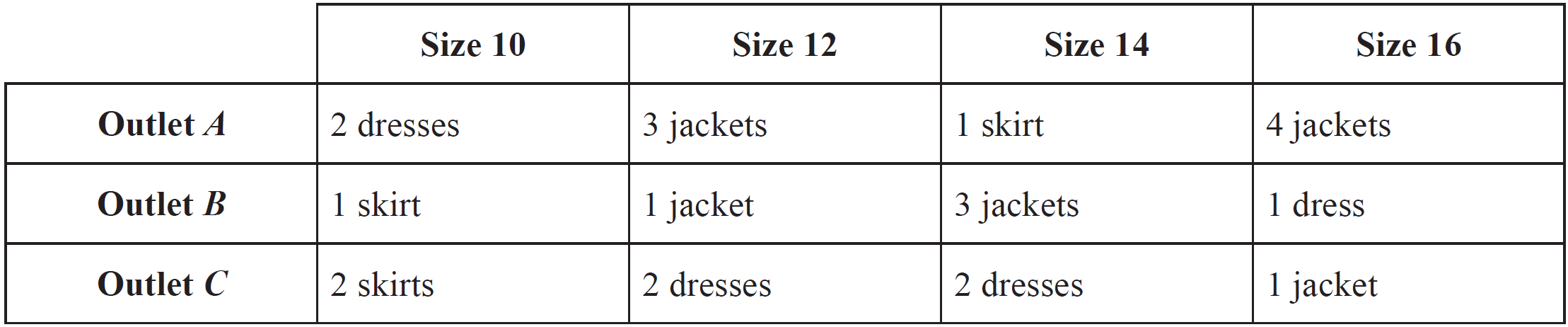
A store has three outlets, A, B and C. These outlets sell dresses, jackets and skirts made by the fashion house Ocki.

The table below lists the number of Ocki dresses, jackets and skirts that are currently held at each outlet.
 

     MATRICES, FUR1 2012 VCAA 7 MC1 
 

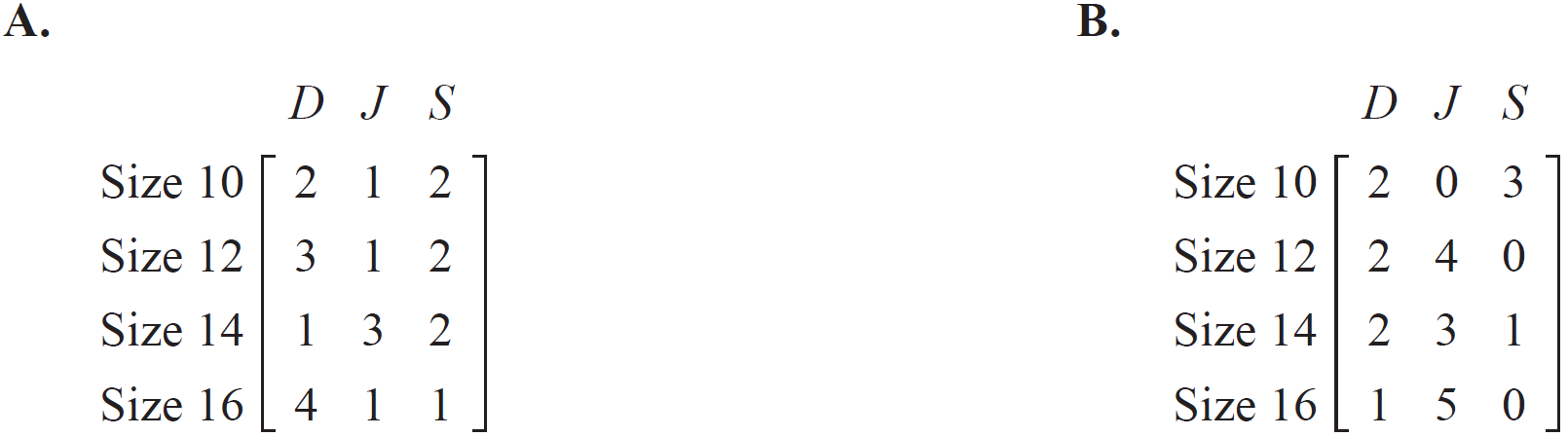
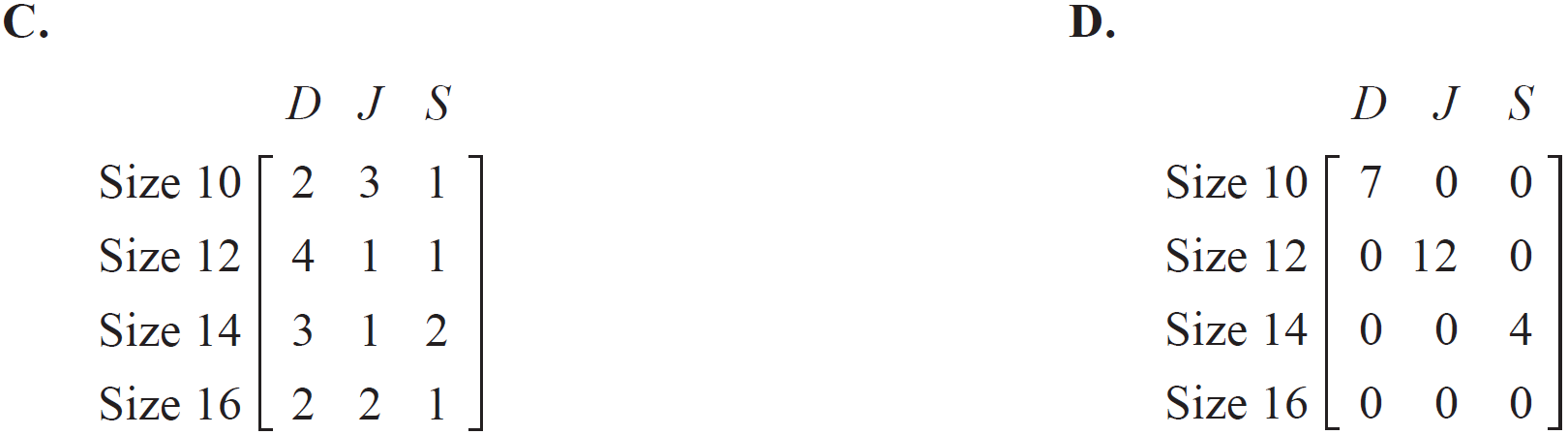
A matrix that shows the total number of Ocki dresses (D), jackets (J) and skirts (S) in each size held at the three outlets is given by
 

MATRICES, FUR1 2012 VCAA 7 MC ab

MATRICES, FUR1 2012 VCAA 7 MC cd

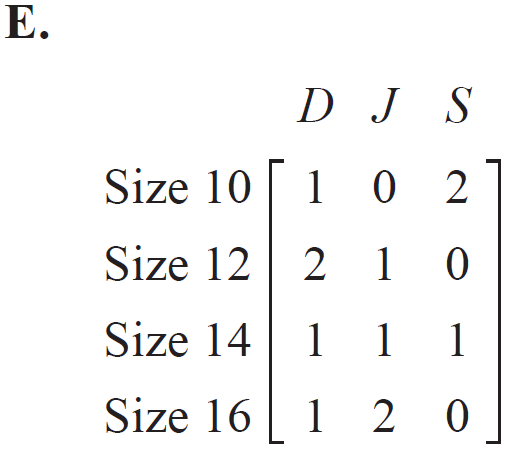
MATRICES, FUR1 2012 VCAA 7 MC e

Show Answers Only

`B`

Show Worked Solution

`text(By consolidating the 3 outlets for the)`

`text(same items in the same size.)`

`rArr B`

Filed Under: Matrix Applications Tagged With: Band 4, smc-619-20-Matrix product from table

MATRICES, FUR1 2012 VCAA 6 MC

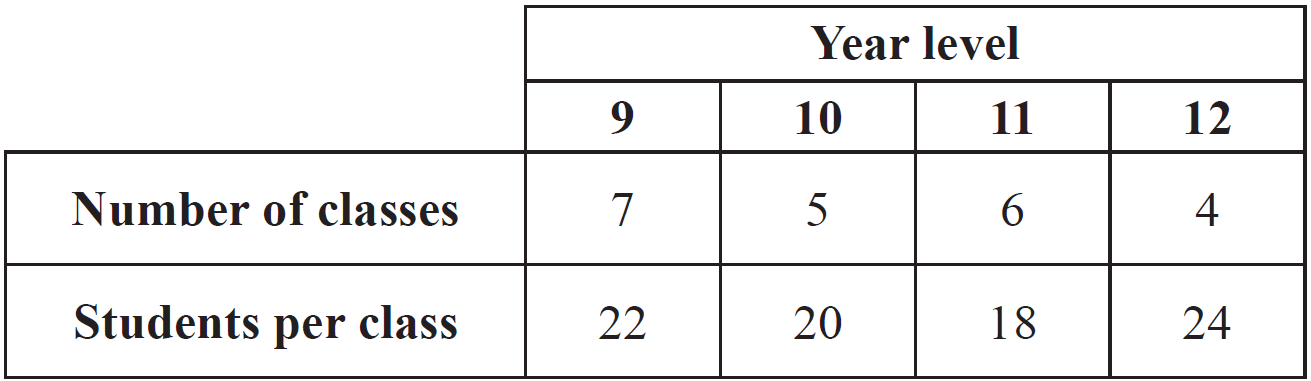
 The table below shows the number of classes and the number of students in each class at each year level in a secondary school.
 

MATRICES, FUR1 2012 VCAA 6 MC1
  

Let   `F= [1 quad 1 quad 1 quad 1], \ G= [(1),(1),(1),(1)],\ M= [7 quad 5 quad 6 quad 4],\ N= [(7),(5),(6),(4)],\ P= [(22,0,0,0), (0,20,0,0), (0,0,18,0), (0,0,0,24)]`
 

A matrix product that displays the total number of students in Years 9 – 12 at this school is

A.   `M xx P xx F`

B.   `P xx G xx M`

C.   `F xx P xx N`

D.   `P xx N xx F`

E.   `F xx N xx P`

Show Answers Only

`C`

Show Worked Solution

`text(Total student matrix will produce)`

`text(a 1 × 1 matrix.)`

`text(Consider)\ C,`

   `F` `xx`  `P` `xx`   `N` `=`      `FPN`
`1 xx 4`    `4 xx 4`     `4 xx 1`        `1 xx 1`


`A, B\ text(and)\ E\ text(produce undefined matrices)`

`text(and)\ D\ text(produces a 4 × 4.)`

`rArr C`

Filed Under: Matrix Applications Tagged With: Band 4, smc-619-20-Matrix product from table, smc-619-30-Matrix product and interpretation

MATRICES, FUR1 2012 VCAA 2 MC

If  `A = [(8,1), (4,2)]`  and  `B= [(3,12),(6,0)],` then the matrix  `AB = [(30,96), (24,48)].`


The element 24 in the matrix  `AB`  is correctly obtained by calculating

A.   `4 × 6 + 2 × 0`

B.   `4 × 3 + 2 × 6`

C.   `3 × 4 + 12 × 1`

D.   `4 × 2 + 8 × 2`

E.   `8 × 3 + 1 × 0`

Show Answers Only

`B`

Show Worked Solution

`[(8,1),(4,2)][(3,12),(6,0)] = [(30,96),(24,48)]`


`e_21\ text(in)\ AB\ text(is calculated.)`

`4 xx 3 + 2 xx 6 = 24`

`rArr B`

Filed Under: Matrix Calculations Tagged With: Band 4, smc-616-30-Matrix Product

MATRICES, FUR1 2013 VCAA 3 MC

 A coffee shop sells three types of coffee, Brazilian (B), Italian (I) and Kenyan (K). The regular customers buy one cup of coffee each per day and choose the type of coffee they buy according to the following transition matrix, `T`.
 

`{:({:qquadqquadqquadtext(choose today):}),(qquadqquadqquad\ BquadqquadIquadqquadK),(T = [(0.8,0.1,0.1), (0,0.8,0.1), (0.2,0.1,0.8)]{:(B), (I), (K):} qquadtext(choose tomorrow)):}`
 

On a particular day, 84 customers bought Brazilian coffee, 96 bought Italian coffee and 81 bought Kenyan coffee.

If these same customers continue to buy one cup of coffee each per day, the number of these customers who are expected to buy each of the three types of coffee in the long term is
 

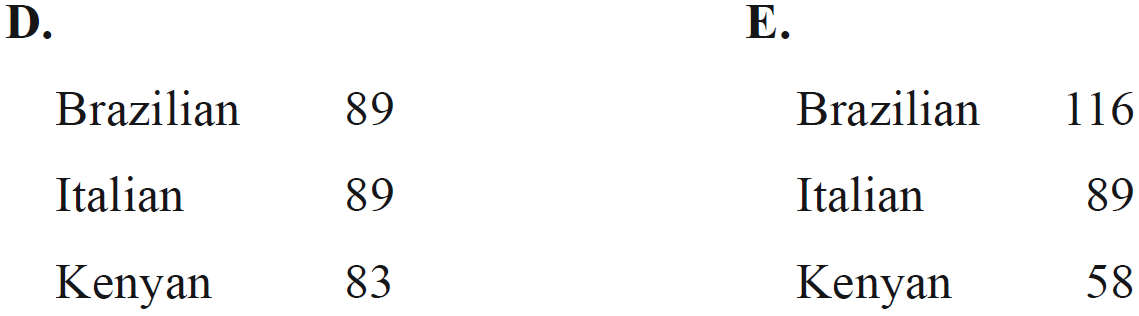
MATRICES, FUR1 2013 VCAA 3 MC abc

MATRICES, FUR1 2013 VCAA 3 MC de

Show Answers Only

`B`

Show Worked Solution

`text(Consider)\ n\ text(large)\ (n= 50),`

`[(B),(I),(K)]` `= [(0.8,0.1,0.1),(0,0.8,0.1),(0.2,0.1,0.8)]^50[(84),(96),(81)]`
  `= [(87),(58),(116)]`

`rArr B`

Filed Under: Transition Matrices - Regular Tagged With: Band 4, smc-618-40-Steady State, smc-618-61-3x3 Matrix

MATRICES, FUR1 2013 VCAA 4 MC

`2.8x + 0.7y` `= 10`
`1.4x + ky` `= 6`

 
The set of simultaneous linear equations above does not have a solution if `k` equals

A.   `– 0.35`

B.   `– 0.250`

C.      `0`

D.      `0.25`

E.      `0.35`

Show Answers Only

`E`

Show Worked Solution

`[(2.8,0.7),(1.4,k)][(x),(y)] = [(10),(6)]`

`text(det) [(2.8,0.7),(1.4,k)] = 2.8k – 0.7 xx 1.4`


`text(No solution if det) = 0,`

`0` `= 2.8k – 0.98`
`k` `= (0.98)/2.8`
  `= 0.35`

`rArr E`

Filed Under: Simultaneous Equations Tagged With: Band 4, smc-617-30-Determinant

MATRICES, FUR1 2014 VCAA 7 MC

A transition matrix, `T`, and a state matrix, `S_2`, are defined as follows.
 

`T=[(0.5,0,0.5),(0.5,0.5,0),(0,0.5,0.5)]\ \ \ \ \ S_2=[(300),(200),(100)]`
 

If  `S_2 = TS_1`, the state matrix  `S_1` is


Show Answers Only

`D`

Show Worked Solution
`TS_1` `= S_2`
 `:. S_1` `= T^-1 S_2`
  `= [(0.5, 0, 0.5), (0.5, 0.5, 0), (0, 0.5, 0.5)]^-1 [(300), (200), (100)]`
  `= [(400), (0), (200)]`

 
`=>D`

Filed Under: Transition Matrices - Regular Tagged With: Band 4, smc-618-30-State Matrix in discrete period, smc-618-61-3x3 Matrix

MATRICES, FUR1 2006 VCAA 8 MC

Australians go on holidays either within Australia or overseas.

Market research shows that

  • 95% of those who had their last holiday in Australia said that their next holiday would be in Australia
  • 20% of those who had their last holiday overseas said that their next holiday would also be overseas.

A transition matrix that could be used to describe this situation is

A.    `[(0.95),(0.20)]` B.    `[(0.95),(0.05)] + [(0.20),(0.80)]`
       
C.    `[(0.95,0.95),(0.20,0.20)]` D.    `[(0.95,0.20),(0.05,0.80)]`   
       
E.    `[(0.95,0.80),(0.05,0.20)]`    


Show Answers Only

`E`

Show Worked Solution

`{:(\ text(last holiday)),(qquad\ AqquadquadO),([(0.95,0.8),(0.05,0.2)]{:(A),(O):}qquadtext(next holiday)):}`

`rArr E`

Filed Under: Transition Matrices - Regular Tagged With: Band 4, M/C

MATRICES, FUR1 2006 VCAA 5 MC

A company makes Regular (`R`), Queen (`Q`) and King (`K`) size beds. Each bed comes in either the Classic style or the more expensive Deluxe style.

The price of each style of bed, in dollars, is listed in a price matrix `P`, where
 

`{:(qquadqquadqquad\ RquadqquadQquadqquadK),(P = [(145, 210, 350), (185, 270, 410)]{: (text (Classic)), (text (Deluxe)) :}):}`
 

The company wants to increase the price of all beds.

A new price matrix, listing the increased prices of the beds, can be generated from `P` by forming a matrix product with the matrix, `M`, where
 

`M = [(1.2,0), (0, 1.35)]`
 

This new price matrix is

MATRICES, FUR1 2006 VCAA 5 MC ab 1

MATRICES, FUR1 2006 VCAA 5 MC cd 1

MATRICES, FUR1 2006 VCAA 5 MC e

Show Answers Only

`D`

Show Worked Solution
`MP` `= [(1.2,0),(0,1.35)][(145,210,350),(185,270,410)]`
  `= [(174,252,420),(249.75,364.50,553.50)]`

 
`rArr D`

Filed Under: Matrix Applications Tagged With: Band 4, smc-619-30-Matrix product and interpretation

MATRICES, FUR1 2007 VCAA 6 MC

A colony of fruit bats feeds nightly at three different locations, `A, B` and `C.`

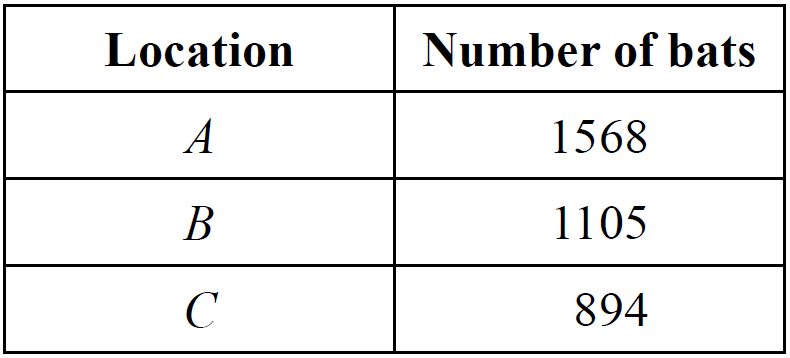
Initially, the number of bats from the colony feeding at each of the locations was as follows.

MATRICES, FUR1 2007 VCAA 6 MC

The bats change feeding locations according to the following transition matrix `T.`

`{:(qquadqquadqquadquadtext(this night)),({:qquadqquadqquad\ A\ qquadBquadqquadC:}),(T = [(0.8, 0.1, 0.2), (0.1, 0.6, 0.1), (0.1, 0.3, 0.7)]{:(A), (B), (C):} quad quad text (next night)):}`


If this pattern of feeding continues, the number of bats feeding at location `A` in the long term will be closest to

A.   `1254`

B.   `1543`

C.   `1568`

D.   `1605`

E.   `1725`

Show Answers Only

`D`

Show Worked Solution

`text(Consider)\ n\ text{large (say}\ n = 50),`

`[(0.8, 0.1, 0.2), (0.1, 0.6, 0.1), (0.1, 0.3, 0.7)]^50[(1568),(1105),(894)]`

`= [(0.45,0.45,0.45),(0.2,0.2,0.2),(0.35,0.35,0.35)][(1568),(1105),(894)]`

`= [(1605.15),(713.4),(1248.45)]`

`=>  D`

Filed Under: Transition Matrices - Regular Tagged With: Band 4

MATRICES, FUR1 2007 VCAA 4 MC

Consider the following system of three simultaneous linear equations.

`2x+z=5`

`x-2y=0`

`y-z=-1`

This system of equations can be written in matrix form as

A.   `[(2, 1), (1, -2), (1, -1)][(x), (y), (z)] = [(5), (0), (-1)]` B.   `[(2,0,1), (1,-2,0), (0,1, -1)][(x), (y), (z)] = [(5), (0), (-1)]`
   
C.   `[(2, 1, 5), (1, -2, 0), (1, -1, -1)][(x), (y), (z)] = [(5), (0), (-1)]` D.   `[(2, 1, 0), (1, -2, 0), (1, -1, 0)][(x), (y), (z)] = [(5), (0), (-1)]`
   
E.   `[(2, 1), (1, -2), (1, -1)][(5), (0), (-1)] = [(x), (y), (z)]`  


Show Answers Only

`B`

Show Worked Solution

`=>  B`

Filed Under: Simultaneous Equations Tagged With: Band 4, smc-617-20-SE to Matrix

MATRICES, FUR1 2007 VCAA 3 MC

If  `A = [(8, 4), (5, 3)]` and the product  `AX = [(5, 6), (8, 10)]`  then `X` is
 

A.   `[(24, -14), (13, -7.5)]` B.   `[(-4.25, -5.5), (9.75, 12.5)]`
   
C.   `[(-3.75, 7), (-6.5, 12)]` D.   `[(25, 11), (-19.5, -8.5)]`
   
E.   `[(0.625, 1.5), (1.6, 3.333)]`  
Show Answers Only

`B`

Show Worked Solution
`AX` `= [(5,6),(8,10)]`
`X` `= [(8,4),(5,3)]^(−1)[(5,6),(8,10)]`
  `= [(0.75,−1),(−1.25,2)][(5,6),(8,10)]`
  `= [(−4.25,−5.5),(9.75,12.5)]`

`=>  B`

Filed Under: Matrix Calculations Tagged With: Band 4, M/C, smc-616-30-Matrix Product

MATRICES, FUR1 2011 VCAA 7 MC

Each night, a large group of mountain goats sleep at one of two locations, `A` or `B`.

On the first night, equal numbers of goats are observed to be sleeping at each location.

From night to night, goats change their sleeping locations according to a transition matrix `T`.

It is expected that, in the long term, more goats will sleep at location `A` than location `B`.

Assuming the total number of goats remains constant, a transition matrix `T` that would predict this outcome is

MATRICES, FUR1 2011 VCAA 7 MC ab

MATRICES, FUR1 2011 VCAA 7 MC cd

MATRICES, FUR1 2011 VCAA 7 MC e

Show Answers Only

`A`

Show Worked Solution

`text(Consider option)\ A,`

`text(20% sleeping at)\ A\ text(move to)\ B\ text(the next night,)`

`text(while 40% sleeping at)\ B\ text(move to)\ A\ text(the next)`

`text(night.)`

`=>A`

Filed Under: Transition Matrices - Regular Tagged With: Band 4, M/C

MATRICES, FUR1 2011 VCAA 4 MC

Matrix `A` is a 3 x 4 matrix.

Matrix `B` is a 3 x 3 matrix.

Which one of the following matrix expressions is defined?

A.   `BA^2`

B.   `BA - 2A`

C.   `A + 2B`

D.   `B^2 - AB`

E.   `A^-1`

Show Answers Only

`B`

Show Worked Solution

`text(Consider)\ B,`

   `B` `xx`  `A` `=`   `BA`
`3 xx 3`    `3 xx 4`     `3 xx 4`
 `:. BA`  `-`     `2Aqquadtext(is defined)`
`3 xx 4`      `3 xx 4`


`text(All other options can be shown)`

`text(to produce undefined matrices.)`

`=> B`

Filed Under: Matrix Calculations Tagged With: Band 4, smc-616-20-Order / (Un)Defined, smc-616-40-Powers/Inverse

MATRICES, FUR1 2011 VCAA 3 MC

Each of the following four matrix equations represents a system of simultaneous linear equations.

`[(1,3),(0,2)] [(x),(y)]=[(4),(8)]`

`[(1,1),(2,2)] [(x),(y)]=[(5),(3)]`

`[(1,0),(0,2)] [(x),(y)]=[(4),(8)]`

`[(0,3),(0,2)] [(x),(y)]=[(6),(12)]`


How many of these systems of simultaneous linear equations have a unique solution?

A.   0

B.   1

C.   2

D.   3

E.   4

Show Answers Only

`C`

Show Worked Solution

`text(Consider the 1st system,)`

`Delta = text(det)[(1,3),(0,2)] = 1 xx 2 – 3 xx 0 = 2 != 0`

`:.\ text(Unique solutions exists)`


`text(Similarly for the other systems, we find)`

`text(that)\ Delta != 0\ text{in two (total).}`

`=> C`

Filed Under: Simultaneous Equations Tagged With: Band 4, smc-617-30-Determinant

MATRICES, FUR1 2014 VCAA 8 MC

Wendy will have lunch with one of her friends each day of this week.

Her friends are Angela (A), Betty (B), Craig (C), Daniel (D) and Edgar (E).

On Monday, Wendy will have lunch with Craig.

Wendy will use the transition matrix below to choose a friend to have lunch with for the next four days of the week.

`{:(qquad qquad qquad qquad qquad text(today)),(\ quad qquad qquad {:(A, B, C, D, E):}),(T = [(0,\ 1,\ 0,\ 0,\ 0), (0,\ 0,\ 0,\ 1,\ 0), (1,\ 0,\ 0,\ 0,\ 0), (0,\ 0,\ 0,\ 0,\ 1), (0,\ 0,\ 1,\ 0,\ 0)] {:(A), (B), (C), (D), (E):} quad text(tomorrow)):}`


The order in which Wendy has lunch with her friends for the next four days is

A.   Angela, Betty, Craig, Daniel

B.   Daniel, Betty, Angela, Craig

C.   Daniel, Betty, Angela, Edgar

D.   Edgar, Angela, Daniel, Betty

E.   Edgar, Daniel, Betty, Angela 

Show Answers Only

`E`

Show Worked Solution

`T xx [(0), (0), (1), (0), (0)] = [(0), (0), (0), (0), (1)] {:(), (), (), (), (E):},\ \ Txx [(0), (0), (0), (0), (1)] = [(0), (0), (0), (1), (0)] {:(), (), (), (D), ():}`

`T xx [(0), (0), (0), (1), (0)] = [(0), (1), (0), (0), (0)] {:(), (B), (), (), ():},\ \ Txx [(0), (1), (0), (0), (0)] = [(1), (0), (0), (0), (0)] {:(A), (), (), (), ():}`


`:.\ text(The order is)\ EDBA`

`=>E` 

Filed Under: Transition Matrices - Regular Tagged With: Band 4

MATRICES, FUR1 2014 VCAA 5 MC

Students from Year 7 and Year 8 in a school sold trees to raise funds for a school trip.

The number of large, medium and small trees that were sold by each year group is shown in the table below.

The large trees were sold for $32 each, the medium trees were sold for $26 each and the small trees were sold for $18 each.

A matrix product that can be used to calculate the amount, in dollars, raised by each year group by selling trees is

VCAA MATRICES FUR1 2014 5aii

VCAA MATRICES FUR1 2014 5aiii

Show Answers Only

`C`

Show Worked Solution

`=>C`

Filed Under: Matrix Applications Tagged With: Band 4, M/C

MATRICES, FUR2 2015 VCAA 3

A new model for the number of students in the school after each assessment takes into account the number of students who are expected to leave the school after each assessment.

After each assessment, students are classified as beginner (`B`), intermediate (`I`), advanced (`A`) or left the school (`L`).

Let matrix `T_2` be the transition matrix for this new model.

Matrix `T_2`, shown below, contains the percentages of students who are expected to change their ability level or leave the school after each assessment.
  

`{:(qquadqquadqquadquadtext(before assessment)),(qquadqquadqquadquad{:(B,\ qquadI,qquadA,quadL):}),(T_2 = [(0.30,0,0,0),(0.40,0.70,0,0),(0.05,0.20,0.75,0),(0.25,0.10,0.25,1)]{:(B),(I),(A),(L):}qquadtext(after assessment)):}`

  1. An incomplete transition diagram for matrix `T_2` is shown below.
  2. Complete the transition diagram by adding the missing information.   (2 marks)

    --- 0 WORK AREA LINES (style=lined) ---


    Matrices, FUR2 2015 VCAA 3

The number of students at each level, immediately before the first assessment of the year, is shown in matrix `R_0` below.

`R_0 = [(20),(60),(40),(0)]{:(B),(I),(A),(L):}`

Matrix `T_2`, repeated below, contains the percentages of students who are expected to change their ability level or leave the school after each assessment.

`{:(qquadqquadqquadquadtext(before assessment)),(qquadqquadqquadquad{:(B,\ qquadI,qquadA,quadL):}),(T_2 = [(0.30,0,0,0),(0.40,0.70,0,0),(0.05,0.20,0.75,0),(0.25,0.10,0.25,1)]{:(B),(I),(A),(L):}qquadtext(after assessment)):}`

  1. What percentage of students is expected to leave the school after the first assessment?   (1 mark)

    --- 2 WORK AREA LINES (style=lined) ---

  2. How many advanced-level students are expected to be in the school after two assessments.
  3. Write your answer correct to the nearest whole number.   (1 mark)

    --- 4 WORK AREA LINES (style=lined) ---

  4. After how many assessments is the number of students in the school, correct to the nearest whole number, first expected to drop below 50?   (1 mark)

    --- 3 WORK AREA LINES (style=lined) ---

Another model for the number of students in the school after each assessment takes into account the number of students who are expected to join the school after each assessment.

Let `R_n` be the state matrix that contains the number of students in the school immediately after `n` assessments.

Let `V` be the matrix that contains the number of students who join the school after each assessment. 

Matrix `V` is shown below.

`V = [(4),(2),(3),(0)]{:(B),(I),(A),(L):}`

The expected number of students in the school after `n` assessments can be determined using the matrix equation

`R_(n + 1) = T_2 xx R_n + V`

where

`R_0 = [(20),(60),(40),(0)]{:(B),(I),(A),(L):}`
 

  1. Consider the intermediate-level students expected to be in the school after three assessments.
  2. How many are expected to become advanced-level students after the next assessment?
  3. Write your answer correct to the nearest whole number.   (2 marks)

    --- 6 WORK AREA LINES (style=lined) ---

Show Answers Only
  1.  
  2. `17.5 text(%)`
  3. `43`
  4. `5`
  5. `7`
Show Worked Solution
a.   


b.   `T_2 R_0` `= [(0.3, 0, 0, 0), (0.4, 0.7, 0, 0), (0.05, 0.2, 0.75, 0), (0.25, 0.1, 0.25, 1)] [(20), (60), (40), (0)]= [(6), (50), (43), (21)]`

 
`:.\ text(Percentage that leave school)`

♦♦ Mean mark of parts (b)-(e) was 32%.

`= 21/120`

`= 17.5 text(%)`
 

c.   `text(After 2 assessments,)`

`(T_2)^2 R_0` `= [(0.3, 0, 0, 0), (0.4, 0.7, 0, 0), (0.05, 0.2, 0.75, 0), (0.25, 0.1, 0.25, 1)]^2 [(20), (60), (40), (0)]=[(1.8), (37.4), (42.55), (38.25)]`

 
`:.\ text(43 advanced-level students expected to remain.)`
 

d.   `text(After 4 assessments,)`

`(T_2)^4 R_0\ text(shows 54 students left)`

`text(After 5 assessments,)`

`(T_2)^5 R_0\ text(shows 43 students left.)`

`:.\ text(Numbers drop below 50 after 5 assessments.)`
 

MARKER’S COMMENT: Understand why the common error `R_3 =` `(T_2)^3R_0 + V` is incorrect!
e.   `R_1` `= T_2 R_0 + V`
    `= [(6), (50), (43), (21)] + [(4), (2), (3), (0)] = [(10), (52), (46), (21)]`
  `R_2` `= [(0.30, 0, 0, 0), (0.40, 0.70, 0, 0), (0.05, 0.20, 0.75, 0), (0.25, 0.10, 0.25, 1)] [(10), (52), (46), (21)] + [(4), (2), (3), (0)] = [(7), (42.4), (48.4), (40.2)]`
   `R_3` `= [(0.30, 0, 0, 0), (0.40, 0.70, 0, 0), (0.05, 0.20, 0.75, 0), (0.25, 0.10, 0.25, 1)] [(7), (42.4), (48.4), (40.2)] + [(4), (2), (3), (0)] = [(6.1), (34.48), (48.13), (58.29)]`


`:.\ text(After 3 assessments, the number expected to)`

`text(move from Intermediate to Advanced)`

`= 20text(%) xx 34.48`

`= 6.896`

`= 7\ text{students  (nearest whole)}`

Filed Under: Transition Matrices - Regular Tagged With: Band 4, Band 5, Band 6

MATRICES, FUR2 2012 VCAA 3

When a new industrial site was established at the beginning of 2011, there were 350 staff at the site. 

The staff comprised 100 apprentices (`A`), 200 operators (`O`) and 50 professionals (`P`). 

At the beginning of each year, staff can choose to stay in the same job, move to a different job at the site or leave the site (`L`).

The number of staff in each category at the beginning of 2011 is given in the matrix

`S_2011 = [(100), (200), (50), (0)]{:(A), (O), (P), (L):}`

The transition diagram below shows the way in which staff are expected to change their jobs at the site each year.

Matrices, FUR2 2012 VCAA 3

  1. How many staff at the site are expected to be working in their same jobs after one year?   (1 mark)

    --- 2 WORK AREA LINES (style=lined) ---

The information in the transition diagram has been used to write the transition matrix `T`.

`{:(qquad qquad qquad qquad qquad qquad text(this year)),((qquad qquad qquad\ A, qquad O, qquad P, qquad L)),(T = [(0.70, 0, 0, 0),(0.10, 0.80, 0, 0), (0, 0.10, 0.90, 0), (0.20, 0.10, 0.10, 1.00)]):} {:(), (), (A), (O), (P), (L):} {:(), (), (qquad text(next year)):}`

  1. Explain the meaning of the entry in the fourth row and fourth column of transition matrix `T`.   (1 mark)

    --- 2 WORK AREA LINES (style=lined) ---

If staff at the site continue to change their jobs in this way, the matrix `S_n` will contain the number of apprentices (`A`), operators (`O`), professionals (`P`) and staff who leave the site (`L`) at the beginning of the `n`th year.

  1. Use the rule  `S_(n + 1) = TS_n`  to find


    1. `S_2012`   (1 mark)

      --- 3 WORK AREA LINES (style=lined) ---

    2. the expected number of operators at the site at the beginning of 2013   (1 mark)

      --- 2 WORK AREA LINES (style=lined) ---

    3. the beginning of which year the number of operators at the site first drops below 30   (1 mark)

      --- 4 WORK AREA LINES (style=lined) ---

    4. the total number of staff at the site in the longer term.   (1 mark)

      --- 3 WORK AREA LINES (style=lined) ---

Suppose the manager decides to bring 30 new apprentices, 20 new operators and 10 new professionals to the site at the beginning of each year.

The matrix `S_(n + 1)` will then be given by

`S_(n + 1) = T S_n + A`   where   `S_2011 = [(100), (200), (50), (0)] {:(A), (O), (P), (L):}`   and   `A = [(30), (20), (10), (0)] {:(A), (O), (P), (L):}`

  1. Find the expected number of operators at the site at the beginning of 2013.   (2 marks) 

    --- 6 WORK AREA LINES (style=lined) ---

Show Answers Only
  1. `275`
  2. `text(Any worker who has left the)`
    `text(site will not return.)`
    1. `[(70), (170), (65), (45)]`
    2. `143`
    3. `2021`
    4. `0`
  3. `182`
Show Worked Solution

a.  `text(Same jobs after 1 year)`

♦ Mean mark for parts (a)-(d) (combined) was 37%.

`= 0.7 xx 100 + 0.8 xx 200 + 0.9 xx 50`

`= 275`
 

b.    `text(Any worker who has left the site will not return.)`

MARKER’S COMMENT: Most students couldn’t explain the meaning of the 1.0 figure in this context.


c.i.   `S_2012` `= T S_2011`
    `= [(0.70, 0, 0, 0), (0.10, 0.80, 0, 0), (0, 0.10, 0.90, 0), (0.20, 0.10, 0.10, 1.00)] [(100), (200), (50), (0)]`
    `= [(70),(150),(65),(45)]`


c.ii.   `S_2013` `= T S_2012`
    `= [(49), (143), (75.5), (82.5)]`

 
`:.\ text(143 operators are expected at the site at the start of 2013.)`
 

c.iii.   `S_2020` `= T^9 S_2011`
    `= [(0.70, 0, 0, 0), (0.10, 0.8, 0, 0), (0, 0.10, 0.90, 0), (0.20, 0.10, 0.10, 1.00)]^9 [(100), (200), (50), (0)] = [(4), (36.2), (78), (231.8)]`
  `S_2021` `= T^10 S_2011`
    `= [(2.8), (29.4), (73.8), (244)]`


`:.\ text(At the start of 2021, the number of operators drops below 30.)`

MARKER’S COMMENT: “In the 10th year” recieved no marks – make sure you answer with specific years when actual years are used.

 
c.iv.
  `text(Consider)\ n\ text(large:)`

`T^100 S_2011 = [(0), (0), (0), (350)]`

`:.\ text(NO staff remain at the site in the long term.)`
 

d.   `S_2012` `= T S_2011 + A`
    `= [(0.70, 0, 0, 0), (0.10, 0.80, 0, 0), (0, 0.10, 0.90, 0), (0.20, 0.10, 0.10, 1.00)] [(100), (200), (50), (0)] + [(30), (20), (10), (0)]= [(100), (190), (75), (45)]`
     
  `S_2013` `= T S_2012 + A`
    `= [(0.70, 0, 0, 0), (0.10, 0.80, 0, 0), (0, 0.10, 0.90, 0), (0.20, 0.10, 0.10, 1.00)] [(100), (190), (75), (45)] + [(30), (20), (10), (0)]= [(100), (182), (96.5), (91.5)]`
MARKER’S COMMENT: A common error was  `S_2013“=T^2S_2011“+A`. Know why this is not correct!


`:.\ text(182 operators are expected on site at the )`

`text(start of 2013.)`

Filed Under: Transition Matrices - Regular Tagged With: Band 4, Band 5, Band 6

MATRICES, FUR2 2008 VCAA 2

The following transition matrix, `T`, is used to help predict class attendance of History students at the university on a lecture-by-lecture basis.

`{:(qquad qquad qquad text(this lecture)),(qquad qquad text(attend    not attend)),(T = [(0.90 qquad,0.20),(0.10 qquad,0.80)]{:(text(attend)),(text(not attend)):}{:qquad text(next lecture):}):}`  

`S_1` is the attendance matrix for the first History lecture.

`S_1 = [(540),(36)]{:(text(attend)),(text(not attend)):}`

`S_1` indicates that 540 History students attended the first lecture and 36 History students did not attend the first lecture.

  1. Use `T` and `S_1` to


    1. determine `S_2` the attendance matrix for the second lecture.   (1 mark)

      --- 2 WORK AREA LINES (style=lined) ---

    2. predict the number of History students attending the fifth lecture.   (1 mark)

      --- 3 WORK AREA LINES (style=lined) ---

  2. Write down a matrix equation for `S_n` in terms of `T`, `n` and `S_1`.   (1 mark)

    --- 1 WORK AREA LINES (style=lined) ---

The History lecture can be transferred to a smaller lecture theatre when the number of students predicted to attend falls below 400.

  1. For which lecture can this first be done?   (1 mark)

    --- 3 WORK AREA LINES (style=lined) ---

  2. In the long term, how many History students are predicted to attend lectures?   (1 mark)

    --- 3 WORK AREA LINES (style=lined) ---

Show Answers Only
    1. `[(493.2),(82.8)]`
    2. `421`
  1. `S_n = T^(n-1)S_1`
  2. `text(8th lecture)`
  3. `384`
Show Worked Solution
a.i.   `S_2` `= TS_1`
    `= [(0.9, 0.2), (0.1, 0.8)] [(540), (36)]`
    `= [(493.2), (82.8)]`


  ii.   `S_5` `= TS_4`
    `= [(0.9, 0.2), (0.1, 0.8)]^4 [(540), (36)]`
    `= [(421.46), (154.54)]`

 
`:. 421\ text(History students attend the 5th lecture.)`

 
b.
  `S_n = T^(n-1)S_1`
 

c.   `S_8 = [(396.847),(179.15)]`
 

`:.\ text(The 8th lecture is predicted to be the 1st one)`

`text(with less than 400 students.)`
 

d.   `text(Consider)\ n = 51 and n = 52:`

`S_51 = T^50 S_1 = [(384.00), (191.99)]`

`S_52 = T^51 S_1 = [(384.00), (191.99)]`
 

`:. 384\ text(students are predicted to attend in the long run.)`

Filed Under: Transition Matrices - Regular Tagged With: Band 4, Band 5

GRAPHS, FUR2 2012 VCAA 3

A company repairs phones and laptops.

Let  `x` be the number of phones repaired each day

 `y` be the number of laptops repaired each day.

It takes 35 minutes to repair a phone and 50 minutes to repair a laptop. 

The constraints on the company are as follows.

Constraint 1    `x ≥ 0`

Constraint 2    `y ≥ 0`

Constraint 3    `35x + 50y ≤ 1750`

Constraint 4    `y ≤ 4/5 x`

  1. Explain the meaning of Constraint 3 in terms of the time available to repair phones and laptops.  (1 mark)
  2. Constraint 4 describes the maximum number of phones that may be repaired relative to the number of laptops repaired.


    Use this constraint to complete the following sentence.


    For every ten phones repaired, at most _______ laptops may be repaired.  (1 mark)

The line `y = 4/5 x` is drawn on the graph below.

GRAPHS, FUR2 2012 VCAA 3

  1. Draw the line  `35x + 50y = 1750`  on the graph.  (1 mark)
  2. Within Constraints 1 to 4, what is the maximum number of laptops that can be repaired each day?  (1 mark)
  3. On a day in which exactly nine laptops are repaired, what is the maximum number of phones that can be repaired?  (1 mark)

The profit from repairing one phone is $60 and the profit from repairing one laptop is $100.

    1. Determine the number of phones and the number of laptops that should be repaired each day in order to maximise the total profit.  (2 marks)
    2. What is the maximum total profit per day that the company can obtain from repairing phones and laptops?  (1 mark) 
Show Answers Only
  1. `text(Max total repair time is 1750 minutes.)`
  2. `8`
  3. `text(See Worked Solutions)`
  4. `18`
  5. `37`
    1. `(24,18)`
    2. `$3240`
Show Worked Solution

a.   `text(Constraint 3 means that the maximum time)`

`text(available to repair phones and laptops is 1750)`

`text(minutes on any given day.)`


b.   `y <= 4/5x`

`text(When)\ x = 10,`

`y` `<= 4/5 xx 10`
  `<= 8`

 `:.\ text(At most, 8 laptops may be repaired)`


c.    GRAPHS, FUR2 2012 VCAA 3 Answer


d.   `text(From the graph, the highest number)`

♦♦ Mean mark of parts (c) – (f) combined was 32%.

`text(of laptops below the intersection)`

`text{(in the feasible region) is 18.}`


e.   `text(When)\ y = 9,\ text(constraint 3 requires)`

`35x + (50 xx 9)` `<= 1750`
`35x` `<= 1300`
`:. x` `<= 37.14…`


`:.\ text(The maximum number of phones = 37.)`


f.i.   `text(Profit)\ = 60x + 100y`

`text(In the feasible region, maximum)`

`text(profits occur at the intersection.)`

`:. 18\ text(laptops)`

`text(When)\ y = 18,\ text(constraint 3 requires)`

`35x + (50 xx 18)` `<= 1750`
`35x` `<= 850`
`x` `<= 24.28…`


`:. text(Maximum profit occurs at)\ (24,18)` 


f.ii.   `text(Maximum daily profit)`

`= 60 xx 24 + 100 xx 18`

`= $3240`

Filed Under: Linear Programming Tagged With: Band 4, Band 5, Band 6

GRAPHS, FUR2 2012 VCAA 1

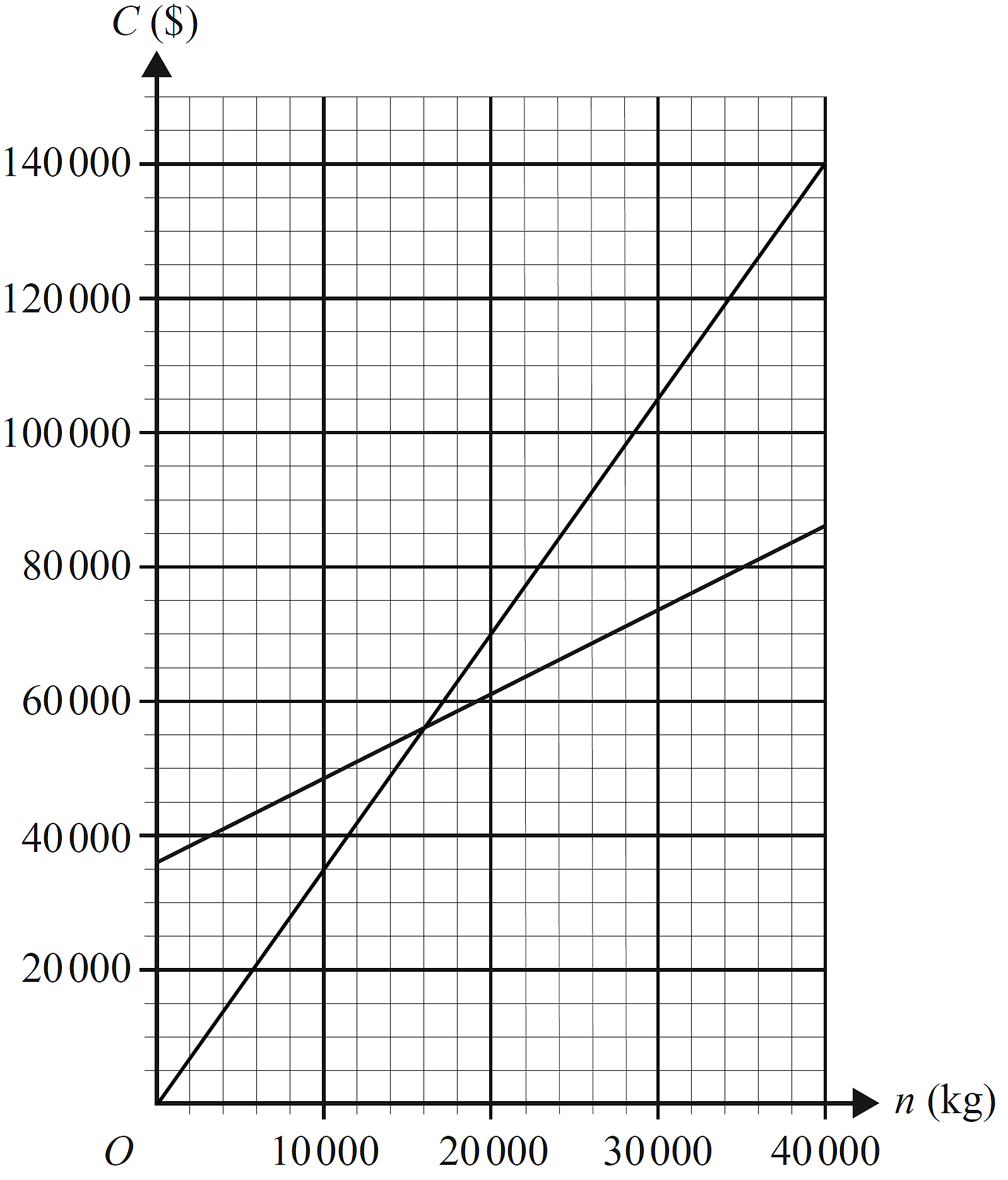
The cost, `C`, in dollars, of making `n` phones, is shown by the line in the graph below.

GRAPHS, FUR2 2012 VCAA 1

    1. Calculate the gradient of the line, `C`, drawn above.  (1 mark)
    2. Write an equation for the cost, `C`, in dollars, of making `n` phones.  (1 mark)

  1. The revenue, `R`, in dollars, obtained from selling `n` phones is given by  `R = 150n`.

    1. Draw this line on the graph above.  (1 mark)
    2. How many phones would need to be sold to obtain $54 000 in revenue?  (1 mark)
  2. Determine the number of phones that would need to be made and sold to break even.  (1 mark) 
Show Answers Only
    1. `50`
    2. `C = 20\ 000 + 50n`
    1. `text(See Worked Solutions)`
    2. `360`
  1. `200`
Show Worked Solution

a.i.   `text{Using (0, 20 000) and (300, 35 000)}`

`text(Gradient)` `= (y_2 – y_1)/(x_2 – x_1)`
  `= (35\ 000 – 20\ 000)/(300 – 0)`
  `= 50`


a.ii.   `C = 50n + 20\ 000`


b.i.    GRAPHS, FUR2 2012 VCAA 1 Answer


b.ii.    `54\ 000` `= 150n`
  `:. n` `= (54\ 000)/150`
    `= 360`

`:. 360\ text(planes need to be sold.)`


c.   `text(Breakeven occurs when)`

`text(Revenue)` `=\ text(C)text(osts)`
`150n` `= 50n + 20\ 000`
`100n` `= 20\ 000`
`:. n` `= 200\ text(phones)`

Filed Under: Linear relationships Tagged With: Band 2, Band 3, Band 4

GEOMETRY, FUR2 2012 VCAA 4

`OABCD` has three triangular sections, as shown in the diagram below. 

Triangle `OAB` is a right-angled triangle. 

Length `OB` is 10 m and length `OC` is 14 m. 

Angle `AOB` = angle `BOC` = angle `COD` = 30°
 

Geometry and trigonometry, FUR2 2012 VCAA 4
 

  1. Calculate the length, `OA`.


    Write your answer, in metres, correct to two decimal places.  (1 mark)

  2. Determine the area of triangle `OAB`.


    Write your answer, in m², correct to one decimal place.  (1 mark)

  3. Triangles `OBC` and `OCD` are similar.


    The area of triangle `OBC` is 35 m².


    Find the area of triangle `OCD`, in m².  (2 marks)

  4. Determine angle `CDO`.


    Write your answer, correct to the nearest degree.  (2 marks)

Show Answers Only
  1. `8.66\ text{m  (2 d.p.)}`
  2. `21.7\ text{m²  (1 d.p.)}`
  3. `68.6\ text(m²)`
  4. `43^@\ \ text{(nearest degree)}`
Show Worked Solution

a.   `text(In)\ DeltaOAB,`

`cos30^@` `= (OA)/10`
`:. OA` `= 10 xx cos30`
  `= 8.660…`
  `= 8.66\ text{m  (2 d.p.)}`


b.   `text(Using the sine rule,)`

`text(Area)\ DeltaAOB` `= 1/2 ab sinC`
  `= 1/2 xx 8.66 xx 10 xx sin30^@`
  `= 21.65…`
  `= 21.7\ text{m²  (1 d.p.)}`


c.   `text(Linear scale factor) = 14/10 = 1.4`

`:. (text(Area)\ DeltaOCD)/(text(Area)\ DeltaOBC)` `= 1.4^2`
   
`:. text(Area)\ DeltaOCD` `= 35 xx 1.4^2`
  `= 68.6\ text(m²)`


d.   `text(In)\ DeltaBCO,`

`BC^2` `= 10^2 + 14^2 – 2 xx 10 xx 14 xx cos30^@`
  `= 53.51…`
`:. BC` `= 7.315…\ text(m)`


`text(Using the sine rule in)\ DeltaBCO,`

`(sin angleBCO)/10` `= (sin30^@)/(BC)`
`sin angleBCO` `= (10 xx sin30)/(7.315…)`
  `= 0.683…`
`:. angleBCO` `= 43.11^@`


`text(S)text(ince)\ DeltaBCO\ text(|||)\ DeltaCDO,`

`angleCDO` `= angleBCO`
  `= 43^@\ \ text{(nearest degree)}`

Filed Under: Similarity and Scale, Trig - Harder Applications Tagged With: Band 3, Band 4, Band 5, smc-606-30-Factors k / k^2 / k^3

GEOMETRY, FUR2 2012 VCAA 3

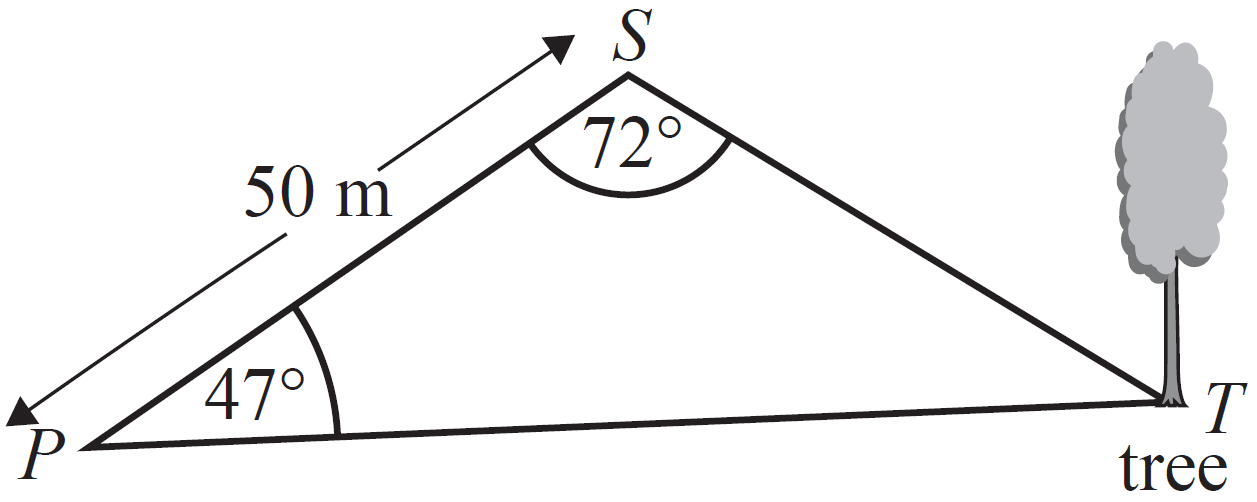
A tree is growing near the block of land.

The base of the tree, `T`, is at the same level as the corners, `P` and `S`, of the block of land.
 

Geometry and trigonometry, FUR2 2012 VCAA 3
 

  1. Show that, correct to two decimal places, distance `ST` is 41.81 metres.  (1 mark)
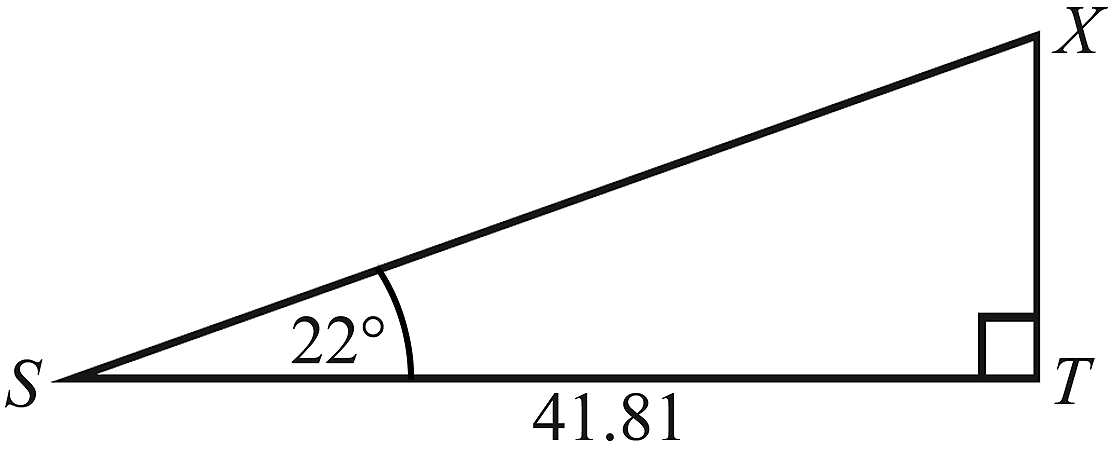
  2. From point `S`, the angle of elevation to the top of the tree is 22°.


    Calculate the height of the tree.


    Write your answer, in metres, correct to one decimal place.  (1 mark) 

Show Answers Only
  1. `text(See Worked Solutions)`
  2. `16.9\ text(m)`
Show Worked Solution
a.    `∠STP` `= 180 − (72 + 47)`
    `= 61^@`


`text(Using the sine rule:)`

`(ST)/(sin47^@)` `= 50/(sin61^@)`
`ST` `= (50 xx sin47^@)/(sin61^@)`
  `= 41.809…`
  `= 41.81\ text{m  (to 2 d.p.)  … as required}`


b.   `text(Let)\ \ X\ text(be the top of the tree)`

♦♦ Exact data unavailable although this part was highlighted as “very poorly answered”.

 
GEOMETRY, FUR2 2012 VCAA 3 Answer

`text(In)\ DeltaSXT, XT\ text(is height of tree.)`

`tan22^@` `= (XT)/(41.81)`
`:. XT` `= 41.81 xx tan22^@`
  `= 16.892…`
  `= 16.9\ text{m  (1 d.p.)}`

Filed Under: Non-Right-Angled Trig Tagged With: Band 4, Band 5, smc-3589-10-Sine rule

GEOMETRY, FUR2 2012 VCAA 1

A rectangular block of land has width 50 metres and length 85 metres.

  1. Calculate the area of this block of land.


    Write your answer in m².  (1 mark)

In order to build a house, the builders dig a hole in the block of land.

The hole has the shape of a right-triangular prism, `ABCDEF`.

The width `AD` = 20 m, length `DC` = 25 m and height `EC` = 4 m are shown in the diagram below.

GEOMETRY, FUR2 2012 VCAA 11

  1. Calculate the volume of the right-triangular prism, `ABCDEF`.


    Write your answer in m³.  (1 mark)

Once the right-triangular prism shape has been dug, a fence will be placed along the two sloping edges, `AF` and `DE`, and along the edges `AD` and `FE`.

Geometry and trigonometry, FUR2 2012 VCAA 1_2

  1. Calculate the total length of fencing that will be required. 


    Write your answer, in metres, correct to one decimal place.  (1 mark)

Show Answers Only
  1. `4250\ text(m²)`
  2. `1000\ text(m³)`
  3. `90.6\ text(m)`
Show Worked Solution
a.    `text(Area)` `= 50 xx 85`
    `= 4250\ text(m²)`


b.    `V` `= Ah`
   `A` `= 1/2 xx 4 xx 25`
    `= 50\ text(m²)`


`:. V` `= 50 xx 20`
  `= 1000\ text(m³)`


c.   `text(Using Pythagoras in)\ DeltaECD,`

GEOMETRY, FUR2 2012 VCAA 1

`ED` `= sqrt(25^2 + 4^2)`
  `= sqrt(641)`
  `= 25.317…`


MARKER’S COMMENT: A poorly done question with many students failing to include the two 20 metre sections of fencing.

`:.\ text(Total length of fencing)`

`= 2 xx 20 + 2 xx 25.317…`

`= 90.635…`

`= 90.6\ text(m)`

Filed Under: Perimeter, Area and Volume Tagged With: Band 3, Band 4

CORE*, FUR2 2013 VCAA 3

Hugo paid $7500 for a second bike under a hire-purchase agreement.

A flat interest rate of 8% per annum was charged.

He will fully repay the principal and the interest in 24 equal monthly instalments.

  1. Determine the monthly instalment that Hugo will pay.


    Write your answer in dollars, correct to the nearest cent.   (2 marks)

    --- 5 WORK AREA LINES (style=lined) ---

  2. Find the effective rate of interest per annum charged on this hire-purchase agreement.


    Write your answer as a percentage, correct to two decimal places.   (1 mark)

    --- 3 WORK AREA LINES (style=lined) ---

  3. Explain why the effective interest rate per annum is higher than the flat interest rate per annum.   (1 mark)

    --- 1 WORK AREA LINES (style=lined) ---

  4. The value of his second bike, purchased for $7500, will be depreciated each year using the reducing balance method of depreciation.


    One year after it was purchased, this bike was valued at $6375.


    Determine the value of the bike five years after it was purchased. 


    Write your answer, correct to the nearest dollar.   (2 marks)

    --- 6 WORK AREA LINES (style=lined) ---

Show Answers Only
  1. `$362.50`
  2. `15.36text(%)`
  3. `text(Simple interest does not take the)`
    `text(reducing balance over the life)`
    `text(of the loan into account.)`
  4. `$3328\ \ text{(nearest dollar)}`
Show Worked Solution
a.    `text(Total interest)` `= (PrT)/100`
    `= (7500 xx 8 xx 2)/100`
    `= $1200`
`:.\ text(Total to repay)` `= 7500 + 1200`
  `= $8700`
`:.\ text(Repayments)` `= 8700/24`
  `= $362.50`


♦ Mean mark of all parts combined was 37%.
b.    `text(Effective Rate)` `= (2n)/(n + 1) xx text(flat rate)`
    `= (2 xx 24)/(24 + 1) xx 8`
    `= 15.36text(%)`

  
c.
   `text(Simple interest does not take the reducing)`

`text(balance over the life of the loan into account.)`
  

d.    `text(Depreciation Rate)` `= 1-6375/7500`
    `= 0.15`
    `= 15text(%)`

`:.\ text(Value after 5 years)`

`= 7500 (1-0.15)^5`

`= 7500(0.85)^5`

`= 3327.789…`

`= $3328\ \ text{(nearest dollar)}`

Filed Under: Borrowing and Loans, Depreciation Tagged With: Band 4, Band 5, Band 6, smc-602-20-Reducing balance, smc-603-30-Hire purchase

CORE*, FUR2 2013 VCAA 2

Hugo won $5000 in a road race and invested this sum at an interest rate of 4.8% per annum compounding monthly.

  1. What is the value of Hugo’s investment after 12 months?
  2. Write your answer in dollars, correct to the nearest cent.   (1 mark)

    --- 4 WORK AREA LINES (style=lined) ---

    1. Suppose instead that at the end of each month Hugo added $200 to his initial investment of $5000.
    2. Find the value of this investment immediately after the 12th monthly payment of $200 is made.
    3. Write your answer in dollars, correct to the nearest cent.   (1 mark)

      --- 1 WORK AREA LINES (style=lined) ---

    4. Assume Hugo follows the investment that is described in part b.i.
    5. Determine the total interest he would earn over the 12-month period.
    6. Write your answer in dollars, correct to the nearest cent.   (1 mark)

      --- 4 WORK AREA LINES (style=lined) ---

Show Answers Only

  1. `$5245.35`
    1. `$7698.86`
    2. `$298.86`

Show Worked Solution

a.   `text(Monthly interest rate)`

♦ Mean mark for all parts combined was 39%.

`= 4.8/12`

`= 0.4text(%)`
 

`:.\ text(Value after 12 months)`

`= 5000(1 + 0.4/100)^12`

`= 5000(1.004)^12`

`= 5245.351…`

`= $5245.35\ \ text{(nearest cent)}`


b.i.   `text(Using TVM Solver,)`

`N` `= 12`
`I(text(%))` `= 4.8`
`PV` `=-5000`
`PMT` `=-200`
`FV` `= ?`
`text(P/Y)` `= text(C/Y) = 12`


`FV = 7698.8614…`

`:. text(Value of interest) = $7698.86`


b.ii.   `text(Total interest)`

`=\ text{Final value − (original + payments)}`

`= 7698.86-(5000 + 12 xx 200)`

`= 7698.86-7400`

`= $298.86`

Filed Under: Annuities and Perpetuities Tagged With: Band 4, Band 5, smc-2512-10-Annuity, smc-2512-50-CAS solver

CORE*, FUR2 2013 VCAA 1

Hugo is a professional bike rider.

The value of his bike will be depreciated over time using the flat rate method of depreciation.

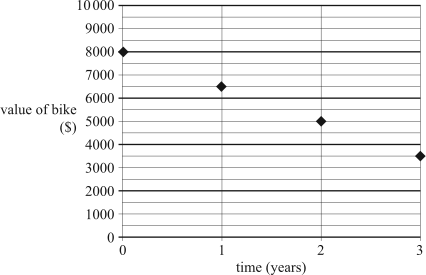
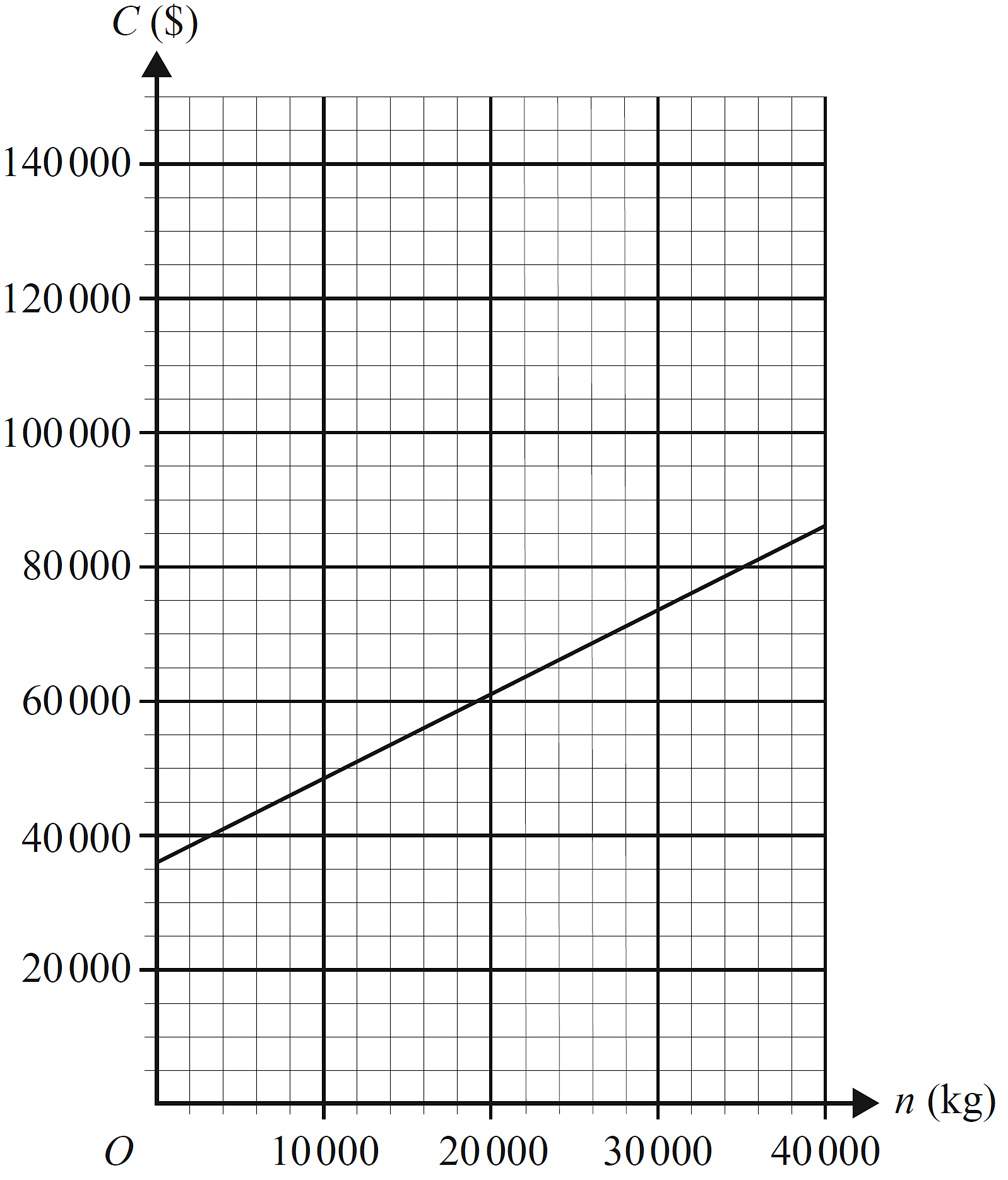
The graph below shows his bike’s initial purchase price and its value at the end of each year for a period of three years.
 

  1. What was the initial purchase price of the bike?   (1 mark)

    --- 1 WORK AREA LINES (style=lined) ---

    1. Show that the bike depreciates in value by $1500 each year.   (1 mark)

      --- 3 WORK AREA LINES (style=lined) ---

    2. Assume that the bike’s value continues to depreciate by $1500 each year.
    3. Determine its value five years after it was purchased.   (1 mark)

      --- 4 WORK AREA LINES (style=lined) ---

The unit cost method of depreciation can also be used to depreciate the value of the bike.

In a two-year period, the total depreciation calculated at $0.25 per kilometre travelled will equal the depreciation calculated using the flat rate method of depreciation as described above.

  1. Determine the number of kilometres the bike travels in the two-year period.   (1 mark)

    --- 5 WORK AREA LINES (style=lined) ---

Show Answers Only

  1. `$8000`
  2. i.  `text(See Worked Solutions)`
    ii. `$500`
  3. `12\ 000\ text(km)`

Show Worked Solution

a.   `$8000`
  

b.i.   `text(Value after 1 year) = $6500`

`:.\ text(Annual depreciation)` `= 8000-6500`
  `= $1500`

  
b.ii.
   `text(Value after)\ n\ text(years)`

`= 8000-1500n`

`:.\ text(After 5 years,)`

`text(Value)` `= 8000-1500 xx 5`
  `= $500`

  
c.
   `text(After 2 years,)`

`text(Depreciation)` `= 2 xx 1500`
  `= $3000`

  
`:.\ text(Distance travelled)`

`= 3000/0.25`

`= 12\ 000\ text(km)`

Filed Under: Depreciation Tagged With: Band 2, Band 3, Band 4, smc-602-40-Comparing methods, smc-602-60-Depreciation graphs

GRAPHS, FUR2 2013 VCAA 4

The school group may hire two types of camp sites: powered sites and unpowered sites.

Let  `x` be the number of powered camp sites hired

 `y` be the number of unpowered camp sites hired.

Inequality 1 and inequality 2 give some restrictions on `x` and `y`.

inequality 1   `x ≤ 5`

inequality 2   `y ≤ 10`

There are 48 students to accommodate in total.

A powered camp site can accommodate up to six students and an unpowered camp site can accommodate up to four students.

Inequality 3 gives the restrictions on `x` and `y` based on the maximum number of students who can be accommodated at each type of camp site.

inequality 3   `ax + by ≥ 48`

  1. Write down the values of `a` and `b` in inequality 3.  (1 mark)


          Graphs and relations, FUR2 2013 VCAA 4

School groups must hire at least two unpowered camp sites for every powered camp site they hire.

  1. Write this restriction in terms of `x` and `y` as inequality 4.  (1 mark)


The graph below shows the three lines that represent the boundaries of inequalities 1, 3 and 4.

GRAPHS, FUR2 2013 VCAA 4

  1. On the graph above, show the points that satisfy inequalities 1, 2, 3 and 4.  (1 mark)
  2. Determine the minimum number of camp sites that the school would need to hire.  (1 mark)
  3. The cost of each powered camp site is $60 per day and the cost of each unpowered camp site is $30 per day.


    1. Find the minimum cost per day, in total, of accommodating 48 students.  (1 mark)

School regulations require boys and girls to be accommodated separately.

The girls must all use one type of camp site and the boys must all use the other type of camp site.

  1. Determine the minimum cost per day, in total, of accommodating the 48 students if there is an equal number of boys and girls.  (1 mark)
Show Answers Only
  1. `a = 6\ text(and)\ b = 4`
  2. `y ≥ 2x`
  3.  
    GRAPHS, FUR2 2013 VCAA 4 Answer
  4. `text(11 camp sites)`
    1. `$390`
    2. `$480`
Show Worked Solution

a.   `a = 6`

`b = 4`


b.   `text(Inequality 4)`

`y ≥ 2x`


c.    GRAPHS, FUR2 2013 VCAA 4 Answer


d.   `text(From the graph, minimum number)`

♦♦ Mean mark of parts (c)-(e) combined was 22%.

`text(of camps is 11, which occurs at)\ (2,9)`

`text(and)\ (3,8).`


e.i.   `text(Test)\ (2,9)\ text(and)\ (3,8)\ text(for minimum cost.)`

`text(At)\ (2,9),`

`text(C)text(ost) = 60 xx 2 + 30 xx 9 = $390`

`text(At)\ (3,8),`

`text(C)text(ost) = 60 xx 3 + 30 xx 8 = $420`


`:. text(Minimum cost per day) = $390.`


e.ii.   `text(If equal boys and girls at each site.)`

`text(Powered sites) = 24/6 = 4`

`text(Unpowered sites) = 24/4 = 6`

`:. x >= 4\ text(and)\ y = 8`

`:.\ text(Minimum cost)` `= 60 xx 4 + 30 xx 8`
  `= $480`

Filed Under: Linear Programming Tagged With: Band 4, Band 5, Band 6

GRAPHS, FUR2 2013 VCAA 3

A rock-climbing activity will be offered to students at the camp on one afternoon.

Each student who participates will pay $24.

The organisers have to pay the rock-climbing instructor $260 for the afternoon. They also have to pay an insurance cost of $6 per student.

Let `n` be the total number of students who participate in rock climbing.

  1. Write an expression for the profit that the organisers will make in terms of `n`.  (1 mark)
  2. The organisers want to make a profit of at least $500.


    Determine the minimum number of students who will need to participate in rock climbing.  (1 mark)

Show Answers Only
  1. `text(Profit) = 18n − 260`
  2. `43\ text(students)`
Show Worked Solution

a.   `text(Revenue = 24)n`

`text(C)text(osts) = 260 + 6n`

`:.\ text(Profit)` `= 24n – (260 + 6n)`
  `= 18n – 260`


b.   `text(Profit) >= 500`

`:. 18n – 260` `>= 500`
`18n` `>= 760`
`n` `>= 42.22…`

`:. 43\ text(students are needed to make)`

`text(a profit) >= $500.`

Filed Under: Linear relationships Tagged With: Band 4, Band 5

GEOMETRY, FUR2 2014 VCAA 3

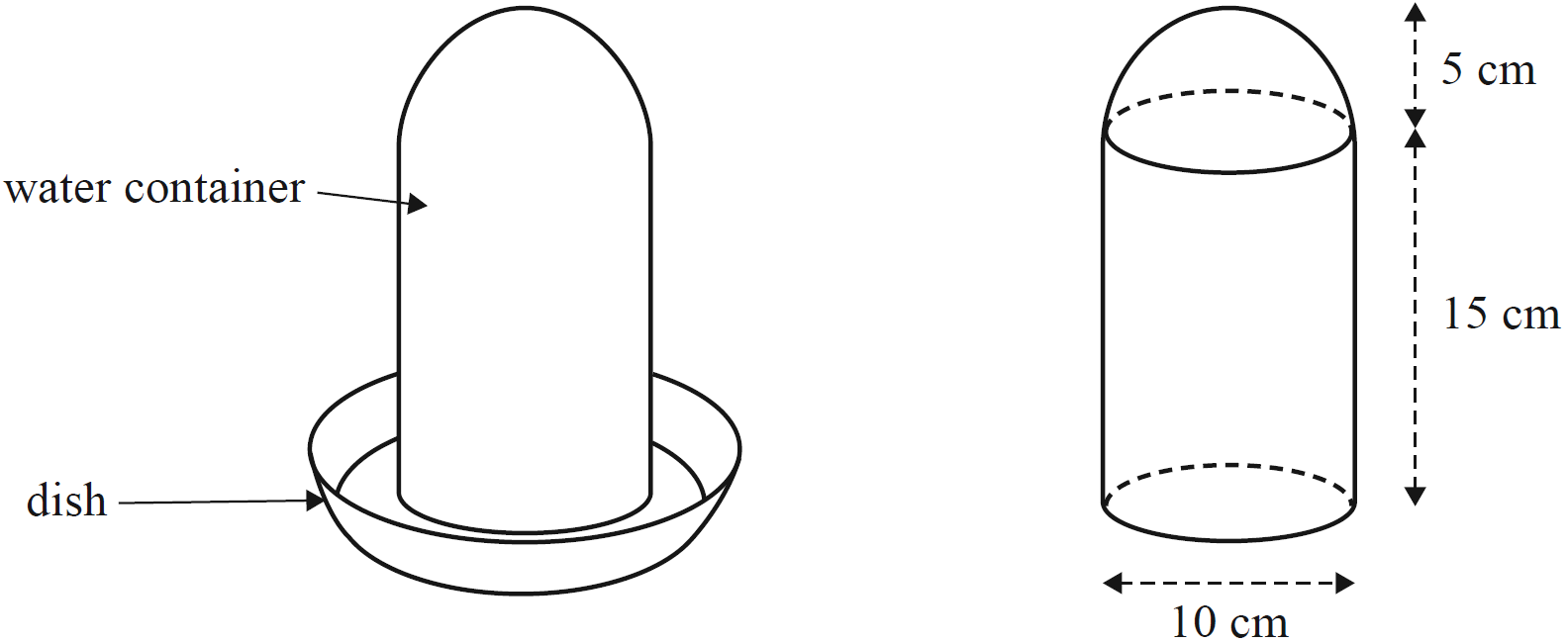
The chicken coop contains a circular water dish.

Water flows into the dish from a water container.

The water container is in the shape of a cylinder with a hemispherical top.

The water container and the dish are shown in the diagrams below.
 

GEOMETRY, FUR2 2014 VCAA 3
 

The cylindrical part of the water container has a diameter of 10 cm and a height of 15 cm.

The hemisphere has a radius of 5 cm.

  1. What is the surface area of the hemispherical top of the water container?


    Write your answer, correct to the nearest square centimetre.  (1 mark)

  2. What is the maximum volume of water that the water container can hold?


    Write your answer, correct to the nearest cubic centimetre.  (2 marks)

The eating space of the chicken coop also has a feed container.


The feed container is similar in shape to the water container.


The volume of the water container is three-quarters of the volume of the feed container.


The surface area of the water container is 628 cm².

  1. What is the surface area of the feed container?


    Write your answer, correct to the nearest square centimetre.  (2 marks) 

Show Answers Only
  1. `157\ text(cm)²`
  2. `1440\ text(cm)³`
  3. `761\ text(cm)²`
Show Worked Solution
a.    `text(Area)` `= 1/2 xx (4pi xx r^2)`
    `= 1/2 xx (4pi xx 5^2)`
    `= 157\ text{cm²  (nearest cm²)}`


b.    `text(Volume of Cylinder)` `=pi r^2 h`
    `=pi xx 5^2 xx 15`
    `=1178.09…\ text(cm³)`
  `text(Volume of Hemisphere)` `=1/2 xx 4/3 pi r^3`
    `=1/2 xx 4/3 xx pi xx 5^3`
    `=261.79…\ text(cm³)`


♦ Mean mark of all parts of question (combined) was 44%.

`:.\ text(Maximum volume of the container)`

`=1178.09… + 261.79…`

`=1439.8…`

`=1440\ text{cm³  (nearest cm³)}`


c.    `text(Volume Factor)` `=4/3`
  `text(Linear Factor)` `=root3(4/3)`
  `text(Area Factor)` `=(root3(4/3))^2=1.2114…`


`:.\ text(S.A. of Feed Container)`

`=628 xx 1.2114…`

`=760.7…`

`=761\ text(cm²)`

Filed Under: Perimeter, Area and Volume, Similarity and Scale Tagged With: Band 4, Band 5, smc-606-30-Factors k / k^2 / k^3

GEOMETRY, FUR2 2013 VCAA 3

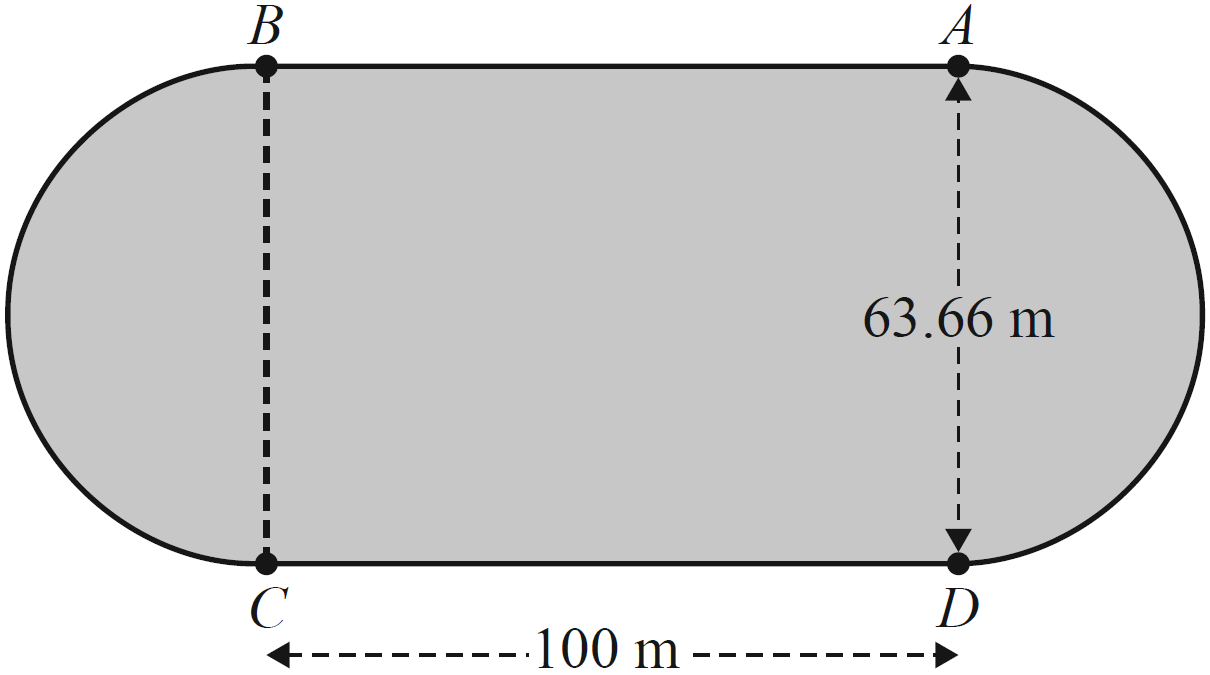
A grassed region in the athletics ground is shown shaded in the diagram below.

Geometry and Trig, FUR2 2013 VCAA 3_1

The perimeter of the grassed region comprises two parallel lines, `BA` and `CD`, each 100 m in length, and two semi-circles, `BC` and `AD`.

In total, the perimeter of the grassed region is 400 m.

  1. The diameter of the semi-circle `AD` is 63.66 m, correct to two decimal places.


    Show how this value could be obtained.  (1 mark)

  2. Determine the area of the grassed region, correct to the nearest square metre.  (1 mark)

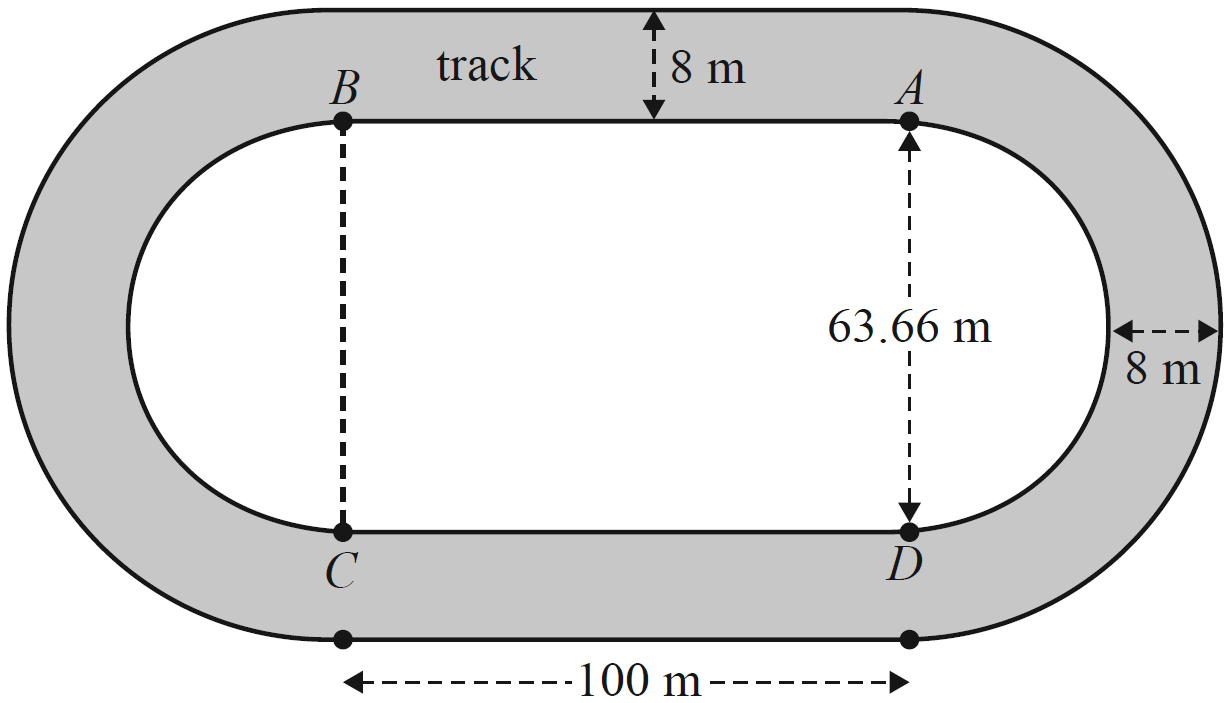
A running track, shown shaded in the diagram below, surrounds the grassed region. This running track is 8 m wide at all points.

GEOMETRY, FUR2 2013 VCAA 3

  1. The running track is to be resurfaced with special rubber material that is 0.1 m deep.


    Find the volume of rubber material that is needed to resurface the running track.


    Write your answer, correct to the nearest cubic metre.  (2 marks)

Show Answers Only
  1. `63.66\ text{m  (2d.p.)}`
  2. `9549\ text{m²  (nearest m²)}`
  3. `340\ text{m³  (nearest m³)}`
Show Worked Solution

a.   `text(Total perimeter = 400 m)`

`text(Perimeter)` `= AB + CD + 2\ text(semi-circles)`
`400` `= 100 + 100 + 2 xx (1/2 xx pi xx AD)`
  `= 200 + pi xx AD`
`:. AD` `= 200/pi`
  `= 63.66\ text{m  (2d.p.)}`


b.    `text(Grassed Area)` `= 100 xx 63.66 + 2 xx 1/2 xx pi xx (63.66/2)^2`
    `= 6366 + 3182.90…`
    `= 9548.90…`
    `= 9549\ text{m²  (nearest m²)}`


c.   `text(Area within the outer boundary)`

`= 100 xx (63.66 + 16) + 2 xx 1/2 xx pi xx ((63.66 + 16)/2)^2`

`= 7966 + 4983.91…`

`= 12\ 949.91…\ text(m²)`


`:.\ text(Volume of rubber)`

♦ Mean mark of part (c) 34%.

`=\ text(Area of track × depth)`

`= (12\ 949.91 – 9549) xx 0.1`

`= 340.09`

`= 340\ text{m³  (nearest m³)}`

Filed Under: Perimeter, Area and Volume Tagged With: Band 4, Band 5

GEOMETRY, FUR2 2013 VCAA 2

A concrete staircase leading up to the grandstand has 10 steps.

The staircase is 1.6 m high and 3.0 m deep.

Its cross-section comprises identical rectangles.

One of these rectangles is shaded in the diagram below.

Geometry and Trig, FUR2 2013 VCAA 2_1

  1. Find the area of the shaded rectangle in square metres.  (1 mark)

The concrete staircase is 2.5 m wide.

GEOMETRY, FUR2 2013 VCAA 2

  1. Find the volume of the solid concrete staircase in cubic metres.  (2 marks)
Show Answers Only
  1. `0.048\ text(m²)`
  2. `6.6\ text(m³)`
Show Worked Solution

a.   `text(Height of rectangle)`

MARKER’S COMMENT: Keep units in metres as many students made mistakes converting cm² to m².

`= 1.6/10`

`= 0.16\ text(m)`

`text(Length of rectangle)`

`= 3.0/10`

`= 0.3\ text(m)`

`:.\ text(Area)` `= 0.16 xx 0.3`
  `= 0.048\ text(m²)`


b.   `V = Ah`

`text(S)text(ince there are 55 rectangles)`

`A` `= 55 xx 0.048`
  `= 2.64\ text(m²)`
`:. V` `= 2.64 xx 2.5`
  `= 6.6\ text(m³)`

Filed Under: Perimeter, Area and Volume Tagged With: Band 4, Band 5

GEOMETRY, FUR2 2013 VCAA 1

A spectator, `S`, in the grandstand of an athletics ground is 13 m vertically above point `G`.

Competitor `X`, on the athletics ground, is at a horizontal distance of 40 m from `G`.
  

Geometry and Trig, FUR2 2013 VCAA 1_1
 

  1. Find the distance, `SX`, correct to the nearest metre.  (1 mark)

Competitor `X` is 40 m from `G` and competitor `Y` is 52 m from `G`.

The angle `XGY` is 113°.
 

Geometry and Trig, FUR2 2013 VCAA 1_2
 

    1. Calculate the distance, `XY`, correct to the nearest metre.  (1 mark)
    2. Find the area of triangle `XGY`, correct to the nearest square metre.  (1 mark)
  1. Determine the angle of elevation of spectator `S` from competitor `Y`, correct to the nearest degree.

    Note that `X`, `G` and `Y` are on the same horizontal level.  (1 mark)
     

Geometry and Trig, FUR2 2013 VCAA 1_3

Show Answers Only
  1. `42\ text{m  (nearest m)}`
    1. `77\ text{m  (nearest m)}`
    2. `957\ text{m²  (nearest m²)}`
  2. `14^@\ \ text{(nearest degree)}`
Show Worked Solution

a.   `text(Using Pythagoras:)`

`SX^2` `= 40^2 + 13^2`
  `= 1769`
`:. SX` `= 42.05…`
  `= 42\ text{m  (nearest m)}`


b.i.   `text(Using the cosine rule:)`

`XY^2` `= 40^2 + 52^2 – 52^2 xx 40 xx 52cos113^@`
  `= 5929.44…`
`:. XY` `= 77.00…`
  `= 77\ text{m  (nearest m)}`


b.ii.   `text(Using the sine rule:)`

`text(Area)` `= 1/2ab sinC`
  `= 1/2 xx 40 xx 52 xx sin113^@`
  `= 957.32…`
  `= 957\ text{m²  (nearest m²)}`


c.    Geometry-FUR2-2013-VCAA-1 Answer
`theta` `= text(angle of elevation of)\ S\ text(from)\ Y`
`tantheta` `= 13/52`
`:. theta` `= tan^(−1)\ 1/4`
  `= 14.036…`
  `= 14^@\ \ text{(nearest degree)}`

Filed Under: Non-Right-Angled Trig, Right-Angled Trig and Angle Properties Tagged With: Band 3, Band 4, smc-3589-10-Sine rule, smc-3589-20-Cosine rule

CORE*, FUR2 2014 VCAA 3

The cricket club had invested $45 550 in an account for four years.

After four years of compounding interest, the value of the investment was $60 000.

  1. How much interest was earned during the four years of this investment?   (1 mark)

    --- 3 WORK AREA LINES (style=lined) ---

Interest on the account had been calculated and paid quarterly.

  1. What was the annual rate of interest for this investment?
  2. Write your answer, correct to one decimal place.   (1 mark)

    --- 2 WORK AREA LINES (style=lined) ---

The $60 000 was re-invested in another account for 12 months.

The new account paid interest at the rate of 7.2% per annum, compounding monthly.

At the end of each month, the cricket club added an additional $885 to the investment.

    1. The equation below can be used to determine the account balance at the end of the first month, immediately after the $885 was added.
    2. Complete the equation by filling in the boxes.   (1 mark)

      --- 0 WORK AREA LINES (style=lined) ---


      BUSINESS, FUR2 2014 VCAA 3
    3. What was the account balance at the end of 12 months?
    4. Write your answer, correct to the nearest dollar.   (1 mark)

      --- 2 WORK AREA LINES (style=lined) ---

Show Answers Only

  1. `14\ 450`
  2. `text(6.9%)`
    1. `text(account balance)\ = 60\ 000 xx (1 + (7.2)/(12 xx 100)) + 885`
    2. `75\ 443`

Show Worked Solution

a.   `text(Interest earned)`

`=  text(End value − original investment)`

`= 60\ 000-45\ 550`

`= $74\ 450`


♦ Mean mark of all parts (combined) was 40%.

b.   `text(By TVM Solver:)`

`N` `= 4 xx 4 = 16`
`I(text(%))` `= ?`
`PV` `=-45\ 550`
`PMT` `= 0`
`FV` `= 60\ 000`
`text(P/Y)` `= text(C/Y) = 4`


`I(text(%)) = 6.948…`

`:.\ text(Annual interest rate = 6.9%)`


c.i.   `text(account balance)`

`= 60\ 000 xx (1 + 7.2/(12 xx 100)) + 885`


c.ii.   `text(By TVM Solver:)`

`N` `= 12`
`I(text(%))` `= 7.2`
`PV` `=-60\ 000`
`PMT` `=-885`
`FV` `= ?`
`text(P/Y)` `= text(C/Y) = 12`


`FV = 75\ 443.014…`

`:. text(Balance after 12 months) = $75\ 443`

Filed Under: Annuities and Perpetuities Tagged With: Band 4, Band 5, smc-2512-10-Annuity, smc-2512-50-CAS solver

CORE*, FUR2 2014 VCAA 2

A sponsor of the cricket club has invested $20 000 in a perpetuity.

The annual interest from this perpetuity is $750.

The interest from the perpetuity is given to the best player in the club every year, for a period of 10 years.

  1. What is the annual rate of interest for this perpetuity investment?   (1 mark)

    --- 3 WORK AREA LINES (style=lined) ---

  2. After 10 years, how much money is still invested in the perpetuity?   (1 mark)

    --- 1 WORK AREA LINES (style=lined) ---

  1. The average rate of inflation over the next 10 years is expected to be 3% per annum.
    1. Michael was the best player in 2014 and he considered purchasing cricket equipment that was valued at $750.
    2. What is the expected price of this cricket equipment in 2015?   (1 mark)

      --- 3 WORK AREA LINES (style=lined) ---

    3. What is the 2014 value of cricket equipment that could be bought for $750 in 2024?  Write your answer, correct to the nearest dollar.   (1 mark)

      --- 3 WORK AREA LINES (style=lined) ---

Show Answers Only

  1. `3.75`
  2. `$20\ 000`
    1. `$772.50`
    2. `$558\ \ text{(nearest dollar)}`

Show Worked Solution

a.    `20\ 000 xx r` `= 750`
  `:. r` `= 750/(20\ 000)`
    `= 0.0375`

 
`:.\ text(Annual interest rate = 3.75%)`
    

b.   `$20\ 000`

`text{(A perpetuity’s balance remains constant.)}`
  

c.i.   `text(Expected price in 2015)`

`= 750 xx (1 + 3/100)`

`= 750 xx 1.03`

`= $772.50`
  

c.ii.   `text(Value in 2014) xx (1.03)^10 = 750`

`:.\ text(Value in 2014)\ ` `= 750/((1.03)^10)`
  `= 558.07…`
  `= $558\ \ text{(nearest dollar)}`

Filed Under: Annuities and Perpetuities, Interest Rates and Investing Tagged With: Band 3, Band 4, Band 5, smc-2512-20-Perpetuity, smc-604-20-Compound interest

GRAPHS, FUR2 2014 VCAA 2

The cost, `C`, in dollars, of producing `n` kilograms of tomatoes is given by

`C = 1.25n + 36\ 000qquadqquad0 ≤ n ≤ 40\ 000`

The revenue, `R`, in dollars, from selling `n` kilograms of tomatoes is given by

`R = 3.5nqquadqquadqquad0 ≤ n ≤ 40\ 000`

The cost, `C`, for the production of `n` kilograms of tomatoes is graphed below.

GRAPHS, FUR2 2014 VCAA 2 

  1. On the graph above, draw the revenue equation line, `R = 3.5n`.  (1 mark)

(Answer on the graph above.)

  1. What profit will Arthur make if he sells a total of 20 000 kg of tomatoes?  (2 marks)
Show Answers Only
  1. `text(See Worked Solutions)`
  2. `$9000`
Show Worked Solution
a.   

GRAPHS, FUR2 2014 VCAA 2 Answer


b.   `text(Profit)`

`=\ text(Revenue – Costs)`

`= 3.5 xx 20\ 000 − (1.25 xx 20\ 000 + 36\ 000)`

`=70\ 000 – 61\ 000`

`=$9000`

Filed Under: Linear relationships Tagged With: Band 4

GRAPHS, FUR2 2014 VCAA 1

Fastgrow and Booster are two tomato fertilisers that contain the nutrients nitrogen and phosphorus.

The amount of nitrogen and phosphorus in each kilogram of Fastgrow and Booster is shown in the table below.

GRAPHS, FUR2 2014 VCAA 11

  1. How many kilograms of phosphorus are in 2 kg of Booster?  (1 mark)
  2. If 100 kg of Booster and 400 kg of Fastgrow are mixed, how many kilograms of nitrogen would be in the mixture?  (1 mark)

Arthur is a farmer who grows tomatoes.


He mixes quantities of Booster and Fastgrow to make his own fertiliser.


Let `x` be the number of kilograms of Booster in Arthur’s fertiliser.


Let `y` be the number of kilograms of Fastgrow in Arthur’s fertiliser.


Inequalities 1 to 4 represent the nitrogen and phosphorus requirements of Arthur’s tomato field.

  1.           Inequality 1 `x` `≥ 0`
              Inequality 2 `y` `≥ 0`
              Inequality 3 (nitrogen) `0.05x + 0.05y` `≥ 200`
              Inequality 4 (phosphorus)      `0.02x + 0.06y` `≥ 120`

Arthur’s tomato field also requires at least 180 kg of the nutrient potassium.


Each kilogram of Booster contains 0.06 kg of potassium.


Each kilogram of Fastgrow contains 0.04 kg of potassium.

  1. Inequality 5 represents the potassium requirements of Arthur’s tomato field.


    Write down Inequality 5 in terms of `x` and `y`.  (1 mark)


The lines that represent the boundaries of Inequalities 3, 4 and 5 are shown in the graph below.

GRAPHS, FUR2 2014 VCAA 12 

    1. Using the graph above, write down the equation of line `A`.  (1 mark)
    2. On the graph above, shade the region that satisfies Inequalities 1 to 5.  (1 mark)

(Answer on the graph above.)

Arthur would like to use the least amount of his own fertiliser to meet the nutrient requirements of his tomato field and still satisfy Inequalities 1 to 5.

    1. What weight of his own fertiliser will Arthur need to make?  (1 mark)
    2. On the graph above, show the point(s) where this solution occurs.  (2 marks)

(Answer on the graph above.)

Show Answers Only
  1. `0.04\ text(kg)`
  2. `25\ text(kg)`
  3. `0.06x + 0.04y ≥ 180`
    1. `0.02x + 0.06y = 120`
    2. `text(See Worked Solutions)`
    1. `4000\ text(kg)`
    2. `text(See Worked Solutions)`
  4.  
Show Worked Solution

a.   `text(Phosphorous in 2 kg of Booster)`

`=0.02× 2`

`= 0.04\ text(kg)`


b.  `text(Total Phosphorous)`

`=0.05×100 + 0.05× 400`

`= 25\ text(kg)`


c.   `text(Inequality 5,)`

`0.06x + 0.04y >= 180`


d.i.   `text(Line)\ A\ text(is the boundary of Inequality 4.)`

♦♦ Mean mark for parts (d) and (e) combined was 32%.
MARKER’S COMMENT: A majority of students didn’t identify Inequality 4 as relevant to Line A.

`:.\ text(It can be expressed)`

`0.02x + 0.06y = 120`


d.ii.   

GRAPHS, FUR2 2014 VCAA 1 Answer1


e.i.   `text(The minimum amount is on the boundary)`

`x+y=4000`

`:.\ text(Arthur will have to make at least 4000 kg.)`


e.ii.   `text(All points on the bold line are solutions,)`

`text{including (1000, 3000) and (3000, 1000).}`

GRAPHS, FUR2 2014 VCAA 1 Answer2 

Filed Under: Linear Programming Tagged With: Band 3, Band 4, Band 5

CORE*, FUR2 2015 VCAA 4

As their business grows, Jane and Michael decide to invest some of their earnings.

They each choose a different investment strategy.

Jane opens an account with Red Bank, with an initial deposit of $4000.

Interest is calculated at a rate of 3.6% per annum, compounding monthly.

  1. Determine the amount in Jane’s account at the end of six months.


    Write your answer correct to the nearest cent.   (1 mark)

    --- 3 WORK AREA LINES (style=lined) ---

Michael decides to open an account with Blue Bank, with an initial deposit of $2000.

At the end of each quarter, he adds an additional $200 to his account.

Interest is compounded at the end of each quarter.

The equation below can be used to determine the balance of Michael’s account at the end of the first quarter.

account balance = 2000 × (1 + 0.008) + 200

  1. Show that the annual compounding rate of interest is 3.2%.   (1 mark)

    --- 2 WORK AREA LINES (style=lined) ---

  2. Determine the amount in Michael’s account, after the $200 has been added, at the end of five years.


    Write your answer correct to the nearest cent.   (1 mark)

    --- 2 WORK AREA LINES (style=lined) ---

Show Answers Only
  1. `$4072.54`
  2. `3.2text(%)`
  3. `$6664.63`
Show Worked Solution

a.   `text(Amount in account after 6 months)`

`= 4000 xx (1 + 3.6/(12 xx 100))^6`

`=4072.542…`

`=$4072.54\ \ text{(nearest cent)}`


b.  `text(Annual compounding rate)`

`=0.008 xx text(100%) xx 4`

`= 3.2text(%)`


c.   `text(By TVM Solver, after 5 years)`

`N` `=5 xx 4 = 20`
`I (%)` `=3.2`
`PV` `=-2000`
`PMT` `=200`
`FV` `=?`
`text(P/Y)` `= text(C/Y) = 4`


`FV=6664.629…`

`:.\ text(The amount in Michael’s account is $6664.63)`

Filed Under: Annuities and Perpetuities Tagged With: Band 4, Band 5, smc-2512-10-Annuity, smc-2512-50-CAS solver

CORE*, FUR2 2015 VCAA 3

Jane and Michael decide to set up an annual music scholarship.

To fund the scholarship, they invest in a perpetuity that pays interest at a rate of 3.68% per annum.

The interest from this perpetuity is used to provide an annual $460 scholarship.

  1. Determine the minimum amount they must invest in the perpetuity to fund the scholarship.   (1 mark)

    --- 3 WORK AREA LINES (style=lined) ---

  2. For how many years will they be able to provide the scholarship?   (1 mark)

    --- 1 WORK AREA LINES (style=lined) ---

Show Answers Only
  1. `12\ 500`
  2. `text(It will last forever.)`
Show Worked Solution

a.   `text(Let)\ \ $A\ =\ text(Perpetuity amount)`

`3.68text(%) xx A` `= 460`
`:.A` `=460/0.0368`
  `= $12\ 500`


b.   `text(It will last forever.)`

Filed Under: Annuities and Perpetuities Tagged With: Band 3, Band 4, smc-2512-20-Perpetuity

CORE*, FUR2 2015 VCAA 2

The sound system used by the business was initially purchased at a cost of $3800.

After two years, the value of the sound system had depreciated to $3150.

  1. Assuming the flat rate method of depreciation was used, show that the value of the sound system was depreciated by $325 each year.   (1 mark)

    --- 2 WORK AREA LINES (style=lined) ---

  2. The value of the sound system will continue to depreciate by $325 each year.


    How many years will it take, after the initial purchase, for the sound system to have a value of $550?   (1 mark)

    --- 4 WORK AREA LINES (style=lined) ---

  3. The recording equipment used by the business was initially purchased at a cost of $2100.


    After five years, the value of the recording equipment had depreciated to $1040 using the reducing balance method.


    Find the annual percentage rate by which the value of this recording equipment depreciated.


    Write your answer correct to two decimal places.   (1 mark) 

    --- 6 WORK AREA LINES (style=lined) ---

Show Answers Only
  1. `$325`
  2. `10`
  3. `13.11text(%)`
Show Worked Solution

a.   `text(Annual depreciation)`

`=(3800-3150)/ 2`

`= $325\ …\ text(as required)`

  
b.
  `text(Let)\ t =\ text(number of years.)`

`3800-325 xx t` `= 550`
`325t` `= 3250`
`:. t` `=3250/325`
  `=10\ text(years)`

  
c.
   `text(Let)\ r =\ text(annual depreciation rate)`

`2100(1-r)^5` `= 1040`
`(1-r)^5` `= 1040/2100`
`(1-r)` `=0.868…`
`:. r`  `=0.13111…`
  `=13.11 text{%  (2 d.p.)}`

Filed Under: Depreciation Tagged With: Band 4, Band 5, smc-602-40-Comparing methods

CORE*, FUR2 2015 VCAA 1

Jane and Michael have started a business that provides music at parties.

The business charges customers $88 per hour.

The $88 per hour includes a 10% goods and services tax (GST).

  1. Calculate the amount of GST included in the $88 hourly rate.  (1 mark)

Jane and Michael’s first booking was a party where they provided music for four hours.

  1. Calculate the total amount they were paid for this booking.  (1 mark)

After six months of regular work, Jane and Michael decided to increase the hourly rate they charge by 12.5%.

  1. Calculate the new hourly rate (including GST).  (1 mark)
Show Answers Only
  1. `$8`
  2. `$352`
  3. `$99`
Show Worked Solution

a.   `text(Let)\ \ x=\ text(hourly rate before GST)`

`x +\ text(GST)` `= 88`
 `x+0.1x` `= 88`
`x` `=88/1.1`
  `=80`


`:.\ text(GST)\ = 88-80 = $8`


b.    `text(Total amount)` `=88 xx 4`
    `=$352`


c.    `text(New hourly rate including GST)`
   `= 88 + 88 xx 12.5 text(%)`
  `= 88 xx 1.125`
  `=$99`

Filed Under: Taxation and Other Tagged With: Band 3, Band 4, smc-605-10-GST, smc-605-20-% increase/decrease

GRAPHS, FUR2 2015 VCAA 5

When Ben is in Japan, he will study at a Japanese school.

Some of his lessons will be in English and some of his lessons will be in Japanese.

Let `x` be the number of lessons in English that he will attend each week.

Let `y` be the number of lessons in Japanese that he will attend each week.

There are 35 lessons each week.

It is a condition of his exchange that Ben attends at least 24 lessons each week.

It is also a condition that Ben attends no more than two lessons in English for every lesson in Japanese.

This information can be represented by Inequalities 1, 2 and 3.

Inequality 1   `x + y ≤ 35`

Inequality 2   `x + y ≥ 24`

Inequality 3   `y ≥ x/2`

There is another constraint given by

Inequality 4   `y ≥ 10`

  1. Describe Inequality 4 in terms of the lessons that Ben must attend.  (1 mark)
  2. The graph below shows the lines that represent the boundaries of Inequalities 1 to 4.


    On the graph below, shade the region that contains the points that satisfy these inequalities.  (1 mark)

Graphs, FUR2 2015 VCAA 5

  1. Determine the maximum number of lessons in English that Ben can attend.  (1 mark)
Show Answers Only
  1. `text(Ben must attend at least 10 lessons in Japanese.)`
  2.  

  3. `23`
Show Worked Solution

a.   `text(Ben must attend at least 10 lessons in Japanese.)`


b.   


c.   `text{The maximum integral value of}\ x\ text(in)`

`text(the shaded feasible region is 23.)`

`:.\ text(Maximum lessons in English)\ = 23`

Filed Under: Linear Programming Tagged With: Band 4

GRAPHS, FUR2 2015 VCAA 4

The airline that Ben uses to travel to Japan charges for the seat and luggage separately.

The charge for luggage is based on the weight, in kilograms, of the luggage.

If the luggage is paid for at the airport, the graph below can be used to determine the cost, in dollars, of luggage of a certain weight, in kilograms. 

Graphs, FUR2 2015 VCAA 4

  1. Find the cost at the airport for 23 kg of luggage.  (1 mark)

If the luggage is paid for online prior to arriving at the airport, the equation for the relationship between the online cost, in dollars, and the weight, in kilograms, would be

`text(online cost) = {{:(75),(22.5 xx text(weight) - 375):} qquad {:(\ \ 0 < text(weight) <= 20),(20 < text(weight ≤ 40)):} :}`


  1. Find the online cost for 30 kg of luggage.  (1 mark)
  2. On the graph above, sketch a graph of the online cost of luggage for `0 <` weight `≤ 40`. Include the end points.  (2 marks)

(Answer on the graph above.)

  1. Determine the weight of luggage for which the airport cost and online cost are the same.
    Write your answer correct to one decimal place.  (1 mark)
Show Answers Only
  1. `$250`
  2. `$300`
  3.  

    Graphs-FUR2-2015-VCAA-4i

  4. `27.8\ text(kg)`
Show Worked Solution

a.   `$250`


b.    `text(Online cost)` `= 22.5 xx 30 – 375`
    `= 300\ text(dollars)`


c.   `text{Online cost (40 kg)}` `= 22.5 xx 40 – 375`
    `= 525`

`:.\ text(End points are)\ \ (0, 75) and (40, 525)`

Graphs-FUR2-2015-VCAA-4i


d.    `text(From the graph, the intersection`

`text(occurs when)`

`22.5 xx text(weight) – 375` `= 250`
`text(weight)` `= 625/22.5`
  `= 27.77…`
  `= 27.8\ text(kg)`

Filed Under: Graph Applications Tagged With: Band 3, Band 4, Band 5

  • « Previous Page
  • 1
  • …
  • 104
  • 105
  • 106
  • 107
  • 108
  • …
  • 125
  • Next Page »

Copyright © 2014–2026 SmarterEd.com.au · Log in