SmarterEd

Aussie Maths & Science Teachers: Save your time with SmarterEd

  • Login
  • Get Help
  • About

BIOLOGY, M7 2015 HSC 27b

The steps below show the preparation and use of blood products in the treatment of Ebola Virus Disease. This disease is characterised by significant blood loss.

World Health Organisation Protocol

  1. A patient recovers from Ebola Virus Disease.
  2. The same patient is disease-free for 28 days.
  3. Blood is taken from the patient and screened for transmissible diseases.
  4. Plasma is separated from the whole blood.
  5. Plasma is transfused into another person with early signs of Ebola Virus Disease.

 
Explain why this protocol produces an effective treatment for Ebola Virus Disease.   (3 marks)

--- 6 WORK AREA LINES (style=lined) ---

Show Answers Only
  • The plasma has been taken from a person who has survived the Ebola Virus and as a result, it will contain antibodies for the disease.
  • This will assist in the immobilisation of the pathogen in the blood stream of the recipient.
  • The spread of blood-borne diseases such as Ebola from donor to recipient can be prevented through blood screening.
Show Worked Solution
  • The plasma has been taken from a person who has survived the Ebola Virus and as a result, it will contain antibodies for the disease.
  • This will assist in the immobilisation of the pathogen in the blood stream of the recipient.
  • The spread of blood-borne diseases such as Ebola from donor to recipient can be prevented through blood screening.

Filed Under: Prevention, Treatment and Control Tagged With: Band 4, smc-3658-20-Vaccines

BIOLOGY, M7 2015 HSC 25

A group of students wanted to test whether water purifying tablets were effective in making creek water free from bacteria.

They conducted an experiment using a water sample collected from the creek and found that the tablets were effective.

  1. Describe a means of addressing ONE identified hazard relevant to this investigation.   (2 marks)

    --- 4 WORK AREA LINES (style=lined) ---

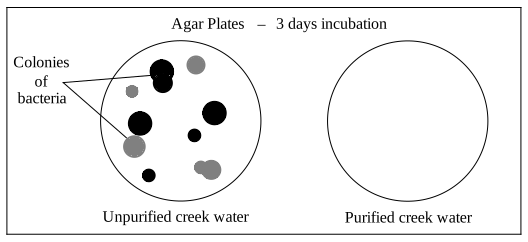
  2. Illustrate the results of this experiment in diagrammatic form.
  3. Use labels to clearly identify the data collected.   (3 marks)


    --- 0 WORK AREA LINES (style=lined) ---

Show Answers Only

a.   Successful answers could include one of the following:

  • A pathogenic microbe might be cultured during the process.
  • Post experiment, agar plates must be heated under high pressure to kill any microbes cultured before disposal.  

b.   Results of experiment:

Show Worked Solution

a.   Successful answers could include one of the following:

  • A pathogenic microbe might be cultured during the process.
  • Post experiment, agar plates must be heated under high pressure to kill any microbes cultured before disposal.  

b.   Results of experiment:

Filed Under: Causes of Infectious Disease Tagged With: Band 3, Band 4, smc-3655-50-Microbial Tests

BIOLOGY, M5 2015 HSC 23

The diagram shows a model involving DNA.
 

  1. What process is being modelled?   (1 mark)

    --- 1 WORK AREA LINES (style=lined) ---

  2. Identify TWO structural features of the DNA molecule which are NOT shown in this model.   (2 marks)

    --- 5 WORK AREA LINES (style=lined) ---

Show Answers Only

a.   DNA replication

b.   Successful answers should include two of the following:

  • the double helix.
  • the sugar-phosphate backbone.
  • hydrogen bonds (connecting base pairs)
Show Worked Solution

a.   DNA replication

b.   Successful answers should include two of the following:

  • the double helix.
  • the sugar-phosphate backbone.
  • hydrogen bonds (connecting base pairs)

Mean mark (a) 53%.

Filed Under: Cell Replication Tagged With: Band 4, Band 5, smc-3649-10-DNA Structure

CHEMISTRY, M6 2015 HSC 14 MC

The graph shows the changes in pH during a titration.
 

Which pH range should an indicator have to be used in this titration?

  1. \(3.1-4.4\)
  2. \(5.0-8.0\)
  3. \(6.0-7.6\)
  4. \(8.3-10.0\)
Show Answers Only

\(D\)

Show Worked Solution
  • The indicator suitable for this titration needs to completely change colour at the centre of the vertical section of the graph (equivalence point).
  • The range that will achieve this is  \(8.3-10.0\).

\(\Rightarrow D\)

Filed Under: Quantitative Analysis Tagged With: Band 4, smc-3675-10-Titration

CHEMISTRY, M7 2017 HSC 28a

Outline TWO advantages and TWO disadvantages of using ethanol as an alternative fuel for motor vehicles.   (4 marks)

Show Answers Only

Advantages:

  • Ethanol can be produced from biomass. These renewable sources include crops such as sugarcane as opposed to other fuels such as petrol which come from non-renewable fossil fuels, which are finite resources.
  • Ethanol undergoes complete combustion more easily than octane, producing less soot \(\ce{(C(s))}\) which can adversely affect the efficiency and running of motors, and less \(\ce{CO(g)}\) which is poisonous.

Disadvantages:

  • Ethanol releases less energy, on a mole or per kilogram basis, than octane. This results in a greater mass of fuel being required to supply an equivalent amount of energy.
  • Producing ethanol from renewable crops requires a huge amount of arable land. This reduces the availability of land for other crops.
Show Worked Solution

Advantages:

  • Ethanol can be produced from biomass. These renewable sources include crops such as sugarcane as opposed to other fuels such as petrol which come from non-renewable fossil fuels, which are finite resources.
  • Ethanol undergoes complete combustion more easily than octane, producing less soot \(\ce{(C(s))}\) which can adversely affect the efficiency and running of motors, and less \(\ce{CO(g)}\) which is poisonous.

Disadvantages:

  • Ethanol releases less energy, on a mole or per kilogram basis, than octane. This results in a greater mass of fuel being required to supply an equivalent amount of energy.
  • Producing ethanol from renewable crops requires a huge amount of arable land. This reduces the availability of land for other crops.

♦ Mean mark 52%.

Filed Under: Alcohols Tagged With: Band 4, Band 5, smc-3679-60-Biofuels

CHEMISTRY, M6 2017 HSC 24

A solution of sodium hydroxide was titrated against a standardised solution of acetic acid which had a concentration of 0.5020 mol L¯1.

  1. The end point was reached when 19.30 mL of sodium hydroxide solution had been added to 25.00 mL of the acetic acid solution.
  2. Calculate the concentration of the sodium hydroxide solution.   (3 marks)

    --- 7 WORK AREA LINES (style=lined) ---

  3. Explain why the pH of the resulting salt solution was not 7. Include a relevant chemical equation in your answer.   (2 marks)

    --- 4 WORK AREA LINES (style=lined) ---

Show Answers Only

a.   \(\ce{CH3COOH(aq) + NaOH(aq) -> NaCH3COO(aq) + H2O(l)}\)
 

b.   \(\ce{CH3COO-(aq) + H2O \rightleftharpoons CH3COOH(aq) + OH-(aq)}\)

  • The acetate ion is a weak base.
  • As a result, it has accepted a proton from the water resulting in production of hydroxide ions.
  • Therefore the solution has a pH > 7.
Show Worked Solution

a.   \(\ce{CH3COOH(aq) + NaOH(aq) -> NaCH3COO(aq) + H2O(l)}\)

\(\ce{n(CH3COOH) = c \times V = 0.5020 \times 0.0250 = 0.01255 mol}\)

\(\ce{n(NaOH) = n(CH3COOH) = 0.01255 mol}\)

\[\ce{[NaOH] = \frac{n}{V} = \frac{0.01255}{0.01930} = 0.6503 mol L^{-1}}\]  

b.   \(\ce{CH3COO-(aq) + H2O \rightleftharpoons CH3COOH(aq) + OH-(aq)}\)

  • The acetate ion is a weak base.
  • As a result, it has accepted a proton from the water resulting in production of hydroxide ions.
  • Therefore the solution has a pH > 7.

♦♦ Mean mark (b) 34%.

Filed Under: Bronsted-Lowry Theory, Quantitative Analysis Tagged With: Band 4, Band 5, smc-3674-18-Dissociation in Water, smc-3675-10-Titration

CHEMISTRY, M6 2019 HSC 33

A student adds 1.17 g of \(\ce{Al(OH)3 (s)}\) to 0.500 L of 0.100 mol L¯1 \(\ce{HCl(aq)}\).

Calculate the pH of the resulting solution. Assume that the volume of the resulting solution is 0.500 L.   (4 marks)

Show Answers Only

\(\ce{pH = -log(0.010) = 2.00}\)

Show Worked Solution

\(\ce{Al(OH)3(s) + 3HCl(aq) -> AlCl3(aq) + 3H2O(l)}\)

\[\ce{n(Al(OH)3) = \frac{m}{MM} = \frac{1.17}{78.004} = 0.0150 mol}\]

\(\ce{n(HCl) = c \times V = 0.500 \times 0.100 = 0.050 mol}\)
 

  • \(\ce{Al(OH)3}\) is limiting reagent  \( \rightarrow \ce{HCl}\) is excess reagent
     

\(\ce{n(HCl)_{reacted} = 3 \times 0.015 = 0.0450 mol}\)

\(\ce{n(HCl)_{excess}}\) \(\ce{= n(HCl)_{init}-n(HCl)_{reacted}}\)  
  `=0.0500-0.0450`  
  `=0.005\ \text{mol}`  

 
\(\ce{HCl(aq) -> H+(aq) + Cl-(aq)}\)

\(\ce{n(H+) = n(HCl)_{excess} = 0.005 mol}\)

\[\ce{[H+] = \frac{n}{V} = \frac{0.005}{0.5} = 0.010 mol L^{-1}}\]

\(\ce{pH = -log[H+] = -log(0.010) = 2.00}\)


Mean mark 56%.

Filed Under: Bronsted-Lowry Theory Tagged With: Band 4, smc-3674-10-Calculations Involving pH

CHEMISTRY, M7 2019 HSC 32

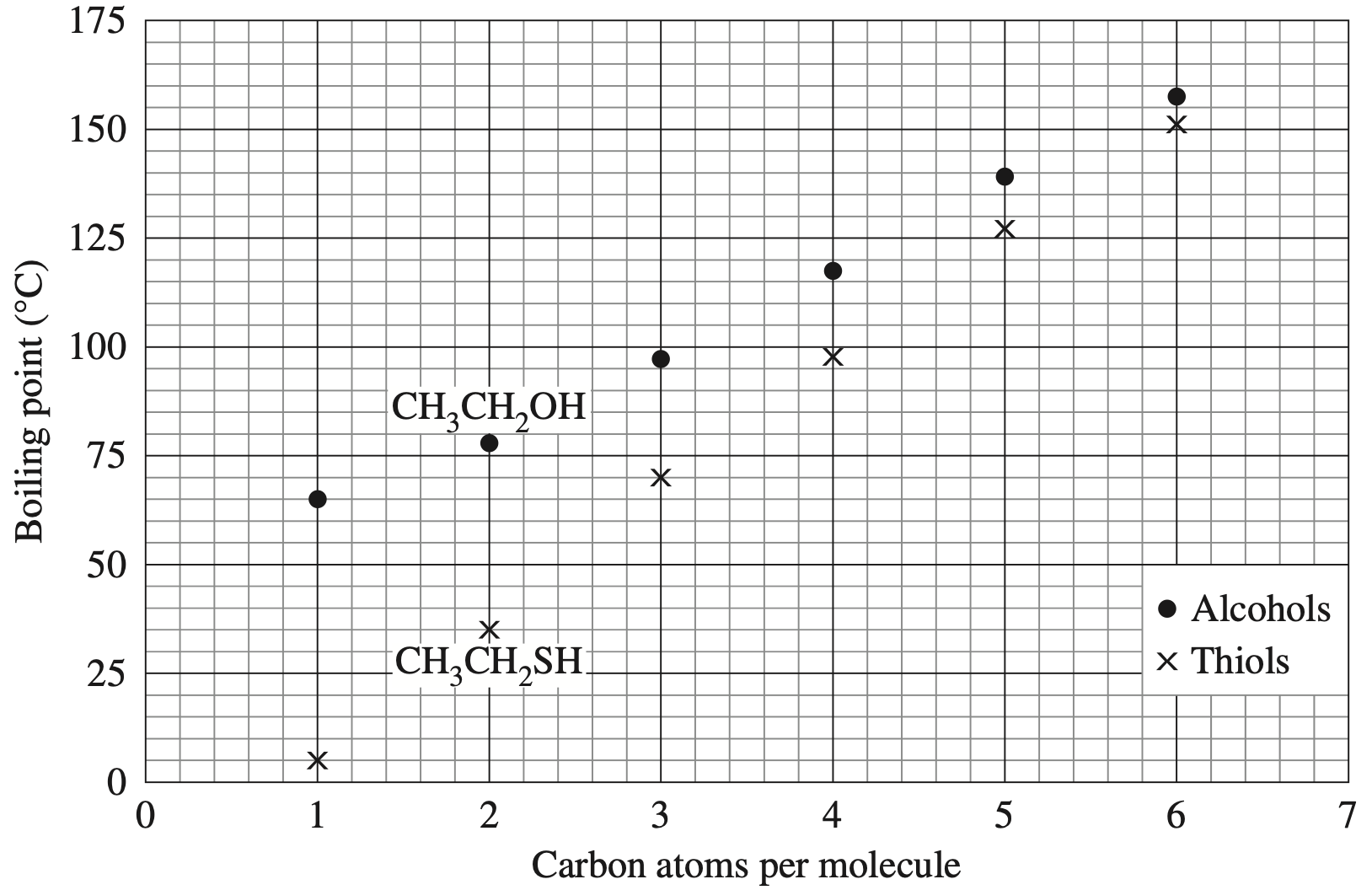
Thiols are the sulfur analogues of alcohols in that the oxygen atom of the alcohol is replaced by a sulfur atom. For example, methanethiol \(\ce{(CH3SH)}\) is the analogue of methanol \(\ce{(CH3OH)}\). The boiling points of some straight chain alcohols and thiols are given in the following graph.


Explain the patterns of the boiling points shown in the graph.   (4 marks)

Show Answers Only
  • The boiling point of a compound increases with an increase in the number of carbon atoms due to the increase in dispersion forces.
  • Alcohols have higher boiling points than thiols with the same number of carbon atoms due to the stronger hydrogen bonding in alcohols compared to the weaker dispersion forces in thiols.
  • As the chain length increases, the difference in boiling point between alcohols and thiols decreases because hydrogen bonding becomes a smaller contributor to the total intermolecular forces and the increasing strength of dispersion forces becomes more significant.
  • Methanol has hydrogen bonding as the dominant intermolecular force, while methanethiol has dipole-dipole forces as the dominant intermolecular force, resulting in a lower boiling point for methanethiol.
  • As the chain length increases, the thiols have a greater increase in boiling point due to their higher molecular mass and stronger dispersion forces compared to the alcohols.
Show Worked Solution
  • The boiling point of a compound increases with an increase in the number of carbon atoms due to the increase in dispersion forces.
  • Alcohols have higher boiling points than thiols with the same number of carbon atoms due to the stronger hydrogen bonding in alcohols compared to the weaker dispersion forces in thiols.
  • As the chain length increases, the difference in boiling point between alcohols and thiols decreases because hydrogen bonding becomes a smaller contributor to the total intermolecular forces and the increasing strength of dispersion forces becomes more significant.
  • Methanol has hydrogen bonding as the dominant intermolecular force, while methanethiol has dipole-dipole forces as the dominant intermolecular force, resulting in a lower boiling point for methanethiol.
  • As the chain length increases, the thiols have a greater increase in boiling point due to their higher molecular mass and stronger dispersion forces compared to the alcohols.

Filed Under: Alcohols Tagged With: Band 4, smc-3679-50-Solubility and Boiling Point

CHEMISTRY, M5 2019 HSC 31

The following reaction occurs in an aqueous solution.

   \(\ce{HgCl4^2-(aq) + Cu^2+(aq) \rightleftharpoons CuCl4^2-(aq) + Hg^2+\ \ \ \ \ \ $K_{eq}$ = 4.55 \times 10^{-11}}\)

A solution containing a mixture of \(\ce{HgCl4^2-(aq)}\) and \(\ce{Cu^2+(aq)}\) ions is prepared. The initial concentration of each ion is 0.100 mol L ¯1 and there are no other ions present.

Calculate the concentration of \(\ce{Hg^2+(aq)}\) ions once the system has reached equilibrium.   (4 marks)

--- 14 WORK AREA LINES (style=lined) ---

Show Answers Only

\(\ce{[Hg^2+] = 6.75 \times 10^{-7} mol L^{-1}}\)

Show Worked Solution

\[\ce{$K_{eq}$ = \frac{[CuCl4^2-][Hg^2+]}{[HgCl4^2-][Cu^2+]}}\]

\begin{array} {|l|c|c|c|c|}
\hline  & \ce{[HgCl4^2-]} & \ce{[Cu^2+]} & \ce{[CuCl4^2-]} & \ce{[Hg^2+]} \\
\hline \text{Initial} & 0.100 & 0.100 & 0 & 0 \\
\hline \text{Change} & -x & -x & +x & +x \\
\hline \text{Equilibrium} & 0.100-x & 0.100-x & x & x \\
\hline \end{array}

Since `x` is small  `=> 0.100-x~~0.100`

`4.55 xx 10^{-11}` `=(x xx x)/((0.100-x)(0.100-x))`  
`4.55 xx 10^{-11}` `=x^2/(0.100)^2`  
`x^2` `=4.55 xx 10^{-11} xx (0.100)^2`  
`x` `=sqrt(4.55 xx 10^{-11} xx (0.100)^2)`  
  `=6.75 xx 10^{-7}\ text{mol L}^{-1}`  

 
\(\therefore \ce{[Hg^2+] = 6.75 \times 10^{-7} mol L^{-1}}\)

Filed Under: Equilibrium Constant Tagged With: Band 4, smc-3671-20-Calcs given K(eq), smc-3671-35-Chemical equation given, smc-3671-60-Ionic solutions

CHEMISTRY, M6 2019 HSC 27

The relationship between the acid dissociation constant, `K_a`, and the corresponding conjugate base dissociation constant, `K_b`, is given by:

`K_(a)xxK_(b)=K_(w)`

Assume that the temperature for part (a) and part (b) is 25°C.

  1. The `K_a` of hypochlorous acid `text{(HOCl)}` is  `3.0 xx10^(-8)`.
  2. Show that the `K_b` of the hypochlorite ion, `text{OCl}^-`, is  `3.3 xx10^(-7)`.   (1 mark)

    --- 3 WORK AREA LINES (style=lined) ---

  3. The conjugate base dissociation constant, `K_b`, is the equilibrium constant for the following equation:
  4.      `text{OCl}^(-)(aq)+ text{H}_(2) text{O}(l) ⇌ text{HOCl}(aq)+ text{OH}^(-)(aq)`
  5. Calculate the pH of a 0.20 mol L¯1 solution of sodium hypochlorite `(text{NaOCl})`.   (4 mark)

    --- 14 WORK AREA LINES (style=lined) ---

Show Answers Only
  1. `K_b=3.3 xx 10^{-7}`
  2. \(\ce{pH = 14-3.59 = 10.41}\)
Show Worked Solution

a.   `K_(a)xxK_(b)=K_(w)\ \ =>\ \ K_b=(K_(w))/(K_(a))`

`K_b=(1.0 xx 10^{-14})/(3.0 xx 10^{-8}=3.3 xx 10^{-7}`
 

b.   \(\ce{OCl-(aq) + H2O(l) \rightleftharpoons HOCl(aq) + OH-(aq)}\)
 

\begin{array} {|l|c|c|c|}
\hline  & \ce{OCl-} & \ce{HOCl} & \ce{OH–} \\
\hline \text{Initial} & 0.20 & 0 & 0 \\
\hline \text{Change} & -x & +x & +x \\
\hline \text{Equilibrium} & 0.20-x & x & x \\
\hline \end{array}

 
\[ K_b = \ce{\frac{[HOCl][OH– ]}{[OCl-]}} = \frac{x^2}{(0.20-x)} \]

Assume  `0.20-x~~0.20`  because `x` is negligible:

`3.3 xx 10^(-7)` `= x^2 / (0.20-x)`  
`x` `=sqrt(3.3 xx 10^(−7) xx 0.20)`  
  `= 2.5690 xx 10^{-4}\ text{mol L}^(–1)`  

 
\(\ce{[OH-] = 2.5690 \times 10^{-4} mol L^{-1}}\)

\(\ce{pOH = -log10[OH-] = -log10(2.5690 \times 10^{-4}) = 3.59}\)

\(\therefore \ce{pH = 14-3.59 = 10.41}\)


♦ Mean mark (b) 45%.

Filed Under: Bronsted-Lowry Theory, Equilibrium Constant, Quantitative Analysis Tagged With: Band 4, Band 5, smc-3671-10-Find K(eq), smc-3671-35-Chemical equation given, smc-3671-40-K(eq) and pH, smc-3671-50-Acids and bases, smc-3674-10-Calculations Involving pH, smc-3675-30-Ka/Kb

CHEMISTRY, M8 2019 HSC 26b

Explain why a chemist should use more than one spectroscopic technique to identify an organic compound. Use TWO spectroscopic techniques to support your answer.   (3 marks)

Show Answers Only
  • Different techniques in organic chemistry can be used to identify and characterise the structure of organic molecules.
  • These techniques such as \(\ce{^1H NMR}\) spectroscopy and mass spectrometry, provide different pieces of information about the molecule’s structure.
  • \(\ce{^1H NMR}\) spectroscopy can be used to identify functional groups and distinguish between isomers by providing information about the chemical environment and relative number of hydrogen nuclei.
  • Mass spectrometry, on the other hand, gives information about the molecular weight of a molecule and its characteristic fragments.
  • It is important to use a combination of these techniques in order to obtain a complete understanding of the structure of an organic compound.
Show Worked Solution
  • Different techniques in organic chemistry can be used to identify and characterise the structure of organic molecules.
  • These techniques such as \(\ce{^1H NMR}\) spectroscopy and mass spectrometry, provide different pieces of information about the molecule’s structure.
  • \(\ce{^1H NMR}\) spectroscopy can be used to identify functional groups and distinguish between isomers by providing information about the chemical environment and relative number of hydrogen nuclei.
  • Mass spectrometry, on the other hand, gives information about the molecular weight of a molecule and its characteristic fragments.
  • It is important to use a combination of these techniques in order to obtain a complete understanding of the structure of an organic compound.

Filed Under: Organic Substances Tagged With: Band 4, smc-3683-50-Combining Techniques

CHEMISTRY, M8 2019 HSC 26a

The following data were obtained for an organic compound containing carbon, hydrogen and oxygen. The compound is a colourless liquid that reacts with sodium carbonate powder to produce bubbles.
 

What is the structural formula of this compound? Justify your answer with reference to the information given on its reactivity and to at least THREE of the provided spectra.   (5 marks)

Show Answers Only

  • The compound exhibits characteristics that suggest it is an organic acid.
  • This is demonstrated by its reaction with sodium carbonate, which produces carbon dioxide bubbles, as well as the presence of a strong absorption around 1700 cm ¯1 in the IR spectrum, which is characteristic of a \(\ce{CO}\) bond, and another broad absorption in the region 2500-3500 cm ¯1, which is characteristic of an \(\ce{OH}\) bond in acids.
  • The mass spectrum of the compound has a parent peak at m/z = 74, which is consistent with its molecular formula \(\ce{C3H6O2}\) (molar mass = 74 g mol ¯1).
  • The \(\ce{^13C NMR}\) spectrum shows 3 signals, including one around 180 ppm, which is characteristic of a carbonyl carbon, and the \(\ce{^1H NMR}\) spectrum shows 3 signals, including a quartet with an integration of 2 and a triplet with an integration of 3, indicating the presence of a \(\ce{CH3}\) group and \(\ce{CH2}\) group respectively.
  • These observations confirm the presence of a \(\ce{COOH}\) group in the compound.
Show Worked Solution

  • The compound exhibits characteristics that suggest it is an organic acid.
  • This is demonstrated by its reaction with sodium carbonate, which produces carbon dioxide bubbles, as well as the presence of a strong absorption around 1700 cm ¯1 in the IR spectrum, which is characteristic of a \(\ce{CO}\) bond, and another broad absorption in the region 2500-3500 cm ¯1, which is characteristic of an \(\ce{OH}\) bond in acids.
  • The mass spectrum of the compound has a parent peak at m/z = 74, which is consistent with its molecular formula \(\ce{C3H6O2}\) (molar mass = 74 g mol ¯1).
  • The \(\ce{^13C NMR}\) spectrum shows 3 signals, including one around 180 ppm, which is characteristic of a carbonyl carbon, and the \(\ce{^1H NMR}\) spectrum shows 3 signals, including a quartet with an integration of 2 and a triplet with an integration of 3, indicating the presence of a \(\ce{CH3}\) group and \(\ce{CH2}\) group respectively.
  • These observations confirm the presence of a \(\ce{COOH}\) group in the compound.

Filed Under: Organic Substances Tagged With: Band 4, smc-3683-50-Combining Techniques

CHEMISTRY, M5 2019 HSC 25

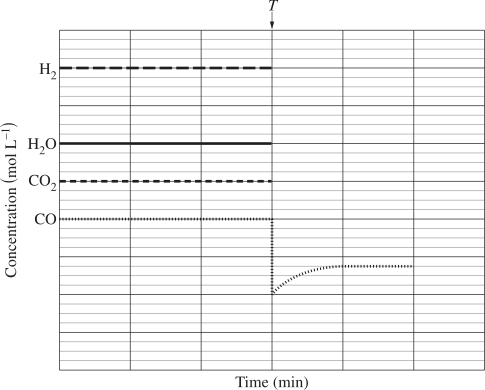
The concentrations of reactants and products as a function of time for the following system were determined.

`text{CO}(g)+ text{H}_(2) text{O}(g) ⇌ text{CO}_(2)(g)+ text{H}_(2)(g)`

At time \(T\), some \(\ce{CO(g)}\) was removed from the system.

  1. The concentration of \(\ce{CO}\) after time \(T\) is shown.
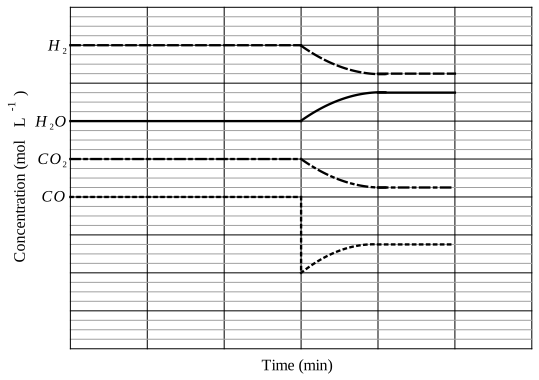
  2. Sketch the concentrations after time \(T\) for the remaining species.   (2 marks)


  3. Using collision theory, explain the change in the concentration of \(\text{CO}\) after time \(T\).  (3 marks)

    --- 8 WORK AREA LINES (style=lined) ---

Show Answers Only

a.   
     

b.   Changes in \(\ce{CO}\) after time \(T\):

  • The removal of \(\ce{CO}\) from the system leads to a decrease in the concentration of  CO, which in turn leads to a decrease in the rate of the forward reaction.
  • This is because there are fewer collisions between \(\ce{CO}\) and \(\ce{H2O}\) molecules, which are necessary for the forward reaction to occur.
  • The rate of the reverse reaction increases, becoming greater than the rate of the forward reaction. This results in a shift in the equilibrium to the left, leading to an increase in the concentration of \(\ce{CO}\) and \(\ce{H2O}\) and a decrease in the concentration of \(\ce{H2}\) and \(\ce{CO2}\).
  • Over time, the rate of the forward reaction subsequently increases until it becomes equal to the rate of the reverse reaction, at which point the system reaches a new equilibrium state with constant concentrations of all species.


Show Worked Solution

a.   
     

b.   Changes in \(\ce{CO}\) after time \(T\):

  • The removal of \(\ce{CO}\) from the system leads to a decrease in the concentration of  CO, which in turn leads to a decrease in the rate of the forward reaction.
  • This is because there are fewer collisions between \(\ce{CO}\) and \(\ce{H2O}\) molecules, which are necessary for the forward reaction to occur.
  • The rate of the reverse reaction increases, becoming greater than the rate of the forward reaction. This results in a shift in the equilibrium to the left, leading to an increase in the concentration of \(\ce{CO}\) and \(\ce{H2O}\) and a decrease in the concentration of \(\ce{H2}\) and \(\ce{CO2}\).
  • Over time, the rate of the forward reaction subsequently increases until it becomes equal to the rate of the reverse reaction, at which point the system reaches a new equilibrium state with constant concentrations of all species.

Filed Under: Factors that Affect Equilibrium Tagged With: Band 4, smc-3670-30-Concentration, smc-3670-40-Collision theory, smc-3670-60-Concentration diagrams

CHEMISTRY, M5 2015 HSC 12 MC

A transuranic element can be produced in a nuclear reactor according to this equation:

\({ }_{94}^{239} \text{Pu}+2 \text{X} \rightarrow{ }_{94}^{241} \text{Pu} \rightarrow{ }_{95}^{241} \text{Am} +\text{Y}\)

Which row of the table correctly identifies \(\text{X}\) and \(\text{Y}\)?

\begin{align*} 
\begin{array}{l}
\rule{0pt}{1.5ex} \ \rule[-0.5ex]{0pt}{0pt}& \\
\rule{0pt}{2.5ex}\textbf{A.}\rule[-1ex]{0pt}{0pt}\\
\rule{0pt}{2.5ex}\textbf{B.}\rule[-1ex]{0pt}{0pt}\\
\rule{0pt}{2.5ex}\textbf{C.}\rule[-1ex]{0pt}{0pt}\\
\rule{0pt}{2.5ex}\textbf{D.}\rule[-1ex]{0pt}{0pt}\\
\end{array}
\begin{array}{|c|c|}
\hline
\rule{0pt}{1.5ex}\text{X}\rule[-0.5ex]{0pt}{0pt}& \text{Y} \\
\hline
\rule{0pt}{2.5ex}\quad \text{Neutron}\quad \rule[-1ex]{0pt}{0pt}&\quad \text{Electron}\quad \\
\hline
\rule{0pt}{2.5ex}\text{Proton}\rule[-1ex]{0pt}{0pt}& \text{Neutron}\\
\hline
\rule{0pt}{2.5ex}\text{Neutron}\rule[-1ex]{0pt}{0pt}& \text{Proton} \\
\hline
\rule{0pt}{2.5ex}\text{Proton}\rule[-1ex]{0pt}{0pt}& \text{Electron} \\
\hline
\end{array}
\end{align*}

Show Answers Only

\(A\)

Show Worked Solution
  • A balanced equation requires the sum of top and bottom numbers to be equal on both sides.
  • \(\text{X}\) is a neutron \(\left({ }_0^1 n \right)\)
  • \(\text{Y}\) is an electron \(\left({ }_{-1}^0 e\right)\)

\(\Rightarrow A\)

Filed Under: Static and Dynamic Equilibrium Tagged With: Band 4, smc-3669-10-Static/Dynamic Models

CHEMISTRY, M7 2015 HSC 11 MC

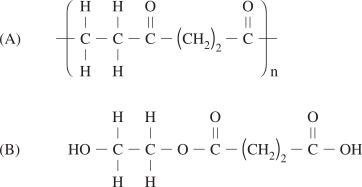
Two monomers are shown.
 

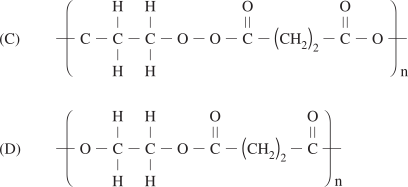
Which of the following shows a condensation polymer that could be formed from the monomers?


Show Answers Only

`D`

Show Worked Solution
  • Condensation polymer will eliminate molecule (\(\ce{H2O}\) in this case)

`=>D`

Filed Under: Polymers Tagged With: Band 4, smc-3681-20-Condensation Polymers

CHEMISTRY, M7 2015 HSC 9 MC

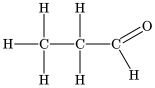
What are the reactants used to make this compound?

  1. Butan-1-ol and butanoic acid
  2. Butan-1-ol and propanoic acid
  3. Propan-1-ol and butanoic acid
  4. Propan-1-ol and propanoic acid
Show Answers Only

`C`

Show Worked Solution
  • Compound is an ester
  • Oxygen double bond comes from butanoic acid (eliminate B and D)
  • The other carbon chain comes from propan-1-ol

`=>C`

Filed Under: Reactions of Organic Acids and Bases Tagged With: Band 4, smc-3680-10-Esters

CHEMISTRY, M8 2017 HSC 19 MC

The sulfate content of a fertiliser is 48% by mass. 1.20 g of this fertiliser is completely dissolved in water and an excess of \( \ce{Ba(NO3)2(aq)} \) is added.

What mass of precipitate would be formed?

  1. 0.006 g
  2. 0.58 g
  3. 1.40 g
  4. 1.57 g
Show Answers Only

`C`

Show Worked Solution

\(\ce{m(SO4^2-) = 0.48 \times 1.20 = 0.576\ g}\)

\[\ce{n(SO4^2-) = \frac{m}{MM} = \frac{0.576}{32.07 + 4 \times 16.00} = 5.996 \times 10^{-3} mol} \]

Chemical equation

\(\ce{Ba^2+(aq) + SO4^2-(aq) -> BaSO4(s)} \)

\(\ce{n(BaSO4) = n(SO4^2-) = 5.996 \times 10^{-3} mol}\)

\(\ce{m(BaSO4) = n \times MM = (5.996 \times 10^{-3}) \times 233.37 = 1.40 g} \)

\( \Rightarrow C \)


Mean mark 57%.

Filed Under: Inorganic Substances Tagged With: Band 4, smc-3682-40-Gravimetric Analysis

CHEMISTRY, M6 2017 HSC 5 MC

Which of the following substances is amphiprotic in nature?

  1. \(\ce{HSO4-}\)
  2. \(\ce{H2SO4}\)
  3. \(\ce{SO4^2-}\)
  4. \(\ce{H2SO3}\)
Show Answers Only

`A`

Show Worked Solution

\(\ce{HSO4-}\) is amphiprotic.

  • It can accept a proton to form \(\ce{H2SO4}\)
  • It can donate a proton to form \(\ce{SO4^2-}\)

`=>A`

Filed Under: Bronsted-Lowry Theory Tagged With: Band 4, smc-3674-40-Amphiprotic Compounds

CHEMISTRY, M6 2017 HSC 1 MC

In an experiment, 30 mL of water is to be transferred into a conical flask.

Which piece of equipment would deliver the volume with the greatest accuracy?

  1. Burette
  2. Beaker
  3. Test tube
  4. Measuring cylinder
Show Answers Only

`A`

Show Worked Solution
  • A burette can measure and deliver to 0.05 mL accuracy, making it easily the most accurate measuring device of the given options.

`=>A`

Filed Under: Quantitative Analysis Tagged With: Band 4, smc-3675-10-Titration

BIOLOGY, M5 2018 HSC 4 MC

Which of the following describes the daughter cells produced as a result of mitosis?

  1. Two genetically different cells
  2. Two genetically identical cells
  3. Four genetically different cells
  4. Four genetically identical cells
Show Answers Only

`B`

Show Worked Solution
  • Mitosis is the division of the nucleus which produces two identical sets of DNA, and therefore two identical daughter cells.

`=>B`

Filed Under: Cell Replication Tagged With: Band 4, smc-3649-30-Mitosis

PHYSICS, M6 2015 HSC 28

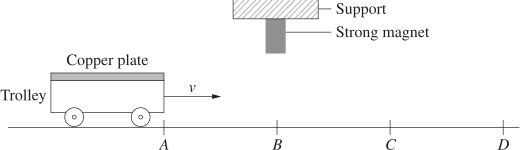
A copper plate is attached to a lightweight trolley. The trolley moves at an initial velocity, `v`, towards a strong magnet fixed to a support.
 

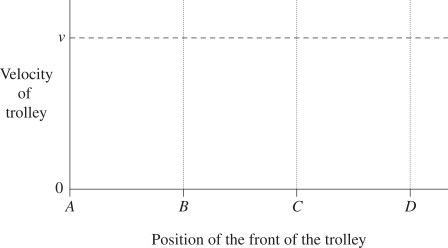
The dashed line on the graph shows the velocity of the trolley when the magnet is not present.

On the axes, sketch the graph of the velocity of the trolley as it travels from `A` to `D` under the magnet, and justify your graph.   (5 marks)
 

--- 8 WORK AREA LINES (style=lined) ---

Show Answers Only

  • As the trolley passes under the magnet at B, its kinetic energy is transformed into heat energy in the copper plate.
  • This causes the trolley to slow down.
  • This result is due to the change in flux produced by the movement of the copper plate through the field of the strong magnet.
  • The change in flux induces currents in the copper plate (Faraday’s law) that produce a magnetic field that opposes the changing flux (Lenz’s law). The resulting force decelerates the trolley.
Show Worked Solution

  • As the trolley passes under the magnet at B, its kinetic energy is transformed into heat energy in the copper plate.
  • This causes the trolley to slow down.
  • This result is due to the change in flux produced by the movement of the copper plate through the field of the strong magnet.
  • The change in flux induces currents in the copper plate (Faraday’s law) that produce a magnetic field that opposes the changing flux (Lenz’s law). The resulting force decelerates the trolley.

Filed Under: Electromagnetic Induction Tagged With: Band 4, smc-3705-40-Lenz and Faraday

PHYSICS, M5 2015 HSC 26

Consider the following two models used to calculate the work done when a 300 kg satellite is taken from Earth's surface to an altitude of 200 km.

You may assume that the calculations are correct.
 

  1. What assumptions are made about Earth's gravitational field in models `X` and `Y` that lead to the different results shown?   (2 marks)

--- 5 WORK AREA LINES (style=lined) ---

  1. Why do models `X` and `Y` produce results that, although different, are close in value?   (1 mark)

--- 3 WORK AREA LINES (style=lined) ---

  1. Calculate the orbital velocity of the satellite in a circular orbit at the altitude of 200 km.   (3 marks)

--- 5 WORK AREA LINES (style=lined) ---

Show Answers Only

a.  Model `X`:

  • Assumes Earth’s gravitational field strength remains constant moving upwards from the surface.

Model `Y`:

  • Assumes Earth’s gravitational field strength changes with altitude.

b.   Similarity of results due to:

  • The variation in gravitational field strength from Earth’s surface to an altitude of 200 km is minimal, so both models `X` and `Y` produce similar results.

c.   `v=7797  text{ms}^(-1)`

Show Worked Solution

a.  Model `X`:

  • Assumes Earth’s gravitational field strength remains constant moving upwards from the surface.

Model `Y`:

  • Assumes Earth’s gravitational field strength changes with altitude.

♦ Mean mark (a) 54%.

b.   Similarity of results due to:

  • The variation in gravitational field strength from Earth’s surface to an altitude of 200 km is minimal, so both models `X` and `Y` produce similar results.

♦♦ Mean mark (b) 38%.

c.    Centripetal force = force due to gravity:

`F_(c)` `=F_(g)`  
`(mv^2)/(r)` `=(GMm)/(r^2)`  
`:.v` `=sqrt((GM)/(r))=sqrt((6.67 xx10^(-11)xx6xx10^(24))/(6.58 xx10^(6)))=7797  text{ms}^(-1)`  

Filed Under: Circular Motion, Motion in Gravitational Fields Tagged With: Band 4, Band 5, smc-3691-20-Applications of Circular Motion, smc-3691-80-Satellites, smc-3692-30-Orbital Velocity/Period/Radius

PHYSICS, M6 2015 HSC 24

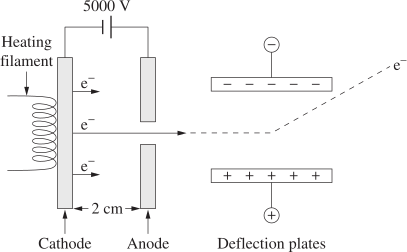
A part of a cathode ray oscilloscope was represented on a website as shown.
 

Electrons leave the cathode and are accelerated towards the anode.

  1. Explain why the representation of the path of the electron between the deflection plates is inaccurate.   (3 marks)

    --- 7 WORK AREA LINES (style=lined) ---

  1. Calculate the force on an electron due to the electric field between the cathode and the anode.   (2 marks)

    --- 6 WORK AREA LINES (style=lined) ---
  1. Calculate the velocity of an electron as it reaches the anode.   (2 marks)

    --- 6 WORK AREA LINES (style=lined) ---

Show Answers Only

a.    Inaccuracies include:

  • The electron is shown to travel towards the negative plate. This is inaccurate as the electron is a negatively charged particle so will be attracted towards the positive plate.
  • The electron is shown to only deflect once it has travelled halfway through the plates. This is inaccurate as the plate will deflect the electron immediately after it enters the uniform electric field. 
  • The electron is shown to follow a straight path. This is inaccurate as the electron has a constant acceleration towards the positive plate and a constant horizontal velocity, it will follow a parabolic path.

b.   `F=4xx10^(-14)  text{N}`

c.   `v=4.19 xx10^(7)  text{ms}^(-1)`

Show Worked Solution

a.    Inaccuracies include:

  • The electron is shown to travel towards the negative plate. This is inaccurate as the electron is a negatively charged particle so will be attracted towards the positive plate.
  • The electron is shown to only deflect once it has travelled halfway through the plates. This is inaccurate as the plate will deflect the electron immediately after it enters the uniform electric field. 
  • The electron is shown to follow a straight path. This is inaccurate as the electron has a constant acceleration towards the positive plate and a constant horizontal velocity, it will follow a parabolic path. 

b.    Using  `E=(F)/(q)`  and  `E=(V)/(d):`

`(F)/(q)` `=(V)/(d)`  
`F` `=(Vq)/(d)`  
  `=(5000 xx1.6 xx10^(-19))/(0.02)`  
  `=4xx10^(-14)  text{N}`  

 
c.
    `a=(F)/(m)=(4xx10^(-14))/(9.1 xx10^(-31))=4.4 xx10^(16)  text{ms}^(-1)`
 

`v^(2)` `=u^(2)+2as`  
`:.v` `=sqrt(2xx4.4 xx10^(16)xx0.02)`  
  `=4.19 xx10^(7)  text{ms}^(-1)`  

♦♦♦ Mean mark (c) 20%.

Filed Under: Charged Particles, Conductors and Electric/Magnetic Fields Tagged With: Band 4, Band 6, smc-3693-10-Charged Particles in EF, smc-3693-35-Kinematic/Work Calcs, smc-3693-80-X-Topic: Projectile motion

PHYSICS, M6 2015 HSC 22

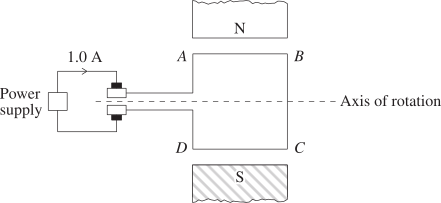
The diagram represents a simple DC motor. A current of 1.0 A flows through a square loop `ABCD` with 5 cm sides in a magnetic field of 0.01 T.
 

  1. Determine the force acting on section `AB` and the force acting on section `BC` due to the magnetic field, when the loop is in the position shown.   (3 marks)

--- 4 WORK AREA LINES (style=lined) ---

  1. How is the direction of the torque maintained as the loop rotates 360° from the position shown?   (2 marks)

--- 4 WORK AREA LINES (style=lined) ---

Show Answers Only

a.    `F_(AB)=5xx10^(-4)  text{N into the page.}`

`F_(BC)=0  text{N}`

b.   The split ring conductor reverses the direction of current.

  • This switches the direction of force on sides `AB` and `CD` of the coil every half turn, ensuring torque remains in the same direction.
Show Worked Solution
a.    `F_(AB)` `=BIℓsin theta`
    `=0.01 xx1.0 xx0.05 xx sin 90^(@)`
    `=5xx10^(-4)  text{N into the page.}`
     
  `F_(BC)` `=0.01 xx1.0 xx0.05 xx sin 0^(@)=0\ text{N}`


b.   The split ring conductor reverses the direction of current.

  • This switches the direction of force on sides `AB` and `CD` of the coil every half turn, ensuring torque remains in the same direction.

Mean mark (b) 57%.

Filed Under: Applications of the Motor Effect, The Motor Effect Tagged With: Band 4, smc-3694-20-Force on Current-Carrying Conductor, smc-3695-10-Torque

PHYSICS, M5 2015 HSC 21

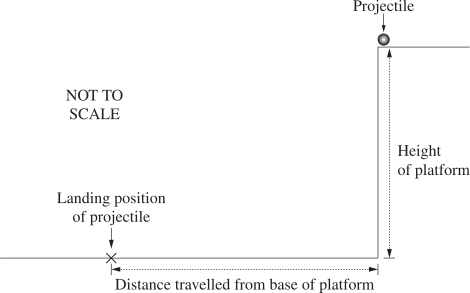
A projectile is fired horizontally from a platform.
 

Measurements of the distance travelled by the projectile from the base of the platform are made for a range of initial velocities.   

\begin{array}{|c|c|}
\hline
\rule{0pt}{2.5ex}\textit{Initial velocity}& \textit{Distance travelled from} \\
\textit{of projectile}\ \text{(ms\(^{-1}\))} \rule[-1ex]{0pt}{0pt}& \textit{base of platform}\  \text{(m)} \\
\hline
\rule{0pt}{2.5ex} 1.4 \rule[-1ex]{0pt}{0pt}&1.0\\
\hline
\rule{0pt}{2.5ex} 2.3 \rule[-1ex]{0pt}{0pt}& 1.7\\
\hline
\rule{0pt}{2.5ex} 3.1 \rule[-1ex]{0pt}{0pt}& 2.2\\
\hline
\rule{0pt}{2.5ex} 3.9 \rule[-1ex]{0pt}{0pt}& 2.3 \\
\hline
\rule{0pt}{2.5ex} 4.2 \rule[-1ex]{0pt}{0pt}& 3.0 \\
\hline
\end{array}

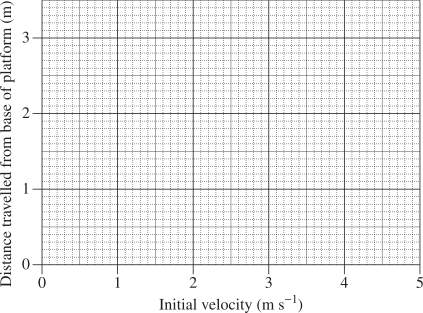
  1. Graph the data on the grid provided and draw the line of best fit.   (2 marks)


--- 0 WORK AREA LINES (style=lined) ---

  1. Calculate the height of the platform.   (2 marks)

    --- 6 WORK AREA LINES (style=lined) ---

Show Answers Only

a. 
     

b.   2.5 m

Show Worked Solution

a.   
          

b.   \(s_x=u(x) t\ \ \Rightarrow\ \ t=\dfrac{s_x}{u_x} \text{(gradient)}\)

\(\text{Using the line of best fit, gradient = 0.714.}\)

\(t = 0.714\ s\)

\(s_y\) \(=u_y t+\frac{1}{2} a_y t^2\)  
  \(=0+0.5 \times 9.8 \times(0.714)^2\)  
  \(=2.5 \ \text{m}\)  

 
\(\text{Height}\ = 2.5\ \text{m}\)

Filed Under: Projectile Motion Tagged With: Band 2, Band 4, smc-3690-40-Vertical Displacement

PHYSICS, M7 2015 HSC 17 MC

Which row of the table correctly shows ideas that Planck and Einstein contributed to quantum theory?

\begin{align*}
\begin{array}{l}
\rule{0pt}{2.5ex}\text{}\rule[-0.5ex]{0pt}{0pt}& \text{} \\
\rule{0pt}{1.5ex}\textbf{A.}\\
\text{}\rule[-0.5ex]{0pt}{0pt}&\text{}\\
\rule{0pt}{1.5ex}\textbf{B.}\\
\text{}\rule[-0.5ex]{0pt}{0pt}&\text{}\\
\rule{0pt}{1.5ex}\textbf{C.}\\
\text{}\rule[-0.5ex]{0pt}{0pt}&\text{}\\
\rule{0pt}{1.5ex}\textbf{D.}\\
\text{}\rule[-0.5ex]{0pt}{0pt}&\text{}\\
\end{array}
\begin{array}{|l|l|}
\hline
\rule{0pt}{1.5ex}\quad \quad \quad \quad \quad \quad  \textit{Planck}\rule[-1ex]{0pt}{0pt}& \quad \quad \quad  \quad \quad \quad  \textit{Einstein} \\
\hline
\rule{0pt}{1.5ex}\text{Hot objects emit radiation in discrete} & \text{Light consists of packets of energy}\\
\text{amounts.}\rule[-0.5ex]{0pt}{0pt}&\text{with specific values.}\\
\hline
\rule{0pt}{1.5ex}\text{Planck's constant determines the} & \text{Objects emit energy that increases}\\
\text{energy of photons.}\rule[-0.5ex]{0pt}{0pt}&\text{exponentially with frequency.}\\
\hline
\rule{0pt}{1.5ex}\text{No energy is lost from black body} & \text{Energy is absorbed if the band gap is}\\
\text{radiators.}\rule[-0.5ex]{0pt}{0pt}&\text{less than the photon energy.}\\
\hline
\rule{0pt}{1.5ex}\text{The energy of photons decreases as} & \text{Photons have energy proportional to}\\
\text{the wavelength increases.}\rule[-0.5ex]{0pt}{0pt}&\text{their frequency.}\\
\hline
\end{array}
\end{align*} 

Show Answers Only

\(A\)

Show Worked Solution

By Elimination:

  • Statements of both scientists are incorrect in B and C.
  • In D, Planck’s experiments did not look at photons (eliminate D).

\(\Rightarrow A\)

Filed Under: Light: Quantum Model Tagged With: Band 4

PHYSICS, M7 2015 HSC 16 MC

Astronauts travel at a velocity of 0.9 `c` to Alpha Centauri. Newtonian physics predicts that this journey would take 4.86 years.

How many years will the journey take in the frame of reference of the astronauts?

  1. 0.923
  2. 1.54
  3. 2.12
  4. 11.1
Show Answers Only

`C`

Show Worked Solution
  • The Newtonian distance to Alpha Centauri: `4.86 xx0.9 = 4.373` light years.
  • Finding the relativistic distance due to length contraction:
`l` `=l_(0)sqrt(1-(v^2)/c^2)`  
  `=4.373xx sqrt(1-((0.9c)^2)/c^2)`  
  `=4.373 xxsqrt(1-0.9^2)`  
  `=1.906\ text{ly}`  

 
This will take `(1.906)/(0.9) = 2.12` years.

`=>C`


Mean mark 59%.

Filed Under: Light and Special Relativity Tagged With: Band 4, smc-3699-20-Length Contraction

PHYSICS, M7 2015 HSC 14 MC

A passenger is playing billiards on a train that is travelling forwards on a level track. The ball takes the path shown when hit by the cue.
 

What can be inferred about the motion of the train?

  1. It is turning left.
  2. It is speeding up.
  3. It is turning right.
  4. It is slowing down.
Show Answers Only

`C`

Show Worked Solution
  • The ball will travel on a straight path relative to the ground (Newton’s First Law).
  • Looking from the back of the pool table, facing the direction of the front of the train, the ball moves left.
  • The pool table (and hence the train) must be moving towards the right relative to the ground.

`=>C`

Filed Under: Light and Special Relativity Tagged With: Band 4, smc-3699-40-Einstein's Postulates

PHYSICS, M6 2015 HSC 8 MC

In which of the following situations does the magnetic field exert the greatest force on the proton ( ), given that all of the fields are of equal magnitude?


Show Answers Only

`C`

Show Worked Solution
  • The force on each proton is given by  `F=qvB sin theta.`
  • As `q` and `B` are the same in all four situations, the maximum force will occur when  `v sin theta`  is greatest.

A:  `vsintheta=0`

B:  `vsintheta=60sin 0°=0`

C:  `vsintheta=40sin 90°=40`

D:  `vsintheta=50sin 45°~~35`

`=>C`

Filed Under: Charged Particles, Conductors and Electric/Magnetic Fields Tagged With: Band 4, smc-3693-15-Charged Particles in MF

PHYSICS, M6 2016 HSC 29

Explain how different discoveries in physics led to the development of THREE technologies, including the electric generator.   (6 marks)

--- 14 WORK AREA LINES (style=lined) ---

Show Answers Only

Electric Generator

  • The discovery that a change in magnetic flux would induce an emf in a conductor was discovered by Faraday.
  • This discovery led directly to the development of the electric generator.

GPS Tracking

  • Einstein discovered the Theory of Special Relativity that is an explanation of how speed affects mass, time and space.
  • The Hafele-Keating atomic clock experiment involved flying atomic clocks at high speeds on aircraft and comparing them with synchronised clocks on the surface of Earth. This experiment helped validate time dilation which is a feature of Special Relativity.
  • This theory and its subsequent validation has seen it applied to GPS technology. Without adjustments for special relativity, GPS would not work with any meaningful degree of accuracy.

Television

  • Physicists discovered that electrons could be made to travel through evacuated tubes.
  • They were deflected by electric and magnetic fields and could cause a fluorescent screen to emit light.
  • The electrons could be manipulated precisely to form an image on the screen leading to the development of television.
Show Worked Solution

Electric Generator

  • The discovery that a change in magnetic flux would induce an emf in a conductor was discovered by Faraday.
  • This discovery led directly to the development of the electric generator.

GPS Tracking

  • Einstein discovered the Theory of Special Relativity that is an explanation of how speed affects mass, time and space.
  • The Hafele-Keating atomic clock experiment involved flying atomic clocks at high speeds on aircraft and comparing them with synchronised clocks on the surface of Earth. This experiment helped validate time dilation which is a feature of Special Relativity.
  • This theory and its subsequent validation has seen it applied to GPS technology. Without adjustments for special relativity, GPS would not work with any meaningful degree of accuracy.

Television

  • Physicists discovered that electrons could be made to travel through evacuated tubes.
  • They were deflected by electric and magnetic fields and could cause a fluorescent screen to emit light.
  • The electrons could be manipulated precisely to form an image on the screen leading to the development of television.

Filed Under: Applications of the Motor Effect Tagged With: Band 4, smc-3695-40-Generators

PHYSICS, M5 2016 HSC 25

Two teams carried out independent experiments with the purpose of investigating Newton's Law of Universal Gravitation. Each team used the same procedure to accurately measure the gravitational force acting between two spherical masses over a range of distances.

The following graphs show the data collected by each team.


  1. Compare qualitatively the relationship between force and distance in the graphs.   (2 marks)

--- 5 WORK AREA LINES (style=lined) ---

  1. Assess the appropriateness of Team A's data and Team B's data in achieving the purpose of the experiments.   (3 marks)

--- 6 WORK AREA LINES (style=lined) ---
Show Answers Only

a.    Force vs Distance relationship:

  • Both graphs show that as distance between the centres of masses increases, force increases.
  • Team A’s data shows that the force between masses is inversely proportional to the square of the distance between them.
  • Team B’s data shows that force decreases at a constant rate.

b.   Data appropriateness:

  • Team A’s data set uses a good range of distances however it is inappropriate as it incorporates too few measurements for a valid relationship to be determined.
  • Team B’s data set is inappropriate as it does not incorporate a sufficient range of distances to determine a valid relationship although it has a sufficient number of measurements.
Show Worked Solution

a.    Force vs Distance relationship:

  • Both graphs show that as distance between the centres of masses increases, force increases.
  • Team A’s data shows that the force between masses is inversely proportional to the square of the distance between them.
  • Team B’s data shows that force decreases at a constant rate.

b.   Data appropriateness:

  • Team A’s data set uses a good range of distances however it is inappropriate as it incorporates too few measurements for a valid relationship to be determined.
  • Team B’s data set is inappropriate as it does not incorporate a sufficient range of distances to determine a valid relationship although it has a sufficient number of measurements.

Mean mark (b) 56%.

Filed Under: Motion in Gravitational Fields Tagged With: Band 4, smc-3692-10-Gravity between 2 objects, smc-3692-80-Newton's Laws

PHYSICS, M6 2016 HSC 22b

A strong magnet is at rest a few centimetres above a solid metal disc made of a non-magnetic metal. The magnet is then dropped.   


The velocity of the magnet is shown in this graph.


Account for the shape of the graph.   (4 marks)

--- 8 WORK AREA LINES (style=lined) ---

Show Answers Only
  • Initially, the magnet falls only under the influence of gravity accelerating downwards at a rate of 9.8 m s –1.
  • This corresponds to the downwards line on the graph with a gradient of – 9.8.
  • As the magnet approaches the disc, eddy currents are induced in the disc due to the changing flux (Faraday’s Law).
  • The magnetic field formed by these eddy currents opposes the motion of the disc (Lenz’s Law).
  • This slows the descent of the magnet, corresponding to the upwards line on the graph.
  • Eventually, the magnet comes to rest on the disc, shown when `v=0` on the graph.
Show Worked Solution
  • Initially, the magnet falls only under the influence of gravity accelerating downwards at a rate of 9.8 m s –1.
  • This corresponds to the downwards line on the graph with a gradient of – 9.8.
  • As the magnet approaches the disc, eddy currents are induced in the disc due to the changing flux (Faraday’s Law).
  • The magnetic field formed by these eddy currents opposes the motion of the disc (Lenz’s Law).
  • This slows the descent of the magnet, corresponding to the upwards line on the graph.
  • Eventually, the magnet comes to rest on the disc, shown when `v=0` on the graph.

Filed Under: Electromagnetic Induction Tagged With: Band 4, smc-3705-40-Lenz and Faraday

PHYSICS, M5 2016 HSC 21b

Calculate the magnitude of the gravitational force that acts on a 50 kg satellite when it is 8000 km from Earth's centre.   (3 marks)

--- 6 WORK AREA LINES (style=lined) ---

Show Answers Only

312.7 N

Show Worked Solution
  `F` `=(GMm)/(r^(2))`
    `=(6.67 xx10^(-11)xx6xx10^(24)xx50)/((8000 xx10^(3))^(2))`
    `=312.7\ text{N}`

Filed Under: Motion in Gravitational Fields Tagged With: Band 4, smc-3692-10-Gravity between 2 objects, smc-3692-40-Satellites

PHYSICS, M5 2016 HSC 18 MC

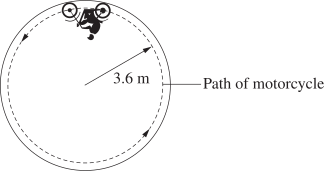
A motorcycle travels around a vertical circular path of radius 3.6 m at a constant speed. The combined mass of the rider and motorcycle is 200 kg.
 

What is the minimum speed, in `text{m s}^(-1)`, at which the motorcycle must travel to maintain the circular path?

  1. 0.42
  2. 1.9
  3. 5.9
  4. 35
Show Answers Only

`C`

Show Worked Solution
  • The minimum speed occurs when the centripetal force keeping the motorcycle on its path equals the downwards weight force at the top of the circle.
`F_(c)` `=W`  
`(mv^2)/(r)` `=mg`  
`v` `=sqrt(rg)=sqrt(3.6 xx9.8)=5.9\ text{m s}^-1`  

 
`=>C`

Filed Under: Circular Motion Tagged With: Band 4, smc-3691-10-Centripetal Forces

PHYSICS, M7 2016 HSC 10 MC

In a thought experiment, a train is moving at a constant speed of 0.8 `c`. A lamp is located at the midpoint of a carriage. There are doors `W` and `Z` at each end of the carriage which open automatically when light from the lamp reaches them.
 

The passenger standing at the midpoint of the carriage switches on the lamp.

Which statement best explains what the passenger observes about the doors?

  1. `Z` opens before `W` because the lamp is moving towards `Z`.
  2. `W` opens before `Z` because `W` is moving towards the lamp.
  3. `W` and `Z` open simultaneously because the lamp is placed at an equal distance from both.
  4. `W` and `Z` open simultaneously because the distance from the lamp to each door has contracted by the same amount.
Show Answers Only

`C`

Show Worked Solution
  • The observer, the lamp and the doors are all in the same frame of reference. Observations are therefore not affected by length contraction.
  • The observer sees light travel an equal distance to each of the doors.
  • As the speed of light is constant the observer sees light reach the doors at the same time and thus sees the doors open simultaneously.

`=>C`

Filed Under: Light and Special Relativity Tagged With: Band 4, smc-3699-60-Simultaneity

PHYSICS, M6 2016 HSC 9 MC

How does back emf affect a DC motor?

  1. It creates heat in the iron core.
  2. It limits the speed of the motor.
  3. It reverses the current in the coil.
  4. It increases the torque of the motor.
Show Answers Only

`B`

Show Worked Solution
  • Back emf in a DC motor increases as the speed of rotation increases until the back emf completely opposes the supplied emf.
  • When this occurs, the DC motor no longer accelerates and its speed is limited.

`=>B`

Filed Under: Applications of the Motor Effect Tagged With: Band 4, smc-3695-20-Back emf

PHYSICS, M6 2016 HSC 7 MC

A magnet passes through a copper tube at constant velocity along the path shown.

A current is induced in the tube by the motion of the magnet.
 

Which row of the table correctly describes the forces acting between the tube and the magnet at points \(P\) and \(Q\) ? 
 

\begin{align*}
\begin{array}{l}
& \\
\rule{0pt}{2.5ex}\textbf{A.}\rule[-1ex]{0pt}{0pt}\\
\rule{0pt}{2.5ex}\textbf{B.}\rule[-1ex]{0pt}{0pt}\\
\rule{0pt}{2.5ex}\textbf{C.}\rule[-1ex]{0pt}{0pt}\\
\rule{0pt}{2.5ex}\textbf{D.}\rule[-1ex]{0pt}{0pt}\\
\end{array}
\begin{array}{|c|c|}
\hline
\quad \textit{Force at P} \quad & \quad \textit{Force at Q} \quad \\
\hline
\rule{0pt}{2.5ex}\text{Attraction}\rule[-1ex]{0pt}{0pt}&\text{Repulsion}\\
\hline
\rule{0pt}{2.5ex}\text{Repulsion}\rule[-1ex]{0pt}{0pt}& \text{Attraction}\\
\hline
\rule{0pt}{2.5ex}\text{Attraction}\rule[-1ex]{0pt}{0pt}& \text{Attraction} \\
\hline
\rule{0pt}{2.5ex}\text{Repulsion}\rule[-1ex]{0pt}{0pt}& \text{Repulsion} \\
\hline
\end{array}
\end{align*}

Show Answers Only

\(B\)

Show Worked Solution
  • Lenz’s Law states that the force due to the induced current in the tube will oppose the motion of the magnet.
  • At \(P\) a force of repulsion will act to oppose the motion of the magnet towards the tube.
  • At \(Q\) a force of attraction will act to oppose the motion of the magnet away from the tube.

\(\Rightarrow B\)

Filed Under: Electromagnetic Induction Tagged With: Band 4, smc-3705-40-Lenz and Faraday

PHYSICS, M7 2016 HSC 6 MC

In a thought experiment, a jet is travelling at 0.5 `c` relative to the ground, towards a train that is travelling at 0.1 `c` relative to the ground, as shown.
 

What is the speed of the light emitted from the train's headlight, as measured by a pilot in the jet?

  1. 0.1 `c`
  2. 0.4 `c`
  3. 0.6 `c`
  4. 1.0 `c`
Show Answers Only

`D`

Show Worked Solution
  • The speed of light is constant at 1.0 `c` for all observers.

`=>D`

Filed Under: Light and Special Relativity Tagged With: Band 4, smc-3699-40-Einstein's Postulates

PHYSICS, M5 2017 HSC 29

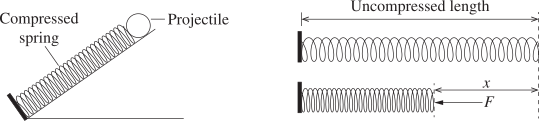
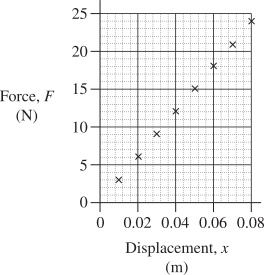
A spring is used to construct a device to launch a projectile. The force `(F)` required to compress the spring is measured as a function of the displacement `(x)` by which the spring is compressed.
 

The potential energy stored in the compressed spring can be calculated from  `E_p=(1)/(2) kx^(2)`, where `k` is the gradient of the force-displacement graph shown.
 

  1. A projectile of mass 0.04 kg is launched using this device with the spring compressed by 0.08 m. Calculate the launch velocity.   (4 marks)

--- 11 WORK AREA LINES (style=lined) ---

  1. Calculate the range of a projectile launched by this device from ground level at an angle of 60° to the horizontal with a velocity of 10 `text{m s}^(-1)`.   (3 marks)

--- 9 WORK AREA LINES (style=lined) ---
Show Answers Only

a.   `6.9  text{m s}^(-1)`

b.   `8.8  text{m}`

Show Worked Solution

a.   `k=  text{gradient}=(24-6)/(0.08-0.02)=300`

Finding the potential energy stored in the compressed spring:

`E_(p)=(1)/(2)kx^(2)=(1)/(2)xx300 xx0.08^(2)=0.96  text{J}`

  
As this potential energy is converted into kinetic energy when the projectile is launched:

`E_(k)` `=0.96  text{J}`
 `(1)/(2)mv^(2)` `=0.96`
`v^(2)` `=(2 xx0.96)/(0.04)`
`v` `=6.9  text{m s}^(-1)`


b.   Time to reach the highest point `(v_(y)=0)`:

`v_(y)` `=u_(y)+a_(y)t`
`0` `=10xx sin 60^(@)-9.8t`
`t` `=(10xx sin 60^(@))/(9.8)=0.88  text{s}`


The time of flight is twice the time taken to reach the highest point:

`t=2 xx0.88=1.77\ text{s}`

 
Find range:

`s_(x)=u_(x)t=10xx cos 60^(@)xx 1.77=8.8\ text{m}`


Mean mark (b) 59%.

Filed Under: Projectile Motion Tagged With: Band 4, smc-3690-25-Range, smc-3690-50-Kinetic Energy

PHYSICS, M6 2017 HSC 22b

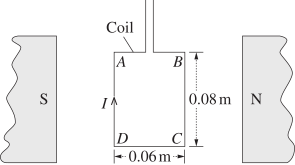
A coil consisting of 15 turns is placed in a uniform 0.2 T magnetic field between two magnets. A current of 7.0 amperes flows in the direction shown.
 

Calculate the magnitude and direction of the torque produced by the side `BC` of the 15-turn coil.   (3 marks)

--- 6 WORK AREA LINES (style=lined) ---
Show Answers Only

0.05 Nm into the page

Show Worked Solution
  `F_(BC)` `=BIl sin theta`
    `=0.2 xx7xx0.08 xx sin 90^(@)`
    `=0.112  text{N}`

 
`text{Total force (15 turns)}  =0.112 xx15=1.68\ text{N}`

`:.tau` `=rF sin theta`
  `=1.68 xx0.03 xx sin90^(@)`
  `=0.05  text{Nm into the page}`

Mean mark 58%.

Filed Under: The Motor Effect Tagged With: Band 4, smc-3694-20-Force on Current-Carrying Conductor

PHYSICS, M7 2017 HSC 20 MC

The length of a spaceship is measured by an observer to be 3.57 m as the spaceship passes with a velocity of 0.7`c`.

At what velocity would the spaceship be moving relative to the observer if its measured length was 2.5 m?

  1. 0.490`c`
  2. 0.707`c`
  3. 0.714`c`
  4. 0.866`c`
Show Answers Only

`D`

Show Worked Solution
`l` `=l_(0)sqrt((1-(v^(2))/(c^(2))))`  
`3.57` `=l_(0)sqrt((1-((0.7c)^(2))/(c^(2))))`  
`3.57` `=l_(0)sqrt(1-0.7^2)`  
`l_(0)` `=(3.57)/(sqrt(1-0.7^2))=5.0  text{m}`  


If the measured length were to be 2.5 m:

`2.5` `=(5.0)sqrt((1-(v^(2))/(c^(2))))`  
`(1)/(2)` `=sqrt(1-(v^(2))/(c^(2)))`  
`1-(v^(2))/(c^(2))` `=(1)/(4)`  
`(v^(2))/(c^(2))` `=(3)/(4)`  
`v^2` `=(3)/(4)c^2`  
`v` `=0.866c`  

 
`=>D`

Filed Under: Light and Special Relativity Tagged With: Band 4, smc-3699-20-Length Contraction

PHYSICS, M6 2017 HSC 14 MC

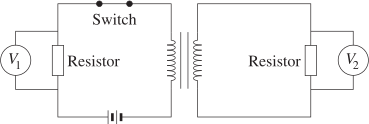
The diagram shows a DC circuit containing a transformer.
 

The potential differences `V_1` and `V_2` are measured continuously for 4 s. The switch is initially closed.

At t = 2 s, the switch is opened.

Which pair of graphs shows how the potential differences `V_1` and `V_2` vary with time over the 4-second interval?


Show Answers Only

`A`

Show Worked Solution
  • When the switch is opened at t = 2 s, the current through the primary circuit and thus `V_(1)`  drops to zero.
  • This sudden decrease in magnetic flux through the secondary coil induces a temporary voltage in the secondary circuit.

`=>A`

Filed Under: Electromagnetic Induction Tagged With: Band 4, smc-3705-20-Induced emf

PHYSICS, M6 2017 HSC 13 MC

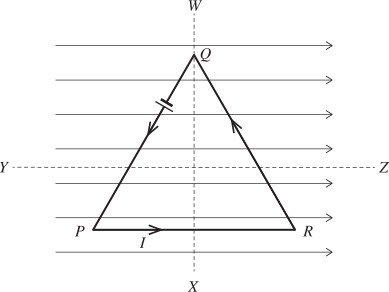
A triangular piece of wire is placed in a magnetic field as shown.
 

When current \(I\) is supplied as shown, how does the wire move?

\begin{align*}
\begin{array}{l}
\rule{0pt}{2.5ex} \ \rule[-1ex]{0pt}{0pt}& \\
\rule{0pt}{2.5ex}\textbf{A.}\rule[-1ex]{0pt}{0pt}\\
\rule{0pt}{2.5ex}\textbf{B.}\rule[-1ex]{0pt}{0pt}\\
\rule{0pt}{2.5ex}\textbf{C.}\rule[-1ex]{0pt}{0pt}\\
\rule{0pt}{2.5ex}\textbf{D.}\rule[-1ex]{0pt}{0pt}\\
\end{array}
\begin{array}{|c|c|}
\hline
\rule{0pt}{2.5ex}\textit{Axis of rotation}\rule[-1ex]{0pt}{0pt}& \textit{Direction of movement} \\
\hline
\rule{0pt}{2.5ex}YZ\rule[-1ex]{0pt}{0pt}&Q\ \text{into page}\\
\hline
\rule{0pt}{2.5ex}YZ\rule[-1ex]{0pt}{0pt}& Q\ \text{out of page}\\
\hline
\rule{0pt}{2.5ex}WX\rule[-1ex]{0pt}{0pt}&R\  \text{into page} \\
\hline
\rule{0pt}{2.5ex}WX\rule[-1ex]{0pt}{0pt}& R\ \text{out of page} \\
\hline
\end{array}
\end{align*} 

Show Answers Only

\(C\)

Show Worked Solution
  • Using the right hand palm rule, there will be a force into the page acting on \(QR\) and a force out the page acting on \(QP\). 
  • The wire will rotate around \(WX\) with \(R\)moving into the page.

\(\Rightarrow C\)

Filed Under: The Motor Effect Tagged With: Band 4, smc-3694-20-Force on Current-Carrying Conductor

PHYSICS, M6 2017 HSC 11 MC

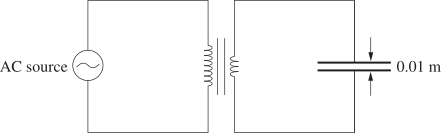
An AC source is connected to a transformer having a primary winding of 900 turns. Connected to the secondary winding of 450 turns is a pair of parallel plates 0.01 m apart.
 

The AC input is shown in the graph.
 

What is the maximum field strength (in `text{V m}^(-1)`) produced between the plates?

  1. `1.7`
  2. `6.8`
  3. `1.7 × 10^4`
  4. `6.8 × 10^4`
Show Answers Only

`C`

Show Worked Solution

Maximum voltage in primary coil = 340 `text{V}`  (see graph)

`(V_(p))/(V_(s))` `=(N_(p))/(N_(s))`  
`(340)/(V_(s))` `=(900)/(450)`  
`V_(s)` `=(450 xx 340)/900=170\ text{V}`  

 
∴ The maximum voltage in the secondary circuit is 170 `text{V}`.

  `E=(V)/(d)=(170)/(0.01)=1.7 xx10^(4)\ text{V m}^(-1)`

`=>C`

Filed Under: Charged Particles, Conductors and Electric/Magnetic Fields, Electromagnetic Induction Tagged With: Band 4, smc-3693-20-EF Strength, smc-3705-50-Transformer Calcs

PHYSICS, M6 2017 HSC 10 MC

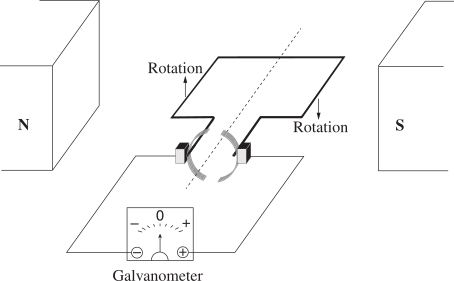
The diagram shows a model of a generator connected to a galvanometer.
 

The loop is rotated continuously in a clockwise direction as viewed from the end nearest the galvanometer.

Which row of the table correctly identifies the type of generator and the movement of the needle of the galvanometer?
 

\begin{align*}
\begin{array}{l}
\rule{0pt}{1.5ex} \ \rule[-0.5ex]{0pt}{0pt}& \\
\rule{0pt}{2.5ex}\textbf{A.}\rule[-1ex]{0pt}{0pt}\\
\rule{0pt}{2.5ex}\textbf{B.}\rule[-1ex]{0pt}{0pt}\\
\rule{0pt}{2.5ex}\textbf{C.}\rule[-1ex]{0pt}{0pt}\\
\rule{0pt}{2.5ex}\textbf{D.}\rule[-1ex]{0pt}{0pt}\\
\end{array}
\begin{array}{|c|c|}
\hline
\rule{0pt}{1.5ex}\textit{Type of generator}\rule[-0.5ex]{0pt}{0pt}& \textit{Movement of the needle} \\
\hline
\rule{0pt}{2.5ex}\text{DC}\rule[-1ex]{0pt}{0pt}&\text{Swings between 0 and +}\\
\hline
\rule{0pt}{2.5ex}\text{AC}\rule[-1ex]{0pt}{0pt}& \text{Swings between – and 0}\\
\hline
\rule{0pt}{2.5ex}\text{DC}\rule[-1ex]{0pt}{0pt}& \text{Swings between + and –} \\
\hline
\rule{0pt}{2.5ex}\text{AC}\rule[-1ex]{0pt}{0pt}& \text{Swings between – and +} \\
\hline
\end{array}
\end{align*}

Show Answers Only

\(A\)

Show Worked Solution
  • The generator has a split ring commutator so it is a DC generator.
  • Using the right hand palm rule, induced current will flow clockwise as viewed from above through the external circuit.
  • This means current will flow into the positive terminal of the galvanometer causing a deflection towards +.

\(\Rightarrow A\)

Filed Under: Applications of the Motor Effect Tagged With: Band 4, smc-3695-40-Generators

PHYSICS, M6 2018 HSC 26

Outline the similarities and differences between the effects of electric fields and gravitational fields on matter. In your answer, refer to the definitions of these fields.   (4 marks)

--- 12 WORK AREA LINES (style=lined) ---
Show Answers Only

Differences in effects:

  • Electric fields are regions in space where a force acts on a charged particle whereas gravitational fields are regions in space where a force acts on an object with mass due to the influence of another object with mass.
  • Electric field strength is defined by `E=(F)/(q)`, or force per unit charge.
  • Gravitational field strength is defined with `g=(F)/(m)`, or force per unit mass.
  • Electric fields can produce forces of repulsion (due to like charges) while gravitational fields can only produce forces of attraction.

Similarities:

  • Both fields are able to produce forces of attraction.
  • Electric and gravitational fields vary in strength due to magnitudes of charge and mass respectively.
  • The strength of both fields is inversely proportional to the distance of separation from a point charge or mass.
  • Gravity is a significantly weaker fundamental force compared to electromagnetism.
Show Worked Solution

Differences in effects:

  • Electric fields are regions in space where a force acts on a charged particle whereas gravitational fields are regions in space where a force acts on an object with mass due to the influence of another object with mass.
  • Electric field strength is defined by `E=(F)/(q)`, or force per unit charge.
  • Gravitational field strength is defined with `g=(F)/(m)`, or force per unit mass.
  • Electric fields can produce forces of repulsion (due to like charges) while gravitational fields can only produce forces of attraction.

Similarities:

  • Both fields are able to produce forces of attraction.
  • Electric and gravitational fields vary in strength due to magnitudes of charge and mass respectively.
  • The strength of both fields is inversely proportional to the distance of separation from a point charge or mass.
  • Gravity is a significantly weaker fundamental force compared to electromagnetism.

Filed Under: Charged Particles, Conductors and Electric/Magnetic Fields, Electrostatics Tagged With: Band 4, smc-3693-70-EF vs gravity, smc-4283-10-Electric fields

PHYSICS, M6 2018 HSC 24b

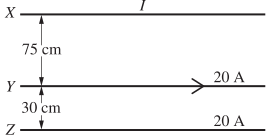
Three parallel wires `X`, `Y` and `Z` all carry electric currents. A force of attraction is produced between `Y` and `Z`. There is zero net force on `Y`.
 

What is the magnitude and direction of the current in `X` ?   (3 marks)

--- 9 WORK AREA LINES (style=lined) ---

Show Answers Only

50 Amps in the same direction as `Y`.

Show Worked Solution
  • Net force on `Y=0` (given).
  • The force of attraction between `Y` and `X` is equal to the force of attraction between `Y` and `Z`.
`(F)/(l)` `=(mu_(0))/(2pi)(I_(1)I_(2))/(r)`  
`(mu_(0))/(2pi)(I_(Y)I_(Z))/(0.3)` `=(mu_(0))/(2pi)(I_(X)I_(Y))/(0.75)`  
`(I_(Y)I_(Z))/(0.3)` `=(I_(X)I_(Y))/(0.75)`  
`(20 xx20)/(0.3)` `=(20I_(X))/(0.75)`  
`I_(X)` `=50\ text{A}`  


  • The direction of current in `X` is the same as the direction of current in `Y`, as there is a force of attraction between `X` and `Y`.

Filed Under: The Motor Effect Tagged With: Band 4, smc-3694-30-Force Between Current-Carrying Conductors

ENGINEERING, PPT 2022 HSC 4 MC

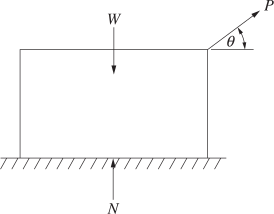
The diagram shows a box being pulled along a horizontal surface at angle `theta` to the horizontal.
 

Which equation is correct for `N`?

  1. `N = W - P costheta`
  2. `N = W + P costheta`
  3. `N = W - P sintheta`
  4. `N = W + P sintheta`
Show Answers Only

`C`

Show Worked Solution
`SigmaF_V` `=0`  
`0` `= N-W + P sintheta`  
`N` `= W-P sintheta`  

 
`=>C`

Mean mark 59%.

Filed Under: Mechanics Tagged With: Band 4, smc-3718-40-Normal Force

ENGINEERING, TE 2022 HSC 2 MC

Which of the following best describes the change in battery-powered telecommunications products since the introduction of semiconductors?

  1. Larger and use less power
  2. Smaller and use less power
  3. Larger and use more power
  4. Smaller and use more power
Show Answers Only

`B`

Show Worked Solution

`=>B`

Filed Under: Scope, Historical and Societal Influences Tagged With: Band 4, smc-3728-20-Innovation

ENGINEERING, PPT 2022 HSC 1 MC

What property of a material can be measured by testing its resistance to scratching?

  1. Hardness
  2. Stiffness
  3. Strength
  4. Toughness
Show Answers Only

`A`

Show Worked Solution

`=>A`

Filed Under: Materials Tagged With: Band 4, smc-3719-80-Compare properties

Algebra, STD1 A3 2022 HSC 25

Sam is making cupcakes to sell at a market. It costs Sam $60 to hire a stall, and each cupcake costs $1.50 to make. Sam intends to sell each cupcake for $4.00.

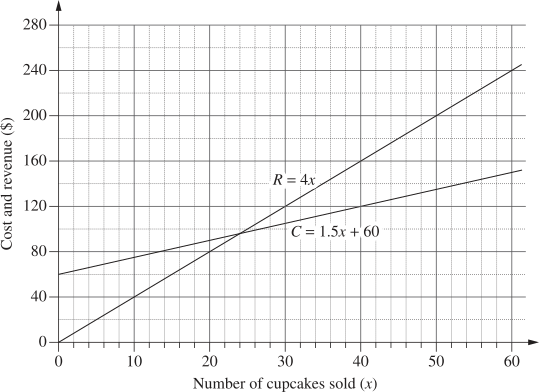
The equations representing Sam's cost `($ C)` and revenue `($ R)`, are

`C=1.5 x+60`  and  `R=4 x`, where `x` is the number of cupcakes sold.

The graphs of `C` and `R` are shown below.


  1. How many cupcakes must Sam sell in order to break even?  (1 mark)

    --- 1 WORK AREA LINES (style=lined) ---
  2. If Sam sells 60 cupcakes, what profit is made?
  3. You may assume that  Profit = Revenue – Cost.  (2 marks)

    --- 4 WORK AREA LINES (style=lined) ---
Show Answers Only
  1. 24
  2. $90
Show Worked Solution

a.   Break even occurs where the two graphs intersect.

→ 24 cupcakes
 

b.   If cupcakes sold (`x`) = 60:

`C = 1.5 xx 60 + 60= $150`

`R = 4 xx 60=$240`
  
`:.\ text{Profit}\ = 240-150 = $90`

Filed Under: A3 Types of Relationships (Y12) Tagged With: Band 4, smc-1099-10-Cost/Revenue

Statistics, STD1 S3 2022 HSC 23

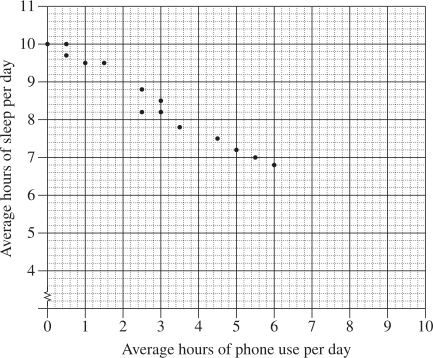
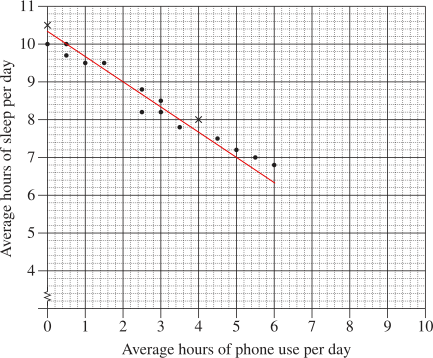
A teacher surveyed the students in her Year 8 class to investigate the relationship between the average number of hours of phone use per day and the average number of hours of sleep per day.

The results are shown on the scatterplot below.
 

  1. The data for two new students, Alinta and Birrani, are shown in the table below. Plot their results on the scatterplot.  (2 marks)

\begin{array} {|l|c|c|}
\hline
  & \textit{Average hours of} & \textit{Average hours of} \\ & \textit{phone use per day} & \textit{sleep per day} \\
\hline
\rule{0pt}{2.5ex} \text{Alinta} \rule[-1ex]{0pt}{0pt} & 4 & 8 \\
\hline
\rule{0pt}{2.5ex} \text{Birrani} \rule[-1ex]{0pt}{0pt} & 0 & 10.5 \\
\hline
\end{array}

  1. By first fitting the line of best fit by eye on the scatterplot, estimate the average number of hours of sleep per day for a student who uses the phone for an average of 2 hours per day.  (2 marks)

    --- 2 WORK AREA LINES (style=lined) ---

Show Answers Only
  1.  
  2. 9 hours (see LOBF in diagram above)
Show Worked Solution

a.     \(\text{New data points are marks with a × on the diagram below.}\)
 

b.   \(\text{9 hours (see LOBF in diagram above)}\)

Filed Under: Bivariate Data, S3 Further Statistical Analysis (Y12) Tagged With: Band 4, num-title-ct-coreb, num-title-qs-hsc, smc-1113-10-Line of Best Fit, smc-1113-20-Scatterplot from Table, smc-5022-10-Line of best fit graphs, smc-5022-20-Scatterplot from table

Financial Maths, STD1 F1 2022 HSC 21

A real estate agent's commission for selling houses is 2% for the first $800 000 of the sale price and 1.5% for any amount over $800 000.

Calculate the commission earned in selling a house for $1 500 000.  (2 marks)

Show Answers Only

$26 500

Show Worked Solution
`text{Commission}` `=800\ 000 xx 2text{%} + (1\ 500\ 000-800\ 000) xx 1.5text{%}`  
  `=800\ 000 xx 0.02 + 700\ 000 xx 0.015`  
  `=16\ 000 + 10\ 500`  
  `=$26\ 500`  

Filed Under: Earning Money and Budgeting (Std 1), Ways of Earning (Std1-2027) Tagged With: Band 4, smc-1126-20-Commission, smc-6515-20-Commission

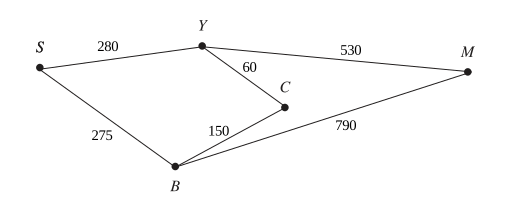
Networks, STD1 N1 2022 HSC 20

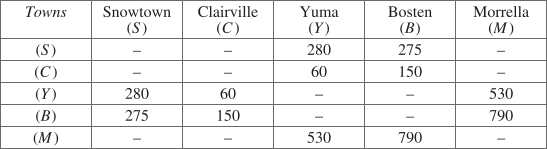
The table below shows the distances, in kilometres, between a number of towns.
 

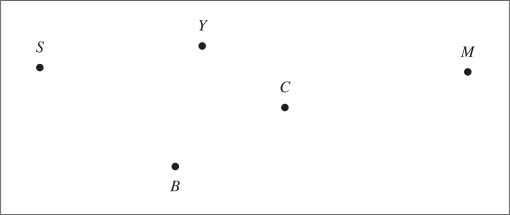
  1. Using the vertices given, draw a weighted network diagram to represent the information shown in the table.  (2 marks)


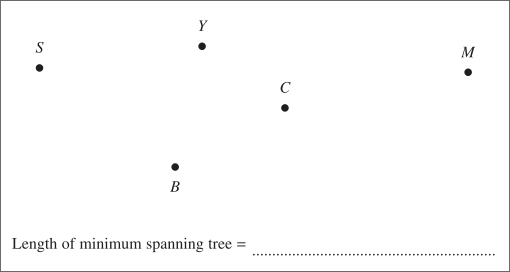
  2. A tourist wishes to visit each town.
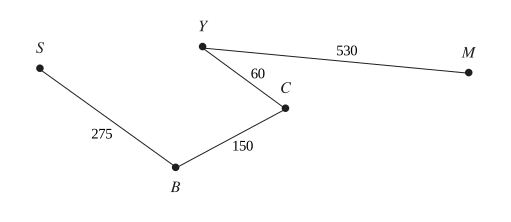
  3. Draw the minimum spanning tree which will allow for this AND determine its length.  (3 marks)
     

    --- 0 WORK AREA LINES (style=lined) ---
Show Answers Only
  1.  
     
     
  2.   
     
  3. `1015\ text{km}`
Show Worked Solution

a. 

b.   `text{Using Prim’s algorithm (starting at}\ Y):`

`text{1st edge:}\ YC`

`text{2nd edge:}\ CB`

`text{3rd edge:}\ SB`

`text{4th edge:}\ YM`

`text{Length of minimum spanning tree}`

`=275 + 150+60+530`

`=1015\ text{km}`

Filed Under: Basic Concepts, Minimum Spanning Trees, Network Concepts (Std1-2027), Spanning Trees (Std1-2027) Tagged With: Band 3, Band 4, smc-1136-10-Table to Network, smc-1138-20-Distance, smc-1138-40-Draw Tree, smc-6526-10-Table to Network, smc-6528-20-Distance, smc-6528-40-Draw Tree, std2-std1-common

Statistics, STD1 S3 2022 HSC 16

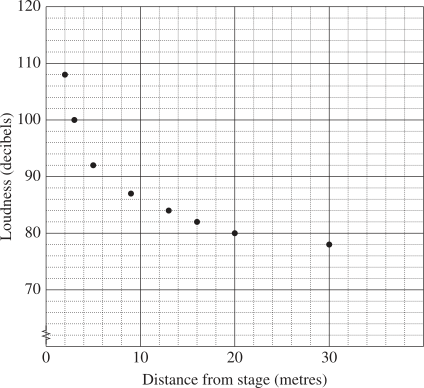
A concert organiser is interested in the relationship between the distance from the stage, in metres, and the loudness of the sound measured in decibels.

The data the concert organiser collected is shown on the graph.
 

  1. Is the relationship between distance and loudness linear or non-linear?  (1 mark)

    --- 1 WORK AREA LINES (style=lined) ---
  2. Based on this dataset, at approximately what distance from the stage would the sound be at 90 decibels?  (1 mark)

    --- 1 WORK AREA LINES (style=lined) ---

Show Answers Only
  1. `text{Non-linear}`
  2. `text{6 metres}`
Show Worked Solution

a.   The graph is not a straight line, therefore, non-linear.

b.   Distance =  6 metres.

→ Intersection of line of best fit and horizontal line at decibels (y-axis) = 90


♦ Mean mark part (b) 46%.

Filed Under: S3 Further Statistical Analysis (Y12) Tagged With: Band 4, Band 5, smc-1113-10-Line of Best Fit

Measurement, STD1 M4 2022 HSC 15

Tom is 25 years old, and likes to keep fit by exercising.

  1. Use this formula to find his maximum heart rate (bpm).
  2.       Maximum heart rate = 220 – age in years
  3. Tom's maximum heart rate is .................... bpm.  (1 mark)
  4. Tom will get the most benefit from this exercise if his heart rate is between 50% and 85% of his maximum heart rate.
  5. Between what two heart rates should Tom be aiming for to get the most benefit from his exercise?  (2 marks)

    --- 4 WORK AREA LINES (style=lined) ---

Show Answers Only
  1. `195\ text{bpm}`
  2. `text{98 – 166 bpm}`
Show Worked Solution
a.    `text{Max heart rate}` `=220-25`
    `=195\ text{bpm}`


b.   `text{50% max heart rate}\ = 0.5 xx 195 = 97.5\ text{bpm}`

`text{85% max heart rate}\ = 0.85 xx 195 = 165.75\ text{bpm}`

`:.\ text{Tom should aim for between 98 and 166 bpm in exercise.}`

Filed Under: M4 Rates (Y12) Tagged With: Band 2, Band 4, smc-1104-40-Heart Rates/Blood Pressure

ENGINEERING, AE 2020 HSC 27a

Explain why engineering production drawings prepared for Australian use should adhere to AS 1100 drawing standards.   (2 marks)

--- 5 WORK AREA LINES (style=lined) ---
Show Answers Only
  • AS1100 standards are important as they provide an unambiguous, standard method of communicating engineering drawings.
  • This standard can be applied nationally and understood internationally due to the strict rules which must be adhered to.
  • It is far easier to communicate ideas with visuals rather than words, and using these standards makes this communication clearer and easier to understand.
Show Worked Solution
  • AS1100 standards are important as they provide an unambiguous, standard method of communicating engineering drawings.
  • This standard can be applied nationally and understood internationally due to the strict rules which must be adhered to.
  • It is far easier to communicate ideas with visuals rather than words, and using these standards makes this communication clearer and easier to understand.

Filed Under: Communication Tagged With: Band 4, smc-3726-40-AS 1100

ENGINEERING, PPT 2020 HSC 26d

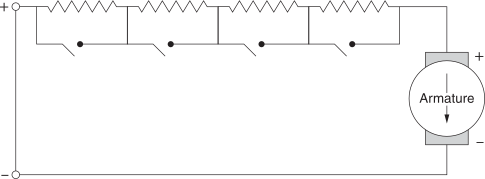
The diagram shows an electrical circuit that is used to control the speed of a DC electric traction motor.
 

Explain, with reference to the diagram, how the speed of the motor can be controlled. (3 marks)

--- 8 WORK AREA LINES (style=lined) ---
Show Answers Only
  • The motor’s speed and torque can be increased or decreased by varying the input current.
  • Since current and resistance are inversely proportional, the current can be increased by decreasing resistance and vice versa.
  • The above diagram shows 4 resistors that can be used or avoided by flicking a switch for each.
  • The more resistors that are switched out of the circuit, the more current flows to the motor and the speed of the motor increases.
Show Worked Solution
  • The motor’s speed and torque can be increased or decreased by varying the input current.
  • Since current and resistance are inversely proportional, the current can be increased by decreasing resistance and vice versa.
  • The above diagram shows 4 resistors that can be used or avoided by flicking a switch for each.
  • The more resistors that are switched out of the circuit, the more current flows to the motor and the speed of the motor increases.

Filed Under: Electricity/Electronics Tagged With: Band 4, smc-3720-20-Circuit diagrams, smc-3720-40-Electrical motors

BIOLOGY, M7 2019 HSC 32

Use the following data to answer parts (a) and (b).

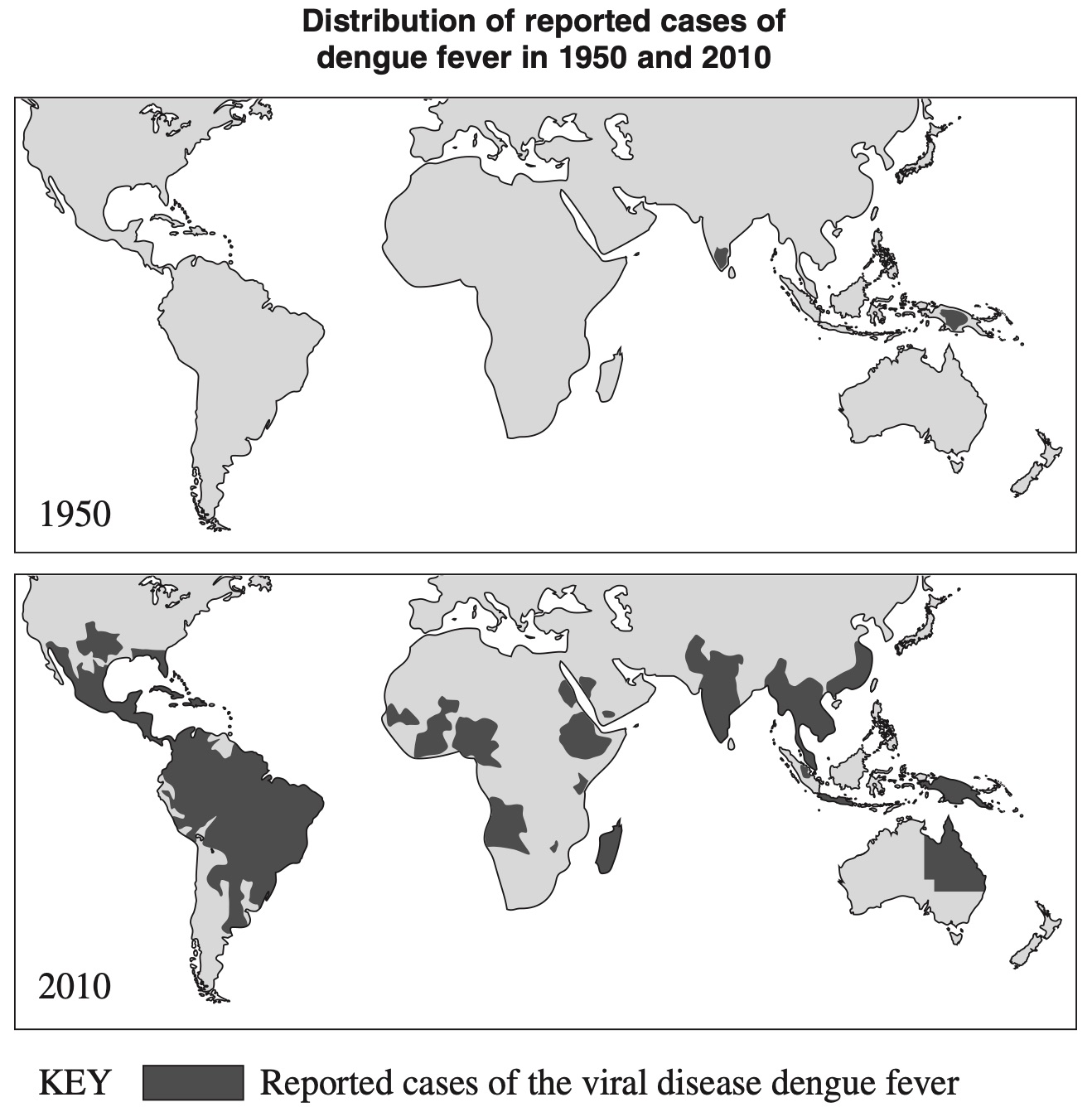
Dengue fever and malaria are examples of infectious diseases transmitted between humans by mosquitoes. Dengue fever is caused by a virus transmitted by mosquitoes of the genus Aedes. Malaria is caused by a single-celled organism transmitted by mosquitoes of the genus Anopheles.

The following data provide information about the global incidence of these two diseases over time.


  1. Based on the data provided, identify trends in the global disease burden for both malaria and dengue fever.   (3 marks)

    --- 8 WORK AREA LINES (style=lined) ---
  2. Analyse factors that could have contributed to the change in global distribution of both dengue fever and malaria over the last 100 years. Support your answer with reference to the data provided.   (7 marks)

    --- 16 WORK AREA LINES (style=lined) ---
Show Answers Only

a.   Trends in global disease burden:

  • The distribution on Dengue Fever has significantly increased since 1950, with continents such as Australia, Europe, South America and Africa now having a significant number of reported cases.
  • This spread is seen both north and south of the equator.
  • Malaria has a declining number of countries with reported cases of the disease.
  • However, population growth means the number of individuals at risk is increasing, having almost doubled between 1965 and 2010.
  • We can conclude however, that there is an increasing number of people at risk of malaria, but representing a smaller portion of the global population. 

b.  Analysis of factors that could have contributed to the change in global distribution of both dengue fever and malaria

Both diseases are transmitted by a mosquito vector. The prevalence of mosquitoes in each area would therefore have a large influence on the number of infected individuals.

  • The increase in international travel allows mosquitoes to spread across the world.
  • The increasing population of the world along with rapid urbanisation gives rise to more urban mosquito habitats.

These factors can be associated with the distribution seen on the Dengue Fever map, however the countries with reported cases of Malaria has shrunk.

  • The mosquitoes responsible for Dengue Fever and Malaria respectively, are from a different genus of mosquito. It is likely that more is known about Anopheles than Aedes.
  • The use of quarantine and pesticides on the Anopheles is most likely being used to contain the spread of malaria.

Medical advances such as vaccines also have the potential to be an effective measure of containing diseases.

  • From both data sets, it would be accurate to conclude, however, that medicinal products had better results when maintaining malaria compared to dengue fever.
  • Antimalarial tablets or a malaria vaccine may be types of malaria medicinal products that may be used to maintain the disease.
  • The rapid evolution of the dengue virus, ineffective antivirals or potentially that there is no known vaccine may be some of the reasons why medicinals may not be effective for dengue fever.
Show Worked Solution

a.   Trends in global disease burden:

  • The distribution on Dengue Fever has significantly increased since 1950, with continents such as Australia, Europe, South America and Africa now having a significant number of reported cases.
  • This spread is seen both north and south of the equator.
  • Malaria has a declining number of countries with reported cases of the disease.
  • However, population growth means the number of individuals at risk is increasing, having almost doubled between 1965 and 2010.
  • We can conclude however, that there is an increasing number of people at risk of malaria, but representing a smaller portion of the global population. 

b.  Analysis of factors that could have contributed to the change in global distribution of both dengue fever and malaria

Both diseases are transmitted by a mosquito vector. The prevalence of mosquitoes in each area would therefore have a large influence on the number of infected individuals.

  • The increase in international travel allows mosquitoes to spread across the world.
  • The increasing population of the world along with rapid urbanisation gives rise to more urban mosquito habitats.

These factors can be associated with the distribution seen on the Dengue Fever map, however the countries with reported cases of Malaria has shrunk.

  • The mosquitoes responsible for Dengue Fever and Malaria respectively, are from a different genus of mosquito. It is likely that more is known about Anopheles than Aedes.
  • The use of quarantine and pesticides on the Anopheles is most likely being used to contain the spread of malaria.

Medical advances such as vaccines also have the potential to be an effective measure of containing diseases.

  • From both data sets, it would be accurate to conclude, however, that medicinal products had better results when maintaining malaria compared to dengue fever.
  • Antimalarial tablets or a malaria vaccine may be types of malaria medicinal products that may be used to maintain the disease.
  • The rapid evolution of the dengue virus, ineffective antivirals or potentially that there is no known vaccine may be some of the reasons why medicinals may not be effective for dengue fever.

♦ Mean mark (b) 52%.

Filed Under: Prevention, Treatment and Control Tagged With: Band 4, Band 5, smc-3658-40-Interpreting Data, smc-3658-50-Malaria

BIOLOGY, M7 2019 HSC 31

  1. Outline ONE adaptation of a specific pathogen that facilitates its entry into a host.   (2 marks)

    --- 4 WORK AREA LINES (style=lined) ---
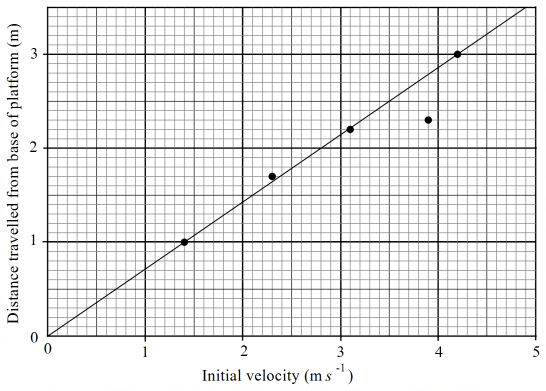
  2. Explain how the mode of transmission of pathogens influences the spread of diseases.   (3 marks)

    --- 6 WORK AREA LINES (style=lined) ---
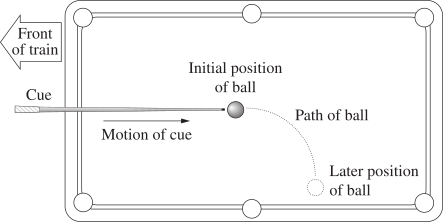
Show Answers Only

a.    Helicobacter pylori is a bacteria that causes stomach ulcers.

  • It has flagellum which allows it to move in the stomach and penetrate the stomach wall. 

Other answers could include:

  • Salmonella and its ability to adapt to host blood temperature. 

b.    Diseases will be able to spread faster and easier with certain modes of transmission.

  • Airborne disease such as influenza are able to spread faster as the virus can be passed through droplets of air by infected individuals sneezing/coughing.
  • Diseases that can only spread via direct contact will have lower infection rates as there is a less effective mode of transmission. 

Other answers could include the effectiveness of modes such as 

  • Vectors and their presence in an area influencing infection rate.
  • Foodborne/waterborne diseases.
  • Zoonotic diseases.
Show Worked Solution

a.    Helicobacter pylori is a bacteria that causes stomach ulcers.

  • It has flagellum which allows it to move in the stomach and penetrate the stomach wall. 

Other answers could include:

  • Salmonella and its ability to adapt to host blood temperature. 

♦♦ Mean mark (a) 36%.

b.    Diseases will be able to spread faster and easier with certain modes of transmission.

  • Airborne disease such as influenza are able to spread faster as the virus can be passed through droplets of air by infected individuals sneezing/coughing.
  • Diseases that can only spread via direct contact will have lower infection rates as there is a less effective mode of transmission. 

Other answers could include the effectiveness of modes such as 

  • Vectors and their presence in an area influencing infection rate.
  • Foodborne/waterborne diseases.
  • Zoonotic diseases.

Filed Under: Causes of Infectious Disease Tagged With: Band 4, Band 5, smc-3655-20-Transmission, smc-3655-30-Vectors, smc-3655-40-Pathogen Adaptations

  • « Previous Page
  • 1
  • …
  • 52
  • 53
  • 54
  • 55
  • 56
  • …
  • 114
  • Next Page »

Copyright © 2014–2025 SmarterEd.com.au · Log in