SmarterEd

Aussie Maths & Science Teachers: Save your time with SmarterEd

  • Login
  • Get Help
  • About

Calculus, EXT1 C3 2011 SPEC2 17 MC

SPEC2 2011 VCAA 17 MC

The differential equation which best represents the above direction field is

A.   `(dy)/(dx) = (y - 2x)/(2y + x)`

B.   `(dy)/(dx) = (2x - y)/(y - 2x)`

C.   `(dy)/(dx) = (2y - x)/(y + 2x)`

D.   `(dy)/(dx) = (y - 2x)/(2y - x)`

E.   `(dy)/(dx) = (x - 2y)/(2y + x)`
Show Answers Only

`A`

Show Worked Solution

`text(When)\ \ x=0\ \ => \ \ text(gradients are all positive)`

Almost half of all students answered incorrectly – mean mark 52%.

`text(Eliminate B and E.)`

`text(When)\ \ y=0\ \ => \ \ text(gradients are all negative)`

`text(Eliminate D.)`

`text(Option A will have zero gradient along)\ \ y=2x\ \ text{(correct)}`

`text(Option C will have zero gradient along)\ \ y=1/2 x\ \ text{(incorrect)}`

`=> A`

Filed Under: Equations and Slope Fields Tagged With: Band 4, smc-1197-10-Slope Fields

Calculus, EXT1 C3 2017 SPEC1-N 7

Let  `(dy)/(dx) = (4 - y)^2`.

Express  `y`  in terms of  `x`, where  `y(0) = 3`.  (3 marks)

--- 6 WORK AREA LINES (style=lined) ---

Show Answers Only

`y = 4-1/(x + 1)`

Show Worked Solution
`(dy)/(dx)` `=(4-y)^2`
`(dx)/(dy)` `= 1/(4-y)^2`
`x` `= int 1/(4-y)^2\ dy`
  `= int (4-y)^(-2) dy`
  `= (-1)(-1)(4-y)^(-1)+ c`
  `= 1/(4-y) + c`

 
`text(When)\ \ x=0,\ \ y=3:`

`0` `= 1/(4-3) + c`
`:.c` `= -1`


`x` `= 1/(4-y) – 1`
`x + 1` `= 1/(4-y)`
`1/(x + 1)` `= 4-y`
`:. y` `= 4-1/(x + 1)`

Filed Under: Equations and Slope Fields Tagged With: Band 4, smc-1197-20-Differential Equations, smc-1197-40-dy/dx = f(y)

Calculus, EXT1 C3 2018 VCE 8

A tank initially holds 16 L of water in which 0.5 kg of salt has been dissolved. Pure water then flows into the tank at a rate of 5 L per minute. The mixture is stirred continuously and flows out of the tank at a rate of 3 L per minute.

  1.  Show that the differential equation for `Q`, the number of kilograms of salt in the tank after `t` minutes, is given by

    `qquad (dQ)/(dt) = -(3Q)/(16 + 2t)`  (1 mark)
      
  2.  Solve the differential equation given in part a. to find `Q` as a function of `t`.
      
    Express your answer in the form  `Q = a/(16 + 2t)^(b/c)`, where `a, b` and `c` are positive integers.  (3 marks)
Show Answers Only
  1.  `text(Proof)\ \ text{(See Worked Solutions)}`
  2.  `Q = 32/(16 + 2t)^(3/2)`
Show Worked Solution

a. `Q_0 = 0.5, \ V_0 = 16`

♦ Net mean mark of both parts 44%.

`V(t)` `= 16 + (5 – 3) t`
  `= 16 + 2t`

 
`text(Concentration)\ (C)= Q/V= Q/(16 + 2t)\ text(kg/L)`

`(dQ)/(dt)` `= 0 xx 5 – 3C`
  `= -(3Q)/(16 + 2t)`

MARKER’S COMMENT: Many students took the common factor of 2 from  `16+2t`. This wasn’t necessary and complicated the arithmetic in part b.


b.   `-1/(3Q) * (dQ)/(dt) = 1/(16 + 2t)`

`int -1/(3Q)\ dQ` `= int 1/(16 + 2t) dt`
`-1/3 int 1/Q\ dQ` `= 1/2 int 2/(16 + 2t)\ dt`
`-1/3 ln Q` ` = [1/2 ln(16 + 2t)] + c`

 
`text(When)\ \ t=0,\ \ Q=0.5,`

COMMENT: A very challenging test of using exponential and log laws!

`-1/3 ln (1/2)` `= 1/2 ln (16) +c`
`c` `= -1/2 ln (16) -1/3 ln (1/2)`


`-1/3 ln Q` `= 1/2 ln(16 + 2t) -1/2 ln(16) – 1/3 ln (1/2)`
`-1/3 ln Q` `= 1/2 ln ((16 + 2t)/16) – 1/3 ln (1/2)`
`-1/3 ln Q` `= ln (((16 + 2t)^(1/2))/4) – ln (2^(-1/3))`
`ln (Q^(-1/3))` `= ln (((16 + 2t)^(1/2))/(2^2 ⋅ 2^(-1/3)))`
`Q^(-1/3)` `= ((16 + 2t)^(1/2))/(2^(5/3))`
`Q` `= (((16 + 2t)^(1/2))/(2^(5/3)))^-3`
  `= (16 + 2t)^(- 3/2)/(2^(-5))`
`:. Q` `= 32/((16 + 2t)^(3/2))`

Filed Under: Uncategorized Tagged With: Band 4, Band 5, smc-1198-10-Mixing

Calculus, EXT1 C1 2013 VCE 5

A container of water is heated to boiling point (100°C) and then placed in a room that has a constant temperature of 20°C. After five minutes the temperature of the water is 80°C.

  1. Use Newton’s law of cooling  `(dT)/(dt) = -k (T - 20)`, where `T text(°C)` is the temperature of the water at the time `t` minutes after the water is placed in the room, to show that  `e^(-5k) = 3/4.`  (2 marks)

    --- 7 WORK AREA LINES (style=lined) ---

  2. Find the temperature of the water 10 minutes after it is placed in the room.  (3 marks)

    --- 8 WORK AREA LINES (style=lined) ---

Show Answers Only
  1. `text(Proof)\ \ text{(See Worked Solutions)}`
  2. `65`
Show Worked Solution
a.    `(dT)/(dt)` `= -k (T – 20)`
  `(dt)/(dT)` `= -1/k * 1/(T – 20)`
  `t` `= -1/k int 1/(T – 20)\ dT`
  `-kt` `= log_e (T – 20) + c`
     

`text(When)\ \ t = 0,\ \ T = 100,`

COMMENT: Recognise that exponential G+D models are simply differential equations with known solutions (syllabus p.58)!

`=>c = -log_e 80,`

`:. -kt` `= log_e (T – 20) – log_e 80`
  `= log_e ((T – 20)/80)`

 
`text(When)\ \ t = 5,\ \ T = 80,`

`-5k = log_e (3/4)`

`:. e^(-5k) = 3/4`


(b)   `text(Find)\ \ T\ \ text(when)\ \ t = 10:`

`-10k` `= log_e ((T – 20)/80)`
`(T – 20)/80` `= e^(-10k)`
`(T – 20)/80` `= (e^(-5k))^2`
`(T – 20)/80` `= (3/4)^2`
`:. T` `= (3/4)^2 xx 80 + 20`
  `=(9 xx 80)/16 +20`
  `= 65^@ text(C)`

Filed Under: Modified Growth and Decay Tagged With: Band 4, smc-1080-10-Cooling

Calculus, EXT1 C3 2017 SPEC2 9 MC

The gradient of the tangent to a curve at any point  `P(x, y)`  is half the gradient of the line segment joining `P` and the point  `Q(-1, 1)`.

The coordinates of points on the curve satisfy the differential equation

A.   `(dy)/(dx) = (y + 1)/(2(x - 1))`

B.   `(dy)/(dx) = (2(y - 1))/(x + 1)`

C.   `(dy)/(dx) = (x - 1)/(2(y + 1))`

D.   `(dy)/(dx) = (y - 1)/(2(x + 1))`

Show Answers Only

`D`

Show Worked Solution
`m_text(tang)` `= 1/2 m_(PQ)`
`m_(PQ)` `= (y – 1)/(x – (-1))`
  `= (y – 1)/(x + 2)`

 
`:. m_text(tang) = (dy)/(dx) = (y – 1)/(2(x + 1))`

`=>   D`

Filed Under: Equations and Slope Fields Tagged With: Band 4, smc-1197-10-Slope Fields

Calculus, EXT1 C3 2017 SPEC2-N 10 MC

A solution to the differential equation  `(dy)/(dx) = (cos(x + y) - cos(x - y))/(e^(x + y))`  can be obtained from

  1. `int e^y/(sin(y))\ dy = -int (2 sin(x))/e^x\ dx`
  2. `int e^y/(cos(y))\ dy = int 2/e^x\ dx`
  3. `int e^y/(cos(y))\ dy = -int (2 cos(x))/e^x\ dx`
  4. `int e^y/(cos(y))\ dy = int (2 sin(x))/e^x\ dx`
Show Answers Only

`A`

Show Worked Solution
`dy/dx` `=(cos(x + y) – cos(x – y))/(e^(x + y))`
`(dy)/(dx)` `= (cos(x) cos(y) – sin(x) sin(y) – cos(x) cos(y) – sin(x) sin(y))/(e^x ⋅ e^y)`
`e^y *(dy)/(dx)` `= (-2 sin(x) sin(y))/(e^x)`
`e^y/(sin(y)) *(dy)/(dx)` `= (-2 sin(x))/(e^x)`
`:. int e^y/(sin(y))\ dy` `= -int (2 sin(x))/e^x\ dx`

 
`=>   A`

Filed Under: Equations and Slope Fields Tagged With: Band 4, smc-1197-20-Differential Equations, smc-1197-30-dy/dx = f(x y), y)

Calculus, EXT1 C3 2018 SPEC2 9 MC

A solution to the differential equation  `(dy)/(dx) = 2/{sin(x + y) - sin(x - y)}`  can be obtained from

  1. `int 1\ dx = int 2 sin(y)\ dy`
  2. `int cos(y)\ dy = int text{cosec}(x)\ dx`
  3. `int cos(x)\ dx = int text{cosec}(y)\ dy`
  4. `int sec(x)\ dx = int sin(y)\ dy`
Show Answers Only

`D`

Show Worked Solution
`(dy)/(dx)` `= 2/{sin(x) cos(y) + sin(y) cos(x) – (sin(x) cos(y) – sin(y) cos(x))}`
  `= 2/{2 sin(y) cos(x)}`
  `= 1/{sin(y) cos(x)}`

 
`sin(y) *(dy)/(dx)= sec(x)`

`int sin (y)\ dy= int sec(x)\ dx`

`=>  D`

Filed Under: Equations and Slope Fields Tagged With: Band 4, smc-1197-20-Differential Equations, smc-1197-30-dy/dx = f(x y), y)

Calculus, EXT1 C3 2014 VCE 10 MC

A large tank initially holds 1500 L of water in which 100 kg of salt is dissolved. A solution containing 2 kg of salt per litre flows into the tank at a rate of 8 L per minute. The mixture is stirred continuously and flows out of the tank through a hole at a rate of 10 L per minute.

The differential equation for `Q`, the number of kilograms of salt in the tank after `t` minutes, is given by

A.   `(dQ)/(dt) = 16 - (5Q)/(750 - t)`

B.   `(dQ)/(dt) = 16 - (5Q)/(750 + t)`

C.   `(dQ)/(dt) = 16 + (5Q)/(750 - t)`

D.   `(dQ)/(dt) = (100Q)/(750 - t)`

Show Answers Only

`A`

Show Worked Solution

`(dQ_text(in))/(dV)= 2\ text(kg/L),\ (dV_text(in))/(dt) = 8\ text(L/min)`

`V_0 = 1500,\ Q_0 = 100`

`(dV_text(out))/(dt) = 10\ text(L/min)`
  

`V(t)` `= 1500 + (8 – 10)t`
  `= 1500 – 2t`
  `= 2(750 – t)`


`(dQ_text(in))/(dt)` `= 2 xx 8 = 16 text(kg/min)`
`(dQ_text(out))/(dt)` `= Q/(v(t)) xx 10`
  `= (10Q)/(2(750 – t))`
  `= (5Q)/(750 – t)`

 
`:.(dQ)/(dt)= 16 – (5Q)/(150 – t)`

`=> A`

Filed Under: Uncategorized Tagged With: Band 4, smc-1198-10-Mixing

Calculus, EXT1 C3 2013 VCE 13 MC

Water containing 2 grams of salt per litre flows at the rate of 10 litres per minute into a tank that initially contained 50 litres of pure water. The concentration of salt in the tank is kept uniform by stirring and the mixture flows out of the tank at the rate of 6 litres per minute.

If `Q` grams is the amount of salt in the tank `t` minutes after the water begins to flow, the differential equation relating `Q` to `t` is

A.   `(dQ)/(dt) = 20 - (3Q)/(25 + 2t)`

B.   `(dQ)/(dt) = 10 - (3Q)/(25 + 2t)`

C.   `(dQ)/(dt) = 20 - (3Q)/(25 - 2t)`

D.   `(dQ)/(dt) = 10 - (3Q)/(25 - 2t)`

Show Answers Only

`A`

Show Worked Solution
`text(Volume)` `= 50 + (10 – 6)t`
  `= 50 + 4t`

 
`text(Salt in tank at time)\ \ t=Q\ text(grams)`

`:.\ text(Concentration)\ = Q/(50 + 4t)\ text(grams per litre)`
 

`(dQ)/(dt)text(in) = 2 xx 10 = 20\ \ text(g/min)`

`(dQ)/(dt)text(out)` `= 6 xx Q/(50 + 4t)`
  `= (3Q)/(25 + 2t)`

 
`:. (dQ)/(dt) = 20 – (3Q)/(25 + 2t)`

`=> A`

Filed Under: Uncategorized Tagged With: Band 4, smc-1198-10-Mixing

Vectors, EXT1 V1 EQ-Bank 4 MC

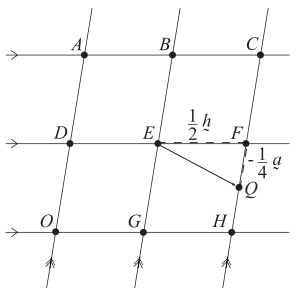
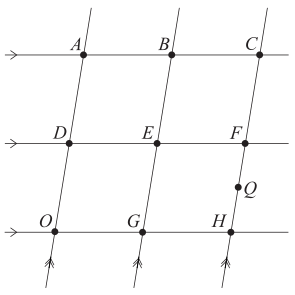
The diagram shows a grid of equally spaced lines. The vector  `overset(->)(OA) = underset~a`  and the vector  `overset(->)(OH) = underset~h`. The point `Q` is halfway between `F` and `H`.
 

Which expression represents the vector `overset(->)(EQ)`?

  1. `−1/4 underset~a + 1/2 underset~h`
  2. `1/2 underset~a - 1/4 underset~h`
  3. `1/4 underset~a + 1/2 underset~h`
  4. `1/4 underset~a + underset~h`
Show Answers Only

`A`

Show Worked Solution

`overset(->)(EQ) = 1/2underset~h-1/4underset~a`

`=> A`

Filed Under: Vectors and Geometry (Ext1) Tagged With: Band 4, smc-1211-60-Other

Vectors, EXT2 V1 2017 SPEC1 10

Consider the vectors  `underset ~a = - underset ~i - 2 underset ~j + 3 underset ~k`  and  `underset ~b = 2 underset ~i + c underset ~j + underset ~k`.

Find the value of  `c, \ c in R`, if the angle between  `underset ~a`  and  `underset ~b`  is  `pi/3`.  (4 marks)

--- 8 WORK AREA LINES (style=lined) ---

Show Answers Only

`c = -3`

Show Worked Solution
`underset ~a ⋅ underset ~b` `= -1 xx 2 + (-2) xx c + 3 xx 1`
  `= -2 – 2c + 3`
  `= 1 – 2c`


`1-2c` `= sqrt((-1)^2 + (-2)^2 + 3^3) *sqrt(2^2 + c^2 + 1^2) xx cos (pi/3)`
`1 – 2c` `= 1/2(sqrt 14 ⋅ sqrt(5 + c^2))`
`2 – 4c` `= sqrt(14(5 + c^2))`
`(2 – 4c)^2` `= 14(5 + c^2)`
`4 – 16c + 16c^2` `= 70 + 14c^2`
`2c^2 – 16c – 66` `= 0`
`c^2 – 8c – 33` `= 0`
`(c – 11)(c + 3)` `= 0`

 
`c = 11 or c = -3`

`text(S)text(ince)\ \ 2 – 4c = sqrt(15(5 + c^2))`

`2 – 4c > 0\ \ =>\ \ c<2`

`:. c = -3`

Filed Under: Basic Concepts and Arithmetic Tagged With: Band 4, smc-1195-20-Angles Between Vectors

Vectors, EXT2 V1 2015 VCE 1

Consider the rhombus  `OABC`  shown below, where  `vec (OA) = a underset ~i`  and  `vec (OC) = underset ~i + underset ~j + underset ~k`, and `a` is a positive real constant.
 

VCAA 2015 spec 1a
 

  1. Find  `a.`  (1 mark)

    --- 2 WORK AREA LINES (style=lined) ---

  2. Show that the diagonals of the rhombus  `OABC`  are perpendicular.  (2 marks)

    --- 6 WORK AREA LINES (style=lined) ---

Show Answers Only
  1. `sqrt 3`
  2. `text(Proof)\ \ text{(See Worked Solutions)}`
Show Worked Solution

i.   `|\ vec(OA)\ | = |\ vec(OC)\ |,`

`:. a` `= sqrt (1^2 + 1^2 + 1^2)`
  `= sqrt 3`


ii.   `overset(->)(CB) = overset(->)(OA), \ \ overset(->)(AB) = overset(->)(OC)`

MARKER’S COMMENT: Vector notation was poor in many answers.

`overset(->)(OB) = overset(->)(OC) + overset(->)(CB)`

`= underset~i + underset~j + underset~k + sqrt3 underset~i`

`= (sqrt3 + 1)underset~i + underset~j + underset~k`
 

`overset(->)(AC) = overset(->)(AO) + overset(->)(OC)`

`= −sqrt3underset~i + underset~i + underset~j + underset~k`

`= (1 – sqrt3)underset~i + underset~j + underset~k`
 

`overset(->)(AC) · overset(->)(OB)` `= (1 + sqrt3)(1 – sqrt3) + 1 + 1`
  `= 1 – 3 + 1 + 1`
  `= 0`

 
`:. overset(->)(AC) ⊥ overset(->)(OB)`

Filed Under: Vectors and Geometry Tagged With: Band 4, smc-1210-30-Quadrilateral, smc-1210-60-2D problems

Vectors, EXT2 V1 2014 SPEC1 1

Consider the vector  `underset ~a = sqrt 3 underset ~i - underset ~j - sqrt 2 underset ~k`, where  `underset ~i, underset ~j`  and  `underset ~k`  are unit vectors in the positive directions of the `x, y` and `z` axes respectively.

  1.  Find the unit vector in the direction of  `underset ~a`.  (1 mark)

    --- 2 WORK AREA LINES (style=lined) ---

  2.  Find the acute angle that  `underset ~a`  makes with the positive direction of the `x`-axis.  (2 marks)

    --- 4 WORK AREA LINES (style=lined) ---

  3.  The vector  `underset ~b = 2 sqrt 3 underset ~i + m underset ~j - 5 underset ~k`.


     Given that  `underset ~b`  is perpendicular to  `underset ~a,` find the value of `m`.  (2 marks)

    --- 2 WORK AREA LINES (style=lined) ---

Show Answers Only
  1. `1/sqrt 6 (sqrt 3 underset ~i – underset ~j – sqrt 2 underset ~k)`
  2. `theta = 45^@`
  3. `m = 6 + 5 sqrt 2`
Show Worked Solution
i.    `|underset ~a|` `= sqrt((sqrt 3)^2 + (-1)^2 + (-sqrt 2)^2)`
    `= sqrt 6`
`:. hat underset ~a` `= underset ~a/|underset ~a|`
  `= 1/sqrt 6 (sqrt 3 underset ~i – underset ~j – sqrt 2 underset ~k)`


Mean mark part (b) 51%.

ii.    `underset ~a ⋅ underset ~i` `= sqrt 3 xx 1 = sqrt 3`
  `underset ~a ⋅ underset ~i` `= |underset ~a||underset ~i| cos theta`
    `= sqrt 6 cos theta`
  `sqrt 3` `= sqrt 6 cos theta`
`cos theta` `= 1/sqrt 2`
`:. theta` `= pi/4 = 45^@`


iii.   `underset ~a ⋅ underset ~b = sqrt 3 (2 sqrt 3) + (-1)(m) + (-sqrt 2)(-5) = 0`

`6 – m + 5 sqrt 2` `=0`  
`:. m` `=6 + 5 sqrt 2`  

Filed Under: Basic Concepts and Arithmetic Tagged With: Band 3, Band 4, smc-1195-20-Angles Between Vectors, smc-1195-30-Perpendicular Vectors, smc-1195-40-Unit Vectors and Projections

Vectors, EXT2 V1 2013 SPEC1 3

The coordinates of three points are  `A\ ((– 1), (2), (4)), \ B\ ((1), (0), (5)) and C\ ((3), (5), (2)).`

  1. Find  `vec (AB).`  (1 mark)

    --- 2 WORK AREA LINES (style=lined) ---

  2. The points `A, B` and `C` are the vertices of a triangle. 


    Prove that the triangle has a right angle at `A.`  (2 marks)

    --- 4 WORK AREA LINES (style=lined) ---

  3. Find the length of the hypotenuse of the triangle.  (1 mark)

    --- 5 WORK AREA LINES (style=lined) ---

Show Answers Only
  1. `2underset~i – 2underset~j + underset~k`
  2. `text(Proof)\ \ text{(See Worked Solutions)}`
  3. `sqrt 38`
Show Worked Solution
i.   `vec(AB)` `=(1 – −1)underset~i + (0 – 2)underset~j + (5 – 4)underset~k`
    `= 2underset~i – 2underset~j + underset~k`


ii.    `overset(->)(AC)` `= (3 – −1)underset~i + (5 – 2)underset~j + (2 – 4)underset~k`
    `= 4underset~i + 3underset~j – 2underset~k`


`overset(->)(AB) · overset(->)(AC)` `= 2 xx 4 + (−2) xx 3 + 1 xx (−2)`
  `= 8 – 6 – 2`
  `= 0`

 
`=>  overset(->)(AB) ⊥ overset(->)(AC)`

`:. DeltaABC\ text(has a right angle at)\ A.`
 

iii.    `overset(->)(BC)` `= (3 – 1)underset~i + (5 – 0)underset~j + (2 – 5)underset~k`
    `= 2underset~i + 5underset~j – 3underset~k`


`|overset(->)(BC)|` `= sqrt(2^2 + 5^2 + (−3)^2)`
  `= sqrt(4 + 25 + 9)`
  `= sqrt38`

Filed Under: Basic Concepts and Arithmetic Tagged With: Band 3, Band 4, smc-1195-10-Basic Calculations, smc-1195-30-Perpendicular Vectors

Vectors, EXT2 V1 SM-Bank 8

If  `underset ~a = -2 underset ~i - underset ~j + 3 underset ~k`  and  `underset ~b = -m underset ~i + underset ~j + 2 underset ~k`, where  `m`  is a real constant, find  `m`  such that the vector  `underset ~a - underset ~b`  will be perpendicular to vector  `underset ~b`.   (2 marks)

Show Answers Only

`0 or 2`

Show Worked Solution
`underset ~a – underset ~b` `= (m – 2) underset ~i – 2 underset ~j + underset ~k `
`(underset ~a – underset ~b) ⋅ underset ~b` `= -m(m – 2) – 2(1) + 1(2) = 0`
`0` `= -m^2 + 2m – 2 + 2`
`0` `= 2m – m^2`
`0` `= m(2 – m)`
`:. m` `= 0 \ or \ 2`

Filed Under: Basic Concepts and Arithmetic Tagged With: Band 4, smc-1195-30-Perpendicular Vectors

Vectors, EXT2 V1 SM-Bank 7

If  `theta`  is the angle between  `underset ~a = sqrt 3 underset ~i + 4 underset ~j - underset ~k`  and  `underset ~b = underset ~i - 4 underset ~j + sqrt 3 underset ~k`, then find  `cos(2 theta)`.   (2 marks)

Show Answers Only

`7/25`

Show Worked Solution
`underset ~a ⋅ underset ~b` `= sqrt 3 xx 1 + 4 xx (-4) + (-1) xx sqrt 3`
  `= -16`

 
`|\ underset~a\ | = sqrt20,\ \ |\ underset~b\ | = sqrt20,`

`cos(theta)` `=(underset ~a ⋅ underset ~b)/(|\ underset~a\ |\ |\ underset~b\ | `
  `= (-16)/(sqrt 20 xx sqrt 20)`
  `= -4/5`


`cos (2 theta)` `= 2cos^2theta – 1`
  `= 2(-4/5)^2 – 1`
  `= 7/25`

Filed Under: Basic Concepts and Arithmetic Tagged With: Band 4, smc-1195-20-Angles Between Vectors

Vectors, EXT1 V1 SM-Bank 25

Consider the vectors given by  `underset ~a = m underset ~i + underset ~j`  and  `underset ~b = underset ~i + m underset ~j`, where  `m in R`.

Find the value(s) of  `m`  if the acute angle between  `underset ~a`  and  `underset ~b`  is 30°.   (2 marks)

--- 6 WORK AREA LINES (style=lined) ---

Show Answers Only

`sqrt 3, 1/sqrt 3`

Show Worked Solution
`underset ~a *underset ~b` `= m xx 1 + 1 xxm`
  `=2m`
   
`underset ~a *underset ~b` `= |underset ~a||underset ~b| cos 30^@`
  `= sqrt(m^2 + 1) *sqrt(1 + m^2) *cos 30^@`
  `= {(m^2 + 1) sqrt 3}/2`


`{(m^2 + 1) sqrt 3}/2` `=2m`  
`m^2 sqrt 3 + sqrt 3` `=4m`  
`m^2 sqrt 3-4m + sqrt 3` `=0`  
`(sqrt 3 m)^2-4(sqrt 3 m) + 3` `=0`  
`(sqrt 3 m)^2-4(sqrt 3 m) + 2^2-1` `=0`  
`(sqrt 3 m-2)^2-1` `=0`  
`sqrt 3 m-2` `= +-1`  
`sqrt 3 m` `= 2 +- 1`  

 
`:. m = (2 +- 1)/sqrt 3 = 3/sqrt 3 or 1/sqrt 3`

`= sqrt 3, 1/sqrt 3`

Filed Under: Operations With Vectors (Ext1) Tagged With: Band 4, smc-1086-20-Angles Between Vectors

Vectors, EXT2 V1 2013 VCE 15 MC

Let  `underset~u = 4underset~i - underset~j + underset~k`,  `underset~v = 3underset~j + 3underset~k`  and  `underset~w = −4underset~i + underset~j + underset~k`.

Which one of the following statements is not true?

A.   `|\ underset~u\ | = |\ underset~v\ |`

B.   `|\ underset~u\ | = |\ −underset~w\ |`

C.   `underset~u.underset~v = 0`

D.   `(underset~u + underset~w).underset~v = 12`

Show Answers Only

`D`

Show Worked Solution
`|underset~u|` `= sqrt(16 + 1 + 1)=sqrt18`
`|underset~v|` `= sqrt(9 + 9)=sqrt18`
`|underset~w|` `= sqrt(16+1+1)=sqrt18`

 
`underset~u · underset~v= 4 xx 0 + (−1) xx 3 + 1 xx 3=0`
 

`(underset~u + underset~w) · underset~v` `= ((4 – 4)underset~i + (−1 + 1)underset~j + (1 + 1)underset~k) · underset~v`
  `= 2underset~k · underset~v`
  `= 6`

 
`=> D`

Filed Under: Uncategorized Tagged With: Band 4

Vectors, EXT1 V1 SM-Bank 2


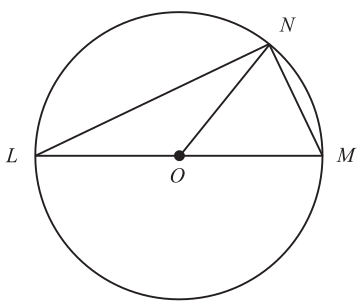
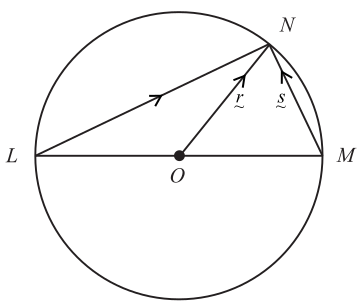
In the diagram above, `LOM` is a diameter of the circle with centre `O`.

`N` is a point on the circumference of the circle.

If  `underset~r = vec(ON)`  and  `underset ~s = vec(MN)`, express  `vec(LN)`  in terms of  `underset~r `  and  `underset~s`.   (2 marks)

--- 6 WORK AREA LINES (style=lined) ---

Show Answers Only

`vec(LN)= 2 underset~r –  underset~s`

Show Worked Solution

`vec(LN)` `= vec(LM) + vec(MN)`
`vec(LN)` `= vec(LO) + vec(ON)`
  `= 1/2\ vec(LM) + vec(ON)`


`:. vec(LM) + underset~s` `= 1/2\ vec(LM) + underset~r`
`1/2\ vec(LM)` `= underset ~r – underset~s`
`vec(LM)` `= 2 underset~r – 2 underset~s`


`:. vec(LN)` `= 2 underset~r – 2 underset~s + underset~s`
  `= 2 underset~r –  underset~s`


Filed Under: Vectors and Geometry (Ext1) Tagged With: Band 4, smc-1211-50-(Semi)circle

Vectors, EXT1 V1 2011 VCE 10 MC

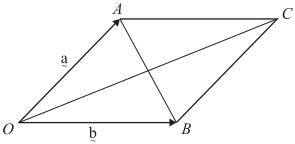
The diagram below shows a rhombus, spanned by the two vectors  `underset~a`  and  `underset~b`.
 

SPEC2 2011 VCAA 10 MC
 

It follows that

  1. `underset~a*underset~b = 0`
  2. `underset~a = underset~b`
  3. `(underset~a + underset~b)*(underset~a-underset~b) = 0`
  4. `|\ underset~a + underset~b\ | = |\ underset~a-underset~b|`
Show Answers Only

`C`

Show Worked Solution

`text(Consider A:)`

`text(If)\ \ underset~a · underset~b = 0\ \ =>\ \ underset~a ⊥ underset~b\ \ text{(incorrect)}`

`text(Consider B:)`

`underset~a != underset~b\ \ text{(incorrect)}`

`text(Consider C:)`

`underset~a + underset~b` `= overset(->)(OC)`
`underset~a-underset~b` `= overset(->)(BA)`

 
`overset(->)(OC) · overset(->)(BA)=0`

`text{The diagonals of a rhombus are perpendicular  (correct)}`

 
`=> C`

Filed Under: Vectors and Geometry (Ext1) Tagged With: Band 4, smc-1211-20-Rhombus

Functions, EXT1 F1 SM-Bank 12

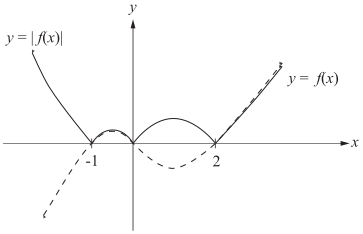
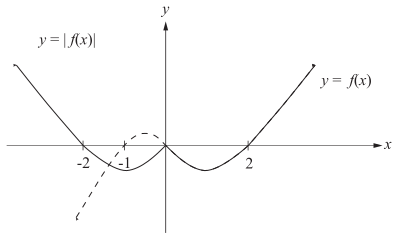
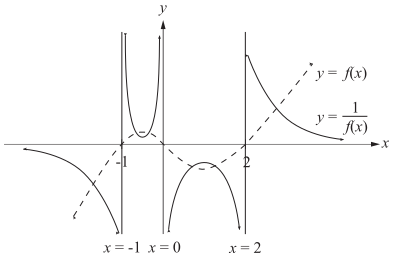
Given  `f(x) = x^3 - x^2 - 2x`, without calculus sketch a separate half page graph of the following functions, showing all asymptotes and intercepts.

  1.   `y = |\ f(x)\ |`  (1 mark)

    --- 8 WORK AREA LINES (style=lined) ---

  2.   `y = f(|x|)`  (2 marks)

    --- 8 WORK AREA LINES (style=lined) ---

  3.    `y = 1/(f(x))`  (2 marks)

    --- 10 WORK AREA LINES (style=lined) ---

Show Answers Only
  1.  
  2.   
  3.   
Show Worked Solution
i.    `f(x)` `= x^3 – x^2 – 2x`
    `= x(x^2 – x – 2)`
    `= x(x – 2)(x + 1)`


ii.   

 
`y = f(|x|)\ text(is a reflection of)\ y = f(x)\ text(for)\ x > 0`

`text(is the)\ ytext(-axis.)`


iii.

Filed Under: Reflections and Harder Graphs (Ext1) Tagged With: Band 3, Band 4, smc-1072-10-y = 1 / f(x), smc-1072-30-y = | f(x) |; y = f( |x| )

Functions, EXT1 F1 SM-Bank 9

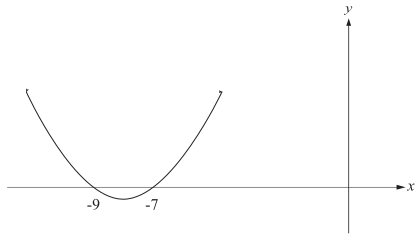
  1. Sketch the graph of the function described by the parametric equations


          `x = 4t - 7`


          `y = 2t^2 + t`  (2 marks)

    --- 8 WORK AREA LINES (style=lined) ---

  2. State the domain and range of the function.  (1 mark)

    --- 2 WORK AREA LINES (style=lined) ---

Show Answers Only
  1.  
  2. `text(Domain:  all)\ x`
    `text(Range)\ {y: −1/8 <= y < ∞}`
Show Worked Solution

i.   `x = 4t – 7 \ \ => \ \ t = (x + 7)/4`

`y` `= 2t^2 + t`
`y` `= 2((x + 7)/4)^2 + ((x + 7)/4)`
`16y` `= 2(x + 7)^2 + 4(x + 7)`
`16y` `= 2x^2 + 28x + 98 + 4x + 28`
`16y` `= 2x^2 + 32x + 126`
`8y` `= x^2 + 16x + 63`
`y` `= 1/8(x + 7)(x + 9)`

 
`=>\ text(Equation is a concave up quadratic with)`

`text(zeros at)\ \ x = −9\ text(and)\ \ x = −7.`


ii.   `text(Axis at)\ \ x = −8`

`:.\ y_text(min)` `= 1/8(−1)(1)`
  `= −1/8`

 
`text(Domain: all)\ x`

`text(Range:)\ −1/8 <= y < ∞`

Filed Under: Parametric Functions (Ext1), Parametric Functions and Relations (Ext1-2027) Tagged With: Band 3, Band 4, smc-1035-10-Quadratic, smc-6642-10-Quadratics

Functions, 2ADV F2 SM-Bank 2

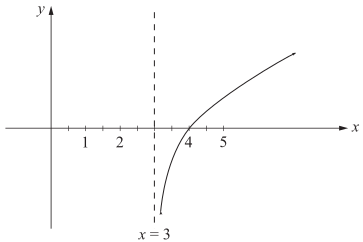
Sketch the graph  `y = log_2(x - 3)`.

Show all asymptotes and state its domain and range.  (3 marks)

--- 6 WORK AREA LINES (style=lined) ---

Show Answers Only

`text(Domain)\ {x: \ x > 3}`

`text(Range:  all)\ y`
 

Show Worked Solution

`text(Asymptote when)\ x = 3`

`text(Domain)\ {x: \ x > 3}`

`text(Range:  all)\ y`
 

Filed Under: Graph Transformations (Adv-2027), Transformations (Y12) Tagged With: Band 4, smc-1008-30-Log/Exp, smc-1008-60-Translation (Only), smc-6408-20-Log/Exp, smc-6408-40-Translation (only)

Functions, 2ADV F2 SM-Bank 6 MC

The graph of a function  `f(x)`  is obtained from the graph of the function  `g(x) = sqrt (2x - 5)`  by a reflection in the `x`-axis followed by a dilation from the `y`-axis by a factor of  `1/2`.

Which one of the following is the function  `f(x)`?

A.   `f(x) = sqrt (5 - 4x)`

B.   `f(x) = - sqrt (x - 5)`

C.   `f(x) = sqrt (x + 5)`

D.   `f(x) = −sqrt (4x - 5)`

Show Answers Only

`D`

Show Worked Solution

`text(Let)\ \ y=sqrt(2x-5)`

`text(1st transformation:)`

`y = – sqrt(2x-5)`

COMMENT: Using “swap” terminology for dilations from the y-axis is simpler and more intelligible for students in our view.


`text(2nd transformation:)`

`text(Dilate from)\ y text(-axis by a factor of)\ 1/2`

`=>\ text(Swap)\ \ x → 2x`

`y` `=-sqrt(2(2x)-5)`
  `=- sqrt(4x-5)`
`:. f(x)` `= −sqrt(4x – 5)`

 
`=>   D`

Filed Under: Graph Transformations (Adv-2027), Transformations (Y12) Tagged With: Band 4, smc-1008-50-Other Functions, smc-1008-70-Combinations, smc-6408-25-Other Functions, smc-6408-60-Combinations

Functions, 2ADV F2 SM-Bank 4 MC

The graph of the function  `f(x) = 3x^(5/2)`  is reflected in the `x`-axis and then translated 3 units to the right and 4 units down.

The equation of the new graph is

A.   `y = 3(x - 3)^(5/2) + 4`

B.   `y = -3 (x - 3)^(5/2) - 4`

C.   `y = -3 (x + 3)^(5/2) - 1`

D.   `y = -3 (x - 4)^(5/2) + 3`

Show Answers Only

`B`

Show Worked Solution

`text(Let)\ \ y= 3x^(5/2)`

`text(Reflect in the)\ x text(-axis:)`

`y= – 3x^(5/2)`
 

`text(Translate 3 units to the right:)`

`y=- 3(x-3)^(5/2)`
 

`text(Translate 4 units down:)`

`y=- 3(x-3)^(5/2) – 4`
 

`=>   B`

Filed Under: Graph Transformations (Adv-2027), Transformations (Y12) Tagged With: Band 4, smc-1008-50-Other Functions, smc-1008-70-Combinations, smc-6408-25-Other Functions, smc-6408-60-Combinations

Functions, 2ADV F2 SM-Bank 3


The diagram below shows part of the graph of the function with rule

`f (x) = k log_e (x + a) + c`, where `k`, `a` and `c` are real constants.
 

    • The graph has a vertical asymptote with equation  `x = –1`.
    • The graph has a y-axis intercept at 1.
    • The point `P` on the graph has coordinates  `(p, 10)`, where `p` is another real constant.
       

      VCAA 2010 1b

  1. State the value of `a`.  (1 mark)

    --- 1 WORK AREA LINES (style=lined) ---

  2. Find the value of `c`.  (1 mark)

    --- 1 WORK AREA LINES (style=lined) ---

  3. Show that  `k = 9/(log_e (p + 1)`.  (2 marks)

    --- 4 WORK AREA LINES (style=lined) ---

Show Answers Only
  1. `1`
  2. `1`
  3. `text(Proof)\ \ text{(See Worked Solutions)}`
Show Worked Solution

i.   `text(Vertical Asymptote:)`

`x = – 1`

`:. a = 1`
 

  ii.   `text(Solve)\ \ f(0) = 1\ \ text(for)\ \ c,`

`c = 1`
 

iii.  `f(x)= k log_e (x + 1) + 1`

`text(S)text(ince)\ \ f(p)=10,`

`k log_e (p + 1) + 1` `= 10`
`k log_e (p + 1)` `= 9`
`:. k` `= 9/(log_e (p + 1))\ text(… as required)`

Filed Under: Graph Transformations (Adv-2027), Transformations (Y12) Tagged With: Band 4, smc-1008-30-Log/Exp, smc-6408-20-Log/Exp

Algebra, STD2 A4 SM-Bank 2

Moses finds that for a Froghead eel, its mass is directly proportional to the square of its length.

An eel of this species has a length of 72 cm and a mass of 8250 grams.

What is the expected length of a Froghead eel with a mass of 10.2 kg? Give your answer to one decimal place.  (3 marks)

--- 6 WORK AREA LINES (style=lined) ---

Show Answers Only

`80.1\ text{cm}`

Show Worked Solution

`text(Mass) prop text(length)^2`

`m = kl^2`
 

`text(Find)\ k:`

`8250` `= k xx 72^2`
`k` `= 8250/72^2`
  `= 1.591…`

 
`text(When)\ \ l\ \ text(when)\ \ m = 10\ 200:`

`10\ 200` `= 1.591… xx l^2`
`l^2` `= (10\ 200)/(1.591…)`
`:. l` `= 80.069…`
  `= 80.1\ text{cm  (to 1 d.p.)}`

Filed Under: Non-Linear: Exponential/Quadratics (Std 2) Tagged With: Band 4, smc-830-20-Quadratics, smc-830-60-Proportional

Probability, 2ADV S1 SM-Bank 3

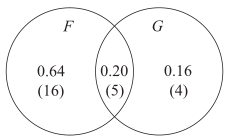
In a workplace of 25 employees, each employee speaks either French or German, or both.

If 36% of the employees speak German, and 20% speak both French and German.

  1. Calculate the probability one person chosen could speak German if they could speak French. Give your answer to the nearest percent.  (1 mark)

    --- 4 WORK AREA LINES (style=lined) ---

  2. Calculate the probability one person chosen could not speak French if they could speak German. Give your answer to the nearest percent.  (1 mark)

    --- 3 WORK AREA LINES (style=lined) ---

Show Answers Only
  1. `24text(%)`
  2. `44text(%)`
Show Worked Solution

i.   `text(Expressing in a Venn diagram:)`


`P(G|F)` `= (P(G ∩ F))/(P(F))`
  `= 0.20/0.84`
  `= 0.238…`
  `= 24text(%)`


ii.    `P(text(not)\ F|G)` `= (P(text(not)\ F ∩ G))/(P(G))`
    `= 0.16/0.36`
    `= 0.444…`
    `= 44text(%)`

Filed Under: Conditional Probability and Venn Diagrams (Adv-2027), Conditional Probability and Venn Diagrams (Y11) Tagged With: Band 4, smc-6470-10-Conditional Prob Formula, smc-6470-20-Venn Diagrams/Intersections, smc-991-10-Conditional Prob Formula, smc-991-20-Venn Diagrams/Intersections

Financial Maths, 2ADV M1 SM-Bank 8

When placed in a pond, the length of a fish was 14.2 centimetres.

During its first month in the pond, the fish increased in length by 3.6 centimetres.

During its `n`th month in the pond, the fish increased in length by `G_n` centimetres, where  `G_(n+1) = 0.75G_n`

Calculate the maximum length this fish can grow to.  (3 marks)

--- 6 WORK AREA LINES (style=lined) ---

Show Answers Only

`28.6\ text(cm)`

Show Worked Solution

`text(Initial length) = 14.2\ text(cm)`

`G_1 = 3.6`

`G_2 = (0.75) G_1 = (0.75) 3.6`

`G_3 = (0.75) G_2 = (0.75^2) 3.6`

`text(Growth is a geometric sequence)`

`underbrace(3.6, \ 3.6(0.75), \ 3.6(0.75)^2, …)_{text(GP where)\ \ a=3.6,\ \ r=0.75}`

 
`text(S)text(ince)\ \ |\ r\ |< 1,`

`S_oo` `= a/(1-r)`
  `= (3.6)/(1-0.75)`
  `= 14.4`

 
`:.\ text(Maximum length of fish)`

`= 14.2 +14.4`

`=28.6\ text(cm)`

Filed Under: Geometric Series (Y12) Tagged With: Band 4, smc-1006-60-Recursion

Financial Maths, 2ADV M1 SM-Bank 6

Julie deposits some money into a savings account that will pay compound interest every month.

The balance of Julie’s account, in dollars, after `n` months, `V_n` , can be modelled by the recurrence relation shown below.
 

`V_0 = 12\ 000, qquad V_(n + 1) = 1.0062\ V_n`
 

  1.  Recursion can be used to calculate the balance of the account after one month.


    1. Write down a calculation to show that the balance in the account after one month, `V_1`, is  $12 074.40. (1 mark)

      --- 2 WORK AREA LINES (style=lined) ---

    2. After how many months will the balance of Julie’s account first exceed $12 300  (1 mark)

      --- 2 WORK AREA LINES (style=lined) ---

  2.  A rule of the form  `V_n = a xx b^n`  can be used to determine the balance of Julie's account after `n` months.

    1. Complete this rule for Julie’s investment after `n` months by writing the appropriate numbers in the boxes provided below. (1 mark)
       
balance = 
 
 × 
 
 n


    1. What would be the value of `n` if Julie wanted to determine the value of her investment after three years?  (1 mark)

      --- 1 WORK AREA LINES (style=lined) ---

Show Answers Only

a.i.   `text(Proof)\ \ text{(See Worked Solutions)}`

a.ii.  `4\ text(months)`

b.i  `text(balance) = 12\ 000 xx 1.0062^n`

b.ii.  `36`

Show Worked Solution
a.i.   `V_1` `= 1.0062 xx V_0`
    `= 1.0062 xx 12000`
    `= $12\ 074.40\ text(… as required.)`


a.ii.   `V_2` `= 1.0062 xx 12\ 074.40 = 12\ 149.26`
  `V_3` `= 1.0062 xx 12\ 149.26 = 12\ 224.59`
  `V_4` `= 1.0062 xx 12\ 224.59 = 12\ 300.38`

 
`:.\ text(After 4 months)`

 
b.i.
  `text(balance) = 12\ 000 xx 1.0062^n`

 
b.ii.
  `n = 12 xx 3 = 36`

Filed Under: Geometric Series (Y12) Tagged With: Band 3, Band 4, smc-1006-60-Recursion

Financial Maths, 2ADV M1 SM-Bank 5 MC

Shirley would like to purchase a new home. She will establish a loan for $225 000 with interest charged at the rate of 3.6% per annum, compounding monthly.

Each month, Shirley will pay only the interest charged for that month.

Let `V_n` be the value of Shirley’s loan, in dollars, after `n` months.

A recurrence relation that models the value of `V_n` is

  1. `V_0 = 225\ 000,qquadV_(n + 1) = 1.003 V_n`
  2. `V_0 = 225\ 000,qquadV_(n + 1) = 1.036 V_n`
  3. `V_0 = 225\ 000,qquadV_(n + 1) = 1.003 V_n - 8100`
  4. `V_0 = 225\ 000,qquadV_(n + 1) = 1.003 V_n - 675`
Show Answers Only

`D`

Show Worked Solution

`text(Monthly interest rate)`

`= text(3.6%)/12 = 0.3text(%) = 0.003`
 

`text(Monthly payment)`

`= 225\ 000 xx 0.3text(%)`

`= $675`
 

`:.\ text(Recurrence Relation is)`

`V_(n + 1) = 1.003V_n – 675`
 

`=> D`

Filed Under: Geometric Series (Y12) Tagged With: Band 4, smc-1006-60-Recursion

Financial Maths, 2ADV M1 SM-Bank 4 MC

Each trading day, a share trader buys and sells shares according to the rule
 

 `T_(n+1)=0.6 T_n + 50\ 000`
 

where `T_n` is the number of shares the trader owns at the start of the `n`th trading day.

From this rule, it can be concluded that each day

A.    the trader sells 60% of the shares that she owned at the start of the day and then buys another 50 000 shares.

B.    the trader sells 40% of the shares that she owned at the start of the day and then buys another 50 000 shares.

C.    the trader sells 50 000 of the shares that she owned at the start of the day.

D.    the trader sells 60% of the 50 000 shares that she owned at the start of the day.

Show Answers Only

`B`

Show Worked Solution

`T_(n+1)=0.6\ \T_n + 50 000`

`text(The difference equation describes a rule)`

`text(where a trader sells 40% of shares owned on)`

`text{the day before (left with 60% or 0.6}\ T_n text{)} `

`text(and then buys another 50 000 each day.)`

`=> B`

Filed Under: Geometric Series (Y12) Tagged With: Band 4, smc-1006-60-Recursion

Financial Maths, 2ADV M1 SM-Bank 3 MC

The first four terms of a sequence are

`12, 18, 30, 54`

A recursive equation that generates this sequence is

A. `t_(n+1)` `= t_n + 6` `t_1` `=12`
B. `t_(n+1)` `= 1.5t_n` `t_1` `= 12`
C. `t_(n+1)` `= 0.5t_n + 12` `t_1` `= 12`
D. `t_(n+1)` `= 2t_n - 6` `t_1` `= 12`
Show Answers Only

`D`

Show Worked Solution

`text(Calculating)` `t_3` `text(in each given option)`

`text(eliminates)\ A, B\ text(and)\ C.`

`rArr D`

Filed Under: Geometric Series (Y12) Tagged With: Band 4, smc-1006-60-Recursion

Financial Maths, 2ADV M1 SM-Bank 2 MC

The values of the first five terms of a sequence are plotted on the graph shown below.


The recursion equation that could describe the sequence is

A.   `t_(n+1) = t_n + 5,` `\ \ \ \ \ t_1 = 4`
B.   `t_(n+1) = 2t_n + 1,` `\ \ \ \ \ t_1 = 4`
C.   `t_(n+1) = t_n - 3,` `\ \ \ \ \ t_1 = 4`
D.   `t_(n+1) = 3t_n,` `\ \ \ \ \ t_1 = 4`
Show Answers Only

`B`

Show Worked Solution

`text(By elimination,)`

`text(There is no common difference between terms,)`

`:.\ text(Cannot be A, or C)`

`text(The equation in B has)\ \ t_2=9,\ \ text(while the equation)`

`text(in C has)\ \ t_2=12.`

`rArr B`

Filed Under: Geometric Series (Y12) Tagged With: Band 4, smc-1006-60-Recursion

Probability, 2ADV S1 SM-Bank 4 MC

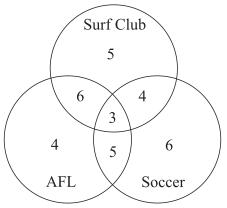
In a classroom, students are asked what sports club they are members of and the results are shown in the Venn diagram.


A student who is a member of a soccer club is chosen at random. What is the probability that he/she is also a member of a surf club?

  1. `2/5`
  2. `4/11`
  3. `2/9`
  4. `7/18`
Show Answers Only

`D`

Show Worked Solution
`P(text(Surf | Soccer))` `= (n(text(Surf) ∩ text(Soccer)))/(n(text(Soccer)))`
  `= (3 + 4)/(3 + 4 + 5 + 6)`
  `= 7/18`

 
`=>\ D`

Filed Under: Conditional Probability and Venn Diagrams (Adv-2027), Conditional Probability and Venn Diagrams (Y11) Tagged With: Band 4, smc-6470-10-Conditional Prob Formula, smc-6470-20-Venn Diagrams/Intersections, smc-991-10-Conditional Prob Formula, smc-991-20-Venn Diagrams/Intersections

Statistics, 2ADV S3 SM-Bank 20

A continuous random variable `X` has a probability density function given by
 

`f(x) = {{:(Cx + D),(0):}\ \ \ \ {:(2 <= x <= 5),(text(elsewhere)):}:}`
 

where `C` and `D` are constants.

Find the exact values of `C` and `D`, given the median of  `X`  is 4.  (4 marks)

--- 8 WORK AREA LINES (style=lined) ---

Show Answers Only

`C = 1/6`

`D = −1/4`

Show Worked Solution

`int_2^5 Cx + D\ dx = 1`

`[C/2 x^2 + Dx]_2^5 = 1`

`[(25/2 C + 5D) – (2C + 2D)]` `= 1`
`21/2C + 3D` `= 1`
`21C + 6D` `= 2\ \ …\ (1)`

 
`text(Using median)\ \ X = 4:`

`[C/2 x^2 + Dx]_2^4 = 0.5`

`[(8C + 4D) – (2C + 2D)]` `= 0.5`
`6C + 2D` `= 0.5\ \ …\ (2)`

  
`text(Multiply:)\ (2) xx 3`

`18C + 6D = 1.5\ \ …\ (3)`
 

`text(Subtract:)\ \ (1) – (3)`

`3C` `= 1/2`
`:. C` `= 1/6`

 
`text{Substitute into (1):}`

`21/6 + 6D` `= 2`
`6D` `= −9/6`
`:. D` `= −1/4`

Filed Under: Probability Density Functions (Y12) Tagged With: Band 4, smc-994-10-Median, smc-994-50-Linear PDF

Statistics, 2ADV S3 SM-Bank 12

The function
 

`f(x) = {{:(k),(0):}{:(sin(pix)qquad\ \ 0<=x<=1),(qquadqquadqquadqquadquadtext(otherwise)):}`
 

is a probability density function for the continuous random variable `X`.

Show that  `k = pi/2`.  (2 marks)

--- 4 WORK AREA LINES (style=lined) ---

Show Answers Only

`text(See Worked Solutions)`

Show Worked Solution

`text(Total Area under curve) = 1\ text(u²)`

`int_0^1 k sin(pix)\ dx` `= 1`
`- k/pi [cos(pix)]_0^1` `= 1`
`- k/pi[cos(pi) – cos(0)]` `= 1`
`- k/pi[-1 – 1]` `= 1`
`2k` `= pi`
`:.k` `= pi/2`

Filed Under: Probability Density Functions (Y12) Tagged With: Band 4, smc-994-80-Trig PDF

Statistics, 2ADV S3 SM-Bank 11

The probability density function of a continuous random variable \(X\) is given by

\(f(x)=\begin{cases}
\dfrac{x}{12} & 1 \leq x \leq 5 \\
\ \\
0 & \text {otherwise }
\end{cases}\)

Find  \(P(X < 3)\)  (2 marks)

Show Answers Only

\(\dfrac{1}{3}\)

Show Worked Solution

\(\begin{aligned}
P(X & <3)\\
& =\int_1^3 \dfrac{1}{12} x d x \\
& =\dfrac{1}{12}\left[\frac{1}{2} x^2\right]_1^3 \\
& =\dfrac{1}{24}\left[3^2-1^2\right] \\
& =\dfrac{1}{3}
\end{aligned}\)

Filed Under: Probability Density Functions (Y12) Tagged With: Band 4, smc-994-30-Other Probability, smc-994-50-Linear PDF

Statistics, 2ADV S3 SM-Bank 10

A continuous random variable, \(X\), has a probability density function given by

\(f(x)= \begin{cases}\dfrac{1}{5}\,e^{-\frac{x}{5}} & x \geq 0 \\
\ \\
0 & x<0
\end{cases}\) 

The median of \(X\) is  \(m\).

Determine the value of  \(m\).  (3 marks)

Show Answers Only

\(-5 \log _e\left(\dfrac{1}{2}\right)\) or \(5 \log _e(2)\) or \(\log _e 32\)

Show Worked Solution

\(\begin{aligned} \dfrac{1}{5} \int_0^m e^{-\frac{x}{5}} d x & =\dfrac{1}{2} \\
\dfrac{1}{5} \times(-5)\left[e^{-\frac{x}{5}}\right]_0^m & =\dfrac{1}{2} \\
{\left[-e^{-\frac{x}{5}}\right]_0^m } & =\dfrac{1}{2} \\
-e^{-\frac{m}{5}}+1 & =\frac{1}{2} \\ e^{-\frac{m}{5}} & =\dfrac{1}{2} \\
-\frac{m}{5} & =\log _e\left(\dfrac{1}{2}\right)
\end{aligned}\)

\(\therefore m=-5 \log _e\left(\dfrac{1}{2}\right)\) (or \(5 \log _e(2)\), or \(\log _e 32\) )

Filed Under: Probability Density Functions (Y12) Tagged With: Band 4, smc-994-10-Median, smc-994-90-Other PDF functions

Statistics, 2ADV S3 SM-Bank 9

The probability density function  \(f(x)\)  of a random variable \(X\) is given by

\(f(x)=\begin{cases}
\dfrac{x+1}{12} & 0 \leq x \leq 4 \\
\ \\
0 & \text{otherwise }
\end{cases}\)

Find the value of \(b\) such that \(P(X \leq b)=\dfrac{5}{8}\).  (3 marks)

Show Answers Only

\(3\)

Show Worked Solution

\(\begin{aligned}
\dfrac{1}{12} \int_0^b(x+1) d x & =\dfrac{5}{8} \\
{\left[\dfrac{1}{2} x^2+x\right]_0^b } & =\dfrac{15}{2} \\
\dfrac{1}{2} b^2+b & =\dfrac{15}{2} \\
b^2+2 b-15 & =0 \\ (b+5)(b-3) & =0
\end{aligned}\)

\(\therefore b=3 \quad(0 \leq b \leq 4)\)

Filed Under: Probability Density Functions (Y12) Tagged With: Band 4, smc-994-30-Other Probability, smc-994-50-Linear PDF

Statistics, 2ADV S3 SM-Bank 8

The continuous random variable `X` has a distribution with probability density function given by
 

`f(x) = {(ax(5 - x), \ text(if)\ \ 0 <= x <= 5), (0,\ text (if)\ \ x < 0\ \ text(or if)\ \ x > 5):}`
 

where `a` is a positive constant.

  1. Find the value of  `a`.  (3 marks)

    --- 6 WORK AREA LINES (style=lined) ---

  2. Express  `P(X < 3)`  as a  definite integral. (Do not evaluate the definite integral.)  (1 mark)

    --- 2 WORK AREA LINES (style=lined) ---

Show Answers Only
  1. `6/125`
  2. `int_0^3 ax(5 – x)\ dx`
Show Worked Solution
a.   `text(Total Area under curve)` `= 1`
  `a int_0^5 (5x – x^2)\ dx` `= 1`
  `a [5/2 x^2 – 1/3 x^3]_0^5` `= 1`
  `a [(125/2 – 125/3) – (0)]` `= 1`
  `125/6 a` `= 1`
  `:. a` `= 6/125`


b.   `P(X < 3) = int_0^3 ax(5 – x)\ dx`

Filed Under: Probability Density Functions (Y12) Tagged With: Band 4, smc-994-30-Other Probability, smc-994-60-Polynomial PDF

Statistics, 2ADV S3 SM-Bank 5 MC

The function  `f(x)`  is a probability density function of a continuous random variable with the rule
 

`f(x) = {(ae^x, 0 <= x <= 1), (ae, 1 < x <= 2), (\ 0, text(otherwise)):}`
 

The value of `a` is

A.   `1`

B.   `1/e`

C.   `1/(2e)`

D.   `1/(2e - 1)`

Show Answers Only

`D`

Show Worked Solution

`text(Total area) = 1`

`int_0^1 ae^x\ dx + int_1^2 ae\ dx` `= 1`
`[ae^x]_0^1 + [ae*x]_1^2` `=1`
`[ae-a] + [2ae-ae]` `=1`
`2ae-a` `=1`
`a(2e-1)` `=1`
`:. a` `= 1/(2e – 1)`

 
`=>   D`

Filed Under: Probability Density Functions (Y12) Tagged With: Band 4, smc-994-90-Other PDF functions

Statistics, 2ADV S3 SM-Bank 2

If a continuous random variable  \(X\)  has probability density function

\(f(x)=
\begin{cases}
\dfrac{x}{2} & \text{if } \quad 0 \leq x \leq 2 \\
\ \\
0 & \text {otherwise }
\end{cases}\)

Find the exact value of  \(p\)  such that  \(P(X>p) = 0.4\).   (3 marks)

Show Answers Only

\(\dfrac{2 \sqrt{15}}{5}\)

Show Worked Solution

\(\displaystyle \int_p^2 \dfrac{x}{2} d x=0.4\)

\(\begin{aligned} {\left[\dfrac{x^2}{4}\right]_p^2 } & =\dfrac{2}{5} \\
1-\dfrac{p^2}{4} & =\dfrac{2}{5} \\
\dfrac{p^2}{4} & =\dfrac{3}{5} \\ p^2 & =\dfrac{12}{5} \\
\therefore p & =\dfrac{2 \sqrt{3}}{\sqrt{5}} \\
& =\dfrac{2 \sqrt{15}}{5} \quad(0 \leq p \leq 2)
\end{aligned}\)

Filed Under: Probability Density Functions (Y12) Tagged With: Band 4, smc-994-30-Other Probability, smc-994-50-Linear PDF

Probability, 2ADV S1 EQ-Bank 40

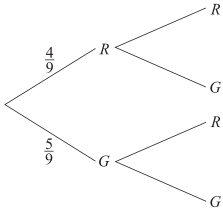
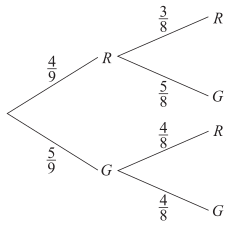
One bag contains red and green balls.

Kalyn randomly chooses one ball from the bag. Without replacement, he then chooses a second ball from the bag.

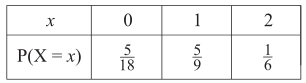
Complete the tree diagram below and then draw a probability distribution table for the number of red balls that could be drawn out of the bag.  (3 marks)
 

--- 4 WORK AREA LINES (style=lined) ---

Show Answers Only

Show Worked Solution


`x = 2: \ P(R R) = 4/9 xx 3/8 = 1/6`

`x = 1: \ P(R and G) = 4/9 xx 5/8 + 5/9 xx 4/8 = 5/9`

`x = 0: \ P(G G) = 5/9 xx 4/8 = 5/18`
 

Filed Under: Discrete Probability Distributions (Y11) Tagged With: Band 4, smc-992-50-Draw Table

Probability, 2ADV S1 SM-Bank 41

Evaluate `p` and `q` in the discrete probability distribution table below, given that  `E(X) = 3`.   (3 marks)

\begin{array} {|c|c|c|c|c|}
\hline
\rule{0pt}{2.5ex} x \rule[-1ex]{0pt}{0pt} & \ \ \ 1\ \ \  & \ \ \ 2\ \ \  & \ \ \ 3\ \ \  & \ \ \ 4\ \ \  \\
\hline
\rule{0pt}{2.5ex} P(X=x) \rule[-1ex]{0pt}{0pt} & p & q & 0.2 & 0.4 \\
\hline
\end{array}

--- 6 WORK AREA LINES (style=lined) ---

Show Answers Only

`text(See Worked Solutions)`

Show Worked Solution
`p + q + 0.2 + 0.4` `= 1`
`p + q` `= 0.4\ \ …\ (1)`

 
`text(Given)\ \ E(X) = 3,`

`p + 2q + 0.6 + 1.6` `= 3`
`p + 2q` `= 0.8\ \ …\ (2)`

 
`text{Subtract: (2) – (1)}`

`q` `= 0.4`
`:.p` `= 0`

Filed Under: Discrete Probability Distributions (Y11) Tagged With: Band 4, smc-992-10-Sum of Probabilities = 1, smc-992-20-E(X) / Mean

Trigonometry, 2ADV T2 SM-Bank 42

Prove that

`(1 - sin^2 x cos^2 x)/(sin^2 x) = cot^2 x + sin^2 x`.  (2 marks)

--- 4 WORK AREA LINES (style=lined) ---

Show Answers Only

`text(See Worked Solutions)`

Show Worked Solution
`text(RHS)` `= (cos^2 x)/(sin^2 x) + sin^2 x`
  `= (cos^2 x + sin^4 x)/(sin^2 x)`
  `= (cos^2 x + sin^2 x(1 – cos^2 x))/(sin^2 x)`
  `= (cos^2 x + sin^2 x – sin^2 x cos^2 x)/(sin^2 x)`
  `= (1 – sin^2 x cos^2 x)/(sin^2 x)`
  `= \ text(LHS)`

Filed Under: Trig Identities and Harder Equations (Adv-2027), Trig Identities and Harder Equations (Y11) Tagged With: Band 4, smc-1189-20-Prove Identity, smc-6412-20-Prove Identity

Trigonometry, 2ADV T3 SM-Bank 16

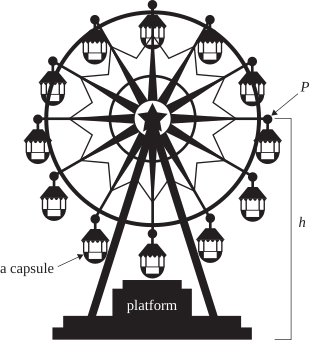
Sammy visits a giant Ferris wheel. Sammy enters a capsule on the Ferris wheel from a platform above the ground. The Ferris wheel is rotating anticlockwise. The capsule is attached to the Ferris wheel at point `P`. The height of `P` above the ground, `h`, is modelled by  `h(t) = 65 - 55cos((pit)/15)`, where `t` is the time in minutes after Sammy enters the capsule and `h` is measured in metres.

Sammy exits the capsule after one complete rotation of the Ferris wheel.


  1. State the minimum and maximum heights of `P` above the ground.  (1 mark)

    --- 2 WORK AREA LINES (style=lined) ---

  2. For how much time is Sammy in the capsule?  (1 mark)

    --- 1 WORK AREA LINES (style=lined) ---

  3. Find the rate of change of `h` with respect to `t` and, hence, state the value of `t` at which the rate of change of `h` is at its maximum.  (2 marks)

    --- 4 WORK AREA LINES (style=lined) ---

Show Answers Only
  1. `h_text(min) = 10\ text(m), h_text(max) = 120\ text(m)`
  2. `30\ text(min)`
  3. `t = 7.5`
Show Worked Solution
i.    `h_text(min)` `= 65 – 55` `h_text(max)` `= 65 + 55`
    `= 10\ text(m)`   `= 120\ text(m)`


ii.   `text(Period) = (2pi)/(pi/15) = 30\ text(min)`


iii.    `h′(t)` `=65 – 55cos((pit)/15)`
  `h′(t)` `=pi/15 xx 55sin(pi/15 t)`
    `= (11pi)/3\ sin(pi/15 t)`
     

`text(S)text(ince)\ \ sin(pi/15 t)_text(max) = sin (pi/2),`

 
`:. h′(t)_text(max)\ \ text(occurs when)`

`(pi t)/15` `=pi/2`  
`:. t` `=pi/2 xx 15/pi`  
  `=15/2\ text(minutes)\ \ (0<=t<=30)`  

Filed Under: Maxima and Minima (Y12), Trig Applications (Y12) Tagged With: Band 4, Band 5, smc-1188-30-Other Applications, smc-970-60-Other Themes

Functions, 2ADV F1 SM-Bank 32

Find the centre and radius of the circle with the equation

`x^2-12x + y^2 + 2y-12 = 0`  (2 marks)

Show Answers Only

`text(Centre)\ (6, −1)`

`text(Radius = 7)`

Show Worked Solution
`x^2-12x + y^2 + 2y-12` `= 0`
`(x-6)^2 + (y + 1)^2-36-1-12` `= 0`
`(x-6)^2 + (y + 1)^2` `= 49`

 
`:.\ text(Centre)\ (6, −1)`

`:.\ text(Radius = 7)`

Filed Under: Further Functions and Relations (Y11) Tagged With: Band 4

Functions, 2ADV F1 SM-Bank 31

Find the domain and range of  `f(g(x))`  given

`f(x) = 2x^2 - 8x`  and  `g(x) = x + 2`.   (2 marks)

--- 4 WORK AREA LINES (style=lined) ---

Show Answers Only

`text(Domain: all)\ x`

`text(Range:)\ −8<=y< ∞`

Show Worked Solution
`f(g(x))` `= 2(x + 2)^2 – 8(x + 2)`
  `= 2(x^2 + 4x + 4) – 8x – 16`
  `= 2x^2 + 8x + 8 – 8x – 16`
  `= 2(x^2 – 4)`

 
`:. text(Domain: all)\ x`

`:. text(Range:)\ −8<=y< ∞`

Filed Under: Composite Functions (Adv-2027), Composite Functions (Y11) Tagged With: Band 4, smc-6216-20-Quadratics, smc-986-20-Quadratic

Functions, 2ADV F1 SM-Bank 30

Given  `f(x) = sqrtx`  and  `g(x) = 25 - x^2`

  1. Find  `g(f(x))`.  (1 mark)

    --- 2 WORK AREA LINES (style=lined) ---

  2. Find the domain and range of  `f(g(x))`.  (2 marks)

    --- 3 WORK AREA LINES (style=lined) ---

Show Answers Only
  1. `25 – x`
  2. `text(Domain:)\ −5<= x <= 5`


    `text(Range:)\ 0<=y<= 5`

Show Worked Solution
i.    `g(f(x))` `= 25 – (f(x))^2`
    `= 25 – (sqrtx)^2`
    `= 25 – x`


ii.    `f(g(x))` `= sqrt(g(x))`
    `= sqrt(25 – x^2)`

 
`:.\ text(Domain:)\ −5<= x <= 5`

`:.\ text(Range:)\ 0<=y<= 5`

Filed Under: Composite Functions (Adv-2027), Composite Functions (Y11) Tagged With: Band 3, Band 4, smc-6216-20-Quadratics, smc-6216-30-Other Functions, smc-6216-40-Domain/Range, smc-986-20-Quadratic, smc-986-30-Other, smc-986-40-Domain/Range

Trigonometry, 2ADV T2 SM-Bank 39

Let  `f(x) = sin((2pix)/3)`.

Solve the equation  `sin((2pix)/3) = -sqrt3/2`  for  `0<=x<=3`  (2 marks)

Show Answers Only

`x = 2, 5/2`

Show Worked Solution

`sin((2pix)/3) = -sqrt3/2`

`=>\ text(Base angle)\ = pi/3`

`(2 pi x)/3` `=(4pi)/3, (5pi)/3, (10pi)/3, …` 
`:.x` `=2 or 5/2, \ \ \ (0<=x<=3)`

Filed Under: Exact Trig Ratios (Adv-2027), Exact Trig Ratios (Y11) Tagged With: Band 4, smc-6411-10-sin, smc-979-10-sin

Trigonometry, 2ADV T3 SM-Bank 13

On any given day, the depth of water in a river is modelled by the function

`h(t) = 14 + 8sin((pit)/12),\ \ 0 <= t <= 24`

where `h` is the depth of water, in metres, and  `t`  is the time, in hours, after 6 am. 

  1. Find the minimum depth of the water in the river.  (1 mark)

    --- 1 WORK AREA LINES (style=lined) ---

  2. Find the values of  `t`  for which  `h(t) = 10`.  (2 marks)

    --- 4 WORK AREA LINES (style=lined) ---

Show Answers Only
  1. `6\ text(m)`
  2. `14quadtext(or)quad22`
Show Worked Solution

i.   `h_(text(min))\ text(occurs when)\ \ sin((pit)/12)=-1`

MARKER’S COMMENT: Students who used calculus to find the minimum were less successful.
`:. h_(text(min))` `= 14 – 8`
  `= 6\ text(m)`


ii.    `14 + 8sin(pi/12t)` `= 10`
  `sin(pi/12t)` `= – 1/2`


`text(Solve in general:)`

`pi/12t` `=(7pi)/6 + 2pi n\ \ \ \ text(or)\ \ \ `  `pi/12t` `= (11t)/6 + 2pi n,`
`t` `= 14 + 24n` `t` `=22 + 24n`


`text(Substitute integer values for)\ n,`

`:. t = 14quadtext(or)quad22,\ \ \ (0<=t<=24)`

Filed Under: Trig Applications (Y12) Tagged With: Band 4, smc-1188-20-Tides

Trigonometry, 2ADV T2 SM-Bank 38

Solve  `2cos(2x) = −sqrt3`  for  `x`, where  `0 <= x <= pi`.  (2 marks) 

Show Answers Only

`x = (5pi)/12, (7pi)/12`

Show Worked Solution
`cos(2x)` `= – sqrt3/2`
`2x` `= (5pi)/6, 2pi – (5pi)/6, 2pi+(5pi)/6`
  `=(5pi)/6, (7pi)/6, (17pi)/6,\ …`
`:. x` `=(5pi)/12, (7pi)/12\ \ \ (0 <= x <= pi)`

Filed Under: Exact Trig Ratios (Adv-2027), Exact Trig Ratios (Y11) Tagged With: Band 4, smc-6411-20-cos, smc-979-20-cos

Trigonometry, 2ADV T2 SM-Bank 37

Solve the equation  `cos((3x)/2) = 1/2`  for  `−pi/2<=x<=pi/2`.   (2 marks)

Show Answers Only

`x = ± (2pi)/9`

Show Worked Solution

`cos((3x)/2) = 1/2`

`=>\ text(Base angle)\ =pi/3`

`(3x)/2` `= (-pi)/3, pi/3, (5pi)/3, …`
`:. x` `=(-2pi)/9, (2pi)/9, (10pi)/9`
  `= (-2pi)/9, (2pi)/9\ \ \ (-pi/2<=x<=pi/2)`

Filed Under: Exact Trig Ratios (Adv-2027), Exact Trig Ratios (Y11) Tagged With: Band 4, smc-6411-20-cos, smc-979-20-cos

Trigonometry, 2ADV T2 SM-Bank 36

Solve the equation  `sin (x/2) = -1/2`  for  `2 pi<=x<= 4 pi`  (2 marks)

Show Answers Only

`x = (7 pi)/3, (11 pi)/3`

Show Worked Solution
`x/2` `=pi/6 + pi, 2pi-pi/6, 2pi + (pi/6 +pi), …`
  `=(7pi)/6, (11pi)/6, (19pi)/6, …`
`:. x` `=(7pi)/3, (11pi)/3, (19pi)/3, …`
   

`text(Given)\ \ \2 pi<=x<= 4 pi`

`:. x = (7 pi)/3, (11 pi)/3`

Filed Under: Exact Trig Ratios (Adv-2027), Exact Trig Ratios (Y11) Tagged With: Band 4, smc-6411-10-sin, smc-979-10-sin

Trigonometry, 2ADV T2 SM-Bank 35

Solve the equation

`sin (2x + pi/3) = 1/2\ \ text(for)\ \ 0<= x <=pi`  (2 marks)

Show Answers Only

`x = pi/4, (11 pi)/12`

Show Worked Solution

`sin (2x + pi/3) = 1/2`

`=>\ text(Base angle is)\ \ pi/6`

`(2x + pi/3)` `= pi/6, (5pi)/6, (13pi)/6, (17pi)/6, …`
`2x` `= – pi/6, pi/2, (11pi)/6, (15pi)/6, …`
`x` `= – pi/12, pi/4, (11pi)/12, (15pi)/12, …`

 
`:. x = pi/4, (11 pi)/12\ \ (0<=x<=pi)`

Filed Under: Exact Trig Ratios (Adv-2027), Exact Trig Ratios (Y11) Tagged With: Band 4, smc-6411-10-sin, smc-979-10-sin

Trigonometry, 2ADV T3 SM-Bank 12

State the range and period of the function

`h(x) = 4 + 3 cos ((pi x)/2).`  (2 marks)

--- 4 WORK AREA LINES (style=lined) ---

Show Answers Only

`text(Range:)\ \ 1<=y<= 7`

`text(Period) = 4`

Show Worked Solution
  `-1` `<= cos ((pi x)/2)<=1`
  `-3` `<=3cos ((pi x)/2)<=3`
  `1` `<= 4+ 3cos ((pi x)/2)<=7`

 
`:.\ text(Range:)\ \ 1<=y<= 7`

 
`text(Period) = (2pi)/n = (2 pi)/(pi/2) = 4`

Filed Under: Trig Graphs (Y12) Tagged With: Band 4, smc-977-20-cos

Trigonometry, 2ADV T2 SM-Bank 34

Solve the equation  `sqrt 3 sin x = cos x`  for  `– pi<=x<= pi`.   (2 marks)

--- 4 WORK AREA LINES (style=lined) ---

Show Answers Only

`x = pi/6,\ \ \ – (5 pi)/6`

Show Worked Solution

`text(Divide both sides by)\ cos x :`

MARKER’S COMMENT: Many students who found the base angle correctly could not solve within the restrictions.
`sqrt 3 sin x` `=cos x`
`sqrt 3 tan x` `= 1`
`tan x` `= 1/sqrt 3`
`=>\ text(Base angle)\ = pi/6`

 
`:. x = pi/6\ \ text(or)\ -(5 pi)/6,\ \ \ (-pi <=x<= pi)`

Filed Under: Trig Identities and Harder Equations (Adv-2027), Trig Identities and Harder Equations (Y11) Tagged With: Band 4, smc-1189-10-Solve Equation, smc-6412-10-Solve Equation

Trigonometry, 2ADV T3 SM-Bank 10

The population of wombats in a particular location varies according to the rule  `n(t) = 1200 + 400 cos ((pi t)/3)`, where `n` is the number of wombats and `t` is the number of months after 1 March 2018.

  1. Find the period and amplitude of the function `n`.  (2 marks)

    --- 4 WORK AREA LINES (style=lined) ---

  2. Find the maximum and minimum populations of wombats in this location.  (2 marks)

    --- 3 WORK AREA LINES (style=lined) ---

  3. Find  `n(10)`.  (1 mark)

    --- 2 WORK AREA LINES (style=lined) ---

  4. Over the 12 months from 1 March 2018, find the fraction of time when the population of wombats in this location was less than  `n(10)`.  (2 marks)

    --- 4 WORK AREA LINES (style=lined) ---

Show Answers Only
  1. `text(Period) = text(6 months);\ text(Amplitude) = 400`
  2. `text(Max) = 1600;\ text(Min) = 800`
  3. `1000`
  4. `1/3`
Show Worked Solution

i.   `text(Period) = (2pi)/n = (2pi)/(pi/3) = 6\ text(months)`

`text(A)text(mplitude) = 400`
 

ii.   `text(Max:)\ 1200 + 400 = 1600\ text(wombats)`

`text(Min:)\ 1200 – 400 = 800\ text(wombats)`
 

iii.    `n(10)` `=1200 + 400 cos ((10 pi)/3)`
    `=1200 + 400 cos ((2 pi)/3)`
    `=1200-400 xx 1/2`
    `= 1000\ text(wombats)`


iv.  `text(Find)\ \ t\ \ text(when)\ \ n(t)=1000`

`1000` `=1200 + 400 cos((pit)/3)`  
`cos((pit)/3)` `=- 1/2`  
`(pit)/3` `=(2pi)/3, (4pi)/3, (8pi)/3, (10pi)/3, … `  
`t` `=2,4,8,10`  

 
`text(S)text(ince)\ \ n(0)=1600,`

`=> n(t)\ \ text(drops below 1000 between)\ \ t=2\ \ text(and)\ \ t=4,`

`text(and between)\ \ t=8\ \ text(and)\ \ t=10.`
 

`:.\ text(Fraction)` `= (2 + 2)/12`
  `= 1/3\ \ text(year)`

Filed Under: Trig Applications (Y12) Tagged With: Band 3, Band 4, Band 5, smc-1188-10-Population

Trigonometry, 2ADV T3 SM-Bank 9

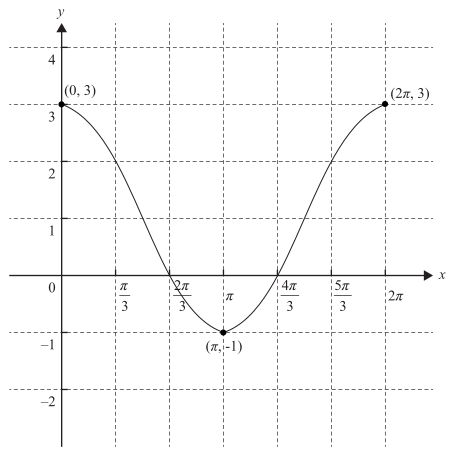
Let   `f(x) = 2cos(x) + 1`  for  `0<=x<=2pi`.

  1. Solve the equation  `2cos(x) + 1 = 0`  for  `0 <= x <= 2pi`.  (2 marks)

    --- 4 WORK AREA LINES (style=lined) ---

  2. Sketch the graph of the function  `f(x)`  on the axes below. Label the endpoints and local minimum point with their coordinates.  (3 marks)


--- 0 WORK AREA LINES (style=lined) ---

Show Answers Only
  1. `(2pi)/3, (4pi)/3`
  2.  
Show Worked Solution
i. `2cos(x) + 1` `= 0`
  `cos(x)` `= −1/2`

`=> cos\ pi/3 = 1/2\ text(and cos is negative)`

`text(in 2nd/3rd quadrant)`

`:.x` `= pi – pi/3, pi + pi/3`
  `= (2pi)/3, (4pi)/3`


ii.   

Filed Under: Trig Graphs (Y12) Tagged With: Band 3, Band 4, smc-977-20-cos

  • « Previous Page
  • 1
  • …
  • 73
  • 74
  • 75
  • 76
  • 77
  • …
  • 114
  • Next Page »

Copyright © 2014–2025 SmarterEd.com.au · Log in