SmarterEd

Aussie Maths & Science Teachers: Save your time with SmarterEd

  • Login
  • Get Help
  • About

Mechanics, SPEC2 2013 VCAA 16 MC

Forces of magnitude 5 N, 7 N and `Q` N act on a particle that is in equilibrium, as shown in the diagram below.
 

SPEC2 2013 VCAA 16 MC
 

The magnitude of `Q`, in newtons, can be found by evaluating

A.   `sqrt(5^2 + 7^2 - 2 xx 5 xx 7 cos(70^@))`

B.   `5^2 + 7^2 - 2 xx 5 xx 7 cos(110^@)`

C.   `sqrt(5^2 + 7^2 - 2 xx 5 xx 7 cos(110^@))`

D.   `5^2 + 7^2 - 2 xx 5 xx 7 cos(70^@)`

E.   `sqrt(5^2 + 7^2 - 2 xx 5 xx 7 cos(20^@))`

Show Answers Only

`A`

Show Worked Solution

`text(Using cosine rule:)`
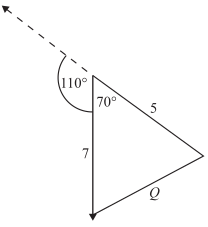


`Q^2` `= 5^2 + 7^2 – 2(5)(7)cos(70^@)`
`Q` `= sqrt(5^2 + 7^2 – (5)(7)cos(70^@))`

 
`=> A`

Filed Under: Pulleys, Planes and Equilibrium (SM) Tagged With: Band 4, smc-1175-40-Equilibrium

Vectors, SPEC2 2013 VCAA 15 MC

Let  `underset~u = 4underset~i - underset~j + underset~k`,  `underset~v = 3underset~j + 3underset~k`  and  `underset~w = −4underset~i + underset~j + underset~k`.

Which one of the following statements is not true?

  1. `|\ underset~u\ | = |\ underset~v\ |`
  2. `|\ underset~u\ | = |\ −underset~w\ |`
  3. `underset~u`, `underset~v` and `underset~w` are linearly independent
  4. `underset~u.underset~v = 0`
  5. `(underset~u + underset~w).underset~v = 12`
Show Answers Only

`E`

Show Worked Solution
`|underset~u|` `= sqrt(16 + 1 + 1)=sqrt18`
`|underset~v|` `= sqrt(9 + 9)=sqrt18`
`|underset~w|` `= sqrt(16+1+1)=sqrt18`

 
`underset~u · underset~v= 4 xx 0 + (−1) xx 3 + 1 xx 3=0`
 

`(underset~u + underset~w) · underset~v` `= ((4 – 4)underset~i + (−1 + 1)underset~j + (1 + 1)underset~k) · underset~v`
  `= 2underset~k · underset~v`
  `= 6`

 
`=> E`

Filed Under: Basic Concepts and Calculations Tagged With: Band 4, smc-1176-60-Other

Calculus, SPEC2 2013 VCAA 13 MC

Water containing 2 grams of salt per litre flows at the rate of 10 litres per minute into a tank that initially contained 50 litres of pure water. The concentration of salt in the tank is kept uniform by stirring and the mixture flows out of the tank at the rate of 6 litres per minute.

If `Q` grams is the amount of salt in the tank `t` minutes after the water begins to flow, the differential equation relating `Q` to `t` is

A.   `(dQ)/(dt) = 20 - (3Q)/(25 + 2t)`

B.   `(dQ)/(dt) = 10 - (3Q)/(25 + 2t)`

C.   `(dQ)/(dt) = 20 - (3Q)/(25 - 2t)`

D.   `(dQ)/(dt) = 10 - (3Q)/(25 - 2t)`

E.   `(dQ)/(dt) = 20 - (3Q)/25`

Show Answers Only

`A`

Show Worked Solution
`text(Volume)` `= 50 + (10 – 6)t`
  `= 50 + 4t`

 
`text(Salt in tank at time)\ \ t=Q\ text(grams)`

`:.\ text(Concentration)\ = Q/(50 + 4t)\ text(grams per litre)`
 

`(dQ)/(dt)text(in) = 2 xx 10 = 20\ \ text(g/min)`

`(dQ)/(dt)text(out)` `= 6 xx Q/(50 + 4t)`
  `= (3Q)/(25 + 2t)`

 
`:. (dQ)/(dt) = 20 – (3Q)/(25 + 2t)`

`=> A`

Filed Under: Applied Contexts Tagged With: Band 4, smc-1184-40-Mixing problems

Calculus, SPEC2 2013 VCAA 12 MC

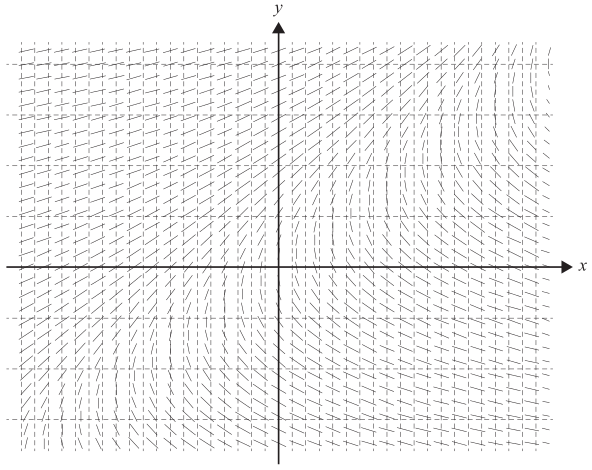
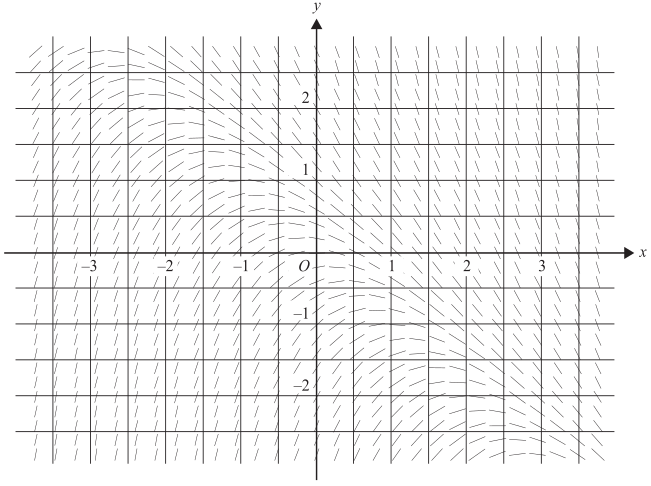
SPEC2 2013 VCAA 12 MC

The differential equation that best represents the above direction field is

A.   `(dy)/(dx) = x^2 - y^2`

B.   `(dy)/(dx) = y^2 - x^2`

C.   `(dy)/(dx) = y/x`

D.   `(dy)/(dx) = −x/y`

E.   `(dy)/(dx) = x/y`

Show Answers Only

`E`

Show Worked Solution

`text(By inspection:)`

`text(When)\ \ x=0\ \ =>\ \ (dy)/(dx) = 0`

`text(When)\ \ y=0\ \ => (dy)/(dx) -> oo`

`:.\ text(Eliminate A, B and C)`
 

`text(Along)\ \ y = x\ \ =>\ \ (dy)/(dx) > 0`

`:.\ text(Eliminate D)`

`=> E`

Filed Under: Euler, Pseudocode and Slope Fields Tagged With: Band 4, smc-1183-20-Slope fields

Calculus, SPEC2 2013 VCAA 11 MC

Consider the differential equation  `(dy)/(dx) = 1/(3 + 3x + x^2)`, with  `y_0 = 1`  when  `x_0 = 0`.

Using Euler's method with a step size of 0.1, the value of  `y_2` correct to three decimal places, is

A.   1.033

B.   1.063

C.   1.064

D.   1.065

E.   1.066

Show Answers Only

`C`

Show Worked Solution
`y_1` `= y_0 + h xx (dy)/(dx)|_{(x_0,y_0)}`
  `= 1 + 0.1 xx 1/(3 + 3 xx 0 + 0)`
  `= 1.03`


`y_2` `= y_1 + h xx (dy)/(dx)|_{(x_1,y_1)}`
  `= 1.03 + 0.1(1/(3 + 0.3 + 0.01))`
  `~~ 1.064`

 
`=> C`

Filed Under: Euler, Pseudocode and Slope Fields Tagged With: Band 4, smc-1183-10-Euler method

Calculus, SPEC2 2013 VCAA 10 MC

The region bounded by the lines  `x = 0`, `y = 3`  and the graph of  `y = x^(4/3)`  where  `x ≥ 0`  is rotated about the `y`-axis to form a solid of revolution.

The volume of this solid is

A.   `(81pi3^(2/3))/11`

B.   `(12pi3^(3/4))/7`

C.   `(27pi3^(1/3))/7`

D.   `(18pi3^(1/2))/5`

E.   `(6pi3^(1/2))/5`

Show Answers Only

`D`

Show Worked Solution
`y` `= (x^(2/3))^2`
`y` `= (x^2)^(2/3)`
`y^(3/2)` `= x^2`


`:. V` `= pi int_0^3 x^2\ dy`
  `= pi int_0^3 y^(3/2)\ dy\ \ \ text{(by CAS)}`
  `= (18pisqrt3)/5`

 
`=> D`

Filed Under: Solids of Revolution Tagged With: Band 4, smc-1180-10-Polynomial, smc-1180-60-y-axis rotation

Complex Numbers, SPEC2 2013 VCAA 8 MC

The principal arguments of the solutions to the equation  `z^2 = 1 + i`  are

  1. `pi/8`  and  `(9pi)/8`
  2. `−pi/8`  and  `(7pi)/8`
  3. `−(7pi)/8`  and  `pi/8`
  4. `(7pi)/8`  and  `(15pi)/8`
  5. `−(3pi)/4`  and  `pi/4`
Show Answers Only

`C`

Show Worked Solution
`z^2` `= 1 + i`
  `= sqrt2 text(cis)(pi/4 + 2kpi)`
`z` `= 2^(1/4) text(cis) (pi/8 + kpi)`

 
`:.\ text(Principal arguments are)\ −(7pi)/8\ text(and)\ pi/8.`

`=> C`

Filed Under: Mod/Arg Form and Argand Diagrams (SM) Tagged With: Band 4, smc-2597-20-Cartesian to Mod/Arg, smc-2597-50-Mod/Arg and powers

Complex Numbers, SPEC2 2013 VCAA 5 MC

The region in the complex plane that is outside the circle of radius `b` centred at the origin is given by the set of points `z`, where  `z ∈ C`, such that

A.   `|\ z\ | < b`

B.   `|\ z\ | > b`

C.   `|\ z\ | > b^2`

D.   `|\ z\ | = b`

E.   `|\ z\ | < b^2`

Show Answers Only

`B`

Show Worked Solution

`text(Circle:)\ |z| = b`

`text(Outside:)\ |z| > b`

`=> B`

Filed Under: Geometry and Complex Numbers (SM) Tagged With: Band 4, smc-1173-10-Circles

Calculus, SPEC1 2013 VCAA 9

The shaded region below is enclosed by the graph of  `y = sin(x)`  and the lines  `y = 3x`  and  `x = pi/3.`

This region is rotated about the `x`-axis.

VCAA 2013 spec 9

Find the volume of the resulting solid of revolution.  (4 marks)

Show Answers Only

`pi^4/9 – pi^2/6 + (sqrt 3 pi)/8\ \ text(u³)`

Show Worked Solution

`text{Volume of large (outer) cone}`

`= 1/3 pi r^2 xx h`

`=1/3 pi xx pi^2 xx pi/3`

`=pi^4/9`
 

`text{Volume of smaller (inner) cone}`

`= pi int_0^(pi/3) sin^2 x\ dx`

`= pi/2 int_0^(pi/3) (1 – cos 2x)\ dx`

`= pi/2[x – 1/2 (sin 2x)]_0^(pi/3)`

`=pi/2 [pi/3 – 1/2 sin ((2pi)/3)]`

`=pi/2(pi/3 + 1/2 xx sqrt3/2)`

`= pi^2/6 – (sqrt3 pi)/8`
 

`:.\ text(Volume of solid)`

`=pi^4/9 – pi^2/6 + (sqrt3 pi)/8\ \ text(u³)`

Filed Under: Solids of Revolution Tagged With: Band 4, smc-1180-20-Trig function, smc-1180-50-x-axis rotations

Calculus, SPEC1 2013 VCAA 5

A container of water is heated to boiling point (100°C) and then placed in a room that has a constant temperature of 20°C. After five minutes the temperature of the water is 80°C.

  1. Use Newton’s law of cooling  `(dT)/(dt) = -k (T-20)`, where `T text(°C)` is the temperature of the water at the time `t` minutes after the water is placed in the room, to show that  `e^(-5k) = 3/4.`   (2 marks)

    --- 6 WORK AREA LINES (style=lined) ---

  2. Find the temperature of the water 10 minutes after it is placed in the room.   (3 marks)

    --- 6 WORK AREA LINES (style=lined) ---

Show Answers Only
  1. `text(Proof)\ \ text{(See Worked Solutions)}`
  2. `65`
Show Worked Solution
a.    `(dT)/(dt)` `= -k (T-20)`
  `(dt)/(dT)` `= -1/k * 1/(T-20)`
  `t` `= -1/k int 1/(T-20)\ dT`
  `-kt` `= log_e (T-20) + c`
     

`text(When)\ \ t = 0,\ \ T = 100,`

`=>c = -log_e 80,`

`:. -kt` `= log_e (T-20)-log_e 80`
  `= log_e ((T-20)/80)`

 
`text(When)\ \ t = 5,\ \ T = 80,`

`-5k = log_e (3/4)`

`:. e^(-5k) = 3/4`


(b)   `text(Find)\ \ T\ \ text(when)\ \ t = 10:`

`-10k` `= log_e ((T-20)/80)`
`(T-20)/80` `= e^(-10k)`
`(T-20)/80` `= (e^(-5k))^2`
`(T-20)/80` `= (3/4)^2`
`:. T` `= (3/4)^2 xx 80 + 20`
  `=(9 xx 80)/16 +20`
  `= 65^@ text(C)`

Filed Under: Applied Contexts Tagged With: Band 4, smc-1184-50-Cooling problems

Graphs, SPEC1 2013 VCAA 4

  1. State the maximal domain and the range of  `y = arccos(1-2x).`   (2 marks)

    --- 4 WORK AREA LINES (style=lined) ---

  2. Sketch the graph of  `y = arccos(1-2x)`  over its maximal domain. Label the endpoints with their coordinates.   (2 marks)


              VCAA 2013 spec 4b
     

  3. Find the gradient of the tangent to the graph of  `y = arccos (1 – 2x)`  at  `x = 1/4.`   (2 marks)

    --- 4 WORK AREA LINES (style=lined) ---

Show Answers Only
  1. `text(Maximal domain)\ \ [0, 1];\ \ \ text(Range)\ \ [0, pi]`
  2.  

  3. `4/sqrt3`
Show Worked Solution

a.  `text(Maximal domain:)`

`1-2x` `∈ [−1, 1]`
`-2x` `∈ [−2, 0]`
`x` `∈ [0, 1]`

 
`text(When)\ \ x = 0,\ \ y = cos^-1 1= 0;`

`text(When)\ \ x = 1,\ \ y = cos^-1 (-1)= pi`

`:.\ text(Range is)\ \ [0, pi]`


b.   


c.   `y = cos^-1 (1-2x),`

`(dy)/(dx)` `= (-1(-2))/sqrt(1-(1-2x)^2)`
  `= 2/sqrt(1-(1-2x)^2)`

 
`text(At)\ \ x = 1/4,`

`m_T` `= 2/sqrt(1-(1-1/2)^2)`
  `=2/sqrt(3/4)`
  `= 4/sqrt 3`
  `= (4 sqrt 3)/3`

Filed Under: Inverse Trig Functions (SM), Tangents and Curve Sketching Tagged With: Band 4, smc-1153-20-arccos, smc-1182-10-Find gradient, smc-1182-35-Sketch curve

Vectors, SPEC1 2013 VCAA 3

The coordinates of three points are  `A (– 1, 2, 4), \ B(1, 0, 5) and C(3, 5, 2).`

  1. Find  `vec (AB)`  (1 mark)

    --- 2 WORK AREA LINES (style=lined) ---

  2. The points `A, B` and `C` are the vertices of a triangle.
  3. Prove that the triangle has a right angle at `A.`  (2 marks)

    --- 5 WORK AREA LINES (style=lined) ---

  4. Find the length of the hypotenuse of the triangle.  (1 mark)

    --- 5 WORK AREA LINES (style=lined) ---

Show Answers Only

  1. `2underset~i – 2underset~j + underset~k`
  2. `text(Proof)\ \ text{(See Worked Solutions)}`
  3. `sqrt 38`

Show Worked Solution

a.   `vec(AB)` `=(1 – −1)underset~i + (0 – 2)underset~j + (5 – 4)underset~k`
    `= 2underset~i – 2underset~j + underset~k`


b.    `overset(->)(AC)` `= (3 – −1)underset~i + (5 – 2)underset~j + (2 – 4)underset~k`
    `= 4underset~i + 3underset~j – 2underset~k`


`overset(->)(AB) · overset(->)(AC)` `= 2 xx 4 + (−2) xx 3 + 1 xx (−2)`
  `= 8 – 6 – 2`
  `= 0`

 
`=>  overset(->)(AB) ⊥ overset(->)(AC)`

`:. DeltaABC\ text(has a right angle at)\ A.`
 

c.    `overset(->)(BC)` `= (3 – 1)underset~i + (5 – 0)underset~j + (2 – 5)underset~k`
    `= 2underset~i + 5underset~j – 3underset~k`


`|overset(->)(BC)|` `= sqrt(2^2 + 5^2 + (−3)^2)`
  `= sqrt(4 + 25 + 9)`
  `= sqrt38`

Filed Under: Vector Lines, Planes and Geometry Tagged With: Band 3, Band 4, smc-1177-40-Triangles, smc-1177-50-2D problems

Calculus, SPEC1 2013 VCAA 2

Evaluate  `int_0^1 (x-5)/(x^2-5x + 6)\ dx.`  (4 marks)

--- 10 WORK AREA LINES (style=lined) ---

Show Answers Only

`ln(9/32)`

Show Worked Solution
`int_0^1 (x-5)/(x^2-5x + 6)\ dx` `= int_0^1 (x-5)/((x-3)(x-2))\ dx`
  `= int_0^1 A/(x-3) + B/(x-2)\ dx`

 
`text(Using partial fractions:)` 

`A(x-2) + B(x-3) = x-5`

`text(If)\ \ x = 2,` `-B` `= −3`
  `B` `= 3`
`text(If)\ \ x = 3,` `A` `=-2`

 
`:. int_0^1 (x-5)/(x^2-5x + 6)\ dx`

  `= int_0^1 −2/(x-3) + 3/(x-2)\ dx`
  `= [−2ln|x-3| + 3ln|x-2|]_0^1`
  `= −2ln(2) + 3ln(1) + 2ln(3)-3ln(2)`
  `= 2ln(3)-5ln(2)`
  `= ln(3^2/2^5)`
  `= ln(9/32)`

Filed Under: Partial Fractions and Other Integration (SM) Tagged With: Band 4, smc-2565-10-Quadratic denom, smc-2565-60-PF not given

Calculus, SPEC1 2013 VCAA 6

Find the value of `c`, where  `c in R`, such that the curve defined by

`y^2 + (3e^{(x - 1)})/(x - 2) = c`

has a gradient of 2 where  `x = 1.`   (4 marks)

Show Answers Only

`-3/4`

Show Worked Solution

`text(Using implicit differentiation:)`

`d/(dx)(y^2) + d/(dx)((3e^(x – 1))/(x – 2))` `= d/(dx)(c)`
`2y(dy)/(dx) + ((x – 2)3e^(x – 1) – 3e^(x – 1))/(x – 2)^2` `= 0`
`2y(dy)/(dx) +(3e^(x – 1) (x – 3))/(2y(x – 2)^2)` `=0`

 
`:. (dy)/(dx) = -(3e^(x – 1) (x – 3))/(2y(x – 2)^2)`

`text(When)\ \ x=1,\ \ dy/dx=2`

`2=(-6)/(-2y)\ \ =>\ \ y=3/2`

`text(Substituting into curve equation:)`

`(3/2)^2 + (3e^0)/(1 – 2)` `= c`
`9/4 – 3` `= c`
`c` `= -3/4`

Filed Under: Tangents and Curve Sketching Tagged With: Band 4, smc-1182-10-Find gradient, smc-1182-50-Implicit functions

Calculus, SPEC2 2014 VCAA 21 MC

The acceleration, in `text(ms)^(-2)`, of a particle moving in a straight line is given by  `–4x`, where `x` metres is its displacement from a fixed origin `O`.

If the particle is at rest where  `x = 5`, the speed of the particle, in `text(ms)^(−1)`, where  `x = 3`  is

A.           `8`

B.     `8 sqrt 2`

C.         `12`

D.     `4 sqrt 2`

E.   `2 sqrt 34`

Show Answers Only

`A`

Show Worked Solution
`a` `= -4x`
`(d(1/2 v^2))/(dx)` `=-4x`
`1/2 v^2` `=-2x^2 + c_0`
`v^2` `=-4x^2 + c_1`

 
`text(When)\ \ x=5,\ \ v=0:`

`=> c_1 = 100`
 

`text(Find)\ \ |\ v\ |\ \ text(when)\ \ x=3:`

`v^2 =  -4 xx 3^2 + 100`

`:. |\ v\ | = 8\ \ text(m/s)`

`=> A`

Filed Under: Motion (SM) Tagged With: Band 4, smc-1159-20-Motion as f(x)

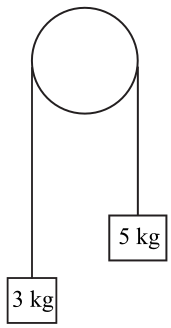
Mechanics, SPEC2 2014 VCAA 20 MC

Particles of mass 3 kg and 5 kg are attached to the ends of a light inextensible string that passes over a fixed smooth pulley, as shown above. The system is released from rest.

Assuming the system remains connected, the speed of the 5 kg mass after two seconds is

A.     4.0 m/s

B.     4.9 m/s

C.     9.8 m/s

D.   10.0 m/s

E.   19.6 m/s

Show Answers Only

`B`

Show Worked Solution
`sum F` `= 5g – 3g = 2g`
  `=2 xx 9.8`
  `=19.6\ \ text(N)`
`(5+3)a` `= 19.6`
`a` `=2.45`

  
`u = 0, quad t = 2, quad a = 2.45`

`v` `= u + at`
  `= 0 + 2.45 xx 2`
  `=4.9\ \ text(m/s)`

 
`=> B`

Filed Under: Pulleys, Planes and Equilibrium (SM) Tagged With: Band 4, smc-1175-30-Connected particles

Vectors, SPEC2 2014 VCAA 17 MC

The acceleration vector of a particle that starts from rest is given by

`underset ~a(t) = −4 sin(2t) underset ~i + 20 cos (2t) underset ~j - 20 e^(−2t) underset ~k`, where `t >= 0`.

The velocity vector of the particle, `underset ~v(t)`, is given by

  1. `−8 cos(2t) underset ~i - 40 sin(2t) underset ~j + 40e^(−2t) underset ~k`
  2. `2 cos(2t) underset ~i + 10 sin(2t) underset ~j + 10e^(−2t) underset ~k`
  3. `(8 - 8 cos(2t)) underset ~i - 40 sin(2t) underset ~j + (40e^(−2t) - 40) underset ~k`
  4. `(2 cos(2t) - 2) underset ~i + 10 sin(2t) underset ~j + (10e^(−2t) - 10) underset ~k`
  5. `(4 cos(2t) - 4) underset ~i + 20 sin(2t) underset ~j + (20 - 20e^(−2t)) underset ~k`
Show Answers Only

`D`

Show Worked Solution
`underset ~ dot v(t)` `= underset ~a(t)`
`underset ~v(t)` `= int underset ~a (t)\ dt`
  `= (2 cos (2t) + c_0) underset ~i + (10 sin (2t) + c_1) underset ~j + (10e^(-2t) + c_2) underset ~k`

 
`text(S)text(ince)\ \ v=0\ \ text(when)\ \ t=0:`

`0` `= (2 cos (0) + c_0) underset ~i + (10 sin (0) + c_1) underset ~j + (10e^0 + c_2) underset ~k`
`0` `= (2 + c_0) underset ~i + c_1 underset ~j + (10 + c_2) underset ~k `

 
`=> c_0 = -2, \ \  c_1 = 0, \ \  c_2 = -10`
 

`:. underset ~v(t) = (2 cos (2t) – 2) underset ~i + 10 sin(2t) underset ~j + (10e^(-2t) – 10) underset ~k`

`=> D`

Filed Under: Forces and Motion Along a Curve Tagged With: Band 4, smc-1179-50-Motion and integration

Vectors, SPEC2 2014 VCAA 15 MC

If  `theta`  is the angle between  `underset ~a = sqrt 3 underset ~i + 4 underset ~j - underset ~k`  and  `underset ~b = underset ~i - 4 underset ~j + sqrt 3 underset ~k`, then  `cos(2 theta)`  is

  1. `−4/5`
  2.    `7/25`
  3. `−7/25`
  4.    `14/25`
  5. `−24/25`
Show Answers Only

`B`

Show Worked Solution
`underset ~a ⋅ underset ~b` `= sqrt 3 xx 1 + 4 xx (-4) + (-1) xx sqrt 3`
  `= -16`

 
`|\ underset~a\ | = sqrt20,\ \ |\ underset~b\ | = sqrt20,`

`cos(theta)` `=(underset ~a ⋅ underset ~b)/(|\ underset~a\ |\ |\ underset~b\ | `
  `= (-16)/(sqrt 20 xx sqrt 20)`
  `= -4/5`


`cos (2 theta)` `= 2cos^2theta – 1`
  `= 2(-4/5)^2 – 1`
  `= 7/25`

 
`=> B`

Filed Under: Basic Concepts and Calculations Tagged With: Band 4, smc-1176-20-Angle between vectors

Calculus, SPEC2 2014 VCAA 14 MC

The differential equation that is best represented by the above direction field is

A.   `(dy)/(dx) = 1/(x - y)`

B.   `(dy)/(dx) = y - x`

C.   `(dy)/(dx) = 1/(y - x)`

D.   `(dy)/(dx) = x - y`

E.   `(dy)/(dx) = 1/(y + x)`

Show Answers Only

`C`

Show Worked Solution

`text(Method 1:)`

`text(Draw direction field of each option by CAS.)`
 

`text(Method 2:)`

`text(Consider quadrant 2,)`

`x < 0, \ \ y > 0, \ \  m > 0\ \ => text(Eliminate A, D and E)`
 

`text(Consider vertical gradients where)\ \ m=oo\ \ => text(Eliminate B)`

 
`=> C`

Filed Under: Euler, Pseudocode and Slope Fields Tagged With: Band 4, smc-1183-20-Slope fields

Calculus, SPEC2 2015 VCAA 20 MC

An object is moving in a straight line, initially at `5\ text(ms)^(–1)`. Sixteen seconds later, it is moving at `11\ text(ms)^(–1)` in the opposite direction to its initial velocity.

Assuming that the acceleration of the object is constant, after 16 seconds the distance, in metres, of the object from its starting point is

A.   24

B.   48

C.   73

D.   96

E.   128

Show Answers Only

`B`

Show Worked Solution

`u = 5, v = −11, t = 16`

`v=u+at`

`-11=5+a xx 16\ \ =>\ \ a=-1`

`s` `= ut+1/2 at^2`
  `= 5xx16 – 1 xx 16^2`
  `=-48`

 
`:.\ text(Object is 48 metres from strating point.)`

`=> B`

Filed Under: Motion (SM) Tagged With: Band 4, smc-1159-10-Motion as f(t)

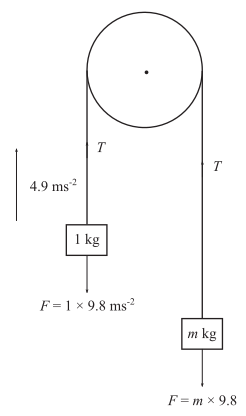
Mechanics, SPEC2 2015 VCAA 19 MC

A light inextensible string passes over a smooth pulley, as shown below, with particles of mass 1 kg and `m` kg attached to the ends of the string.
 

SPEC2 2015 VCAA 19 MC

If the acceleration of the 1 kg particle is 4.9 `text(ms)^(-2)` upwards, then `m` is equal to

A.   1

B.   2

C.   3

D.   4

E.   5

Show Answers Only

`C`

Show Worked Solution

`T – (9.8 xx 1) = 4.9 xx 1`

`T=14.7`
 

`m xx 9.8 – T` `=m xx 4.9`
`4.9m` `= 14.7“
`:. m` `= 14.7/4.9`
  `= 3`

`=> C`

Filed Under: Pulleys, Planes and Equilibrium (SM) Tagged With: Band 4, smc-1175-30-Connected particles

Vectors, SPEC2 2015 VCAA 18 MC

The position vectors of two moving particles are given by  `underset~r_1(t) = (2 + 4t^2)underset~i + (3t + 2)underset~j`  and  `underset~r(t) = (6t)underset~i + (4 + t)underset~j`, where  `t >=0`.

The particles will collide at

  1. `3underset~i + 3.5underset~j`
  2. `6underset~i + 5underset~j`
  3. `3underset~i + 4.5underset~j`
  4. `0.5underset~i + underset~j`
  5. `5underset~i + 6underset~j`
Show Answers Only

`B`

Show Worked Solution

`text(Equating)\ \ underset~i\ \ text(components:)`

`2 + 4t^2 = 6t`

`t=1\ \ text(or)\ \ t = 1/2`
 

`text(Equating)\ \ underset~j\ \ text(components:)`

`3t + 2=4+t`

`t = 1`
 

`underset~r_1(1) = 6underset~i + 5underset~j`

`=> B`

Filed Under: Position Vectors as a Function of Time Tagged With: Band 4, smc-1178-30-Collision

Calculus, SPEC2 2015 VCAA 11 MC

The velocity–time graph for a body moving along a straight line is shown below.
 

SPEC2 2015 VCAA 11 MC
 

The body first returns to its initial position within the time interval

A.   (0, 0.5)

B.   (0.5, 1.5)

C.   (1.5, 2.5)

D.   (2.5, 3.5)

E.   (3.5, 5)

Show Answers Only

`D`

Show Worked Solution

`text(Body moves forward between)\ \ t = 0 and t=2.`

`text(Body moves in reverse direction between)\ \ t = 2 and t=4.`

`text(By approximation, between)\ \ t=0 and t=4,\ text(the area below)`

`text(the)\ xtext(-axis equals the area above the)\ x text(-axis occurs when)\ \ t~~3.25`

`text(seconds.)`

 
`=> D`

Filed Under: Motion (SM) Tagged With: Band 4, smc-1159-40-Graphs

Statistics, SPEC2 2016 VCAA 20 MC

The lifetime of a certain brand of batteries is normally distributed with a mean lifetime of 20 hours and a standard deviation of two hours. A random sample of 25 batteries is selected.

The probability that the mean lifetime of this sample of 25 batteries exceeds 19.3 hours is

A.   0.0401

B.   0.1368

C.   0.6103

D.   0.8632

E.   0.9599

Show Answers Only

`E`

Show Worked Solution

`X\ ~\ N (20, 2^2)`

`bar X\ ~\ N (20, (2^2)/25)`

`text(Pr) (bar X > 19.3) ~~ 0.9599`

`=>  E`

Filed Under: Confidence Intervals and Hypothesis Testing (SM) Tagged With: Band 4, smc-1162-30-One-tail test

Statistics, SPEC2 2016 VCAA 18 MC

Oranges grown on a citrus farm have a mean mass of 204 grams with a standard deviation of 9 grams

Lemons grown on the same farm have a mean mass of 76 grams with a standard deviation of 3 grams.

The masses of the lemons are independent of the masses of the oranges.

The mean mass and standard deviation, in grams, respectively of a set of three of these oranges and two of these lemons are

  1. `764, 3 sqrt 29`
  2. `636, 12`
  3. `764, sqrt 33`
  4. `636, 3 sqrt 10`
  5. `636, 33`
Show Answers Only

`A`

Show Worked Solution

`O~N (204, 9^2)`

`L~N (76, 3^2)`

`T = O+O+O + L + L`

`T~N (3 xx 204 + 2 xx 76, 9^2 + 9^2 + 9^2 + 3^2 + 3^2)`

`T~N (764, 261)`

`:. mu_T= 764, quad sigma_T = sqrt 261 = 3 sqrt 29`

`=>  A`

Filed Under: Linear Combinations and Sample Means (SM) Tagged With: Band 4, smc-1160-30-Z = aX + bY

Mechanics, SPEC2 2016 VCAA 17 MC

A body of mass 3 kg is moving to the left in a straight line at 2 `text(ms)^(-1)`. It experiences a force for a period of time, after which it is then moving to the right at 2 `text(ms)^(-1)`.

The change in momentum of the particle, in kg `text(ms)^(-1)`, in the direction of the final motion is

A.   − 6

B.     0

C.     4

D.     6

E.   12

Show Answers Only

`E`

Show Worked Solution
`m_1 v_1` `= 3 xx -2 = -6`
`m_2 v_2` `= 3 xx 2 = 6`


`Deltap` `=m_2 v_2 – m_1 v_1`
  `= 6 – (-6)`
  `= 12`

 
`=>  E`

Filed Under: Force, Momentum and Motion (SM) Tagged With: Band 4, smc-1174-30-Momentum

Mechanics, SPEC2 2016 VCAA 15 MC

A variable force of  `F`  newtons acts on a 3 kg mass so that it moves in a straight line. At time  `t`  seconds,  `t >= 0`, its velocity  `v`  metres per second and position  `x`  metres from the origin are given by  `v = 3 - x^2`.

It follows that

A.   `F = -2x`

B.   `F = -6x`

C.   `F = 2x^3 - 6x`

D.   `F = 6x^3 - 18x`

E.   `F = 9x - 3x^3`

Show Answers Only

`D`

Show Worked Solution

`(dv)/(dx) = -2x`

`a = v (dv)/(dx) = -2x(3 – x^2)`
 

`:. F` `=ma`
  `= -6x(3 – x^2)`
  `= 6x^3-18x`

 
`=>  D`

Filed Under: Force, Momentum and Motion (SM) Tagged With: Band 4, smc-1174-10-Force and motion

Vectors, SPEC2 2016 VCAA 13 MC

A particle of mass 5 kg is subject to forces  `12 underset ~i`  newtons and  `9 underset ~j`  newtons.

If no other forces act on the particle, the magnitude of the particle’s acceleration, in ms¯², is

  1. `3`
  2. `2.4 underset ~i + 1.8 underset ~j`
  3. `4.2`
  4. `9`
  5. `60 underset ~i + 45 underset ~j`
Show Answers Only

`A`

Show Worked Solution
`underset ~F` `= 12 underset ~i + 9 underset ~j`
`5 underset ~a` `= 12 underset ~i + 9 underset ~j`
`underset ~a` `= 12/5 underset ~i + 9/5 underset ~j`
   
`|underset ~a|` `= sqrt(144/25 + 81/25)`
  `= 3`

 
`=>  A`

Filed Under: Forces and Motion Along a Curve Tagged With: Band 4, smc-1179-10-Force magnitude

Vectors, SPEC2 2016 VCAA 12 MC

If  `underset ~a = -2 underset ~i - underset ~j + 3 underset ~k`  and  `underset ~b = -m underset ~i + underset ~j + 2 underset ~k`, where  `m`  is a real constant, the vector  `underset ~a - underset ~b`  will be perpendicular to vector  `underset ~b`  where  `m`  equals

A.   0 only

B.   2 only

C.   0 or 2

D.   4.5

E.   0 or −2

Show Answers Only

`C`

Show Worked Solution
`underset ~a – underset ~b` `= (m – 2) underset ~i – 2 underset ~j + underset ~k `
`(underset ~a – underset ~b) ⋅ underset ~b` `= -m(m – 2) – 2(1) + 1(2) = 0`
`0` `= -m^2 + 2m – 2 + 2`
`0` `= 2m – m^2`
`0` `= m(2 – m) \ => \ m = 0 \ or \ 2`

`=>  C`

Filed Under: Basic Concepts and Calculations Tagged With: Band 4, smc-1176-30-Perpendicular vectors

Vectors, SPEC2 2016 VCAA 11 MC

Let  `underset ~a = 3 underset ~i + 2 underset ~j + alpha underset ~k`  and  `underset ~b = 4 underset ~i - underset ~j + alpha^2 underset ~k`, where  `alpha`  is a real constant.

If the scalar resolute of  `underset ~a`  in the direction of  `underset ~b`  is  `74/sqrt 273`,  then  `alpha`  equals

A.   1

B.   2

C.   3

D.   4

E.   5 

Show Answers Only

`D`

Show Worked Solution
`underset ~a ⋅ underset ~ hat b` `= (3 xx 4 + 2 xx -1 + alpha xx alpha^2)/sqrt(4^2 + 1^2 + alpha^4)`
`74/sqrt 273` `= (12 – 2 + alpha^3)/ sqrt(17 + alpha^4)`
`74 sqrt(17 + alpha^4)` `=sqrt 273 (10 + alpha^3)`


`alpha = 1:\ \ text(LHS:)\ sqrt 273 xx 11 = 74 sqrt 18\ \ text(RHS)`  ✖

`alpha = 2:\ \ sqrt 273(18) = 74 sqrt 33`  ✖

`alpha = 3:\ \ sqrt 273 xx 37 = 74 sqrt 98`  ✖

`alpha = 4:\ \ sqrt 273 xx 74 = 74 sqrt 273`  ✔

`=>  D`

Filed Under: Basic Concepts and Calculations Tagged With: Band 4, smc-1176-50-Linear dependence

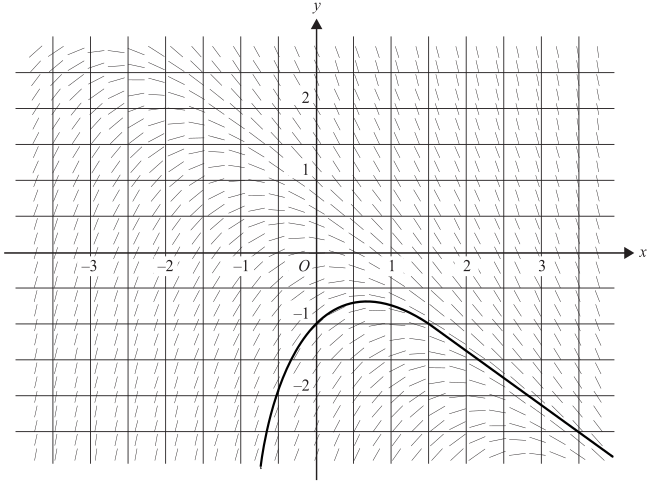
Calculus, SPEC2 2016 VCAA 10 MC

The direction field for the differential equation  `(dy)/(dx) + x + y = 0`  is shown above.

A solution to this differential equation that includes  `(0, -1)`  could also include

A.  `(3, –1)`

B.  `(3.5, –2.5)`

C.  `(–1.5, –2)`

D.  `(2.5, –1)`

E.  `(2.5, 1)` 

Show Answers Only

`B`

Show Worked Solution

 
`=>  B`

Filed Under: Euler, Pseudocode and Slope Fields Tagged With: Band 4, smc-1183-20-Slope fields

Calculus, SPEC2 2014 VCAA 10 MC

A large tank initially holds 1500 L of water in which 100 kg of salt is dissolved. A solution containing 2 kg of salt per litre flows into the tank at a rate of 8 L per minute. The mixture is stirred continuously and flows out of the tank through a hole at a rate of 10 L per minute.

The differential equation for `Q`, the number of kilograms of salt in the tank after `t` minutes, is given by

A.   `(dQ)/(dt) = 16 - (5Q)/(750 - t)`

B.   `(dQ)/(dt) = 16 - (5Q)/(750 + t)`

C.   `(dQ)/(dt) = 16 + (5Q)/(750 - t)`

D.   `(dQ)/(dt) = (100Q)/(750 - t)`

E.   `(dQ)/(dt) = 8 - Q/(1500 - 2t)`

Show Answers Only

`A`

Show Worked Solution

`(dQ_text(in))/(dV)= 2\ text(kg/L),\ (dV_text(in))/(dt) = 8\ text(L/min)`

`V_0 = 1500,\ Q_0 = 100`

`(dV_text(out))/(dt) = 10\ text(L/min)`
  

`V(t)` `= 1500 + (8 – 10)t`
  `= 1500 – 2t`
  `= 2(750 – t)`


`(dQ_text(in))/(dt)` `= 2 xx 8 = 16 text(kg/min)`
`(dQ_text(out))/(dt)` `= Q/(v(t)) xx 10`
  `= (10Q)/(2(750 – t))`
  `= (5Q)/(750 – t)`

 
`:.(dQ)/(dt)= 16 – (5Q)/(150 – t)`

`=> A`

Filed Under: Applied Contexts Tagged With: Band 4, smc-1184-40-Mixing problems

Calculus, SPEC2 2016 VCAA 9 MC

If  `f(x) = (dy)/(dx) = 2x^2 - x`, where  `y_0 = 0 = y(2)`, then  `y_3`  using Euler’s formula with step size 0.1 is

A.  `0.1\ f(2)`

B.  `0.6 + 0.1\ f(2.1)`

C.  `1.272 + 0.1\ f(2.2)`

D.  `2.02 + 0.1\ f(2.3)`

E.  `2.02 + 0.1\ f(2.2)` 

Show Answers Only

`C`

Show Worked Solution
`y_1` `= y_0 + 0.1(2(2)^2 – 2)`
  `= 0.6`
`y_2` `= 0.6 + 0.1 (2(2.1)^2 – 2.1)`
  `= 1.272`
`:.  y_3` `= 1.272 + 0.1\ f(2.2)`

 
`=>  C`

Filed Under: Euler, Pseudocode and Slope Fields Tagged With: Band 4, smc-1183-10-Euler method

Calculus, SPEC2 2016 VCAA 8 MC

Using a suitable substitution,  `int_a^b (x^3e^(2x^4))\ dx`, where  `a`  and  `b`  are real constants, can be written as

A.  `int_a^b (e^(2u))\ du`

B.  `int_(a^4)^(b^4) (e^(2u))\ du`

C.  `1/8 int_a^b (e^u)\ du`

D.  `1/4 int_(a^4)^(b^4) (e^(2u))\ du`

E.  `1/8 int_(8a^3)^(8b^3) (e^u)\ du` 

Show Answers Only

`D`

Show Worked Solution
`u` `= x^4`
`(du)/(dx)` `= 4x^3\ \ =>\ \ 1/4\ du = x^3\ dx`

  
`text(When)\ \ x=a, \ u=a^4`

`text(When)\ \ x=b, \ u=b^4`
 

`:. int_a^b x^3 e^(2x^4)\ dx`

`= 1/4 int_(a^4)^(b^4) e^(2u)\ du`
 

`=>  D`

Filed Under: Integration by Substitution (SM) Tagged With: Band 4, smc-2564-20-Polynomial

Complex Numbers, SPEC2 2016 VCAA 6 MC

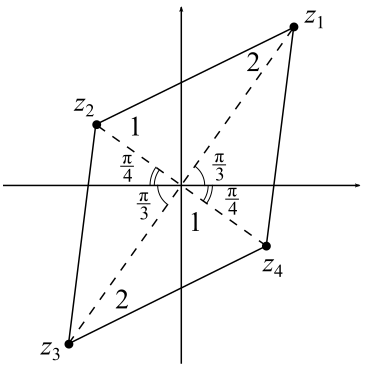
The points corresponding to the four complex numbers given by
 

`z_1 = 2 text(cis) (pi/3),\ z_2 = text(cis) ((3 pi)/4),\ z_3 = 2 text(cis)(-(2 pi)/3),\ z_4 = text(cis) (-pi/4)`
 

are the vertices of a parallelogram in the complex plane.

Which one of the following statements is not true?

A.  The acute angle between the diagonals of the parallelogram is  `(5 pi)/12`

B.  The diagonals of the parallelogram have lengths 2 and 4

C.  `z_1 z_2 z_3 z_4 = 0 `

D.  `z_1 + z_2 + z_3 + z_4 = 0`

E.  `1 <= |z| <= 2`  for all four of  `z_1, z_2, z_3, z_4` 

Show Answers Only

`C`

Show Worked Solution

`text(Consider each option:)`

`A: qquad theta_1` `= pi/3 + pi/4=(7 pi)/12`
`theta_2` `= pi – (7 pi)/12= (5 pi)/12\ \ text{(correct)}`


`B: qquad l_1` `= 2 + 2 = 4`
`l_2` `= 1+ 1 = 2\ \ text{(correct)}`


`C: qquad 2 text(cis) (pi/3) ⋅ text(cis) ((3 pi)/4) ⋅ 2 text(cis) (-(2 pi)/3) ⋅ text(cis) (-pi/4)`

`!= 0\ \ text{(by CAS → incorrect)}`

 
`=>  C`

Filed Under: Geometry and Complex Numbers (SM) Tagged With: Band 4, smc-1173-50-Quadrilaterals

Complex Numbers, SPEC2 2016 VCAA 5 MC

If   `text(Arg) (-1 + ai) = -(2 pi)/3`, then the real number  `a`  is

  1. `-sqrt 3`
  2. `-sqrt 3/2`
  3. `-1/sqrt 3`
  4. `1/sqrt 3`
  5. `sqrt 3` 
Show Answers Only

`A`

Show Worked Solution

`z\ \ text(is in the 3rd quandrant)`

`=> a < 0`

`-pi + tan^(-1) (|a|/1)` `= -(2 pi)/3`
` tan^(-1)(|a|)` `= pi/3`

 
`|a| = sqrt 3`

`:.  a = -sqrt 3` 

`=>  A`

Filed Under: Mod/Arg Form and Argand Diagrams (SM) Tagged With: Band 4, smc-2597-60-Argand diagrams

Complex Numbers, SPEC2 2016 VCAA 4 MC

One of the roots of   `z^3 + bz^2 + cz = 0`  is  `3 - 2i`, where `b` and `c` are real numbers.

The values of `b` and `c` respectively are

A.  `6, 13`

B.  `3, -2`

C.  `-3, 2`

D.  `2, 3`

E.  `-6, 13` 

Show Answers Only

`E`

Show Worked Solution

`z(z^2 + bz + c) = 0,\ b, c in RR`

`text(Given)\ \ z= 3 – 2i \ \ text(is a root,)`

`=> z = 3 + 2i\ \ text{is a root (conjugate).}`
 

`z(z^2 + bz + c)` `= 0`
`z((z – 3) + 2i)((z – 3) – 2i)` `= 0`
`z((z – 3)^2 – 4i^2)` `= 0`
`z(z^2 – 6z + 9 + 4)` `= 0`
`z^3 – 6z^2 + 13z` `= 0`

 
`b = -6,\ \ c = 13` 

`=>  E`

Filed Under: Factors and Roots (SM) Tagged With: Band 4, smc-1172-20-Cubic roots, smc-1172-40-Conjugate roots

Graphs, SPEC2 2016 VCAA 3 MC

The straight-line asymptote(s) of the graph of the function with rule  `f(x) = (x^3 - ax)/x^2`, where  `a`  is a non-zero real constant, is given by

A.  `x = 0`  only.

B.  `x = 0`  and  `y = 0`  only.

C.  `x = 0`  and  `y = x`  only.

D.  `x = 0, \ x = sqrt a`  and  `x = -sqrt a`  only.

E.  `x = 0`  and  `y = a`  only. 

Show Answers Only

`C`

Show Worked Solution

`f(x) = x – a/x,\ x != o`

`lim_(x -> oo) f(x) = x`

`:.\ text(Asymptotes):\ \ x = 0,\ \ y = x`

 
`=>  C`

Filed Under: Partial Fractions, Quotient and Other Functions (SM) Tagged With: Band 4, smc-1154-10-Quotient functions/Asymptotes

Trigonometry, SPEC1 2016 VCAA 9

Given that  `cos (x - y) = 3/5`  and  `tan(x) tan (y) = 2`, find  `cos(x + y)`.  (3 marks)

Show Answers Only

`-1/5`

Show Worked Solution

`cos(x+y)= cos(x) cos(y) – sin(x) sin(y)`
 

`cos (x) cos (y) + sin (x) sin (y) = 3/5\ \ …\ (1)`

`(sin(x) sin(y))/(cos(x) cos(y))` `=2`  
`sin(x) sin(y)` `= 2 cos (x) cos(y)\ \ …\ (2)`  

  
`text{Substitute (2) into (1):}`

`cos(x) cos(y) + 2 cos(x) cos(y)` `= 3/5`
`3 cos(x) cos(y)` `= 3/5`
`cos(x) cos(y)` `= 1/5`

 
`text(Substitute)\ \ cos(x)cos(y)=1/5\ \ text{into (1):}`

`1/5 + sin(x) sin(y)` `= 3/5`
`sin(x) sin(y)` `= 2/5`


`:. cos(x + y)` `= cos(x) cos(y) – sin(x) sin(y)`
  `= 1/5 – 2/5`
  `= -1/5`

Filed Under: Trigonometry (SM) Tagged With: Band 4, smc-1150-40-Compound angles

Vectors, SPEC1 2016 VCAA 8

The position of a body with mass 3 kg from a fixed origin at time  `t`  seconds, `t >= 0`, is given by  `underset ~r = (3 sin (2t)-2)underset ~i + (3-2 cos(2t)) underset ~j`, where components are in metres.

  1. Find an expression for the speed, in metres per second, of the body at time  `t`.   (2 marks)

    --- 4 WORK AREA LINES (style=lined) ---

  2. Find the speed of the body, in metres per second, when  `t = pi/12`.   (1 mark)

    --- 4 WORK AREA LINES (style=lined) ---

  3. Find the maximum magnitude of the net force acting on the body in newtons.   (3 marks)

    --- 8 WORK AREA LINES (style=lined) ---

Show Answers Only
  1. `|underset ~ dot r| = sqrt(36 cos^2(2t) + 16 sin^2(2t))`
  2. `sqrt 31`
  3. `36`
Show Worked Solution
a.    `underset ~r ` `=(3 sin (2t)-2)underset ~i + (3-2 cos(2t)) underset ~j`
   `underset ~ dot r` `= 6 cos (2t) underset ~i + 4 sin (2t) underset ~j`
  `|underset ~ dot r|` `= sqrt(36 cos^2(2t) + 16 sin^2(2t))`


b.   `text(Find)\ \ |underset ~ dot r|\ \ text(when)\ \ t=pi/12:`

`underset ~ dot r` `=(36 cos^2 (pi/6) + 16 sin^2 (pi/6))^(1/2)`  
  `= (36 (sqrt 3/2)^2 + 16 (1/2)^2)^(1/2)`  
  `= (36/4 xx 3 + 16/4)^(1/2)`  
  `= (27 + 4)^(1/2)`  
  `= sqrt 31`  


c.    `underset ~ ddot r` `= d/(dt) (underset ~dotr)= -12 sin (2t) underset ~i + 8 cos (2t) underset ~j`
  `underset ~F` `= 3 ddot r`
  `|underset ~F|` `= 3 |underset ~ ddot r|`
    `= 3 sqrt(144 sin^2 (2t) + 64 cos^2 (2t))`
    `= 3 sqrt(64 sin^2 (2t) + 64 cos^2(2t) + 80 sin^2 (2t))`
    `= 3 sqrt(64 + 80 sin^2 (2t))`

 
`text(Max occurs when)\ \ (sin^2 (2t)) = 1`

Mean mark 51%.

`:. max (|underset ~F|)` `= 3 sqrt(64 + 80)`
  `= 3 sqrt 144`
  `= 3 xx 12`
  `= 36`

Filed Under: Forces and Motion Along a Curve Tagged With: Band 3, Band 4, smc-1179-20-Max/min force

Calculus, SPEC1 2016 VCAA 7

Find the arc length of the curve  `y = 1/3 (x^2 + 2)^(3/2)`  from  `x = 0`  to  `x = 2`.  (4 marks)

Show Answers Only

`14/3`

Show Worked Solution
`y` `= 1/3 (x^2 + 2)^(3/2)`
`(dy)/(dx)` `= 1/3 xx 3/2 xx 2x (x^2 + 2)^(3/2 – 1)`
  `= x(x^2 + 2)^(1/2)`
`((dy)/(dx))^2` `= x^2 (x^2 + 2)`
  `= x^4 + 2x^2`


`l` `= int_0^2 sqrt(1 + ((dy)/(dx))^2)\ dx`
  `= int_0^2 sqrt(x^4 + 2x^2 + 1)\ dx`
  `= int_0^2 sqrt((x^2 + 1)^2)\ dx`
  `= int_0^2 x^2 + 1\ dx`
  `= [x^3/3 + x]_0^2`
  `= 8/3 + 2`
  `= 14/3`

Filed Under: Arc Lengths, Areas and Other Tagged With: Band 4, smc-1181-10-Arc length

Complex Numbers, SPEC1 2016 VCAA 6

Write  `(1-sqrt 3 i)^4/(1 + sqrt 3 i)`  in the form  `a + bi`, where  `a`  and  `b`  are real constants.   (3 marks)

--- 10 WORK AREA LINES (style=lined) ---

Show Answers Only

`4 + 4 sqrt 3 i`

Show Worked Solution

`(1-sqrt 3 i) \ \ => \ r_1=sqrt (1^2 + (sqrt 3)^2)=2`

`theta_1 = tan^(-1) (-sqrt 3)=- pi/3`

`(1 + sqrt 3 i) \ \ => \ r_2=2, \ theta_2 =pi/3`
 

`:. (1-sqrt 3 i)^4/(1 + sqrt 3 i)` `= (2 text(cis) (-pi/3))^4/(2 text(cis) (pi/3))`
  `= (16 text(cis) (-(4 pi)/3))/(2 text(cis) (pi/3))`
  `= 8 text(cis) (-(5 pi)/3)`
  `= 8 text(cis) (pi/3)\ \ \ (-pi<=theta<=pi)`
  `= 8(1/2 + sqrt 3/2 i)`
  `= 4 + 4 sqrt 3 i`

Filed Under: Mod/Arg Form and Argand Diagrams (SM) Tagged With: Band 4, smc-2597-20-Cartesian to Mod/Arg, smc-2597-50-Mod/Arg and powers

Vectors SPEC1 2016 VCAA 5

Consider the vectors  `underset ~a = 3 underset ~i + 5 underset ~j-2 underset ~k,\ underset ~b = underset ~i-2 underset ~j + 3 underset ~k`  and  `underset ~c = underset ~i + d\  underset ~k`, where  `d`  is a real constant.

  1. Find the vector resolute of  `underset ~a`  in the direction of  `underset ~b`.  (2 marks)

    --- 5 WORK AREA LINES (style=lined) ---

  2. Find the value of  `d`  if the vectors are linearly dependent.  (2 marks)

    --- 6 WORK AREA LINES (style=lined) ---

Show Answers Only

  1.  `-13/14 (underset ~i-2 underset ~j + 3 underset ~k)`
  2.  `d = 1`

Show Worked Solution

a.   `underset ~hat b = 1/sqrt14(underset ~i-2 underset ~j + 3 underset ~k)`

`text(Scalar resolute)\ \ (underset ~a ⋅ underset ~hat b)`

`=1/sqrt14 (3xx1-5xx2 -2xx3)`

`=-13/sqrt14`
 

`text(Vector resolute)`

`(underset ~a ⋅ underset ~hat b) underset ~hat b` `= -13/sqrt14 xx 1/sqrt14(underset ~i-2 underset ~j + 3 underset ~k)`  
   `=-13/14 (underset ~i-2 underset ~j + 3 underset ~k)`  


b.    `text(If linearly dependent)\ \ =>\ \ alpha underset ~a + beta underset ~b = underset ~c`

`(3 alpha + beta) underset ~i + (5 alpha-2 beta) underset ~j + (-2 alpha + 3 beta) underset ~k = underset ~i + d\ underset ~k`

`3 alpha + beta` `= 1\ \ …\ (1)`
`5 alpha-2 beta` `=0\ \ …\ (2)`
`3 beta-2 alpha` `= d\ \ …\ (3)`

 
`2 xx (1) + (2):`

`11 alpha = 2 => alpha = 2/11`

`text(Substitute)\ \ alpha = 2/11\ \ text{into (1):}`

`6/11 + beta = 1 \ => \ beta = 5/11`

`:.d` `=3(5/11)-2(2/11)`  
  `=15/11-4/11`  
  `=1`  

Filed Under: Basic Concepts and Calculations Tagged With: Band 4, smc-1176-40-Vector resolute, smc-1176-50-Linear dependence

Calculus, SPEC1 2016 VCAA 4

Chemicals are added to a container so that a particular crystal will grow in the shape of a cube. The side length of the crystal, `x`  millimetres, `t`  days after the chemicals were added to the container, is given by  `x = arctan(t)`.

Find the rate at which the surface area, `A` square millimetres, of the crystal is growing one day after the chemicals were added. Give your answer in square millimetres per day.  (4 marks)

Show Answers Only

`(3 pi)/2`

Show Worked Solution
`x` `=tan^(-1) x`
`(dx)/(dt)` `= 1/(1 + t^2)`

 
`text(Surface Area)\ \ (A) = 6x^2`

`(dA)/(dx)` `= 12x`
`(dA)/(dt)` `= (dA)/(dx) ⋅ (dx)/(dt)`
  `= (12 x)/(1 + t^2)`

 
`text(When)\ \ t=1,`

`x= tan^(-1) (1) = pi/4`

`:. (dA)/(dt) |_(x=pi/4,t=1)` `=(12 xx pi/4)/(1+1^2)`  
  `=(3pi)/2\ text(mm²/day)`  

Filed Under: Related Rates of Change Tagged With: Band 4, smc-1185-30-Area

Calculus, SPEC1 2016 VCAA 3

Find the equation of the line perpendicular to the graph of  `cos (y) + y sin(x) = x^2`  at  `(0, -pi/2)`.  (4 marks)

Show Answers Only

`y_N = (-2)/pi x – pi/2`

Show Worked Solution

`d/(dx) (cos(y)) + d/(dx) (y sin(x)) = d/(dx) (x^2)`

`-sin(y) *(dy)/(dx) + sin(x) *(dy)/(dx) + y cos (x) = 2x`

`dy/dx(sin(x)-sin(y))` `=2x-ycos(x)`  
`dy/dx` `=(2x-ycos(x))/(sin(x)-sin(y))`  

 
`dy/dx |_(x=0, y=pi/2) =(0-(pi/2)(1))/(0-1)=pi/2`

`m_T = pi/2\ \ =>\ \ m_⊥ = (-2)/pi`
 

`:.\ text(Equation of ⊥ line:)`

`y – ((-pi)/2)` `=(-2)/pi (x-0)`  
`y` `=((-2)/pi) x – pi/2`  

Filed Under: Tangents and Curve Sketching Tagged With: Band 4, smc-1182-30-Normal, smc-1182-50-Implicit functions

Statistics, SPEC2-NHT 2017 VCAA 6

A bank claims that the amount it lends for housing is normally distributed with a mean of $400 000 and a standard deviation of $30 000.

A consumer organisation believes that the average loan amount is higher than the bank claims.

To check this, the consumer organisation examines a random sample of 25 loans and finds the sample mean to be $412 000.

  1. Write down the two hypotheses that would be used to undertake a one-sided test.   (1 mark)

    --- 1 WORK AREA LINES (style=lined) ---

  2. Write down an expression for the `p` value for this test and evaluate it to four decimal places.   (2 marks)

    --- 4 WORK AREA LINES (style=lined) ---

  3. State with a reason whether the bank’s claim should be rejected at the 5% level of significance.   (1 mark)

    --- 2 WORK AREA LINES (style=lined) ---

  4. What is the largest value of the sample mean that could be observed before the bank’s claim was rejected at the 5% level of significance? Give your answer correct to the nearest 10 dollars.   (1 mark)

    --- 3 WORK AREA LINES (style=lined) ---

  5. If the average loan made by the bank is actually $415 000 and not $400 000 as originally claimed, what is the probability that a random selection of 25 loans has a sample mean that is at most $410 000? Give your answer correct to three decimal places.   (2 marks)

    --- 4 WORK AREA LINES (style=lined) ---

Show Answers Only
  1. `H_0: mu = 400\ 000`


    `H_1: mu > 400\ 000`

  2. `p ~~ 0.0228`
  3. `text(reject)`
  4. `x_max ~~ 409\ 860`
  5. `~~ 0.202`
Show Worked Solution

a.   `H_0: \ mu = 400\ 000`

`H_1: \ mu > 400\ 000`


b.   `L\ ~\ N (400\ 000, 30\ 000^2)`

`bar L\ ~\ N (400\ 000, (30\ 000^2)/25)`

`p = text(Pr)(bar L > $412\ 000)`
 

`:. p ~~ 0.0228`


c.   `text(The bank’s claim)\ (h_0: mu = 400\ 000)`

`text(should be rejected at the 5% level of)`

`text(significance as)\ \ p ~~ 0.0228 < 0.05.`


d.   `p = text(Pr)(bar L > x) = 0.05`

`=> text(Pr)(bar L < x) = 0.95`

`=> x ~~ 409\ 869.12`

`:. x_max ~~ $409\ 870\ \ text{(nearest $10)}`


e.   `text(New distribution):\ \ L_2\ ~\ N (415\ 000, 30\ 000^2)`

`bar L_2\ ~\ N (415\ 000, (30\ 000^2)/25)`

`text(Pr)(bar L_2 <= 410\ 000) ~~ 0.202`

Filed Under: Confidence Intervals and Hypothesis Testing (SM) Tagged With: Band 3, Band 4, Band 5, smc-1162-30-One-tail test, smc-1162-50-Null/Alternative hypothesis

Mechanics, SPEC2-NHT 2017 VCAA 5

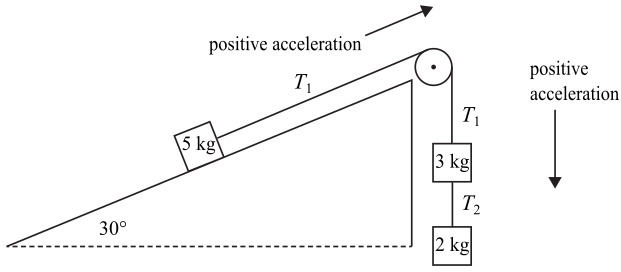
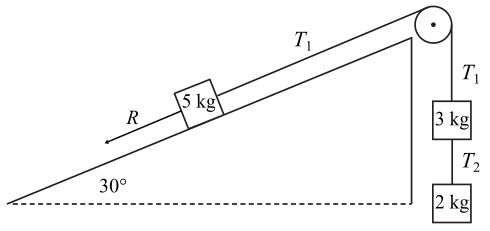
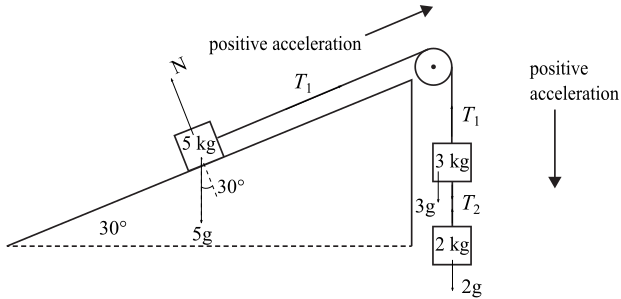
A 5 kg mass is initially held at rest on a smooth plane that is inclined at 30° to the horizontal. The mass is connected by a light inextensible string passing over a smooth pulley to a 3 kg mass, which in turn is connected to a 2 kg mass.

The 5 kg mass is released from rest and allowed to accelerate up the plane.

Take acceleration to be positive in the directions indicated.
 

  1. Write down an equation of motion, in the direction of motion, for each mass.   (3 marks)
  2. Show that the acceleration of the 5 kg mass is  `g/4\ text(ms)^(-2)`.  (1 mark)
  3. Find the tensions  `T_1`  and  `T_2`  in the string in terms of  `g`.  (2 marks)
  4. Find the momentum of the 5 kg mass, in kg ms`­^(-1)`, after it has moved 2 m up the plane, giving your answer in terms of `g`.  (2 marks)
  5. A resistance force  `R`  acting parallel to the inclined plane is added to hold the system in equilibrium, as shown in the diagram below.


    `qquad`


    Find the magnitude of  `R`  in terms of  `g`.  (2 marks)

Show Answers Only
  1. `2a = 2g – T_2`


    `3a = 3g + T_2 – T_1`


    `5a = T_1 – (5g)/2`

  2. `text(Proof)\ text{(See Worked Solutions)}`
  3. `T_1 = (15g)/4`


    `T_2 = (3g)/2`

  4. `p = 5 sqrt g`
  5. `R = (5g)/2`
Show Worked Solution
a.    `2\ text(kg): \ 2a` `= 2g – T_2`
  `3\ text(kg): \ 3a` `= 3g + T_2 – T_1`
  `5\ text(kg): \ 5a` `= T_1 – 5g sin (30^@)`
  `5a` `= T_1 – (5g)/2`


b.   `sum F = 3g + 2g – 5g sin 30^@ = (5 + 3 + 2)a`

`5g – (5g)/2` `= 10a`
`a` `= (5g)/(2 xx 10)`
`:. a` `= g/4\ text(ms)^(-2)`


c.   ` T_1 – (5g)/2` `= 5a`
`:. T_1` `= (5g)/2 + 5(g/4)`
  `= (15g)/4`


`2g – T_2` `= 2a`
`:. T_2` `= 2g – 2(g/4)`
  `= (3g)/2`


d.   `u = 0,\ \ a = g/4,\ \ s = 2`

`text(Find)\ \ v\ \ text(when)\ \ s=2:`

`v^2` `= u^2 + 2as`  
  `=0 + 2 (g/4) xx 2`  
  `=g`  
`v` `=sqrtg\ \ \ (v>0)`  

 
`:. p = 5 sqrt g`


e.   `sum F = 2g + 3g – 5g sin 30^@ – R = 0`

`:. R` `= 2g + 3g – 5g sin 30^@`
  `= 5g – (5g)/2`
  `= (5g)/2`

Filed Under: Pulleys, Planes and Equilibrium (SM) Tagged With: Band 3, Band 4, Band 5, smc-1175-30-Connected particles

Vectors, SPEC2-NHT 2017 VCAA 4

A cricketer hits a ball at time  `t = 0`  seconds from an origin `O` at ground level across a level playing field.

The position vector  `underset ~r(t)`, from `O`, of the ball after `t` seconds is given by
 
  `qquad underset ~r(t) = 15t underset ~i + (15 sqrt 3 t-4.9t^2)underset ~j`,
 
where,  `underset ~i`  is a unit vector in the forward direction, `underset ~j`  is a unit vector vertically up and displacement components are measured in metres.

  1. Find the initial velocity of the ball and the initial angle, in degrees, of its trajectory to the horizontal.   (2 marks)

    --- 4 WORK AREA LINES (style=lined) ---

  2. Find the maximum height reached by the ball, giving your answer in metres, correct to two decimal places.   (2 marks)

    --- 5 WORK AREA LINES (style=lined) ---

  3. Find the time of flight of the ball. Give your answer in seconds, correct to three decimal places.   (1 mark)

    --- 2 WORK AREA LINES (style=lined) ---

  4. Find the range of the ball in metres, correct to one decimal place.   (1 mark)

    --- 2 WORK AREA LINES (style=lined) ---

  5. A fielder, more than 40 m from `O`, catches the ball at a height of 2 m above the ground.


    How far horizontally from `O` is the fielder when the ball is caught? Give your answer in metres, correct to one decimal place.   (2 marks)

    --- 5 WORK AREA LINES (style=lined) ---

Show Answers Only
  1. `underset ~v (0) = 15 underset ~i + 15 sqrt 3 underset ~j`


    `theta = pi/3 = 60^@`

  2. `34.44\ text(m)`
  3. `5.302\ text(s)`
  4. `79.5\ text(m)`
  5. `78.4\ text(m)`
Show Worked Solution

a.   `underset ~v (t) = underset ~ dot r (t) = 15 underset ~i + (15 sqrt 3-9.8t)underset ~j`

`text(Initial velocity occurs when)\ \ t=0:`

`:. underset ~v (0) = 15 underset ~i + 15 sqrt 3 underset ~j`
 

`text(Let)\ \ theta = text(Initial trajectory,)`

`tan theta` `=(15sqrt3)/15=sqrt3`  
`:. theta` `=pi/3\ \ text(or)\ \ 60^@`  


b.  `text(Max height)\ =>underset~j\ \ text(component of)\ \ underset ~v=0.`

`15 sqrt 3-9.8t` `=0`
`t` `=(15 sqrt 3)/9.8`
  `=2.651…`

 
`text(Find max height when)\ \ t = 2.651…`

`:.\ text(Max height)` `= 15 sqrt 3 xx 2.651-4.9 xx (2.651)^2`
  `~~ 34.44\ text(m)`


c.   `text(Ball travels in parabolic path.)`

`:.\ text(Total time of flight)`

`= 2 xx (15 sqrt 3)/9.8`

`~~ 5.302\ text(s)`


d.   `text(Range)` `= x ((15 sqrt 3)/4.9)-x(0)`
  `= (225 sqrt 3)/4.9`
  `~~ 79.5\ text(m)`


e.
   `text(Find)\ \ t\ \ text(when height of ball = 2 m:)`

`15 sqrt 3 t-4.9t^2` `=2`  
`4.9t^2-15 sqrt 3 t + 2` `=0`  

  
`t_1 ~~ 0.078131,\ \ t_2 ~~ 5.22406`

 
`text(When)\ \ t=0.0781,`

`x= 15 xx 0.0781 = 1.17\ \ text{(no solution →}\ x<40 text{)}`

 `text(When)\ \ t=5.2241,`

`x=15 xx 5.2241 = 78.4\ text(m)`
 

`:.\ text(Ball is caught 78.4 m horizontally from)\ O.`

Filed Under: Forces and Motion Along a Curve Tagged With: Band 4, Band 5, smc-1179-70-Projectile motion

Calculus, SPEC2-NHT 2017 VCAA 3

Bacteria are spreading over a Petri dish at a rate modelled by the differential equation

`(dP)/(dt) = P/2 (1-P),\ 0 < P < 1`

where  `P`  is the proportion of the dish covered after  `t`  hours.

    1. Express  `2/(P(1-P))`  in partial fraction form.   (1 mark)

      --- 4 WORK AREA LINES (style=lined) ---

    2. Hence show by integration that  `(t-c)/2= log_e(P/(1-P))`, where  `c`  is a constant of integration.   (2 marks)

      --- 5 WORK AREA LINES (style=lined) ---

    3. If half of the Petri dish is covered by the bacteria at  `t = 0`, express  `P`  in terms of  `t`.   (2 marks)

      --- 5 WORK AREA LINES (style=lined) ---

After one hour, a toxin is added to the Petri dish, which harms the bacteria and reduces their rate of growth. The differential equation that models the rate of growth is now

`(dP)/(dt) = P/2 (1-P)-sqrt P/20`  for  `t >= 1`

  1. Find the limiting value of  `P`, which is the maximum possible proportion of the Petri dish that can now be covered by the bacteria. Give your answer correct to three decimal places.   (2 marks)

    --- 4 WORK AREA LINES (style=lined) ---

  2. The total time, `T`  hours, measured from time  `t = 0`, needed for the bacteria to cover 80% of the Petri dish is given by


    `qquad qquad T = int_q^r (1/(P/2(1-P)-sqrt P/20)) dP + s`


    where  `q, r and s in R`.


    Find the values of  `q, r` and `s`, giving the value of `q` correct to two decimal places.   (2 marks)

    --- 4 WORK AREA LINES (style=lined) ---

  1. Given that  `P = 0.75`  when  `t = 3`, use Euler’s method with a step size of 0.5 to estimate the value of `P` when  `t = 3.5`. Give your answer correct to three decimal places.   (3 marks)

    --- 4 WORK AREA LINES (style=lined) ---

Show Answers Only
    1. `2/(P(1-P)) = 2/P + 2/(1-P)`
    2. `text(Proof)\ text{(See Worked Solutions)}`
    3. `P = e^(t/2)/(1 + e^(t/2))`
  1. `P ~~ 0.894`
  2. `r = 0.8`
    `s = 1`
    `q ~~ 0.62`
  3. `~~ 0.775`
Show Worked Solution

a.i.   `2/(P(1-P)) = A/P + B/(1 ⋅ P)`

`A(1-P) + BP = 2`

`text(If)\ \ P = 0\ \ =>\ \ A = 2`

`text(If)\ \ P = 1\ \ =>\ \ B = 2`

`:. 2/(P(1-P)) = 2/P + 2/(1-P)\ \ \ text{(can also solve by CAS)}`


a.ii.  `(dt)/(dP) = 2/(P(1-P)) = 2/P + 2/(1-P)`

`t` `= int 2/P + 2/(1-P)\ dP`
  `= 2 ln |P|-2ln|1-P| + c`
`(t-c)/2` `=ln|P|-ln|1-P|`
  `=ln |(P)/(1-P)|`
  `= ln (P/(1-P))`

  
`text(S)text(ince)\ \ 0 < P < 1 :\ |P| = P\ and\ |1-P| = 1-P`


a.iii.
  `text(When)\ \ t=0,\ P=0.5`

`(-c)/2` `= ln (0.5/0.5)`
`c` `= ln (1) = 0`


`t/2` `= ln (P/(1-P))\ \ \ text{(solve manually or by CAS)}`
`e^(t/2)` `= P/(1-P)`
`e^(t/2) (1-P)` `= P`
`e^(t/2)-Pe^(t/2)` `= P`
`e^(t/2)` `= P(1 + e^(t/2))`
`:. P` `= e^(t/2)/(1 + e^(t/2))`


b.   `(dP)/(dt) = P/2 (1-P)-sqrt P/20`

`text(Limiting value occurs when)\ \ (dP)/(dt) = 0,`

`P ~~ 0.894\ \ \ text{(by CAS)}`
 

`=>\ text(Lower solution values at levels already exceeded)`

 `text(are ignored.)`


c.   `(dt)/(dP) = 1/(P/2 (1-P)-sqrt P/20)\ \ text(for)\ \ t>=1`

`text(When)\ \ t=1\ \ =>\ \ P=0.622`
 

`T = int_0.62^0.8 1/(P/2 (1-P)-sqrt P/20) dP + 1`
 

`:. r = 0.8,\ s = 1 and q = 0.62`


d.   `P(3.5) ~~ P(3) + h* (dP)/(dt)|_(P= 0.75)`

   `= 0.75 + 0.5 (0.75/2 (1-0.75)-sqrt 0.75/20)`

   `~~ 0.775`
 

`:. P~~0.775\ \ text(when)\ \ t=3.5`

Filed Under: Applied Contexts, Euler, Pseudocode and Slope Fields Tagged With: Band 3, Band 4, Band 5, smc-1183-10-Euler method, smc-1184-60-Growth and decay

Statistics, SPEC2 2017 VCAA 6

A dairy factory produces milk in bottles with a nominal volume of 2 L per bottle. To ensure most bottles contain at least the nominal volume, the machine that fills the bottles dispenses volumes that are normally distributed with a mean of 2005 mL and a standard deviation of 6 mL.

  1. Find the percentage of bottles that contain at least the nominal volume of milk, correct to one decimal place.   (1 marks)

    --- 2 WORK AREA LINES (style=lined) ---

Bottles of milk are packed in crates of 10 bottles, where the nominal total volume per crate is 20 L.

  1. Show that the total volume of milk contained in each crate varies with a mean of 20 050 mL and a standard deviation of  `6sqrt10`  mL.   (2 marks)

    --- 4 WORK AREA LINES (style=lined) ---

  2. Find the percentage, correct to one decimal place, of crates that contain at least the nominal volume of 20 L.   (1 mark)

    --- 2 WORK AREA LINES (style=lined) ---

  3. Regulations require at least 99.9% of crates to contain at least the nominal volume of 20 L.
  4. Assuming the mean volume dispensed by the machine remains 2005 mL, find the maximum allowable standard deviation of the bottle-filling machine needed to achieve this outcome. Give your answer in millilitres, correct to one decimal place.   (3 marks)

    --- 6 WORK AREA LINES (style=lined) ---

  5. A nearby dairy factory claims the milk dispensed into its 2 L bottles varies normally with a mean of 2005 mL and a standard deviation of 2 mL.
  6. When authorities visit the nearby dairy factory and check a random sample of 10 bottles of milk, they find the mean volume to be 2004 mL.
  7. Assuming that the standard deviation of 2 mL is correct, carry out a one-sided statistical test and determine, stating a reason, whether the nearby dairy’s claim should be accepted at the 5% level of significance.   (2 marks)

    --- 5 WORK AREA LINES (style=lined) ---

Show Answers Only
  1. `79.8text(%)`
  2. `text(See Worked Solutions)`
  3. `99.6text(%)`
  4. `text(max) (σ_x) ~~ 5.1`
  5. `text(The claim should be accepted at a 5% significance level.)`
Show Worked Solution

a.   `V_B~N(2005, 6^2)`

`text(Pr)(V_B > 2000)` `~~ 0.797672\ \ \ text{(by CAS)}`
  `~~ 79.8text(%)`


b.   `text(Let)\ \ V_C=\ text(Volume of a crate)`

`mu_(V_C)` `= 10 xx mu_(V_B)=20\ 050`  
     
  `σ_(V_C)^2` `= σ_(V_B)^2 xx 10`
    `= 360`
  `:. σ_(V_C)` `= 6sqrt(10)`


c.  `V_C~N(20\ 050, (6sqrt10)^2)`

`text(Pr)(V_C > 20\ 000)` `~~ 0.995796`
  `~~ 99.6text(%)`


d.   `text(Let)\ \ V_A =\ text(New distribution)`

`V_A~N(20\ 050, (σ_x  sqrt10)^2)`

`text(Pr)(V_A > 20\ 000)` `>= 0.999`  
`text(Pr)(Z=a)` `=0.999`  
`:.a` `=-3.0902`  


`(20\ 000-20\ 050)/(σ_x sqrt10)` `=-3.0902`
`σ_x` `=5.116…`

 
`:.\ text(max) (σ_x) ~~ 5.1`


e.   `H_0: mu=2005`

`H_1: mu<2005`

`D~N(2005, 2^2)\ \ =>\ \ barD~N(2005, (2^2)/10)`

`p` `= text(Pr)(barD < 2004)`
  `~~ 0.056923`


`:.\ text(S)text(ince)\ \ p>0.05,\ text(the claim should be accepted)`

`text(at a 5% significance level.)`

Filed Under: Confidence Intervals and Hypothesis Testing (SM), Linear Combinations and Sample Means (SM) Tagged With: Band 4, Band 5, smc-1160-10-Y = aX + b, smc-1162-30-One-tail test, smc-1162-50-Null/Alternative hypothesis

Trigonometry, SPEC2 2016 VCAA 1 MC

The cartesian equation of the relation given by  `x = 3 text(cosec)^2 (t)`  and  `y = 4 cot (t) - 1`  is

A.  `(y + 1)^2/16 - x^2/9 = 1`

B.  `(y + 1)^2 = (16 (x + 3))/3`

C.  `x^2/9 + (y + 1)^2/16 = 1`

D.  `4x - 3y = 15`

E.  `(y + 1)^2 = (16 (x - 3))/3` 

Show Answers Only

`E`

Show Worked Solution
`x/3` `= text(cosec)^2(t)`  
`(y+1)/4` `=cot (t)`  


`sin^2(t) + cos^2(t)` `= 1`
`1 + cot^2(t)` `= text(cosec)^2(t)`
`text(cosec)^2(t) – cot^2(t)` `= 1`
   
`(x/3) – ((y + 1)/4)^2` `= 1`
`(y + 1)^2/16` `= x/3 – 1`
`(y + 1)^2` `= (16 (x – 3))/3`

 
`=>  E`

Filed Under: Trigonometry (SM) Tagged With: Band 4, smc-1150-30-Composite

Vectors, SPEC2 2017 VCAA 5

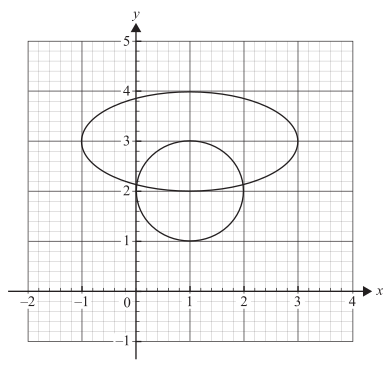
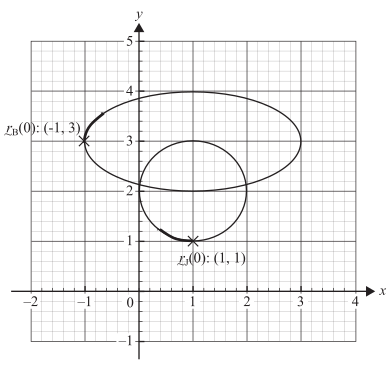
On a particular morning, the position vectors of a boat and a jet ski on a lake  `t`  minutes after they have started moving are given by  `underset~r_B(t) = (1-2cos(t)) underset~i + (3 + sin(t))underset~j`  and  `underset~r_J(t) = (1-sin(t)) underset~i + (2-cos(t))underset~j`  respectively for  `t >= 0`, where distances are measured in kilometres. The boat and the jet ski start moving at the same time. The graphs of their paths are shown below.

  1. On the diagram above, mark the initial positions of the boat and the jet ski, clearly identifying each of them. Use arrows to show the directions in which they move.   (2 marks)

    --- 4 WORK AREA LINES (style=lined) ---

    1. Find the first time for  `t > 0`  when the speeds of the boat and the jet ski are the same.   (2 marks)

      --- 4 WORK AREA LINES (style=lined) ---

    2. State the coordinates of the boat at this time.   (1 mark)

      --- 3 WORK AREA LINES (style=lined) ---

    1. Write down an expression for the distance between the jet ski and the boat at any time `t`.   (1 mark)

      --- 2 WORK AREA LINES (style=lined) ---

    2. Find the minimum distance separating the boat and the jet ski. Give your answer in kilometres, correct to two decimal places.   (1 mark)

      --- 2 WORK AREA LINES (style=lined) ---

  2. On another morning, the boat’s position vector remained the same but the jet skier considered starting from a different location with a new position vector given by  `underset~r(t) = (1-2sin(t)) underset~i + (a-cos(t))underset~j, \ t >= 0`, where `a` is a real constant. Both vessels are to start at the same time.
    Assuming the vessels would collide shortly after starting, find the time of the collision and the value of `a`.   (3 marks)

    --- 7 WORK AREA LINES (style=lined) ---

Show Answers Only
  1.  
  2.   
    1. `t = 0, t_2 = pi`
    2. `(3,3)`
  3.   
    1. `sqrt((sin(t)-2cos(t))^2 + (1 + sin(t) + cos (t))^2)`
    2. `d_text(min) ~~ 0.33`
  4. `a = 3 + 3/sqrt5, t = tan^(−1)(2)`
Show Worked Solution
a.   

`text(Initial positions occur at)\ \ t=0.`

`text(Consider the graph)\ \ underset~r_B(t)\ \ text(at)\ \ t=pi/4:`

`(1-2cos0) < (1-2cos(pi/4)) =>\ text(moves higher)`
  

`text(Consider the graph)\ \ underset~r_J(t)\ \ text(at)\ \ t=pi/4:`

`(1-sin(0)) > (1-sin(pi/4)) =>\ text(moves left)`


b.i.    `underset~dotr_B(t)` `= 2sin(t)underset~i + cos(t)underset~j`
  `|underset~dotr_B(t)|` `= sqrt(4sin^2(t) + cos^2(t))`
`underset~dotr_J(t)` `= −cos(t)underset~i + sin(t)underset~j`
`|underset~dotr_J(t)|` `= sqrt(cos^2(t) + sin(t))=1`
   

`text(Find)\ \ t\ \ text(when)\ \ sqrt(4sin^2(t) + cos^2(t))=1:`

`t = pi\ text(seconds)\ \ \ (t!=0)`


♦ Mean mark (b)(ii) 48%.

b.ii.    `(underset~r)_B(pi)` `= (1-2cos(pi))underset~i + (3 + sin(pi))underset~j`
    `= 3underset~i + 3underset~j`

`:.\ text(Boat coordinates):\  (3,3)`


c.i.    `underset~r_B-underset~r_J` `=(sin(t)-2 cos(t))i +(1+sin(t) + cos(t))`
  `:. d` `= |underset~r_B-underset~r_J|`
    `= sqrt((sin(t)-2cos(t))^2 + (1 + sin(t) + cos (t))^2)`


c.ii.  `d_text(min) ~~ 0.33\ \ \ text{(by CAS)}`

♦♦♦ Mean mark part (c)(ii) 15%.


d.   `text(Equating coefficients for collision:)`

  `x:\ \ \ 1-sin(t)` `= 1-2cos(t)\ …\ (1)`
  `sin(t)` `= 2cos(t)`
  `tan(t)` `= 2`
  `t` `=tan^(−1)(2)`

 
`y:\ \ \ a-cos(t) = 3 + sin(t)\ …\ (2)`

♦ Mean mark part (d) 41%.


`text(Using)\ \ tan(t)=2,`

`=> sin(t) = (2sqrt5)/5,\ \ cos(t) = sqrt5/5`

`text{Substitute into (1):}`

`a-1/sqrt5` `= 3 + 2/sqrt5`  
`:. a` `= 3 + 3/sqrt5`  

 
`:.\ text(Collision occurs when)\ \ t=tan^(-1)2\ \ text(and)\ \ a=3 + 3/sqrt5`

Filed Under: Forces and Motion Along a Curve Tagged With: Band 4, Band 5, Band 6, smc-1179-75-Other applications

Complex Numbers, SPEC2 2017 VCAA 4

  1. Express  `−2-2sqrt3 i`  in polar form.  (1 mark)

    --- 3 WORK AREA LINES (style=lined) ---

  2. Show that the roots of  `z^2 + 4z + 16 = 0`  are  `z = −2-sqrt3 i`  and  `z = −2 + 2sqrt3 i`.  (1 mark)

    --- 3 WORK AREA LINES (style=lined) ---

  3. Express the roots of  `z^2 + 4z + 16 = 0`  in terms of  `2-2sqrt3 i`.  (1 mark)

    --- 2 WORK AREA LINES (style=lined) ---

  4. Show that the cartesian form of the relation  `|z| = |z-(2-2sqrt3 i)|`  is  `x-sqrt3 y-4 = 0`  (2 marks)

    --- 5 WORK AREA LINES (style=lined) ---

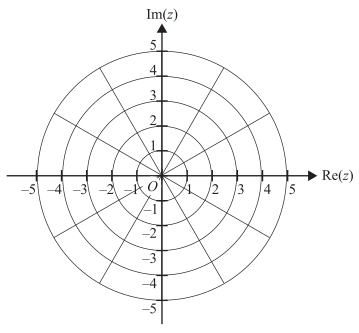
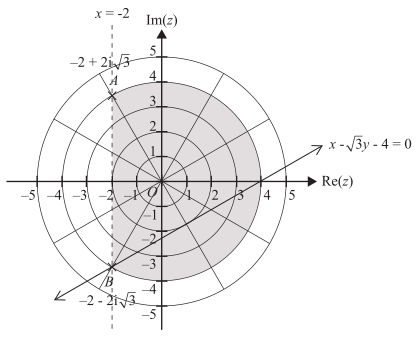
  5. Sketch the line represented by  `x-sqrt3y -4 = 0`  and plot the roots of  `z^2 + 4z + 16 = 0`  on the Argand diagram below.  (2 marks)

    --- 0 WORK AREA LINES (style=lined) ---


  6. The equation of the line passing through the two roots of  `z^2 + 4z + 16 = 0`  can be expressed as  `|z-a| = |z-b|`, where  `a, b ∈ C`.


    Find `b` in terms of `a`.  (1 mark)

    --- 3 WORK AREA LINES (style=lined) ---

  7. Find the area of the major segment bounded by the line passing through the roots of  `z^2 + 4z + 16 = 0`  and the major arc of the circle given by  `|z| = 4`.  (2 marks)

    --- 5 WORK AREA LINES (style=lined) ---

Show Answers Only
  1. `4text(cis)((−2pi)/3)`
  2. `text(See Worked Solutions)`
  3. `−(2-2sqrt3 i) and-bar((2-2sqrt3 i))`
  4. `text(See Worked Solutions)`
  5.  
  6. `−4-bara`
  7. `4sqrt3 + (32pi)/3`
Show Worked Solution
a.    `r` `= sqrt((−2)^2 + (−2sqrt3)^2)=4`


`theta` `= −pi + tan^(−1)((2sqrt3)/2)`
  `= −pi + pi/3`
  `=(-2pi)/3`

 
`:. −2-2sqrt3 i = 4text(cis)((−2pi)/3)`
 

b.   `z^2 + 4z + z^2-4 + 16` `=0`
`(z + 2)^2 + 12` `= 0`
`(z + 2)^2` `= -12`
`(z + 2)^2` `= 12i^2`
`z + 2` `= ±sqrt12 i`
`z + 2` `= ±2sqrt3 i`
`:. z` `= -2 ± 2sqrt3 i`


♦♦ Mean mark part (c) 31%.

c.    `z_1` `= -2 + 2sqrt3 i = -(2-2sqrt3 i)`
  `z_2` `=-2-2sqrt3 i =-bar((2-2sqrt3 i))`


d. `|z|` `= |z-(2-2sqrt3 i)|`
     `x^2 + y^2` `= (x-2)^2 + (y + 2sqrt3)^2`
    `x^2 + y^2` `= x^2-4x + 4+ y^2 + 4sqrt3 y + 12`
  `0` `= −4x + 4sqrt3 y + 16`
  `0` `= −x + sqrt3 y + 4`

 
`:. x-sqrt3 y-4=0`


e.   


f.   `x = − 2\ \ text(is equidistant from)\ \ z_1 = a\ \ text(and)\ \ z_2 = b`

♦♦♦ Mean mark 1%!

`=> text(Im)(a) = text(Im)(a)`
 

`text(Let)\ \ a = alpha + betai, \ b = gamma + betaj`

`(alpha + gamma)/2` `= −2`
`alpha + gamma` `= −4`
`gamma` `= -4-alpha`


`:. b` `= -4-alpha + betaj`
  `= -4-(alpha + betaj)`
  `= -4-bara`


♦♦ Mean mark 31%.

g.    `text(Area)\ DeltaOAB` `= 1/2 xx (4sqrt3 xx 2)`
    `= 4sqrt3`


`text(Area of sector)\ AOB` `= pi xx 4^2 xx (2 xx pi/3)/(2pi)`
  `= (16pi)/3`

 
`:.\ text(Area of major segment area)`

`=pi(4)^2-((16pi)/3-4sqrt3)`

`= 4sqrt3 + (32pi)/3`

Filed Under: Factors and Roots (SM), Geometry and Complex Numbers (SM) Tagged With: Band 3, Band 4, Band 5, Band 6, smc-1172-10-Quadratic roots, smc-1172-60-Sketch solutions, smc-1173-30-Sketch regions, smc-1173-40-Linear

Calculus, SPEC2 2017 VCAA 3

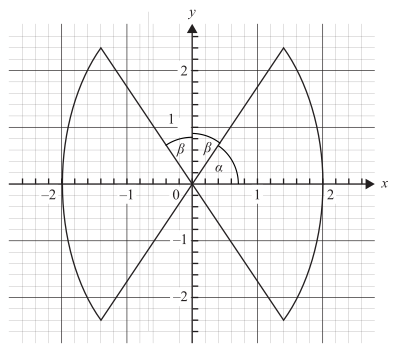
A brooch is designed using inverse circular functions to make the shape shown in the diagram below.


The edges of the brooch in the first quadrant are described by the piecewise function

`f(x){(3text(arcsin)(x/2)text(,), 0 <= x <= sqrt2),(3text(arccos)(x/2)text(,), sqrt2 < x <= 2):}`

  1. Write down the coordinates of the corner point of the brooch in the first quadrant.  (1 mark)

    --- 2 WORK AREA LINES (style=lined) ---

  2. Specify the piecewise function that describes the edges in the third quadrant.  (1 mark)

    --- 2 WORK AREA LINES (style=lined) ---

  3. Given that each unit in the diagram represents one centimetre, find the area of the brooch.
  4. Give your answer in square centimetres, correct to one decimal place.  (3 marks)

    --- 2 WORK AREA LINES (style=lined) ---

  5. Find the acute angle between the edges of the brooch at the origin. Give your answer in degrees, correct to one decimal place.  (3 marks)

    --- 6 WORK AREA LINES (style=lined) ---

  6. The perimeter of the brooch has a border of gold.
    Show that the length of the gold border needed is given by a definite integral of the form  `int_0^2 (sqrt(a + b/(4-x^2)))dx`, where  `a, b ∈ R`. Find the values of `a` and `b`.  (2 marks)

    --- 5 WORK AREA LINES (style=lined) ---

Show Answers Only

  1. `(sqrt2,(3pi)/4)`
  2. `text(See Worked Solutions)`
  3. `9.9\ text(cm²)`
  4. `67.4°`
  5. `a = 16, b = 144`

Show Worked Solution

a.   `text(Corner point occurs when)\ \ x=sqrt2.`

`y=3 sin^(-1) (sqrt2/2) = (3pi)/4`

`:.\ text(Coordinates are:)\ \ (sqrt2, (3pi)/4)`
 

b.    `text(Reflect in the)\ xtext(-axis and then the)\ ytext(-axis:)`

♦ Mean mark 49%.

`g(x){(-3text(arccos)(- x/2)text(,), -2 <= x < -sqrt2),(-3text(arcsin)(- x/2)text(,), -sqrt2 <= x <= 0):}`


c.    `A` `= 4 xx (int_0^sqrt2 3sin^(−1)(x/2)dx + int_sqrt2^2 3cos^(−1)(x/2)dx)`
    `~~ 9.9\ text(cm²)`


d.   `text(Find the gradient of graph at)\ \ x=0:`

`f′(0) = 3/2`

`alpha = tan^(−1)(3/2) = 56.31…°`

`beta = pi/2-tan^(−1)(1.5) = 33.69°`


`:.\ text(Acute angle between the edges)`

`=2 xx 33.69`

`=67.4°`
  

e.  `f′(x)\ {(3/sqrt(4-x^2)text(,), 0<= x <= sqrt2),((-3)/sqrt(4-x^2)text(,), sqrt2 < x <= 2):}`
 

`:.\ text(Length of border)`

♦♦ Mean mark 27%.

`= 4 int_0^sqrt2 sqrt(1 + (3/sqrt(4-x^2))^2)\ dx + 4 int_sqrt2^2 sqrt(1 + ((-3)/sqrt(4-x^2))^2)\ dx`

`= 4 int_0^2 sqrt(1 + (3/sqrt(4-x^2))^2)\ dx`

`= int_0^2 sqrt(16 + 144/(4-x^2)\ dx`

  
`:. a=16, \ b=144`

Filed Under: Arc Lengths, Areas and Other, Inverse Trig Functions (SM) Tagged With: Band 4, Band 5, smc-1153-40-Combinations, smc-1181-10-Arc length, smc-1181-20-Area Under Curves

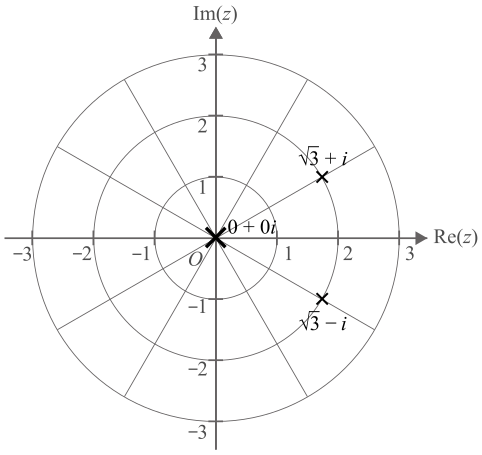
Complex Numbers, SPEC2-NHT 2017 VCAA 2

One root of a quadratic equation with real coefficients is  `sqrt 3 + i`.

    1. Write down the other root of the quadratic equation.   (1 mark)

      --- 2 WORK AREA LINES (style=lined) ---

    2. Hence determine the quadratic equation, writing it in the form  `z^2 + bz + c = 0`.   (2 marks)

      --- 5 WORK AREA LINES (style=lined) ---

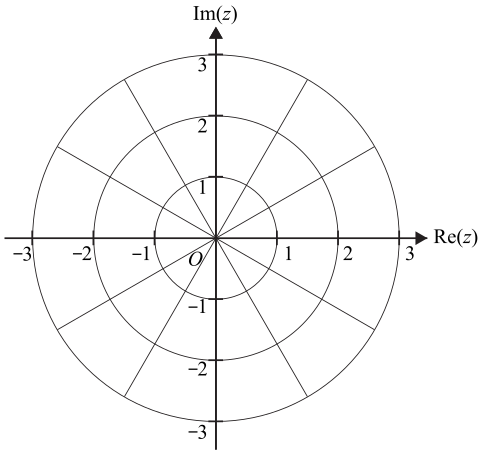
  1. Plot and label the roots of   `z^3-2 sqrt 3 z^2 + 4z = 0`  on the Argand diagram below.   (3 marks)

    --- 0 WORK AREA LINES (style=lined) ---


  1. Find the equation of the line that is the perpendicular bisector of the line segment joining the origin and the point  `sqrt 3 + i`. Express your answer in the form  `y = mx + c`.   (2 marks)

    --- 5 WORK AREA LINES (style=lined) ---

  1. The three roots plotted in part b. lie on a circle.


    Find the equation of this circle, expressing it in the form  `|z-alpha| = beta`,  where  `alpha, beta in R`.   (3 marks)

    --- 5 WORK AREA LINES (style=lined) ---

Show Answers Only
    1. `z_2 = sqrt 3-i`
    2. `z^2-2 sqrt 3 z + 4 = 0`
  1. `text(See Worked Solutions)`
  2. `y = -sqrt 3 x + 2`
  3. `|z-2/sqrt 3 | = 2/sqrt 3`
Show Worked Solution

a.i.   `z_1 = sqrt 3 + i`

 `z_2 = bar z_1 = sqrt 3-i\ \ \ text{(conjugate root)}`


a.ii.    `(z-(sqrt 3 + i))(z-(sqrt 3-i))` `= 0`
  `((z-sqrt 3)-i)((z-sqrt 3) + i)` `= 0`
  `(z-sqrt 3)^2-i^2` `= 0`
  `z^2-2 sqrt 3 z + 3 + 1` `= 0`
  `z^2-2 sqrt 3 z + 4` `= 0`


b.    `z(z^2-2 sqrt 3 z + 4)` `= 0`
  `z(z-(sqrt 3 + i))(z-(sqrt 3-i))` `= 0`

 
`text(Convert to polar form:)`

  `sqrt 3 + i` `= sqrt((sqrt 3)^2 + 1^2) * text(cis) (tan^(-1)(1/sqrt 3))`
    `= 2 text(cis) (pi/6)`
  `=> sqrt 3-i` `= 2 text(cis) (-pi/6)`


c.   `text(Equidistant from)\ (0, 0) and (sqrt 3, 1)`

`text(Midpoint)\ (x_1, y_1)` `= (sqrt 3/2, 1/2)`

 
`m = (1-0)/(sqrt 3-0) = 1/sqrt 3`

`m_(_|_) = (-1)/m = -sqrt 3`
 

`:.\ text(Equation of ⊥ bisector:)`

`y-1/2` `=-sqrt3(x-sqrt3/2)`  
`y` `=-sqrt3 x +3/2+1/2`  
`:.y` `=-sqrt3 x +2`  


d.   `text(Let)\ O = (0, 0),\ P = (sqrt 3, 1),\ Q = (sqrt 3, -1)`

`text(⊥ bisector of two points on arc of a circle passes)`

`text(through the centre of the circle.)`
 

`OP = OQ = PQ = 2`

`=> Delta OPQ\ text(is equilateral)`
 

`text(⊥ bisector of)\ PQ\ text(is)\ y=0.`

`text(Centre of circle occurs when:)`

`0 = -sqrt 3 x + 2\ \ text{(using part c)`

`x=2/sqrt3`

`=>\ text(Radius)\ = 2/sqrt3`
 

`:. |z-2/sqrt 3| = 2/sqrt 3`

Filed Under: Factors and Roots (SM), Geometry and Complex Numbers (SM) Tagged With: Band 3, Band 4, Band 5, Band 6, smc-1172-10-Quadratic roots, smc-1172-20-Cubic roots, smc-1172-60-Sketch solutions

Calculus, SPEC2-NHT 2017 VCAA 1

  1. i.  Use an appropriate double angle formula with  `t = tan((5 pi)/12)`  to deduce a quadratic equation of the form  `t^2 + bt + c = 0`, where `b` and `c` are real values.   (2 marks)

    --- 5 WORK AREA LINES (style=lined) ---

  2. ii. Hence show that  `tan((5 pi)/12) = 2 + sqrt 3`.   (1 mark)

    --- 2 WORK AREA LINES (style=lined) ---

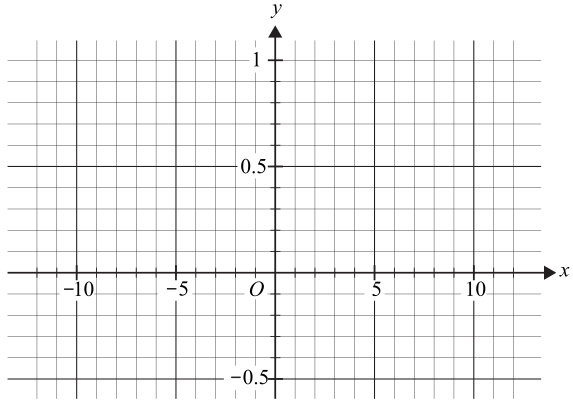
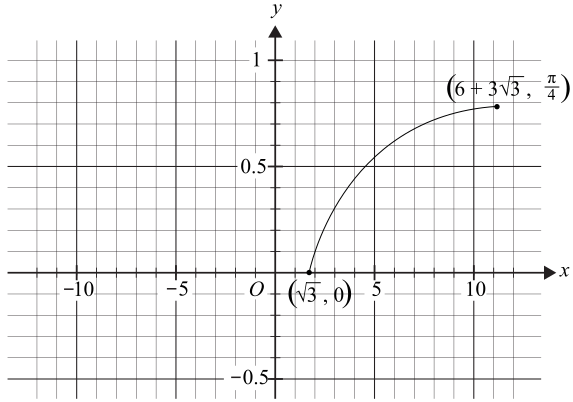
Consider  `f: [sqrt 3, 6 + 3 sqrt 3] -> R,\ \ f(x) = arctan (x/3)-pi/6`.

  1. Sketch the graph of `f` on the axes below, labelling the end points with their coordinates.   (3 marks)

    --- 3 WORK AREA LINES (style=lined) ---


  1. The region between the graph of  `f`  and the `y`-axis is rotated about the `y`-axis to form a solid of revolution.
  2. i.  Write down a definite integral in terms of  `y`  that gives the volume of the solid formed.   (2 marks)

    --- 5 WORK AREA LINES (style=lined) ---

  3. ii. Find the volume of the solid, correct to the nearest integer.   (1 mark)

    --- 2 WORK AREA LINES (style=lined) ---

  1. A fish pond that has a shape approximately like that of the solid of revolution in part c. is being filled with water. When the depth is `h` metres, the volume, `V\ text(m)^3`, of water in the pond is given by


    `qquad V = tan(h + pi/6)-h-sqrt 3/3`


    If water is flowing into the pond at a rate of 0.03 m³ per minute, find the rate at which the depth is increasing when the depth is 0.6 m. Give your answer in metres per minute, correct to three decimal places.   (3 marks)

    --- 6 WORK AREA LINES (style=lined) ---

Show Answers Only
  1. i.  `t^2-2t sqrt 3-1 = 0`
  2. ii. `text(Proof)\ text{(See Worked Solutions)}`
  3. `text(See Worked Solutions)`
  4. i.  `V = pi int_0^(pi/4) 9 tan^2 (y + pi/6)\ dy`
  5. ii. `67`
  6. `0.007\ text(m/min)`
Show Worked Solution

a.i.   `tan (theta/2) = tan ((5pi)/12) = t`

`tan (theta)` `=(2 tan (theta/2))/(1-tan^2(theta/2)`
`tan((5 pi)/6)` `= (2tan ((5pi)/12))/(1-tan^2((5pi)/2)`
`-1/sqrt 3` `= (2t)/(1-t^2), quad (t != +- 1)`
`-(1-t^2)` `= 2t sqrt 3`
`-1 + t^2` `= 2t sqrt 3`

 
`:. t^2-2 sqrt 3 t-1 = 0`


a.ii.    `t^2-2 sqrt 3 t + (-sqrt 3)^2 +3 -4 = 0`
  `(t-sqrt 3)^2` `= 4`
  `t-sqrt 3` `= +- 2`
  `t` `= sqrt 3 +-2`

 
`=> tan ((5 pi)/12)\ \ text(is in 1st quadrant,)`

`:. t` `= tan ((5 pi)/12) = 2 + sqrt 3`


b.    `f(sqrt 3)` `= 0`
`f(6 + 3 sqrt 3)` `=pi/4`

`text(Graphing)\ \ f(x) = arctan (x/3)-pi/6\ \ text(on CAS will)`

`text(show the shape of the graph.)`


c.i.    `y` `= tan^(-1)(x/3)-pi/6`
  `y + pi/6` `= tan^(-1)(x/3)`
  `x/3` `= tan(y + pi/6)`
  `x` `= 3 tan (y + pi/6)`
  `x^2` `= 9 tan^2 (y + pi/6)`


`:. V` `= pi int_0^(pi/4) x^2\ dy`  
  `=pi int_0^(pi/4) 9 tan^2 (y + pi/6)\ dy`  


c.ii.  `pi int_0^(pi/4) 9 tan^2 (y + pi/6)\ dy`

`=66.99…`

`=67\ text(u³)`


d.    `(dV)/(dt)` `= 0.03`
  `V` `= tan(h + pi/6)-h-sqrt 3/3`
  `(dV)/(dh)` `= tan^2 (h+pi/6)\ \ \ text{(by CAS)}`
  `(dh)/(dt)` `= (dh)/(dV) * (dV)/(dt)`
    `= 1/(tan^2 (h+pi/6)) xx 3/100`

  
`(dh)/(dt)|_(h = 0.6)~~0.007\ text(m/min)`

Filed Under: Related Rates of Change, Solids of Revolution Tagged With: Band 4, Band 5, smc-1180-20-Trig function, smc-1180-60-y-axis rotation, smc-1185-10-Volume

Statistics, SPEC2-NHT 2018 VCAA 7

According to medical records, the blood pressure of the general population of males aged 35 to 45 years is normally distributed with a mean of 128 and a standard deviation of 14. Researchers suggested that male teachers had higher blood pressures than the general population of males.

To investigate this, a random sample of 49 male teachers from this age group was obtained and found to have a mean blood pressure of 133.

  1. State two hypotheses and perform a statistical test at the 5% level to determine if male teachers belonging to the 35 to 45 years age group have higher blood pressures than the general population of males. Clearly state your conclusion with a reason.   (3 marks)

    --- 7 WORK AREA LINES (style=lined) ---

  2. Find a 90% confidence interval for the mean blood pressure of all male teachers aged 35 to 45 years using a standard deviation of 14. Give your answers correct to the nearest integer.   (1 mark)

    [wa_lines lines="3" style="lined"
Show Answers Only
  1. `text(See Worked Solutions)`
  2. `(130, 136)`
Show Worked Solution

a.   `B\ ~\ N (128, 14^2)`

`H_0: mu = 128`

`H_1: mu > 128`

`bar B\ ~\ N (128, 14^2/49)`

`p` `= text(Pr) (bar B > 133 | mu=128)`
  `= text(Pr)(Z>(133-128)/(14/sqrt49))`
  `= text(Pr)(Z>5/2)`
  `~~ 0.00621`

 
`p < 0.05 => text(Reject)\ H_0\ text(at the 5% significance level):`

`text{evidence supports the contention that male teachers 35 to 45}`

`text(have higher blood pressure than the general male population.)`


b.  `text(If)\ \ text(Pr)(- z < Z < z) = 0.9`

`text(Pr)(Z < z) = 0.95\ \ =>\ \ z ~~ 1.64485`

`:.\ text(90% CI): (133-(z xx 14)/sqrt 49, 133 + (z xx 14)/sqrt 49)`

`~~(130, 136)`

Filed Under: Confidence Intervals and Hypothesis Testing (SM) Tagged With: Band 4, Band 5, smc-1162-20-Other CI (sample), smc-1162-30-One-tail test, smc-1162-50-Null/Alternative hypothesis

Statistics, SPEC2-NHT 2018 VCAA 6

A coffee machine dispenses coffee concentrate and hot water into a 200 mL cup to produce a long black coffee. The volume of coffee concentrate dispensed varies normally with a mean of 40 mL and a standard deviation of 1.6 mL.

Independent of the volume of coffee concentrate, the volume of water dispensed varies normally with a mean of 150 mL and a standard deviation of 6.3 mL.

  1. State the mean and the standard deviation, in millilitres, of the total volume of liquid dispensed to make a long black coffee.   (2 marks)

    --- 5 WORK AREA LINES (style=lined) ---

  2. Find the probability that a long black coffee dispensed by the machine overflows a 200 mL cup. Give your answer correct to three decimal places.   (1 mark)

    --- 2 WORK AREA LINES (style=lined) ---

  3. Suppose that the standard deviation of the volume of water dispensed by the machine can be adjusted, but that the mean volume of water dispensed and the standard deviation of the volume of coffee concentrate dispensed cannot be adjusted.
  4. Find the standard deviation of the volume of water dispensed that is needed for there to be only a 1% chance of a long black coffee overflowing a 200 mL cup. Give your answer in millilitres, correct to two decimal places.   (2 marks)

    --- 6 WORK AREA LINES (style=lined) ---

Show Answers Only
  1. `mu_V = 40 + 150 = 190\ text(mL)`


    `sigma_V = sqrt (1.6^2 + 6.3^2) = 6.5\ text(mL)`

  2. `0.062`
  3. `3.99\ text(mL)`
Show Worked Solution

a.   `C~N (40, 1.6^2)`

`W~N (150, 6.3^2)`

`V = C + W`

`mu_V = 40 + 150 = 190\ text(mL)`

`{:sigma^2:}_V` `= 1.6^2 + 6.3^2`  
`:.sigma_V ` `= sqrt (1.6^2 + 6.3^2)`  
  `= 6.5\ text(mL)`  


b.   `V~N (190, 6.5^2)`

`text(Pr)(V > 200) ~~ 0.062\ \ text{(by CAS)}`


c.  `C~N (40, 1.6^2)`

`W_2~N (150, sigma_w^2)`

`V_2 = C + W_2`

`V_2~N (190, 1.6^2 + sigma_w^2)`

`Z~N (0, 1)`
 

`text(Pr)(V_2 > 200) = 0.01`

`text(Pr)(Z > a) = 0.01\ \ =>\ \ a=2.326…`
  

`text(Find)\ \ sigma_w:`

`2.326…` `= (200-190)/sqrt(1.6^2 + sigma_w^2)`
`:. sigma_w` `~~ 3.99\ text(mL)\ \ \ text{(by CAS)}`

Filed Under: Confidence Intervals and Hypothesis Testing (SM), Linear Combinations and Sample Means (SM) Tagged With: Band 3, Band 4, Band 5, smc-1160-30-Z = aX + bY, smc-1162-30-One-tail test

Calculus, SPEC2-NHT 2018 VCAA 5

A horizontal beam is supported at its endpoints, which are 2 m apart. The deflection `y` metres of the beam measured downwards at a distance `x` metres from the support at the origin `O` is given by the differential equation  `80 (d^2y)/(dx^2) = 3x-4`.


  1. Given that both the inclination, `(dy)/(dx)`, and the deflection, `y`, of the beam from the horizontal at  `x = 2`  are zero, use the differential equation above to show that  `80 y = 1/2 x^3-2x^2 + 2x`.   (2 marks)

    --- 6 WORK AREA LINES (style=lined) ---

  2. Find the angle of inclination of the beam to the horizontal at the origin `O`. Give your answer as a positive acute angle in degrees, correct to one decimal place.   (2 marks)

    --- 4 WORK AREA LINES (style=lined) ---

  3. Find the value of `x`, in metres, where the maximum deflection occurs, and find the maximum deflection, in metres.   (3 marks)

    --- 5 WORK AREA LINES (style=lined) ---

  4. Find the maximum angle of inclination of the beam to the horizontal in the part of the beam where  `x >= 1`. Give your answer as a positive acute angle in degrees, correct to one decimal place.   (2 marks)

    --- 5 WORK AREA LINES (style=lined) ---

Show Answers Only
  1. `text(Proof)\ \ text{(See Worked Solutions)}`
  2. `1.4^@`
  3. `x = 2/3; quad 1/135\ text(m)`
  4. `0.5^@`
Show Worked Solution
a.   `80 * int (d^2y)/(dx^2)\ dx` `= int 3x-4\ dx`
  `80* (dy)/(dx)` `= (3x^2)/2-4x + c_0`

 
`text(When)\ \ x=2,\ \ dy/dx=0:`

`80 xx 0` `= (3xx2^2)/2-4xx2 + c_0`
`c_0` `= 2`


`80* (dy)/(dx)` `= (3x^2)/2-4x + 2`
`80y` `= int (3x^2)/2-4x + 2\ dx`
  `= 1/2 x^3-2x^2+2x +c_1`


`text(When)\ \ x=2,\ \ y=0:`

`0` `= 1/2 2^3-2 xx 2^2 + 2 xx 2 + c_1`
`c_1` `= 0`

`:. 80y = 1/2x^3-2x^2 + 2x`


b.   `text(Find)\ \ dy/dx\ \ text(when)\ \ x=0:`

  `80 *(dy)/(dx)` `= 0-0 + 2`
  `(dy)/(dx)` `= 1/40`
  `:. theta` `= tan^(-1) (1/40) ~~ 1.4^@`


c.   `text(Find)\ \ x\ \ text(when)\ \ dy/dx=0:`

`x=2\ \ text(or)\ \ 2/3`

`=>y_text(max)\ \ text(occurs at)\ \ x=2/3\ \ (y=0\ \ text(at)\ \ x=2)`


`80*y_max` `= 1/2(2/3)^3-2(2/3)^2 + 2(2/3)`
`:. y_max` `= 1/80 xx 16/27`
  `= 1/135\ text(metres)`


d.   `text(Max inclination when convexity changes)\ => (d^2y)/(dx^2) =0`

`80*(d^2y)/(dx^2) = 3x-4 = 0`

`=> x = 4/3`

`text(Find)\ \ dy/dx\ \ text(when)\ \ x = 4/3 :`

`(dy)/(dx)` `= 1/80 (3/2(4/3)^2-4(4/3) + 2)`
  `= (-1)/120`


`theta` `= tan^(-1) (|-1/120|)`
  `~~ 0.5^@`

Filed Under: Applied Contexts Tagged With: Band 4, Band 5, Band 6, smc-1184-70-Curve problems

Vectors, SPEC2-NHT 2018 VCAA 4

A basketball player aims to throw a basketball through a ring, the centre of which is at a horizontal distance of 4.5 m from the point of release of the ball and 3 m above floor level. The ball is released at a height of 1.75 m above floor level, at an angle of projection `alpha` to the horizontal and at a speed of  `V\ text(ms)^(-1)`. Air resistance is assumed to be negligible.


The position vector of the centre of the ball at any time, `t` seconds, for  `t >= 0`, relative to the point of release is given by 
 
`qquad underset ~r(t) = Vt cos (alpha) underset ~i + (Vt sin(alpha)-4.9t^2) underset ~j`,
 
where  `underset ~i`  is a unit vector in the horizontal direction of motion of the ball and  `underset ~j`  is a unit vector vertically up. Displacement components are measured in metres.

  1. For the player’s first shot at goal, `V = 7\ text(ms)^(-1)` and  `alpha = 45^@`
  2.   i. Find the time, in seconds, taken for the ball to reach its maximum height. Give your answer in the form  `(a sqrt b)/c`, where  `a, b` and `c` are positive integers.   (2 marks) 

    --- 5 WORK AREA LINES (style=lined) ---

  3.  ii. Find the maximum height, in metres, above floor level, reached by the centre of the ball.   (2 marks)

    --- 4 WORK AREA LINES (style=lined) ---

  4. iii. Find the distance of the centre of the ball from the centre of the ring one second after release. Give your answer in metres, correct to two decimal places.   (2 marks)

    --- 4 WORK AREA LINES (style=lined) ---

  5. For the player’s second shot at goal, `V = 10\ text(ms)^(-1)`.
    Find the possible angles of projection, `alpha` , for the centre of the ball to pass through the centre of the ring. Give your answers in degrees, correct to one decimal place.   (3 marks)

    --- 5 WORK AREA LINES (style=lined) ---

  6. For the player’s third shot at goal, the angle of projection is  `alpha = 60^@`
  7. Find the speed `V` required for the centre of the ball to pass through the centre of the ring. Give your answer in metres per second, correct to one decimal place.   (2 marks)

    --- 4 WORK AREA LINES (style=lined) ---

Show Answers Only
    1. `(5 sqrt 2)/14`
    2. `3\ text(m)`
    3. `128\ text(m)`
  1. `alpha ~~ 29.7^@ or 75.8^@`
  2. `7.8\ text(ms)^(-1)`
Show Worked Solution
a.i.    `underset ~r(t)` `=7t\ cos 45^@ underset ~i+(7t\ sin 45^@-4.9t^2) underset ~j`
    `=(7sqrt2t)/2 underset ~i + ((7sqrt2)/2 t-4.9t^2) underset ~j`
     

 `text(Maximum height when)\ \ underset ~V_(underset ~j) (t) = 0:`

`(7sqrt2)/2-9.8t` `= 0`
`t` `= (5 sqrt 2)/14\ \ text(seconds)`


a.ii.   `underset ~r_(underset ~j)((5 sqrt 2)/14)` `= 7 xx (5 sqrt 2)/14 xx 1/sqrt 2-4.9 xx ((5 sqrt 2)/14)^2`
    `= 1.25`

 
`:.\ text(Height above floor) = 1.25 + 1.75 = 3\ text(m)`


a.iii.  `underset ~r_text(ring)= 4.5 underset ~i + 1.25 underset ~j`

  `underset ~r_text(ring)-underset ~r_text(ball)` `= (4.5-7/sqrt 2) underset ~i + (1.25-((7sqrt2)/2-4.9)underset ~j`
  `d` `= |underset ~r_text(ring)-underset ~r(1)|`
    `= sqrt((4.5-7/sqrt 2)^2 + (1.25-7/sqrt 2 + 4.9)^2)`
    `~~ 1.28\ text(m)`


b.   `underset ~r(t) = 10 t cos (alpha) underset ~i + (10t sin (alpha)-4.9t^2) underset ~j`

`=> 10t cos (alpha) = 4.5`

`=>10t sin (alpha)-4.9t^2 = 1.25`
 

`:. alpha ~~ 29.7^@ or 75.8^@\ \ (text{solve by CAS for}\ \ 0<=alpha<=90)`


c.   `underset ~r(t)=Vt cos (60^@)underset ~i + (Vt sin (60^@)-4.9t^2) underset ~j`

`Vt cos (60^@)` `=4.5`  
`(Vt)/2` `= 9/2`  
`=> Vt` `=9`  

 
`=> (Vt sqrt 3)/2-49t^2 = 1.25`
 

`:. V~~ 7.8\ text(ms)^(-1)\ \ \ text{(solve simultaneously by CAS)}`

Filed Under: Forces and Motion Along a Curve Tagged With: Band 4, Band 5, smc-1179-70-Projectile motion

  • « Previous Page
  • 1
  • …
  • 75
  • 76
  • 77
  • 78
  • 79
  • …
  • 114
  • Next Page »

Copyright © 2014–2025 SmarterEd.com.au · Log in