SmarterEd

Aussie Maths & Science Teachers: Save your time with SmarterEd

  • Login
  • Get Help
  • About

GEOMETRY, FUR1 2015 VCAA 5 MC

A company logo is in the shape of a regular hexagon with side length 2 cm, as shown below.

GEO & TRIG, FUR1 2015 VCAA 5 MC

The hexagon is divided into six equilateral triangles. Every second triangle is shaded.

The shaded area of the logo, in square centimetres, is closest to

A.     `1.7`

B.     `2.0`

C.     `5.2`

D.     `6.0`

E.   `10.4` 

Show Answers Only

`C`

Show Worked Solution

`text(Each triangle has 3 sides of 2 cm and 3)`

`text(internal angles of 60°.)`

`text(Shaded Area)` `= 3 xx (1/2 ab sinC )`
  `= 3 xx (1/2 xx 2 xx 2 xx sin60^@)`
  `=5.196…\ text(cm²)`

`=> C`

Filed Under: Perimeter, Area and Volume Tagged With: Band 4

GEOMETRY, FUR1 2015 VCAA 4 MC

Town A is due west of town B.

Town C is due south of town B.

The bearing of town A from town C is

A.   between `000^@` and `090^@`

B.   between `090^@` and `180^@`

C.   exactly `135^@`

D.   between `180^@` and `270^@`

E.   between `270^@` and `360^@`

Show Answers Only

`E`

Show Worked Solution

GEOMETRY, FUR1 2015 VCAA 4 MC Answer1 

`=> E`

Filed Under: Trig - Bearings Tagged With: Band 4

GEOMETRY, FUR1 2015 VCAA 2 MC

A one-on-one basketball court is a composite shape made up of a rectangle and a semicircle, as shown below.

GEO & TRIG, FUR1 2015 VCAA 2 MC

A boundary line is painted around the perimeter of the shape.

The total length of the boundary line, in metres, is closest to

A.   `38.8`

B.   `57.7`

C.   `66.8`

D.   `76.5`

E.   `85.7`

Show Answers Only

`A`

Show Worked Solution
`text(Perimeter)` `= (1/2 xx pi xx 12) + (4 + 12 + 4)`
  `=18.849… + 20`
  `= 38.849…\ text(m²)`

`=> A`

Filed Under: Perimeter, Area and Volume Tagged With: Band 4

CORE*, FUR1 2015 VCAA 7 MC

The following graph shows the depreciating value of a van.
 

BUSINESS, FUR1 2015 VCAA 7 MC
 

The graph could represent the van being depreciated using

  1. flat rate depreciation with an initial value of $35 000 and a depreciation rate of $25 per year.
  2. flat rate depreciation with an initial value of $35 000 and a depreciation rate of 25 cents per year.
  3. reducing balance depreciation with an initial value of $35 000 and a depreciation rate of 2.5% per annum.
  4. unit cost depreciation with an initial value of $35 000 and a depreciation rate of 25 cents per kilometre travelled.
  5. unit cost depreciation with an initial value of $35 000 and a depreciation rate of $25 per kilometre travelled.
Show Answers Only

`D`

Show Worked Solution

`text{Initial value = $35 000 (from graph)}`

`text(Depreciation looks constant, and using the van)`

`text(valuation of $25 000 at 40 000 kms travelled.)`

`:.\ text(Depreciation Rate)` `= (35\ 000 – 25\ 000)/(40\ 000 – 0)`
  `= $0.25\ text(per km)`

`=> D`

Filed Under: Depreciation Tagged With: Band 4, smc-602-60-Depreciation graphs

CORE*, FUR1 2015 VCAA 5 MC

The purchase price of a car is $20 000.

A deposit of $5000 is paid.

The balance will be repaid with 60 monthly repayments of $400.

The total amount of interest charged is

A.      $1000

B.      $4000

C.      $9000

D.   $19 000

E.   $24 000

Show Answers Only

`C`

Show Worked Solution

`text(Amount borrowed)\ =20\ 000 – 5000 = $15\ 000`

`text(Total paid in 60 repayments)`

`=400 xx 60 = $24\ 000`

`:.\ text(Interest charged)` `= 24\ 000 – 15\ 000`
  `= $9000`

`=> C`

Filed Under: Borrowing and Loans Tagged With: Band 4, smc-603-40-Loans - Other

CORE*, FUR1 2015 VCAA 4 MC

Mary invests $1200 for two years.

Interest is calculated at the rate of 3.35% per annum, compounding monthly.

The amount of interest she earns in two years is closest to

A.     `$6.71`

B.   `$40.82`

C.   `$80.40`

D.   `$81.75`

E.   `$83.03`

Show Answers Only

`E`

Show Worked Solution

`text(Monthly interest rate)\ = 3.35/12 = 0.27916…`

`text(Total after 2 years)` `= 1200(1 + (0.27916…)/100)^24`
  `=$1283.03…`


`:.\ text(Interest earned)` `= 1283.03 – 1200`
  `= $83.03`

 
`=> E`

Filed Under: Interest Rates and Investing Tagged With: Band 4, smc-604-20-Compound interest

CORE*, FUR1 2015 VCAA 2 MC

An investment property was purchased for $600 000.

Over a 10-year period, its value increased to $850 000.

The increase in value, as a percentage of the purchase price, is closest to

A.     `text(4.2%)`

B.   `text(25.0%)`

C.   `text(29.4%)`

D.   `text(41.7%)`

E.   `text(70.6%)`

Show Answers Only

`D`

Show Worked Solution
`text{Increase (%)}` `=(850\ 000 – 600\ 000)/(600\ 000)`
  `=0.4166…`
  `=41.66…text(%)`

 
`=> D`

Filed Under: Interest Rates and Investing Tagged With: Band 4, smc-604-40-% Increase/Decrease

CORE*, FUR1 2015 VCAA 6 MC

Miki is competing as a runner in a half-marathon.

After 30 minutes, his progress in the race is modelled by the difference equation

`K_(n + 1) = 0.99K_n + 250,\ \ \ \ \ \ K_30 = 7550`

where  `n ≥ 30`  and  `K_n`  is the total distance Miki has run, in metres, after `n` minutes.

Using this difference equation, the total distance, in metres, that Miki is expected to have run 32 minutes after the start of the race is closest to

A.   7650

B.   7725

C.   7800

D.   7900

E.   8050

Show Answers Only

`D`

Show Worked Solution

`K_(n + 1) = 0.99K_n + 250`
 

`text(S)text(ince)\ \ K_30 = 7550,`

`K_31` `= 0.99 xx 7550 + 250`
  `= 7724.5`
`K_32` `= 0.99 xx 7724.5 + 250`
  `= 7897.255`

 
`=> D`

Filed Under: Difference Equations - MC, Recursion - General Tagged With: Band 4, smc-714-25-RR (combination), smc-714-50-Find term(s)

Calculus, SPEC2 2014 VCAA 13 MC

Using the substitution  `u = sqrt(x + 1)`  then  `int_0^2(dx)/((x + 2) sqrt (x + 1))`  can be expressed as

A.   `int_1^sqrt 3 1/(sqrt u (u^2 + 1))\ du`

B.   `int_0^2 2/(u^2 + 1)\ du`

C.   `int_1^3 1/(sqrt u (u + 1))\ du`

D.   `1/4 int_0^2 1/(u^2(u^2 + 1))\ du`

E.   `2 int_1^sqrt 3 1/(u^2 + 1)\ du`

Show Answers Only

`E`

Show Worked Solution
`u` `=sqrt(x + 1)`
`(du)/(dx)` `= 1/(2 sqrt (x + 1))\ \ =>\ \ dx=2sqrt(x + 1)\ du`


`u^2` `= x + 1`
`u^2 + 1` `= x + 2`


`u(0)` `= sqrt (0 + 1) = 1`
`u(2)` `= sqrt (2 + 1) = sqrt 3`

 
`:. int_0^2 (dx)/((x + 2) sqrt(x + 1))`

`=int_1^sqrt3 (2sqrt(x + 1))/((u^2 + 1) xx sqrt(x + 1))\ du`

`= int_1^sqrt 3 2/(u^2 + 1) du`
 

`=> E`

Filed Under: Integration by Substitution (SM) Tagged With: Band 4, smc-2564-45-Other

Calculus, SPEC2 2014 VCAA 12 MC

If  `(dy)/(dx) = sqrt((2x^6 + 1))`  and  `y = 5`  when  `x = 1`, then the value of `y` when  `x = 4`  is given by

  1. `int_1^4(sqrt((2x^6 + 1)) + 5)\ dx`
  2. `int_1^4sqrt((2x^6 + 1))\ dx`
  3. `int_1^4 sqrt((2x^6 + 1))\ dx + 5`
  4. `int_1^4sqrt((2x^6 + 1))\ dx - 5`
  5. `int_1^4(sqrt((2x^6 + 1)) - 5)\ dx`
Show Answers Only

`C`

Show Worked Solution
`F(b)-F(a) ` `= int_a^b sqrt((2x^6 + 1))\ dx`
`F(b)` `= int_a^b sqrt((2x^6 + 1))\ dx + F(a)`
`:. F(4)` `= int_1^4 sqrt((2x^6 + 1))\ dx + F(1)`
  `= int_1^4 sqrt((2x^6 + 1))\ dx + 5`

 
`=> C`

Filed Under: Partial Fractions and Other Integration (SM) Tagged With: Band 4, smc-2565-20-Other

CORE*, FUR1 2008 VCAA 8 MC

A loan of $300 000 is taken out to finance a new business venture.

The loan is to be repaid fully over twenty years with quarterly payments of $6727.80.

Interest is calculated quarterly on the reducing balance.

The annual interest rate for this loan is closest to

A.     4.1%

B.     6.5%

C.     7.3%

D.   19.5%

E.   26.7%

Show Answers Only

 `B`

Show Worked Solution

`text(Using a TVM Solver,)`

`N` `=4 xx 20=80`
`I (%)` `= ?`
`PV` `= – 300\ 000`
`PMT` `= 6727.80`
`FV` `= 0`
`text(P/Y)` `= text(C/Y) = 4`


`:.I = 6.50text(%)`

`=> B`

Filed Under: Borrowing and Loans Tagged With: Band 4, smc-603-22-Reducible balance loans, smc-603-60-CAS (1 step)

CORE*, FUR1 2009 VCAA 7 MC

A loan of $17 500 is to be paid back over four years at an interest rate of 6.25% per annum on a reducing monthly balance.

The monthly repayment, correct to the nearest cent, will be

A.     $364.58

B.     $413.00

C.     $802.08

D.   $1156.77

E.   $5079.29

Show Answers Only

`B`

Show Worked Solution

`text(By TVM solver:)`

`N` `= 4 × 12 = 48`
`I(%)` `= 6.25text(%)`
`PV` `= – 17\ 500`
`PMT` `= ?`
`FV` `=0`
`text(P/Y)` `= text(C/Y) = 12`


`:. PMT = $412.99…`

`=>  B`

Filed Under: Borrowing and Loans Tagged With: Band 4, smc-603-22-Reducible balance loans, smc-603-60-CAS (1 step)

CORE*, FUR1 2010 VCAA 7 MC

A loan of  $300 000  is to be repaid over a period of 20 years. Interest is charged at the rate of 7.25% per annum compounding quarterly.

The quarterly repayment to the nearest cent is

A.   $2371.13

B.   $5511.46

C.   $7113.39

D.   $7132.42

E.   $7156.45

Show Answers Only

`D`

Show Worked Solution

`text(By TVM Solver:)`

`N` `= 4 xx 20=80`
`I (%)` `= 7.25text(%)`
`PV` `= – 300\ 000`
`PMT` `= ?`
`FV` `= 0`
`text(P/Y)` `= text(C/Y) = 4`


`:.PMT = $ 7132.41…`

`=> D`

Filed Under: Borrowing and Loans Tagged With: Band 4, smc-603-22-Reducible balance loans, smc-603-60-CAS (1 step)

CORE*, FUR1 2010 VCAA 5 MC

A file server costs $30 000.

The file server depreciates by 20% of its value each year.

After three years its value is

A.      `$6000`

B.   `$12\ 000`

C.   `$15\ 360`

D.   `$19\ 200`

E.   `$24\ 000`

Show Answers Only

`C`

Show Worked Solution

`P = 30\ 000,\ \ \ r = 0.2,\ \ \ n = 3`

`A` `= P (1-r)^n`
`A` `= 30\ 000 (1-0.2)^3`
  `= $15\ 360`

 
`=>  C`

Filed Under: Depreciation Tagged With: Band 4, smc-602-20-Reducing balance

CORE*, FUR1 2012 VCAA 5 MC

A second-hand car is purchased for $9000.

A deposit of $2500 is paid.

Interest is calculated at the rate of 14.95% per annum on the reducing monthly balance.

The balance and interest will be repaid over two years with equal monthly payments.

The monthly payment is closest to 

A.   $315

B.   $415

C.   $436

D.   $575

E.   $587

Show Answers Only

`A`

Show Worked Solution

`text(Balance owing after deposit)`

`= $ 9000 – 2500`

 `= $ 6500`
 

`text(By TVM Solver:)`

`N` `= 2 xx 12=24`
`I (%)` `= 14.95`
`PV` `= – 6500`
`PMT` `= ?`
`FV` `= 0`
`text(P/Y)` `= text(C/Y) = 12`


`:.PMT = $315.01`

`=>  A`

Filed Under: Borrowing and Loans Tagged With: Band 4, smc-603-22-Reducible balance loans, smc-603-60-CAS (1 step)

CORE, FUR1 2010 VCAA 13 MC

A garden supplies outlet sells water tanks. The monthly seasonal indices for the revenue from the sale of water tanks are given below.

The seasonal index for September is missing.

CORE, FUR1 2010 VCAA 13 MC

The revenue from the sale of water tanks in September 2009 was $104 500.

The deseasonalised revenue for September 2009 is closest to

A.     `$42\ 800`

B.     `$74\ 100`

C.   `$104\ 500`

D.   `$141\ 000`

E.   `$147\ 300`

Show Answers Only

`B`

Show Worked Solution
`text(Seasonal index for September)` `=12 -\ text(sum of others)`
  `=12-10.59`
  `=1.41`

`:.\ text(Deseasonalised Revenue for September)`

`= (text(actual))/(text(index))`

`= (104\ 500)/(1.41)`

`= $74\ 113.48`

`=> B`

Filed Under: Time Series Tagged With: Band 4, smc-266-20-(De)Seasonalising Data

CORE, FUR1 2010 VCAA 10 MC

For a set of bivariate data that involves the variables `x` and `y`, with `y` as the response variable

`r = – 0.644, \ \ barx = 5.30, \ \ bary = 5.60, \ \ s_x = 3.06, \ \ s_y = 3.20`

The equation of the least squares regression line is closest to

A.   `y = 9.2 - 0.7x`

B.   `y = 9.2 + 0.7x`

C.   `y = 2.0 - 0.6x`

D.   `y = 2.0 - 0.7x`

E.   `y = 2.0 + 0.7x`

Show Answers Only

`A`

Show Worked Solution

`y = a + bx\ \ text(where)`

`b` `= r(s_y)/(s_x)`
  `=– 0.644 xx 3.20/3.06`
  `= – 0.6734…`


`a` `= bary – b barx`
  `=5.30 – (– 0.6734… xx 5.60)`
  `= 9.07…`

 
`:. y ~~ 9.2 – 0.7x`

`=> A`

Filed Under: Correlation and Regression Tagged With: Band 4, smc-265-30-LSRL formula

PATTERNS, FUR1 2015 VCAA 4 MC

The amount added to a new savings account each month follows a geometric sequence.

In the first month, $64 was added to the account.

In the second month, $80 was added to the account.

In the third month, $100 was added to the account.

Assuming this sequence continues, the total amount that will have been added to this savings account after five months is closest to

A.   `$155`

B.   `$195`

C.   `$370`

D.   `$400`

E.   `$525`

Show Answers Only

`E`

Show Worked Solution
`text(GP where)\ \ \ a` `= 64, and`
 `r` `= t_2/t_1 = 80/64=1.25`
`S_n` `= (a(r^n – 1))/(r – 1)`
`:. S_5`  `= (64(1.25^5 – 1))/(0.25)`
  `= 525.25`

`=> E`

Filed Under: APs and GPs - MC Tagged With: Band 4

CORE*, FUR1 2015 VCAA 3 MC

A town has a population of 200 people when a company opens a large mine.

Due to the opening of the mine, the town’s population is expected to increase by 50% each year.

Let `P_n` be the population of the town `n` years after the mine opened.

The expected growth in the town’s population can be modelled by

A.   `P_(n + 1) = P_n + 100` `\ \ \ \ \ P_0 = 200`
B.   `P_(n + 1) = P_n + 100` `\ \ \ \ \ P_1= 300`
C.   `P_(n + 1) = 0.5P_n` `\ \ \ \ \ P_0 = 200`
D.   `P_(n + 1) = 1.5P_n` `\ \ \ \ \ P_0 = 300`
E.   `P_(n + 1) = 1.5P_n` `\ \ \ \ \ P_1 = 300`
Show Answers Only

`E`

Show Worked Solution

`text(After 1 year,)`

`P_1` `= 1.5 xx P_0`
  `= 1.5 xx 200`
  `=300`

 
`=> E`

Filed Under: Difference Equations - MC, Recursion - General Tagged With: Band 4, smc-714-20-RR (geometric), smc-714-60-Identify RR

CORE, FUR1 2015 VCAA 12 MC

The time series plot below charts the number of calls per year to a computer help centre over a 10-year period.
 

CORE, FUR1 2015 VCAA 12 MC

Using five-median smoothing, the smoothed number of calls in year 6 was closest to

A.   `3500`

B.   `3700`

C.   `3800`

D.   `4000`

E.   `4200`

Show Answers Only

`D`

Show Worked Solution

`text(The median of the 5 data points from year 4 – year 8)`

`text(is 4000.)`

`=> D`

Filed Under: Time Series Tagged With: Band 4, smc-266-70-MEDIAN Smoothing

CORE, FUR1 2015 VCAA 10 MC

For a set of bivariate data that involves the variables `x` and `y`:

`r = –0.47`,   `barx = 1.8`,   `s_x = 1.2`,   `bary = 7.2`,   `s_y = 0.85`

Given the information above, the least squares regression line predicting `y` from `x` is closest to

A.   `y = 8.4 - 0.66x`

B.   `y = 8.4 + 0.66x`

C.   `y = 7.8 - 0.33x`

D.   `y = 7.8 + 0.33x`

E.   `y = 1.8 + 5.4x`

Show Answers Only

`C`

Show Worked Solution

`text(Regression line has the form,)`

`y = a + bx\ \ \ text(where)`

`b` `=r s_y/s_x`
  `= – 0.47 xx (0.85)/1.2`
  `= -0.332…`


`a` `=bar y – b bar x`
  `= 7.2 – (-0.332… xx 1.8)`
  `= 7.799…`

`=> C` 

Filed Under: Correlation and Regression Tagged With: Band 4, smc-265-30-LSRL formula

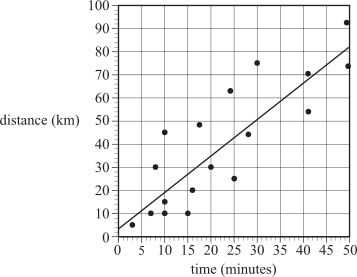
CORE, FUR1 2015 VCAA 9 MC

A least squares regression line has been fitted to the scatterplot above to enable distance, in kilometres, to be predicted from time, in minutes.

The equation of this line is closest to

A.   distance `= 3.5 + 1.6 ×`time

B.   time `= 3.5 + 1.6 ×`distance

C.   distance `= 1.6 + 3.5 ×`time

D.   time `= 1.8 + 3.5 ×`distance

E.   distance `= 3.5 + 1.8 ×`time

Show Answers Only

`A`

Show Worked Solution

`text{Line passes through  (0, 3.5) and (50, 82)`

`:.\ text(Gradient) ` `=(y_2-y_1)/(x_2-x_1)`
  `~~(82 – 3.5)/(50 – 0)`
  `~~ 1.57`

`text(Distance is the dependent variable and the)`

`y text(-intercept is approximately 3.5.)`

`=> A`

Filed Under: Correlation and Regression Tagged With: Band 4, smc-265-20-Find LSRL Equation/Gradient

CORE, FUR1 2015 VCAA 6-7 MC

The following information relates to Parts 1 and 2.

In New Zealand, rivers flow into either the Pacific Ocean (the Pacific rivers) or the Tasman Sea (the Tasman rivers).

The boxplots below can be used to compare the distribution of the lengths of the Pacific rivers and the Tasman rivers.
 

CORE, FUR1 2015 VCAA 6 MC

Part 1

The five-number summary for the lengths of the Tasman rivers is closest to

  1. `32, 48, 64, 76, 108`
  2. `32, 48, 64, 76, 180`
  3. `32, 48, 64, 76, 322`
  4. `48, 64, 97, 169, 180`
  5. `48, 64, 97, 169, 322`


Part 2

Which one of the following statements is not true?

  1. The lengths of two of the Tasman rivers are outliers.
  2. The median length of the Pacific rivers is greater than the length of more than 75% of the Tasman rivers.
  3. The Pacific rivers are more variable in length than the Tasman rivers.
  4. More than half of the Pacific rivers are less than 100 km in length.
  5. More than half of the Tasman rivers are greater than 60 km in length.
Show Answers Only

`text(Part 1:)\ B`

`text(Part 2:)\ D`

Show Worked Solution

`text(Part 1)`

♦ Mean mark 46%.

`text(Outliers are inputs into a five-number summary,)`

`text(including the maximum and minimum values.)`

`:.\ text(A maximum length of 180 km is part of the Tasman)`

`text(river summary.)`

`=> B`


`text(Part 2)`

`text(Consider)\ D,`

`D\ text(would be true if its median value was less than)`

`text(100 km, which is not the case.)`

`=> D`

Filed Under: Graphs - Stem/Leaf and Boxplots Tagged With: Band 4, Band 5, smc-643-20-Parallel Box-Plots, smc-643-60-Outliers, smc-643-70-Distribution Description

CORE, FUR1 2015 VCAA 4-5 MC

The foot lengths of a sample of 2400 women were approximately normally distributed with a mean of 23.8 cm and a standard deviation of 1.2 cm. 


Part 1

The expected number of these women with foot lengths less than 21.4 cm is closest to

A.       `60`

B.     `120`

C.    ` 384`

D.   `2280`

E.   `2340`


Part 2

The standardised foot length of one of these women is  `z` = – 1.3

Her actual foot length, in centimetres, is closest to

A.   `22.2`

B.   `22.7`

C.   `25.3`

D.   `25.6`

E.   `31.2`

Show Answers Only

`text(Part 1:)\ A`

`text(Part 2:)\ A`

Show Worked Solution

`text(Part 1)`

`z text{-score (21.4)}` `=(x – barx)/s`
  `=(21.4-23.8)/1.2`
  `= – 2`


`:.\ text(Number of women with foot length under 21.4 cm)`

`=2.5text(%) xx 2400 = 60`

`=> A`


`text(Part 2)`

`text(If)\ \ z = – 1.3`

`– 1.3` `=(x-23.8)/1.2`
 `x-23.8` `= – 1.3 xx 1.2`
 `:. x` `=23.8 – 1.56`
  `=22.24`

`=> A`

Filed Under: Normal Distribution Tagged With: Band 4, smc-600-10-Single z-score

CORE, FUR1 2015 VCAA 3 MC

The dot plot below displays the difference between female and male life expectancy, in years, for a sample of 20 countries.
 

CORE, FUR1 2015 VCAA 3 MC
 

The mean (`barx`) and standard deviation (`s`) for this data are

A.   `text(mean)\ = 2.32` `\ \ \ \ \ text(standard deviation)\ = 5.25`
B.   `text(mean)\ = 2.38` `\ \ \ \ \ text(standard deviation)\ = 5.25`
C.   `text(mean)\ = 5.0` `\ \ \ \ \ text(standard deviation)\ = 2.0`
D.   `text(mean)\ = 5.25` `\ \ \ \ \ text(standard deviation)\ = 2.32`
E.   `text(mean)\ = 5.25` `\ \ \ \ \ text(standard deviation)\ = 2.38`
Show Answers Only

`E`

Show Worked Solution

`text(By calculator.)`

`=> E`

Filed Under: Graphs - Histograms and Other, Summary Statistics Tagged With: Band 4, smc-468-20-Mean, smc-468-30-Std Dev, smc-644-10-Dot Plots

CORE, FUR1 2015 VCAA 1 MC

The stem plot below displays the average number of decayed teeth in 12-year-old children from `31` countries.
 

     CORE, FUR1 2015 VCAA 1 MC
 

Based on this stem plot, the distribution of the average number of decayed teeth for these countries is best described as

  1. negatively skewed with a median of 15 decayed teeth and a range of 45
  2. positively skewed with a median of 15 decayed teeth and a range of 45
  3. approximately symmetric with a median of 1.5 decayed teeth and a range of 4.5
  4. negatively skewed with a median of 1.5 decayed teeth and a range of 4.5
  5. positively skewed with a median of 1.5 decayed teeth and a range of 4.5
Show Answers Only

`E`

Show Worked Solution

`text(Median = 16th value)\ = 1.5`

`text(Range)\ = 4.7-0.2=4.5`

`text(The clear tail to the upper end of values shows that the)`

`text(data is positively skewed.)`

`=> E`

Filed Under: Graphs - Stem/Leaf and Boxplots Tagged With: Band 4, smc-643-40-Stem and Leaf, smc-643-70-Distribution Description

CORE*, FUR1 2006 VCAA 7 MC

The values of the first five terms of a sequence are plotted on the graph shown below.


The first order difference equation that could describe the sequence is

A.   `t_(n+1) = t_n + 5,` `\ \ \ \ \ t_1 = 4`
B.   `t_(n+1) = 2t_n + 1,` `\ \ \ \ \ t_1 = 4`
C.   `t_(n+1) = t_n - 3,` `\ \ \ \ \ t_1 = 4`
D.   `t_(n+1) = t_n + 3,` `\ \ \ \ \ t_1 = 4`
E.   `t_(n+1) = 3t_n,` `\ \ \ \ \ t_1 = 4`
Show Answers Only

`B`

Show Worked Solution

`text(By elimination,)`

`text(There is no common difference between terms,)`

`:.\ text(Cannot be A, C or D.)`

`text(The equation in B has)\ \ t_2=9,\ \ text(while the equation)`

`text(in C has)\ \ t_2=12.`

`rArr B`

Filed Under: Difference Equations - MC, Recursion - General Tagged With: Band 4, smc-714-60-Identify RR, smc-714-70-RR and graphs

CORE*, FUR1 2006 VCAA 5 MC

A difference equation is defined by

`f_(n+1) - f_n = 5\ \ \ \ \ text (where)\ \ f_1 =– 1`

The sequence   `f_1, \ f_2, \ f_3, ...` is

A.   `5, 4, 3\ …`

B.   `4, 9, 14\ …`

C.   `– 1, – 6, – 11\ …`

D.   `– 1, 4, 9\ …`

E.   `– 1, 6, 11\ …` 

Show Answers Only

`D`

Show Worked Solution

`text(Using)\ \ \ f_(n+1) = f_n +5`

`text(Consider)\ \ f_1 = – 1,`

`f_2= – 1 + 5=4`

`f_3 = 4+5=9`

`rArr D`

Filed Under: Difference Equations - MC, Recursion - General Tagged With: Band 4, smc-714-10-RR (arithmetic), smc-714-50-Find term(s)

CORE, FUR1 2006 VCAA 11-13 MC

The following information relates to Parts 1, 2 and 3.

The table shows the seasonal indices for the monthly unemployment numbers for workers in a regional town.

Part 1

The seasonal index for October is missing from the table.

The value of the missing seasonal index for October is

A.   `0.93`

B.   `0.95`

C.   `0.96`

D.   `0.98`

E.   `1.03`


Part 2

The actual number of unemployed in the regional town in September is 330.

The deseasonalised number of unemployed in September is closest to

A.   `310`

B.   `344`

C.   `351`

D.   `371`

E.   `640`


Part 3

A trend line that can be used to forecast the deseasonalised number of unemployed workers in the regional town for the first nine months of the year is given by

deseasonalised number of unemployed = 373.3 – 3.38 × month number

where month 1 is January, month 2 is February, and so on.

The actual number of unemployed for June is predicted to be closest to

A.   `304`

B.   `353`

C.   `376`

D.   `393`

E.   `410`

Show Answers Only

`text (Part 1:)\ D`

`text (Part 2:)\ C`

`text (Part 3:)\ A`

Show Worked Solution

`text (Part 1)`

`text(Oct index)` `=12-text(sum of other 11)`
  `=12-11.02`
  `=0.98`

`rArr D`


`text (Part 2)`

`text(Deseasonalised number)` `= text(Actual)/text(Index)`
  `=330/0.94`
  `=351.06…`

`rArr C`


`text (Part 3)`

♦♦ Mean mark 29%.
MARKERS’ COMMENT: 59% of students correctly found the deseasonalised number but failed to convert it to the actual.

`text(Deseasonalised number)`

`=373.3 – 3.38 xx 6`

`=353.02`

`text(Actual number)` `= text(Deseasonalised) xx text(Index)`
  `=353.02 xx 0.86`
  `=303.59…`

`rArr A`

Filed Under: Time Series Tagged With: Band 4, Band 6, smc-266-10-Seasonal Index from a Table, smc-266-20-(De)Seasonalising Data

CORE, FUR1 2006 VCAA 10 MC

The table below displays the total monthly rainfall (in mm) in a reservoir catchment area over a one-year period.

Using three mean moving average smoothing, the smoothed value for the total rainfall in April is closest to

A.   `65`

B.   `66`

C.   `70`

D.   `75`

E.   `88`

Show Answers Only

`C`

Show Worked Solution

`text(Three mean average for April)`

`=(35+99+75)/3`

`=69.66…`

`rArr C`

Filed Under: Time Series Tagged With: Band 4, smc-266-60-MEAN Smoothing

CORE, FUR1 2006 VCAA 8 MC

The waist measurement (cm) and weight (kg) of 12 men are displayed in the table below.
 

Using this data, the equation of the least squares regression line that enables weight to be predicted from waist measurement is

`text(weight = – 20 + 1.11 × waist)`

When this equation is used to predict the weight of the man with a waist measurement of 80 cm, the residual value is closest to

A.     `–11\ text(kg)`

B.       `11\ text(kg)`

C.      `–2\ text(kg)`

D.         `2\ text(kg)`

E.       `69\ text(kg)`

Show Answers Only

`C`

Show Worked Solution
`text(Residual)` `=\ text(Actual – Predicted)`
  `=67-(- 20+1.11 xx 80)`
  `= – 1.8\ text(kg)`

`rArr C`

Filed Under: Correlation and Regression Tagged With: Band 4, smc-265-50-Residuals

CORE, FUR1 2006 VCAA 7 MC

For a set of bivariate data, involving the variables `x` and `y`,

`r =– 0.5675, \ bar x = 4.56, \ s_x = 2.61, \ bar y = 23.93 \ and\  s_y = 6.98`

The equation of the least squares regression line  `y = a + bx`  is closest to

A.   `y= 30.9 - 1.52x`

B.   `y = 17.0 - 1.52x`

C.   `y = – 17.0 + 1.52x`

D.   `y = 30.9 - 0.2x`

E.   `y = 24.9 - 0.2x`

Show Answers Only

`A`

Show Worked Solution
`b` `=r xx s_y/s_x`
  `=-0.5675 xx 6.98/2.61`
  `=-1.517…`
`a` `=bar y – b barx`
  `=23.93 – (- 1.517… xx 4.56)`
  `=30.85…`

`rArr A`

Filed Under: Correlation and Regression Tagged With: Band 4, smc-265-30-LSRL formula

CORE, FUR1 2006 VCAA 5-6 MC

The distribution of test marks obtained by a large group of students is displayed in the percentage frequency histogram below.
 

Part 1

The pass mark on the test was 30 marks.

The percentage of students who passed the test is

A.     `7text(%)`

B.   `22text(%)`

C.   `50text(%)`

D.   `78text(%)`

E.   `87text(%)`


Part 2

The median mark lies between

A.   `35 and 40`

B.   `40 and 45`

C.   `45 and 50`

D.   `50 and 55`

E.   `55 and 60`

Show Answers Only

`text (Part 1:)\ D`

`text (Part 2:)\ B`

Show Worked Solution

`text (Part 1)`

`text(Adding up the percentage bars above 30)`

`=7+11+14+16+18+12`

`=78text(%)`

`rArr D`


`text (Part 2)`

`text(Adding up the percentage bars from the left,)`

`text(the 50th and 51st percentile lie in the 40–45)`

`text(mark interval.)`

`rArr B`

Filed Under: Graphs - Histograms and Other, Summary Statistics Tagged With: Band 3, Band 4, smc-468-40-Median Mode and Range, smc-644-20-Histograms

CORE, FUR1 2006 VCAA 4 MC

The head circumference (in cm) of a population of infant boys is normally distributed with a mean of 49.5 cm and a standard deviation of 1.5 cm.

Four hundred of these boys are selected at random and each boy’s head circumference is measured.

The number of these boys with a head circumference of less than 48.0 cm is closest to 

A.       `3`

B.     `10`

C.     `64`

D.   `272`

E.   `336`

Show Answers Only

`C`

Show Worked Solution

`bar x=49.5,\ \ \ s=1.5`

`z text{-score (49.5)` `=(x-bar x)/s`
  `=(48.0-49.5)/1.5`
  `=– 1`

`:.\ text(Number of boys with a head under 48.0 cm)`

`=16text(%) xx 400`

`=64`

`=>  C`

Filed Under: Normal Distribution Tagged With: Band 4, smc-600-10-Single z-score

CORE, FUR1 2006 VCAA 1-3 MC

The back-to-back ordered stemplot below shows the distribution of maximum temperatures (in °Celsius) of two towns, Beachside and Flattown, over 21 days in January.


Part 1

The variables

temperature (°Celsius), and

town (Beachside or Flattown), are

A.   both categorical variables.

B.   both numerical variables.

C.   categorical and numerical variables respectively.

D.   numerical and categorical variables respectively.

E.   neither categorical nor numerical variables.


Part 2

For Beachside, the range of maximum temperatures is

A.     `3°text(C)`

B.   `23°text(C)`

C.   `32°text(C)`

D.   `33°text(C)`

E.   `38°text(C)`


Part 3

The distribution of maximum temperatures for Flattown is best described as

A.   negatively skewed.

B.   positively skewed.

C.   positively skewed with outliers.

D.   approximately symmetric.

E.   approximately symmetric with outliers.

Show Answers Only

`text (Part 1:)\ D`

`text (Part 2:)\ B`

`text (Part 3:)\ E`

Show Worked Solution

`text (Part 1)`

`text(Temperature is numerical,)`

`text(Town is categorical.)`

`rArr D`


`text (Part 2)`

`text(Beachside’s maximum temperature range)`

`=38-15`

`=23°text(C)`

`rArr B`


`text (Part 3)`

`IQR\ text{(Beachside)}`  `=Q_3 – Q_1`
  `=40-33`
  `=7`
`Q_1 – 1.5 xx IQR` `=33 – 1.5 xx7`
  `=22.5°text(C)`

 
`:.\ text(Flattown’s maximum temperature readings of)`

`text(18° and 19° are outliers.)`

`rArr E`

Filed Under: Graphs - Stem/Leaf and Boxplots Tagged With: Band 3, Band 4, smc-643-50-Back-to-Back Stem and Leaf, smc-643-70-Distribution Description

CORE*, FUR1 2007 VCAA 8 MC

The first four terms of a sequence are

`12, 18, 30, 54`

A difference equation that generates this sequence is

A.   `t_(n+1)` `= t_n + 6` `\ \ \ \ t_1 = 12`
B.   `t_(n+1)` `= 1.5t_n` `\ \ \ \ t_1 = 12`
C.   `t_(n+1)` `= 0.5t_n + 12` `\ \ \ \ t_1 = 12`
D.   `t_(n+1)` `= 2t_n - 6` `\ \ \ \ t_1 = 12`
E.   `t_(n+2)` `= t_(n+1) + t_n` `\ \ \ \ t_1 = 12, t_2 = 18`
Show Answers Only

`D`

Show Worked Solution

`text(Calculating)\ t_3\ \ text(in each given option)`

`text(eliminates)\ A, B\ text(and)\ C.`

`text(Consider)\ E,`

`t_4 != t_3 + t_2\ \ text(which eliminates)\ E.`

`rArr D`

Filed Under: Difference Equations - MC, Recursion - General Tagged With: Band 4, smc-714-60-Identify RR

PATTERNS, FUR1 2007 VCAA 7 MC

The first term, `t_1`, of a geometric sequence is positive.

The common ratio of this sequence is negative.

A graph that could represent the first five terms of this sequence is

patterns 2007 VCAA 7mci

Show Answers Only

`E`

Show Worked Solution

`text(General terms are)\ \ \ a, ar, ar^2, …`

`text(By elimination,)`

`a >0,\  text(Eliminate D.)`

`r<0,\ \ text(terms will alternate between positive and)`

`text(negative. Eliminate A, B and C.`

`rArr E`

Filed Under: APs and GPs - MC Tagged With: Band 4

CORE*, FUR1 2007 VCAA 4-5 MC

The following information relates to Parts 1 and 2.

The number of waterfowl living in a wetlands area has decreased by 4% each year since 2003.

At the start of 2003 the number of waterfowl was 680.
 

Part 1

If this percentage decrease continues at the same rate, the number of waterfowl in the wetlands area at the start of 2008 will be closest to

A.   532

B.   544

C.   554

D.   571

E.   578
 

Part 2

`W_n` is the number of waterfowl at the start of the `n`th year.

Let  `W_1 = 680.`

The rule for a difference equation that can be used to model the number of waterfowl in the wetlands area over time is

A.   `W_(n+1) = W_n - 0.04n`

B.   `W_(n+1) = 1.04 W_n` 

C.   `W_(n+1) = 0.04 W_n` 

D.   `W_(n+1) = -0.04 W_n` 

E.   `W_(n+1) = 0.96 W_n`

Show Answers Only

`text (Part 1:)\ C`

`text (Part 2:)\ E`

Show Worked Solution

`text (Part 1)`

`text(After 1 year, number of waterfowls)`

`=680 – 4/100 xx 680`

`=680\ (0.96)^1`

`text(After 2 years)\ = 680\ (0.96)^2`

`vdots`

`text{After 5 years (in 2008)}`

`=680\ (0.96)^5 =554.45…`

`rArr C`


`text (Part 2)`

`text(Sequence is geometric where)\ \ r=0.96`

`:. W_(n+1)/W_n` `=0.96`
`W_(n+1)` `=0.96 W_n`

`rArr E`

Filed Under: Difference Equations - MC, Recursion - General Tagged With: Band 4, smc-714-20-RR (geometric), smc-714-60-Identify RR

CORE, FUR1 2007 VCAA 11-13 MC

The following information relates to Parts 1, 2 and 3.

The time series plot below shows the revenue from sales (in dollars) each month made by a Queensland souvenir shop over a three-year period.

Part 1

This time series plot indicates that, over the three-year period, revenue from sales each month showed

A.   no overall trend.

B.   no correlation.

C.   positive skew.

D.   an increasing trend only.

E.   an increasing trend with seasonal variation.


Part 2

A three median trend line is fitted to this data.

Its slope (in dollars per month) is closest to

A.   `125`

B.   `146`

C.   `167`

D.   `188`

E.   `255`


Part 3

The revenue from sales (in dollars) each month for the first year of the three-year period is shown below.

If this information is used to determine the seasonal index for each month, the seasonal index for September will be closest to

A.   `0.80`

B.   `0.82`

C.   `1.16`

D.   `1.22`

E.   `1.26`

Show Answers Only

`text (Part 1:)\ E`

`text (Part 2:)\ C`

`text (Part 3:)\ E`

Show Worked Solution

`text (Part 1)`

`text(The time series plot clearly shows an increasing)`

`text(trend and a seasonal spike and drop over the)`

`text(Summer months.)`

`rArr E`


`text (Part 2)`

♦ Mean mark 37%.
MARKERS’ COMMENT: A common error was to incorrectly use the 6 month and 30 month data points as the median.

`text(From the graph, the median of the bottom third)`

`text(of data points is)\ \ (6.5, 3000).`

`text(From the graph, the median of the top third of)`

`text(data points is)\ \ (30.5, 7000).`

`:.\ text(Gradient of the three median line)`

`=(7000 – 3000)/(30.5 – 6.5)`

`=166.66…`

`rArr C`


`text (Part 3)`

`text(Average monthly sales)\ ` `= (43\ 872)/12`
  `=3656`

`:.\ text(Seasonal index for September)`

`=4597/3656`

`=1.257…` 

`rArr E`

Filed Under: Time Series Tagged With: Band 2, Band 4, Band 5, smc-266-10-Seasonal Index from a Table, smc-266-40-Time Series Trends

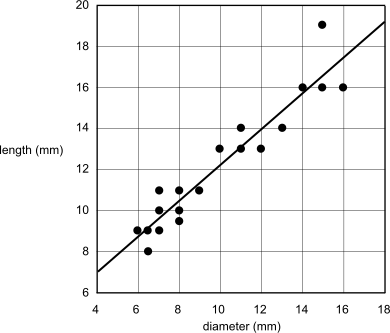
CORE, FUR1 2007 VCAA 7-8 MC

The lengths and diameters (in mm) of a sample of jellyfish selected were recorded and displayed in the scatterplot below. The least squares regression line for this data is shown.

The equation of the least squares regression line is

length = 3.5 + 0.87 × diameter

The correlation coefficient is  `r = 0.9034`
 

Part 1

Written as a percentage, the coefficient of determination is closest to

  1. `0.816 text(%)`
  2. `0.903text(%)`
  3. `81.6text(%)`
  4. `90.3text(%)`
  5. `95.0text(%)`


Part 2

From the equation of the least squares regression line, it can be concluded that for these jellyfish, on average

  1. there is a 3.5 mm increase in diameter for each 1 mm increase in length.
  2. there is a 3.5 mm increase in length for each 1 mm increase in diameter.
  3. there is a 0.87 mm increase in diameter for each 1 mm increase in length.
  4. there is a 0.87 mm increase in length for each 1 mm increase in diameter.
  5. there is a 4.37 mm increase in diameter for each 1 mm increase in length.
Show Answers Only

`text (Part 1:)\ C`

`text (Part 2:)\ D`

Show Worked Solution

`text (Part 1)`

`r^2` `=0.9034^2`
  `=0.8161…`

 
`rArr C`
 

`text(Part 2)`

`text(Length)\ =3.5 + 0.87 xx text(diameter)`

`text(Gradient)\ = 0.87`

`text(i.e. the length increases 0.87 mm for each 1 mm)`

`text(increase in diameter.)`

`rArr D`

Filed Under: Correlation and Regression Tagged With: Band 4, smc-265-10-r / r^2 and Association, smc-265-40-Interpret Gradient

CORE, FUR1 2007 VCAA 5-6 MC

Samples of jellyfish were selected from two different locations, A and B. The diameter (in mm) of each jellyfish was recorded and the resulting data is summarised in the boxplots shown below.


Part 1

The percentage of jellyfish taken from location A with a diameter greater than 14 mm is closest to

  1. `2text(%)`
  2. `5text(%)`
  3. `25text(%)`
  4. `50text(%)`
  5. `75text(%)`


Part 2

From the boxplots, it can be concluded that the diameters of the jellyfish taken from location A are generally

  1. similar to the diameters of the jellyfish taken from location B.
  2. less than the diameters of the jellyfish taken from location B and less variable.
  3. less than the diameters of the jellyfish taken from location B and more variable.
  4. greater than the diameters of the jellyfish taken from location B and less variable.
  5. greater than the diameters of the jellyfish taken from location B and more variable. 
Show Answers Only

`text (Part 1:)\ C`

`text (Part 2:)\ C`

Show Worked Solution

`text (Part 1)`

`text(Consider the boxplot of location A,)`

`Q_3 = 14`

`:.\ text(25% will have a diameter greater than 14 mm.)`

`rArr C`


`text (Part 2)`

`text(The boxplot of location A has a lower median and a)`

`text(higher range than the boxplot of location B.)`

`rArr C`

Filed Under: Graphs - Stem/Leaf and Boxplots Tagged With: Band 4, smc-643-20-Parallel Box-Plots

CORE, FUR1 2007 VCAA 4 MC

The length of 3-month-old baby boys is approximately normally distributed with a mean of 61.1 cm and a standard deviation of 1.6 cm.

The percentage of 3-month-old baby boys with length greater than 59.5 cm is closest to

A.     `5text(%)`

B.   `16text(%)`

C.   `68text(%)`

D.   `84text(%)`

E.   `95text(%)`

Show Answers Only

`D`

Show Worked Solution
`z text{-score (59.5)}` `=(x-bar x)/s`
  `=(59.5 – 61.1)/1.6`
  `= – 1`

`:.\ text(% of baby boys longer than 59.5 cm)`

`= 34 + 50`

`=84 text(%)`

`rArr D`

Filed Under: Normal Distribution Tagged With: Band 4

CORE, FUR1 2007 VCAA 3 MC

 A student obtains a mark of 56 on a test for which the mean mark is 67 and the standard deviation is 10.2.

The student’s standardised mark (standard `z`-score) is closest to

A.   `– 1.08`

B.   `– 1.01`

C.      `1.01`

D.      `1.08`

E.    `49.4`

Show Answers Only

`A`

Show Worked Solution
`z text(-score)` `=(x-bar x)/s`
  `=(56-67)/10.2`
  `= – 1.0784…`

`rArr A`

Filed Under: Normal Distribution Tagged With: Band 4, smc-600-10-Single z-score

PATTERNS, FUR1 2008 VCAA 6 MC

Kai commenced a 12-day program of daily exercise. The time, in minutes, that he spent exercising on each of the first four days of the program is shown in the table below. 

If this pattern continues, the total time (in minutes) that Kai will have spent exercising after 12 days is

A.    `59`

B.   `180`

C.   `354`

D.   `444`

E.   `468`

Show Answers Only

`D`

Show Worked Solution

`15, 19, 23, 27\ …`

`text(AP where)\ \ \ a` `= 15, and`
 `d` `= 19-15=4`
`S_n` `= n/2 [2a + (n – 1) d]`
`:. S_12` `= 12/2[2 xx 15+(12-1)4]`
  `= 6[30 + 44]`
  `= 444`

`=>  D`

Filed Under: APs and GPs - MC Tagged With: Band 4

CORE*, FUR1 2008 VCAA 4 MC

In 2008, there are 800 bats living in a park.

After 2008, the number of bats living in the park is expected to increase by 15% per year.

Let `Β_n` represent the number of bats living in the park `n` years after 2008.

A difference equation that can be used to determine the number of bats living in the park `n` years after 2008 is

A.   `B_n=1.15B_(n-1)-800` `\ \ \ \ \ B_0=2008`
B.   `B_n=B_(n-1)+1.15xx800` `\ \ \ \ \ B_0=2008`
C.   `B_n=B_(n-1)-0.15xx800` `\ \ \ \ \ B_0=800`
D.   `B_n=0.15B_(n-1)` `\ \ \ \ \ B_0=800`
E.    `B_n=1.15B_(n-1)` `\ \ \ \ \ B_0=800`
Show Answers Only

`E`

Show Worked Solution

`B_0=800`

`B_1= B_0 + 15 text(%) xx B_0=1.15 B_0`

`B_2= 1.15B_1`

`vdots`

`B_n=1.15 B_(n-1)`

`=> E`

Filed Under: Difference Equations - MC, Recursion - General Tagged With: Band 4, smc-714-20-RR (geometric), smc-714-60-Identify RR

Complex Numbers, SPEC1 2011 VCAA 4

Consider  `z = (1-sqrt 3 i)/(-1 + i),\ \ z in C.`

Find the principal argument of `z` in the form  `k pi,\ k in R.`   (3 marks)

--- 10 WORK AREA LINES (style=lined) ---

Show Answers Only

`text(Arg)(z) = 11/12 pi`

Show Worked Solution
`z_1` `= 1-sqrt3 i`
  `= sqrt(1^2 + 3)\ text(cis)(−tan^(−1)(sqrt3))`
  `= 2text(cis)(−pi/3)`


`z_2` `= −1 + i`
  `= sqrt(1^2 + 1^2)\ text(cis)(pi-tan^(−1)(1))`
  `= sqrt2 text(cis)(pi-pi/4)`
  `= sqrt2 text(cis)((3pi)/4)`


`text(Arg)((1-sqrt3 i)/(−1 + i))` `= text(Arg)(1-sqrt3 i)-text(Arg)(−1 + i)`
  `= -pi/3-(3pi)/4`
  `= -(13pi)/12`


`-(13pi)/12 + 2pi` `= (-13pi+ 24pi)/12`  
  `= (11pi)/12`  

Filed Under: Mod/Arg Form and Argand Diagrams (SM) Tagged With: Band 4, smc-2597-20-Cartesian to Mod/Arg

CORE*, FUR1 2013 VCAA 8 MC

The initial rate of pay for a job is $10 per hour.

A worker’s skill increases the longer she works on this job. As a result, the hourly rate of pay increases each month.

The hourly rate of pay in the `n`th month of working on this job is given by the difference equation

`S_(n+1) = 0.2 xx S_n+15\ \  \ \ \ \ S_1 = 10`

The maximum hourly rate of pay that the worker can earn in this job is closest to

A.    $3.00

B.  $12.00

C.  $12.50

D.  $18.75

E.  $75.00

Show Answers Only

`D`

Show Worked Solution

`text(Maximum rate)\ S_(max)\ text(occurs when)`

`S_(n+1)` `=S_n`
`S_(max)` `=0.2×S_(max)+15`
`0.8 xx S_(max)` `=15`
`S_(max)` `=15/0.8`
  `=18.75`

 
`=> D`

Filed Under: Difference Equations - MC, Recursion - General Tagged With: Band 4, smc-714-25-RR (combination), smc-714-50-Find term(s)

PATTERNS, FUR1 2013 VCAA 7 MC

The following are either three consecutive terms of an arithmetic sequence or three consecutive terms of a geometric sequence. 

Which one of these sequences could not include 2 as a term?

A.  `–1, 0.5, –0.25`  

B.  `–1, –3, –5`  

C.  `5, 12.5, 31.25`

D.  `6, 8, 10`

E.  `8, 16, 32`

Show Answers Only

`B`

Show Worked Solution

`text(By elimination,)`

`text(In A, GP where)\ \  r=0.5/-1=-0.5`

`:.\ text(Term before −1 is 2.)`


`text(In B, AP where)\ \ d=-2`

`:.\ text{Terms before −1 = −1 − (−2) = 1}`

`text{Term before 1 = 1 − (−2) = 3}`

`:.\ text(Does NOT  include 2.)`

`text(Other choices can all be shown to contain 2.`

`=> B`

Filed Under: APs and GPs - MC Tagged With: Band 4

Calculus, MET2 2013 VCAA 14 MC

Consider the graph of  `y = 2^x + c`, where `c` is a real number. The area of the shaded rectangles is used to find an approximation to the area of the region that is bounded by the graph, the `x`-axis and the lines  `x = 1`  and  `x = 5.`

If the total area of the shaded rectangles is 44, then the value of `c` is

A.   `14`

B.   `-4`

C.   `14/5`

D.   `7/2`

E.   `-16/5`

Show Answers Only

`D`

Show Worked Solution

`text(Finding the shaded area:)`

`44`  `=(2^1 + c) 1 + (2^2 + c) 1 + (2^3 + c) 1 + (2^4 + c) 1`
`44` `=(2+c) + (4+c) + (8+c) + (16+c)`
`14` `=4c`
`:. c` `=7/2`

 
`=>   D`


Filed Under: Area Under Curves (old) Tagged With: Band 4, smc-723-50-Log/Exponential, smc-723-90-Approximations

Probability, MET2 2013 VCAA 10 MC

For events `A` and `B,\ text(Pr)(A ∩ B) = p,\ text(Pr)(A′∩ B) = p - 1/8`  and  `text(Pr)(A ∩ B prime) = (3p)/5.`

If `A` and `B` are independent, then the value of  `p`  is

  1. `0`
  2. `1/4`
  3. `3/8`
  4. `1/2`
  5. `3/5`
Show Answers Only

`C`

Show Worked Solution
`text{Pr}(A)` `= text{Pr}(A ∩ B) + text{Pr}(A ∩ B prime)`
  `= p + (3p)/5`
  `= (8p)/5`


`text{Pr}(B)` `= text{Pr}(B ∩ A) + text{Pr}(B ∩ A prime)`
  `= p + p – 1/8`
  `= 2p – 1/8`


`text(S)text(ince)\ A and B\ text(are independent events,)`

`text{Pr}(A ∩ B)` ` = text{Pr}(A) xx text{Pr}(B)`
`p` `=(8p)/5 (2p – 1/8)`
`5p` `=16p^2-p`
`16p^2-6p` `=0`
`2p(8p-3)` `=0`
`:.p` `=3/8,\ \ \ p!=0`

`=>   C`

Filed Under: Conditional Probability and Set Notation Tagged With: Band 4, smc-2736-20-Set Notation, smc-2736-40-Independent Events

Calculus, SPEC1 2015 VCAA 6

The acceleration `a` ms¯² of a body moving in a straight line in terms of the velocity `v` ms¯¹ is given by  `a = 4v^2.`

Given that  `v = e`  when  `x = 1`, where `x` is the displacement of the body in metres, find the velocity of the body when  `x = 2.`  (4 marks)

Show Answers Only

`e^5`

Show Worked Solution
`v* (dv)/(dx)` `= 4v^2`
`(dv)/(dx)` `= 4v`
`(dx)/(dv)` `= 1/(4v)`
`x` `=int 1/(4v) \ dv`
  `=1/4 ln (4v)+c`

 
`text(When)\ \ x=1, v=e`

`1` `=1/4 ln(4e)+c`  
`:.c` `=1-1/4 ln(4e)`  

 
`text(Find)\ \ v\ \ text(when)\ \ x=2:`

COMMENT: Strong log and exponential calculation ability required here.

`1/4 ln (4v)+1-1/4 ln(4e)` `= 2`
`1/4 ln(4v)` `= 1/4 ln (4e)+1`
`ln(4v)` `= ln(4e)+4`
`e^(ln4v)` `= e^(ln(4e) +4)`
`4v` `= e^(ln(4e)) * e^4`
`4v` `=4e xx e^4`
`:.v` `=e^5`

Filed Under: Motion (SM) Tagged With: Band 4, smc-1159-30-a=f(v)

Algebra, MET2 2015 VCAA 20 MC

If  `f(x - 1) = x^2 - 2x + 3`, then  `f(x)` is equal to

  1. `x^2 - 2`
  2. `x^2 + 2`
  3. `x^2 - 2x + 2`
  4. `x^2 - 2x + 4`
  5. `x^2 - 4x + 6`
Show Answers Only

`B`

Show Worked Solution

`text(Let)\ g(x) = f(x – 1)`

`text(Shift)\ g(x)\ text(left 1):`

`g(x + 1)` `= (x + 1)^2 – 2(x + 1) + 3`
  `= x^2 + 2`

 
`=>   B`

Filed Under: Transformations Tagged With: Band 4, smc-753-10-Translation (Only)

Calculus, MET2 2015 VCAA 19 MC

If  `f(x) = int_0^x (sqrt(t^2 + 4))\ dt`, then  `f prime (– 2)`  is equal to

A.   `sqrt 2`

B.   `- sqrt 2`

C.   `2 sqrt 2`

D.   `-2 sqrt 2`

E.   `4 sqrt 2`

Show Answers Only

`C`

Show Worked Solution
`f(x)` `= int_0^x (sqrt(t^2 + 4))\ dt`
`f′(x)` `= sqrt(t^2 + 4)`
`:. f′(− 2)` `= sqrt((-2)^2+4)`
  `=sqrt8`
  `=2 sqrt2`

`=>   C`

Filed Under: Standard Integration Tagged With: Band 4, smc-749-20-Definite Integrals

Graphs, MET2 2015 VCAA 17 MC

A graph with rule  `f(x) = x^3 - 3x^2 + c`, where `c` is a real number, has three distinct `x`-intercepts

The set of all possible values of `c` is

A.   `R`

B.   `R^+`

C.   `{0, 4}`

D.   `(0, 4)`

E.   `text{(−∞, 4)}`

Show Answers Only

`D`

Show Worked Solution

met2-2015-vcaa-17-mc-answer

`text(Consider the graph of)\ \ f(x) = x^3 – 3x^2`

`text(For three)\ xtext(-intercepts, translate up)`

`text{between (0, 4) units}`

`c ∈ (0,4)`

`=>   D`

Filed Under: Polynomials Tagged With: Band 4, smc-750-50-Cubics

Calculus, MET2 2015 VCAA 15 MC

If  `int_0^5 g(x)\ dx = 20`  and  `int_0^5 (2g(x) + ax)\ dx = 90`, then the value of `a` is

A.       `0`

B.       `4`

C.       `2`

D.   `− 3`

E.       `1`

Show Answers Only

`B`

Show Worked Solution
`int_0^5 (2g(x) + ax)\ dx` `=90`
`2int_0^5 g(x)\ dx + int_0^5 ax\ dx` `= 90`
`2(20) + a/2[x^2]_0^5` `=90`
`25/2a` `= 50`
`:. a` `= 4`

`=>   B`

Filed Under: Standard Integration Tagged With: Band 4, smc-749-20-Definite Integrals

Probability, MET2 2015 VCAA 13 MC

The function `f` is a probability density function with rule
 

`f(x) = {(ae^x, 0 <= x <= 1), (ae, 1 < x <= 2), (\ 0, text(otherwise)):}`
 

The value of `a` is

  1. `1`
  2. `e`
  3. `1/e`
  4. `1/(2e)`
  5. `1/(2e - 1)`
Show Answers Only

`E`

Show Worked Solution

`text(Total area) = 1`

`int_0^1 ae^x\ dx + int_1^2 ae\ dx` `= 1`
`[ae^x]_0^1 + [ae*x]_1^2` `=1`
`[ae-a] + [2ae-ae]` `=1`
`a(2e-1)` `=1`
`:. a` `= 1/(2e – 1)`

`=>   E`

Filed Under: Probability density functions Tagged With: Band 4, smc-637-35-Sum probabilities = 1, smc-637-70-Exp/Log PDF

Probability, MET2 2015 VCAA 12 MC

A box contains five red balls and three blue balls. John selects three balls from the box, without replacing them.

The probability that at least one of the balls that John selected is red is

  1. `5/7`
  2. `5/14`
  3. `7/28`
  4. `15/56`
  5. `55/56`
Show Answers Only

`E`

Show Worked Solution
`text{Pr(at least 1 red)}` `= 1 – text{Pr(no reds)}`
  `= 1 – text(Pr)(B,B,B)`
  `= 1 – (3/8 xx 2/7 xx 1/6)`
  `= 55/56`

 
`=>   E`

Filed Under: Multi-Stage Events Tagged With: Band 4, smc-646-30-Complement

Probability, MET2 2015 VCAA 10 MC

The binomial random variable, `X`, has  `text(E)(X) = 2`  and  `text(Var)( X ) = 4/3.`

`text(Pr)(X = 1)`  is equal to

A.   `(1/3)^6`

B.   `(2/3)^6`

C.   `1/3 xx (2/3)^2`

D.   `6 xx 1/3 xx (2/3)^5`

E.   `6 xx 2/3 xx (1/3)^5`

Show Answers Only

`D`

Show Worked Solution

`np = 2\ …\ (1)`

`np(1 – p) = 4/3\ …\ (2)`

`text(Solve simultaneous equations:)`

`n = 6,quadp = 1/3`

`:. X ∼\ text(Bi)(6, 1/3)`


`:. text(Pr)(X=1)` `= ((6),(1)) xx (1/3)^1 xx (2/3)^5`
  `= 6 xx 1/3 xx (2/3)^5`

`=>   D`

Filed Under: Binomial Tagged With: Band 4, smc-638-35-Find n/p given E(X) Var(X)

Calculus, MET2 2015 VCAA 8 MC

The graph of a function  `f:\ text{[−2, p]} -> R`  is shown below.
 

VCAA 2015 8mc

The average value of  `f` over the interval  `text{[−2, p]}`  is zero.

The area of the shaded region is  `25/8.`

If the graph is a straight line, for  `0 <= x <= p`, then the value of `p` is

A.   `2`

B.   `5`

C.   `5/4`

D.   `5/2`

E.   `25/4`

Show Answers Only

`D`

Show Worked Solution
`text(Shaded Area)` `=\ text(Area below)\ \ f(x)\ text(from)\ \ 0 to p`
`1/2 p^2` `= 25/8`
`p^2` `=25/4`
`:. p` `= 5/2,quadp > 0`

`=>   D`

Filed Under: Average Value and Other Tagged With: Band 4, smc-756-40-Graphs and Avg Value

Graphs, MET2 2015 VCAA 7 MC

The range of the function  `f:\ text{(−1, 2]} -> R,\ \ f(x) = -x^2 + 2x-3` is

  1. `R`
  2. `text{(−6, −3]}`
  3. `text{(−6, −2]}`
  4. `text{[−6, −3]}`
  5. `text{[−6, −2]}`
Show Answers Only

`C`

Show Worked Solution

`text(A sketch of the equation:)`

`y` `=-x^2 + 2x-3`
 `dy/dx` `=-2x+2`


`=>\ text(Concave down with turning point when)\ \ x=1,`
 

vcaa-2015-7mc-answer1
 

`:. text(Range) = (-6,-2]`

`=>   C`

Filed Under: Curve Sketching, Polynomials Tagged With: Band 4, smc-724-45-Other graphs, smc-750-40-Solve Quadratic

  • « Previous Page
  • 1
  • …
  • 96
  • 97
  • 98
  • 99
  • 100
  • …
  • 114
  • Next Page »

Copyright © 2014–2025 SmarterEd.com.au · Log in