What is the pH of a 0.0500 M solution of barium hydroxide, \(\ce{Ba(OH)2}\)?
- 1.00
- 1.30
- 12.7
- 13.0
Aussie Maths & Science Teachers: Save your time with SmarterEd
What is the pH of a 0.0500 M solution of barium hydroxide, \(\ce{Ba(OH)2}\)?
Hydrogen sulfide, in solution, is a diprotic acid and ionises in two stages. \(\ce{H2S(aq) + H2O(l)\rightleftharpoons HS-(aq) + H3O+(aq)}\) \(\quad K_{a1} = 9.6 × 10^{–8} \text{ M}\) \(\ce{HS–(aq) + H2O(l)\rightleftharpoons S^{2-}(aq) + H3O+(aq)}\) \(\quad K_{a2} = 1.3 × 10^{–14} \text{ M}\) A student made two assumptions when estimating the pH of a \(0.01 \text{ M}\) solution of \(\ce{H2S}\): Assumption 1: The pH can be estimated by considering only the first ionisation reaction. Assumption 2: The concentration of \(\ce{H2S}\) at equilibrium is approximately equal to \(0.01 \text{ M}\). --- 6 WORK AREA LINES (style=lined) --- --- 5 WORK AREA LINES (style=lined) --- --- 4 WORK AREA LINES (style=lined) ---
The following table shows the value of the ionisation constant of pure water at various temperatures and at a constant pressure.
| \(\text{Temperature (°C)}\) | \(0\) | \(25\) | \(50\) | \(75\) | \(100\) |
| \(K_W\) | \( 1.1 \times 10^{-15}\) | \( 1.0 \times 10^{-14}\) | \( 5.5 \times 10^{-14}\) | \( 2.0 \times 10^{-13}\) | \( 5.6 \times 10^{-13}\) |
Given this data, which one of the following statements about pure water is correct?
A physics student comes across a river which runs north to south and has a current of 3 ms\(^{-1}\) running south.
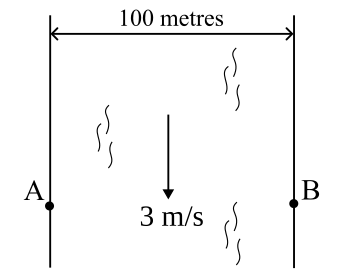
The student starts on the west side of the river at point A and paddles a kayak at 5 ms\(^{-1}\) directly across the river to finish at point B.
--- 5 WORK AREA LINES (style=blank) ---
--- 4 WORK AREA LINES (style=blank) ---
a.
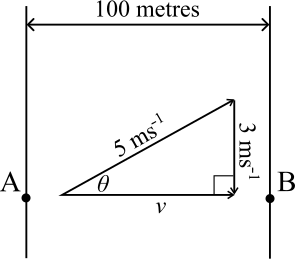
| \(\sin \theta\) | \(=\dfrac{3}{5}\) | |
| \(\theta\) | \(=\sin^{-1}\Big(\dfrac{3}{5}\Big)=36.9^{\circ}\) |
The student must turn 36.9\(^{\circ}\) into the current as shown on the diagram.
b. Using Pythagoras:
\(v=\sqrt{5^2-3^2}=4\ \text{ms}^{-1}\)
\(\therefore\) It will take the student 25 seconds to travel from A to B.
Below is a description of the motion of a runner. The motion can be divided into three stages.
Stage 1: Runner travels 120 metres south taking 20 seconds.
Stage 2: Runner turns west and travels at 5 ms\(^{-1}\) for half a minute.
Stage 3: Runner travels directly back to their starting position.
--- 2 WORK AREA LINES (style=blank) ---
--- 6 WORK AREA LINES (style=blank) ---
a. \(d=v \times t=5 \times 30=150\ \text{m}\)
b. Stage 1 and Stage 2 displacement diagram:
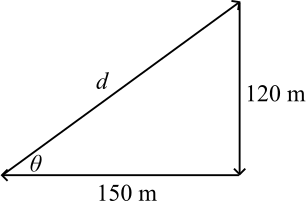
Using Pythagoras:
\(d=\sqrt{150^2 + 120^2}=\sqrt{36900}=192.1\ \text{m}\)
| \(\tan\,\theta\) | \(=\dfrac{120}{150} \) | |
| \(\theta\) | \(=\tan^{-1}\Big(\dfrac{120}{150}\Big)=38.7^{\circ}\) |
\(\therefore\) Displacement of the start point from the runner is 192.1 m, N51.3°E.
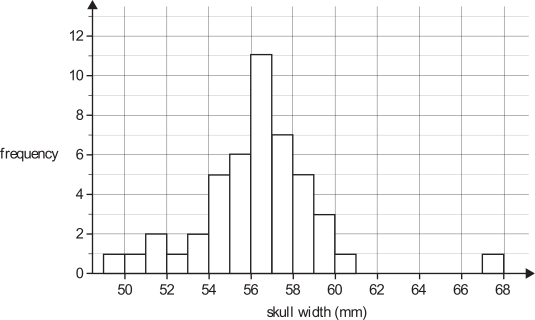
The histogram below displays the distribution of skull width, in millimetres, for 46 female possums.
Question 1
The shape of the distribution is best described as
Question 2
The percentage of the 46 possums with a skull width of less than 55 mm is closest to
Question 3
The third quartile \((Q_3)\) for this distribution, in millimetres, could be
A plane is travelling at 315 ms\(^{-1}\) north when it passes through a dense cloud and slows down to a velocity of 265 ms\(^{-1}\) for safety precautions.
The plane did not change direction and travelled 2.5 km while it was slowing down.
Using north as the positive direction for all calculations, determine:
--- 3 WORK AREA LINES (style=lined) ---
--- 5 WORK AREA LINES (style=lined) ---
--- 5 WORK AREA LINES (style=lined) ---
Plane A is flying due north at 300 kmh\(^{-1}\) when it measures the velocity of plane B flying due south to be 750 kmh\(^{-1}\).
Calculate the velocity of plane B as measured by the pilots on plane B? (3 marks)
--- 6 WORK AREA LINES (style=blank) ---
A hot-air balloon is travelling at a constant upwards velocity of 15 ms\(^{-1}\).
A passenger on the hot-air balloon decides to time how long it takes a pen to hit the ground when dropped from a height of 50 m.
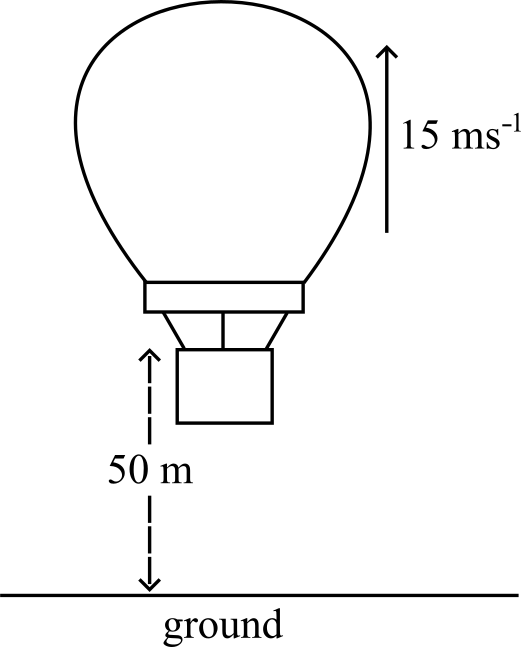
Ignoring air resistance, determine how long it will take the pen to hit the ground. (4 marks)
The network below shows the one-way paths between the entrance, \(A\), and the exit, \(H\), of a children's maze.
The vertices represent the intersections of the one-way paths.
The number on each edge is the maximum number of children who are allowed to travel along that path per minute.
The minimum cut of the network is drawn, showing the maximum flow capacity of the maze is 23 children per minute.
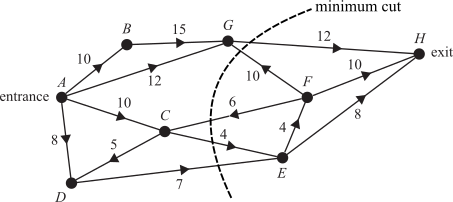
One path in the maze is to be changed.
Determine the changes in the maximum flow capacity of the network in each of the following changes
--- 2 WORK AREA LINES (style=lined) ---
--- 2 WORK AREA LINES (style=lined) ---
--- 2 WORK AREA LINES (style=lined) ---
i. \(GH ↑ 16,\ \text{minimum cut = 27}\)
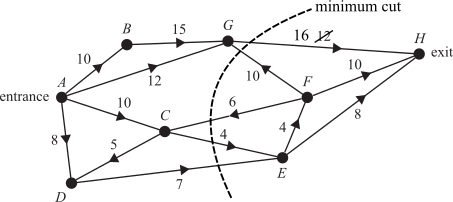
\(\text{Change: increases by 4}\)
ii. \(CE ↑ 12,\ \text{minimum cut = 24}\)
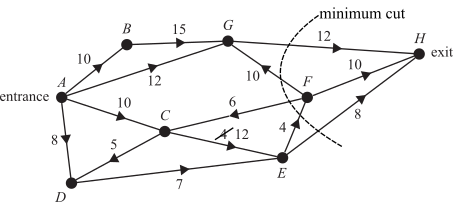
\(\text{Change: increases by 1}\)
iii. \(GF\ \text{is reversed, minimum cut = 30 (close to exit H)}\)
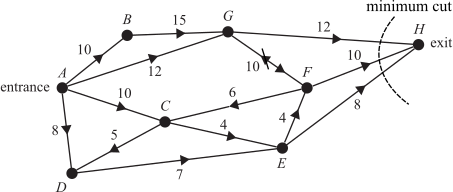
\(\text{Change: increases by 7}\)
The network below shows the one-way paths between the entrance, \(A\), and the exit, \(H\), of a children's maze.
The vertices represent the intersections of the one-way paths.
The number on each edge is the maximum number of children who are allowed to travel along that path per minute.
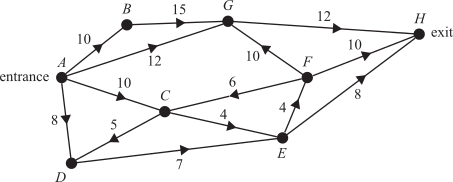
Cuts on this network are used to consider the possible flow of children through the maze.
Determine the capacity of the minimum cut of this network. (2 marks)
--- 3 WORK AREA LINES (style=lined) ---
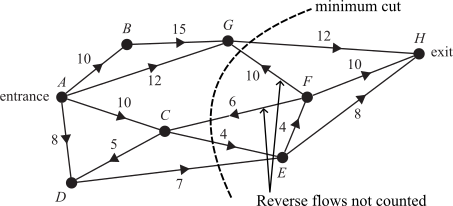
\(\text{Minimum cut}\ = 12+4+7 = 23\)
The network below shows the one-way paths between the entrance, \(A\), and the exit, \(H\), of a children's maze.
The vertices represent the intersections of the one-way paths.
The number on each edge is the maximum number of children who are allowed to travel along that path per minute.
Question 39
Cuts on this network are used to consider the possible flow of children through the maze. The capacity of the minimum cut would be
Question 40
One path in the maze is to be changed.
Which one of these five changes would lead to the largest increase in flow from entrance to exit?
\(\text{Question 39} \)
\(\text{Minimum cut}\ = 12+4+7 = 23\)
\(\Rightarrow B\)
\(\text{Question 40}\)
\(CE ↑ 12,\ \text{minimum cut = 24}\)
\(FH ↑ 14,\ \text{minimum cut = 23}\)
\(GH ↑ 16,\ \text{minimum cut = 27}\)
\(CF\ \text{is reversed, minimum cut = 29}\)
\(GF\ \text{is reversed, minimum cut = 30 (close to exit H)}\)
\(\Rightarrow E\)
The adjacency matrix below represents a planar graph with five vertices.
\begin{aligned}
& \ \ \ J\ \ \ K\ \ \ L\ \ M\ \ N \\
& {\left[\begin{array}{lllll}
0 & 1 & 0 & 1 & 1 \\
1 & 0 & 2 & 1 & 1 \\
0 & 2 & 0 & 1 & 1 \\
1 & 1 & 1 & 0 & 1 \\
1 & 1 & 1 & 1 & 0
\end{array}\right] \begin{array}{l}
J \\
K \\
L \\
M \\
N
\end{array}} \\
\end{aligned}
The number of faces on the planar graph is
\(\text{Sketch network:}\)
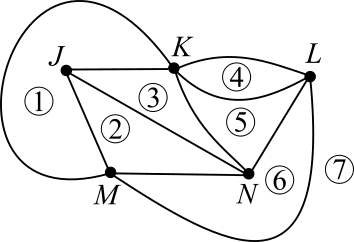
\(\Rightarrow B\)
Four employees, Anthea, Bob, Cho and Dario, are each assigned a different duty by their manager.
The time taken for each employee to complete duties 1,2,3 and 4, in minutes, is shown in the table below
\begin{array} {|l|c|c|c|c|}
\hline \rule{0pt}{2.5ex} \text{} \rule[-1ex]{0pt}{0pt} & \text{Duty 1} & \text{Duty 2} & \text{Duty 3} & \text{Duty 4} \\
\hline \rule{0pt}{2.5ex} \text{Anthea} \rule[-1ex]{0pt}{0pt} & \text{8} & \text{7} & \text{7} & \text{8}\\
\hline \rule{0pt}{2.5ex} \text{Bob} \rule[-1ex]{0pt}{0pt} & \text{10} & \text{8} & \text{10} & \text{9}\\
\hline \rule{0pt}{2.5ex} \text{Cho} \rule[-1ex]{0pt}{0pt} & \text{8} & \text{9} & \text{7} & \text{10}\\
\hline \rule{0pt}{2.5ex} \text{Dario} \rule[-1ex]{0pt}{0pt} & \text{7} & \text{7} & \text{8} & \text{9}\\
\hline
\end{array}
The manager allocates the duties so as to minimise the total time taken to complete the four duties.
The minimum total time taken to complete the four duties, in minutes, is
For one particular week in a school year, students at Phyllis Island Primary School can spend their lunch break at the playground \((P)\), basketball courts \((B)\), oval \((O)\) or the library \((L)\).
Students stay at the same location for the entire lunch break.
The transition diagram below shows the proportion of students who change location from one day to the next.
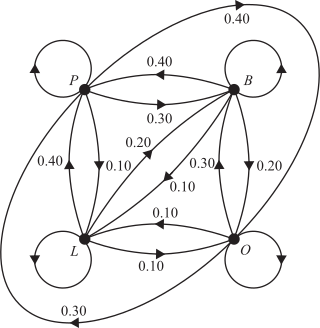
The transition diagram is incomplete.
On the Monday, 150 students spent their lunch break at the playground, 50 students spent it at the basketball courts, 220 students spent it at the oval, and 40 students spent it in the library.
Of the students expected to spend their lunch break on the oval on the Wednesday, the percentage of these students who also spent their lunch break on the oval on Tuesday is closest to
A species of bird has a life span of three years.
The females in this species do not reproduce in their first year but produce an average of four female offspring in their second year, and three in their third year.
The Leslie matrix, \(L\), below is used to model the female population distribution of this species of bird.
\(L=\begin{bmatrix}
0 & 4 & 3\\
0.2 & 0 & 0\\
0 & 0.4 & 0
\end{bmatrix}\)
The element in the second row, first column states that on average 20% of this population will
How many of the following statements are true?
--- 8 WORK AREA LINES (style=lined) ---
\( e^{n^2+n}>(n !)^2 .\) (3 marks)
--- 11 WORK AREA LINES (style=lined) ---
Complete the table below, describing the reactivity characteristics of the three metals listed. (3 marks)
\begin{array} {|l|l|l|l|}
\hline
\ \ \ \ \textbf{Metal} \ & \ \ \ \ \textbf{Reactivity with} \ \ \ \ &\ \ \ \ \textbf{Reactivity with}\ \ \ \ & \ \ \ \ \textbf{Reactivity with}\ \ \ \ \ \ \\ & \ \ \ \ \ \ \ \ \ \ \ \textbf{water} & \ \ \ \ \ \ \ \ \textbf{dilute acid} & \ \ \ \ \ \ \ \ \textbf{oxygen}\\
\hline
\rule{0pt}{2.5ex} \rule[-1ex]{0pt}{0pt} & & & \\ \rule{0pt}{2.5ex} \text{Potassium (K)} \rule[-1ex]{0pt}{0pt} & & & \\ & & & \\
\hline
\rule{0pt}{2.5ex} \rule[-1ex]{0pt}{0pt} & & & \\ \rule{0pt}{2.5ex} \text{Zinc (Zn)} \rule[-1ex]{0pt}{0pt} & & & \\ & & & \\
\hline
\rule{0pt}{2.5ex} \rule[-1ex]{0pt}{0pt} & & & \\ \rule{0pt}{2.5ex} \text{Copper (Cu)} \rule[-1ex]{0pt}{0pt} & & & \\ & & & \\
\hline
\end{array}
--- 0 WORK AREA LINES (style=lined) ---
Metals such as Lead, Copper, Mercury and Silver do not react with dilute acids but will react with the same acids at higher concentration levels.
Explain why this occurs with reference to first ionisation energy. (3 marks)
--- 6 WORK AREA LINES (style=lined) ---
In a laboratory, students reacted aluminium with water to produce an oxide and hydrogen gas.
Which of the following equations correctly represents this reaction.
Two moles of butane \(\ce{C3H8(g)}\) were reacted with 224 grams of oxygen \(\ce{O2(g)}\).
--- 6 WORK AREA LINES (style=lined) ---
--- 2 WORK AREA LINES (style=lined) ---
The following recurrence relation models the value, \(P_n\), of a perpetuity after \(n\) time periods.
\(P_0=a, \quad P_{n+1}=R P_n-d\)
The value of \(R\) can be found by calculating
Timmy took out a reducing balance loan of $500 000, with interest calculated monthly.
The balance of the loan, in dollars, after \(n\) months, \(T_n\), can be modelled by the recurrence relation
\(T_0=500\ 000, \quad T_{n+1}=1.00325 T_n-2611.65\)
A final repayment that will fully repay the loan to the nearest cent is
For taxation purposes, Audrey depreciates the value of her $3000 computer over a four-year period. At the end of the four years, the value of the computer is $600.
Question 20
If Audrey uses flat rate depreciation, the depreciation rate, per annum is
Question 21
If Audrey uses reducing balance depreciation, the depreciation rate, per annum is closest to
The number of visitors each month to a zoo is seasonal.
To correct the number of visitors in January for seasonality, the actual number of visitors, to the nearest percent, is increased by 35%.
The seasonal index for that month is closest to
The number of visitors to a public library each day for 10 consecutive days was recorded.
These results are shown in the table below.
\begin{array} {|l|c|c|c|c|c|c|c|c|c|}
\hline
\rule{0pt}{2.5ex} \textbf{Day number} \rule[-1ex]{0pt}{0pt} & 1 & 2 & 3 & 4 & 5 & 6 & 7 & 8 & 9 & 10 \\
\hline
\rule{0pt}{2.5ex} \textbf{Number of visitors} \rule[-1ex]{0pt}{0pt} & 337 & 317 & 313 & 335 & 322 & 335 & 322 & 338 & 302 & 349 \\
\hline
\end{array}
The eight-mean smoothed number of visitors with centring for day number 6 is
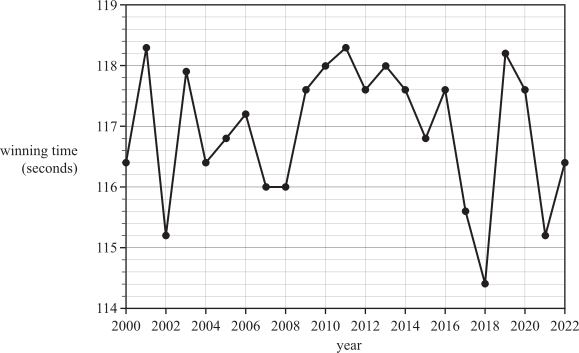
The following graph shows a selection of winning times, in seconds, for the women's 800 m track event from various athletic events worldwide. The graph shows one winning time for each calendar year from 2000 to 2022.
Question 13
The time series is smoothed using seven-median smoothing.
The smoothed value for the winning time in 2006, in seconds, is closest to
Question 14
The median winning time, in seconds, for all the calendar years from 2000 to 2022 is closest to
A least squares line can be used to model the birth rate (children per 1000 population) in a country from the average daily food energy intake (megajoules) in that country.
When a least squares line is fitted to data from a selection of countries it is found that:
The slope of this least squares line is closest to
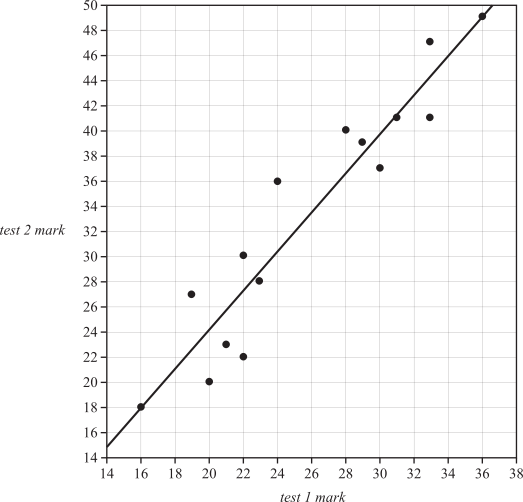
A teacher analysed the class marks of 15 students who sat two tests.
The test 1 mark and test 2 mark, all whole number values, are shown in the scatterplot below.
A least squares line has been fitted to the scatterplot.
Question 7
The equation of the least squares line is closest to
Question 8
The least squares line shows the predicted test 2 mark for each student based on their test 1 mark.
The number of students whose actual test 2 mark was within two marks of that predicted by the line is
The heights of a group of Year 8 students have a mean of $163.56 cm and a standard deviation of $8.14 cm.
One student's height has a standardised \(z\)-score of –0.85 .
This student's height, in centimetres, is closest to
In the system diagram below, a 5-kilogram mass and masses \(A\) and \(B\) are held by high tensile frictionless wire in static equilibrium.
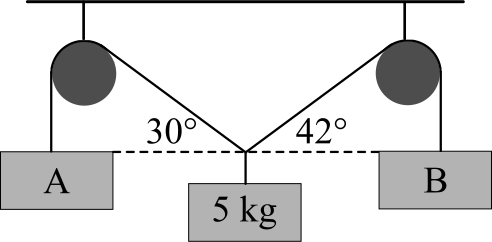
Using a vector diagram, calculate the masses of both \(A\) and \(B\). (4 mark)
--- 8 WORK AREA LINES (style=blank) ---
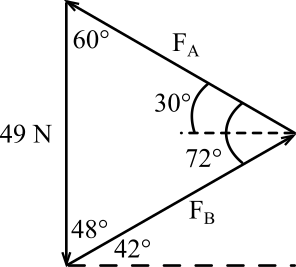
Using the sin rule both \(F_B\) and \(F_A\) can be calculated:
| \(\dfrac{F_A}{\sin 48^{\circ}}\) | \(=\dfrac{5 \times 9.8}{\sin 72^{\circ}}\) | |
| \(F_A\) | \(=\dfrac{49\,\sin 48^{\circ}}{\sin 72^{\circ}}=38.3\ \text{N}\) |
\(\text{Mass}_A =\dfrac{F}{a}=\dfrac{38.3}{9.8}=3.91\ \text{kg}\)
| \(\dfrac{F_B}{\sin 60^{\circ}}\) | \(=\dfrac{49}{\sin 72^{\circ}}\) |
| \(F_B\) | \(=\dfrac{49\, \sin 60^{\circ}}{\sin 72^{\circ}}=44.6\ \text{N}\) |
\(\text{Mass}_B =\dfrac{F}{a}=\dfrac{44.6}{9.8}=4.55\ \text{kg}\)
Outline and explain the process by which ferromagnetic materials can become magnetised using a bar magnet. (3 marks)
--- 8 WORK AREA LINES (style=blank) ---
A wire with a current of \(I\) amps running through it was measured to have a magnetic field strength of 2 × 10\(^{-3}\) T at a distance of \( r\) metres from the wire.
If the current through the wire is halved and the distance \(r\) is increased to \(3r\), find the new magnetic field strength measured. (2 marks)
--- 4 WORK AREA LINES (style=blank) ---
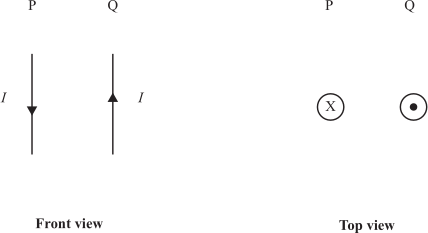
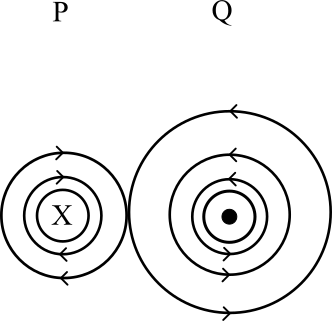
Two long, straight current-carrying wires, \(\text{P}\) and \(\text{Q}\), are parallel, as shown below. The current in the wires is the same in magnitude and opposite in direction. The Top View diagram below shows the wires as viewed from above. On the Top View diagram, sketch the magnetic field around the wires, showing the direction of the magnetic field. Use at least five field lines. (3 marks) --- 0 WORK AREA LINES (style=blank) ---
 Show Answers Only
 Show Worked Solution
♦ Mean mark 48%.
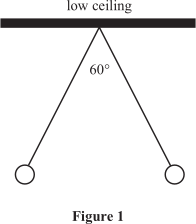
Some physics students are conducting an experiment investigating both electrostatic and gravitational forces. They suspend two equally charged balls, each of mass 4.0 g, from light, non-conducting strings suspended from a low ceiling. The charged balls repel each other with the strings at an angle of 60°, as shown in Figure 1. There are three forces acting on each ball: --- 0 WORK AREA LINES (style=lined) --- --- 5 WORK AREA LINES (style=lined) --- --- 6 WORK AREA LINES (style=lined) --- a. \(F_g = 9.8 \times 4 \times 10^{-3} = 3.92 \times 10^{-2}\ \text{N}\) a. \(F_g = 9.8 \times 4 \times 10^{-3} = 3.92 \times 10^{-2}\ \text{N}\) c. Using the same triangle as part (b):
Show Answers Only
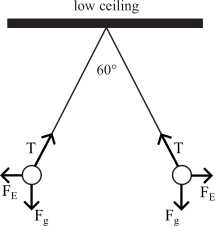
b. System is in an equilibrium state:
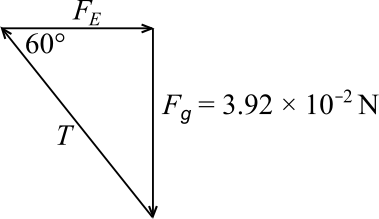
\(\sin\,60^{\circ}\)
\(=\dfrac{3.92 \times 10^{-2}}{T}\)
\(T\)
\(=\dfrac{3.92 \times 10^{-2}}{\sin\,60^{\circ}}=4.5 \times 10^{-2}\ \text{N}\)
c. Using the same triangle as part (b):
\(\tan\,60^{\circ}\)
\(=\dfrac{3.92 \times 10^{-2}}{F_E}\)
\(F_E\)
\(=\dfrac{3.92 \times 10^{-2}}{\tan\,60^{\circ}}=2.3 \times 10^{-2}\ \text{N}\)
Show Worked Solution
b. System is in an equilibrium state:
\(\sin\,60^{\circ}\)
\(=\dfrac{3.92 \times 10^{-2}}{T}\)
\(T\)
\(=\dfrac{3.92 \times 10^{-2}}{\sin\,60^{\circ}}=4.5 \times 10^{-2}\ \text{N}\)
\(\tan\,60^{\circ}\)
\(=\dfrac{3.92 \times 10^{-2}}{F_E}\)
\(F_E\)
\(=\dfrac{3.92 \times 10^{-2}}{\tan\,60^{\circ}}=2.3 \times 10^{-2}\ \text{N}\)
♦ Mean mark 41%.
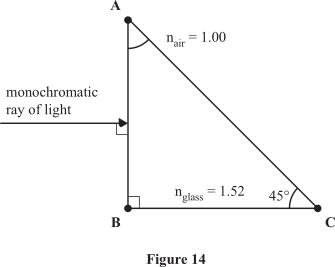
A ray of monochromatic light is incident on a triangular glass prism with a refractive index of 1.52 . The ray is perpendicular to the side \(\text{AB}\) of the glass prism, as shown in the diagram below. The ray of light travels through the glass prism before reaching side \(\text{AC}\). --- 4 WORK AREA LINES (style=lined) --- --- 4 WORK AREA LINES (style=lined) ---
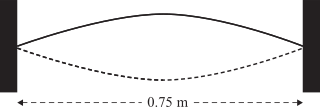
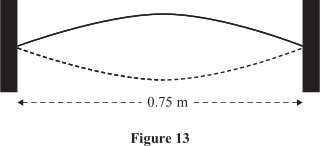
A guitar string of length 0.75 m and fixed at both ends is plucked and a standing wave is produced. The envelope of the standing wave is shown in the diagram.
The speed of the wave along the string is 393 m s\( ^{-1}\).
--- 2 WORK AREA LINES (style=lined) ---
--- 3 WORK AREA LINES (style=lined) ---
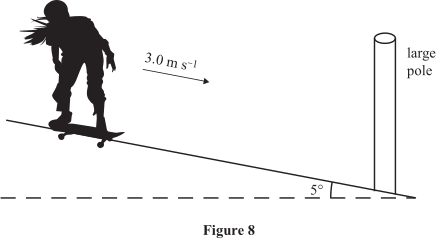
Maia is at a skatepark. She stands on her skateboard as it rolls in a straight line down a gentle slope at a constant speed of 3.0 m s\(^{-1}\), as shown in the figure below. The slope is 5° to the horizontal. The combined mass of Maia and the skateboard is 65 kg. --- 0 WORK AREA LINES (style=lined) --- --- 5 WORK AREA LINES (style=lined) --- Near the bottom of the ramp, Maia takes hold of a large pole and comes to a complete rest while still standing on the skateboard. Maia and the skateboard now have no momentum or kinetic energy. --- 3 WORK AREA LINES (style=lined) --- a. b. 55.5 N c. Momentum: Kinetic energy: a. b. Total frictional forces: c. Momentum: Kinetic energy:
Show Answers Only

Show Worked Solution
\(F_{\text{down slope}}\)
\(=F_f\)
\(=mg\, \sin\, \theta\)
\(=65 \times 9.8 \times \sin\,5^{\circ}\)
\(=55.5\ \text{N}\)
♦ Mean mark (b) 50%.
♦♦♦ Mean mark (c) 26%.
The diagram below shows the force versus time graph of the force on a tennis ball when it is hit by a tennis racquet. The tennis ball is stationary when the tennis racquet first comes into contact with the ball.
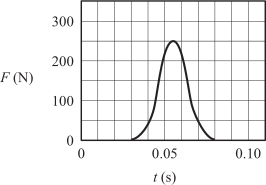
Which one of the following is closest to the impulse experienced by the tennis ball as it is hit by the tennis racquet?
The diagram below shows two charges, \(Q_1\) and \(Q_2\), separated by a distance, \(d\).

There is a force, \(F\), acting between the two charges.
Which one of the following is closest to the magnitude of the force acting between the two charges if both \(d\) and the charge on \(Q_1\) are halved?
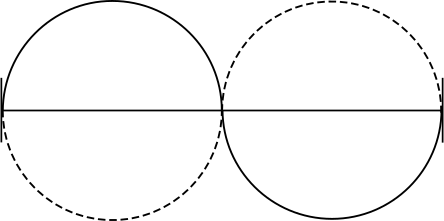
Standing waves are formed on a string of length 4.0 m that is fixed at both ends. The speed of the waves is 240 m s\(^{-1}\). --- 3 WORK AREA LINES (style=lined) --- --- 3 WORK AREA LINES (style=lined) --- --- 6 WORK AREA LINES (style=lined) --- a. 30 Hz b. 60 Hz c. Standing waves: a. Lowest frequency resonance: b. When \(\lambda = 4: \) \(f=\dfrac{v}{\lambda}=\dfrac{240}{4}=60\ \text{Hz}\) c. Standing waves:
Show Answers Only
 Show Worked Solution
♦ Mean mark (c) 43%.
The enthalpies of formation for a number of chemical reactions are as follows:
\(\ce{C6H12O6(s)}\) \(\Delta H^{\circ}_f = -1271\ \text{kJmol}^{-1}\)
\(\ce{C2H5OH(aq)}\) \(\Delta H^{\circ}_f = -277.7\ \text{kJmol}^{-1}\)
\(\ce{CO2(g)}\) \(\Delta H^{\circ}_f = -393.5\ \text{kJmol}^{-1}\)
Calculate the enthalpy change for the fermentation of glucose (reaction below) using the enthalpies of formation above.
\(\ce{C6H12O6(s) \rightarrow 2C2H5OH(aq) + 2CO2(g)}\) (3 marks)
--- 6 WORK AREA LINES (style=lined) ---
--- 2 WORK AREA LINES (style=lined) ---
--- 6 WORK AREA LINES (style=lined) ---
Three unknown metals are reacted with dilute \(\ce{HCl(aq)}\) and the following observations are made:
\begin{array} {|c|l|}
\hline
\rule{0pt}{2.5ex} \textit{Metal} \rule[-1ex]{0pt}{0pt} & \ \ \ \ \ \ \textit{Observations} \\
\hline
\rule{0pt}{2.5ex} \text{A} \rule[-1ex]{0pt}{0pt} & \text{No observable reaction} \\
\hline
\rule{0pt}{2.5ex} \text{B} \rule[-1ex]{0pt}{0pt} & \text{Slow bubbling} \\
\hline
\rule{0pt}{2.5ex} \text{C} \rule[-1ex]{0pt}{0pt} & \text{Fast, abrupt bubbling} \\
\hline
\end{array}
You are told that the metals in question are Magnesium, Platinum and Zinc.
--- 6 WORK AREA LINES (style=lined) ---
--- 1 WORK AREA LINES (style=lined) ---
--- 1 WORK AREA LINES (style=lined) ---
A transition duct is shown.
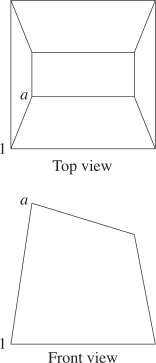
What is the true angle of the line \(1-a\) to the horizontal plane?
Climate change is altering the Earth’s habitats and ecosystems, putting many species at risk of global population reductions or extinction.
Justify this statement, giving real world examples of climate change. (5 marks)
--- 10 WORK AREA LINES (style=lined) ---
A rail switch lever is shown.
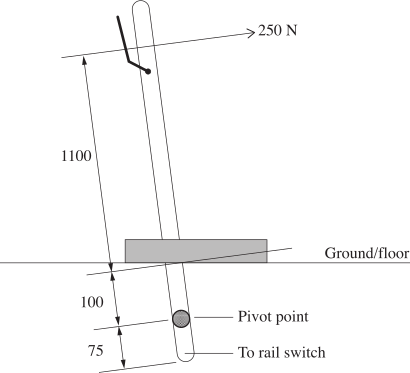
What is the calculated mechanical advantage when operating this rail switch lever?
The landing gear on an aircraft uses a hydraulic braking system. A force of 60 N is applied at the master cylinder with a piston diameter of 12 mm.
What is the force at the brake calliper with a piston diameter of 42 mm ?
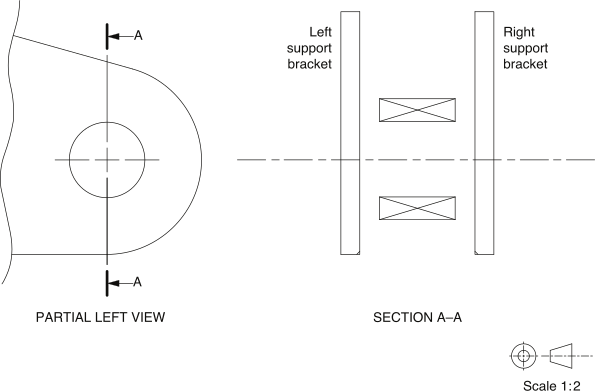
A portion of a roller coaster wheel sub-assembly is shown. An exploded pictorial of the wheel sub-assembly is shown. Complete an assembled sectioned front view of the wheel sub-assembly at scale 1: 2. Apply AS 1100 drawing standards. Do NOT add dimensions. (6 marks) --- 0 WORK AREA LINES (style=lined) ---
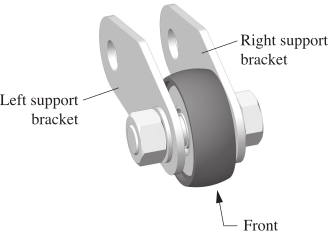
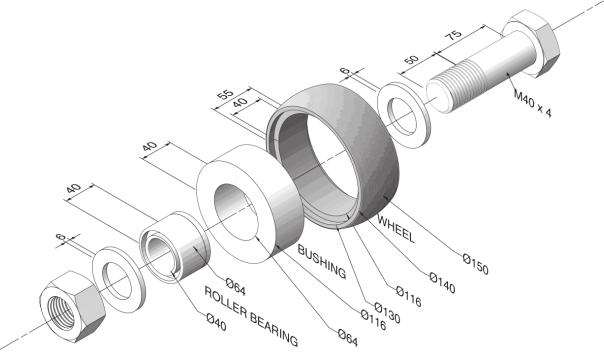
 Show Answers Only
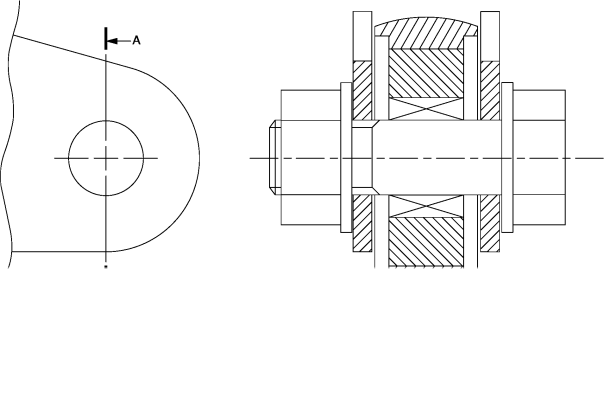 Show Worked Solution
♦ Mean mark 49%.
The enthalpies of reaction of a number of chemical reactions are as follows:
Reaction 1: \(\ce{C2H2(g) + \frac{5}{2}O2(g) \rightarrow 2CO2(g) + H2O(l)}\) \(\Delta H_1=-1299.5\ \text{kJ mol}^{-1}\)
Reaction 2: \(\ce{C(s) + O2(g) \rightarrow CO2(g)}\) \(\Delta H_2=-393.5\ \text{kJ mol}^{-1}\)
Reaction 3: \(\ce{H2(g) + \frac{1}{2}O2(g) \rightarrow H2O(l)}\) \(\Delta H_3=-285.8\ \text{kJ mol}^{-1}\)
Calculate the enthalpy change for the reaction below, stating whether the reaction is exothermic or endothermic:
\(\ce{2C(s) + H2(g) \rightarrow C2H2(g)}\) \(\Delta H_4=?\) (4 marks)
--- 7 WORK AREA LINES (style=lined) ---
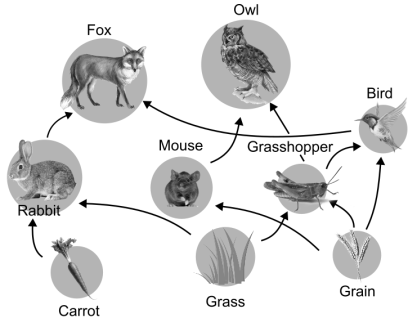
--- 1 WORK AREA LINES (style=lined) ---
--- 2 WORK AREA LINES (style=lined) ---
--- 6 WORK AREA LINES (style=lined) ---
Which of the following is a recognised impact test?
Why did steel replace cast iron in bridges built after 1850 ?
A truss is loaded as shown.
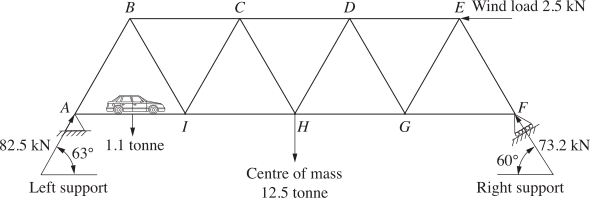
Showing working, complete the table. (6 marks)
\begin{array} {|l|c|c|}
\hline
\rule{0pt}{2.5ex} \rule[-1ex]{0pt}{0pt} & \textit{Magnitude} & \textit{Nature of force}\\ & \text{(kN)} & \text{(T or C)} \\
\hline
\rule{0pt}{2.5ex} \text{Internal reaction of member}\ EF \rule[-1ex]{0pt}{0pt} & 73.2\ \text{kN} & \text{Compression} \\
\hline
\rule{0pt}{2.5ex} \text{Internal reaction of member}\ CH \rule[-1ex]{0pt}{0pt} & 71.138\ \text{kN} & \text{Tension} \\
\hline
\end{array}
\(\text{Consider member}\ EF:\)
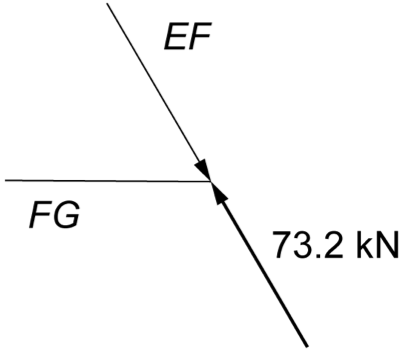
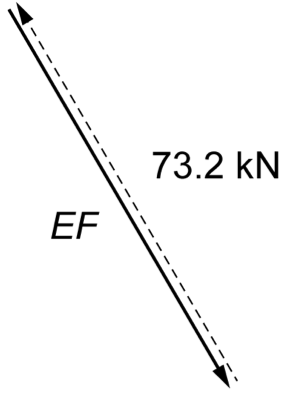
\(\text{Consider member}\ CH:\)
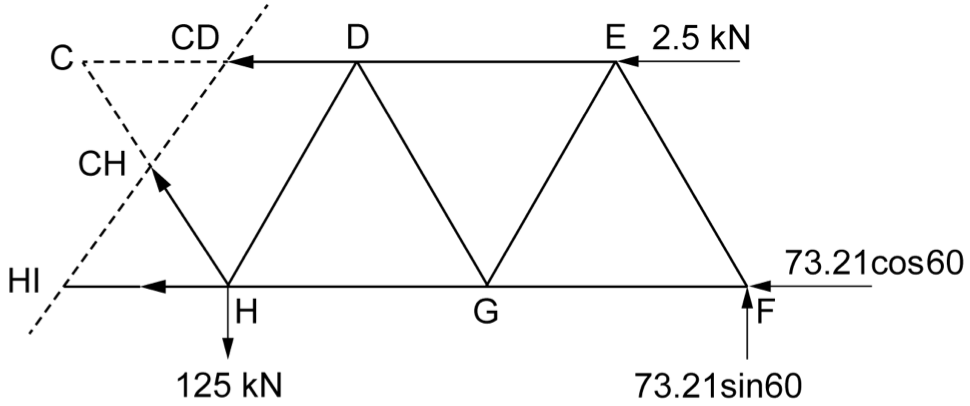
| \(+ \uparrow \Sigma F_{V}\) | \(=0\) | |
| \(0\) | \(=-125 + 73.2 \times \sin\,60^{\circ} + CH \times \sin\,60^{\circ}\) | |
| \(CH \times \sin\,60^{\circ}\) | \(=61.607\) | |
| \(CH\) | \(= \dfrac{61.607}{\sin\,60^{\circ}} =71.138\ \text{kN (tension)} \) |
A component of a roller coaster car bogie is to be punched out from a 10 mm thick rectangular plate of mild steel as shown.
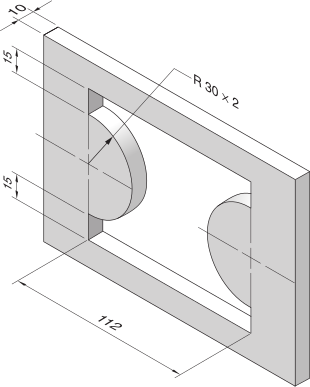
Calculate the shear force of the punching die if the shear stress is 345 MPa. (3 marks)
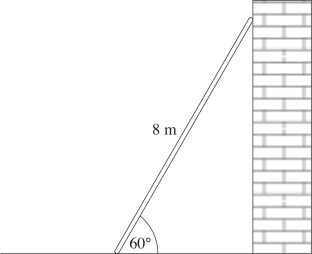
A uniform 8-metre ladder with a mass of 12 kg has been placed against a smooth wall. Determine the minimum coefficient of static friction between the ground and the ladder. Assume there is no friction between the ladder and the wall. (4 marks) --- 5 WORK AREA LINES (style=lined) ---
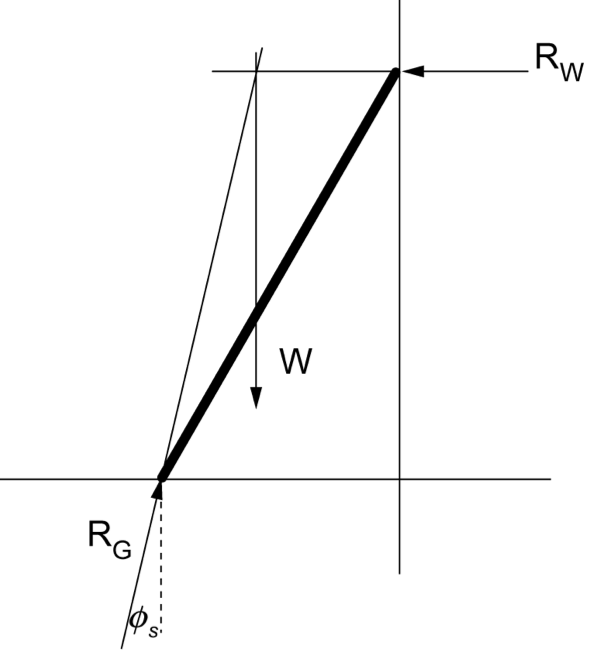
Graphical solution: \(\phi = 16^{\circ}\) \(\mu = \tan \phi = \tan 16^{\circ} = 0.287\ \text{(3 d.p.)}\) Analytical solution: \(\cos 60^{\circ} = \dfrac{\text{d}_1}{4}\ \Rightarrow \ \text{d}_1 = 2\ \text{m} \) \(\sin 60^{\circ} = \dfrac{\text{d}_2}{8}\ \Rightarrow \ \text{d}_2 = 6.928\ \text{m} \) \(\text{F}_{\text{g}}=mg=120\ \text{N}\)
 Show Worked Solution
 ♦♦ Mean mark 31%.
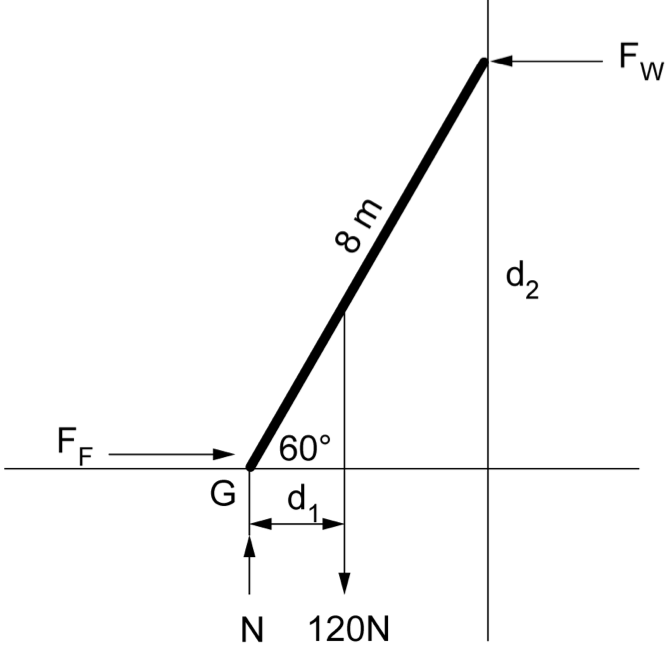
\( \Sigma \text{M}_{\text{G}} \)
\(=0\)
\(0\)
\(=(120 \times 2)-(\text{F}_{\text{W}} \times 6.928) \)
\(\text{F}_{\text{W}}\)
\(=\dfrac{240}{6.928}= 34.64\ \text{N}\)
\(\therefore \text{F}_{\text{F}} = 34.64 \text{ N}\)
\(\therefore \text{N} = 120 \text{N}\uparrow \)
\(\text{F}_{\text{F}}\)
\(= \mu \text{N}\)
\(\mu\)
\(= \dfrac{34.64}{120}=0.289\ \text{(3 d.p.)} \)
Outline how GPS satellites determine a position on the planet. (2 marks) --- 4 WORK AREA LINES (style=lined) ---
Explain the functions of a transistor in an electrical circuit. (3 marks) --- 7 WORK AREA LINES (style=lined) ---
Describe the process of compression moulding when used to manufacture aircraft components. (3 marks) --- 7 WORK AREA LINES (style=lined) ---