Within the circus, there are different types of employees: directors \((D)\), managers \((M)\), performers \((P)\) and sales staff \((S).\) Customers \((C)\) attend the circus. Communication between the five groups depends on whether they are customers or employees, and on what type of employee they are. Matrix \(G\) below shows the communication links between the five groups. \begin{aligned} In this matrix: --- 2 WORK AREA LINES (style=lined) --- \begin{aligned} --- 0 WORK AREA LINES (style=lined) --- --- 2 WORK AREA LINES (style=lined) ---
&\quad \quad \quad\quad \quad \quad\quad \quad \quad \ \ \textit{receiver}\\
&\quad \quad\quad \quad \quad\quad \quad \quad D \ \ M \ \ P \ \ \ S \ \ \ C \\
& G=\textit{sender} \quad \begin{array}{ccccc}
D\\
M\\
P\\
S\\
C
\end{array}
\begin {bmatrix}
0 & 1 & 1 & 1 & 1 \\
1 & 0 & 1 & 1 & 1 \\
0 & 1 & 0 & 0 & 0 \\
0 & 1 & 0 & 0 & 1 \\
0 & 0 & 0 & 1 & 0
\end{bmatrix}\\
&
\end{aligned}
&\quad \quad \quad\quad \quad \quad\quad \quad \quad \ \ \textit{receiver}\\
&\quad \quad\quad \quad \quad\quad \quad \quad D \quad M \quad P \quad \ S \quad \ C \\
& H=\textit{sender} \quad \begin{array}{ccccc}
D\\
M\\
P\\
S\\
C
\end{array}
\begin {bmatrix} {\displaystyle}
1 & \rule{0.5cm}{0.15mm} & \rule{0.5cm}{0.15mm} & \rule{0.5cm}{0.15mm} & \rule{0.5cm}{0.15mm} \\
0 & \rule{0.5cm}{0.15mm} & \rule{0.5cm}{0.15mm} & \rule{0.5cm}{0.15mm} & \rule{0.5cm}{0.15mm} \\
1 & \rule{0.5cm}{0.15mm} & \rule{0.5cm}{0.15mm} & \rule{0.5cm}{0.15mm} & \rule{0.5cm}{0.15mm} \\
1 & \rule{0.5cm}{0.15mm} & \rule{0.5cm}{0.15mm} & \rule{0.5cm}{0.15mm} & \rule{0.5cm}{0.15mm} \\
0 & 1 & 0 & 0 & 1
\end{bmatrix}\\
&
\end{aligned}
Matrices, GEN2 2023 VCAA 9
The circus is held at five different locations, \(E, F, G, H\) and \(I\).
The table below shows the total revenue for the ticket sales, rounded to the nearest hundred dollars, for the last 20 performances held at each of the five locations.
\begin{array} {|l|c|}
\hline
\rule{0pt}{2.5ex} \textbf{Location} \rule[-1ex]{0pt}{0pt} & E & F & G & H & I \\
\hline
\rule{0pt}{2.5ex} \textbf{Ticket Sales} \rule[-1ex]{0pt}{0pt} & \$960\ 000 & \$990\ 500 & \$940\ 100 & \$920\ 800 & \$901\ 300 \\
\hline
\end{array}
The ticket sales information is presented in matrix \(R\) below.
\(R=\begin{bmatrix}
960\ 000 & 990\ 500 & 940\ 100 & 920\ 800 & 901\ 300
\end{bmatrix}\)
- Complete the matrix equation below that calculates the average ticket sales per performance at each of the five locations. (1 mark)
--- 0 WORK AREA LINES (style=lined) ---
\(\begin {bmatrix}\rule{2cm}{0.25mm} \end {bmatrix}\times R = \begin {bmatrix}\rule{2cm}{0.25mm} &\rule{2cm}{0.25mm} &\rule{2cm}{0.25mm} &\rule{2cm}{0.25mm} &\rule{2cm}{0.25mm} \end {bmatrix}\)
The circus would like to increase its total revenue from the ticket sales from all five locations.
The circus will use the following matrix calculation to target the next 20 performances.
\( [t] \times R \times \begin{bmatrix}
1 \\
1 \\
1 \\
1 \\
1
\end{bmatrix}\)
- Determine the value of \(t\) if the circus would like to increase its revenue from ticket sales by 25%. (1 mark)
--- 2 WORK AREA LINES (style=lined) ---
The circus moves from one location to the next each month. It rotates through each of the five locations, before starting the cycle again.
The following matrix displays the movement between the five locations.
\begin{aligned}
& \quad \ \ \ this \ month\\
& \ \ \ E \ \ \ F \ \ \ G \ \ \ H \ \ \ I \\
& \begin{bmatrix}
0 & 0 & 0 & 1 & 0 \\
0 & 0 & 1 & 0 & 0 \\
1 & 0 & 0 & 0 & 0 \\
0 & 0 & 0 & 0 & 1 \\
0 & 1 & 0 & 0 & 0
\end{bmatrix} \begin{array}{ll}
E & \\
F\\
G & \ \ next \ month \\
H & \\
I
\end{array}\\
&
\end{aligned}
- The circus started in town \(I\).
- What is the order in which the circus will visit the five towns? (1 mark)
--- 2 WORK AREA LINES (style=lined) ---
Matrices, GEN2 2023 VCAA 8
A circus sells three different types of tickets: family \((F)\), adult \((A)\) and child \((C)\).
The cost of admission, in dollars, for each ticket type is presented in matrix \(N\) below.
\(N=\begin{bmatrix}
36 \\
15 \\
8
\end{bmatrix}\begin{aligned}
F \\
A \\
C
\end{aligned}\)
The element in row \(i\) and column \(j\) of matrix \(N\) is \(n_{i j}\).
- Which element shows the cost for one child ticket? (1 mark)
--- 1 WORK AREA LINES (style=lined) ---
- A family ticket will allow admission for two adults and two children.
- Complete the matrix equation below to show that purchasing a family ticket could give families a saving of $10. (1 mark)
--- 0 WORK AREA LINES (style=lined) ---
\(\displaystyle{\begin {bmatrix} 0 &2&2 \end {bmatrix} \times N - \begin{bmatrix} \rule{1cm}{0.25mm} & \rule{1cm}{0.25mm} & \rule{1cm}{0.25mm} \end {bmatrix} \times N = \left[ 10\right]}\)
- On the opening night, the circus sold 204 family tickets, 162 adult tickets and 176 child tickets.
- The owners of the circus want a 3 × 1 product matrix that displays the revenue for each ticket type: family, adult and child.
- This product matrix can be achieved by completing the following matrix multiplication.
\(K \times N=\begin{bmatrix}
7344 \\
2430 \\
1408
\end{bmatrix}\)
- Write down matrix \(K\). (1 mark)
--- 4 WORK AREA LINES (style=lined) ---
Financial Maths, GEN2 2023 VCAA 7
Arthur takes out a new loan of $60 000 to pay for an overseas holiday. Interest on this loan compounds weekly. The balance of the loan, in dollars, after \(n\) weeks, \(V_n\), can be determined using a recurrence relation of the form \(V_0=60\ 000, \quad V_{n+1}=1.0015\,V_n-d\) --- 2 WORK AREA LINES (style=lined) --- --- 2 WORK AREA LINES (style=lined) --- --- 3 WORK AREA LINES (style=lined) --- --- 3 WORK AREA LINES (style=lined) --- --- 2 WORK AREA LINES (style=lined) ---
Arthur fully repays the loan in five years. Round your answer to the nearest cent. (1 mark)
Financial Maths, GEN2 2023 VCAA 6
Arthur invests $600 000 in an annuity that provides him with a monthly payment of $3973.00.
Interest is calculated monthly.
Three lines of the amortisation table for this annuity are shown below.
\begin{array} {|c|c|}
\hline
\textbf{Payment} & \textbf{Payment} & \textbf{Interest} & \textbf{Principal reduction} & \textbf{Balance} \\
\textbf{number} & \textbf{(\$) } & \textbf{(\$) } & \textbf{(\$) } & \textbf{(\$) }\\
\hline
\rule{0pt}{2.5ex} 0 \rule[-1ex]{0pt}{0pt} & 0.00 & 0.00 & 0.00 & 600\ 000.00 \\
\hline
\rule{0pt}{2.5ex} 1 \rule[-1ex]{0pt}{0pt} & 3973.00 & 2520.00 & 1453.00& 598\ 547.00\\
\hline
\rule{0pt}{2.5ex} 2 \rule[-1ex]{0pt}{0pt} & 3973.00 & 2513.90 & 1459.10 & 597\ 087.90 \\
\hline
\end{array}
- The interest rate for the annuity is 0.42% per month.
- Determine the interest rate per annum. (1 mark)
--- 2 WORK AREA LINES (style=lined) ---
- Using the values in the table, complete the next line of the amortisation table.
- Write your answers in the spaces provided in the table below.
- Round all values to the nearest cent. (1 mark)
--- 0 WORK AREA LINES (style=lined) ---
\begin{array} {|c|c|}
\hline
\textbf{Payment} & \textbf{Payment} & \textbf{Interest} & \textbf{Principal reduction} & \textbf{Balance} \\
\textbf{number} & \textbf{(\$) } & \textbf{(\$) } & \textbf{(\$) } & \textbf{(\$) }\\
\hline
\rule{0pt}{2.5ex} 0 \rule[-1ex]{0pt}{0pt} & 0.00 & 0.00 & 0.00 & 600\ 000.00 \\
\hline
\rule{0pt}{2.5ex} 1 \rule[-1ex]{0pt}{0pt} & 3973.00 & 2520.00 & 1453.00& 598\ 547.00\\
\hline
\rule{0pt}{2.5ex} 2 \rule[-1ex]{0pt}{0pt} & 3973.00 & 2513.90 & 1459.10 & 597\ 087.90 \\
\hline
\rule{0pt}{2.5ex} 3 \rule[-1ex]{0pt}{0pt} & & & & \\
\hline
\end{array}
- Let \(V_n\) be the balance of Arthur's annuity, in dollars, after \(n\) months.
- Write a recurrence relation in terms of \(V_0, V_{n+1}\) and \(V_n\) that can model the value of the annuity from month to month. (1 mark)
--- 2 WORK AREA LINES (style=lined) ---
- The amortisation tables above show that the balance of the annuity reduces each month.
- If the balance of an annuity remained constant from month to month, what name would be given to this type of annuity? (1 mark)
--- 1 WORK AREA LINES (style=lined) ---
Financial Maths, GEN2 2023 VCAA 5
Arthur borrowed $30 000 to buy a new motorcycle. Interest on this loan is charged at the rate of 6.4% per annum, compounding quarterly. Arthur will repay the loan in full with quarterly repayments over six years. --- 1 WORK AREA LINES (style=lined) --- The balance of the loan, in dollars, after \(n\) quarters, \(A_n\), can be modelled by the recurrence relation \(A_0=30\ 000, \quad A_{n+1}=1.016 A_n-1515.18\) --- 4 WORK AREA LINES (style=lined) --- --- 3 WORK AREA LINES (style=lined) ---
Data Analysis, GEN2 2023 VCAA 4
The time series plot below shows the average monthly ice cream consumption recorded over three years, from January 2010 to December 2012.
The data for the graph was recorded in the Northern Hemisphere.
In this graph, month number 1 is January 2010, month number 2 is February 2010 and so on.
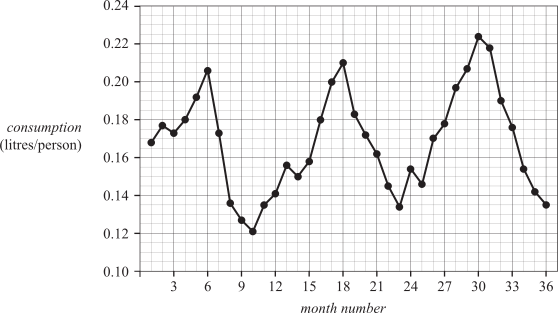
- Identify a feature of this plot that is consistent with this time series having a seasonal component. (1 mark)
--- 3 WORK AREA LINES (style=lined) ---
- The long-term seasonal index for April is 1.05
- Determine the deseasonalised value for average monthly ice cream consumption in April 2010 (month 4).
- Round your answer to two decimal places. (1 mark)
--- 2 WORK AREA LINES (style=lined) ---
- The table below shows the average monthly ice cream consumption for 2011 .
| Consumption (litres/person) | ||||||||||||
| Year | Jan | Feb | Mar | Apr | May | Jun | Jul | Aug | Sept | Oct | Nov | Dec |
| 2011 | 0.156 | 0.150 | 0.158 | 0.180 | 0.200 | 0.210 | 0.183 | 0.172 | 0.162 | 0.145 | 0.134 | 0.154 |
- Show that, when rounded to two decimal places, the seasonal index for July 2011 estimated from this data is 1.10. (2 marks)
--- 5 WORK AREA LINES (style=lined) ---
Data Analysis, GEN2 2023 VCAA 3
The scatterplot below plots the average monthly ice cream consumption, in litres/person, against average monthly temperature, in °C. The data for the graph was recorded in the Northern Hemisphere.
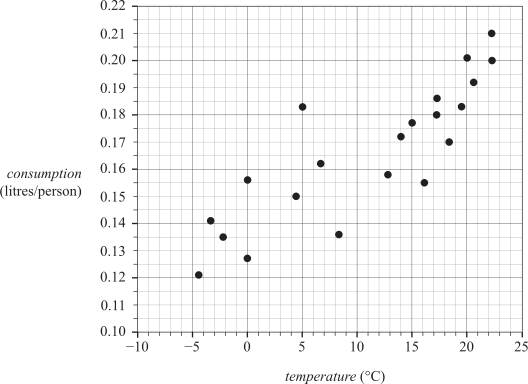
When a least squares line is fitted to the scatterplot, the equation is found to be:
consumption = 0.1404 + 0.0024 × temperature
The coefficient of determination is 0.7212
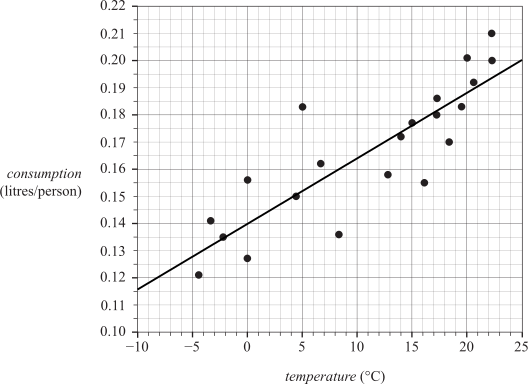
- Draw the least squares line on the scatterplot graph above. (1 mark)
--- 0 WORK AREA LINES (style=lined) ---
- Determine the value of the correlation coefficient \(r\).
- Round your answer to three decimal places. (1 mark)
--- 1 WORK AREA LINES (style=lined) ---
- Describe the association between average monthly ice cream consumption and average monthly temperature in terms of strength, direction and form. (1 mark)
--- 0 WORK AREA LINES (style=lined) ---
\begin{array} {|l|c|}
\hline
\rule{0pt}{2.5ex} \textbf{strength} \rule[-1ex]{0pt}{0pt} & \quad \quad \quad \quad \quad \quad \quad \quad \\
\hline
\rule{0pt}{2.5ex} \textbf{direction} \rule[-1ex]{0pt}{0pt} & \\
\hline
\rule{0pt}{2.5ex} \textbf{form} \rule[-1ex]{0pt}{0pt} & \\
\hline
\end{array} - Referring to the equation of the least squares line, interpret the value of the intercept in terms of the variables consumption and temperature. (1 mark)
--- 3 WORK AREA LINES (style=lined) ---
- Use the equation of the least squares line to predict the average monthly ice cream consumption, in litres per person, when the monthly average temperature is –6°C. (1 mark)
--- 2 WORK AREA LINES (style=lined) ---
- Write down whether this prediction is an interpolation or an extrapolation. (1 mark)
--- 1 WORK AREA LINES (style=lined) ---
Show Answers Only
a.
b. \(r = \sqrt{0.7212} = 0.849\ \text{(3 d.p.)}\)
c.
\begin{array} {|l|c|}
\hline
\rule{0pt}{2.5ex} \textbf{strength} \rule[-1ex]{0pt}{0pt} & \text{strong} \\
\hline
\rule{0pt}{2.5ex} \textbf{direction} \rule[-1ex]{0pt}{0pt} & \text{positive} \\
\hline
\rule{0pt}{2.5ex} \textbf{form} \rule[-1ex]{0pt}{0pt} & \text{linear} \\
\hline
\end{array}
d. \(\text{At 0°C, the predicted average consumption is:}\)
\(\textit{consumption} = 0.1404 + 0.002 \times 0 = 0.1404\ \text{L/person}\)
e. \(\text{Find consumption} (c)\ \text{when temperature} (t) = -6:\)
\(c=0.1404 + 0.002 \times -6 = 0.1284\ \text{L/person} \)
f. \(\text{Extrapolation (even though the axes extend to –6°C, the data set} \)
\(\text{range finishes with a lower limit around –4.5°C.)}\)
Show Worked Solution
a.
b. \(r = \sqrt{0.7212} = 0.849\ \text{(3 d.p.)}\)
c.
\begin{array} {|l|c|}
\hline
\rule{0pt}{2.5ex} \textbf{strength} \rule[-1ex]{0pt}{0pt} & \text{strong} \\
\hline
\rule{0pt}{2.5ex} \textbf{direction} \rule[-1ex]{0pt}{0pt} & \text{positive} \\
\hline
\rule{0pt}{2.5ex} \textbf{form} \rule[-1ex]{0pt}{0pt} & \text{linear} \\
\hline
\end{array}
d. \(\text{At 0°C, the predicted average consumption is:}\)
\(\textit{consumption} = 0.1404 + 0.002 \times 0 = 0.1404\ \text{L/person}\)
e. \(\text{Find consumption} (c)\ \text{when temperature} (t) = -6:\)
\(c=0.1404 + 0.002 \times -6 = 0.1284\ \text{L/person} \)
f. \(\text{Extrapolation (even though the axes extend to –6°C, the data set} \)
\(\text{range finishes with a lower limit around –4.5°C.)}\)
Networks, GEN1 2022 VCAA 7-8 MC
A project involves 11 activities, \(A\) to \(K\).
The table below shows the earliest start time and duration, in days, for each activity.
The immediate predecessor(s) of each activity is also shown.
\begin{array} {|c|c|c|}
\hline
\rule{0pt}{2.5ex} \ \ \textbf{Activity}\ \ & \textbf{Earliest} & \ \ \textbf{Duration}\ \ & \textbf{Immediate}\\
& \textbf{start time} \rule[-1ex]{0pt}{0pt} & &\textbf{predecessor}\\
\hline
\rule{0pt}{2.5ex} A \rule[-1ex]{0pt}{0pt} & \text{0} & \text{6} & \text{-}\\
\hline
\rule{0pt}{2.5ex} B \rule[-1ex]{0pt}{0pt} & \text{0} & \text{7} & \text{-}\\
\hline
\rule{0pt}{2.5ex} C \rule[-1ex]{0pt}{0pt} & \text{6} & \text{10} & A\\
\hline
\rule{0pt}{2.5ex} D \rule[-1ex]{0pt}{0pt} & \text{6} & \text{7} & A\\
\hline
\rule{0pt}{2.5ex} E \rule[-1ex]{0pt}{0pt} & \text{7} & \text{8} & B\\
\hline
\rule{0pt}{2.5ex} F \rule[-1ex]{0pt}{0pt} & \text{15} & \text{2} & D,\ E\\
\hline
\rule{0pt}{2.5ex} G \rule[-1ex]{0pt}{0pt} & \text{15} & \text{2} & E\\
\hline
\rule{0pt}{2.5ex} H \rule[-1ex]{0pt}{0pt} & \text{17} & \text{3} & G\\
\hline
\rule{0pt}{2.5ex} I \rule[-1ex]{0pt}{0pt} & \text{20} & \text{6} & C,\ F,\ H\\
\hline
\rule{0pt}{2.5ex} J \rule[-1ex]{0pt}{0pt} & \text{17} & \text{5} & G\\
\hline
\rule{0pt}{2.5ex} K \rule[-1ex]{0pt}{0pt} & \text{26} & \text{2} & I,\ J\\
\hline
\end{array}
Question 7
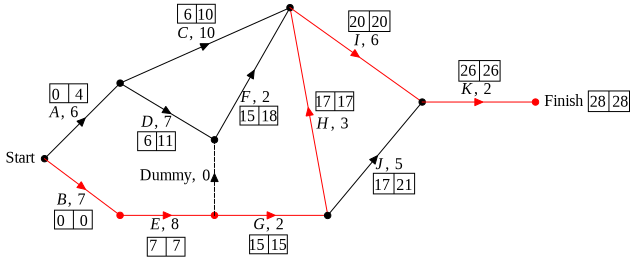
A directed network for this project will require a dummy activity.
The dummy activity will be drawn from the end of
- activity \(A\) to the start of activity \(D\).
- activity \(E\) to the start of activity \(F\).
- activity \(F\) to the start of activity \(I\).
- activity \(G\) to the start of activity \(H\).
- activity \(I\) to the start of activity \(J\).
Question 8
When this project is completed in the minimum time, the sum of all the float times, in days, will be
- 0
- 16
- 18
- 20
- 28
Show Worked Solution
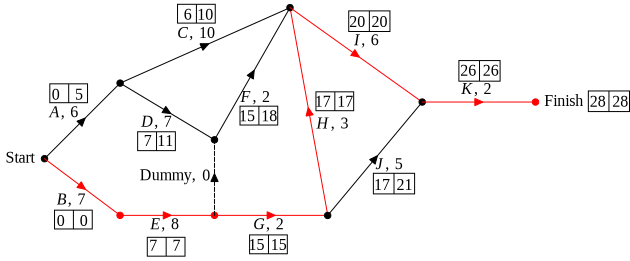
♦ Mean mark (Q7) 49%.
\(\text{Question 8}\)
Scanning forwards and backwards on network diagram:
→ The critical path is \(B E G H I K\)
→ Float times occur at all points not on the critical path.
| \(\text{Total Float Times}\) | \(= A + C + D + F + J\) | |
| \(= 4 + 4 + 5 + 3 + 4\) | ||
| \(= 20\) |
\(\Rightarrow D\)
♦♦ Mean mark (Q8) 34%.
Networks, GEN1 2022 VCAA 6 MC
A landscaping project has 12 activities. The network below gives the time, in hours, that it takes to complete each activity.
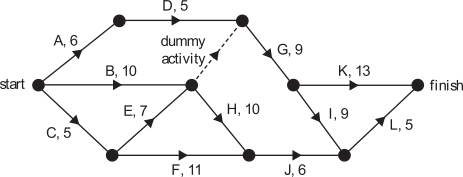
The earliest start time, in hours, for activity \(G\) is
- 10
- 11
- 12
- 13
- 14
Networks, GEN1 2022 VCAA 5 MC
A connected graph consists of five vertices and four edges.
Which one of the following statements is not true?
- The graph could be a tree.
- The graph could be planar.
- The graph could be bipartite.
- The graph could contain a path.
- The graph could contain a cycle.
Show Worked Solution
By elimination:
By definition the graph could be a tree or a path (eliminate A and D).
Consider B: Planar graphs satisfy \(f + v = e + 2.\) In the connected graph described, \(f = 1,\ v = 5,\ e = 4\). Satisfies equation (eliminate B).
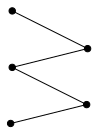
Consider C: The graph could be bipartite – see below (eliminate C).
Consider E: The graph could not contain a cycle and remain connected.
\(\Rightarrow E\)
♦ Mean mark 54%.
Networks, GEN1 2022 VCAA 3 MC
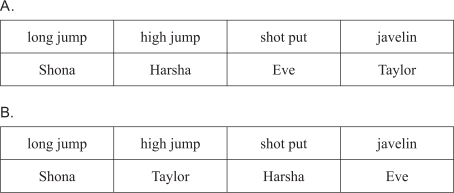
An athletics club needs to select one team of four athletes.
The team is required to have one long jump, one high jump, one shot put and one javelin competitor.
The following table shows the best distances, in metres, for each athlete for each event.
\begin{array} {|l|c|}
\hline
\rule{0pt}{2.5ex} \ \ \textbf{Athlete}\ \ & \textbf{Long jump} & \textbf{High jump} & \ \ \textbf{Shot put} \ \ & \quad \textbf{Javelin} \quad \\
\rule[-1ex]{0pt}{0pt}& \textbf{(m)}& \textbf{(m)}& \textbf{(m)}& \textbf{(m)}\\
\hline
\rule{0pt}{2.5ex} \text{Eve} \rule[-1ex]{0pt}{0pt} & \text{4.8} & \text{1.7} & \text{13.1} & \text{40.9} \\
\hline
\rule{0pt}{2.5ex} \text{Harsha} \rule[-1ex]{0pt}{0pt} & \text{4.8} & \text{1.6} & \text{13.9} & \text{39.5} \\
\hline
\rule{0pt}{2.5ex} \text{Shona} \rule[-1ex]{0pt}{0pt} & \text{5.1} & \text{1.8} & \text{14.4} & \text{41.2} \\
\hline
\rule{0pt}{2.5ex} \text{Taylor} \rule[-1ex]{0pt}{0pt} & \text{4.8} & \text{1.7} & \text{12.8} & \text{39.8} \\
\hline
\end{array}
The athletics club will allocate each athlete to one event in order to maximise the total distance that the team jumps and throws.
Which allocation of athlete to event must occur in order to maximise the total distance?
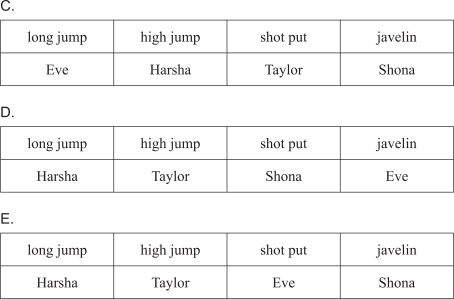
Networks, STD2 N2 EQ-Bank 32
The map below shows seven countries within Central America.
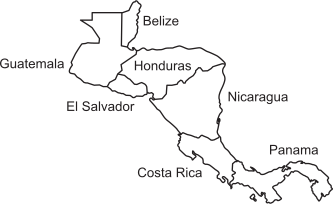
Draw a network diagram of the map where seven vertices represent each of the countries on the map and edges represent a border shared between two countries. (2 marks)
--- 5 WORK AREA LINES (style=blank) ---
Show Answers Only
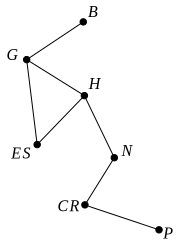
Show Worked Solution
Networks, GEN1 2022 VCAA 2 MC
The map below shows seven countries within Central America.
A network diagram was drawn with seven vertices to represent each of the countries on the map of Central America. Edges were drawn to represent a border shared between two countries.
The number of edges that this network has is
- 5
- 6
- 7
- 8
- 9
Show Worked Solution
There are 7 edges.
\(\Rightarrow C\)
♦ Mean mark 49%.
Matrices, GEN1 2022 VCAA 6 MC
Consider the following system of simultaneous linear equations.
\(y+z=4\)
\(x-y+z=1\)
\(-x+y=2\)
The solution to these simultaneous equations can be found by calculating

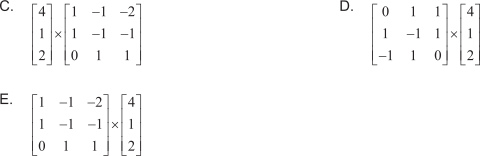
MATRICES, FUR1 2022 VCAA 7 MC
Matrix `K` is a permutation matrix.
`K = [(0,0,1,0,0),(0,1,0,0,0),(0,0,0,1,0),(0,0,0,0,1),(1,0,0,0,0)]`
Matrix `M` is a column matrix that is multiplied once by matrix `K` to obtain matrix `P`.
When matrix `M` is multiplied by matrix `K`, the element `m_31` moves to element
- `p_11`
- `p_21`
- `p_31`
- `p_41`
- `p_51`
Financial Maths, GEN1 2022 VCAA 24 MC
On 1 January 2020, Dion invested $10 500 into an investment account paying compound interest of 0.52% quarterly.
At the end of each quarter, after the interest was credited, Dion added an additional amount of money.
Let \(D_n\) represent the additional amount, in dollars, added at the end of quarter \(n\).
This additional amount per quarter is modelled by the recurrence relation
\(D_1=C,\ \ \ D_{n+1}=D_n\)
The balance of Dion's investment account on 1 January 2022 was $12 700.95
The value of \(C\) is
- $71.69
- $215.55
- $260.22
- $270.15
- $275.12
Recursion, GEN1 2022 VCAA 23 MC
Li invests $4000 for five years at 3.88% per annum, compounding annually.
Joseph invests a sum of money for five years, which earns simple interest paid annually.
Let \(J_n\) be the value, in dollars, of Joseph's investment after \(n\) years.
The two investments will finish at the same value, rounded to the nearest cent, if Joseph's investment is modelled by which one of the following recurrence relations?
- \(J_0=2000,\ \ \ J_{n+1}=J_n+467.72\)
- \(J_0=2500,\ \ \ J_{n+1}=J_n+367.72\)
- \(J_0=3000,\ \ \ J_{n+1}=J_n+317.72\)
- \(J_0=3500,\ \ \ J_{n+1}=J_n+267.72\)
- \(J_0=4000,\ \ \ J_{n+1}=J_n+67.72\)
Financial Maths, GEN1 2022 VCAA 21 MC
Consider the following four statements regarding nominal and effective interest rates as they apply to compound interest investments and loans:
- An effective interest rate is the same as a nominal interest rate if interest compounds annually.
- Effective interest rates increase as the number of compounding periods per year increases.
- A nominal rate of 12% per annum is equivalent to a nominal rate of 1% per month.
- An effective interest rate can be lower than a nominal interest rate.
How many of these four statements are true?
- 0
- 1
- 2
- 3
- 4
Financial Maths, GEN1 2022 VCAA 18-19 MC
The balance of a loan, \(V_n\), in dollars, after \(n\) months is modelled by the recurrence relation
\(V_0=400\ 000,\ \ \ V_{n+1}=1.003\,V_n-2024\)
Question 18
The balance of the loan first falls below $398 000 after how many months?
- 1
- 2
- 3
- 4
- 5
Question 19
With a small change to the final payment, the loan is expected to be repaid in full in
- 25 years.
- 26 years.
- 28 years.
- 29 years.
- 30 years.
Recursion, GEN1 2022 VCAA 17 MC
A sequence of numbers is generated by the recurrence relation shown below.
\(R_0 = 2,\ \ \ R_{n+1} = 2-R_n\)
The value of \(R_2\) is
- \(-4\)
- \(-2\)
- \(0\)
- \(2\)
- \(4\)
Data Analysis, GEN1 2022 VCAA 16 MC
The seasonal index for sales of sunscreen in summer is 1.25
To correct for seasonality, the actual sunscreen sales for summer should be
- reduced by 20%
- reduced by 25%
- reduced by 80%
- increased by 20%
- increased by 25%
Data Analysis, GEN1 2022 VCAA 12-14 MC
The scatterplot below displays the body length, in centimetres, of 17 crocodiles, plotted against their head length, in centimetres. A least squares line has been fitted to the scatterplot. The explanatory variable is head length.
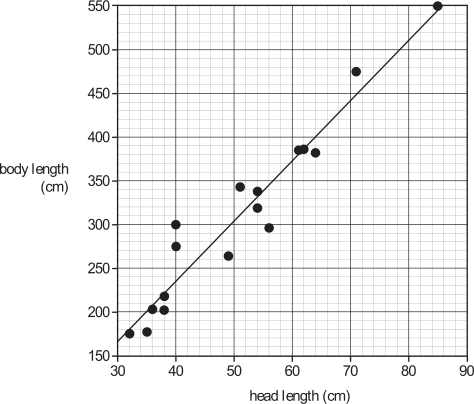
Question 12
The equation of the least squares line is closest to
- head length = –40 + 7 × body length
- body length = –40 + 7 × head length
- head length = 168 + 7 × body length
- body length = 168 – 40 × head length
- body length = 7 + 168 × head length
Question 13
The median head length of the 17 crocodiles, in centimetres, is closest to
- 49
- 51
- 54
- 300
- 345
Question 14
The correlation coefficient \(r\) is equal to 0.963
The percentage of variation in body length that is not explained by the variation in head length is closest to
- 0.9%
- 3.7%
- 7.3%
- 92.7%
- 96.3%
CHEMISTRY, M7 2020 VCE 3
Below is a reaction pathway beginning with hex-3-ene.
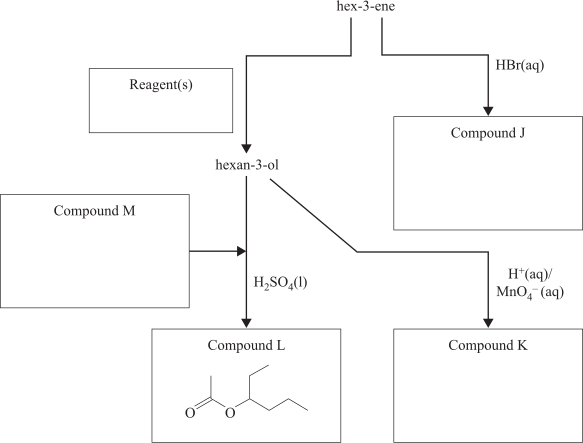
- Write the IUPAC name of Compound J in the box provided. (1 mark)
--- 0 WORK AREA LINES (style=lined) ---
- State the reagent(s) required to convert hex-3-ene to hexan-3-ol in the box provided. (1 mark)
--- 0 WORK AREA LINES (style=lined) ---
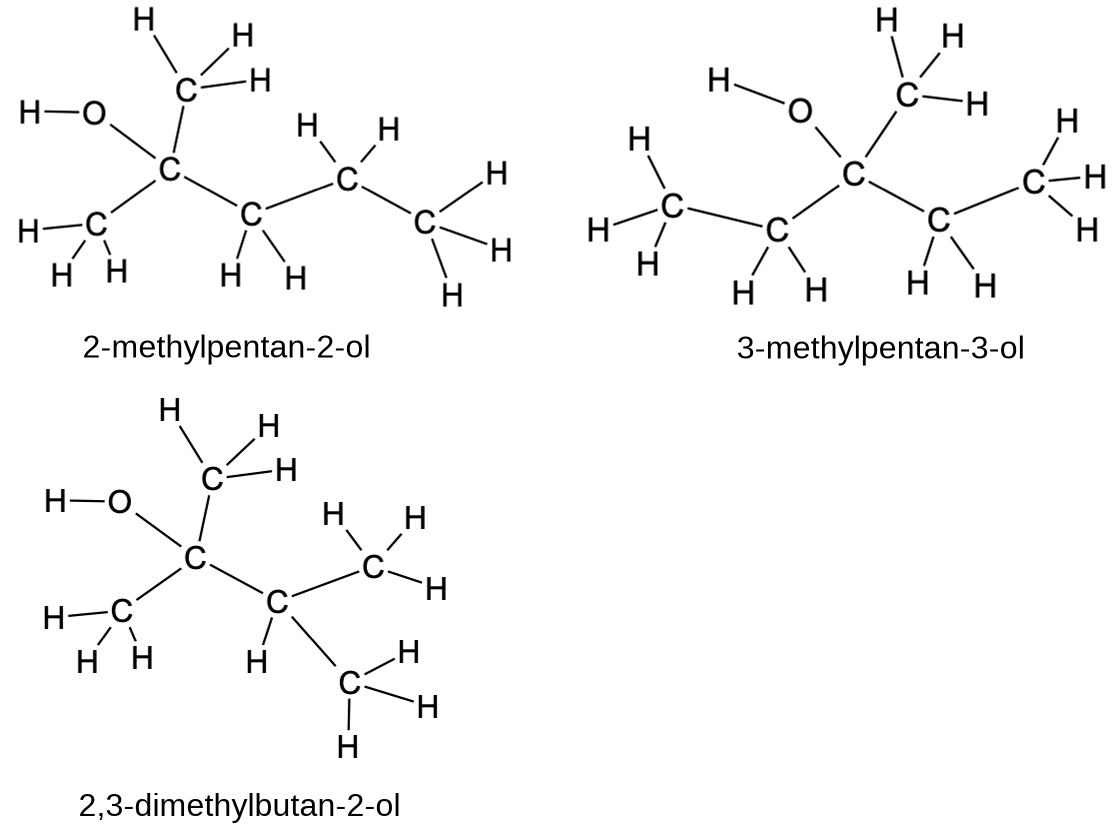
- Draw the structural formula for a tertiary alcohol that is an isomer of hexan-3-ol. (1 mark)
--- 6 WORK AREA LINES (style=lined) ---
- Hexan-3-ol is reacted with Compound M under acidic conditions to produce Compound L.
- Draw the semi-structural formula for Compound M in the box provided on the image above. (1 mark)
--- 0 WORK AREA LINES (style=lined) ---
- i. Draw the semi-structural formula for Compound K in the box provided on the image above. (1 mark)
--- 0 WORK AREA LINES (style=lined) ---
- ii. Name the class of organic compound (homologous series) to which Compound K belongs. (1 mark)
--- 1 WORK AREA LINES (style=lined) ---
- What type of reaction produces Compound K from hexan-3-ol? (1 mark)
--- 1 WORK AREA LINES (style=lined) ---
Show Answers Only
a. 3-bromohexane
b. Steam and any specific inorganic strong acid (although not \(\ce{HCl}\)) is correct.
eg. \(\ce{H2O, H+}\)
c.
d. Correct answers included one of:
\(\ce{CH3COOH}\) or \(\ce{HOOCCH3}\)
e.i. Correct answers included one of the following:
\(\ce{CH3CH2COCH2CH2CH3}\)
\(\ce{CH3CH2CH2COCH2CH3}\)
\(\ce{CH3CH2CO(CH2)2CH3}\)
e.ii. Ketone
f. Oxidation
Show Worked Solution
a. 3-bromohexane
b. Steam and any specific inorganic strong acid (although not \(\ce{HCl}\)) is correct.
eg. \(\ce{H2O, H+}\)
♦ Mean mark (b) 38%.
c.
♦ Mean mark (c) 49%.
d. Correct answers included one of:
\(\ce{CH3COOH}\) or \(\ce{HOOCCH3}\)
e.i. Correct answers included one of the following:
\(\ce{CH3CH2COCH2CH2CH3}\)
\(\ce{CH3CH2CH2COCH2CH3}\)
\(\ce{CH3CH2CO(CH2)2CH3}\)
e.ii. Ketone
f. Oxidation
♦ Mean mark e(i) 39%.
CHEMISTRY, M7 2020 VCE 7 MC
How many structural isomers have the molecular formula \(\ce{C3H6BrCl}\)?
- 4
- 5
- 6
- 7
CHEMISTRY, M6 2016 VCE 20 MC
How does diluting a 0.1 M solution of lactic acid, \(\ce{HC3H5O3}\), change its pH and percentage ionisation?
| pH | Percentage ionisation | |
| A. | increase | decrease |
| B. | increase | increase |
| C. | decrease | increase |
| D. | decrease | decrease |
CHEMISTRY, M7 2016 VCE 7a
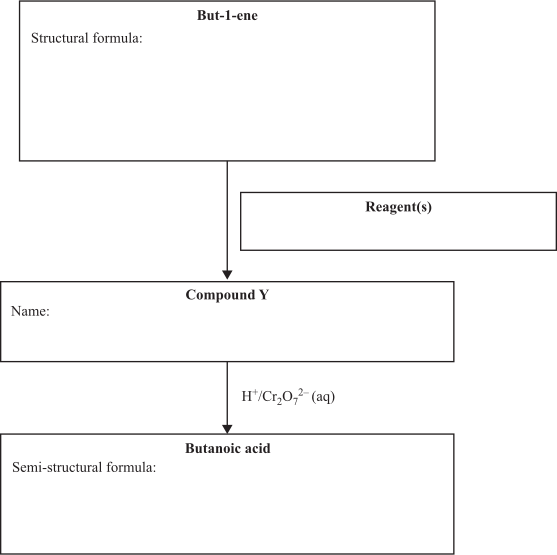
Butanoic acid is the simplest carboxylic acid that is also classified as a fatty acid. Butanoic acid may be synthesised as outlined in the following reaction flow chart. --- 0 WORK AREA LINES (style=lined) --- --- 0 WORK AREA LINES (style=lined) --- --- 0 WORK AREA LINES (style=lined) --- --- 0 WORK AREA LINES (style=lined) --- --- 1 WORK AREA LINES (style=lined) --- i. ii. \(\ce{H2O}\) and \(\ce{H3PO4}\) (catalyst) iii. butan-1-ol or 1-butanol iv. \(\ce{CH3CH2CH2COOH}\) v. \(\ce{Cr2O7^{2-}(aq) + 14H+(aq) + 6e- \rightarrow 2Cr^{3+}(aq) + 7H2O(l)} \) i. iii. butan-1-ol or 1-butanol iv. \(\ce{CH3CH2CH2COOH}\) v. \(\ce{Cr2O7^{2-}(aq) + 14H+(aq) + 6e- \rightarrow 2Cr^{3+}(aq) + 7H2O(l)} \)
Show Answers Only
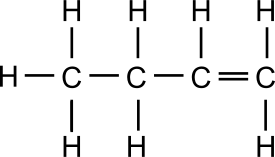 Show Worked Solution
ii. \(\ce{H2O}\) and \(\ce{H3PO4}\) (catalyst)
♦♦ Mean mark (ii) 29%.
CHEMISTRY, M7 2015 VCE 5c
A student mixed salicylic acid with ethanoic anhydride (acetic anhydride) in the presence of concentrated sulfuric acid. The products of this reaction were the painkilling drug aspirin (acetyl salicylic acid) and ethanoic acid. --- 0 WORK AREA LINES (style=lined) --- --- 2 WORK AREA LINES (style=lined) --- a. b. Sulphuric acid increases the rate of reaction by: a. b. Sulphuric acid increases the rate of reaction by:
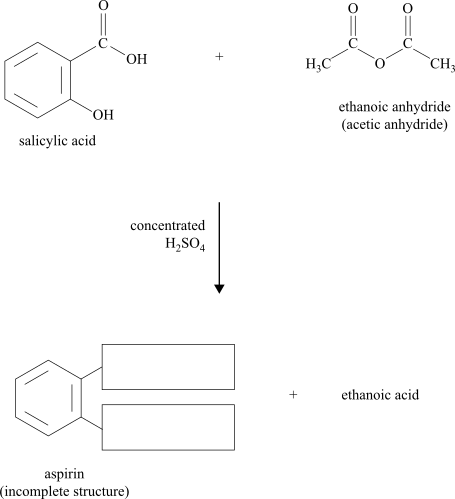
Show Answers Only
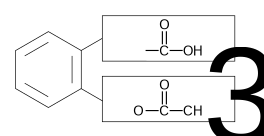
Show Worked Solution
♦ Mean mark (i) 48%.
CHEMISTRY, M7 2016 VCE 24 MC
Methanol is a liquid fuel that is often used in racing cars. The thermochemical equation for its complete combustion is
\(\ce{2CH3OH(l) + 3O2(g)\rightarrow 2CO2(g) + 4H2O(l) \quad \quad \ \ \ \Delta H = –1450 kJ mol^{–1}}\)
Octane is a principal constituent of petrol, which is used in many motor vehicles. The thermochemical equation for
the complete combustion of octane is
\(\ce{2C8H18(l) + 25O2(g)\rightarrow 16CO2(g) + 18H2O(l) \quad \quad \Delta H = –10\ 900 kJ mol^{-1}}\)
The molar mass of methanol is 32 g mol\(^{-1}\) and the molar mass of octane is 114 g mol\(^{–1}\). Which one of the following statements is the most correct?
- Burning just 1.0 g of octane releases almost 96 kJ of heat energy.
- Burning just 1.0 g of methanol releases almost 23 kJ of heat energy.
- Octane releases almost eight times more energy per kilogram than methanol.
- The heat energy released by methanol will not be affected if the oxygen supply is limited.
CHEMISTRY, M7 2016 VCE 22 MC
When ethene is mixed with chlorine in the presence of UV light, the following reaction takes place.
\(\ce{CH2CH2(g) + Cl2(g) \xrightarrow{\text{UV light}} CH2ClCH2Cl(l)}\)
Reactions of organic compounds can be classified in a number of ways. The following list shows four possible classifications:
-
- addition
- substitution
- redox
- condensation
Which classification(s) applies to the reaction between ethene and chlorine?
- 1
- 1 and 2
- 1 and 3
- 4
CHEMISTRY, M6 2015 VCE 22 MC
What is the pH of a 0.0500 M solution of barium hydroxide, \(\ce{Ba(OH)2}\)?
- 1.00
- 1.30
- 12.7
- 13.0
CHEMISTRY, M6 2015 VCE 8
Hydrogen sulfide, in solution, is a diprotic acid and ionises in two stages. \(\ce{H2S(aq) + H2O(l)\rightleftharpoons HS-(aq) + H3O+(aq)}\) \(\quad K_{a1} = 9.6 × 10^{–8} \text{ M}\) \(\ce{HS–(aq) + H2O(l)\rightleftharpoons S^{2-}(aq) + H3O+(aq)}\) \(\quad K_{a2} = 1.3 × 10^{–14} \text{ M}\) A student made two assumptions when estimating the pH of a \(0.01 \text{ M}\) solution of \(\ce{H2S}\): Assumption 1: The pH can be estimated by considering only the first ionisation reaction. Assumption 2: The concentration of \(\ce{H2S}\) at equilibrium is approximately equal to \(0.01 \text{ M}\). --- 6 WORK AREA LINES (style=lined) --- --- 5 WORK AREA LINES (style=lined) --- --- 4 WORK AREA LINES (style=lined) ---
CHEMISTRY, M6 2015 VCE 23 MC
The following table shows the value of the ionisation constant of pure water at various temperatures and at a constant pressure.
| \(\text{Temperature (°C)}\) | \(0\) | \(25\) | \(50\) | \(75\) | \(100\) |
| \(K_W\) | \( 1.1 \times 10^{-15}\) | \( 1.0 \times 10^{-14}\) | \( 5.5 \times 10^{-14}\) | \( 2.0 \times 10^{-13}\) | \( 5.6 \times 10^{-13}\) |
Given this data, which one of the following statements about pure water is correct?
- The \(\ce{[OH–]}\) will decrease with increasing temperature.
- The \(\ce{[H3O+]}\) will increase with increasing temperature.
- Its pH will increase with increasing temperature.
- Its pH will always be exactly 7 at any temperature.
PHYSICS, M1 EQ-Bank 1
A physics student comes across a river which runs north to south and has a current of 3 ms\(^{-1}\) running south.
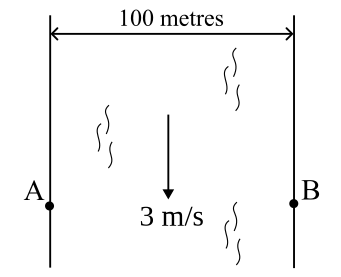
The student starts on the west side of the river at point A and paddles a kayak at 5 ms\(^{-1}\) directly across the river to finish at point B.
- Calculate the angle which he must position the boat to travel in a straight line across the river. (2 mark)
--- 5 WORK AREA LINES (style=blank) ---
- If the river is 100 metres wide, determine the time it takes for the student to cross the river. (2 mark)
--- 4 WORK AREA LINES (style=blank) ---
Show Worked Solution
a.
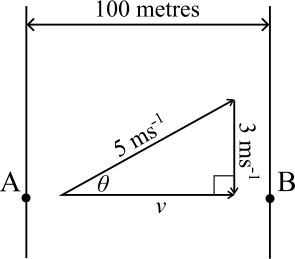
| \(\sin \theta\) | \(=\dfrac{3}{5}\) | |
| \(\theta\) | \(=\sin^{-1}\Big(\dfrac{3}{5}\Big)=36.9^{\circ}\) |
The student must turn 36.9\(^{\circ}\) into the current as shown on the diagram.
b. Using Pythagoras:
\(v=\sqrt{5^2-3^2}=4\ \text{ms}^{-1}\)
\(t=\dfrac{d}{s}=\dfrac{100}{4}=25\ \text{s}\)
\(\therefore\) It will take the student 25 seconds to travel from A to B.
PHYSICS, M1 EQ-Bank 7
Below is a description of the motion of a runner. The motion can be divided into three stages.
Stage 1: Runner travels 120 metres south taking 20 seconds.
Stage 2: Runner turns west and travels at 5 ms\(^{-1}\) for half a minute.
Stage 3: Runner travels directly back to their starting position.
- Determine the distance that the runner ran during Stage 2 of their journey. (1 mark)
--- 2 WORK AREA LINES (style=blank) ---
- Find the displacement of the start point from the runner Stage 2 is completed. (3 marks)
--- 6 WORK AREA LINES (style=blank) ---
Show Worked Solution
a. \(d=v \times t=5 \times 30=150\ \text{m}\)
b. Stage 1 and Stage 2 displacement diagram:
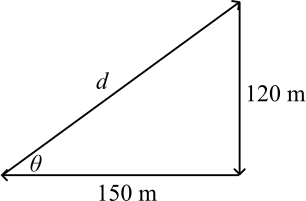
Using Pythagoras:
\(d=\sqrt{150^2 + 120^2}=\sqrt{36900}=192.1\ \text{m}\)
| \(\tan\,\theta\) | \(=\dfrac{120}{150} \) | |
| \(\theta\) | \(=\tan^{-1}\Big(\dfrac{120}{150}\Big)=38.7^{\circ}\) |
\(\therefore\) Displacement of the start point from the runner is 192.1 m, N51.3°E.
Data Analysis, GEN1 2022 VCAA 1-3 MC
The histogram below displays the distribution of skull width, in millimetres, for 46 female possums.
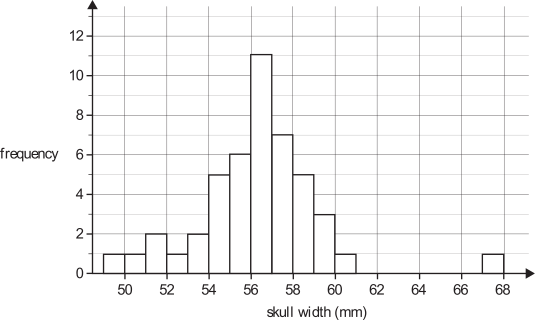
Question 1
The shape of the distribution is best described as
- negatively skewed.
- approximately symmetric.
- negatively skewed with a possible outlier.
- positively skewed with a possible outlier.
- approximately symmetric with a possible outlier.
Question 2
The percentage of the 46 possums with a skull width of less than 55 mm is closest to
- 12%
- 26%
- 39%
- 61%
- 74%
Question 3
The third quartile \((Q_3)\) for this distribution, in millimetres, could be
- 55.8
- 56.2
- 56.9
- 57.7
- 58.3
PHYSICS, M1 EQ-Bank 7
A plane is travelling at 315 ms\(^{-1}\) north when it passes through a dense cloud and slows down to a velocity of 265 ms\(^{-1}\) for safety precautions.
The plane did not change direction and travelled 2.5 km while it was slowing down.
Using north as the positive direction for all calculations, determine:
- the change in velocity of the plane. (1 mark)
--- 3 WORK AREA LINES (style=lined) ---
- the plane's acceleration. (2 marks)
--- 5 WORK AREA LINES (style=lined) ---
- the time over which the plane slowed down. (2 marks)
--- 5 WORK AREA LINES (style=lined) ---
PHYSICS, M1 EQ-Bank 5
Plane A is flying due north at 300 kmh\(^{-1}\) when it measures the velocity of plane B flying due south to be 750 kmh\(^{-1}\).
Calculate the velocity of plane B as measured by the pilots on plane B? (3 marks)
--- 6 WORK AREA LINES (style=blank) ---
PHYSICS, M1 EQ-Bank 3
A hot-air balloon is travelling at a constant upwards velocity of 15 ms\(^{-1}\).
A passenger on the hot-air balloon decides to time how long it takes a pen to hit the ground when dropped from a height of 50 m.
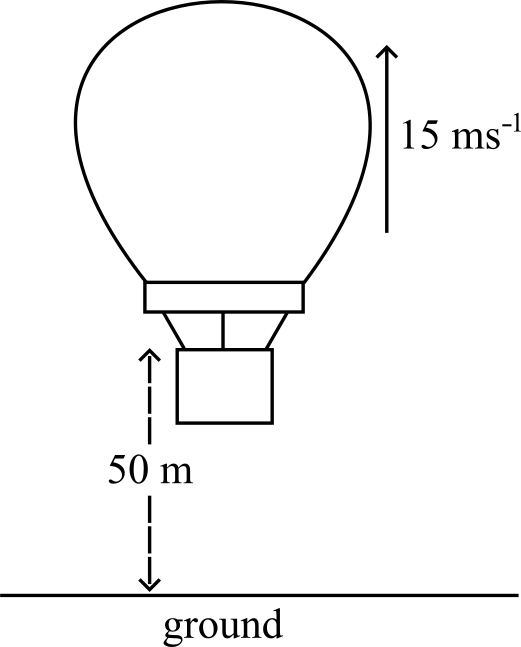
Ignoring air resistance, determine how long it will take the pen to hit the ground. (4 marks)
Networks, STD2 N3 EQ-Bank 32
The network below shows the one-way paths between the entrance, \(A\), and the exit, \(H\), of a children's maze.
The vertices represent the intersections of the one-way paths.
The number on each edge is the maximum number of children who are allowed to travel along that path per minute.
The minimum cut of the network is drawn, showing the maximum flow capacity of the maze is 23 children per minute.
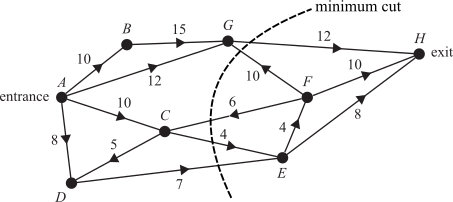
One path in the maze is to be changed.
Determine the changes in the maximum flow capacity of the network in each of the following changes
- the capacity of flow along the edge \(GH\) is increased to 16. (1 mark)
--- 2 WORK AREA LINES (style=lined) ---
- the capacity of flow along the edge \(C E\) is increased to 12. (2 marks)
--- 2 WORK AREA LINES (style=lined) ---
- the direction of flow along the edge \(G F\) is reversed. (2 marks)
--- 2 WORK AREA LINES (style=lined) ---
Show Worked Solution
a. \(GH ↑ 16,\ \text{minimum cut = 27}\)
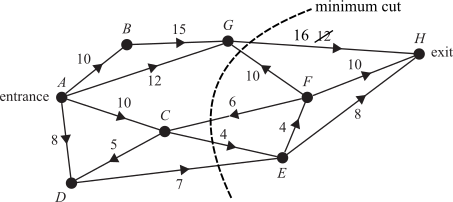
\(\text{Change: increases by 4}\)
b. \(CE ↑ 12,\ \text{minimum cut = 24}\)
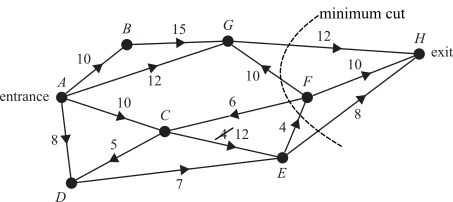
\(\text{Change: increases by 1}\)
c. \(GF\ \text{is reversed, minimum cut = 30 (close to exit H)}\)
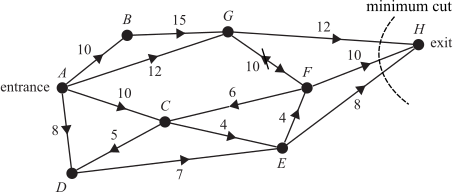
\(\text{Change: increases by 7}\)
Networks, STD2 N3 EQ-Bank 38
The network below shows the one-way paths between the entrance, \(A\), and the exit, \(H\), of a children's maze.
The vertices represent the intersections of the one-way paths.
The number on each edge is the maximum number of children who are allowed to travel along that path per minute.
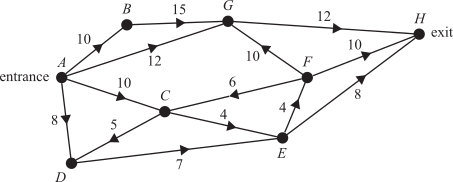
Cuts on this network are used to consider the possible flow of children through the maze.
Determine the capacity of the minimum cut of this network. (2 marks)
--- 3 WORK AREA LINES (style=lined) ---
Show Worked Solution
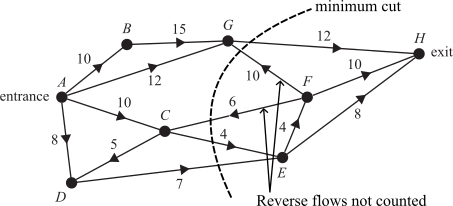
\(\text{Minimum cut}\ = 12+4+7 = 23\)
Networks, GEN1 2023 VCAA 39-40 MC
The network below shows the one-way paths between the entrance, \(A\), and the exit, \(H\), of a children's maze.
The vertices represent the intersections of the one-way paths.
The number on each edge is the maximum number of children who are allowed to travel along that path per minute.
Question 39
Cuts on this network are used to consider the possible flow of children through the maze. The capacity of the minimum cut would be
- 20
- 23
- 24
- 29
- 30
Question 40
One path in the maze is to be changed.
Which one of these five changes would lead to the largest increase in flow from entrance to exit?
- increasing the capacity of flow along the edge \(C E\) to 12
- increasing the capacity of flow along the edge \(FH\) to 14
- increasing the capacity of flow along the edge \(GH\) to 16
- reversing the direction of flow along the edge \(C F\)
- reversing the direction of flow along the edge \(G F\)
Show Worked Solution
\(\text{Question 39} \)
\(\text{Minimum cut}\ = 12+4+7 = 23\)
\(\Rightarrow B\)
\(\text{Question 40}\)
\(CE ↑ 12,\ \text{minimum cut = 24}\)
\(FH ↑ 14,\ \text{minimum cut = 23}\)
\(GH ↑ 16,\ \text{minimum cut = 27}\)
\(CF\ \text{is reversed, minimum cut = 29}\)
\(GF\ \text{is reversed, minimum cut = 30 (close to exit H)}\)
\(\Rightarrow E\)
Networks, GEN1 2023 VCAA 37 MC
The adjacency matrix below represents a planar graph with five vertices.
\begin{aligned}
& \ \ \ J\ \ \ K\ \ \ L\ \ M\ \ N \\
& {\left[\begin{array}{lllll}
0 & 1 & 0 & 1 & 1 \\
1 & 0 & 2 & 1 & 1 \\
0 & 2 & 0 & 1 & 1 \\
1 & 1 & 1 & 0 & 1 \\
1 & 1 & 1 & 1 & 0
\end{array}\right] \begin{array}{l}
J \\
K \\
L \\
M \\
N
\end{array}} \\
\end{aligned}
The number of faces on the planar graph is
- 5
- 7
- 9
- 15
- 17
Show Worked Solution
\(\text{Sketch network:}\)
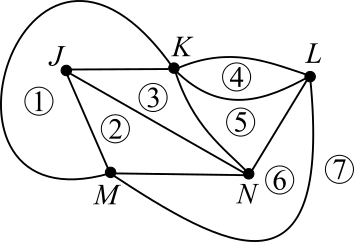
\(\Rightarrow B\)
Networks, GEN1 2023 VCAA 36 MC
Four employees, Anthea, Bob, Cho and Dario, are each assigned a different duty by their manager.
The time taken for each employee to complete duties 1,2,3 and 4, in minutes, is shown in the table below
\begin{array} {|l|c|c|c|c|}
\hline \rule{0pt}{2.5ex} \text{} \rule[-1ex]{0pt}{0pt} & \text{Duty 1} & \text{Duty 2} & \text{Duty 3} & \text{Duty 4} \\
\hline \rule{0pt}{2.5ex} \text{Anthea} \rule[-1ex]{0pt}{0pt} & \text{8} & \text{7} & \text{7} & \text{8}\\
\hline \rule{0pt}{2.5ex} \text{Bob} \rule[-1ex]{0pt}{0pt} & \text{10} & \text{8} & \text{10} & \text{9}\\
\hline \rule{0pt}{2.5ex} \text{Cho} \rule[-1ex]{0pt}{0pt} & \text{8} & \text{9} & \text{7} & \text{10}\\
\hline \rule{0pt}{2.5ex} \text{Dario} \rule[-1ex]{0pt}{0pt} & \text{7} & \text{7} & \text{8} & \text{9}\\
\hline
\end{array}
The manager allocates the duties so as to minimise the total time taken to complete the four duties.
The minimum total time taken to complete the four duties, in minutes, is
- 29
- 30
- 31
- 32
Matrices, GEN1 2023 VCAA 32 MC
For one particular week in a school year, students at Phyllis Island Primary School can spend their lunch break at the playground \((P)\), basketball courts \((B)\), oval \((O)\) or the library \((L)\).
Students stay at the same location for the entire lunch break.
The transition diagram below shows the proportion of students who change location from one day to the next.
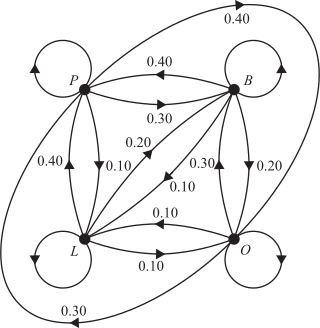
The transition diagram is incomplete.
On the Monday, 150 students spent their lunch break at the playground, 50 students spent it at the basketball courts, 220 students spent it at the oval, and 40 students spent it in the library.
Of the students expected to spend their lunch break on the oval on the Wednesday, the percentage of these students who also spent their lunch break on the oval on Tuesday is closest to
- 27%
- 30%
- 33%
- 47%
- 52%
Matrices, GEN1 2023 VCAA 31 MC
A species of bird has a life span of three years.
The females in this species do not reproduce in their first year but produce an average of four female offspring in their second year, and three in their third year.
The Leslie matrix, \(L\), below is used to model the female population distribution of this species of bird.
\(L=\begin{bmatrix}
0 & 4 & 3\\
0.2 & 0 & 0\\
0 & 0.4 & 0
\end{bmatrix}\)
The element in the second row, first column states that on average 20% of this population will
- be female.
- never reproduce.
- survive into their second year.
- produce offspring in their first year.
- live for the entire lifespan of three years.
Matrices, GEN1 2023 VCAA 30 MC
How many of the following statements are true?
- All square matrices have an inverse.
- The inverse of a matrix could be the same as the transpose of that matrix.
- If the determinant of a matrix is equal to zero, then the inverse does not exist.
- It is possible to take the inverse of an identity matrix.
- 0
- 1
- 2
- 3
- 4
Proof, EXT2 P1 2023 HSC 16b
- Prove that \(x>\ln x\), for \(x>0\). (2 marks)
--- 8 WORK AREA LINES (style=lined) ---
- Using part (i), or otherwise, prove that for all positive integers \(n\),
\( e^{n^2+n}>(n !)^2 .\) (3 marks)
--- 11 WORK AREA LINES (style=lined) ---
CHEMISTRY, M3 EQ-Bank 7
Complete the table below, describing the reactivity characteristics of the three metals listed. (3 marks)
\begin{array} {|l|l|l|l|}
\hline
\ \ \ \ \textbf{Metal} \ & \ \ \ \ \textbf{Reactivity with} \ \ \ \ &\ \ \ \ \textbf{Reactivity with}\ \ \ \ & \ \ \ \ \textbf{Reactivity with}\ \ \ \ \ \ \\ & \ \ \ \ \ \ \ \ \ \ \ \textbf{water} & \ \ \ \ \ \ \ \ \textbf{dilute acid} & \ \ \ \ \ \ \ \ \textbf{oxygen}\\
\hline
\rule{0pt}{2.5ex} \rule[-1ex]{0pt}{0pt} & & & \\ \rule{0pt}{2.5ex} \text{Potassium (K)} \rule[-1ex]{0pt}{0pt} & & & \\ & & & \\
\hline
\rule{0pt}{2.5ex} \rule[-1ex]{0pt}{0pt} & & & \\ \rule{0pt}{2.5ex} \text{Zinc (Zn)} \rule[-1ex]{0pt}{0pt} & & & \\ & & & \\
\hline
\rule{0pt}{2.5ex} \rule[-1ex]{0pt}{0pt} & & & \\ \rule{0pt}{2.5ex} \text{Copper (Cu)} \rule[-1ex]{0pt}{0pt} & & & \\ & & & \\
\hline
\end{array}
--- 0 WORK AREA LINES (style=lined) ---
CHEMISTRY, M3 EQ-Bank 6
Metals such as Lead, Copper, Mercury and Silver do not react with dilute acids but will react with the same acids at higher concentration levels.
Explain why this occurs with reference to first ionisation energy. (3 marks)
--- 6 WORK AREA LINES (style=lined) ---
CHEMISTRY, M3 EQ-Bank 1 MC
In a laboratory, students reacted aluminium with water to produce an oxide and hydrogen gas.
Which of the following equations correctly represents this reaction.
- \(\ce{Al(s) + H2O(g) \rightarrow AlO(s) + H2(g)}\)
- \(\ce{2Al(s) + 3H2O(l) \rightarrow Al2O3(s) + H2(l)}\)
- \(\ce{Al(s) + 3H2O(g) \rightarrow AlO3(s) + H2(l)}\)
- \(\ce{2Al(s) + 3H2O(g) \rightarrow Al2O3(s) + H2(g)}\)
CHEMISTRY, M3 EQ-Bank 9
Two moles of butane \(\ce{C3H8(g)}\) were reacted with 224 grams of oxygen \(\ce{O2(g)}\).
- Write the balanced equation for this reaction. (3 marks)
--- 6 WORK AREA LINES (style=lined) ---
- Determine the mass, in grams, of \(\ce{CO2(g)}\) produced by this reaction. (1 mark)
--- 2 WORK AREA LINES (style=lined) ---
Recursion, GEN1 2023 VCAA 24 MC
The following recurrence relation models the value, \(P_n\), of a perpetuity after \(n\) time periods.
\(P_0=a, \quad P_{n+1}=R P_n-d\)
The value of \(R\) can be found by calculating
- \(a+d\)
- \(\dfrac{a+d}{a}\)
- \(\dfrac{a+d}{d}\)
- \(1+\dfrac{a+d}{a}\)
- \(1+\dfrac{a+d}{d}\)
Recursion, GEN1 2023 VCAA 22 MC
Timmy took out a reducing balance loan of $500 000, with interest calculated monthly.
The balance of the loan, in dollars, after \(n\) months, \(T_n\), can be modelled by the recurrence relation
\(T_0=500\ 000, \quad T_{n+1}=1.00325 T_n-2611.65\)
A final repayment that will fully repay the loan to the nearest cent is
- $2605.65
- $2609.18
- $2611.65
- $2614.12
- $2615.81
Financial Maths, GEN1 2023 VCAA 20-21 MC
For taxation purposes, Audrey depreciates the value of her $3000 computer over a four-year period. At the end of the four years, the value of the computer is $600.
Question 20
If Audrey uses flat rate depreciation, the depreciation rate, per annum is
- 10%
- 15%
- 20%
- 25%
- 33%
Question 21
If Audrey uses reducing balance depreciation, the depreciation rate, per annum is closest to
- 10%
- 15%
- 20%
- 25%
- 33%
Data Analysis, GEN1 2023 VCAA 16 MC
The number of visitors each month to a zoo is seasonal.
To correct the number of visitors in January for seasonality, the actual number of visitors, to the nearest percent, is increased by 35%.
The seasonal index for that month is closest to
- 0.61
- 0.65
- 0.69
- 0.74
- 0.77
Data Analysis, GEN1 2023 VCAA 15 MC
The number of visitors to a public library each day for 10 consecutive days was recorded.
These results are shown in the table below.
\begin{array} {|l|c|c|c|c|c|c|c|c|c|}
\hline
\rule{0pt}{2.5ex} \textbf{Day number} \rule[-1ex]{0pt}{0pt} & 1 & 2 & 3 & 4 & 5 & 6 & 7 & 8 & 9 & 10 \\
\hline
\rule{0pt}{2.5ex} \textbf{Number of visitors} \rule[-1ex]{0pt}{0pt} & 337 & 317 & 313 & 335 & 322 & 335 & 322 & 338 & 302 & 349 \\
\hline
\end{array}
The eight-mean smoothed number of visitors with centring for day number 6 is
- 323
- 324
- 325
- 326
- 327
Data Analysis, GEN1 2023 VCAA 13-14 MC
The following graph shows a selection of winning times, in seconds, for the women's 800 m track event from various athletic events worldwide. The graph shows one winning time for each calendar year from 2000 to 2022.
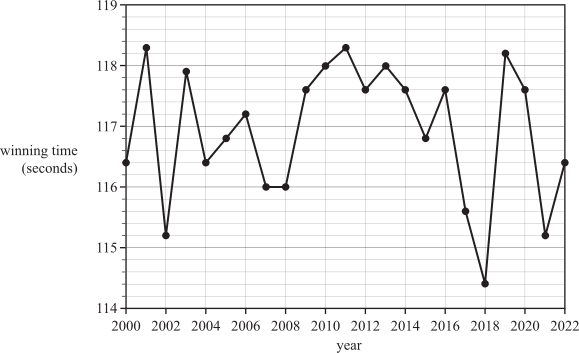
Question 13
The time series is smoothed using seven-median smoothing.
The smoothed value for the winning time in 2006, in seconds, is closest to
- 116.0
- 116.4
- 116.8
- 117.2
- 117.6
Question 14
The median winning time, in seconds, for all the calendar years from 2000 to 2022 is closest to
- 116.8
- 117.2
- 117.6
- 118.0
- 118.3
Data Analysis, GEN1 2023 VCAA 11-12 MC
The table below shows the height, in metres, and the age, in years, for 11 plantation trees. A scatterplot displaying this data is also shown.
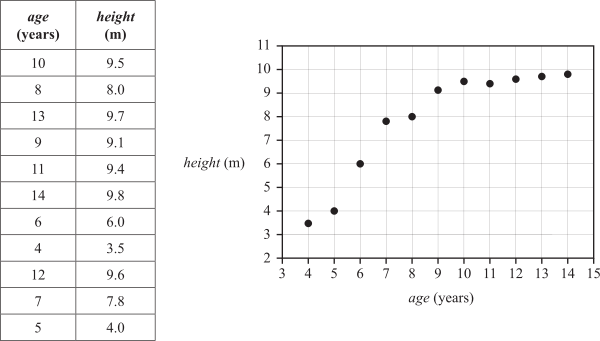
Question 11
A reciprocal transformation applied to the variable age can be used to linearise the scatterplot.
With \(\dfrac{1}{\textit{age}}\) as the explanatory variable, the equation of the least squares line fitted to the linearised data is closest to
- \(\textit{height}\ =-13.04 + 40.22 \times \dfrac{1}{\textit{age}}\)
- \(\textit{height}\ =-10.74+8.30 \times \dfrac{1}{\textit{age}}\)
- \(\textit{height}\ =2.14 + 0.63 \times \dfrac{1}{\textit{age}}\)
- \(\textit{height}\ =13.04-40.22 \times \dfrac{1}{\textit{age}}\)
- \(\textit{height}\ =16.56-22.47 \times \dfrac{1}{\textit{age}}\)
Question 12
The scatterplot can also be linearised using a logarithm (base 10) transformation applied to the variable age.
The equation of the least squares line is
\(\textit{height }=-3.8+12.6 \times \log _{10}(\textit{age}) \)
Using this equation, the age, in years, of a tree with a height of 8.52 m is closest to
- 7.9
- 8.9
- 9.1
- 9.5
- 9.9
Data Analysis, GEN1 2023 VCAA 9 MC
A least squares line can be used to model the birth rate (children per 1000 population) in a country from the average daily food energy intake (megajoules) in that country.
When a least squares line is fitted to data from a selection of countries it is found that:
-
- for a country with an average daily food energy intake of 8.53 megajoules, the birth rate will be 32.2 children per 1000 population
- for a country with an average daily food energy intake of 14.9 megajoules, the birth rate will be 9.9 children per 1000 population.
The slope of this least squares line is closest to
- \(-4.7\)
- \(-3.5\)
- \(-0.29\)
- \(2.7\)
- \(25\)
- « Previous Page
- 1
- …
- 34
- 35
- 36
- 37
- 38
- …
- 88
- Next Page »