SmarterEd

Aussie Maths & Science Teachers: Save your time with SmarterEd

  • Login
  • Get Help
  • About

Proof, EXT2 P1 2022 HSC 16c

It is given that for positive numbers `x_(1),x_(2),x_(3),dots,x_(n)` with arithmetic mean `A`,
 

               `(x_(1)xxx_(2)xxx_(3)xx cdots xxx_(n))/(A^(n)) <= 1`    (Do NOT prove this.)

Suppose a rectangular prism has dimensions  `a,b,c`  and surface area `S`.

  1. Show that  `abc <= ((S)/(6))^((3)/(2))`.  (2 marks)

    --- 6 WORK AREA LINES (style=lined) ---

  2. Using part (i), show that when the rectangular prism with surface area `S` is a cube, it has maximum volume.  (2 marks)

    --- 6 WORK AREA LINES (style=lined) ---
Show Answers Only
  1. `text{Proof (See Worked Solutions)}`
  2. `text{Proof (See Worked Solutions)}`
Show Worked Solution

i.    `text{Show}\ \ abc <= ((S)/(6))^((3)/(2))`

`S=2(ab+bc+ac)`

`A=(ab+bc+ac)/3`

`text{Using given relationship, where}\ x_1=ab, x_2=bc, …`


♦♦♦ Mean mark (i) 26%.
`(ab xx bc xx ca)/((ab+bc+ac)/3)^3` `<=1`  
`(ab xx bc xx ca)` `<=((ab+bc+ac)/3)^3`  
`(abc)^2` `<=((2(ab+bc+ac))/6)^3`  
`abc` `<=(S/6)^(3/2)`  


ii.   `text{If prism is a cube}\ \ a=b=c`

`=> V=a^3, \ \ S=6a^2`

`(S/6)^(3/2)=((6a^2)/6)^(3/2)=a^3`
 

`text{In the case of a cube:}`

`V=(S/6)^(3/2)`


♦♦♦ Mean mark (ii) 26%.

`text{Also,}\ \ V<=(S/6)^(3/2)\ \ \ text{(using part (i))}`

`:.\ text{For rectangular prisms with a given surface area, a cube}`

`text{has the maximum volume.}`

Filed Under: Proof and Inequalities Tagged With: Band 5, Band 6, smc-1208-30-Proof using given equation, smc-1208-50-Arithmetic/Geometric Mean, smc-1208-60-Other Proofs

Mechanics, EXT2 M1 2022 HSC 16b

A projectile of mass `M` kg is launched vertically upwards from a horizontal plane with initial speed `v_0\ text{m s}^(-1)` which is less than 100`\ text{m s}^(-1)`. The projectile experiences a resistive force which has magnitude `0.1 M v` newtons, where `v\ text{m s}^(-1)` is the speed of the projectile. The acceleration due to gravity is 10`\ text{m s}^(-2)`.

The projectile lands on the horizontal plane 7 seconds after launch.

Find the value of `v_0`, correct to 1 decimal place.  (4 marks)

Show Answers Only

`39.1\ text{m s}^(-1)`

Show Worked Solution

`text{Motion is only vertical.}`

`Mddoty=M(-g-0.1v)`

`(dv)/(dt)` `=-(g+0.1v)`  
`(dt)/(dv)` `=- 1/(g+0.1v)`  
`t` `=-int1/(g+0.1v) dv`  
  `=-10ln abs(g+0.1v)+c`  

 
`text{When}\ \ t=0, \ v=v_0`

`=>c=10ln abs(g+0.1v_0)`


♦ Mean mark 45%.
`t` `=10ln abs(g+0.1v_0)-10ln abs(g+0.1v)`  
  `=10ln abs((g+0.1v_0)/(g+0.1v))`  
`e^(t/10)` `=(g+0.1v_0)/(g+0.1v)`  
`(g+0.1v)` `=(g+0.1v_0)*e^(- t/10)\ \ \ (text{note}\ (g+0.1v)>0\ text{as}\ v<100)`  
`0.1v` `=-g+(g+0.1v_0)*e^(- t/10)`  
`v` `=10[-g+(g+0.1v_0)*e^(- t/10)]`  

 
`y=intv\ dt=10[-g t-10(g+0.1v_0)*e^(- t/10)]+c`

`text{When}\ \ t=0, \ y=0:`

`=> \ c=100(g+0.1v_0)`

`:.y=10[-g t-10(g+0.1v_0)*e^(- t/10)]+100(g+0.1v_0)`
 

`text{Find}\ v_0,\ text{given}\ y=0\ text{at}\ t=7:`

`0` `=10[-70-10(10+0.1v_0)*e^(-0.7)]+100(10+0.1v_0)`  
`0` `=-700-100(10+0.1v_0)*e^(-0.7)+1000+10v_0`  
`0` `=-700-1000e^(-0.7)-10v_0e^(-0.7)+1000+10v_0`  
`0` `=300-1000e^(-0.7)+v_0(10-10e^(-0.7))`  
`:.v_0` `=(1000e^(-0.7)-300)/(10-10e^(-0.7))`  
  `=39.0503…`  
  `=39.1\ text{m s}^(-1)\ \ text{(to 1 d.p.)}`  

Filed Under: Resisted Motion Tagged With: Band 5, smc-1061-05-Projectile Motion, smc-1061-10-R ~ v

Proof, EXT2 P1 2022 HSC 15d

The complex number `z` satisfies `|z-(4)/(z)|=2`.  

Using the triangle inequality, or otherwise, show that `|z| <= sqrt5+1`.  (3 marks)

--- 8 WORK AREA LINES (style=lined) ---

Show Answers Only

`text{Proof (See Worked Solutions)}`

Show Worked Solution


♦♦♦ Mean mark 27%.

`text{Triangle Inequality:}\ \ absx+absy>=abs(x+y)`

`absz` `<=abs(z-z/4)+abs(4/z)`  
`absz` `<=2+4/absz\ \ \ (text{using}\ |z-(4)/(z)|=2)`  
`absz^2` `<=2absz+4`  
`absz^2-2absz-4` `<=0`  
`absz` `<=(2+sqrt(2^2+4xx4))/2\ \ \ (absz>=0)`  
`absz` `<=(2+sqrt20)/2`  
`absz` `<=1+sqrt5\ \ text{… as required}`  

Filed Under: Proof and Inequalities Tagged With: Band 5, smc-1208-55-Triangle inequality

ENGINEERING, CS 2020 HSC 24c

The photograph shows a turnbuckle and yoke secured by a pin.


The diameter of the pin in the turnbuckle is 40 mm and the shear stress across this pin is 55 MPa.

Find the magnitude of the axial load on the turnbuckle.   (3 marks)

--- 6 WORK AREA LINES (style=lined) ---

Show Answers Only

`138.23\ text{kN}`

Show Worked Solution

`Ø = 40\ text{mm} = 0.04\ text{m}\ \ =>\ \ r=0.02\ text{m}`

`sigma = 55\ text{MPa} = 55\ 000\ 000\ text{Pa}`

`sigma` `=F/A`  
`F` `=A\ xx \sigma`  
  `=pixx0.02^2xx55\ 000\ 000`  
  `=0.0004pixx55\ 000\ 000`  
  `=69\ 115.04\ text{N}`  

 
However, the system is in double shear, therefore:

`F=2xx69\ 115.04=138\ 230.08\ text{N}=138.23\ text{kN}`


♦ Mean mark 47%.

Filed Under: Engineering Mechanics Tagged With: Band 5, smc-3714-60-Shear stress

ENGINEERING, CS 2020 HSC 25c


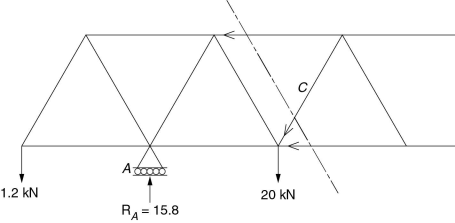
A cycle bridge has been constructed using a Warren girder truss loaded as shown. The diagram is drawn to scale.
 

By considering necessary loads and reactions, calculate the magnitude and nature of the force in member `C`.   (6 marks)

--- 12 WORK AREA LINES (style=lined) ---

Show Answers Only

`C` = 6.24 kN in tension

Show Worked Solution

Let the length of a member be 2 units

`sin60°` `=d/2`  
`d` `=2 xx sin60°=1.732\ text{units}`  


\({+ \circlearrowleft \Sigma M_B}\) `=0`  
`0` `=(3000xx1.732)+(20\ 000xx4)+(-R_Axx6)+(1200xx8)`  
`0` `=5196+80\ 000-6R_A+9600`  
`6R_A` `=94\ 796`  
`R_A` `=15\ 799.33=15.80\ text{kN} ↑`  

`sin60°` `= y/C`  
`y` `= C\ sin60°`  
`+↑ SigmaF_Y` `=  -1200 + 15\ 799.33-20\ 000-C\ sin60°`  
`0` `=  -5400.667-C\ sin60°`  
`C\ sin60°` `=  -5401`  
`C` `=  -5401/(sin60°)=  -6236.54`  

 
`=>` Assumed direction was incorrect and reaction in `C` is away from the joint.

∴  `C= 6.24\ \text{kN in tension}`


♦ Mean mark 48%.

Filed Under: Engineering Mechanics Tagged With: Band 5, smc-3714-10-Truss analysis

Mechanics, EXT2 M1 2022 HSC 15b

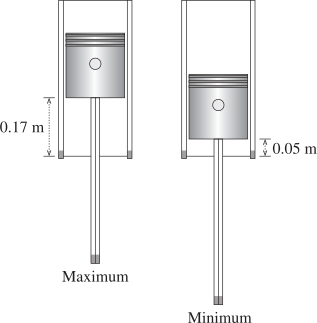
The diagrams show two positions of a single piston in the cylinder chamber of a motorcycle. The piston moves vertically, in simple harmonic motion, between a maximum height of 0.17 metres and a minimum height of 0.05 metres.


The mass of the piston is 0.8 kg. The piston completes 40 cycles per second.

What is the resultant force on the piston, in newtons, that produces the maximum acceleration of the piston? Give your answer correct to the nearest newton.  (3 marks)

--- 5 WORK AREA LINES (style=lined) ---

Show Answers Only

`text{3032 N}`

Show Worked Solution

`text{Using}\ \ ddotx=-n^2(x-b)`

`text{Centre of motion}\ (b) = 0.11`

`text{Amplitude}\ (a) = (0.17-0.05)/2=0.06\ text{m}`

`text{Period}\ (T) = 1/40=0.025\ text{sec}`

`n=(2pi)/T=80pi`

`:.ddotx=-(80pi)^2(x-0.11)`


♦ Mean mark 50%.

`ddotx_(max)\ text{occurs when}\ x=0.17\ text{or}\ 0.05`

`ddotx_(max)` `=-(80pi)^2(0.17-0.11)`  
  `=384pi^2\ text{m s}^(-2)`  


`:.F_(max)` `=mddotx`  
  `=0.8xx384pi^2`  
  `=3031.942…`  
  `=3032\ text{N (to 0 d.p.)}`  

Filed Under: Simple Harmonic Motion Tagged With: Band 5, smc-1059-10-Amplitude / Period, smc-1059-50-Real World examples

Mechanics, EXT2 M1 2022 HSC 15a

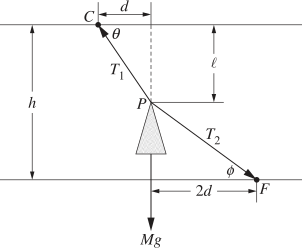
A machine is lifted from the floor of a room using two ropes. The two ropes ensure that the horizontal components of the forces are balanced at all times. It is assumed that at all times the machine moves vertically upwards at a constant velocity.

The machine is located in a room with height `h` metres.

One of the ropes is attached to the point `P` on the machine and to the fixed point `C` on the ceiling of the room. The point `C` is a distance `d` metres to the left of `P`. Let the vertical distance from `P` to the ceiling be `ℓ` metres and let `\theta` be the angle this rope makes with the horizontal.

The other rope is attached to the point `P` and to the fixed point `F` on the floor of the room. The point `F` is a distance `2 d` metres to the right of `P`. Let `\phi` be the angle this rope makes with the horizontal.

Let the tension in the first rope be `T_1` newtons, the tension in the second rope be `T_2` newtons, the mass of the machine be `M` kilograms and the acceleration due to gravity be `g\ text{m s}^(-2)`.
 

  1. By considering horizontal and vertical components of the forces at `P`, show that
  2.            `tan theta=tan phi+(Mg)/(T_(2)cos phi)`   (3 marks)

    --- 6 WORK AREA LINES (style=lined) ---

  3. Hence, or otherwise, show that the point `P` cannot be lifted to a position `{2 h}/{3}` metres above the floor.  (2 marks)

    --- 5 WORK AREA LINES (style=lined) ---

Show Answers Only
  1. `text{Proof (See Worked Solutions)}`
  2. `text{Proof (See Worked Solutions)}`
Show Worked Solution

i.   
       

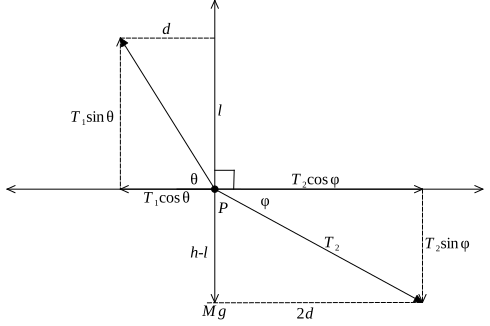
`text{Resolving forces horizontally:}`

`T_1cos\ theta=T_2cos\ phi\ \ text{… (1)}`

`text{Resolving forces vertically:}`

`T_1\ sin\ theta=Mg + T_2\ sin\ phi\ \ text{… (2)}`
 

`text{Divide}\ (2) -: (1):`

`tan\ theta` `=(Mg + T_2\ sin\ phi)/(cos\ phi)`  
  `=(Mg)/(T_2\ cos\ phi)+tan\ phi`  


Mean mark (i) 56%.

ii.   `text{Using diagram in part (i):}`

`tan\ theta=l/d,\ \ tan\ phi=(h-l)/(2d)`

`text{Using part (i):}`

`l/d` `=(Mg)/(T_2\ cos\ phi)+tan\ phi`  
  `=(Mg)/(T_2\ cos\ phi)+(h-l)/(2d)`  

 
`text{S}text{ince}\ \ (Mg)/(T_2\ cos\ phi)>0`

`=> l/d` `>(h-l)/(2d)`  
`l` `>(h-l)/2`  
`(3l)/2` `>h/2`  
`l` `>h/3`  
`h-l` `>h-h/3`  
`h-l` `>(2h)/3`  

 
`:.\ text{Point}\ P\ text(cannot be lifted to)\ (2h)/3\ text(metres above floor.)`


♦♦♦ Mean mark (ii) 27%.

Filed Under: Resisted Motion Tagged With: Band 4, Band 5, smc-1061-50-Max Height, smc-1061-70-Newton's Law

Calculus, EXT2 C1 2022 HSC 14b

Let  `J_(n)=int_(0)^(1)x^(n)e^(-x)\ dx`, where "n" is a non-negative integer.

  1. Show that  `J_(0)=1-(1)/(e)`.  (1  mark)

    --- 2 WORK AREA LINES (style=lined) ---

  2. Show that  `J_(n) <= (1)/(n+1)`.  (2 marks)

    --- 3 WORK AREA LINES (style=lined) ---

  3. Show that  `J_(n)=nJ_(n-1)-(1)/(e)`.  (2 marks)

    --- 4 WORK AREA LINES (style=lined) ---

  4. Using parts (i) and (iii), show by mathematical induction, or otherwise, that for all `n >= 1`,
  5.        `J_(n)=n!-(n!)/(e)sum_(r=0)^(n)(1)/(r!)`    (2 marks)

    --- 6 WORK AREA LINES (style=lined) ---
  6. Using parts (ii) and (iv) prove that  `e=lim_(n rarr oo)sum_(r=0)^(n)(1)/(r!)`.  (1  mark)

    --- 5 WORK AREA LINES (style=lined) ---

Show Answers Only
  1. `text{Proof (See Worked Solutions)}`
  2. `text{Proof (See Worked Solutions)}`
  3. `text{Proof (See Worked Solutions)}`
  4. `text{Proof (See Worked Solutions)}`
  5. `text{Proof (See Worked Solutions)}`
Show Worked Solution
i.    `J_0` `=int_0^1 e^(-x)\ dx`
    `=[-e^(-x)]_0^1`
    `=-e^(-1)+1`
    `=1-1/e`


Mean mark (i) 93%.

ii.  `text{Show}\ \ J_n<=1/(n+1)`

`text{Note:}\ e^(-x)<1\ \ text{for}\ \ x in [0,1]`

`J_n` `=int_0^1 x^n e^(-x)\ dx`  
  `leq int_0^1 x^n \ dx`  
  `leq 1/(n+1)[x^(n+1)]_0^1`  
  `leq 1/(n+1)(1^(n+1)-0)`  
  `leq 1/(n+1)\ \ text{… as required}`  


♦♦ Mean mark (ii) 28%.
 

iii.  `text{Show}\ \ J_n=nJ_(n-1)-1/e`

`u` `=x^n` `v′` `=e^(-x)`
`u′` `=nx^(n-1)` `v` `=-e^(-x)`
`J_n` `=[-x^n * e^(-x)]_0^1-int_0^1 nx^(n-1)*-e^(-x)\ dx`  
  `=(-1^n * e^(-1)+0^n e^0)+nint_0^1 x^(n-1)*e^(-x)\ dx`  
  `=nJ_(n-1)-1/e`  

 
iv.
   `text{Prove}\ \ J_(n)=n!-(n!)/(e)sum_(r=0)^(n)(1)/(r!)\ \ text{for}\ \ n >= 0`

`text{If}\ \ n=0:`

`text{LHS} = 1-1/e\ \ text{(see part (i))}`

`text{RHS} = 0!-0!/e (1/(0!)) = 1-1/e(1)=\ text{LHS}`

`:.\ text{True for}\ \ n=0.`
 

`text{Assume true for}\ \ n=k:`

`J_(k)=k!-(k!)/(e)sum_(r=0)^(k)(1)/(r!)`


♦ Mean mark (iv) 50%.

`text{Prove true for}\ \ n=k+1:`

`text{i.e.}\ \ J_(k+1)=(k+1)!-((k+1!))/(e)sum_(r=0)^(k+1)(1)/(r!)`

`J_(k+1)` `=(k+1)J_k-1/e\ \ text{(using part (iii))}`  
  `=(k+1)(k!-(k!)/(e)sum_(r=0)^(k)(1)/(r!))-1/e`  
  `=(k+1)!-((k+1)!)/(e)sum_(r=0)^(k)(1)/(r!)-1/e xx ((k+1)!)/((k+1)!)`  
  `=(k+1)!-((k+1)!)/e(\ sum_(\ r=0)^(k)(1)/(r!)+1/((k+1)!))`  
  `=(k+1)!-((k+1)!)/e(\ sum_(\ r=0)^(k+1)(1)/(r!))`  

 
`=>\ text{True for}\ \ n=k+1`

`:.\ text{S}text{ince true for}\ n=1,\ text{by PMI, true for integers}\ n>=1`
 

v.   `0<=J_n<= 1/(n+1)\ \ \ text{(part (ii))}`

`lim_(n->oo) 1/(n+1)=0\ \ => \ lim_(n->oo) J_n=0`

  
`text{Using part (iv):}`

`J_n/(n!)` `=1-1/e sum_(r=0)^(n)(1)/(r!)`  
`1/e sum_(r=0)^(n)(1)/(r!)` `=1-J_n/(n!)`  
`sum_(r=0)^(n)(1)/(r!)` `=e-(eJ_n)/(n!)`  
`lim_(n->oo)(\ sum_(\ r=0)^(n)(1)/(r!))`  `=lim_(n->oo)(e-(eJ_n)/(n!))`  
  `=e-0`  
  `=e`  

♦♦ Mean mark (v) 34%.

Filed Under: Induction, P2 Induction (Ext2), Recurrence Relations Tagged With: Band 2, Band 3, Band 5, smc-1044-60-Recursive, smc-1044-68-Sigma Notation, smc-1054-30-Logs/Exp, smc-5115-60-Recursive, smc-5115-68-Sigma notation

BIOLOGY, M5 2019 HSC 18 MC

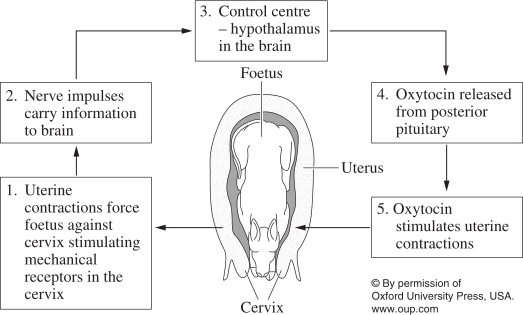
The diagram shows the effect of the hormone oxytocin on the uterus during the birth of a mammal.
 

 Which of the following best identifies and explains the feedback loop demonstrated in the diagram?
 
\begin{align*}
\begin{array}{l}
\ & \\
\rule{0pt}{3.5 ex}\textbf{A.}\\
\\
\textbf{B.}\\
\\
\textbf{C.}\\
\\
\textbf{D.}\\
\\
\end{array}
\begin{array}{|l|l|}
\hline
\rule{0pt}{2.5ex}\textit{Feedback loop} \rule[-1ex]{0pt}{0pt} & \quad \quad \quad \quad \quad \quad \quad \quad \quad \quad \textit{Explanation} \\
\hline
\text{Negative} & \text{The production of oxytocin results in the production of more} \\
\text{} & \text{oxytocin.} \\
\hline
\text{Positive} & \text{The production of oxytocin results in the production of more} \\
\text{} & \text{oxytocin.} \\
\hline
\text{Negative} & \text{The production of oxytocin results in the detection of the} \\
\text{} & \text{contraction by receptors in the cervix.} \\
\hline
\text{Positive} & \text{The production of oxytocin results in the detection of the} \\
\text{} & \text{contraction by receptors in the cervix.} \\
\hline
\end{array}
\end{align*}

Show Answers Only

\(B\)

Show Worked Solution
  • Oxytocin is a chemical which maintains cervical contractions by releasing more oxytocin when the cervix is contracted, a property of a positive feedback mechanism.

\(\Rightarrow B\)


♦♦ Mean mark 31%.

Filed Under: Homeostasis, Reproduction Tagged With: Band 5, smc-3647-05-Human/Mammal, smc-3647-50-Hormones, smc-3659-12-Negative Feedback Loops

BIOLOGY, M6 2019 HSC 13 MC

Genetic drift is a gradual change in

  1. the alleles of an individual due to mutation.
  2. allele frequency in a population due to chance.
  3. the genes of a population due to natural selection.
  4. gene frequency in a population due to natural selection.
Show Answers Only

`B`

Show Worked Solution

By Elimination

  • C and D both refer to natural selection, another mechanism of change within a population, but one that caters towards certain phenotypes or genotypes. (eliminate C and D)
  • A does not refer to a population, but the genotype of an individual (eliminate A)
  • Genetic drift is the reduction or change in allele frequency in a population due to a random chance event that does not favour certain individuals for survival (e.g. a natural disaster).

`=>B`


♦♦ Mean mark 38%.

Filed Under: Mutation Tagged With: Band 5, smc-3652-10-Mechanisms of Change/Variation

BIOLOGY, M7 2019 HSC 5 MC

Which of the following is part of the innate immune response?

  1. Antibodies
  2. Phagocytes
  3. Stomach acid
  4. B lymphocytes
Show Answers Only

`B`

Show Worked Solution

By Elimination

  • Antibodies and B lymphocytes are specific to a pathogen and form part of the specific immune response (eliminate A and D).
  • Stomach acid is non-specific but is a barrier and always active, it is not a response (eliminate C).
  • Phagocytes engulf pathogens by phagocytosis, a process which is non-specific (innate).

`=>B`


♦♦ Mean mark 48%.

Filed Under: Immunity and Responses to Pathogens Tagged With: Band 5, smc-3657-30-Innate Response (2nd Line)

CHEMISTRY, M6 2019 HSC 24

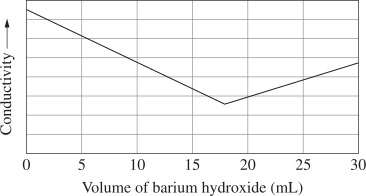
A conductometric titration was undertaken to determine the concentration of a barium hydroxide solution. The solution was added to 250.0 mL of standardised 1.050 × 10 ¯ 3 mol L ¯1 hydrochloric acid solution. The results of the titration are shown in the conductivity graph.


  1. Explain the shape of the titration curve.   (3 marks)

    --- 8 WORK AREA LINES (style=lined) ---

  2. The equivalence point was reached when a volume of 17.15 mL of barium hydroxide was added.
  3. Calculate the concentration of barium hydroxide (in mol L¯1), and give a relevant chemical equation.   (4 marks)

    --- 10 WORK AREA LINES (style=lined) ---

Show Answers Only

a.   Titration curve shape:

  • The conductivity of a solution of hydrochloric acid is initially very high due to the high concentration of ions in the solution.
  • As barium hydroxide is added, the conductivity decreases because the concentration of \(\ce{H+}\) decreases due to the neutralization reaction with \(\ce{OH-}\) ions.
  • The conductivity reaches a minimum at the equivalence point, which is when all the \(\ce{H+}\) ions have been removed and the solution only contains \(\ce{Ba^2+}\) and \(\ce{Cl-}\) ions.
  • These ions are much less mobile than \(\ce{H+}\) or \(\ce{OH-}\) ions, so the conductivity is lower at the equivalence point.
  • After the equivalence point, the conductivity increases as more barium hydroxide is added, resulting in an increase in the concentration of \(\ce{OH-}\) ions and therefore an increase in conductivity.
     

b.   \(\ce{2HCl(aq) + Ba(OH)2(aq) -> BaCl2(aq) + 2H2O(l)} \)

\(\ce{[Ba(OH)2]} = 7.653 \times 10^{-3}\ \text{mol L}^{-1}\)

Show Worked Solution

a.   Titration curve shape:

  • The conductivity of a solution of hydrochloric acid is initially very high due to the high concentration of ions in the solution.
  • As barium hydroxide is added, the conductivity decreases because the concentration of \(\ce{H+}\) decreases due to the neutralization reaction with \(\ce{OH-}\) ions.
  • The conductivity reaches a minimum at the equivalence point, which is when all the \(\ce{H+}\) ions have been removed and the solution only contains \(\ce{Ba^2+}\) and \(\ce{Cl-}\) ions.
  • These ions are much less mobile than \(\ce{H+}\) or \(\ce{OH-}\) ions, so the conductivity is lower at the equivalence point.
  • After the equivalence point, the conductivity increases as more barium hydroxide is added, resulting in an increase in the concentration of \(\ce{OH-}\) ions and therefore an increase in conductivity.

♦ Mean mark (a) 46%.

b.   \(\ce{2HCl(aq) + Ba(OH)2(aq) -> BaCl2(aq) + 2H2O(l)} \)

\(\ce{n(HCl) = c \times V = 1.050 \times 10^{-3} \times 250 = 2.625 \times 10^{-4} mol }\)

\(\ce{n(Ba(OH)2) = 0.5 \times n(HCl) = 1.3125 \times 10^{-4} mol}\)

\(\ce{[Ba(OH)2] = \dfrac{\text{n}}{\text{V}}}=\dfrac{1.3125 \times 10^{-4}}{0.01715}=7.653 \times 10^{-3}\ \text{mol L}^{-1}\)

Filed Under: Quantitative Analysis Tagged With: Band 4, Band 5, smc-3675-10-Titration, smc-3675-20-Titration Curves and Conductivity Graphs

CHEMISTRY, M6 2019 HSC 22

A buffer was prepared with acetic acid and sodium acetate. A few drops of universal indicator were then added. When small amounts of either 0.1 mol L ¯1 \(\ce{HCl(aq)}\) or 0.1 mol L ¯1 \(\ce{NaOH(aq)}\) were added, no change in the colour of the solution was observed.

Explain these observations. Support your answer with at least ONE chemical equation.   (4 marks)

Show Answers Only

\(\ce{CH3COOH(aq) + H2O(l) \rightleftharpoons CH3COO-(aq) + H3O+(aq)}\)

  • A buffer is a solution that resists changes in pH when small amounts of acid or base are added.
  • When a small amount of acid or base is added to a buffer solution containing \(\ce{CH3COOH}\) and \(\ce{CH3COO-}\), the equilibrium of the reaction shifts in order to minimise the disturbance and maintain a stable pH.
  • This is due Le Chatelier’s Principle, which states that when a disturbance occurs in a chemical system at equilibrium, the equilibrium will shift in a way that minimises the disturbance.
  • If acid is added to the buffer solution, the equilibrium will shift to the left to use the \(\ce{H3O+}\) ions, and if base is added, the equilibrium will shift to the right to increase the \(\ce{H3O+}\) concentration.
  • As a result, the pH remains relatively stable and there is no change in the colour of the indicator.
Show Worked Solution

\(\ce{CH3COOH(aq) + H2O(l) \rightleftharpoons CH3COO-(aq) + H3O+(aq)}\)

  • A buffer is a solution that resists changes in pH when small amounts of acid or base are added.
  • When a small amount of acid or base is added to a buffer solution containing \(\ce{CH3COOH}\) and \(\ce{CH3COO-}\), the equilibrium of the reaction shifts in order to minimise the disturbance and maintain a stable pH.
  • This is due Le Chatelier’s Principle, which states that when a disturbance occurs in a chemical system at equilibrium, the equilibrium will shift in a way that minimises the disturbance.
  • If acid is added to the buffer solution, the equilibrium will shift to the left to use the \(\ce{H3O+}\) ions, and if base is added, the equilibrium will shift to the right to increase the \(\ce{H3O+}\) concentration.
  • As a result, the pH remains relatively stable and there is no change in the colour of the indicator.

♦♦ Mean mark 38%.

Filed Under: Quantitative Analysis Tagged With: Band 5, smc-3675-60-Buffers

CHEMISTRY, M7 2019 HSC 21

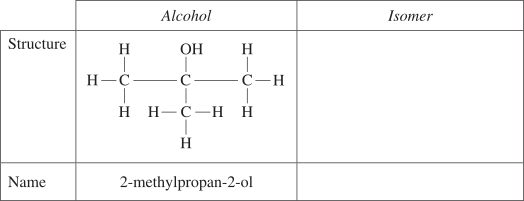
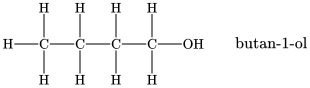
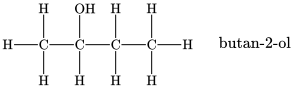
  1. The structural formula for 2-methylpropan-2-ol is shown in the table.
  2. Draw one structural isomer of this alcohol and state its name.   (2 marks)

    --- 0 WORK AREA LINES (style=blank) ---


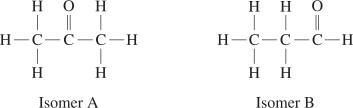
  3. The structural formulae for two compounds are shown below.


  1. Why are these two compounds classed as functional group isomers?   (2 marks)

    --- 4 WORK AREA LINES (style=lined) ---

  2. A chemical test is required to distinguish between the isomers in part (b).
  3. Identify a suitable test and explain the expected observations.   (3 marks)

    --- 6 WORK AREA LINES (style=lined) ---
Show Answers Only

a.   Successful answers should have one of the following:


b.  Functional Group isomers

  • Both isomers have the same number and type of atoms, but they have different arrangements of those atoms and therefore have different functional groups.
  • Isomer A has a ketone functional group, while isomer B has an aldehyde functional group.
     

c.   Tollens’ Test:

  • The Tollens’ test can be used to differentiate between Isomer A (a ketone) and Isomer B (an aldehyde).
  • Isomer B will be readily oxidised to a carboxylic acid, whereas isomer A will not.
  • As a result, Isomer B will reduce the silver-ions in Tollens’ reagent to form a silver mirror inside the test tube, while Isomer A will not react.
Show Worked Solution

a.   Successful answers should have one of the following:

b.  Functional Group isomers

  • Both isomers have the same number and type of atoms, but they have different arrangements of those atoms and therefore have different functional groups.
  • Isomer A has a ketone functional group, while isomer B has an aldehyde functional group. 

c.   Tollens’ Test:

  • The Tollens’ test can be used to differentiate between Isomer A (a ketone) and Isomer B (an aldehyde).
  • Isomer B will be readily oxidised to a carboxylic acid, whereas isomer A will not.
  • As a result, Isomer B will reduce the silver-ions in Tollens’ reagent to form a silver mirror inside the test tube, while Isomer A will not react.

♦♦ Mean mark (c) 39%.

Filed Under: Alcohols, Nomenclature, Reactions of Organic Acids and Bases Tagged With: Band 3, Band 4, Band 5, smc-3676-05-Isomers, smc-3679-40-Naming Alcohols, smc-3680-20-Formulae and Properties

CHEMISTRY, M8 2019 HSC 20 MC

The manganese content in a 12.0 gram sample of steel was determined by measuring the absorbance of permanganate \(\ce{(MnO4^-)} \) using the following process.

The steel sample was dissolved in nitric acid and the \(\ce{Mn^2+(aq)}\)  ions produced were oxidised to \(\ce{MnO4^-(aq)}\) by periodate ions, \(\ce{IO4^-(aq)}\) , according to the following equation.

\(\ce{2Mn^2+(aq) + 5IO4^-(aq) + 3H2O(l) → 2MnO4^-(aq) + 5IO3^-(aq) + 6H+(aq)} \)

The resulting solution was made up to a volume of 1.00 L, then 20.0 mL of this solution was diluted to 100.0 mL. The absorbance at 525 nm of the resulting solution was 0.50.

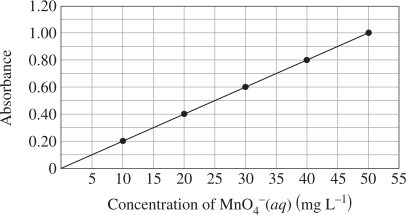
A calibration curve for \(\ce{MnO4^-(aq)}\) was constructed and is shown below.
 

What was the percentage by mass of manganese in the steel sample?

  1. 0.019%
  2. 0.096%
  3. 0.48%
  4. 1.0%
Show Answers Only

`C`

Show Worked Solution

From graph, 0.5 absorbance corresponds to 0.25 mg L ¯1.

\(\ce{[MnO4^-]_{dilute}}\) `=(25 xx 10^(-3))/(54.94+16 xx 4)=2.1019 xx 10^(-4)\ text{mol L}^(-1)`  
\(\ce{[MnO4^-]_{conc}}\) `=2.1019 xx 10^(-4) xx 1/2=1.05095 xx 10^(-3)\ text{mol L}^(-1)`  

 
\(\ce{n(MnO4^-) = c \times V = 1.05095 \times 10^{-3} \times 1 = 1.05095 \times 10^{-3} mol}\)

\(\ce{n(Mn^2) = n(MnO4^-) = 1.05095 \times 10^{-3} mol}\)

\(\ce{m(Mn^2+)}=\text{n} \times \text{MM}=1.05095 \times 10^{-3} \times 54.94=5.774 \times 10^{-3} \text{g} \)

 `:.\ text{Mn}^(2+)text{(%)} = (5.774 xx 10^(-3))/12.0 xx 100text(%) = 0.48text(%)`

`=>C`


♦♦ Mean mark 43%.

Filed Under: Inorganic Substances Tagged With: Band 5, smc-3682-50-Stoichiometric Calculations, smc-3682-60-Colourimetry UV-Vis and AAS

CHEMISTRY, M5 2019 HSC 17 MC

A student makes a solution with a final volume of 200 mL by mixing 100 mL of 0.0500 mol L ¯1 barium nitrate solution with 100 mL of 0.100 mol L ¯1 sodium hydroxide solution.

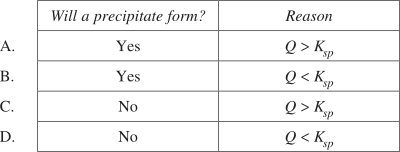
Which row of the table correctly identifies if a precipitate will form under these conditions and the reason?
 

Show Answers Only

\(D\)

Show Worked Solution

\(\ce{Ba(OH)2(s) \rightleftharpoons Ba^2+(aq) + 2OH-(aq)}\)

\(K_{sp}=2.55 \times 10^{-4}\)

\[\ce{[Ba^2+] = \frac{(0.05)(0.1)}{(0.2)} = 0.025 M}\]

\[\ce{[OH-] = \frac{(0.1)(0.1)}{(0.2)} = 0.05 M}\]

\(Q=\ce{[Ba^2+][OH-]^2}=(0.025)(0.05)^2=6.25 \times 10^{-6}\)

Since \(Q \lt K_{sp}\), no precipitate forms.

\(\Rightarrow D\)


♦♦♦ Mean mark 36%.

Filed Under: Equilibrium Constant Tagged With: Band 5, smc-3671-20-Calcs given K(eq), smc-3671-30-Deduce chemical equation, smc-3671-70-Precipitate

BIOLOGY, M8 2019 HSC 6 MC

How does the cochlear implant assist people with severe hearing loss?

  1. It amplifies sound.
  2. It stimulates the ear drum.
  3. It stimulates the auditory nerve.
  4. It amplifies vibrations in the cochlea.
Show Answers Only

`C`

Show Worked Solution
  • The cochlear implant can bypass the cochlear and send electrical impulses directly to the auditory nerve.

`=>C`


♦♦ Mean mark 42%.

Filed Under: Technologies and Disorders Tagged With: Band 5, smc-3663-30-Ears

BIOLOGY, M8 2022 HSC 27

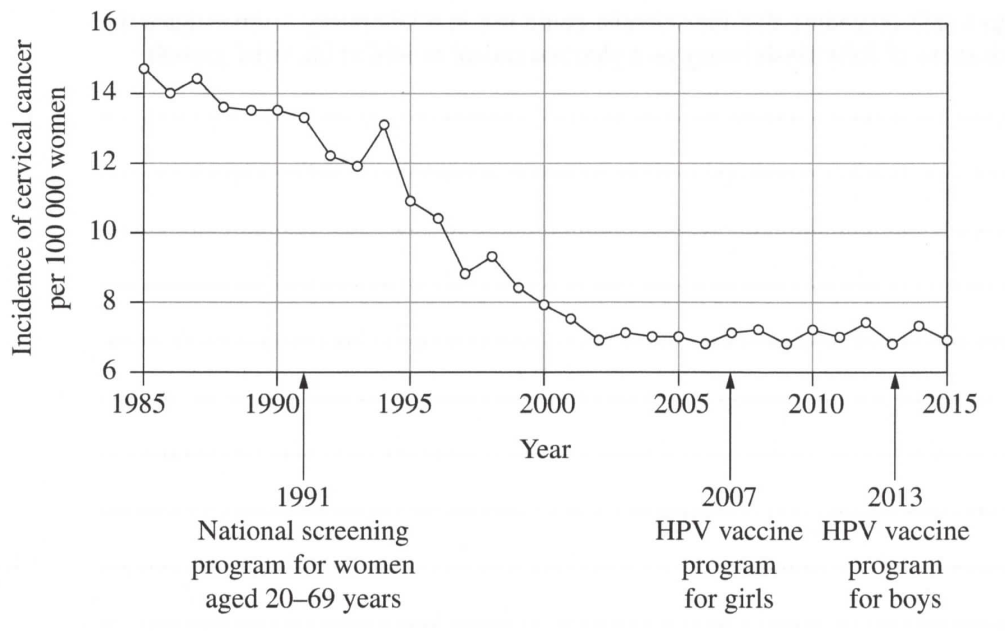
The incidence of cervical cancer in the Australian population is shown in the graph from 1985-2015. Public health campaigns commenced during this period to reduce the incidence of cervical cancer. This included a national screening program to detect pre-cancerous cells and a vaccination program against human papillomavirus (HPV) which causes most cervical cancers.

Evaluate the success of these campaigns in reducing the incidence of cervical cancer in Australian women. Include reference to the data in your answer.  (6 marks)

--- 12 WORK AREA LINES (style=lined) ---
Show Answers Only

In 1991, a national screening program for women aged 20-69 years was introduced to try and lower the incidence of cervical cancer.

  • Screening programs work by detecting pre-cancerous cells so they can be treated before they spread.
  • The graph above shows that the incidence of cervical cancer almost halved from 1990 to 2002, showing that the screening program was most likely successful in reducing incidence.

In 2007 and 2013, HPV vaccine programs for girls and boys respectively were introduced.

  • HPV is a virus that is responsible for most cervical cancers. A national vaccine rollout may help to reduce the incidence of HPV, thus reducing cervical cancers.
  • The graph only shows the incidence of cervical cancer per 100 000 women, so based on this graph alone, it is impossible to determine if the boys program was successful.
  • After the girls rollout in 2007, the incidence of cervical cancer has not shown noticeable fluctuations.
  • Extending the data up until the present day should be undertaken for a more accurate analysis of the programs’ effectiveness.
Show Worked Solution

In 1991, a national screening program for women aged 20-69 years was introduced to try and lower the incidence of cervical cancer.

  • Screening programs work by detecting pre-cancerous cells so they can be treated before they spread.
  • The graph above shows that the incidence of cervical cancer almost halved from 1990 to 2002, showing that the screening program was most likely successful in reducing incidence.

In 2007 and 2013, HPV vaccine programs for girls and boys respectively were introduced.

  • HPV is a virus that is responsible for most cervical cancers. A national vaccine rollout may help to reduce the incidence of HPV, thus reducing cervical cancers.
  • The graph only shows the incidence of cervical cancer per 100 000 women, so based on this graph alone, it is impossible to determine if the boys program was successful.
  • After the girls rollout in 2007, the incidence of cervical cancer has not shown noticeable fluctuations.
  • Extending the data up until the present day should be undertaken for a more accurate analysis of the programs’ effectiveness.

Mean mark 61%.

Filed Under: Prevention Tagged With: Band 4, Band 5, smc-3662-11-Educational Programs

BIOLOGY, M7 2022 HSC 26

Jelly Bush honey has been used by Aboriginal Peoples to treat cuts, sores and burns. Recent studies have shown that Jelly Bush honey has a very high level of methylglyoxal which is known to help fight infection.

A scientist wants to test the effectiveness of Jelly Bush honey using agar plates.

Design a safe procedure that the scientist could use in a laboratory to investigate the effectiveness of Jelly Bush honey as a pharmaceutical to inhibit bacterial growth.  (5 marks)

Show Answers Only

STEP 1: Sterilise 5 agar plates to remove contamination.

STEP 2: Set up the 5 agar plates as 1 blank (control), 1 with just bacteria* (control), 1 with bacteria and Jelly Bush honey, 1 with pure methylglyoxal and 1 with bacteria and a known antibiotic which will inhibit the bacterial growth.

*Bacteria must be a pathogen encountered during infection that is also native to Australia.

STEP 3: Store all agar plates in an incubator at 37°C and 1 atm for 5 days.

STEP 4: Record the amount of bacterial growth in each agar plate in comparison to the pure bacteria plate.

STEP 5: Repeat 3 times to ensure no other variables are responsible for inhibiting bacterial growth. 

Experiment summary:

  • This experiment is a valid way of determining Jelly Bush honey as a pharmaceutical as it tests it against pure methylglyoxal (and 2 controls).
  • This experiment should show evidence whether methylglyoxal or some other factor(s) within the honey contribute to its ability to fight infection.
Show Worked Solution

STEP 1: Sterilise 5 agar plates to remove contamination.

STEP 2: Set up the 5 agar plates as 1 blank (control), 1 with just bacteria* (control), 1 with bacteria and Jelly Bush honey, 1 with pure methylglyoxal and 1 with bacteria and a known antibiotic which will inhibit the bacterial growth.

  • *Bacteria must be a pathogen encountered during infection that is also native to Australia.

STEP 3: Store all agar plates in an incubator at 37°C and 1 atm for 5 days.

STEP 4: Record the amount of bacterial growth in each agar plate in comparison to the pure bacteria plate.

STEP 5: Repeat 3 times to ensure no other variables are responsible for inhibiting bacterial growth. 

Experiment summary:

  • This experiment is a valid way of determining Jelly Bush honey as a pharmaceutical as it tests it against pure methylglyoxal (and 2 controls).
  • This experiment should show evidence whether methylglyoxal or some other factor(s) within the honey contribute to its ability to fight infection.

♦ Mean mark 54%.

Filed Under: Prevention, Treatment and Control Tagged With: Band 4, Band 5, smc-3658-11-Pharmaceuticals, smc-3658-60-Indigenous

BIOLOGY, M6 2022 HSC 32

Researchers have identified a gene that determines the inflammatory response of lung cells to infection with a virus. An allele of this gene is associated with increased inflammation and increased chance of death from the virus.

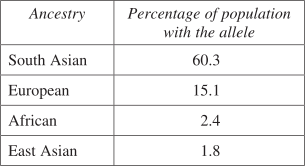
The table shows the percentage presence of the allele in people with different ancestries.
 

Explain how mutation, natural selection, genetic drift and gene flow could have led to these differences in the gene pools of populations with differing ancestry.   (7 marks)

--- 15 WORK AREA LINES (style=lined) ---
Show Answers Only

Mutation

  • A mutation is a mechanism of change which permanently alters DNA, changing genotype and phenotype of the ‘host’.
  • In this case, a mutation has occurred which has altered the gene responsible for the inflammatory response in the lungs in response to a virus, making death more common for people who contract the virus as the gene is now faulty.
  • Other mechanisms of variation such as natural selection, gene flow and genetic drift, are responsible for the allele frequency distribution.

Natural selection

  • Refers to the process where selection pressures such as predators, climate, or in this case the lung virus, favour certain individuals, which then means that their alleles can be carried into further generations.
  • It is highly likely that the virus was never present in South Asia, hence the high frequency in South Asian people (60.3%); the allele was negligible.
  • The virus most likely was present in Europe, Africa and East Asia (<15%) and was responsible for almost eliminating the allele in these populations.

Gene flow

  • Gene Flow is the movement of alleles into new populations, usually via migration.
  • Interbreeding between the migrated individual in the new population with the allele, in conjunction with processes such as natural selection can cause the allele to be prominent in the new population.
  • The allele could have originated in South Asia, and gene flow may be responsible for the other frequencies, especially in Europe.

Genetic drift

  • This occurs when populations experience drastic changes in allele frequencies due to random chance events.
  • These events, such as a natural disaster or re-establishing a new population, can eliminate or change the allele frequency and do not cater towards any genotype. 
  • It is possible genetic drift is responsible for the comparatively high allele frequency in South Asia, or the relatively low frequency in Africa and East Asia.
Show Worked Solution

Mutation

  • A mutation is a mechanism of change which permanently alters DNA, changing genotype and phenotype of the ‘host’.
  • In this case, a mutation has occurred which has altered the gene responsible for the inflammatory response in the lungs in response to a virus, making death more common for people who contract the virus as the gene is now faulty.
  • Other mechanisms of variation such as natural selection, gene flow and genetic drift, are responsible for the allele frequency distribution.

Natural selection

  • Refers to the process where selection pressures such as predators, climate, or in this case the lung virus, favour certain individuals, which then means that their alleles can be carried into further generations.
  • It is highly likely that the virus was never present in South Asia, hence the high frequency in South Asian people (60.3%); the allele was negligible.
  • The virus most likely was present in Europe, Africa and East Asia (<15%) and was responsible for almost eliminating the allele in these populations.

Gene flow

  • Gene Flow is the movement of alleles into new populations, usually via migration.
  • Interbreeding between the migrated individual in the new population with the allele, in conjunction with processes such as natural selection can cause the allele to be prominent in the new population.
  • The allele could have originated in South Asia, and gene flow may be responsible for the other frequencies, especially in Europe.

Genetic drift

  • This occurs when populations experience drastic changes in allele frequencies due to random chance events.
  • These events, such as a natural disaster or re-establishing a new population, can eliminate or change the allele frequency and do not cater towards any genotype. 
  • It is possible genetic drift is responsible for the comparatively high allele frequency in South Asia, or the relatively low frequency in Africa and East Asia.

♦♦♦ Mean mark 32%.

Filed Under: Genetic Variation / Inheritance, Mutation Tagged With: Band 5, Band 6, smc-3648-70-Allele Frequency Data, smc-3652-10-Mechanisms of Change/Variation, smc-3652-55-Mutation in Reproduction

BIOLOGY, M5 2022 HSC 31b

Lung cancer can be linked to genetic causes. One of the genes frequently studied in lung cancer tissue is the Epidermal Growth Factor Receptor (EGFR) gene. It codes for EGFR protein, which is composed of one polypeptide chain.

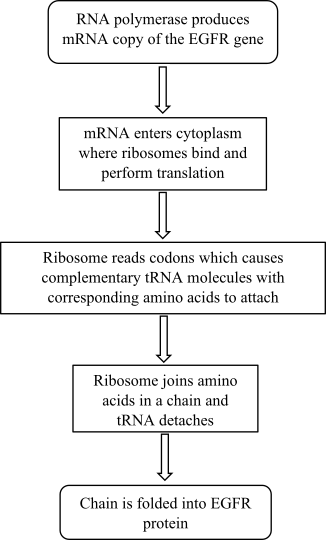
  1. Construct a flow chart to outline the synthesis of the EGFR protein from the EGFR gene.   (4 marks)

    --- 12 WORK AREA LINES (style=blank) ---

The structure of the EGFR protein includes a receptor and an enzyme component. The function of the protein is to help the cell to regulate cell division.

EGFR mutations are present in about 32% of cases of Non-Small Cell Lung Cancer (the most common type of lung cancer).

  1. Explain how a mutation in the EGFR gene could result in changes in protein structure and function to increase the risk of lung cancer.   (4 marks)

    --- 8 WORK AREA LINES (style=lined) ---
Show Answers Only

i. 

ii.    Explanation

  • A mutation is a permanent change to any section of DNA.
  • It can include the change in a single nucleotide base, the deletion or insertion of a base, which will alter all codons proceeding it, or the translation, deletion or addition or entire segments of a chromosome.
  • If this occurred in the EGFR gene, this will be copied onto the mRNA, which will be transcribed into the EGFR protein.
  • The change of the removal or addition of certain amino acids within the polypeptide chain or even the change in a single amino acid will change the function of the protein or make it unusable at all. In rare cases, this could be beneficial, or a change in an amino acid will be insignificant and not change the proteins shape.
  • In most cases however, the mutation on the EFGR gene will render it useless, leading to uncontrolled cell division (cancer).
Show Worked Solution

i. 


♦♦♦ Mean mark (i) 28%.

ii.    Explanation

  • A mutation is a permanent change to any section of DNA.
  • It can include the change in a single nucleotide base, the deletion or insertion of a base, which will alter all codons proceeding it, or the translation, deletion or addition or entire segments of a chromosome.
  • If this occurred in the EGFR gene, this will be copied onto the mRNA, which will be transcribed into the EGFR protein.
  • The change of the removal or addition of certain amino acids within the polypeptide chain or even the change in a single amino acid will change the function of the protein or make it unusable at all. In rare cases, this could be beneficial, or a change in an amino acid will be insignificant and not change the proteins shape.
  • In most cases however, the mutation on the EFGR gene will render it useless, leading to uncontrolled cell division (cancer).

♦♦ Mean mark (ii) 32%.

Filed Under: DNA and Polypeptide Synthesis Tagged With: Band 5, page-break-before-question, smc-3650-20-Translation, smc-3650-30-Transcription

BIOLOGY, M8 2022 HSC 31a

Studies have shown that lung cancer can be linked to environmental causes.

In one historical study across 29 health districts in Japan, non-smoking married women aged 40 and above were followed up for 14 years (1966-79) and annual mortality rates for lung cancer were assessed according to the smoking habits of their husbands. They were compared to women who smoked.

The results are shown.

  1. Evaluate the method used in this epidemiological study.   (4 marks)

    --- 8 WORK AREA LINES (style=lined) ---
  2. Justify conclusions that could be drawn from the results of the study.   (3 marks)

    --- 6 WORK AREA LINES (style=lined) ---
Show Answers Only

i.    Sample size:

  • Large sample (36 302 average amount per group).
  • Widespread (29 different health districts) which means results will be more accurate.

Other factors to consider:

  • The study was conducted over an extended period of 14 years, which will again lead to more accurate results.
  • The study also has a control group (non-smokers with non-smoker husbands) which provides a base for the study.
  • Overall, it can be concluded that this study is a valid way of showing the relationship between first and second hand smoking and mortality in women.

ii.   Conclusions of study:

  • The control group (non-smoker women with non-smoker husbands) shows that 8.7 women per 100 000 have died to lung cancer.
  • This could be due to friends or other family members who smoke or exposure to smoke in the workplace.
  • Other possible contributing factors in Japan, such as poor air quality can have an effect but be outside the scope of the study.
  • The study also shows that non-smoker women who have smoker husbands have almost double the mortality of women in the control group, and women who smoke themselves with smoker husbands have triple the mortality rate.
  • With this information, it can be concluded that both smoking and exposure to second hand smoke, increases a woman’s chance of death by lung cancer.
Show Worked Solution

i.    Sample size:

  • Large sample (36 302 average amount per group).
  • Widespread (29 different health districts) which means results will be more accurate.

Other factors to consider:

  • The study was conducted over an extended period of 14 years, which will again lead to more accurate results.
  • The study also has a control group (non-smokers with non-smoker husbands) which provides a base for the study.
  • Overall, it can be concluded that this study is a valid way of showing the relationship between first and second hand smoking and mortality in women.

♦ Mean mark (i) 44%.
ii.   Conclusions of study:

  • The control group (non-smoker women with non-smoker husbands) shows that 8.7 women per 100 000 have died to lung cancer.
  • This could be due to friends or other family members who smoke or exposure to smoke in the workplace.
  • Other possible contributing factors in Japan, such as poor air quality can have an effect but be outside the scope of the study.
  • The study also shows that non-smoker women who have smoker husbands have almost double the mortality of women in the control group, and women who smoke themselves with smoker husbands have triple the mortality rate.
  • With this information, it can be concluded that both smoking and exposure to second hand smoke, increases a woman’s chance of death by lung cancer.

Filed Under: Epidemiology Tagged With: Band 4, Band 5, smc-3661-10-Analysing Results, smc-3661-20-Evaluating the Method

BIOLOGY, M7 2022 HSC 21b

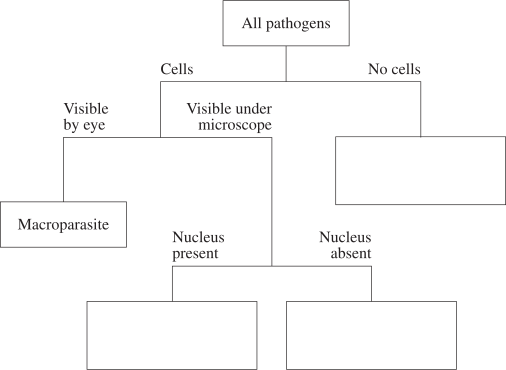
The following key can be used to classify some pathogens.

Complete each empty box with an appropriate pathogen.  (3 marks)


--- 0 WORK AREA LINES (style=lined) ---
Show Answers Only

Show Worked Solution


♦ Mean mark 47%.

Filed Under: Causes of Infectious Disease Tagged With: Band 5, smc-3655-10-Classifying Pathogens

BIOLOGY, M6 2022 HSC 16 MC

What is the significance of mutations in non-coding DNA?

  1. They do not alter nucleotides.
  2. They do not affect phenotype.
  3. They may affect gene expression.
  4. They may alter amino acid codons.
Show Answers Only

`C`, `B`

Show Worked Solution
  • While non-coding DNA does not directly code for polypeptides, it can be associated with inhibiting their expression.

`=>C`  (NESA solution)
 

  • Note that mutations in non-coding DNA can also be silent, and not have any effect on genes.

`=>B`  (Arguably alternative solution)

Filed Under: Mutation Tagged With: Band 5, smc-3652-50-Non-Coding DNA

ENGINEERING, PPT 2020 HSC 23c

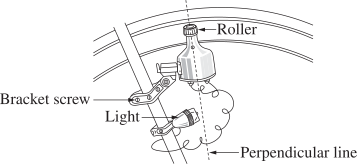
The diagram shows a dynamo mounted on the frame of a bicycle, with its roller positioned against the side of the tyre. Wires connect the dynamo to the bicycle light.
 

Explain how the dynamo generates power to turn the bicycle light on.   (3 marks)

--- 8 WORK AREA LINES (style=lined) ---
Show Answers Only
  • When the wheel on the bicycle begins turning, the shaft (connected to the roller) spins the armature through a magnetic field produced by stationary magnets.
  • This process, with the effect of the commutator, results in the generation of DC electricity.
  • Wires connecting the dynamo to the light carry the DC electricity to the light, turning it on.
Show Worked Solution
  • When the wheel on the bicycle begins turning, the shaft (connected to the roller) spins the armature through a magnetic field produced by stationary magnets.
  • This process, with the effect of the commutator, results in the generation of DC electricity.
  • Wires connecting the dynamo to the light carry the DC electricity to the light, turning it on.

♦ Mean mark 48%.

Filed Under: Electricity/Electronics Tagged With: Band 5, smc-3720-10-Electrical systems

ENGINEERING, PPT 2020 HSC 23b

A diagram of the front steering system of a bicycle is shown.


  1. A rider leans forward so that 55% of their mass is exerted as a force, as shown in the diagram. A turning moment of 132.19 Nm is generated about the front axle.
  2. What is the mass of the rider?   (3 marks)

--- 6 WORK AREA LINES (style=lined) ---
  1. In overcoming the resistance due to gravity, drag and rolling resistance, a rider applies a force of 500 N on the pedals. This allows the rider to cover, in 5 seconds, a distance of 20 metres from the starting point.
  2. How much power was produced by the rider?  (2 marks)

--- 6 WORK AREA LINES (style=lined) ---
Show Answers Only

i.   `95\ text{kg}`

ii.  `2000\ text{W}`

Show Worked Solution

i.  
         

`sin20°` `= d/740`  
`d` `= 740 xx sin20°= 253.09\ text{mm}`  


`M` `= Fxxd`  
`F` `= 132.19/0.25309= 522.5\ text{N}`  


`55\text{%} xx F_(text{total})` `= 522.5\ text{N}`  
`F_(text{total})` `= 522.5/0.55= 950\ text{N}`  

 
`:. M_(text{rider})= 950/10= 95\ text{kg}`


♦ Mean mark 47%.

ii.   `F=500\ text{N}, \ s=20\ text{m},\ t=5\ text{sec}`

`P` `= Fxxv`  
  `= F xx s/t`  
  `= 500 xx 20/5`  
  `= 2000\ text{W}`  

Filed Under: Mechanics Tagged With: Band 4, Band 5, smc-3718-60-Work Energy Power, smc-3718-85-Moments

BIOLOGY, M7 2022 HSC 30

Malaria is a disease transmitted by a mosquito vector. There has been no effective vaccine developed.

Refer to the maps below to answer Question 30.


Discuss possible reasons for the differences in the distribution of malaria and its vector. Include detailed reference to Map 1 and Map 2.  (7 marks)

--- 16 WORK AREA LINES (style=lined) ---

Show Answers Only
  • Malaria is a disease which is transmitted via a female mosquito.
  • The plasmodium responsible for the disease can multiply inside a mosquito.
  • When it bites an individual, it enters the bloodstream via the mosquito’s saliva.
  • The presence of infected individuals and the malaria vector (mosquito) in the same regional area is an obvious overlap between the two maps.

 Regions with mosquito vector but no infected individuals

  • Areas such as Japan, Western Europe and North America have the mosquito vector responsible for malaria but no infected individuals.

This can be due to:

  • Accessibility to medical treatment such as pharmaceuticals which can treat infected individuals.
  • Better mosquito control eg effective repellent.
  • Better quarantine of infected individuals.

 Regions with no mosquito vector but infected individuals

  • Areas such as China, sections of Northern and Southern Africa and areas of the North-Western coast of South America have cases of malaria but no mosquito vectors in the area.

This can be due to:

  • Migration of infected individuals to the areas stated above from surrounding areas where both the vector and disease are present.
Show Worked Solution
  • Malaria is a disease which is transmitted via a female mosquito.
  • The plasmodium responsible for the disease can multiply inside a mosquito.
  • When it bites an individual, it enters the bloodstream via the mosquito’s saliva.
  • The presence of infected individuals and the malaria vector (mosquito) in the same regional area is an obvious overlap between the two maps.

 Regions with mosquito vector but no infected individuals

  • Areas such as Japan, Western Europe and North America have the mosquito vector responsible for malaria but no infected individuals.

This can be due to:

  • Accessibility to medical treatment such as pharmaceuticals which can treat infected individuals.
  • Better mosquito control eg effective repellent.
  • Better quarantine of infected individuals.

 Regions with no mosquito vector but infected individuals

  • Areas such as China, sections of Northern and Southern Africa and areas of the North-Western coast of South America have cases of malaria but no mosquito vectors in the area.

This can be due to:

  • Migration of infected individuals to the areas stated above from surrounding areas where both the vector and disease are present.

Mean mark 56%.

Filed Under: Prevention, Treatment and Control Tagged With: Band 4, Band 5, smc-3658-30-Procedures to Prevent Spread, smc-3658-50-Malaria

BIOLOGY, M6 2022 HSC 29

Bt cotton has been genetically engineered to produce an insecticide that kills cotton bollworm. It was introduced to a cotton-producing nation in 2002.

The graphs show trends of national cotton yield, % Bt cotton grown, total insecticide use, insecticide use to control bollworms and insecticide use to control another insect pest (hemiptera).


  1. Explain ONE reason why cotton yield changed between 2002 and 2013.  (2 marks)

    --- 4 WORK AREA LINES (style=lined) ---
  2. To what extent do the data support the use of Bt cotton as a method of disease control in cotton?  (5 marks)

    --- 12 WORK AREA LINES (style=lined) ---
Show Answers Only

a.   Cotton yield increase between 2002-2013:

  • The cotton yield increased because the pesticide produced by Bt cotton will decrease the likelihood of the plant contracting Bollworm, which kills the plant.
  • This increases the percentage of healthy cotton, increasing the yield of cotton that is harvested.  

b.   Use of Bt cotton for disease control:

  • Bt cotton is effective in producing plants resistant to Bollworm.
  • The amount of pesticide used for Bollworm dropped to less than 500 tonnes by 2008, and approaching zero by 2013.
  • This saves farmers money which can be spent on other measures effective for disease control, such as better hygiene in the workplace.
  • The top graph also shows an increase in cotton yield, further supporting the statement above.
     
  • Bt cotton however is not effective as a method of disease control against Hemipteran.
  • The amount of pesticide used for Hemipteran increased by 8000 tonnes from 2002 to 2013. This increase has taken the total pesticide used in 2013 to above that used in 2002.
  • While Bt cotton may be effective against Bollworm, other pests such as Hemipteran can now thrive and cause problems to cotton farms.
  • More studies with other cotton pest species need to be done in a similar style to prove if Bt cotton would be a well-rounded and effective method of disease control.
Show Worked Solution

a.   Cotton yield increase between 2002-2013:

  • The cotton yield increased because the pesticide produced by Bt cotton will decrease the likelihood of the plant contracting Bollworm, which kills the plant.
  • This increases the percentage of healthy cotton, increasing the yield of cotton that is harvested.    

b.   Use of Bt cotton for disease control:

  • Bt cotton is effective in producing plants resistant to Bollworm.
  • The amount of pesticide used for Bollworm dropped to less than 500 tonnes by 2008, and approaching zero by 2013.
  • This saves farmers money which can be spent on other measures effective for disease control, such as better hygiene in the workplace.
  • The top graph also shows an increase in cotton yield, further supporting the statement above.
     
  • Bt cotton however is not effective as a method of disease control against Hemipteran.
  • The amount of pesticide used for Hemipteran increased by 8000 tonnes from 2002 to 2013. This increase has taken the total pesticide used in 2013 to above that used in 2002.
  • While Bt cotton may be effective against Bollworm, other pests such as Hemipteran can now thrive and cause problems to cotton farms.
  • More studies with other cotton pest species need to be done in a similar style to prove if Bt cotton would be a well-rounded and effective method of disease control.

♦ Mean mark (b) 47%.

Filed Under: Biotechnology, Genetic Technologies Tagged With: Band 4, Band 5, smc-3653-20-Evaluating Genetic Technology, smc-3654-05-Transgenic Organisms, smc-3654-20-Agriculture

BIOLOGY, M5 2022 HSC 28b

Describe the process of DNA replication.   (3 marks)

Show Answers Only

The following produces 2 identical DNA molecules, which are also identical to the original.

  1. DNA helicase ‘unwinds’ DNA by breaking hydrogen bonds between the bases.
  2. Binding proteins are added to each strand to prevent them reattaching. 
  3. RNA primase adds RNA primers which act as a promoter region for DNA polymerase.
  4. DNA polymerase adds complementary nucleotides in the 5′ to 3′ direction of each strand.
  5. Exonuclease removes RNA primers, and DNA polymerase adds complementary nucleotides.
  6. DNA ligase reattaches sections together.
Show Worked Solution

The following produces 2 identical DNA molecules, which are also identical to the original.

  1. DNA helicase ‘unwinds’ DNA by breaking hydrogen bonds between the bases.
  2. Binding proteins are added to each strand to prevent them reattaching. 
  3. RNA primate adds RNA primers which act as a promoter region for DNA polymerase.
  4. DNA polymerase adds complementary nucleotides in the 5′ to 3′ direction of each strand.
  5. Exonuclease removes RNA primers, and DNA polymerase adds complementary nucleotides.
  6. DNA ligase reattaches sections together.

♦ Mean mark 47%.

Filed Under: Cell Replication Tagged With: Band 5, smc-3649-15-DNA Replication

BIOLOGY, M6 2022 HSC 25

Offspring are rarely identical to their parents.

Compare the ways in which genetic variation can arise from asexual and sexual reproduction.   (6 marks)

--- 18 WORK AREA LINES (style=lined) ---
Show Answers Only

Asexual reproduction:

  • To produce offspring, this method is often undergone by single celled, colonial or very simple multicellular organisms, including fungi (budding/spores) and bacteria (binary fission).
  • It involves mitotic divisions resulting in offspring which are often genetically identical to the parent.
  • Variation may arise if a mutation occurs in the first cell of the division, leading to offspring with that mutation.

Sexual reproduction:

  • The reproduction method involves the fusion of male and female gametes to form offspring with genetical material from both parents.
  • Many processes are responsible for producing offspring with genetical variability which include:-
  • Processes in producing the gametes which lead to variability amongst them, including crossing over, independent assortment and random segregation.
  • Germ line mutations, which affect offspring but not the parent.
  • The randomness associated with fertilisation, where each unique gamete can combine, meaning many genetically varied offspring can be produced.
  • As a result of these processes, sexual reproduction often produces higher variability compared to asexually reproduced offspring.
Show Worked Solution

Asexual reproduction:

  • To produce offspring, this method is often undergone by single celled, colonial or very simple multicellular organisms, including fungi (budding/spores) and bacteria (binary fission).
  • It involves mitotic divisions resulting in offspring which are often genetically identical to the parent.
  • Variation may arise if a mutation occurs in the first cell of the division, leading to offspring with that mutation.

Sexual reproduction:

  • The reproduction method involves the fusion of male and female gametes to form offspring with genetical material from both parents.
  • Many processes are responsible for producing offspring with genetical variability which include:-
  • Processes in producing the gametes which lead to variability amongst them, including crossing over, independent assortment and random segregation.
  • Germ line mutations, which affect offspring but not the parent.
  • The randomness associated with fertilisation, where each unique gamete can combine, meaning many genetically varied offspring can be produced.
  • As a result of these processes, sexual reproduction often produces higher variability compared to asexually reproduced offspring.

♦ Mean mark 46%.

Filed Under: Mutation Tagged With: Band 5, smc-3652-20-Somatic vs. Germ-Line

BIOLOGY, M8 2022 HSC 24

Birth defects in humans can be caused by chromosomal abnormalities.

\begin{array}{|c|c|}
\hline
\rule{0pt}{2.5ex}\quad \textit{Maternal} \quad & \textit{Prevalence of}\\
\textit{age} & \textit{chromosomal}\\
\text{(years)} & \textit{abnormalities}\\
\text{} & \rule[-1ex]{0pt}{0pt}\text{(per 1000 births)}\\
\hline \rule{0pt}{2.5ex}20 \rule[-1ex]{0pt}{0pt}& 1.5 \\
\hline \rule{0pt}{2.5ex}30 \rule[-1ex]{0pt}{0pt}& 3 \\
\hline \rule{0pt}{2.5ex}35 \rule[-1ex]{0pt}{0pt}& 8 \\
\hline \rule{0pt}{2.5ex}40 \rule[-1ex]{0pt}{0pt}& 22 \\
\hline \rule{0pt}{2.5ex}45 \rule[-1ex]{0pt}{0pt}& 38 \\
\hline
\end{array}

  1. Draw a suitable graph of the data provided in the table. Include a suitable line of best fit.  (3 marks)
     

  1. Outline the trend shown in the data.  (2 marks)

    --- 3 WORK AREA LINES (style=lined) ---
  2. Explain the cause of a type of chromosomal mutation.  (3 marks)

    --- 6 WORK AREA LINES (style=lined) ---
Show Answers Only

a. 


b.   Data trend:

  • After 20 years of age, the older a woman is when she gives birth, the chance of her child having a chromosomal abnormality increases exponentially.

c.   Cause of chromosomal mutation:

  • Aneuploidy is a chromosomal mutation where the child contains either an extra or a deficit of a chromosome.
  • This is a result of non-disjunction, where in meiosis, chromosomes fail to separate.
  • This can produce a gamete with an extra chromosome (trisomy, 2N+1) or one missing a certain chromosome (monosomy, 2N-1).
  • Down Syndrome (Trisomy 21) is the result of a child containing an extra chromosome 21.

Other answers could include

  • Polyploidy, duplications of whole sets of chromosomes (XN).
  • Rearrangement, deletion, insertion, translocation or duplications of sections of a chromosome.
Show Worked Solution

a. 

b.   Data trend:

  • After 20 years of age, the older a woman is when she gives birth, the chance of her child having a chromosomal abnormality increases exponentially.

♦ Mean mark (a) 54%.
Mean mark (b) 56%.

c.   Cause of chromosomal mutation:

  • Aneuploidy is a chromosomal mutation where the child contains either an extra or a deficit of a chromosome.
  • This is a result of non-disjunction, where in meiosis, chromosomes fail to separate.
  • This can produce a gamete with an extra chromosome (trisomy, 2N+1) or one missing a certain chromosome (monosomy, 2N-1).
  • Down Syndrome (Trisomy 21) is the result of a child containing an extra chromosome 21.

Other answers could include

  • Polyploidy, duplications of whole sets of chromosomes (XN).
  • Rearrangement, deletion, insertion, translocation or duplications of sections of a chromosome.

♦♦ Mean mark (c) 32%.

Filed Under: Causes and Effects, Mutation Tagged With: Band 4, Band 5, smc-3652-40-Chromosomal Mutations, smc-3660-20-Genetic/Cancer, smc-3660-50-Draw graph

BIOLOGY, M6 2022 HSC 23

  1. Outline the process of artificial pollination.  (2 marks)

    --- 5 WORK AREA LINES (style=lined) ---

  2. Explain a possible outcome of the use of artificial pollination on subsequent populations.  (2 marks)

    --- 4 WORK AREA LINES (style=lined) ---
Show Answers Only

a.   Artificial pollination Process

  • This is the process of manually pollinating plants with pollen of known characteristics in order to obtain offspring with similar qualities.
  • First, anthers of the recipient plant are cut off in order to remove chance of self pollination.
  • Then, pollen is manually transferred to the stigma of the recipient plant by hand using a brush, or using machinery.   

b.   Artificial pollen’s effect on subsequent populations:

  • decreases the variability amongst the species
  • decreases the genetic diversity.
Show Worked Solution

a.   Artificial pollination Process

  • This is the process of manually pollinating plants with pollen of known characteristics in order to obtain offspring with similar qualities.
  • First, anthers of the recipient plant are cut off in order to remove chance of self pollination.
  • Then, pollen is manually transferred to the stigma of the recipient plant by hand using a brush, or using machinery.      

b.   Artificial pollen’s effect on subsequent populations:

  • decreases the variability amongst the species
  • decreases the genetic diversity.

♦ Mean mark (b) 49%.

Filed Under: Genetic Technologies Tagged With: Band 4, Band 5, smc-3654-10-Genetic Diversity, smc-3654-20-Agriculture, smc-3654-51-Reproductive Technologies

BIOLOGY, M8 2022 HSC 19 MC

A person with short-sighted vision (myopia) was incorrectly given a pair of spectacles with convex lenses.

Which row of the table demonstrates what happens?
 

Show Answers Only

`D`

Show Worked Solution

By Elimination:

  • People with myopia have shortened focal length, causing the focal point to fall short of the retina (eliminate A and B).
  • Convex lenses would further shorten the length, hence they are the incorrect shape.

`=>D`


♦ Mean mark 53%.

Filed Under: Technologies and Disorders Tagged With: Band 5, smc-3663-20-Eyes

BIOLOGY, M5 2022 HSC 18 MC

The occurrence of a genetic disease in a family resulting from the presence of a dominant allele is shown.


If the disease has arisen as a result of a mutation, which of the following is the most likely cause of the disease in this family?

  1. A germ-line mutation in individual 2
  2. A germ-line mutation in individual 4
  3. A somatic mutation in individuals 1 and 2
  4. A somatic mutation in individuals 4 and 5
Show Answers Only

`A`

Show Worked Solution

By Elimination:

  • The characteristic is inherited via individual 4 by generation 3 .
  • It must be germ-line (eliminate C and D).
  • If a mutation occurs in the germ-line cells of an individual, it does not affect that individual, but will affect the offspring.
  • The mutation would have to occur in individual 2’s germ-line cells to then affect individual 4 and 5.

`=>A`


♦ Mean mark 48%.

Filed Under: Genetic Variation / Inheritance Tagged With: Band 5, smc-3648-10-Pedigrees

BIOLOGY, M5 2022 HSC 17 MC

A student constructed a model of the phases of meiosis in an organism with six chromosomes in its somatic cells. One of the early phases is shown.
 

Which of the following identifies an error in the model?

  1. Chromosomes are not lined up single file on the metaphase plate.
  2. Chromosomes of matching size and structure are not paired.
  3. There are no homologous chromosomes.
  4. There are too many chromosomes.
Show Answers Only

`B`

Show Worked Solution
  • The student has tried to show metaphase I, as indicated by the chromosomes being lined up in the centre.
  • However, the model does not show that they must be aligned in tetrads.

`=>B`


♦ Mean mark 50%.

Filed Under: Cell Replication Tagged With: Band 5, smc-3649-20-Meiosis

BIOLOGY, M6 2022 HSC 13 MC

The section of DNA shown in Question 12 came into contact with a mutagen, resulting in a change in the cytosine. The effect on the DNA after several replication cycles is shown.
 

The mutagen has resulted in

  1. a frame-shift mutation.
  2. an increase in cytosine.
  3. a change in one base pair.
  4. a change in one nucleotide.
Show Answers Only

`C`

Show Worked Solution
  • The Guanine-Cytosine bond has changed to a Thymine-Adenine bond, resulting in the change in that base pair.

`=>C`


♦ Mean mark 40%.

Filed Under: Mutation Tagged With: Band 5, smc-3652-30-Point Mutations

ENGINEERING, AE 2020 HSC 22d

An air gauge contains air at 750 kPa (gauge) while atmospheric pressure is at 100 kPa. The air at absolute pressure operates a piston of 15 mm diameter.

Calculate the force the compressed air exerts on the piston.  (4 marks)

--- 8 WORK AREA LINES (style=lined) ---

Show Answers Only

`150.45\ text{N}`

Show Worked Solution

`P_(ga)=750\ text{kPa}, \ P_(atm)=100\ text{kPa}, \ D=15\ text{mm}`

`P` `=P_0+rhogh`  
`P_(abs)` `=P_(atm)+P_(ga)= 750 + 100= 850\ text{kPa}`  


`P_(abs)` `=F/A`  
`F` `=P_(abs)xxA`  
`A` `=(piD^2)/4=(pixx0.015^2)/4=1.77xx10^(-4)\ text{m}^2`  

 
`:.\ F=850xx10^3xx1.77xx10^(-4)=  150.45\ text{N}`


♦♦ Mean mark 40%.

Filed Under: Mechanics and Hydraulics Tagged With: Band 5, smc-3724-70-Pressure

ENGINEERING, AE 2020 HSC 21c

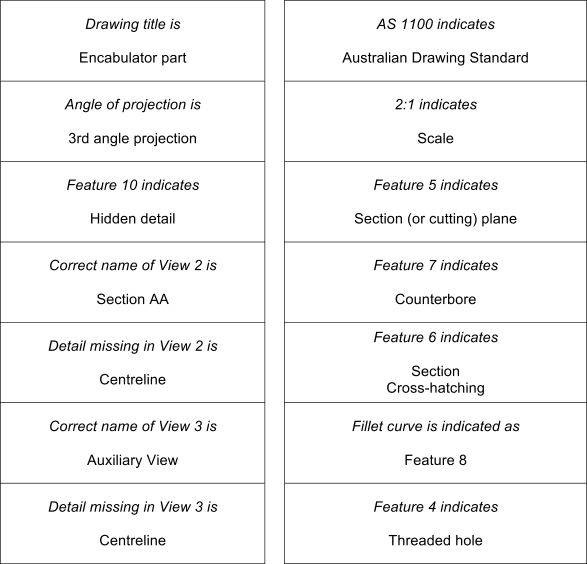
The following drawing provides a series of orthographic views of a machine part, supported by a 'modified' title block. Some of the features have been labelled with the numbers 4 to 10.


With reference to the orthographic views and the modified title block, complete the table below.   (4 marks)
 

--- 0 WORK AREA LINES (style=blank) ---

Show Answers Only

Show Worked Solution


Mean mark 51%.

Filed Under: Communication Tagged With: Band 5, smc-3726-20-Orthogonal diagrams, smc-3726-40-AS 1100

ENGINEERING, PPT 2020 HSC 18 MC

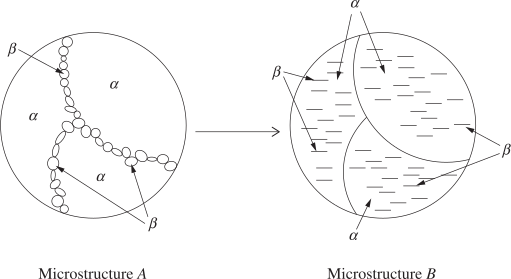
The grain structure of a material has changed over time from that shown in microstructure `A` to that shown in microstructure `B`.
 

What heat treatment process has the material undergone to cause this change?

  1. Tempering
  2. Normalising
  3. Quench hardening
  4. Precipitation hardening
Show Answers Only

`D`

Show Worked Solution
  • Of the answers presented, precipitation hardening is the only form of heat treatment that causes `alpha` and `beta` to dissolve into a single phase alloy as shown in Microstructure B.

`=>D`


♦♦ Mean mark 33%.

Filed Under: Materials Tagged With: Band 5, smc-3719-35-Tempering/Hardening, smc-3719-40-Macro/microstructure

ENGINEERING, PPT 2020 HSC 14 MC

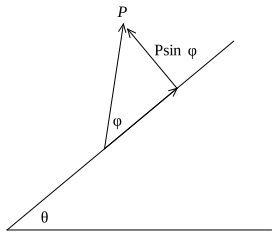
The diagram shows the forces acting on a block on an inclined plane. The block is held in a stationary position by force `P`.
 

What is the correct equation for the normal force, `N` ?

  1. `N=W cos theta - P sin phi`
  2. `N=W cos theta + P sin phi`
  3. `N=W sin theta - P cos phi`
  4. `N=W sin theta + P cos phi`
Show Answers Only

`A`

Show Worked Solution

  • `P\ sin phi` is the upward force on the block perpendicular to the plane.

  • `Wcos\ theta`  is the downward force on the block perpendicular to the plane.
  • Therefore, `N` is equal to the downward component of the weight force minus the upwards component of force `P`.

`=>A`


♦ Mean mark 50%.

Filed Under: Mechanics Tagged With: Band 5, smc-3718-40-Normal Force, smc-3718-50-Inclined planes

CHEMISTRY, M7 2019 HSC 13 MC

A sample of polydifluoroethylene is determined to have an average molar mass of  4.8 × 10⁴ g mol ¯1.

Approximately how many carbon atoms are there in an average molecule?

  1. 750
  2. 1500
  3. 2500
  4. 4000
Show Answers Only

`B`

Show Worked Solution
  • \( \ce{Polydifluoroethylene: C2F2H2} \)
  • \( \text{MM} (\ce{C2F2H2}) = 64.036\ \text{g}\)
   `text{N (repeating units)}` `=(text{MM (total sample)})/(text{MM (repeating sample)})`  
  `=(4.8 xx 10^4)/64.036`  
  `=750\ text{carbons per repeating unit}`  
  `=1500\ text{carbons (2 per repeating unit)}`   

 
`=>B`


♦ Mean mark 50%.

Filed Under: Polymers Tagged With: Band 5, smc-3681-10-Addition Polymers

ENGINEERING, AE 2020 HSC 19 MC

Turbofan engines are generally more fuel efficient than turbojet engines.

What causes this efficiency?

  1. Smaller intake area
  2. Higher combustion temperatures
  3. Air bypassing the combustion system
  4. Air directly entering the combustion area
Show Answers Only

`C`

Show Worked Solution
  • Turbofans accelerate higher masses of air than a turbojet without burning additional fuel due to their additional fan.
  • This increases thrust and fuel efficiency.
  • The fan does this by forcing additional air to bypass the engine, increasing its velocity without excessive use of fuel.

`=>C`


Mean mark 51%.

Filed Under: Mechanics and Hydraulics Tagged With: Band 5, smc-3724-60-Propulsion

ENGINEERING, CS 2020 HSC 17 MC

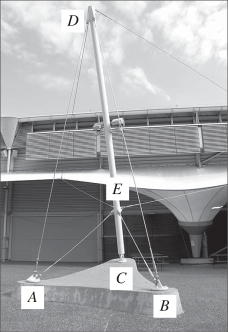
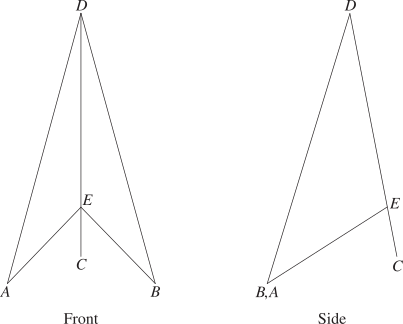
A photograph of a 6.5 m stanchion with guy wires is shown.


Using the scaled orthogonal drawing, find the true length of wire `BD`.

  1. 7.3 m
  2. 7.9 m
  3. 8.3 m
  4. 8.9 m
Show Answers Only

`B`

Show Worked Solution
  • The stanchion `CD` has true length (6.5 m) in the side view as it is vertical in the front view.
  • By using this scale and finding the true length graphically, `BD` is 7.9 m.

`=>B`


♦♦ Mean mark 33%.

Filed Under: Communication Tagged With: Band 5, smc-3716-15-Orthogonal drawings

ENGINEERING, AE 2020 HSC 16 MC

Which of the following contributes to pitting or crevice corrosion in aircraft component joints?

  1. Water levels
  2. Alloy concentrations
  3. Oxygen concentrations
  4. Levels of static electricity
Show Answers Only

`C`

Show Worked Solution

Pit and crevice corrosion occurs when:

  • The anode and cathode are both in contact with an electrolyte, and
  • The concentration is lower at the anode.
  • Therefore, oxygen concentrations contribute as oxygen is an electrolyte which is often in contact with aircraft component joints.

`=>C`


Mean mark 54%.

Filed Under: Materials Tagged With: Band 5, smc-3725-60-Corrosion

ENGINEERING, TE 2020 HSC 13 MC

Which of the following can be safely transmitted by fibre optic cables?

  1. Microwaves
  2. Radio waves
  3. Gamma rays
  4. Infrared waves
Show Answers Only

`D`

Show Worked Solution
  • Optical fibres transmit light along their length.
  • Since gamma, radio and microwaves are not light waves and infrared is a light wave, infrared is the only possible answer.

`=>D`


Mean mark 52%.

Filed Under: Materials Tagged With: Band 5, smc-3729-25-Fibre optics

ENGINEERING, TE 2020 HSC 5 MC

To what must the professional services of telecommunications engineers be primarily dedicated?

  1. Completing projects on time
  2. Ensuring public health and safety
  3. Designing efficient engineering systems
  4. Reducing the legal liability of their employers
Show Answers Only

`B`

Show Worked Solution
  • `A` and `D` both concern profitability which does not rank above other options.
  • While `C` is an important professional aim of all engineering projects, this is trumped by public health and safety.

`=>B`


♦♦ Mean mark 40%.

Filed Under: Scope, Historical and Societal Influences Tagged With: Band 5, smc-3728-10-Professional scope

ENGINEERING, CS 2020 HSC 4 MC

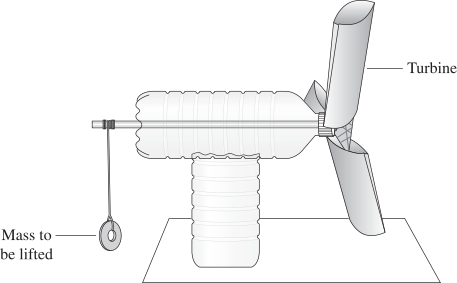
The diagram shows a model of a windmill which is designed to lift a mass as the turbine rotates.
 

A mass of 80 grams is lifted a distance of 200 mm by the windmill.

What is the work done by the windmill?

  1. `0.16\ \text{J}`
  2. `16\ \text{J}`
  3. `160\ \text{J}`
  4. `1600\ \text{J}`
Show Answers Only

`A`

Show Worked Solution

Convert units:

`80\ \text{grams} = 0.08\ \text{kilograms}`

`200\ \text{mm} = 0.2\ \text{m}` 

`:.W= Fd= (0.08 xx 10) xx 0.2= 0.16\ text{J}`

`=>A`


Mean mark 55%.

Filed Under: Engineering Mechanics Tagged With: Band 5, smc-3714-90-Work

Vectors, EXT2 V1 2022 HSC 14a

  1. The two non-parallel vectors `\vec{u}` and `\vec{v}` satisfy  `lambda vec(u)+mu vec(v)= vec(0)`  for some real numbers `\lambda` and `\mu`.
  2. Show that  `\lambda=\mu=0`.  (2 marks)

    --- 3 WORK AREA LINES (style=lined) ---
  3. The two non-parallel vectors `\vec{u}` and `\vec{v}` satisfy  `\lambda_1 \vec{u}+\mu_1 \vec{v}=\lambda_2 \vec{u}+\mu_2 \vec{v}`  for some real numbers `\lambda_1, \lambda_2, \mu_1` and `\mu_2`.
  4. Using part (i), or otherwise, show that  `\lambda_1=\lambda_2`  and  `\mu_1=\mu_2`. (1  mark)

    --- 5 WORK AREA LINES (style=lined) ---

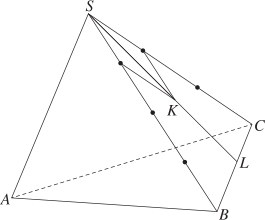
The diagram below shows the tetrahedron with vertices `A, B, C` and `S`.

The point `K` is defined by  `vec(SK)=(1)/(4) vec(SB)+(1)/(3) vec(SC)`, as shown in the diagram.

The point `L` is the point of intersection of the straight lines `S K` and `B C`.


  1. Using part (ii), or otherwise, determine the position of `L` by showing that  `vec(BL)=(4)/(7) vec(BC)`.  (2 marks)

    --- 6 WORK AREA LINES (style=lined) ---

  2. The point `P` is defined by  `vec(AP)=-6 vec(AB)-8 vec(AC)`.
  3. Does `P` lie on the line `A L`? Justify your answer.  (2 marks)

    --- 5 WORK AREA LINES (style=lined) ---

Show Answers Only
  1. `text{Proof (See Worked Solution)}`
  2. `text{Proof (See Worked Solution)}`
  3. `text{Proof (See Worked Solution)}`
  4. `P\ text{lies on}\ vec(AL)\ \ text{(See Worked Solution)}`
Show Worked Solution
i.    `lambda vecu+mu vecv` `=0`
  `lambda vecu` `=-mu vecv`

 
`lambda=0\ \ text{or}\ \ vecu=-(mu/lambda)vecv=k vecv\ \ (kinRR)`

`text{S}text{ince}\ \ vecu and vecv\ \ text{are not parallel}`

`=> lambda=mu=0`
 

ii.  `\lambda_1 \vec{u}+\mu_1 \vec{v}=\lambda_2 \vec{u}+\mu_2 \vec{v}`

`\lambda_1 \vec{u}-\lambda_2 \vec{u}+\mu_1 \vec{v}-\mu_2 \vec{v}` `=vec0`  
`(\lambda_1-\lambda_2)\vec{u}+(\mu_1-\mu_2)\vec{v}` `=vec0`  


`text{Using part (i):}`

`(\lambda_1-\lambda_2)=0 and (\mu_1-\mu_2)=0`

`:.\lambda_1=\lambda_2  and  \mu_1=\mu_2\ …\ text{as required}`


Mean mark (ii) 56%.
iii.   `vec(BL)` `=lambda vec(BC)`
    `=lambda(vec(BS)+vec(SC))\ \ \ …\ (1)`


`vec(BL)` `=vec(BS)+mu vec(SK)`  
  `=-vec(SB)+mu(1/4vec(SB)+1/3vec(SC))`  
  `=-vec(SB)+mu/4vec(SB)+mu/3vec(SC)`  
  `=mu/3vec(SC)+(mu/4-1)vec(SB)\ \ \ …\ (2)`  


♦♦♦ Mean mark (iii) 25%.

`text{Using}\ \ (1) = (2):`

`lambda vec(BS)+ lambda vec(SC)=mu/3vec(SC)+(mu/4-1)vec(SB)`

`mu/3=lambda, \ \ 1-mu/4=lambda`

`mu/3` `=1-mu/4`  
`(4mu+3mu)/12` `=1`  
`(7mu)/12` `=1`  
`mu` `=12/7`  

 
`lambda=(12/7)/3=4/7`

`:.vec(BL)=(4)/(7) vec(BC)\ \ text{… as required}`
 

iv.  `vec(AP)=-6 vec(AB)-8 vec(AC)`

`text{If}\ P\ text{lies on}\ AL, ∃k\ text{such that}\ \ vec(AP)=k vec(AL)`


♦♦♦ Mean mark (iv) 23%.
`-6 vec(AB)-8 vec(AC)` `=k vec(AL)`  
`-6 vec(AB)-8 (vec(AB)+vec(BC))` `=k(vec(AB)+vec(BL))`  
`-14 vec(AB)-8vec(BC)` `=k(vec(AB)+4/7vec(BC))\ \ text{(see part (iii))}`  
`-14 vec(AB)-8vec(BC)` `=kvec(AB)+(4k)/7vec(BC)`  

 
`k=-14, \ \ (4k)/7=-8\ \ =>\ \ k=-14`

`:.\ P\ text{lies on}\ \ AL.`

Filed Under: Vectors and Geometry, Vectors and Vector Equations of Lines Tagged With: Band 4, Band 5, Band 6, smc-1196-25-Point lies on line, smc-1196-30-Parallel, smc-1196-80-3D vectors, smc-1210-20-Pyramid, smc-1210-70-3D problems

BIOLOGY, M5 2022 HSC 12 MC

The following diagram represents a short section of DNA.
 

What are the components labelled `X, Y` and `Z` ?
 

Show Answers Only

`A`

Show Worked Solution
  • `X` is a pentagon therefore representing a five-carbon sugar.
  • `Y` is connecting the sugars in the DNA backbone and therefore must be a phosphate group.
  • As `Z` is part of the bond between Adenosine and Thymine because the bond only contains 2 hydrogen bonds, and that Cytosine only bonds with Guanine, `Z` must be Thymine.

`=>A`


♦♦ Mean mark 34%.

Filed Under: Cell Replication Tagged With: Band 5, smc-3649-10-DNA Structure

BIOLOGY, M7 2022 HSC 10-11 MC

Refer to the following information to answer Questions 10 – 11.

Pasteur used swan neck flasks to conduct experiments on microbial contamination of broth. One of Pasteur's investigations is shown.
 

Question 10

Which of the following was the independent variable in this investigation?

  1. The air
  2. The flask
  3. The broth
  4. The microbes

 
Question 11

What is the best explanation for Pasteur's results?

  1. Cells arise from existing cells
  2. Heating prevents broth spoiling
  3. Gases in the air cause broth to spoil
  4. Cells arise by spontaneous generation
Show Answers Only

Question 10: `B`

Question 11: `A`

Show Worked Solution

Question 10

  • The flask was changed in each test therefore it is the independent variable.

`=>B`
 

Question 11

  • Pasteur’s experiment was conducted to show that microbes arise from existing cells in the air, disproving spontaneous generation.

`=>A`


♦ Mean mark (Q11) 40%.

Filed Under: Causes of Infectious Disease Tagged With: Band 4, Band 5, smc-3655-60-Louis Pasteur

BIOLOGY, M5 2022 HSC 8 MC

In mice, muscle cells contain 40 chromosomes.

Which of the following is a correct statement about mouse cells?

  1. The gametes contain 20 pairs of chromosomes.
  2. The somatic cells contain 20 pairs of chromosomes.
  3. The cells produced by meiosis contain 40 chromosomes.
  4. The cells produced by mitosis contain 40 pairs of chromosomes.
Show Answers Only

`B`

Show Worked Solution
  • Muscle cells are somatic, diploid cells.
  • Therefore, they would contain 20 pairs of chromosomes.

`=>B`


♦ Mean mark 46%.

Filed Under: Genetic Variation / Inheritance Tagged With: Band 5, smc-3648-60-Karyotypes

ENGINEERING, CS 2021 HSC 25b

A truss is fixed to a wall at `A` and `B` as shown. Ignore the mass of the truss.


  1. Determine the horizontal reaction at `A`.   (2 marks)

--- 4 WORK AREA LINES (style=lined) ---
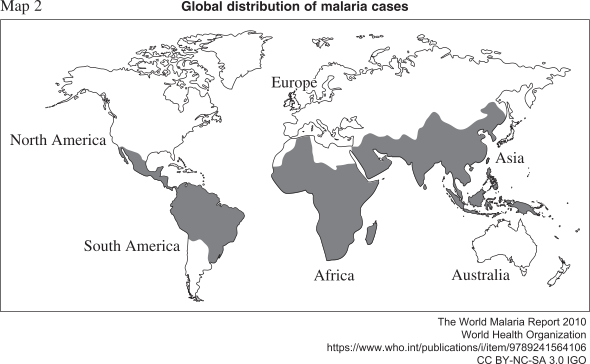
  1. Determine, using method of joints, the internal reaction in member `AC`. Indicate the nature of the force in the member.   (3 marks)

--- 6 WORK AREA LINES (style=lined) ---
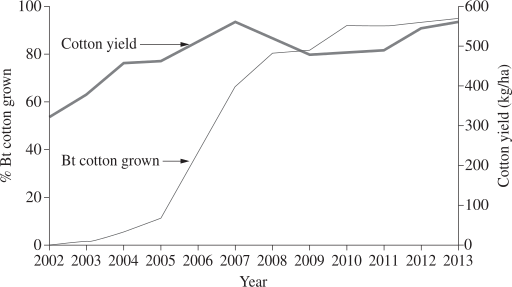
  1. Determine, using method of sections, the internal reaction in member `CE`. Indicate the nature of the force.   (3 marks)

--- 6 WORK AREA LINES (style=lined) ---
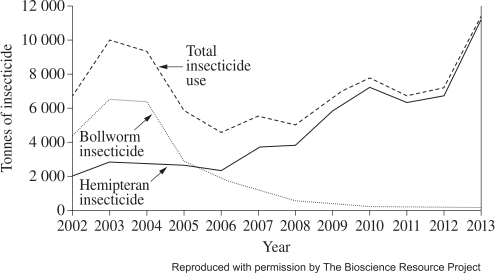
Show Answers Only

i.    `3.75\ text{kN ←}`

ii.    `AC=4802\ text{N}`

iii.   `CE = 3\ text{kN (tension)}`

Show Worked Solution

i.   Horizontal reaction at `A`

\(\circlearrowright \Sigma \text{M}_\text{B}\) \(= 0\)  
`0` `= -(A_H xx 4\ text{m}) + (1500\ text{N} xx  10\ text{m})`  
`A_H` `= 3750\ text{N}= 3.75\ text{kN ←}`  


ii.   Method of joints at A


→Σ`F_H` `=0`  
`0` `= -3750+AC xx sin(51.34°)`  
`AC` `=3750/sin(51.34°)=4802\ text{N}`  

♦♦ Mean mark (ii) 41%.

iii.  Method of Sections

\(\circlearrowright \Sigma \text{M}_\text{B}\) \(=0\)  
`0` `= (1500 xx 10)-(CE xx 5)`  
`CE` `=(15\ 000)/5=3000\ text{N}=3\ text{kN (tension)}`  

♦♦♦ Mean mark (iii) 30%.

Filed Under: Engineering Mechanics Tagged With: Band 4, Band 5, Band 6, smc-3714-10-Truss analysis

BIOLOGY, M7 2020 HSC 32c

Rabies is a disease that can affect all mammals and is caused by the rabies virus. It is transmitted by the bite of an infected animal. Without treatment it almost always results in death.


  1.  

The rabies virus is a single-stranded RNA virus. It contains and codes for only five proteins. The diagrams show the structure and reproduction of the virus.


Post exposure prophylaxis (PEP) is given to patients who have been bitten by a rabid animal.

PEP includes an injection of human rabies antibodies (HRIG) as well as injections of a rabies vaccine at 0, 3, 7 and 14 days after exposure to the virus.

The following graphs show a generalised response to rabies infection without and with PEP.
  

Explain how PEP prevents rabies developing after infection with the virus. Support your answer with reference to the information and data provided above.   (8 marks)

--- 20 WORK AREA LINES (style=lined) ---

Show Answers Only

Once the rabies virus has entered the wound:

  • It will use the patient’s cells to replicate and the viral concentration will increase (as seen in the first five days).
  • Without PEP the virus will continue to replicate, migrate to the CNS (in the first graph this occurs by day 7), and eventually cause rabies and death.
  • Initially, the infected individual will not have the antibodies required to inactivate the virus.
  • A HRIG injection provides the required antibodies to inactivate the virus, through inhibiting replication or enhancing phagocytosis. 
  •  The PEP graph shows that these antibodies will only last up to 21 days, but are essential in inactivating the initial virus, as seen by a reduction in viral concentration after 6-8 days. 

The rabies vaccine works by:

  • containing an inactivated or weakened version of the rabies virus, which stimulates an immune response by the individual.
  • Initially, macrophages will display an MHC-antigen complex on its surface which helper T lymphocytes will bind to.
  • This then stimulates specific plasma B cells which can produce complementary antibodies, and memory B cells, which stay dormant and can rapidly differentiate into plasma B cells when exposed to the same virus.
  • The PEP graph shows the rapid production of antibodies on day 7, which coincides with rapid decrease in the virus concentration over the next few days. 
  • The antibodies then remain in the bloodstream and slowly decline over months, which allows quick diffusion if the virus is encountered within that timeframe.
Show Worked Solution

Once the rabies virus has entered the wound:

  • It will use the patient’s cells to replicate and the viral concentration will increase (as seen in the first five days).
  • Without PEP the virus will continue to replicate, migrate to the CNS (in the first graph this occurs by day 7), and eventually cause rabies and death.
  • Initially, the infected individual will not have the antibodies required to inactivate the virus.
  • A HRIG injection provides the required antibodies to inactivate the virus, through inhibiting replication or enhancing phagocytosis. 
  •  The PEP graph shows that these antibodies will only last up to 21 days, but are essential in inactivating the initial virus, as seen by a reduction in viral concentration after 6-8 days. 

The rabies vaccine works by:

  • containing an inactivated or weakened version of the rabies virus, which stimulates an immune response by the individual.
  • Initially, macrophages will display an MHC-antigen complex on its surface which helper T lymphocytes will bind to.
  • This then stimulates specific plasma B cells which can produce complementary antibodies, and memory B cells, which stay dormant and can rapidly differentiate into plasma B cells when exposed to the same virus.
  • The PEP graph shows the rapid production of antibodies on day 7, which coincides with rapid decrease in the virus concentration over the next few days. 
  • The antibodies then remain in the bloodstream and slowly decline over months, which allows quick diffusion if the virus is encountered within that timeframe.

♦♦ Mean mark 41%.

Filed Under: Immunity and Responses to Pathogens, Prevention, Treatment and Control Tagged With: Band 5, Band 6, smc-3657-10-Antibody Mediated, smc-3657-25-Antibodies, smc-3658-20-Vaccines

BIOLOGY, M8 2020 HSC 31

  1. The levels of glucose, insulin and glucagon were measured in the plasma of 24 healthy adults at intervals over a 5-hour period. After 1 hour at rest the patients ate a large carbohydrate meal. The results are shown.

  2. Use the data provided to explain how blood glucose is controlled in the body.   (6 marks)

    --- 12 WORK AREA LINES (style=lined) ---
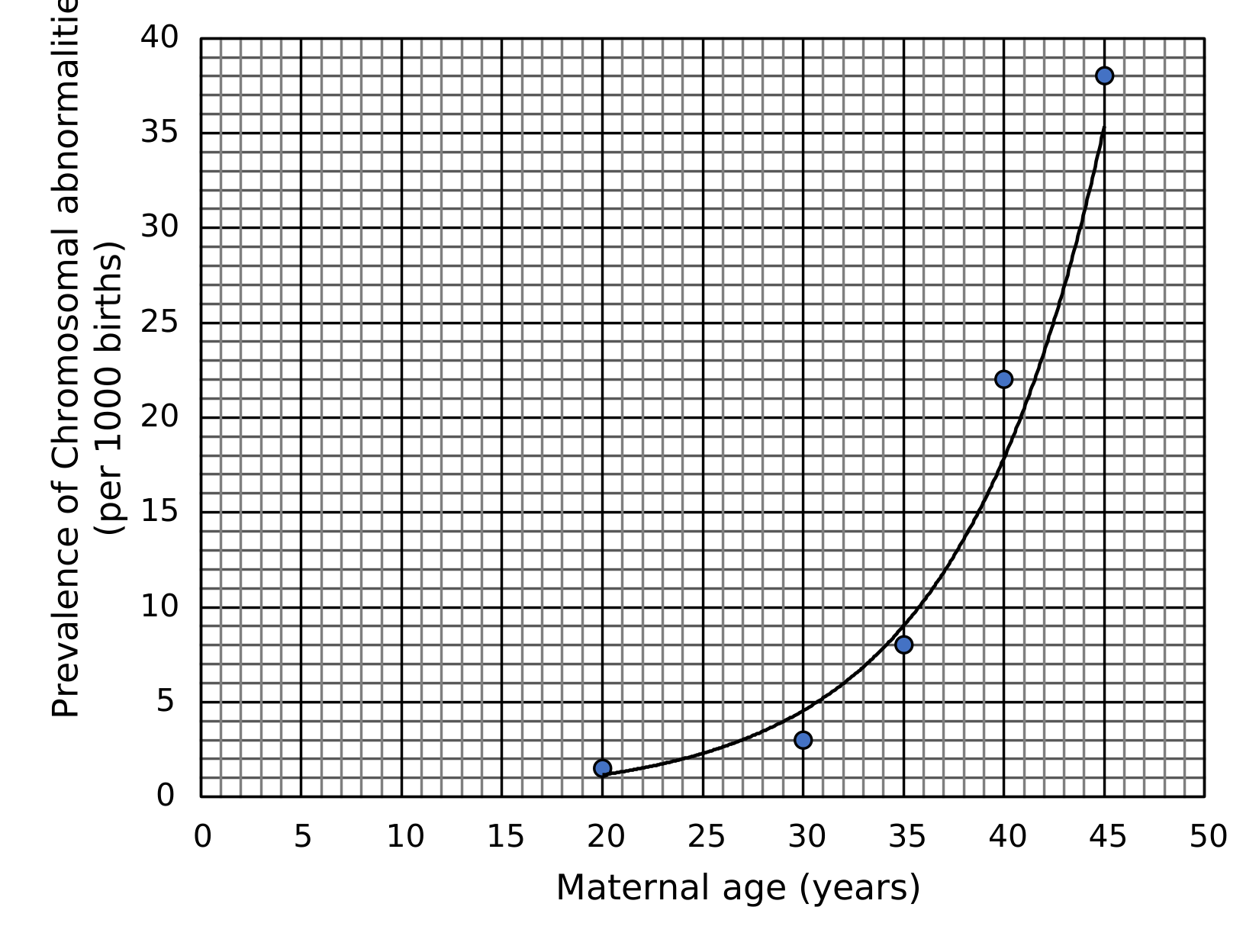
  3. Outline how in humans, maintenance of temperature is different to the way that glucose is controlled.   (3 marks)

    --- 6 WORK AREA LINES (style=lined) ---
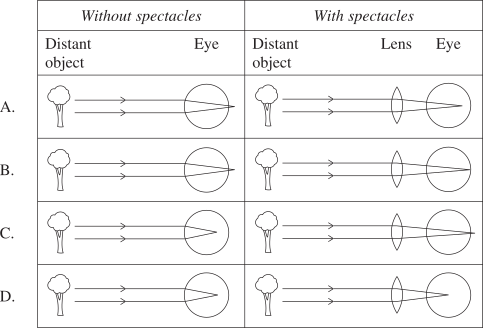
Show Answers Only

a.   Glucose Levels

  • Plasma levels within the first 60 minutes represent the resting glucose levels of the individuals.
  • After the 1 hour mark, the rise in glucose is a result of the absorption of glucose into the bloodstream from the gut after eating the carb rich meal.

Insulin Levels

  • Insulin is a hormone secreted by beta cells in the pancreas. It causes excess glucose in the bloodstream to be taken by the liver and stored as glycogen.
  • This can be seen when the insulin levels directly correlate to the amount of glucose in the body; glucose absorbed in the meal stimulates release of insulin.
  • The reduction in glucose by the insulin then causes insulin to also fall.

Glucagon Levels

  • Glucagon is a hormone secreted by alpha cells in the pancreas. It can almost be seen as the opposite of insulin, and forms the negative feedback loop responsible for controlling blood glucose. 
  • It causes glycogen stores in the liver to decompose into glucose and be absorbed by the bloodstream when blood glucose levels drop too low.
  • When glucose levels rise between the 1-2 hour mark, glucagon levels drop significantly, as the build up of glucose from the meal has meant that glycogen stores are not needed.
  • Gradually, as glucose levels drop, glucagon levels will increase as the glucose from the meal is depleted.

b.  Differences in temperature vs glucose maintenance

  • Temperature changes are detected by the hypothalamus and sensory neurons, but changes in blood glucose levels (BGL) are detected by the pancreas.
  • Responses are carried out by the nervous system when temperature changes are detected, but carried out by hormones when changes in BGL are detected.
Show Worked Solution

a.   Glucose Levels

  • Plasma levels within the first 60 minutes represent the resting glucose levels of the individuals.
  • After the 1 hour mark, the rise in glucose is a result of the absorption of glucose into the bloodstream from the gut after eating the carb rich meal.

Insulin Levels

  • Insulin is a hormone secreted by beta cells in the pancreas. It causes excess glucose in the bloodstream to be taken by the liver and stored as glycogen.
  • This can be seen when the insulin levels directly correlate to the amount of glucose in the body; glucose absorbed in the meal stimulates release of insulin.
  • The reduction in glucose by the insulin then causes insulin to also fall.

Glucagon Levels

  • Glucagon is a hormone secreted by alpha cells in the pancreas. It can almost be seen as the opposite of insulin, and forms the negative feedback loop responsible for controlling blood glucose. 
  • It causes glycogen stores in the liver to decompose into glucose and be absorbed by the bloodstream when blood glucose levels drop too low.
  • When glucose levels rise between the 1-2 hour mark, glucagon levels drop significantly, as the build up of glucose from the meal has meant that glycogen stores are not needed.
  • Gradually, as glucose levels drop, glucagon levels will increase as the glucose from the meal is depleted.

♦ Mean mark (a) 48%.

b.  Differences in temperature vs glucose maintenance

  • Temperature changes are detected by the hypothalamus and sensory neurons, but changes in blood glucose levels (BGL) are detected by the pancreas.
  • Responses are carried out by the nervous system when temperature changes are detected, but carried out by hormones when changes in BGL are detected.

♦♦ Mean mark (b) 36%.

Filed Under: Homeostasis Tagged With: Band 5, Band 6, smc-3659-12-Negative Feedback Loops, smc-3659-25-BGL/Diabetes

BIOLOGY, M7 2020 HSC 30

Explain the impact that genetic technologies have had on the management of both infectious and non-infectious diseases.   (7 marks)

--- 16 WORK AREA LINES (style=lined) ---
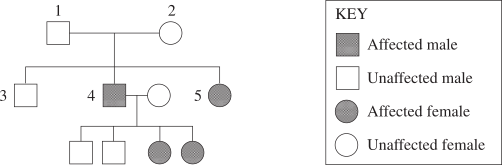
Show Answers Only

Non Infectious diseases

  • Down syndrome and diabetes are examples of non-infectious diseases that are not caused by pathogens and are not contagious.
  • Recombinant DNA: This technology delivers replacement genes by creating recombinant plasmids in bacteria which then multiply via binary fission.
  • This has been used to produce insulin by inserting a copy of the human insulin gene for the treatment of diabetic patients.
  • Pre-Implantation Genetic Testing: before IVF, eggs can be tested for various genetic diseases, such as down syndrome or cystic fibrosis.

Infectious diseases

  • These diseases are caused by pathogens.
  • The genetic makeup of organisms can be altered to lower risk of such diseases.
  • Transgenic Organisms involve technology that combines genes from other species to incorporate certain characteristics.
  • For example, Recombinant Bt corn contains a gene that is toxic to the destructive European corn borer. This will protect the corn and reduce the occurence of the associated infectious disease in humans.
Show Worked Solution

Non Infectious diseases

  • Down syndrome and diabetes are examples of non-infectious diseases that are not caused by pathogens and are not contagious.
  • Recombinant DNA: This technology delivers replacement genes by creating recombinant plasmids in bacteria which then multiply via binary fission.
  • This has been used to produce insulin by inserting a copy of the human insulin gene for the treatment of diabetic patients.
  • Pre-Implantation Genetic Testing: before IVF, eggs can be tested for various genetic diseases, such as down syndrome or cystic fibrosis.

Infectious diseases

  • These diseases are caused by pathogens.
  • The genetic makeup of organisms can be altered to lower risk of such diseases.
  • Transgenic Organisms involve technology that combines genes from other species to incorporate certain characteristics.
  • For example, Recombinant Bt corn contains a gene that is toxic to the destructive European corn borer. This will protect the corn and reduce the occurence of the associated infectious disease in humans.

♦♦ Mean mark 44%.

Filed Under: Genetic Technologies, Prevention Tagged With: Band 5, smc-3654-05-Transgenic Organisms, smc-3654-30-Benefits, smc-3654-80-Gene Cloning, smc-3662-20-Genetic Engineering

BIOLOGY, M6 2020 HSC 29

Explain how TWO processes that affect the gene pool of populations can lead to evolution.   (5 marks)

Show Answers Only
  • A gene pool is the total genetic diversity of a population. It includes various genotypes and phenotypes which are a result of variability within offspring, the individual and the population. This process as a whole can be referred to as evolution.

Gene Flow

  • The movement of alleles in or out of a population, usually as a result of migration.
  • For example, immigration of an animal into a population as a result of environmental pressures or predators can result in the introduction of that animal’s unique phenotype into the gene pool of the population. 

Genetic Drift

  • The change in allele frequency as a result of a random event.
  • For example, an earthquake or other natural disaster eliminates organisms regardless of their genotype. The remaining individuals will then carry a small sample of the alleles present in the original population, some which might be eliminated.

Other answers could include

  • Mutation
  • Natural Selection
  • Sexual reproduction
Show Worked Solution
  • A gene pool is the total genetic diversity of a population. It includes various genotypes and phenotypes which are a result of variability within offspring, the individual and the population. This process as a whole can be referred to as evolution.

Gene Flow

  • The movement of alleles in or out of a population, usually as a result of migration.
  • For example, immigration of an animal into a population as a result of environmental pressures or predators can result in the introduction of that animal’s unique phenotype into the gene pool of the population. 

Genetic Drift

  • The change in allele frequency as a result of a random event.
  • For example, an earthquake or other natural disaster eliminates organisms regardless of their genotype. The remaining individuals will then carry a small sample of the alleles present in the original population, some which might be eliminated.

Other answers could include

  • Mutation
  • Natural Selection
  • Sexual reproduction

Mean mark 53%.

Filed Under: Mutation Tagged With: Band 4, Band 5, smc-3652-10-Mechanisms of Change/Variation, smc-3652-20-Somatic vs. Germ-Line, smc-3652-55-Mutation in Reproduction

BIOLOGY, M5 2020 HSC 28

  1. A student drew a diagram to model part of the process of meiosis.
     

  1. Explain the misunderstanding of meiosis shown in this model.   (3 marks)

    --- 6 WORK AREA LINES (style=lined) ---
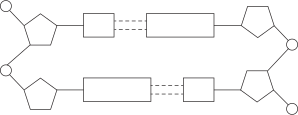
  2. Explain the effect of meiosis on genetic variation.   (3 marks)

    --- 6 WORK AREA LINES (style=lined) ---
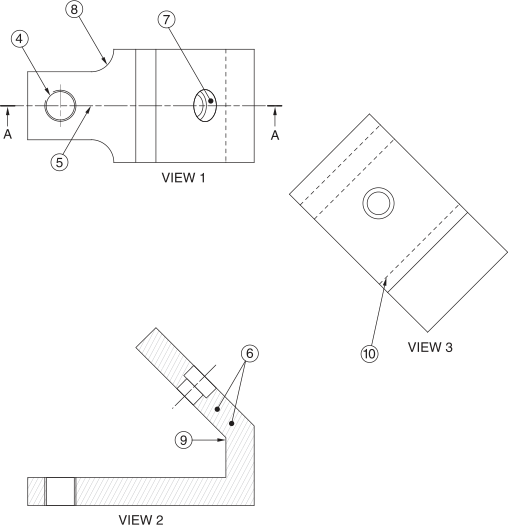
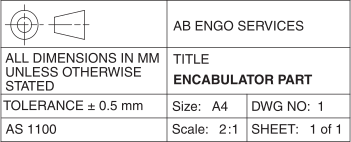
Show Answers Only

a.


  • In the diagram above, the paired homologous chromosomes are incorrectly drawn.
  • Prior to crossing over, each chromosome duplicates forming the sister chromatids with one being maternal and one being paternal.
  • In the model above, they are shown as a mix of both, when in actuality the sister chromatids should be identical.
     

b.   The Effect of Meiosis on Genetic Variation

Independent Assortment

  • when chromosomes are lined up along the cells equator in independent order and orientation to all other chromosomes.

Random Segregation  

  • different combinations of maternal and paternal chromosomes end up in resulting gametes, increasing variability amongst them.

Crossing Over

  • the process of exchanging genetic material between chromatids of homologous chromosomes during Meiosis I, leading to unique combinations of alleles on each chromatid.
Show Worked Solution

a.


  • In the diagram above, the paired homologous chromosomes are incorrectly drawn.
  • Prior to crossing over, each chromosome duplicates forming the sister chromatids with one being maternal and one being paternal.
  • In the model above, they are shown as a mix of both, when in actuality the sister chromatids should be identical.

♦♦♦ Mean mark (a) 25%.

b.   The Effect of Meiosis on Genetic Variation

Independent Assortment

  • when chromosomes are lined up along the cells equator in independent order and orientation to all other chromosomes.

Random Segregation  

  • different combinations of maternal and paternal chromosomes end up in resulting gametes, increasing variability amongst them.

Crossing Over

  • the process of exchanging genetic material between chromatids of homologous chromosomes during Meiosis I, leading to unique combinations of alleles on each chromatid.

♦ Mean mark (b) 43%.

Filed Under: Cell Replication, Genetic Variation / Inheritance Tagged With: Band 5, Band 6, smc-3648-50-Meiosis, smc-3649-20-Meiosis

CHEMISTRY, M6 2020 HSC 36

-

100.00 mL of 2.00 mol L¯1 \( \ce{HCl(aq)} \) was initially at a temperature of 22.5°C. The mass of this solution was 103 g.

10.0 g of solid `text{NaOH}` was added to the acid. The specific heat capacity of the resulting solution was 3.99 J g ¯1 K ¯1.

Assuming no energy loss to the environment, calculate the maximum temperature reached by the solution.   (5 marks)

Use the following information in your calculations.

\begin{array} {ll}
\ce{NaOH(s) -> Na+(aq) + OH-(aq) & Δ$H=–44.5$\ \text{kJ mol}^{-1}} \\
\ce{NaOH(aq) + HCl(aq) -> NaCl(aq) + H2O(l) & Δ$H=–56.1$\ \text{kJ mol}^{-1}} \end{array}

--- 15 WORK AREA LINES (style=lined) ---

Show Answers Only

`T_(f i nal) = 72.1text{°C  (to 1 d.p.)}`

Show Worked Solution

\( \text{Dissolution of}\ \ce{NaOH(s):} \)

\(\ce{NaOH(s) → Na+ (aq) + OH– (aq)}\)

`text{n(NaOH)} = text{m} / text{MM} = [10.0] / [22.99 + 16.00 + 1.008] = 0.250\ text{mol}`

`q_1 = -ΔH xx text{n} = 44.5 xx 0.250 = −11.125\ text{kJ}`
 

\( \text{Reaction between}\ \ce{NaOH(aq)}\ \text{and}\ \ce{HCl(aq):}\)

\(\ce{HCl(aq) + NaOH(aq) → NaCl(aq) + H2O(l)}\)

`text{n(HCl)} = text{c} xx text{V} = 2.00 xx 0.100 = 0.200\ text{mol}`

`=>\ text{HCl = limiting reagent}`
 

`text{n(H}_2 text{O) formed} = 0.200\ text{mol}`

`q_2 = -ΔH xx text{n} = 56.1 xx 0.200 = 11.22\ text{kJ}`

`q_(t otal) = q_1 + q_2 = 11.125 + 11.22 = 22.345\ text{kJ} = 22\ 345\ text{J}`
 

`q_(t otal)` `= mcΔT`  
`22\ 345` `= (103 + 10.0) xx 3.99 xx (T_(f i nal) − T_(i nitial))`  
  `= (103 + 10.0) xx 3.99 xx (T_(f i nal) − 22.5)`  
`T_(f i nal)` `=(22\ 345)/((103 + 10.0) xx 3.99)+22.5`  
  `= 72.1text{°C  (to 1 d.p.)}`  

♦ Mean mark 49%.

Filed Under: Properties of Acids and Bases Tagged With: Band 5, smc-3673-20-Enthalpy of Neutralisation

CHEMISTRY, M5 2020 HSC 35

In aqueous solution, iodide ions `(text{I}^-)`react rapidly with iodine `(text{I}_2)` to form triiodide ions `text{I}_(3)^(\ -)`, making the equilibrium system shown in the chemical equation:

`text{I}^(-)(aq)+ text{I}_(2)(aq) ⇌ text{I}_(3)^(\ -)(aq)`

The following relationships can be derived from the reaction mechanism:

`[text{I}^(-)]_(eq)=2[text{I}_(2)]_(eq)`

`[text{I}^(-)]_(i nitial)=4[text{I}_(2)]_(eq)+3[text{I}_(3)^(\ -)]_(eq)`

where 'initial' designates the initial concentration and 'eq' designates the equilibrium concentration.

The absorbance of the solution in the UV-Vis spectrum is given by:

`A=[text{I}_(3)^(\ -)]xx2.76 xx10^(4)`

Determine the value of the equilibrium constant, given that  `A = 0.745`  at equilibrium and  `[text{I}^(-)]_(i nitial )=7.00 xx10^(-4)\ text{mol L}^(-1)`.   (4 marks)

--- 14 WORK AREA LINES (style=lined) ---

Show Answers Only

`K_text{eq}= 564`

Show Worked Solution
`text{A}` \(\ce{= [I3–]_{eq} \times 2.76 × 10^4}\)
`0.745` \(\ce{= [I3–]_{eq} \times 2.76 × 10^4}\)
\(\ce{[I3–]_{eq}}\) `= 2.70 \times 10^(−5)\ text{mol L}^(–1)`


\(\ce{[I– ]_{initial}}\) \(\ce{= 4[I2 ]_{eq} + 3 [I3– ]_{eq}}\)
`7.00 xx 10^(−4)` `= 4 [text{I}_2 ]_text{eq} + (3 xx 2.70 xx 10^(−5))`
\(\ce{[I2 ]_{eq}}\) `=(7.00 xx 10^(−4)-(3 xx 2.70 xx 10^(−5)))/4`
  `= 1.55 xx 10^(−4)\ text{mol L}^(–1)`


`[text{I}^– ]_text(eq) = 2 [text{I}_2 ]_text(eq) = 2 xx (1.55 xx 10^(−4)) = 3.10 xx 10^(−4)\ text{mol L}^(–1)`


`K_text{eq}` `=[text{I}_3\^(\ -)]_text(eq) /[[text{I}^–]_text(eq) xx [text{I}_2]_text(eq)]`
  `= [2.70 xx 10^(−5)] / [3.10 xx 10^(−4) xx 1.55 xx 10^(−4)]`
  `= 564`

Mean mark 55%.

Filed Under: Equilibrium Constant, Solution Equilibria Tagged With: Band 5, smc-3671-10-Find K(eq), smc-3671-35-Chemical equation given, smc-3671-60-Ionic solutions, smc-3672-10-Mixed ionic solutions

CHEMISTRY, M8 2020 HSC 31

A water sample was analysed to determine the chloride ion content. 100.0 mL of this water was added to 25.00 mL of 0.100 mol L¯1 \( \ce{AgNO3(aq)}\).

The mixture was filtered and the filtrate was titrated against 0.0500 mol L¯1 \( \ce{KSCN(aq)} \) according to the following reaction.

\( \ce{Ag+(aq) + SCN-(aq) -> AgSCN(s)} \)

The titration was repeated three times and the average titre was 28.65 mL.

Calculate the concentration of chloride ions in the water, expressed in mg L¯1.   (4 marks)

Show Answers Only

`378\ text{mg L}^(–1)`

Show Worked Solution

`text{n(SCN}^–) = text{c} xx text{V} = 0.0500 xx 0.02865 = 1.43 xx 10^(−3)\ text{mol}`

`text{n(Ag}^+ text{) excess} = 1.43 xx 10^(−3)\ text{mol}`

`text{n(Ag}^+ text{) added} = 0.100 xx 0.02500 = 2.50 xx 10^(−3)\ text{mol}`

`text{n(Ag}^+ text{) reacted}` `= text{n(Ag}^+ text{) added} − text{n(Ag}^+ text{) excess}`
  `= 2.50 xx 10^(−3)\ text{mol}− 1.43 xx 10^(−3)\ text{mol}`
  `= 1.07 xx 10^(−3)\ text{mol}`

 
`text{n(Cl}^– ) = 1.07 xx 10^(−3)\ text{mol}`

`text{m(Cl}^– ) = text{n} xx text{MM} = 1.07 xx 10^(−3) xx 35.45  = 0.0378\ text{g} = 37.8\ text{mg}`

`[text{Cl}^– ] = text{m} / text{V} = [37.8\ text{mg}] / [0.100\ text{L}] = 378\ text{mg L}^(–1)`


♦♦ Mean mark 44%.

Filed Under: Inorganic Substances Tagged With: Band 5, smc-3682-70-Precipitation Titrations

  • « Previous Page
  • 1
  • …
  • 38
  • 39
  • 40
  • 41
  • 42
  • …
  • 82
  • Next Page »

Copyright © 2014–2025 SmarterEd.com.au · Log in