SmarterEd

Aussie Maths & Science Teachers: Save your time with SmarterEd

  • Login
  • Get Help
  • About

Compound Interest, SMB-006

Natalie is saving for a netball hoop and invests $2200 in an account that earns interest at 5.5% per annum, compounded monthly.

What is the future value of Natalie's investment, to the nearest dollar, after 1.5 years?   (2 marks)

--- 4 WORK AREA LINES (style=lined) ---
Show Answers Only

`$2389`

Show Worked Solution

`text{Annual interest rate = 5.5% = 0.055}` 

`text(Monthly interest rate) = \frac(0.055)(12)`

`n = 1.5 xx 12 = 18`
  

`FV` `= PV(1 + r)^n`
  `= 2200 (1 + frac(0.055)(12))^18`
  `= 2388.74…`
  `=$2389`

Filed Under: Compound Interest Tagged With: num-title-ct-coreb, smc-4334-10-Find FV

Compound Interest, SMB-005 MC

Roger invests $1400. He earns interest at 4% per annum, compounded monthly.

What is the future value of Roger's investment after 2.5 years?

  1. $1540.00
  2. $1546.98
  3. $3080.00
  4. $4540.76
Show Answers Only

`B`

Show Worked Solution

`text{Annual interest rate = 4% = 0.04}` 

`text(Monthly interest rate) = \frac(0.04)(12)`

`n = 2.5 xx 12 = 130`
  

`FV` `= PV(1 + r)^n`
  `= 1400 (1 + frac(0.04)(12))^30`
  `= $1546.98`

 
`=> \ B`

Filed Under: Compound Interest Tagged With: num-title-ct-coreb, smc-4334-10-Find FV

Compound Interest, SMB-004

In Japan, a bowl of ramen cost 1000 Japanese yen in 2005. The cost of ramen has increased by 0.5% per annum since then. 

Determine the cost of the same bowl of ramen in 2020 in Japanese yen, to the nearest yen.   (2 marks)

--- 4 WORK AREA LINES (style=lined) ---
Show Answers Only

`1078\ text{yen}`

Show Worked Solution

`r =\ text(0.5%)\ = 0.005`

`n = 15\ text(years)`

`FV` `=PV(1+r)^n`  
  `=1000(1 + 0.005)^15`  
  `=1077.68…`  
  `=1078\ text{yen}`  

Filed Under: Compound Interest Tagged With: num-title-ct-coreb, smc-4334-10-Find FV, smc-4334-70-Inflation

Compound Interest, SMB-003 MC

At the pump, one litre of diesel fuel cost 98 cents in NSW in 2003. The value of diesel fuel has increased by 4% per annum since then. 

Which expression gives the value, in cents, of one litre of diesel at the pump in 2023?  

  1. `98 xx 20 xx 1.04` 
  2. `98(1 + 0.04)^20`
  3. `98 xx 1.04 xx 20`
  4. `98 xx 20 xx 0.04`
Show Answers Only

`B`

Show Worked Solution

`r =\ text(4%)\ = 0.04`

`n = 20\ text(years)`

`text{Using}\ \ FV=PV(1+r)^n`

`text{Value in 2023} =98(1 + 0.04)^20`

`=>  B`

Filed Under: Compound Interest Tagged With: num-title-ct-coreb, smc-4334-10-Find FV, smc-4334-70-Inflation

Compound Interest, SMB-002

Samanda opens a bank account and deposits $5000 into it. Interest is paid at 4% per annum, compounding annually.

Assuming no further deposits or withdrawals are made, what will be the balance in the account at the end of three years?   (2 marks)

--- 3 WORK AREA LINES (style=lined) ---

Show Answers Only

`$5624.32`

Show Worked Solution
`FV` `= PV(1 + r)^n`
  `= 5000(1 + 0.05)^3`
  `= $5624.32`

Filed Under: Earning and Spending Money Tagged With: num-title-ct-coreb, smc-4334-10-Find FV

Compound Interest, SMB-001 MC

Resilia opens a bank account and deposits $2000 into it. Interest is paid at 4% per annum, compounding annually.

Assuming no further deposits or withdrawals are made, what will be the balance in the account at the end of two years?

  1. $2160.00
  2. $2163.20
  3. $2346.24
  4. $3920.00
Show Answers Only

`=> B`

Show Worked Solution
`FV` `= PV(1 + r)^n`
  `= 2000(1 + 0.04)^2`
  `= $2163.20`

 
`=> B`

Filed Under: Compound Interest Tagged With: num-title-ct-coreb, smc-4334-10-Find FV

Volume, SMB-016

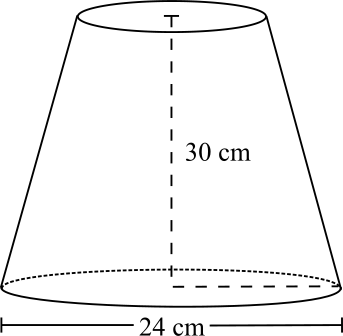
The truncated cone, pictured below, is made by cutting a right cone of height 60 centimetres.
 

Find the volume of the truncated cone, giving your answer to the nearest cubic centimetre.   (4 marks)

--- 8 WORK AREA LINES (style=lined) ---

Show Answers Only

`7916\ text(cm)^3`

Show Worked Solution

`text{Radius (original cone) = 12 cm}`

`text{Radius (small cone) = 6 cm}`

`text{Volume}` `=\ text{Original cone – Small cone}`  
  `=(1/3 xx pi xx 12^2 xx 60)-(1/3 xx pi xx 6^2 xx 30)`  
  `= 7916.81…`  
  `=7916\ text{cm}^3\ \ text{(nearest cm}^3 text{)}`  

Filed Under: Volume Tagged With: num-title-ct-coreb, smc-4235-50-Pyramids/Cones

Trigonometry, SMB-039

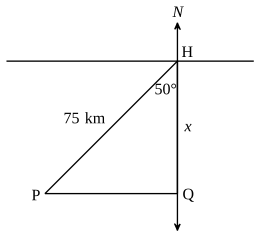
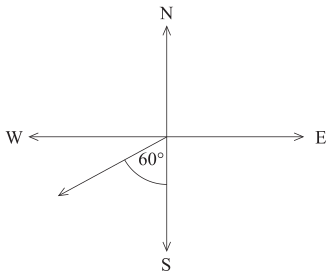
Gerry flies his helicopter from a heliport on a bearing of S50°W for 75 km until he stops at Town P which is due west of Town Q.

If Town Q is due south of the heliport, find the distance between the heliport and Town Q in kilometres, correct to two decimal places.   (3 marks)

--- 8 WORK AREA LINES (style=lined) ---

Show Answers Only

\(48.21\ \text{km} \)

Show Worked Solution

\(\text{Let}\ \ x=\ \text{distance from heliport and Town Q}\)

\(\cos 50^{\circ}\) \(= \dfrac{x}{75} \)  
\(x\) \(= 75 \times \cos 50^{\circ}\)  
  \(= 48.209…\)  
  \(= 48.21\ \text{km} \)  

Filed Under: Right-Angled Trig Tagged With: num-title-ct-coreb, smc-4552-70-Bearings

Trigonometry, SMB-038

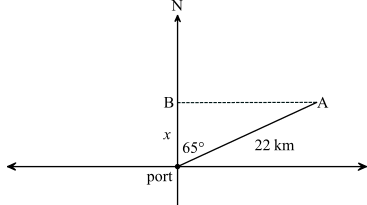
Boat A leaves port on a bearing of 065° and sails for 22 km until it is due east of Boat B. 

If Boat B is due north of the port, find the distance between the port and Boat B in kilometres, correct to two decimal places.   (3 marks)

--- 7 WORK AREA LINES (style=lined) ---

Show Answers Only

\(9.30\ \text{km} \)

Show Worked Solution
 

\(\text{Let}\ \ x=\ \text{distance from port to Boat B}\)

\(\cos 65^{\circ}\) \(= \dfrac{x}{22} \)  
\(x\) \(= 22 \times \cos 65^{\circ}\)  
  \(= 9.2976…\)  
  \(= 9.30\ \text{km} \)  

Filed Under: Right-Angled Trig Tagged With: num-title-ct-coreb, smc-4552-70-Bearings

Trigonometry, SMB-037

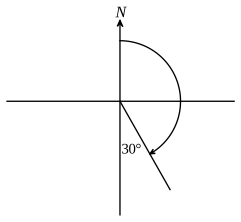
Express the compass bearing S30°E as a true bearing.   (2 marks)

--- 4 WORK AREA LINES (style=lined) ---
Show Answers Only

`text{True bearing}\ = 150°`

Show Worked Solution

`text(S30°E)` `= 90 + 60`
  `= 150°`

Filed Under: Right-Angled Trig Tagged With: num-title-ct-coreb, smc-4552-70-Bearings

Trigonometry, SMB-036

Express the compass bearing S60°W as a true bearing.   (2 marks)

--- 2 WORK AREA LINES (style=lined) ---

Show Answers Only

`text{True bearing}\ = 240°`

Show Worked Solution

`text(S60°W)` `= 180 + 60`
  `= 240°`

Filed Under: Right-Angled Trig Tagged With: num-title-ct-coreb, smc-4552-70-Bearings

Trigonometry, SMB-035 MC

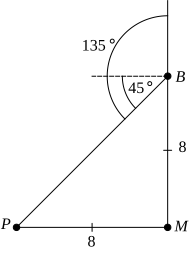
Peter is standing 8 metres due west of Mary.

Bob is standing 8 metres due north of Mary.

Bob is facing north. He then turns anticlockwise so that he is facing Peter.

How many degrees does Bob turn through?

  1. `45^@`
  2. `60^@`
  3. `120^@`
  4. `135^@`
Show Answers Only

 `D`

Show Worked Solution

`text(Degrees Bob turns through)`

`= 90 + 45`

`= 135^@`

`=>D`

Filed Under: Right-Angled Trig Tagged With: num-title-ct-coreb, smc-4552-70-Bearings

Trigonometry, SMB-034

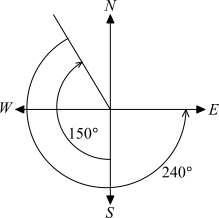
Ian is facing south. He turns 150° clockwise.

Ian then turns anticlockwise until he faces east.

By how many degrees did Ian turn anticlockwise?  (2 marks)

--- 6 WORK AREA LINES (style=lined) ---

Show Answers Only

`240^@`

Show Worked Solution

`150^@ + 90^@ = 240^@`

Filed Under: Right-Angled Trig Tagged With: num-title-ct-coreb, smc-4552-70-Bearings

Statistics, STD1 S3 2023 HSC 19

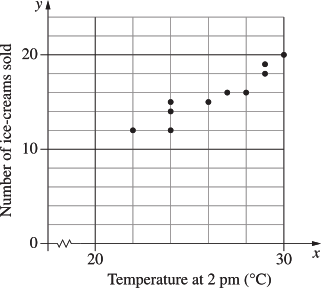
The scatterplot shows the number of ice-creams sold, \(y\), at a shop over a ten-day period, and the temperature recorded at 2 pm on each of these days.
 

  1. The data are modelled by the equation of the line of best fit given below.

\(y=0.936 x-8.929\), where \(x\) is the temperature.

  1. Sam used a particular temperature with this equation and predicted that 23 ice-creams would be sold.
  2. What was the temperature used by Sam, to the nearest degree?  (2 marks)

    --- 4 WORK AREA LINES (style=lined) ---
  3. In using the equation to make the prediction in part (a), was Sam interpolating or extrapolating? Justify your answer.  (2 marks)

    --- 3 WORK AREA LINES (style=lined) ---

Show Answers Only

a.    \(34^{\circ}\text{ (nearest degree)}\)

b.    \(\text{See worked solutions}\)

Show Worked Solution

a.             \(y\) \(=0.936x-8.929\)
\(23\) \(=0.936x-8.929\)
\(0.936x\) \(=23+8.929\)
\(x\) \(=\dfrac{31.921}{0.936}\)
  \(=34.112\ldots ^{\circ}\)
  \(= 34^{\circ}\text{ (nearest degree)}\)

♦♦ Mean mark (a) 31%.

b.     \(\text{Sam is extrapolating as 34°C is outside the range of data}\)

\(\text{points shown on the graph (i.e. temp between 0 and 30°C).}\)


♦♦ Mean mark (b) 33%.

Filed Under: Bivariate Data, S3 Further Statistical Analysis (Y12) Tagged With: Band 5, num-title-ct-coreb, num-title-qs-hsc, smc-1113-10-Line of Best Fit, smc-5022-10-Line of best fit graphs, smc-5022-28-LOBF equations, smc-5022-70-Inter/extrapolating

Quadratics, SMB-006

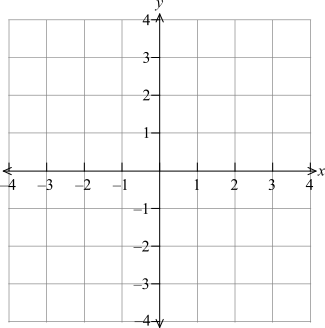
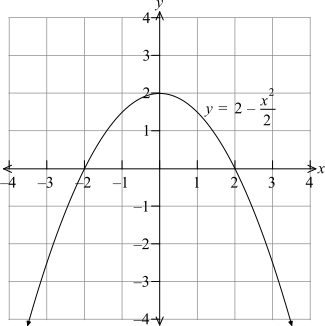
  1. Complete the table of values for the equation  `y=2-x^2/2`.  (1 mark)

\begin{array} {|l|c|c|c|c|}
\hline
\rule{0pt}{2.5ex} x \rule[-1ex]{0pt}{0pt} & -2 & -1 & \ \ 0\ \  & \ \ 1\ \  & \ \ 2 \ \  \\
\hline
\rule{0pt}{2.5ex} y \rule[-1ex]{0pt}{0pt} &   &  & 2 &  &  0 \\
\hline
\end{array}

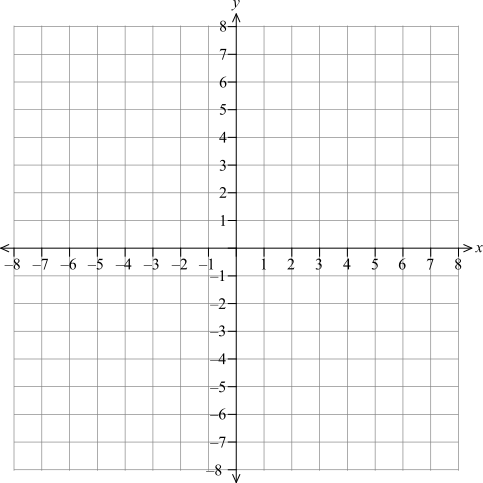
  1. Sketch the graph  `y=2-x^2/2`  (2 marks)  


  2. For what range of `x`-values is the parabola concave up?  (1 mark)

    --- 2 WORK AREA LINES (style=lined) ---

Show Answers Only

i.   

\begin{array} {|l|c|c|c|c|}
\hline
\rule{0pt}{2.5ex} x \rule[-1ex]{0pt}{0pt} & -2 & -1 & \ \ 0\ \  & \ \ 1\ \  & \ \ 2 \ \  \\
\hline
\rule{0pt}{2.5ex} y \rule[-1ex]{0pt}{0pt} & 0  & \frac{3}{2} & 2 & \frac{3}{2} &  0 \\
\hline
\end{array}

ii. 


iii.   `text{The parabola is concave down for all values of}\ x.`

`=>\ text{There are no values of}\ x\ text{where the graph is concave up.}`

Show Worked Solution

i.   

\begin{array} {|l|c|c|c|c|}
\hline
\rule{0pt}{2.5ex} x \rule[-1ex]{0pt}{0pt} & -2 & -1 & \ \ 0\ \  & \ \ 1\ \  & \ \ 2 \ \  \\
\hline
\rule{0pt}{2.5ex} y \rule[-1ex]{0pt}{0pt} & 0  & \frac{3}{2} & 2 & \frac{3}{2} &  0 \\
\hline
\end{array}

ii. 


iii.   `text{The parabola is concave down for all values of}\ x.`

`=>\ text{There are no values of}\ x\ text{where the graph is concave up.}`

Filed Under: Quadratics Tagged With: num-title-ct-coreb, smc-4443-20-Sketch graphs

Quadratics, SMB-005

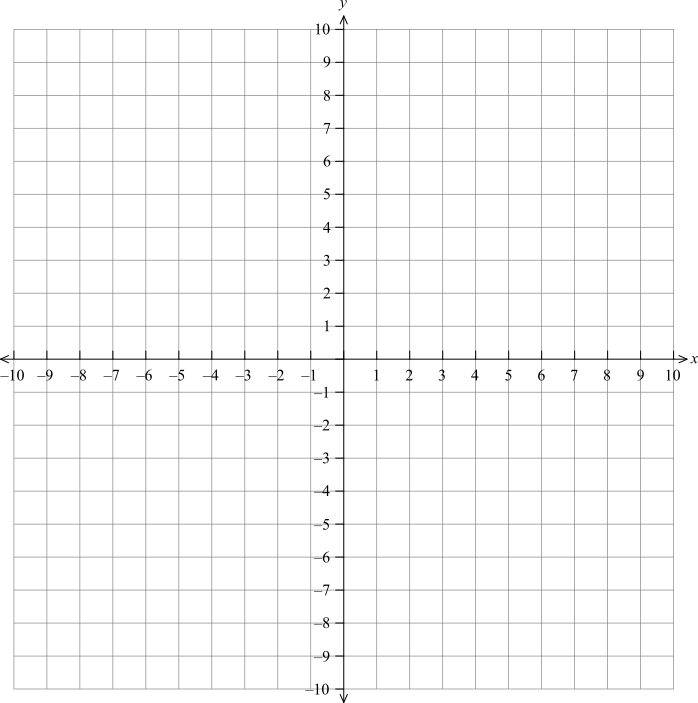
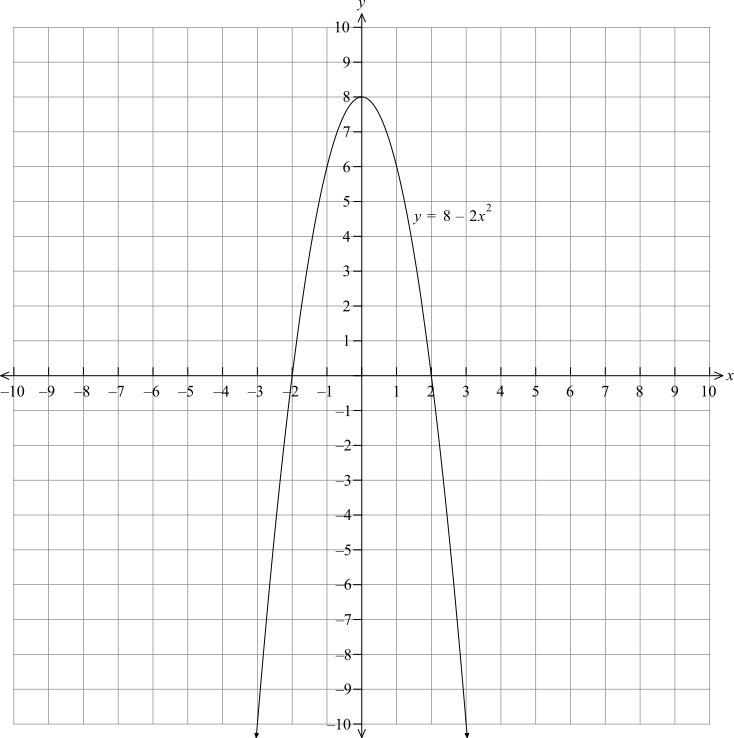
  1. Complete the table of values for the equation  `y=8-2x^2`.  (1 mark)

\begin{array} {|l|c|c|c|c|c|c|}
\hline
\rule{0pt}{2.5ex} x \rule[-1ex]{0pt}{0pt} & -3 & -2 & -1 & \ \ 0\ \  & \ \ 1\ \  & \ \ 2\ \ & \ \ 3 \ \  \\
\hline
\rule{0pt}{2.5ex} y \rule[-1ex]{0pt}{0pt} &  &   & 6 &  &  &  & -10  \\
\hline
\end{array}

  1. Sketch the graph  `y=8-2x^2`  (2 marks) 
      
  2. For what range of `x`-values is the parabola concave down?  (1 mark)

    --- 2 WORK AREA LINES (style=lined) ---

Show Answers Only

i.   

\begin{array} {|l|c|c|c|c|c|c|}
\hline
\rule{0pt}{2.5ex} x \rule[-1ex]{0pt}{0pt} & -3 & -2 & -1 & \ \ 0\ \  & \ \ 1\ \  & \ \ 2\ \ & \ \ 3 \ \  \\
\hline
\rule{0pt}{2.5ex} y \rule[-1ex]{0pt}{0pt} & -10 & 0  & 6 & 8 & 6 & 0 & -10  \\
\hline
\end{array}

ii. 


iii.   `text{The parabola is concave down for all values of}\ x.`

Show Worked Solution

i.   

\begin{array} {|l|c|c|c|c|c|c|}
\hline
\rule{0pt}{2.5ex} x \rule[-1ex]{0pt}{0pt} & -3 & -2 & -1 & \ \ 0\ \  & \ \ 1\ \  & \ \ 2\ \ & \ \ 3 \ \  \\
\hline
\rule{0pt}{2.5ex} y \rule[-1ex]{0pt}{0pt} & -10 & 0  & 6 & 8 & 6 & 0 & -10  \\
\hline
\end{array}

ii. 


iii.   `text{The parabola is concave down for all values of}\ x.`

Filed Under: Quadratics Tagged With: num-title-ct-coreb, smc-4443-20-Sketch graphs

Quadratics, SMB-004

  1. Complete the table of values for the equation  `y=4-x^2`.  (1 mark)

\begin{array} {|l|c|c|c|c|c|}
\hline
\rule{0pt}{2.5ex} x \rule[-1ex]{0pt}{0pt} & -2 & -1 & \ \ 0\ \  & \ \ 1\ \  & \ \ 2\ \  \\
\hline
\rule{0pt}{2.5ex} y \rule[-1ex]{0pt}{0pt} &  &   &  & 3 &  \\
\hline
\end{array}

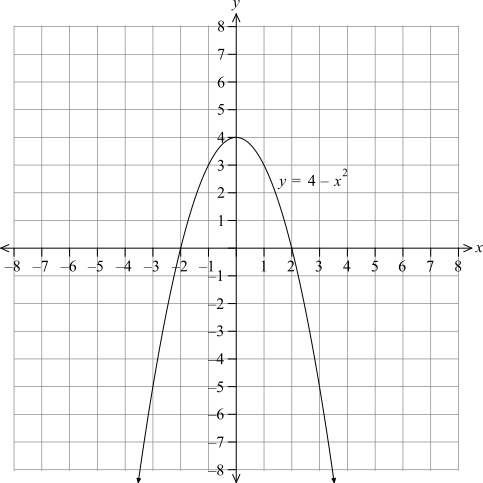
  1. Sketch the graph  `y=4-x^2`  (2 marks)  
      
  2. What are the coordinates of the vertex of the parabola?  (1 mark)

    --- 2 WORK AREA LINES (style=lined) ---

Show Answers Only


Show Worked Solution

i.   

\begin{array} {|l|c|c|c|c|c|}
\hline
\rule{0pt}{2.5ex} x \rule[-1ex]{0pt}{0pt} & -2 & -1 & \ \ 0\ \  & \ \ 1\ \  & \ \ 2\ \  \\
\hline
\rule{0pt}{2.5ex} y \rule[-1ex]{0pt}{0pt} & 0 & 3  & 4 & 3 & 0 \\
\hline
\end{array}

ii. 


iii.   `text{Vertex at (0,4)}`

Filed Under: Quadratics Tagged With: num-title-ct-coreb, smc-4443-20-Sketch graphs

Quadratics, SMB-003

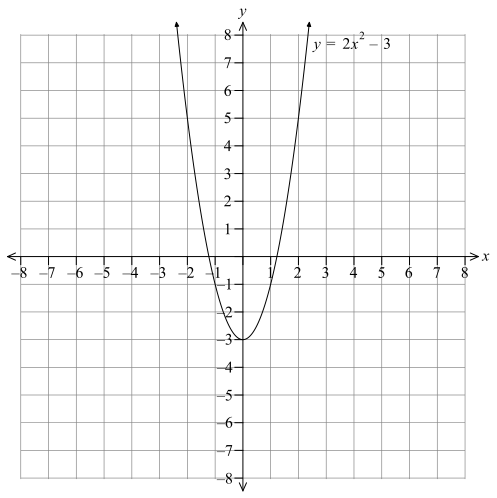
By completing the table of values, sketch the graph of  `y=2x^2-3`.  (3 marks)

\begin{array} {|l|c|c|c|c|c|}
\hline
\rule{0pt}{2.5ex} x \rule[-1ex]{0pt}{0pt} & -2 & -1 & \ \ 0\ \  & \ \ 1\ \  & \ \ 2\ \  \\
\hline
\rule{0pt}{2.5ex} y \rule[-1ex]{0pt}{0pt} &  &   &  & -1 &  \\
\hline
\end{array}


--- 0 WORK AREA LINES (style=lined) ---

Show Answers Only

\begin{array} {|l|c|c|c|c|c|}
\hline
\rule{0pt}{2.5ex} x \rule[-1ex]{0pt}{0pt} & -2 & -1 & \ \ 0\ \  & \ \ 1\ \  & \ \ 2\ \  \\
\hline
\rule{0pt}{2.5ex} y \rule[-1ex]{0pt}{0pt} & 5 & -1  & -3 & -1 & 5 \\
\hline
\end{array}

Show Worked Solution

\begin{array} {|l|c|c|c|c|c|}
\hline
\rule{0pt}{2.5ex} x \rule[-1ex]{0pt}{0pt} & -2 & -1 & \ \ 0\ \  & \ \ 1\ \  & \ \ 2\ \  \\
\hline
\rule{0pt}{2.5ex} y \rule[-1ex]{0pt}{0pt} & 5 & -1  & -3 & -1 & 5 \\
\hline
\end{array}

Filed Under: Quadratics Tagged With: num-title-ct-coreb, smc-4443-20-Sketch graphs

Exponentials, SMB-005

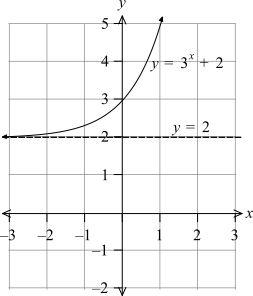
Sketch the graph of  `y=3^x+2`, clearly labelling any asymptotes.  (3 marks)

--- 0 WORK AREA LINES (style=lined) ---

Show Answers Only

Show Worked Solution

`y=3^x+2`

\begin{array} {|l|c|c|c|c|c|}
\hline
\rule{0pt}{2.5ex} x \rule[-1ex]{0pt}{0pt} & -2 & -1  & \ \ 0\ \  & \ \ 1\ \  & \ \ 2\ \  \\
\hline
\rule{0pt}{2.5ex} y \rule[-1ex]{0pt}{0pt} & 2 \frac{1}{9} & 2 \frac{1}{3} & 3 & 5 & 11\\
\hline
\end{array}

Filed Under: Exponentials Tagged With: num-title-ct-coreb, smc-4444-20-Sketch graphs

Exponentials, SMB-001

In 2004 there were 13.5 million registered motor vehicles in Australia. The number of registered motor vehicles is increasing at a rate of 2.3% per year.

Find an expression that represents the number (in millions) of registered motor vehicles `(V)`, if `y` represents the number of years after 2004?  (2 marks)

Show Answers Only

`V = 13.5 xx (1.023)^y`

Show Worked Solution

`text(In 2004, 13.5 million)`

`Vtext{(1 year later)} = 13.5 xx (1.023)`

`Vtext{(2 years later)}= 13.5 xx (1.023) xx (1.023)= 13.5 xx (1.023)^2`

`:. V(y\ text{years later}) = 13.5 xx (1.023)^y`

Filed Under: Exponentials Tagged With: num-title-ct-coreb, smc-4444-60-Other applications

Linear Applications, SMB-007

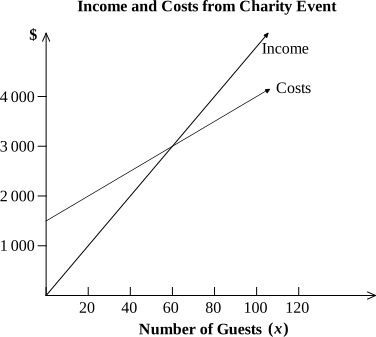
Fiona and John are planning to hold a fund-raising event for cancer research.  They can hire a function room for $650 and a band for $850.  Drinks will cost them $25 per person.

  1. Write a formula for the cost ($C) of holding the charity event for  `x`  people.  (1 mark)

    --- 2 WORK AREA LINES (style=lined) ---

  2. The graph below shows the planned income and costs if they charge $50 per ticket.  Estimate the number of guests they need to break even.    (1 mark)

    --- 2 WORK AREA LINES (style=lined) ---


  3. How much profit will Fiona and John make if 80 people attend their event?   (1 mark)

    --- 3 WORK AREA LINES (style=lined) ---

Show Answers Only
  1. `$C = 1500 + 25x`
  2. `60`
  3. `$500`
Show Worked Solution
i.    `text(Fixed C) text(osts)` `= 650 + 850`
    `= $1500`

 
`text(Variable C) text(osts) = $25x`

`:.\ $C = 1500 + 25x`


ii.   `text(From the graph)`
  `text(C) text(osts = Income when)\ x = 60`
  `text{(i.e. where graphs intersect)}`


iii.  `text(When)\ \ x = 80:` 

`text(Income)` `= 80 xx 50`  
  `= $4000`  


`$C` `= 1500 + 25 xx 80`
  `= $3500`


`:.\ text(Profit)` `= 4000-3500`
  `= $500`

Filed Under: Linear Applications Tagged With: num-title-ct-coreb, smc-4421-30-Cost/Revenue

Linear Applications, SMB-006

The average height, `C`, in centimetres, of a girl between the ages of 6 years and 11 years can be represented by a line with equation

`C = 6A + 79`

where `A` is the age in years. For this line, the gradient is 6.

  1. What does this indicate about the heights of girls aged 6 to 11?   (1 mark)

    --- 1 WORK AREA LINES (style=lined) ---

  2. Give ONE reason why this equation is not suitable for predicting heights of girls older than 12.   (1 mark)

    --- 1 WORK AREA LINES (style=lined) ---

Show Answers Only
  1. `text(It indicates that 6-11 year old girls, on average, grow 6 cm per year.)`
  2. `text(Girls eventually stop growing, and the equation doesn’t factor this in.)`
Show Worked Solution

i.    `text(It indicates that 6-11 year old girls, on average, grow)`

`text(6 cm per year.)`
 

ii.    `text(Girls eventually stop growing, and the equation doesn’t)`

`text(factor this in.)`

Filed Under: Linear Applications Tagged With: num-title-ct-coreb

Linear Applications, SMB-005 MC

Renee went bike riding on a holiday.

The hiring charges are  listed in the table below:

\begin{array} {|l|c|c|}
\hline \text{Hours hired} \ (h) & 1 & 2 & 3 & 4 & 5 \\
\hline \text{Cost} \ (C) & 18 & 24 & 30 & 36 & 42 \\
\hline \end{array}

Which linear equation shows the relationship between `C` and `h`?

  1. `C = 12 + 6h`
  2. `C = 6 + 12h`
  3. `C=18 + 12h`
  4. `C=12 + 18h`
Show Answers Only

`A`

Show Worked Solution

`text(Consider Option 1:)`

`12 + (6 xx 1) = 12+6=18`

`12 + (6 xx 2) = 12+12=24`

`12 + (6 xx 3) = 12+18=30\ \ \ \ text(etc …)`

`:.\ text(The linear equation is:)\ \ C = 12 + 6h`

`=>A`

Filed Under: Linear Applications Tagged With: num-title-ct-coreb

Linear Applications, SMB-004

The prices at an ice cream shop can be seen below.


Each extra scoop of ice cream costs the same amount of money.

How much will an ice cream with 5 scoops cost?  (2 marks)

--- 4 WORK AREA LINES (style=lined) ---
Show Answers Only

`$8.80`

Show Worked Solution

`text{Cost of 1 extra scoop}`

`= 6.25-5.40`

`= 0.85`
 

`:.\ text{Cost of an icecream with 5 scoops}`

`= $5.40 + 4\ text(extra scoops)`

`= 5.40 + (4 xx 0.85)`

`= 5.40 + 3.40`

`= $8.80`

Filed Under: Linear Applications Tagged With: num-title-ct-coreb

Linear Applications, SMB-003 MC

This chart shows the longest run, in kilometres, that Deek ran each week over 5 weeks.

\begin{array} {|l|c|c|c|c|c|}
\hline \textbf{Week} & 1 & 2 & 3 & 4 & 5\\
\hline \textbf{Longest run (km)} & 8 & 11 & 14 & 17 & 20\\
\hline \end{array}

If the pattern continues, in which week is Deek's longest run 29 km?

  1. `7`
  2. `8`
  3. `9`
  4. `10`
Show Answers Only

`B`

Show Worked Solution

`text(Deek’s longest run increases by 3 km each week.)`

`text(In week 6:  Longest run = 23 km)`

`text(In week 7:  Longest run = 26 km)`

`text(In week 8:  Longest run = 29 km)`

`=>B`

Filed Under: Linear Applications Tagged With: num-title-ct-coreb

Linear Applications, SMB-002 MC

At an apple orchard, apples are picked and put in a basket.

The table below shows the total number of apples in the basket after each minute.

\begin{array} {|c|c|c|}
\hline \textbf{Minutes} & \textbf{Total number of apples} \\
\hline 1 & 4 \\
\hline 2 & 8 \\
\hline 3 & 12 \\
\hline 4 & 16 \\
\hline \end{array}

How many apples are in the basket after 10 minutes? 

  1. `20`
  2. `30`
  3. `35`
  4. `40`
Show Answers Only

 `D`

Show Worked Solution

`text(4 apples are put into the basket each minute.)`

`:.\ text(Apples in basket after 10 minutes)`

`=4 xx 10`

`= 40\ text(apples)`

`=>D`

Filed Under: Linear Applications Tagged With: num-title-ct-coreb

Linear Applications, SMB-001 MC

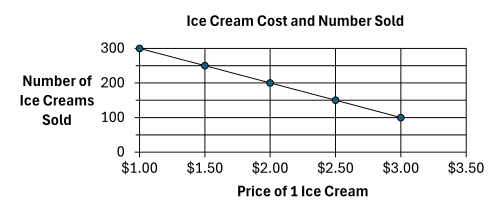
Jeremy sold ice creams out of his ice cream truck.

He drew the graph below to show how the number of ice creams he sells in a week is related to their price.

 
Which statement best describes the graph?

  1. As the ice cream price goes up, the number sold goes down.
  2. As the ice cream price goes up, the number sold goes up.
  3. As the ice cream price goes down, the number sold goes down.
  4. As the ice cream price goes down, the number sold stays the same.
Show Answers Only

`A`

Show Worked Solution

`text(As the ice cream price goes up, the number)`

`text(sold goes down.)`

`=>A`

Filed Under: Linear Applications Tagged With: num-title-ct-coreb

Cartesian Plane, SMB-007

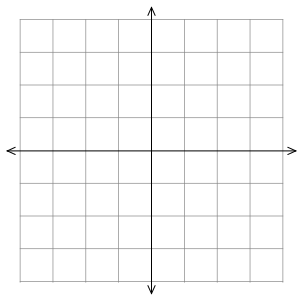
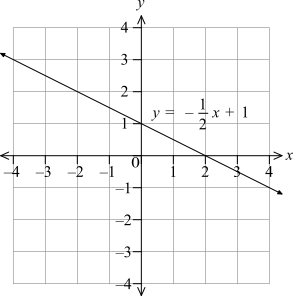
On the Cartesian plane below, graph the equation  `y-1=-1/2x`.

Clearly label the coordinates of the intercepts with both the `x` and `y`-axes.  (2 marks)

--- 0 WORK AREA LINES (style=lined) ---
Show Answers Only

Show Worked Solution

`y-1=-1/2x\ \ =>\ \ y=-1/2x+1`

`ytext{-intercept = 1,  gradient}\ = -1/2`

`xtext{-intercept occurs when}\ y=0:`

`0=-1/2x+1\ \ =>\ \ x=2`

Filed Under: Cartesian Plane Tagged With: num-title-ct-coreb, smc-4422-25-y-int gradient

Cartesian Plane, SMB-006

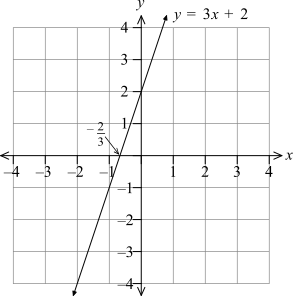
On the Cartesian plane below, graph the equation  `y=3x+2`.

Clearly label the coordinates of the intercepts with both the `x` and `y`-axes.  (2 marks)

--- 0 WORK AREA LINES (style=lined) ---
Show Answers Only

Show Worked Solution

`ytext{-intercept = 2,  gradient = 3}`

`xtext{-intercept occurs when}\ y=0:`

`0=3x+2\ \ =>\ \ x=-2/3`
 

Filed Under: Cartesian Plane Tagged With: num-title-ct-coreb, smc-4422-25-y-int gradient

Cartesian Plane, SMB-005

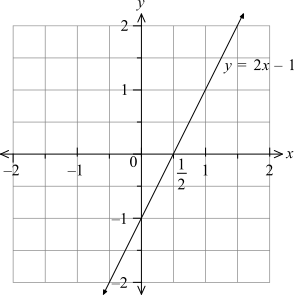
On the Cartesian plane below, graph the equation  `y=2x-1`.

Clearly label the coordinates of all intercepts.  (2 marks)

--- 0 WORK AREA LINES (style=lined) ---
Show Answers Only

Show Worked Solution

`ytext{-intercept = –1,  gradient = 2}`

`xtext{-intercept occurs when}\ y=0:`

`0=2x-1\ \ =>\ \ x=1/2`
 

Filed Under: Cartesian Plane Tagged With: num-title-ct-coreb, smc-4422-25-y-int gradient

Financial Maths, SMB-021

Manou purchased an oven that depreciates in value by 15% per annum. Two years after it was purchased it had depreciated to a value of $6069, using the declining balance method.

What was the purchase price of the oven?   (2 marks)

--- 4 WORK AREA LINES (style=lined) ---
Show Answers Only

`$8400`

Show Worked Solution

`S = V_0 (1-r)^n`

`6069` `= V_0 (1-0.15)^2`
`6069` `= V_0 (0.85)^2`
`V_0` `= 6069/0.85^2`
  `= 8400`


`:.\ text(The purchase price) = $8400`

Filed Under: Depreciation Tagged With: num-title-ct-coreb, smc-4335-28-Find V

Financial Maths, SMB-020

A company purchases a machine for $50 000. The two methods of depreciation being considered are the declining-balance method and the straight-line method.

For the declining-balance method, the salvage value of the machine after `n` years is given by the formula

    `S=V_(0)xx(0.80)^(n),`

where `S` is the salvage value and `V_(0)` is the initial value of the asset.

  1. What is the annual rate of depreciation used in this formula?  (1 mark)

    --- 1 WORK AREA LINES (style=lined) ---
  2. Calculate the salvage value of the machine after 3 years, based on the given formula.  (2 marks)

    --- 4 WORK AREA LINES (style=lined) ---
Show Answers Only
  1.  `20text{%}`
  2. `$25\ 600`
Show Worked Solution

a.  `text{Depreciation rate}\ = 1-0.8=0.2=20text{%}`
 

b.  `text{Find}\ \ S\ \ text{when}\ \ n=3:`

`S` `=V_0 xx (0.80)^n`  
  `=50\ 000 xx (0.80)^3`  
  `=$25\ 600`  

♦♦ Mean mark (a) 24%.
COMMENT: A poor State result in part (a) that warrants attention.

Filed Under: Depreciation Tagged With: num-title-ct-coreb, smc-4335-10-Find S, smc-4335-25-Find r

Financial Maths, SMB-019

Alan bought a light aircraft for $76 500. It will depreciate at 14% per annum. 

Using the declining balance method, what will be the salvage value of the light aircraft after 6 years, to the nearest dollar? 

Show Answers Only

`$30\ 949`

Show Worked Solution
`S` `= V_0 (1-r)^n`
  `= 76\ 500 (1-14/100)^6`
  `= 76\ 500 (0.86)^6`
  `= $30\ 949.39`
  `=$30\ 949\ \ text{(nearest dollar)}`

Filed Under: Depreciation Tagged With: num-title-ct-coreb, smc-4335-10-Find S

Financial Maths, SMB-018

Marnus bought a cricket bowling machine two years ago that cost $3400. Its value has depreciated by 10% each year, based on the declining-balance method.

What is the salvage value today, to the nearest dollar?  (2 marks)

Show Answers Only

`$2754`

Show Worked Solution
`S` `= V_0 (1-r)^n`
  `= 3400 (1-0.10)^2`
  `= 3400 (0.90)^2`
  `= $2754`

Filed Under: Depreciation Tagged With: num-title-ct-coreb, smc-4335-10-Find S

Financial Maths, SMB-017

Albert invests $3000 and earns interest at 4% per annum, compounded quarterly.

What is the future value of Albert's investment after 2.5 years?  (3 marks)

--- 6 WORK AREA LINES (style=lined) ---
Show Answers Only

`$3313.87`

Show Worked Solution

`text{Annual interest rate = 4%}`

`text(Quarterly interest rate) \ = frac(4%)(4)=1text{%}`

`n = 2.5 xx 4 = 10`
  

`FV` `= PV(1 + r)^n`
  `= 3000 (1 + 0.01)^10`
  `=3000(1.01)^10`
  `= $3313.87`

Filed Under: Compound Interest Tagged With: num-title-ct-coreb, smc-4334-10-Find FV

Financial Maths, SMB-016

What amount must be invested now at 3% per annum, compounded annually, so that in two years it will have grown to  $20 000?  (2 marks)

--- 4 WORK AREA LINES (style=lined) ---
Show Answers Only

`$18\ 851.92`

Show Worked Solution

`text(Using)\ \ FV = PV(1 + r)^n`

`r = 3text{%}, \ n=2`
 

`20\ 000` `= PV(1 + 0.03)^(2)`
`:.PV` `= (20\ 000)/1.03^(2)`
  `= $18\ 851.92`

Filed Under: Compound Interest Tagged With: num-title-ct-coreb, smc-4334-30-Find PV

Financial Maths, SMB-015

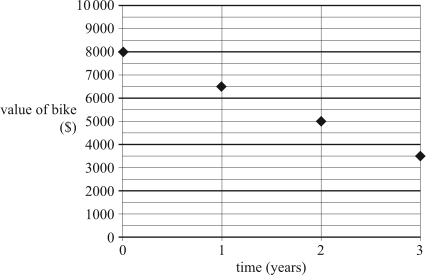
Hugo is a professional bike rider.

The value of his bike will be depreciated over time using the flat rate method of depreciation.

The graph below shows his bike’s initial purchase price and its value at the end of each year for a period of three years.
 

  1. What was the initial purchase price of the bike?  (1 mark)

    --- 1 WORK AREA LINES (style=lined) ---
  2. Use calculations to show that the bike depreciates in value by $1500 each year.  (1 mark)

    --- 2 WORK AREA LINES (style=lined) ---
  3. Assume that the bike's value continues to depreciate by $1500 each year. Determine its value five years after it was purchased.  (1 mark)

    --- 2 WORK AREA LINES (style=lined) ---

Show Answers Only
  1. `$8000`
  2. `text(See Worked Solutions)`
  3. `$500`
Show Worked Solution

i.   `$8000`
 

ii.   `text(Value after 1 year) = $6500\ \ \ text{(from graph)}`

`:.\ text(Annual depreciation)` `= 8000-6500`
  `= $1500`


iii.  `text(After 5 years:)`

`S` `=V_0-Dn`
  `=8000-5 xx 1500`
  `=$500`

Filed Under: Depreciation Tagged With: num-title-ct-coreb, smc-4335-60-Straight-line

Financial Maths, SMB-014

Rae paid  $40 000  for new office equipment at the start of the 2019 financial year.

At the start of each following financial year, she used straight-line (flat rate) depreciation to revalue her equipment.

At the start of the 2022 financial year she revalued her equipment at  $22 000.

Calculate the annual straight-line rate of depreciation she used, as a percentage of the purchase price.  (2 marks)

--- 4 WORK AREA LINES (style=lined) ---
Show Answers Only

`15text(%)`

Show Worked Solution

`text(Depreciation over 3 years)`

♦ Mean mark 50%.

`=40\ 000-22\ 000`

`=$18\ 000`
 

`:.\ text(Annual depreciation) = (18\ 000)/3 = $6000`

`:.\ text(Depreciation rate) = 6000/(40\ 000) = 0.15 = 15text(%)`

Filed Under: Depreciation Tagged With: num-title-ct-coreb, smc-4335-60-Straight-line

Statistics, STD1 S3 2022 HSC 23

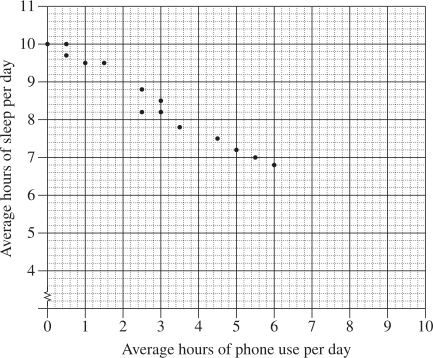
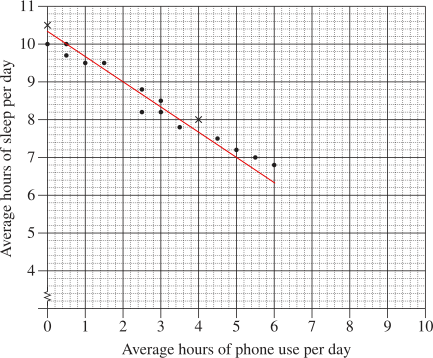
A teacher surveyed the students in her Year 8 class to investigate the relationship between the average number of hours of phone use per day and the average number of hours of sleep per day.

The results are shown on the scatterplot below.
 

  1. The data for two new students, Alinta and Birrani, are shown in the table below. Plot their results on the scatterplot.  (2 marks)

\begin{array} {|l|c|c|}
\hline
  & \textit{Average hours of} & \textit{Average hours of} \\ & \textit{phone use per day} & \textit{sleep per day} \\
\hline
\rule{0pt}{2.5ex} \text{Alinta} \rule[-1ex]{0pt}{0pt} & 4 & 8 \\
\hline
\rule{0pt}{2.5ex} \text{Birrani} \rule[-1ex]{0pt}{0pt} & 0 & 10.5 \\
\hline
\end{array}

  1. By first fitting the line of best fit by eye on the scatterplot, estimate the average number of hours of sleep per day for a student who uses the phone for an average of 2 hours per day.  (2 marks)

    --- 2 WORK AREA LINES (style=lined) ---
Show Answers Only
  1.  
  2. 9 hours (see LOBF in diagram above)
Show Worked Solution

a.     \(\text{New data points are marks with a × on the diagram below.}\)
 

b.   \(\text{9 hours (see LOBF in diagram above)}\)

Filed Under: Bivariate Data, S3 Further Statistical Analysis (Y12) Tagged With: Band 4, num-title-ct-coreb, num-title-qs-hsc, smc-1113-10-Line of Best Fit, smc-1113-20-Scatterplot from Table, smc-5022-10-Line of best fit graphs, smc-5022-20-Scatterplot from table

Algebra, STD2 A4 2022 HSC 22

The formula  `C=100 n+b`  is used to calculate the cost of producing laptops, where `C` is the cost in dollars, `n` is the number of laptops produced and `b` is the fixed cost in dollars.

  1. Find the cost when 1943 laptops are produced and the fixed cost is $20 180.  (1 mark)

    --- 2 WORK AREA LINES (style=lined) ---

  2. Some laptops have some extra features added. The formula to calculate the production cost for these is
  3.      `C=100 n+a n+20\ 180`
  4. where `a` is the additional cost in dollars per laptop produced.
  5. Find the number of laptops produced if the additional cost is $26 per laptop and the total production cost is $97 040.  (2 marks)

    --- 4 WORK AREA LINES (style=lined) ---
Show Answers Only
  1. `$214\ 480`
  2. `610\ text{laptops}`
Show Worked Solution

a.   `text{Find}\ \ C\ \ text{given}\ \ n=1943 and b=20\ 180`

`C` `=100 xx 1943 + 20\ 180`  
  `=$214\ 480`  


b.   `text{Find}\ \ n\ \ text{given}\ \ C=97\ 040 and a=26`

`C` `=100 n+a n+20\ 180`  
`97\ 040` `=100n + 26n +20\ 180`  
`126n` `=76\ 860`  
`n` `=(76\ 860)/126`  
  `=610 \ text{laptops}`  

Filed Under: Applications: Currency, Fuel and Other Problems (Std 2), Applications: Currency, Fuel and Other Problems (Std2-2027), Linear Applications Tagged With: Band 2, Band 4, num-title-ct-coreb, num-title-qs-hsc, smc-6256-30-Other Linear Applications, smc-793-30-Other Linear Applications

Financial Maths, STD2 F4 2022 HSC 11 MC

In ten years, the future value of an investment will be $150 000. The interest rate is 4% per annum, compounded half-yearly.

Which equation will give the present value `(PV)` of the investment?

  1. `PV=(150\ 000)/((1+0.04)^(10))`
  2. `PV=(150\ 000)/((1+0.04)^(20))`
  3. `PV=(150\ 000)/((1+0.02)^(10))`
  4. `PV=(150\ 000)/((1+0.02)^(20))`
Show Answers Only

`D`

Show Worked Solution

`text{Compounding periods}\ = 10 xx 2 = 20`

`text{Compounding rate}\ = (4text{%})/2 = 2text{%} = 0.02`

`PV=(150\ 000)/((1+0.02)^(20))`

`=>D`

Filed Under: Compound Interest, Compound Interest and Shares (Std2) Tagged With: Band 4, common-content, num-title-ct-coreb, num-title-qs-hsc, smc-817-20-FV Formula

Algebra, STD2 A4 2022 HSC 9 MC

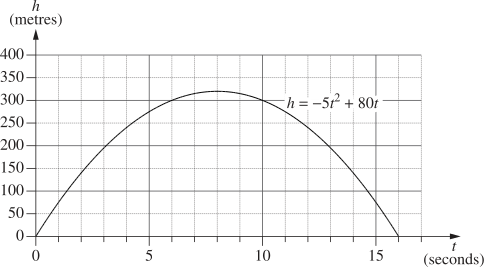
An object is projected vertically into the air. Its height, `h` metres, above the ground after `t` seconds is given by  `h=-5 t^2+80 t`.
 

For how long is the object at a height of 300 metres or more above the ground?

  1. 4 seconds
  2. 6 seconds
  3. 8 seconds
  4. 10 seconds
Show Answers Only

`A`

Show Worked Solution

`text{Object reaches 300 m when}\ \ t=6\ text{seconds.}`

`text{Object drops back below 300 m when}\ \ t=10\ text{seconds.}`

`text{Time at 300 m or above}\ = 10-6=4\ text{seconds}`

`=>A`

Filed Under: Non-Linear: Exponential/Quadratics (Std 2), Quadratics Tagged With: Band 3, num-title-ct-coreb, num-title-qs-hsc, smc-4443-60-Projectiles, smc-830-20-Quadratics

Measurement, STD2 M6 2022 HSC 8 MC

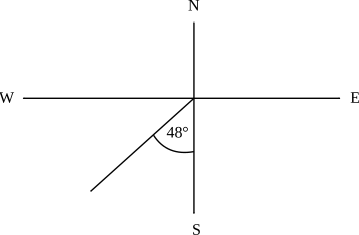
Which true bearing is the same as `text{S} 48^@ text{W}`?

  1. `132^@`
  2. `222^@`
  3. `228^@`
  4. `312^@`
Show Answers Only

`C`

Show Worked Solution

`text{True bearing}` `=180 + 48`
  `=228^@`

 
`=>C`

Filed Under: Bearings and Radial Surveys (Std2), Right-Angled Trig Tagged With: Band 4, common-content, num-title-ct-coreb, num-title-qs-hsc, smc-4552-70-Bearings, smc-803-30-Compass vs True Bearings

Algebra, STD2 A4 2021 HSC 24

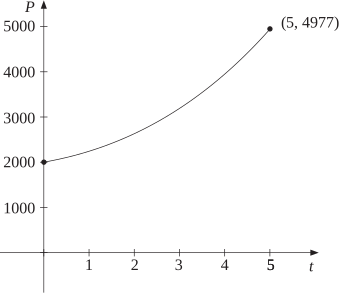
A population, `P`,  is to be modelled using the function  `P = 2000 (1.2)^t`, where `t` is the time in years.

  1. What is the initial population?  (1 mark)

    --- 2 WORK AREA LINES (style=lined) ---
  2. Find the population after 5 years.  (1 mark)

    --- 2 WORK AREA LINES (style=lined) ---
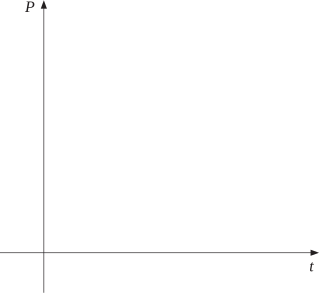
  3. On the axes below, draw the graph of the population against time, showing the points at  `t = 0`  and at  `t = 5`.  (2 marks)
      

    --- 0 WORK AREA LINES (style=lined) ---
Show Answers Only
  1. `2000`
  2. `4977`
  3. `text{See Worked Solutions}`
Show Worked Solution

a.  `text{Initial population occurs when}\ \  t = 0:`

`P= 2000 (1.2)^0= 2000`
 

b.    `text{Find} \ P \ text{when} \ \ t = 5: `

`P` `= 2000 (1.2)^5`  
  `= 4976.64`  
  `= 4977 \ text{(nearest whole)}`  


♦ Mean mark (c) 48%.

c. 

Filed Under: Exponentials, Non-Linear: Exponential/Quadratics (Std 2) Tagged With: Band 3, Band 4, Band 5, num-title-ct-coreb, num-title-qs-hsc, smc-4444-40-Population, smc-830-30-Exponential

Algebra, STD2 A4 2021 HSC 10 MC

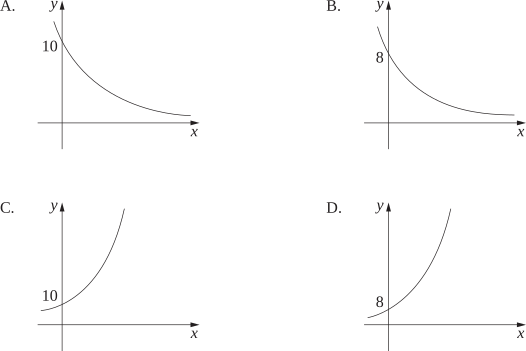
Which of the following best represents the graph of  `y = 10 (0.8)^x`?
 

Show Answers Only

`A`

Show Worked Solution

`\text{By elimination:}`

♦ Mean mark 41%.

`\text{When} \ x = 0 \ , \ y = 10(0.8) ^0 = 10`

`-> \ text{Eliminate B and D}`

`text(As)\ \ x→oo, \ y→0`

`-> \ text{Eliminate C}`

`=> A`

Filed Under: Exponentials, Non-Linear: Exponential/Quadratics (Std 2) Tagged With: 2adv-std2-common, Band 5, common-content, num-title-ct-coreb, num-title-qs-hsc, smc-4444-10-Identify graphs, smc-830-10-Identify Graphs, smc-830-30-Exponential

Financial Maths, STD2 F4 2021 HSC 26

Nina plans to invest $35 000 for 1 year. She is offered two different investment options.

Option A:  Interest is paid at 6% per annum compounded monthly.

Option B:  Interest is paid at `r` % per annum simple interest.

  1. Calculate the future value of Nina's investment after 1 year if she chooses Option A.  (2 marks)

    --- 4 WORK AREA LINES (style=lined) ---
  2. Find the value of `r` in Option B that would give Nina the same future value after 1 year as for Option A. Give your answer correct to two decimal places.  (2 marks)

    --- 4 WORK AREA LINES (style=lined) ---
Show Answers Only
  1. `$37\ 158.72`
  2. `6.17text(%)`
Show Worked Solution
a.   `r` `= text(6%)/12= text(0.5%) = 0.005\ text(per month)`
  `n` `=12`


`FV` `= PV(1 + r)^n`
  `= 35\ 000(1 + 0.005)^(12)`
  `= $37\ 158.72`

♦♦ Mean mark part (b) 36%.
b.   `I` `=Prn`
  `2158.72` `=35\ 000 xx r xx 1`
  `r` `=2158.72/(35\ 000)`
    `=0.06167…`
    `=6.17 text{% (to 2 d.p.)}`

Filed Under: Compound Interest, Compound Interest and Shares (Std2) Tagged With: Band 4, Band 5, num-title-ct-coreb, num-title-qs-hsc, smc-4334-10-Find FV, smc-4334-40-Find r, smc-4334-50-Compound vs Simple, smc-817-20-FV Formula, smc-817-30-i/r comparisons (incl. graphs)

Financial Maths, STD2 F1 2021 HSC 19

Adam purchased some office furniture five years ago. It depreciated by $2300 each year based on the straight-line method of depreciation. The salvage value of the furniture is now $7500.

Find the initial value of the office furniture.  (2 marks)

--- 4 WORK AREA LINES (style=lined) ---
Show Answers Only

`$19\ 000`

Show Worked Solution

`text{Find initial value}\ (V_0):`

`S` `=V_0-Dn`  
`7500` `=V_0-2300 xx 5`  
`V_0` `=7500 + 11\ 500`  
  `=$19\ 000`  

Filed Under: Depreciation, Simple Interest and S/L Depreciation (Std 1), Simple Interest and S/L Depreciation (Std 2) Tagged With: Band 3, num-title-ct-coreb, num-title-qs-hsc, smc-1124-20-Straight Line Depreciation, smc-4335-60-Straight-line, smc-808-20-Straight Line Depreciation

Financial Maths, STD2 F4 2021 HSC 4 MC

Three years ago an appliance was valued at $2467. Its value has depreciated by 15% each year, based on the declining-balance method.

What is the salvage value today, to the nearest dollar?

  1. $952
  2. $1110
  3. $1357
  4. $1515
Show Answers Only

`D`

Show Worked Solution
`S` `= V_0 (1-r)^n`
  `= 2467 (1-0.15)^3`
  `= 2467 (0.85)^3`
  `= $1515`

 
`=>  D`

Filed Under: Depreciation, Depreciation - Declining Balance (Std 2) Tagged With: Band 3, num-title-ct-coreb, num-title-qs-hsc, smc-4335-10-Find S, smc-813-10-Find S

Statistics, STD1 S3 2020 HSC 22

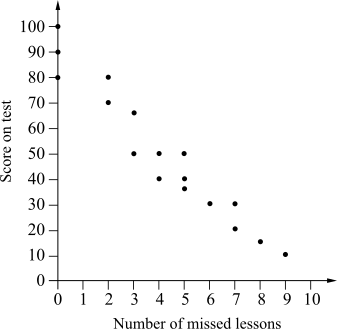
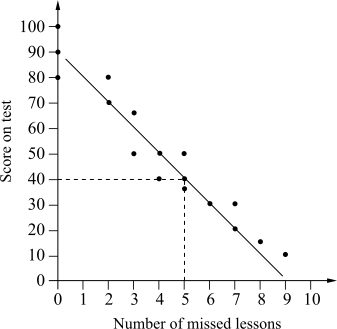
A group of students sat a test at the end of term. The number of lessons each student missed during the term and their score on the test are shown on the scatterplot.


  1. Describe the strength and direction of the linear association observed in this dataset.  (2 marks)

    --- 5 WORK AREA LINES (style=lined) ---
  2. Calculate the range of the test scores for the students who missed no lessons.  (1 mark)

    --- 1 WORK AREA LINES (style=lined) ---
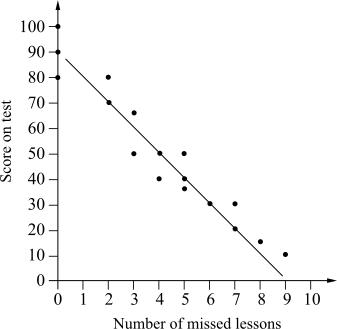
  3. Draw a line of the best fit in the scatterplot above.  (1 mark)
  4. Meg did not sit the test. She missed five lessons.


    Use the line of the best fit drawn in part (c) to estimate Meg's score on this test. (1 mark)

    --- 1 WORK AREA LINES (style=lined) ---
  5. John also did not sit the test and he missed 16 lessons.


    Is it appropriate to use the line of the best fit to estimate his score on the test? Briefly explain your answer. (1 mark)

    --- 2 WORK AREA LINES (style=lined) ---
Show Answers Only

a.    \(\text{Strength : strong}\)

\(\text{Direction : negative} \)

b.    \(\text{Range}\ = \text{high}-\text{low}\ = 100-80=20\)
 

c.   

d. 


e.    \(\text{John’s missed days are too extreme and the LOBF is not}\)

\(\text{appropriate. The model would estimate a negative score for}\)

\(\text{John which is impossible.}\)

Show Worked Solution

a.    \(\text{Strength : strong}\)

\(\text{Direction : negative} \)

♦ Mean mark (a) 45%.
♦♦ Mean mark (b) 31%.

b.    \(\text{Range}\ = \text{high}-\text{low}\ = 100-80=20\)
 

c.   

d. 


\(\therefore\ \text{Meg’s estimated score = 40}\)
 

e.    \(\text{John’s missed days are too extreme and the LOBF is not}\)

\(\text{appropriate. The model would estimate a negative score for}\)

\(\text{John which is impossible.}\)

♦ Mean mark (e) 38%.

Filed Under: Bivariate Data, S3 Further Statistical Analysis (Y12) Tagged With: Band 4, Band 5, num-title-ct-coreb, num-title-qs-hsc, smc-1113-10-Line of Best Fit, smc-1113-60-Limitations, smc-5022-10-Line of best fit graphs, smc-5022-25-Draw LOBF, smc-5022-30-Correlation, smc-5022-60-Limitations

Algebra, STD1 A3 2020 HSC 19

Each year the number of fish in a pond is three times that of the year before.

  1. The table shows the number of fish in the pond for four years.
    \begin{array} {|l|c|c|c|c|}
    \hline
    \rule{0pt}{2.5ex}\textit{Year}\rule[-1ex]{0pt}{0pt} & \ \ \ 2020\ \ \  & \ \ \ 2021\ \ \  & \ \ \ 2022\ \ \  & \ \ \ 2023\ \ \ \\
    \hline
    \rule{0pt}{2.5ex}\textit{Number of fish}\rule[-1ex]{0pt}{0pt} & 100 & & & 2700\\
    \hline
    \end{array}

    Complete the table above showing the number of fish in 2021 and 2022.   (2 marks)
     

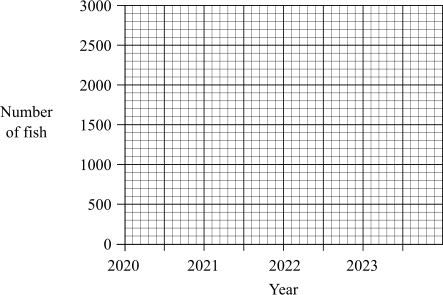
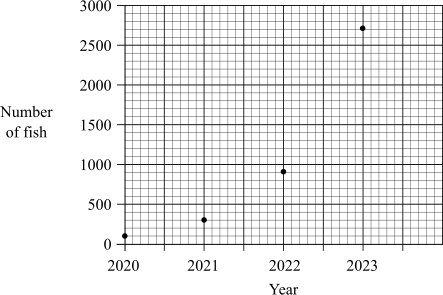
  2. Plot the points from the  table in part (a) on the grid.   (2 marks)
     
  3. Which model is more suitable for this dataset: linear or exponential? Briefly explain your answer.   (2 marks)

    --- 4 WORK AREA LINES (style=lined) ---
Show Answers Only

a.   

\begin{array} {|l|c|c|c|c|}
\hline
\rule{0pt}{2.5ex}\textit{Year}\rule[-1ex]{0pt}{0pt} & \ \ \ 2020\ \ \  & \ \ \ 2021\ \ \  & \ \ \ 2022\ \ \  & \ \ \ 2023\ \ \ \\
\hline
\rule{0pt}{2.5ex}\textit{Number of fish}\rule[-1ex]{0pt}{0pt} & 100 & 300 & 900 & 2700\\
\hline
\end{array}

b.   
       

c.     The more suitable model is exponential.

A linear dataset would graph a straight line which is not the case here.

An exponential curve can be used to graph populations that grow at an increasing rate, such as this example.

Show Worked Solution

a.        

\begin{array} {|l|c|c|c|c|}
\hline
\rule{0pt}{2.5ex}\textit{Year}\rule[-1ex]{0pt}{0pt} & \ \ \ 2020\ \ \  & \ \ \ 2021\ \ \  & \ \ \ 2022\ \ \  & \ \ \ 2023\ \ \ \\
\hline
\rule{0pt}{2.5ex}\textit{Number of fish}\rule[-1ex]{0pt}{0pt} & 100 & 300 & 900 & 2700\\
\hline
\end{array}

b.  

c.     The more suitable model is exponential.

A linear dataset would graph a straight line which is not the case here.

An exponential curve can be used to graph populations that grow at an increasing rate, such as this example.

♦ Mean mark (c) 31%.

Filed Under: A3 Types of Relationships (Y12), Exponentials Tagged With: Band 3, Band 5, num-title-ct-coreb, num-title-qs-hsc, smc-1099-50-Non-linear graphs, smc-4444-40-Population

Statistics, STD1 S3 2020 HSC 4 MC

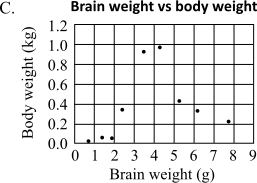
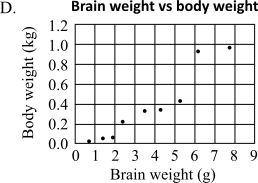
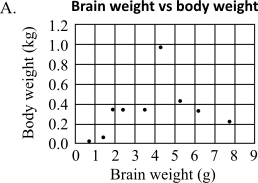
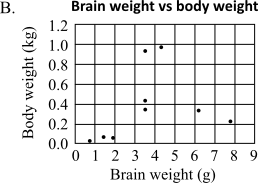
The table shows the average brain weight (in grams) and average body weight (in kilograms) of nine different mammals.

\begin{array} {|l|c|c|c|c|c|c|c|c|}
\hline
\rule{0pt}{2.5ex} \textit{Brain weight (g)} \rule[-1ex]{0pt}{0pt} & 0.7 & 0.4 & 1.9 & 2.4 & 3.5 & 4.3 & 5.3 & 6.2 & 7.8 \\
\hline
\rule{0pt}{2.5ex} \textit{Body weight (kg)} \rule[-1ex]{0pt}{0pt} & 0.02 &0.06 & 0.05 & 0.34 & 0.93 & 0.97 & 0.43 & 0.33 & 0.22 \\
\hline
\end{array}

Which of the following is the correct scatterplot for this dataset?


Show Answers Only

`C`

Show Worked Solution

`text{Consider data point} \ (1.9, 0.05)`

`→ \ text{Eliminate} \ A \ text{(too high)}`

`→ \ text{Eliminate} \ D \ text{(should be below 2nd data point)}`
 

`text{Consider data point} \ (2.4, 0.34)`

`→ \ text{Eliminate} \ B \ text{(not on graph)}` 

`=> \ C`

Filed Under: Bivariate Data, S3 Further Statistical Analysis (Y12) Tagged With: Band 4, num-title-ct-coreb, num-title-qs-hsc, smc-1113-20-Scatterplot from Table, smc-5022-20-Scatterplot from table

Financial Maths, STD2 F4 2020 HSC 21

The inflation rate over the year from January 2019 to January 2020 was 2%.

The cost of a school jumper in January 2020 was $122.

Calculate the cost of the jumper in January 2019 assuming that the only change in the cost of the jumper was due to inflation.   (2 marks)

--- 5 WORK AREA LINES (style=lined) ---
Show Answers Only

`$119.61`

Show Worked Solution
`FV` `=PV(1+r)^n`
`122` `=C_(2019)(1+0.02)^1`
`C_2019 xx 1.02` `= 122`
`C_2019` `= frac(122)(1.02)`
  `= $119.61`

Filed Under: Compound Interest, Compound Interest and Shares (Std2), F2 Investment (Y12) Tagged With: Band 4, num-title-ct-coreb, num-title-qs-hsc, smc-1108-20-FV Formula, smc-4334-30-Find PV, smc-817-20-FV Formula

Algebra, STD2 A4 2020 HSC 19

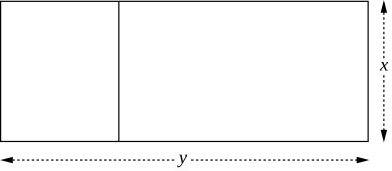
A fence is to be built around the outside of a rectangular paddock. An internal fence is also to be built.

The side lengths of the paddock are `x` metres and `y` metres, as shown in the diagram.


A total of 900 metres of fencing is to be used. Therefore  `3x + 2y = 900`.
 
The area, `A`, in square metres, of the rectangular paddock is given by  `A =450x - 1.5x^2`.

The graph of this equation is shown.
  

  1. If the area of the paddock is `30 \ 000\ text(m)^2`, what is the largest possible value of `x`?   (1 mark)

    --- 2 WORK AREA LINES (style=lined) ---
  2. Find the values of `x` and `y` so that the area of the paddock is as large as possible.   (2 marks)

    --- 4 WORK AREA LINES (style=lined) ---
  3. Using your value from part (b), find the largest possible area of the paddock.   (1 mark)

    --- 2 WORK AREA LINES (style=lined) ---
Show Answers Only
  1. `200 \ text(m)`
  2. `x = 150 \ text(m and) \ y = 225 \ text(m)`
  3. `33 \ 750 \ text(m)^2`
Show Worked Solution

a.     `text(From the graph, an area of)\ 30\ 000\ text(m)^2`

♦ Mean mark part (a) 39%.

  `text(can have an)\ x text(-value of)\ \ x=100 or 200\ text(m.)`

`:. x_text(max) = 200 text(m)`
 

b.    `A_text(max) \ text(occurs when) \ \ x = 150`

♦♦ Mean mark part (b) 34%.

`text(Substitute)\ \ x=150\ \ text(into)\ \ 3x + 2y = 900:`

`3 xx 150 + 2y` `= 900`
`2y` `= 450`
`y` `= 225`

 
`therefore \ text(Maximum area when) \ \ x = 150 \ text(m  and) \ \ y = 225 \ text(m)`

♦ Mean mark part (c) 40%.
c.    `A_(max)` `= xy`
    `= 150 xx 225`
    `= 33 \ 750 \ text(m)^2`

Filed Under: Non-Linear: Exponential/Quadratics (Std 2), Quadratics Tagged With: Band 5, num-title-ct-coreb, num-title-qs-hsc, smc-4443-70-Other applications, smc-830-20-Quadratics

Algebra, STD2 A2 2020 HSC 10 MC

A plumber charges a call-out fee of $90 as well as $2 per minute while working.

Suppose the plumber works for `t` hours.

Which equation expresses the amount the plumber charges ($`C`) as a function of time (`t` hours)?

  1.  `C = 2 + 90t`
  2.  `C = 90 + 2t`
  3.  `C = 120 + 90t`
  4.  `C = 90 + 120t`
Show Answers Only

`D`

Show Worked Solution

♦ Mean mark 42%.

`text(Hourly rate)\ = 60 xx 2=$120`

`:. C = 90 + 120t`

`=>D`

Filed Under: Applications: Currency, Fuel and Other Problems (Std 2), Applications: Currency, Fuel and Other Problems (Std2-2027), Linear Applications Tagged With: Band 5, num-title-ct-coreb, num-title-qs-hsc, smc-6256-30-Other Linear Applications, smc-793-30-Other Linear Applications

Financial Maths, STD2 F4 2020 HSC 4 MC

Joan invests $200. She earns interest at 3% per annum, compounded monthly.

What is the future value of Joan's investment after 1.5 years?

  1. $209.07
  2. $209.19
  3. $279.51
  4. $311.93
Show Answers Only

`B`

Show Worked Solution

`text(Monthly interest rate) \ = frac(0.03)(12)`

`n \ = \ 1.5 xx 12 = 18`
  

`text(FV)` `= text(PV) \ (1 + r)^n`
  `= 200 (1 + frac(0.03)(12))^18`
  `= $209.19`

 
`=> \ B`

Filed Under: Compound Interest, Compound Interest and Shares (Std2) Tagged With: Band 4, num-title-ct-coreb, num-title-qs-hsc, smc-4334-10-Find FV, smc-817-20-FV Formula

Algebra, STD2 A4 2020 HSC 1 MC

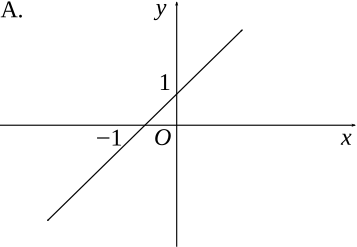
Which of the following could represent the graph of  `y = -x^2 + 1`?


Show Answers Only

`C`

Show Worked Solution

♦ Mean mark 53%.
COMMENT: A surprisingly low State mean mark!

`=> C`

Filed Under: Non-Linear: Exponential/Quadratics (Std 2) Tagged With: Band 4, num-title-ct-coreb, num-title-qs-hsc, smc-4443-10-Identify graphs, smc-830-10-Identify Graphs

Statistics, STD1 S3 2019 HSC 27

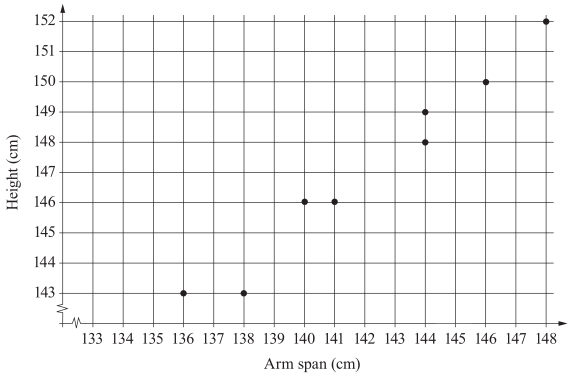
A set of bivariate data is collected by measuring the height and arm span of eight children. The graph shows a scatterplot of these measurements.
 

  1. On the graph, draw a line of best fit by eye.  (1 mark)

    --- 0 WORK AREA LINES (style=lined) ---
  2. Robert is a child from the class who was absent when the measurements were taken. He has an arm span of 147 cm. Using your line of best fit from part (a), estimate Robert’s height.  (1 mark)

    --- 1 WORK AREA LINES (style=lined) ---
Show Answers Only
  1.   
  2. `text(Robert’s height ≈ 151.1 cm)`
Show Worked Solution

a.     
       

♦ Mean mark (a) 38%.

b.   `text(Robert’s height ≈ 151.1 cm)`

`text{(Answers can vary slightly depending on line of best fit drawn).}`

Filed Under: S3 Further Statistical Analysis (Y12) Tagged With: Band 4, Band 5, num-title-ct-coreb, num-title-qs-hsc, smc-1113-10-Line of Best Fit, smc-5022-10-Line of best fit graphs, smc-5022-25-Draw LOBF

Financial Maths, STD2 F4 2019 HSC 37

A new car is bought for $24 950. Each year the value of the car is depreciated by the same percentage.

The table shows the value of the car, based on the declining-balance method of depreciation, for the first three years.

\begin{array} {|c|c|}
\hline
\rule{0pt}{2.5ex}\textit{End of year}\rule[-1ex]{0pt}{0pt} & \textit{Value}\\
\hline
\rule{0pt}{2.5ex}1\rule[-1ex]{0pt}{0pt} & \$21\ 457.00 \\
\hline
\rule{0pt}{2.5ex}2\rule[-1ex]{0pt}{0pt} & \$18\ 453.02 \\
\hline
\rule{0pt}{2.5ex}3\rule[-1ex]{0pt}{0pt} & \$15\ 869.60 \\
\hline
\end{array}

What is the value of the car at the end of 10 years?  (3 marks)

--- 6 WORK AREA LINES (style=lined) ---

Show Answers Only

`$5521.47`

Show Worked Solution

`text(Find the depreciation rate:)`

`S` `= V_0(1-r)^n`
`21\ 457` `= 24\ 950(1-r)^1`
`1-r` `= (21\ 457)/(24\ 950)`
`1-r` `= 0.86`
`r` `= 0.14`

 
`:.\ text(Value after 10 years)`

`= 24\ 950(1-0.14)^10`

`= 5521.474…`

`= $5521.47\ \ (text(nearest cent))`

Filed Under: Depreciation, Depreciation - Declining Balance (Std 1), Depreciation - Declining Balance (Std 2) Tagged With: Band 4, num-title-ct-coreb, num-title-qs-hsc, smc-1139-10-Find S, smc-4335-10-Find S, smc-4335-25-Find r, smc-813-10-Find S, smc-813-20-Find r

Algebra, STD2 A2 2019 HSC 14 MC

Last Saturday, Luke had 165 followers on social media. Rhys had 537 followers. On average, Luke gains another 3 followers per day and Rhys loses 2 followers per day.

If  `x`  represents the number of days since last Saturday and  `y`  represents the number of followers, which pair of equations model this situation?

A.  `text(Luke:)\ \ y = 165x + 3`


`text(Rhys:)\ \ y = 537x - 2`

B. `text(Luke:)\ \ y = 165 + 3x`


`text(Rhys:)\ \ y = 537 - 2x`

C. `text(Luke:)\ \ y = 3x + 165`


`text(Rhys:)\ \ y = 2x - 537`

D. `text(Luke:)\ \ y = 3 + 165x`


`text(Rhys:)\ \ y = 2 - 537x`

Show Answers Only

`B`

Show Worked Solution

`text(Luke starts with 165 and adds 3 per day:)`

`y = 165 + 3x`

`text(Rhys starts with 537 and loses 2 per day:)`

`y = 537 – 2x`

`=> B`

Filed Under: Applications: Currency, Fuel and Other Problems (Std 2), Linear Applications, Linear Functions (Adv-2027), Linear Functions (Y11) Tagged With: Band 4, common-content, num-title-ct-coreb, num-title-qs-hsc, smc-6214-50-Simultaneous Equations, smc-793-30-Other Linear Applications, smc-985-40-Simultaneous Equations

Financial Maths, STD2 F4 2019 HSC 13 MC

The graph show the future values over time of  `$P`, invested at three different rates of compound interest.


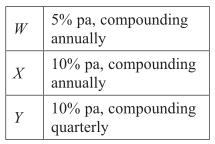
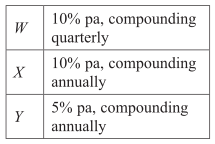
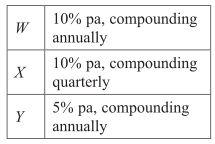
Which of the following correctly identifies each graph?

A. B.
C. D.
Show Answers Only

`C`

Show Worked Solution

`text(Values increase quicker)`

`text(- higher compounding interest rate)`

`text(- same rate but more frequent compounding period)`

`:. W = 10text(% quarterly)`

`X = 10text(% annually)`

`Y = 5text(% annually)`

 
`=> C`

Filed Under: Compound Interest, Compound Interest and Shares (Std2), Modelling Investments and Loans (Y12) Tagged With: Band 4, common-content, num-title-ct-coreb, num-title-qs-hsc, smc-1002-30-Interest Rate Graph Comparison, smc-4334-40-Find r, smc-4334-60-Graphs, smc-817-30-i/r comparisons (incl. graphs)

  • « Previous Page
  • 1
  • 2
  • 3
  • Next Page »

Copyright © 2014–2025 SmarterEd.com.au · Log in