An owl is 7 metres above ground level, in a tree. The owl sees a mouse on the ground at an angle of depression of 32°.
How far must the owl fly in a straight line to catch the mouse, assuming the mouse does not move?
- 3.7 m
- 5.9 m
- 8.3 m
- 13.2 m
Aussie Maths & Science Teachers: Save your time with SmarterEd
An owl is 7 metres above ground level, in a tree. The owl sees a mouse on the ground at an angle of depression of 32°.
How far must the owl fly in a straight line to catch the mouse, assuming the mouse does not move?
`D`
Chris opens a bank account and deposits $1000 into it. Interest is paid at 3.5% per annum, compounding annually.
Assuming no further deposits or withdrawals are made, what will be the balance in the account at the end of two years?
`=> B`
| `FV` | `= PV(1 + r)^n` |
| `= 1000(1 + 0.035)^2` | |
| `= $1071.23` |
`=> B`
A car is purchased for $23 900.
The value of the car is depreciated by 11.5% each year using the declining-balance method.
What is the value of the car after three years? (2 marks)
--- 4 WORK AREA LINES (style=lined) ---
`$16\ 566\ \ (text(nearest dollar))`
| `S` | `= V_0(1-r)^n` |
| `= 23\ 900(1-0.115)^3` | |
| `= 23\ 900(0.885)^3` | |
| `= 16\ 566.383…` | |
| `= $16\ 566\ \ (text(nearest dollar))` |
A movie theatre has 200 seats. Each ticket currently costs $8.
The theatre owners are currently selling all 200 tickets for each session. They decide to increase the price of tickets to see if they can increase the income earned from each movie session.
It is assumed that for each one dollar increase in ticket price, there will be 10 fewer tickets sold.
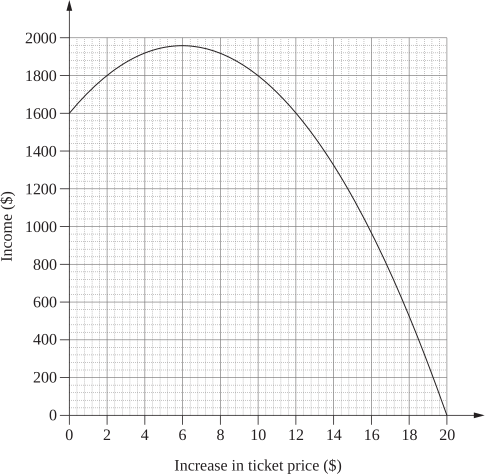
A graph showing the relationship between an increase in ticket price and the income is shown below.
--- 1 WORK AREA LINES (style=lined) ---
Calculate the profit earned by the theatre owners when the income earned from a session is maximised. (2 marks)
--- 4 WORK AREA LINES (style=lined) ---
i. `text(Graph is highest when increase = $6)`
`:.\ text(Ticket price)\ = 8 + 6= $14`
ii. `text(Solution 1)`
`text(Tickets sold)\ =200-(4 xx 10)=140`
`text(Solution 2)`
`text(Tickets)\ = text(max income)/text(ticket price) = 1960/14= 140`
iii. `text{Cost}\ = 140 xx $2 + $500= $780`
`:.\ text(Profit when income is maximised)`
`= 1960-780`
`= $1180`
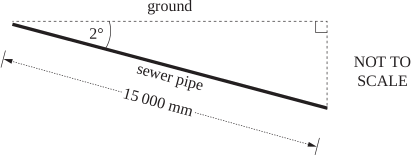
A sewer pipe needs to be placed into the ground so that it has a 2° angle of depression. The length of the pipe is 15 000 mm.
How much deeper should one end of the pipe be compared to the other end? Answer to the nearest mm. (2 marks)
--- 4 WORK AREA LINES (style=lined) ---
`523\ text{mm (nearest mm)}`
`text(Let)\ \ x = text(depth needed)`
| `sin 2^@` | `= x/(15\ 000)` |
| `x` | `= 15\ 000 xx sin 2^@` |
| `= 523.49…` | |
| `= 523\ text{mm (nearest mm)}` |
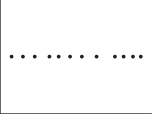
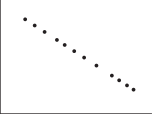
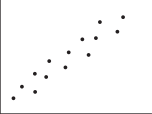
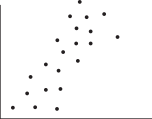
Which of the data sets graphed below has the largest positive correlation coefficient value?
| A. | B. | ||
| C. | D. |
\(C\)
\(\text{Largest positive correlation occurs when both variables move}\)
\(\text{in tandem. The tighter the linear relationship, the higher the}\)
\(\text{correlation.}\)
\(\Rightarrow C\)
\(\text{(Note that B is negatively correlated)}\)
A new car was bought for $19 900 and one year later its value had depreciated to $16 300.
What is the approximate depreciation, expressed as a percentage of the purchase price?
`A`
| `text(Net Depreciation)` | `= 19\ 900-16\ 300` |
| `= $3600` |
| `:. %\ text(Depreciation)` | `= 3600/(19\ 900) xx 100` |
| `= 18.09…text(%)` |
`=>A`
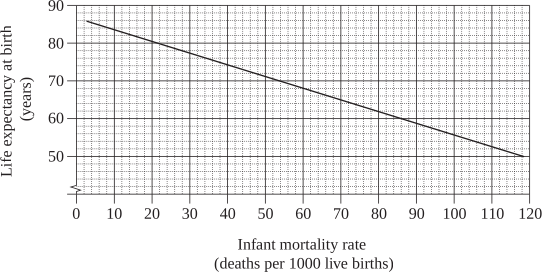
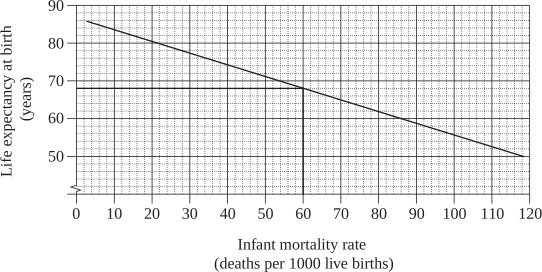
The graph shows the relationship between infant mortality rate (deaths per 1000 live births) and life expectancy at birth (in years) for different countries.
What is the life expectancy at birth in a country which has an infant mortality rate of 60?
\(A\)
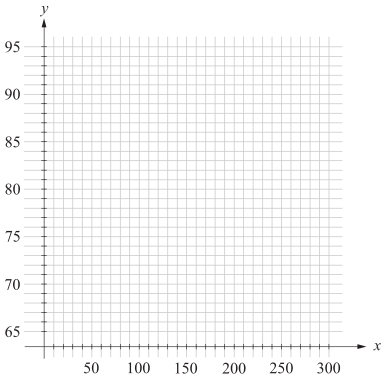
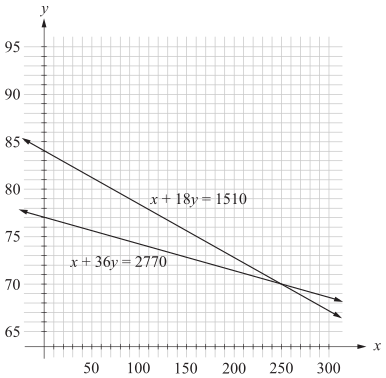
Ariana’s parents have given her an interest‑free loan of $4800 to buy a car. She will pay them back by paying `$x` immediately and `$y` every month until she has repaid the loan in full.
After 18 months Ariana has paid back $1510, and after 36 months she has paid back $2770.
This information can be represented by the following equations.
`x + 18y = 1510`
`x + 36y = 2770`
i.
`:.\ text(Solution is)\ \ x = 250, \ y = 70`
ii. `text(Let)\ \ A = text(the amount paid back after)\ n\ text(months)`
`A = 250 + 70n`
`text(Find)\ n\ text(when)\ A = 4800`
| `250 + 70n` | `= 4800` |
| `70n` | `= 4550` |
| `n` | `= 65` |
`:.\ text(It will take Ariana 65 months to repay)`
`text(the loan in full.)`
A family currently pays $320 for some groceries.
Assuming a constant annual inflation rate of 2.9%, calculate how much would be paid for the same groceries in 5 years’ time. (2 marks)
`$369.17\ \ text{(nearest cent)}`
| `FV` | `= PV(1 + r)^n` |
| `= 320(1.029)^5` | |
| `= $369.1703…` | |
| `= $369.17\ \ text{(nearest cent)}` |
What amount must be invested now at 4% per annum, compounded quarterly, so that in five years it will have grown to $60 000?
`C`
`text(Using)\ \ FV = PV(1 + r)^n`
| `r` | `= text(4%)/4` | `= text(1%) = 0.01\ text(per quarter)` |
| `n` | `= 5 xx 4` | `= 20\ text(quarters)` |
| `60\ 000` | `= PV(1 + 0.01)^(20)` |
| `:.PV` | `= (60\ 000)/1.01^(20)` |
| `= $49\ 172.66…` |
`⇒ C`
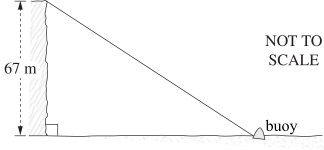
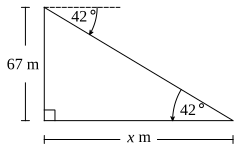
From the top of a cliff 67 metres above sea level, the angle of depression of a buoy is 42°.
How far is the buoy from the base of the cliff, to the nearest metre?
`B`
A sports car worth $150 000 is bought in December 2005.
In December each year, beginning in 2006, the value of the sports car is depreciated by 10% using the declining balance method of depreciation.
In which year will the depreciated value first fall below $120 000? (2 marks)
--- 5 WORK AREA LINES (style=lined) ---
`text(The value falls below $120 000 in the third year)`
`text{which will be during 2008.}`
`text(Using)\ \ S = V_0(1-r)^n`
`text(where)\ \ V_0 = 150\ 000, r = text(10%)`
`text(If)\ \ n = 2,`
| `S` | `= 150\ 000(1-0.1)^2` |
| `= 121\ 500` |
`text(If)\ \ n= 3,`
| `S` | `= 150\ 000(1-0.1)^3` |
| `= 109\ 350` |
`:.\ text(The value falls below $120 000 in the third year)`
`text{which will be during 2008.}`
The total cost, `$C`, of a school excursion is given by `C = 2n + 5`, where `n` is the number of students.
If three extra students go on the excursion, by how much does the total cost increase?
`A`
`C = 2n + 5`
`text(If)\ n\ text(increases to)\ n + 3`
| `C` | `= 2(n + 3) + 5` |
| `= 2n + 6 + 5` | |
| `= 2n + 11` |
`:.\ text(Total cost increases by $6)`
`=> A`
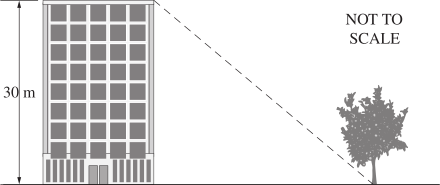
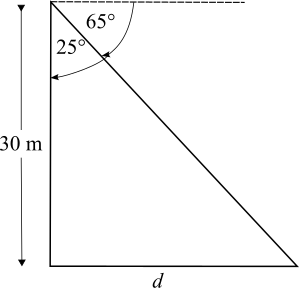
The angle of depression of the base of the tree from the top of the building is 65°. The height of the building is 30 m.
How far away is the base of the tree from the building, correct to one decimal place?
`B`
Which of the following would be most likely to have a positive correlation?
\(A\)
\(\text{Positive correlation means that as one variable increases,}\)
\(\text{the other tends to increase also.}\)
\(\Rightarrow A\)
A plasma TV depreciated in value by 15% per annum. Two years after it was purchased it had depreciated to a value of $2023, using the declining balance method.
What was the purchase price of the plasma TV? (2 marks)
--- 4 WORK AREA LINES (style=lined) ---
`$2800`
`S = V_0 (1-r)^n`
| `2023` | `= V_0 (1-0.15)^2` |
| `2023` | `= V_0 (0.85)^2` |
| `V_0` | `= 2023/0.85^2` |
| `= 2800` |
`:.\ text(The purchase price) = $2800`
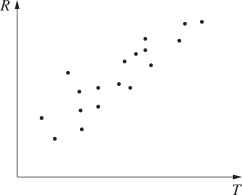
A scatterplot is shown.
Which of the following best describes the correlation between \(R\) and \(T\)?
\(A\)
\(\text{Correlation is positive.}\)
\(\text{NB. The skew does not directly relate to correlation.}\)
\(\Rightarrow A\)
A car is bought for $19 990. It will depreciate at 18% per annum.
Using the declining balance method, what will be the salvage value of the car after 3 years, to the nearest dollar?
`C`
| `S` | `= V_0 (1-r)^n` |
| `= 19\ 990 (1-18/100)^3` | |
| `= 19\ 990 (0.82)^3` | |
| `= $11\ 021.85` |
`=> C`
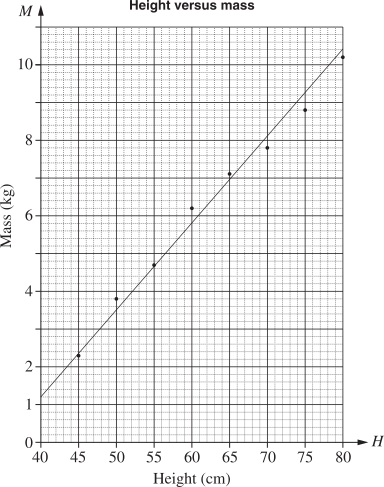
The height and mass of a child are measured and recorded over its first two years.
\begin{array} {|l|c|c|}
\hline \rule{0pt}{2.5ex} \text{Height (cm), } H \rule[-1ex]{0pt}{0pt} & \text{45} & \text{50} & \text{55} & \text{60} & \text{65} & \text{70} & \text{75} & \text{80} \\
\hline \rule{0pt}{2.5ex} \text{Mass (kg), } M \rule[-1ex]{0pt}{0pt} & \text{2.3} & \text{3.8} & \text{4.7} & \text{6.2} & \text{7.1} & \text{7.8} & \text{8.8} & \text{10.2} \\
\hline
\end{array}
This information is displayed in a scatter graph.
--- 2 WORK AREA LINES (style=lined) ---
Find the equation of this line. (2 marks)
--- 4 WORK AREA LINES (style=lined) ---
`text(mass is positive and strong.)`
i. `text(The correlation between height and)`
`text(mass is positive and strong.)`
ii. `text(Using)\ \ P_1(40, 1.2)\ \ text(and)\ \ P_2(80, 10.4)`
| `text(Gradient)` | `= (y_2-y_1)/(x_2-x_1)` |
| `= (10.4-1.2)/(80-40)` | |
| `= 9.2/40` | |
| `= 0.23` |
`text(Line passes through)\ \ P_1(40, 1.2)`
| `text(Using)\ \ \ y-y_1` | `= m(x-x_1)` |
| `y-1.2` | `= 0.23(x-40)` |
| `y-1.2` | `= 0.23x-9.2` |
| `y` | `= 0.23x-8` |
`:. text(Equation of the line is)\ \ M = 0.23H-8`
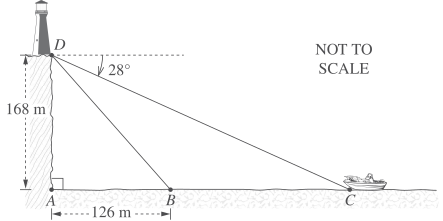
The base of a lighthouse, `D`, is at the top of a cliff 168 metres above sea level. The angle of depression from `D` to a boat at `C` is 28°. The boat heads towards the base of the cliff, `A`, and stops at `B`. The distance `AB` is 126 metres.
--- 6 WORK AREA LINES (style=lined) ---
--- 4 WORK AREA LINES (style=lined) ---
| i. | `tan/_ADB` | `=126/168` |
| ` /_ADB` | `=36.8698…` | |
| `=36.9^circ\ \ \ \ text{(to 1 d.p)}` |
| `/_text(Depression)\ D\ text(to)\ B` | `=90-36.9` |
| `=53.1` | |
| `=53^circ\ text{(nearest degree)}` |
ii. `text(Find)\ CB:`
| `/_ADC+28` | `=90` |
| `/_ADC` | `=62^circ` |
| `tan 62^circ` | `=(AC)/168` |
| `AC` | `=168xxtan 62^circ` |
| `=315.962…` |
| `CB` | `=AC-AB` |
| `=315.962…-126` | |
| `=189.962…` | |
| `=190\ text(m (nearest m))` |
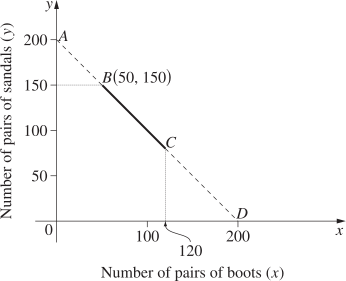
A factory makes boots and sandals. In any week
• the total number of pairs of boots and sandals that are made is 200
• the maximum number of pairs of boots made is 120
• the maximum number of pairs of sandals made is 150.
The factory manager has drawn a graph to show the numbers of pairs of boots (`x`) and sandals (`y`) that can be made.
--- 2 WORK AREA LINES (style=lined) ---
--- 3 WORK AREA LINES (style=lined) ---
Compare the profits at `B` and `C`. (2 marks)
--- 5 WORK AREA LINES (style=lined) ---
`=> x\ text(cannot)\ >120`
`text(S)text(ince the max amount of sandals = 150`
`=> y\ text(cannot)\ >150`
`:.\ text(The line)\ AD\ text(is only possible between)\ B\ text(and)\ C.`
i. `text{We are told the number of boots}\ (x),`
`text{and shoes}\ (y),\ text(made in any week = 200)`
`=>text(Equation of)\ AD\ text(is)\ \ x + y = 200`
ii. `text(S)text(ince the max amount of boots = 120)`
`=> x\ text(cannot)\ >120`
`text(S)text(ince the max amount of sandals = 150`
`=> y\ text(cannot)\ >150`
`:.\ text(The line)\ AD\ text(is only possible between)\ B\ text(and)\ C.`
iii. `text(At)\ B,\ \ x = 50,\ y = 150`
| `=>$P (text(at)\ B)` | `= 24 xx 50 + 15 xx 150` |
| `= 1200 + 2250` | |
| ` = $3450` |
`text(At)\ C,\ \ x = 120 text(,)\ y = 80`
| `=> $P (text(at)\ C)` | `= 24 xx 120 + 15 xx 80` |
| `= 2880 + 1200` | |
| `= $4080` |
`:.\ text(The profits at)\ C\ text(are $630 more than at)\ B.`
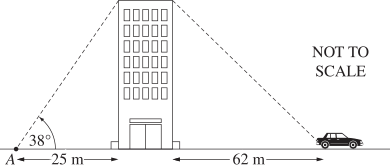
The point `A` is 25 m from the base of a building. The angle of elevation from `A` to the top of the building is 38°.
--- 2 WORK AREA LINES (style=lined) ---
What is the angle of depression from the top of the building to the car?
Give your answer to the nearest minute. (2 marks)
--- 5 WORK AREA LINES (style=lined) ---
i. `text{Proof (See Worked Solutions)}`
ii. `17°28^{′}`
i. `text(Need to prove height (h) ) ~~ 19.5\ text(m)`
| `tan 38^@` | `= h/25` |
| `h` | `= 25 xx tan38^@` |
| `= 19.5321…` | |
| `~~ 19.5\ text(m)\ \ text(… as required.)` |
| ii. |
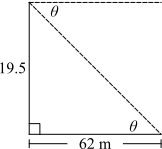
`text(Let)\ \ /_ \ text(Elevation (from car) ) = theta`
| `tan theta` | `= h/62` |
| `= 19.5/62` | |
| `= 0.3145…` | |
| `:. theta` | `= 17.459…` |
| `= 17°27^{′}33^{″}..` | |
| `=17°28^{′}\ \ text{(nearest minute)}` |
`:./_ \ text(Depression to car) =17°28^{′}\ \ text{(alternate to}\ theta text{)}`
If `A = 6x + 10`, and `x` is increased by 2, what will be the corresponding increase in `A` ?
`D`
`A = 6x + 10`
`text(If)\ x\ text(increases by 2)`
`A\ text(increases by)\ 6 xx 2 = 12`
`=> D`
A house was purchased in 1984 for $35 000. Assume that the value of the house has increased by 3% per annum since then.
Which expression gives the value of the house in 2009?
`A`
`r =\ text(3%)\ = 0.03`
`n = 25\ text(years)`
`text(Using)\ \ FV = PV(1 + r)^n`
` :.\ text(Value in 2009) = 35\ 000(1+0.03)^25`
`=> A`
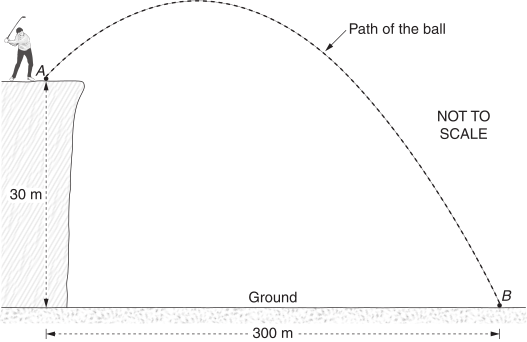
A golf ball is hit from point `A` to point `B`, which is on the ground as shown. Point `A` is 30 metres above the ground and the horizontal distance from point `A` to point `B` is 300 m.
The path of the golf ball is modelled using the equation
`h = 30 + 0.2d-0.001d^2`
where
`h` is the height of the golf ball above the ground in metres, and
`d` is the horizontal distance of the golf ball from point `A` in metres.
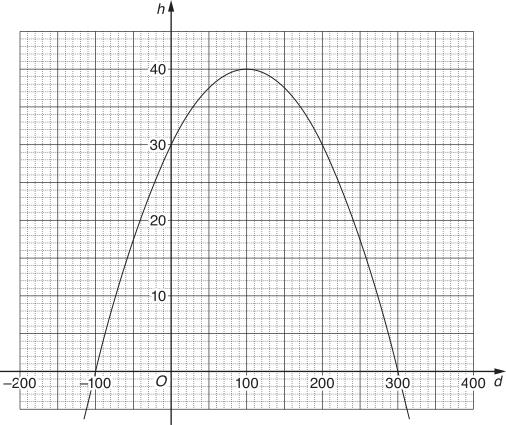
The graph of this equation is drawn below.
--- 1 WORK AREA LINES (style=lined) ---
What horizontal distance does the ball travel in the period between these two occasions? (1 mark)
--- 2 WORK AREA LINES (style=lined) ---
Find all values of `d` that are not suitable to use with this model, and explain why these values are not suitable. (2 marks)
--- 4 WORK AREA LINES (style=lined) ---
i. `text(Max height) = 40 text(m)`
ii. `text(From graph)`
`h = 35\ text(when)\ x = 30\ text(and)\ x = 170`
| `:.\ text(Horizontal distance)` | `= 170-30` |
| `= 140\ text(m)` |
iii. `text(Ball hits ground at)\ x = 300`
`=>text(Need to find)\ y\ text(when)\ x = 250`
`text(From graph,)\ y = 17.5 text(m)\ text(when)\ x = 250`
`:.\ text(Height of ball is 17.5 m at a horizontal)`
`text(distance of 50m before)\ B.`
iv. `text(Values of)\ d\ text(not suitable).`
`text(If)\ d < 0 text(, it assumes the ball is hit away)`
`text(from point)\ B text(. This is not the case in our)`
`text(example.)`
`text(If)\ d > 300 text(,)\ h\ text(becomes negative which is)`
`text(not possible given the ball cannot go)`
`text(below ground level.)`
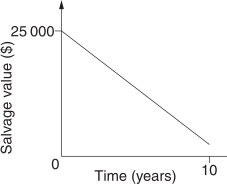
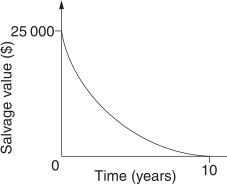
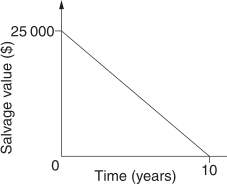
A machine was bought for $25 000.
Which graph best represents the salvage value of the machine over 10 years using the declining balance method of depreciation?
| (A) | (B) | |||
| (C) | (D) |
`A`
`text(By Elimination)`
`B\ \ text(and)\ \ D\ \ text(represent straight line depreciation.)`
`C\ \ text(incorrectly has no salvage value after 10 years)`
`=>A`
Which of the following relationships would most likely show a negative correlation?
\(B\)
\(\text{Increased hours training should reduce the time}\)
\(\text{to complete a race.}\)
\(\Rightarrow B\)
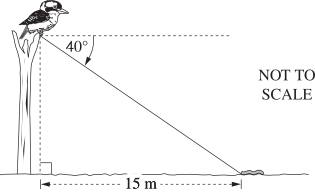
The angle of depression from a kookaburra’s feet to a worm on the ground is 40°. The worm is 15 metres from a point on the ground directly below the kookaburra’s feet.
How high above the ground are the kookaburra's feet, correct to the nearest metre?
`C`
| ` /_ \ text{Elevation (worm)}` | `= 40^@` `text{(alternate angles)}` |
| `tan 40^@` | `=h/15` |
| `:. h` | `=15xxtan 40^@` |
| `=12.58…\ text(m)` |
`=>C`