Consider the function \(h(x)=a\, \log _e(b x)\), where \(a, b \in R\).
Given that its derivative \(h^{\prime}(x)\) has range \((0, \infty)\), which of the following must be true?
- \( a>0\) only
- \( a>0\) and \(b<0\)
- \(a>0\) and \(b>0\)
- \(a b>0\)
Aussie Maths & Science Teachers: Save your time with SmarterEd
Consider the function \(h(x)=a\, \log _e(b x)\), where \(a, b \in R\).
Given that its derivative \(h^{\prime}(x)\) has range \((0, \infty)\), which of the following must be true?
\(D\)
\(h(x)=a\, \log _e(b x)\)
\(h^{\prime}(x)=a\, \times \dfrac{b}{bx}=\dfrac{a}{x}\)
\(\text{Consider} \ \ h(x)=a\, \log _e(b x) \ \Rightarrow \ b x>0\)
\(\text{Case 1:} \ \ b>0 \ \Rightarrow \ x>0 \ (\text{since} \ \ b x>0 )\)
\(\dfrac{a}{x} \ \ \text{is only positive when}\ \ a>0\)
\(\text {Case 2:} \ \ b<0 \ \Rightarrow \ x<0 \ \ (\text{since} \ \ b x>0)\)
\(\dfrac{a}{x} \ \ \text{is only positive when} \ \ a<0\)
\(\text{In both cases,} \ ab>0\)
\(\Rightarrow D\)
The diagram shows the graph of \(y=f^{\prime}(x)\).
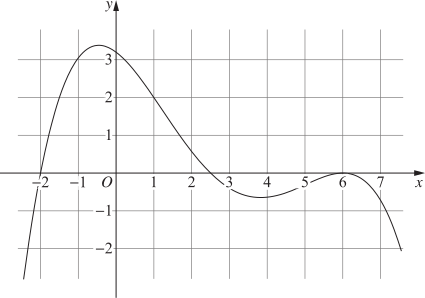
Given \(f(1)=6\), which interval includes the best estimate for \(f(1.1)\) ?
\(B\)
\(\text{Gradient of \(f(x)\) at \(x=1\) is 2 (see graph).}\)
\(\text{Gradient of \(f(x)\) at \(x=1.1\) is slightly below 2 (see graph).}\)
\(\text{As \(x\) increases 0.1 (from 1.0 to 1.1), \(y\) will increase less than 0.2 units.}\)
\(\therefore f(1.1) \in [6.0,6.2)\)
\(\Rightarrow B\)
Given \(y=x e^{-3 x}\), prove that
\(\dfrac{d^2 y}{d x^2}+6 \dfrac{d y}{d x}+9 y=0\) (3 marks)
--- 7 WORK AREA LINES (style=lined) ---
\(\text{Proof (See worked solution}\)
\(y=x e^{-3 x}\)
\(\dfrac{d y}{d x}=e^{-3 x}-3 x e^{-3 x}\)
| \(\dfrac{d^2 y}{d x^2}\) | \(=-3 e^{-3 x}-3 e^{-3 x}+3 \cdot 3 x e^{-3 x}\) |
| \(=-6 e^{-3 x}+9 x e^{-3 x}\) |
\(\text {Substituting into equation: }\)
\(\dfrac{d^2 y}{d x^2}+6 \dfrac{d y}{d x}+9 y\)
\(=-6 e^{-3 x}+9 x e^{-3 x}+6\left(e^{-3 x}-3 x e^{-3 x}\right)+9 x e^{-3 x}\)
\(=-6 e^{-3 x}+9 x e^{-3 x}+6 e^{-3 x}-18 x e^{-3 x}+9 x e^{-3 x}\)
\(=0\)
For what values of `x` is `f(x) = x^2 - 2x^3` increasing? (3 marks)
`x ∈ (0, 1/3)`
| `f(x)` | `= x^2 – 2x^3` |
| `f′(x)` | `= 2x – 6x^2` |
`f(x)\ \ text(is increasing when)\ \ f′(x) > 0`
`2x – 6x^2 > 0`
`2x(1 – 3x) > 0`
`x ∈ (0, 1/3)`
Find the coordinates of the stationary point on the graph `y = e^x − ex`, and determine its nature. (3 marks)
--- 6 WORK AREA LINES (style=lined) ---
`(1,0)\ =>text(MINIMUM)`
| `y` | `= e^x – ex` |
| `dy/dx` | `= e^x – e` |
| `(d^2 y)/(dx^2)` | `= e^x` |
`text(S.P. when)\ \ dy/dx = 0`
| `e^x – e` | `= 0` |
| `e^x` | `= e^1` |
| `x` | `= 1` |
`text(At)\ \ x = 1`
| `y` | `= e^1 – e = 0` |
| `(d^2 y)/(dx^2)` | `= e > 0\ \ => text(MIN)` |
`:.\ text(MINIMUM S.P. at)\ (1,0)`
Let `f(x) = x^3-3x^2 + kx + 8`, where `k` is a constant.
Find the values of `k` for which `f(x)` is an increasing function. (2 marks)
--- 5 WORK AREA LINES (style=lined) ---
`k>3`
| `f(x)` | `= x^3-3x^2 + kx + 8` |
| `f^{′}(x)` | `= 3x^2-6x + k` |
`f(x)\ text(is increasing when)\ \ f^{′}(x) > 0`
`=> 3x^2-6x + k > 0`
`f^{′}(x)\ text(is always positive)`
`=> f^{′}(x)\ text(is a positive definite.)`
`text(i.e. when)\ \ a > 0\ text(and)\ Delta < 0`
`a=3>0`
`Delta = b^2-4ac`
| `(-6)^2-(4 xx 3 xx k)` | `<0` |
| `36-12k` | `<0` |
| `12k` | `>36` |
| `k` | `>3` |
`:.\ f(x)\ text(is increasing when)\ \ k > 3.`
The cubic `y = ax^3 + bx^2 + cx + d` has a point of inflection at `x = p`.
Show that `p= - b/(3a)`. (2 marks)
--- 5 WORK AREA LINES (style=lined) ---
`text(Proof)\ \ text{(See Worked Solutions)}`
`text(Show)\ \ p= – b/(3a)`
| `y` | `=ax^3 + bx^2 + cx + d` |
| `y prime` | `=3ax^2 + 2bx + c` |
| `y″` | `=6ax + 2b` |
`text(Given P.I. occurs when)\ \ x = p`
`=> y″=0\ \ text(when)\ \ x=p`
| `:.\ 6ap + 2b` | `=0` |
| `6ap` | `=-2b` |
| `p` | `= -(2b)/(6a)` |
| `=-b/(3a)\ \ \ text(… as required)` |