SmarterEd

Aussie Maths & Science Teachers: Save your time with SmarterEd

  • Login
  • Get Help
  • About

Calculus, 2ADV C3 2025 MET2 16 MC

Consider the function  \(h(x)=a\, \log _e(b x)\), where \(a, b \in R\).

Given that its derivative \(h^{\prime}(x)\) has range \((0, \infty)\), which of the following must be true?

  1. \( a>0\)  only
  2. \( a>0\)  and  \(b<0\)
  3. \(a>0\)  and  \(b>0\)
  4. \(a b>0\)
Show Answers Only

\(D\)

Show Worked Solution

\(h(x)=a\, \log _e(b x)\)

\(h^{\prime}(x)=a\, \times \dfrac{b}{bx}=\dfrac{a}{x}\)

\(\text{Consider} \ \ h(x)=a\, \log _e(b x) \ \rightarrow \ b x>0\)
 

\(\text{Case 1:} \ \ b>0 \ \rightarrow \ x>0 \ (\text{since} \ \ b x>0 )\)

\(\dfrac{a}{x} \ \ \text{is only positive when}\ \  a>0\)
 

\(\text {Case 2:} \ \ b<0 \ \rightarrow \ x<0 \ \ (\text{since} \ \ b x>0)\)

\(\dfrac{a}{x} \ \ \text{is only positive when} \ \  a<0\)

\(\text{In both cases,} \ ab>0\)
  

\(\Rightarrow D\)

Filed Under: Interpreting and Graphing Derivatives, The Derivative Function and its Graph Tagged With: Band 6, smc-1089-50-Other, smc-7133-50-Other Problems

Calculus, 2ADV C3 2025 HSC 9 MC

The diagram shows the graph of  \(y=f^{\prime}(x)\).
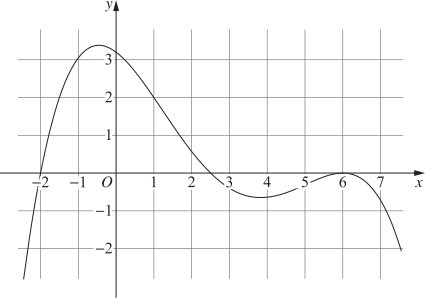
 

Given  \(f(1)=6\), which interval includes the best estimate for \(f(1.1)\) ?

  1. \([6.2,6.4)\)
  2. \([6.0,6.2)\)
  3. \([5.8,6.0)\)
  4. \([5.6,5.8)\)
Show Answers Only

\(B\)

Show Worked Solution

\(\text{Gradient of \(f(x)\)  at  \(x=1\)  is 2 (see graph).}\)

\(\text{Gradient of \(f(x)\)  at  \(x=1.1\)  is slightly below 2 (see graph).}\)

\(\text{As \(x\) increases 0.1 (from 1.0 to 1.1), \(y\) will increase less than 0.2 units.}\)

\(\therefore f(1.1) \in [6.0,6.2)\)

\(\Rightarrow B\)

♦♦♦ Mean mark 27%.

Filed Under: Interpreting and Graphing Derivatives, The Derivative Function and its Graph Tagged With: Band 6, smc-1089-50-Other, smc-7133-50-Other Problems

Calculus, 2ADV C3 EQ-Bank 28

Given  \(y=x e^{-3 x}\), prove that

\(\dfrac{d^2 y}{d x^2}+6 \dfrac{d y}{d x}+9 y=0\)   (3 marks)

--- 7 WORK AREA LINES (style=lined) ---

Show Answers Only

\(\text{Proof (See worked solution}\)

Show Worked Solution

\(y=x e^{-3 x}\)

\(\dfrac{d y}{d x}=e^{-3 x}-3 x e^{-3 x}\)

\(\dfrac{d^2 y}{d x^2}\) \(=-3 e^{-3 x}-3 e^{-3 x}+3 \cdot 3 x e^{-3 x}\)
  \(=-6 e^{-3 x}+9 x e^{-3 x}\)

 
\(\text {Substituting into equation: }\)

\(\dfrac{d^2 y}{d x^2}+6 \dfrac{d y}{d x}+9 y\)

\(=-6 e^{-3 x}+9 x e^{-3 x}+6\left(e^{-3 x}-3 x e^{-3 x}\right)+9 x e^{-3 x}\)

\(=-6 e^{-3 x}+9 x e^{-3 x}+6 e^{-3 x}-18 x e^{-3 x}+9 x e^{-3 x}\)

\(=0\)

Filed Under: Interpreting and Graphing Derivatives, The Derivative Function and its Graph Tagged With: Band 5, smc-1089-50-Other, smc-7133-50-Other Problems

Calculus, 2ADV C3 2024 MET2 3*

A function is defined as  \(f(x)=\dfrac{x-h}{(x+1)(x-4)}\)

Determine the range of \(h\) where the graph of \(f(x)\) have no turning points.   (3 marks)

--- 9 WORK AREA LINES (style=lined) ---

Show Answers Only

\(-1 \leq h \leq 4\)

Show Worked Solution

\(f(x)=\dfrac{x-h}{(x+1)(x-4)}\)

\(\text{Let}\ \ u=x-h\ \ \rightarrow\ \ u^{\prime} = 1\)

 \(v=x^2-3x-4\ \ \rightarrow\ \ v^{\prime\prime} = 2x-3\)

\(f^{\prime}(x)=\dfrac{(x^2-3x-4)-(2x-3)(x-h)}{(x+1)^2(x-4)^2}\)

\(\text{Solve}\ \ f^{\prime}(x)=0:\)

\(x^2-3x-4-2x^2+2xh+3x-3h\) \(=0\)
\(-x^2+2xh-(4+3h)\) \(=0\)
\(x^2-2xh+(4+3h)\) \(=0\)
\(x\) \(= \dfrac{2h \pm \sqrt{4h^2-4(4+3h)}}{2}\)
  \(=h \pm \sqrt{h^2-3h-4}\)

 
\(\text{No turning points occur if}\ \ h^2-3h-4=(h-4)(h+1)<0\)

\(-1 \lt h \lt 4\)

\(\text{If}\ \ h=-1\ \ \text{or}\ \ 4, f(x)\ \text{is linear (no TPs)}\)

\(\therefore -1 \leq h \leq 4\)

Filed Under: Interpreting and Graphing Derivatives, The Derivative Function and its Graph Tagged With: Band 5, smc-1089-49-No SPs, smc-7133-50-Other Problems

Calculus, 2ADV C3 2021 HSC 16

For what values of  `x`  is  `f(x) = x^2-2x^3`  increasing?   (3 marks)

--- 5 WORK AREA LINES (style=lined) ---

Show Answers Only

`x ∈ (0, 1/3)`

Show Worked Solution
`f(x)` `= x^2-2x^3`
`f^{prime}(x)` `= 2x-6x^2`

  
`f(x)\ \ text(is increasing when)\ \ f^{prime}(x) > 0`

`2x-6x^2 > 0`

`2x(1-3x) > 0`

`x ∈ (0, 1/3)`

Filed Under: Interpreting and Graphing Derivatives, The Derivative Function and its Graph Tagged With: Band 4, smc-1089-50-Other, smc-7133-50-Other Problems

Calculus, 2ADV C3 2018 HSC 14c

Let  `f(x) = x^3 + kx^2 + 3x-5`, where `k` is a constant.

Find the values of `k` for which `f(x)` has NO stationary points.   (3 marks)

--- 6 WORK AREA LINES (style=lined) ---

Show Answers Only

`-3 < k < 3`

Show Worked Solution

`f(x) = x^3 + kx^2 + 3x-5`

♦ Mean mark 49%.

`f^{prime}(x) = 3x^2 + 2kx + 3`
 

`text(No S.P.’s exist if)\ f^{prime}(x)\ text(has no roots,)`

`Delta` `< 0`
`b^2-4ac` `< 0`
`(2k)^2-4 xx 3 xx 3` `< 0`
`4k^2-36` `< 0`
`k^2-9` `< 0`
`(k-3) (k + 3)` `< 0`


`:. -3 < k < 3`

Filed Under: Curve Sketching, Curve Sketching and The Primitive Function, Interpreting and Graphing Derivatives, The Derivative Function and its Graph Tagged With: Band 5, smc-1089-49-No SPs, smc-7133-50-Other Problems, smc-7225-10-Cubic

Calculus, 2ADV C3 2014 HSC 14a

Find the coordinates of the stationary point on the graph  `y = e^x-ex`, and determine its nature.   (3 marks)

--- 6 WORK AREA LINES (style=lined) ---

Show Answers Only

`(1,0)\ ->text(MINIMUM)`

Show Worked Solution

`y= e^x-ex`

`dy/dx= e^x-e`

`(d^2 y)/(dx^2)= e^x` 

`text(S.P. when)\ \ dy/dx = 0`

`e^x-e` `= 0`
`e^x` `= e^1`
`x` `= 1`

 
`text(At)\ \ x = 1`

`y= e^1-e = 0`

`(d^2 y)/(dx^2)= e > 0\ \ -> text(MIN)` 
  

`:.\ text(MINIMUM S.P. at)\ (1,0)`

Filed Under: Curve Sketching, Curve Sketching and The Primitive Function, Interpreting and Graphing Derivatives, The Derivative Function and its Graph Tagged With: Band 4, smc-1089-50-Other, smc-7133-50-Other Problems, smc-7225-30-Other Graphs

Calculus, 2ADV C3 2010 HSC 8d

Let  `f(x) = x^3-3x^2 + kx + 8`, where `k` is a constant.

Find the values of `k` for which `f(x)` is an increasing function.   (2 marks)

--- 5 WORK AREA LINES (style=lined) ---

Show Answers Only

`k>3`

Show Worked Solution
`f(x)` `= x^3-3x^2 + kx + 8`
`f^{prime}(x)` `= 3x^2-6x + k`

  
`f(x)\ text(is increasing when)\ \ f^{prime}(x) > 0`

`-> 3x^2-6x + k > 0`

♦♦ Mean mark 28%.
MARKER’S COMMENT: The arithmetic required to solve `36-12k<0`  proved the undoing of many students.

  
`f^{prime}(x)\ text(is always positive)`

`-> f^{prime}(x)\ text(is a positive definite.)`

`text(i.e. when)\ \ a > 0\ text(and)\ Delta < 0`
 

`a=3>0`

`Delta = b^2-4ac`

`(-6)^2-(4 xx 3 xx k)` `<0`
`36-12k` `<0`
`12k` `>36`
`k` `>3`


`:.\ f(x)\ text(is increasing when)\ \ k > 3.`

Filed Under: Curve Sketching, Curve Sketching and The Primitive Function, Interpreting and Graphing Derivatives, Roots and the discriminant, Standard Differentiation, Standard Differentiation, The Derivative Function and its Graph Tagged With: Band 5, smc-1069-50-Other, smc-1089-50-Other, smc-6436-50-Other, smc-7133-50-Other Problems, smc-7225-10-Cubic, smc-7225-50-Increasing/Decreasing Intervals

Calculus, 2ADV C3 2013 HSC 12a

The cubic  `y = ax^3 + bx^2 + cx + d`  has a point of inflection at  `x = p`. 

Show that  `p=-b/(3a)`.   (2 marks)

--- 5 WORK AREA LINES (style=lined) ---

Show Answers Only

`text(Proof)\ \ text{(See Worked Solutions)}`

Show Worked Solution

`text(Show)\ \ p= – b/(3a)`

`y` `=ax^3 + bx^2 + cx + d`
`y^{prime}` `=3ax^2 + 2bx + c`
`y^{primeprime}` `=6ax + 2b`

 
`text(Given P.I. occurs when)\ \ x = p`

`-> y^{primeprime}=0\ \ text(when)\ \ x=p`

`:.\ 6ap + 2b` `=0`
`6ap` `=-2b`
`p` `= -(2b)/(6a)`
  `=-b/(3a)\ \ \ text(… as required)`

Filed Under: Curve Sketching and The Primitive Function, Interpreting and Graphing Derivatives, The Derivative Function and its Graph Tagged With: Band 3, smc-1089-50-Other, smc-7133-50-Other Problems

Copyright © 2014–2026 SmarterEd.com.au · Log in