SmarterEd

Aussie Maths & Science Teachers: Save your time with SmarterEd

  • Login
  • Get Help
  • About

Graphs, MET2 2023 VCAA 1 MC

The amplitude, \(A\), and the period, \(P\), of the function \(f(x)=-\dfrac{1}{2}\sin(3x+2\pi)\) are

  1. \(A=-\dfrac{1}{2},\ P=\dfrac{\pi}{3}\)
  2. \(A=-\dfrac{1}{2},\ P=\dfrac{2\pi}{3}\)
  3. \(A=-\dfrac{1}{2},\ P=\dfrac{3\pi}{2}\)
  4. \(A=\dfrac{1}{2},\ P=\dfrac{\pi}{3}\)
  5. \(A=\dfrac{1}{2},\ P=\dfrac{2\pi}{3}\)
Show Answers Only

\(E\)

Show Worked Solution

\(\text{Period:}\ \ P= \dfrac{2\pi}{n}= \dfrac{2\pi}{3}\)  

\(\text{Amplitude}:\ \ A=\bigg|-\dfrac{1}{2}\bigg|=\dfrac{1}{2}\)

\(\Rightarrow E\)

Filed Under: Trig Graphing Tagged With: Band 3, smc-2757-10-Sin, smc-2757-30-Find period, smc-2757-40-Find amplitude

Trigonometry, MET2-NHT 2019 VCAA 2

The wind speed at a weather monitoring station varies according to the function

`v(t) = 20 + 16sin ((pi t)/(14))`

where `v` is the speed of the wind, in kilometres per hour (km/h), and  `t`  is the time, in minutes, after 9 am.

  1. What is the amplitude and the period of  `v(t)`?   (2 marks)

    --- 3 WORK AREA LINES (style=lined) ---

  2. What are the maximum and minimum wind speeds at the weather monitoring station?   (1 mark)

    --- 2 WORK AREA LINES (style=lined) ---

  3. Find  `v(60)`, correct to four decimal places.   (1 mark)

    --- 2 WORK AREA LINES (style=lined) ---

  4. Find the average value of  `v(t)`  for the first 60 minutes, correct to two decimal places.   (2 marks)

    --- 5 WORK AREA LINES (style=lined) ---

A sudden wind change occurs at 10 am. From that point in time, the wind speed varies according to the new function

                    `v_1(t) = 28 + 18 sin((pi(t-k))/(7))`

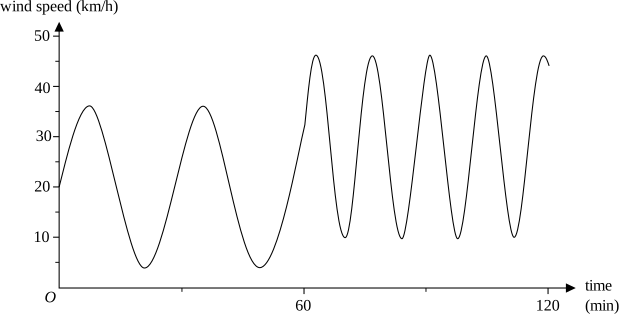
where  `v_1`  is the speed of the wind, in kilometres per hour, `t` is the time, in minutes, after 9 am and  `k ∈ R^+`. The wind speed after 9 am is shown in the diagram below.
 

  1. Find the smallest value of `k`, correct to four decimal places, such that  `v(t)`  and  `v_1(t)`  are equal and are both increasing at 10 am.   (2 marks)

    --- 2 WORK AREA LINES (style=lined) ---

  2. Another possible value of `k` was found to be 31.4358


    Using this value of `k`, the weather monitoring station sends a signal when the wind speed is greater than 38 km/h.


    i.  Find the value of `t` at which a signal is first sent, correct to two decimal places.   (1 mark)

    --- 2 WORK AREA LINES (style=lined) ---


    ii. Find the proportion of one cycle, to the nearest whole percent, for which  `v_1 > 38`.   (2 marks)

    --- 5 WORK AREA LINES (style=lined) ---

  3. Let  `f(x) = 20 + 16 sin ((pi x)/(14))`  and  `g(x) = 28 + 18 sin ((pi(x-k))/(7))`.
     
    The transformation  `T([(x),(y)]) = [(a \ \ \ \ 0),(0 \ \ \ \ b)][(x),(y)] + [(c),(d)]`  maps the graph of  `f`  onto the graph of  `g`.


    State the values of  `a`, `b`, `c` and `d`, in terms of `k` where appropriate.   (3 marks)

    --- 11 WORK AREA LINES (style=lined) ---

Show Answers Only
  1. `28`
  2. `v_text(max) \ = 36 \ text(km/h)`


    `v_text(min) \ = 4 \ text(km/h)`

  3. `32.5093 \ text(km/h)`
  4. `20.45 \ text(km/h)`
  5. `3.4358`
  6. i. `60.75 \ text(m)`


    ii. `31text(%)`

  7. `a = (1)/(2) \ , \ b = (9)/(8) \ , \ c = k \ , \ d = (11)/(2)`
Show Worked Solution

a.    `text(Amplitude) = 16`

`text{Find Period (n):}`

`(2 pi)/(n)` `= (pi)/(14)`
`n` `= 28`


b.    `v_text(max) = 20 + 16 = 36 \ text(km/h)`

`v_text(min) = 20-16 = 4 \ text(km/h)`


c.    `v(60)` `= 20 + 16 sin ((60 pi)/(14))`
  `= 32.5093 \ \ text(km/h)`


d.    `v(t)\ \ text(is always positive.)`

`s(t) = int_0^60 v(t) \ dt`

`v(t)_(avg)` `= (1)/(60) int_0^60 20 + 16 sin ((pi t)/(14))\ dt`
  `= 20.447`
  `= 20.45 \ text(km/h) \ \ text((to 2 d.p.))`


e.    `text(S) text{olve (for}\ k text{):} \ \ v(60) = v_1(60)`

`k = 3.4358 \ \ text((to 4 d.p.))`


f.i.  `text(S) text(olve for) \ t , \ text(given) \ \ v_1(t) = 38 \ \ text(and) \ \ k = 31.4358`

`=> t = 60.75 \ text(minutes)`
 

f.ii.  `text(S) text(olving for) \ \ v_1(t) = 38 \ , \ k = 31.4358`

`t_1 = 60.75 \ text{(part i)}, \ t_2 = 65.123`

`text(Period of) \ \ v_1 = (2 pi)/(n) = (pi)/(7)\ \ => \ n = 14`

`:. \ text(Proportion of cycle)` `= (65.123-60.75)/(14)`
  `= 0.312`
  `= 31 text{%  (nearest %)}`


g.    `f(x) → g(x)`

`y^{prime} = 28 + 18 sin ({pi(x^{prime}-k)}/{7})`

`x^{prime} = ax + c` `\ \ \ \ \ \ y^{prime} = by + d`


`text(Using) \ \ y^{prime} = by + d`

`28 + 18 sin ({pi(x^{prime}-k)}/{7}) = b (20 + 16 sin ({pi x}/{14})) + d`
 

`text(Equating coefficients of) \ \ sin theta :`

`16b = 18 \ \ \ => \ b = (9)/(8)`
 

`text(Equating constants:)`

`20 xx (9)/(8) + d = 28 \ \ \ => \ \ d = (11)/(2)`

`(x^{prime}-k)/(7)` `= (x)/(14)`
`x^{prime}` `= (x)/(2) + k \ \ => \ \ a = (1)/(2) \ , \ c = k`


`a = (1)/(2) \ , \ b = (9)/(8) \ , \ c = k \ , \ d = (11)/(2)`

Filed Under: Transformations, Trig Graphing Tagged With: Band 4, Band 5, Band 6, smc-2757-10-Sin, smc-2757-30-Find period, smc-2757-40-Find amplitude, smc-2757-80-Applications, smc-2757-85-Max/min (non-calc), smc-753-60-Matrix

Graphs, MET2-NHT 2019 VCAA 2 MC

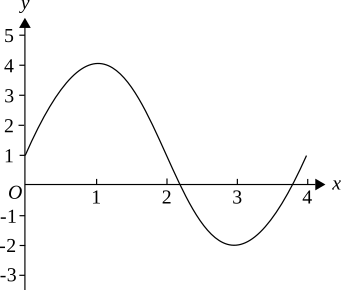
The diagram below shows one cycle of a circular function.
 

The amplitude, period and range of this function are respectively

  1. `3, 2 \ \ text(and)\ \ [-2, 4]`
  2. `3, (pi)/(2) \ \ text(and)\ \ [-2, 4]`
  3. `4, 4 \ \ text(and) \ \ [0, 4]`
  4. `4, (pi)/(4) \ \ text(and) \ \ [-2, 4]`
  5. `3, 4 \ \ text(and) \ \ [-2, 4]`
Show Answers Only

`E`

Show Worked Solution

`text(Graph centres around)\ \ y = 1`

`text(Amplitude) \ = 3`

`:. \ text(Range) \ = [1 – 3, 1 + 3] = [-2, 4]`

`text(Period:) = 4`

`=> E`

Filed Under: Trig Equations Tagged With: Band 3, smc-2757-30-Find period, smc-2757-35-Find range, smc-2757-40-Find amplitude

Graphs, MET1 SM-Bank 27

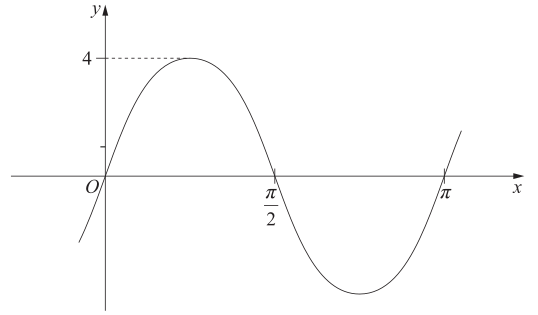
The graph shown is  `y = A sin bx`.

  1. Write down the value of  `A`.   (1 mark)

    --- 1 WORK AREA LINES (style=lined) ---

  2. Find the value of  `b`.   (1 mark)

    --- 6 WORK AREA LINES (style=lined) ---

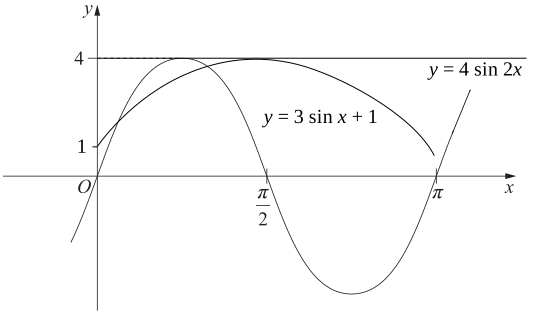
  3. Copy or trace the graph into your writing booklet.


    On the same set of axes, draw the graph  `y = 3 sin x + 1`  for  `0 <= x <= pi`.   (2 marks)

    --- 10 WORK AREA LINES (style=blank) ---

Show Answers Only
  1. `A = 4`
  2. `b = 2`
  3. `text(See Worked Solutions for sketch)`
Show Worked Solution

a.   `A = 4`

b.  `text(S)text(ince the graph passes through)\ \ (pi/4, 4)`

`text(Substituting into)\ \ y = 4 sin bx`

`4 sin (b xx pi/4)` `=4`
`sin (b xx pi/4)` `= 1`
`b xx pi/4` `= pi/2`
`:. b` `= 2`


 MARKER’S COMMENT: Graphs are consistently drawn too small by many students. Aim to make your diagrams 1/3 to 1/2 of a page. 
c.

Filed Under: Trig Graphing Tagged With: Band 3, Band 4, smc-2757-10-Sin, smc-2757-30-Find period, smc-2757-40-Find amplitude, smc-2757-70-Sketch graph

Functions, MET1 2006 VCAA 4

For the function  `f: [-pi, pi] -> R, f(x) = 5 cos (2 (x + pi/3))`

  1. write down the amplitude and period of the function.   (2 marks)

    --- 2 WORK AREA LINES (style=lined) ---

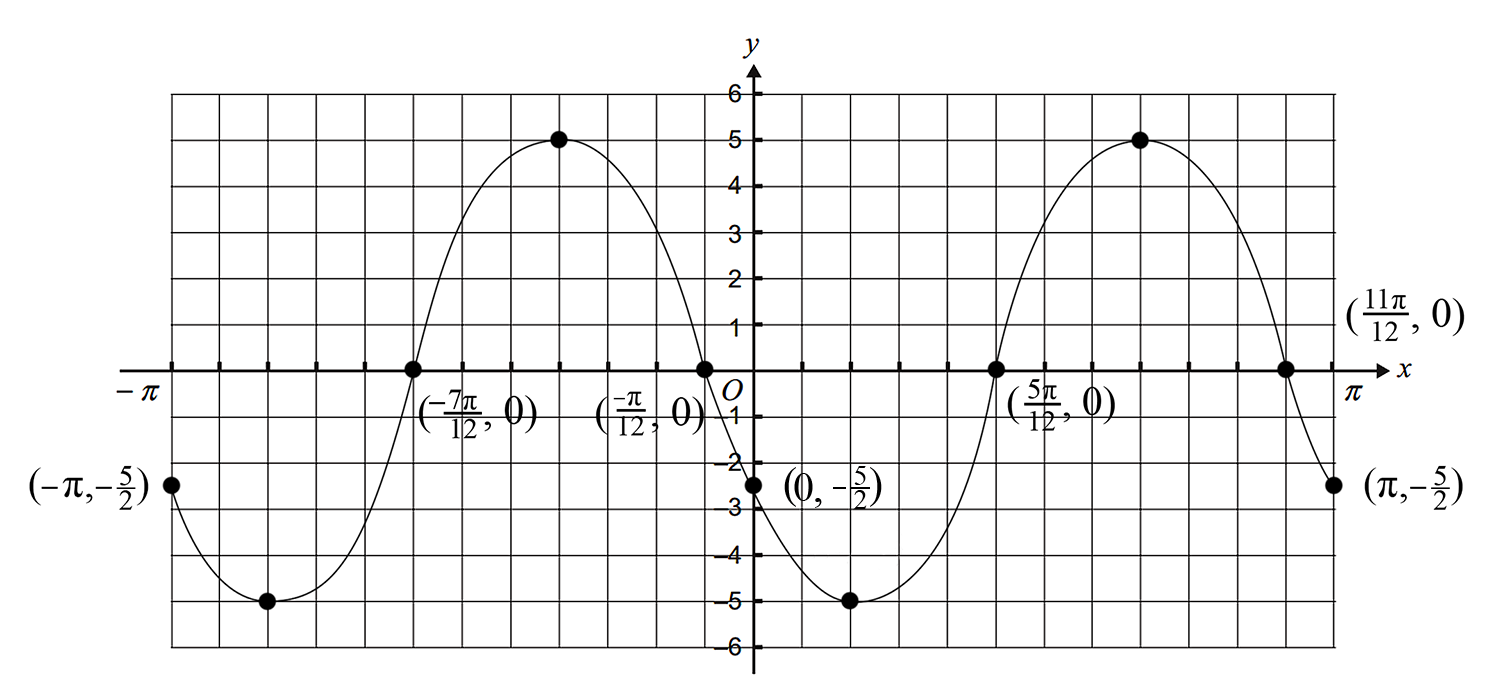
  2. sketch the graph of the function `f` on the set of axes below. Label axes intercepts with their coordinates.


    Label endpoints of the graph with their coordinates.   (3 marks)

    --- 3 WORK AREA LINES (style=lined) ---


VCAA 2006 meth 4b

Show Answers Only
  1. `text(Amplitude) = 5;\ \ \ text(Period) = pi`
  2.  
Show Worked Solution

a.   `text(Amplitude) = 5`

`text(Period) = (2 pi)/2 = pi`


b.  

`text(Shift)\ \ y = 5 cos (2x)\ \ text(left)\ \ pi/3\ \ text(units).`

`text(Period) = pi`

`text(Endpoints are)\ \ (-pi, -5/2) and (pi,-5/2)`

Filed Under: Trig Graphing Tagged With: Band 2, Band 5, smc-2757-15-Cos, smc-2757-30-Find period, smc-2757-40-Find amplitude, smc-2757-70-Sketch graph

Functions, MET1 2010 VCAA 4a

Write down the amplitude and period of the function

`qquad f: R -> R,\ \ f(x) = 4 sin ((x + pi)/3)`.   (2 marks)

--- 3 WORK AREA LINES (style=lined) ---

Show Answers Only

`text(Amplitude) = 4;\ \ text(Period) = 6 pi`

Show Worked Solution

`text(Amplitude) = 4`

`text(Period):\ \ (2 pi)/n = (2 pi)/(1/3) = 6 pi`

Filed Under: Trig Graphing Tagged With: Band 3, smc-2757-10-Sin, smc-2757-30-Find period, smc-2757-40-Find amplitude

Functions, MET1 2012 VCAA 6

The graphs of  `y = cos (x) and y = a sin (x)`,  where `a` is a real constant, have a point of intersection at  `x = pi/3.`

  1. Find the value of `a`.  (2 marks)

    --- 5 WORK AREA LINES (style=lined) ---

  2. If  `x in [0, 2 pi]`, find the `x`-coordinate of the other point of intersection of the two graphs.  (1 mark)

    --- 3 WORK AREA LINES (style=lined) ---

Show Answers Only
  1. `1/sqrt 3`
  2. `(4 pi)/3`
Show Worked Solution

a.   `text(Intersection occurs when)\ \ x=pi/3,`

`a sin(pi/3)` `= cos (pi/3)`
`tan(pi/3)` `= 1/a`
`sqrt 3` `=1/a`
`:. a` `=1/sqrt3`


b.   `tan (x)` `= sqrt 3`
  `x` `= pi/3, (4 pi)/3, 2pi+ pi/3, …\ text(but)\ x in [0, 2 pi]`
  `:. x` `= (4 pi)/3`

Filed Under: Trig Graphing Tagged With: Band 3, Band 5, smc-2757-10-Sin, smc-2757-15-Cos, smc-2757-40-Find amplitude, smc-2757-80-Applications

Algebra, MET2 2014 VCAA 1

The population of wombats in a particular location varies according to the rule  `n(t) = 1200 + 400 cos ((pi t)/3)`, where `n` is the number of wombats and `t` is the number of months after 1 March 2013.

  1. Find the period and amplitude of the function `n`.   (2 marks)

    --- 3 WORK AREA LINES (style=lined) ---

  2. Find the maximum and minimum populations of wombats in this location.   (2 marks)

    --- 2 WORK AREA LINES (style=lined) ---

  3. Find  `n(10)`.   (1 mark)

    --- 1 WORK AREA LINES (style=lined) ---

  4. Over the 12 months from 1 March 2013, find the fraction of time when the population of wombats in this location was less than  `n(10)`.   (2 marks)

    --- 6 WORK AREA LINES (style=lined) ---

Show Answers Only
  1. `text(Period) = text(6 months);\ text(Amplitude) = 400`
  2. `text(Max) = 1600;\ text(Min) = 800`
  3. `1000`
  4. `1/3`
Show Worked Solution

a.   `text(Period) = (2pi)/n = (2pi)/(pi/3) = 6\ text(months)`

MARKER’S COMMENT: Expressing the amplitude as [800,1600] in part (a) is incorrect.

`text(A)text(mplitude) = 400`
  

b.   `text(Max:)\ 1200 + 400 = 1600\ text(wombats)`

`text(Min:)\ 1200-400 = 800\ text(wombats)`
  

c.   `n(10) = 1000\ text(wombats)`
   

d.    `text(Solve)\ n(t)` `= 1000\ text(for)\ t ∈ [0,12]`

`t= 2,4,8,10`

`text(S)text(ince the graph starts at)\ \ (0,1600),`

♦ Mean mark 48%.

`=> n(t) < 1000\ \ text(for)`

`t ∈ (2,4)\ text(or)\ t ∈ (8,10)`

`:.\ text(Fraction)` `= ((4-2) + (10-8))/12`
  `= 1/3\ \ text(year)`

Filed Under: Trig Graphing Tagged With: Band 2, Band 3, Band 4, smc-2757-15-Cos, smc-2757-30-Find period, smc-2757-40-Find amplitude, smc-2757-80-Applications, smc-2757-85-Max/min (non-calc)

Copyright © 2014–2025 SmarterEd.com.au · Log in