SmarterEd

Aussie Maths & Science Teachers: Save your time with SmarterEd

  • Login
  • Get Help
  • About

BIOLOGY, M7 2024 HSC 8 MC

Trypanosomes (Trypanosoma brucei) are protozoans that cause African sleeping sickness in humans. The diagram shows the way that the disease is transmitted to humans.
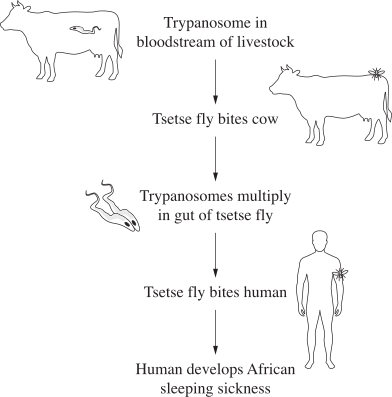
 

Which row of the table identifies the pathogen, vector and method of disease transmission to humans?

\begin{align*}
\begin{array}{l}
\rule{0pt}{2.5ex}\ & \\
\ & \rule[-1ex]{0pt}{0pt} \\ 
\rule{0pt}{2.5ex} \textbf{A.}\rule[-1ex]{0pt}{0pt}\\
\rule{0pt}{2.5ex} \textbf{B.}\rule[-1ex]{0pt}{0pt}\\
\rule{0pt}{2.5ex} \textbf{C.}\rule[-1ex]{0pt}{0pt}\\
\rule{0pt}{2.5ex} \textbf{D.}\rule[-1ex]{0pt}{0pt}\\
\end{array}
\begin{array}{|l|l|l|}
\hline
\rule{0pt}{2.5ex} \quad \textit{Pathogen} & \ \ \textit{Vector} & \ \ \textit{Method of disease} \\
\textit{} \rule[-1ex]{0pt}{0pt} & \textit{} & \ \ \textit{transmission} \\
\hline
\rule{0pt}{2.5ex}\text{Trypanosomes} \rule[-1ex]{0pt}{0pt}&  \text{Tsetse fly}& \text{Direct} \\
\hline
\rule{0pt}{2.5ex}\text{Tsetse fly} \rule[-1ex]{0pt}{0pt}& \text{Cow} & \text{Direct} \\
\hline
\rule{0pt}{2.5ex}\text{Trypanosomes} \rule[-1ex]{0pt}{0pt}& \text{Tsetse fly} & \text{Indirect}\\
\hline
\rule{0pt}{2.5ex}\text{Tsetse fly} \rule[-1ex]{0pt}{0pt}&  \text{Cow} & \text{Indirect}\\
\hline
\end{array}
\end{align*}
Show Answers Only

\(C\)

Show Worked Solution
  • African sleeping sickness is caused by trypanosome parasites (pathogen).
  • The pathogens are transmitted indirectly to humans through the bite of tsetse flies (vector).

\(\Rightarrow C\)

♦ Mean mark 48%.

Filed Under: Causes of Infectious Disease Tagged With: Band 5, smc-3655-10-Classifying Pathogens, smc-3655-20-Transmission, smc-3655-30-Vectors

BIOLOGY, M7 2024 HSC 1 MC

Which of the following are non-cellular pathogens?

  1. Bacteria
  2. Fungi
  3. Prions
  4. Protozoa
Show Answers Only

\(C\)

Show Worked Solution
  • Bacteria, fungi, and protozoa are all cellular organisms.
  • Prions are misfolded proteins that can cause disease by inducing normal proteins to misfold, making them non-cellular pathogens.

\(\Rightarrow C\)

Filed Under: Causes of Infectious Disease Tagged With: Band 3, smc-3655-10-Classifying Pathogens

BIOLOGY, M7 2023 HSC 28

  1. Describe a feature that distinguishes a viral from a bacterial pathogen.   (2 marks)

    --- 5 WORK AREA LINES (style=lined) ---

  2. A waterborne disease outbreak occurred after a flood.
  3. Outline an experimental procedure that could be used to determine if the pathogen is viral or bacterial.   (2 marks)

    --- 5 WORK AREA LINES (style=lined) ---

Show Answers Only

a.   Viral vs Bacterial Pathogen

  • Bacteria are single celled organisms and can reproduce on their own, outside of a host.
  • A virus is simply a protein coating around genetic material that can only reproduce via a host, using ribosomes to make copies of itself. 

Other answers could include:

  • Bacteria contain plasmids while viruses do not.
  • Bacteria contain a cell membrane and flagella while viruses are just a protein coat.
  • The length of a bacterium is 1–10 \(\mu\)m, much larger than the length of a virus which is typically between 0.05–0.1 \(\mu\)m. 

b.   Experimental procedure:

  • Collect diarrhoea samples from infected individuals and make stool cultures. 
  • If the disease is bacterial, the bacteria will be able to grow and multiply but if it is viral no growth will occur. 

Other answers could include

  • Using PCR to multiply DNA within the sample then using antigen testing to determine if the DNA is viral or bacterial in nature.

Show Worked Solution

a.   Viral vs Bacterial Pathogen

  • Bacteria are single celled organisms and can reproduce on their own, outside of a host.
  • A virus is simply a protein coating around genetic material that can only reproduce via a host, using ribosomes to make copies of itself. 

Other answers could include:

  • Bacteria contain plasmids while viruses do not.
  • Bacteria contain a cell membrane and flagella while viruses are just a protein coat.
  • The length of a bacterium is 1–10 \(\mu\)m, much larger than the length of a virus which is typically between 0.05–0.1 \(\mu\)m.  

b.   Experimental procedure:

  • Collect diarrhoea samples from infected individuals and make stool cultures. 
  • If the disease is bacterial, the bacteria will be able to grow and multiply but if it is viral no growth will occur. 

Other answers could include

  • Using PCR to multiply DNA within the sample then using antigen testing to determine if the DNA is viral or bacterial in nature.
Mean mark (b) 56%.

Filed Under: Causes of Infectious Disease Tagged With: Band 4, smc-3655-10-Classifying Pathogens

BIOLOGY, M7 EQ-Bank 11

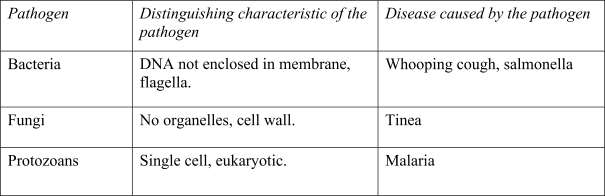
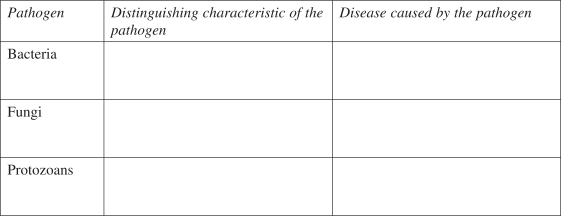
Complete the following table to show the distinguishing characteristic of each pathogen and a disease caused by each.   (3 marks)
 

--- 0 WORK AREA LINES (style=lined) ---

Show Answers Only

Show Worked Solution

Filed Under: Causes of Infectious Disease Tagged With: Band 4, smc-3655-10-Classifying Pathogens

BIOLOGY, M7 EQ-Bank 1 MC

All pathogens can be described as

  1. infectious.
  2. macroscopic.
  3. microscopic.
  4. viral.
Show Answers Only

`A`

Show Worked Solution
  • Pathogens can be macroscopic, microscopic or viral, but are all fundamentally agents of infectious disease.

`=>A`

Filed Under: Causes of Infectious Disease Tagged With: Band 2, smc-3655-10-Classifying Pathogens

BIOLOGY, M7 2014 HSC 5 MC

In which of the following cases would bacteria be described as pathogens?

  1. Bacteria reducing lung function in mammals
  2. Bacteria in the human gut assisting digestion
  3. Bacteria producing insulin as a result of genetic engineering
  4. Bacteria in the mouth preventing growth of harmful bacteria
Show Answers Only

`A`

Show Worked Solution
  • A pathogen is a biological agent of disease.
  • Bacteria ‘A’ is the only one which fits the criteria of a pathogen.

`=>A`

Filed Under: Causes of Infectious Disease Tagged With: Band 3, smc-3655-10-Classifying Pathogens

BIOLOGY, M5 2020 HSC 32b

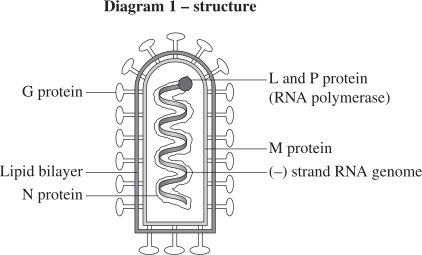
The rabies virus is a single-stranded RNA virus. It contains and codes for only five proteins. The diagrams show the structure and reproduction of the virus.


  1. Use the information provided in Diagram 1 to explain why the rabies virus cannot be classified as a cellular pathogen.   (3 marks)

    --- 5 WORK AREA LINES (style=lined) ---

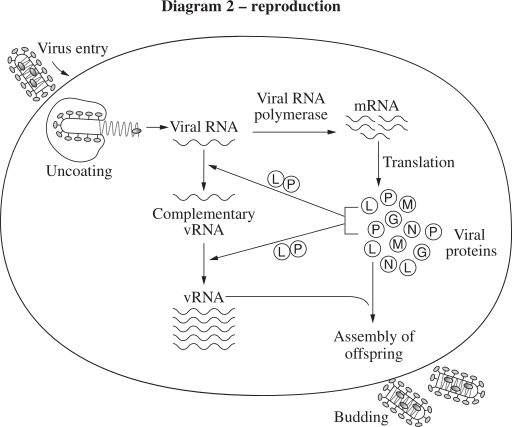
  2. After infection the virus reproduces in muscle cells near the bite site and in the central nervous system. This requires the single-stranded rabies RNA to be transcribed, translated and replicated in the cytoplasm of host cells. These processes are shown in Diagram 2.
  3. Use the information provided in Diagrams 1 and 2 to explain the role of viral RNA polymerase in the reproduction of the virus.   (5 marks)

    --- 12 WORK AREA LINES (style=lined) ---

Show Answers Only

i.   Rabies virus cannot be a singular pathogen:

  • This pathogen contains only a single strand of RNA which only codes for five proteins.
  • Cellular pathogens such as bacteria contain a much larger genome in the form of DNA that allows the pathogen to perform complex processes without relying on a host. 

ii.   The Role of Viral RNA 

  • The viral RNA polymerase (which is made from L and P proteins) is responsible for the production of the viral proteins and RNA, components of the rabies viruses.
  • RNA polymerase is responsible for transcription of viral RNA into mRNA, which is then used by the host’s ribosomes to produce respective viral proteins.
  • RNA polymerase is also responsible for the replication of the viral RNA. In this process, a complementary RNA strand is produced from the original RNA strand. This strand is then used as a template for RNA polymerase to rapidly produce more RNA, complementary to the template. The new RNA will therefore be identical to the original.
  • In this way, RNA polymerase is essential in producing viral proteins and new RNA strands which form new rabies virus particles.
Show Worked Solution

i.   Rabies virus cannot be a singular pathogen:

  • This pathogen contains only a single strand of RNA which only codes for five proteins.
  • Cellular pathogens such as bacteria contain a much larger genome in the form of DNA that allows the pathogen to perform complex processes without relying on a host.

♦♦ Mean mark (i) 33%.

ii.   The Role of Viral RNA 

  • The viral RNA polymerase (which is made from L and P proteins) is responsible for the production of the viral proteins and RNA which are components of the rabies viruses.
  • RNA polymerase is responsible for transcription of viral RNA into mRNA, which is then used by the host’s ribosomes to produce viral proteins.
  • RNA polymerase is also responsible for the replication of the viral RNA. In this process, a complementary RNA strand is produced from the original RNA strand. This strand is then used as a template for RNA polymerase to rapidly produce more RNA, complementary to the template. The new RNA will therefore be identical to the original.
  • In this way, RNA polymerase is essential in producing viral proteins and new RNA strands which form new rabies virus particles.

♦♦♦ Mean mark (ii) 29%.

Filed Under: Causes of Infectious Disease, DNA and Polypeptide Synthesis Tagged With: Band 5, Band 6, smc-3650-11-RNA, smc-3650-60-Proteins, smc-3655-10-Classifying Pathogens

BIOLOGY, M7 2017 HSC 14 MC

Which statement correctly describes fungi and protozoans?

  1. Fungi and protozoans are unicellular.
  2. Fungi and protozoans have chloroplasts.
  3. Fungi have a cell wall and protozoans do not.
  4. Fungi are procaryotic and protozoans are eucaryotic.
Show Answers Only

`C`

Show Worked Solution
  • Protozoans are unicellular organisms with no cell walls.
  • Fungi cells have cell walls.

`=>C`


♦ Mean mark 43%.

Filed Under: Causes of Infectious Disease Tagged With: Band 5, smc-3655-10-Classifying Pathogens

BIOLOGY, M7 2016 HSC 25

Rabies is a disease caused by a virus that affects mammals.

In 1880 Louis Pasteur investigated dogs that were suffering from rabies in order to find the cause. He believed rabies was caused by a microorganism but could not culture it in broth nor observe it under the light microscope. However, he could cause the disease in healthy dogs by injecting them with saliva from infected dogs. He was able to repeat the disease cycle in this way.

  1. Why was Pasteur NOT able to observe the rabies virus?   (2 marks)

    --- 3 WORK AREA LINES (style=lined) ---

  2. Explain why Pasteur needed to identify and culture the microorganism in order to meet the scientific standards for establishing the cause of rabies.   (4 marks)

    --- 8 WORK AREA LINES (style=lined) ---

Show Answers Only

a.    Rabies virus unobservable:

  • The rabies virus is very small in size.
  • It is unable to be seen by the naked eye under light microscopes. 

b.    Dog saliva contains many microorganisms.

  • Any of these could have been responsible for causing rabies.
  • It was necessary for Pasteur to isolate and culture the specific microorganism he believed to be causing the disease.
  • A healthy host without symptoms needed to be injected with one of the isolated  microorganisms and develop the disease.
  • By trial and error of this process, Pasteur could deduce which microorganism had caused the rabies.
Show Worked Solution

a.    Rabies virus unobservable:

  • The rabies virus is very small in size.
  • It is unable to be seen by the naked eye under light microscopes.  

Mean mark (a) 52%.

b.    Dog saliva contains many microorganisms.

  • Any of these could have been responsible for causing rabies.
  • It was necessary for Pasteur to isolate and culture the specific microorganism he believed to be causing the disease.
  • A healthy host without symptoms needed to be injected with one of the isolated  microorganisms and develop the disease.
  • By trial and error of this process, Pasteur could deduce which microorganism had caused the rabies.

Mean mark (b) 54%.

Filed Under: Causes of Infectious Disease Tagged With: Band 5, smc-3655-10-Classifying Pathogens, smc-3655-60-Louis Pasteur

BIOLOGY, M7 2016 HSC 15 MC

The table shows four features that can be used to distinguish between types of pathogens.

Which row of the table is correct?
  

\begin{align*}
\begin{array}{l}
\rule{0pt}{2.5ex} \ \rule[-1ex]{0pt}{0pt}& \\
\rule{0pt}{2.5ex}\textbf{A.}\rule[-1ex]{0pt}{0pt}\\
\rule{0pt}{2.5ex}\textbf{B.}\rule[-1ex]{0pt}{0pt}\\
\rule{0pt}{2.5ex}\textbf{C.}\rule[-1ex]{0pt}{0pt}\\
\rule{0pt}{2.5ex}\textbf{D.}\rule[-1ex]{0pt}{0pt}\\
\end{array}
\begin{array}{|l|c|c|}
\hline
\rule{0pt}{2.5ex}\textit{Feature}\rule[-1ex]{0pt}{0pt}& \quad \textit{Prion} \quad & \ \textit{Protozoan} \ \\
\hline
\rule{0pt}{2.5ex}\text{Contains DNA}\rule[-1ex]{0pt}{0pt}&\checkmark& X \\
\hline
\rule{0pt}{2.5ex}\text{Cellular}\rule[-1ex]{0pt}{0pt}& X & \checkmark\\
\hline
\rule{0pt}{2.5ex}\text{Can reproduce}\rule[-1ex]{0pt}{0pt}& \checkmark & X \\
\hline
\rule{0pt}{2.5ex}\text{Composed of protein}\rule[-1ex]{0pt}{0pt}& X & \checkmark \\
\hline
\end{array}
\end{align*}
Show Answers Only

\(B\)

Show Worked Solution

By elimination:

  • Both contain DNA, can reproduce and are composed of protein therefore eliminate \(A\), \(C\) and \(D\)
  • Prion are non-cellular and protozoan are cellular, therefore \(B\).

\(\Rightarrow B\)


Mean mark 59%.

Filed Under: Causes of Infectious Disease Tagged With: Band 4, smc-3655-10-Classifying Pathogens

BIOLOGY, M7 2018 HSC 8 MC

An organism suspected of causing a disease is described as being unicellular, having a cell wall and lacking a nucleus.

How is this organism classified?

  1. A bacterium
  2. A fungus
  3. A protozoan
  4. A virus
Show Answers Only

`A`

Show Worked Solution

By Elimination

  • By definition, a virus is not unicellular as it is not living or a cell (Eliminate D).
  • Both protozoa and fungi contain a nucleus (Eliminate B and C).

`=>A`


♦♦ Mean mark 35%.

Filed Under: Causes of Infectious Disease Tagged With: Band 5, smc-3655-10-Classifying Pathogens

BIOLOGY, M7 2015 HSC 9 MC

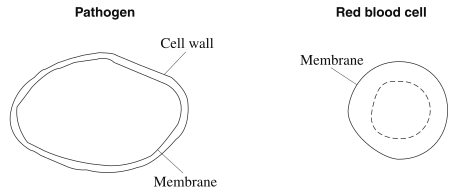
A pathogen and a red blood cell are drawn to the same scale, with some features indicated.
 

What type of pathogen is this?

  1. A virus
  2. A prion
  3. A fungus
  4. A bacterium
Show Answers Only

`C`

Show Worked Solution
  • Pathogen structure and size are indicative of a fungus.

`=>C`


♦♦♦ Mean mark 27%.

Filed Under: Causes of Infectious Disease Tagged With: Band 6, smc-3655-10-Classifying Pathogens

BIOLOGY, M7 2019 HSC 33d

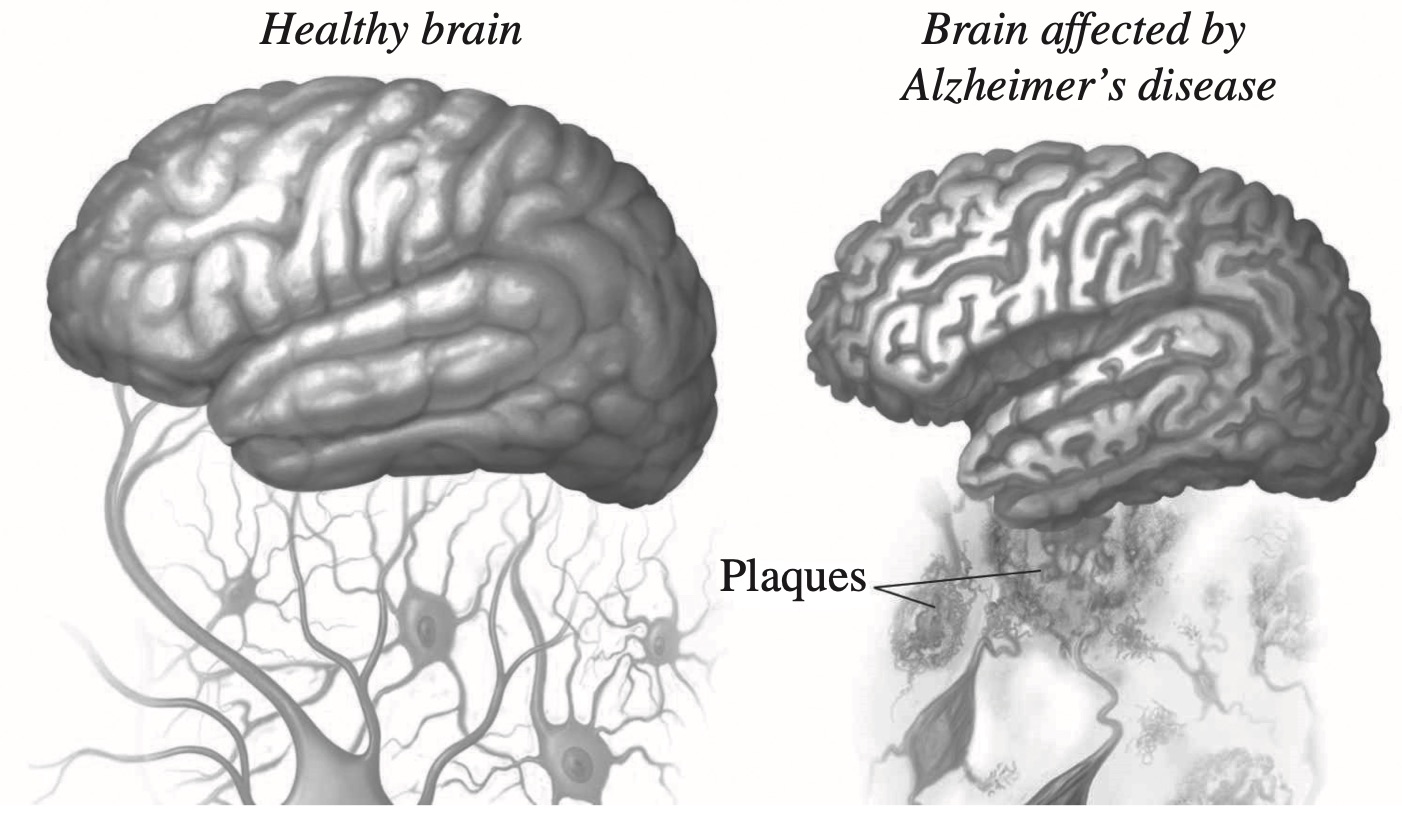
Alzheimer's disease causes destruction of brain tissue, dementia and eventually death.

The diagram shows the effect of Alzheimer's disease on the brain.

Amyloid beta protein is produced in the human brain throughout life. In people with Alzheimer's disease, it accumulates in excessive amounts.

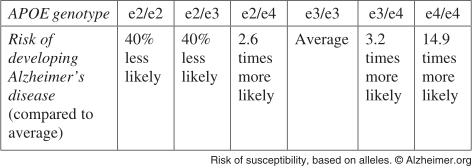
The gene with the greatest known effect on the risk of developing late-onset Alzheimer's disease is called APOE. It is found on chromosome 19.

The APOE gene has multiple alleles, including e2, e3 and e4 .

The table shows the risk of developing Alzheimer's disease for various APOE genotypes compared to average risk in the population.


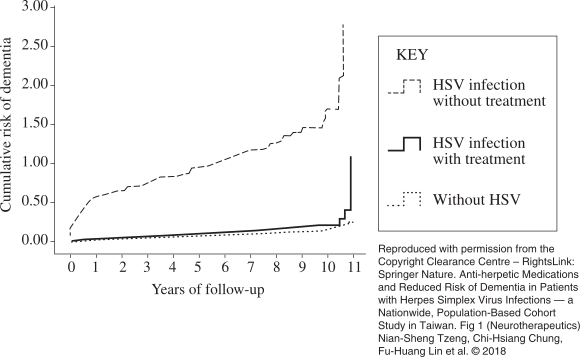
A large epidemiological study was conducted. It used historical data to investigate the association between Herpes simplex virus (HSV) infection and dementia. Dementia is caused by a variety of brain illnesses. Alzheimer's disease is the most common cause of dementia.

The study used the records of 8362 patients with HSV infection and 25086 randomly selected sex- and age-matched control patients without HSV infection. Some of the patients with HSV had been treated with antiviral medication.

The graph below shows some results of the study.
 

Diseases are classified as infectious or non-infectious.

Evaluate whether Alzheimer's disease should be classified as an infectious disease or a non-infectious disease. In your answer, include reference to the information and data provided above.   (8 marks)

--- 18 WORK AREA LINES (style=lined) ---

Show Answers Only

Infectious vs non-infection disease classification

  • Infectious diseases are a result of pathogens, biological agents of disease, which transmit disease between hosts. A pathogen is a cause of a certain disease if it meets the criteria in Koch’s postulates.
  • The study above shows the association between HSV and Alzheimer’s.
  • The study is conducted over a long period and includes a large and controlled sample size, so the assumption can be made that the findings are valid.
  • HSV is an infectious disease as it is caused by a pathogen, the virus Herpes simplex.
  • The findings show that treating HSV with antiviral medication also reduces the risk of developing Alzheimer’s.
  • This may mean that Alzheimer’s is also a virus and therefore an infectious disease. 
  • Non-infectious diseases are not contagious and do not spread from person to person. They are a result of environmental factors or genetic conditions.
  • Alzheimer’s is the result of a build-up of the amyloid beta protein, which is produced in the brain.
  • The synthesis of this protein is regulated by the APOE gene. This gene also has various alleles, each of which in different combinations can increase or decrease a individual’s risk of developing Alzheimer’s.
  • This indicates that Alzheimer’s is a non-infectious disease, as it is not transmitted by a pathogen. Rather, it results from a natural build up of a specific protein, which may be accelerated or reduced based on genotype. 

Conclusion

  • From the information provided it is not possible to accurately classify Alzheimer’s as either an infectious or non-infectious disease.
  • There is evidence to support that the risk of developing Alzheimer’s can be linked to both antiviral and virus traits as well as genotype.
Show Worked Solution

Infectious vs non-infection disease classification

  • Infectious diseases are a result of pathogens, biological agents of disease, which transmit disease between hosts. A pathogen is a cause of a certain disease if it meets the criteria in Koch’s postulates.
  • The study above shows the association between HSV and Alzheimer’s.
  • The study is conducted over a long period and includes a large and controlled sample size, so the assumption can be made that the findings are valid.
  • HSV is an infectious disease as it is caused by a pathogen, the virus Herpes simplex.
  • The findings show that treating HSV with antiviral medication also reduces the risk of developing Alzheimer’s.
  • This may mean that Alzheimer’s is also a virus and therefore an infectious disease. 
  • Non-infectious diseases are not contagious and do not spread from person to person. They are a result of environmental factors or genetic conditions.
  • Alzheimer’s is the result of a build-up of the amyloid beta protein, which is produced in the brain.
  • The synthesis of this protein is regulated by the APOE gene. This gene also has various alleles, each of which in different combinations can increase or decrease a individual’s risk of developing Alzheimer’s.
  • This indicates that Alzheimer’s is a non-infectious disease, as it is not transmitted by a pathogen. Rather, it results from a natural build up of a specific protein, which may be accelerated or reduced based on genotype. 

Conclusion

  • From the information provided it is not possible to accurately classify Alzheimer’s as either an infectious or non-infectious disease.
  • There is evidence to support that the risk of developing Alzheimer’s can be linked to both antiviral and virus traits as well as genotype.

♦♦ Mean mark 46%.

Filed Under: Causes and Effects, Causes of Infectious Disease, Epidemiology Tagged With: Band 5, Band 6, smc-3655-10-Classifying Pathogens, smc-3660-20-Genetic/Cancer, smc-3661-10-Analysing Results

BIOLOGY, M8 2019 HSC 1 MC

Which of the following is an example of a non-infectious disease?

  1. Polio caused by a virus
  2. Cholera caused by a bacterium
  3. Wheat rust caused by a fungus
  4. Haemophilia caused by a gene mutation
Show Answers Only

`D`

Show Worked Solution
  • Virus, bacteria and fungi are all pathogens; disease carriers which can be transmitted between hosts.
  • Gene mutations are changes in DNA and cannot be transmitted to others by contact or vectors.

`=>D`

Filed Under: Causes and Effects, Causes of Infectious Disease Tagged With: Band 2, smc-3655-10-Classifying Pathogens, smc-3660-20-Genetic/Cancer

BIOLOGY, M7 2022 HSC 21b

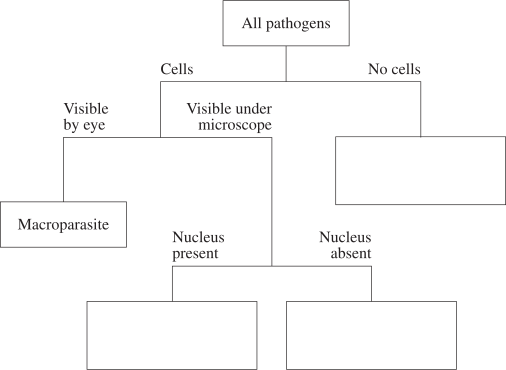
The following key can be used to classify some pathogens.

Complete each empty box with an appropriate pathogen.  (3 marks)


--- 0 WORK AREA LINES (style=lined) ---

Show Answers Only

Show Worked Solution


♦ Mean mark 47%.

Filed Under: Causes of Infectious Disease Tagged With: Band 5, smc-3655-10-Classifying Pathogens

BIOLOGY, M7 2020 HSC 4 MC

Malaria is a disease in humans caused by a single-celled Plasmodium species. It is transmitted by female mosquitoes.

Which of the following is true for malaria?

  1. Both Plasmodium and the mosquito are vectors
  2. Both Plasmodium and the mosquito are pathogens
  3. The mosquito is the vector and Plasmodium is the pathogen
  4. The mosquito is the pathogen and Plasmodium is the vector
Show Answers Only

`C`

Show Worked Solution
  • The Plasmodium is the pathogen that causes malaria disease, while the mosquito transmits the pathogen and is therefore the vector.

`=>C`

Filed Under: Causes of Infectious Disease Tagged With: Band 2, smc-3655-10-Classifying Pathogens, smc-3655-30-Vectors

BIOLOGY, M7 2021 HSC 14 MC

The human PRNP gene codes for the prion protein. Misfolding of this protein may be the result of ingesting tissue that contains misfolded prion protein or a mutation. Accumulation of misfolded prion protein causes serious diseases such as Creutzfeldt-Jakob disease (CJD).

Which of the following statements best classifies CJD?

  1. It is both a genetic disease and an infectious disease.
  2. It is a genetic disease only, since it is encoded by a gene.
  3. It is not an infectious disease because the prion is non-cellular.
  4. It is an infectious disease and the normal prion protein is the pathogen.
Show Answers Only

`A`

Show Worked Solution
  • Infectious, as CJD can be caused by an infectious agent, i.e. ingesting tissue that contains the misfolded protein.
  • Genetic, as CJD can be caused by mutation.

`=>A`

♦♦ Mean mark 39%.

Filed Under: Causes of Infectious Disease Tagged With: Band 5, smc-3655-10-Classifying Pathogens

BIOLOGY, M7 2021 HSC 21

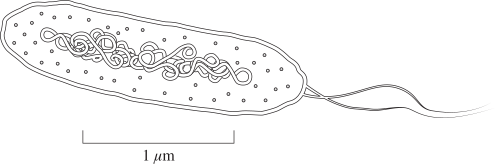
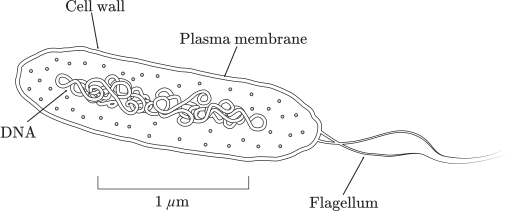
  1. Label TWO features on the diagram below that would help to classify this pathogen as a bacterium.   (2 marks)


  2. A scientist followed Koch's postulates to confirm that this bacterium was causing diarrhoea in pigs on a local farm. 
  3. Complete the boxes in the flowchart provided to show the steps taken by the scientist.    (2 marks)


  4.  
  5. Two pig farmers on neighbouring farms noticed that their pigs were suffering from diarrhoea and gradually losing weight. The farmers each adopted a different strategy to deal with this disease, as shown in the table.  

\begin{array} {|c|l|l|}
\hline
\rule{0pt}{2.5ex} \quad \textit{Farm} \quad \rule[-1ex]{0pt}{0pt} & \quad\quad\quad \quad \textit{Strategy} & \quad\quad\quad \quad \textit{Result}\\
\hline
\rule{0pt}{2.5ex} 1  & \text{Treatment with antibiotics} & \text{All pigs recovered after two}\\
\rule[-1ex]{0pt}{0pt} & \text{} & \text{weeks}\\
\hline
\rule{0pt}{2.5ex} 2  & \text{Elimination of rats and mice} & \text{Decrease in number of sick}\\
& \text{from pig sheds to improve} & \text{animals over three months}\\
\rule[-1ex]{0pt}{0pt} & \text{hygiene} & \\
\hline
\end{array}

Outline ONE benefit and ONE limitation of the strategies used on each farm.   (3 marks)

--- 6 WORK AREA LINES (style=lined) ---

Show Answers Only

a.    Include two of the following labels:


b.    Box 2: Bacteria grown in pure culture and identified.

Box 4: Healthy pig became ill with diarrhoea. 

c.   Benefits and Limitations of the strategies used on each farm.

  • The use of antibiotics on farm 1 has resulted in a rapid elimination of diarrhoea cases, however may induce antibiotic resistance in the
    future, rendering the strategy less effective.
  • The removal of rats and mice from pig sheds to increase hygiene on farm 2 is slow to eliminate diarrhoea cases, however provides reassurance to prevent future outbreaks. 

Other correct answers:

  • Proper hygiene practices can reduce incidence of other diseases, not just diarrhoea.
Show Worked Solution

a.    Include two of the following labels:


b.    Box 2: Bacteria grown in pure culture and identified.

Box 4: Healthy pig became ill with diarrhoea. 
 

c.   Benefits and Limitations of the strategies used on each farm.

  • The use of antibiotics on farm 1 has resulted in a rapid elimination of diarrhoea cases, however may induce antibiotic resistance in the
    future, rendering the strategy less effective.
  • The removal of rats and mice from pig sheds to increase hygiene on farm 2 is slow to eliminate diarrhoea cases, however provides reassurance to prevent future outbreaks. 

Other correct answers:

  • Proper hygiene practices can reduce incidence of other diseases, not just diarrhoea.

Filed Under: Causes of Infectious Disease, Prevention, Treatment and Control Tagged With: Band 3, Band 4, smc-3655-10-Classifying Pathogens, smc-3655-70-Robert Koch, smc-3658-30-Procedures to Prevent Spread

Copyright © 2014–2025 SmarterEd.com.au · Log in