SmarterEd

Aussie Maths & Science Teachers: Save your time with SmarterEd

  • Login
  • Get Help
  • About

Data Analysis, GEN1 2024 NHT 2 MC

The variables exercise type (aerobic, boxing, circuit) and recovery time (short, medium, long) are

  1. a nominal variable and a numerical variable respectively.
  2. a nominal variable and an ordinal variable respectively.
  3. an ordinal variable and a nominal variable respectively.
  4. both ordinal variables.
  5. both nominal variables.
Show Answers Only

\(B\)

Show Worked Solution

\(\text{Exercise type is nominal → no ranking}\)

\(\text{Recovery time is ordinal → categories that can be ranked}\)

\(\Rightarrow B\)

Filed Under: Summary Statistics Tagged With: Band 3, smc-468-10-Data Classification

Data Analysis, GEN1 2024 VCAA 2 MC

Freddie organised a function at work. He surveyed the staff about their preferences.

He asked them about their payment preference (cash or electronic payment) and their budget preference (less than $50 or more than $50).

The variables in this survey, payment preference and budget preference, are

  1. both categorical variables.
  2. both numerical variables.
  3. categorical and numerical variables, respectively.
  4. numerical and categorical variables, respectively.
Show Answers Only

\(A\)

Show Worked Solution

\(\text{Payment preference is categorical.}\)

\(\text{Budget preference contains numbers, however, it cannot be}\)

\(\text{quantified, therefore it is also categorical.}\)

\(\Rightarrow A\)

Filed Under: Summary Statistics Tagged With: Band 3, smc-468-10-Data Classification

Data Analysis, GEN1 2022 VCAA 9-11 MC

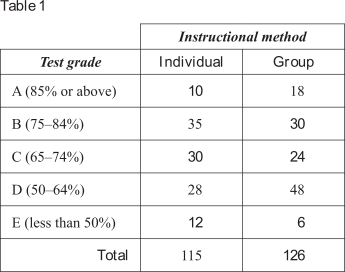
Table 1 summarises the results of a study that compared the effectiveness of individual and group instruction (instructional method) when training future basketball referees.
 

In this table, test grade is the response variable and instructional method is the explanatory variable.
 

Question 9

The variables test grade (A, B, C, D, E) and instructional method (individual, group) are

  1. a numerical and a categorical variable respectively.
  2. both nominal variables.
  3. a nominal and an ordinal variable respectively.
  4. both ordinal variables.
  5. an ordinal and a nominal variable respectively.

 
Question 10

Of the students who received an A grade, the percentage who were instructed individually is closest to

  1. 9%
  2. 22%
  3. 36%
  4. 56%
  5. 64%

 
Question 11

To become a qualified referee, a grade of A or B on the test is required. Those who receive a C, a D or an E will not qualify.

Using column percentages, a new two-way percentage frequency table is constructed from the data in Table 1.

In this new table, qualified to be a referee (yes, no) is the response variable and instructional method (individual, group) is the explanatory variable.

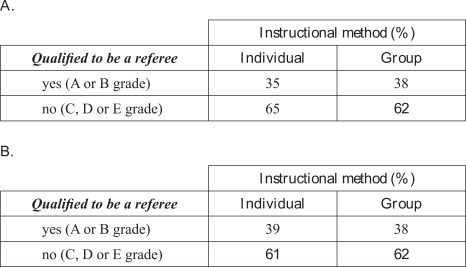
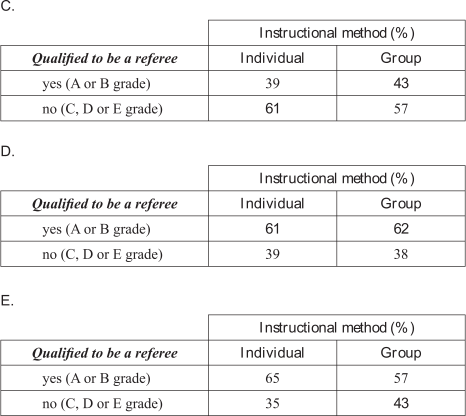
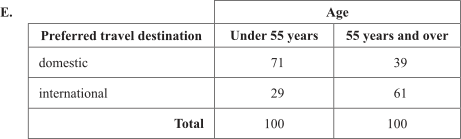
Which one of the following tables correctly displays the data from Table 1?
 

Show Answers Only

\(\text{Question 9:} \ E\)

\(\text{Question 10:} \ C\)

\(\text{Question 11:} \ B\)

Show Worked Solution

\(\text{Question 9} \)

\(\text{Both variables are categorical.}\)

\(\text{Test grade (A, B, C, D, E) → ordinal, as they can be ranked.}\)

\(\text{Instructional method → nominal, has no ranking.}\)

\(\Rightarrow E\)
 

\(\text{Question 10} \)

\(\text{Students who received an A}\ =10+18 = 28 \)

\(\text{% instructed individually}\ = \dfrac{10}{28} \times 100 = 35.714…\% \)

\(\Rightarrow C\)
 

Mean mark (Q10) 56%.

\(\text{Question 11} \)

\(\text{yes (A or B):} \)

\(\text{Individual}\ =\dfrac{10+35}{115} \times 100 \approx 39\% \)

\(\text{Group}\ = \dfrac{18+30}{126} \times 100 \approx 38\% \)
 

\(\text{no (C, D or E):} \)

\(\text{Individual}\ = 100-39 \approx 61\% \)

\(\text{Group}\ = 100-38 \approx 62\% \)

\(\Rightarrow B\)

Filed Under: Summary Statistics Tagged With: Band 3, Band 4, smc-468-10-Data Classification, smc-468-60-Two-way freq tables

CORE, FUR1 2021 VCAA 1-3 MC

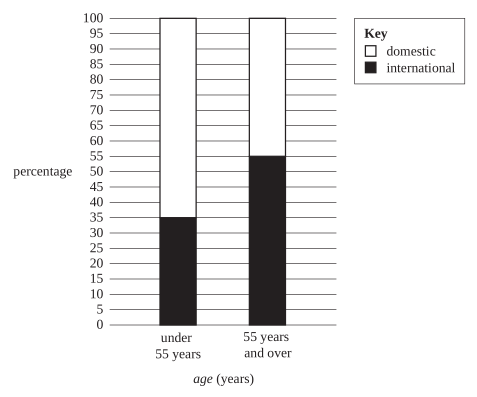
The percentaged segmented bar chart below shows the age (under 55 years, 55 years and over) of visitors at a travel convention, segmented by preferred travel destination (domestic, international).
 

Part 1

The variables age (under 55 years, 55 years and over) and preferred travel destination (domestic, international) are

  1. both categorial variables.
  2. both numerical variables.
  3. a numerical variable and a categorical variable respectively.
  4. a categorical variable and a numerical variable respectively.
  5. a discrete variable and a continuous variable respectively.

 
Part 2

The data displayed in the percentaged segmented bar chart supports the contention that there is an association between preferred travel destination and age because

  1. more visitors favour international travel.
  2. 35% of visitors under 55 years favour international travel.
  3. 45% of visitors 55 years and over favour domestic travel.
  4. 65% of visitors under 55 years favour domestic travel while 45% of visitors 55 years and over favour domestic travel.
  5. the percentage of visitors who prefer domestic travel is greater than the percentage of visitors who prefer international travel.

 
Part 3

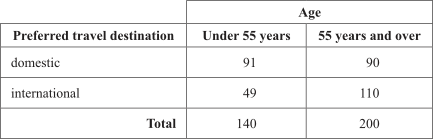
The results could also be summarised in a two-way frequency table.

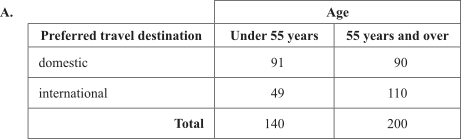
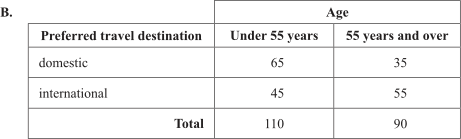
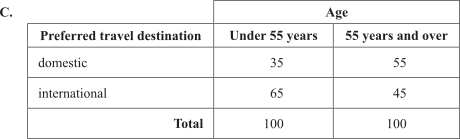
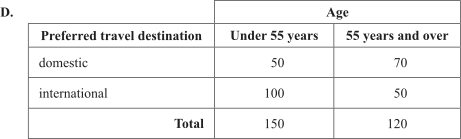
Which one of the following frequency tables could match the pecentaged segmented bar chart?


Show Answers Only

`text(Part 1:)\ A`

`text(Part 2:)\ D `

`text(Part 3:)\ A`

Show Worked Solution

`text(Part 1)`

`text{Preferred travel destination → categorical (nominal) variable}`

`text{Age → categorical (ordinal) variable}`

`=> A`
 

`text(Part 2)`

`text(Only option)\ D\ text(highlights a change in preference for domestic travel)`

`text(between the two age categories.)`

`=>D` 

 
`text(Part 3)`

♦ Mean mark 50%.

`text(Converting the frequency table data into percentages,)`

`text(consider option)\ A:`

`91/140 xx 100 = 65text(%),\ \ 49/140 xx 100 = 35text(%)`

`90/200 xx 100 = 45text(%), \ \ 110/200 xx 100 = 55text(%)`

`=> A`

Filed Under: Graphs - Histograms and Other, Summary Statistics Tagged With: Band 3, Band 4, Band 5, smc-468-10-Data Classification, smc-644-40-Segmented Bar Charts

CORE, FUR1 2020 VCAA 10-12 MC

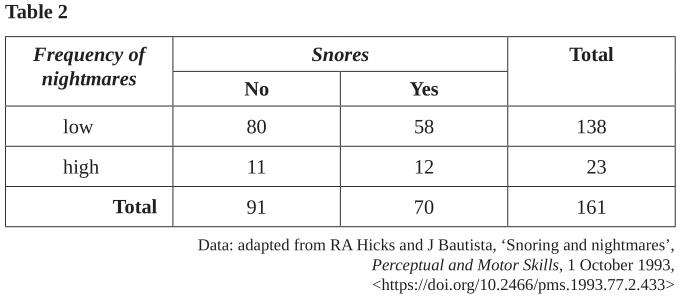
The data in Table 2 was collected in a study of the association between the variables frequency of nightmares (low, high) and snores (no, yes).


Part 1

The variables in this study, frequency of nightmares (low, high) and snores (no, yes), are

  1. ordinal and nominal respectively.
  2. nominal and ordinal respectively.
  3. both numerical.
  4. both ordinal.
  5. both nominal.

 
Part 2

The percentage of participants in the study who did not snore is closest to

  1. 42.0%
  2. 43.5%
  3. 49.7%
  4. 52.2%
  5. 56.5%

 
Part 3

Of those people in the study who did snore, the percentage who have a high frequency of nightmares is closest to

  1.   7.5%
  2. 17.1%
  3. 47.8%
  4. 52.2%
  5. 58.0%
Show Answers Only

`text(Part 1:)\ A`

`text(Part 2:)\ E`

`text(Part 3:)\ B`

Show Worked Solution

Part 1

`text{frequency of nightmares (low, high) is ordinal.}`

`text{snores (no, yes) is nominal.}`

`=> A`
 

Part 2

`text(Percentage)` `= text(not snore)/text(total participants) xx 100`
  `= 91/161 xx 100`
  `= 56.5%`

`=> E`
 

Part 3

`text(Percentage)` `= text(High frequency and snore)/text(total who snore) xx 100`
  `= 12/70 xx 100`
  `= 17.1%`

`=> B`

Filed Under: Graphs - Histograms and Other, Summary Statistics Tagged With: Band 2, Band 4, smc-468-10-Data Classification, smc-644-50-Frequency Tables

CORE, FUR1 2020 VCAA 7 MC

Data relating to the following five variables was collected from insects that were caught overnight in a trap:

    • colour
    • name of species
    • number of wings
    • body length (in millimetres)
    • body weight (in milligrams)

The number of these variables that are discrete numerical variables is

  1. 1
  2. 2
  3. 3
  4. 4
  5. 5
Show Answers Only

`A`

Show Worked Solution

`text(Discrete numeral variables:)`

`text(number of wings only)`

`=>  A`

Filed Under: Summary Statistics Tagged With: Band 4, smc-468-10-Data Classification

Data Analysis, GEN2 2019 NHT 1

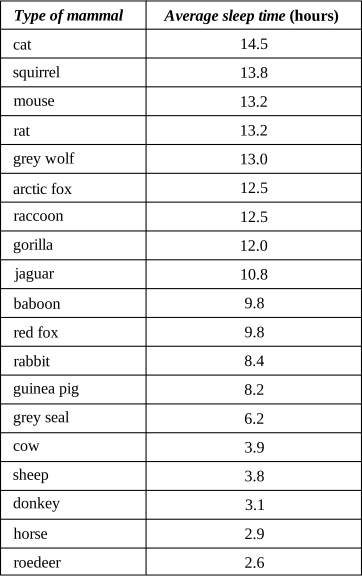
The table below displays the average sleep time, in hours, for a sample of 19 types of mammals.
 

  1. Which of the two variables, type of mammal or average sleep time, is a nominal variable?   (1 mark)

    --- 1 WORK AREA LINES (style=lined) ---

  2. Determine the mean and standard deviation of the variable average sleep time for this sample of mammals.
  3. Round your answer to one decimal place.   (1 mark)

    --- 2 WORK AREA LINES (style=lined) ---

  4. The average sleep time for a human is eight hours.
  5. What percentage of this sample of mammals has an average sleep time that is less than the average sleep time for a human.
  6. Round your answer to one decimal place.   (1 mark)

    --- 2 WORK AREA LINES (style=lined) ---

  7. The sample is increase in size by adding in the average sleep time of the little brown bat.
  8. Its average sleep time is 19.9 hours.
  9. By how many many hours will the range for average sleep time increase when the average sleep time for the little brown bat is added to the sample?   (1 mark)

    --- 2 WORK AREA LINES (style=lined) ---

Show Answers Only
  1. `text(type of mammal)`
  2. `text(mean)= 9.2 \ text(hours)`


    `sigma = 4.2 \ text(hours)`

  3. `31.6text(%)`
  4. `5.4 \ text(hours)`
Show Worked Solution

a.    `text(type of mammal is nominal)`

 
b.    `text(mean)= 9.2 \ text(hours) \ \ text{(by CAS)}`

`sigma = 4.2 \ text(hours) \ \ text{(by CAS)}`
 

c.    `text(Percentage)` `= (6)/(19) xx 100`
  `= 0.3157 …`
  `= 31.6text(%)`


d.    `text(Range increase)` `= 19.9-14.5`
  `= 5.4 \ text(hours)`

Filed Under: Summary Statistics Tagged With: Band 2, Band 3, Band 4, page-break-before-question, smc-468-10-Data Classification, smc-468-20-Mean, smc-468-30-Std Dev, smc-468-40-Median Mode and Range

Data Analysis, GEN1 2019 NHT 8 MC

The variables recovery time after exercise (in minutes) and fitness level (below average, average, above average) are

  1. both numerical.
  2. both categorical.
  3. an ordinal variable and a nominal variable respectively.
  4. a numerical variable and a nominal variable respectively.
  5. a numerical variable and an ordinal variable respectively.
Show Answers Only

`E`

Show Worked Solution

`text{Recovery time in minutes → numerical variable}`

`text{Fitness level → ordinal (categories that can be ordered)}`

`=> E`

Filed Under: Summary Statistics Tagged With: Band 4, smc-468-10-Data Classification

CORE, FUR2 2018 VCAA 1


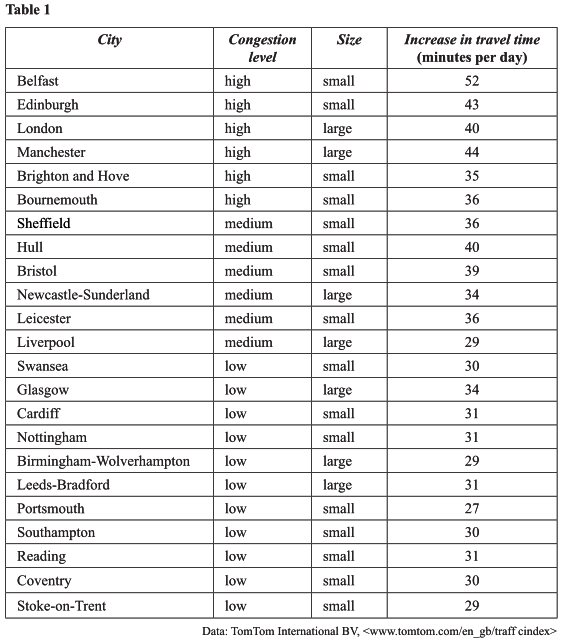
The data in Table 1 relates to the impact of traffic congestion in 2016 on travel times in 23 cities in the United Kingdom (UK).

The four variables in this data set are:

  • city — name of city
  • congestion level — traffic congestion level (high, medium, low)
  • size — size of city (large, small)
  • increase in travel time — increase in travel time due to traffic congestion (minutes per day).
  1. How many variables in this data set are categorical variables?  (1 mark)

    --- 1 WORK AREA LINES (style=lined) ---

  2. How many variables in this data set are ordinal variables  (1 mark)

    --- 1 WORK AREA LINES (style=lined) ---

  3. Name the large UK cities with a medium level of traffic congestion.  (1 mark)

    --- 1 WORK AREA LINES (style=lined) ---

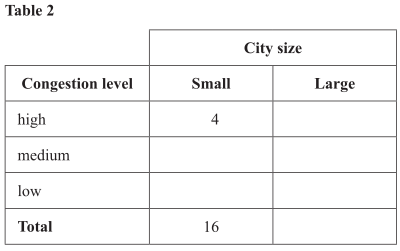
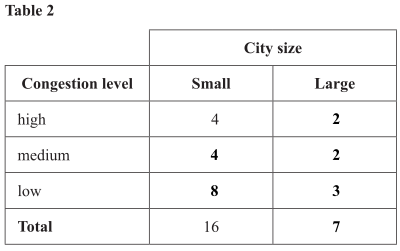
  4. Use the data in Table 1 to complete the following two-way frequency table, Table 2.  (2 marks)

    --- 0 WORK AREA LINES (style=lined) ---


  5. What percentage of the small cities have a high level of traffic congestion?  (1 mark)

    --- 3 WORK AREA LINES (style=lined) ---

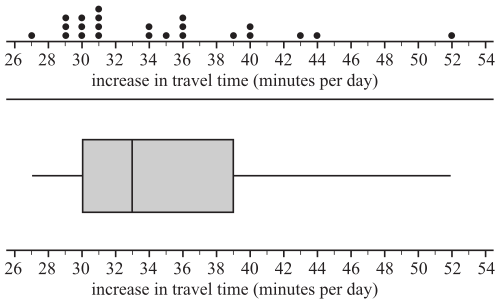
Traffic congestion can lead to an increase in travel times in cities. The dot plot and boxplot below both show the increase in travel time due to traffic congestion, in minutes per day, for the 23 UK cities.


  1. Describe the shape of the distribution of the increase in travel time for the 23 cities.  (1 mark)

    --- 1 WORK AREA LINES (style=lined) ---

  2. The data value 52 is below the upper fence and is not an outlier.
  3. Determine the value of the upper fence.  (1 mark)

    --- 3 WORK AREA LINES (style=lined) ---

Show Answers Only

  1. `3\ text(city, congestion level, size)`
  2. `2\ text(congestion level, size)`
  3. `text(Newcastle-Sunderland and Liverpool)`
  4. `text(See Worked Solutions)`
  5. `25 text(%)`
  6. `text(Positively skewed)`
  7. `52.5`

Show Worked Solution

a.   `3\-text(city, congestion level, size)`
 

b.   `2\-text(congestion level, size)`
 

c.   `text(Newcastle-Sunderland and Liverpool)`
 

d.   


e.    `text(Percentage)` `= text(Number of small cities high congestion)/text(Number of small cities) xx 100`
    `= 4/16 xx 100`
    `= 25 text(%)`

 
f.
   `text(Positively skewed)`


g.   `IQR = 39-30 = 9`
 

`text(Calculate the Upper Fence:)`

`Q_3 + 1.5 xx IQR` `= 39 + 1.5 xx 9`
  `= 52.5`

Filed Under: Graphs - Stem/Leaf and Boxplots, Summary Statistics Tagged With: Band 2, Band 3, Band 4, page-break-before-question, smc-468-10-Data Classification, smc-468-50-IQR / Outliers, smc-643-10-Single Box-Plots, smc-643-60-Outliers, smc-643-70-Distribution Description

CORE, FUR1 2017 VCAA 5-7 MC

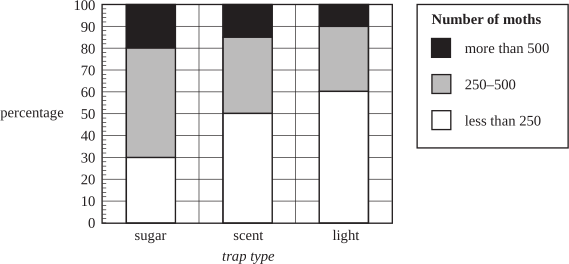
A study was conducted to investigate the association between the number of moths caught in a moth trap (less than 250, 250–500, more than 500) and the trap type (sugar, scent, light). The results are summarised in the percentaged segmented bar chart below.
 

Part 1

There were 300 sugar traps.

The number of sugar traps that caught less than 250 moths is closest to

  1. 30
  2. 90
  3. 250
  4. 300
  5. 500

 
Part 2

The data displayed in the percentaged segmented bar chart supports the contention that there is an association between the number of moths caught in a moth trap and the trap type because

  1. most of the light traps contained less than 250 moths.
  2. 15% of the scent traps contained 500 or more moths.
  3. the percentage of sugar traps containing more than 500 moths is greater than the percentage of scent traps containing less than 500 moths.
  4. 20% of sugar traps contained more than 500 moths while 50% of light traps contained less than 250 moths.
  5. 20% of sugar traps contained more than 500 moths while 10% of light traps contained more than 500 moths.

 
Part 3

The variables number of moths (less than 250, 250–500, more than 500) and trap type (sugar, scent, light) are

  1. both nominal variables.
  2. both ordinal variables.
  3. a numerical variable and a categorical variable respectively.
  4. a nominal variable and an ordinal variable respectively.
  5. an ordinal variable and a nominal variable respectively.
Show Answers Only

`text(Part 1:)\ B`

`text(Part 2:)\ E`

`text(Part 3:)\ E`

Show Worked Solution

`text(Part 1)`

`text(Sugar traps that caught < 250)`

`= 30text(%) xx 300`

`= 90`

`=> B`


`text(Part 2)`

`text(An association should compare different)`

`text(trap types against the same value of)`

`text(number of moths caught.)`

`=> E`


`text(Part 3)`

`text{Number of moths (grouped) – ordinal variable}`

`text(Trap type – nominal variable)`

`=> E`

Filed Under: Graphs - Histograms and Other, Summary Statistics Tagged With: Band 4, Band 5, smc-468-10-Data Classification, smc-644-40-Segmented Bar Charts

CORE, FUR1 2016 VCAA 1-2 MC

The blood pressure (low, normal, high) and the age (under 50 years, 50 years or over) of 110 adults were recorded. The results are displayed in the two-way frequency table below.


Part 1

The percentage of adults under 50 years of age who have high blood pressure is closest to

  1.  11%
  2.  19%
  3.  26%
  4.  44%
  5.  58%

Part 2

The variables blood pressure (low, normal, high) and age (under 50 years, 50 years or over) are

  1. both nominal variables.
  2. both ordinal variables.
  3. a nominal variable and an ordinal variable respectively.
  4. an ordinal variable and a nominal variable respectively.
  5. a continuous variable and an ordinal variable respectively.
Show Answers Only

`text(Part 1:)\ B`

`text(Part 2:)\ B`

Show Worked Solution

`text(Part 1)`

`text(Percentage)` `= text(Under 50 with high BP)/text(Total under 50)`
  `= 11/58`
  `~~ 19text(%)`

 
`=> B`


`text(Part 2)`

♦♦ Mean mark of Part 2: 31%.
MARKER’S COMMENT: Many students incorrectly identified the age (under 50, 50 or over) as nominal.

`text(Blood pressure is an ordinal variable)`

`text(because it is categorical data that can)`

`text(have an order.)`

`text(Under 50 and over 50, likewise, is an)`

`text(ordinal variable.)`

`=> B`

Filed Under: Summary Statistics Tagged With: Band 3, Band 5, smc-468-10-Data Classification

CORE, FUR1 2011 VCAA 4 MC

The variables

region (city, urban, rural)

population density (number of people per square kilometre)

A.  are both categorical.

B.   are both numerical. 

C.   are categorical and numerical respectively.

D.   are numerical and categorical respectively.

E.   are neither categorical nor numerical.

Show Answers Only

`C`

Show Worked Solution

`text(Region is a categorical variable and population)`

`text{density is a numerical variable (i.e. it can be}`

`text{represented by quantifiable numbers).}`

`=>  C`

Filed Under: Summary Statistics Tagged With: Band 2, smc-468-10-Data Classification

CORE, FUR1 2014 VCAA 3-5 MC

The following table shows the data collected from a sample of seven drivers who entered a supermarket car park. The variables in the table are:

distance – the distance that each driver travelled to the supermarket from their home
 

    • sex – the sex of the driver (female, male)
    • number of children – the number of children in the car
    • type of car – the type of car (sedan, wagon, other)
    • postcode – the postcode of the driver’s home.
       

Part 1

The mean,  `barx`, and the standard deviation, `s_x`, of the variable, distance, are closest to

A.  `barx = 2.5\ \ \ \ \ \ \s_x = 3.3`

B.  `barx = 2.8\ \ \ \ \ \ \s_x = 1.7`

C.  `barx = 2.8\ \ \ \ \ \ \s_x = 1.8`

D.  `barx = 2.9\ \ \ \ \ \ \s_x = 1.7`

E.  `barx = 3.3\ \ \ \ \ \ \s_x = 2.5`


Part 2

The number of categorical variables in this data set is

A.  `0`

B.  `1`

C.  `2`

D.  `3`

E.  `4`


Part 3

The number of female drivers with three children in the car is

A.  `0`

B.  `1`

C.  `2`

D.  `3`

E.  `4`


Show Answers Only

`text(Part 1:) \ C`

`text(Part 2:)\ D`

`text(Part 3:)\ B`

Show Worked Solution

`text(Part 1)`

`text(By calculator)`

`text(Distance)\ \ barx` `=2.8`
`s_x` `≈1.822`

 
`=>C`


`text(Part 2)`

♦♦ Mean mark 29%.
MARKER’S NOTE: Postcodes here are categorical variables. Ask yourself “Does it make sense to calculate the mean of this variable?” If the answer is “No”, the variable is categorical.

`text(Categorical variables are sex, type)`

`text(of car, and post code.)`

`=>D`


`text(Part 3)`

`text(1 female driver has 3 children.)`

`=>B`

Filed Under: Summary Statistics Tagged With: Band 2, Band 3, Band 6, smc-468-10-Data Classification, smc-468-20-Mean, smc-468-30-Std Dev

Copyright © 2014–2025 SmarterEd.com.au · Log in