SmarterEd

Aussie Maths & Science Teachers: Save your time with SmarterEd

  • Login
  • Get Help
  • About

HMS, HAG EQ-Bank 121

Recent epidemiological data shows that Australian life expectancy decreased for the first time since the mid-1900s during 2020-2022, while simultaneously showing that males experience higher total disease burden than females across most age groups.

Explain how this data reflects current challenges in Australian population health.   (5 marks)

--- 15 WORK AREA LINES (style=lined) ---

Show Answers Only
  • The decrease in life expectancy during 2020-2022 demonstrates that infectious diseases can still significantly impact population health, as evidenced by COVID-19 becoming the third leading cause of death and disrupting decades of steady improvement.
  • This reveals that Australia’s health system faced unprecedented challenges during the pandemic, resulting in increased mortality from both COVID-19 infections and other causes due to delayed medical treatments and healthcare service disruptions.
  • The higher disease burden experienced by males across most age groups indicates that persistent gender-based health inequities remain unresolved, reflecting significant differences in health-seeking behaviours, workplace risk exposures and lifestyle choices.
  • This pattern shows that males are more likely to experience fatal burden from preventable conditions like cardiovascular disease and intentional injuries, while females experience more non-fatal burden from anxiety disorders and chronic musculoskeletal conditions.
  • The combination of these contrasting trends demonstrates that Australian population health faces both emerging infectious disease threats and entrenched chronic disease inequities that require comprehensive, multi-faceted public health interventions and targeted prevention strategies.
Show Worked Solution
  • The decrease in life expectancy during 2020-2022 demonstrates that infectious diseases can still significantly impact population health, as evidenced by COVID-19 becoming the third leading cause of death and disrupting decades of steady improvement.
  • This reveals that Australia’s health system faced unprecedented challenges during the pandemic, resulting in increased mortality from both COVID-19 infections and other causes due to delayed medical treatments and healthcare service disruptions.
  • The higher disease burden experienced by males across most age groups indicates that persistent gender-based health inequities remain unresolved, reflecting significant differences in health-seeking behaviours, workplace risk exposures and lifestyle choices.
  • This pattern shows that males are more likely to experience fatal burden from preventable conditions like cardiovascular disease and intentional injuries, while females experience more non-fatal burden from anxiety disorders and chronic musculoskeletal conditions.
  • The combination of these contrasting trends demonstrates that Australian population health faces both emerging infectious disease threats and entrenched chronic disease inequities that require comprehensive, multi-faceted public health interventions and targeted prevention strategies.

Filed Under: Current Health Status Tagged With: Band 4, smc-5474-20-Life Expectancy and Trends, smc-5474-30-Gender Inequities, smc-5474-50-Data Interpretation

HMS, HAG EQ-Bank 116

Evaluate the effectiveness of women-centred healthcare approaches in addressing systemic health inequities experienced by Australian females.   (8 marks)

--- 24 WORK AREA LINES (style=lined) ---

Show Answers Only

Evaluation Statement

  • Women-centred healthcare approaches demonstrate moderate effectiveness in addressing systemic health inequities.
  • They show strong potential in specialised care delivery but limited impact on broader structural healthcare barriers.

Specialised Care Delivery

  • Women-centred approaches strongly meet the criterion of addressing gender-specific health needs through integrated care models.
  • Specialised women’s health clinics effectively provide comprehensive services for reproductive health, mental health and chronic conditions like endometriosis within single locations.
  • Evidence supporting this includes improved diagnosis rates for conditions traditionally misunderstood in women, such as cardiovascular disease presentations.
  • This approach demonstrates significant value in recognising biological and social differences that influence female health outcomes, particularly during life transitions like menopause and pregnancy.

Structural Healthcare Reform

  • Healthcare system reform shows limited effectiveness in addressing unconscious bias and research gaps that contribute to female health inequities.
  • While training programs aim to reduce diagnostic delays and inappropriate prescribing, systemic issues persist in medical education and research funding priorities.
  • The approach partially fulfils comprehensive reform requirements, as individual clinic initiatives cannot address broader problems like inadequate representation in clinical trials.
  • Evidence indicates that women continue experiencing delayed diagnoses and symptom dismissal despite localised improvements in women-centred services.

Final Evaluation

  • Women-centred healthcare approaches achieve meaningful improvements in direct service delivery but prove insufficient for systemic reform.
  • The effectiveness remains moderate because broader healthcare inequities require policy-level interventions beyond individual clinic models.
Show Worked Solution

Evaluation Statement

  • Women-centred healthcare approaches demonstrate moderate effectiveness in addressing systemic health inequities.
  • They show strong potential in specialised care delivery but limited impact on broader structural healthcare barriers.

Specialised Care Delivery

  • Women-centred approaches strongly meet the criterion of addressing gender-specific health needs through integrated care models.
  • Specialised women’s health clinics effectively provide comprehensive services for reproductive health, mental health and chronic conditions like endometriosis within single locations.
  • Evidence supporting this includes improved diagnosis rates for conditions traditionally misunderstood in women, such as cardiovascular disease presentations.
  • This approach demonstrates significant value in recognising biological and social differences that influence female health outcomes, particularly during life transitions like menopause and pregnancy.

Structural Healthcare Reform

  • Healthcare system reform shows limited effectiveness in addressing unconscious bias and research gaps that contribute to female health inequities.
  • While training programs aim to reduce diagnostic delays and inappropriate prescribing, systemic issues persist in medical education and research funding priorities.
  • The approach partially fulfils comprehensive reform requirements, as individual clinic initiatives cannot address broader problems like inadequate representation in clinical trials.
  • Evidence indicates that women continue experiencing delayed diagnoses and symptom dismissal despite localised improvements in women-centred services.

Final Evaluation

  • Women-centred healthcare approaches achieve meaningful improvements in direct service delivery but prove insufficient for systemic reform.
  • The effectiveness remains moderate because broader healthcare inequities require policy-level interventions beyond individual clinic models.

Filed Under: Current Health Status Tagged With: Band 6, smc-5474-30-Gender Inequities

HMS, HAG EQ-Bank 115

Explain how targeted healthcare interventions could reduce health inequities experienced by Australian males.   (5 marks)

--- 15 WORK AREA LINES (style=lined) ---

Show Answers Only
  • Targeted healthcare interventions can reduce male health inequities because they address specific barriers that prevent men from accessing timely healthcare services.
  • This works by implementing male-friendly clinics with flexible hours and drop-in services that eliminate cultural barriers to healthcare seeking, resulting in earlier detection and treatment of conditions.
  • Regular health screening programs specifically designed for men can identify cardiovascular disease, diabetes and mental health disorders before they progress to serious stages, which prevents late diagnosis and treatment.
  • Health promotion campaigns that target male audiences help improve health literacy and awareness about risk factors such as tobacco use, poor diet and physical inactivity, encouraging protective health behaviours.
  • This approach works because it addresses the underlying causes of male health inequities by making healthcare more accessible and culturally appropriate for men’s needs and preferences.
  • Therefore, targeted interventions can significantly reduce the premature mortality rates experienced by males compared to females by addressing both access barriers and behavioural risk factors.
Show Worked Solution
  • Targeted healthcare interventions can reduce male health inequities because they address specific barriers that prevent men from accessing timely healthcare services.
  • This works by implementing male-friendly clinics with flexible hours and drop-in services that eliminate cultural barriers to healthcare seeking, resulting in earlier detection and treatment of conditions.
  • Regular health screening programs specifically designed for men can identify cardiovascular disease, diabetes and mental health disorders before they progress to serious stages, which prevents late diagnosis and treatment.
  • Health promotion campaigns that target male audiences help improve health literacy and awareness about risk factors such as tobacco use, poor diet and physical inactivity, encouraging protective health behaviours.
  • This approach works because it addresses the underlying causes of male health inequities by making healthcare more accessible and culturally appropriate for men’s needs and preferences.
  • Therefore, targeted interventions can significantly reduce the premature mortality rates experienced by males compared to females by addressing both access barriers and behavioural risk factors.

Filed Under: Current Health Status Tagged With: Band 4, smc-5474-30-Gender Inequities

HMS, HAG EQ-Bank 114

Describe the main health inequities that exist between males and females in Australia.   (4 marks)

--- 12 WORK AREA LINES (style=lined) ---

Show Answers Only
  • Males experience higher rates of premature death compared to females, with life expectancy differences of approximately four years at birth.
  • The leading causes of death differ between genders, with coronary heart disease being the primary cause for males while dementia is the leading cause for females.
  • Males are more likely to engage in risky health behaviours and delay seeking healthcare services. This contributes to late diagnosis and treatment of conditions such as cardiovascular disease and mental health disorders.
  • Females experience higher rates of mental health conditions, particularly anxiety disorders, and are more likely to live with chronic conditions for longer periods despite having greater life expectancy.
  • Males face higher rates of fatal burden from injuries and suicide, while females experience more non-fatal burden from musculoskeletal and mental health conditions.
  • Healthcare access patterns differ, with males often waiting longer than acceptable to make GP appointments, while females are more likely to seek timely medical care.
Show Worked Solution
  • Males experience higher rates of premature death compared to females, with life expectancy differences of approximately four years at birth.
  • The leading causes of death differ between genders, with coronary heart disease being the primary cause for males while dementia is the leading cause for females.
  • Males are more likely to engage in risky health behaviours and delay seeking healthcare services. This contributes to late diagnosis and treatment of conditions such as cardiovascular disease and mental health disorders.
  • Females experience higher rates of mental health conditions, particularly anxiety disorders, and are more likely to live with chronic conditions for longer periods despite having greater life expectancy.
  • Males face higher rates of fatal burden from injuries and suicide, while females experience more non-fatal burden from musculoskeletal and mental health conditions.
  • Healthcare access patterns differ, with males often waiting longer than acceptable to make GP appointments, while females are more likely to seek timely medical care.

Filed Under: Current Health Status Tagged With: Band 3, smc-5474-30-Gender Inequities

HMS, HAG EQ-Bank 112

Discuss the differences in major causes of disease burden between males and females in Australia.   (6 marks)

--- 18 WORK AREA LINES (style=lined) ---

Show Answers Only

Benefits for males

  • [P] Males experience coronary heart disease as their leading cause of disease burden.
  • [E] This occurs because males have higher rates of cardiovascular disease and suicide as primary burden contributors, reflecting lifestyle and behavioural risk factors.
  • [Ev] The leading causes for males include coronary heart disease, back pain and problems, and suicide and self-inflicted injuries, demonstrating more fatal burden patterns.
  • [L] Therefore, males experience higher total disease burden overall compared to females.

Challenges for females

  • [P] Females experience dementia and anxiety disorders as their leading causes of disease burden.
  • [E] This demonstrates that mental health conditions and neurological conditions are prominent burden contributors for females, contrasting with the cardiovascular focus seen in males.
  • [Ev] The leading causes for females include dementia, anxiety disorders and back pain problems, showing different patterns of non-fatal burden and longer-term chronic conditions.
  • [L] Consequently, females experience different types of disease burden that require distinct healthcare approaches and interventions.
Show Worked Solution

Benefits for males

  • [P] Males experience coronary heart disease as their leading cause of disease burden.
  • [E] This occurs because males have higher rates of cardiovascular disease and suicide as primary burden contributors, reflecting lifestyle and behavioural risk factors.
  • [Ev] The leading causes for males include coronary heart disease, back pain and problems, and suicide and self-inflicted injuries, demonstrating more fatal burden patterns.
  • [L] Therefore, males experience higher total disease burden overall compared to females.

Challenges for females

  • [P] Females experience dementia and anxiety disorders as their leading causes of disease burden.
  • [E] This demonstrates that mental health conditions and neurological conditions are prominent burden contributors for females, contrasting with the cardiovascular focus seen in males.
  • [Ev] The leading causes for females include dementia, anxiety disorders and back pain problems, showing different patterns of non-fatal burden and longer-term chronic conditions.
  • [L] Consequently, females experience different types of disease burden that require distinct healthcare approaches and interventions.

Filed Under: Current Health Status Tagged With: Band 5, smc-5474-10-Morbidity and Mortality, smc-5474-30-Gender Inequities

HMS, HAG EQ-Bank 6 MC

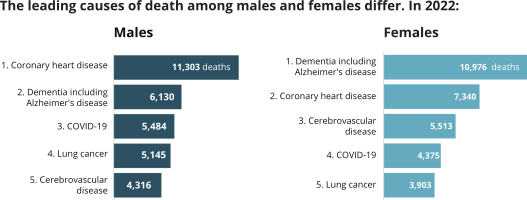
Based on Australia's Health 2024 mortality data, which statement BEST explains the pattern of leading causes of death between males and females in 2022?

  1. Males and females share identical top 5 causes of death in the same ranking order
  2. The same 5 conditions cause the most deaths but males have higher absolute numbers for coronary heart disease
  3. Infectious diseases rank higher for females than males in the top 5 causes
  4. Cancer-related deaths affect males significantly more than females across all types
Show Answers Only

\(B\)

Show Worked Solution
  • B is correct: Same 5 causes but males have 11,303 coronary deaths vs 10,976 females.

Other Options:

  • A is incorrect: Same causes but different ranking order between genders.
  • C is incorrect: COVID-19 ranks similarly for both genders.
  • D is incorrect: Lung cancer affects both genders in top 5.

Filed Under: Current Health Status Tagged With: Band 5, smc-5474-10-Morbidity and Mortality, smc-5474-30-Gender Inequities, smc-5474-50-Data Interpretation

HMS, HAG EQ-Bank 5 MC

According to Australia's Health 2024 data, which statement BEST describes the differences in leading causes of disease burden between males and females?

  1. Both males and females have identical leading causes of disease burden
  2. Males experience higher rates of anxiety disorders whilst females experience higher rates of suicide
  3. Coronary heart disease is the leading cause for males whilst dementia is the leading cause for females
  4. Back pain and problems affects females more than males across all age groups
Show Answers Only

\(C\)

Show Worked Solution
  • C is correct: Data shows coronary heart disease leads for males, dementia for females.

Other Options:

  • A is incorrect: Leading causes differ significantly between genders.
  • B is incorrect: Anxiety disorders lead for females, suicide for males.
  • D is incorrect: Back pain ranks similarly for both genders.

Filed Under: Current Health Status Tagged With: Band 4, smc-5474-10-Morbidity and Mortality, smc-5474-30-Gender Inequities

HMS, HAG 2013 HSC 10 MC

In Australia, men have a lower health status than women.

What is the most likely reason for this?

  1. Types of health care services available
  2. Unwillingness to seek medical assistance
  3. Heredity and lifestyle factors experienced in early life
  4. Lack of knowledge and understanding of health care services
Show Answers Only

\(B\)

Show Worked Solution
  • B is correct: Men typically delay seeking medical help for health issues.

Other Options:

  • A is incorrect: Healthcare services available equally to both genders.
  • C is incorrect: Heredity factors similar, lifestyle choices are behavioural responses.
  • D is incorrect: Knowledge access similar, willingness to use differs significantly.

Filed Under: Current Health Status Tagged With: Band 4, smc-5474-30-Gender Inequities

HMS, HAG 2017 HSC 12 MC

In Australia, women have a higher health status than men.

What is the most likely reason for this?

  1. Females are more likely to seek medical assistance than males
  2. Females have much higher rates of health literacy than males
  3. The types of health care services available for males and females differ
  4. Heredity and lifestyle factors have a greater effect on males compared to females
Show Answers Only

\(A\)

Show Worked Solution
  • A is correct: Females demonstrate better help-seeking behaviours, leading to earlier intervention and better outcomes.

Other Options:

  • B is incorrect: Health literacy differences exist but are not the primary reason.
  • C is incorrect: Healthcare services are generally available to both genders equally.
  • D is incorrect: Lifestyle factors affect both genders, though patterns may differ.

Filed Under: Current Health Status Tagged With: Band 3, smc-5474-30-Gender Inequities

HMS, HAG 2018 HSC 15 MC

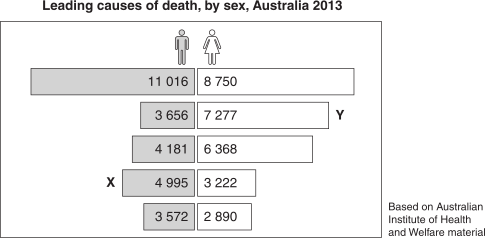
The table shows the data related to leading causes of death, by sex, in Australia in 2013.
 

What are the causes labelled by X and Y?
 

  X Y
A.   Coronary heart disease Cerebrovascular disease
B. Cerebrovascular disease Coronary heart disease
C. Dementia/Alzheimer’s disease Lung cancer
D. Lung cancer Dementia/Alzheimer’s disease
Show Answers Only

\(D\)

Show Worked Solution

  • D is correct: X represents lung cancer (higher in males), Y represents dementia (higher in females).

Other Options:

  • A is incorrect: Coronary heart disease typically has higher male rates, not matching Y pattern.
  • B is incorrect: Pattern doesn’t match cerebrovascular disease gender distribution for these positions.
  • C is incorrect: Reverses the correct gender patterns for these conditions.

♦♦ Mean mark 29%.

Filed Under: Current Health Status Tagged With: Band 6, smc-5474-10-Morbidity and Mortality, smc-5474-30-Gender Inequities, smc-5474-50-Data Interpretation

Copyright © 2014–2026 SmarterEd.com.au · Log in