Solve for \(x\), giving your answers in the simplest form \(a+b\sqrt{c}\) where \(a, b\) and \(c\) are real:
\(5 x^2-20 x+4=0\) (2 marks)
--- 6 WORK AREA LINES (style=lined) ---
Aussie Maths & Science Teachers: Save your time with SmarterEd
Solve for \(x\), giving your answers in the simplest form \(a+b\sqrt{c}\) where \(a, b\) and \(c\) are real:
\(5 x^2-20 x+4=0\) (2 marks)
--- 6 WORK AREA LINES (style=lined) ---
\(x=2 \pm \dfrac{4}{5} \sqrt{5}\)
\(5 x^2-20 x+4=0\)
| \(x\) | \(=\dfrac{-b \pm \sqrt{b^2-4 a c}}{2 a}\) |
| \(=\dfrac{20 \pm \sqrt{20^2-4 \times 5 \times 4}}{2 \times 5}\) | |
| \(=\dfrac{20 \pm \sqrt{320}}{10}\) | |
| \(=2 \pm \dfrac{8 \sqrt{5}}{10}\) | |
| \(=2 \pm \dfrac{4}{5} \sqrt{5}\) |
What are the solutions to \(3x^2+2x-4=0\)?
\(A\)
\(3 x^2+2 x-4=0\)
| \(x\) | \(=\dfrac{-b \pm \sqrt{b^2-4 a c}}{2a}\) |
| \(=\dfrac{-2 \pm \sqrt{2^2-4 \times 3 \times-4}}{2 \times 3}\) | |
| \(=\dfrac{-2 \pm \sqrt{52}}{6}\) | |
| \(=\dfrac{-1 \pm \sqrt{13}}{3}\) |
\(\Rightarrow A\)
Using the discriminant, or otherwise, justify why the graph of \(f(x)=-x^2+2 x-2\) lies entirely below the \(x\)-axis. (2 marks)
--- 5 WORK AREA LINES (style=lined) ---
\(\Delta=b^2-4 a c=2^2-4(-1)(-2)=-4\)
\(\text{Since \(\ \Delta<0, \ y=-x^2+2 x-2\ \) does not intersect the \(x\)-axis.}\)
\(\text{Since \(\ a=-1<0, f(x)\) is an upside down parabola.}\)
\(\Rightarrow f(x)\ \text{must lie entirely below} \ x\text{-axis.}\)
\(\Delta=b^2-4 a c=2^2-4(-1)(-2)=-4\)
\(\text{Since \(\ \Delta<0, \ y=-x^2+2 x-2\ \) does not intersect the \(x\)-axis.}\)
\(\text{Since \(\ a=-1<0, f(x)\) is an upside down parabola.}\)
\(\Rightarrow f(x)\ \text{must lie entirely below} \ x\text{-axis.}\)
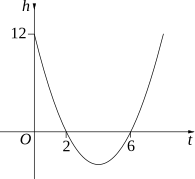
The graph of a quadratic function represented by the equation \(h=t^2-8 t+12\) is shown.
--- 6 WORK AREA LINES (style=lined) ---
--- 3 WORK AREA LINES (style=lined) ---
a. \(\text{Turning point at} \ \ (4,-4)\)
b. \(t=8\)
a. \(\text{Strategy 1 (no calculus)}\)
\(\text{Axis of quadratic occurs when}\ \ t= \dfrac{2+6}{2} = 4\)
\(\text{At} \ \ t=4:\)
\(h=4^2-8 \times 4+12=-4\)
\(\therefore \ \text{Turning point at} \ \ (4,-4)\)
\(\text{Strategy 2 (using calculus)}\)
\(h=t^2-8 t+12\)
\(h^{\prime}=2 t-8\)
\(\text{Find \(t\) when} \ \ h^{\prime}=0:\)
\(2 t-8=0 \ \Rightarrow \ t=4\)
b. \(\text {When} \ \ h=12:\)
| \(t^2-8 t+12\) | \(=12\) |
| \(t(t-8)\) | \(=0\) |
\(\therefore \ \text{Other value:} \ \ t=8\)
The graph of a quadratic function \(f(x)=a x^2+b x+c\) is drawn below.
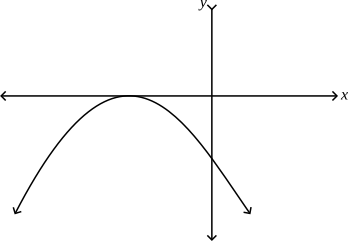
Which of the following are true?
\(D\)
\(\text{Quadratic touches } x \text{-axis once only} \ \ \Rightarrow b^2-4 a c=0\ \ \text{(eliminate C)}\)
\(\text{Quadratic is inverted} \Rightarrow a<0 \ \ \text{(eliminate B)}\)
\(\text{If} \ \ c=0, f(x)=a x^2+b x+0=x(a x+b) \Rightarrow \text{cuts twice (Eliminate A)}\)
\(\Rightarrow D\)
\(R\left(r, r^2\right), S\left(s, s^2\right)\) and \(T\left(t, t^2\right)\) are points on the parabola \(y=x^2\).
Given \(RT\) is parallel to \(SO\), show \(r+t=s\) (2 marks)
--- 5 WORK AREA LINES (style=lined) ---
\(R\left(r, r^2\right), S\left(s, s^2\right), T\left(t, t^2\right)\)
\(m_{S O}=\dfrac{y_2-y_1}{x_2-x_1}=\dfrac{s^2-0}{s-0}=s\)
\(m_{R T}=\dfrac{t^2-r^2}{t-r}=\dfrac{(t-r)(t+r)}{(t-r)}=t+r\)
\(\text{Given}\ R T \ \| \ SO \ \Rightarrow \ m_{SO}=m_{R T}\)
\(\therefore s=r+t\ \ …\ \text{as required} \)
\(R\left(r, r^2\right), S\left(s, s^2\right), T\left(t, t^2\right)\)
\(m_{S O}=\dfrac{y_2-y_1}{x_2-x_1}=\dfrac{s^2-0}{s-0}=s\)
\(m_{R T}=\dfrac{t^2-r^2}{t-r}=\dfrac{(t-r)(t+r)}{(t-r)}=t+r\)
\(\text{Given}\ R T \ \| \ SO \ \Rightarrow \ m_{SO}=m_{R T}\)
\(\therefore s=r+t\ \ …\ \text{as required} \)
The tangent to the parabola \(y=x^2+2 x-4\) is \(y=px-5\) where \(p>0\).
Find the value of \(p\). (2 marks)
--- 5 WORK AREA LINES (style=lined) ---
\(p=4\)
\(\text{Intersection occurs when:}\)
| \(x^2+2x-4\) | \(=px-5\) | |
| \(x^2+(2-p)x+1\) | \(=0\) |
\(\text{Tangent touches once}\ \Rightarrow\ \text{Discriminant}\ \Delta=0\)
| \((2-p)^2-4 \times 1 \times 1\) | \(=0\) | |
| \(4-4p+p^2-4\) | \(=0\) | |
| \(p(p-4)\) | \(=0\) | |
| \(p\) | \(=4\ \ \ (p\gt 0)\) |
Show that the parabola \(2x^2-kx+k-2\) has at least one real root. (3 marks)
--- 7 WORK AREA LINES (style=lined) ---
\(2x^2-kx+k-2=0\)
\(\Delta=b^2-4ac=(-k)^2-4 \times 2(k-2) = k^{2}-8k+16\)
\(\text{Real roots:}\ \ \Delta \geqslant 0\)
| \(k^2-8k+16\) | \(\geqslant 0\) | |
| \((x-4)^2\) | \(\geqslant 0\) |
\(\therefore\ \text{At least one root exists for all}\ k\)
\(2x^2-kx+k-2=0\)
\(\Delta=b^2-4ac=(-k)^2-4 \times 2(k-2) = k^{2}-8k+16\)
\(\text{Real roots:}\ \ \Delta \geqslant 0\)
| \(k^2-8k+16\) | \(\geqslant 0\) | |
| \((x-4)^2\) | \(\geqslant 0\) |
\(\therefore\ \text{At least one root exists for all}\ k\)
The graph \(y = x^2\) meets the line \(y = k\) (where \(k>0\)) at points \(P\) and \(Q\) as shown in the diagram. The length of the interval \(PQ\) is \(L\).
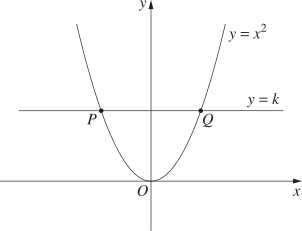
Let \(a\) be a positive number. The graph \(y=\dfrac{x^2}{a^2}\) meets the line \(y=k\) at points \(S\) and \(T\).
What is the length of \(ST\)?
\(C\)
\(\text{Intersection of}\ \ y=x^2\ \ \text{and}\ \ y=k:\)
\(x^2=k\ \ \Rightarrow\ \ x=\pm \sqrt k\)
\(\therefore L=2\sqrt k\)
\(\text{Intersection of}\ \ y=\dfrac{x^2}{a^2}\ \ \text{and}\ \ y=k:\)
| \(\dfrac{x^2}{a^2} \) | \(=k\) | |
| \(x^2\) | \(=a^2k\) | |
| \(x\) | \(=\pm a\sqrt k\) |
\(\therefore ST=a \times 2\sqrt k = aL \)
\(\Rightarrow C\)
Which of the following is the range of the function `f(x)=x^2-1` ?
`A`
`text{Range minimum = – 1}`
`:.\ text{Range}\ in [-1, oo)`
`=>A`
Find the values of `k` for which the expression `x^2-3x + (4-2k)` is always positive. (3 marks)
--- 7 WORK AREA LINES (style=lined) ---
`k < 7/8`
`x^2-3x + (4-2k) > 0`
`x^2-3x + (4-2k) = 0\ \ text(is a concave up parabola)`
`=>\ text{Always positive (no roots) if}\ \ Delta < 0`
`b^2-4ac < 0`
| `(−3)^2-4 · 1 · (4-2k)` | `< 0` |
| `9-16 + 8k` | `< 0` |
| `8k` | `< 7` |
| `k` | `< 7/8` |
Which expression is equal to `3x^2-x-2`?
`D`
`3x^2-x-2= (3x + 2) (x-1)`
`=> D`
Find the points of intersection of `y=-5-4x` and `y=3-2x-x^2.` (3 marks)
--- 7 WORK AREA LINES (style=lined) ---
`(4, – 21) and (– 2, 3)`
`y = 3 – 2x – x^2`
`text(Substitute)\ \ y = -5 – 4x\ \ text(into equation)`
| `-5 – 4x` | `= 3 – 2x – x^2` |
| `x^2 – 2x – 8` | `= 0` |
| `(x – 4) (x + 2)` | `= 0` |
`:. x = 4 or -2`
`text(When)\ \ x = 4,\ \ y = -5 – 4(4) = -21`
`text(When)\ \ x = -2,\ \ y = -5 – 4 (-2) = 3`
`:.\ text(Intersection at)\ \ (4, – 21) and (– 2, 3)`
Factorise `2x^2 + 5x − 12`. (2 marks)
`(2x – 3) (x + 4)`
`2x^2 + 5x – 12`
`= (2x – 3) (x + 4)`
Factorise fully `3x^2-27`. (2 marks)
`3 (x + 3) (x-3)`
| `3x^2-27` | `= 3 (x^2-9)` |
| `= 3 (x + 3) (x-3)` |
Factorise `2x^2 + 5x-3`. (2 marks)
`(2x-1) (x + 3)`
`2x^2 + 5x-3= (2x-1) (x + 3)`
Factorise `3x^2 + x − 2`. (2 marks)
`(3x- 2)(x + 1)`
`3x^2 + x – 2`
`= (3x- 2)(x + 1)`
Solve `x^2 = 4x`. (2 marks)
`x = 0\ text(or)\ 4`
| `x^2` | `= 4x` |
| `x^2-4x` | `= 0` |
| `x(x-4)` | `= 0` |
`:.\ x = 0\ text(or)\ 4`
Simplify `(n^2 - 25)/(n - 5)`. (1 mark)
`n + 5`
| `(n^2\ – 25)/(n -5)` | `= ((n -5)(n + 5))/(n -5)` |
| `= n + 5` |
Factorise `2x^2 - 7x +3` (2 marks)
`(2x -1)(x-3)`
`2x^2 – 7x +3`
`= (2x -1)(x-3)`
What are the solutions of `2x^2-5x-1 = 0`?
`D`
`2x^2-5x-1 = 0`
`text(Using)\ x = (-b +- sqrt( b^2-4ac) )/(2a)`
| `x` | `= (5 +- sqrt{\ \ (-5)^2-4 xx 2 xx(-1) })/ (2 xx 2)` |
| `= (5 +- sqrt(25 + 8) )/4` | |
| `= (5 +- sqrt(33) )/4` |
`=> D`