SmarterEd

Aussie Maths & Science Teachers: Save your time with SmarterEd

  • Login
  • Get Help
  • About

Calculus, MET2 2022 VCAA 2

On a remote island, there are only two species of animals: foxes and rabbits. The foxes are the predators and the rabbits are their prey.

The populations of foxes and rabbits increase and decrease in a periodic pattern, with the period of both populations being the same, as shown in the graph below, for all `t \geq 0`, where time `t` is measured in weeks.

One point of minimum fox population, (20, 700), and one point of maximum fox population, (100, 2500), are also shown on the graph.

The graph has been drawn to scale.
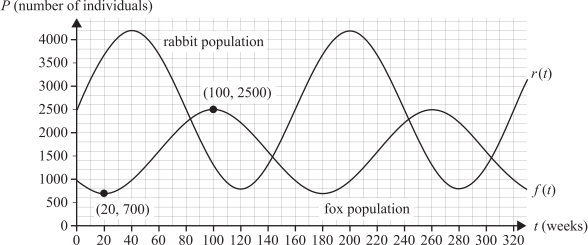
 

The population of rabbits can be modelled by the rule `r(t)=1700 \sin \left(\frac{\pi t}{80}\right)+2500`.

  1.   i. State the initial population of rabbits.   (1 mark)

    --- 2 WORK AREA LINES (style=lined) ---

  2.  ii. State the minimum and maximum population of rabbits.   (1 mark)

    --- 2 WORK AREA LINES (style=lined) ---

  3. iii. State the number of weeks between maximum populations of rabbits.   (1 mark)

    --- 2 WORK AREA LINES (style=lined) ---

The population of foxes can be modelled by the rule `f(t)=a \sin (b(t-60))+1600`.

  1. Show that `a=900` and `b=\frac{\pi}{80}`.   (2 marks)

    --- 4 WORK AREA LINES (style=lined) ---

  2. Find the maximum combined population of foxes and rabbits. Give your answer correct to the nearest whole number.   (1 mark)

    --- 1 WORK AREA LINES (style=lined) ---

  3. What is the number of weeks between the periods when the combined population of foxes and rabbits is a maximum?   (1 mark)

    --- 1 WORK AREA LINES (style=lined) ---

The population of foxes is better modelled by the transformation of `y=\sin (t)` under `Q` given by

 

  1. Find the average population during the first 300 weeks for the combined population of foxes and rabbits, where the population of foxes is modelled by the transformation of `y=\sin(t)` under the transformation `Q`. Give your answer correct to the nearest whole number.   (4 marks)

    --- 8 WORK AREA LINES (style=lined) ---

Over a longer period of time, it is found that the increase and decrease in the population of rabbits gets smaller and smaller.

The population of rabbits over a longer period of time can be modelled by the rule

`s(t)=1700cdote^(-0.003t)cdot sin((pit)/80)+2500,\qquad text(for all)\ t>=0`

  1. Find the average rate of change between the first two times when the population of rabbits is at a maximum. Give your answer correct to one decimal place.   (2 marks)

    --- 3 WORK AREA LINES (style=lined) ---

  2. Find the time, where `t>40`, in weeks, when the rate of change of the rabbit population is at its greatest positive value. Give your answer correct to the nearest whole number.   (2 marks)

    --- 3 WORK AREA LINES (style=lined) ---

  3. Over time, the rabbit population approaches a particular value.
  4. State this value.   (1 mark)

    --- 1 WORK AREA LINES (style=lined) ---
Show Answers Only

ai.   `r(0)=2500`

aii.  Minimum population of rabbits `= 800`

Maximum population of rabbits `= 4200`

aiii. `160`  weeks

b.    See worked solution.

c.    `~~ 5339` (nearest whole number)

d.    Weeks between the periods is 160

e.    `~~ 4142` (nearest whole number)

f.    Average rate of change `=-3.6` rabbits/week (1 d.p.)

g.    `t = 156` weeks (nearest whole number)  

h.    ` s → 2500`

Show Worked Solution

ai.  Initial population of rabbits

From graph when `t=0, \ r(0) = 2500`

Using formula when `t=0`

`r(t)` `= 1700\ sin \left(\frac{\pi t}{80}\right)+2500`  
`r(0)` `= 1700\ sin \left(\frac{\pi xx 0}{80}\right)+2500 = 2500`  rabbits  


aii.
From graph,

Minimum population of rabbits `= 800`

Maximum population of rabbits `= 4200`

OR

Using formula

Minimum is when `t = 120`

`r(120) = 1700\ sin \left(\frac{\pi xx 120}{80}\right)+2500 = 1700 xx (-1) + 2500 = 800`

Maximum is when `t = 40`

`r(40) = 1700\ sin \left(\frac{\pi xx 40}{80}\right)+2500 = 1700 xx (1) + 2500 = 4200`

 
aiii. Number of weeks between maximum populations of rabbits `= 200-40 = 160`  weeks

 
b.  Period of foxes = period of rabbits = 160:

`frac{\2pi}{b} = 160`

`:.\  b = frac{\2pi}{160} = frac{\pi}{80}` which is the same period as the rabbit population.

Using the point `(100 , 2500)`

Amplitude when `b = frac{\pi}{80}`: 

`f(t)` `=a \ sin (pi/80(t-60))+1600`  
`f(100)` `= 2500`  
`2500` `= a \ sin (pi/80(100-60))+1600`  
`2500` `= a \ sin (pi/2)+1600`  
`a` `= 2500-1600 = 900`  

 
`:.\  f(t)= 900 \ sin (pi/80)(t-60) + 1600`


c.    Using CAS find `h(t) = f(t) + r(t)`:

`h(t):=900 \cdot \sin \left(\frac{\pi}{80} \cdot(t-60)\right)+1600+1700\cdot \sin \left(\frac{\pit}{80}\right) +2500`

  
`text{fMax}(h(t),t)|0 <= t <= 160`      `t = 53.7306….`
  

`h(53.7306…)=5339.46`

  
Maximum combined population `~~ 5339` (nearest whole number)


♦♦ Mean mark (c) 40%.
MARKER’S COMMENT: Many rounding errors with a common error being 5340. Many students incorrectly added the max value of rabbits to the max value of foxes, however, these points occurred at different times.

d.    Using CAS, check by changing domain to 0 to 320.

`text{fMax}(h(t),t)|0 <= t <= 320`     `t = 213.7305…`
 
`h(213.7305…)=5339.4568….`
 
Therefore, the number of weeks between the periods is 160.
  

e.    Fox population:

`t^{\prime} = frac{90}{pi}t + 60`   →   `t = frac{pi}{90}(t^{\prime}-60)`

`y^{\prime} = 900y+1600`   →   `y = frac{1}{900}(y^{\prime}-1600)`

`frac{y^{\prime}-1600}{900} = sin(frac{pi(t^{\prime}-60)}{90})`

`:.\  f(t) = 900\ sin\frac{pi}{90}(t-60) + 1600`

  
Average combined population  [Using CAS]   
  
`=\frac{1}{300} \int_0^{300} left(\900 \sin \left(\frac{\pi(t-60)}{90}\right)+1600+1700\ sin\ left(\frac{\pi t}{80}\right)+2500\right) d t`
  

`= 4142.2646…..  ~~ 4142` (nearest whole number)


♦ Mean mark (e) 40%.
MARKER’S COMMENT: Common incorrect answer 1600. Some incorrectly subtracted `r(t)`. Others used average rate of change instead of average value.

f.   Using CAS

`s(t):= 1700e^(-0.003t) dot\sin\frac{pit}{80} + 2500`
 

`text{fMax}(s(t),t)|0<=t<=320`        `x = 38.0584….`
 

`s(38.0584….)=4012.1666….`
 

`text{fMax}(s(t),t)|160<=t<=320`     `x = 198.0584….`
 

`s(198.0584….)=3435.7035….`
 

Av rate of change between the points

`(38.058 , 4012.167)`  and  `(198.058 , 3435.704)`

`= frac{4012.1666….-3435.7035….}{38.0584….-198.0584….} =-3.60289….`
 

`:.` Average rate of change `=-3.6` rabbits/week (1 d.p.)


♦ Mean mark (f ) 45%.
MARKER’S COMMENT: Some students rounded too early.
`frac{s(200)-s(40)}{200-40}` was commonly seen.
Some found average rate of change between max and min populations.

g.   Using CAS

`s^(primeprime)(t) = 0` , `t = 80(n-0.049) \ \forall n \in Z`

After testing `n = 1, 2, 3, 4` greatest positive value occurs for `n = 2` 

`t` `= 80(n-0.049)`  
  `= 80(2-0.049)`  
  `= 156.08`  

 
`:. \ t = 156` weeks (nearest whole number)


♦♦♦ Mean mark (g) 25%.
MARKER’S COMMENT: Many students solved `frac{ds}{dt}=0`.
A common answer was 41.8, as `s(156.11…)=41.79`.
Another common incorrect answer was 76 weeks.

h.   As `t → ∞`, `e^(-0.003t) → 0`

`:.\ s → 2500`

Filed Under: Average Value and Other, Differentiation (Trig), Maxima and Minima, Trig Differentiation Tagged With: Band 2, Band 4, Band 5, Band 6, smc-2757-10-Sin, smc-2757-80-Applications, smc-641-60-Other themes, smc-736-10-sin, smc-744-10-sin, smc-753-60-Matrix, smc-756-20-Trig

Calculus, MET1 2023 VCAA 9

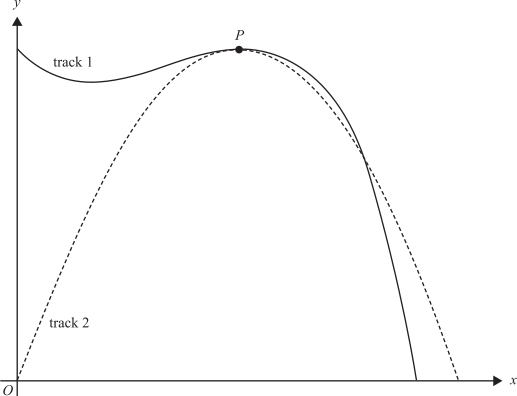
The shapes of two walking tracks are shown below.


Track 1 is described by the function  \(f(x)=a-x(x-2)^2\).

Track 2 is defined by the function  \(g(x)=12x-bx^2\).

The unit of length is kilometres.

  1. Given that \(f(0)=12\)  and  \(g(1)=9\), verify that \(a=12\)  and  \(b=-3\).   (1 mark)

    --- 4 WORK AREA LINES (style=lined) ---

  2. Verify that \(f(x)\) and \(g(x)\) both have a turning point at \(P\).
  3. Give the co-ordinates of \(P\).  (2 marks)

    --- 8 WORK AREA LINES (style=lined) ---

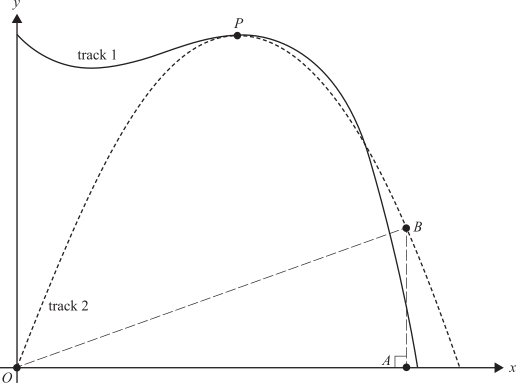
  4. A theme park is planned whose boundaries will form the triangle \(\Delta OAB\) where \(O\) is the origin, \(A\) is at \((k, 0)\) and \(B\) is at \((k, g(k))\), as shown below, where \(k \in (0, 4)\).
  5. Find the maximum possible area of the theme park, in km².   (3 marks)
     

    --- 12 WORK AREA LINES (style=lined) ---

Show Answers Only

a.    \(\text{See worked solution}\)

b.    \(P(2, 12)\ \text{Also see worked solution}\)

c.    \(\dfrac{128}{9}\)

Show Worked Solution
a.    \(f(0)\) \(=a-0(0-2)^2=12\)
  \(\therefore\ a\) \(=12\)


\(g(1)\) \(=12\times 1+b\times 1^2\)
\(12+b\) \(=9\)
\(\therefore b\) \(=-3\)


b.    \(f(x)\) \(=12-x(x-2)^2\)
    \(=-x^3+4x^2-4x+12\)
  \(f^{′}(x)\) \(=-(3x^2-8x+4)\)


\(\text{For turning point }f^{′}(x)=0:\)

\( -(3x^2-8x+4)\) \(=0\)
\(-(3x-2)(x-2)\) \(=0\)

 
\(\therefore\ x=\dfrac{2}{3}\ \text{or}\ 2\)
 

\(f(2)\) \(=12-2(2-2)^2=12\)
\(f\Big{(}\dfrac{2}{3}\Big{)}\) \(=12-\dfrac{2}{3}\Big(\dfrac{2}{3}-2\Big)^2<12\)

 
\(\therefore\ \text{Given graph of }f(x)\ \text{relevant turning point is }(2, 12).\)
 

\(g(x)=12x-3x^2\ \Rightarrow\ g^{′}(x)=12-6x\)

\(\text{For turning point}\ \ g^{′}(x)=0:\)

\(12-6x=0\ \ \Rightarrow \ x=2\)

\(g(x)\) \(=12x-3x^2\)
\(g(2)\) \(=12\times 2-3\times 2^2=12\)

 
\(\therefore\ g(x)\ \text{also has a turning point at }(2, 12).\)


♦ Mean mark (b) 48%.

c.   \(\text{Area of triangle }\Delta OAB\)

\(A(k)\) \(=\dfrac{1}{2}\times k\times g(k)\)
  \(=\dfrac{k}{2}\times (12k-3k^2)\)
  \(=6k^2-\dfrac{3k^3}{2}\)

 
\(\text{Max area when }A^{′}(k)=0:\)

\(A^{′}(k)=12k-\dfrac{9k^2}{2}=\dfrac{1}{2}(24k-9k^2)\)

\(\dfrac{1}{2}k(24-9k)=0\)

\(\therefore\ k=\dfrac{24}{9}=\dfrac{8}{3}\)

 
\(\text{Maximum area occurs when}\ k=\dfrac{8}{3}:\)

\(A(k)\) \(=\dfrac{1}{2}k\times (12k-3k^2)\)
\(A\bigg(\dfrac{8}{3}\bigg)\) \(=\dfrac{1}{2}\times\dfrac{8}{3}\times\bigg (12\bigg(\dfrac{8}{3}\bigg)-3\bigg(\dfrac{8}{3}\bigg)^2\bigg)\)
  \(=\dfrac{4}{3}\bigg(32-\dfrac{64}{3}\bigg)\)
  \(=\dfrac{4}{3}\bigg(\dfrac{96}{3}-\dfrac{64}{3}\bigg)\)
  \(=\dfrac{4}{3}\times\dfrac{32}{3}\)
  \(=\dfrac{128}{9}\)

♦♦♦ Mean mark (c) 27%.
MARKER’S COMMENT: Many students made arithmetic errors substituting the fractional values of \(k\) into \(A(k)\) to find max area.

Filed Under: Maxima and Minima Tagged With: Band 3, Band 5, Band 6, smc-641-10-Area, smc-641-60-Other themes

Calculus, MET2 2011 VCAA 4

Deep in the South American jungle, Tasmania Jones has been working to help the Quetzacotl tribe to get drinking water from the very salty water of the Parabolic River. The river follows the curve with equation  `y = x^2-1`,  `x >= 0` as shown below. All lengths are measured in kilometres.

Tasmania has his camp site at `(0, 0)` and the Quetzacotl tribe’s village is at `(0, 1)`. Tasmania builds a desalination plant, which is connected to the village by a straight pipeline.
 

met2-2011-vcaa-q4

  1. If the desalination plant is at the point `(m, n)` show that the length, `L` kilometres, of the straight pipeline that carries the water from the desalination plant to the village is given by
  2.    `L = sqrt(m^4-3m^2 + 4)`.   (3 marks)

    --- 6 WORK AREA LINES (style=lined) ---

  3. If the desalination plant is built at the point on the river that is closest to the village
    1. find `(dL)/(dm)` and hence find the coordinates of the desalination plant.   (3 marks)

      --- 5 WORK AREA LINES (style=lined) ---

    2. find the length, in kilometres, of the pipeline from the desalination plant to the village.   (2 marks)

      --- 3 WORK AREA LINES (style=lined) ---

The desalination plant is actually built at `(sqrt7/2, 3/4)`.

If the desalination plant stops working, Tasmania needs to get to the plant in the minimum time.

Tasmania runs in a straight line from his camp to a point `(x,y)` on the river bank where  `x <= sqrt7/2`. He then swims up the river to the desalination plant.

Tasmania runs from his camp to the river at 2 km per hour. The time that he takes to swim to the desalination plant is proportional to the difference between the `y`-coordinates of the desalination plant and the point where he enters the river.

  1. Show that the total time taken to get to the desalination plant is given by


    `qquadT = 1/2 sqrt(x^4-x^2 + 1) + 1/4k(7-4x^2)` hours where `k` is a positive constant of proportionality.   (3 marks)

    --- 6 WORK AREA LINES (style=lined) ---

The value of `k` varies from day to day depending on the weather conditions.

  1. If  `k = 1/(2sqrt13)`
    1. find `(dT)/(dx)`   (1 mark)

      --- 1 WORK AREA LINES (style=lined) ---
    2. hence find the coordinates of the point where Tasmania should reach the river if he is to get to the desalination plant in the minimum time.   (2 marks)

      --- 4 WORK AREA LINES (style=lined) ---

  2. On one particular day, the value of `k` is such that Tasmania should run directly from his camp to the point `(1,0)` on the river to get to the desalination plant in the minimum time. Find the value of `k` on that particular day.   (2 marks)

    --- 4 WORK AREA LINES (style=lined) ---

  3. Find the values of `k` for which Tasmania should run directly from his camp towards the desalination plant to reach it in the minimum time.   (2 marks)

    --- 5 WORK AREA LINES (style=lined) ---

Show Answers Only
  1. `text(See Worked Solutions)`
  2.  i. `(sqrt6/2, 1/2)`
  3. ii. `sqrt7/2\ text(km)`
  4. `text(See Worked Solutions)`
  5.  i. `(dT)/(dx) = (x(2x^2-1))/(2sqrt(x^4-x^2 + 1))-(sqrt13 x)/13`
  6. ii. `(sqrt3/2, −1/4)`
  7. `1/4`
  8. `(5sqrt37)/74`
Show Worked Solution

a.   `text(S)text(ince)\ \ (m,n)\ \ text(lies on)\ \ y=x^2-1,`

♦ Mean mark (a) 47%.

`=> n=m^2-1`

`V(0,1), D(m,m^2-1)`

`L` `= sqrt((m-0)^2 + ((m^2-1)-1)^2)`
  `= sqrt(m^2 + m^4-4m^2 + 4)`
  `= sqrt(m^4-3m^2 + 4)\ \ text(… as required)`


b.i.   `(dL)/(dm) = (2m^2-3m)/(sqrt(m^4-3m^2 + 4))`

`text(Solve:)\ \ (dL)/(dm) = 0quadtext(for)quadm >= 0`

`\Rightarrow m = sqrt6/2`

`text(Substitute into:)\ \ D(m, m^2-1),`

`:. text(Desalination plant at)\ \ (sqrt6/2, 1/2)`
 

♦ Mean mark part (b)(ii) 41%.
b.ii.   `L(sqrt6/2)` `= sqrt(m^4-3m^2 + 4)`
    `=sqrt(36/16-3xx6/4+4`
    `=sqrt7/2`


c.   `text(Let)\ \ P(x,x^2-1)\ text(be run point on bank)`

♦♦♦ Mean mark (c) 16%.

`text(Let)\ \ D(sqrt7/2, 3/4)\ text(be desalination location)`

`T` `=\ text(run time + swim time)`
  `= (sqrt((x-0)^2 + ((x^2-1)-0)^2))/2 + k(3/4-(x^2-1))`
  `= (sqrt(x^2 + x^4-2x^2 + 1))/2 + k/4(3-4(x^2-1))`
`:. T` `= (sqrt(x^4-x^2 + 1))/2 + 1/4k(7-4x^2)`


d.i.   `(dT)/(dx) = (x(2x^2-1))/(2sqrt(x^4-x^2 + 1))-(sqrt13 x)/13`


d.ii.   `text(Solve:)\ \ (dT)/(dx) = 0`

♦♦ Mean mark (d.ii.) 33%.

`x = sqrt3/2`

`y=x^2-1=-1/4`

`:. T_(text(min)) \ text(when point is)\ \ (sqrt3/2, −1/4)`


e.  `(dT)/(dx) = (x(2x^2-1))/(2sqrt(x^4-x^2 + 1))-2kx`

♦♦ Mean mark (e) 39%.

`text(When)\ \ x=1:`

`text(Solve:)\ \ (dT)/(dx)` `=0\ \ text(for)\ k,`
`1/2 -2k` `=0`
`:.k` `=1/4`


f.   `text(Require)\ T_text(min)\ text(to occur at right-hand endpoint)\ \ x = sqrt7/2.`

`text(This can occur in 2 situations:)`

♦♦♦ Mean mark (f) 13%.

`text(Firstly,)\ \ T\ text(has a local min at)\ \ x = sqrt7/2,`

`text(Solve:)\ \ (x(2x^2-1))/(2sqrt(x^4-x^2 + 1))-2kx=0| x = sqrt7/2,\ \ text(for)\ k,`

`:.k = (5sqrt37)/74`
 

`text(S)text(econdly,)\ \ T\ text(is decreasing function over)\ x ∈ (0, sqrt7/2),`

`text(Solve:)\ \ (dT)/(dx) <= 0 | x = sqrt7/2,\ text(for)\ k,`

`:. k > (5sqrt37)/74`

`:. k >= (5sqrt37)/74`

Filed Under: Maxima and Minima Tagged With: Band 4, Band 5, Band 6, smc-641-50-Distance, smc-641-60-Other themes

Calculus, MET1 2011 VCAA 10

The figure shown represents a wire frame where `ABCE` is a convex quadrilateral. The point `D` is on line segment `EC` with  `AB = ED = 2\ text(cm)` and  `BC = a\ text(cm)`, where `a` is a positive constant.

`/_ BAE = /_ CEA = pi/2`

Let  `/_ CBD = theta`  where  `0 < theta < pi/2.`

 vcaa-2011-meth-10a

  1. Find `BD` and `CD` in terms of `a` and `theta`.   (2 marks)

    --- 5 WORK AREA LINES (style=lined) ---

  2. Find the length, `L` cm, of the wire in the frame, including length `BD`, in terms of `a` and `theta`.   (1 mark)

    --- 3 WORK AREA LINES (style=lined) ---

  3. Find  `(dL)/(d theta)`, and hence show that  `(dL)/(d theta) = 0`  when  `BD = 2CD`.   (2 marks)

    --- 5 WORK AREA LINES (style=lined) ---

  4. Find the maximum value of `L` if  `a = 3 sqrt 5`.   (1 mark)

    --- 5 WORK AREA LINES (style=lined) ---

Show Answers Only
  1. `BD = a cos theta,\ \ \ CD = a sin theta`
  2. `L = 4 + a + 2 a cos theta + a sin theta`
  3. `text(Proof)\ text{(See Worked Solutions)}`
  4. `L_max = 19 + 3 sqrt 5`
Show Worked Solution

a.   `text(In)\ \ Delta BCD,`

`cos theta` `= (BD)/a`
`:. BD` `= a cos theta`
`sin theta` `= (CD)/a`
`:. CD` `= a sin theta`


b.   `L` `= 4 + 2 BD + CD + a`
    `= 4 + 2a cos theta + a sin theta + a`
    `= 4 + a + 2a cos theta + a sin theta`


c.   `text(Noting that)\ a\ text(is a constant:)`

♦ Mean mark 35%.

`(dL)/(d theta)= – 2 a sin theta + a cos theta`

`text(When)\ \ (dL)/(d theta) = 0`,

`- 2 a sin theta+ a cos theta` `= 0`
`a cos theta` `= 2 a sin theta`
`:.  BD` `= 2CD\ \ text{(using part (a))}`


d.   `text(SP’s when)\ \ (dL)/(d theta)=0,`

♦♦♦ Mean mark 5%.
`- 2 a sin theta+ a cos theta` `= 0`
`sin theta` `=1/2 cos theta`
`tan theta` `=1/2`

vcaa-2011-meth-10ai

`text(If)\ \ tan theta=1/2,\ \ cos theta = 2/sqrt5,\ \ sin theta = 1/sqrt5`

`L_(max)` `= 4 + a + 2a cos theta + a sin theta`
  `= 4 + (3 sqrt 5) + 2 (3 sqrt 5) (2/sqrt 5) + (3 sqrt 5) (1/sqrt 5)`
  `= 4 + 3 sqrt 5 + 12 + 3`
  `= 19 + 3 sqrt 5\ text(cm)`

Filed Under: Maxima and Minima Tagged With: Band 4, Band 5, Band 6, smc-641-60-Other themes

Calculus, MET2 2014 VCAA 3

In a controlled experiment, Juan took some medicine at 8 pm. The concentration of medicine in his blood was then measured at regular intervals. The concentration of medicine in Juan’s blood is modelled by the function  `c(t) = 5/2 te^(-(3t)/2), t >= 0`, where `c` is the concentration of medicine in his blood, in milligrams per litre, `t` hours after 8 pm. Part of the graph of the function `c` is shown below.
 

VCAA 2014 3a

  1. What was the maximum value of the concentration of medicine in Juan’s blood, in milligrams per litre, correct to two decimal places?   (1 mark)

    --- 2 WORK AREA LINES (style=lined) ---

    1. Find the value of `t`, in hours, correct to two decimal places, when the concentration of medicine in Juan’s blood first reached 0.5 milligrams per litre.   (1 mark)

      --- 2 WORK AREA LINES (style=lined) ---

    2. Find the length of time that the concentration of medicine in Juan’s blood was above 0.5 milligrams per litre. Express the answer in hours, correct to two decimal places.   (2 marks)

      --- 3 WORK AREA LINES (style=lined) ---

    1. What was the value of the average rate of change of the concentration of medicine in Juan’s blood over the interval  `[2/3, 3]`?
    2. Express the answer in milligrams per litre per hour, correct to two decimal places.   (2 marks)

      --- 5 WORK AREA LINES (style=lined) ---

    3. At times `t_1` and `t_2`, the instantaneous rate of change of the concentration of medicine in Juan's blood was equal to the average rate of change over the interval  `[2/3, 3]`.
    4. Find the values of `t_1` and `t_2`, in hours, correct to two decimal places.   (2 marks)

      --- 3 WORK AREA LINES (style=lined) ---

Alicia took part in a similar controlled experiment. However, she used a different medicine. The concentration of this different medicine was modelled by the function  `n(t) = Ate^(-kt),\ t >= 0`  where  `A`  and  `k in R^+`.

  1. If the maximum concentration of medicine in Alicia’s blood was 0.74 milligrams per litre at  `t = 0.5`  hours, find the value of `A`, correct to the nearest integer.  (3 marks)

    --- 6 WORK AREA LINES (style=lined) ---

Show Answers Only
  1. `0.61\ text(mg/L)`
  2.  i. `0.33\ text(hours)`
  3. ii. `0.86\ text(hours)`
  4.  i. `−0.23\ text(mg/L/h)`
  5. ii. `t = 0.90\ text(or)\ t = 2.12`
  6. `4`
Show Worked Solution

a.  `text(Solve:)\ \ c^{′}(t)=0\ text(for)\ t >= 0`

`t=2/3`

`c(2/3)= 0.61\ text(mg/L)`
 

b.i.    `text(Solve:)\ \ c(t)` `= 0.5\ text(for)\ t >= 0`

 `t=0.33\ \ text(or)\ \ t = 1.19`

`:. text(First reached 0.5 mg/L at)\ \ t = 0.33\ text(hours)`

MARKER’S COMMENT: In part (b)(ii), work to sufficient decimal places to ensure your answer has the required accuracy.


b.ii.    `text(Length)` `= 1.18756…-0.326268…`
    `= 0.86\ text(hours)`


c.i.    `text(Average ROC)` `= (c(3)-c(2/3))/(3-2/3)`
    `= (0.083-0.613)/(7/3)`
    `=-0.227…`
    `= −0.23\ text{mg/L/h  (2 d.p.)}`


c.ii.   `text(Solve:)\ \ cprime(t) = −0.22706…\ text(for)\ \ t >= 0`

♦ Mean mark part (c)(ii) 38%.

`:. t = 0.90\ \ text(or)\ \ t = 2.12\ text{h  (2 d.p.)}`
 

d.  `text(Solution 1)`

♦ Mean mark 46%.

`text(Equations from given information:)`

`n(1/2) = 0.74`

`0.74 = 1/2Ae^(−1/2k)\ …\ (1)`

`n^{′} (1/2) = 0`

`text(Solve simultaneously for)\ A and k\ \ text([by CAS])`

`:.A` `= 4.023`
  `= 4\ \ text{(nearest integer)}`

 
`text(Solution 2)`

`n(1/2) = 0.74`

`0.74 = 1/2Ae^(−1/2k)\ …\ (1)`

`n^{′}(t)` `=Ae^(- k/2)-1/2 Ake^(- k/2)`
  `=Ae^(- k/2) (1- k/2)\ …\ (2)`

 
`n^{′} (1/2) = 0`

`:. k=2\ \ text{(using equation (2))}`

`:.A` `= 4\ \ text{(nearest integer)}`

Filed Under: Maxima and Minima Tagged With: Band 3, Band 4, Band 5, smc-641-60-Other themes

Calculus, MET2 2015 VCAA 2

A city is located on a river that runs through a gorge.

The gorge is 80 m across, 40 m high on one side and 30 m high on the other side.

A bridge is to be built that crosses the river and the gorge.

A diagram for the design of the bridge is shown below.
 

 VCAA 2015 2a

The main frame of the bridge has the shape of a parabola. The parabolic frame is modelled by  `y = 60-3/80x^2`  and is connected to concrete pads at  `B (40, 0)`  and  `A (– 40, 0).`

The road across the gorge is modelled by a cubic polynomial function.

  1. Find the angle, `theta`, between the tangent to the parabolic frame and the horizontal at the point  `(– 40, 0)` to the nearest degree.   (2 marks)

    --- 4 WORK AREA LINES (style=lined) ---

The road from `X` to `Y` across the gorge has gradient zero at  `X (– 40, 0)`  and at  `Y (40, 30)`, and has equation  `y = x^3/(25\ 600)-(3x)/16 + 35`.

  1. Find the maximum downwards slope of the road. Give your answer in the form  `-m/n`  where `m` and `n` are positive integers.   (2 marks)

    --- 4 WORK AREA LINES (style=lined) ---

Two vertical supporting columns, `MN` and `PQ`, connect the road with the parabolic frame.

The supporting column, `MN`, is at the point where the vertical distance between the road and the parabolic frame is a maximum.

  1. Find the coordinates `(u, v)` of the point `M`, stating your answers correct to two decimal places.   (3 marks)

    --- 5 WORK AREA LINES (style=lined) ---

The second supporting column, `PQ`, has its lowest point at  `P (– u, w)`.

  1. Find, correct to two decimal places, the value of `w` and the lengths of the supporting columns `MN` and `PQ`.   (3 marks)

    --- 5 WORK AREA LINES (style=lined) ---

For the opening of the bridge, a banner is erected on the bridge, as shown by the shaded region in the diagram below.

VCAA 2015 2ai

  1. Find the `x`-coordinates, correct to two decimal places, of `E` and `F`, the points at which the road meets the parabolic frame of the bridge.   (3 marks)

    --- 4 WORK AREA LINES (style=lined) ---

  2. Find the area of the banner (shaded region), giving your answer to the nearest square metre.   (1 mark)

    --- 2 WORK AREA LINES (style=lined) ---

Show Answers Only
  1. `72^@`
  2. `−3/16`
  3. `M (2.49,34.53)`
  4. `w = 35.47\ text(m);quadMN = 25.23\ text(m);quadPQ = 24.30\ text(m)`
  5. `x_E = -23.71;quadx_F = 28.00`
  6. `870\ text(m²)`
Show Worked Solution
a.    `f(x)` `=60-3/80x^2`
  `f′(x)` `=- 3/40 x`


`text(At)\ \ x=-40,\ \ f′(x)=3`

♦ Mean mark part (a) 40%.
`tan theta` `= 3`
`:. theta` `= tan^(−1)(3)`
  `=71.56…`
  `= 72^@`


b.    `g(x)` `= (x^3)/(25\ 600)-3/16 x + 35`
  `g′(x)` `=(3x^2)/(25\ 600)-3/16`
     

`text(S)text(ince)\ \ 3x^2>=0\ \ text(for all)\ \ x,`

`text(Max downwards slope occurs at)\ \ x= 0.`

`gprime(0) = −3/16` 


c.   `text(Let)\ \ V=\ text(distance)\ MN`

`V` `= (60-3/80x^2)-((x^3)/(25\ 600)-3/16x + 35)`
`(dV)/(dx)` `=-3/40 x-(3x^2)/(25\ 600) + 3/16`
♦ Mean mark part (c) 39%.
`(dV)/(dx)` `= 0quadtext(for)\ x ∈ [−40,40]`
 `x` `= 2.490…`

 
`text(When)\ \ x=2.490…,\ \ g(2.490…) = 34.533…`

`:. M (2.49,34.53)`

♦♦ Mean mark part (d) 29%.
MARKER’S COMMENT: Many students didn’t work to a sufficient number of decimal places.

 
d.
   `P(-2.49, w)`

`text(When)\ \ x=-2.490…,\ \ g(-2.490…) = 35.47…`

`:. w = 35.47\ \ text{(2 d.p.)}`

`V_(MN)` `=(60-3/80(2.49…)^2)-(((2.49…)^3)/(25\ 600)-3/16(2.49…) + 35)`
  `=25.23\ text{m  (2 d.p.)}`
`V_(PQ)` `=(60-3/80(-2.49…)^2)-(((-2.49…)^3)/(25\ 600)-3/16(-2.49…) + 35)`
  `=24.30\ text{m  (2 d.p.)}`


e.   `text(Intersection occurs when:)`

`f(x) = g(x)quadtext(for)\ x ∈ (−40,40)`

`60-3/80x^2=(x^3)/(25\ 600)-3/16x + 35\ \ text([by CAS])`
 

`x_E = -23.7068… = -23.71\ text{(2 d.p.)}`

`x_F = 27.9963… = 28.00\ text{(2 d.p.)}`
 

f.     `text(Area)` `= int_-23.71^28.00 (f(x)-g(x))dx`
    `=int_-23.71^28.00 (60-3/80x^2-((x^3)/(25\ 600)-3/16x + 35))\ dx`
    `=869.619…\ \ text([by CAS])`
    `= 870\ text(m²)`

Filed Under: Maxima and Minima, Polynomials Tagged With: Band 4, Band 5, smc-641-60-Other themes, smc-750-60-Other

Calculus, MET2 2013 VCAA 3

Tasmania Jones is in Switzerland. He is working as a construction engineer and he is developing a thrilling train ride in the mountains. He chooses a region of a mountain landscape, the cross-section of which is shown in the diagram below.

VCAA 2013 2a

The cross-section of the mountain and the valley shown in the diagram (including a lake bed) is modelled by the function with rule

`f(x) = (3x^3)/64-(7x^2)/32 + 1/2.`

Tasmania knows that  `A (0, 1/2)`  is the highest point on the mountain and that `C(2, 0)` and `B(4, 0)` are the points at the edge of the lake, situated in the valley. All distances are measured in kilometres.

  1. Find the coordinates of `G`, the deepest point in the lake.   (3 marks)

    --- 5 WORK AREA LINES (style=lined) ---

Tasmania’s train ride is made by constructing a straight railway line `AB` from the top of the mountain, `A`, to the edge of the lake, `B`. The section of the railway line from `A` to `D` passes through a tunnel in the mountain.

  1. Write down the equation of the line that passes through `A` and `B.`   (2 marks)

    --- 4 WORK AREA LINES (style=lined) ---

  2.  i. Show that the `x`-coordinate of `D`, the end point of the tunnel, is `2/3.`   (1 mark)

    --- 3 WORK AREA LINES (style=lined) ---

  3. ii. Find the length of the tunnel `AD.`   (2 marks)

    --- 2 WORK AREA LINES (style=lined) ---

In order to ensure that the section of the railway line from `D` to `B` remains stable, Tasmania constructs vertical columns from the lake bed to the railway line. The column `EF` is the longest of all possible columns. (Refer to the diagram above.)

  1.  i. Find the `x`-coordinate of `E.`   (2 marks)

    --- 3 WORK AREA LINES (style=lined) ---

  2. ii. Find the length of the column `EF` in metres, correct to the nearest metre.   (2 marks)

    --- 2 WORK AREA LINES (style=lined) ---

Tasmania’s train travels down the railway line from `A` to `B`. The speed, in km/h, of the train as it moves down the railway line is described by the function.

`V: [0, 4] -> R, \ V(x) = k sqrt x-mx^2,`

where `x` is the `x`-coordinate of a point on the front of the train as it moves down the railway line, and `k` and `m` are positive real constants.

The train begins its journey at `A (0, 1/2)`. It increases its speed as it travels down the railway line.

The train then slows to a stop at `B(4, 0)`, that is  `V(4) = 0.`

  1. Find `k` in terms of `m.`   (1 mark)

    --- 3 WORK AREA LINES (style=lined) ---

  2. Find the value of `x` for which the speed, `V`, is a maximum.   (2 marks)

    --- 3 WORK AREA LINES (style=lined) ---

Tasmania is able to change the value of `m` on any particular day. As `m` changes, the relationship between `k` and `m` remains the same.

  1. If, on one particular day, `m = 10`, find the maximum speed of the train, correct to one decimal place.   (2 marks)

    --- 4 WORK AREA LINES (style=lined) ---

  2. If, on another day, the maximum value of `V` is 120, find the value of `m.`   (2 marks)

    --- 4 WORK AREA LINES (style=lined) ---

Show Answers Only
  1. `G(28/9,−50/243)`
  2. `y = −1/8x + 1/2`
  3.  i. `text(See Worked Solutions)`
  4. ii. `sqrt65/12`
  5.  i. `(2(sqrt31 + 7))/9`
  6. ii. `336\ text(m)`
  7. `8\ text(m)`
  8. `2^(2/3)`
  9. `75.6\ text(km/h)`
  10. `10 xx 2^(2/3)`
Show Worked Solution

a.   `G\ text(occurs when)\ \ f^{′}(x)=0.`

`text(Solve:)\ \ (3x^3)/64-(7x^2)/32 + 1/2=0\ \ text(for)\ x`

`x= 28/9quadtext(for)quadx ∈ (2,4)`

`f(28/9) = −50/243`

`:. G(28/9,−50/243)`
 

b.    `m_(AB)` `= (1/2-0)/(0-4)`
    `= −1/8`

 
`text(Equation using point gradient formula,)`

`y-y_1` `= m(x-x_1)`
`y-1/2` `= −1/8(x-0)`
`:. y` `= −1/8x + 1/2`

 
c.i.
 `text{Solution 2 (using technology)}`

`text(Solve:)\ \ ` `3/64x^3-7/32x^2 + 1/2` `= −1/8x + 1/2\ \ text(for)\ x`

`x=0, 2/3 or 4`

`:.x=2/3,\ \ (0<x<4)`
 

`text(Solution 1)`

`text(Intersection occurs when:)`

`3/64x^3-7/32x^2 + 1/2` `= −1/8x + 1/2`
`3x^3-14x^2 + 8x` `= 0`
`x(3x^2-14x + 8)` `= 0`
`x(x-4)(3x-2)` `= 0`

 
`x = 2/3,\ \ (0<x<4)`

`:. x text(-coordinate of)\ D = 2/3`
 

c.ii.   `D (2/3, 5/12)qquadA(0,1/2)`

  `text(By Pythagoras,)`

`AD` `= sqrt((2/3-0)^2 + (5/12-1/2)^2)`
  `= sqrt65/12`


d.i.  `text(Let)\ \ z =\ EF`

♦♦♦ Mean mark part (d)(i) 24%.
MARKER’S COMMENT: Many students unfamiliar with this type of question.
 `z` `= (−1/8x + 1/2)-((3x^2)/64-7/32 x^2 + 1/2)`
  `=-1/8x-(3x^2)/64 + 7/32 x^2`

 
`text(Solve:)\ \ d/dx (-1/8x-(3x^2)/64 + 7/32 x^2) =0\ \ text(for)\ x`

`x= (2(sqrt31 + 7))/9,\ \ \ x > 0`
 

♦♦♦ Mean mark part (d)(ii) 22%.
d.ii.    `z((2sqrt31 + 14)/9)` `= 0.3360…\ text(km)`
    `= 336\ text{m  (nearest m)}`


e.    `V(4)` `= 0quadtext{(given)}`
  ` 0` `= k sqrt4-m xx 4^2`
  `:.k` `= 8m`


f.  `V(x) = 8msqrtx-mx^2`

`text(Solve:)\ \ V^{′}(x)` `= 0quadtext(for)quadx`

`x= 2^(2/3)`
 

g.  `text(When)\ \ m=10,\ \ k=8 xx 10=80`

♦ Mean mark 43%.

`:.V(x) = 80sqrtx-10x^2`

`text(Solve:)\ \ V^{′}(x)` `= 0quadtext(for)quadx`

`x= 2^(2/3)`

`V(2^(2/3))` `=75.59…`
  `= 75.6\ text(km/h)`


h.   `text(Maximum occurs at)\ x = 2^(2/3)`

♦ Mean mark 38%.

`V(x) = 8msqrtx-mx^2`

`text(Solve:)\ \ V(2^(2/3))` `= 120quadtext(for)quadm`
`:. m` `= 10 xx 2^(2/3)`

Filed Under: Curve Sketching, Maxima and Minima Tagged With: Band 3, Band 4, Band 5, Band 6, smc-641-60-Other themes, smc-724-10-Cubic, smc-724-70-Applied context

Copyright © 2014–2025 SmarterEd.com.au · Log in