SmarterEd

Aussie Maths & Science Teachers: Save your time with SmarterEd

  • Login
  • Get Help
  • About

Algebra, STD1 EQ-Bank 24

Zara is looking for a new mobile phone plan. She has found two plans that suit her needs and wants to work out which plan is cheaper depending on how many minutes she uses.

Plan \(\text{A}\):   $20 per month fixed charge plus $0.10 per minute

Plan \(\text{B}\):  $0.30 per minute, no fixed charge

Let  \(C\) = total monthly cost in dollars, and  \(m\) = number of minutes used.

  1. Plan \(\text{B}\) can be modelled by the equation  \(C=0.30m\).
  2. Write an equation for the monthly cost of Plan \(\text{A}\).   (1 mark)

    --- 2 WORK AREA LINES (style=lined) ---

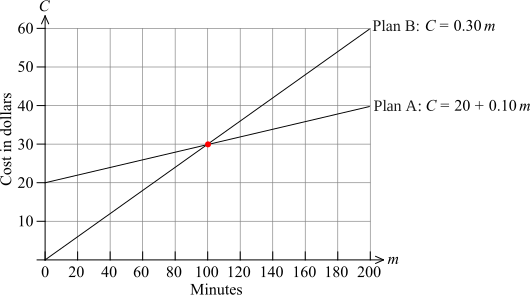
  3. The graph of Plan \(\text{B}\) is provided on the grid below. Use the equation from (a) to add the graph of Plan \(\text{A}\) to the grid.   (2 marks)

    --- 3 WORK AREA LINES (style=lined) ---
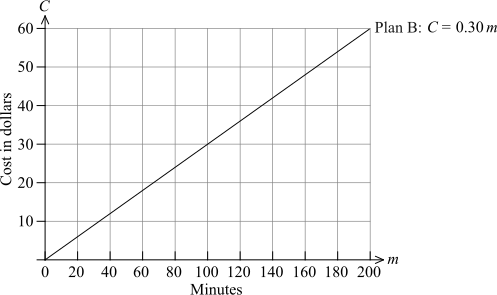
      
  4. For how many minutes per month do both plans cost the same amount?   (1 mark)

    --- 5 WORK AREA LINES (style=lined) ---

  5. Zara uses an average of 140 minutes per month.
  6. Which plan she should choose and how much does she save compared to the other plan.   (1 mark)

    --- 4 WORK AREA LINES (style=lined) ---

Show Answers Only

a.    \(\text{Plan A: }C=20+0.10m\)

b.    

c.    \(100\ \text{minutes}\)

d.    \(\text{Plan A, cheaper by } \$8\)

Show Worked Solution

a.    \(\text{Plan A: }\ C=20+0.10m\)
  

b.    \(\text{Table of values}\)

\(\begin{array}{|c|c|c|c|c|c|} \hline m & 0 & 50 & 100 & 150 & 200 \\ \hline \text{Plan A} & 20 & 25 & 30 & 35 & 40 \\ \hline \end{array}\)


c.    \(\text{From the graph, the lines intersect at }\ m=100.\)

\(\therefore\ \text{Both plans cost the same at } 100\ \text{minutes}\)
  

d.    \(\text{Plan A:   }\ C=20+0.10\times140=\$34\)

\(\text{Plan B:   }\ C=0.30\times140=\$42\)

\(\text{Difference} = 42-34=\$8\)

\(\therefore\ \text{Zara should choose Plan A, which is \$8 cheaper than Plan B.}\)
Filed Under: Simultaneous Linear Equations Tagged With: Band 3, Band 4, Band 5, smc-6839-20-Other SE Applications, smc-6839-30-Find Intersection

Algebra, STD1 EQ-Bank 36

Two cyclists, Aiko and Ben, are riding along the same straight track in the same direction.

Aiko starts 2000 m ahead of Ben. Aiko rides at a constant speed of 250 metres/minute and Ben rides at a constant speed of 500 metres/minute.

Let    \(d\) = distance from the starting point in metres, and 

   \(t\) = time in minutes.

  1. The equation  \(d=2000+250t\)  models Aiko's distance from the starting point.
  2. Write an equation to model Ben's distance.   (1 mark)

    --- 2 WORK AREA LINES (style=lined) ---

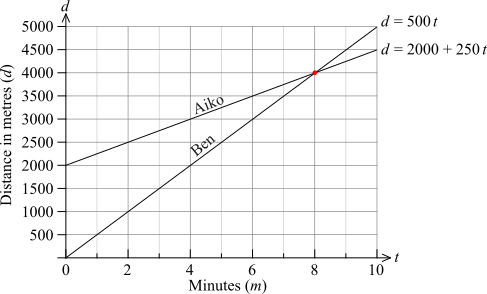
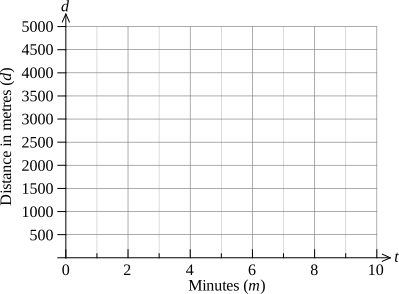
  3. Use the equations from (a) to graph Aiko and Ben's journeys on the grid below.   (2 marks)

    --- 3 WORK AREA LINES (style=lined) ---

      
  4. After how many minutes does Ben catch Aiko?   (1 mark)

    --- 1 WORK AREA LINES (style=lined) ---

  5. How far has each cyclist travelled from their own starting point when they meet?   (2 marks)

    --- 4 WORK AREA LINES (style=lined) ---

Show Answers Only

a.    \(d=500t\)

b.    

c.    \(8\ \text{minutes}\)

d.    \(\text{Aiko travelled 2000 m, Ben travelled 4000 m.}\)

Show Worked Solution

a.    \(d=500t\)

b.    \(\text{Table of values:}\)

\(\begin{array}{|c|c|c|c|c|c|c|} \hline t & 0 & 2 & 4 & 6 & 8 & 10 \\ \hline \text{Aiko} & 2000 & 2500 & 3000 & 3500 & 4000 & 4500 \\ \hline \text{Ben} & 0 & 1000 & 2000 & 3000 & 4000 & 5000 \\ \hline \end{array}\)
 

c.    \(\text{From the graph, the lines intersect at }\ t=8.\)

\(\therefore\ \text{Ben catches Aiko after 8 minutes}\)
 

d.    \(\text{When}\ \ t=8, d=4000:\)

\(\text{Aiko started 2000 m ahead, so the distance travelled}\)

\(=4000-2000=2000\ \text{m}\)

\(\text{Ben started at the origin, so the distance travelled =4000 m}\)

Filed Under: Simultaneous Linear Equations Tagged With: Band 4, Band 5, Band 6, smc-6839-20-Other SE Applications, smc-6839-30-Find Intersection

Algebra, STD1 EQ-Bank 34

Two water tanks sit side by side on a farm.

Tank A has a capacity of 1000 litres and is full. It is being emptied at a constant rate of 60 litres per minute.

At the same time, Tank B is empty and is being filled at a constant rate of 40 litres per minute.

Let    \(V\) = volume of water in litres, and 

   \(t\) = time in minutes.

  1. The equation  \(V=1000-60t\)  models the volume of water in Tank A.
  2. Write an equation to model the volume of water in Tank B.   (1 mark)

    --- 2 WORK AREA LINES (style=lined) ---

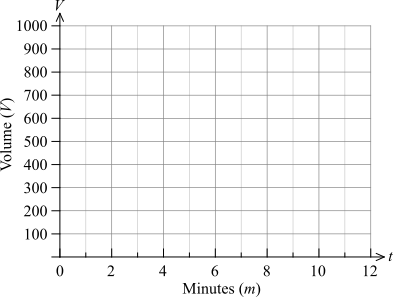
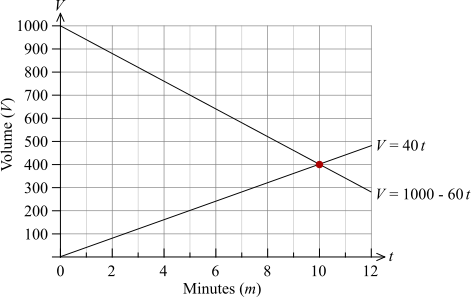
  3. Complete the table below and use the values to graph the volume of water in Tank A and Tank B on the grid below.   (3 marks)
     
          \(\begin{array}{|c|c|c|c|c|c|c|c|} \hline t & 0 & 2 & 4 & 6 & 8 & 10 & 12 \\ \hline \text{Tank A} & \ \ \ \ \ \ \ \  & 880 & 760 & 640 & 520 & 400 & 280 \\ \hline \text{Tank B} & 0 & \ \ \ \ \ \ \ \ \  & 160 & 240 & 320 & 400 & \ \ \ \ \ \ \ \  \\ \hline \end{array}\)
  
    1. --- 0 WORK AREA LINES (style=lined) ---

  1. After how many minutes do both tanks contain the same volume of water?   (1 mark)

    --- 1 WORK AREA LINES (style=lined) ---

  2. What is the volume of water in each tank at this time?   (1 mark)

    --- 4 WORK AREA LINES (style=lined) ---

Show Answers Only

a.    \(V=40t\)

b.    \(\text{Table of values:}\)

\(\begin{array}{|c|c|c|c|c|c|c|c|} \hline t & 0 & 2 & 4 & 6 & 8 & 10 & 12 \\ \hline \text{Tank A} & 1000 & 880 & 760 & 640 & 520 & 400 & 280 \\ \hline \text{Tank B} & 0 & 80 & 160 & 240 & 320 & 400 & 480 \\ \hline \end{array}\)


c.    \(10\ \text{minutes}\)

d.    \(400\ \text{litres}\)

Show Worked Solution

a.    \(V=40t\)

b.    \(\text{Table of values:}\)

\(\begin{array}{|c|c|c|c|c|c|c|c|} \hline t & 0 & 2 & 4 & 6 & 8 & 10 & 12 \\ \hline \text{Tank A} & 1000 & 880 & 760 & 640 & 520 & 400 & 280 \\ \hline \text{Tank B} & 0 & 80 & 160 & 240 & 320 & 400 & 480 \\ \hline \end{array}\)


c.    \(\text{From the graph, the lines intersect at }\ t=10.\)

\(\therefore\ \text{Both tanks contain the same volume after 10 minutes}\)
  

d.    \(\text{Method 1: Graphically}\)

\(\text{From the graph, when }\ t=10,\ \text{the volume in both tanks = 400 litres}\)
  

\(\text{Method 2: Algebraically}\)

\(\text{When }\ t=10:\)

\(\text{Tank A volume:}\ \ V=1000-60\times10=400\ \text{L}\)

\(\text{Tank B volume:}\ \ V=40\times10=400\ \text{L}\ \checkmark\)

\(\therefore\ \text{Each tank contains } 400\ \text{litres}\)

Filed Under: Simultaneous Linear Equations Tagged With: Band 4, Band 5, Band 6, smc-6839-20-Other SE Applications, smc-6839-30-Find Intersection

Algebra, STD1 EQ-Bank 6 MC

An AFL football team scored 15 times in a game, made up of goals and behinds.

Goals are worth 6 points and behinds are worth 1 point. The team's total score was 45 points.

Let  \(g\) = number of goals and  \(b\) = number of behinds.

Which pair of equations correctly represents this situation?

  1. \(g+b=45\)  and  \(6g+b=15\)
  2. \(6g+b=15\)  and  \(g+b=45\)
  3. \(g+b=15\)  and  \(6g+b=45\)
  4. \(g+b=15\)  and  \(g+6b=45\)
Show Answers Only

\(C\)

Show Worked Solution

\(g+b=15-\text{Eliminate A and B}\)

\(\text{Total points from goals} = 6g\)

\(\text{Total points from behinds} = b\)

\(\text{Total points} = 6g+b\ \ \Rightarrow\ \ 6g+b=45\)

\(\Rightarrow C\)

Filed Under: Simultaneous Linear Equations Tagged With: Band 5, smc-6839-20-Other SE Applications

Algebra, STD1 EQ-Bank 4 MC

A preschool has 20 bikes in total for the children to use, made up of bicycles and tricycles.

Each bicycle has 2 wheels and each tricycle has 3 wheels. Altogether, there is a total of 46 wheels.

Let  \(b\) = number of bicycles and  \(t\) = number of tricycles.

Which pair of equations correctly represents this situation?

  1. \(b+t=20\)  and  \(2b+3t=46\)
  2. \(b+t=46\)  and  \(2b+3t=20\)
  3. \(b+t=20\)  and  \(3b+2t=46\)
  4. \(b+t=46\)  and  \(3b+2t=20\)
Show Answers Only

\(A\)

Show Worked Solution

\(b+t=20-\text{Eliminate B and D.}\)

\(\text{Total wheels on bicycles} = 2b\)

\(\text{Total wheels on tricycles} = 3t\)

\(\text{Total wheels} = 46\ \ \Rightarrow\ \ 2b+3t=46\)

\(\Rightarrow A\)

Filed Under: Simultaneous Linear Equations Tagged With: Band 4, smc-6839-20-Other SE Applications

Algebra, STD1 A3 2025 HSC 23

It costs $465 to register a passenger car and $350 to register a motorcycle.

Let    \(P\) \(\ =\ \text{the number of passenger cars, and}\)
  \(B\) \(\ =\ \text{the number of motorcycles}\)

 
Write TWO linear equations that represent the relationship below.

  • There are 11 times as many passenger cars as motorcycles.
  • The total registration fees for passenger cars and motorcycles is $494 million.   (2 marks)

--- 8 WORK AREA LINES (style=lined) ---

Show Answers Only

\(\text{Equation 1: }\ P=11B\)

\(\text{Equation 2: }\ 465P+350B=494\ 000\ 000\)

Show Worked Solution

\(\text{Equation 1: }\ P=11B\)

\(\text{Equation 2: }\ 465P+350B=494\ 000\ 000\)


♦♦♦ Mean mark 11%.

Filed Under: A3 Types of Relationships (Y12), Simultaneous Linear Equations Tagged With: Band 6, smc-1099-20-Other SE applications, smc-6839-20-Other SE Applications, std2-std1-common

Algebra, STD1 A3 2023 HSC 26

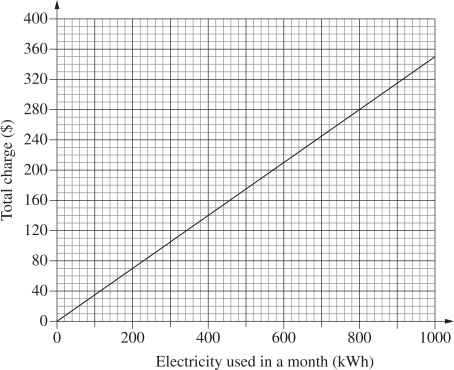
Electricity provider \(A\) charges 25 cents per kilowatt hour (kWh) for electricity, plus a fixed monthly charge of $40.

  1. Complete the table showing Provider \(A\) 's monthly charges for different levels of electricity usage.   (1 mark)

\begin{array} {|l|c|}
\hline
\rule{0pt}{2.5ex} \text{Electricity used in a month (kWh)} \rule[-1ex]{0pt}{0pt} & \ \ \ \ \ 0\ \ \ \ \  & \ \ \ 400\ \ \  & \ \ 1000\ \  \\
\hline
\rule{0pt}{2.5ex} \text{Monthly charge (\$)} \rule[-1ex]{0pt}{0pt} & 40 & & 290 \\
\hline
\end{array}

Provider \(B\) charges 35 cents per kWh, with no fixed monthly charge. The graph shows how Provider \(B\) 's charges vary with the amount of electricity used in a month.

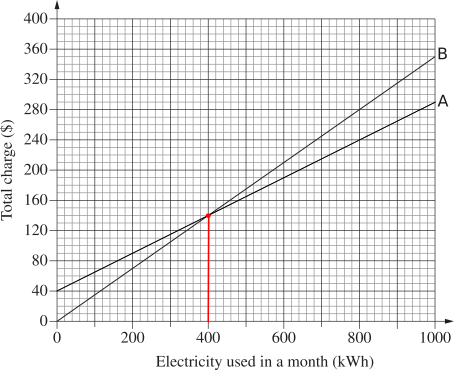
  1. On the grid on above, graph Provider A's charges from the table in part (a).   (1 mark)
  2. Use the two graphs to determine the number of kilowatt hours per month for which Provider \(A\) and Provider \(B\) charge the same amount.   (1 mark)

    --- 2 WORK AREA LINES (style=lined) ---

  3. A customer uses an average of 800 kWh per month.
  4. Which provider, \(A\) or \(B\), would be the cheaper option and by how much?   (2 marks)

    --- 5 WORK AREA LINES (style=lined) ---

Show Answers Only

a.   

\begin{array} {|l|c|}
\hline
\rule{0pt}{2.5ex} \text{Electricity used in a month (kWh)} \rule[-1ex]{0pt}{0pt} & \ \ \ \ \ 0\ \ \ \ \  & \ \ \ 400\ \ \  & \ \ 1000\ \  \\
\hline
\rule{0pt}{2.5ex} \text{Monthly charge (\$)} \rule[-1ex]{0pt}{0pt} & 40 & \textbf{140} & 290 \\
\hline
\end{array}

b.

c.    \(400\text{ kWh}\)

d.    \(A\text{ is cheaper by }$40.\)

Show Worked Solution

a.   

\begin{array} {|l|c|}
\hline
\rule{0pt}{2.5ex} \text{Electricity used in a month (kWh)} \rule[-1ex]{0pt}{0pt} & \ \ \ \ \ 0\ \ \ \ \  & \ \ \ 400\ \ \  & \ \ 1000\ \  \\
\hline
\rule{0pt}{2.5ex} \text{Monthly charge (\$)} \rule[-1ex]{0pt}{0pt} & 40 & \textbf{140} & 290 \\
\hline
\end{array}

b.   


♦♦ Mean mark (b) 40%.

c.    \(\text{Same charge when Provider }A = \text{Provider } B \text{ i.e. where the lines intersect}\)

\(=400\text{ kWh (see graph above)}\)

d.    \(\text{When kWh}= 800, \ \ A=$240 \text{ and } B=$280\)

\(\therefore A\text{ is cheaper by }$40.\)

Filed Under: A3 Types of Relationships (Y12), Simultaneous Linear Equations Tagged With: Band 4, Band 5, smc-1099-20-Other SE applications, smc-6839-20-Other SE Applications, std2-std1-common

Algebra, STD1 A3 2021 HSC 29

In a park the only animals are goannas and emus. Let `x` be the number of goannas and let `y` be the number of emus.

The number of goannas plus the number of emus in the park is 31. Hence  `x + y = 31`.

Each goanna has four legs and each emu has two legs. In total the emus and goannas have 76 legs.

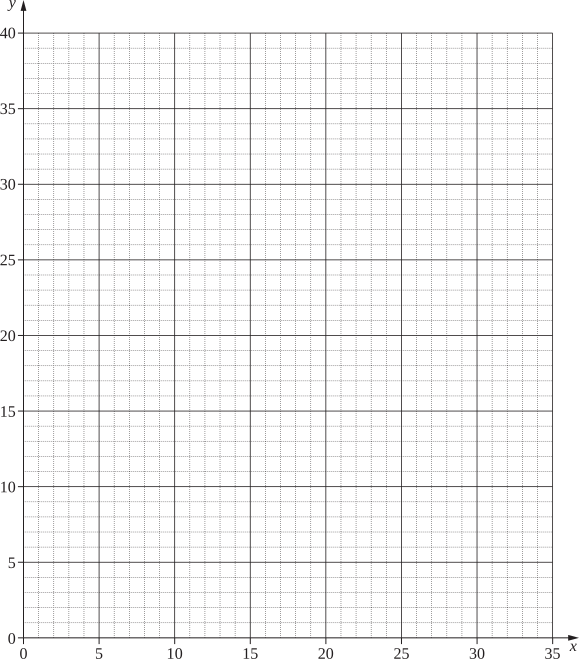
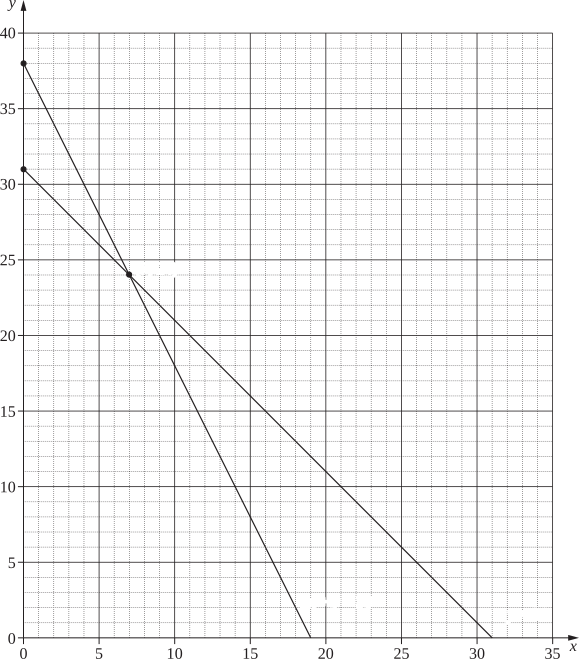
By writing another relevant equation and graphing both equations on the grid, find the number of goannas and the number of emus in the park.   (4 marks)

--- 6 WORK AREA LINES (style=lined) ---


Number of goannas = _______________

Number of emus = _________________

Show Answers Only

`text{7 goannas, 24 emus}`

Show Worked Solution

`text{Total goanna legs} = 4x`

♦♦♦ Mean mark 8%.

`text{Total emu legs} = 2y`

`text{Total legs} = 76`

`4x + 2y` `= 76`  
`2x + y` `= 38\ \ …\ (1)`  
`x + y` `= 31\ \ …\ (2)`  


`text{Number of goannas}\ (x) = 7`

`text{Number of emus}\ (y) = 24`

Filed Under: A3 Types of Relationships (Y12), Simultaneous Linear Equations Tagged With: Band 6, smc-1099-20-Other SE applications, smc-1099-30-Find intersection, smc-1099-40-Sketch equations, smc-6839-20-Other SE Applications, smc-6839-30-Find Intersection

Algebra, STD1 A3 2020 HSC 29

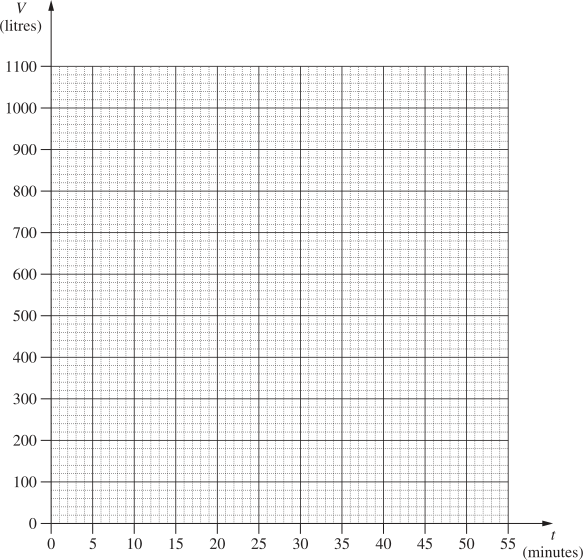
There are two tanks on a property, Tank A and Tank B. Initially, Tank A holds 1000 litres of water and Tank B is empty.

  1. Tank A begins to lose water at a constant rate of 20 litres per minute.


    The volume of water in Tank A is modelled by  `V = 1000-20t`  where `V` is the volume in litres and  `t`  is the time in minutes from when the tank begins to lose water.


    On the grid below, draw the graph of this model and label it as Tank A.   (1 mark)


  2. Tank B remains empty until  `t=15`  when water is added to it at a constant rate of 30 litres per minute.
    By drawing a line on the grid (above), or otherwise, find the value of  `t`  when the two tanks contain the same volume of water.   (2 marks)
  3. Using the graphs drawn, or otherwise, find the value of  `t`  (where  `t > 0`) when the total volume of water in the two tanks is 1000 litres.   (1 mark)

    --- 2 WORK AREA LINES (style=lined) ---

Show Answers Only

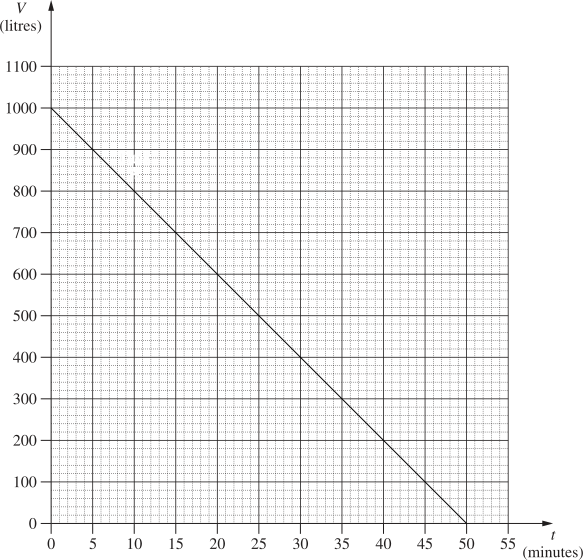
 a.    `text{T} text{ank} \ A \ text{will pass trough (0, 1000) and (50, 0)}` 


b.    `29 \ text{minutes}`

c.    `45 \ text{minutes}`

Show Worked Solution

a.    `text{T} text{ank} \ A \ text{will pass trough (0, 1000) and (50, 0)}`

♦ Mean mark part (a) 45%.


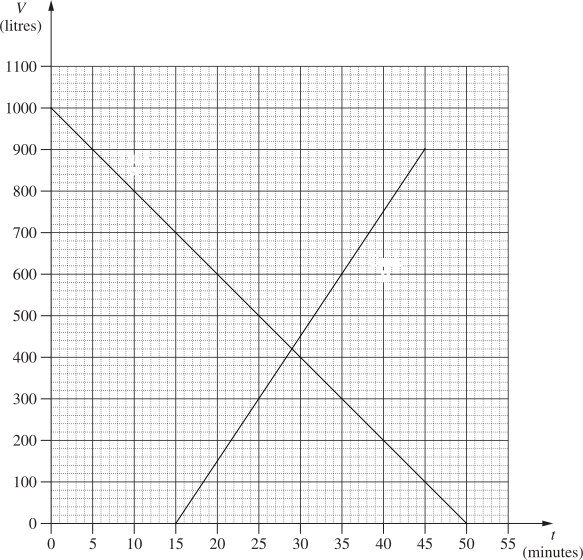
b.    `text{T} text{ank} \ B \ text{will pass through (15, 0) and (45, 900)}`

♦♦ Mean mark part (b) 24%.


`text{By inspection, the two graphs intersect at} \ \ t = 29 \ text{minutes}`

 
c.    `text{Strategy 1}`

♦♦♦ Mean mark part (c) 5%.

`text{By inspection of the graph, consider} \ \ t = 45`

`text{T} text{ank A} = 100 \ text{L} , \ text{T} text{ank B} =900 \ text{L} `

`:.\ text(Total volume = 1000 L when  t = 45)`
  

`text{Strategy 2}`

`text{Total Volume}` `=text{T} text{ank A} + text{T} text{ank B}`
`1000` `= 1000-20t + (t-15) xx 30`
`1000` `= 1000-20t + 30t-450 `
`10t` `= 450`
`t` `= 45 \ text{minutes}`

Filed Under: A3 Types of Relationships (Y12), Simultaneous Linear Equations Tagged With: Band 5, Band 6, smc-1099-20-Other SE applications, smc-1099-40-Sketch equations, smc-6839-20-Other SE Applications

Algebra, STD2 A4 EQ-Bank 26

Temperature can be measured in degrees Celsius (`C`) or degrees Fahrenheit (`F`).

The two temperature scales are related by the equation  `F = (9C)/5 + 32`.

  1. Calculate the temperature in degrees Fahrenheit when it is `-20` degrees Celsius.   (1 mark)

    --- 2 WORK AREA LINES (style=lined) ---

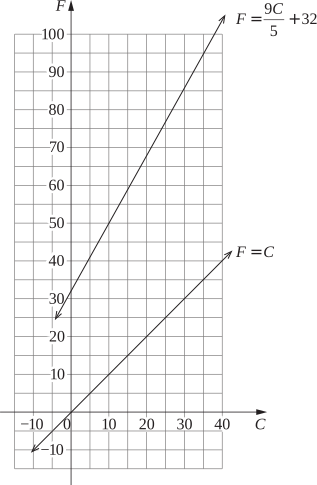
  2. The following two graphs are drawn on the axes below:
     
           `F = (9C)/5 + 32`  and  `F = C`


    Explain what happens at the point where the two graphs intersect.   (1 mark)

    --- 2 WORK AREA LINES (style=lined) ---

Show Answers Only

a.    `-4^@F`

b.    `text(The two graphs intersect at a temperature where)`

`text(Celsius and Fahrenheit are the same.)`

Show Worked Solution

a.    `F= (9xx(-20))/5 + 32=-4^@F`

b.    `text(The two graphs intersect at a temperature where)`

`text(Celsius and Fahrenheit are the same.)`

Filed Under: A3 Types of Relationships (Y12), Simultaneous Equations and Applications, Simultaneous Linear Equations, Simultaneous Linear Equations Tagged With: Band 3, Band 5, smc-1099-20-Other SE applications, smc-6839-20-Other SE Applications, smc-6920-15-Other SE Applications, smc-794-15-Other SE Applications

Copyright © 2014–2026 SmarterEd.com.au · Log in