SmarterEd

Aussie Maths & Science Teachers: Save your time with SmarterEd

  • Login
  • Get Help
  • About

Networks, STD2 N3 2025 HSC 19

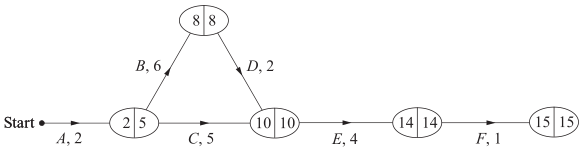
The activities and corresponding durations in days for a project are shown in the network diagram.
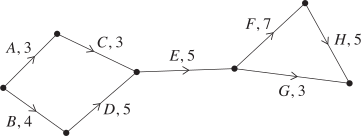


  1. Complete the table showing the immediate prerequisites for each activity. Indicate with an \(\text{X}\) any activities without any immediate prerequisites.   (2 marks)

\begin{array} {|c|c|}
\hline
\rule{0pt}{2.5ex} \text{Activity} \rule[-1ex]{0pt}{0pt} & \text{Immediate prerequisite(s)} \\
\hline
\rule{0pt}{2.5ex} B \rule[-1ex]{0pt}{0pt} &  \\
\hline
\rule{0pt}{2.5ex} E \rule[-1ex]{0pt}{0pt} &  \\
\hline
\rule{0pt}{2.5ex} F \rule[-1ex]{0pt}{0pt} &  \\
\hline
\end{array}

  1. Find the critical path for this project AND state the minimum duration for the project.   (2 marks)

--- 4 WORK AREA LINES (style=lined) ---

  1. The duration of activity \( A \) is increased by 2. Does this affect the critical path for the project? Give a reason for your answer.   (1 mark)

--- 4 WORK AREA LINES (style=lined) ---

Show Answers Only

a.           

\begin{array} {|c|c|}
\hline
\rule{0pt}{2.5ex} \text{Activity} \rule[-1ex]{0pt}{0pt} & \text{Immediate prerequisite(s)} \\
\hline
\rule{0pt}{2.5ex} B \rule[-1ex]{0pt}{0pt} & \text{X} \\
\hline
\rule{0pt}{2.5ex} E \rule[-1ex]{0pt}{0pt} & C,D \\
\hline
\rule{0pt}{2.5ex} F \rule[-1ex]{0pt}{0pt} & E \\
\hline
\end{array}

  
b.   \(\text{Critical Path:}\ BDEFH\)
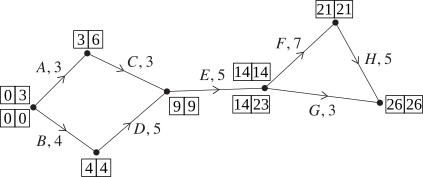
\(\text{Minimum Duration}\ =4+5+5+7+5=26\ \text{days}\)
 

c.   \(\text{If duration of activity \(A\) is increased by 2:}\)

\(\text{The critical path remains unchanged (EST of activity \(E\) remains = 9)}\)
Show Worked Solution

a.   

\begin{array} {|c|c|}
\hline
\rule{0pt}{2.5ex} \text{Activity} \rule[-1ex]{0pt}{0pt} & \text{Immediate prerequisite(s)} \\
\hline
\rule{0pt}{2.5ex} B \rule[-1ex]{0pt}{0pt} & \text{X} \\
\hline
\rule{0pt}{2.5ex} E \rule[-1ex]{0pt}{0pt} & C,D \\
\hline
\rule{0pt}{2.5ex} F \rule[-1ex]{0pt}{0pt} & E \\
\hline
\end{array}

  
b.   

\(\text{Critical Path:}\ BDEFH\)

\(\text{Minimum Duration}\ =4+5+5+7+5=26\ \text{days}\)
 

c.   \(\text{If duration of activity \(A\) is increased by 2:}\)

\(\text{The critical path remains unchanged (EST of activity \(E\) remains = 9)}\)
♦ Mean mark (c) 46%.

Filed Under: Critical Path Analysis (Y12), Critical Paths Tagged With: Band 3, Band 4, Band 5, smc-6916-30-Scanning Both Ways, smc-916-30-Scanning Both Ways

Networks, STD2 N3 2024 HSC 39

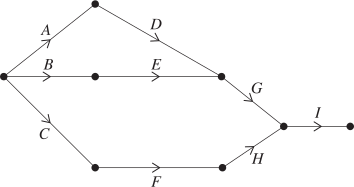
A project involving nine activities is shown in the network diagram.

The duration of each activity is not yet known.
 

The following table gives the earliest start time (EST) and latest start time (LST) for three of the activities. All times are in hours.

\begin{array} {|c|c|c|}
\hline
\rule{0pt}{2.5ex} \textit{Activity} \rule[-1ex]{0pt}{0pt} & EST & LST \\
\hline
\rule{0pt}{2.5ex} A \rule[-1ex]{0pt}{0pt} & \ \ \ \ \ \ 0\ \ \ \ \ \  & \ \ \ \ \ \ 2\ \ \ \ \ \  \\
\hline
\rule{0pt}{2.5ex} C \rule[-1ex]{0pt}{0pt} & 0 & 1 \\
\hline
\rule{0pt}{2.5ex} I \rule[-1ex]{0pt}{0pt} & 12 & 12 \\
\hline
\end{array}

  1. What is the critical path?   (1 mark)

    --- 2 WORK AREA LINES (style=lined) ---

  2. The minimum time required for this project to be completed is 19 hours.
  3. What is the duration of activity \(I\)?   (1 mark)

    --- 2 WORK AREA LINES (style=lined) ---

  4. The duration of activity \(C\) is 3 hours.
  5. What is the maximum amount of time that could occur between the start of activity \(F\) and the end of activity \(H\)?   (1 mark)

    --- 2 WORK AREA LINES (style=lined) ---

Show Answers Only

a.   \(\text{Critical Path:}\ BEGI\)

b.   \(\text{Duration of}\ I =7\ \text{hours}\)

c.  \(\text{Max time}\ =8\ \text{hours}\)

Show Worked Solution

a.   \(\text{Activity}\ A\ \text{and}\ C: \ LST \gt EST\)

\(\Rightarrow\ \text{Activity}\ A\ \text{and}\ C\ \text{not on critical path.}\)

\(\text{Critical Path:}\ BEGI\)
 

♦ Mean mark (a) 43%.

b.   \(\text{Duration of}\ I = 19-12=7\ \text{hours}\)
 

c.   \(\text{Since}\ C + F + H + I\ \text{is not a critical path:}\)

\(C + F + H + I = 18\ \text{or less (C.P. = 19 hours)}\)

\(3+F+H+7 = 18\ \text{or less}\)

\(\Rightarrow\ F+H = 8\ \text{or less}\)

\(\therefore\ \text{Max time from start of}\ F\ \text{to end of}\ H = 8\ \text{hours}\)

♦♦♦ Mean mark (c) 10%.

Filed Under: Critical Path Analysis (Y12), Critical Paths Tagged With: Band 4, Band 5, Band 6, smc-6916-20-Forward Scanning, smc-6916-30-Scanning Both Ways, smc-916-20-Forward Scanning, smc-916-30-Scanning Both Ways

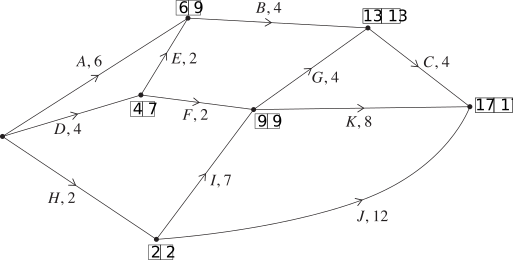
Networks, STD2 N3 2023 HSC 31

A function centre employs staff so that all necessary tasks can be completed between the end of one function and the beginning of the next function.

The network diagram shows the time taken in hours for the tasks that need to be completed.


  1. Find the TWO critical paths.   (2 marks)

    --- 4 WORK AREA LINES (style=lined) ---

  2. The function centre wants to decrease the length of each critical path by 3 hours. They can do this by hiring more staff to do ONE of the tasks so it takes less time to complete.
  3. For which task should the centre hire more staff, and how long should that task take to ensure all tasks can be completed in 14 hours?   (2 marks) 

    --- 4 WORK AREA LINES (style=lined) ---

Show Answers Only

a.    `HIGC and HIK`

b.    `text{More staff should be hired for task}\ I.`

`text{By decreasing task}\ I\ text{by 3 hours (so it takes 4 hours), the}`

`text{critical path of the network reduces to 14 hours.}`

Show Worked Solution

a.    `text{Scanning both ways:}`
 

`text{Critical paths:}\ HIGC and HIK`

♦ Mean mark (a) 46%.

 
b. 
   `text{More staff should be hired for task}\ I.`

`text{By decreasing task}\ I\ text{by 3 hours (so it takes 4 hours), the}`

`text{critical path of the network reduces to 14 hours.}`

Mean mark (b) 52%.

Filed Under: Critical Path Analysis (Y12), Critical Paths Tagged With: Band 4, Band 5, smc-6916-30-Scanning Both Ways, smc-6916-40-Critical Path Adjustments, smc-916-30-Scanning Both Ways, smc-916-40-Critical Path Adjustments

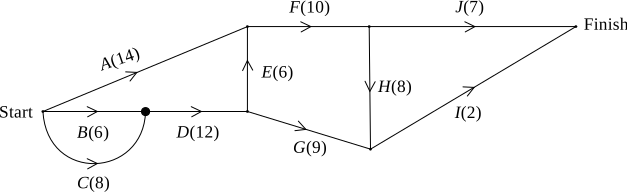
Networks, STD2 N3 2020 HSC 26

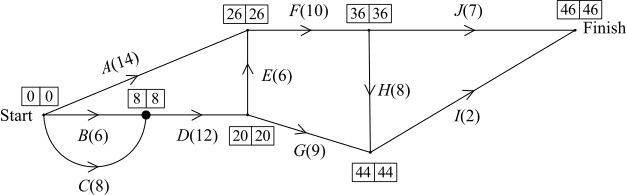
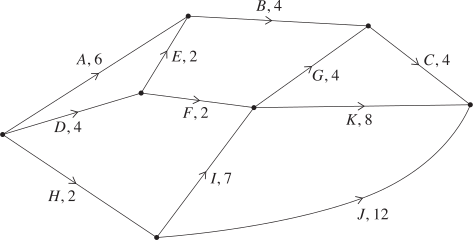
The preparation of a meal requires the completion of all activities `A` to `J`. The network diagram shows the activities and their completion times in minutes.


  1. What is the minimum time needed to prepare the meal?   (1 mark)

    --- 1 WORK AREA LINES (style=lined) ---

  2. List the activities which make up the critical path for this network.   (2 marks)

    --- 5 WORK AREA LINES (style=lined) ---

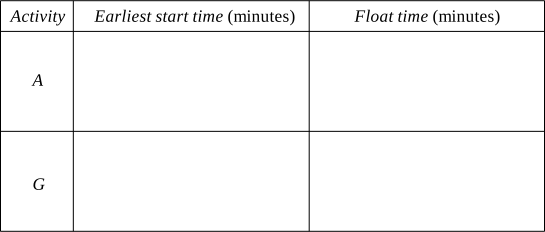
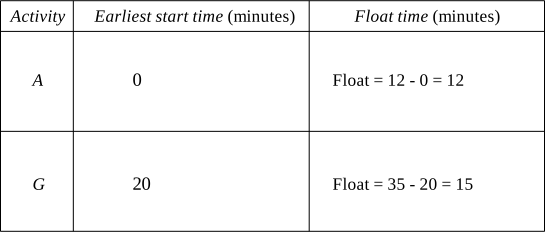
  3. Complete the table below, showing the earliest start time and float time for activities `A` and `G`   (2 marks)
     

    --- 0 WORK AREA LINES (style=lined) ---

Show Answers Only

a.    `46 \ text{minutes}`

b.    `C – D – E – F – H – I`

c.   

Show Worked Solution

a.     `text{Scan forwards and backwards (to answer all parts):}`

♦♦ Mean mark part (a) 31%.


`text{Minimum time} = 46 \ text{minutes}`
 

b.     `C – D – E – F – H – I`

Mean mark part (b) 51%.


c.  `text{Scan backwards (see above):}`

♦♦ Mean mark part (c) 22%.
  

Filed Under: Critical Path Analysis (Y12), Critical Paths Tagged With: Band 5, smc-6916-30-Scanning Both Ways, smc-916-30-Scanning Both Ways

Networks, STD2 N3 2019 FUR2-N 2

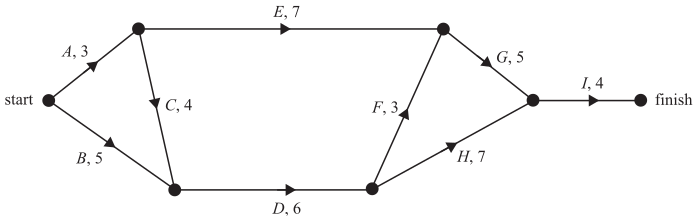
The construction of the new reptile exhibit is a project involving nine activities, `A` to `I`.

The directed network below shows these activities and their completion times in weeks.


  1. Which activities have more than one immediate predecessor?   (1 mark)

    --- 1 WORK AREA LINES (style=lined) ---

  2. Write down the critical path for this project.   (1 mark)

    --- 1 WORK AREA LINES (style=lined) ---

  3. What is the latest start time, in weeks, for activity `B`?   (1 mark)

    --- 2 WORK AREA LINES (style=lined) ---

Show Answers Only

a.    `D, G and I`

b.    `text(See Worked Solutions)`

c.    `2\ text(weeks)`

Show Worked Solution

a.   `D, G and I`
  

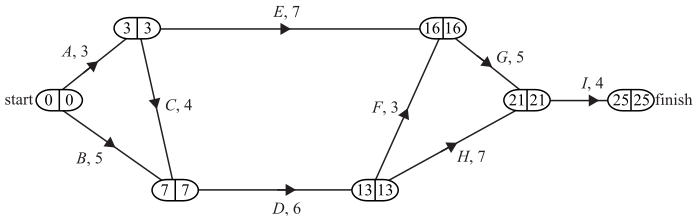
b.   `text(Scanning forwards and backwards:)`
 

​
 

`text(Critical Path:)\ ACDFGI`
  

c.    `text{LST (activity}\ B text{)}=7-5=2\ text(weeks)`

Filed Under: Critical Path Analysis (Y12), Critical Paths Tagged With: Band 3, Band 4, smc-6916-30-Scanning Both Ways, smc-916-30-Scanning Both Ways

Networks, STD2 N3 2019 HSC 26

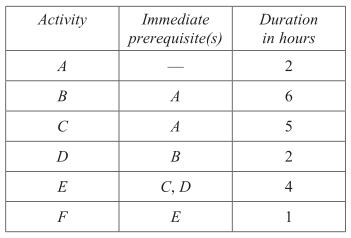
A project requires activities `A` to `F` to be completed. The activity chart shows the immediate prerequisite(s) and duration for each activity.

  1. By drawing a network diagram, determine the minimum time for the project to be completed.   (3 marks)

    --- 8 WORK AREA LINES (style=lined) ---

  2. Determine the float time of the non-critical activity.   (1 mark)

    --- 2 WORK AREA LINES (style=lined) ---

Show Answers Only

a.    `text(15 hours)`

b.    `text(3 hours)`

Show Worked Solution
a.    


`text(Scanning forwards:)`

`text(Minimum time = 2 + 6 + 2 + 4 + 1 = 15 hours)`

`text{(Scanning forwards and backwards is highly recommended but not}`

 `text{required in the network diagram.)}`


b.    `text(Critical Path is)\ ABDEF.`

♦♦ Mean mark 30%.

`text(Non-critical activity is)\ C.`

`text(Float time)=5-2=3\ text(hours)`

Filed Under: Critical Path Analysis (Y12), Critical Paths Tagged With: Band 4, Band 5, smc-6916-10-Precedence Tables, smc-6916-30-Scanning Both Ways, smc-916-10-Table to Network, smc-916-30-Scanning Both Ways

Networks, STD2 N3 EQ-Bank 32

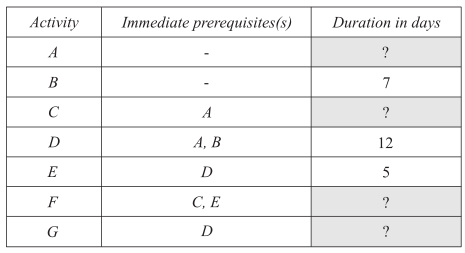
An engineering project requires activities `A` to `G` to be completed, as shown in the table.


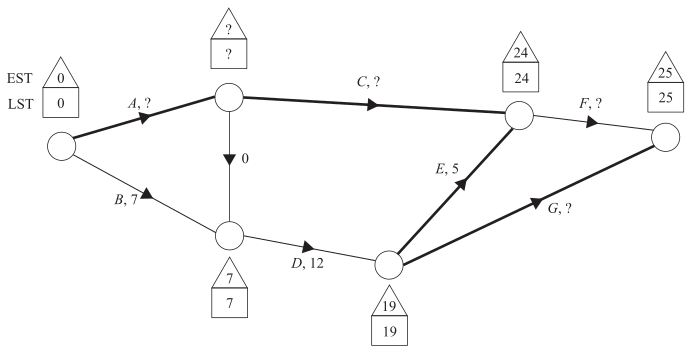
The minimum completion time for the project is 25 days and the critical path includes activities `B, D, E` and `F`. The float for activity `G` is two days and the float for activity `C` is four days.

Find the possible duration for each of the activities `A, C, F` and `G`. Include a network diagram in your answer.   (5 marks)

Show Answers Only

`text(Duration of)\ F = 1\ text(day)`

`text(Duration of)\ G = 4\ text(days)`

`text(*Understand why there are many possibilities for the duration of)`

`A and C, text(provided they add up to 20 days and)\ A\ text(is not longer)`

`text{than 7 days (or a new critical path is created)}.`

Show Worked Solution

`text(Sketch the network:)`
 

`text{Critical path information included in the network (where EST = LST)}`

`F\ text(is on critical path)rightarrow text(no float)`

`:.\ text(Duration of)\ F=  25-24 = 1\ text(day)`


`text(Duration of)\ G` `=\ text(LST of next activity − EST of)\ G-text(float)`
  `= 25-19-2= 4\ text(days)`


`text(The float of)\ C\ text{is 4 days (given)}`

`:.\ text(Duration of)\ C` `=\ text(LST of)\ F-text(EST of)\ C-4`
  `= 24-text(EST of)\ C-4`
  `= 20-text(EST of)\ C`


`text(EST of)\ C =\ text(Duration of)\ A\ \ (A\ text(has no prerequisites))`

`=>\ text(Duration of)\ A +\ text(Duration of)\ C = 20\ text(days)`

`:.\ text(Possible durations of)\ A\ text(and)\ C\ text(are:)`

`A = 5\ text(days), C = 15\ text(days)`
 

`text(*Understand why there are many possibilities for the duration of)`

`A and C, text(provided they add up to 20 days and)\ A\ text(is not longer)`

`text{than 7 days (or a new critical path is created)}.`

Filed Under: Critical Path Analysis (Y12), Critical Paths Tagged With: Band 5, smc-6916-10-Precedence Tables, smc-6916-30-Scanning Both Ways, smc-6916-50-Dummy Activity, smc-916-10-Table to Network, smc-916-30-Scanning Both Ways, smc-916-50-Dummy Activity

Networks, STD2 N3 EQ-Bank 31

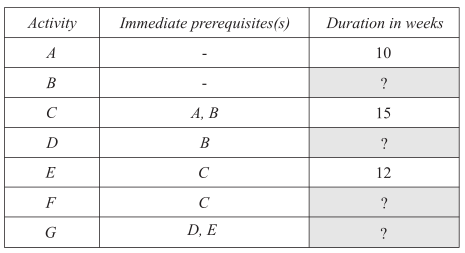
An engineering project requires activities `A` to `G` to be completed, as shown in the table.


The minimum completion time for the project is 40 weeks and the critical path includes activities `A, C, E` and `G`. The float for activity `F` is six weeks and the float for activity `D` is 9 weeks.

Find the possible duration for each of the activities `B, D, F` and `G`. Include a network diagram in your answer.   (5 marks)

Show Answers Only


`text(Duration of)\ G = 3\ text(weeks)`

`text(Duration of)\ F = 9\ text(weeks)`

`text(There are many possibilities for the duration of)\ B and D`

`text(provided they add up to 28 weeks and)\ B\ text(is not longer)`

`text{than 10 weeks (new critical path)}.`

Show Worked Solution

`text(Sketch network:)`

`text{Critical path added to network (where EST = LST)}`

`G\ text(is on critical path ⇒ no float)`

`:.\ text(Duration of)\ G = 40-37 = 3\ text(weeks)`


`text(Duration of)\ F` `=40- text(EST of)\ F-text(float)`
  `= 40-25-6= 9\ text(weeks)`


`text(Float of)\ D = 9\ text{weeks (given)}`

`:.\ text(Duration of)\ D` `=\ text(LST of)\ G-\ text(EST of)\ D-9`
  `= 37-\ text(EST of)\ D-9`
  `= 28-\ text(EST of)\ D`


`text(EST of)\ D =\ text(Duration of)\ B\ \ \ (B\ text(has no prerequisites))`

`text(Duration of)\ B +\ text(Duration of)\ D = 28\ text(weeks)`

`:.\ text(Possible durations of)\ B\ text(and)\ D\ text(are:)`

`B = 1\ text(week), D = 27\ text(weeks)`


`text(*Understand why there are many possibilities for the duration of)`

`B and D, text(provided they add up to 28 weeks and)\ B\ text(is not longer)`

`text{than 10 weeks (or a new critical path is created)}.`

Filed Under: Critical Path Analysis (Y12), Critical Paths Tagged With: Band 5, smc-6916-10-Precedence Tables, smc-6916-30-Scanning Both Ways, smc-6916-50-Dummy Activity, smc-916-10-Table to Network, smc-916-30-Scanning Both Ways, smc-916-50-Dummy Activity

Networks, STD2 N3 2007 FUR2 4

A community centre is to be built on the new housing estate.

Nine activities have been identified for this building project.

The directed network below shows the activities and their completion times in weeks.


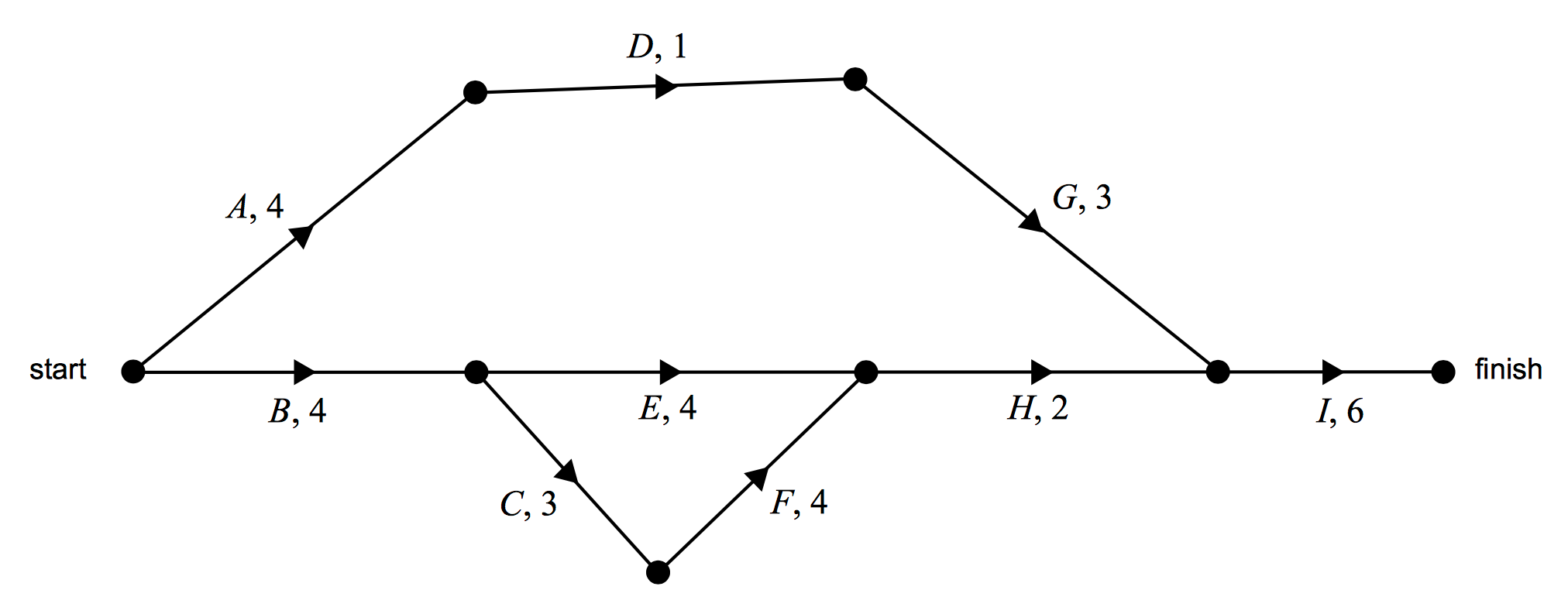
  1. Determine the minimum time, in weeks, to complete this project.   (1 mark)

    --- 1 WORK AREA LINES (style=lined) ---

  2. Determine the float time, in weeks, for activity `D`.   (2 marks)

    --- 4 WORK AREA LINES (style=lined) ---

The builders of the community centre are able to speed up the project.

Some of the activities can be reduced in time at an additional cost.

The activities that can be reduced in time are `A, C, F, E` and `G`.

  1. Which of these activities, if reduced in time individually, would not result in an earlier completion of the project?   (1 mark)

    --- 2 WORK AREA LINES (style=lined) ---

The owner of the estate is prepared to pay the additional cost to achieve early completion.

The cost of reducing the time of each activity is $5000 per week.

The maximum reduction in time for each one of the five activities, `A, C, E, F, G`, is 2 weeks.

  1. Determine the minimum time, in weeks, for the project to be completed now that certain activities can be reduced in time.   (1 mark)

    --- 1 WORK AREA LINES (style=lined) ---

  2. Determine the minimum additional cost of completing the project in this reduced time.   (1 mark)

    --- 1 WORK AREA LINES (style=lined) ---

Show Answers Only

a.   `19\ text(weeks)`

b.    `5\ text(weeks)`

c.    `A, E, G`

d.    `text(15 weeks)`

e.    `$25\ 000`

Show Worked Solution

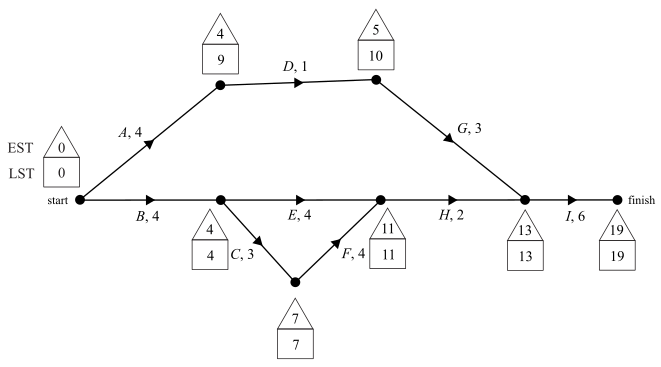
a.    `text(Scanning forwards and backwards:)`


`BCFHI\ \ text(is the critical path.)`

♦ Mean mark of all parts (combined) 40%.

`:.\ text(Minimum time)= 4 + 3 + 4 + 2 + 6= 19\ text(weeks)`

  
b.    `text(EST of)\ D=4`

`text(LST of)\ D=9`

`:.\ text(Float time of)\ D= 9-4= 5\ text(weeks)`
  

c.    `A, E,\ text(and)\ G\ text(are not currently on the critical path,)`

`text(therefore reducing their time will not result in an)`

`text(earlier completion time.)`
 

d.    `text(Reduce)\ C\ text(and)\ F\ text(by 2 weeks each.)`

`text(However, a new critical path created:)\ BEHI\ \ text{(16 weeks)}`

`:.\ text(Also reduce)\ E\ text(by 1 week.)`

`:.\ text(Minimum completion time = 15 weeks)`

  
e.    `text(Additional cost)= 5 xx $5000= $25\ 000`

Filed Under: Critical Path Analysis (Y12), Critical Paths Tagged With: Band 4, Band 5, Band 6, smc-6916-30-Scanning Both Ways, smc-916-30-Scanning Both Ways

Copyright © 2014–2026 SmarterEd.com.au · Log in