SmarterEd

Aussie Maths & Science Teachers: Save your time with SmarterEd

  • Login
  • Get Help
  • About

Algebra, STD2 A4 2019 HSC 31

A rectangle has width `w` centimetres. The area of the rectangle, `A`, in square centimetres, is  `A = 2w^2 + 5w`.

The graph  `A = 2w^2 + 5w`  is shown.
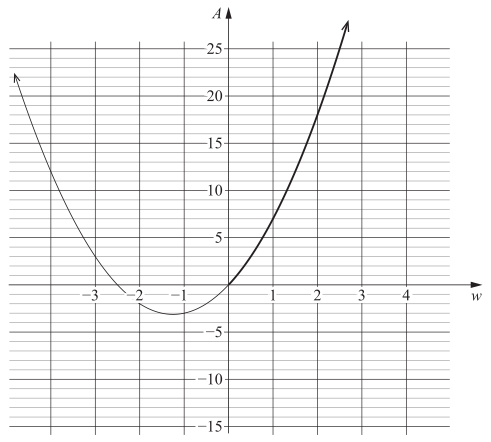
 

  1. Explain why, in this context, the model  `A = 2w^2 + 5w`  only makes sense for the bold section of the graph.   (1 mark)

    --- 2 WORK AREA LINES (style=lined) ---

  2. The area of the rectangle is 18 cm². Calculate the perimeter of the rectangle.   (2 marks)

    --- 4 WORK AREA LINES (style=lined) ---

Show Answers Only

a.    `text(The width of a rectangle cannot be negative.)`

b.    `22\ text(cm)`

Show Worked Solution

a.    `text(The width of a rectangle cannot be negative.)`

♦ Mean mark (a) 44%.
  

b.    `text(When)\ A = 18, w = 2`

♦ Mean mark (b) 42%.

`text(Let)\ h =\ text(height of rectangle)`

`18` `= 2 xx h`
`h` `= 9\ text(cm)`

  
`:.\ text(Perimeter)= 2 xx (2 + 9)= 22\ text(cm)`

Filed Under: Non-Linear: Exponential/Quadratics, Quadratic Relationships Tagged With: Band 5, smc-6922-20-Practical Problems, smc-6922-50-Model Limitations, smc-830-20-Quadratics, smc-830-50-Limitations

Algebra, STD2 A4 2009 HSC 28a

Anjali is investigating stopping distances for a car travelling at different speeds. To model this she uses the equation

`d = 0.01s^2+ 0.7s`,

where `d` is the stopping distance in metres and `s` is the car’s speed in km/h.

The graph of this equation is drawn below.

2009 28a

  1. Anjali knows that only part of this curve applies to her model for stopping distances.


    In your writing booklet, using a set of axes, sketch the part of this curve that applies for stopping distances.   (1 mark)

  2. What is the difference between the stopping distances in a school zone when travelling at a speed of 40 km/h and when travelling at a speed of 70 km/h?   (2 marks)

    --- 4 WORK AREA LINES (style=lined) ---

Show Answers Only

 a.    
        2UG-2009-28a-Answer

b.    `54\ text(metres)`

Show Worked Solution
a.   

2UG-2009-28a-Answer

b.    `text(When)\ \ s = 40:`

♦ Mean mark 41%
COMMENT: Students could easily have used the graph for calculating part (b).

`d= 0.01(40^2)+ 0.7 (40)= 44\ text(m)`

`text(When)\ \ s = 70:`

`d= 0.01 (70^2) +0.7(70)= 98\ text(m)`
 

`:.\ text(Difference)= 98-44= 54\ text(metres)`

Filed Under: Exponential/Quadratic (Projectile), Non-Linear: Exponential/Quadratics, Quadratic Relationships Tagged With: Band 4, Band 5, smc-6922-20-Practical Problems, smc-6922-50-Model Limitations, smc-830-20-Quadratics

Algebra, STD2 A4 2012 HSC 30b

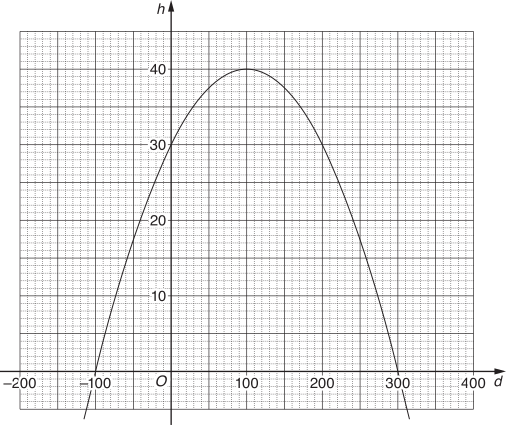
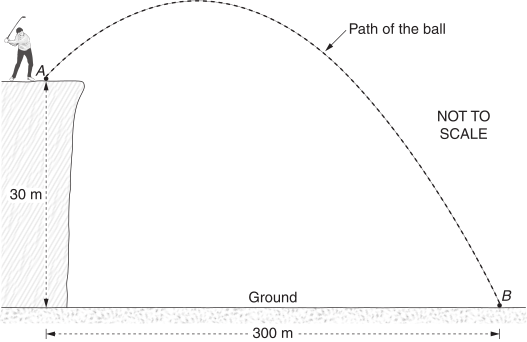
A golf ball is hit from point `A` to point `B`, which is on the ground as shown. Point `A` is 30 metres above the ground and the horizontal distance from point `A` to point `B` is  300 m.
 

The path of the golf ball is modelled using the equation 

`h = 30 + 0.2d-0.001d^2` 

where 

`h` is the height of the golf ball above the ground in metres, and 

`d` is the horizontal distance of the golf ball from point `A` in metres.

The graph of this equation is drawn below.


  1. What is the maximum height the ball reaches above the ground?   (1 mark)

    --- 1 WORK AREA LINES (style=lined) ---

  2. There are two occasions when the golf ball is at a height of 35 metres.


    What horizontal distance does the ball travel in the period between these two occasions?   (1 mark)

    --- 2 WORK AREA LINES (style=lined) ---

  3. What is the height of the ball above the ground when it still has to travel a horizontal distance of 50 metres to hit the ground at point `B`?   (1 mark)

    --- 2 WORK AREA LINES (style=lined) ---

  4. Only part of the graph applies to this model.
  5. Find all values of `d` that are not suitable to use with this model, and explain why these values are not suitable.   (2 marks)

    --- 4 WORK AREA LINES (style=lined) ---
Show Answers Only

a.    `40 text(m)`

b.    `140 text(m)`

c.    `text(17.5 m)`

d.    `d < 0\ text(and)\ d>300`

Show Worked Solution

a.    `text(Max height) = 40 text(m)`
 

b.    `text(From graph:)`

`h = 35\ text(when)\ \ x = 30\ \ text(and)\ \ x = 170`

`:.\ text(Horizontal distance)= 170-30= 140\ text(m)`
 

c.    `text(Ball hits ground at)\ \ x = 300`

MARKER’S COMMENT: Responses for (c) in the range  `17<=\ h\ <=18`  were deemed acceptable.

`text(Find)\ y\ text(when)\ \ x = 250:`

`text(From graph,)\ y = 17.5\ text(m)`

`:.\ text(Height of ball is 17.5 m at a horizontal distance of 50 m before)\ B.`
 

d.    `text(Values of)\ d\ text(not suitable:)`

♦♦♦ Mean mark (d) 12%
MARKER’S COMMENT: Many students did not refer to the domain `d>300` as unsuitable to the model.

`text(If)\ d < 0 text(, it assumes the ball is hit away from point)\ B.`

`\text{This is not the case in our example.}`
 

`text(If)\ d > 300 text(,)\ h\ text(becomes negative which is not possible)`

`\text(– i.e. the ball cannot go below ground level.)`

Filed Under: Exponential/Quadratic (Projectile), Non-Linear: Exponential/Quadratics, Quadratic Relationships, Quadratics Tagged With: Band 2, Band 4, Band 6, num-title-ct-coreb, num-title-qs-hsc, page-break-before-question, smc-4443-60-Projectiles, smc-6922-20-Practical Problems, smc-6922-50-Model Limitations, smc-830-20-Quadratics, smc-830-50-Limitations

Copyright © 2014–2026 SmarterEd.com.au · Log in