SmarterEd

Aussie Maths & Science Teachers: Save your time with SmarterEd

  • Login
  • Get Help
  • About

Calculus, 2ADV C4 2023 HSC 32

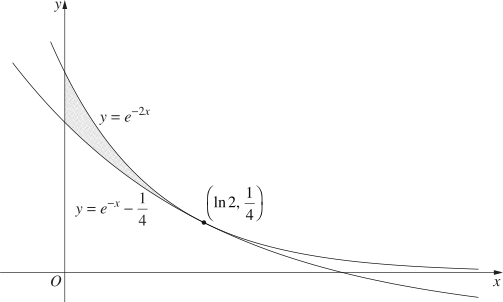
The curves  \(y=e^{-2 x}\)  and  \(y=e^{-x}-\dfrac{1}{4}\)  intersect at exactly one point as shown in the diagram. The point of intersection has coordinates \(\left(\ln 2, \dfrac{1}{4}\right)\). (Do NOT prove this.)
 

  1. Show that the area bounded by the two curves and the \(y\)-axis, as shaded in the diagram, is  \(\dfrac{1}{4} \ln 2-\dfrac{1}{8}\).   (3 marks)

    --- 7 WORK AREA LINES (style=lined) ---

  2. Find the values of \(k\) such that the curves  \(y=e^{-2 x}\)  and  \(y=e^{-x}+k\)  intersect at two points.   (3 marks)

    --- 8 WORK AREA LINES (style=lined) ---
Show Answers Only

a.    \(\text{See Worked Solutions}\)

b.    \(-\dfrac{1}{4} < k < 0 \)

Show Worked Solution

a.     \(A\) \(= \int_0^{\ln2} e^{-2x}-(e^{-x}-\dfrac{1}{4})\ dx\)
    \(=\Big{[}-\dfrac{1}{2} e^{-2x}+e^{-x}+\dfrac{1}{4}x \Big{]}_0^{\ln2} \)
    \(=\Big{[}(-\dfrac{1}{2} e^{-2\ln2}+e^{-\ln2}+\dfrac{1}{4}\ln2)-(-\dfrac{1}{2}e^0+e^0-0)\Big{]} \)
    \(=\Big{[}(-\dfrac{1}{2} e^{\ln{(2^{-2})}}+e^{\ln{(2^{-1})}}+\dfrac{1}{4}\ln2+\dfrac{1}{2}-1)\Big{]} \)
    \(=\Big{[}(-\dfrac{1}{2} e^{\ln \frac{1}{4}}+e^{\ln \frac{1}{2}}+\dfrac{1}{4}\ln2-\dfrac{1}{2}\Big{]} \)
    \(=-\dfrac{1}{2} \times \dfrac{1}{4} +\dfrac{1}{2}+\dfrac{1}{4}\ln2-\dfrac{1}{2} \)
    \(=\dfrac{1}{4}\ln2-\dfrac{1}{8} \)


b.    \(\text{Intersection occurs when}\)

\(e^{-2x}\) \(=e^{-x}+k\)
\(e^{-2x}-e^{-x}-k\) \(=0\)

 
\(\text{Let}\ X=e^{-x} \)

\(X^2-X-k=0 \)

\(X\) \(=\dfrac{1\pm \sqrt{1^2-4(1)(-k)}}{2} \)
  \(=\dfrac{1\pm \sqrt{1+4k}}{2} \)

  
\(\text{2 solutions}\ \Rightarrow\ \Delta >0 \)

\(1+4k>0\ \ \Rightarrow \ k>-\dfrac{1}{4} \)
 

\(\text{Since}\ X=e^{-x} >0:\)

\(\Rightarrow\ \text{Both real solutions to the quadratic MUST be positive.}\)

\(\sqrt{1+4k}\) \(<1\)
\(1+4k\) \(<1\)
\(k\) \(<0\)

 
\(\therefore\ -\dfrac{1}{4} < k < 0 \)

♦♦♦ Mean mark (b) 14%.

Filed Under: Area Under Curves, Areas Under Curves Tagged With: Band 4, Band 6, smc-7131-40-Exponential/Log, smc-975-40-Exponential

Calculus, 2ADV C4 2021 HSC 28

The region bounded by the graph of the function  `f(x) = 8-2^x`  and the coordinate axes is shown
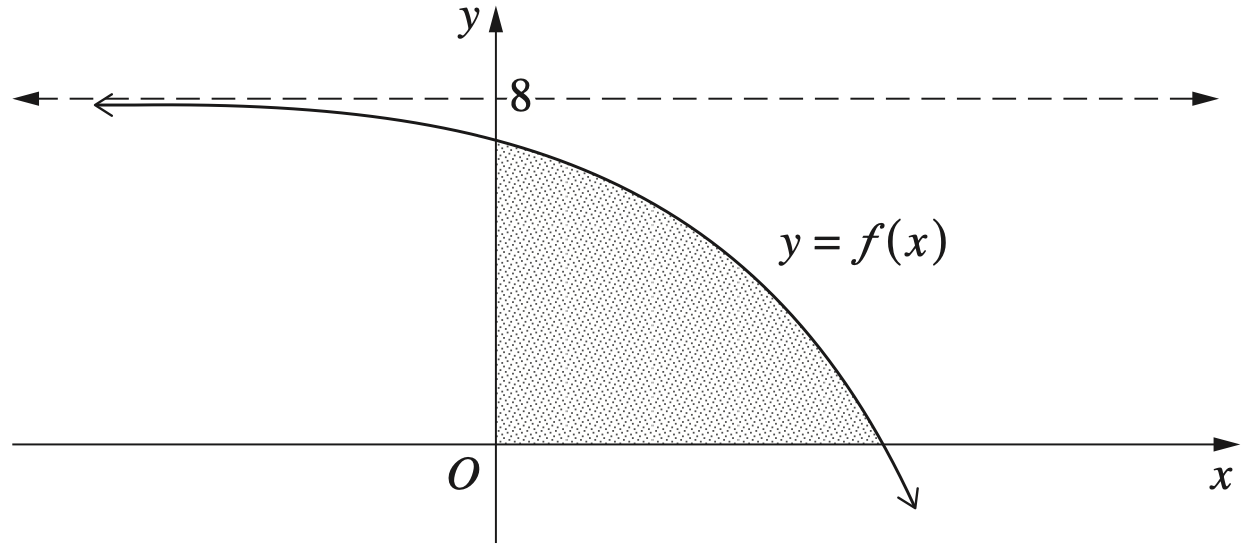
 

  1. Show that the exact area of the shaded region is given by  `24-7/ln2`.   (3 marks)

    --- 6 WORK AREA LINES (style=lined) ---

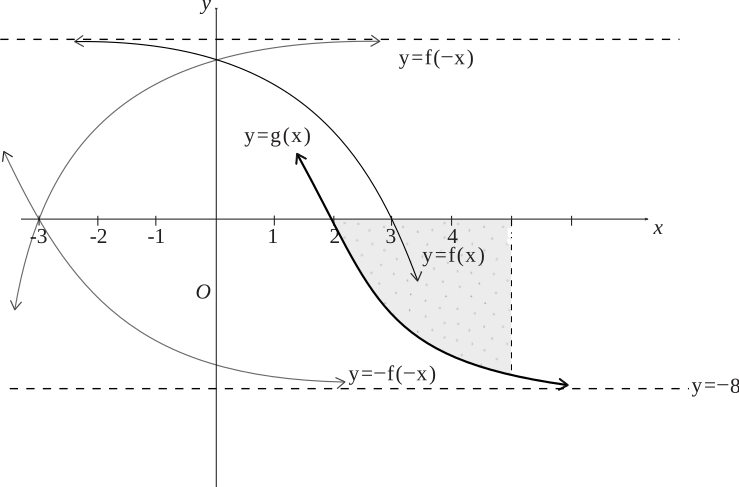
  2. A new function  `g(x)`  is found by taking the graph of   `y =-f(-x)`  and translating it by 5 units to the right.
  3. Sketch the graph of  `y = g(x)`  showing the `x`-intercept and the asymptote.   (2 marks)

    --- 8 WORK AREA LINES (style=lined) ---

  4. Hence, find the exact value of  `int_2^5 g(x)\ dx`.   (1 mark)

    --- 1 WORK AREA LINES (style=lined) ---

Show Answers Only

a.    `text(See Worked Solution)`

b.    

 c.    `7/(ln2)-24`

Show Worked Solution

a.    `xtext(-intercept occurs when)`

`8-2^x = 0 \ => \ x = 3`

`text(Area)` `= int_0^3 8-2^x\ dx`
  `= [8x-(2^x)/(ln2)]_0^3`
  `= 24-8/(ln 2)-(0-1/(ln2))`
  `= 24-8/(ln2) + 1/(ln2)`
  `= 24-7/(ln2)\ \ text(u²)`

♦ Mean mark part (b) 48%.
b.    

`y = f(-x) -> text(reflect)\ \ y = f(x)\ \ text(in the)\ ytext(-axis)`

`y =-f(-x) -> text(reflect)\ \ y = f(-x)\ \ text(in the)\ xtext(-axis)`
 

♦♦♦ Mean mark part (c) 13%.

c.   `int_2^5 g(x)\ dx\ \ text{is the same area as found in part (a)}`

`text(except it is below the)\ xtext(-axis.)`

`:. int_2^5 g(x)\ dx = 7/(ln2)-24`

Filed Under: Area Under Curves, Areas Under Curves Tagged With: Band 4, Band 5, Band 6, smc-7131-40-Exponential/Log, smc-7131-80-X-topic Transformations, smc-975-40-Exponential, smc-975-80-AUC and Transformations

Calculus, 2ADV C4 2019 HSC 16c

The diagram shows the region  `R`, bounded by the curve  `y = x^r`, where  `r >= 1`, the `x`-axis and the tangent to the curve at the point  `(1, 1)`.
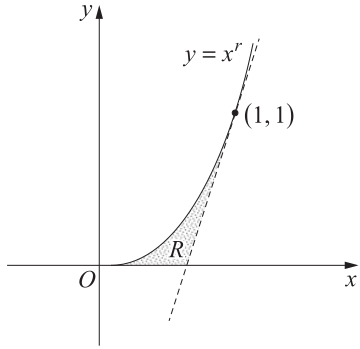
 

  1. Show that the tangent to the curve at  `(1, 1)`  meets the `x`-axis at
     
         `qquad ((r-1)/r, 0)`.   (2 marks)

    --- 5 WORK AREA LINES (style=lined) ---

  2. Using the result of part (i), or otherwise, show that the area of the region  `R`  is
     
         `qquad (r-1)/(2r (r + 1))`.   (2 marks)

    --- 6 WORK AREA LINES (style=lined) ---

  3. Find the exact value of  `r`  for which the area of  `R`  is a maximum.   (3 marks)

    --- 6 WORK AREA LINES (style=lined) ---

Show Answers Only

i.    `text(Proof)\ text{(See Worked Solutions)}`

ii.   `text(Proof)\ text{(See Worked Solutions)}`

iii.  `r = 1 + sqrt 2`

Show Worked Solution
i.     `y` `= x^r`
  `(dy)/(dx)` `= r x^(r-1)`

 
`text(When)\ \ x = 1, \ (dy)/(dx) = r`

♦♦ Mean mark part (i) 31%.

`text(Equation of tangent:)`

`y-1` `= r(x-1)`
`y` `= rx-r + 1`

 
`text(When)\ \ y = 0:`

`rx-r + 1` `= 0`
`rx` `= r-1`
`x` `= (r-1)/r`

 
`:.\ text(T)text(angent meets)\ x text(-axis at)\ \ ((r-1)/r, 0)`
  

ii.   `text(Area under curve)`

♦♦♦ Mean mark part (ii) 21%.

`= int_0^1 x^r`

`= [1/(r + 1) ⋅ x^(r + 1)]_0^1`

`= 1/(r + 1) xx 1^(r + 1)-0`

`= 1/(r + 1)`

  
`text(Area under tangent)`

`= 1/2 xx b xx h`

`= 1/2 (1-(r-1)/r) xx 1`

`= 1/2 (1-(r-1)/r)`
 

`:. R` `= 1/(r + 1)-1/2(1-(r-1)/r)`
  `= 1/(r + 1)-1/(2r) [r-(r-1)]`
  `= 1/(r + 1)-1/(2r)`
  `= (2r-(r + 1))/(2r(r + 1))`
  `= (r-1)/(2r(r + 1))`


iii.    `R` `= (r-1)/(2r(r + 1)) = (r-1)/(2r^2 + 2r)`
  `(dR)/(dr)` `= ((2r^2 + 2r) xx 1-(r-1)(4r + 2))/(2r^2 + 2r)^2`
    `= (2r^2 + 2r-4r^2-2r + 4r + 2)/(2r^2 + 2r)^2`
    `= (-2r^2 + 4r + 2)/(2r^2 + 2r)^2`
    `= (-2(r^2-2r-1))/(2r^2 + 2r)^2`

  
`text(Find)\ \ r\ \ text(when)\ \ (dR)/(dr) = 0:`

♦♦ Mean mark part (iii) 23%.

`r^2-2r-1 = 0`

`r` `= (2 +- sqrt((-2)^2-4 xx 1 xx (-1)))/2 `
  `= (2 +- sqrt 8)/2`
  `= 1 + sqrt 2\ \ (r >= 1)`


`qquadr qquad` `qquad 1 qquad` `\ \ 1 + sqrt 2\ \ ` `qquad 3 qquad`
`(dR)/(dr)` `1/4` `0` `-1/144`

  
`:. R_text(max)\ text(occurs when)\ \ r = 1 + sqrt 2`

Filed Under: Area Under Curves, Areas Under Curves, Maxima and Minima, Optimisation Tagged With: Band 5, Band 6, smc-7131-40-Exponential/Log, smc-7131-60-Other, smc-7134-10-Area, smc-970-10-Area, smc-975-40-Exponential

Calculus, 2ADV C4 EQ-Bank 28

Let  `f(x) = 2e^(-x/5)\ \ \ text(for)\ \ x>=0`

A right-angled triangle `OQP` has vertex `O` at the origin, vertex `Q` on the `x`-axis and vertex `P` on the graph of  `f(x)`, as shown. The coordinates of `P` are  `(x, f(x)).`
 

 vcaa-2013-meth-10

  1. Find the area, `A`, of the triangle `OPQ` in terms of `x`.   (1 mark)

    --- 2 WORK AREA LINES (style=lined) ---

  2. Find the maximum area of triangle `OQP` and the value of `x` for which the maximum occurs.   (3 marks)

    --- 6 WORK AREA LINES (style=lined) ---

  3. Let `S` be the point on the graph of  `f(x)` on the `y`-axis and let `T` be the point on the graph of `f(x)` with the `y`-coordinate `1/2`. Find the area of the region bounded by the graph of  `f(x)` and the line segment `ST`.   (2 marks)


      vcaa-2013-meth-10i

--- 8 WORK AREA LINES (style=lined) ---

Show Answers Only

a.    `x e^(-x/5)`

b.    `5/e\ text(u)^2`

c.    `25/4 log_e (4)-15/2\ text(u²)`

Show Worked Solution

a.    `text(Area)= 1/2 xx b xx h= 1/2x(2e^(-x/5))= xe^(-x/5)`
 

b.    `text(Stationary point when)\ \ (dA)/(dx) = 0:`

♦ Mean mark (b) (Vic) 35%.
`x(-1/5 e^(-x/5)) + e^(-x/5)` `= 0`
`e^(-x/5)(1-x/5)` `= 0`

 
`:. x= 5\ \ \ \ (e^(-x/5) >0,\ \ text(for all)\ x)`
 

`text(When)\ \ x = 5,\ \ A= xe^(-x/5)= 5e^-1`

`:. A_max = 5/e\ text(u²,   when)\ \ x = 5`
 

c.    `text(Find)\ S:`

`F(0) = 2\ \ =>\ \ S(0, 2)`

♦♦ Mean mark (c) (Vic) 32%.
`text(Find)\ T:\ \ \ ` `2e^(-x/5)` `= 1/2`
  `e^(-x/5)` `= 1/4`
  `-x/5` `= log_e (1/4)`
  `x` `= 5 log_e (4)`

 
`=> T(5log_e(4), 1/2)`
 

vcaa-2013-meth-10ii

`:.\ text(Area)` `= text(Area)\ SOAT-int_0^(5 log_e(4)) (2e^(-x/5)) dx`
  `=1/2h(a+b) + 10 [e^(-x/5)]_0^(5 log_e (4))`
  `= 5/2 log_e (4) (2 + 1/2) + 10 [e^(-log_e (4))-e^0]`
  `= 25/4 log_e (4) +10 (1/4-1)`
  `= 25/4 log_e (4)-15/2\ text(u)^2`

Filed Under: Area Under Curves, Areas Under Curves, Areas Under Curves, Maxima and Minima, Maxima and Minima, Optimisation Tagged With: Band 4, Band 5, smc-7131-40-Exponential/Log, smc-7134-10-Area, smc-970-10-Area, smc-975-40-Exponential

Calculus, 2ADV C4 2008 HSC 10a


In the diagram, the shaded region is bounded by  `y = log_e (x-2)`, the  `x`-axis and the line  `x = 7`.

Find the exact value of the area of the shaded region.   (5 marks)

--- 10 WORK AREA LINES (style=lined) ---

Show Answers Only

`5 log_e 5-4\ \ \ text(u²)`

Show Worked Solution

`text(Shaded Area)\ text{(} A_1 text{)}` `=\ text(Rectangle)-A_2`
`text(Area of Rectangle)\ ` `= 7 xx log_e 5`


`text(Finding the Area of)\ \ A_2`

`y` `= log_e (x-2)` 
`x-2` `= e^y`
`x` `= e^y + 2`
`:. A_2` `= int_0^(log_e 5) x\ dy`
  `= int_0^(log_e 5) e^y + 2\ dy`
  `= [e^y + 2y]_0^(log_e 5)`
  `= [(e^(log_e 5) + 2 log_e 5)-(e^0 + 0)]`
  `= (5 + 2 log_e 5)-1`
  `= 4 + 2 log_e 5`
   
`:.\ A_1` `= 7 log_e 5-(4 + 2 log_e 5)`
  `= 5 log_e 5-4\ \ \ text(u²)`

Filed Under: Applied Calculus (L&E), Area Under Curves, Areas Under Curves, Areas Under Curves Tagged With: Band 5, smc-7131-40-Exponential/Log, smc-7131-60-Other, smc-7131-65-\(\large y\)-axis Areas, smc-975-60-Other

Calculus, 2ADV C4 2010 HSC 4b

The curves  `y=e^(2x)`  and  `y=e^-x`  intersect at the point `(0,1)`  as shown in the diagram.
 

2010 4b
  

Find the exact area enclosed by the curves and the line  `x=2`.   (3 marks)

--- 6 WORK AREA LINES (style=lined) ---

Show Answer Only

`1/2e^4+e^-2-3/2\ \ text(u²)`

Show Worked Solutions
MARKER’S COMMENT: The best responses used only a single integral before any substitution as shown in Worked Solutions.
`text(Area)` `=int_0^2e^(2x)\ \ dx-int_0^2 e^-x\ \ dx`
  `=int_0^2(e^(2x)-e^-x)dx`
  `=[1/2e^(2x)+e^-x]_0^2`
  `=[(1/2e^4+e^-2)-(1/2e^0+e^0)]`
  `=1/2e^4+e^-2-3/2\ \ \ text(u²)`

Filed Under: Applied Calculus (L&E), Area Under Curves, Areas Under Curves, Areas Under Curves Tagged With: Band 4, smc-7131-40-Exponential/Log, smc-975-40-Exponential

Copyright © 2014–2026 SmarterEd.com.au · Log in