SmarterEd

Aussie Maths & Science Teachers: Save your time with SmarterEd

  • Login
  • Get Help
  • About

Calculus, 2ADV EQ-Bank 22

The diagram shows the graph of  \(y=\log _e(x+1)\)
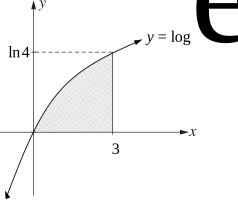
 

  1. Express \(x\) as a function of \(y\).   (1 mark)

    --- 2 WORK AREA LINES (style=lined) ---

  2. Hence, or otherwise, find the exact area of the shaded region bounded by the curve  \(y=\log _e(x+1)\), the \(x\)-axis, and the line  \(x=3\).   (3 marks)

    --- 10 WORK AREA LINES (style=lined) ---
Show Answers Only

a.    \(x=e^y-1\)

b.    \(A=4 \ln 4-3 \ \text{u}^2\)

Show Worked Solution

a.    \(y=\ln (x+1) \ \Rightarrow \ x+1=e^y \ \Rightarrow \ x=e^y-1\)
 

b.    \(\text{Area of rectangle}=\ln 4 \times 3=3 \ln 4\)

\(\text{Find the area between curve and \(y\)-axis from  \(\ y=0\ \)  to  \(\ y=\ln 4\):}\)

\(A\) \(=\displaystyle \int_0^{\ln 4} e^y-1\, d y\)
  \(=\Big[e^y-y\Big]_0^{\ln 4}\)
  \(=\left(e^{\ln 4}-\ln 4\right)-(1)\)
  \(=4-\ln 4-1\)
  \(=3-\ln 4\)


\(\text{Shaded Area}\) \(=3 \ln 4-(3-\ln 4)\)
  \(=4 \ln 4-3 \ \text{u}^2\)

Filed Under: Area Under Curves Tagged With: Band 3, Band 5, smc-7131-60-Other, smc-7131-65-\(\large y\)-axis Areas, syllabus-2027

Calculus, 2ADV EQ-Bank 29

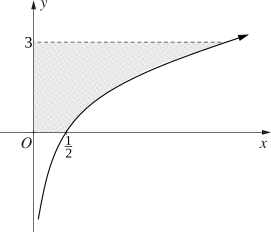
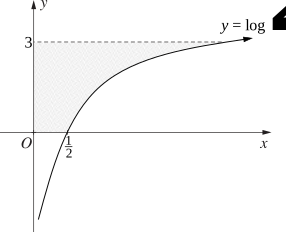
The diagram shows the graph of  \(y=\log _2 2 x\)


Determine the exact value of the shaded area bounded by the \(x\)-axis, the \(y\)-axis, and the curve  \(y=\log _2 2 x\).

Express your answer is the form \(\dfrac{a}{\ln b}\), where \(a\) and \(b\) are integers.   (4 marks)

--- 10 WORK AREA LINES (style=lined) ---
Show Answers Only

\(A=\dfrac{7}{\ln 4}\ \text{u}^2\)

Show Worked Solution

\(y=\log _2(2 x) \ \Rightarrow \ 2 x=2^y \ \Rightarrow \ x=\dfrac{1}{2} \times 2^y\)

\(A\) \(=\dfrac{1}{2} \displaystyle \int_0^3 2^y\, d y\)
  \(=\dfrac{1}{2}\left[\dfrac{2^y}{\ln 2}\right]_0^3\)
  \(=\dfrac{1}{2}\left[\dfrac{2^3}{\ln 2}-\dfrac{1}{\ln 2}\right]\)
  \(=\dfrac{7}{2 \ln 2}\)
  \(=\dfrac{7}{\ln 4}\ \text{u}^2\)

Filed Under: Area Under Curves Tagged With: Band 5, smc-7131-60-Other, smc-7131-65-\(\large y\)-axis Areas, syllabus-2027

Calculus, 2ADV C4 EQ-Bank 19

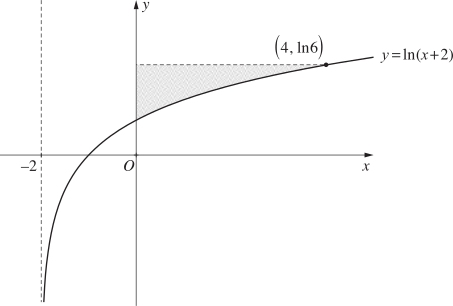
The diagram shows the graph of  \(y=\ln (x+2)\).
  

Find the exact value of the shaded area bounded by the \(y\)-axis, the line  \(y=\ln 6\)  and the curve  \(y=\ln (x+2)\). Express your answer in the form  \(a+b\,\ln c\) where  \(a, b\) and \(c\) are integers.   (4 marks)

--- 10 WORK AREA LINES (style=lined) ---
Show Answers Only

\(A=(4-2 \ln 3) \ \text{u}^2\)

Show Worked Solution

\(y=\ln (x+2)\ \ \Rightarrow\ \ x+2=e^y\ \ \Rightarrow\ \ x=e^y-2\)

\(y\text{-intercept occurs at}\ (0,\ln 2).\) 

\(A\) \(=\displaystyle \int_{\ln 2}^{\ln 6}\left(e^y-2\right) d y\)
  \(=\Big[e^y-2 y\Big]_{\ln 2}^{\ln 6}\)
  \(=e^{\ln 6}-2 \ln 6-e^{\ln 2}+2 \ln 2\)
  \(=6-2-2\left(\ln \dfrac{6}{2}\right)\)
  \(=(4-2 \ln 3) \ \text{u}^2\)

Filed Under: Area Under Curves Tagged With: Band 4, smc-7131-60-Other, smc-7131-65-\(\large y\)-axis Areas, syllabus-2027

Calculus, 2ADV C4 EQ-Bank 30

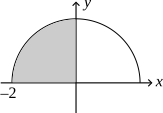
Evaluate  \(\displaystyle \int_{-2}^0 \sqrt{4-x^2} \, d x\).   (3 marks)

--- 6 WORK AREA LINES (style=lined) ---

Show Answers Only

\(\pi\)

Show Worked Solution

\(\sqrt{4-x^2} \ \ \text{is a semicircle, centre}\ \ (0,0) \ \ \text {and radius 2.}\)
 

STRATEGY: This integral is beyond 2ADV integration techniques. An alternate strategy is required.
\(\displaystyle \int_{-2}^0 \sqrt{4-x^2} \, d x \ \) \( \ =\ \text{Shaded area (above)}\)
  \(=\dfrac{1}{4} \times \pi+2^2\)
  \(=\pi\)

Filed Under: Area Under Curves, Areas Under Curves Tagged With: Band 5, smc-7131-60-Other, smc-7131-70-Areas Without Calculus, smc-975-60-Other, smc-975-70-Areas Without Calculus

Calculus, 2ADV C4 2022 HSC 28

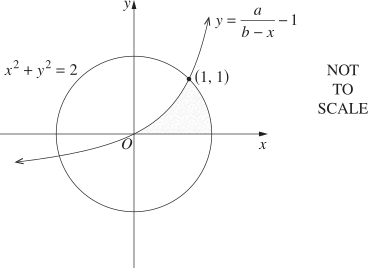
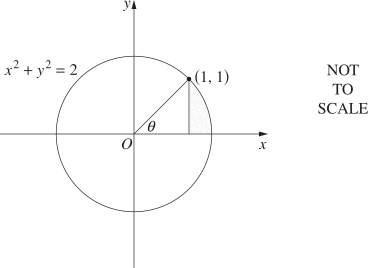
The graph of the circle  `x^2+y^2=2`  is shown.

The interval connecting the origin, `O`, and the point `(1,1)` makes an angle `theta` with the positive `x`-axis.
 

  1. By considering the value of `theta`, find the exact area of the shaded region, as shown on the diagram.   (2 marks)

    --- 4 WORK AREA LINES (style=lined) ---

Part of the hyperbola  `y=(a)/(b-x)-1`  which passes through the points `(0,0)` and `(1,1)` is drawn with the circle  `x^2+y^2=2`  as shown.
 

  1. Show that  `a=b=2`.   (2 marks)

    --- 5 WORK AREA LINES (style=lined) ---

  2. Using parts (a) and (b), find the exact area of the region bounded by the hyperbola, the positive `x`-axis and the circle as shown on the diagram.   (3 marks)

    --- 6 WORK AREA LINES (style=lined) ---

Show Answers Only

a.    `(pi-2)/4\ text{u}^2`

b.    `text{Proof (See Worked Solutions)}`

c.    `(8ln2+pi-6)/4\ text{u}^2`

Show Worked Solution

a.    `tan theta=1\ \ =>\ \ theta = pi/4`

`text{Using Pythagoras,}`

`r=sqrt(1^2+1^2)=sqrt2`

`text{Shaded Area}` `=A_text{sector}-A_Delta`
  `=(pi/4)/(2pi) xx pi r^2-1/2 xx b xx h`
  `=1/8xxpixx(sqrt2)^2-1/2xx1xx1`
  `=pi/4-1/2`
  `=(pi-2)/4\ text{u}^2`

Mean mark (a) 54%.

b.    `text{Show}\ \ a=b=2`

`y=(a)/(b-x)-1\ \ text{passes through}\ \ (0,0):`

`0` `=a/(b-0)-1`
`a/b` `=1`
`a` `=b`

 
`y=(a)/(b-x)-1\ \ text{passes through}\ \ (1,1):`

`1` `=a/(b-1)-1`
`a/(b-1)` `=2`
`a` `=2(b-1)`
`a` `=2b-2`
`b` `=2b-2\ \ text{(using}\ a=b)`
`b` `=2`

 
`:.a=b=2` 


♦ Mean mark (b) 47%.
c.     `int_0^1 2/(2-x)-1\ dx` `=int_0^1-2 xx (-1)/(2-x)-1\ dx`
    `=[-2ln|2-x|-x]_0^1`
    `=[(-2ln1-1)-(-2ln2-0)]`
    `=-1+2ln2`


`:.\ text{Total Area}` `=2ln2-1 + (pi-2)/4`
  `=(8ln2-4+pi-2)/4`
  `=(8ln2+pi-6)/4\ text{u}^2`

♦♦ Mean mark (c) 36%.

Filed Under: Area Under Curves, Areas Under Curves Tagged With: Band 4, Band 5, smc-7131-30-Hyperbola/Quotient, smc-7131-60-Other, smc-975-30-Hyperbola/Quotient, smc-975-60-Other

Calculus, 2ADV C4 2019 HSC 16c

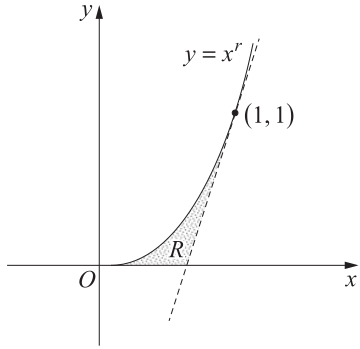
The diagram shows the region  `R`, bounded by the curve  `y = x^r`, where  `r >= 1`, the `x`-axis and the tangent to the curve at the point  `(1, 1)`.
 

  1. Show that the tangent to the curve at  `(1, 1)`  meets the `x`-axis at
     
         `qquad ((r-1)/r, 0)`.   (2 marks)

    --- 5 WORK AREA LINES (style=lined) ---

  2. Using the result of part (i), or otherwise, show that the area of the region  `R`  is
     
         `qquad (r-1)/(2r (r + 1))`.   (2 marks)

    --- 6 WORK AREA LINES (style=lined) ---

  3. Find the exact value of  `r`  for which the area of  `R`  is a maximum.   (3 marks)

    --- 6 WORK AREA LINES (style=lined) ---

Show Answers Only

i.    `text(Proof)\ text{(See Worked Solutions)}`

ii.   `text(Proof)\ text{(See Worked Solutions)}`

iii.  `r = 1 + sqrt 2`

Show Worked Solution
i.     `y` `= x^r`
  `(dy)/(dx)` `= r x^(r-1)`

 
`text(When)\ \ x = 1, \ (dy)/(dx) = r`

♦♦ Mean mark part (i) 31%.

`text(Equation of tangent:)`

`y-1` `= r(x-1)`
`y` `= rx-r + 1`

 
`text(When)\ \ y = 0:`

`rx-r + 1` `= 0`
`rx` `= r-1`
`x` `= (r-1)/r`

 
`:.\ text(T)text(angent meets)\ x text(-axis at)\ \ ((r-1)/r, 0)`
  

ii.   `text(Area under curve)`

♦♦♦ Mean mark part (ii) 21%.

`= int_0^1 x^r`

`= [1/(r + 1) ⋅ x^(r + 1)]_0^1`

`= 1/(r + 1) xx 1^(r + 1)-0`

`= 1/(r + 1)`

  
`text(Area under tangent)`

`= 1/2 xx b xx h`

`= 1/2 (1-(r-1)/r) xx 1`

`= 1/2 (1-(r-1)/r)`
 

`:. R` `= 1/(r + 1)-1/2(1-(r-1)/r)`
  `= 1/(r + 1)-1/(2r) [r-(r-1)]`
  `= 1/(r + 1)-1/(2r)`
  `= (2r-(r + 1))/(2r(r + 1))`
  `= (r-1)/(2r(r + 1))`


iii.    `R` `= (r-1)/(2r(r + 1)) = (r-1)/(2r^2 + 2r)`
  `(dR)/(dr)` `= ((2r^2 + 2r) xx 1-(r-1)(4r + 2))/(2r^2 + 2r)^2`
    `= (2r^2 + 2r-4r^2-2r + 4r + 2)/(2r^2 + 2r)^2`
    `= (-2r^2 + 4r + 2)/(2r^2 + 2r)^2`
    `= (-2(r^2-2r-1))/(2r^2 + 2r)^2`

  
`text(Find)\ \ r\ \ text(when)\ \ (dR)/(dr) = 0:`

♦♦ Mean mark part (iii) 23%.

`r^2-2r-1 = 0`

`r` `= (2 +- sqrt((-2)^2-4 xx 1 xx (-1)))/2 `
  `= (2 +- sqrt 8)/2`
  `= 1 + sqrt 2\ \ (r >= 1)`


`qquadr qquad` `qquad 1 qquad` `\ \ 1 + sqrt 2\ \ ` `qquad 3 qquad`
`(dR)/(dr)` `1/4` `0` `-1/144`

  
`:. R_text(max)\ text(occurs when)\ \ r = 1 + sqrt 2`

Filed Under: Area Under Curves, Areas Under Curves, Maxima and Minima, Optimisation Tagged With: Band 5, Band 6, smc-7131-40-Exponential/Log, smc-7131-60-Other, smc-7134-10-Area, smc-970-10-Area, smc-975-40-Exponential

Calculus, 2ADV C3 EQ-Bank 34

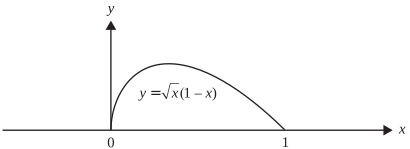
The graph of  `f(x) = sqrt x (1-x)`  for  `0<=x<=1`  is shown below.
 

  1. Calculate the area between the graph of `f(x)` and the `x`-axis.   (2 marks)

    --- 5 WORK AREA LINES (style=lined) ---

  2. For `x` in the interval `(0, 1)`, show that the gradient of the tangent to the graph of `f(x)` is  `(1-3x)/(2 sqrt x)`.   (1 mark)

    --- 2 WORK AREA LINES (style=lined) ---

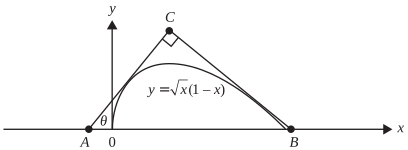
The edges of the right-angled triangle `ABC` are the line segments `AC` and `BC`, which are tangent to the graph of  `f(x)`, and the line segment `AB`, which is part of the horizontal axis, as shown below.

Let `theta` be the angle that `AC` makes with the positive direction of the horizontal axis.
 

  1. Find the equation of the line through `B` and `C` in the form  `y = mx + c`, for  `theta = 45^@`.   (3 marks)

    --- 6 WORK AREA LINES (style=lined) ---

Show Answers Only

a.    `4/15\ text(units)^2`

b.    `text(Proof)\ \ text{(See Worked Solutions)}`

c.    `y = -x + 1`

Show Worked Solution
a.     `text(Area)` `= int_0^1 (sqrt x-x sqrt x)\ dx`
    `= int_0^1 (x^(1/2)-x^(3/2))\ dx`
    `= [2/3 x^(3/2)-2/5 x^(5/2)]_0^1`
    `= (2/3-2/5)-(0-0)`
    `= 10/15-6/15`
    `= 4/15\ text(units)^2`


b.     `f (x)` `= x^(1/2)-x^(3/2)`
  `f^{prime}(x)` `= 1/2 x^(-1/2)-3/2 x^(1/2)`
    `= 1/(2 sqrt x)-(3 sqrt x)/2`
    `= (1-3x)/(2 sqrt x)\ \ text(.. as required.)`


c.    `m_(AC) = tan 45^@=1`

♦♦♦ Mean mark (Vic) part (c) 20%.
MARKER’S COMMENT: Most successful answers introduced a pronumeral such as  `a=sqrtx`  to solve.

`=> m_(BC) =-1\ \ (m_text(BC) _|_ m_(AC))`

 
`text(At point of tangency of)\ BC,\  f^{prime}(x) =-1`

`(1-3x)/(2 sqrt x)` `=-1`
`1-3x` `=-2sqrtx`
`3x-2sqrt x-1` `=0`

 
`text(Let)\ \ a=sqrtx,`

`3a^2-2a-1` `=0`
`(3a+1)(a-1)` `=0`
`a=1 or -1/3`   
`:. sqrt x` `=1` `or`   `sqrt x=-1/3\ \ text{(no solution)}`
`x` `=1`    

 
`f(1)=sqrt1(1-1)=0\ \ =>B(1,0)`
 

`text(Equation of)\ \ BC, \ m=-1, text{through (1,0):}`

`y-0` `=-1(x-1)`
`y` `=-x+1`

Filed Under: Area Under Curves, Areas Under Curves, Tangents, Tangents and Normals Tagged With: Band 4, Band 5, Band 6, smc-1090-10-Find tangent given curve, smc-1090-65-Other Function, smc-7131-60-Other, smc-975-60-Other

Calculus, 2ADV C4 2016 HSC 9 MC

What is the value of  `int_-3^2 |\ x + 1\ |\ dx?`

  1. `5/2`
  2. `11/2`
  3. `13/2`
  4. `17/2` 
Show Answers Only

`C`

Show Worked Solution
♦♦♦ Mean mark 19%.

hsc-2016-9mci

`int_-3^2 |\ x + 1\ |\ dx` `=\ text(Area of 2 triangles)`
  `= 1/2 xx 2 xx 2 + 1/2 xx 3 xx 3`
  `= 13/2`

`=>  C`

Filed Under: Area Under Curves, Areas Under Curves, Areas Under Curves Tagged With: Band 6, smc-7131-60-Other, smc-7131-70-Areas Without Calculus, smc-975-60-Other, smc-975-70-Areas Without Calculus

Calculus, 2ADV C4 2005 HSC 8b

2005 8b

The shaded region in the diagram is bounded by the circle of radius 2 centred at the origin, the parabola  `y = x^2-3x + 2`, and the `x`-axis.

By considering the difference of two areas, find the area of the shaded region.   (3 marks)

--- 8 WORK AREA LINES (style=lined) ---

Show Answers Only

`(pi-5/6)\ \ text(u²)`

Show Worked Solution

`text(Shaded Area = Area in the quarter circle less)`

`text(the area below the parabola between)\ x= 0 and 1.`

`text(Area of)\ 1/4\ text(circle)` `= 1/4 xx pir^2`
  `= 1/4 xx pi xx 2^2`
  `= pi\ \ \ text(u²)`

  
`text(Area below the parabola between)\ x= 0 and 1`

`=int_0^1y\ dx`

`= int_0^1x^2-3x + 2\ dx`

`= [x^3/3-3/2x^2 + 2x]_0^1`

`= [(1/3-3/2 + 2)-0]`

`= 5/6`
  

`:.\ text(Shaded Area) = (pi-5/6)\ \ \ text(u²)`

Filed Under: Area Under Curves, Areas Under Curves, Areas Under Curves Tagged With: Band 4, smc-7131-10-Quadratic, smc-7131-60-Other, smc-975-10-Quadratic, smc-975-60-Other

Calculus, 2ADV C4 2008 HSC 10a


In the diagram, the shaded region is bounded by  `y = log_e (x-2)`, the  `x`-axis and the line  `x = 7`.

Find the exact value of the area of the shaded region.   (5 marks)

--- 10 WORK AREA LINES (style=lined) ---
Show Answers Only

`5 log_e 5-4\ \ \ text(u²)`

Show Worked Solution

`text(Shaded Area)\ text{(} A_1 text{)}` `=\ text(Rectangle)-A_2`
`text(Area of Rectangle)\ ` `= 7 xx log_e 5`


`text(Finding the Area of)\ \ A_2`

`y` `= log_e (x-2)` 
`x-2` `= e^y`
`x` `= e^y + 2`
`:. A_2` `= int_0^(log_e 5) x\ dy`
  `= int_0^(log_e 5) e^y + 2\ dy`
  `= [e^y + 2y]_0^(log_e 5)`
  `= [(e^(log_e 5) + 2 log_e 5)-(e^0 + 0)]`
  `= (5 + 2 log_e 5)-1`
  `= 4 + 2 log_e 5`
   
`:.\ A_1` `= 7 log_e 5-(4 + 2 log_e 5)`
  `= 5 log_e 5-4\ \ \ text(u²)`

Filed Under: Applied Calculus (L&E), Area Under Curves, Areas Under Curves, Areas Under Curves Tagged With: Band 5, smc-7131-40-Exponential/Log, smc-7131-60-Other, smc-7131-65-\(\large y\)-axis Areas, smc-975-60-Other

Calculus, 2ADV C3 2009 HSC 10

`text(Let)\ \ f(x) = x-(x^2)/2 + (x^3)/3`

  1. Show that the graph of  `y = f(x)`  has no turning points.   (2 marks)

    --- 4 WORK AREA LINES (style=lined) ---
  2. Find the point of inflection of  `y = f(x)`.   (1 mark)

    --- 3 WORK AREA LINES (style=lined) ---
  3. i. Show that `1-x + x^2-1/(1 + x) = (x^3)/(1 + x)`  for  `x !=-1`.   (1 mark)

    --- 2 WORK AREA LINES (style=lined) ---
     

    ii. Let  `g(x) = ln (1 + x)`.


        Use the result in part c.i. to show that  `f^{prime} (x) >= g ^{prime}(x)`  for all  `x >= 0`.   (2 marks)

    --- 5 WORK AREA LINES (style=lined) ---

  1. Sketch the graphs of  `y = f(x)`  and  `y = g(x)`  for  `x >= 0`.   (2 marks)

    --- 8 WORK AREA LINES (style=lined) ---

  2. Show that  `d/(dx) [(1 + x) ln (1 + x)-(1 + x)] = ln (1 + x)`.   (2 marks)

    --- 5 WORK AREA LINES (style=lined) ---

  3. Find the area enclosed by the graphs of  `y = f(x)`  and  `y = g(x)`, and the straight line  `x = 1`.   (2 marks)

    --- 5 WORK AREA LINES (style=lined) ---

Show Answers Only

a.    `text{Proof  (See Worked Solutions)}`

b.    `(1/2, 5/12)`

c.i.  `text{Proof  (See Worked Solutions)}`

c.ii. `text{Proof  (See Worked Solutions)}` 

d.   

 Geometry and Calculus, 2UA 2009 HSC 10 Answer

e.    `text{Proof  (See Worked Solutions)}`

f.    `1 5/12-2ln2\ \ text(u²)`

Show Worked Solution

a.    `f(x) = x-(x^2)/2 + (x^3)/3`

♦♦ Mean mark 28% for all of Q10 (note that data for each question part is not available).
 

`text(Turning points when)\ f^{prime} (x) = 0`

`f^{prime}(x) = 1-x + x^2`

`x^2-x + 1 = 0`

`text(S)text(ince)\ \ Delta` `= b^2-4ac`
  `= (-1)^2-4 xx 1 xx 1`
  `= -3 < 0 => text(No solution)`

   
`:.\ f(x)\ text(has no turning points)`
  

b.    `text(P.I. when)\ f^{prime prime}(x) = 0`

`f^{prime prime}(x)` `=-1 + 2x = 0`
`2x` `= 1`
`x` `= 1/2`

  
`text(Check for change in concavity)`

`f^{prime prime}(1/4)` `=-1/2 < 0`
`f^{prime prime}(3/4)` `= 1/2 > 0`

  
`=>\ text(Change in concavity)`

`:.\ text(P.I. at)\ \ x = 1/2`
  

`f(1/2)` `= 1/2-((1/2)^2)/2 + ((1/2)^3)/3`
  `= 1/2-1/8 + 1/24`
  `= 5/12`

  
`:.\ text(Point of Inflection at)\ (1/2, 5/12)`
  

c.i.   `text(Show)\ 1- x + x^2-1/(1 + x) = (x^3)/(1 + x),\ \ \ x !=-1` 

`text(LHS)` `= (1+x)/(1+x)-(x(1+x))/(1+x) + (x^2(1+x))/((1+x))-1/(1+x)`
  `= (1 + x-x-x^2 + x^2 + x^3-1)/(1+x)`
  `= (x^3)/(1+x)\ \ \ text(… as required)`


c.ii.
 `text(Let)\ g(x) = ln(1+x)`

`g^{prime} (x) = 1/(1 + x)`

`f^{prime} (x)-g^{prime} (x)` `= 1-x + x^2-1/(1+x)`
  `= (x^3)/(1 + x)\ \ text{(using part (i))}`

  
`text(S)text(ince)\ (x^3)/(1 + x) >= 0\ text(for)\ x >= 0`

`f^{prime}(x)-g^{prime}(x) >= 0`

`f^{prime}(x) >= g^{prime}(x)\ text(for)\ x >= 0`

MARKER’S COMMENT: When 2 graphs are drawn on the same set of axes, you must label them. 
 

d.    

Geometry and Calculus, 2UA 2009 HSC 10 Answer

  
e.    `text(Show)\ d/(dx) [(1 + x) ln (1 + x)-(1 + x)] = ln (1 + x)`

`text(Using)\ d/(dx) uv=uv^{prime}+vu^{prime}`

`text(LHS)` `= (1+x) xx 1/(1 + x) + ln(1+x)xx1 +-1`
  `= 1+ ln(1+x)-1`
  `= ln(1+x)`
  `=\ text(RHS    … as required)`


f.     `text(Area)` `= int_0^1 f(x)-g(x)\ dx`
    `= int_0^1 (x-(x^2)/2 + (x^3)/3-ln(x+1))\ dx`
    `= [x^2/2-x^3/6 + (x^4)/12-(1 + x) ln (1+x) + (1+x)]_0^1`
    `text{(using part (e) above)}`
    `= [(1/2-1/6 + 1/12-(2)ln2 + 2)-(ln1 + 1)]`
    `= 5/12-2ln2 + 2-1`
    `= 1 5/12-2 ln 2\ \ text(u²)`

Filed Under: Applied Calculus (L&E), Area Under Curves, Areas Under Curves, Areas Under Curves, Curve Sketching, Curve Sketching, Curve Sketching and The Primitive Function Tagged With: Band 4, Band 5, Band 6, smc-7131-60-Other, smc-7225-10-Cubic, smc-7225-30-Other Graphs, smc-969-10-Cubic, smc-969-30-Other Graphs, smc-975-60-Other

Copyright © 2014–2026 SmarterEd.com.au · Log in