A probability density function is shown in the diagram.
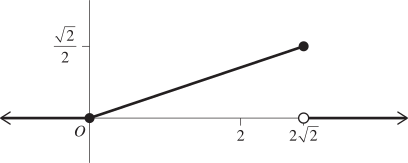
What is the mode of the given probability density function?
- \(0\)
- \(\dfrac{\sqrt{2}}{2}\)
- \(2\)
- \(2\sqrt{2}\)
Aussie Maths & Science Teachers: Save your time with SmarterEd
A probability density function is shown in the diagram.
What is the mode of the given probability density function?
\(D\)
\(\text{Mode occurs when}\ f(x)\ \text{is a maximum.}\)
\(f(x)_{\text{max}}\ \text{occurs at}\ \ x=2\sqrt{2}\ \ \text{(closed circle)}\)
\(\Rightarrow D\)
A continuous random variable \(X\) has a probability density function given by
\(f(x)= \begin{cases}\ 0 & \quad x<1 \\ \dfrac{1}{x} & \quad 1 \leq x \leq e \\ \ 0 & \quad x>e\end{cases}\)
--- 6 WORK AREA LINES (style=lined) ---
b. \(\text{Find \(k\) such that} \ P(X<k)=0.25:\)
| \(\displaystyle \int_1^{Q_1} \frac{1}{x}\) | \(=0.25\) |
| \(\ln Q_1-\ln 1\) | \(=0.25\) |
| \(Q_1\) | \(=e^{0.25}\) |
| \(=1.284 \ \text{(3 d.p.)}\) |
A continuous random variable \(X\) has probability density function \(f(x)\) given by \(f(x)=\left\{\begin{array}{ll} 12 x^2(1-x) & \text { for } 0 \leq x \leq 1 \\ 0 & \text { for all other values of } x \end{array}\right.\) --- 6 WORK AREA LINES (style=lined) --- --- 6 WORK AREA LINES (style=lined) --- --- 4 WORK AREA LINES (style=lined) --- a. \(x=\dfrac{2}{3} \) b. \(F(x)=\left\{\begin{array}{ll} 0 & \text { for } x \lt 0 & \\ 4x^3-3x^4 & \text { for } 0 \leq x \leq 1 \\ 1 & \text { for } x > 1 \end{array}\right.\) c. \(\text{See Worked Solutions}\) a. \(\text{Mode}\ \rightarrow \ f(x)_\text{max} \) \(f(x)=12 x^2(1-x)=12x^2-12x^3 \) \(f^{\prime}(x)=24x-36x^2=12x(2-3x) \) \(f^{\prime\prime}(x)=24-72x \) \(\text{Max/min when}\ f^{\prime}(x)=0 \) \(2-3x=0\ \ ⇒\ \ x=\dfrac{2}{3} \ \ (x \neq 0) \) \(\text{At}\ x=\dfrac{2}{3}, \ f^{\prime\prime}(x)=24-72(\dfrac{2}{3})=-24<0 \) \(\therefore \ \text{Mode (max) at}\ x=\dfrac{2}{3} \) \(F(x)=4x^3-3x^4 \) \(F(x)=\left\{\begin{array}{ll} 0 & \text { for } x \lt 0 & \\ 4x^3-3x^4 & \text { for } 0 \leq x \leq 1 \\ 1 & \text { for } x > 1 \end{array}\right.\)
b.
\(F(x)\)
\(= \int 12x^2-12x^3\ dx\)
\(=4x^3-3x^4+c \)
\(\text{At}\ x=0, F(x)=0\ \ ⇒\ \ c=0 \)
c. \(\text{Find}\ F\Big{(}\dfrac{2}{3}\Big{)}: \)
\(F\Big{(}\dfrac{2}{3}\Big{)} \)
\(=4 \times \Big{(}\dfrac{2}{3}\Big{)}^3-3 \times \Big{(}\dfrac{2}{3}\Big{)}^4 \)
\(=\dfrac{16}{27}>0.5 \)
\(\therefore\ \text{Mode > median}\)
People are given a maximum of six hours to complete a puzzle. The time spent on the puzzle, in hours, can be modelled using the continuous random variable \(X\) which has probability density function
\(f(x)= \begin{cases}
\dfrac{A x}{x^2+4} & \text{for } 0 \leq x \leq 6,(\text { where } A>0) \\
\ \\
0 & \text {for all other values of } x
\end{cases}\)
The graph of the probability density function is shown below. The graph has a local maximum.
--- 6 WORK AREA LINES (style=lined) ---
--- 5 WORK AREA LINES (style=lined) ---
--- 4 WORK AREA LINES (style=lined) ---
a. \(\text{See Worked Solution}\)
b. \(\text{See Worked Solution}\)
c. \(\text{See Worked Solution}\)
d. \(0.066\)
a. \(\displaystyle\int_0^6 \dfrac{A x}{x^2+4} \, d x=1\)
\(\begin{aligned} \dfrac{A}{2} \int_0^6 \dfrac{2 x}{x^2+4} d x & =1 \\
\dfrac{A}{2}\left[\ln \left(x^2+4\right)\right]_0^6 & =1 \\
\dfrac{A}{2}(\ln 40-\ln 4) & =1 \\
\dfrac{A}{2} \ln \left(\dfrac{40}{4}\right) & =1 \\
\dfrac{A}{2} \ln 10 & =1 \\
A & =\dfrac{2}{\ln 10}\end{aligned}\)
b. \(\text{Mode \(\rightarrow f(x)\) is a MAX}\)
\(\begin{aligned}
f(x) & =\dfrac{A x}{x^2+4} \\
f^{\prime}(x) & =\dfrac{A\left(x^2+4\right)-A x(2 x)}{\left(x^2+4\right)^2} \\
& =\dfrac{A x^2+4 A-2 A x^2}{\left(x^2+4\right)^2} \\
& =\dfrac{A\left(4-x^2\right)}{\left(x^2+4\right)^2}
\end{aligned}\)
\(\text{\(f(x)\) max occurs when \(f^{\prime}(x)=0\) :}\)
\(\begin{aligned}
4-x^2 & =0 \\
x & =2 \quad(x>0)
\end{aligned}\)
| c. | \(P(X<2)\) | \(=\displaystyle \int_0^2 \dfrac{A x}{x^2+4} d x\) |
| \(=\dfrac{A}{2}\left[\ln \left(x^2+4\right)\right]_0^2\) | ||
| \(=\dfrac{1}{\ln 10}(\ln 8-\ln 4)\) | ||
| \(=\dfrac{1}{\ln 10}\left(\ln \dfrac{8}{4}\right)\) | ||
| \(=\dfrac{1}{\ln 10} \cdot \ln 2\) | ||
| \(=\log _{10} 2\) |
d. \(z \text{-score}(130)=\dfrac{x-\mu}{\sigma}=\dfrac{130-100}{15}=2\)
\(P(z>2)=2.5 \%\)
\begin{aligned}
P(\text { IQ }>130 \mid x<2) & =\dfrac{P(\text { IQ }>130 \cap X<2)}{P(X<2)} \\
& =\dfrac{0.8 \times 0.025}{\log _{10} 2} \\
& =0.0664 \ldots \\
& =0.066\ \text{(3 d.p.)}
\end{aligned}
A continuous probability density function graph is drawn below.
Which of the following is the mode?
`C`
`text(Mode is the most common)\ xtext(-value.)`
`ytext(-axis measures the probability.)`
`text(Highest probability = 0.42)`
`:.\ text(Mode = 1.5)`
`=>\ C`
A probability density function `f(x)` is given by
`f(x) = {(px(3-x), \ text(if)\ \ 0 <= x <= 3),(0, \ text(if)\ \ x < 0\ \ text(or if)\ \ x > 3):}`
where `p` is a positive constant.
--- 4 WORK AREA LINES (style=lined) ---
a. `2/9`
b. `3/2`
a. `text(Total Area under curve = 1)`
| `p int_0^3 3x-x^2\ dx` | `= 1` |
| `p[3/2 x^2-(x^3)/3]_0^3` | `= 1` |
| `p[27/2-27/3-0]` | `= 1` |
| `(9p)/2` | `= 1` |
| `p` | `= 2/9` |
b. `f(x) = 2/9(3x-x^2)`
`f^{prime}(x) = 2/9(3-2x)`
`text(S.P. when)\ \ f^{prime}(x) = 0:`
| `3-2x` | `= 0` |
| `x` | `= 3/2` |
`f^{primeprime}(x) = -4/9 < 0 \ =>\ text(MAX)`
`:.\ text(Mode) = 3/2`
A function \(f(x)\) is given by
\(f(x)= \begin{cases}
\dfrac{3}{4}(x-2)(4-x) & \text {if } 2 \leq x \leq 4 \\
\ \\
0 & \text{if } x<2 \text { or if } x>4
\end{cases}\)
--- 4 WORK AREA LINES (style=lined) ---
a. \(\text{See Worked Solutions}\)
b. \(3\)
| a. | \(f(x)\) | \( =\dfrac{3}{4}(x-2)(4-x)\) |
| \(\displaystyle \int_2^4 f(x) \) | \( =\dfrac{3}{4} \displaystyle\int_2^4-x^2+6 x-8 d x\) | |
| \( =\dfrac{3}{4}\left[\dfrac{-x^3}{3}+3 x^2-8 x\right]_2^4\) | ||
| \( =\dfrac{3}{4}\left[\left(-\dfrac{64}{3}+48-32\right)-\left(-\dfrac{8}{3}+12-16\right)\right] \) | ||
| \( =\dfrac{3}{4}\left(-\dfrac{16}{3}+\dfrac{20}{3}\right) \) | ||
| \(= 1\) |
\(f(2)=0, f(4)=0\)
\(f(x)>0 \text { for } 2<x<4\)
\(f(2) \geq 0 \text { for } 2 \leq x \leq 4\)
\(\therefore f(x) \ \text{is a probability density function.}\)
| b. | \(f(x\) | \(=\dfrac{3}{4}\left(-x^2+6 x-8\right)\) |
| \(f^{\prime}(x)\) | \(=\dfrac{3}{4}(-2 x+6)\) | |
| \(f^{\prime\prime}(x)\) | \(=-\dfrac{3}{2}\) |
\(\text{SP when}\ f'(x) = 0\)
\(\begin{array}{r}-2 x+6=0 \\
x=3\end{array}\)
\(f^{\prime \prime}(x)<0 \Rightarrow \text {MAX}\)
\(\therefore \text {Mode}=3\)
The time Jennifer spends on her homework each day varies, but she does some homework every day.
The continuous random variable \(T\), which models the time, \(t\), in minutes, that Jennifer spends each day on her homework, has a probability density function \(f\), where
\(f(t)= \begin{cases}
\dfrac{1}{625}(t-20) & 20 \leq t<45 \\
\ \\
\dfrac{1}{625}(70-t) & 45 \leq t \leq 70 \\
\ \\
0 & \text {elsewhere }
\end{cases}\)
| a. |
b. \(\text{Mode \(=45\) (value of \(t\) at highest value of \(f(t))\)}\)
c. \(P(25 \leq T \leq 55)\)
\(\begin{aligned}
& =\int_{25}^{45} \dfrac{1}{625}(t-20) d t+\int_{45}^{55} \dfrac{1}{625}(70-t) d t \\
& =\dfrac{1}{625}\left[\dfrac{t^2}{2}-20 t\right]_{25}^{45}+\dfrac{1}{625}\left[70 t-\dfrac{t^2}{2}\right]_{45}^{55} \\
& =\dfrac{1}{625}[112.5-(-187.5)]+\dfrac{1}{625}(2337.5-2137.5) \\ & =\dfrac{300}{625}+\dfrac{200}{625} \\
& =\dfrac{4}{5}
\end{aligned}\)