SmarterEd

Aussie Maths & Science Teachers: Save your time with SmarterEd

  • Login
  • Get Help
  • About

Calculus, MET2 2024 VCAA 3

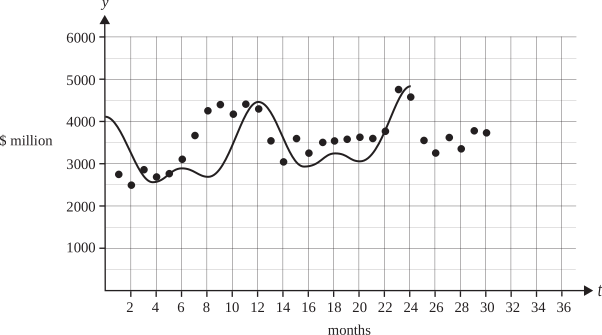
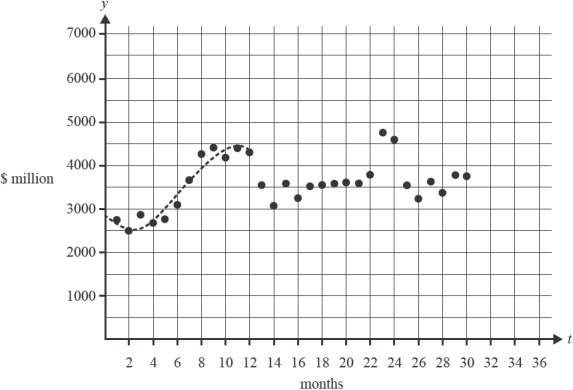
The points shown on the chart below represent monthly online sales in Australia.

The variable \(y\) represents sales in millions of dollars.

The variable \(t\) represents the month when the sales were made, where \(t=1\) corresponds to January 2021, \(t=2\) corresponds to February 2021 and so on.

  1. A cubic polynomial \(p ;(0,12] \rightarrow R, p(t)=a t^3+b t^2+c t+d\) can be used to model monthly online sales in 2021.

    The graph of \(y=p(f)\) is shown as a dashed curve on the set of axes above.

    It has a local minimum at (2,2500) and a local maximum at (11,4400).

     i. Find, correct to two decimal places, the values of \(a, b, c\) and \(d\).   (3 mark)

    --- 5 WORK AREA LINES (style=lined) ---

    ii. Let \(q:(12,24] \rightarrow R, q(t)=p(t-h)+k\) be a cubic function obtained by translating \(p\), which can be used to model monthly online sales in 2022.

    Find the values of \(h\) and \(k\) such that the graph of \(y=q(t)\) has a local maximum at \((23,4750)\).   (2 marks)

    --- 5 WORK AREA LINES (style=lined) ---

  2. Another function \(f\) can be used to model monthly online sales, where
     
    \(f:(0,36] \rightarrow R, f(t)=3000+30 t+700 \cos \left(\dfrac{\pi t}{6}\right)+400 \cos \left(\dfrac{\pi t}{3}\right)\)

    Part of the graph of \(f\) is shown on the axes below.

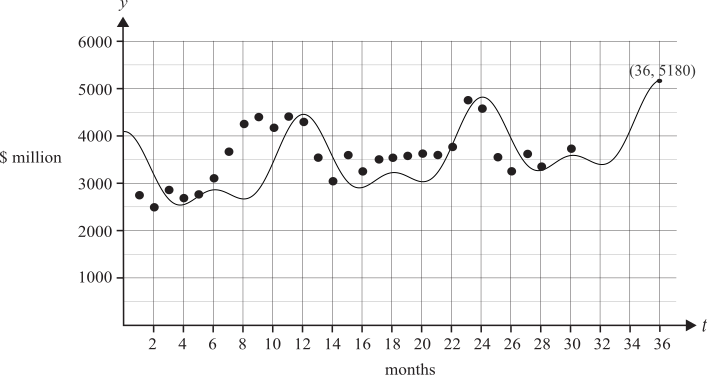
    1. Complete the graph of \(f\) on the set of axes above until December 2023, that is, for \(t \in(24,36]\).Label the endpoint at \(t=36\) with its coordinates.   (2 marks)

      --- 0 WORK AREA LINES (style=lined) ---

    1. The function \(f\) predicts that every 12 months, monthly online sales increase by \(n\) million dollars.

      Find the value of \(n\).   (1 mark)

      --- 3 WORK AREA LINES (style=lined) ---

    1. Find the derivative \(f^{\prime}(t)\).   (1 mark)

      --- 3 WORK AREA LINES (style=lined) ---

    1. Hence, find the maximum instantaneous rate of change for the function \(f\), correct to the nearest million dollars per month, and the values of \(t\) in the interval \((0,36]\) when this maximum rate occurs, correct to one decimal place.   (2 marks)

      --- 4 WORK AREA LINES (style=lined) ---

Show Answers Only

ai.   \(a\approx -5.21, b\approx 101.65, c\approx -344.03, d\approx 2823.18\)

aii.  \(h=12, k=350\)

bi.  

bii.  \( n=360\)

biii. \(f^{\prime}(t)=30-\dfrac{350\pi}{3}\sin\left(\dfrac{\pi t}{6}\right)-\dfrac{400\pi}{3}\sin\left(\dfrac{\pi t}{3}\right)\)

biv. \(\text{Maximum rate occurs at }t=10.2, 22.2, 34.2\)

\(\text{Maximum rate}\ \approx 725\ \text{million/month}\)

Show Worked Solution
ai.   \(\text{Given}\ p(2)=2500, p(11)=4400, p^{\prime}(2)=0\ \text{and}\ p^{\prime}(11)=0\) 
  
\(p(t)=at^3+bt^2+ct+d\ \Rightarrow\ p^{\prime}(t)=3at^2+2bt+c\)
  
\(\text{Using CAS:}\)
    
\(\text{Solve}
\begin{cases}
8a+4b+2c+d=2500 \\
1331a+121b+11c+d=4400 \\
12a+4b+c=0  \\
363a+22b+c=0
\end{cases}\)
  

\(a\approx -5.21, b\approx 101.65, c\approx -344.03, d\approx 2823.18\)

aii. \(\text{Local maximim }p(t)\ \text{is}\ (11, 4400)\)

\(\therefore\ h\) \(=23-11=12\)
\(k\) \(=4750-4400=350\)


bi.   \(\text{Plotting points from CAS:}\)

\((24,4820), (26, 3930), (28, 3290), (30, 3600), (32, 3410), (34, 4170), (36, 5180)\)

bii.  \(\text{Using CAS: }\)

\(f(12)-f(0)\) \(=4460-4100=360\)
\(f(24)-f(12)\) \(=4820-4460=360\)
\(f(36)-f(24)\) \(=5180-4820=360\) 

\(\therefore\ n=360\)

biii.  \(f(t)\) \(=3000+30t+700\cos\left(\dfrac{\pi t}{6}\right)+400\cos\left(\dfrac{\pi t}{3}\right)\)
  \(f^{\prime}(t)\) \(=30-\dfrac{700\pi}{6}\sin\left(\dfrac{\pi t}{6}\right)-\dfrac{400\pi}{3}\sin\left(\dfrac{\pi t}{3}\right)\)
    \(=30-\dfrac{350\pi}{3}\sin\left(\dfrac{\pi t}{6}\right)-\dfrac{400\pi}{3}\sin\left(\dfrac{\pi t}{3}\right)\)

  
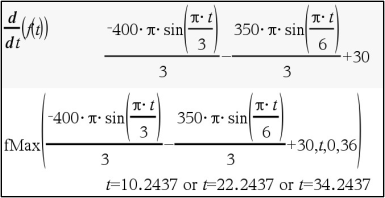
biv.  \(\text{Max instantaneous rate of change occurs when }f^{\prime\prime}(t)=0\)

\(\text{Maximum rate occurs at }t=10.2, 22.2, 34.2\)

\(\text{Maximum rate using CAS:}\)

\(f^{\prime}(10.2)=f^{\prime}(22.2)=f^{\prime}(34.2)=725.396\approx 725\ \text{million/month}\)
Filed Under: Average Value and Other, Differentiation (Trig), Polynomials, Transformations, Trig Differentiation, Trig Graphing Tagged With: Band 3, Band 4, Band 5, smc-2757-70-Sketch graph, smc-721-10-Unique solution, smc-736-10-sin, smc-736-20-cos, smc-744-10-sin, smc-744-20-cos, smc-753-70-Polynomials, smc-756-20-Trig, smc-756-30-Polynomial

Calculus, MET2 2022 VCAA 5

Consider the composite function `g(x)=f(\sin (2 x))`, where the function `f(x)` is an unknown but differentiable function for all values of `x`.

Use the following table of values for `f` and `f^{\prime}`.

`\quad x \quad` `\quad\quad 1/2\quad\quad` `\quad\quad(sqrt{2})/2\quad\quad` `\quad\quad(sqrt{3})/2\quad\quad`
`f(x)` `-2` `5` `3`
`\quad\quad f^{prime}(x)\quad\quad` `7` `0` `1/9`


  1. Find the value of `g\left(\frac{\pi}{6}\right)`.   (1 mark)

    --- 3 WORK AREA LINES (style=lined) ---

The derivative of `g` with respect to `x` is given by `g^{\prime}(x)=2 \cdot \cos (2 x) \cdot f^{\prime}(\sin (2 x))`.

  1. Show that `g^{\prime}\left(\frac{\pi}{6}\right)=\frac{1}{9}`.   (1 mark)

    --- 2 WORK AREA LINES (style=lined) ---

  2. Find the equation of the tangent to `g` at `x=\frac{\pi}{6}`.   (2 marks)

    --- 4 WORK AREA LINES (style=lined) ---

  3. Find the average value of the derivative function `g^{\prime}(x)` between `x=\frac{\pi}{8}` and `x=\frac{\pi}{6}`.   (2 marks)

    --- 5 WORK AREA LINES (style=lined) ---

  4. Find four solutions to the equation `g^{\prime}(x)=0` for the interval `x \in[0, \pi]`.   (3 marks)

    --- 8 WORK AREA LINES (style=lined) ---

Show Answers Only

a.    `3`

b.    `1/9`

c.    `y=1/9x+3-pi/54`

d.    `-48/pi`

e.    ` x = pi/8 , pi/4 , (3pi)/8 ,(3pi)/4`

Show Worked Solution
 

a.  `g(pi/6)`
`= f(sin(pi/3))`  
  `= f(sqrt3/2)`  
  `= 3`  


b.  `g\ ^{prime}(x)` `= 2\cdot\ cos(pi/3)\cdot\ f\ ^{prime}(sin(pi/3))`  
`g\ ^{prime}(pi/6)` `= 2 xx 1/2 xx f\ ^{prime}(sqrt3/2)`  
  `= 1/9`  


c.   `m = 1/9`  and  `g(pi/6) = 3`

`y  –  y_1` `= m(x-x_1)`  
`y  –  3` `= 1/9(x-pi/6)`  
`y` `= 1/9x + 3-pi/54`  

♦♦ Mean mark (c) 45%.
MARKER’S COMMENT: Some students did not produce an equation as required.

  
d.   The average value of `g^{\prime}(x)` between `x=\frac{\pi}{8}` and `x=\frac{\pi}{6}`

Average `= \frac{1}{\frac{\pi}{6}-\frac{\pi}{8}}\cdot\int_{\frac{\pi}{8}}^{\frac{\pi}{6}} g^{\prime}(x) d x`  
  `=24/pi \cdot[g(x)]_{\frac{\pi}{8}}^{\frac{\pi}{\6}}`  
  `= 24/pi \cdot(f(sqrt3/2)-f(sqrt2/2))`  
  `= 24/pi (3-5) = -48/pi`  

♦♦ Mean mark (d) 30%.
MARKER’S COMMENT: Those who used the Average Value formula were generally successful.
Some students substituted `g^{\prime}(x)`, not `g(x)`.

e.   `2 \cos (2 x) f^{\prime}(\sin (2 x)) = 0`

`:.\   2 \cos (2 x) = 0\ ….(1)`  or  ` f^{\prime}(\sin (2 x)) = 0\ ….(2)`

(1):   ` 2 \cos (2 x)`  `= 0`      `x \in[0, \pi]`
`\cos (2 x)` `= 0`      `2 x \in[0,2 \pi]`
`2x` `= pi/2 , (3pi)/2`  
`x` `= pi/4 , (3pi)/4`  
     
(2): ` f^{\prime}(\sin (2 x)) ` `= sqrt2/2`  
`2x` `= pi/4 , (3pi)/4`  
`x` `= pi/8 , (3pi)/8`  

  
`:. \  x = pi/8 , pi/4 , (3pi)/8 ,(3pi)/4`


♦♦ Mean mark (e) 30%.
MARKER’S COMMENT: Some students were able to find `pi/4, (3pi)/4`. Some solved `2 cos(2x)=0` or `f^{\prime}(sin(2x))=0` but not both.

Filed Under: Differentiation (Trig), Integration (Trig), Trig Differentiation, Trig Equations, Trig Integration Tagged With: Band 4, Band 5, Band 6, smc-725-10-Sin, smc-725-20-Cos, smc-736-10-sin, smc-736-20-cos, smc-737-10-sin, smc-737-20-cos, smc-737-50-Average Value, smc-737-60-Find f(x) given f'(x), smc-744-10-sin, smc-744-20-cos, smc-747-10-sin, smc-747-20-cos, smc-747-60-Average Value

Calculus, MET1-NHT 2019 VCAA 1b

Let  `f(x) = x^2 cos(3x)`.
 
Find  `f ^{\prime} (pi/3)`.   (2 marks)

--- 4 WORK AREA LINES (style=lined) ---

Show Answers Only

`-(2pi)/3`

Show Worked Solution
  `f(x)` `= x^2 cos 3x`
  `f^{\prime}(x)` `= x^2 ⋅ 3(-sin 3x) + 2x cos 3x`
  `f^{\prime}(pi/3)` `= (pi/3)^2 ⋅ 3 (-sin pi) + 2 (pi/3) cos pi`
    `= -(2pi)/3`

Filed Under: Differentiation (Trig), Trig Differentiation Tagged With: Band 4, smc-736-20-cos, smc-736-40-Product Rule, smc-744-20-cos, smc-744-40-Product Rule

Calculus, MET1 2018 VCAA 1b

Let  `f(x) = (e^x)/(cos(x))`.

Evaluate  `f^{prime}(pi)`.   (2 marks)

--- 7 WORK AREA LINES (style=lined) ---

Show Answers Only

`text(See Worked Solutions)`

Show Worked Solution

`f^{prime}(x) = (e^x)/(cos(x))`

`u` `= e^x` `v` `= cos(x)`
`u^{prime}` `= e^x` `v^{prime}` `=-sin(x)`
`f^{prime}(x)` `= (u^{prime}v-uv^{prime})/(v^2)`
  `= (e^x · cos(x) + e^x sin(x))/(cos^2(x))`


`f^{prime}(pi)` `= (e^pi · cospi + e^pi sinpi)/(cos^2 pi)`
  `= (e^pi(-1) + e^pi · 0)/((-1)^2)`
  `= -e^pi`

Filed Under: Differentiation (L&E), Differentiation (Trig), L&E Differentiation, Trig Differentiation Tagged With: Band 4, smc-736-20-cos, smc-736-50-Quotient Rule, smc-736-70-Log/Exp overlap, smc-739-10-Exponential, smc-739-50-Quotient Rule, smc-739-80-Trig overlap, smc-744-20-cos, smc-744-50-Quotient Rule, smc-744-70-Log/Exp Overlap, smc-745-10-Exponential, smc-745-40-Quotient Rule, smc-745-60-Trig Overlap

Calculus, MET1 2009 VCAA 1b

For  `f(x) = (cos(x))/(2x + 2)`  find  `f prime (pi)`.   (3 marks)

--- 6 WORK AREA LINES (style=lined) ---

Show Answers Only

`1/(2 (pi + 1)^2)`

Show Worked Solution

`text(Using Quotient Rule:)`

MARKER’S COMMENT: A majority of students did not substitute  `x=pi`  correctly.
`(g/h)^{prime}` `= (g^{prime} h – gh^{prime})/h^2`
`f^{prime}(x)` `= (-sin (x) (2x + 2)-2 cos (x))/(2x + 2)^2`
`:. f^{prime}(pi)` `= (-sin (pi) (2pi + 2)-2 cos (pi))/(2pi + 2)^2`
  `= (0-2 (-1))/[2 (pi + 1)]^2`
  `= 2/(4(pi + 1)^2)`
  `= 1/(2 (pi + 1)^2)`

Filed Under: Differentiation (Trig), Trig Differentiation Tagged With: Band 4, smc-736-20-cos, smc-736-50-Quotient Rule, smc-744-20-cos, smc-744-50-Quotient Rule

Calculus, MET1 2016 VCAA 1a

Let `y = (cos(x))/(x^2 + 2)`.

Find  `(dy)/(dx)`.   (2 marks)

--- 4 WORK AREA LINES (style=lined) ---

Show Answers Only

`(-x^2sin(x)-2sin(x)-2xcos(x))/((x^2 + 2)^2)`

Show Worked Solution

`text(Using Quotient Rule:)`

`(h/g)^{prime}` `= (h^{prime}g-hg^{prime})/(g^2)`
`(dy)/(dx)` `= (-sin(x)(x^2 + 2)-cos(x)(2x))/((x^2 + 2)^2)`
  `= (-x^2sin(x)-2sin(x)-2xcos(x))/((x^2 + 2)^2)`

Filed Under: Differentiation (Trig), Trig Differentiation Tagged With: Band 3, smc-736-20-cos, smc-736-50-Quotient Rule, smc-744-20-cos, smc-744-50-Quotient Rule

Copyright © 2014–2025 SmarterEd.com.au · Log in