SmarterEd

Aussie Maths & Science Teachers: Save your time with SmarterEd

  • Login
  • Get Help
  • About

Complex Numbers, EXT2 2026 HSC 15d

Let  \(w=2+i\).

  1. Let \(z_1\) be a complex number on the circle of radius 1, centred at \(w\).
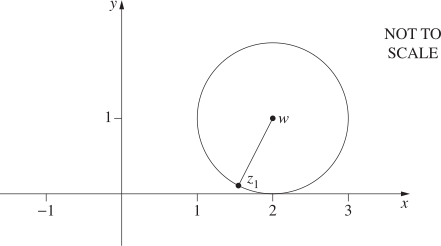
     
  2. If  \(\text{Arg}\left(z_1-w\right)=-\dfrac{2\pi}{3}\), find \(z_1\) in Cartesian form.   (2 marks)

    --- 8 WORK AREA LINES (style=lined) ---

  3. Let \(z_2\) be a complex number on the circle of radius 1, centred at \(w\).
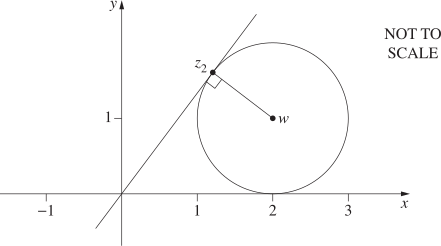
     
  4. If the tangent to the circle at \(z_2\) passes through the origin, find \(z_2\) in Cartesian form.   (2 marks)

    --- 10 WORK AREA LINES (style=lined) ---
Show Answers Only

i.    \(z_1=\dfrac{3}{2}+\left(1-\dfrac{\sqrt{3}}{2}\right) i\)

ii.   \(z_2=\dfrac{6}{5}+\dfrac{8}{5} i\)

Show Worked Solution

i.    \(z_1\ \text{lies on circle of radius 1, centred at}\ w\)

\(\Rightarrow \abs{z_1-w}=1\)

\(z_1-w\) \(=1\left(\cos\left(-\dfrac{2\pi}{3}\right)+i \sin\left(-\dfrac{2\pi}{3}\right)\right)\)
\(z_1-w\) \(=-\dfrac{1}{2}-\dfrac{\sqrt{3}}{2} i\)
\(z_1\) \(=2+i-\dfrac{1}{2}-\dfrac{\sqrt{3}}{2} i\)
  \(=\dfrac{3}{2}+\left(1-\dfrac{\sqrt{3}}{2}\right) i\)


ii.   \(\abs{w}=\sqrt{2^2+1^2}=\sqrt{5}\)

\(\text{Tangent}\ \perp\ \text{radius at}\ z_2\ \Rightarrow \angle O z_2 w=\dfrac{\pi}{2}\)

\(\text{Using Pythagoras in}\ \triangle O z_2 w:\)

\(\abs{z_2}=\sqrt{\left(\sqrt{5}\right)^2-1^2}=2\)
 

\(\text{Let}\ \ \alpha=\angle z_2 O w:\)

\(\cos \alpha=\dfrac{2}{\sqrt{5}},\ \ \sin \alpha=\dfrac{1}{\sqrt{5}}\)

\(z_2\ \text{is obtained by rotating}\ w\ \text{anticlockwise by}\ \alpha\ \text{and}\)

\(\text{scaling by a factor of}\ \dfrac{\abs{z_2}}{\abs{w}}=\dfrac{2}{\sqrt{5}}:\)

\(z_2\) \(=\dfrac{2}{\sqrt{5}}\,w\left(\cos \alpha+i \sin \alpha\right)\)
  \(=\dfrac{2}{\sqrt{5}}(2+i)\left(\dfrac{2}{\sqrt{5}}+\dfrac{1}{\sqrt{5}} i\right)\)
  \(=\dfrac{2}{5}(2+i)(2+i)\)
  \(=\dfrac{2}{5}(3+4i)\)
  \(=\dfrac{6}{5}+\dfrac{8}{5} i\)

Filed Under: Geometric Representations, Powers and Roots Tagged With: Band 4, Band 5, smc-7428-30-Mod/Arg to Cartesian, smc-7430-60-Rotation and Shapes

Complex Numbers, EXT2 N2 2023 14a*

Let \(z\) be the complex number  \(z=\text{cis}\dfrac{\pi}{6} \)  and \(w\) be the complex number  \(w=\text{cis}\dfrac{3\pi}{4} \).

  1. By first writing \(z\) and \(w\) in Cartesian form, or otherwise, show that
  2.    \(|z+w|^2=\dfrac{4-\sqrt{6}+\sqrt{2}}{2}\).   (3 marks)

    --- 9 WORK AREA LINES (style=lined) ---

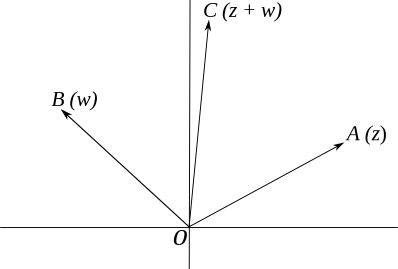
  3. The complex numbers \(z, w\) and \(z+w\) are represented in the complex plane by the vectors \(\overrightarrow{O A},\overrightarrow{O B}\) and \(\overrightarrow{O C}\) respectively, where \(O\) is the origin.
  4. Show that  \(\angle A O C=\dfrac{7 \pi}{24}\).   (2 marks)

    --- 8 WORK AREA LINES (style=lined) ---

  5. Deduce that  \(\cos \dfrac{7 \pi}{24}=\dfrac{\sqrt{8-2 \sqrt{6}+2 \sqrt{2}}}{4}\).   (1 mark)

    --- 5 WORK AREA LINES (style=lined) ---

Show Answers Only

i.    \(\text{See Worked Solutions}\)

ii.   \(\text{See Worked Solutions}\)

iii.  \(\text{See Worked Solutions}\)

Show Worked Solution

i.    \(z= \cos\,\dfrac{\pi}{6} + i \,\sin\,\dfrac{\pi}{6} = \dfrac{\sqrt3}{2} + \dfrac{1}{2}i \)

\(w= \cos\,\dfrac{3\pi}{4} + i \,\sin\,\dfrac{3\pi}{4} = -\dfrac{1}{\sqrt2} + \dfrac{i}{\sqrt2} \)

\(|z+w|^2\) \(=\Bigg{|} \dfrac{\sqrt3}{2}+\dfrac{1}{2}i-\dfrac{1}{\sqrt2}+\dfrac{i}{\sqrt2} \Bigg{|}\)  
  \(=\Bigg{|} \Bigg{(}\dfrac{\sqrt3}{2}-\dfrac{1}{\sqrt2} \Bigg{)} +\Bigg{(}\dfrac{1}{2}+\dfrac{1}{\sqrt2}\Bigg{)}\,i \Bigg{|}\)  
  \(=\Bigg{|} \dfrac{\sqrt6-2}{2\sqrt2}+\dfrac{\sqrt2+2}{2\sqrt2}\,i \Bigg{|}\)  
  \(= \dfrac{(\sqrt6-2)^2+(\sqrt2+2)^2}{(2\sqrt2)^2}\)  
  \(= \dfrac{6-4\sqrt6+4+2+4\sqrt2+4}{8}\)  
  \(=\dfrac{16-4\sqrt6+4\sqrt2}{8} \)  
  \(=\dfrac{4-\sqrt6+\sqrt2}{2} \)  

 
ii.   

\(\angle AOB= \arg(w)-\arg(z)=\dfrac{3\pi}{4}-\dfrac{\pi}{6}=\dfrac{7\pi}{12} \)

\( |z|=|w|=1\ \Rightarrow AOBC\ \text{is a rhombus.} \)

\(\overrightarrow{OC}\ \text{is a diagonal of rhombus}\ AOBC \)

\(\Rightarrow \overrightarrow{OC}\ \text{bisects}\ \angle AOB \)

\(\therefore \angle AOC= \dfrac{1}{2} \times \dfrac{7\pi}{12}=\dfrac{7\pi}{24} \)
  

iii.   \(\text{In}\ \triangle AOC: \)

\( \overrightarrow{AC}=\overrightarrow{OC}-\overrightarrow{OA} = \overrightarrow{OB} \)

\(\Rightarrow \overrightarrow{OB}\ \text{is represented by}\ w. \)
 

\(\text{Using the cos rule in}\ \triangle AOC: \)

\(\cos\,\dfrac{7\pi}{24}\) \(=\dfrac{|z|^2+|z+w|^2-|w|^2}{2|z||z+w|}\)  
  \(=\dfrac{ 1+\frac{4-\sqrt6+\sqrt2}{2}-1}{2 \times 1  \sqrt{\frac{4-\sqrt6+\sqrt2}{2}}} \)  
  \(=\dfrac{\sqrt{\frac{4-\sqrt6+\sqrt2}{2}} \times 2} {2 \times 2} \)  
  \(=\dfrac{\sqrt{4( \frac{4-\sqrt6+\sqrt2}{2})}} {4} \)  
  \(=\dfrac{8-2\sqrt6+2\sqrt2}{4} \)  
♦♦ Mean mark (iii) 26%.

Filed Under: Geometric Representations Tagged With: Band 3, Band 4, Band 5, smc-7428-30-Mod/Arg to Cartesian, smc-7428-50-Modulus Identities

Copyright © 2014–2026 SmarterEd.com.au · Log in