Using de Moivre’s theorem and the binomial expansion of `(cos theta + i sin theta)^5`, or otherwise, show that
`cos5theta = 16cos^5theta-20cos^3 theta + 5cos theta`. (3 marks)
--- 10 WORK AREA LINES (style=lined) ---
Aussie Maths & Science Teachers: Save your time with SmarterEd
Using de Moivre’s theorem and the binomial expansion of `(cos theta + i sin theta)^5`, or otherwise, show that
`cos5theta = 16cos^5theta-20cos^3 theta + 5cos theta`. (3 marks)
--- 10 WORK AREA LINES (style=lined) ---
`text(See Worked Solution)`
`(cos theta + i sin theta)^5 = cos5theta + i sin 5theta\ \ text{(by De Moivre)}`
`text(Using binomial expansion:)`
`(cos theta + i sin theta)^5`
`= cos^5theta + 5cos^4theta · isin theta + 10cos^3theta · i^2sin^2theta + 10 cos^2theta · i^3sin^3theta`
`+ 5costheta · i^4sin^4theta + i^5sin^5theta`
`= cos^5theta-10cos^3thetasin^2theta + 5costhetasin^4theta + i\ \ text{(imaginary part)}`
`text(Equating real parts:)`
| `cos5theta` | `= cos^5theta-10cos^3thetasin^2theta + 5costhetasin^4theta` |
| `= cos^5theta-10cos^3theta(1-cos^2theta) + 5costheta(1-cos^2theta)sin^2theta` | |
| `= cos^5theta-10cos^3theta + 10cos^5theta + (5costheta-5cos^3theta)(1-cos^2theta)` | |
| `= 11cos^5theta-10cos^3theta + 5costheta-5cos^3theta-5cos^3theta + 5cos^5theta` | |
| `= 16cos^5theta-20cos^3theta + 5costheta` |
--- 4 WORK AREA LINES (style=lined) --- --- 4 WORK AREA LINES (style=lined) --- i. \(2 \text{cis}\left(\dfrac{\pi}{6}\right)=2\left(\cos \left(\dfrac{\pi}{6}\right)+i \sin \left(\dfrac{\pi}{6}\right)\right)\) ii. \(-64 \sqrt{3}-64 i\) i. \(z=\sqrt{3}+i\) \(|z|=\sqrt{3+1}=2\) \(\arg (z)=\tan ^{-1}\left(\dfrac{1}{\sqrt{3}}\right)=\dfrac{\pi}{6}\) \(z=2 \text{cis}\left(\dfrac{\pi}{6}\right)=2\left(\cos \left(\dfrac{\pi}{6}\right)+i \sin \left(\dfrac{\pi}{6}\right)\right)\)
ii.
\((\sqrt{3}+i)^7\)
\(=2^7\left(\cos \left(\dfrac{7 \pi}{6}\right)+i \sin \left(\dfrac{7 \pi}{6}\right)\right)\)
\(=128\left(-\dfrac{\sqrt{3}}{2}-\dfrac{1}{2} i\right)\)
\(=-64 \sqrt{3}-64 i\)
Let `z = sqrt3-3 i`
--- 6 WORK AREA LINES (style=lined) ---
a. `2 sqrt3 text{cis} (frac{-pi}{3})`
b. `3`
| a. | `z` | `= sqrt3-3 i` |
| `|z|` | `= sqrt((sqrt3)^2 + 3^2) = 2 sqrt3` |
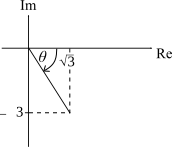
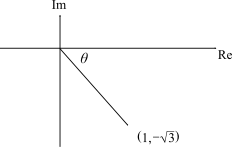
`tan theta= frac{3}{sqrt3}=sqrt3\ \ =>\ \ `theta= frac{pi}{3}`
`text{arg} (z)=-frac{pi}{3}`
`therefore z = 2 sqrt3 \ text{cis} (frac{-pi}{3})`
b. `z^n + (overset_z)^n = 0`
`[2 sqrt3 \ cos (frac{-pi}{3}) + i sin (frac{-pi}{3})]^n + [ 2 sqrt3 \ cos (frac{-pi}{3})-i sin (frac{-pi}{3}) ]^n = 0`
`(2 sqrt3)^n [cos (frac{-n pi}{3}) + i sin (frac{-n pi}{3}) + cos (frac{-n pi}{3})-i sin (frac{-n pi}{3}) = 0`
| `2 \ cos (frac{-n pi}{3})` | `= 0` |
| `cos (frac{n pi}{3})` | `= 0` |
| `frac{n pi}{3}` | `= frac{pi}{2} + k pi \ , \ k = 0, ± 1, ± 2, …` |
| `frac{n}{3}` | `= frac{(2k + 1)}{2}` |
| `n` | `= frac{3 (2k + 1)}{2}` |
`text{Numerator will always be odd ⇒ no solution exists}`
Let `beta = 1-i sqrt3`.
--- 6 WORK AREA LINES (style=lined) ---
--- 3 WORK AREA LINES (style=lined) ---
a. `2 \ text{cis} (-frac{pi}{3})`
b. `32 \ text{cis} (frac{pi}{3})`
c. `16 + i 16 sqrt3`
a. `beta = 1-i sqrt3`
`| beta | = sqrt(1^2 + (sqrt3)^2) = 2`
| `tan theta` | `= frac{sqrt3}{1} = sqrt3` |
| `theta` | `= frac{pi}{3}` |
| `text{arg} (beta)` | `= -frac{pi}{3}` |
`therefore \ beta = 2 \ text{cis} (-frac{pi}{3})`
| b. | `beta^5` | `= 2^5 \ text{cis} (-frac{pi}{3} xx5)` |
| `= 32 \ text{cis} (-frac{5pi}{3} + 2 pi)` | ||
| `= 32 \ text{cis} (frac{pi}{3})` |
| c. | `beta^5` | `= 32 ( cos (frac{pi}{3}) + i sin (frac{pi}{3}) )` |
| `= 32 ( frac{1}{2} + i frac{sqrt3}{2})` | ||
| `= 16 + i 16 sqrt3` |
Let `z = -1 + i sqrt 3`.
--- 5 WORK AREA LINES (style=lined) ---
i. `z = 2 text(cis) (2 pi)/3`
ii. `8 + 0i`
i. `|\ z\ |= -1 + i sqrt 3= sqrt((-1)^2 + (sqrt 3)^2)= 2`
| `tan theta` | `= -sqrt 3` | |
| `text(arg)(z)` | `= (2 pi)/3` | |
| `:. z` | `= 2 text(cis) (2 pi)/3` |
ii. `z^3 = 2^3 [cos(3 xx (2 pi)/3) + i sin (3 xx (2 pi)/3)]\ \ \ text{(by De Moivre)}`
`= 8(cos 2 pi + i sin 2 pi)`
`= 8(1 + 0i)`
`= 8 + 0i`
--- 10 WORK AREA LINES (style=lined) ---
i. `text(By De Moivre)`
`costheta + isintheta^8 = cos8theta + isin8theta\ \ …\ (text{*})`
`text(Using Binomial Expansion)`
`(costheta + isintheta)^8`
`= cos^8theta + ((8),(1))cos^7theta * isintheta + ((8),(2)) cos^6theta *i^2sin^2theta`
`+ ((8),(3)) cos^5theta *i^3sin^3theta + ((8),(4)) cos^4theta *i^4sin^4theta + ((8),(5)) cos^3theta *i^5sin^5theta`
`+ ((8),(6)) cos^2theta *i^6sin^6theta + ((8),(7)) costheta *i^7sin^7theta + i^8sin^8theta`
`text(Equating imaginary parts of the expansion equation (*)):`
`isin8theta = ((8),(1)) cos^7theta* isintheta + ((8),(3)) icos^5theta* i^3sin^3theta`
`+ ((8),(5)) cos^3theta* i ^5sintheta + ((8),(7)) costheta *i^7sin^7theta`
`:. sin8theta = ((8),(1)) cos^7theta sintheta-((8),(3)) cos^5theta sin^3theta`
`+ ((8),(5)) cos^3theta sin^5theta-((8),(7)) costheta sin^7theta`
| ii. | `sin8theta` | `= 8cos^7theta sintheta-56cos^5 sin^3theta + 56cos^3theta sin^5theta-8costheta sin^7theta` |
| `= 2sinthetacostheta (4cos^6theta-28cos^4theta sin^2theta + 28cos^2theta sin^4theta-4sin^6theta)` |
`:. (sin8theta)/(sin2theta)`
`= 4cos^6theta-28cos^4theta sin^2theta + 28cos^2theta sin^4theta-4sin^6theta`
`= 4(1-sin^2theta)^3-28(1-sin^2theta)^2 sin^2theta + 28(1-sin^2theta) sin^4theta-4sin^6theta`
`= 4(1-3sin^2theta + 3sin^4theta + sin^6theta)-28sin^2theta (1-2sin^2theta + sin^4theta)`
`+ 28sin^4theta (1-sin^2theta)-4sin^6theta`
`= 4-40sin^2theta + 96sin^4theta-56sin^6theta`
`= 4(1-10sin^2theta + 24sin^4theta-16sin^6theta)`
Let `z = cos theta + i sin theta.`
--- 3 WORK AREA LINES (style=lined) ---
i. `text(See Worked Solutions)`
ii. `8cos^4theta-8cos^2theta + 1`
i. `z = costheta + isintheta`
| `z^4` | `= (costheta + isintheta)^4` |
|
`= cos^4theta + 4cos^3theta*(isintheta) + 6cos^2theta*(isintheta)^2 +` `4costheta*(isintheta)^3 + (isintheta)^4` |
|
|
`= cos^4theta + 4icos^3thetasintheta-6cos^2thetasin^2theta -` `4icosthetasin^3theta + sin^4theta` |
`z^4 = cos4theta + isin4theta\ \ text{(by De Moivre)}`
`text(Equating real parts:)`
`cos4theta = cos^4theta-6cos^2thetasin^2theta + sin^4theta\ …\ text(as required)`
| ii. | `cos4theta` | `= cos^4theta-6cos^2theta(1-cos^2theta) + (1-cos^2theta)^2` |
| `= cos^4theta-6cos^2theta + 6cos^4theta + 1-2cos^2theta + cos^4theta` | ||
| `= 8cos^4theta-8cos^2theta + 1` |
--- 6 WORK AREA LINES (style=lined) ---
--- 12 WORK AREA LINES (style=lined) ---
--- 8 WORK AREA LINES (style=lined) ---
a. `text(Proof)\ \ text{(See Worked Solutions)}`
b. `text(Proof)\ \ text{(See Worked Solutions)}`
c. `text(Proof)\ \ text{(See Worked Solutions)}`
a. `1 + z^2 + z^4 + … + z^(2n-2),\ z^2 != 1`
`text(GP where)\ a = 1,\ \ r = z^2,\ \ n\ text(terms):`
| `S_n` | `=(1((z^2)^n-1))/(z^2-1)` |
| `=(z^(2n)-1)/(z^2-1)` | |
| `=((z^n-z^-n))/(z-z^-1) xx z^n/z` | |
| `=((z^n-z^-n)/(z-z^-1))z^(n-1)` |
| b. | `z` | `= cos theta + i sin theta` |
| `z^n` | `= cos n theta + i sin n theta\ \ …\ text(etc)\ \ \ \ text{(De Moivre)}` | |
| `z^-n` | `= cos( -n theta) + i sin (-n theta)` | |
| `= cos n theta-i sin n theta` |
| `text(LHS)` | `= 1 + (cos 2 theta + i sin 2 theta) + (cos 4 theta + i sin 4 theta) + ` |
| `… + (cos(2n-2) theta + i sin (2n-2) theta)` | |
| `= 1 + cos 2 theta + cos 4 theta + … + cos (2n-2) theta + ` | |
| `i (sin 2 theta + sin 4 theta + … + sin (2n-2) theta)` | |
`text{Using part (a):}`
| `text(LHS)` | `=((cos n theta + i sin n theta-cos n theta + i sin n theta))/(cos theta + i sin theta-cos theta + i sin theta) xx` |
| `[cos (n-1) theta + i sin (n-1) theta]` | |
| `=(2 i sin n theta)/(2 i sin theta) [cos (n-1) theta + i sin (n-1) theta]` | |
| `=(sin n theta)/(sin theta) [cos (n-1) theta + i sin (n-1) theta]\ \ text(… as required.)` |
c. `text{Equating the imaginary parts in part (b):}`
`sin 2 theta + sin 4 theta + … + sin 2 (n-1) theta = (sin (n theta) sin (n-1) theta)/(sin theta)`
`text(When)\ \ theta = pi/(2n):`
`sin\ (2 pi)/(2n) + sin\ (4 pi)/(2n) + … + sin\ (2(n-1) pi)/(2 n) = (sin\ (n pi)/(2n) sin\ ((n-1) pi)/(2n))/(sin\ pi/(2n))`
`:. sin\ pi/n + sin\ (2 pi)/n + … + sin\ ((n-1) pi)/n`
`=(sin\ pi/2)/(sin\ pi/(2n)) xx sin\ ((n-1) pi)/(2n)`
`=1/(sin\ pi/(2n)) sin (pi/2-pi/(2n))`
`=(cos\ pi/(2n))/(sin\ pi/(2n))`
`=cot\ pi/(2n)`
--- 8 WORK AREA LINES (style=lined) ---
--- 6 WORK AREA LINES (style=lined) ---
a. `sqrt 2 ( cos pi/4 + i sin pi/4)`
b. `256 + 256i`
| a. | ![]() |
| `|\ 1+i\ |` | `=sqrt(1^2+1^2)=sqrt2` |
| `text(arg)(1+i)` | `=pi/4` |
| `:. 1 + i =` | `sqrt 2 (cos pi/4 + i sin pi/4)` |
| b. `(1 + i)^17` | `=(sqrt 2)^17 (cos\ pi/4 + i sin\ pi/4)^17` |
| `=2^8 sqrt 2 (cos (17 pi)/4 + i sin (17 pi)/4)\ \ \ \ text{(De Moivre)}` | |
| `=2^8 sqrt 2 (cos pi/4 + i sin pi/4)` | |
| `=2^8 sqrt2(1/sqrt2 + 1/sqrt2 i)` | |
| `=2^8 (1 + i)` | |
| `=256 + 256 i` |
Given that `z = 1 -i`, which expression is equal to `z^3 ?`
`B`
--- 5 WORK AREA LINES (style=lined) ---
--- 4 WORK AREA LINES (style=lined) ---
a. `2 text(cis) (−pi/6)`
b. `2^7 text(cis) ((5 pi)/6)`
c. `64 (−sqrt 3 + i)`
| a. | ![]() |
`|\ sqrt 3-i\ |= sqrt ((sqrt 3)^2+1^2)=2`
`theta=tan^-1(- 1/sqrt3)=- pi/6`
`:. sqrt 3-i = 2 text(cis) (- pi/6)`
| b. `(sqrt 3-i)^7 =` | `2^7 text(cis) (-(7 pi)/6)\ \ \ \ text{(De Moivre)}` |
| `=` | `128 text(cis) ((5 pi)/6)` |
| c. `(sqrt 3-i)^7` | `=128 (cos\ (5pi)/6 + i sin\ (5pi)/6)` |
| `=128 (- sqrt 3/2 + i/2)` | |
| `=-64 sqrt 3 + 64i` |
Let `z = cos theta + i sin theta.`
--- 6 WORK AREA LINES (style=lined) ---
--- 12 WORK AREA LINES (style=lined) ---
--- 8 WORK AREA LINES (style=lined) ---
a. `text(Proof)\ \ text{(See Worked Solutions)}`
b. `text(Proof)\ \ text{(See Worked Solutions)}`
c. `text(Proof)\ \ text{(See Worked Solutions)}`
| a. | `z` | `= cos theta + i sin theta` |
| `z^n` | `= cos n theta + i sin n theta\ \ \ \ text{(De Moivre)}` | |
| `z^-n` | `= cos (-n theta) + i sin (-n theta)\ \ \ \ text{(De Moivre)}` | |
| `= cos n theta-i sin n theta` | ||
| `z^n + z^-n` | `= cos n theta + i sin n theta + cos n theta-i sin n theta` | |
| `= 2 cos n theta,\ \ \ \ n > 0` |
b. `z + z^-1 = 2 cos theta`
`:.(2 cos theta)^(2m)`
`=(z + z^-1)^(2m)`
`=z^(2m) + ((2m), (1)) z^(2m-1) z^-1 + ((2m), (2)) z^(2m-2) z^-2+`
` … + ((2m), (2m-1)) z^1 z^-(2m-1) + z^-(2m)`
`=z^(2m) + ((2m), (1)) z^(2m-2) + ((2m), (2)) z^(2m-4)+`
` … + ((2m), (2m-1)) z^-(2m-2) + z^(-2m)`
`=z^(2m) + ((2m), (1)) z^(2m-2) + ((2m), (2)) z^(2m-4) + … + ((2m), (m)) z^(2m-2m) …`
`+ ((2m), (2)) z^-(2m-4) + ((2m), (1)) z^-(2m-2) + z^(-2m)`
`=(z^(2m) + z^(-2m)) + ((2m), (1)) (z^(2m-2) + z^-(2m-2)) + ((2m), (2))`
`(z^(2m-4) + z^-(2m-4)) + … + ((2m), (m-1)) (z + z^-1) + ((2m), (m))`
`=2 [cos 2 m theta + ((2m), (1)) cos (2m-2) theta + ((2m), (2)) cos (2m-4) theta`
`+ … + ((2m), (m-1)) cos 2 theta] + ((2m), (m))`
c. `int_0^(pi/2) cos^(2m) d theta`
`=1/(2^(2m)) int_0^(pi/2) (2 cos theta)^(2m)`
`=1/(2^(2m)) int_0^(pi/2)[2(cos 2 m theta + ((2m), (1)) cos (2m-2) theta + ((2m), (2))`
`cos (2m-4) theta + … + ((2m), (m-1)) cos 2 theta) + ((2m), (m))] d theta`
`=1/(2^(2m)) [2((sin 2 m theta)/(2m) + ((2m), (1)) (sin (2m-2) theta)/(2m-2)`
`+ … + ((2m), (m-1)) (sin 2 theta)/2) + ((2m), (m)) theta]_0^(pi/2)`
`=1/(2^(2m)) [2(0 + 0 + … + 0) + ((2m), (m)) pi/2-(0)]`
`=pi/(2^(2m + 1)) ((2m), (m))`
--- 5 WORK AREA LINES (style=lined) ---
--- 4 WORK AREA LINES (style=lined) ---
a. `2text(cis)(-(5pi)/6)`
b. `-64`
a. `|-sqrt3-i\ |=sqrt((-sqrt3)^2+sqrt((-1)^2))=2`
`text(From the graph)`
`text{arg}(-sqrt3-i)=- (5pi)/6\ \ \ \ text{(for}\ –pi<theta<pi text{)}`
`:.-sqrt3-i= 2text(cis)(-(5pi)/6)`
`text{Alternative Solution (to find the argument)}`
`-sqrt3-i= 2(- sqrt3/2-1/2 i)=2text(cis)(-(5pi)/6)`
| b. | `(-sqrt3-i)^6` | `= [2text(cis)(-(5pi)/6)]^6` |
| `=2^6[cos((-5pi)/6 xx6) +i sin((-5 pi)/6 xx6)]\ \ \ \ text{(De Moivre)}` | ||
| `= 2^6[cos(-5pi) + i sin(-5pi)]` | ||
| `= 64(-1 + 0i)` | ||
| `= -64` |
--- 4 WORK AREA LINES (style=lined) ---
--- 8 WORK AREA LINES (style=lined) ---
--- 5 WORK AREA LINES (style=lined) ---
a. `(cos theta + i sin theta)^3`
`=sum_(k=0)^3 \ ^3C_k (cos theta)^(3-k) (i sin theta)^k`
`= cos^3 theta + 3 cos^2 theta (i sin theta)+ 3 cos theta (i sin theta)^2 + (i sin theta)^3`
`= cos^3 theta + 3 i cos^2 theta sin theta- 3 cos theta sin^2 theta-i sin^3 theta`
b. `text(Using De Moivre’s Theorem)`
`(cos theta + i sin theta)^3 = cos 3 theta + i sin 3 theta`
`text(Equate real parts)`
| `cos 3 theta` | `= cos^3 theta-3 cos theta sin^2 theta` |
| `cos 3 theta` | `= cos^3 theta-3 cos theta (1-cos^2 theta)` |
| `cos 3 theta` | `= 4 cos^3 theta-3 cos theta` |
| `4 cos^3 theta` | `=cos 3 theta+3cos theta` |
| `:.cos^3 theta` | `= 1/4 cos 3 theta + 3/4 cos theta\ \ \ text(… as required)` |
c. `text(If)\ \ \ 4 cos^3 theta-3 cos theta = 1`
`=>cos 3 theta = 1\ \ \ \ text{(from part (b))}`
| `3 theta` | `= 2 k pi` |
| `:. theta` | `= (2 k pi)/3` |
`:.\ text(Smallest positive solution occurs when)`
`theta = (2 pi)/3\ \ \ \ text{(i.e. when}\ k = 1 text{)}`
--- 4 WORK AREA LINES (style=lined) ---
a. `2\ text(cis)(-pi/6)`
b. `i512`
| a. | `z` | `=sqrt3-i` |
| `|\ z\ |` | `=sqrt((sqrt3)^2+1^2)=2` |
| `:.z = sqrt3 − i` | `= 2(sqrt3/2 − 1/2i)` | |
| `= 2(cos\ (-pi/6) + i\ sin\ (-pi/6))` | ||
| `= 2\ text(cis)(-pi/6)` |
| b. | `z^9` | `= 2^9\ (cos\ (-pi/6) + i\ sin\ (-pi/6))^9` |
| `= 2^9\ text(cis)(-(9pi)/6)\ \ \ \ text{(by De Moivre)}` | ||
| `=512\ text(cis)(-(3pi)/2)` | ||
| `= 512(0 + i)` | ||
| `=i512` |
Let `z = 2-i sqrt 3` and `w = 1 + i sqrt 3.`
--- 3 WORK AREA LINES (style=lined) ---
--- 5 WORK AREA LINES (style=lined) ---
a. `3-i\ 2 sqrt 3`
b. `2 text(cis) pi/3`
c. `2^24`
a. `z = 2-i sqrt 3\ ,\ \ w = 1 + i sqrt 3`
`bar w = 1-i sqrt 3`
| `z + bar w` | `= 2-i sqrt 3 + 1-i sqrt 3` |
| `= 3-i\ 2 sqrt 3` |
b. `|\ w\ |=sqrt(1^2 + (sqrt3)^2)=2`
| `:.w` | `= 2 (1/2 + i sqrt 3/2)` |
| `=2(cos\ pi/3 + i sin\ pi/3)` | |
| `= 2 text(cis) pi/3` |
| c. `w^24` | `= 2^24 text(cis)\ (24 xx pi/3)` |
| `= 2^24\ text(cis)(8 pi)` | |
| `= 2^24` |