SmarterEd

Aussie Maths & Science Teachers: Save your time with SmarterEd

  • Login
  • Get Help
  • About

Calculus, MET1 2024 VCAA 7

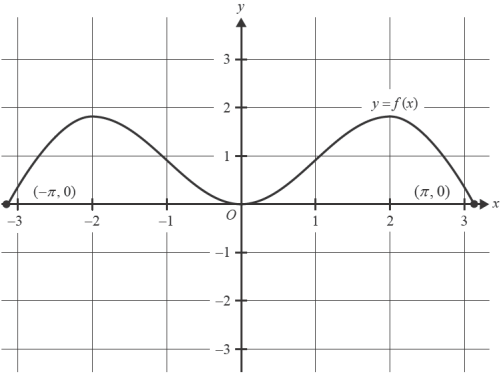
Part of the graph of  \(f:[-\pi, \pi] \rightarrow R, f(x)=x \sin (x)\)  is shown below.

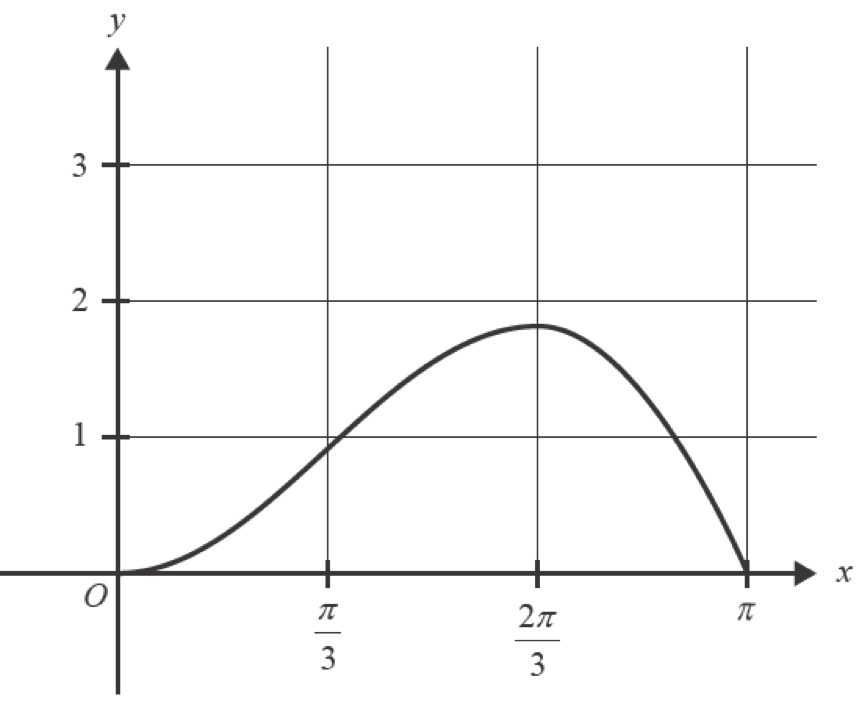
  1. Use the trapezium rule with a step size of \(\dfrac{\pi}{3}\) to determine an approximation of the total area between the graph of  \(y=f(x)\) and the \(x\)-axis over the interval  \(x \in[0, \pi]\).   (3 marks)

    --- 8 WORK AREA LINES (style=lined) ---

  2.   i. Find \(f^{\prime}(x)\).   (1 mark)

    --- 3 WORK AREA LINES (style=lined) ---

  3.  ii. Determine the range of \(f^{\prime}(x)\) over the interval \(\left[\dfrac{\pi}{2}, \dfrac{2 \pi}{3}\right]\).   (1 mark)

    --- 3 WORK AREA LINES (style=lined) ---

  4. iii. Hence, verify that \(f(x)\) has a stationary point for \(x \in\left[\dfrac{\pi}{2}, \dfrac{2 \pi}{3}\right]\).   (1 mark)

    --- 3 WORK AREA LINES (style=lined) ---

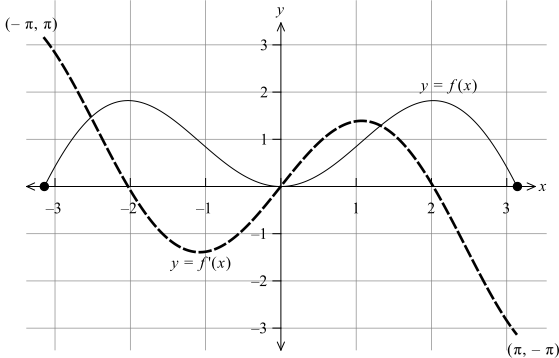
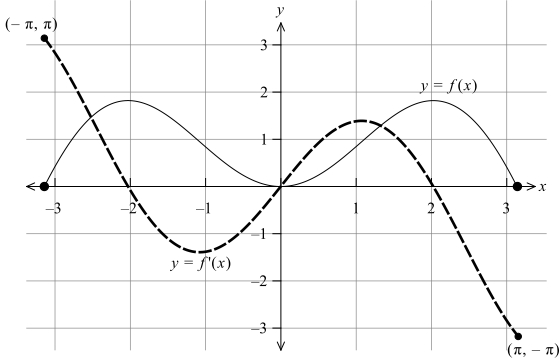
  5. On the set of axes below, sketch the graph of  \(y=f^{\prime}(x)\)  on the domain \([-\pi, \pi]\), labelling the endpoints with their coordinates.
  6. You may use the fact that the graph of  \(y=f^{\prime}(x)\)  has a local minimum at approximately \((-1.1,-1.4)\) and a local maximum at approximately \((1.1,1.4)\).   (3 marks)

    --- 0 WORK AREA LINES (style=lined) ---

Show Answers Only

a.    \(\dfrac{\sqrt{3}\pi^2}{6}\)

bi.   \(x\cos(x)+\sin(x)\)

bii.  \(\left[-\dfrac{\pi}{3}+\dfrac{\sqrt{3}}{3},\ 1\right]\)

biii. \(\text{In the interval }\left[\dfrac{\pi}{2}, \dfrac{2\pi}{3}\right],\ f^{\prime}(x)\ \text{changes from positive to negative.}\)

\(f^{\prime}(x)=0\ \text{at some point in the interval.}\)

\(\therefore\ \text{A stationary point must exist in the given range.}\)

c. 

Show Worked Solution

a.     \(A\) \(=\dfrac{\pi}{3}\times\dfrac{1}{2}\left(f(0)+2f\left(\dfrac{\pi}{3}\right)+2f\left(\dfrac{2\pi}{3}\right)+f(\pi)\right)\)
    \(=\dfrac{\pi}{6}\left(0+2\times \dfrac{\pi}{3}\sin\left(\dfrac{\pi}{3}\right)+2\times \dfrac{2\pi}{3}\sin\left(\dfrac{2\pi}{3}\right)+\pi\sin({\pi})\right)\)
    \(=\dfrac{\pi}{6}\left(2\times \dfrac{\pi}{3}\times\dfrac{\sqrt{3}}{2}+2\times\dfrac{2\pi}{3}\times \dfrac{\sqrt{3}}{2}+0\right)\)
    \(=\dfrac{\pi}{6}\left(\dfrac{2\pi\sqrt{3}}{6}+\dfrac{4\pi\sqrt{3}}{6}\right)\)
    \(=\dfrac{\pi}{6}\times \dfrac{6\pi\sqrt{3}}{6}\)
    \(=\dfrac{\sqrt{3}\pi^2}{6}\)
♦ Mean mark (a) 48%.
bi.    \(f(x)\) \(=x\sin(x)\)
  \(f^{\prime}(x)\) \(=x\cos(x)+\sin(x)\)


b.ii.  \(\text{Gradient in given range gradually decreases.}\)

\(\text{Range of}\ f^{\prime}(x)\ \text{will be defined by the endpoints.}\)

  \(f^{\prime}\left(\dfrac{\pi}{2}\right)\) \(=1\)
  \(f^{\prime}\left(\dfrac{2\pi}{3}\right)\) \(=\dfrac{2\pi}{3}\left(\dfrac{-1}{2}+\dfrac{\sqrt{3}}{2}\right)=-\dfrac{\pi}{3}+\dfrac{\sqrt{3}}{3}\)

 
\(\therefore\ \text{Range of }\ f^{\prime} (x)\ \text{is}\quad\left[-\dfrac{\pi}{3}+\dfrac{\sqrt{3}}{3},\ 1\right]\)

♦♦♦ Mean mark (b.ii.) 20%.
♦♦♦ Mean mark (b.iii.) 12%.

 
biii. \(\text{In the interval }\left[\dfrac{\pi}{2}, \dfrac{2\pi}{3}\right],\ f^{\prime}(x)\ \text{changes from positive to negative.}\)

\(f^{\prime}(x)=0\ \text{at some point in the interval.}\)

\(\therefore\ \text{A stationary point must exist in the given range.}\)

 
c.   
\(f^{\prime}(\pi)=\pi\cos(\pi)+\sin(\pi)=-\pi\)

\(f^{\prime}(-\pi)=-\pi\cos(-\pi)+\sin(-\pi)=\pi\)

\(\therefore\ \text{Endpoints are }\ (-\pi,\ \pi)\ \text{and}\ (\pi,\ -\pi).\)
♦♦ Mean mark (c) 36%.

Filed Under: Curve Sketching, The Derivative Function and its Graph, Trapezium Rule and Newton Tagged With: Band 4, Band 5, Band 6, smc-2830-20-Find f'(x) graph given f(x), smc-2830-50-SP problems, smc-5145-04-Trapezium rule, smc-5145-20-No table, smc-724-45-Other graphs, smc-744-40-Product Rule

Calculus, MET1 2023 VCAA 1b

Let  \(f(x)=\sin(x)e^{2x}\).

Find  \(f^{'}\Big(\dfrac{\pi}{4}\Big)\).   (2 marks)

--- 6 WORK AREA LINES (style=lined) ---

Show Answers Only

\(\dfrac{3\sqrt{2}}{2}e^{\frac{\pi}{2}}\ \text{or}\ \dfrac{3e^{\frac{\pi}{2}}}{\sqrt{2}}\)

Show Worked Solution

\(\text{Using the product rule}\)

\(f'(x)\) \(=e^{2x}\cos(x)+2e^{2x}\sin(x)\)
  \(=e^{2x}\Big(\cos(x)+2\ \sin(x)\Big)\)
\(\therefore\ f’\Big(\dfrac{\pi}{4}\Big)\) \(=e^{2(\frac{\pi}{4})}\Bigg(\cos(\dfrac{\pi}{4})+2\ \sin(\dfrac{\pi}{4})\Bigg)\)
  \(=e^{\frac{\pi}{2}}\Bigg(\dfrac{1}{\sqrt{2}}+\sqrt{2}\Bigg)\)
  \(=e^{\frac{\pi}{2}}\Bigg(\dfrac{1+\sqrt2 \times \sqrt2}{\sqrt2} \Bigg) \)
  \(=\dfrac{3\sqrt{2}}{2}e^{\frac{\pi}{2}}\ \ \text{or}\ \ \dfrac{3e^{\frac{\pi}{2}}}{\sqrt{2}}\)

Filed Under: Differentiation (L&E), Differentiation (Trig), L&E Differentiation, Trig Differentiation Tagged With: Band 3, smc-736-40-Product Rule, smc-736-70-Log/Exp overlap, smc-739-40-Product Rule, smc-739-80-Trig overlap, smc-744-40-Product Rule, smc-744-70-Log/Exp Overlap, smc-745-30-Product Rule, smc-745-60-Trig Overlap

Calculus, MET1 2007 ADV 2aii

Let  `y=xsinx.`  Evaluate  `dy/dx`  for  `x=pi`.   (3 marks)

--- 6 WORK AREA LINES (style=lined) ---

Show Answers Only

`-pi`

Show Worked Solution

`y = x sin x`

`(dy)/(dx)` `= x xx d/(dx) (sin x) + d/(dx) (x) xx sin x`
  `= x  cos x + sin x`

 
`text(When)\ \ x = pi,`

`(dy)/(dx)` `= pi xx cos pi + sin pi`
  `= pi (-1) + 0`
  `=-pi`

Filed Under: Differentiation (Trig), Trig Differentiation Tagged With: Band 4, smc-736-10-sin, smc-736-40-Product Rule, smc-744-10-sin, smc-744-40-Product Rule

Calculus, MET1 2020 VCAA 1a

Let  `y = x^2 sin(x)`.

Find  `(dy)/(dx)`.   (1 mark)

--- 2 WORK AREA LINES (style=lined) ---

Show Answers Only

`2x sin(x) + x^2 cosx`

Show Worked Solution

`(dy)/(dx) = 2x sin(x) + x^2 cosx`

Filed Under: Differentiation (Trig), Trig Differentiation Tagged With: Band 3, smc-736-10-sin, smc-736-40-Product Rule, smc-744-10-sin, smc-744-40-Product Rule

Calculus, MET1-NHT 2019 VCAA 1b

Let  `f(x) = x^2 cos(3x)`.
 
Find  `f ^{\prime} (pi/3)`.   (2 marks)

--- 4 WORK AREA LINES (style=lined) ---

Show Answers Only

`-(2pi)/3`

Show Worked Solution
  `f(x)` `= x^2 cos 3x`
  `f^{\prime}(x)` `= x^2 ⋅ 3(-sin 3x) + 2x cos 3x`
  `f^{\prime}(pi/3)` `= (pi/3)^2 ⋅ 3 (-sin pi) + 2 (pi/3) cos pi`
    `= -(2pi)/3`

Filed Under: Differentiation (Trig), Trig Differentiation Tagged With: Band 4, smc-736-20-cos, smc-736-40-Product Rule, smc-744-20-cos, smc-744-40-Product Rule

Calculus, MET1 2011 VCAA 1b

If  `g(x) = x^2 sin (2x)`,  find  `g^{prime}(pi/6).`   (2 marks)

--- 6 WORK AREA LINES (style=lined) ---

Show Answers Only

`(sqrt 3 pi)/6 + pi^2/36`

Show Worked Solution

`g(x) = x^2 sin (2x)`

MARKER’S COMMENT: Incorrect determination of exact trig values lost many students marks here.

`text(Using Product Rule:)`

`(fh)^{prime}` `= f^{prime} h + fh^{prime}`
`g^{prime}(x)` `= 2 x sin (2x) + 2x^2 cos (2x)`
   
`:. g^{prime}(pi/6)` `= 2 (pi/6) sin (pi/3) + 2 (pi/6)^2 cos (pi/3)`
  `= pi/3 xx sqrt 3/2 + pi^2/18 xx 1/2`
  `= (sqrt 3 pi)/6 + pi^2/36`

Filed Under: Differentiation (Trig), Trig Differentiation Tagged With: Band 4, smc-736-10-sin, smc-736-40-Product Rule, smc-744-10-sin, smc-744-40-Product Rule

Calculus, MET1 2006 VCAA 3a

Let  `y = x tan(x)`. Evaluate  `(dy)/(dx)`  when `x = pi/6`.   (3 mark)

--- 7 WORK AREA LINES (style=lined) ---

Show Answers Only

`(3sqrt3 + 2pi)/9`

Show Worked Solution

`text(Using the product rule:)`

MARKER’S COMMENT: A common error was not knowing the exact trig function values.

`d/(dx)(uv)` `= u^{prime}v + uv^{prime}`
`(dy)/(dx)` `= tan(x) + x/(cos^2(x))`


`text(When)\ x = pi/6,`

`(dy)/(dx)` `= tan(pi/6) + (pi/6)/((cos(pi/6))^2)`
  `= 1/sqrt3 + pi/6 xx (2/sqrt3)^2`
  `= sqrt3/3 + (4pi)/18`
  `= (3sqrt3 + 2pi)/9`

Filed Under: Differentiation (Trig), Trig Differentiation Tagged With: Band 4, smc-736-30-tan, smc-736-40-Product Rule, smc-744-30-tan, smc-744-40-Product Rule

Calculus, MET1 2006 ADV 2ai

Differentiate with respect to `x`:

Let  `f(x)=x tan x`.  Find  `f^{prime}(x)`.   (2 marks)

--- 4 WORK AREA LINES (style=lined) ---


Show Answers Only

`f^{prime}(x) = x  sec^2 x + tan x `

Show Worked Solution

`y = x tan x`

`text(Using product rule)`

`f^{prime} (uv)` `= u^{prime}v + uv ^{prime}`
`:.f^{prime}(x)` `= tan x + x xx sec^2 x`
  `= x sec^2 x + tan x`

Filed Under: Differentiation (Trig), Trig Differentiation Tagged With: Band 3, smc-736-30-tan, smc-736-40-Product Rule, smc-744-30-tan, smc-744-40-Product Rule

Calculus, MET1 2014 VCAA 1a

If  `y = x^2sin(x)`, find  `(dy)/(dx)`.   (2 marks)

--- 3 WORK AREA LINES (style=lined) ---
Show Answers Only

`2xsin(x) + x^2cos(x)`

Show Worked Solution

`text(Using product rule:)`

MARKER’S COMMENT: Factorising your answer is not necessary.
`(fg)^{prime}` `= f^{prime}g + fg^{prime}`
`:. (dy)/(dx)` `= 2xsin(x) + x^2cos(x)`

Filed Under: Differentiation (Trig), Trig Differentiation Tagged With: Band 2, smc-736-10-sin, smc-736-40-Product Rule, smc-744-10-sin, smc-744-40-Product Rule

Copyright © 2014–2025 SmarterEd.com.au · Log in