SmarterEd

Aussie Maths & Science Teachers: Save your time with SmarterEd

  • Login
  • Get Help
  • About

Financial Maths, STD2 EQ-Bank 24

Yuki works as a musician and receives royalties from streaming services. A spreadsheet is used to calculate her quarterly royalty earnings.

Total royalty earnings = Number of streams \(\times\) Royalty rate per stream

A spreadsheet showing Yuki's quarterly royalty earnings is shown.
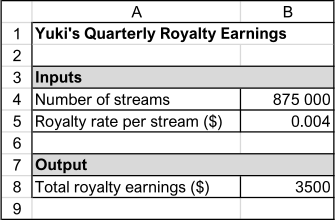


In the following quarter, Yuki's total royalty earnings were $4200. The royalty rate per stream remained at $0.004. Calculate the number of streams Yuki received that quarter.   (2 marks)

--- 5 WORK AREA LINES (style=lined) ---
Show Answers Only

\(1\,050\,000\)

Show Worked Solution

\(\text{Total royalty earnings (B8)} = $4200\)

\(\text{Royalty rate per stream (B5)}=$0.004\)

\(\text{Let the number of streams (B4)}=N\)

\(\text{Total royalty earnings} = \text{Number of streams} \times\text{Royalty rate per stream}\)

\(\text{B8}\) \(=\text{B4}^*\text{B5}\)
\(4200\) \(=N\times 0.004\)
\(N\) \(=\dfrac{4200}{0.004}\)
  \(=1\,050\,000\)

\(\text{Yuki had 1 050 000 streams in the next quarter}\)

Filed Under: Ways of Earning, Ways of Earning Tagged With: Band 5, smc-6276-30-Piecework/Royalties, smc-6276-60-Spreadsheets, smc-6515-30-Piecework/Royalties, smc-6515-60-Spreadsheets, syllabus-2027

Financial Maths, STD2 EQ-Bank 38

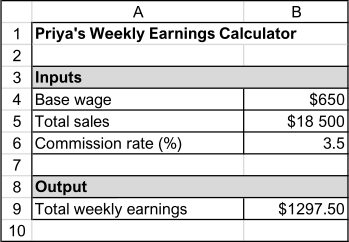
Priya works as a sales representative and earns a base wage plus commission. A spreadsheet is used to calculate her weekly earnings.

Total weekly earnings = Base wage + Total sales \(\times\) Commission rate

A spreadsheet showing Priya's weekly earnings is shown.


  1. Write down the formula used in cell B9, using appropriate grid references.   (1 mark)

    --- 1 WORK AREA LINES (style=lined) ---

  2. In the following week, Priya earned total weekly earnings of $1437.50. Her base wage and commission rate remained unchanged. Calculate Priya's total sales for that week.   (2 marks)

    --- 5 WORK AREA LINES (style=lined) ---
  3. Priya's employer increases her commission rate to 4.2% but keeps her base wage the same. If Priya makes $22 000 in sales, calculate her new total weekly earnings.   (2 marks)

    --- 5 WORK AREA LINES (style=lined) ---
Show Answers Only

a.   \(=\text{B4}+\text{B5}^*\text{B6}/100\)

b.    \($22\, 500\)

c.    \($1574\)

Show Worked Solution

a.   \(\text{Total weekly earnings} = \text{Base wage}+\text{Total sales} \times \text{Commission rate}\)

\(\therefore\ \text{Formula:}\ =\text{B4}+\text{B5}^*\text{B6}/100\)
 

b.   \(\text{Total weekly earnings} = \text{Base wage}+\text{Total sales} \times \text{Commission rate}\)

\(\text{Let the Total sales}=S\)

\(1437.50\) \(=650+S\times \dfrac{3.5}{100}\)
\(787.50\) \(=S\times \dfrac{3.5}{100}\)
\(S\) \(=\dfrac{787.50\times 100}{3.5}=$22\,500\)

 
\(\text{The amount of Priya’s total sales was \$22 500.}\)
 

c.    \(\text{Base wage}=650\)

\(\text{Total sales}=$22\,000\)

\(\text{New commission rate}=4.2\%\)

\(\text{Total weekly earnings}\) \(=650+22\,000\times \dfrac{4.2}{100}\)
  \(=650+924=$1574\)

Filed Under: Ways of Earning, Ways of Earning Tagged With: Band 3, Band 4, Band 5, smc-6276-20-Commission, smc-6276-60-Spreadsheets, smc-6515-20-Commission, smc-6515-60-Spreadsheets, syllabus-2027

Financial Maths, STD2 EQ-Bank 17 MC

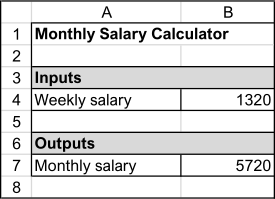
A company uses a spreadsheet to calculate employees' monthly salaries from their weekly salaries. The spreadsheet is shown below.
 

Which formula has been used in cell B7 to calculate the monthly salary?
 
  1. \(=\text{B4}^*4\)
  2. \(=\text{B4}^*52/12\)
  3. \(=\text{B4}^*12\)
  4. \(=\text{B4}/52^*12\)
Show Answers Only

\(B\)

Show Worked Solution

\(\text{Monthly salary} = \dfrac{\text{weekly salary} \times 52}{12}\)

\(\therefore\ \text{Formula:}\ =\text{B4}^*52/12\)

\(\Rightarrow B\)

Filed Under: Ways of Earning, Ways of Earning Tagged With: Band 4, smc-6276-10-Wages/Salaries, smc-6276-60-Spreadsheets, smc-6515-10-Wages/Salaries, smc-6515-60-Spreadsheets, syllabus-2027

Financial Maths, STD2 EQ-Bank 21

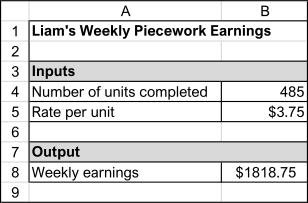
Liam works in a factory assembling electronic components and is paid on a piecework basis. A spreadsheet is used to calculate his weekly earnings.

Weekly earnings = Number of units completed \(\times\) Rate per unit

A spreadsheet showing Liam's earnings for one week is shown.
  

  1. Write down the formula used in cell B8, using appropriate grid references.   (1 mark)

    --- 1 WORK AREA LINES (style=lined) ---

  2. In the following week, Liam earned $2036.25. The rate per unit remained at $3.75. Calculate the number of units Liam completed that week.   (2 marks)

    --- 5 WORK AREA LINES (style=lined) ---
Show Answers Only

a.   \(=\text{B4}^*\text{B5}\)

b.    \(\text{Number of units completed}=543\)

Show Worked Solution

a.   \(\text{Weekly earnings} = \text{Number of units completed} \times \text{Rate per unit}\)

\(\text{Formula:}\ =\text{B4}^*\text{B5}\)
 

b.   \(\text{Weekly earnings} = \text{Number of units completed} \times \text{Rate per unit}\)

\(\text{Let the Weekly earnings}=E\)

\(2036.25\) \(=E\times 3.75 \)
\(E\) \(=\dfrac{2036.25}{3.75}=543\)

Filed Under: Ways of Earning, Ways of Earning Tagged With: Band 3, Band 4, smc-6276-30-Piecework/Royalties, smc-6276-60-Spreadsheets, smc-6515-30-Piecework/Royalties, smc-6515-60-Spreadsheets, syllabus-2027

Financial Maths, STD2 EQ-Bank 19

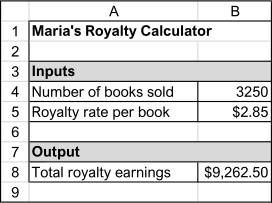
Maria works as a freelance writer and earns income through royalties. A spreadsheet is used to calculate her monthly royalty earnings.

Royalties = Number of books sold \( \times \) Royalty rate per book

A spreadsheet showing Maria's royalty earnings is shown.
  

  1. Write down the formula used in cell B8, using appropriate grid references.   (1 mark)

    --- 1 WORK AREA LINES (style=lined) ---

  2. In April, Maria earned total royalty earnings of $8960. Her royalty rate remained at $2.85 per book. How many books did Maria sell in April?   (2 marks)

    --- 5 WORK AREA LINES (style=lined) ---
Show Answers Only

a.   \(=\text{B4}^*\text{B5}\)

b.    \(\text{Number of books}=3144\)

Show Worked Solution

a.   \(\text{Total royalty earnings} = \text{Number of books sold} \times \text{Royalty rate per book}\)

\(\text{Formula:}\ =\text{B4}^*\text{B5}\)
 

b.   \(\text{Total royalty earnings} = \text{Number of books sold} \times \text{Royalty rate per book}\)

\(\text{Let the Number of books sold}=N\)

\(8960.40\) \(=N\times 2.85 \)
\(N\) \(=\dfrac{8960.40}{2.85}=3144\)

Filed Under: Ways of Earning, Ways of Earning Tagged With: Band 3, Band 4, smc-6276-30-Piecework/Royalties, smc-6276-60-Spreadsheets, smc-6515-30-Piecework/Royalties, smc-6515-60-Spreadsheets, syllabus-2027

Financial Maths, STD2 EQ-Bank 31

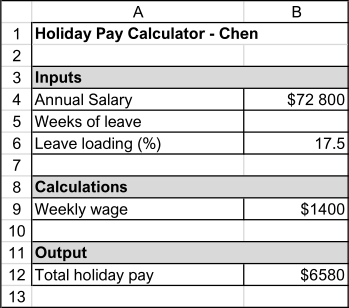
Chen earns an annual salary of $72 800. He is entitled to four weeks annual leave with 17.5% leave loading. A spreadsheet is used to calculate his total holiday pay.

Total holiday pay = 4 × weekly wage + 4 × weekly wage × 17.5%

A spreadsheet showing Chen's holiday pay calculation is shown.

  1. What value from the question should be entered in cell B5?   (1 mark)

    --- 1 WORK AREA LINES (style=lined) ---
  2. Write down the formula used in cell B9 to calculate the weekly wage, using appropriate grid references.   (2 marks)

    --- 2 WORK AREA LINES (style=lined) ---
  3. Verify the amount of Chen's total holiday pay using calculations.   (2 marks)

    --- 5 WORK AREA LINES (style=lined) ---
Show Answers Only

a.   \(4\)

b.   \(=\text{B4}/52\)

c.    \(\text{Total holiday pay}=\text{weekly wage}\times 4 +\ \text{weekly wage}\times 4\ \times 17.5\%\)

\(\text{Total holiday pay}=1400\times 4+1400\times 4\times\dfrac{17.5}{100}=5600+980=$6580\)

Show Worked Solution

a.    \(\text{Chen gets 4 weeks leave }\rightarrow\ 4\)
 

b.    \(\text{Weekly wage }=\dfrac{\text{Annual salary}}{52}\)

\(\text{Formula: }=\text{B4}/52\)
 

c.    \(\text{Total holiday pay}=\text{weekly wage}\times 4 +\ \text{weekly wage}\times 4\ \times 17.5\%\)

\(\text{Total holiday pay}=1400\times 4+1400\times 4\times\dfrac{17.5}{100}=5600+980=$6580\)

Filed Under: Ways of Earning, Ways of Earning Tagged With: Band 2, Band 3, Band 5, smc-6276-10-Wages/Salaries, smc-6276-60-Spreadsheets, smc-6515-10-Wages/Salaries, smc-6515-60-Spreadsheets, syllabus-2027

Financial Maths, STD2 EQ-Bank 19 MC

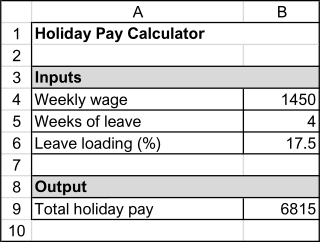
A company calculates holiday pay for employees entitled to four weeks annual leave with 17.5% leave loading on four weeks pay.

A spreadsheet is used to calculate the total holiday pay.
 

Which formula has been used in cell B9?

  1. \(=\text{B4}^*\text{B5}+\text{B4}^*\text{B5}^*\text{B6}\)
  2. \(=\text{B4}^*\text{B5}+\text{B4}^*\text{B5}^*\text{B6}/100\)
  3. \(=\text{B4}^*\text{B5}^*\text{B6}/100\)
  4. \(=\text{B4}+\text{B5}+\text{B6}\)
Show Answers Only

\(B\)

Show Worked Solution

\(\text{Total holiday pay}=\text{weekly wage}\times 4 +\text{weekly wage}\times 4\ \times 17.5\%\)

\(\text{Formula: }\text{weekly wage}\times 4 +\text{weekly wage}\times 4\ \times \dfrac{17.5}{100}\)

\(\text{Using cell references: }=\text{B4}^*\text{B5}+\text{B4}^*\text{B5}^*\text{B6}/100\)

\(\text{Check: }1450\times 4+1450\times 4\times\dfrac{17.5}{100}=5800+1015=6815\)

\(\Rightarrow B\)

Filed Under: Ways of Earning, Ways of Earning Tagged With: Band 5, smc-6276-10-Wages/Salaries, smc-6276-60-Spreadsheets, smc-6515-10-Wages/Salaries, smc-6515-60-Spreadsheets, syllabus-2027

Algebra, STD2 EQ-Bank 29

The formula below is used to estimate the number of hours you must wait before your blood alcohol content (BAC) will return to zero after consuming alcohol.

\(\text{Number of hours}\ =\dfrac{\text{BAC}}{0.015}\)

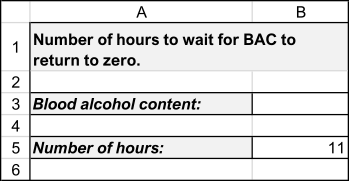
The spreadsheet below has been created by Ben so his 21st birthday attendees can monitor their alcohol consumption if they intend to drive, given their BAC reading. 

  1. By using appropriate grid references, write down a formula that could appear in cell B5.   (2 marks)

    --- 2 WORK AREA LINES (style=lined) ---
  2. Ben's friend Ryan's reading reflects that he will have to wait 11 hours for his BAC to return to zero. Using the formula, calculate the value Ryan entered into cell B3.   (2 marks)

    --- 5 WORK AREA LINES (style=lined) ---
Show Answers Only

a.    \(=\text{B3}/0.015\)

b.    \(0.165\)

Show Worked Solution

a.    \(=\text{B3}/0.015\)

b.    \(11\) \(=\dfrac{\text{BAC}}{0.015}\)
  \(\text{BAC}\) \(=11\times 0.015=0.165\)

  
\(\text{Ryan entered 0.165 into cell B3.}\)

Filed Under: Applications: BAC, D=SxT and Medication, Applications: BAC, Medicine and d=s x t Tagged With: Band 3, Band 5, smc-6235-10-\(BAC\) formula, smc-6235-60-Spreadsheets, smc-6509-10-BAC, smc-6509-60-Spreadsheets, syllabus-2027

Algebra, STD2 EQ-Bank 28

Fried's formula for determining the medicine dosage for children aged 1 - 2 years is:

\(\text{Dosage}=\dfrac{\text{Age of infant (months)}\  \times \ \text{adult dose}}{150}\)

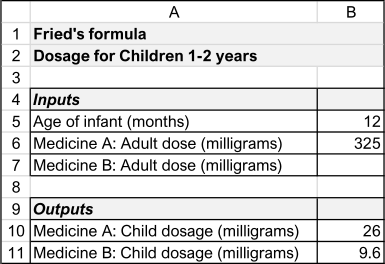
The spreadsheet below is used as a calculator for determining an infant's medicine dosage according to Fried's formula.
 

Amber, a 12 month old child, is being discharged from hospital with two medications. Medicine A has an adult dosage of 325 milligrams and she is to take 26 milligrams. She must also take 9.6 milligrams of Medicine B but the equivalent adult dosage has been left off the spreadsheet.

  1. By using appropriate grid references, write down a formula that could appear in cell B10.   (2 marks)

    --- 1 WORK AREA LINES (style=lined) ---
  2. Calculate the equivalent adult dosage for Medicine B (cell B7) using the information in the spreadsheet.    (2 marks)

    --- 5 WORK AREA LINES (style=lined) ---
Show Answers Only

a.    \(=\text{B5}^*\text{B6}/150\)

b.    \(120 \ \text{milligrams}\)

Show Worked Solution

a.     \(=\text{B5}^*\text{B6}/150\)
 

b.    \(\text{Let} \ A= \text{Adult dose}\)

\(\text{Using given formula:}\)

\(9.6\) \(=\dfrac{12 \times A}{150}\)
\(A\) \(=\dfrac{9.6 \times 150}{12}=120 \ \text{milligrams}\)

Filed Under: Applications: BAC, D=SxT and Medication, Applications: BAC, Medicine and d=s x t Tagged With: Band 4, Band 5, smc-6235-40-Medication Formulas, smc-6235-60-Spreadsheets, smc-6509-30-Medication Formulas, smc-6509-60-Spreadsheets, syllabus-2027

Financial Maths, STD1 EQ-Bank 1

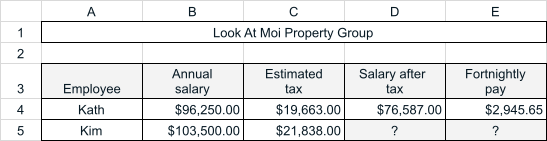
A company uses the spreadsheet below to calculate the fortnightly pay, after tax, of its employees.
 

  1. Write down the formula that was used in cell D5, using appropriate grid references.   (1 mark)

    --- 1 WORK AREA LINES (style=lined) ---
  2. Hence, calculate Kim's fortnightly pay.   (2 marks)

    --- 4 WORK AREA LINES (style=lined) ---
Show Answers Only

a.  \(=\text{B6}-\text{C6}\)

b.    \(\$3140.85\)

Show Worked Solution

a.    \(\text{Formula for Kim’s Salary after tax:}\)

\(=\text{B5}-\text{C5}\)
 

b.    \(\text{Kim’s salary after tax}\ = \$81\,662\)

\(\text{Kim’s fortnightly pay}\ = \dfrac{81\,662}{26}=\$3140.85\)

Filed Under: Taxation Tagged With: Band 3, Band 4, smc-6516-30-Other Tax Problems, smc-6516-50-Spreadsheets, syllabus-2027

Financial Maths, STD2 EQ-Bank 17

The table shows the income tax rate for Australian residents for the 2024-2025 financial year.

\begin{array}{|l|l|}
\hline
\rule{0pt}{2.5ex}\textit{Taxable income} \rule[-1ex]{0pt}{0pt}& \textit{Tax on this income} \\
\hline
\rule{0pt}{2.5ex}0-\$18\,200 \rule[-1ex]{0pt}{0pt}& \text{Nil} \\
\hline
\rule{0pt}{2.5ex}\$18 \, 201-\$45\,000 \rule[-1ex]{0pt}{0pt}& \text{16 cents for each \$1 over \$18 200} \\
\hline
\rule{0pt}{2.5ex}\$45\,001-\$135\,000 \rule[-1ex]{0pt}{0pt}& \$4288 \text{ plus 30 cents for each \$1 over \$45 000} \\
\hline
\rule{0pt}{2.5ex}\$135\,001-\$190\,000 \rule[-1ex]{0pt}{0pt}& \$31 \, 288 \text{ plus 37 cents for each \$1 over \$135 000} \\
\hline
\rule{0pt}{2.5ex}\$190\,001 \text{ and over} \rule[-1ex]{0pt}{0pt}& \$51 \, 638 \text{ plus 45 cents for each \$1 over \$190 000} \\
\hline
\end{array}

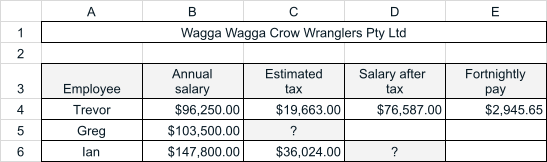
A company's spreadsheet was created that calculates its employees' after tax fortnightly pay, based on the table and excluding the Medicare levy.

  1. Write down the formula that was used in cell D6, using appropriate grid references.   (1 mark)

    --- 1 WORK AREA LINES (style=lined) ---
  2. Write down the formula that was used in cell C5, using appropriate grid references.   (1 mark)

    --- 2 WORK AREA LINES (style=lined) ---
  3. Hence, calculate Greg's fortnightly pay.   (2 marks)

    --- 4 WORK AREA LINES (style=lined) ---
Show Answers Only

a.  \(=\text{B6}-\text{C6}\)

b.  \(=4288+(\text{B5}-45000)^*0.30 \)

c.    \(\$3140.85\)

Show Worked Solution

a.    \(\text{Formula for Ian’s Salary after tax:}\)

\(=\text{B6}-\text{C6}\)
 

b.    \(\text{Formula for Greg’s estimated tax:}\)

\(=4288+(\text{B5}-45000)^*0.30 \)
 

c.    \(\text{Greg’s estimated tax}\ =4288+(103\,500-45\,000) \times 0.30=\$21\,838\)

\(\text{Greg’s salary after tax}\ = 103\,500-21\,838=\$81\,662\)

\(\text{Greg’s fornightly pay}\ = \dfrac{81\,662}{26}=\$3140.85\)

Filed Under: Taxation Tagged With: Band 3, Band 4, smc-6277-10-Tax Tables, smc-6277-40-Spreadsheets, syllabus-2027

Algebra, STD2 EQ-Bank 12 MC

Young's formula for determining the medicine dosage for children aged 1 - 12 years is:

\(\text{Dosage} = \dfrac{\text{Age of child (years)}\ \times\ \text{Adult dose}}{\text{Age of child (years) } +\  12}\)

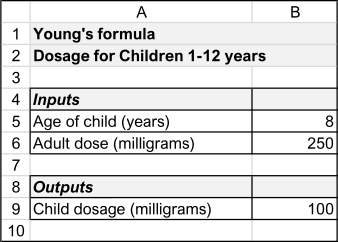
The spreadsheet below is used as a calculator for determining an child's medicine dosage according to Young's formula.


Young's formula for calculating an 8 year old child's dosage has been used in cell B9. Using appropriate cell references, the correct formula to input into cell B9 is:

  1. \(=\text{B5}^*\text{B6}/\text{B5}+12\)
  2. \(=(\text{B5}^*\text{B6})/\text{B5}+12\)
  3. \(=\text{B5}^*\text{B6}/(\text{B6}+12)\)
  4. \(=(\text{B5}^*\text{B6})/(\text{B5}+12)\)
Show Answers Only

\(D\)

Show Worked Solution

\(=(\text{B5}^*\text{B6})/(\text{B5}+12)\)

\(\Rightarrow D\)

Filed Under: Applications: BAC, D=SxT and Medication, Applications: BAC, Medicine and d=s x t Tagged With: Band 5, smc-6235-40-Medication Formulas, smc-6235-60-Spreadsheets, smc-6509-30-Medication Formulas, smc-6509-60-Spreadsheets, syllabus-2027

Algebra, STD2 EQ-Bank 26

Fried's formula for determining the medicine dosage for children aged 1 - 2 years is:

\(\text{Dosage}=\dfrac{\text{Age of infant (months)}\  \times \ \text{adult dose}}{150}\)

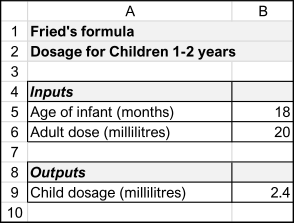
The spreadsheet below is used as a calculator for determining an infant's medicine dosage according to Fried's formula.
 

  1. By using appropriate grid references, write down a formula that could appear in cell B9.   (2 marks)

    --- 1 WORK AREA LINES (style=lined) ---
  2. Another infant requiring the same medicine has been recommended a dosage of 2 millilitres. What is the age of the infant?   (2 marks)

    --- 5 WORK AREA LINES (style=lined) ---
Show Answers Only

a.    \(=\text{B5}^*\text{B6}/150\)

b.    \(15 \ \text{months}\)

Show Worked Solution

a.     \(=\text{B5}^*\text{B6}/150\)
 

b.    \(\text{Let} \ n= \text{age of infant}\)

\(\text{Using given formula:}\)

\(2\) \(=\dfrac{n \times 20}{150}\)
\(n\) \(=\dfrac{2 \times 150}{20}=15 \ \text{months}\)

Filed Under: Applications: BAC, D=SxT and Medication, Applications: BAC, Medicine and d=s x t Tagged With: Band 4, Band 5, smc-6235-40-Medication Formulas, smc-6235-60-Spreadsheets, smc-6509-30-Medication Formulas, smc-6509-60-Spreadsheets, syllabus-2027

Financial Maths, STD2 EQ-Bank 36

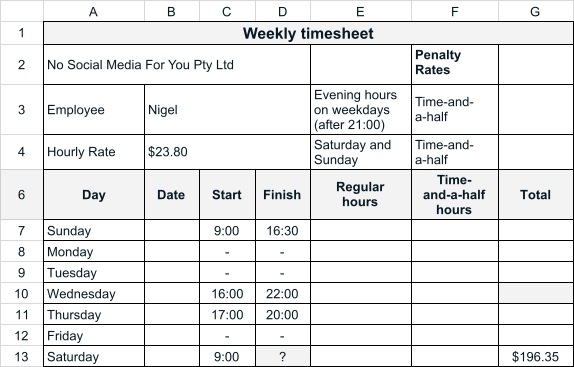
Nigel's weekly wages are calculated using the partially completed spreadsheet below.
 

  1. Calculate the total wages Nigel earned on Wednesday.   (2 marks)

    --- 4 WORK AREA LINES (style=lined) ---
  2. Determine the time Nigel finished work on Saturday, given he earned $196.35 on the day.   (2 marks)

    --- 5 WORK AREA LINES (style=lined) ---
Show Answers Only

a.    \(\text{Total wages}=119.00+35.70=\$ 154.70\)

b.    \(14:30\)

Show Worked Solution

a.    \(\text{Wednesday wages:}\)

\(\text{Regular hours:} \ 5 \times 23.80=\$ 119.00\)

\(\text{Time-and-a-half:} \ 1 \times 1.5 \times 23.80=\$35.70\)

\(\text{Total wages}=119.00+35.70=\$ 154.70\)
 

b.    \(\text{Let \(h=\) total hours worked:}\)

\(\text{Since Saturday wages are time-and-a-half rate:}\)

\(h \times 1.5 \times 23.80\) \(=196.35\)
\(h\) \(=\dfrac{196.35}{1.5 \times 23.80}=5.5\ \text{hours}\)


\(\text{Nigel’s shift started at 09:00 and lasted 5.5 hours.}\)

\(\therefore\ \text{Nigel finished work at 14:30.}\)

Filed Under: Ways of Earning, Ways of Earning Tagged With: Band 4, Band 5, smc-6276-10-Wages/Salaries, smc-6276-60-Spreadsheets, smc-6515-10-Wages/Salaries, smc-6515-60-Spreadsheets, syllabus-2027

Financial Maths, STD2 EQ-Bank 37

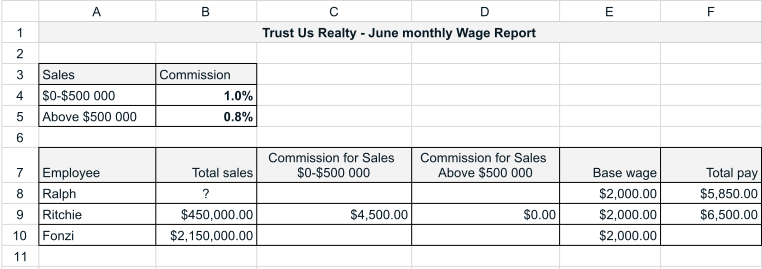
Trust Us Realty has three salespeople, Ralph, Ritchie, and Fonzi.

Their June monthly wages include a base wage and commission earned, which is modelled in the spreadsheet below.

  1. Write down the formula that was used in cell C9, using appropriate grid references.   (1 mark)

    --- 2 WORK AREA LINES (style=lined) ---
  2. Calculate Fonzi's total pay for the month of June.   (2 marks)

    --- 4 WORK AREA LINES (style=lined) ---
  3. Ralph's total pay for June is $5850. Determine Ralph's total sales for the month.   (2 marks)

    --- 4 WORK AREA LINES (style=lined) ---
Show Answers Only

a.    \(=0.01^* \text{B9}\)

b.    \(\$ 20\,200\)

c.    \(\$ 385\,000\)

Show Worked Solution

a.    \(=0.01^* \text{B9}\)
 

b.    \(\text{Fonzi’s Commission:}\)

\(\text{Sales}\ \$0-\$500\,000=0.01 \times 500\,000=\$ 5000\)

\(\text{Sales over} \ \$500\, 000=(2\,150\,000-500\,000) \times 0.008=\$13\,200\)

\(\text{Total June wages}=5000+13\,200+2000=\$ 20\,200\)
 

c.    \(\text{Ralph’s sales commission}\ =5850-2000=\$3850\)

\(\text {Since Ralph earned} \ \$3850 \ \text{in commission:}\)

\(\text{Sales} \times 0.01\) \(=3850\)
\(\text{Sales}\) \(=\dfrac{3850}{0.01}=\$ 385\,000\)

Filed Under: Ways of Earning, Ways of Earning Tagged With: Band 4, Band 5, smc-6276-20-Commission, smc-6276-60-Spreadsheets, smc-6515-20-Commission, smc-6515-60-Spreadsheets, syllabus-2027

Algebra, STD2 EQ-Bank 31

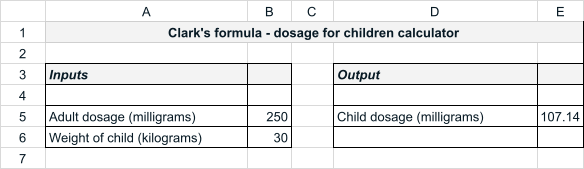
Clark's formula for determining the medicine dosage for children is:

\(\text{Dosage}=\dfrac{\text{weight in kilograms}\  \times \ \text{adult dosage}}{70}\)

The spreadsheet below is used as a calculator for determining a child's medicine dosage according to Clark's formula.
 

  1. By using appropriate grid references, write down a formula that could appear in cell E5.   (2 marks)

    --- 1 WORK AREA LINES (style=lined) ---
  2. Another child requiring the same medicine has been recommended a dosage of 62.5 milligrams. How much does the child weigh?   (2 marks)

    --- 5 WORK AREA LINES (style=lined) ---
Show Answers Only

a.    \(=\text{B6}^*\text{B5}/70\)

b.    \(17.5 \ \text{kilograms}\)

Show Worked Solution

a.    \(=\text{B6}^*\text{B5}/70\)
 

b.    \(\text{Let} \ w= \text{weight of the child.}\)

\(\text{Using given formula:}\)

\(62.5\) \(=\dfrac{w \times 250}{70}\)
\(w\) \(=\dfrac{62.5 \times 70}{250}=17.5 \ \text{kilograms}\)

Filed Under: Applications: BAC, D=SxT and Medication, Applications: BAC, Medicine and d=s x t Tagged With: Band 4, Band 5, smc-6235-40-Medication Formulas, smc-6235-60-Spreadsheets, smc-6509-30-Medication Formulas, smc-6509-60-Spreadsheets, syllabus-2027

Algebra, STD2 EQ-Bank 19

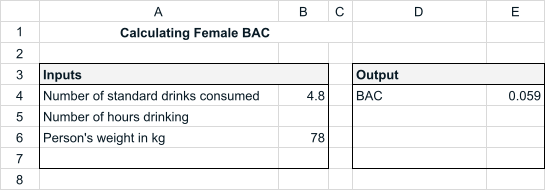
Sharon drinks three glasses of chardonnay over a 180-minute period, each glass containing 1.6 standard drinks.

Sharon weighs 78 kilograms, and her blood alcohol content (BAC) at the end of this period can be calculated using the following formula:

\(\text{BAC}_{\text {female }}=\dfrac{10 N-7.5 H }{5.5 M}\)

where \(N\) = number of standard drinks consumed
\(H\)  = the number of hours drinking
\(M\)  = the person's mass in kilograms

 
The spreadsheet below can be used to calculate Sharon's \(\text{BAC}\).
 

  1. What value should be input into cell B5.   (1 mark)

    --- 2 WORK AREA LINES (style=lined) ---
  2. Write down the formula that has been used in cell E4, using appropriate grid references.   (2 marks)

    --- 2 WORK AREA LINES (style=lined) ---
Show Answers Only

a.    \(\text{Cell B5 value}=3\)

b.  \(=\left(10^* \text{B4}-7.5^* \text{B5}\right) /(5.5^* \text{B6})\)

Show Worked Solution

a.    \(\text{180 minutes}\ =\ \text{3 hours}\)

\(\therefore \ \text{Cell B5 value}=3\)
 

b.  \(=\left(10^* \text{B4}-7.5^* \text{B5}\right) /(5.5^* \text{B6})\)

Filed Under: Applications: BAC, D=SxT and Medication, Applications: BAC, Medicine and d=s x t Tagged With: Band 3, Band 5, smc-6235-10-\(BAC\) formula, smc-6235-60-Spreadsheets, smc-6509-10-BAC, smc-6509-60-Spreadsheets, syllabus-2027

Financial Maths, STD2 EQ-Bank 28

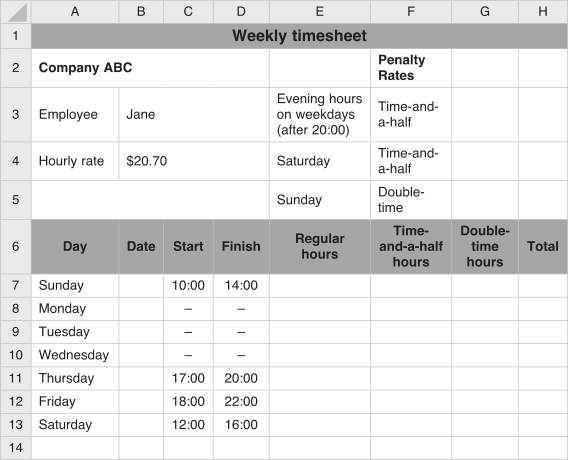
The spreadsheet shows a casual employee's partially completed timesheet.
 

Calculate Jane's total earnings for the week.   (2 marks)

--- 6 WORK AREA LINES (style=lined) ---
Show Answers Only

\(\text{Earnings:}\)

\(\text{Sunday:}\ 4 \times 20.70 \times 2 = $165.60\)

\(\text{Thursday:}\ 3 \times 20.70 = $62.10\)

\(\text{Friday:}\ (2 \times 20.70) + (2 \times 20.70 \times 1.5) = $103.50\)

\(\text{Saturday:}\ 4 \times 20.70 \times 1.5 = $124.20\)
 

\(\text{Total earnings}\ =165.60+62.10+103.50+124.20=$455.40\)

Show Worked Solution

\(\text{Earnings:}\)

\(\text{Sunday:}\ 4 \times 20.70 \times 2 = $165.60\)

\(\text{Thursday:}\ 3 \times 20.70 = $62.10\)

\(\text{Friday:}\ (2 \times 20.70) + (2 \times 20.70 \times 1.5) = $103.50\)

\(\text{Saturday:}\ 4 \times 20.70 \times 1.5 = $124.20\)
 

\(\text{Total earnings}\ =165.60+62.10+103.50+124.20=$455.40\)

Filed Under: Ways of Earning, Ways of Earning Tagged With: Band 4, smc-6276-10-Wages/Salaries, smc-6276-60-Spreadsheets, smc-6515-10-Wages/Salaries, smc-6515-60-Spreadsheets, syllabus-2027

Algebra, STD2 EQ-Bank 25

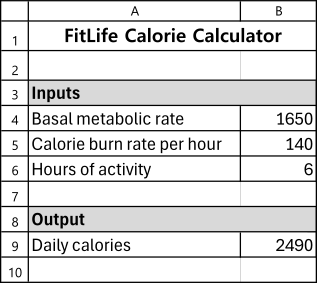
A fitness app calculates daily calorie requirements using the formula below.

Daily calories = Basal metabolic rate + Calorie burn rate per hour \( \times \) Hours of activity

The spreadsheet below has been used to calculate Jamal's daily calorie requirements when he has had 6 hours of activity.
  

  1. Write down the formula used in cell B9, using appropriate grid references.   (1 mark)

    --- 2 WORK AREA LINES (style=lined) ---
  2. Jamal increases his hours of activity to 8 hours per day, while his basal metabolic rate and calorie burn rate remain the same.

    What will be Jamal's new daily calorie requirement?   (1 mark)

    --- 4 WORK AREA LINES (style=lined) ---
Show Answers Only

a.    \(=\text{B4}+ \text{B5} \ ^* \ \text{B6}\)

b.    \(2770\ \text{calories}\)

Show Worked Solution

a.   \(=\text{B4}+ \text{B5} \ ^* \ \text{B6}\)

b.    \(\text{Daily calories}\) \(=1650+140\times 8\)
    \(=2770\)

\(\therefore\ \text{Jamal’s new daily calorie requirement is}\ 2770.\)

Filed Under: Applications of Linear Relationships, Applications of Linear Relationships Tagged With: Band 3, smc-6256-50-Spreadsheets, smc-6513-30-Other Linear Applications, smc-6513-50-Spreadsheets, syllabus-2027

Algebra, STD2 EQ-Bank 24

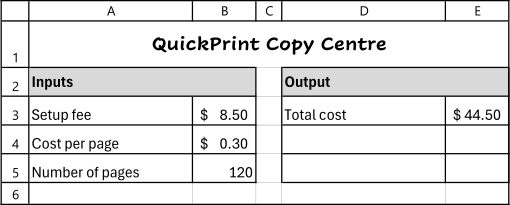
QuickPrint Copy Centre charges for printing services using the formula below.

Total cost = Setup fee + Cost per page \( \times \) Number of pages

A spreadsheet used to calculate the total cost is shown.

  1. Write down the formula used in cell E3, using appropriate grid references.   (1 mark)

    --- 2 WORK AREA LINES (style=lined) ---
  2. QuickPrint increases their cost per page to \$0.42, but keeps the setup fee unchanged. Aisha needs to print 120 pages.

    How much more will Aisha pay compared to the original pricing shown in the spreadsheet?   (2 marks)

    --- 5 WORK AREA LINES (style=lined) ---
Show Answers Only

a.    \(=\text{B3}+ \text{B4} \ ^* \ \text{B5}\)

b.    \($14.40\)

Show Worked Solution

a.   \(=\text{B3}+ \text{B4} \ ^* \ \text{B5}\)
 

b.   \(\text{Original cost from spreadsheet}:\ $44.50\)

\(\text{At increased rate}:\)

\(\text{Total cost}\ =8.50+0.42\times 120=$58.90\)

\(\text{Additional amount}\ =58.90-44.50=$14.40\)

Filed Under: Applications of Linear Relationships, Applications of Linear Relationships Tagged With: Band 3, Band 4, smc-6256-30-Other Linear Applications, smc-6256-50-Spreadsheets, smc-6513-30-Other Linear Applications, smc-6513-50-Spreadsheets, syllabus-2027

Algebra, STD2 EQ-Bank 23

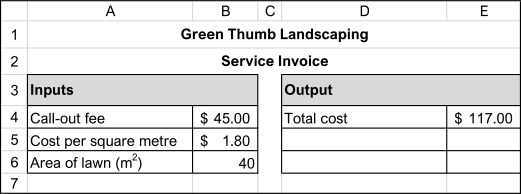
Green Thumb Landscaping charges for their lawn mowing service based on the size of the lawn.

They use the formula below to calculate the cost of each service.

Total cost = Call-out fee + Cost per square metre \( \times \) Area of lawn

The spreadsheet they provide to their clients is included below.

  1. Write down the formula that has been used in cell E4, using appropriate grid references.   (1 mark)

    --- 2 WORK AREA LINES (style=lined) ---
  2. Miguel has a lawn with a different area. The call-out fee and cost per square metre remain the same. When Miguel's lawn area is entered into the spreadsheet, the total cost shown in cell E4 becomes \$153.00.

    What is the area of Miguel's lawn?   (2 marks)

    --- 5 WORK AREA LINES (style=lined) ---
Show Answers Only

a.    \(=\text{B4}+ \text{B5} \ ^* \ \text{B6}\)

b.    \(\text{60 m}^2\)

Show Worked Solution

a.    \(=\text{B4}+ \text{B5} \ ^* \ \text{B6}\)
 

b.     \(153\) \(=45+1.8A\)
  \(108\) \(=1.8A\)
  \(A\) \(=\dfrac{108}{1.8}=60\)

 
\(\therefore\ \text{The area of Miguel’s lawn is 60m}^2.\)

Filed Under: Applications of Linear Relationships, Applications of Linear Relationships Tagged With: Band 3, Band 4, smc-6256-30-Other Linear Applications, smc-6256-50-Spreadsheets, smc-6513-30-Other Linear Applications, smc-6513-50-Spreadsheets, syllabus-2027

Algebra, STD2 EQ-Bank 27

Dial-A-Lift Luxury Transport offers ride services in the local area of Maitland.

They currently use the formula below to calculate the cost of each fare.

   Total fare \(=\) Booking fee \(+\) Cost per kilometre \(\times\) Number of kilometres travelled

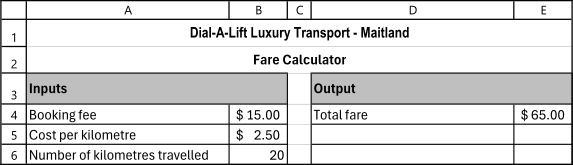
A spreadsheet used to calculate the total fare is shown.
 

  1. By using appropriate grid references, write down a formula that could have been used in cell E4.   (2 marks)

    --- 2 WORK AREA LINES (style=lined) ---
  2. A trip with a different number of kilometres travelled is entered, but the booking fee and cost per kilometre remain unchanged. As a result, the value in cell E4 changes to $47.50.
  3. Calculate the value entered in cell B6.   (2 marks)

    --- 5 WORK AREA LINES (style=lined) ---
Show Answers Only

a.    \(=\text{B4}+ \text{B5} \ ^* \ \text{B6}\)

b.    \(\text{Cell B6 value = 13.}\)

Show Worked Solution

a.    \(=\text{B4}+ \text{B5} \ ^* \ \text{B6}\)
 

b.     \(47.5\) \(=15+2.5 n\)
  \(32.5\) \(=2.5n\)
  \(n\) \(=\dfrac{32.5}{2.5}=13\)

 
\(\text{Cell B6 value = 13.}\)

Filed Under: Applications of Linear Relationships, Applications of Linear Relationships Tagged With: Band 4, smc-6256-20-Fuel/Transport, smc-6256-50-Spreadsheets, smc-6513-10-Fuel/Transport, smc-6513-50-Spreadsheets, syllabus-2027

Algebra, STD2 EQ-Bank 25

The following formula can be used to calculate the recommended dosage of a medicine for a child.

   Recommended dosage \(=\) base dosage \(+\) adjustment factor \(\times\) weight of child,

where the recommended dosage and base dosage are in milligrams and the weight of the child is in kilograms.

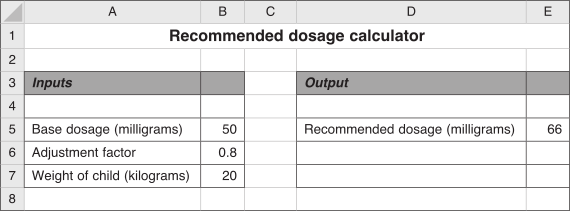
A spreadsheet used to calculate the recommended dosage is shown.
 

  1. By using appropriate grid references, write down a formula that could have been used in cell E5.   (2 marks)

    --- 2 WORK AREA LINES (style=lined) ---

  2. The weight of a different child is entered, but the base dosage and adjustment factor remain unchanged. As a result, the value in cell E5 changes to 70.
  3. Calculate the value entered in cell B7.   (2 marks)

    --- 5 WORK AREA LINES (style=lined) ---

Show Answers Only

a.    \(=\text{B5}+ \text{B6} \ ^* \ \text{B7}\)

b.    \(\text{Cell B7 value = 25.}\)

Show Worked Solution

a.    \(=\text{B5}+ \text{B6} \ ^* \ \text{B7}\)
 

b.    \(\text{Let \(w\) = weight of the child}\)

\(70\) \(=50+0.8 w\)
\(20\) \(=0.8 w\)
\(w\) \(=\dfrac{20}{0.8}=25\)

 
\(\text{Cell B7 value = 25.}\)

Filed Under: Applications of Linear Relationships, Applications of Linear Relationships Tagged With: Band 4, smc-6256-30-Other Linear Applications, smc-6256-50-Spreadsheets, smc-6513-30-Other Linear Applications, smc-6513-50-Spreadsheets, syllabus-2027

Polynomials, EXT1 EQ-Bank 11

The polynomial  \(R(x)=x^3+p x^2+q x+6\)  has a double zero at  \(x=-1\)  and a zero at  \(x=s\).

Find the values of \(p, q\) and \(s\).   (3 marks)

--- 10 WORK AREA LINES (style=lined) ---

Show Answers Only

\(s=-6, \ p=8, \ q=13\)

Show Worked Solution

\(R(x)=x^3+p x^2+q x+6\)

\(R(x)\ \text{is monic with a zero at} \ s \ \text{and double zero at}\ -1:\)

\(R(x)\) \(=(x+1)^2(x-s)\)
  \(=\left(x^2+2 x+1\right)(x-s)\)
  \(=x^3+2 x^2+x-s x^2-2 s x-s\)
  \(=x^3+(2-s) x^2+(1-2 s) x-s\)


\(\text{Equating coefficients:}\)

\(-s=6 \ \Rightarrow \ s=-6\)

\(p=2-(-6)=8\)

\(q=1-2(-6)=13\)

Filed Under: Graphs of Polynomials Tagged With: Band 3, smc-6742-20-Degree/Coefficients, smc-6742-25-Multiplicity of Zeroes, syllabus-2027

Polynomials, EXT1 EQ-Bank 10

The polynomial  \(R(x)=2 x^4+a x^3+b x^2+c x+d\)  has a double zero at  \(x=1\), a zero at  \(x=-3\), and passes through the point \((0,-12)\).

Find the integer values of \(a, b, c, d\) and the fourth zero of the polynomial.   (4 marks)

--- 12 WORK AREA LINES (style=lined) ---

Show Answers Only

\(a=-2, \ b=-14, \ c=26, \ d=-12\)

\(\text{Fourth zero:} \ \ x=2\)

Show Worked Solution

\(R(x)=2 x^4+a x^3+b x^2+c x+d\)

\(\text{Since leading coefficient is 2 with a double zero at 1 and a zero at }-3:\)

\(R(x)=2(x-1)^2(x+3)(x-k) \ \ \text{where} \ k \ \text{is the fourth zero.}\)

\(\text{The polynomial passes through}\ (0,-12):\)

\(R(0)=2(0-1)^2(0+3)(0-k)=-12\ \ \Rightarrow\ \ k=2\)
 

\(\text{Expanding}\ R(x):\)

\(R(x)\) \(=2(x-1)^2(x+3)(x-2)\)  
  \(=2\left(x^2-2 x+1\right)(x+3)(x-2) \)  
  \(=2(x^3+3 x^2-2 x^2-6 x+x+3)(x-2) \)  
  \(=2(x^3+x^2-5 x+3)(x-2) \)  
  \(=2(x^4+x^3-5 x^2+3 x-2 x^3-2 x^2+10 x-6) \)  
  \(=2 x^4-2 x^3-14 x^2+26 x-12\)  


\(\text{Equating coefficients:}\)

\(a=-2, \ b=-14, \ c=26, \ d=-12\)

\(\text{Fourth zero:} \ \ x=2\)

Filed Under: Graphs of Polynomials Tagged With: Band 4, smc-6742-20-Degree/Coefficients, smc-6742-25-Multiplicity of Zeroes, syllabus-2027

Polynomials, EXT1 EQ-Bank 9

A polynomial has the equation

\(Q(x)=(x+1)^2(x-2)\left(x^2+2 x-8\right)\)

  1. Express  \(Q(x)\)  as a product of linear factors and determine the multiplicity of each of its roots.   (2 marks)

    --- 6 WORK AREA LINES (style=lined) ---

  2. Hence, without using calculus, draw a sketch of \(y=Q(x)\), showing all  \(x\)-intercepts.   (2 marks)

    --- 12 WORK AREA LINES (style=lined) ---

Show Answers Only

a.    \(Q(x) = (x+1)^2(x-2)\left(x^2+2 x-8\right) \)

\(\text{Roots:}\)

\(x=-1 \ \ \text{(multiplicity 2)}\)

\(x=2 \ \ \text{(multiplicity 2)}\)

\(x=4 \ \ \text{(multiplicity 1)}\)
 

b.

Show Worked Solution
a.     \(Q(x)\) \(=(x+1)^2(x-2)\left(x^2+2 x-8\right)\)
    \(=(x+1)^2(x-2)(x-2)(x+4)\)
    \(=(x+1)^2(x-2)^2(x-4)\)


\(\text{Roots:}\)

\(x=-1 \ \ \text{(multiplicity 2)}\)

\(x=2 \ \ \text{(multiplicity 2)}\)

\(x=4 \ \ \text{(multiplicity 1)}\)
 

b.    \(Q(x) \ \text{degree}=5, \ \text{Leading coefficient}=1\)

\(\text{As} \ \ x \rightarrow-\infty, y \rightarrow-\infty\)

\(\text{As} \ \ x \rightarrow \infty, y \rightarrow \infty\)

\(\text{At}\ \ x=0, \ y=1^2 \times (-2)^2 \times -4 = -16\)

Filed Under: Graphs of Polynomials Tagged With: Band 3, Band 4, smc-6742-25-Multiplicity of Zeroes, smc-6742-40-Sketch Graphs, syllabus-2027

Polynomials, EXT1 EQ-Bank 8

A polynomial \(f(x)\) is defined by

\(f(x)=-3x^3+27x^2+12x-1\)

Explain what happens to \(f(x)\) as  \(x \rightarrow-\infty\).   (2 marks)

--- 5 WORK AREA LINES (style=lined) ---

Show Answers Only

\(\text{Since}\ f(x) \ \text{has degree 3:}\)

\(\text{As} \ \ x \rightarrow-\infty, x^3 \rightarrow-\infty\)

\(f(x) \ \text{has leading coefficient}=-3\)

\(\therefore\ \text{As} \ \ x \rightarrow-\infty,-3 x^3 \rightarrow \infty, \ f(x) \rightarrow \infty\)

Show Worked Solution

\(\text{Since}\ f(x) \ \text{has degree 3:}\)

\(\text{As} \ \ x \rightarrow-\infty, x^3 \rightarrow-\infty\)

\(f(x) \ \text{has leading coefficient}=-3\)

\(\therefore\ \text{As} \ \ x \rightarrow-\infty,-3 x^3 \rightarrow \infty, \ f(x) \rightarrow \infty\)

Filed Under: Graphs of Polynomials Tagged With: Band 3, smc-6742-30-\(x \rightarrow \pm \infty\), syllabus-2027

Polynomials, EXT1 EQ-Bank 7

Consider a polynomial  \(y=(x+3)^2(2-x) \cdot Q(x)\)

where  \(Q(x)=6-x-x^2\)

Explain what happens to \(y\) as  \(x \rightarrow-\infty\).   (2 marks)

--- 5 WORK AREA LINES (style=lined) ---

Show Answers Only
\(y\) \(=(x+3)^2(2-x)\left(6-x-x^2\right)\)
  \(=(x+3)^2(2-x)(x+3)(2-x)\)
  \(=(x+3)^3(2-x)^2\)


\(\text{Degree\(=5\), Leading co-efficient\(=1\)}\)

\(\therefore \text{As} \ \ x \rightarrow-\infty, x^5 \rightarrow-\infty, y \rightarrow-\infty\)

Show Worked Solution
\(y\) \(=(x+3)^2(2-x)\left(6-x-x^2\right)\)
  \(=(x+3)^2(2-x)(x+3)(2-x)\)
  \(=(x+3)^3(2-x)^2\)


\(\text{Degree\(=5\), Leading co-efficient\(=1\)}\)

\(\therefore \text{As} \ \ x \rightarrow-\infty, x^5 \rightarrow-\infty, y \rightarrow-\infty\)

Filed Under: Graphs of Polynomials Tagged With: Band 3, smc-6742-30-\(x \rightarrow \pm \infty\), syllabus-2027

Polynomials, EXT1 EQ-Bank 5

Consider the function  \(P(x)=(x-1)^2(x+2)\left(x^2+3 x-4\right)\)

  1. By expressing \(P(x)\) as a product of its linear factors, identify its zeroes and the multiplicity of each zero.   (2 marks)

    --- 6 WORK AREA LINES (style=lined) ---

  2. Without using calculus, draw a sketch of  \(y=P(x)\)  showing any \(x\)-intercepts.   (2 marks)

    --- 8 WORK AREA LINES (style=lined) ---

Show Answers Only

a.    \(P(x)=(x-1)^3(x+2)(x+4)\)

\(\text{Roots:}\)

\(x=-2 \ \ \text{(multiplicity 1)}\)

\(x=-4 \ \ \text{(multiplicity 1)}\)

\(x=1 \ \ \text{(multiplicity 3)}\)
 

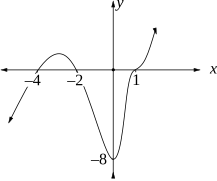
b.  

Show Worked Solution
a.     \(P(x)\) \(=(x-1)^2(x+2)\left(x^2+3 x-4\right)\)
    \(=(x-1)^2(x+2)(x-1)(x+4)\)
    \(=(x-1)^3(x+2)(x+4)\)

 
\(\text{Roots:}\)

\(x=-2 \ \ \text{(multiplicity 1)}\)

\(x=-4 \ \ \text{(multiplicity 1)}\)

\(x=1 \ \ \text{(multiplicity 3)}\)
 

b.    \(\text{Degree} \ P(x)=5, \ \ \text {Leading coefficient }=1\)

\(\text{As} \ \ x \rightarrow \infty, \ y \rightarrow \infty\)

\(\text{As} \ \ x \rightarrow -\infty, \ y \rightarrow -\infty\)

\(\text{At} \ \ x=0, y=-8\)
 

Filed Under: Graphs of Polynomials Tagged With: Band 3, Band 4, smc-6742-25-Multiplicity of Zeroes, smc-6742-40-Sketch Graphs, syllabus-2027

Polynomials, EXT1 EQ-Bank 5 MC

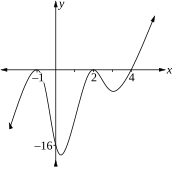
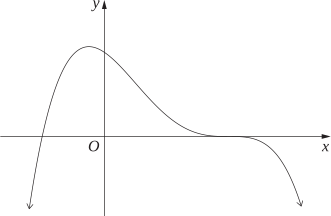
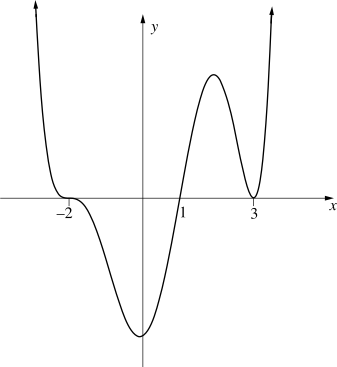
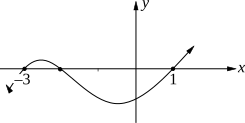
The graph of  `y = f(x)`  is shown.
 

Which of the following could be the equation of this graph?

  1. `y = (1-x)(2 + x)^3`
  2. `y = (x + 1)(x-2)^3`
  3. `y = (x + 1)(2-x)^3`
  4. `y = (x-1)(2 + x)^3`
Show Answers Only

`C`

Show Worked Solution

`text(By elimination:)`

`text(A single negative root occurs when)\ \ x =–1`

`->\ text(Eliminate A and D)`

`text(When)\ \ x = 0, \ y > 0`

`->\ text(Eliminate B)`

`=> C`

Filed Under: Graphs of Polynomials Tagged With: Band 4, smc-6742-10-Identify Graphs, syllabus-2027

Polynomials, EXT1 EQ-Bank 4 MC

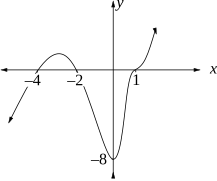
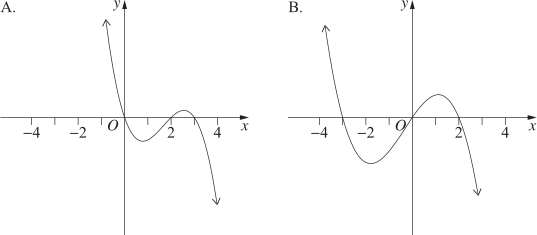
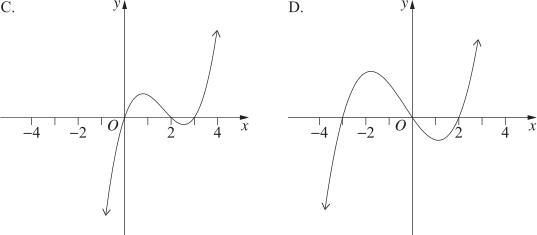
Which of the following best represents the graph of  \(y=-5 x(x-2)(3-x)\)?
 

Show Answers Only

\(C\)

Show Worked Solution

\(\text{By elimination:}\)

\(\text{Degree = 3,  Leading co-efficient}\ = 5\)

\(\text{As}\ \ x \rightarrow \infty,\ \ y \rightarrow \infty\ \text{(eliminate A and B)}\)

\(\text{When}\ x=1:\)

\(y=-5(-1)(2)=10>0\ \ \text{(eliminate D)}\)

\(\Rightarrow C\)

Filed Under: Graphs of Polynomials Tagged With: Band 3, smc-6742-10-Identify Graphs, syllabus-2027

Polynomials, EXT1 EQ-Bank 3

Consider the polynomial \(P(x)=x(3-x)^3\).

  1. State the degree of the polynomial and identify the leading coefficient.   (1 mark)

    --- 2 WORK AREA LINES (style=lined) ---

  2. Explain what happens to \(y\) as  \(x \rightarrow \pm \infty\).   (1 mark)

    --- 2 WORK AREA LINES (style=lined) ---

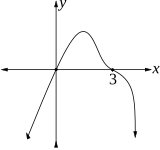
  3. Without using calculus, sketch \(P(x)\) showing its general form and any \(x\)-intercepts.   (2 marks)

    --- 6 WORK AREA LINES (style=lined) ---

Show Answers Only

a.    \(\text{Degree}\ P(x)=4\)

\(\text{Leading co-efficient}=-1\)
 

b.    \(\text{As} \ \ x \rightarrow-\infty,-x^4 \rightarrow-\infty, \ y \rightarrow-\infty\).

\(\text{As} \ \ x \rightarrow \infty,-x^4 \rightarrow-\infty, \ y \rightarrow-\infty\).
 

c.    \(P(x)\ \text{has zeroes at}\ \ x=0, 3:\)


Show Worked Solution

a.    \(\text{Degree}\ P(x)=4\)

\(\text{Leading co-efficient}=-1\)
 

b.    \(\text{As} \ \ x \rightarrow-\infty,-x^4 \rightarrow-\infty, \ y \rightarrow-\infty\).

\(\text{As} \ \ x \rightarrow \infty,-x^4 \rightarrow-\infty, \ y \rightarrow-\infty\).
 

c.    \(P(x)\ \text{has zeroes at}\ \ x=0, 3:\)


Filed Under: Graphs of Polynomials Tagged With: Band 3, smc-6742-20-Degree/Coefficients, smc-6742-30-\(x \rightarrow \pm \infty\), smc-6742-40-Sketch Graphs, syllabus-2027

Polynomials, EXT1 EQ-Bank 4

The polynomial  \(p(x) = x^3 + ax^2 + b\)  has a zero at \(r\) and a double zero at 4.

Find the values of \(a, b\) and \(r\).   (3 marks)

--- 5 WORK AREA LINES (style=lined) ---

Show Answers Only

\(a =-6, b = 32, r = -2\)

Show Worked Solution

\(p(x) = x^3 + ax^2 + b\)

\(\text{Zero at \(r\) and double zero at 4:}\)

\(p(x)\) \(=(x-4)^2(x-r) \)  
  \(=(x^2-8x+16)(x-r)\)  
  \(=x^3-8x^2+16x-rx^2+8rx-16r\)  
  \(=x^3+(-8-r)x^2+(16+8r)x-16r\)  


\(\text{Equating coefficients:}\)

\(16+8r=0\ \ \Rightarrow \ \ r=-2\)

\(a=-8-(-2)=-6\)

\(b=-16 \times -2=32\)

Filed Under: Graphs of Polynomials Tagged With: Band 4, smc-6742-20-Degree/Coefficients, syllabus-2027

Polynomials, EXT1 EQ-Bank 2

Consider a polynomial  \(y=-2 x^5-26 x^4-x+1\).

With reference to the leading term, explain what happens to \(y\) as  \(x \rightarrow-\infty\).   (2 marks)

--- 5 WORK AREA LINES (style=lined) ---

Show Answers Only

\(\text{As}\ \ x \rightarrow-\infty,\ \ x^{5}\ \rightarrow-\infty\)

\(\text{Since the leading coefficient \((-2)\) is negative:}\)

\(\text{As}\ \ x \rightarrow-\infty,\ \ y \rightarrow \infty.\)

Show Worked Solution

\(\text{As}\ \ x \rightarrow-\infty,\ \ x^{5}\ \rightarrow-\infty\)

\(\text{Since the leading coefficient \((-2)\) is negative:}\)

\(\text{As}\ \ x \rightarrow-\infty,\ \ y \rightarrow \infty.\)

Filed Under: Graphs of Polynomials Tagged With: Band 3, smc-6742-30-\(x \rightarrow \pm \infty\), syllabus-2027

Polynomials, EXT1 EQ-Bank 1

A polynomial has the equation

\(P(x)=(x-1)(x-3)(x+2)^2\left(x^2-x-6\right)\).

  1. By expressing \(P(x)\) as a product of its linear factors, determine the multiplicity of each of the roots of  \(P(x)=0\).   (2 marks)

    --- 5 WORK AREA LINES (style=lined) ---

  2. Hence, without using calculus, draw a sketch of  \(y=P(x)\)  showing all \(x\)-intercepts.   (2 marks)

    --- 12 WORK AREA LINES (style=blank) ---

Show Answers Only
a.     \(P(x)\) \(=(x-1)(x-3)(x+2)^2\left(x^2-x-6\right)\)
    \(=(x-1)(x-3)(x+2)^2(x-3)(x+2)\)
    \(=(x-1)(x-3)^2(x+2)^3\)


\(\text{Roots:}\)

\(x=1\ \text{(multiplicity 1)}\)

\(x=-2\ \text{(multiplicity 3)}\)

\(x=3\ \text{(multiplicity 2)}\)
 

b.
     

Show Worked Solution
a.     \(P(x)\) \(=(x-1)(x-3)(x+2)^2\left(x^2-x-6\right)\)
    \(=(x-1)(x-3)(x+2)^2(x-3)(x+2)\)
    \(=(x-1)(x-3)^2(x+2)^3\)


\(\text{Roots:}\)

\(x=1\ \text{(multiplicity 1)}\)

\(x=-2\ \text{(multiplicity 3)}\)

\(x=3\ \text{(multiplicity 2)}\)
 

b.
     

Filed Under: Graphs of Polynomials Tagged With: Band 3, Band 4, smc-6742-25-Multiplicity of Zeroes, smc-6742-40-Sketch Graphs, syllabus-2027

Functions, EXT1 EQ-Bank 10

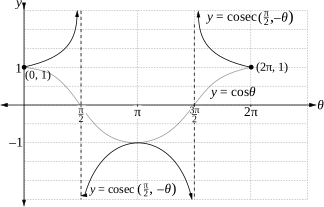
Consider the function  \(f(\theta)=\operatorname{cosec}\left(\frac{\pi}{2}-\theta\right)\)  for  \(0 \leqslant \theta \leqslant 2 \pi\).

  1. Sketch the graph of  \(y=\operatorname{cosec}\left(\frac{\pi}{2}-\theta\right)\),  showing all key features.   (2 marks)


    --- 0 WORK AREA LINES (style=lined) ---

  2. In set notation, state the range of \(\theta\).   (1 mark)

    --- 2 WORK AREA LINES (style=lined) ---

Show Answers Only

a.     


b.   \(\text{Range} \ \ f(\theta):\ y \in(-\infty,-1] \cup[1, \infty)\)

Show Worked Solution

a.    \(y=\operatorname{cosec}\left(\frac{\pi}{2}-\theta\right)=\dfrac{1}{\sin \left(\frac{\pi}{2}-\theta\right)}=\dfrac{1}{\cos\, \theta}\)


b.   \(\text{Range} \ \ f(\theta):\ y \in(-\infty,-1] \cup[1, \infty)\)

Filed Under: Graphical Relationships Tagged With: Band 4, smc-6640-15-cosec/sec/cot, syllabus-2027

Functions, EXT1 EQ-Bank 9

Consider the functions  \(f(x)=\tan x\)  and  \(g(x)=\cot x\).

  1. Explain why  \(\cot x \neq \dfrac{1}{\tan x}\)  for all values of \(x\).   (2 marks)

    --- 5 WORK AREA LINES (style=lined) ---

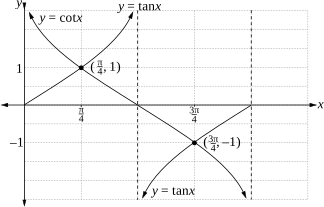
  2. On the same set of axes below, sketch  \(y=\tan x\)  and  \(y=\cot x\)  for  \(0<x<\pi\), identifying any points where the graphs intersect.   (2 marks)


--- 0 WORK AREA LINES (style=lined) ---

Show Answers Only

a.    \(\text{At}\ \  x=\dfrac{\pi}{2}:\)

\(\cot \dfrac{\pi}{2}=\dfrac{\cos \frac{\pi}{2}}{\sin \frac{\pi}{2}}=\dfrac{0}{1}=0 \ \Rightarrow \ \text{defined}\).

\(\tan \dfrac{\pi}{2}=\dfrac{\sin \frac{\pi}{2}}{\cos \frac{\pi}{2}}=\dfrac{1}{0} \Rightarrow \ \text{undefined}\).

\(\dfrac{1}{\tan \frac{\pi}{2}}\ \ \text{is therefore undefined}\).

\(\therefore \cot x \neq \dfrac{1}{\tan x} \ \ \text{for all values of }\ x\).
 

b.
       

Show Worked Solution

a.    \(\text{At}\ \  x=\dfrac{\pi}{2}:\)

\(\cot \dfrac{\pi}{2}=\dfrac{\cos \frac{\pi}{2}}{\sin \frac{\pi}{2}}=\dfrac{0}{1}=0 \ \Rightarrow \ \text{defined}\).

\(\tan \dfrac{\pi}{2}=\dfrac{\sin \frac{\pi}{2}}{\cos \frac{\pi}{2}}=\dfrac{1}{0} \Rightarrow \ \text{undefined}\).

\(\dfrac{1}{\tan \frac{\pi}{2}}\ \ \text{is therefore undefined}\).

\(\therefore \cot x \neq \dfrac{1}{\tan x} \ \ \text{for all values of }\ x\).
 

b.
       

Filed Under: Graphical Relationships Tagged With: Band 4, smc-6640-15-cosec/sec/cot, syllabus-2027

Functions, EXT1 EQ-Bank 8

Consider the function  \(y=\operatorname{cosec}\,x\)  for  \(-\pi \leqslant x \leqslant \pi\).

  1. State the equations of all vertical asymptotes in the given domain.   (1 mark)

    --- 3 WORK AREA LINES (style=lined) ---

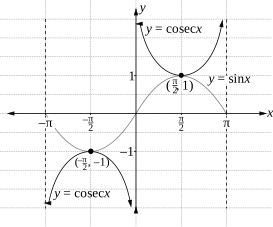
  2. Sketch the graph of  \(y=\operatorname{cosec} x\), showing all key features.   (2 marks)

    --- 0 WORK AREA LINES (style=lined) ---


Show Answers Only

a.    \(y=\operatorname{cosec}\,x=\dfrac{1}{\sin x}\)

\(\text{Asymptotes when \(\ \sin x=0 \ \) in given domain.}\)

\(\therefore \ \text{Asymptotes at} \ \ x=-\pi, 0, \pi\)
 

b.
       

Show Worked Solution

a.    \(y=\operatorname{cosec}\,x=\dfrac{1}{\sin x}\)

\(\text{Asymptotes when \(\ \sin x=0 \ \) in given domain.}\)

\(\therefore \ \text{Asymptotes at} \ \ x=-\pi, 0, \pi\)
 

b.
       

Filed Under: Graphical Relationships Tagged With: Band 3, Band 4, smc-6640-15-cosec/sec/cot, syllabus-2027

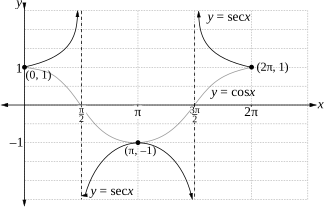
Functions, EXT1 EQ-Bank 7

  1. Sketch the graph of  \(y=\sec x\)  for  \(0 \leqslant x \leqslant 2 \pi\).
  2. In your answer, identify all asymptotes and the coordinates of any maximum and minimum turning points.   (2 marks)

    --- 0 WORK AREA LINES (style=lined) ---


  3. Using set notation, state the domain and range of  \(y=\sec x\).   (1 mark)

    --- 2 WORK AREA LINES (style=lined) ---

Show Answers Only

a.
   

b.    \(\text{Domain:} \ x \in\left[0, \frac{\pi}{2}\right) \cup\left(\frac{\pi}{2}, \frac{3 \pi}{2}\right) \cup\left(\frac{3 \pi}{2}, 2 \pi\right]\)

\(\text{Range:} \ y \in(-\infty,-1] \cup[1, \infty)\)

Show Worked Solution

a.    \(\text{Draw}\ \ y=\cos\,x\ \ \text{to inform graph:}\)


\(\text{Minimum TPs:}\ (0,1), (2\pi, 1) \)

\(\text{Maximum TP:}\ (\pi, -1)\)
 

b.    \(\text{Domain:} \ x \in\left[0, \frac{\pi}{2}\right) \cup\left(\frac{\pi}{2}, \frac{3 \pi}{2}\right) \cup\left(\frac{3 \pi}{2}, 2 \pi\right]\)

\(\text{Range:} \ y \in(-\infty,-1] \cup[1, \infty)\)

Filed Under: Graphical Relationships Tagged With: Band 3, Band 4, smc-6640-15-cosec/sec/cot, syllabus-2027

Probability, 2ADV EQ-Bank 5

Consider the universal set  \(U=\{x\) is a positive integer and  \(x \leqslant 24\}\)

Three sets are defined as

\begin{aligned}
& A=\{x \text { is a factor of } 24\} \\
& B=\{x \text { is a perfect square}\} \\
& C=\{x \text { is divisible by } 3\}
\end{aligned}

  1. List the elements of set \(A\).   (1 mark)

    --- 1 WORK AREA LINES (style=lined) ---

  2. Find \(A \cap B\).   (1 mark)

    --- 2 WORK AREA LINES (style=lined) ---

  3. Find \((A \cup B) \cap C^c\)   (2 marks)

    --- 5 WORK AREA LINES (style=lined) ---

Show Answers Only

a.    \(A=\{1,2,3,4,6,8,12,24\}\)

b.    \(A \cap B=\{1,4\}\)

c.    \((A \cup B) \cap C^c=\{1,2,4,8,16\}\)

Show Worked Solution

a.    \(A=\{1,2,3,4,6,8,12,24\}\)
 

b.    \(B=\{1,4,9,16\}\)

\(A \cap B=\{1,4\}\)
 

c.    \(A \cup B=\{1,2,3,4,6,8,9,12,16,24\}\)

\(C=\{3,6,9,12,15,18,21,24\}\)

\(C^c=\{1,2,4,5,7,8,10,11,13,14,16,17,19,20,22,23\}\)

\((A \cup B) \cap C^c=\{1,2,4,8,16\}\)

Filed Under: Conditional Probability and Venn Diagrams Tagged With: Band 2, Band 3, smc-6470-05-Sets/Set Notation, syllabus-2027

Probability, 2ADV EQ-Bank 3

Consider the universal set  \(U=\{x\) is a positive integer and \(x \leqslant 15\}\)

Three sets are defined as:

\begin{aligned}
& A=\{x \text { is a multiple of } 3\} \\
& B=\{x \text{ is a prime number}\} \\
& C=\{x \text{ is even}\}
\end{aligned}

  1. List the elements of set \(A\).   (1 mark)

    --- 1 WORK AREA LINES (style=lined) ---

  2.  Find  \(B \cap C\)   (1 mark)

    --- 3 WORK AREA LINES (style=lined) ---

  3. Find  \(A \cup \overline{C}\)   (2 marks)

    --- 4 WORK AREA LINES (style=lined) ---

Show Answers Only

a.    \(A=\{3,6,9,12,15\}\)

b.   \(B \cap C = \{2\} \)

c.    \(A \cup \overline{C}=\{1,3,5,6,7,9,11,12,13,15\}\)

Show Worked Solution

a.    \(A=\{3,6,9,12,15\}\)
 

b.    \(B=\{2,3,5,7,11,13\}\)

\(C=\{2,4,6,8,10,12,14\}\)

\(B \cap C = \{2\} \)
 

c.    \(\text{Find} \ \ A \cup \overline{C}:\)

\(\overline{C}=\{1,3,5,7,9,11,13\}\)

\(A \cup \overline{C}=\{1,3,5,6,7,9,11,12,13,15\}\)

Filed Under: Conditional Probability and Venn Diagrams Tagged With: Band 2, Band 3, smc-6470-05-Sets/Set Notation, syllabus-2027

Probability, 2ADV EQ-Bank 2

Consider the universal set  \(U=\{1,2,3,4,5,6,7,8,9,10\}\).

Two sets, \(A\) and \(B\), are given as

\(A= \{1,3,4,7,9\}\)

\(B =\{2,4,7,10\}\)

  1. Find \(A \cup B\)   (1 mark)

    --- 2 WORK AREA LINES (style=lined) ---

  2. Find \(A \cap \overline{B}\)   (2 marks)

    --- 4 WORK AREA LINES (style=lined) ---

Show Answers Only

a.    \(A \cup B = \{1,2,3,4,7,9,10\}\)

b.    \(A \cap \overline{B} = \{3, 4, 9\}\)

Show Worked Solution

a.    \(A= \{1,3,4,7,9\},\ \ B=\{2,4,7,10\}\)

\(A \cup B = \{1,2,3,4,7,9,10\}\)
 

b.     \(\overline{B} = \{1,3,5,6,8,9\}\)

\(A \cap \overline{B} = \{3, 4, 9\}\)

Filed Under: Conditional Probability and Venn Diagrams Tagged With: Band 2, Band 3, smc-6470-05-Sets/Set Notation, syllabus-2027

Measurement, STD2 EQ-Bank 25

A bus departs Sydney at 8:00 am on Monday for Perth. The bus makes five stops on the journey whose durations are given below: 

  • Dubbo: 45 minutes
  • Broken Hill: 1 hour 15 minutes
  • Port Augusta: 50 minutes
  • Ceduna: 40 minutes
  • Norseman: 1 hour 10 minutes

The total driving time (excluding stops) is 52 hours and 30 minutes. The bus arrives in Perth at 3:25 pm on Thursday.

  1. Calculate the total time for the journey from Sydney to Perth, including all stops. Give your answer in hours and minutes.   (2 marks)

    --- 5 WORK AREA LINES (style=lined) ---

  2. Convert your answer from part (a) to days, hours and minutes, and hence state the day and time the bus arrives in Perth. Ignore time zones in your calculations.   (2 marks)

    --- 6 WORK AREA LINES (style=lined) ---

Show Answers Only

a.   \(\text{57 hours 10 minutes}\)

b.   \(\text{Bus arrives on Wednesday at 5:10 pm with the journey}\)

\(\text{taking 2 days 9 hours 10 minutes.}\)

Show Worked Solution

a.   \(\text{Total stopping time}\)

\(=45+75+50+40+70\)

\(= 280 \text{ minutes}= 4\ \text{hours}\ 40 \text{ minutes} \)

\(\text{Total journey}\)

\(=52\ \text{hours}\ 30 \text{ minutes}+4\ \text{hours}\ 40 \text{ minutes} \)

\(=57\ \text{hours}\ 10 \text{ minutes} \)
  

b.   \(\text{Convert 57 hours 10 minutes to days, hours and minutes:}\)

\(57\ \text{hours}=(2 \times 24) + 9=2\ \text{days}\ 9\ \text{hours}\)

\(57\ \text{ hours 10 minutes}=2\ \text{days}\ 9\ \text{hours}\ 10\ \text{minutes}\)
 

\(\text{Bus arrival in Perth:}\)

\(\rightarrow\ \text{Bus departs 8 am Monday}\)

\(\rightarrow\ \text{Monday 8:00 am + 2 days = Wednesday 8:00 am}\)

\(\rightarrow\ \text{Wednesday 8:00 am + 9 hours 10 minutes = Wednesday 5:10 pm}\)

\(\therefore\ \text{Bus arrives Wednesday at 5:10 pm.}\)

Filed Under: Time and Time Difference, Time and Time Difference Tagged With: Band 3, Band 4, smc-6306-15-Time Conversions, smc-6306-20-Elapsed Time Problems, smc-6525-15-Time Conversions, smc-6525-20-Elapsed Time Problems, syllabus-2027

Measurement, STD2 EQ-Bank 23

Day 1 of the Ashes Test match at the SCG begins at 10:30 am. Each session of play lasts 2 hours, with a 40-minute lunch break after the first session and a 20-minute tea break after the second session. Rain delays the start of the third session by 37 minutes.

At what time does play finish for Day 1?   (2 marks)

--- 5 WORK AREA LINES (style=lined) ---

Show Answers Only

\(6:07\ \text{pm}\)

Show Worked Solution

\(\text{Total time }\)

\(=2\ \text{hours}\times 3+40\ \text{minutes}+20\ \text{minutes}+37\ \text{minutes}\)

\(=7\ \text{hours}\ 37\ \text{ minutes}\)

\(\text{Since match starts at }10:30\ \text{am}:\)

\(\text{Finish time}=10:30\ \text{am}+7\ \text{hours}\ 37\ \text{ minutes}=6:07\ \text{pm}\)

Filed Under: Time and Time Difference, Time and Time Difference Tagged With: Band 4, smc-6306-20-Elapsed Time Problems, smc-6525-20-Elapsed Time Problems, syllabus-2027

Measurement, STD2 EQ-Bank 27

A basketball game starts at 6:35 pm. The game consists of four quarters that are 10 minutes each, with a 2-minute break after the first and third quarters and an 8-minute break at half time.

  1. The home team scores a three-pointer 6 minutes into the second quarter. At what time does this occur?   (2 marks)

    --- 4 WORK AREA LINES (style=lined) ---

  2. If 4 minutes injury time is added to the total time, at what time does the game finish?   (2 marks)

    --- 4 WORK AREA LINES (style=lined) ---

Show Answers Only

a.   \(6:53\ \text{pm}\)

b.   \(7:31\ \text{pm}\)

Show Worked Solution

a.   \(\text{Match starts at }6:35\ \text{pm}\)

\(\text{Calculate time elapsed until 6 minutes into the second quarter:}\)

\(\text{Total time before three-pointer}\)

\(=10+2+6=18\text{ minutes}\)

\(\therefore\ \text{Three pointer is scored at: }6:35+18\ \text{minutes}=6:53\ \text{pm}\)
 

b.   \(\text{Total duration of game}\)

\(=4 \times 10+2 \times 2+8+4=56\ \text{minutes}\)

\(\therefore\ \text{Finish time}=6:35+56\ \text{minutes}=7:31\ \text{pm}\)

Filed Under: Time and Time Difference, Time and Time Difference Tagged With: Band 4, smc-6306-20-Elapsed Time Problems, smc-6525-20-Elapsed Time Problems, syllabus-2027

Measurement, STD2 EQ-Bank 24

Sarah's netball match starts at 1:45 pm. The match consists of four quarters that are 12 minutes each, with a 3-minute break after the first and third quarters, and a 7-minute break at half time.

  1. Sarah intercepts the ball 8 minutes into the third quarter. At what time does this occur?   (2 marks)

    --- 3 WORK AREA LINES (style=lined) ---

  2. At what time does the match finish?   (2 marks)

    --- 3 WORK AREA LINES (style=lined) ---

Show Answers Only

a.   \(2:27\ \text{pm}\)

b.   \(2:46\ \text{pm}\)

Show Worked Solution

a.   \(\text{Match starts at }1:45\ \text{pm}\)

\(\text{Calculate time elapsed until 8 minutes into the third quarter:}\)

\(\text{Total time before intercept}\)

\(=12+3+12+7+8=42\text{ minutes}\)

\(\therefore\ \text{Sarah intercepts the ball at: }1:45+42\ \text{minutes}=2:27\ \text{pm}\)
 

b.   \(\text{Total duration of game}\)

\(=4 \times 12+2 \times 3+7=61\ \text{minutes}\)

\(\therefore\ \text{Finish time}=1:45+61\ \text{minutes}=2:46\ \text{pm}\)

Filed Under: Time and Time Difference, Time and Time Difference Tagged With: Band 4, smc-6306-20-Elapsed Time Problems, smc-6525-20-Elapsed Time Problems, syllabus-2027

Measurement, STD2 EQ-Bank 14 MC

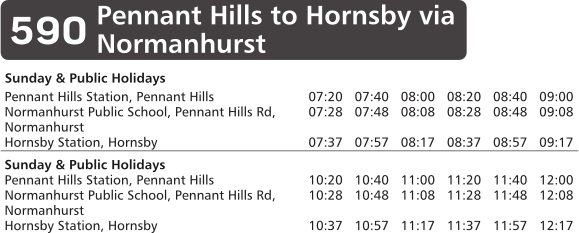
Use the bus timetable below to answer this question.

John works weekend shifts at a cafe near Hornsby station. He needs to be at work by 9:30 am.

It takes him 12 minutes to walk from his home to Pennant Hills Station and 8 minutes to walk from Hornsby Station to his workplace.

What is the latest bus he can catch from Pennant Hills Station and what time must he leave home? 

  1. 8:40 bus, leaving home at 8:28
  2. 9:00 bus, leaving home at 8:48
  3. 9:20 bus, leaving home at 9:08
  4. 9:40 bus, leaving home at 9:28
Show Answers Only

\(B\)

Show Worked Solution

\(\text{Work backwards from when John needs to be at work.}\)

\(\text{John must arrive at work by 9:30 am:}\)

\(\rightarrow\ 8\text{ minutes to walk from Hornsby Station to work.}\)

\(\rightarrow\ \text{Must arrive at Hornsby Station by: }\ 9:30-8 \text{ minutes} = 9:22 \text{ am}\)
 

\(\text{Find the latest bus arriving at Hornsby Station by 9:22 am:}\)

\(\rightarrow\ \text{Arrival times: } 08:37, 08:57, 09:17, 09:37…\)

\(\rightarrow\ \text{He must catch the }09:17.\)

\(\rightarrow\ 09:17\ \text{departs Pennant Hills Station at }09:00.\)
  

\(\text{John needs to leave home 12 minutes before train comes:}\)

\(\rightarrow\ 9:00-12 \text{ minutes} = 8:48 \text{ am} \)
   

\(\Rightarrow B\)

Filed Under: Uncategorized Tagged With: Band 4, smc-6306-20-Elapsed Time Problems, smc-6525-20-Elapsed Time Problems, syllabus-2027

Measurement, STD2 EQ-Bank 7 MC

On Tuesday Sarah started work at 6:45 am and finished at 3:12 pm.

For how many hours and minutes did Sarah work on Tuesday?

  1. 8 hours 27 minutes
  2. 8 hours 33 minutes
  3. 9 hours 27 minutes
  4. 9 hours 33 minutes
Show Answers Only

\(A\)

Show Worked Solution

\(\text{Break into steps}\)

\(\text{From 6:45 am to 7:00 am: }\ 60-45 = 15 \text{ minutes} \)

\(\text{From 7:00 am to 3:12 pm: }\  8\ \text{hours}\ 12 \text{ minutes} \)

\(\text{Total: }\  8\ \text{hours}+12 \text{ minutes} +15 \text{ minutes}=8\ \text{hours}\ 27\ \text{minutes}\)

\(\Rightarrow A\)

Filed Under: Time and Time Difference, Time and Time Difference Tagged With: Band 3, smc-6306-20-Elapsed Time Problems, smc-6525-20-Elapsed Time Problems, syllabus-2027

Measurement, STD2 EQ-Bank 5 MC

A bus departs at 8:23 am and arrives at its destination at 11:47 am.

How long was the bus journey?

  1. 3 hours 24 minutes
  2. 3 hours 34 minutes
  3. 4 hours 24 minutes
  4. 4 hours 34 minutes
Show Answers Only

\(A\)

Show Worked Solution

\(\text{Method 1: Break into steps}\)

\(\rightarrow\text{From 8:23 am to 9:00 am: }\ 60-23 = 37 \text{ minutes} \)

\(\rightarrow\text{From 9:00 am to 11:47 am: }\  2\ \text{hours}\ 47 \text{ minutes} \)

\(\rightarrow\text{Total: }\  37 \text{ minutes} + 2\ \text{hours}+\ 47 \text{ minutes}=2\ \text{hours}\ 84\ \text{minutes}\)

\(=3\ \text{hours}\ 24\ \text{minutes}\)
  

\(\text{Method 2: Calculate hours and minutes separately}\)

\(\rightarrow\text{Hours: } \ 11-8 = 3 \text{ hours} \)

\(\rightarrow\text{Minutes: }\ 47-23 = 24 \text{ minutes} \)

\(\rightarrow\text{Total: }\ 3 \text{ hours } 24 \text{ minutes} \)
  

\(\Rightarrow B\)

Filed Under: Time and Time Difference, Time and Time Difference Tagged With: Band 3, smc-6306-20-Elapsed Time Problems, smc-6525-20-Elapsed Time Problems, syllabus-2027

Measurement, STD2 EQ-Bank 3 MC

It is currently 2:17 pm. A train is due to arrive at 3:08 pm.

How long do you need to wait for the train?

  1. 49 minutes
  2. 51 minutes
  3. 1 hour 9 minutes
  4. 1 hour 51 minutes
Show Answers Only

\(B\)

Show Worked Solution

\(\text{Method 1: Break into steps}\)

\(\rightarrow\text{From 2:17 pm to 3:00 pm: }\ 60-17 = 43 \text{ minutes} \)

\(\rightarrow\text{From 3:00 pm to 3:08 pm: }\  8 \text{ minutes} \)

\(\rightarrow\text{Total: }\  43+8 = 51 \text{ minutes} \)
  
\(\text{Method 2: Calculate directly}\)

\(\rightarrow 3:08-2:17 = 51 \text{ minutes} \)
  

\(\Rightarrow B\)

Filed Under: Time and Time Difference, Time and Time Difference Tagged With: Band 2, smc-6306-20-Elapsed Time Problems, smc-6525-20-Elapsed Time Problems, syllabus-2027

Measurement, STD2 EQ-Bank 21

A concert runs for 5400 seconds.

  1. Convert this time to hours and minutes.   (2 marks)

    --- 3 WORK AREA LINES (style=lined) ---

  2. If the concert finishes at 10:45 pm, what time did it start?   (2 marks)

    --- 3 WORK AREA LINES (style=lined) ---

Show Answers Only

a.   \(\text{1 hours 30 minutes}\)

b.   \(\text{9:15 pm}\)

Show Worked Solution

a.   \(\text{Step 1: Convert seconds to minutes}\)

\(5400 \text{ seconds} = \dfrac{5400}{60} \text{ minutes} = 90 \text{ minutes} \)

\(\text{Step 2: Convert minutes to hours and minutes}\)

\(90 \text{ minutes} = \dfrac{90}{60} \text{ hours} = 1.5 \text{ hours} \)

\(\therefore\ 90 \text{ minutes} = 1 \text{ hour } 30 \text{ minutes} \)
  

b.   \(\text{Finish time: 10:45 pm}\)

\(\text{Concert duration: 1 hours 30 minutes}\)

\(10:45\ \text{pm}-1\ \text{hour}=9:45\ \text{pm}\)

\(9:45\ \text{pm}-30\ \text{minutes}=9:15\ \text{pm}\)

\(\text{Start time: 9:15 pm}\)

Filed Under: Time and Time Difference, Time and Time Difference Tagged With: Band 3, Band 4, smc-6306-15-Time Conversions, smc-6306-20-Elapsed Time Problems, smc-6525-15-Time Conversions, smc-6525-20-Elapsed Time Problems, syllabus-2027

Measurement, STD2 EQ-Bank 20

A movie runs for 8400 seconds.

  1. Convert this time to hours and minutes.   (2 marks)

    --- 3 WORK AREA LINES (style=lined) ---

  2. If the movie starts at 7:15 pm, what time will it finish?   (1 mark)

    --- 2 WORK AREA LINES (style=lined) ---

Show Answers Only

a.   \(\text{2 hours 20 minutes}\)

b.   \(\text{9:35 pm}\)

Show Worked Solution

a.   \(\text{Step 1: Convert seconds to minutes}\)

\(8400 \text{ seconds} = \dfrac{8400}{60} \text{ minutes} = 140 \text{ minutes} \)

\(\text{Step 2: Convert minutes to hours and minutes}\)

\(140 \text{ minutes} = \dfrac{140}{60} \text{ hours} = 2.333… \text{ hours} \)

\(\text{To find the minutes part:}\ 140 = 2 \times 60 + 20  \)

\(\therefore\ 140 \text{ minutes} = 2 \text{ hours } 20 \text{ minutes} \)
  

b.   \(\text{Starting time: 7:15 pm}\)

\(\text{Movie duration: 2 hours 20 minutes}\)

\(\text{Finish time: 9:35 pm}\)

Filed Under: Time and Time Difference, Time and Time Difference Tagged With: Band 3, smc-6306-15-Time Conversions, smc-6306-20-Elapsed Time Problems, smc-6525-15-Time Conversions, smc-6525-20-Elapsed Time Problems, syllabus-2027

Measurement, STD2 EQ-Bank 8 MC

Convert 10 500 seconds to hours and minutes.

  1. 2 hours 55 minutes
  2. 3 hours 15 minutes
  3. 2 hours 50 minutes
  4. 175 minutes
Show Answers Only

\(A\)

Show Worked Solution

\(\text{Convert seconds to minutes:}\)

\(10\,500 \text{ seconds} = \dfrac{10\,000}{60} \text{ minutes} = 175 \text{ minutes} \)
 

\(\text{Convert minutes to hours and minutes:}\)

\(175 \text{ minutes} = \dfrac{175}{60} \text{ hours} = 2.916… \text{ hours} \)
 

\(\text{Calculate minutes:}\ 175-2 \times 60=55  \)

\(\therefore\ 175 \text{ minutes} = 2 \text{ hours } 55 \text{ minutes} \)

\(\Rightarrow A\)

Filed Under: Time and Time Difference, Time and Time Difference Tagged With: Band 4, smc-6306-15-Time Conversions, smc-6525-15-Time Conversions, syllabus-2027

Measurement, STD2 EQ-Bank 10 MC

Convert 7200 seconds to hours.

  1. 1 hour
  2. 2 hours
  3. 12 hours
  4. 120 hours
Show Answers Only

\(B\)

Show Worked Solution

\( 7200 \text{ seconds} = \dfrac{7200}{60} \text{ minutes} = 120 \text{ minutes} \)

\( 120 \text{ minutes} = \dfrac{120}{60} \text{ hours} = 2 \text{ hours} \)

\(\Rightarrow B\)

Filed Under: Time and Time Difference, Time and Time Difference Tagged With: Band 4, smc-6306-15-Time Conversions, smc-6525-15-Time Conversions, syllabus-2027

Measurement, STD2 EQ-Bank 6 MC

Jeremy watched a movie at the cinema that began at 11:35 am. If it finished at 2:05 pm, what was the duration of the movie, in minutes?

  1. 25 minutes
  2. 125 minutes
  3. 150 minutes
  4. 250 minutes
Show Answers Only

\(C\)

Show Worked Solution

\(\text{11:35 to 2:05 = 2.5 hours}\)

\(\text{To convert hours to minutes multiply by 60.}\)

\( 2.5 \text{ hours} = 2.5 \times 60 \text{ minutes} = 150 \text{ minutes} \)

\(\Rightarrow C\)

Filed Under: Time and Time Difference, Time and Time Difference Tagged With: Band 3, smc-6306-15-Time Conversions, smc-6525-15-Time Conversions, syllabus-2027

Measurement, STD2 EQ-Bank 2 MC

Convert 180 seconds to minutes.

  1. 2 minutes
  2. 3 minutes
  3. 18 minutes
  4. 10,800 minutes
Show Answers Only

\(B\)

Show Worked Solution

\(\text{To convert seconds to minutes divide by 60.}\)

\( 180 \text{ seconds} = \dfrac{180}{60} \text{ minutes} = 3 \text{ minutes} \)

\(\Rightarrow B\)

Filed Under: Time and Time Difference, Time and Time Difference Tagged With: Band 2, smc-6306-15-Time Conversions, smc-6525-15-Time Conversions, syllabus-2027

Functions, EXT1 EQ-Bank 07

A cubic function is given by  \(f(x)=\left(2 x^2+3 x-5\right)(x+2)\)

  1. Find the zeros of \(f(x)\).   (1 mark)

    --- 3 WORK AREA LINES (style=lined) ---

  2. Hence, or otherwise, solve \(f(x) \geqslant 0\), giving your answer in set notation.   (2 marks)

    --- 6 WORK AREA LINES (style=lined) ---

Show Answers Only

a.    \(\text{Zeros at} \ \ x=-\dfrac{5}{2}, x=1 \ \ \text{and}\ \  x=-2\)

b.    \(x \in\left[-\frac{5}{2},-2\right] \cup\ x \in[1, \infty)\)

Show Worked Solution

a.    \(f(x)=\left(2 x^2+3 x-5\right)(x+2)=(2 x+5)(x-1)(x+2)\)

\(\text{Zeros at} \ \ x=-\dfrac{5}{2}, x=1 \ \ \text{and}\ \  x=-2\)
 

b.    \(\text{Find} \ x \ \text{such that} \ \ f(x) \geqslant 0.\)

\(\text{At} \ \ x=0: \ (5)(-1)(2)<0\)
 

\(\therefore \text{Graph}\ (f(x)) \geqslant 0 \ \ \text{for} \ \  x \in\left[-\frac{5}{2},-2\right] \cup\ x \in[1, \infty)\)

Filed Under: Inequalities Tagged With: Band 3, Band 4, smc-6643-05-Cubics, syllabus-2027

Functions, 2ADV EQ-Bank 10

The function  \(y=f(x)\)  is defined by:

\begin{align*}
f(x)= \begin{cases}|x+1|-2, & \text { for }\ x \leqslant 1 \\ x^2-4, & \text { for }\ x>1\end{cases}
\end{align*}

  1. Sketch  \(y=f (x)\)   (3 marks)

    --- 12 WORK AREA LINES (style=lined) ---

  2. For what values of \(x\) is  \(f(x)=0\)?   (1 mark)

    --- 2 WORK AREA LINES (style=lined) ---

Show Answers Only

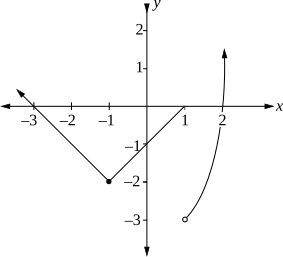
a.   
     
 
b.    \(f(x)=0\ \ \text{when}\ \ x=-3,2\).

Show Worked Solution

a.   
     
 
b.    \(f(x)=0\ \ \text{when}\ \ x=-3,2\).

Filed Under: Piecewise Functions Tagged With: Band 3, Band 4, smc-6217-10-Sketch graph, smc-6217-60-Other problems, syllabus-2027

Functions, 2ADV EQ-Bank 9

Consider the function

\begin{align*}
f(x)=\begin{cases}2^x, & \text {for }\ x<0 \\ m x+c, & \text {for }\ 0 \leq x \leq 2 \\ \dfrac{8}{x}, & \text {for }\ x>2\end{cases}
\end{align*}

Given that \(f(x)\) is continuous at both  \(x =0\)  and \(x =2\):

  1. Find the values of \(m\) and \(c\).   (2 marks)

    --- 6 WORK AREA LINES (style=blank) ---

  2. Identify any asymptotes of  \(y=f(x)\).   (1 mark)

    --- 4 WORK AREA LINES (style=blank) ---

Show Answers Only

a.    \(f(x)=\left\{\begin{array}{cl}2^x & \text {for } x<0 \\ m x+c & \text {for } 0 \leq x \leq 2 \\ \dfrac{8}{x} & \text {for } x>2\end{array}\right.\)

\(\text {Continuous at}\ \ x=0:\)

\(2^\circ=m(0)+c \ \Rightarrow \ c=1\)

\(\text {Continuous at}\ \ x=2:\)

\(2 m+1=\dfrac{8}{2} \ \Rightarrow \ m=\dfrac{3}{2}\)
 

b.    \(\text{Asymptotes:}\)

\(\text{As} \ x \rightarrow-\infty, 2^x \rightarrow 0^{+}\)

\(\text{As} \ x \rightarrow \infty, \dfrac{8}{x} \rightarrow 0^{+}\)
 

\(\text{Asymptote at} \ \ y=0.\)

\(\text{There are no vertical asymptotes.}\)

Show Worked Solution

a.    \(f(x)=\left\{\begin{array}{cl}2^x & \text {for } x<0 \\ m x+c & \text {for } 0 \leq x \leq 2 \\ \frac{8}{x} & \text {for } x>2\end{array}\right.\)

\(\text {Continuous at}\ \ x=0:\)

\(2^\circ=m(0)+c \ \Rightarrow \ c=1\)

\(\text {Continuous at}\ \ x=2:\)

\(2 m+1=d\dfrac{8}{2} \ \Rightarrow \ m=\dfrac{3}{2}\)
 

b.    \(\text{Asymptotes:}\)

\(\text{As} \ x \rightarrow-\infty, 2^x \rightarrow 0^{+}\)

\(\text{As} \ x \rightarrow \infty, \dfrac{8}{x} \rightarrow 0^{+}\)
 

\(\text{Asymptote at} \ \ y=0.\)

\(\text{There are no vertical asymptotes.}\)

Filed Under: Piecewise Functions Tagged With: Band 4, smc-6217-40-Continuity, smc-6217-60-Other problems, syllabus-2027

Functions, 2ADV EQ-Bank 8

The temperature \(T\) (in °C) in a greenhouse follows the pattern:

\begin{align*}
T(h)= \begin{cases}10+2 h, & \text {for }\ 0 \leqslant h<6 \\ 22, & \text {for }\ 6 \leqslant h \leqslant 18 \\ 58-2 h, & \text {for }\ 18<h \leqslant 24\end{cases}
\end{align*}

where \(h\) is the number of hours after midnight.

  1. Sketch the graph of \(T(h)\) for  \(0 \leqslant h \leqslant 24\)   (2 marks)

    --- 12 WORK AREA LINES (style=blank) ---

  2. At what time(s) during the day is the temperature exactly 18 °C?   (2 marks)

    --- 5 WORK AREA LINES (style=lined) ---

Show Answers Only

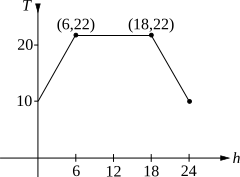
a.


b.   \(\text{Temperature is 18° at 4 am and 8 pm.}\)

Show Worked Solution

a.


b.   \(\text{Temperature}=18^{\circ} \ \text{twice (see graph)}\)

\(10+2 h=18 \ \Rightarrow \ h=4\)

\(58-2 h=18 \ \Rightarrow \ h=20\)

\(\therefore \ \text{Temperature is 18° at 4 am and 8 pm.}\)

Filed Under: Piecewise Functions Tagged With: Band 4, smc-6217-10-Sketch graph, smc-6217-60-Other problems, syllabus-2027

  • 1
  • 2
  • Next Page »

Copyright © 2014–2026 SmarterEd.com.au · Log in