Given \(p\) and \(q\) are rational numbers, and \(p, q \neq 0\), show
\(px^2-(p+q) x+q=0\)
has rational roots. (3 marks)
--- 10 WORK AREA LINES (style=lined) ---
Aussie Maths & Science Teachers: Save your time with SmarterEd
Given \(p\) and \(q\) are rational numbers, and \(p, q \neq 0\), show
\(px^2-(p+q) x+q=0\)
has rational roots. (3 marks)
--- 10 WORK AREA LINES (style=lined) ---
The equation `(p-1)x^2 + 4x = 5-p` has no real roots when
The graphs of `y = mx + c` and `y = ax^2` will have no points of intersection for all values of `m, c` and `a` such that
Determine the value of `k` if the graph of `y = kx-4` intersects the graph of `y = x^2 + 2x` at two distinct points. Give your answer in set notation. (3 marks)
--- 8 WORK AREA LINES (style=lined) ---
Solve for \(x\), giving your answers in the simplest form \(a+b\sqrt{c}\) where \(a, b\) and \(c\) are real:
\(5 x^2-20 x+4=0\) (2 marks)
--- 6 WORK AREA LINES (style=lined) ---
What are the solutions to \(3x^2+2x-4=0\)?
--- 4 WORK AREA LINES (style=lined) ---
--- 8 WORK AREA LINES (style=blank) ---
Using the discriminant, or otherwise, justify why the graph of \(f(x)=-x^2+2 x-2\) lies entirely below the \(x\)-axis. (2 marks)
--- 5 WORK AREA LINES (style=lined) ---
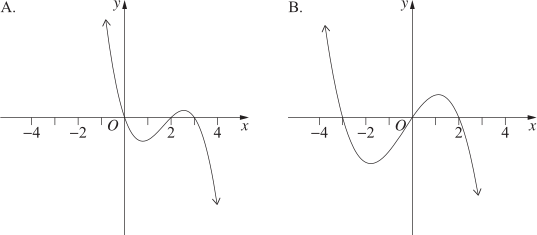
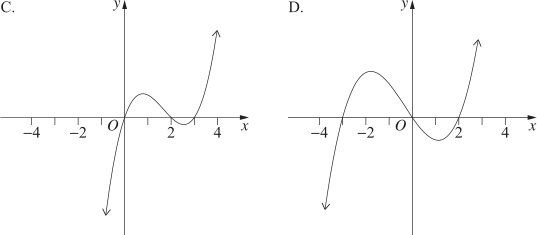
Which of the following best represents the graph of \(y=-5 x(x-2)(3-x)\)?
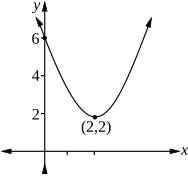
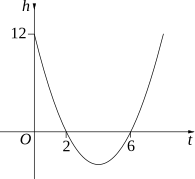
The graph of a quadratic function represented by the equation \(h=t^2-8 t+12\) is shown.
--- 6 WORK AREA LINES (style=lined) ---
--- 3 WORK AREA LINES (style=lined) ---
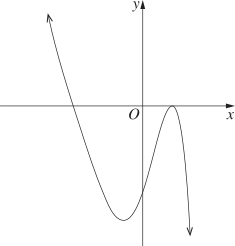
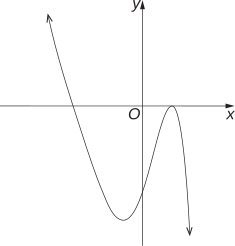
The graph of a quadratic function \(f(x)=a x^2+b x+c\) is drawn below.
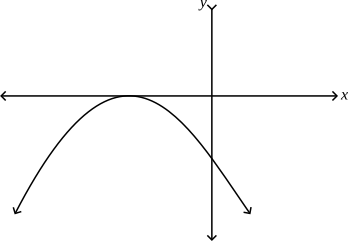
Which of the following are true?
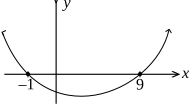
Solve \(x^2-8 x-9 \leq 0\). (2 marks) --- 4 WORK AREA LINES (style=lined) ---
\(\therefore -1 \leqslant x \leqslant 9\)
Show Worked Solution
\(x^2-8 x-9 \leqslant 0\)
\((x-9)(x+1) \leqslant 0\)
\(R\left(r, r^2\right), S\left(s, s^2\right)\) and \(T\left(t, t^2\right)\) are points on the parabola \(y=x^2\).
Given \(RT\) is parallel to \(SO\), show \(r+t=s\) (2 marks)

--- 5 WORK AREA LINES (style=lined) ---
The tangent to the parabola \(y=x^2+2 x-4\) is \(y=px-5\) where \(p>0\).
Find the value of \(p\). (2 marks)
--- 5 WORK AREA LINES (style=lined) ---
Determine whether the function \(f(x)=2x^3-5x\) is even, odd or neither. Show all working. (2 marks)
--- 5 WORK AREA LINES (style=lined) ---
The graph \(y = x^2\) meets the line \(y = k\) (where \(k>0\)) at points \(P\) and \(Q\) as shown in the diagram. The length of the interval \(PQ\) is \(L\).
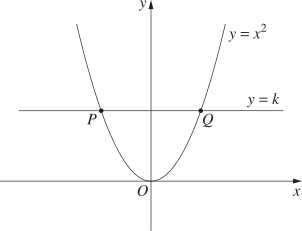
Let \(a\) be a positive number. The graph \(y=\dfrac{x^2}{a^2}\) meets the line \(y=k\) at points \(S\) and \(T\).
What is the length of \(ST\)?
Let \(f(x)\) be any function with domain all real numbers.
Which of the following is an even function, regardless of the choice of \(f(x)\)?
Which of the following is the range of the function `f(x)=x^2-1` ?
Solve the inequality `x^2<=|\ 2x-1\ |` for `x`.
Express your answer in interval notation. (3 marks)
--- 7 WORK AREA LINES (style=lined) ---
The graph of `y = f(x)` is shown.
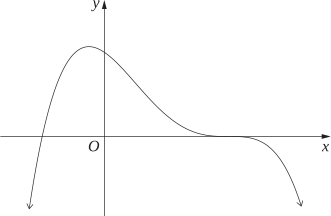
Which of the following could be the equation of this graph?
Which diagram best represents the solution set of `x^2-2x-3 >= 0`?
| A. |  |
B. |  |
| C. |  |
D. |  |
Find the values of `k` for which the expression `x^2-3x + (4-2k)` is always positive. (3 marks)
--- 7 WORK AREA LINES (style=lined) ---
Find the values of `x` that satisfy the equation
`x^2 + 8x + 3 <= 0`. (3 marks)
--- 6 WORK AREA LINES (style=lined) ---
| `x` | `= (-8 ± sqrt(8^2-4 · 1 · 3))/2` |
| `= (-8 ± sqrt(52))/2` | |
| `= -4 ± sqrt13` |
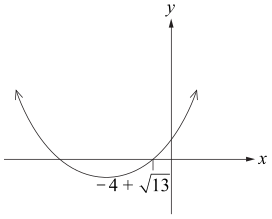
`{x:\ -4-sqrt13 <=x <= -4 + sqrt13}`
Which expression is equal to `3x^2-x-2`?
Find the points of intersection of `y=-5-4x` and `y=3-2x-x^2.` (3 marks)
--- 7 WORK AREA LINES (style=lined) ---
Which diagram shows the graph of an odd function?


Factorise `2x^2 + 5x − 12`. (2 marks)
Factorise fully `3x^2-27`. (2 marks)
--- 4 WORK AREA LINES (style=lined) ---
--- 6 WORK AREA LINES (style=lined) ---
i. `2x^2 + (k-2)x + 8`
| `Delta` | `= b^2-4ac` |
| `= (k-2)^2-4 xx 2 xx 8` | |
| `= k^2-4k + 4-64` | |
| `= k^2-4k-60` |
| ii. `y` | `= 2x^2 + kx + 9` | `\ \ text{… (1)}` |
| `y` | `= 2x + 1` | `\ \ text{… (2)}` |
`text(Substitute)\ y = 2x + 1\ text{into (1)}`
`2x + 1 = 2x^2 + kx + 9`
`2x^2 + kx-2x + 8 = 0`
`2x^2 + (k-2)x + 8 = 0\ …\ text{(∗)}`
`text{The graphs will not intercept if (∗) has no roots, i.e.)\ \ Delta <0`
| `k^2-4k-60` | `< 0` |
| `(k-10) (k + 6)` | `< 0` |

`text(From the graph, no intersection when)`
`-6 < k < 10`
Factorise `2x^2 + 5x-3`. (2 marks)
Which expression is a factorisation of `8x^3 + 27`?
Factorise `3x^2 + x − 2`. (2 marks)
Solve the inequality `x^2-x-12 < 0`. (2 marks)
--- 4 WORK AREA LINES (style=lined) ---
`x^2-x-12<0`
| `text(Solve)\ \ \ ` | `x^2-x-12` | `=0` |
| `(x-4)(x + 3)` | `=0` | |
| `=>x = 4\ text(or)\ -3` | ||

`x^2-x-12 < 0\ \ \text(when)\ \ -3 < x < 4`
Solve `x^2 = 4x`. (2 marks)
Simplify `(n^2 - 25)/(n - 5)`. (1 mark)
Factorise `2x^2 - 7x +3` (2 marks)
What are the solutions of `2x^2-5x-1 = 0`?