For the function \(f(x)\), it is known that \(f(3)=1, f^{\prime}(3)=2\) and \(f^{\prime \prime}(3)=4\).
Let \(g(x)=f^{-1}(x)\).
What is the value of \(g^{\prime \prime}(1)\) ?
- \(\dfrac{1}{4}\)
- \(-\dfrac{1}{4}\)
- \(-\dfrac{1}{2}\)
- \(-1\)
Aussie Maths & Science Teachers: Save your time with SmarterEd
For the function \(f(x)\), it is known that \(f(3)=1, f^{\prime}(3)=2\) and \(f^{\prime \prime}(3)=4\).
Let \(g(x)=f^{-1}(x)\).
What is the value of \(g^{\prime \prime}(1)\) ?
\(C\)
\(f(3)=1, f^{\prime}(3)=2, f^{\prime \prime}(3)=4\)
\(\text{Given} \ \ g(x)=f^{-1}(x):\)
\(f(g(x))=x \ \ \text{(Definition of an inverse fn)}\)
\(\text{Differentiate both sides:}\)
\(g^{\prime}(x) \cdot f^{\prime}(g(x))=1 \ \ \Rightarrow \ \ g^{\prime}(x)=\dfrac{1}{f^{\prime}(g(x))}\)
\(g^{\prime \prime}(x)=\dfrac{d}{d x}\left(\dfrac{1}{f^{\prime}(g(x))}\right)=-\dfrac{f^{\prime \prime}(g(x)) \cdot g^{\prime}(x)}{\left[f^{\prime}(g(x))\right]^2}\)
\(\text{When}\ \ x=1:\)
| \(g^{\prime}(1)\) | \(=\dfrac{1}{f^{\prime}(g(1))}=\dfrac{1}{f^{\prime}(3)}=\dfrac{1}{2}\) |
| \(g^{\prime \prime}(1)\) | \(=-\dfrac{f^{\prime \prime}(g(1)) \cdot g^{\prime}(1)}{\left[f^{\prime}(g(1))\right]^2}=-\dfrac{f^{\prime \prime}(3) \cdot \dfrac{1}{2}}{\left[f^{\prime}(3)\right]^2}=-\dfrac{4 \times \dfrac{1}{2}}{2^2}=-\dfrac{1}{2}\) |
\(\Rightarrow C\)
The function \(f(x)\) is defined by \(f(x)=\cos ^{-1}(\sin x)\) in the domain \((0, \pi)\).
Find \(f^{\prime}(x)\) for those values of \(x\) where it is defined. (3 marks)
--- 6 WORK AREA LINES (style=lined) ---
\(f^{\prime}(x)=-1 \ \text{for} \ \ x \in\left(0, \dfrac{\pi}{2}\right)\)
\(f^{\prime}(x)=1 \ \text{for} \ \ x \in\left(\dfrac{\pi}{2}, \pi\right)\)
| \(f(x)\) | \(=\cos ^{-1}(\sin x)\) |
| \(f^{\prime}(x)\) | \(=-\dfrac{\cos x}{\sqrt{1-\sin ^2 x}}\) |
| \(=-\dfrac{\cos x}{\abs{\cos x}}\) | |
| \(= \pm 1\) |
\(\text{Consider limitations:}\)
\(1-\sin ^2 x \neq 0 \ \Rightarrow \ \sin x \neq \pm 1 \ \Rightarrow \ x \neq \dfrac{\pi}{2}\)
\(\text{In lst quadrant:} \ \ -\dfrac{\cos x}{\abs{\cos x}}=-1\)
\(\text{In 2nd quadrant:}\ \ -\dfrac{\cos x}{\abs{\cos x}}=1\)
\(f^{\prime}(x)=-1 \ \ \text{for} \ \ x \in\left(0, \dfrac{\pi}{2}\right)\)
\(f^{\prime}(x)=1 \ \ \text{for} \ \ x \in\left(\dfrac{\pi}{2}, \pi\right)\)
Find the value of \(n\), given
\(\displaystyle \int_0^n-\dfrac{1}{\sqrt{1-x^2}}=-\dfrac{\pi}{6}\). (2 marks)
\(n=\dfrac{1}{2}\)
| \(\displaystyle\int_0^n-\dfrac{1}{\sqrt{1-x^2}}\) | \(=-\dfrac{\pi}{6}\) |
| \(\left[\cos ^{-1} x\right]_0^n\) | \(=-\dfrac{\pi}{6}\) |
| \(\cos ^{-1}(n)-\cos ^{-1} 0\) | \(=-\dfrac{\pi}{6}\) |
| \(\cos ^{-1}(n)-\dfrac{\pi}{2}\) | \(=-\dfrac{\pi}{6}\) |
| \(\cos ^{-1}(n)\) | \(=\dfrac{\pi}{2}-\dfrac{\pi}{6}\) |
| \(n\) | \(=\cos \left(\dfrac{\pi}{3}\right)\) |
| \(=\dfrac{1}{2}\) |
--- 5 WORK AREA LINES (style=lined) ---
--- 3 WORK AREA LINES (style=lined) ---
a. \(\sin ^{-1}\left(\dfrac{x-2}{2}\right)+c\)
b. \(0<x<4\)
| a. | \(\displaystyle\int \frac{1}{\sqrt{4 x-x^2}}\, d x\) | \(=\displaystyle\int \frac{1}{\sqrt{4-4+4 x-x^2}}\, d x\) |
| \(=\displaystyle\int \frac{1}{\sqrt{4-(x-2)^2}}\, d x\) | ||
| \(=\sin ^{-1}\left(\dfrac{x-2}{2}\right)+c\) |
b. \(4 x-x^2>0\)
\(x(4-x)>0\)
\(0<x<4\)
Find \(\displaystyle \int \frac{1}{\sqrt{15-2 x-x^2}}\, d x\). (3 marks)
--- 6 WORK AREA LINES (style=lined) ---
\(\displaystyle\sin ^{-1}\left(\frac{x+1}{4}\right)+c\)
| \(\displaystyle\int \frac{1}{\sqrt{15-2 x-x^2}}\, d x\) | \(=\displaystyle\int \frac{1}{\sqrt{16-1-2 x-x^2}}\, d x\) |
| \(=\displaystyle\int \frac{1}{\sqrt{16-(x+1)^2}}\, d x\) | |
| \(=\displaystyle\sin ^{-1}\left(\frac{x+1}{4}\right)+c\) |
\(\displaystyle \int \dfrac{1}{\sqrt{5-4 x-x^2}}\, d x=\)
\(\Rightarrow A\)
| \(\displaystyle \int \frac{1}{\sqrt{5-4 x-x^2}}\, d x\) | \(=\displaystyle\int \frac{1}{\sqrt{9-4-4 x-x^2}}\,dx\) |
| \(=\displaystyle \int \frac{1}{\sqrt{9-(x+2)^2}}\,dx\) | |
| \(=\sin ^{-1}\left(\dfrac{x+2}{3}\right)+c\) |
\(\Rightarrow A\)
Given \(y=\dfrac{\cos 2 x}{x^2}\), find the gradient of the tangent of its inverse function at \(\left(\dfrac{8 \sqrt{2}}{\pi^2}, \dfrac{\pi}{4}\right)\). (3 marks)
--- 7 WORK AREA LINES (style=lined) ---
\(-\dfrac{\pi^2}{32}\)
\(y=\dfrac{\cos2x}{x^2}\)
\(\text{Inverse: Swap} \ \ x \leftrightarrow y\)
\(x=\dfrac{\cos 2 y}{y^2}\)
\(u=\cos 2 y \ \ \quad \quad \quad v=y^2\)
\(v^{\prime}=-2 \sin 2 y \ \ \quad v^{\prime}=2 y\)
\(\dfrac{dx}{dy}=\dfrac{-2 y^2 \sin 2 y-2 y\, \cos 2 y}{y^4}\)
\(\dfrac{dy}{dx}=\dfrac{y^4}{-2 y^2 \sin 2 y-2 y\, \cos 2 y}\)
\(\text{At}\ \ y=\dfrac{\pi}{4}:\)
| \(\dfrac{d y}{d x}\) | \(=\dfrac{\left(\dfrac{\pi}{4}\right)^4}{-2\left(\dfrac{\pi}{4}\right)^2 \sin \left(\dfrac{\pi}{2}\right)-2\left(\dfrac{\pi}{4}\right) \cos \left(\dfrac{\pi}{2}\right)}\) |
| \(=-\dfrac{\pi^4}{256} \times \dfrac{8}{\pi^2}\) | |
| \(=-\dfrac{\pi^2}{32}\) |
For what values of the constant \(k\) would the function \(f(x)=\dfrac{k x}{1+x^2}+\arctan x\) have an inverse? (3 marks) --- 7 WORK AREA LINES (style=lined) --- \(f(x)\ \text{has an inverse for}\ \ -1 \leqslant k \leqslant 1\) \(\text{Inverse function } \Rightarrow f(x) \text { has no SPs}\) \(x^2(1-k)+k+1 \neq 0\) \(\text {No solution if } \ \Delta<0:\)
\(f(x)\)
\(=\dfrac{k x}{1+x^2}+\arctan x\)
\(f^{\prime}(x)\)
\(=\dfrac{k\left(1+x^2\right)-k x(2 x)}{\left(1+x^2\right)^2}+\dfrac{1}{1+x^2}\)
\(=\dfrac{k+k x^2-2 k x^2+1+x^2}{\left(1+x^2\right)^2}\)
\(=\dfrac{x^2(1-k)+k+1}{\left(1+x^2\right)^2}\)
\(-4(1-k)(k+1)\)
\(<0\)
\((1-k)(k+1)\)
\(>0\)
\(f(x)\ \text{has an inverse for}\ \ -1 \leq k \leq 1\)
Differentiate the function \(f(x)=\arcsin \left(x^5\right)\). (1 mark) --- 3 WORK AREA LINES (style=lined) --- \(f^{\prime}(x)=\dfrac{5 x^4}{\sqrt{1-x^{10}}}\) \(f(x)=\sin ^{-1}\left(x^5\right)\) \(f^{\prime}(x)=5 x^4 \times \dfrac{1}{\sqrt{1-\left(x^5\right)^2}}=\dfrac{5 x^4}{\sqrt{1-x^{10}}}\)
Let \(f(x)=2 x+\ln x\), for \(x>0\). --- 4 WORK AREA LINES (style=lined) --- --- 8 WORK AREA LINES (style=lined) --- i. \(f(x)=2 x+\ln x\) \(f^{′}(x)=2+\dfrac{1}{x} \) \(\text{In domain}\ x \gt 0\ \ \Rightarrow f^{-1}(x) \gt 0 \ \ (f(x)\ \text{is monotonically increasing}) \) \(\text{Since}\ f(x)\ \text{is one-to-one,}\ f^{-1}(x)\ \text{is a function.} \) ii. \(\dfrac{1}{3}\) i. \(f(x)=2 x+\ln x\) \(f^{′}(x)=2+\dfrac{1}{x} \) \(\text{In domain}\ x \gt 0\ \ \Rightarrow f^{-1}(x) \gt 0 \ \ (f(x)\ \text{is monotonically increasing}) \) \(\text{Since}\ f(x)\ \text{is one-to-one,}\ f^{-1}(x)\ \text{is a function.} \) \(f(g(x))=x\) \(\text{Differentiate both sides:}\) \(\Rightarrow g(2)=1 \ \text{(by inverse definition)}\)
ii. \(g(x)=f^{-1}(x) \)
\(g^{′}(x)\ f^{′}(g(x))\)
\(=1\)
\(g^{′}(x)\)
\(=\dfrac{1}{f^{′}(g(x))}\)
\(g^{′}(2)\)
\(=\dfrac{1}{f^{′}(g(2))}\)
\(f(1)=2 \times 1 + \ln1 = 2 \)
\(\therefore g^{′}(2)\)
\(= \dfrac{1}{f^{′}(1)} \)
\(=\dfrac{1}{2+\frac{1}{1}}\)
\(=\dfrac{1}{3} \)
Find \( {\displaystyle \int} \dfrac{1}{\sqrt{4-9x^2}}\ dx\) (2 marks)
\(\dfrac{1}{3} \sin^{-1} \Big{(}\dfrac{3x}{2} \Big{)} +c \)
| \({\displaystyle \int} \dfrac{1}{\sqrt{4-9x^2}}\ dx\) | \(=\dfrac{1}{3} {\displaystyle \int} \dfrac{3}{\sqrt{2^2-(3x)^2}}\ dx\) | |
| \(=\dfrac{1}{3} \sin^{-1} \Big{(}\dfrac{3x}{2} \Big{)} +c \) |
Find the equation of the tangent to the curve `y=x text{arctan}(x)` at the point with coordinates `(1,(pi)/(4))`. Give your answer in the form `y=mx+c` (3 marks)
--- 6 WORK AREA LINES (style=lined) ---
`y=((2+pi)/4)x-1/2`
| `y` | `=xtan^(-1)(x)` | |
| `dy/dx` | `=x xx 1/(1+x^2)+tan^(-1)(x)` |
`text{When}\ \ x=1:`
`dy/dx=1/2+tan^(-1)(1)=1/2+pi/4=(2+pi)/4`
`text{Equation of tangent}\ \ m=(2+pi)/4,\ text{through}\ \ (1,(pi)/(4)):`
| `y-pi/4` | `=(2+pi)/4 (x-1)` | |
| `y` | `=((2+pi)/4)x-(2+pi)/4+pi/4` | |
| `y` | `=((2+pi)/4)x-1/2` |
A given function `f(x)` has an inverse `f^{-1}(x)`.
The derivatives of `f(x)` and `f^{-1}(x)` exist for all real numbers `x`.
The graphs `y=f(x)` and `y=f^{-1}(x)` have at least one point of intersection.
Which statement is true for all points of intersection of these graphs?
`D`
`text{By Elimination:}`
`text{Consider}\ \ f(x)=x\ \ =>\ \ f^(-1)(x)=x:`
`text{All POI lie on}\ \ y=x\ \ text{and all tangents are parallel}`
`text{→ Eliminate B and C}`
`text{Consider}\ \ f(x)=-x\ \ =>\ \ f^(-1)(x)=-x:`
`text{All POI lie on}\ \ y=-x`
`text{→ Eliminate A}`
`=>D`
The polynomial `g(x) = x^3 + 4x - 2` passes through the point (1, 3).
Find the gradient of the tangent to `f(x) = xg^(-1)(x)` at the point where `x = 3`. (2 marks)
--- 5 WORK AREA LINES (style=lined) ---
`10/7`
`g(x) = x^3 + 4x – 2`
`g′(x) = 3x^2 + 4`
`f(x) = x g^(-1)(x)`
`f′(x) = x · d/(dx) g^(-1)(x) + g^(-1)(x)`
`g(x)\ text(passes through)\ (1, 3)`
`=> g^(-1)(x)\ text(passes through)\ (3, 1)`
`g′(1) = 3 + 4 = 7`
`=> d/(dx) g^(-1)(3) = 1/(d/(dy) g(y)) = 1/(g′(1)) = 1/7`
| `:. f′(x)|_(x = 3)` | `= 3 · 1/7 + 1` |
| `= 10/7` |
Evaluate `int_0^sqrt3 1/(sqrt(4 - x^2))\ dx`. (2 marks)
`pi/3`
| `int_0^sqrt3 1/(sqrt(4 – x^2))\ dx` | `= [sin^(-1)\ x/2]_0^sqrt3` | |
| `= sin^(-1)\ sqrt3/2 – sin^(-1) 0` | ||
| `= pi/3` |
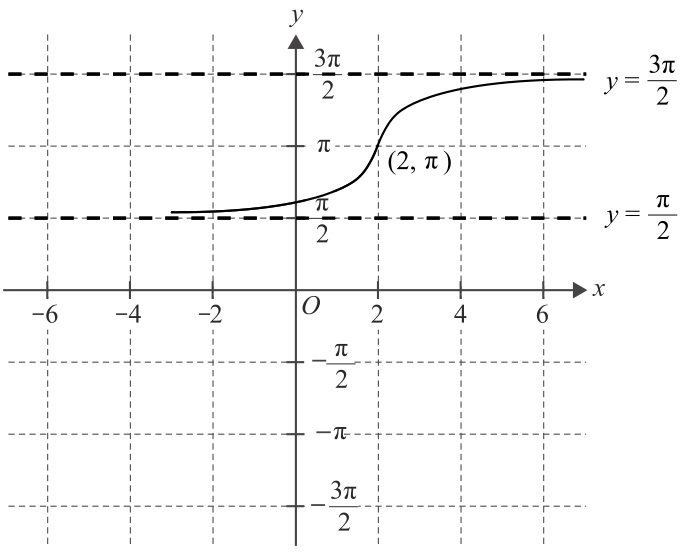
Let `f(x) = tan^(-1) (3x - 6) + pi`.
--- 2 WORK AREA LINES (style=lined) ---
--- 6 WORK AREA LINES (style=lined) ---
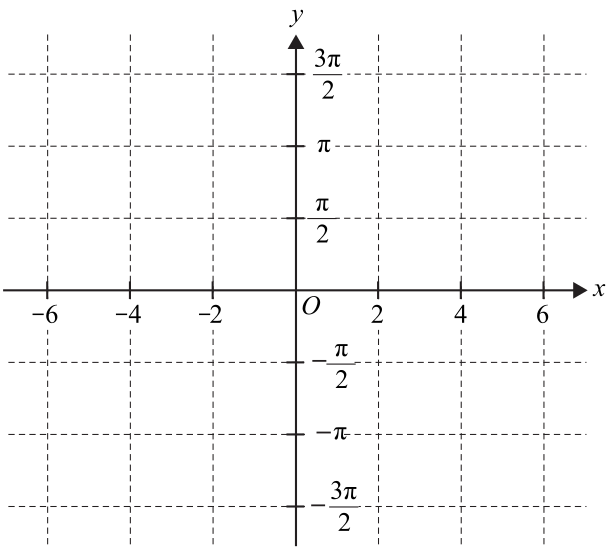
--- 0 WORK AREA LINES (style=lined) ---
| a. | `f^{\prime}(x)` | `= (d/(dx) (3x – 6))/(1 + (3x – 6)^2)` |
| `= 3/(9x^2 – 36x + 37)` |
b. `f^{\prime\prime}(x) = (3(18x – 36))/(9x^2 – 36x + 37)^2`
`f^{\prime\prime}(x) = 0\ \ text(when)\ \ 18x – 36 = 0 \ => \ x = 2`
`text(If)\ \ x < 2, 18x – 36 < 0 \ => \ f^{\prime\prime}(x) < 0`
`text(If)\ \ x > 2, 18x – 36 > 0 \ => \ f^{\prime\prime}(x) > 0`
`text(S) text(ince)\ \ f^{\prime\prime}(x)\ \ text(changes sign about)\ \ x = 2,`
`text(a POI exists at)\ \ x = 2`
| c. |
Suppose `f(x) = tan(cos^(-1)(x))` and `g(x) = (sqrt(1-x^2))/x`.
The graph of `y = g(x)` is given.
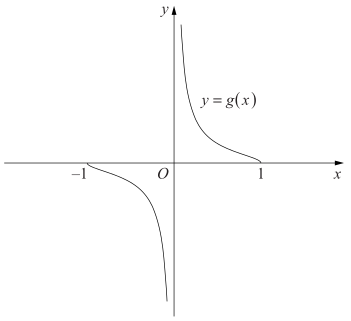
--- 8 WORK AREA LINES (style=lined) ---
--- 6 WORK AREA LINES (style=lined) ---
i. `f(x) = tan(cos^(-1)(x))`
| `f^(′)(x)` | `= -1/sqrt(1-x^2) · sec^2(cos^(-1)(x))` |
| `= -1/sqrt(1-x^2) · 1/(cos^2(cos^(-1)(x)))` | |
| `= -1/(x^2sqrt(1-x^2))` |
`g(x) = (1-x^2)^(1/2) · x^(-1)`
| `g^(′)(x)` | `= 1/2 · -2x(1-x^2)^(-1/2) · x^(-1)-(1-x^2)^(1/2) · x^(-2)` |
| `= (-x)/(x sqrt(1-x^2))-sqrt(1-x^2)/(x^2)` | |
| `= (-x^2-sqrt(1-x^2) sqrt(1-x^2))/(x^2 sqrt(1-x^2))` | |
| `= (-x^2-(1-x^2))/(x^2sqrt(1-x^2))` | |
| `= -1/(x^2sqrt(1-x^2))` | |
| `=f^(′)(x)` |
ii. `f^(′)(x) = g^(′)(x)`
`=> f(x) = g(x) + c`
`text(Find)\ c:`
| `f(1)` | `= tan(cos^(-1) 1)` |
| `= tan 0` | |
| `= 0` |
`g(1) = sqrt(1-1)/0 = 0`
`f(1) = g(1) + c`
`:. c = 0`
`:. f(x) = g(x)`
What is the derivative of `tan^(-1)\ x/2`?
A. `1/(2(4 + x^2))`
B. `1/(4 + x^2)`
C. `2/(4 + x^2)`
D. `4/(4 + x^2)`
`C`
| `y` | `= tan^(-1)\ x/2` |
| `(dy)/(dx)` | `= (1/2)/(1 + (x/2)^2)` |
| `= 1/(2(1 + x^2/4))` | |
| `= 2/(4 + x^2)` |
`=> C`
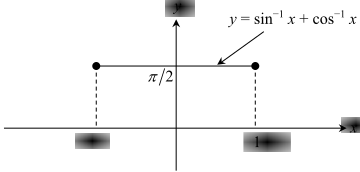
Let `f(x) = sin^(-1) x + cos^(-1) x`.
--- 2 WORK AREA LINES (style=lined) ---
--- 4 WORK AREA LINES (style=lined) ---
--- 8 WORK AREA LINES (style=lined) ---
i. `f^{′}(x) = 1/sqrt(1-x^2) + (-1/sqrt (1-x^2)) = 0`
ii. `text(S)text(ince)\ \ f^{′}(x) = 0\ \ => f(x)\ \ text(is a constant.)`
`text(Substituting)\ \ x=1\ \ text{into the equation (any value works)}`
| `sin^(-1) 1 + cos^(-1) 1` | `= pi/2 + 0` | |
| `= pi/2\ \ text(… as required)` |
iii. `text(Domain restrictions require:)\ \ -1<x<1`
Differentiate `3tan^(−1)(2x)`. (2 marks)
`6/(1 + 4x^2)`
| `y` | `= 3 tan^-1 (2x)` |
| `(dy)/(dx)` | `= 3/(1 + (2x)^2) xx 2` |
| `= 6/(1 + 4x^2)` |
Differentiate `tan^(–1)(x^4)` with respect to `x`. (2 marks)
`(4x^3)/(1 + x^8)`
| `y` | `= tan^(−1)(x^4)` |
| `(dy)/(dx)` | `= 1/(1 + (x^4)^2) xx d/(dx) (x^4)` |
| `= (4x^3)/(1 + x^8)` |
Find `d/(dx)\ cos^(−1)\ (3x^2).` (2 marks)
`(−6x)/(sqrt(1 − 9x^4))`
`d/(dx)\ cos^(−1)\ (3x^2)`
`= (−1)/sqrt(1 − (3x^2)^2) xx d/(dx) (3x^2)`
`= (−6x)/(sqrt(1 − 9x^4))`
Find `int_0^1(dx)/(sqrt(4 − x^2))`. (2 marks)
`pi/6`
| `int_0^1(dx)/(sqrt(4 − x^2))` | `= [sin^(−1)\ x/2]_0^1` |
| `= sin^(−1)(1/2) − sin^(−1)(0)` | |
| `= pi/6` |
Let `f(x) = sin^-1 (x + 5).`
--- 4 WORK AREA LINES (style=lined) ---
--- 8 WORK AREA LINES (style=lined) ---
a. `f(x) = sin^-1 (x + 5)`
`text(Domain)`
`-1 <= x + 5 <= 1`
`-6 <= x <= -4`
`text(Range)`
`-pi/2 <= y <= pi/2`
b. `y = sin^-1 (x + 5)`
`(dy)/(dx) = 1/sqrt(1-(x + 5)^2)`
`text(When)\ \ x = -5`
| `(dy)/(dx)` | `= 1/sqrt(1-(-5 + 5)^2)` |
| `= 1/sqrt(1-0)` | |
| `= 1` |
`:.\ text(Gradient of)\ \ y = f(x)\ \ text(at)\ \ x = -5\ \ text(is)\ \ 1.`
|
c. |
![]() |
Find `int (dx)/(49 + x^2).` (2 marks)
`1/7 tan^-1\ x/7 + c`
`int (dx)/(49 + x^2)`
`= 1/7 tan^-1\ x/7 + c`
Find `d/(dx) (2 sin^-1 5x).` (2 marks)
`10/(sqrt (1 – 25x^2))`
| `d/(dx) (2 sin^-1 5x)` | `= 2 xx d/(dx) (sin^-1 5x)` |
| `= 2 xx 1/(sqrt(1 – (5x)^2)) xx d/(dx) (5x)` | |
| `= 2/(sqrt (1 – 25x^2)) xx 5` | |
| `= 10/(sqrt(1 – 25 x^2))` |
Find `int 1/(x^2 + 49)\ dx.` (1 mark)
`1/7\ tan^-1\ x/7 + c`
| `int 1/(x^2 + 49)\ dx` | `= 1/7 int 7/(x^2 + 7^2)\ dx` |
| `= 1/7\ tan^-1\ x/7 + c` |
Let `f(x) = cos^(-1)\ (x) + cos^(-1)\ (-x)`, where `-1 ≤ x ≤ 1`.
--- 4 WORK AREA LINES (style=lined) ---
i. `text(Prove)\ f(x)\ text(is a constant)`
| `f(x)` | `= cos^(-1)(x) + cos^(-1)(-x), \ \ -1 ≤ x ≤ 1` |
| `f′(x)` | `= (-1)/sqrt(1 – x^2) + (-1)/sqrt(1 -(-x)^2) xx d/(dx) (-x)` |
| `= (-1)/sqrt(1 – x^2) + 1/sqrt(1 – x^2)` | |
| `= 0` |
`:.\ text(S)text(ince)\ \ f′(x) = 0, f(x)\ text(must be a constant.)`
| ii. | `f(0)` | `= cos^(−1)(0) + cos^(−1)(0)` |
| `= pi/2 + pi/2` | ||
| `= pi` |
`:.f(x) = pi`
`pi = cos^(−1)(x) + cos^(−1)(−x)`
`:.cos^(−1)(−x) = pi – cos^(−1)(x)\ \ …text(as required)`
What is the value of `k` such that `int_0^k 1/sqrt(4 − x^2) \ dx= pi/3 ?`
`B`
| `int_0^1 1/sqrt(4 − x^2)dx` | `= pi/3` |
| `[sin^(−1)\ x/2]_0^k` | `= pi/3` |
| `sin^(−1)\ k/2 − sin^(−1)\ 0` | `= pi/3` |
| `sin^(−1)\ k/2` | `= pi/3` |
| `k/2` | `= sin\ pi/3` |
| `= sqrt3/2` | |
| `:.k` | `= sqrt3` |
`⇒ B`
Evaluate `int_-1^1 1/sqrt(4 - x^2)\ dx`. (2 marks)
`pi/3`
`int_-1^1 1/sqrt(4 – x^2)\ dx`
`= [sin^(-1) (x/2)]_(-1)^1`
`= sin^(-1) (1/2) – sin^(-1) (-1/2)`
`= pi/6 – (- pi/6)`
`= pi/3`
Differentiate `cos^(–1) (3x)` with respect to `x`. (2 marks)
`(-3)/sqrt(1 – 9x^2)`
| `y` | `= cos^(-1) (3x)` |
| `dy/dx` | `= – 1/sqrt(1 – (3x)^2) * d/(dx) (3x)` |
| `= (-3)/sqrt(1 – 9x^2)` |
What is the derivative of `3 sin^(-1)\ x/2`?
`B`
`y = 3 sin^(-1)\ x/2`
`dy/dx = 3 xx 1/sqrt(4 – x^2)`
`=> B`
Differentiate `x^2 sin^(–1) 5x`. (2 marks)
`(5x^2)/sqrt(1\ – 25x^2) + 2x sin^(-1) 5x`
| `y` | `= x^2 sin^(-1) 5x` |
| `text(Using the product rule)` | |
| `(dy)/(dx)` | `= x^2 xx 1/sqrt(1\ – (5x)^2) xx d/(dx)(5x) + 2x sin^(-1) 5x` |
| `= (5x^2)/sqrt(1\ – 25x^2) + 2x sin^(-1) 5x` | |
Find `int 1/sqrt (49 - 4x^2)\ dx`. (2 marks)
`1/2 sin^(-1) ((2x)/7) + c`
`int 1/sqrt(49 – 4x^2)\ dx`
`= int 1/(2 sqrt(49/4 – x^2))\ dx`
`= 1/2 int 1/sqrt((7/2)^2 – x^2)\ dx`
`= 1/2 sin^(-1) ((2x)/7) + c`
Let `f(x) = tan^(-1)(x) + tan^(-1)(1/x)` for `x != 0`.
--- 6 WORK AREA LINES (style=lined) ---
| i. | `f(x)` | `= tan^(-1) (x) + tan^(-1) (1/x)\ text(for)\ x != 0` |
| `f prime (x)` | `= 1/(1 + x^2) + 1/(1 + (1/x)^2) xx d/(dx) (1/x)` | |
| `= 1/(1 + x^2) + 1/(1 + 1/(x^2)) xx -1/(x^2)` | ||
| `= 1/(1 + x^2)\ – 1/(x^2 + 1)` | ||
| `= 0` |
`text(S)text(ince)\ \ f prime (x) = 0`
`=> f(x)\ text(is a constant)`
`text(Substitute)\ \ x = 1\ \ text(into)\ \ f(x)`
| `f(1)` | `= tan^(-1) 1 + tan^(-1) (1/1)` |
| `= pi/4 + pi/4` | |
| `= pi/2` |
`:.\ f(x) = pi/2\ \ text(for)\ \ x > 0\ \ \ …\ text(as required)`
| ii. | `text(Given)\ \ f(x)\ \ text(is odd)` |
| `f(–x) = -f(x)` |
Use the table of standard integrals to find `int 1/sqrt(4 - x^2)\ dx`. (1 mark)
`sin^(-1)\ x/2 + c`
`int 1/sqrt(4\ – x^2)\ dx`
`= sin^(-1)\ x/2 + c`
Evaluate `int_0^3 1/(9 + x^2)\ dx`. (3 marks)
`pi/12`
| `int_0^3 1/(9 + x^2)\ dx` | `= int_0^3 1/(3^2 + x^2)\ dx` |
| `= [1/3 tan^(-1) (x/3)]_0^3` | |
| `= [(1/3 tan^(-1) 1) – 0]` | |
| `= 1/3 xx pi/4` | |
| `= pi/12` |
What is the derivative of `cos^(–1) (3x)`?
`D`
`y = cos^(-1) (3x)`
| `dy/dx` | `= (-1)/sqrt(1\ – (3x)^2) xx d/dx (3x)` |
| `= (-3)/sqrt(1\ – 9x^2)` |
`=> D`