Prove by mathematical induction for integers \(n>1\) that
\(\dfrac{1}{n+1}+\dfrac{1}{n+2}+\cdots+\dfrac{1}{2n-1}+\dfrac{1}{2n}>\dfrac{13}{24}\). (4 marks)
--- 16 WORK AREA LINES (style=lined) ---
Aussie Maths & Science Teachers: Save your time with SmarterEd
Prove by mathematical induction for integers \(n>1\) that
\(\dfrac{1}{n+1}+\dfrac{1}{n+2}+\cdots+\dfrac{1}{2n-1}+\dfrac{1}{2n}>\dfrac{13}{24}\). (4 marks)
--- 16 WORK AREA LINES (style=lined) ---
\(\text{See worked solutions.}\)
\(\text{Let}\ \ S_n=\dfrac{1}{n+1}+\dfrac{1}{n+2}+\cdots+\dfrac{1}{2n-1}+\dfrac{1}{2n}\)
\(\text{Prove}\ \ S_n>\dfrac{13}{24}\ \ \text{for}\ \ n>1.\)
\(\text{When}\ \ n=2:\)
\(S_2=\dfrac{1}{3}+\dfrac{1}{4}=\dfrac{7}{12}=\dfrac{14}{24}>\dfrac{13}{24}\)
\(\therefore\ \text{True for}\ \ n=2.\)
\(\text{Assume true for}\ \ n=k:\)
\(S_k=\dfrac{1}{k+1}+\dfrac{1}{k+2}+\cdots+\dfrac{1}{2k}>\dfrac{13}{24}\ \ \ldots\ (1)\)
\(\text{Prove true for}\ \ n=k+1:\)
\(\text{i.e.}\ \ S_{k+1}=\dfrac{1}{k+2}+\dfrac{1}{k+3}+\cdots+\dfrac{1}{2k}+\dfrac{1}{2k+1}+\dfrac{1}{2k+2}>\dfrac{13}{24}\)
| \(S_{k+1}\) | \(=S_k-\dfrac{1}{k+1}+\dfrac{1}{2k+1}+\dfrac{1}{2k+2}\) |
| \(=S_k-\dfrac{2}{2k+2}+\dfrac{1}{2k+1}+\dfrac{1}{2k+2}\) | |
| \(=S_k+\dfrac{1}{2k+1}-\dfrac{1}{2k+2}\) | |
| \(=S_k+\dfrac{(2k+2)-(2k+1)}{(2k+1)(2k+2)}\) | |
| \(=S_k+\dfrac{1}{(2k+1)(2k+2)}\) | |
| \(>S_k \quad \left(\text{since}\ \ \dfrac{1}{(2k+1)(2k+2)}>0\ \ \text{for}\ \ k>1\right)\) | |
| \(>\dfrac{13}{24}\quad \text{(by (1))}\) |
\(\Rightarrow\ \text{True for}\ \ n=k+1.\)
\(\therefore\ \text{Since true for}\ \ n=2,\ \text{by PMI, true for integers}\ \ n>1.\)
Use mathematical induction to prove De Moivre's theorem:
\((\cos \theta+i \,\sin \theta)^n=\cos n \theta+i \, \sin n \theta\)
for all integers \(n \geq 1\). (3 marks)
--- 15 WORK AREA LINES (style=lined) ---
\(\text{Proof (See Worked Solutions)}\)
\(\text{Prove} \ \ (\cos \theta+i \, \sin \theta)^n=\cos (n \theta)+i \sin (n \theta) \ \text {for} \ \ n \geq 1\)
\(\text{If} \ \ n=1:\)
\((\cos \theta+i \, \sin \theta)^1=\cos \theta+i \, \sin \theta=\cos (1 \theta)+i \, \sin (1 \theta)\)
\(\therefore \ \text{True for} \ \ n=1\)
\(\text{Assume true for} \ \ n=k:\)
\((\cos \theta+i \, \sin \theta)^k=\cos k \theta+i \,\sin k \theta\ \ldots\ (1)\)
\(\text{Prove true for} \ \ n=k+1:\)
\(\text{i.e.}\ \ (\cos \theta+i \,\sin \theta)^{k+1}=\cos (k+1) \theta+i \, \sin (k+1) \theta.\)
| \(\text{LHS}\) | \(=(\cos \theta+i \, \sin \theta)^{k+1}\) |
| \(=(\cos \theta+i \, \sin \theta)^k(\cos \theta+i \, \sin \theta)\) | |
| \(=(\cos k \theta+i \, \sin k \theta)(\cos \theta+i \, \sin \theta) \ \ \text{(using}\ (1)\ \text{above)}\) | |
| \(=\cos k \theta \, \cos \theta+i \, \cos k \theta \,\sin \theta+i \, \sin k \theta \,\cos \theta+i^2 \, \sin k \theta \,\sin \theta\) | |
| \(=(\cos k \theta \, \cos \theta-\sin k \theta \,\sin \theta)+i(\sin k \theta \,\cos \theta+\cos k \theta \,\sin \theta)\) | |
| \(=\cos (k+1) \theta+i \, \sin (k+1) \theta\) |
\(\Rightarrow \text{True for} \ \ n=k+1\)
\(\therefore \ \text{Since true for \(n=1\), by PMI, true for integers \(n \geqslant 1\).}\)
Consider a sequence of rectangles with side lengths \(a_{ n }\) and \(b_{ n }\).
The first rectangle has \(a_1=2\) and \(b_1=1\).
For integers \(n \geq 1,\ \ a_{n+1}=\dfrac{a_n+b_n}{2}\) and \(b_{n+1}=\dfrac{2}{a_{n+1}}.\)
--- 2 WORK AREA LINES (style=lined) ---
--- 15 WORK AREA LINES (style=lined) ---
--- 5 WORK AREA LINES (style=lined) ---
a. \(\text{Since}\ \ a_1 b_1=2\ \ \text{and}\ \ a_{n+1} b_{n+1}=a_{n+1} \times \dfrac{2}{a_{n+1}}=2\)
\(\Rightarrow\ \text{Each rectangle has area 2.}\)
b. \(a_1=2\ \ \Rightarrow\ \ a_1 \geq \sqrt{2}\ \ \text{(true for 1st rectangle)}\)
\(\text{AM/GM inequality:}\ \ \dfrac{a_n+b_n}{2} \geq \sqrt{a_nb_n} \)
\(a_nb_n=2\ \ \text{(from part (a))}\)
\(\dfrac{a_n+b_n}{2} \geq \sqrt{2}\ …\ (1)\)
\(\text{Since}\ \ a_{n+1}=\dfrac{a_n+b_n}{2}:\)
\(\ a_{n+1} \geq \sqrt{2}\ \ \ \text{(using (1) above)}\)
\(\therefore a_n \geq \sqrt{2}\)
c. \(\text{Prove}\ \ a_n-\sqrt{2} \leq \dfrac{1}{2^{n-1}}(2-\sqrt{2}),\ \ \text{for}\ \ n \geq 1\)
\(\text{If}\ \ n=1:\)
\(\ a_1-\sqrt{2}=2-\sqrt{2} \leq \dfrac{1}{2^{0}}(2-\sqrt{2})\).
\(\Rightarrow\ \text{True for}\ \ n=1.\)
\(\text{Assume true for}\ \ n=k:\)
\(a_k-\sqrt{2} \leq \dfrac{1}{2^{k-1}}(2-\sqrt{2})\ …\ (1) \)
\(\text{Prove true for}\ \ n=k+1:\)
\(\text{i.e.}\ \ a_{k+1}-\sqrt{2} \leq \dfrac{1}{2^k}(2-\sqrt{2})\)
\(\text{By definition,} \ \ a_{k+1}=\dfrac{1}{2}\left(a_k+b_k\right)\)
| \(a_{k+1}-\sqrt{2}\) | \(=\dfrac{1}{2}\left(a_k-\sqrt{2}\right)+\dfrac{1}{2}\left(b_k-\sqrt{2}\right) \) | |
| \(\leq \dfrac{1}{2}\left(\dfrac{1}{2^{k-1}}(2-\sqrt{2})\right)+\dfrac{1}{2}\left(b_k-\sqrt{2}\right)\ \ \text{(see (1) above)}\ \) |
\(\text{Since}\ \ a_k \geq \sqrt{2}\ \ \text{and}\ \ a_kb_k=2:\)
\(\ b_k \leq \sqrt{2}\ \ \text{and}\ \ b_k-\sqrt{2} \leq 0\)
\(a_{k+1}-\sqrt{2} \leq \dfrac{1}{2^k}(2-\sqrt{2})+\dfrac{1}{2}\left(b_k-\sqrt{2}\right) \leq \dfrac{1}{2^k}(2-\sqrt{2})\)
\(\Rightarrow\ \text{True for}\ \ n=k+1.\)
\(\therefore\ \text{Since true for}\ \ n=1,\ \text{by PMI, true for integers}\ \ n \geq 1.\)
d. \(\text {Combining parts (b) and (c):}\)
\(0 \leq a_n-\sqrt{2} \leq \dfrac{1}{2^{n-1}}(2-\sqrt{2}).\)
\(\text{As}\ \ n \rightarrow \infty, \ \dfrac{1}{2^{n-1}} \rightarrow 0\)
\(\Rightarrow a_n-\sqrt{2} \rightarrow 0\ \ \text{(by squeeze theorem)}\)
\(\text{Since rectangles have an area = 2:}\)
\(\text{As}\ \ n \rightarrow \infty,\ b_n \rightarrow \sqrt{2}\)
\(\text{i.e. rectangles approach a square.}\)
Given the function \(y=x e^{2 x}\), use mathematical induction to prove that \(\dfrac{d^n y}{d x^n}=\left(2^n x+n 2^{n-1}\right) e^{2 x}\) for all positive integers \(n\), where \(\dfrac{d^n y}{d x^n}\) is the
\(n\)th derivative of \(y\) and \(\dfrac{d}{d x}\left(\dfrac{d^n y}{d x^n}\right)=\dfrac{d^{n+1} y}{d x^{n+1}}\). (3 marks)
--- 15 WORK AREA LINES (style=lined) ---
\(\text{Proof (See worked solutions)}\)
\(\text{Prove} \ \ \dfrac{d^n y}{d x^n}=\left(2^n x+n 2^{n-1}\right) e^{2 x}\)
\(\text{If } \ \ n=1:\)
\(\operatorname{LHS}=\dfrac{d}{d x}\left(x e^{2 x}\right)=x \cdot 2 e^{2 x}+1 \cdot e^{2 x}=(2 x+1) e^{2 x}\)
\(\operatorname{RHS}=\left(2^{1} \cdot x+1 \cdot 2^{0}\right) e^{2 x}=(2 x+1) e^{2 x}=\operatorname{RHS}\)
\(\therefore \ \text{True for} \ \ n=1\)
\(\text{Assume true for}\ \ n=k:\)
\(\dfrac{d^k y}{d x^k}=\left(2^k x+k\, 2^{k-1}\right) e^{2 x}\)
\(\text{Prove true for}\ \ n=k+1:\)
\(\text{i.e.}\ \dfrac{d^{k+1} y}{d x^{k+1}}=\left(2^{k+1} x+(k+1) 2^k\right) e^{2 x}\)
| \(\dfrac{d^{k+1} y}{d x^{k+1}}\) | \(=\dfrac{d}{d x}\left(2^k x+k\cdot 2^{k-1}\right) e^{2 x}\) |
| \(=\dfrac{d}{d x}\left(2^k x e^{2 x}+k\cdot 2^{k-1} e^{2 x}\right)\) | |
| \(=2^k x \cdot 2 e^{2 x}+2^k \cdot e^{2 x}+k \cdot 2^{k-1} \cdot 2 e^{2 x}\) | |
| \(=2^{k+1} x e^{2 x}+2^k \cdot e^{2 x}+k \cdot 2^k \cdot e^{2 x}\) | |
| \(=2^{k+1} x e^{2 x}+(k+1) 2^k \cdot e^{2 x}\) | |
| \(=\left(2^{k+1} x+(k+1) 2^k\right) e^{2 x}\) |
\(\Rightarrow \ \text{True for} \ \ n=k+1\)
\(\therefore \ \text{Since true for \(\ \ n=1\), by PMI, true for integers} \ \ n \geqslant 1.\)
Use mathematical induction to prove that \({ }^{2 n} C_n<2^{2 n-2}\), for all integers \(n \geq 5\). (3 marks) --- 12 WORK AREA LINES (style=lined) --- \(\text{Prove \({ }^{2 n} C_n<2^{2 n-2}\) for \(n \geqslant 5\).}\) \(\text {If}\ \ n=5:\) \(\text{LHS}={ }^{10} C_5=252\) \(\text{RHS}=2^8=256>\text {LHS }\) \(\therefore\ \text{True for}\ \ n=5\) \(\text {Assume true for } n=k:\) \({ }^{2 k} C_k<2^{2 k-2}\ \ldots\ (1)\) \(\text{Prove true for}\ \ n=k+1:\) \(\text{i.e. } {}^{2 k+2}C_{k+1}<2^{2 k}\) \(\therefore \text{ Since true for \(n=5\), by PMI, true for integers \(n \geqslant 5\).}\) \(\text{Prove \({ }^{2 n} C_n<2^{2 n-2}\) for \(n \geqslant 5\).}\) \(\text {If}\ \ n=5:\) \(\text{LHS}={ }^{10} C_5=252\) \(\text{RHS}=2^8=256>\text {LHS }\) \(\therefore\ \text{True for}\ \ n=5\) \(\text {Assume true for } n=k:\) \({ }^{2 k} C_k<2^{2 k-2}\ \ldots\ (1)\) \(\text{Prove true for}\ \ n=k+1:\) \(\text{i.e. } {}^{2 k+2}C_{k+1}<2^{2 k}\) \(\therefore \text{ Since true for \(n=5\), by PMI, true for integers \(n \geqslant 5\).}\)
\(\text{LHS}\)
\(=\dfrac{(2 k+2)!}{(k+1)!(k+1)!}\)
\(=\dfrac{(2 k)!}{k!k!} \times \dfrac{(2 k+1)(2 k+2)}{(k+1)(k+1)}\)
\(={ }^{2 k} C_k \times 2 \times \dfrac{2 k+1}{k+1}\)
\(< 2^{2k-2} \times 2 \times \dfrac{2 k+1}{k+1}\)
\(<2^{2k} \ \ \ \left(\text{since}\ \dfrac{2 k+1}{k+1}=2-\dfrac{1}{k+1}<2\right)\)
\(\Rightarrow \text{True for}\ \ n=k+1\)
A function \(f\) has the rule \(f(x)=x\,e^{2x}\).
Use mathematical induction to prove that \(f^{(n)}(x)=\big{(}2^{n}x+n\,2^{n-1}\big{)}e^{2x}\) for \(n \in \mathbb{Z}^{+}\), where \(f^{(n)}(x)\) represents the \(n\)th derivative of \(f(x)\). That is, \(f(x)\) has been differentiated \(n\) times. (3 marks)
--- 12 WORK AREA LINES (style=lined) ---
\(\text{Proof (See Worked Solutions)}\)
\(\text{If}\ \ n=1:\)
\(f(x)=x\,e^{2x}\ \ \Rightarrow \ \ f^{′}(x)=e^{2x} + 2x\,e^{2x} \)
\(f^{(1)}(x)=\big{(}2^{1}x + 1 \times 2^{1-1}\big{)}e^{2x} = e^{2x} + 2x\,e^{2x} \)
\(\therefore\ \text{True for}\ \ n=1.\)
\(\text{Assume true for}\ \ n=k \)
\(f^{(k)}(x)=\big{(}2^{k}x + k\,2^{k-1}\big{)}e^{2x}\)
\(\text{Prove true for}\ \ n=k+1 \)
\(\text{i.e.}\ f^{(k+1)}(x)=\big{(}2^{k+1}x + (k+1)2^{k}\big{)}e^{2x}\)
| \(\text{LHS}\) | \(= \dfrac{d}{dx} \big{(}f^{(k)}(x) \big{)} \) | |
| \(= \dfrac{d}{dx} \Big{[}\big{(}2^{k}x + k\,2^{k-1}\big{)}e^{2x}\Big{]} \) | ||
| \(= 2^{k}e^{2x}+(2^{k}x+k\,2^{k-1}) \times 2 e^{2x} \) | ||
| \(=e^{2x} \big{(}2^{k}+2\cdot2^{k}x + 2k \cdot 2^{k-1}\big{)}\) | ||
| \(=e^{2x}\big{(}2^{k+1}+2^{k}+k \cdot 2^{k} \big{)} \) | ||
| \(=\big{(}2^{k+1}x + (k+1)2^{k}\big{)}e^{2x}\) | ||
| \(=\ \text{RHS}\) |
\(\Rightarrow \text{True for}\ \ n=k+1\)
\(\therefore\ \text{Since true for}\ \ n=1\text{, by PMI, true for}\ n \in \mathbb{Z}^{+} \)
--- 3 WORK AREA LINES (style=lined) --- --- 8 WORK AREA LINES (style=lined) --- i. \(\text{Proof (See Worked Solutions)} \) ii. \(\text{Proof (See Worked Solutions)} \) \(\text{Vertex (min) at}\ (1,-4) \) \(\text{Quadratic is monotonically increasing for}\ \ k \geq1 \) \(\text{At}\ \ k=3, \ k^2-2k-3=0 \) \( \therefore\ \ k^2-2 k-3 \geq 0\ \ \text{for}\ \ k \geq 3\) ii. \(\text{Prove}\ \ 2^n \geq n^2-2 \) \(\text{If}\ \ n=3: \) \(\text{LHS}\ = 2^3=8 \) \(\text{RHS}\ =3^3-2=7 \leq \text{LHS} \) \(\therefore \ \text{True for}\ \ n=3. \) \(\text{Assume true for}\ \ n=k: \) \(2^k \geq k^2-2 \ \ \ …\ (*) \) \(\text{Prove true for}\ \ n=k+1: \) \(\text{i.e.}\ \ 2^{k+1} \geq (k+1)^2-2 \) \(\therefore \text{Since true for}\ \ n=3,\ \text{by PMI, true for integers}\ \ n\geq3 \)
i.
\(k^2-2k-3\)
\(=0\)
\( (k-3)(k+1) \)
\(=0\)
\(\text{LHS}\)
\(=2^{k+1} \)
\(=2 \cdot 2^{k} \)
\( \geq 2(k^2-2) \ \ \ \text{(see (*) above)} \)
\( \geq 2k^2-4 \)
\( \geq k^2 + \underbrace{k^2-2k-3}_{\geq 0\ \ \text{(see part (i))}} +2k-1 \)
\(\geq k^2+2k-1 \)
\(\geq k^2+2k+1-2 \)
\(\geq (k+1)^2-2 \)
\(\Rightarrow \text{True for}\ \ n=k+1 \)
A sequence is given by the recursive formula
`a_1=10, \ a_(n+1)=3a_n+4` for `n>=1`
Using mathematical induction to show the formula for the general term of the sequence is
`a_n=4(3^n)-2` (3 marks)
--- 8 WORK AREA LINES (style=lined) ---
`text{Proof (See Worked Solution)}`
`text{Prove true for}\ \ n=1:`
`text{LHS}\ =a_1=10`
`text{RHS}\ =4(3^1)-2=10=\ text{LHS}`
`:.\ text{True for}\ \ n=1`
`text{Assume true for}\ \ n=k:`
`a_k=4(3^k)-2\ \ text{… (1)}`
`text{Prove true for}\ \ n=k+1:`
`text{i.e.}\ a_(k+1)=4(3^(k+1))-2`
| `a_(k+1)` | `=3a_k+4` | |
| `=3[4(3^k)-2]+4` | ||
| `=4*3^k*3-6+4` | ||
| `=4(3^(k+1))-2` | ||
| `=\ text{RHS}` |
`:.\ text{True for}\ \ n=k+1`
`:.\ text{Since true for} \ n=1,\ text{by PMI, true for integers} \ n>=1.`
Using mathematical induction, show
`sum_(r=1)^n r^2=(n(n+1)(2n+1))/6` for `n>=1.` (3 marks)
--- 9 WORK AREA LINES (style=lined) ---
`text{Proof (See Worked Solution)}`
`text{Prove true for}\ \ n=1:`
`text{LHS}\ =sum_(r=1)^1 n^2=1^2=1`
`text{RHS}\ =(1xx2xx3)/6=1=\ text{LHS}`
`:.\ text{True for}\ \ n=1`
`text{Assume true for}\ \ n=k:`
`sum_(r=1)^k r^2=(k(k+1)(2k+1))/6`
`text{Prove true for}\ \ n=k+1:`
`text{i.e.}\ sum_(r=1)^(k+1) r^2=((k+1)(k+2)(2k+3))/6`
| `sum_(r=1)^(k+1) r^2` | `=sum_(r=1)^k r^2+(k+1)^2` | |
| `=(k(k+1)(2k+1))/6+(k+1)^2` | ||
| `=((k+1)[2k^2+k+6k+6])/6` | ||
| `=((k+1)(2k^2+7k+6))/6` | ||
| `=((k+1)(k+2)(2k+3))/6` | ||
| `=\ text{RHS}` |
`:.\ text{True for}\ \ n=k+1`
`:.\ text{Since true for} \ n=1,\ text{by PMI, true for integers} \ n>=1.`
Using mathematical induction, show
`1/4n^4<sum_(r=1)^n r^3<=n^4` for `n>=1.` (4 marks)
`text{Proof (See Worked Solution)}`
`text{Prove true for}\ \ n=1:`
`text{LHS}\ =1/4`
`text{Middle}\ =1^3=1`
`text{RHS}\ =1^4=1`
`1/4<1<=1`
`:.\ text{True for}\ \ n=1`
`text{Assume true for}\ \ n=k:`
`text{i.e.}\ 1/4k^4<sum_(r=1)^k r^3<=k^4`
`text{Prove true for}\ \ n=k+1:`
`text{i.e.}\ 1/4(k+1)^4<sum_(r=1)^(k+1) r^3<=(k+1)^4`
`text{LHS}\ =1/4(k+1)^4=1/4(k^4+4k^3+6k^2+4k+1)`
`text{RHS}\ =k^4+4k^3+6k^2+4k+1`
`text{Middle}\ =sum_(r=1)^(k+1) r^3=sum_(r=1)^k r^3+(k+1)^3`
`text{Consider LHS to show}\ \ 1/4(k+1)^4<sum_(r=1)^(k+1) r^3`
| `text{Middle}` | `=sum_(r=1)^k r^3+(k+1)^3` | |
| `>1/4k^4+(k^3+3k^2+3k+1)` | ||
| `>1/4(k^4+4k^3+12k^2+12k+4)` | ||
| `>1/4(k^4+4k^3+6k^2+4k+1), \ \ (k>=1)` | ||
| `>\ text{LHS}` |
`text{Consider RHS to show}\ \ sum_(r=1)^(k+1) r^3<=k^4`
| `text{Middle}` | `=sum_(r=1)^k r^3+(k+1)^3` | |
| `<=k^4+k^3+3k^2+3k+1` | ||
| `<=k^4+4k^3+6k^2+4k+4,\ \ (k>=1 => 4k^3>k^3, 6k^2>3k^2, 4k>3k)` | ||
| `<=(k+1)^4` | ||
| `<=\ text{RHS}` |
`:.\ text{True for}\ \ n=k+1`
`:.\ text{Since true for} \ n=1,\ text{by PMI, true for integers} \ n>=1.`
Using mathematical induction and integration by parts, show
`int_0^pi sin^nx\ dx=(n-1)/n int_0^pi sin^(n-2)x\ dx` for `n>=2.` (4 marks)
`text{Prove}\ \ int_0^pi sin^nx\ dx=(n-1)/n int_0^pi sin^(n-2)x\ dx\ \ text{for}\ \ n>=2.`
`text{If}\ \ n=2:`
| `text{LHS}` | `=int_0^pi sin^(2)x\ dx` | |
| `=1/2 int_0^pi (1-cos (2x))\ dx` | ||
| `=1/2 [x-1/2sin(2x)]_0^pi` | ||
| `=1/2[(pi-1/2sin(2pi))-0]` | ||
| `=pi/2` |
| `text{RHS}` | `=(2-1)/2 int_0^pi sin^0 x\ dx` | |
| `=1/2int_0^pi 1\ dx` | ||
| `=1/2[x]_0^pi` | ||
| `=pi/2` | ||
| `=\ text{LHS}` |
`:.\ text{True for}\ \ n=2`
`text{Assume true for}\ \ n=k`
`text{i.e.}\ int_0^pi sin^kx\ dx=(k-1)/k int_0^pi sin^(k-2)x\ dx`
`text{Prove true for}\ \ n=k+1`
`text{i.e.}\ int_0^pi sin^(k+1)x\ dx=(k)/(k+1) int_0^pi sin^(k-1)x\ dx`
`text{Let}\ \ I=\ text{LHS} = int_0^pi sin^(k+1)x\ dx=int_0^pi sinx * sin^(k)x\ dx`
`text{Using IBP:}`
| `u` | `=sin^k x` | `v^(′)=sinx` |
| `u^(′)` | `=kcosx*sin^(k-1)x` | `v=-cosx` |
| `I` | `=[uv]_0^pi-int_0^pi u^(′)v\ dx` | |
| `=[-sin^kx*cosx]_0^pi-int_0^pi -kcosx*sin^(k-1)x*cosx\ dx` | ||
| `=[(-sin^k pi*cos pi)-(-sin^k 0*cos 0)+kint cos^2x*sin^(k-1)x\ dx` | ||
| `=0+kint (1-sin^2x)*sin^(k-1)x\ dx` | ||
| `=kint_0^pi sin^(k-1)x\ dx-kint_0^pi sin^(k+1)x\ dx` | ||
| `I` | `=kint_0^pi sin^(k-1)x\ dx-kI` |
| `I+kI` | `=kint_0^pi sin^(k-1)x\ dx` | |
| `I(k+1)` | `=kint_0^pi sin^(k-1)x\ dx` | |
| `I` | `=k/(k+1) int_0^pi sin^(k-1)x\ dx` | |
| `=\ text{RHS}` |
`:.\ text{True for}\ \ n=k+1`
`:.\ text{Since true for} \ n=2,\ text{by PMI, true for integers} \ n>=2.`
Using mathematical induction, prove that the maximum number of diagonals of an `n`-sided plane convex polynomial is `(n(n-3))/2` for `n>=4`. (3 marks)
--- 9 WORK AREA LINES (style=lined) ---
`text{See Worked Solutions}`
`text{Let}\ \ D_n=\ text{maximum number of diagonals of}\ n text{-sided polygon}`
`text{Prove true for}\ \ n=4:`
`D_4= 2\ \ text{(quadrilateral only has 2 possible diagonals)}`
`(4(4-3))/2 = 2`
`:.\ text{True for}\ \ n=4.`
`text{Assume true for}\ \ n=k:`
`text{i.e.}\ D_k=(k(k-3))/2`
`text{Prove true for}\ \ n=k+1:`
`text{i.e.}\ D_(k+1)=((k+1)(k+1-3))/2=((k+1)(k-2))/2`
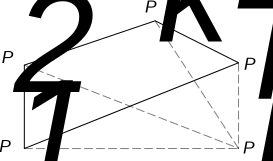
`text{Let}\ ktext{-sided polygon be defined by points}\ P_1,P_2,…,P_k`
`text{Let}\ (k+1)text{-sided polygon be defined by points}\ P_1,P_2,…,P_k,P_(k+1)`
`=>\ text{The extra point adds}\ (k-1)\ text{diagonals}`
| `D_(k+1)` | `=D_k+(k-1)` | |
| `=(k(k-3))/2+ (k-1)` | ||
| `=(k^2-3k+2k-2)/2` | ||
| `=(k^2-k-2)/2` | ||
| `=((k+1)(k-2))/2` | ||
| `=\ text{RHS}` |
`:.\ text{True for}\ \ n=k+1`
`:.\ text{Since true for}\ n=4,\ text{by PMI, true for integers}\ n>=4.`
Using mathematical induction, prove that the sum of the internal angles of an `n`-sided polynomial is `180(n-2)°` for `n>=3`. (3 marks)
--- 10 WORK AREA LINES (style=lined) ---
`text{See Worked Solutions}`
`text{Let}\ \ S_n=\ text{sum of interior angles of}\ n text{-sided polygon}`
`text{Prove true for}\ \ n=3:`
`S_3= 180°\ \ text{(sum of internal angles of a Δ)}`
`180(3-2) = 180°`
`:.\ text{True for}\ \ n=3.`
`text{Assume true for}\ \ n=k:`
`text{i.e.}\ S_k=(k-2)180°`
`text{Prove true for}\ \ n=k+1:`
`text{i.e.}\ S_(k+1)=(k+1-2)180°=(k-1)180°`
`text{Let}\ ktext{-sided polygon be defined by points}\ P_1,P_2,…,P_k`
`text{Let}\ (k+1)text{-sided polygon be defined by points}\ P_1,P_2,…,P_k,P_(k+1)`
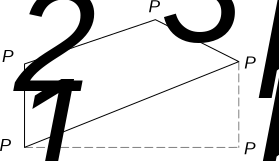
| `S_(k+1)` | `=S_k+\ text{angle sum}\ ΔP_1P_kP_(k+1)` | |
| `=(k-2)180° + 180°` | ||
| `=(k-1)180°` | ||
| `=\ text{RHS}` |
`:.\ text{True for}\ \ n=k+1`
`:.\ text{Since true for}\ n=3,\ text{by PMI, true for integers}\ n>=3.`
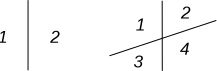
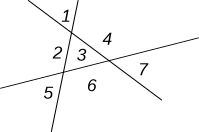
`n` lines are drawn in a 2-dimensional plane such that no three lines are concurrent and no two lines are parallel.
`S_n` is the number of regions into which these lines divide the plane with the diagram illustrating that `S_3=7`
--- 10 WORK AREA LINES (style=lined) ---
--- 8 WORK AREA LINES (style=lined) ---
--- 12 WORK AREA LINES (style=lined) ---
a. `text{See Worked Solutions}`
b. `S_n=(n^2+n+2)/2`
c. `text{See Worked Solutions}`
a. `S_1=2` `S_2=4`
`S_4=11`
b. `text{Consider the pattern above:}`
`S_1=2,\ \ S_2=S_1+2`
`S_3=S_2+3,\ …\ , S_n=S_(n-1)+n`
| `S_n` | `=S_(n-1)+n` | |
| `=S_(n-2)+(n-1)+n` | ||
| `=S_(n-3)+(n-2)+(n-1)+n` | ||
| `vdots` | ||
| `=S_1+(2+3+…+(n-1)+n)` | ||
| `=S_0+(1+2+…+(n-1)+n)` | ||
| `=1+(1+2+…+(n-1)+n)` |
`=>text{AP where}\ \ a=1, l=n, n=n`
| `S_n` | `=1+n/2(1+n)` | |
| `=(2+n(n+1))/2` | ||
| `=(n^2+n+2)/2` |
c. `text{Prove}\ \ S_n=(n^2+n+2)/2\ \ text{for}\ \ n>=0`
`text{If}\ \ n=1`
`text{LHS}\ =S_1=2`
`text{RHS}\ = (1^2+1+2)/2=2=\ text{LHS}`
`:.\ text{True for}\ n=1.`
`text{Assume true for}\ \ n=k:`
`text{i.e.}\ S_k=(k^2+k+2)/2`
`text{Prove true for}\ \ n=k+1:`
`text{i.e.}\ S_(k+1)=((k+1)^2+(k+1)+2)/2=(k^2+3k+4)/2`
`text{Consider the line}\ d_4\ text{added below that crosses 3 existing lines}`
`text{and creates 4 new regions.}`
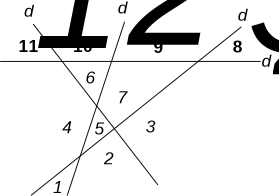
`text{Similarly, the line}\ d_(k+1)\ text{will cross}\ k\ text{existing lines and}`
`text{create}\ (k+1)\ text{new regions.}`
| `S_(k+1)` | `=S_k+k+1` | |
| `=(k^2+k+2)/2+k+1` | ||
| `=(k^2+k+2+2k+2)/2` | ||
| `=(k^2+3k+4)/2` | ||
| `=\ text{RHS}` |
`:.\ text{True for}\ \ n=k+1`
`:.\ text{Since true for}\ n=1,\ text{by PMI, true for integers}\ n>=1`
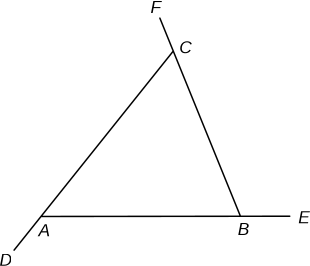
Using mathematical induction, prove that the sum of the external angles of an `n`-sided plane convex polygon equals 360° for `n>=3`. (4 marks)
`text{See Worked Solutions}`
`text{Prove true for}\ \ n=3:`
`text{Let}\ \ S_3=\ text{sum of exterior angles for a 3-sided polynomial (triangle)}`
`S_3=angleACF+angleCBE+angleBAD`
`angleACF+angleACB=180°\ \ (angleFCB\ text{is a straight angle})`
`angleCBE+angleCBA=180°\ \ (angleABE\ text{is a straight angle})`
`angleBAD+angleBAC=180°\ \ (angleDAC\ text{is a straight angle})`
`angleACF+angleACB+angleCBE+angleCBA+angleBAD+angleBAC=540°`
`text{Internal angle sum of}\ ΔABC=180°:`
| `angleACF+angleCBE+angleBAD+180°` | `=540°` | |
| `angleACF+angleCBE+angleBAD` | `=360°` |
`:.\ text{True for}\ \ n=3`
`text{Assume true for}\ \ n=k`
`text{i.e.}\ \ S_k=360°`
`text{Prove true for}\ \ n=k+1:`
`text{i.e.}\ \ S_(k+1)=360°`
`text{Let}\ ktext{-sided polygon be defined by points}\ P_1,P_2,…,P_k`
`text{Let}\ (k+1)text{-sided polygon be defined by points}\ P_1,P_2,…,P_k,P_(k+1)`
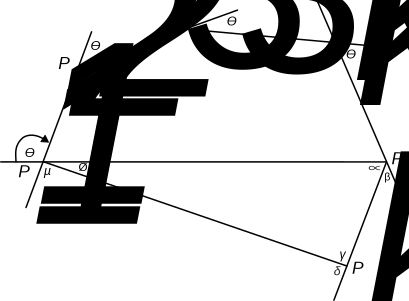
| `S_k` | `=theta_1+theta_2+ … +theta_(k-1)+theta_k` | |
| `=theta_1+theta_2+ … +theta_(k-1)+alpha+beta` |
`S_(k+1)=mu+theta_2+ … +theta_(k-1)+beta+delta`
`theta_1=mu+phi\ \ text{(vertically opposite)}`
`=>\ \ mu=theta_1-phi\ …\ (1)`
`delta=alpha+phi\ …\ (2)\ \ text{(exterior angle of triangle)}`
`text{Substitute (1) and (2) into}\ S_(k+1):`
| `S_(k+1)` | `=theta_1-phi+theta_2+ … +theta_(k-1)+beta+alpha+phi` | |
| `=theta_1+theta_2+ … +theta_(k-1)+alpha+beta` | ||
| `=S_k` |
`:.\ text{True for}\ \ n=k+1`
`:.\ text{Since true for}\ n=3,\ text{true for integers}\ n>=3.`
Let `J_(n)=int_(0)^(1)x^(n)e^(-x)\ dx`, where "n" is a non-negative integer.
--- 2 WORK AREA LINES (style=lined) ---
--- 3 WORK AREA LINES (style=lined) ---
--- 4 WORK AREA LINES (style=lined) ---
--- 6 WORK AREA LINES (style=lined) ---
--- 5 WORK AREA LINES (style=lined) ---
| i. | `J_0` | `=int_0^1 e^(-x)\ dx` |
| `=[-e^(-x)]_0^1` | ||
| `=-e^(-1)+1` | ||
| `=1-1/e` |
ii. `text{Show}\ \ J_n<=1/(n+1)`
`text{Note:}\ e^(-x)<1\ \ text{for}\ \ x in [0,1]`
| `J_n` | `=int_0^1 x^n e^(-x)\ dx` | |
| `leq int_0^1 x^n \ dx` | ||
| `leq 1/(n+1)[x^(n+1)]_0^1` | ||
| `leq 1/(n+1)(1^(n+1)-0)` | ||
| `leq 1/(n+1)\ \ text{… as required}` |
iii. `text{Show}\ \ J_n=nJ_(n-1)-1/e`
| `u` | `=x^n` | `v′` | `=e^(-x)` |
| `u′` | `=nx^(n-1)` | `v` | `=-e^(-x)` |
| `J_n` | `=[-x^n * e^(-x)]_0^1-int_0^1 nx^(n-1)*-e^(-x)\ dx` | |
| `=(-1^n * e^(-1)+0^n e^0)+nint_0^1 x^(n-1)*e^(-x)\ dx` | ||
| `=nJ_(n-1)-1/e` |
iv. `text{Prove}\ \ J_(n)=n!-(n!)/(e)sum_(r=0)^(n)(1)/(r!)\ \ text{for}\ \ n >= 0`
`text{If}\ \ n=0:`
`text{LHS} = 1-1/e\ \ text{(see part (i))}`
`text{RHS} = 0!-0!/e (1/(0!)) = 1-1/e(1)=\ text{LHS}`
`:.\ text{True for}\ \ n=0.`
`text{Assume true for}\ \ n=k:`
`J_(k)=k!-(k!)/(e)sum_(r=0)^(k)(1)/(r!)`
`text{Prove true for}\ \ n=k+1:`
`text{i.e.}\ \ J_(k+1)=(k+1)!-((k+1!))/(e)sum_(r=0)^(k+1)(1)/(r!)`
| `J_(k+1)` | `=(k+1)J_k-1/e\ \ text{(using part (iii))}` | |
| `=(k+1)(k!-(k!)/(e)sum_(r=0)^(k)(1)/(r!))-1/e` | ||
| `=(k+1)!-((k+1)!)/(e)sum_(r=0)^(k)(1)/(r!)-1/e xx ((k+1)!)/((k+1)!)` | ||
| `=(k+1)!-((k+1)!)/e(\ sum_(\ r=0)^(k)(1)/(r!)+1/((k+1)!))` | ||
| `=(k+1)!-((k+1)!)/e(\ sum_(\ r=0)^(k+1)(1)/(r!))` |
`=>\ text{True for}\ \ n=k+1`
`:.\ text{S}text{ince true for}\ n=1,\ text{by PMI, true for integers}\ n>=1`
v. `0<=J_n<= 1/(n+1)\ \ \ text{(part (ii))}`
`lim_(n->oo) 1/(n+1)=0\ \ => \ lim_(n->oo) J_n=0`
`text{Using part (iv):}`
| `J_n/(n!)` | `=1-1/e sum_(r=0)^(n)(1)/(r!)` | |
| `1/e sum_(r=0)^(n)(1)/(r!)` | `=1-J_n/(n!)` | |
| `sum_(r=0)^(n)(1)/(r!)` | `=e-(eJ_n)/(n!)` | |
| `lim_(n->oo)(\ sum_(\ r=0)^(n)(1)/(r!))` | `=lim_(n->oo)(e-(eJ_n)/(n!))` | |
| `=e-0` | ||
| `=e` |
The numbers `a_(n)`, for integers `n >= 1`, are defined as
`{:[a_(1)=sqrt2],[a_(2)=sqrt(2+sqrt2)],[a_(3)=sqrt(2+sqrt(2+sqrt2)) \ text{, and so on.}]:}`
These numbers satisfy the relation `a_(n+1)^(2)=2+a_(n)`, for `n >= 1`. (Do NOT prove this)
Use mathematical induction to prove that `a_(n)=2cos\ pi/(2^(n+1))`, for all integers `n >= 1`. (4 marks)
`text{Proof (See Worked Solution)}`
`text{Prove}\ \ a_(n)=2cos(pi/(2^(n+1)))\ \ text{for}\ \ n >= 1`
`text{If}\ \ n=1:`
`a_1=2cos((pi)/(2^2))=2xx1/sqrt2=sqrt2`
`:.\ text{True for}\ n=1.`
`text{Assume true for}\ \ n=k:`
`a_(k)= =2cos(pi/(2^(k+1)))`
`text{Prove true for}\ \ n=k+1:`
`text{i.e.}\ \ a_(k+1)= 2cos(pi/(2^(k+2)))`
| `text{LHS}` | `=sqrt(2+a_k)` | |
| `=sqrt(2+2cos(pi/(2^(k+1)))` | ||
| `=sqrt(2+2 cos(2 xx (pi/(2^(k+2)))))\ \ \ text{(using}\ \ cos(2theta)=2cos^2theta-1text{)}` | ||
| `=sqrt(2+2(2cos^2(pi/(2^(k+2)))-1)` | ||
| `=sqrt(2+4cos^2(pi/(2^(k+2)))-2)` | ||
| `=sqrt(4cos^2(pi/(2^(k+2)))` | ||
| `=2cos(pi/(2^(k+2)))` | ||
| `=\ text{RHS}` |
Prove by mathematical induction that `sqrt{n!} > 2^n` , for integers `n ≥ 9`. (3 marks)
--- 8 WORK AREA LINES (style=lined) ---
`text{See Worked Solutions}`
`text{Prove} \ sqrt{n!} > 2^n \ text{for integers} \ n≥ 9`
`text{If} \ n = 9,`
`text(LHS) = sqrt{9!} = 602.39 …`
`text(RHS) = 2^9 = 512 < 602.39 …`
`:. \ text{True for} \ n = 1`
`text{Assume true for} \ n = k`
`text{i.e.} \ \ sqrt{k!} > 2^k`
`text{Prove true for} \ n = k +1`
`text{i.e.} \ \ sqrt{(k + 1)!} > 2^{k + 1}`
| `text(LHS)` | `= sqrt{(k + 1)!}` |
| `= sqrt{k!} sqrt{k + 1}` | |
| `> 2^k * sqrt{k + 1}` | |
| `> 2^k * 2 \ \ \ (k ≥ 9\ => \ sqrt{k + 1} > 2)` | |
| `> 2^{k + 1}` |
Prove by mathematical induction that, for `n ≥ 2`,
`frac{1}{2^2} + frac{1}{3^2} + ... + frac{1}{n^2} < frac{n - 1}{n}` (4 marks)
--- 10 WORK AREA LINES (style=lined) ---
`text{See Worked Solutions}`
`text{Prove} \ frac{1}{2^2} + frac{1}{3^2} + … + frac{1}{n^2} < frac{n – 1}{n}\ \ \ text(for)\ \ n>=2`
`text(If)\ \ n=2:`
`text{LHS} = frac{1}{2^2} = frac{1}{4}`
`text{RHS} = frac{2-1}{2} = frac{1}{2} > text{LHS}`
`therefore \ text{True for} \ \ n = 2`
`text{Assume true for} \ \ n =k`
`frac{1}{2^2} + frac{1}{3^2} + … + frac{1}{k^2} < frac{k – 1}{k}`
`text{Prove true for} \ \ n = k + 1`
`frac{1}{2^2} + frac{1}{3^2} + … + frac{1}{k^2} + frac{1}{(k + 1)^2}< frac{k}{k+1}`
| `text{LHS}` | `= frac{k – 1}{k} + frac{1}{(k + 1}^2}` |
| `= frac{(k – 1)(k + 1)^2 + k}{k (k + 1)^2}` | |
| `= frac{(k – 1)(k^2 + 2 k +1) + k}{k(k +1)^2}` | |
| `= frac{k^3 + 2k^2 + k – k^2 – 2k – 1 + k}{k(k + 1)^2}` | |
| `= frac{k^3 + k^2 -1}{k(k + 1)^2}` | |
| `= frac{k^2 (k + 1 – frac{1}{k^2})}{k(k + 1)^2}` | |
| `= frac{k}{k +1} xx frac{(k + 1 – frac{1}{k^2})}{k +1}` | |
| `< frac{k}{k +1} \ \ \ (text{since} \ frac{k + 1 – frac{1}{k^2}}{k +1} < 1 )` |
`=> \ text{True for} \ n = k + 1`
`therefore \ text{S}text{ince true for} \ n = 2, \ text{by PMI, true integral} \ n ≥ 2.`
--- 6 WORK AREA LINES (style=lined) ---
`sum_(r = 1)^n\ text(cosec)(2^r x) = cot x - cot(2^n x)`. (2 marks)
--- 8 WORK AREA LINES (style=lined) ---
i. `text(Show)\ \ cot x – cot 2x = text(cosec)\ 2x`
| `text(LHS)` | `= (cos x)/(sin x) – 1/(tan 2x)` |
| `= (cos x)/(sin x) – (1 – tan^2 x)/(2 tan x)` | |
| `= (cos x)/(sin x) – ((1 – (sin^2 x)/(cos^2 x))/(2 (sin x)/(cos x)))` | |
| `= (cos x)/(sin x) – ((cos^2 x – sin^2 x)/(2 sin x cos x))` | |
| `= (2 cos^2 x – cos^2 x + sin^2 x)/(2 sin x cos x)` | |
| `= 1/(sin 2x)` | |
| `= text(cosec)\ 2x` | |
| `= text(RHS)` |
ii. `text(Prove)\ \ sum_(r = 1)^n\ text(cosec)(2^rx) = cot x – cot 2^n x\ \ text(for)\ \ n >= 1`
`text(Show true for)\ \ n = 1:`
`text(LHS) = text(cosec)(2x)`
`text(RHS) = cot x – cot 2x = text(cosec)(2x)\ \ text{(using part (i))}`
`:.\ text(True for)\ \ n = 1`
`text(Assume true for)\ \ n = k:`
`text(cosec)\ 2x + text(cosec)\ 4x + … + text(cosec)\ 2^rx = cot x – cot 2^r x`
`text(Prove true for)\ \ n = k + 1:`
`text(i.e. cosec)\ 2x + … + text(cosec)\ 2^r x + text(cosec)\ 2^(r + 1) x = cot x – cot 2^(r + 1) x`
| `text(LHS)` | `= cot x – cot 2^r x + text(cosec)\ 2^(r + 1) x` |
| `= cot x – cot 2^r x + text(cosec)\ (2.2^r x)` | |
| `= cot x – cot 2^r x + cot 2^r x – cot 2^(r + 1) x` | |
| `= cot x – cot 2^(r + 1) x` | |
| `= text(RHS)` |
`:.\ text(True for)\ \ n=k+1`
`:.\ text(S)text(ince true for)\ \ n=1, text(by PMI, true for integral)\ \ n>=1.`
Use mathematical induction to prove that
`n^5 + n^3 + 2n`
is divisible by 4 for integers `n >= 1.` (4 marks)
`text(See Worked Solutions)`
`text(If)\ n = 1,`
`1 + 1 + 2 xx 1 = 4\ \ text{(divisible by 4)}`
`:. text(True for)\ n = 1`
`text(Assume true for)\ n = k`
`text(i.e.)\ \ k^5 + k^3 + 2k = 4P\ \ …\ text{(1)}\ \ (text(where)\ P ∈\ text(integer))`
`text(Prove true for)\ n = k + 1`
`text(i.e.)\ \ (k + 1)^5 + (k + 1)^3 + 2(k + 1)\ \ text(is divisible by 4)`
`text(Expanding:)`
`k^5 + 5k^4 + 10k^3 + 10k^2 + 5k + 1 + k^3 + 3k^2 + 3k + 1 + 2k + 2`
`= k^5 + 5k^4 + 11k^3 + 13k^2 + 8k + 4`
`= 4P + 5k^4 + 10k^3 + 13k^2 + 8k + 4\ \ \ \ text{(see (1) above)}`
`= 4P + 4 underbrace{(k^4 + 2k^3 + 3k^2+2k + 1)}_(text(integer)\ Q) + k^4 + 2k^3 + k^2`
`= 4(P + Q) + k^2(k^2 + 2k + 1)`
`= 4(P + Q) + k^2(k + 1)^2`
`text(For any integer)\ \ k >= 2, \ k^2(k + 1)^2\ \ text{is (odd)}^2 xx text{(even)}^2`
`text{and (even)}^2 = (2R)^2\ \ text(where)\ \ R ∈\ text(integer)`
`=> k^2(k + 1)^2 = 4R^2 xx (text(odd))^2\ \ \ text{(divisible by 4)}`
`:. text(True for)\ \ n = k + 1`
`:. text(S)text(ince true for)\ \ n = 1,\ text(by PMI, true for integral)\ n >= 1.`
Use mathematical induction to prove that, for `n >= 1`,
`x^((3^n)) - 1 = (x - 1)(x^2 + x + 1)(x^6 + x^3 + 1) … (x^((2 xx 3^(n - 1))) + x^((3^(n - 1))) + 1)`. (3 marks)
--- 10 WORK AREA LINES (style=lined) ---
`text(See Worked Solutions)`
`text(If)\ \ n = 1`
`text(LHS) = x^3 – 1`
| `text(RHS)` | `=(x-1)(x^2+x+1)` | |
| `=x^3+x^2+x-x^2-x-1` | ||
| `=x^3-1 = text(LHS)` |
`:.\ text(True for)\ n = 1`
`text(Assume true for)\ \ n = k`
`x^(3^k) – 1 = (x – 1)(x^2 + x + 1) … (x^(2 xx 3^(k – 1)) + x^(3^(k – 1)) + 1)`
`text(Prove true for)\ \ n = k + 1`
`text(i.e.)\ \ \ x^(3^(k + 1)) = underbrace{(x – 1)(x^2 + x + 1) …(x^(2 xx 3^(k – 1)) + x^(3^(k – 1)) + 1)}_{x^(3^k) – 1) (x^(2 xx 3^k) + x^(3^k) + 1)`
| `x^(3^(k + 1)) – 1` | `= (x^(3^k) – 1)(x^(2 xx 3^k) + x^(3^k) + 1)` |
| `= x^(3 xx 3^k) + x^(2 xx 3^k) + x^(3^k) – x^(2 xx 3^k) – x^(3^k) – 1` | |
| `= x^(3^(k + 1)) – 1` |
`=>\ text(True for)\ \ n = k + 1`
`:.\ text(S)text(ince true for)\ \ n = 1,\ text(by PMI, true for integral)\ \ n >= 1.`
A 2 by `n` grid is made up of two rows of `n` square tiles, as shown.
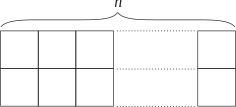
The tiles of the 2 by `n` grid are to be painted so that tiles sharing an edge are painted using different colours. There are `x` different colours available, where `x ≥ 2`.
It is NOT necessary to use all the colours.
Consider the case of the 2 by 2 grid with tiles labelled A, B, C and D, as shown.
There are `x(x - 1)` ways to choose colours for the first column containing tiles A and B. Do NOT prove this.
By considering these two cases, show that the number of ways of choosing colours for the second column is `x^2 - 3x +3`. (2 marks)
--- 6 WORK AREA LINES (style=lined) ---
--- 8 WORK AREA LINES (style=lined) ---
--- 6 WORK AREA LINES (style=lined) ---
| i. |
`text(If Colour)\ C =\ text(Colour)\ B:`
`text(Column 2 combinations)`
`= 1 xx (x – 1)`
`= x – 1`
`text(If Colour)\ C !=\ text(Colour)\ B:`
`text(Column 2 combinations)`
`= (x – 2)(x – 2)`
`:.\ text(Total number of ways for column 2)`
`= x – 1 + (x – 2)^2`
`= x^2 – 3x + 3\ \ …\ text(as required.)`
ii. `P(n) = x(x – 1)(x^2 – 3x + 3)^(n – 1)`
`text(If)\ \ n = 1\ \ (text(i.e. 1 column)),`
`text(Combinations) = x(x – 1)\ \ (text(given))`
| `P(1)` | `= x(x – 1)(x^2 – 3x + 3)^0` |
| `= x(x – 1)` |
`:. text(True for)\ n = 1`
`text(Assume true for)\ n = k:`
`text(i.e. Possible combinations for)\ k\ text(columns)`
`P(k) = x(x – 1)(x^2 – 3x + 3)^(k – 1)`
`text(Prove true for)\ \ n = k + 1`
`text(i.e.)\ \ P(k + 1) = x(x – 1)(x^2 – 3x + 3)^k`
`text(Consider a grid)\ 2 xx k\ text(and add an extra two)`
`text(tiles to make a)\ 2 xx (k + 1)\ text(grid.)`
`text(Total possible combinations)`
`= text(combinations of)\ (2 xx k)\ text(grid) xx (x^2 – 3x + 3)\ \ (text{from (i)})`
`= x(x – 1)(x^2 – 3x + 3)^(k – 1) xx (x^2 – 3x + 3)`
`= x(x – 1)(x^2 – 3x + 3)^k`
`=> text(True for)\ \ n = k + 1`
`:. text(S)text(ince true for)\ n = 1,\ text(by PMI, true for integral)\ n >= 1.`
iii. `text(If)\ \ n = 5, \ x = 3:`
`text{Total combinations (includes using only 2 colours)}`
| `P(5)` | `= 3(3 – 1)(3^2 – 3.3 + 3)^4` |
| `= 3(2)(3)^4` | |
| `= 486` |
`text(Consider pattern when only 2 colours used:)`
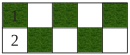
`text(Combinations that only use 2 colours)`
`=\ text(Colours in box 1 × possible colours in box 2)`
`= 3 xx 2`
`= 6`
`:.\ text(Combinations if each colour used at least once)`
| `= 486 – 6` |
| `= 480` |
In a group of `n` people, each has one hat, giving a total of `n` different hats. They place their hats on a table. Later, each person picks up a hat, not necessarily their own.
A situation in which none of the `n` people picks up their own hat is called a derangement.
Let `D(n)` be the number of possible derangements.
Show that, for `n > 2`, the number of such derangements is `(n - 1) D (n - 2).` (1 mark)
--- 4 WORK AREA LINES (style=lined) ---
--- 6 WORK AREA LINES (style=lined) ---
--- 2 WORK AREA LINES (style=lined) ---
--- 5 WORK AREA LINES (style=lined) ---
--- 8 WORK AREA LINES (style=lined) ---
i. `text(See Worked Solutions)`
ii. `text(See Worked Solutions)`
iii. `text(See Worked Solutions)`
iv. `text(See Worked Solutions)`
v. `text(See Worked Solutions)`
i. `text(Tom and one other person can have each)`
`text(other’s hat in)\ (n – 1)\ text(combinations.)`
`text(There are)\ \ D(n – 2)\ \ text(possibilities for the)`
`text(rest of the people selecting the wrong hats.)`
`:. text(Number of derangements) = (n – 1)D(n – 2)`
ii. `text(Consider all possible derangements:)`
`text(Any of)\ n\ text(people choose the wrong hat.)`
`text(Remainder)\ (n – 1)\ text(people can select the)`
`text(wrong hat in)\ D(n – 1)\ text(ways.)`
`:. nD(n – 1)\ text(derangements.)`
`text{This includes part (i) combinations.}`
`:.\ text(Remaining possible derangements)`
`= nD(n – 1) – (n – 1)D(n – 2)`
`= nD(n – 1) – D(n – 1)`
`= (n – 1)D(n – 1)`
| `:. D(n)` | `= (n – 1)D(n – 1) + (n – 1)D(n – 2)` |
| `= (n – 1)[D(n – 1) + D(n – 2)]` |
| iii. | `D(n)` | `= (n – 1)[D(n – 1) + D(n – 2)]` |
| `= nD(n – 1) – D(n – 1) + (n – 1)D(n – 2)` |
`:. Dn – nD(n – 1) = −[D(n – 1) – (n – 1)D(n – 2)]`
iv. `D(1) = 0, D(2) = 1`
`D(2) – 2D(1) = 1`
`D(3) – 3D(2) = −[D(2) – 2D(1)] = −1`
`D(4) – 4D(3) = −[D(3) – 3D(2)] = −(−1) = 1`
`D(5) – 5D(4) = −[D(4) – 4D(3)] = −1`
`:. D(n) – nD(n – 1) = (−1)^n\ text(for)\ n > 1`
v. `text(Prove)\ D(n) = n! sum_(r = 0)^n ((−1)^r)/(r!)\ text(for)\ n >= 1`
`text(When)\ n = 1,`
`D(1) = 1! sum_(r = 0)^1 ((−1)^r)/(r!) = 1 – 1 = 0`
`text(S)text(ince)\ D(1) = 0\ (text(given)),`
`:.\ text(True for)\ n = 1`
`text(Assume true for)\ \ n = k,`
`text(i.e.)\ \ D(k) = k! sum_(r = 0)^k ((−1)^r)/(r!)`
`text(Prove true for)\ \ n=k+1,`
`text(i.e.)\ \ D(k+1) = (k+1)!sum_(r = 0)^(k+1) ((−1)^r)/(r!)`
`D(k+1)`
| `= (k + 1)D(k) + (−1)^(k + 1)qquad(text{from part (iv)})` |
| `= (k + 1) · k! sum_(r = 0)^k ((−1)^r)/(r!) + (−1)^(k + 1)` |
| `= (k + 1)!(1 – 1/(1!) + 1/(2!) – 1/(3!) + … + ((−1)^k)/(k!)) + (−1)^(k + 1) · ((k + 1)!)/((k + 1)!)` |
| `= (k + 1)!(1 – 1/(1!) + 1/(2!) – 1/(3!) + … + ((−1)^k)/(k!) + ((−1)^(k+1))/((k+1)!))` |
| `= (k + 1)! sum_(r = 0)^(k + 1) ((−1)^r)/(r!)` |
`=> text(True for)\ n = k + 1.`
`:. text(S)text(ince true for)\ \ n = 1,\ text(by PMI, true for integral)\ n >= 1.`
The sequence `{x_n}` is given by
`x_1 = 1` and `x_(n + 1) = (4 + x_n)/(1 + x_n)` for `n >= 1.`
--- 10 WORK AREA LINES (style=lined) ---
--- 2 WORK AREA LINES (style=lined) ---
a. `text(Proof)\ \ text{(See Worked Solutions)}`
b. `2`
a. `text(If)\ \ n = 1`
`x_1=2 ((1 – 1/3)/(1 + 1/3))=(2 xx 2/3)/(4/3)=1`
`:.text(True for)\ \ n = 1`
`text(Assume true for)\ \ n=k,`
`text(i.e.)\ \ \ \ x_k = 2 ((1 + alpha^k)/(1 – alpha^k))`
`text(Prove true for)\ \ n=k+1`
`text(i.e.)\ \ \ \ x_(k + 1) = 2 ((1 + alpha^(k + 1))/(1 – alpha^(k+1)))`
| `x_(k + 1) =` | `(4 + x_k)/(1 + x_k)` |
| `=` | `(4 + 2 ((1 + alpha^k)/(1 – alpha^k)))/(1 + 2((1 + alpha^k)/(1 – alpha^k)))` |
| `=` | `2 [(2(1 – alpha^k) + (1 + alpha^k))/(1 – alpha^k + 2 (1 + alpha^k))]` |
| `=` | `2 [(2 – 2 alpha^k + 1 + alpha^k)/(1 – alpha^k + 2 + 2 alpha^k)]` |
| `=` | `2 [(3 – alpha^k)/(3 + alpha^k)]` |
| `=` | `2 [(1 – alpha^k xx 1/3)/(1 + alpha^k xx 1/3)]` |
| `=` | `2 [(1 + alpha^k xx alpha)/(1 – alpha^k xx alpha)],\ \ \ \ (alpha=-1/3)` |
| `=` | `2 [(1 + alpha^(k + 1))/(1 – alpha^(k + 1))]` |
| `=` | `text(RHS)` |
`:.text(True for)\ \ n = k + 1\ \ text(if it is true for)\ \ n = k.`
`:.text(S)text(ince true for)\ \ n=1, text(by PMI, true for all integral)\ \ n >= 1.`
b. `text(S)text(ince)\ \ lim_(n -> oo) (-1/3)^n=0`
| `:.lim_(n -> oo) x_n` | `=2 ((1 + (-1/3)^n)/(1 – (-1/3)^n))` |
| `=2` |
--- 3 WORK AREA LINES (style=lined) ---
--- 6 WORK AREA LINES (style=lined) ---
--- 12 WORK AREA LINES (style=lined) ---
--- 5 WORK AREA LINES (style=lined) ---
a. `text(Proof)\ \ text{(See Worked Solutions)}`
b. `text(Proof)\ \ text{(See Worked Solutions)}`
c. `text(Proof)\ \ text{(See Worked Solutions)}`
d. `4`
a. `text(Let)\ \ a = 1,\ \ b = 1`
| `2^n` | `= 1 + ((n), (1)) + ((n), (2)) + … + ((n), (n))` |
| `:. 2^n` | `> ((n), (2))\ \ \ \ text(for)\ n>=2` |
| b. | `((n), (2))` | `= (n(n-1))/(2 xx 1)` |
| `:.2^n` | `>(n(n-1))/(2 xx 1),\ \ \ \ \ text{(part (i))}` | |
| `1/2^n` | `<2/(n (n-1))` | |
| `2/2^n` | `<4/(n (n-1))` | |
| `1/2^(n-1) ` | `<4/(n (n-1))` | |
| `:.(n + 2)/2^(n-1)` | `< (4n + 8)/(n (n-1)),\ \ \ \ \ (n+2>0)` |
c. `text(If)\ n = 1:`
`text(LHS) = 1`
`text(RHS) = 4-(1+2)/2^0 = 1 = text(LHS)`
`:.\ text(True for)\ \ n = 1`
`text(Assume result is true for)\ \ n = k:`
`1 + 2 (1/2) + 3 (1/2)^2 + … + k (1/2)^(k-1) = 4-(k + 2)/2^(k-1).`
`text(Prove result is true for)\ \ n = k + 1:`
`1 + 2 (1/2) + … + k (1/2)^(k-1) + (k + 1) (1/2)^k = 4-(k + 3)/2^k`
| `text(LHS)` | `=1 + 2 (1/2) + … + k (1/2)^(k-1) + (k + 1) (1/2)^k` |
| `=4-(k + 2)/2^(k-1) + (k + 1)/2^k` | |
| `=4-(2k + 4-k-1)/2^k` | |
| `=4-(k + 3)/2^k` | |
| `=\ text(RHS)` |
`=>text(True for)\ \ n = k + 1\ \ text(if it is true for)\ \ n = k.`
`:.\ text(S)text(ince true for)\ \ n = 1, text(by PMI, true for integers)\ \ n>=1`
d. `lim_(n -> oo) (4-(n + 2)/2^(n-1))=4-lim_(n -> oo) ((n + 2)/2^(n-1))`
`text{Using part (b):}`
| `(n + 2)/2^(n-1)` | `< (4n + 8)/(n (n-1))` |
| `lim_(n -> oo) ((4n + 8)/(n (n-1)))` | `= 0` |
| `:. lim_(n -> oo) ((n + 2)/2^(n-1)) ` | `= 0` |
`:.lim_(n -> oo) (4-(n + 2)/2^(n-1)) = 4-0 = 4`
--- 5 WORK AREA LINES (style=lined) ---
--- 8 WORK AREA LINES (style=lined) ---
--- 6 WORK AREA LINES (style=lined) ---
`qquad tan\ pi/4 + 1/2 tan\ pi/8 + 1/4 tan\ pi/16 + ….` (2 marks)
--- 4 WORK AREA LINES (style=lined) ---
a. `text(Proof)\ \ text{(See Worked Solutions)}`
b. `text(Proof)\ \ text{(See Worked Solutions)}`
c. `text(Proof)\ \ text{(See Worked Solutions)}`
d. `4/pi`
a. `t=tan\ theta/2, \ \ \ sin theta=(2t)/(1+t^2),\ \ \ cos theta=(1-t^2)/(1+t^2)`
`text(Prove)\ \ cot theta + 1/2 tan\ theta/2 = 1/2 cot\ theta/2`
| `text(LHS)` | `=cot theta + 1/2 tan\ theta/2` |
| `=cos theta/sin theta+ 1/2 tan\ theta/2` | |
| `=(1-t^2)/(2t)+t/2` | |
| `=(1-t^2+t^2)/(2t)` | |
| `=1/(2t)` | |
| `=1/2 cot\ theta/2` | |
| `=\ text(RHS)` |
b. `text(If)\ \ n = 1`
| `text(LHS)` | `=1/2^0 tan\ x/2^1=tan\ x/2` |
| `text(RHS)` | `=1/2^0 cot\ x/2 – 2 cot x` |
| `=cot\ x/2 – 2 cot x` |
| `text{Using part (i)},\ \ 1/2 tan\ theta/2` | `= 1/2 cot\ theta/2 – cot theta,` |
| `:.tan\ theta/2` | `= cot\ theta/2 – 2 cot theta` |
| `text(RHS)` | `=tan\ x/2` |
| `=\ text(LHS)` | |
| `:.\ text(True for)\ \ n=1` | |
`text(Assume true for)\ \ n = k`
`text(i.e.)\ \ sum_(r = 1)^k 1/2^(r – 1) tan\ x/2^r = 1/2^(k – 1) cot\ x/2^k – 2 cot x.`
`text(Prove the result true for)\ \ n = k+1`
`text(i.e.)\ \sum_(r = 1)^(k + 1) 1/2^(r – 1) tan x/2^r = 1/2^k cot x/2^(k + 1) – 2 cot x`
| `text(LHS)` | `=sum_(r = 1)^(k) 1/2^(r – 1) tan x/2^r + 1/2^k tan x/2^(k + 1)` |
| `=1/2^(k – 1) cot x/2^k – 2 cot x + 1/2^k tan x/2^(k + 1)` | |
| `=1/2^(k – 1) (cot x/2^k + 1/2 tan x/2^(k +1)) – 2 cot x,\ \ \ \ text{(Let}\ \ theta=x/2^ktext{)}` | |
| `=1/2^(k – 1)(cot\ theta + 1/2 tan\ theta/2) – 2 cot x` | |
| `=1/2^(k – 1)(1/2 cot\ theta/2) – 2 cot x,\ \ \ \ text{(from part (i))}` | |
| `=1/2^k cot\ theta/2 – 2 cot x` | |
| `=1/2^k cot x/2^(k + 1) – 2 cot x` | |
| `=\ text(RHS)` |
`=>text(True for)\ \ n = k + 1\ \ text(if it is true for)\ \ n = k.`
`:.text(S)text(ince true for)\ \ n = 1,\ text(by PMI, true for integral)\ \ n >= 1.`
c. `lim_(n -> oo) sum_(r = 1)^n 1/2^(r – 1) tan x/2^r `
`=lim_(n -> oo) (1/2^(n-1) cot x/2^n – 2 cot x)`
`=lim_(n -> oo) (2/x * x/2^n * 1/(tan x/2^n) – 2 cot x)`
`=2/x xx lim_(n -> oo) ((x/2^n)/(tan x/2^n)) – 2 cot x`
`=>text(As)\ \ n -> oo,\ \ x/2^n=theta->0, and`
`=>lim_(theta-> 0) (theta)/(tan theta) =1`
`:.lim_(n -> oo) sum_(r = 1)^n 1/2^(r – 1) tan x/2^r =2/x – 2 cot x`
d. `tan\ pi/4 + 1/2 tan\ pi/8 + 1/4 tan\ pi/16 + …`
`=lim_(n -> oo) sum_(r = 1)^n 1/2^(r – 1) tan (pi/2)/2^r`
`=(2/(pi/2)) – 2 cot pi/2`
`=4/pi`
A sequence `a_n` is defined by
`a_n = 2a_(n − 1) + a_(n − 2)`,
for `n ≥ 2`, with `a_0 = a_1 = 2`.
Use mathematical induction to prove that
`a_n = (1 + sqrt2)^n + (1 − sqrt2)^n` for all `n ≥ 0`. (3 marks)
--- 10 WORK AREA LINES (style=lined) ---
`text{Proof (See Worked Solutions)}`
`text(Prove)\ \ a_n = (1 + sqrt2)^n + (1 − sqrt2)^n\ text(for all)\ n ≥ 0.`
`text(where)\ a_0 = a_1 = 2, and \ a_n = 2a_(n − 1) + a_(n − 2)\ \ text(for)\ \ n ≥ 2,\ `
| `text(When)\ \ n=0,` | `a_0` | `= (1 + sqrt2)^0 + (1 − sqrt2)^0` |
| `= 1 + 1=2` | ||
| `text(When)\ \ n=1,` | `a_1` | `= (1 + sqrt2)^1 + (1 − sqrt2)^1` |
| `= 1 + sqrt2 + 1 − sqrt2=2` |
`:.\ text(True for)\ n=0\ \ and\ n=1`
`text(Assume that)`
`a_k = (1 + sqrt2)^k + (1 − sqrt2)^k\ text(and)`
`a_(k − 1) = (1 + sqrt2)^(k − 1) + (1 − sqrt2)^(k − 1)\ text(for all)\ k ≥ 1.`
`text(Prove true for)\ \ n = k + 1`
`text(i.e.)\ \ a_(k + 1) = (1 + sqrt2)^(k + 1) + (1 − sqrt2)^(k + 1).`
| `a_(k + 1)` | `= 2a_k + a_(k − 1).` |
| `= 2(1 + sqrt2)^k + 2(1 − sqrt2)^k + (1 + sqrt2)^(k − 1) + (1 − sqrt2)^(k − 1)` | |
| `= (1 + sqrt2)^(k − 1)(2 + 2sqrt2 + 1) + (1 − sqrt2)^(k − 1)(2 − 2sqrt2 + 1)` | |
| `= (1 + sqrt2)^(k − 1)(1 + sqrt2)^2 + (1 − sqrt2)^(k − 1)(1− sqrt2)^2` | |
| `= (1 + sqrt2)^(k + 1) + (1 − sqrt2)^(k + 1)` |
`=>\ text(True for)\ \ n = k + 1\ \ text(if it is true for)\ \ n = k\ \ text(and)\ \ n = k − 1.`
`:.\ text(S)text(ince true for)\ n = 0 and n=1,\ text(by PMI, it is)`
`text(true for integral)\ n ≥ 0.`
Use mathematical induction to prove that `(2n)! >= 2^n (n!)^2` for all positive integers `n`. (3 marks)
--- 8 WORK AREA LINES (style=lined) ---
`text(Proof)\ \ text{(See Worked Solutions)}`
`text(If)\ \ n=1,`
`text(LHS) = 2! = 2`
`text(RHS) = 2 xx (1!)^2 = 2 = text(LHS)`
`text(Assume true for)\ \ n = k,`
`text(i.e.)\ \ (2k)! >= 2^k (k!)^2\ \ \ …\ text{(i)}`
`text(Prove true for)\ \ n = k +1,`
`text(i.e.)\ \ (2(k +1))! >= 2^(k + 1) ((k +1)!)^2`
| `text(LHS)` | `= (2 (k + 1))!` |
| `= (2k + 2)(2k +1) xx underbrace{(2k)!}_text{using part (i)}` | |
| `>= (2k + 2) (2k +1) xx 2^k (k!)^2` | |
| `>= 2(k + 1) (2k + 1) xx 2^k (k!)^2` | |
| `>=2^(k+1) (k+1)(k+1) (k!)^2,\ \ \ \ \ (2k+1)>(k+1),\ text(for)\ k>0` | |
| `>= 2^(k + 1) ((k + 1)!)^2` |
`=>\ text(True for)\ \ n = k + 1`
`:.\ text(S)text(ince true for)\ \ n = 1,\ text(by PMI, true for integral)\ n>=1.`
--- 3 WORK AREA LINES (style=lined) ---
--- 10 WORK AREA LINES (style=lined) ---
--- 3 WORK AREA LINES (style=lined) ---
a. `text{Proof (See Worked Solutions.)}`
b. `text{Proof (See Worked Solutions.)}`
c. `pi/4`
a. `text(Let)\ \ A=tan^(-1)\ x, and B=tan^(-1)y`
`=> tan\ A=x, and tan\ B=y`
| `tan\ (A+B)` | `=(tan A + tan B)/(1-tanAtanB)` |
| `=(x+y)/(1-xy)` | |
| `:. A+B` | `= tan^(-1)\ ((x+y)/(1-xy))\ \ \ text(… as required)` |
b. `sum_(j = 1)^n\ tan^(-1)\ (1/(2j^2)) = tan^(-1)\ (n/(n + 1))`
`text(If)\ \ j=1`
| `text(LHS)` | `=tan^(-1)\ (1/2)` |
| `text(RHS)` | `=tan^(-1)\ (1/(1 + 1))` |
| `=tan^(-1)\ (1/2)` | |
| `=\ text(LHS)` |
`=>\ text(True for)\ \ j = 1.`
`text(Assume true)`
`sum_(j = 1)^n\ tan^(-1)\ (1/(2j^2)) = tan^(-1)\ (n/(n + 1))`
`text(Need to prove)`
`sum_(j = 1)^(n + 1)\ tan^(-1)\ (1/(2j^2)) = tan^(-1)\ ((n + 1)/(n + 2))`
| `text(LHS)` | `=sum_(j = 1)^(n + 1)\ tan^(-1)\ (1/(2j^2))` |
| `=tan^(-1)\ (n/(n + 1)) + tan^(-1)\ (1/(2(n + 1)^2))` | |
| `=tan^(-1)\ ((n/(n + 1) + 1/(2(n + 1)^2))/(1 − n/(n + 1) xx 1/(2(n + 1)^2))),\ \ \ text{(using part (i))}` | |
| `=tan^(-1)\ ((2n(n + 1)^2 + n + 1)/(2(n + 1)^3 − n))` | |
| `=tan^(-1)\ (((n + 1)(2n^2 + 2n + 1))/(2(n + 1)^3 − n))` | |
| `=tan^(-1)\ (((n + 1)(2n^2 + 2n + 1))/(2n^3 + 6n^2 + 6n + 2 − n))` | |
| `=tan^(-1)\ (((n + 1)(2n^2 + 2n + 1))/(2n^3 + 6n^2 + 5n + 2))` | |
| `=tan^(-1)\ (((n + 1)(2n^2 + 2n + 1))/((n + 2)(2n^2 + 2n + 1)))` | |
| `=tan^(-1)\ ((n + 1)/(n + 2))` | |
| `=\ text(RHS)` |
`=> text(True for)\ \ j=n+1`
`:.text(S)text(ince true for)\ \ j = 1,\ text(by PMI, true for integral)\ \ j>=1`
| c. | `lim_(n → ∞) sum_(j = 1)^n\ tan^(-1)\ (1/(2j^2))` | `= lim_(n → ∞)\ tan^(-1)\ (n/(n + 1))` |
| `= lim_(n → ∞)\ tan^(-1)\ (1/(1 + 1/n))` | ||
| `= tan^(-1)\ 1` | ||
| ` = pi/4` |
Let `z_2 = 1 + i` and, for `n > 2`, let `z_n = z_(n - 1) (1 + i/(|\ z_(n - 1)\ |)).`
Use mathematical induction to prove that `|\ z_n\ | = sqrt n` for all integers `n >= 2.` (3 marks)
--- 8 WORK AREA LINES (style=lined) ---
`text(Proof)\ \ text{(See Worked Solutions)}`
`text(Prove)\ \ |\ z_n\ | = sqrt n\ \ \ text(for)\ n>=2`
`text(given)\ \ z_n = z_(n – 1) (1 + i/(|\ z_(n – 1)\ |))`
`text(If)\ \ n=2`
` z_2 = 1 + i`
`|\ z_2\ | = sqrt (1 + 1) = sqrt 2`
`:.text(True for)\ \ n = 2`
`text(Assume that)\ \ |\ z_k\ | = sqrt k\ \ text(and prove that)\ \ |\ z_(k + 1)\ | = sqrt (k + 1)`
| `z_k` | `= z_(k – 1) (1 + i/(|\ z_(k – 1)\ |))` |
| `=> z_(k + 1) ` | `= z_k (1 + i/(|\ z_k\ |))` |
| `|\ z_(k + 1)\ |` | `= |\ z_k (1 + i/(|\ z_k\ |))\ |` |
| `=|\ z_k\ |*|\ (1 + i/sqrt k)\ |` | |
| `= sqrt k * sqrt((1^2+(1/sqrt k)^2))` | |
| `=sqrt k * sqrt((1+1/k))` | |
| `= sqrt k * sqrt((k+1)/k)` | |
| `= sqrt k * sqrt(k+1)/sqrt k` | |
| `=sqrt(k+1)` |
`=>text(True for)\ \ n = k + 1`
`:. text(S)text(ince true for)\ \ n=2,\ \ text(by PMI, true for all integers)\ \ n >= 2.`
`1 + tan\ n theta\ tan (n + 1) theta = cot theta (tan (n + 1) theta-tan\ n theta).` (1 mark)
--- 5 WORK AREA LINES (style=lined) ---
`tan theta\ tan 2 theta + tan 2 theta\ tan 3 theta + … + tan\ n theta\ tan (n + 1) theta`
`=-(n + 1) + cot theta\ tan (n + 1) theta.` (3 marks)
--- 12 WORK AREA LINES (style=lined) ---
a. `text(Proof)\ \ text{(See Worked Solutions)}`
b. `text(Proof)\ \ text{(See Worked Solutions)}`
a. `text(Show)`
`1 + tan\ n theta\ tan ( n + 1) theta = cot theta\ (tan (n+1) theta-tan\ n theta)`
| `text(LHS)` | `= underbrace{1 + tan\ n theta\ tan ( n + 1) theta}_text{rearrange part (i) identity}` |
| `= (tan\ n theta-tan (n + 1) theta)/(tan (n theta-(n + 1) theta)` | |
| `= (tan\ n theta-tan (n + 1) theta)/(tan (-theta))` | |
| `=1/tan theta *-(tan\ n theta-tan (n + 1) theta)` | |
| `= cot theta (tan (n + 1) theta-tan\ n theta)` | |
| `=\ text(RHS … as required.)` |
b. `text(Prove)\ \ tan theta\ tan 2 theta + tan 2 theta\ tan 3 theta + … + tan\ n theta \ tan (n + 1) theta`
`= -(n + 1) + cot theta\ tan (n + 1) theta`
`text(If)\ \ n = 1:`
| `text(LHS)` | `= tan theta\ tan 2 theta` |
| `= cot theta (tan 2 theta-tan theta)-1\ \ \ text{(from (i))}` | |
| `= cot theta\ tan 2 theta-1-1` | |
| `= -2 + cot theta\ tan 2 theta` | |
| `text(RHS)` | `= -2 + cot theta\ tan 2 theta` |
`:.\ text(True for)\ \ n = 1`
`text(Assume true for)\ \ n = k:`
`text(i.e.)\ \ tan theta\ tan 2 theta + … + tan\ k theta\ tan (k + 1) theta`
`= -(k + 1) + cot theta\ tan (k + 1) theta`
`text(Prove true for)\ \ n = k + 1:`
`text(i.e.)\ \ tan theta\ tan 2 theta + … + tan\ k theta\ tan (k + 1) theta + tan (k + 1) theta\ tan (k + 2) theta`
`= -(k + 2) + cot theta\ tan (k + 2) theta`
| `text(LHS)` | `= -(k + 1) + cot theta\ tan(k + 1) theta + tan (k + 1) theta\ tan (k + 2) theta` |
| `= -(k + 1) + cot theta\ tan(k + 1) theta + cot theta[tan (k + 2) theta-tan (k + 1) theta]-1` | |
| `= -(k + 2) + cot theta\ tan(k + 1) theta + cot theta\ tan (k + 2) theta-cot theta\ tan (k + 1) theta` | |
| `= -(k + 2) + cot theta\ tan(k + 2) theta` | |
| `=\ text(RHS)` |
`=>\ text(True for)\ \ n = k + 1`
`:.\ text(S)text(ince true for)\ \ n = 1,\ \ text(true for integral)\ \ n >= 1`
Use the principle of mathematical induction to show that `4^n - 1 - 7n > 0` for all integers `n >= 2.` (3 marks)
--- 8 WORK AREA LINES (style=lined) ---
`text(Proof)\ \ text{(See Worked Solutions)}`
`text(Prove)\ \ 4^n – 1 – 7n > 0\ \ text(for)\ \ n >= 2`
`text(If)\ \ n = 2`
| `text(LHS)` | `= 4^2 – 1 – (7 xx 2)` |
| `= 16 – 1 – 14` | |
| `= 1 > 0` |
`:.\ text(True for)\ \ n = 2`
`text(Assume true for)\ \ n = k`
| `text(i.e.)\ \ 4^k – 1 – 7k` | `> 0` |
| `4^k` | `> 1 + 7k` |
`text(Prove true for)\ \ n = k + 1`
`text(i.e.)\ \ 4^(k + 1) – 1 – 7 (k + 1) > 0`
| `text(LHS)` | `= 4 (4^k) – 1 – 7k – 7` |
| `> 4 (1 + 7k) – 7k – 8` | |
| `> 4 + 28k – 7k -8` | |
| `> 21k – 4` | |
| `> 0\ \ \ \ (k >= 2)` |
`=>\ text(True for)\ \ n = k + 1`
`:.\ text(S)text(ince true for)\ \ n = 2, text(by PMI, true for integral)\ \ n >= 2.`
Prove by mathematical induction that `2^n > n^2` for integral `n > 4`. (3 marks)
--- 9 WORK AREA LINES (style=lined) ---
`text(Proof)\ \ text{(See Worked Solutions)}`
`text(Prove)\ \ 2^n > n^2\ \ text(for integral)\ \ n > 4`
`text(If)\ \ n = 5,`
| `text(LHS)` | `= 2^5 = 32` |
| `text(RHS)` | `= 5^2 = 25 < text(LHS)` |
`:.\ text(True for)\ n = 5`
`text(Assume true for)\ n = k:`
`text(i.e.)\ \ \ 2^k > k^2`
`text(Prove true for)\ n = k + 1`
| `text(i.e.)\ \ \ ` | `2^(k + 1)` | `> (k + 1)^2` |
| `2^(k + 1)` | `> k^2 + 2k + 1` |
| `text(LHS)` | `= 2^(k + 1)` |
| `= 2*2^k` | |
| `> 2k^2` | |
| `> k^2 + k^2` | |
| `> k^2 + 4k\ \ text{(} text(noting)\ k^2>4k,\ k>4 text{)}` | |
| `> k^2 + 2k + 8\ \ text{(} text(noting)\ 4k > 2k + 8,\ k > 4 text{)}` | |
| `> k^2 + 2k + 1` | |
| `> (k + 1)^2` |
`=>\ text(True for)\ n = k + 1`
`:.\ text(S)text(ince true for)\ \ n = 5, text(by PMI, true for integral)\ \ n > 4.`
Use mathematical induction to prove that
`sum_(r=1)^n r^3 = 1/4 n^2 (n + 1)^2`
`text(for integers)\ n>=1` (3 marks)
--- 10 WORK AREA LINES (style=lined) ---
`text(Proof)\ \ text{(See Worked Solutions)}`
`text(Need to prove)\ sum_(r=1)^n r^3 = 1/4 n^2 (n + 1)^2\ \ text(integral)\ n>=1 `
`text(i.e.)\ 1^3 + 2^3 + 3^3 + … + n^3 = 1/4 n^2 (n + 1)^2`
`text(When)\ n = 1`
`text(LHS) = 1^3 = 1`
`text(RHS) = 1/4 1^2 (1 + 1)^2 = 1`
`:.\ text(True for)\ n = 1`
`text(Assume true for)\ n = k`
`text(i.e.)\ 1^3 + 2^3 + … + k^3 = 1/4 k^2 (k + 1)^2`
`text(Need to prove true for)\ n = k + 1`
`1^3 + 2^3 + … + k^3 + (k + 1)^3 = 1/4 (k + 1)^2 (k + 2)^2`
| `text(LHS)` | `= 1/4 k^2 (k + 1)^2 + (k + 1)^3` |
| `= 1/4 (k + 1)^2 [k^2 + 4(k + 1)]` | |
| `= 1/4 (k + 1)^2 (k^2 + 4k + 4)` | |
| `= 1/4 (k + 1)^2 (k + 2)^2` | |
| `=\ text(RHS)` |
`=>text(True for)\ n = k + 1`
`:.text(S)text(ince true for)\ n = 1,\ text(true for integral)\ n >= 1`
--- 2 WORK AREA LINES (style=lined) ---
--- 8 WORK AREA LINES (style=lined) ---
a. `text{Proof (See Worked Solutions)}`
b. `text{Proof (See Worked Solutions)}`
a. `text(Prove)\ \ d/(dx)(x)=1\ \ text(from first principles.)`
| `d/(dx)(x)` | `=lim_(h->0) (f(x+h)-f(x))/h` |
| `=lim_(h->0)(x+h-x)/h` | |
| `=1\ \ \ text(… as required)` |
b. `text(Prove)\ \ d/(dx)(x^n)=nx^(n-1)\ \ text(for integers)\ n>=1`
`text(If)\ n=1,`
`text(LHS)=d/(dx)(x^1)=1`
`text(RHS)=(1)x^0=1=text(LHS)`
`:.\ text(True for)\ n=1`
`text(Assume true for)\ n=k`
`text(i.e.)\ \ d/(dx)(x^k)=kx^(k-1)`
`text(Prove true for)\ n=k+1`
`text(i.e.)\ \ d/(dx)x^(k+1)=(k+1)x^k`
| `text(LHS)` | `=d/(dx)(x^(k+1))` |
| `=d/(dx) (x*x^k)` | |
| `=d/(dx)(x) * x^k+x *d/(dx)(x^k)` | |
| `=(1xx x^k)+(x xxkx^(k-1))` | |
| `=x^k+kx^k` | |
| `=(k+1)x^k` | |
| `=\ text(RHS … as required)` |
`=>\ text(True for)\ n=k+1`
`:.\ text(S)text(ince it is true for)\ n=1, text(by PMI, true for integral)\ n>=1`.
--- 4 WORK AREA LINES (style=lined) ---
--- 8 WORK AREA LINES (style=lined) ---
a. `text{Proof (See Worked Solutions)}`
b. `text{Proof (See Worked Solution)}`
a. `text(Prove that for)\ k>0,\ \ 1/(k+1)^2-1/k+1/(k+1)<0`
| `text(LHS)` | `=(k-(k+1)^2+k(k+1))/(k(k+1)^2)` |
| `=(k-(k^2+2k+1)+k^2+k)/(k(k+1)^2)` | |
| `=(-1)/(k(k+1)^2)` |
`text(S)text(ince)\ \ k>0,\ text(we know)\ \ k(k+1)^2>0`
`:.\ (-1)/(k(k+1)^2)<0\ \ text(… as required)`
b. `text(Prove)\ \ 1/1^2+1/2^2+1/3^2+\ …\ +1/n^2<2-1/n\ \ text(for integer)\ \ n>=2`
`text(If)\ \ n=2:`
`text(LHS)=1/1^2+1/2^2=5/4`
`text(RHS)=2-1/2=3/2 > text(LHS)`
`:.\ text(True for)\ \ n=2`
`text(Assume true for)\ \ n=k:`
`text(i.e.)\ \ 1/1^2+1/2^2+\ …\ +1/k^2<2-1/k`
`text(Prove true for)\ \ n=k+1:`
`text(i.e.)\ 1/1^2+1/2^2+\ …\ +1/k^2+1/(k+1)^2<2-1/(k+1)`
| `text(LHS)` | `=1/1^2+1/2^2+\ …\ +1/k^2+1/(k+1)^2` |
| `<2-1/k+1/(k+1)^2` | |
| `< underbrace{(1/(k+1)^2-1/k+1/(k+1))}_text(<0 from part i)+2-1/(k+1)` | |
| `<2-1/(k+1)` |
`=> text(True for)\ n=k+1`
`:.\ text(S)text(ince it is true for)\ n=2, text(by PMI, true for integral)\ n>=2`.