SmarterEd

Aussie Maths & Science Teachers: Save your time with SmarterEd

  • Login
  • Get Help
  • About

Calculus, EXT2 C1 2025 HSC 14a

Let  \(\displaystyle I_n=\large{\int}_{\small{\dfrac{\pi}{4}}}^{\small{\dfrac{\pi}{2}}}\)\(\cot ^{2 n} \theta \, d \theta\)  for integers  \(n \geq 0\).

  1. Show that  \(I_n=\dfrac{1}{2 n-1}-I_{n-1}\) for \(n>0\),  given that  \(\dfrac{d}{d \theta} \cot \theta=-\operatorname{cosec}^2 \theta\).   (3 marks)

    --- 12 WORK AREA LINES (style=lined) ---

  2. Hence, or otherwise, calculate \(I_2\).   (1 mark)

    --- 5 WORK AREA LINES (style=lined) ---
Show Answers Only

i.    \(\text{See Worked Solutions}\)

ii.   \(\dfrac{\pi}{4}-\dfrac{2}{3}\)

Show Worked Solution

i.    \(\displaystyle I_n=\large{\int}_{\small{\dfrac{\pi}{4}}}^{\small{\dfrac{\pi}{2}}}\)\(\cot ^{2 n} \theta \, d \theta \ \ \Rightarrow \ \ \)\(I_{n-1}=\displaystyle \large{\int}_{\small{\dfrac{\pi}{4}}}^{\small{\dfrac{\pi}{2}}}\)\(\cot ^{2n-2} \theta \, d \theta\)

♦ Mean mark (i) 47%.

\(\text{Show} \ \ I_n=\dfrac{1}{2n-1}-I_{n-1} \ \ \text{for} \ \ n>0\)

\(\text{Given} \ \ \dfrac{d}{d \theta} \cot \theta=-\operatorname{cosec}^2 \theta\ \ldots\ (1)\)

\(I_n\) \(=\displaystyle \large{\int}_{\small{\dfrac{\pi}{4}}}^{\small{\dfrac{\pi}{2}}}\)\(\cot ^{2 n-2} \theta \cdot \cot ^2 \theta \, d \theta\)
  \(=\displaystyle \large{\int}_{\small{\dfrac{\pi}{4}}}^{\small{\dfrac{\pi}{2}}}\)\(\cot ^{2 n-2} \theta\left(\operatorname{cosec}^2 \theta-1\right) \, d \theta\)
  \(=\displaystyle \large{\int}_{\small{\dfrac{\pi}{4}}}^{\small{\dfrac{\pi}{2}}}\)\(\cot ^{2 n-2} \theta \cdot \operatorname{cosec}^2 \theta \, d \theta-\displaystyle \large{\int}_{\small{\dfrac{\pi}{4}}}^{\small{\dfrac{\pi}{2}}}\)\(\cot ^{2n-2} \theta \, d \theta\)
  \(=-\displaystyle \large{\int}_{\small{\dfrac{\pi}{4}}}^{\small{\dfrac{\pi}{2}}}\)\(\cot ^{2 n-2} \theta \cdot \dfrac{d}{d \theta}(\cot \theta) d \theta-I_{n-1}\)
  \(=-\left[\dfrac{\cot ^{2 n-1} \theta}{2 n-1}\right]_{\tfrac{\pi}{4}}^{\tfrac{\pi}{2}}-I_{n-1}\)
  \(=-\left[\dfrac{\cot ^{2 n-1} (\frac{\pi}{2})}{2 n-1}-\dfrac{\cot ^{2 n-1} (\frac{\pi}{4})}{2 n-1}\right]-I_{n-1}\)
  \(=-\left[0-\dfrac{1}{2 n-1}\right]-I_{n-1}\)
  \(=\dfrac{1}{2n-1}-I_{n-1}\)


ii.     \(I_2\) \(=\dfrac{1}{3}-I_1\)
    \(=\dfrac{1}{3}-\left[ \dfrac{1}{2-1}-\displaystyle \int_{\tfrac{\pi}{2}}^{\tfrac{\pi}{2}} 1 \, d\theta \right]\)
    \(=\dfrac{1}{3}-\left[1-\left(\dfrac{\pi}{2}-\dfrac{\pi}{4}\right)\right]\)
    \(=\dfrac{\pi}{4}-\dfrac{2}{3}\)

Filed Under: Recurrence Relations, Recurrence Relations Tagged With: Band 4, Band 5, smc-1054-10-Trig, smc-7436-10-Trig

Calculus, EXT2 C1 2024 HSC 15b

Let  \(I_n=\displaystyle\int_0^a x^{n+\frac{1}{2}}(a-x)^{\frac{1}{2}}\, d x\), where  \(n \geq 0\).

Show that \((2 n+4) I_n=a(2 n+1) I_{n-1}\), for  \(n>0\).   (3 marks)

--- 9 WORK AREA LINES (style=lined) ---

Show Answers Only

\(I_n=\displaystyle{\int}_0^a x^{n+\frac{1}{2}}(a-x)^{\frac{1}{2}}\,d x \ \ \text{where}\ \ n \geqslant 0\)

\(\text{Show}\ \ (2 n+4) I_n=a(2 n+1) I_{n-1}\ \ \text{for}\ \ n>0\)

\(I_n=\displaystyle{\int}_0^a x^{n+\frac{1}{2}}(a-x)^{\frac{1}{2}}\)

\(\text{Using integration by parts: }\)

\(\begin{array}{ll}u=x^{n+\frac{1}{2}} & v^{\prime}=(a-x)^{\frac{1}{2}} \\ u^{\prime}=\left(n+\frac{1}{2}\right) x^{n-\frac{1}{2}} & v=-\dfrac{2}{3}(a-x)^{\frac{3}{2}}\end{array}\)

  \(I_n\) \(=\left[u v\right]_0^a-\displaystyle{\int}_0^a u^{\prime} v\, dx\)
    \(=\underbrace{\left[-\dfrac{2}{3} x^{n-\frac{1}{2}}(a-x)^{\frac{3}{2}}\right]_0^a}_{=0}+\dfrac{2}{3}\left(n+\frac{1}{2}\right) \displaystyle{\int}_0^a x^{n-\frac{1}{2}}(a-x)^{\frac{3}{2}}\, dx\)
    \(=\dfrac{2 n+1}{3} \displaystyle{\int}_0^a a x^{n-\frac{1}{2}}(a-x)^{\frac{1}{2}}-x^{n+\frac{1}{2}}(a-x)^{\frac{1}{2}}\, dx\)
  \(3I_n\) \(=(2 n+1)\left[a I_{n-1}-I_n\right]\)


  \(3 I_n+(2 n+1) I_n\) \(=a(2 n+1) I_{n-1}\)
  \((2 n+4) I_n\) \(=a(2 n+1) I_{n-1}\)

Show Worked Solution

\(I_n=\displaystyle{\int}_0^a x^{n+\frac{1}{2}}(a-x)^{\frac{1}{2}}\,d x \ \ \text{where}\ \ n \geqslant 0\)

\(\text{Show}\ \ (2 n+4) I_n=a(2 n+1) I_{n-1}\ \ \text{for}\ \ n>0\)

\(I_n=\displaystyle{\int}_0^a x^{n+\frac{1}{2}}(a-x)^{\frac{1}{2}}\)

\(\text{Using integration by parts: }\)

\(\begin{array}{ll}u=x^{n+\frac{1}{2}} & v^{\prime}=(a-x)^{\frac{1}{2}} \\ u^{\prime}=\left(n+\frac{1}{2}\right) x^{n-\frac{1}{2}} & v=-\dfrac{2}{3}(a-x)^{\frac{3}{2}}\end{array}\)

  \(I_n\) \(=\left[u v\right]_0^a-\displaystyle{\int}_0^a u^{\prime} v\, dx\)
    \(=\underbrace{\left[-\dfrac{2}{3} x^{n-\frac{1}{2}}(a-x)^{\frac{3}{2}}\right]_0^a}_{=0}+\dfrac{2}{3}\left(n+\frac{1}{2}\right) \displaystyle{\int}_0^a x^{n-\frac{1}{2}}(a-x)^{\frac{3}{2}}\, dx\)
    \(=\dfrac{2 n+1}{3} \displaystyle{\int}_0^a a x^{n-\frac{1}{2}}(a-x)^{\frac{1}{2}}-x^{n+\frac{1}{2}}(a-x)^{\frac{1}{2}}\, dx\)
  \(3I_n\) \(=(2 n+1)\left[a I_{n-1}-I_n\right]\)

  \(3 I_n+(2 n+1) I_n\) \(=a(2 n+1) I_{n-1}\)
  \((2 n+4) I_n\) \(=a(2 n+1) I_{n-1}\)

Filed Under: Recurrence Relations, Recurrence Relations Tagged With: Band 4, smc-1054-50-Other Function, smc-7436-50-Other Functions

Calculus, EXT2 C1 2023 HSC 15a

  1. Let  \(J_n= {\displaystyle \int_0^{\frac{\pi}{2}}} \sin ^n \theta \ d \theta\)  where \(n \geq 0\) is an integer. 
  2. Show that  \(J_n=\dfrac{n-1}{n} J_{n-2}\)  for all integers \(n \geq 2\).  (3 marks)

    --- 9 WORK AREA LINES (style=lined) ---

  3. Let  \(I_n={\displaystyle \int_0^1 x^n(1-x)^n}\, dx \)  where \( n \)  is a positive integer.
  4. By using the substitution  \(x=\sin ^2 \theta\), or otherwise,
  5. show that  \( I_n=\dfrac{1}{2^{2 n}} {\displaystyle \int_0^{\frac{\pi}{2}}} \sin ^{2 n+1} \theta \ d \theta \).  (4 marks)

    --- 12 WORK AREA LINES (style=lined) ---

  6. Hence, or otherwise, show that  \(I_n=\dfrac{n}{4 n+2} I_{n-1}\), for all integers  \(n \geq 1\).   (2 marks)

    --- 8 WORK AREA LINES (style=lined) ---

Show Answers Only
  1. \(\text{See Worked Solutions}\)
  2. \(\text{See Worked Solutions}\)
  3. \(\text{See Worked Solutions}\)
Show Worked Solution
i.    \(J_n\) \(= \displaystyle \int_0^{\frac{\pi}{2}} \sin^{n}\, \theta\, d\theta \)  
    \(= \displaystyle \int_0^{\frac{\pi}{2}} \sin^{n-1}\, \theta \cdot \sin\,\theta\, d\theta \)  

 
\(\text{Integrating by parts:} \)

\(u\) \(=\sin^{n-1}\, \theta \) \(u^{′}=(n-1) \cos\, \theta \cdot \sin^{n-2}\,\theta \)
\(v\) \(=-\cos\,\theta \) \(v^{′}=\sin \, \theta\)
\(J_n\) \(= \big{[} -\cos\,\theta \cdot \sin^{n-1}\,\theta \big{]}_0^{\frac{\pi}{2}} + (n-1) \displaystyle \int_0^{\frac{\pi}{2}} \cos^{2} \theta \cdot \sin^{n-2}\theta\, d\theta\)  
  \(=(n-1) \displaystyle \int_0^{\frac{\pi}{2}} (1-\sin^{2} \theta) \sin^{n-2}\theta\, d\theta\)  
  \(=(n-1) \displaystyle \int_0^{\frac{\pi}{2}} \sin^{n-2}\theta-\sin^{n}\theta\, d\theta\)  
  \(=(n-1)J_{n-2}-(n-1)J_n \)  
\(J_n+(n-1)J_n \) \(=(n-1)J_{n-2} \)  
\(J_n(1+n-1) \) \(=(n-1) J_{n-2} \)  
\(J_n\) \(= \dfrac{n-1}{n} J_{n-2} \)  


ii.   \(I_n= \displaystyle \int_0^1 x^{n}(1-x)^n\,dx \)

\(\text{Let}\ \ x=\sin^{2}\,\theta \)

\(\dfrac{dx}{d\theta}=2\sin\,\theta\, \cos\,\theta \ \Rightarrow \ dx=2\sin\,\theta \,\cos\,\theta\,d\theta \)

\(\text{When}\ \ x=1, \ \theta=\dfrac{\pi}{2}; \ \ x=0, \ \theta=0 \)

\(I_n\) \(= \displaystyle \int_0^{\frac{\pi}{2}} \sin^{2n}\,\theta(1-\sin^{2}\,\theta)^{n} \cdot 2\sin\,\theta \,\cos\,\theta\,d\theta \)  
  \(= 2 \displaystyle \int_0^{\frac{\pi}{2}} \sin^{2n+1}\,\theta \cdot \cos^{2n+1}\,\theta\,d\theta \)  
  \(=\dfrac{2}{2^{2n+1}} \displaystyle \int_0^{\frac{\pi}{2}} (2\sin\,\theta\,\cos\,\theta)^{2n+1} d\theta \)  
  \(=\dfrac{1}{2^{2n}} \displaystyle \int_0^{\frac{\pi}{2}} \sin^{2n+1}(2\theta)\, d\theta \)  

 
\(\text{Let}\ \ u=2\theta \)

\(\dfrac{du}{d\theta}=2\ \ \Rightarrow\ \ \dfrac{du}{2}=d\theta\)

\(\text{When}\ \ \theta=\dfrac{\pi}{2}, \ u=\pi; \ \theta=0, \ u=0 \)

\(I_n=\dfrac{1}{2^{2n+1}} \displaystyle \int_0^{n} \sin^{2n+1} u\, du\)

 
\(\text{Since}\ \ \sin^{2n+1} u\ \ \text{is symmetrical about}\ \ u=\dfrac{\pi}{2} \)

\(\Rightarrow \displaystyle \int_0^{\pi} \sin^{2n+1} u\,du=2\displaystyle \int_0^{\frac{\pi}{2}} \sin^{2n+1} u\,du \)

\(I_n\) \(= \dfrac{1}{2^{2n+1}} \cdot 2\displaystyle \int_0^{\frac{\pi}{2}} \sin^{2n+1} u\,du \)  
  \(= \dfrac{1}{2^{2n}} \displaystyle \int_0^{\frac{\pi}{2}} \sin^{2n+1} u\,du \)  

 
\(\text{Which can be expressed as:}\)

\(I_n= \dfrac{1}{2^{2n}}  \displaystyle \int_0^{\frac{\pi}{2}} \sin^{2n+1} \theta\, d\theta \)
 

♦♦ Mean mark (ii) 34%.
iii.    \(I_n\) \(=\dfrac{1}{2^{2n}}  \displaystyle \int_0^{\frac{\pi}{2}} \sin^{2n+1} \theta\, d\theta \)
    \(=\dfrac{1}{2^{2n}} J_{2n+1} \ \ \ \text{(by definition)}\)
    \(=\dfrac{1}{2^{2n}} \cdot \underbrace{\dfrac{2n}{2n+1} \cdot J_{2n+1}}_{\text{using part i}}  \)
    \(= \dfrac{n}{2(2n+1)} \cdot \dfrac{2^2}{2^{2n}}\cdot J_{2n-1} \)
    \(= \dfrac{n}{4n+2} \cdot \underbrace{\dfrac{1}{2^{2n-2}}\cdot J_{2n-1}}_{=I_{n-1} \ \ \text{(using part ii)}} \)
    \(=\dfrac{n}{4 n+2} I_{n-1}\)
♦♦ Mean mark (iii) 28%.

Filed Under: Recurrence Relations, Recurrence Relations Tagged With: Band 4, Band 5, smc-1054-10-Trig, smc-7436-10-Trig

Calculus, EXT2 C1 2022 HSC 14b

Let  `J_(n)=int_(0)^(1)x^(n)e^(-x)\ dx`, where "n" is a non-negative integer.

  1. Show that  `J_(0)=1-(1)/(e)`.  (1  mark)

    --- 2 WORK AREA LINES (style=lined) ---

  2. Show that  `J_(n) <= (1)/(n+1)`.  (2 marks)

    --- 3 WORK AREA LINES (style=lined) ---

  3. Show that  `J_(n)=nJ_(n-1)-(1)/(e)`.  (2 marks)

    --- 4 WORK AREA LINES (style=lined) ---

  4. Using parts (i) and (iii), show by mathematical induction, or otherwise, that for all `n >= 1`,
  5.        `J_(n)=n!-(n!)/(e)sum_(r=0)^(n)(1)/(r!)`    (2 marks)

    --- 6 WORK AREA LINES (style=lined) ---

  6. Using parts (ii) and (iv) prove that  `e=lim_(n rarr oo)sum_(r=0)^(n)(1)/(r!)`.  (1  mark)

    --- 5 WORK AREA LINES (style=lined) ---
Show Answers Only
  1. `text{Proof (See Worked Solutions)}`
  2. `text{Proof (See Worked Solutions)}`
  3. `text{Proof (See Worked Solutions)}`
  4. `text{Proof (See Worked Solutions)}`
  5. `text{Proof (See Worked Solutions)}`
Show Worked Solution
i.    `J_0` `=int_0^1 e^(-x)\ dx`
    `=[-e^(-x)]_0^1`
    `=-e^(-1)+1`
    `=1-1/e`


Mean mark (i) 93%.

ii.  `text{Show}\ \ J_n<=1/(n+1)`

`text{Note:}\ e^(-x)<1\ \ text{for}\ \ x in [0,1]`

`J_n` `=int_0^1 x^n e^(-x)\ dx`  
  `leq int_0^1 x^n \ dx`  
  `leq 1/(n+1)[x^(n+1)]_0^1`  
  `leq 1/(n+1)(1^(n+1)-0)`  
  `leq 1/(n+1)\ \ text{… as required}`  


♦♦ Mean mark (ii) 28%.
 

iii.  `text{Show}\ \ J_n=nJ_(n-1)-1/e`

`u` `=x^n` `v′` `=e^(-x)`
`u′` `=nx^(n-1)` `v` `=-e^(-x)`
`J_n` `=[-x^n * e^(-x)]_0^1-int_0^1 nx^(n-1)*-e^(-x)\ dx`  
  `=(-1^n * e^(-1)+0^n e^0)+nint_0^1 x^(n-1)*e^(-x)\ dx`  
  `=nJ_(n-1)-1/e`  

 
iv.
   `text{Prove}\ \ J_(n)=n!-(n!)/(e)sum_(r=0)^(n)(1)/(r!)\ \ text{for}\ \ n >= 0`

`text{If}\ \ n=0:`

`text{LHS} = 1-1/e\ \ text{(see part (i))}`

`text{RHS} = 0!-0!/e (1/(0!)) = 1-1/e(1)=\ text{LHS}`

`:.\ text{True for}\ \ n=0.`
 

`text{Assume true for}\ \ n=k:`

`J_(k)=k!-(k!)/(e)sum_(r=0)^(k)(1)/(r!)`


♦ Mean mark (iv) 50%.

`text{Prove true for}\ \ n=k+1:`

`text{i.e.}\ \ J_(k+1)=(k+1)!-((k+1!))/(e)sum_(r=0)^(k+1)(1)/(r!)`

`J_(k+1)` `=(k+1)J_k-1/e\ \ text{(using part (iii))}`  
  `=(k+1)(k!-(k!)/(e)sum_(r=0)^(k)(1)/(r!))-1/e`  
  `=(k+1)!-((k+1)!)/(e)sum_(r=0)^(k)(1)/(r!)-1/e xx ((k+1)!)/((k+1)!)`  
  `=(k+1)!-((k+1)!)/e(\ sum_(\ r=0)^(k)(1)/(r!)+1/((k+1)!))`  
  `=(k+1)!-((k+1)!)/e(\ sum_(\ r=0)^(k+1)(1)/(r!))`  

 
`=>\ text{True for}\ \ n=k+1`

`:.\ text{S}text{ince true for}\ n=1,\ text{by PMI, true for integers}\ n>=1`
 

v.   `0<=J_n<= 1/(n+1)\ \ \ text{(part (ii))}`

`lim_(n->oo) 1/(n+1)=0\ \ => \ lim_(n->oo) J_n=0`

  
`text{Using part (iv):}`

`J_n/(n!)` `=1-1/e sum_(r=0)^(n)(1)/(r!)`  
`1/e sum_(r=0)^(n)(1)/(r!)` `=1-J_n/(n!)`  
`sum_(r=0)^(n)(1)/(r!)` `=e-(eJ_n)/(n!)`  
`lim_(n->oo)(\ sum_(\ r=0)^(n)(1)/(r!))`  `=lim_(n->oo)(e-(eJ_n)/(n!))`  
  `=e-0`  
  `=e`  

♦♦ Mean mark (v) 34%.

Filed Under: Induction, Induction, P2 Induction, Recurrence Relations, Recurrence Relations Tagged With: Band 2, Band 3, Band 5, smc-1044-60-Recursive, smc-1044-68-Sigma Notation, smc-1054-30-Logs/Exp, smc-5115-60-Recursive, smc-5115-68-Sigma notation, smc-7424-60-Recursive, smc-7424-68-Sigma Notation, smc-7436-30-Logs/Exponentials

Calculus, EXT2 C1 2021 HSC 13c

  1. The integral  `I_n`  is defined by  `I_n = int_1^e (ln x)^n\ dx`  for integers  `n >= 0`.
    Show that  `I_n = e - nI_(n - 1)`  for   `n >= 1`.  (2 marks)

    --- 6 WORK AREA LINES (style=lined) ---

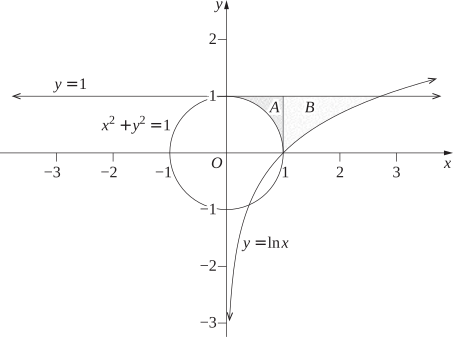
  2. The diagram shows two regions.

Region `A` is bounded by  `y = 1`  and  `x^2 + y^2 = 1`  between  `x = 0`  and  `x = 1`.

Region `B` is bounded by  `y = 1`  and  `y = ln x`  between  `x = 1`  and  `x = e`.


The volume of the solid created when the region between the curve  `y = f(x)`  and the  `x`-axis, between  `x = a`  and  `x = b`, is rotated about the `x`-axis is given by  `V = pi int_a^b [f(x)]^2\ dx`.

The volume of the solid of revolution formed when region `A` is rotated about the `x`-axis is `V_A`.

The volume of the solid of revolution formed when region `B` is rotated about the `x`-axis is `V_B`.

Using part (i), or otherwise, show that the ratio  `V_A : V_B` is `1:3`.  (4 marks)

--- 8 WORK AREA LINES (style=lined) ---

Show Answers Only
  1. `text(See Worked Solutions)`
  2. `text(See Worked Solutions)`
Show Worked Solution

i.   `I_n = int_1^e (ln x)^n\ dx\ \ text(for)\ \ n >= 0`

`text(Show)\ \ I_n = e – nI_(n – 1)\ \ text(for)\ \ n >= 1`

`text(Integrating by parts:)`

`u` `= (ln x)^n` `u′` `= n/x (ln x)^(n – 1)`
`v` `= x` `v′` `= 1`
`I_n` `= [x(ln x)^n]_1^e – n int(ln x)^(n – 1)\ dx`
  `=[e(lne)^n-1(ln1)^n]- n I_(n – 1)`
  `= e – n I_(n – 1)`


ii.    `V_A` `=\ text(cylinder volume – hemisphere volume)`
    `= pi int_0^1 1\ dx – 1/2 xx 4/3 xx pir^3`
    `= pi [x]_0^1 – (2pi)/3`
    `= pi(1 – 0) – (2pi)/3`
    `= pi/3`


`V_B` `= pi int_1^e 1\ dx – pi int_1^e (ln x)^2\ dx`
  `= pi [x]_1^e – pi I_2`
  `= pi(e – 1) – pi(e – 2I_1)`
  `= pi(e – 1) – pi[e – 2(e – I_0)]`
  `= pi(e – 1) – pi(2I_0 – e)`
  `= pi(e – 1) – pi[2(e – 1) – e]`
  `= pi(e – 1) – pi(e – 2)`
  `= pie – pi – pie + 2pi`
  `= pi`
`:. V_A : V_B` `= pi/3 : pi`
  `= 1 : 3`

Filed Under: Recurrence Relations, Recurrence Relations Tagged With: Band 3, Band 4, smc-1054-30-Logs/Exp, smc-1054-60-Recurrence and SOR, smc-7436-30-Logs/Exponentials, smc-7436-60-X-topic

Calculus, EXT2 C1 2020 HSC 16b

Let  `I_n = int_0^(frac{pi}{2}) sin^(2n + 1)(2theta)\ d theta, \ n = 0, 1, ...`

  1. Prove that  `I_n = frac{2n}{2n + 1} I_(n-1) , \ n ≥ 1`.  (3 marks)

    --- 8 WORK AREA LINES (style=lined) ---

  2. Deduce that  `I_n = frac{2^(2n)(n!)^2}{(2n +1)!}`.  (3 marks)

    --- 8 WORK AREA LINES (style=lined) ---

Let  `J_n = int_0^1 x^n (1 - x)^n\ dx , \ n = 0, 1, 2,...`

  1. Using the result of part (ii), or otherwise, show that  `J_n = frac{(n!)^2}{(2n + 1)!}`.  (3 marks)

    --- 8 WORK AREA LINES (style=lined) ---

  2. Prove that  `(2^n n!)^2 ≤ (2n + 1)!`.  (2 marks)

    --- 10 WORK AREA LINES (style=lined) ---

Show Answers Only
  1. `text{See Worked Solutions}`
  2. `text{See Worked Solutions}`
  3. `text{See Worked Solutions}`
  4. `text{See Worked Solutions}`
Show Worked Solution

i.    `text{Prove} \ \ I_n = frac{2n}{2n + 1} I_(n-1) , \ n ≥ 1`

♦ Mean mark (i) 48%.

`I_n = int_0^(frac{pi}{2}) sin^(2n) (2 theta) * sin (2 theta)\ d theta`

`text{Integrating by parts:}`

`u = sin^(2n) (2 theta)`   `u^(′) = 2n sin^(2n -1) (2 theta)  xx -frac(1)(2) cos (2 theta)`
`v = -frac{1}{2} cos (2 theta)`   `v^(′) = sin 2 theta`


`I_n` `= [ sin^(2n) (2 theta) * -frac{1}{2} cos (2 theta)]_0^(frac{pi}{2}) -2n int_0^(frac{pi}{2}) sin^(2n -1) (2 theta) * 2 cos (2 theta) * -frac{1}{2} cos (2 theta)\ d theta`
`I_n` `= 0 + 2n int_0^(frac{pi}{2}) sin^(2n-1) (2 theta) * cos^2 (2 theta)\ d theta`
`I_n` `= 2 n int_0^(frac{pi}{2}) sin^(2n-1) (2 theta) (1 – sin^2 (2 theta))\ d theta`
`I_n` `= 2 n int_0^(frac{pi}{2}) sin^(2n-1) ( 2 theta) – sin^(2n+1) (2 theta)\ d theta`
`I_n` `= 2n (I_(n-1) – I_n)`
`I_n + 2 n  I_n` `= 2 n I_(n-1)`
`I_n (2n + 1)` `= 2 n I_(n-1)`
`therefore I_n` `= frac{2n}{2n +1} I_(n-1)`
♦ Mean mark (ii) 36%.


ii.     `I_0` `= int_0^(frac{pi}{2}) sin (2 theta)\ d theta`
    `= [ -frac(1)(2) cos (2 theta) ]_0^(frac{pi}{2}`
    `=( -frac{1}{2} cos pi + frac{1}{2} cos 0 )`
    `= 1`
     
`I_n` `= frac{2n}{2n + 1} I_(n-1)`
`I_(n-1)` `= frac{2(n -1)}{2n -1} I_(n-2)`
  `vdots`
`I_1` `= frac{2}{3} I_0`


`I_n` `= frac{2n}{2n + 1} xx frac{2(n-1)}{2n-1} xx frac{2(n-2)}{2n-3} xx … xx frac{2}{3} xx 1`
  `= frac{2n}{2n+1} xx frac{2n}{2n} xx frac{2(n-1)}{2n-1} xx frac{2(n-1)}{2n-2} xx … xx frac{2}{3} xx frac{2}{2} xx 1`
  `= frac{2^n (n xx (n-1) xx .. xx 1) xx 2^n (n xx (n – 1) xx … xx 1)}{(2n + 1)!}`
  `= frac{2^(2n) (n!)^2}{(2n + 1)!}`
♦♦♦ Mean mark (iii) 16%.


iii.   `J_n = int_0^1 x^n (1-x)^n\ dx ,  \ n = 0, 1, 2, …`

`text{Let} \ \ x` `= sin^2 theta`
`frac{dx}{d theta}` `= 2 sin theta \ cos theta \ => \ dx = 2 sin theta \ cos theta \ d theta`


`text{When}`    `x = 0 \ ,` ` \ theta = 0`
  `x = 1  \ ,` ` \ theta = frac{pi}{2}`


`J_n` `= int_0^(frac{pi}{2}) (sin^2 theta)^n (1 – sin^2 theta)^n * 2 sin theta \ cos theta \ d theta`
  `= int_0^(frac{pi}{2}) sin^(2n) theta \ cos^(2n) theta * sin (2 theta)\ d theta`
  `= frac{1}{2^(2n)} int_0^(frac{pi}{2}) 2^(2n) sin^(2n) theta \ cos^(2n) theta * sin (2 theta)\ d theta`
  `= frac{1}{2^(2n)} int_0^(frac{pi}{2}) sin^(2n) (2 theta) * sin (2 theta)\ d theta`
  `= frac{1}{2^(2n)} int_0^(frac{pi}{2}) sin^(2n+1) (2 theta)\ d theta`
  `= frac{1}{2^(2n)} * frac{2^(2n) (n!)^2}{(2n+1)!}\ \ \ text{(using part (ii))}`
  `= frac{(n!)^2}{(2n + 1)!}`
♦♦♦ Mean mark (iv) 10%.


iv.   `text{If} \ \ I_n ≤ 1,`

`2^(2n) (n!)^2` ` ≤ (2n + 1)!`
`(2^n n!)^2` `≤ (2n + 1)!`

  
`text{Show} \ \ I_n ≤ 1 :`

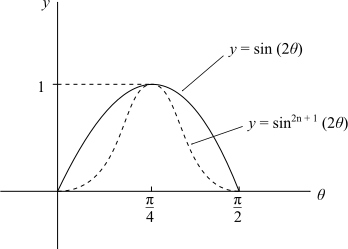
`text{Consider the graphs}`

`y = sin(2 theta) \ \ text{and}\ \ y = sin^(2n + 1) (2 theta) \ \ text{for} \ \ 0 ≤ theta ≤ frac{pi}{2}`
 

`int_0^(frac{pi}{2}) sin(2 theta)` `= [ – frac{1}{2} cos (2 theta) ]_0^(frac{pi}{2})`
  `= – frac{1}{2} cos \ pi + frac{1}{2} cos \ 0`
  `= 1`

 
`y = sin(2 theta) \ => \ text{Range} \ [0, 1] \ \ text{for}\ \ theta ∈ [0, frac{pi}{2}]`

`sin^(2n+1) (2 theta)` `≤ sin (2 theta) \ \ text{for}\ \ theta ∈ [0, frac{pi}{2}]`
`sin^(2n+1) (2 theta)` `≤ 1`
`I_n` `≤ 1`
`therefore (2^n n!)^2` `≤ (2n + 1) !`

Filed Under: Recurrence Relations, Recurrence Relations Tagged With: Band 5, Band 6, smc-1054-10-Trig, smc-7436-10-Trig

Calculus, EXT2 C1 2002 HSC 2b

For  `n = 0, 1, 2,`...

let  `I_n = int_0 ^{(pi)/(4)} tan^(n) theta  d theta`.

  1.  Show that  `I _1 = (1)/(2) ln2`.   (1 mark)

    --- 5 WORK AREA LINES (style=lined) ---

  2.  Show that, for  `n >= 2`,
     
         `I_n + I_(n - 2) = (1)/(n-1)`.   (3 marks)

    --- 6 WORK AREA LINES (style=lined) ---

Show Answers Only

a.    `text(Proof)\ text{(See Worked Solutions)}`

b.    `text(Proof)\ text{(See Worked Solutions)}`

Show Worked Solution

a.         `I_n = int_0 ^{(pi)/(4)} tan^n theta \ d theta`

`I_1` `= int_0 ^{(pi)/(4)} tan theta \ d theta`
  `= [ -ln cos x ]_0 ^{(pi)/(4)}`
  `= [- ln cos\ (pi)/(4) + ln cos 0]`
  `= -ln 2^{-(1)/(2)}`
  `= (1)/(2) ln 2`


b. `I_n` `= int_0 ^{(pi)/(4)} tan^(n – 2) theta ⋅ tan^2 theta \ d theta`
    `= int_0 ^{(pi)/(4)} tan^(n-2) theta ⋅ (sec^2 theta – 1) d theta`
    `= int_0 ^{(pi)/(4)} tan^(n – 2) theta ⋅ sec^2 theta \ d theta – int_0 ^{(pi)/(4)} tan^(n – 2) theta \ d theta`

 
`text(Let) \ \ u = tan theta`

`(du)/(d theta) = sec^2 theta \ => \ du = sec^2 theta \ d theta`

`text(When)` `theta` `= (pi)/(4),`   `\ \ \ \u` `= 1`
  `theta` `=0,`   `u` `= 0`


`I_n` `= int_0 ^1 u^(n-2) \ du – I_(n – 2)`
  `= [(1)/(n-1) ⋅ u^(n-1)]_0 ^1 – I_(n – 2)`
  `= (1)/(n – 1) – I_(n-2)`

 
`:. \ I_n + I_(n – 2)=(1)/(n – 1)\ \ \ \ (n>=2)`

Filed Under: Recurrence Relations, Recurrence Relations Tagged With: Band 4, Band 5, smc-1054-10-Trig, smc-7436-10-Trig

Calculus, EXT2 C1 2008 HSC 3c

For  `n >= 0`, let  `I_n = int_0 ^{(pi)/(4)} tan^(2n) theta  d theta`.   

  1. Show that for `n >= 1`,
     
         `I _n = (1)/(2n - 1) - I_(n-1)`.  (2 marks)

    --- 6 WORK AREA LINES (style=lined) ---

  2. Hence, or otherwise, calculate  `I_3`.   (2 marks)

    --- 5 WORK AREA LINES (style=lined) ---

Show Answers Only

a.    `text(Proof)\ text{(See Worked Solutions)}`

b.    `(52 – 15 pi)/(60)`

Show Worked Solution
a. `I_n` `= int_0 ^{(pi)/(4)} tan^(2n-2) theta * tan^2 theta \ d theta`
    `= int_0 ^{(pi)/(4)} tan^(2n-2) theta * (sec^2 theta – 1) \ d theta`
    `= int_0 ^{(pi)/(4)} tan^(2n-2) theta * sec^2 theta  d theta – int_0 ^{(pi)/(4)} tan^(2n-2) theta \ d theta`
    `= int_0 ^{(pi)/(4)} tan^(2n-2)theta * sec^2 theta \ d theta – I_(n-1)`


`text(Let) \ \ u = tan theta`

`(du)/(d theta) = sec^2 theta \ => \ du = \ sec^2 theta \ d theta`

`text(When)`    `theta` `= (pi)/(4)` `,` `\ \ \ \u` `= 1`
  `theta` `= 0` `,` `u` `= 0`


`I_n` `= int_0 ^1 u^(2n – 2) \ du – I_(n – 1)`
  `= [1/(2n -1) ⋅ u^(2n – 1)]_0 ^1 – I_(n – 1)`
  `= 1/(2n-1)(1^(2n-1)-0)  – I_(n – 1)`
  `= 1/(2n-1)  – I_(n – 1)`


b.        `I_0 = int_0 ^{(pi)/(4)} d theta = (pi)/(4)`

`I_3` `= (1)/(5) – I_2`
  `= (1)/(5) – ((1)/(3) – I_1)`
  `= (1)/(5) – (1)/(3) + (1 – I_0)`
  `= (13)/(15) – (pi)/(4)`
  `= (52 – 15 pi)/(60)`

Filed Under: Recurrence Relations, Recurrence Relations Tagged With: Band 4, Band 5, smc-1054-10-Trig, smc-7436-10-Trig

Calculus, EXT2 C1 2019 HSC 15c

  1. Show that  `int_0^1 x/(x + 1)^2\ dx = ln 2 - 1/2`.  (2 marks)

    --- 5 WORK AREA LINES (style=lined) ---


  2. Let  `I_n = int_0^1 x^n/(x + 1)^2\ dx`.


    Show that  `I_n = 1/(2(n - 1)) - n/(n - 1) I_(n - 1)\ \ text(for)\ \ n >= 2`.  (3 marks)

    --- 7 WORK AREA LINES (style=lined) ---


  3. Evaluate  `I_3`.  (2 marks)

    --- 6 WORK AREA LINES (style=lined) ---

Show Answers Only
  1. `text(Proof)\ text{(See Worked Solutions)}`
  2. `text(Proof)\ text{(See Worked Solutions)}`
  3. `text(See Worked Solutions)`
Show Worked Solution

i.    `text(Show)\ \ int_0^1 x/(x + 1)^2\ dx = ln 2 – 1/2`

`text(Let)\ \ u = x + 1 \ => \ x = u – 1`

`(du)/(dx) = 1 \ => \ du = dx`
 

`text(When)\ \ x = 1,\ \ u = 2`

`text(When)\ \ x = 0,\ \ u = 1`

`int_0^1 x/(x + 1)^2\ dx` `= int_1^2 (u – 1)/(u^2)\ du`
  `= int_1^2 1/u\ du – int_1^2 1/u^2\ du`
  `= [ln u]_1^2 + [1/u]_1^2`
  `= ln 2 – ln 1 + 1/2 – 1`
  `= ln 2 – 1/2`

 
ii.
    `I_u = int_0^1 x^n/(x + 1)^2\ dx`

`u = x^n` `v prime = 1/(x + 1)^2`
`u prime = nx^(n – 1)` `v = -1/{(x + 1)}`


`I_n` `= [uv]_0^1 – int_0^1 u prime v\ dx`
  `= [(-x^n)/(x + 1)]_0^1 + int_0^1 (n x^(n – 1))/(x + 1)\ dx`
  `= (-1/2 – 0) + n int_0^1 (x^(n – 1) (x + 1))/(x + 1)^2\ dx`
  `= -1/2 + n int_0^1 x^n/(x + 1)^2 + (x^(n – 1))/(x + 1)^2\ dx`
  `= -1/2 + n I_n + n I_(n – 1)`
`nI_n – I_n` `= 1/2 – n I_(n – 1)`
`I_n(n – 1)` `= 1/2 – n I_(n – 1)`
`:. I_n` `= 1/(2(n – 1)) – n/(n – 1) I_(n – 1)`


iii.    `I_1` `= ln 2 – 1/2`
  `I_2` `= 1/(2(2 – 1)) – 2/{(2 – 1)} I_1`
    `= 1/2 – 2 I_1`
    `= 1/2 – 2 ln 2 + 1`
    `= 3/2 – 2 ln 2`


`:. I_3` `= 1/4 – 3/2(3/2 – 2 ln 2)`
  `= 1/4 – 9/4 + 3 ln 2`
  `= 3 ln 2 – 2`

Filed Under: Recurrence Relations, Recurrence Relations Tagged With: Band 3, Band 4, smc-1054-20-Quotient, smc-7436-20-Quotient

Calculus, EXT2 C1 2018 HSC 14c

Let  `I_n = int_(−3)^0 x^n sqrt(x + 3)\ dx`  for  `n = 0, 1, 2…`

  1.  Show that, for  `n >= 1`,
     
         `I_n = (−6n)/(3 + 2n) I_(n - 1)`.   (3 marks)

    --- 8 WORK AREA LINES (style=lined) ---

  2.  Find the value of  `I_2`.  (2 marks)

    --- 5 WORK AREA LINES (style=lined) ---

Show Answers Only
  1. `text(See Worked Solutions)`
  2. `(144sqrt3)/35`
Show Worked Solution

i.   `I_n = int_(−3)^0 x^n sqrt(x + 3)\ dx\ \ text(for)\ \ n = 0, 1, 2…`

`u` `= x^n` `vprime` `= (x + 3)^(1/2)`
`uprime` `= nx^(n – 1)` `v` `= 2/3 (x + 3)^(3/2)`


`I_n` `= [2/3 x^n(x + 3)^(3/2)]_(−3)^0 – 2/3int_(−3)^0  nx^(n – 1)(x + 3)sqrt(x + 3)\ dx`
`I_n` `= 0 – (2n)/3 int_(−3)^0 x^nsqrt(x + 3) + 3x^(n – 1)sqrt(x + 3)\ dx`
`I_n` `= −(2n)/3 (I_n + 3I_(n-1))`
`I_n + (2n)/3 I_n` `= −2nI_(n – 1)`
`I_n(1 + (2n)/3)` `= −2nI_(n – 1)`
`I_n((3 + 2n)/3)` `= −2nI_(n – 1)`
`:. I_n` `= (−6n)/(3 + 2n) I_(n – 1)\ \ \ text(… as required)`


ii.    `I_2` `= −12/7 I_1`
    `= −12/7 xx −6/5 I_0`
    `= 72/35 int_(−3)^0 (x + 3)^(1/2)dx`
    `= 72/35 xx 2/3 [(x + 3)^(3/2)]_(−3)^0`
    `= 48/35 (3^(3/2))`
    `= (144sqrt3)/35`

Filed Under: Recurrence Relations, Recurrence Relations, Recurrence Relations Tagged With: Band 3, Band 4, smc-1054-50-Other Function, smc-7436-50-Other Functions

Calculus, EXT2 C1 2017 HSC 15a

Let  `I_n = int_0^1 x^n sqrt (1 - x^2)\ dx`, for  `n = 0, 1, 2, …`

  1. Find the value of `I_1`.  (1 mark)

    --- 3 WORK AREA LINES (style=lined) ---

  2. Using integration by parts, or otherwise, show that for  `n >= 2`
     
         `I_n = ((n - 1)/(n + 2)) I_(n-2)`.  (3 marks)

    --- 8 WORK AREA LINES (style=lined) ---

  3. Find the value of  `I_5`.  (1 mark)

    --- 3 WORK AREA LINES (style=lined) ---

Show Answers Only
  1. `1/3`
  2. `text(Proof)\ \ text{(See Worked Solutions)}`
  3. `8/105`
Show Worked Solution
i.   `I_1` `= int_0^1 x^1 sqrt (1-x^2)\ dx`
    `= -1/2 int_0^1-2x sqrt (1-x^2)\ dx`
    `= -1/2 [2/3 (1-x^2)^(3/2)]_0^1`
    `= -1/2 [0-2/3 (1)]`
    `= 1/3`


ii.  `I_n = int_0^1 x^n sqrt (1-x^2)\ dx`

♦ Mean mark 48%.

`text(Integrating by parts:)`

`u` `= x^(n-1)`    `dv` `= x sqrt (1-x^2)\ dx`
`du` `= (n-1) x^(n – 2)\ dx` `v` `= -1/3 (1-x^2)^(3/2)`
`I_n` `= [x^(n-1) xx -1/3 (1-x^2)^(3/2)]_0^1 + 1/3 int_0^1 (1-x^2)^(3/2)(n-1) x^(n-2)\ dx`
  `= 0 + (n-1)/3 int_0^1 x^(n-2) (1-x^2) · sqrt(1-x^2)\ dx`
  `= (n-1)/3 int_0^1 x^(n-2) sqrt(1-x^2)\ dx-(n-1)/3 int_0^1 x^n sqrt (1-x^2)\ dx`
  `= (n-1)/3 · I_(n-2)-(n-1)/3 · I_n`


`:. I_n + (n-1)/3 · I_n` `= (n-1)/3 · I_(n-2)`
`I_n (1 + (n-1)/3)` `= (n-1)/3 · I_(n-2)`
`I_n ((n + 2)/3)` `= (n-1)/3 · I_(n-2)`
`:. I_n` `= ((n-1)/(n + 2)) · I_(n-2)\ text(… as required.)`


iii.   `I_5` `= 4/7 xx I_3`
    `= 4/7 xx 2/5 xx I_1`
    `= 4/7 xx 2/5 xx 1/3\ text{(part (i))}`
    `= 8/105`

Filed Under: Recurrence Relations, Recurrence Relations, Recurrence Relations Tagged With: Band 4, Band 5, smc-1054-50-Other Function, smc-7436-50-Other Functions

Calculus, EXT2 C1 2016 HSC 14b

Let  `I_n = int_0^1 x^n/(x^2 + 1)^2\ dx,`  for   `n = 0, 1, 2, … .`

  1. Using a suitable substitution, show that  `I_0 = pi/8 + 1/4.`  (3 marks)

    --- 6 WORK AREA LINES (style=lined) ---

  2. Show that  `I_0 + I_2 = pi/4.`  (1 mark)

    --- 4 WORK AREA LINES (style=lined) ---

  3. Find  `I_4.`  (3 marks)

    --- 8 WORK AREA LINES (style=lined) ---

Show Answers Only
  1. `text(See Worked Solutions)`
  2. `text(See Worked Solutions)`
  3. `5/4 – (3pi)/8`
Show Worked Solution

i.   `I_n = int_0^1 (x^n)/((x^2 + 1)^2) dx,quadn >= 0`

`text(Let)\ \ \ x` `= tantheta`
`dx` `= sec^2theta\ d theta`


`text(When)\ \ \ x` `= 0,quad` `theta` `= 0`
`x` `= 1,` `theta` `= pi/4`


`:. I_0` `= int_0^(pi/4)(sec^2theta)/((tan^2theta + 1)^2)\ d theta`
  `= int_0^(pi/4)(sec^2theta)/(sec^4theta)\ d theta`
  `= int_0^(pi/4)cos^2theta\ d theta`
  `= int_0^(pi/4)1/2(1 + cos2theta)\ d theta`
  `= 1/2[x + 1/2sin2theta]_0^(pi/4)`
  `= 1/2[(pi/4 + 1/2 · sin\ pi/2) – 0]`
  `= pi/8 + 1/4`


ii.    `I_0 + I_2` `= int_0^1 1/((x^2 + 1)^2)\ dx + int_0^1 (x^2)/((x^2 + 1)^2)\ dx`
    `= int_0^1 (x^2 + 1)/((x^2 + 1)^2)\ dx`
    `= int_0^1 1/(x^2 + 1)\ dx`
    `= [tan^(−1)x]_0^1`
    `= pi/4`


♦ Mean mark part (iii) 49%.
iii.    `I_4` `= int_0^1 (x^4)/(x^2 + 1)\ dx`
    `= int_0^1 (x^4 – 1)/((x^2 + 1)^2)\ dx + int_0^1 1/((x^2 + 1)^2)`
    `= int_0^1 ((x^2 + 1)(x^2 – 1))/((x^2 + 1)^2)\ dx + I_0`
    `= int_0^1 (x^2 – 1)/(x^2 + 1)\ dx + I_0`
    `= int_0^1 (1 – 2/(x^2 + 1))\ dx + I_0`
    `= [x – 2tan^(−1)x]_0^1 + pi/8 + 1/4`
    `= [(1 – 2 · pi/4) – 0] + pi/8 + 1/4`
    `= 5/4 – (3pi)/8`

Filed Under: Recurrence Relations, Recurrence Relations, Recurrence Relations Tagged With: Band 4, Band 5, smc-1054-20-Quotient, smc-7436-20-Quotient

Calculus, EXT2 C1 2006 HSC 7b

  1. Let  `I_n = int_0^x sec^n t\ dt`,  where  `0 <= x <= pi/2`.  
     
    Show that   `I_n = (sec^(n - 2) x tan x)/(n - 1) + (n - 2)/(n - 1) I_(n - 2).`  (3 marks)

    --- 8 WORK AREA LINES (style=lined) ---

  2. Hence find the exact value of
     
         `int_0^(pi/3) sec^4 t\ dt.`  (2 marks)

    --- 4 WORK AREA LINES (style=lined) ---

Show Answers Only

a.    `text(Proof)\ \ text{(See Worked Solutions)}`

b.    `2 sqrt 3`

Show Worked Solution
STRATEGY: The choice of `u=sec^(n-2)t` and `v=sec^2 t` was extremely important in being able to answer this question. Take note!
a.    `I_n` `=int_0^x sec^n t\ dt,\ \ \ 0 <= x < pi/2`
  `=int_0^x sec^(n – 2)t sec^2 t\ dt`

`text(Integrating by parts)`

`u` `=sec^(n-2)t,` `u′` `=(n-2) sec^(n-2)t tan\ t`
`v` `=tan\ t,` `v′` `=sec^2 t`
`­I_n` `=[tan t sec^(n – 2)t]_0^x – int_0^x tan t (n – 2) sec^(n – 3) t sec t tan t\ dt`
  `=tan x sec^(n – 2) x – (n – 2) int_0^x sec^(n – 2) t tan^2 t\ dt`
  `=tan x sec^(n – 2) x – (n – 2) int_0^x sec^(n – 2) t (1+sec^2 t)\ dt`
  `=tan x sec^(n – 2) x – (n – 2) int_0^x sec^n t\ dt + (n – 2) int_0^x sec^(n – 2)t\ dt`
  `=tan x sec^(n – 2) x-(n-2)I_n+(n-2)I_(n-2)`


`I_n + (n – 2) I_n` `= tan x sec^(n – 2) x + (n – 2) I_(n – 2)`
`(n – 1)I_n` `= tan x sec^(n – 2) x + (n – 2) I_(n – 2)`
`:.I_n ` `= (tan x sec^(n – 2) x)/(n – 1) + ((n – 2)/(n – 1)) I_(n – 2)`


b.   `int_0^(pi/3) sec^4 t\ dt ­=` `(tan\ pi/3 sec^2\ pi/3)/3 + 2/3 int_0^(pi/3) sec^2 t\ dt`
`­=` `(sqrt 3 xx 4)/3 + 2/3 [tan t]_0^(pi/3)`
`­=` `(4 sqrt 3)/3 + 2/3 (sqrt 3 – 0)`
`­=` `2 sqrt 3`

Filed Under: Integration By Parts, Recurrence Relations, Recurrence Relations Tagged With: Band 5, Band 6, smc-1054-10-Trig, smc-7436-10-Trig

Calculus, EXT2 C1 2009 HSC 5b

For each integer  `n >= 0`, let

`I_n = int_0^1 x^(2n + 1) e^(x^2)\ dx.`

  1. Show that for  `n >= 1,`
     
    `I_n = e/2 - nI_(n-1).`  (2 marks)

    --- 6 WORK AREA LINES (style=lined) ---

  2. Hence, or otherwise, calculate  `I_2.`  (2 marks)

    --- 6 WORK AREA LINES (style=lined) ---

Show Answers Only

a.    `text(Proof)\ \ text{(See Worked Solutions)}`

b.    `(e – 2)/2`

Show Worked Solution

a.   `text(Integrating by parts:)`

`u` `=x^(2n),` `u′` `=2nx^(2n-1)`
`v′` `=xe^(x^2),` `v` `=1/2 e^(x^2)`
`:.I_n` `= int_0^1 x^(2n + 1) e^(x^2)\ dx`
  `= int_0^1 x^(2n) x e^(x^2)\ dx`
  `= [(x^(2n) e^(x^2))/2]_0^1 – int_0^1 (2n x^(2n) e^(x^2))/2 \ dx`
  `= e/2 – n int_0^1 x^(2n) e^(x^2)\ dx`
  `= e/2 – nI_(n-1)`


b.   `I_2 = e/2 – 2I_1`

`I_1 = e/2 – I_0`

`I_0` `= int_0^1 xe^(x^2)\ dx`
  `= [(e^(x^2))/2]_0^1`
  `= (e-1)/2`
`I_1` `= e/2 – (e – 1)/2=1/2`
`:.I_2` `= e/2 – 2 xx 1/2`
  `= (e – 2)/2`

Filed Under: Integration By Parts, Recurrence Relations, Recurrence Relations, Recurrence Relations Tagged With: Band 4, Band 5, smc-1054-30-Logs/Exp, smc-7436-30-Logs/Exponentials

Calculus, EXT2 C1 2011 HSC 8a

For every integer `m >= 0`  let

`I_m = int_0^1 x^m (x^2 - 1)^5\ dx.`
 

Prove that for  `m >= 2`

`I_m = (m - 1)/(m + 11) \ I_(m - 2).`   (3 marks)

--- 8 WORK AREA LINES (style=lined) ---

Show Answers Only

`text(Proof)\ \ text{(See Worked Solutions)}`

Show Worked Solution

`I_m = int_0^1 x^m(x^2 – 1)^5 dx`

`u` `=x^(m – 1)\ \ \ \ \ \ ` `\ \ \ \ u′` `=(m – 1)x^(m – 2)`
`v′` `=x(x^2 – 1)^5` `v` `=1/12 (x^2 – 1)^6`
♦♦♦ Mean mark 24%.


`I_m` `=[x^(m-1) xx 1/12(x^2 – 1)^6]_0^1 – int_0^1 1/12(x^2 – 1)^6 xx (m – 1)x^(m – 2) dx`
  `=[0 – 0] – (m – 1)/12 int_0^1 x^(m – 2) (x^2 – 1)^6 dx`
  `=-(m – 1)/12 int_0^1 x^(m – 2) (x^2 – 1)^5 (x^2 – 1) dx`
  `=-(m – 1)/12 int_0^1 x^m (x^2 – 1)^5 dx + (m – 1)/12 int _0^1 x^(m – 2) (x^2 – 1)^5 dx`
  `=-(m – 1)/12 I_m + (m – 1)/12 I_(m – 2)`


`12I_m + mI_m – I_m` `= (m – 1)I_(m – 2)`
`(m + 11)I_m` ` = (m – 1)I_(m-2)`
`:.I_m` `= (m – 1)/(m + 11) I_(m – 2)`

Filed Under: Integration By Parts, Recurrence Relations, Recurrence Relations, Recurrence Relations Tagged With: Band 6, smc-1054-50-Other Function, smc-7436-50-Other Functions

Calculus, EXT2 C1 2012 HSC 12c

For every integer  `n ≥ 0`  let  `I_n = int_1^(e^2)(log_e x)^n\ dx`.

Show that for  `n ≥ 1,`
 
     `I_n = e^2 2^n − nI_(n − 1)`.  (3 marks)

--- 6 WORK AREA LINES (style=lined) ---

Show Answers Only

`text{Proof (See Worked Solutions)}`

Show Worked Solution

`I_n = int_1^(e^2)(log_e x)^n\ dx`

`u` `= (log_e x)^n,` `v′` `= 1`
`u′` `= n (log_e x)^(n − 1) xx 1/x` `v` `= x`
`I_n` `=int_1^(e^2) 1*(ln x)^n\ dx`
  `= [x (log_e x)^n]_1^(e^2) − int_1^(e^2)n/x(log_e x)^(n − 1) xx x\ dx`
  `= [e^2(log_e e^2)^n − 1*ln\ 1] − n int_1^(e^2)(log_e x)^(n − 1)\ dx`
  `= [e^2(2 log_ee)^n-0 ]− nI_(n − 1)`
 
`= e^2 2^n − nI_(n − 1)`

Filed Under: Integration By Parts, Recurrence Relations, Recurrence Relations, Recurrence Relations Tagged With: Band 3, smc-1054-30-Logs/Exp, smc-7436-30-Logs/Exponentials

Calculus, EXT2 C1 2013 HSC 13a

Let  `I_n = int_0^1 (1 - x^2)^(n/2)\ dx`, where  `n >= 0`  is an integer.

  1. Show that
     
            `I_n = n/(n + 1) I_(n-2)`  for every integer  `n>= 2.`  (3 marks)

    --- 8 WORK AREA LINES (style=lined) ---

  2. Evaluate  `I_5.`  (2 marks)

    --- 5 WORK AREA LINES (style=lined) ---

Show Answers Only

a.    `text(Proof)\ \ text{(See Worked Solutions)}`

b.    `(5 pi)/32`

Show Worked Solution

a.    `I_n = int_0^1 (1 – x^2)^(n/2)\ dx`

♦ Mean mark 46%.
STRATEGY TIP: Attempting to prove this relationship using induction proved unsuccessful and time consuming for some students.
`text(Let)\ \ u` `= (1 – x^2)^(n/2)`
`u′` `= n/2 (1 – x^2)^(n/2 – 1) (-2x)`
  `= -nx (1 – x^2)^(n/2 -1)`
`v` `=x`
`v′` `=1`


`I_n` `= [x (1 – x^2)^(n/2)]_0^1 – int_0^1 – nx (1 – x^2)^(n/2 – 1)x\ dx`
  `= 0 + n int_0^1 x^2 (1 – x^2)^(n/2 – 1)\ dx`
  `= n int_0^1 (x^2 – 1 + 1) (1 – x^2)^(n/2 – 1)\ dx`
  `= n int_0^1 1 (1 – x^2)^(n/2 -1)\ dx – n int_0^1 (1 – x^2) (1 – x^2)^(n/2 – 1)\ dx`
  `= n int_0^1 (1 – x^2)^((n-2)/2)\ dx – n int_0^1 (1 – x^2)^(n/2)\ dx`
  `= nI_(n – 2) – nI_n`


`:.(n + 1) I_n` `= nI_(n-2)`
`I_n` `= n/(n + 1) I_(n-2)\ \ \ \ text(where)\ \ n >= 2`
STRATEGY TIP: Realising that the integral `I_1` is equal to the area of a quarter unit circle saved valuable time.


b.    `I_5 = 5/6 I_3 = 5/6 xx 3/4\ I_1`

`I_1` `= int_0^1 (1 – x^2)^(1/2)\ dx`
  `= 1/4 xx pi xx 1^2\ \ \ \ text{(1st quadrant of a circle, radius 1)}`
  `= pi/4`
`I_5` `= 5/6 xx 3/4 xx pi/4`
  `= (5 pi)/32`

Filed Under: Integration By Parts, Recurrence Relations, Recurrence Relations, Recurrence Relations Tagged With: Band 4, Band 5, smc-1054-50-Other Function, smc-7436-50-Other Functions

Calculus, EXT2 C1 2014 HSC 12d

Let  `I_n = int_0^1 (x^(2n))/(x^2 + 1)\ dx`, where  `n`  is an integer and  `n ≥ 0`.

  1. Show that  `I_0 = pi/4`.  (1 mark)

    --- 4 WORK AREA LINES (style=lined) ---

  2. Show that
     
         `I_n + I_(n − 1) = 1/(2n − 1)`.  (2 marks)

    --- 6 WORK AREA LINES (style=lined) ---

  3. Hence, or otherwise, find
     
         `int_0^1 (x^4)/(x^2 + 1)\ dx`.  (2 marks)

    --- 6 WORK AREA LINES (style=lined) ---

Show Answers Only

a.    `text{Proof (See Worked Solutions)}`

b.     `text{Proof (See Worked Solutions)}`

c.     `pi/4 − 2/3`

Show Worked Solution

a.    `I_n = int_0^1 (x^(2n))/(x^2 + 1)\ dx, \ \ n ≥ 0`

  `I_0` `= int_0^1 (x^0)/(x^2 + 1)\ dx`
  `= [tan^(−1) x]_0^1` 
  ` = tan^(−1) 1 − tan^(−1)0`
  `= pi/4`


♦ Mean mark 41%.
STRATEGY: The denominator of the proof, `(2n-1)`, should flag the potential existence of `x^(2n-2)` in the integral.
b.      `I_(n − 1)` `= int_0^1 x^(2n-2)/(x^2 + 1)\ dx`
  `I_n` `= int_0^1 x^(2n)/(x^2 + 1)\ dx`


`I_n + I_(n − 1)` `= int_0^1(x^(2n))/(x^2 + 1)\ dx + int_0^1(x^(2n − 2))/(x^2 + 1)\ dx`
  `= int_0^1(x^(2n) + x^(2n − 2))/(x^2 + 1)\ dx`
  `= int_0^1(x^(2n − 2)(x^2 + 1))/(x^2 + 1)\ dx`
  `= int_0^1x^(2n − 2)\ dx`
  `= [(x^(2n − 1))/(2n − 1)]_0^1`
  `= 1/(2n − 1)`


c.      `I_2` `= int_0^1(x^4)/(x^2 + 1)\ dx`
  `I_1` `= int_0^1(x^2)/(x^2 + 1)\ dx`
`I_n + I_(n − 1)` `= 1/(2n − 1)`
`I_2 + I_1` `= 1/(2(2) − 1) = 1/3\ \ …\ (1)`
`I_1 + I_0` `= 1/(2(1)-1)=1`
`I_1+pi/4` `= 1`
`:.I_1` `=1- pi/4`
`text(Substitute into (1))`
`I_2+1- pi/4` `= 1/3`
 `:.I_2` `= pi/4 − 2/3`

Filed Under: Recurrence Relations, Recurrence Relations, Recurrence Relations Tagged With: Band 2, Band 4, Band 5, smc-1054-20-Quotient, smc-7436-20-Quotient

Copyright © 2014–2026 SmarterEd.com.au · Log in