SmarterEd

Aussie Maths & Science Teachers: Save your time with SmarterEd

  • Login
  • Get Help
  • About

HMS, BM EQ-Bank 117

Analyse how the skeletal, muscular and nervous systems work together differently in a power clean versus a deadlift.   (8 marks)

--- 24 WORK AREA LINES (style=lined) ---

Show Answers Only

Sample Answer

Overview Statement:

  • Power cleans and deadlifts require different interactions between skeletal, muscular and nervous systems.
  • Their relationships vary in timing, force production and movement complexity.

Component Relationship 1 – Movement Speed and Neural Control:

  • Power cleans require the nervous system to coordinate explosive multi-joint movements in under one second.
  • This rapid timing triggers sequential muscle activation from legs to shoulders to arms.
  • Deadlifts involve slower neural control allowing sustained force over 2-4 seconds.
  • The speed difference reveals how neural demands change with movement velocity.
  • Fast movements require precise timing while slow movements need sustained neural drive.

Component Relationship 2 – Force Transfer Through Skeleton:

  • In power cleans, joints act as sequential levers transferring force upward through the body.
  • This creates momentum that travels through hips, spine, shoulders and arms.
  • Deadlifts use the skeletal system as a rigid framework maintaining vertical force.
  • The contrast shows how skeletal function changes with movement type.
  • Dynamic lifts utilise joint mobility while static lifts depend on skeletal stability.

Component Relationship 3 – Muscle Activation Patterns:

  • Power clean muscles fire sequentially, each group building on the previous one’s momentum.
  • This wave-like pattern enables explosive acceleration of the barbell.
  • Deadlift muscles contract simultaneously to produce steady upward force.
  • These patterns demonstrate how the nervous system adapts muscle control to movement demands.

Implications:

  • The analysis reveals that the same three systems can interact in fundamentally different ways.
  • This flexibility allows humans to perform both explosive and grinding movements effectively.
  • Therefore, training programs must consider not just which systems to train, but how they should interact.
Show Worked Solution

Sample Answer

Overview Statement:

  • Power cleans and deadlifts require different interactions between skeletal, muscular and nervous systems.
  • Their relationships vary in timing, force production and movement complexity.

Component Relationship 1 – Movement Speed and Neural Control:

  • Power cleans require the nervous system to coordinate explosive multi-joint movements in under one second.
  • This rapid timing triggers sequential muscle activation from legs to shoulders to arms.
  • Deadlifts involve slower neural control allowing sustained force over 2-4 seconds.
  • The speed difference reveals how neural demands change with movement velocity.
  • Fast movements require precise timing while slow movements need sustained neural drive.

Component Relationship 2 – Force Transfer Through Skeleton:

  • In power cleans, joints act as sequential levers transferring force upward through the body.
  • This creates momentum that travels through hips, spine, shoulders and arms.
  • Deadlifts use the skeletal system as a rigid framework maintaining vertical force.
  • The contrast shows how skeletal function changes with movement type.
  • Dynamic lifts utilise joint mobility while static lifts depend on skeletal stability.

Component Relationship 3 – Muscle Activation Patterns:

  • Power clean muscles fire sequentially, each group building on the previous one’s momentum.
  • This wave-like pattern enables explosive acceleration of the barbell.
  • Deadlift muscles contract simultaneously to produce steady upward force.
  • These patterns demonstrate how the nervous system adapts muscle control to movement demands.

Implications:

  • The analysis reveals that the same three systems can interact in fundamentally different ways.
  • This flexibility allows humans to perform both explosive and grinding movements effectively.
  • Therefore, training programs must consider not just which systems to train, but how they should interact.

Filed Under: Body systems working together Tagged With: Band 5, Band 6, smc-5526-10-Muscular/skeletal, smc-5526-15-Nervous

HMS, BM EQ-Bank 116

Evaluate how the circulatory, respiratory and muscular systems interact during recovery between swimming races.   (8 marks)

--- 24 WORK AREA LINES (style=lined) ---

Show Answers Only

Sample Answer

Evaluation Statement:

  • The three systems interact highly effectively during recovery.
  • They meet both immediate oxygen repayment needs and muscle restoration requirements through coordinated responses.

Oxygen Debt Repayment:

  • The respiratory system maintains elevated breathing rate initially, gradually returning to normal.
  • This provides oxygen to repay the debt accumulated during racing.
  • Meanwhile, the circulatory system keeps heart rate elevated to deliver this oxygen efficiently.
  • Blood flow remains high to muscles needing recovery.
  • Evidence shows breathing rate decreases significantly over the first few minutes of recovery.
  • Heart rate similarly drops from near-maximum toward resting levels.
  • This demonstrates strong effectiveness in meeting immediate oxygen demands for recovery.

Waste Removal and Nutrient Delivery:

  • The circulatory system redirects blood flow patterns to optimise waste removal from muscles.
  • Lactic acid is transported to the liver for processing. 
  • Simultaneously, nutrients and oxygen continue flowing to muscle tissue for repair.
  • The respiratory system supports this by maintaining adequate ventilation.
  • Blood lactate levels decrease substantially during active recovery periods.
  • Muscle pH returns to normal ranges.
  • These interactions prove highly efficient for metabolic recovery between races.

Final Evaluation:

  • While the systems work effectively together, recovery speed depends on fitness level and recovery type.
  • Active recovery enhances these interactions compared to passive rest.
  • Overall, the coordinated response strongly meets the demands of inter-race recovery, though complete restoration may require 20-30 minutes for maximal performance.
Show Worked Solution

Sample Answer

Evaluation Statement:

  • The three systems interact highly effectively during recovery.
  • They meet both immediate oxygen repayment needs and muscle restoration requirements through coordinated responses.

Oxygen Debt Repayment:

  • The respiratory system maintains elevated breathing rate initially, gradually returning to normal.
  • This provides oxygen to repay the debt accumulated during racing.
  • Meanwhile, the circulatory system keeps heart rate elevated to deliver this oxygen efficiently.
  • Blood flow remains high to muscles needing recovery.
  • Evidence shows breathing rate decreases significantly over the first few minutes of recovery.
  • Heart rate similarly drops from near-maximum toward resting levels.
  • This demonstrates strong effectiveness in meeting immediate oxygen demands for recovery.

Waste Removal and Nutrient Delivery:

  • The circulatory system redirects blood flow patterns to optimise waste removal from muscles.
  • Lactic acid is transported to the liver for processing. 
  • Simultaneously, nutrients and oxygen continue flowing to muscle tissue for repair.
  • The respiratory system supports this by maintaining adequate ventilation.
  • Blood lactate levels decrease substantially during active recovery periods.
  • Muscle pH returns to normal ranges.
  • These interactions prove highly efficient for metabolic recovery between races.

Final Evaluation:

  • While the systems work effectively together, recovery speed depends on fitness level and recovery type.
  • Active recovery enhances these interactions compared to passive rest.
  • Overall, the coordinated response strongly meets the demands of inter-race recovery, though complete restoration may require 20-30 minutes for maximal performance.

Filed Under: Body systems working together Tagged With: Band 4, Band 5, smc-5526-10-Muscular/skeletal, smc-5526-20-Respiratory/circulatory

HMS, BM EQ-Bank 115

Analyse how the nervous and respiratory systems work together during high-intensity interval training.   (8 marks)

--- 22 WORK AREA LINES (style=lined) ---

Show Answers Only

Sample Answer

Overview Statement:

  • High-intensity interval training requires precise coordination between nervous and respiratory systems.
  • Their relationships control oxygen delivery, monitor metabolic demands, and adapt breathing patterns throughout work-recovery cycles.

Component Relationship 1 – Neural Control of Breathing:

  • The motor cortex activates muscles while the medulla oblongata simultaneously controls breathing rate.
  • During work intervals, breathing rate increases significantly in response to neural signals.
  • CO2 sensors directly influence the respiratory centre to increase the amount of air breathed per breath.
  • This relationship enables rapid oxygen uptake matching muscle demands.
  • The connection demonstrates how nerve centres coordinate movement with breathing.

Component Relationship 2 – Feedback Systems:

  • Special sensors in the body detect rising CO2 and falling O2 levels during intense work.
  • These sensors trigger nerve signals that adjust breathing depth and rate.
  • The nervous system responds by increasing both respiratory rate and the amount of air per breath.
  • This interaction reveals how body signals control breathing changes.
  • Recovery breathing remains elevated due to continued neural stimulation.

Component Relationship 3 – Training Adaptations:

  • Repeated HIIT sessions lead to improved neural-respiratory coordination.
  • Neural pathways become more efficient at anticipating breathing needs.
  • This adaptation results in faster respiratory responses between intervals.
  • Trained athletes develop better synchronisation of breathing with work phases.

Implications:

  • The interdependence shows that HIIT effectiveness relies on neural-respiratory integration.
  • This means training improves both systems together, not separately.
  • Therefore, optimal HIIT performance requires developing neural control alongside respiratory capacity.
Show Worked Solution

Sample Answer

Overview Statement:

  • High-intensity interval training requires precise coordination between nervous and respiratory systems.
  • Their relationships control oxygen delivery, monitor metabolic demands, and adapt breathing patterns throughout work-recovery cycles.

Component Relationship 1 – Neural Control of Breathing:

  • The motor cortex activates muscles while the medulla oblongata simultaneously controls breathing rate.
  • During work intervals, breathing rate increases significantly in response to neural signals.
  • CO2 sensors directly influence the respiratory centre to increase the amount of air breathed per breath.
  • This relationship enables rapid oxygen uptake matching muscle demands.
  • The connection demonstrates how nerve centres coordinate movement with breathing.

Component Relationship 2 – Feedback Systems:

  • Special sensors in the body detect rising CO2 and falling O2 levels during intense work.
  • These sensors trigger nerve signals that adjust breathing depth and rate.
  • The nervous system responds by increasing both respiratory rate and the amount of air per breath.
  • This interaction reveals how body signals control breathing changes.
  • Recovery breathing remains elevated due to continued neural stimulation.

Component Relationship 3 – Training Adaptations:

  • Repeated HIIT sessions lead to improved neural-respiratory coordination.
  • Neural pathways become more efficient at anticipating breathing needs.
  • This adaptation results in faster respiratory responses between intervals.
  • Trained athletes develop better synchronisation of breathing with work phases.

Implications:

  • The interdependence shows that HIIT effectiveness relies on neural-respiratory integration.
  • This means training improves both systems together, not separately.
  • Therefore, optimal HIIT performance requires developing neural control alongside respiratory capacity.

Filed Under: Body systems working together Tagged With: Band 4, Band 5, smc-5526-15-Nervous, smc-5526-20-Respiratory/circulatory

HMS, BM EQ-Bank 114

Explain how the muscular and skeletal systems respond to maintain posture during a complex dance sequence.   (5 marks)

--- 15 WORK AREA LINES (style=lined) ---

Show Answers Only

Sample Answer

  • Deep core muscles engage continuously around the spinal column during dance movements.
  • As a result, constant stabilisation of the trunk occurs while limbs move dynamically.
  • Muscles like transverse abdominis and multifidus maintain isometric contractions at 30-40% capacity throughout.
  • This core engagement enables the skeletal framework to provide a stable central axis for movement.
  • The skeletal system provides multiple balance points through joint positioning.
  • Consequently, efficient weight transfer occurs as the body moves through dance positions.
  • Ankles, knees and hips constantly adjust angles while the spine maintains vertical alignment.
  • These skeletal adjustments thus allow muscles to control balance with minimal energy expenditure.
  • Small postural muscles make continuous micro-adjustments during movement transitions.
  • Such adjustments result in smooth, controlled shifts between dance positions.
  • Proprioceptors detect tiny changes in joint position, triggering reflexive muscle responses within milliseconds.
  • The rapid feedback system therefore ensures both systems work together to maintain dynamic stability.
Show Worked Solution
  • Deep core muscles engage continuously around the spinal column during dance movements.
  • As a result, constant stabilisation of the trunk occurs while limbs move dynamically.
  • Muscles like transverse abdominis and multifidus maintain isometric contractions at 30-40% capacity throughout.
  • This core engagement enables the skeletal framework to provide a stable central axis for movement.
  • The skeletal system provides multiple balance points through joint positioning.
  • Consequently, efficient weight transfer occurs as the body moves through dance positions.
  • Ankles, knees and hips constantly adjust angles while the spine maintains vertical alignment.
  • These skeletal adjustments thus allow muscles to control balance with minimal energy expenditure.
  • Small postural muscles make continuous micro-adjustments during movement transitions.
  • Such adjustments result in smooth, controlled shifts between dance positions.
  • Proprioceptors detect tiny changes in joint position, triggering reflexive muscle responses within milliseconds.
  • The rapid feedback system therefore ensures both systems work together to maintain dynamic stability.

Filed Under: Body systems working together Tagged With: Band 3, Band 4, smc-5526-10-Muscular/skeletal

HMS, BM EQ-Bank 113

Describe how the digestive and circulatory systems work together to support a 90-minute soccer game.   (4 marks)

--- 12 WORK AREA LINES (style=lined) ---

Show Answers Only

Sample Answer

Pre-game:

  • Digestive enzymes break down pre-game meal in stomach and small intestine.
  • Blood flow increases to digestive organs to enhance nutrient absorption.
  • Circulatory system transports glucose and nutrients to muscle glycogen stores.

Early Game:

  • As the game begins, blood flow shifts from digestive organs to muscles as stored energy is mobilised.
  • Digestive absorption slows while stomach empties.
  • Circulation delivers stored glycogen and oxygen to working muscles.
  • Heart rate elevates to support increased delivery demands.

Mid-Late Game:

  • Digestive system maintains steady blood glucose levels through continued absorption.
  • Circulatory system manages hydration through fluid distribution.
  • Both systems coordinate waste removal while sustaining energy supply.
  • Blood flow patterns optimise nutrient delivery to fatigued muscles.
Show Worked Solution

Sample Answer

Pre-game:

  • Digestive enzymes break down pre-game meal in stomach and small intestine.
  • Blood flow increases to digestive organs to enhance nutrient absorption.
  • Circulatory system transports glucose and nutrients to muscle glycogen stores.

Early Game:

  • As the game begins, blood flow shifts from digestive organs to muscles as stored energy is mobilised.
  • Digestive absorption slows while stomach empties.
  • Circulation delivers stored glycogen and oxygen to working muscles.
  • Heart rate elevates to support increased delivery demands.

Mid-Late Game:

  • Digestive system maintains steady blood glucose levels through continued absorption.
  • Circulatory system manages hydration through fluid distribution.
  • Both systems coordinate waste removal while sustaining energy supply.
  • Blood flow patterns optimise nutrient delivery to fatigued muscles.

Filed Under: Body systems working together Tagged With: Band 3, smc-5526-20-Respiratory/circulatory, smc-5526-25-Digestive/endocrine

HMS, BM EQ-Bank 112

Analyse how THREE body systems work together to maintain balance during a gymnastics beam routine.   (6 marks)

--- 18 WORK AREA LINES (style=lined) ---

Show Answers Only

Sample Answer – Nervous system, muscular system and skeletal system

Overview Statement:

  • Balance during beam routines requires nervous, muscular and skeletal systems working interdependently.
  • Their relationships create continuous adjustments maintaining equilibrium on the narrow apparatus.

Component Relationship 1 – Nervous to Muscular:

  • Inner ear organs and proprioceptors detect body position changes instantly.
  • These sensors directly cause muscles to contract for balance correction.
  • Vision works with body position sensors to show where the gymnast is in space.
  • The connection reveals how sensing movement enables quick muscle responses.
  • Such coordination shows why nerve signals and muscle actions must work together for balance.

Component Relationship 2 – Muscular to Skeletal:

  • Core muscles maintain constant isometric tension around the spine.
  • These contractions work through skeletal attachment points to stabilise posture.
  • Limb muscles interact with joint levers to create precise adjustments.
  • This connection shows how muscles use bones as mechanical advantages.
  • The relationship enables fine-tuned movements essential for beam performance.

Implications:

  • All three systems depend on continuous communication for successful balance.
  • Nerves sense position which causes muscles to move using bones as levers.
  • The interdependence means interruptions to any system affects balance ability.
  • Therefore, gymnastic training must develop all three systems equally.

Show Worked Solution

Sample Answer – Nervous system, muscular system and skeletal system

Overview Statement:

  • Balance during beam routines requires nervous, muscular and skeletal systems working interdependently.
  • Their relationships create continuous adjustments maintaining equilibrium on the narrow apparatus.

Component Relationship 1 – Nervous to Muscular:

  • Inner ear organs and proprioceptors detect body position changes instantly.
  • These sensors directly cause muscles to contract for balance correction.
  • Vision works with body position sensors to show where the gymnast is in space.
  • The connection reveals how sensing movement enables quick muscle responses.
  • Such coordination shows why nerve signals and muscle actions must work together for balance.

Component Relationship 2 – Muscular to Skeletal:

  • Core muscles maintain constant isometric tension around the spine.
  • These contractions work through skeletal attachment points to stabilise posture.
  • Limb muscles interact with joint levers to create precise adjustments.
  • This connection shows how muscles use bones as mechanical advantages.
  • The relationship enables fine-tuned movements essential for beam performance.

Implications:

  • All three systems depend on continuous communication for successful balance.
  • Nerves sense position which causes muscles to move using bones as levers.
  • The interdependence means interruptions to any system affects balance ability.
  • Therefore, gymnastic training must develop all three systems equally.

Filed Under: Body systems working together Tagged With: Band 4, Band 5, smc-5526-10-Muscular/skeletal, smc-5526-15-Nervous, smc-5526-20-Respiratory/circulatory, smc-5526-25-Digestive/endocrine

HMS, BM EQ-Bank 111

Discuss how the muscular and nervous systems work together in a skilled tennis serve versus a beginner's tennis serve.   (4 marks)

--- 10 WORK AREA LINES (style=lined) ---

Show Answers Only

*PEEL – Structure solution using separate PEEL methods for each side of the argument; [P] Identify the point, [E] expand on the point with a link to question asked, [Ev] apply evidence/examples, [L] linking sentence back to question.

Sample Answer

Arguments for skilled server efficiency:

  • [P] Skilled servers utilise automated motor programmes stored in their nervous system.
  • [E] These programmes enable rapid, unconscious muscle coordination throughout the serve sequence.
  • [Ev] Muscles fire in precise millisecond timing, creating smooth kinetic chains from ground to racquet.
  • [L] This automation therefore produces fluid, powerful serves without conscious thought interference.

Arguments highlighting beginner challenges:

  • [P] Novice players must consciously control each muscle group during their serve.
  • [E] Such deliberate control results in poorly timed muscle contractions and inefficient movement patterns.
  • [Ev] Each phase requires mental processing, leading to segmented motions and opposing muscle tensions.
  • [L] Consequently, this conscious processing prevents the smooth system integration needed for effectiveness.
Show Worked Solution

*PEEL – Structure solution using separate PEEL methods for each side of the argument; [P] Identify the point, [E] expand on the point with a link to question asked, [Ev] apply evidence/examples, [L] linking sentence back to question.

Sample Answer

Arguments for skilled server efficiency:

  • [P] Skilled servers utilise automated motor programmes stored in their nervous system.
  • [E] These programmes enable rapid, unconscious muscle coordination throughout the serve sequence.
  • [Ev] Muscles fire in precise millisecond timing, creating smooth kinetic chains from ground to racquet.
  • [L] This automation therefore produces fluid, powerful serves without conscious thought interference.

Arguments highlighting beginner challenges:

  • [P] Novice players must consciously control each muscle group during their serve.
  • [E] Such deliberate control results in poorly timed muscle contractions and inefficient movement patterns.
  • [Ev] Each phase requires mental processing, leading to segmented motions and opposing muscle tensions.
  • [L] Consequently, this conscious processing prevents the smooth system integration needed for effectiveness.

Filed Under: Body systems working together Tagged With: Band 3, Band 4, smc-5526-10-Muscular/skeletal, smc-5526-15-Nervous

HMS, BM EQ-Bank 110

Explain how the circulatory and respiratory systems support a 400 metre sprint.   (4 marks)

--- 10 WORK AREA LINES (style=lined) ---

Show Answers Only

Sample Answer

  • Rapid breathing increases from 12 to 40 breaths per minute at sprint start.
  • This causes more oxygen to enter alveoli for gas exchange.
  • As a result, oxygen-rich blood becomes available for circulation.
  • This enables the heart to pump oxygenated blood to working muscles.
  • Heart rate increases to 180+ bpm because muscles demand more oxygen.
  • This triggers blood vessel dilation in active leg muscles.
  • Consequently, up to 80% of blood flow redirects to working muscles.
  • These combined changes therefore deliver the oxygen needed for sprint energy production.
Show Worked Solution

Sample Answer

  • Rapid breathing increases from 12 to 40 breaths per minute at sprint start.
  • This causes more oxygen to enter alveoli for gas exchange.
  • As a result, oxygen-rich blood becomes available for circulation.
  • This enables the heart to pump oxygenated blood to working muscles.
  • Heart rate increases to 180+ bpm because muscles demand more oxygen.
  • This triggers blood vessel dilation in active leg muscles.
  • Consequently, up to 80% of blood flow redirects to working muscles.
  • These combined changes therefore deliver the oxygen needed for sprint energy production.

Filed Under: Body systems working together Tagged With: Band 3, smc-5526-20-Respiratory/circulatory

HMS, BM EQ-Bank 109

Outline how the skeletal and muscular systems work together during a squat movement.   (3 marks)

--- 9 WORK AREA LINES (style=lined) ---

Show Answers Only

Sample Answer

Descent:

  • Hip, knee and ankle joints flex while quadriceps and gluteal muscles lengthen eccentrically to control downward movement.
  • Skeletal system provides stable framework as muscles work to control lowering speed.

Bottom Position:

  • Skeletal joints maintain alignment while muscles sustain isometric contraction to hold position.
  • Bones bear body weight as muscles stabilise.

Rising:

  • Quadriceps and gluteal muscles contract concentrically to extend joints.
  • Skeleton provides mechanical leverage while muscles generate upward force through bone attachments.
Show Worked Solution

Sample Answer

Descent:

  • Hip, knee and ankle joints flex while quadriceps and gluteal muscles lengthen eccentrically to control downward movement.
  • Skeletal system provides stable framework as muscles work to control lowering speed.

Bottom Position:

  • Skeletal joints maintain alignment while muscles sustain isometric contraction to hold position.
  • Bones bear body weight as muscles stabilise.

Rising:

  • Quadriceps and gluteal muscles contract concentrically to extend joints.
  • Skeleton provides mechanical leverage while muscles generate upward force through bone attachments.

Filed Under: Body systems working together Tagged With: Band 2, smc-5526-10-Muscular/skeletal, smc-5526-20-Respiratory/circulatory

HMS, BM EQ-Bank 108 MC

During a powerful golf swing, what best describes the respiratory system's interaction with other body systems?

  1. Only supports the circulatory system
  2. Coordinates with multiple systems to meet increased oxygen demands
  3. Works in isolation from other systems
  4. Reduces function to allow other systems to dominate
Show Answers Only

\(B\)

Show Worked Solution
  • B is correct: The respiratory system increases breathing to supply oxygen that multiple systems need during the powerful movement.

Other Options:

  • A is incorrect: The respiratory system supports more than just circulation
  • C is incorrect: No body system works in isolation during movement
  • D is incorrect: The respiratory system increases, not reduces, its function during exercise

Filed Under: Body systems working together Tagged With: Band 6, smc-5526-10-Muscular/skeletal, smc-5526-15-Nervous, smc-5526-20-Respiratory/circulatory, smc-5526-25-Digestive/endocrine

HMS, BM EQ-Bank 107 MC

An athlete performs a complex gymnastics routine. How do the skeletal, muscular and nervous systems interact to maintain balance?

  1. Nerves receive sensory input, muscles respond, and skeleton provides stability
  2. Muscles contract randomly while nerves send signals to bones
  3. Skeletal system provides leverage while muscles and nerves are inactive
  4. Bones move independently of muscular and nervous input
Show Answers Only

\(A\)

Show Worked Solution
  • A is correct: The three systems work together with nerves detecting position, muscles making adjustments, and bones providing structural support.

Other Options:

  • B is incorrect: Muscle contractions are coordinated, not random
  • C is incorrect: Muscles and nerves are actively working, not inactive
  • D is incorrect: Bones cannot move without muscle and nerve involvement

Filed Under: Body systems working together Tagged With: Band 5, smc-5526-10-Muscular/skeletal, smc-5526-15-Nervous, smc-5526-20-Respiratory/circulatory

HMS, BM EQ-Bank 106 MC

During sustained swimming, what is the primary role of the circulatory system in supporting movement?

  1. Only removes lactic acid from muscles
  2. Only increases oxygen delivery to active muscles
  3. Delivers oxygen and removes waste products from active muscles
  4. Only maintains core body temperature
Show Answers Only

\(C\)

Show Worked Solution
  • C is correct: The circulatory system delivers oxygen to muscles while removing waste products during swimming.

Other Options:

  • A is incorrect: Ignores oxygen delivery role.
  • B is incorrect: Misses waste removal function.
  • D is incorrect: Omits critical gas exchange function.

Filed Under: Body systems working together Tagged With: Band 4, smc-5526-10-Muscular/skeletal, smc-5526-15-Nervous, smc-5526-20-Respiratory/circulatory

HMS, BM EQ-Bank 105 MC

A tennis player executes a powerful serve. Which statement best describes the nervous system's role?

  1. Only processes visual information from the ball toss
  2. Coordinates sensory input, muscle activation and balance
  3. Only controls muscle contraction timing
  4. Only maintains postural stability during the movement
Show Answers Only

\(B\)

Show Worked Solution

B is correct: The nervous system integrates visual input, coordinates muscle contractions throughout the body, and maintains balance during the serve.

Other Options:

  • A is incorrect: Omits muscle control aspects
  • C is incorrect: Ignores sensory processing required
  • D is incorrect: Misses coordination requirements

Filed Under: Body systems working together Tagged With: Band 4, smc-5526-10-Muscular/skeletal, smc-5526-15-Nervous, smc-5526-20-Respiratory/circulatory

HMS, BM EQ-Bank 104 MC

During a sprinting action, what is occurring in the quadriceps and hamstrings?

  1. Both muscles contract concentrically
  2. Both muscles contract eccentrically
  3. Quadriceps contracts concentrically while hamstrings relax
  4. Quadriceps contracts concentrically while hamstrings contract eccentrically
Show Answers Only

\(D\)

Show Worked Solution
  • D is correct: During sprinting, the quadriceps shortens to extend the knee while the hamstrings lengthens to control the movement.

Other Options:

  • A is incorrect: Both cannot shorten simultaneously
  • B is incorrect: Both cannot lengthen simultaneously
  • C is incorrect: Hamstrings must control leg movement

Filed Under: Body systems working together Tagged With: Band 3, smc-5526-10-Muscular/skeletal, smc-5526-15-Nervous, smc-5526-20-Respiratory/circulatory

HMS, BM EQ-Bank 103 MC

During a netball game, a player performs a layup shot. Which body systems are working together to execute this movement?

  1. Skeletal and respiratory only
  2. Muscular and circulatory only
  3. Skeletal, muscular and nervous
  4. Respiratory and circulatory only
Show Answers Only

\(C\)

Show Worked Solution
  • C is correct: The skeletal (provides framework), muscular (produces force) and nervous systems (timing and precision) work together to execute coordinated movement.

Other Options:

  • A is incorrect: Misses muscular control needed
  • B is incorrect: Omits skeletal framework required
  • D is incorrect: Misses skeletal and muscular components

Filed Under: Body systems working together Tagged With: Band 2, smc-5526-10-Muscular/skeletal, smc-5526-15-Nervous

HMS, BM EQ-Bank 102

Evaluate how neurological adaptations contribute to improved performance in a racquet sport of your choice.   (8 marks)

--- 22 WORK AREA LINES (style=lined) ---

Show Answers Only

Sample Answer:

Judgement Statement:

  • Neurological adaptations prove highly effective in improving tennis performance, meeting criteria of skill refinement and performance consistency.

Skill Refinement:

  • Nerve pathways become better insulated through myelination, making signals travel faster for precise strokes.
  • Repeated practice creates automatic movement patterns in the brain for each stroke type.
  • Visual processing improves, helping players track the ball better and predict opponent shots.
  • The cerebellum gets better at timing movements, producing consistent contact points regardless of ball speed.
  • These changes result in measurable improvements in shot accuracy and power, with players making fewer unforced errors.

Performance Consistency:

  • Automatic movement patterns help maintain consistency by reducing how much players need to think during matches.
  • Less conscious thinking about technique allows focus on tactics and game strategy.
  • Players can repeat shots more accurately under pressure because they sense their body position better.
  • However, stress can still disrupt these automatic patterns in competition, especially in tie-breaks.
  • Neural adaptations show limitations when tiredness affects concentration in long matches.
  • Environmental factors like wind or crowd noise can interfere with established movement patterns.

Final Evaluation:

  • Neural adaptations greatly improve tennis performance by making skills more precise and automatic.
  • These adaptations strongly meet technical improvement goals but only partly meet consistency goals because pressure and tiredness still affect performance.
  • The benefits are much greater than the problems because neural changes create lasting improvements that stay even when players take breaks from training.
  • Players need to add mental training and fitness work to get the best results from their neural improvements.
Show Worked Solution

Sample Answer:

Judgement Statement:

  • Neurological adaptations prove highly effective in improving tennis performance, meeting criteria of skill refinement and performance consistency.

Skill Refinement:

  • Nerve pathways become better insulated through myelination, making signals travel faster for precise strokes.
  • Repeated practice creates automatic movement patterns in the brain for each stroke type.
  • Visual processing improves, helping players track the ball better and predict opponent shots.
  • The cerebellum gets better at timing movements, producing consistent contact points regardless of ball speed.
  • These changes result in measurable improvements in shot accuracy and power, with players making fewer unforced errors.

Performance Consistency:

  • Automatic movement patterns help maintain consistency by reducing how much players need to think during matches.
  • Less conscious thinking about technique allows focus on tactics and game strategy.
  • Players can repeat shots more accurately under pressure because they sense their body position better.
  • However, stress can still disrupt these automatic patterns in competition, especially in tie-breaks.
  • Neural adaptations show limitations when tiredness affects concentration in long matches.
  • Environmental factors like wind or crowd noise can interfere with established movement patterns.

Final Evaluation:

  • Neural adaptations greatly improve tennis performance by making skills more precise and automatic.
  • These adaptations strongly meet technical improvement goals but only partly meet consistency goals because pressure and tiredness still affect performance.
  • The benefits are much greater than the problems because neural changes create lasting improvements that stay even when players take breaks from training.
  • Players need to add mental training and fitness work to get the best results from their neural improvements.

Filed Under: Nervous System Tagged With: Band 5, Band 6, smc-5525-10-Structure-function

HMS, BM EQ-Bank 101

Describe how the nervous system controls movement in power activities versus endurance activities.   (5 marks)

--- 15 WORK AREA LINES (style=lined) ---

Show Answers Only

Sample Answer

Power Activities:

  • Rapid recruitment of fast-twitch motor units through high-frequency neural signals for maximal drive.
  • Motor cortex sends maximal stimulation to activate large numbers of muscle fibres simultaneously within milliseconds.
  • High threshold motor neurons fire to generate explosive force production with immediate total recruitment.
  • Sympathetic nervous system maximally activated for immediate energy release, increasing adrenaline and glucose availability.
  • Short duration neural firing patterns prevent fatigue of neural pathways but cause rapid.

Endurance Activities:

  • Gradual recruitment of slow-twitch motor units through low-frequency neural signals for submaximal sustained activation.
  • Motor cortex maintains steady, submaximal stimulation over extended periods through efficient neural coding.
  • Low threshold motor neurons fire first, with systematic rotation of active motor units delaying fatigue.
  • Parasympathetic influence helps maintain efficient heart rate and breathing rhythm, optimising oxygen delivery.
  • Sustained neural firing patterns with motor unit rotation manage fatigue through gradual, rotating recruitment strategies.
Show Worked Solution

Sample Answer

Power Activities:

  • Rapid recruitment of fast-twitch motor units through high-frequency neural signals for maximal drive.
  • Motor cortex sends maximal stimulation to activate large numbers of muscle fibres simultaneously within milliseconds.
  • High threshold motor neurons fire to generate explosive force production with immediate total recruitment.
  • Sympathetic nervous system maximally activated for immediate energy release, increasing adrenaline and glucose availability.
  • Short duration neural firing patterns prevent fatigue of neural pathways but cause rapid.

Endurance Activities:

  • Gradual recruitment of slow-twitch motor units through low-frequency neural signals for submaximal sustained activation.
  • Motor cortex maintains steady, submaximal stimulation over extended periods through efficient neural coding.
  • Low threshold motor neurons fire first, with systematic rotation of active motor units delaying fatigue.
  • Parasympathetic influence helps maintain efficient heart rate and breathing rhythm, optimising oxygen delivery.
  • Sustained neural firing patterns with motor unit rotation manage fatigue through gradual, rotating recruitment strategies.

Filed Under: Nervous System Tagged With: Band 4, Band 5, smc-5525-10-Structure-function

HMS, BM EQ-Bank 100

Compare and contrast how the nervous system's control of movement differs between novice and elite table tennis players.   (6 marks)

--- 15 WORK AREA LINES (style=lined) ---

Show Answers Only

Sample Answer

Similarities:

  • Both novice and elite players use visual processing to track ball trajectory and opponent positioning.
  • Both rely on sensory neurons to detect ball speed, spin and table position.
  • Both activate motor neurons to execute strokes and footwork patterns.
  • Both utilise the cerebellum for balance and coordination during play.

Differences:

  • Novices rely heavily on conscious processing in the cerebral cortex while elites use automated motor programs.
  • Neural pathways in novices are poorly myelinated causing slow transmission; elites have highly myelinated pathways enabling rapid signals.
  • Novices visually track the ball late and react after bouncing; elites anticipate trajectory before opponent contact.
  • Novices recruit unnecessary muscle groups wasting energy; elites use minimal activation for maximum efficiency.
  • Conscious control in novices limits response speed; automation in elites frees cognitive resources for tactics.
  • Novices show jerky, inconsistent technique; elites demonstrate smooth, precise movement patterns.
Show Worked Solution

Sample Answer

Similarities:

  • Both novice and elite players use visual processing to track ball trajectory and opponent positioning.
  • Both rely on sensory neurons to detect ball speed, spin and table position.
  • Both activate motor neurons to execute strokes and footwork patterns.
  • Both utilise the cerebellum for balance and coordination during play.

Differences:

  • Novices rely heavily on conscious processing in the cerebral cortex while elites use automated motor programs.
  • Neural pathways in novices are poorly myelinated causing slow transmission; elites have highly myelinated pathways enabling rapid signals.
  • Novices visually track the ball late and react after bouncing; elites anticipate trajectory before opponent contact.
  • Novices recruit unnecessary muscle groups wasting energy; elites use minimal activation for maximum efficiency.
  • Conscious control in novices limits response speed; automation in elites frees cognitive resources for tactics.
  • Novices show jerky, inconsistent technique; elites demonstrate smooth, precise movement patterns.

Filed Under: Nervous System Tagged With: Band 4, Band 5, smc-5525-10-Structure-function

HMS, BM EQ-Bank 99

Describe how the nervous system controls movement differently when a basketball player changes from dribbling the ball to shooting.   (4 marks)

--- 9 WORK AREA LINES (style=lined) ---

Show Answers Only

Sample Answer

Dribbling Control:

  • Repetitive motor patterns use established neural pathways for continuous bouncing.
  • Proprioceptors provide constant feedback with cerebellum maintaining rhythm automatically.
  • Lower brain centres coordinate these automated movement patterns.

Shooting Control:

  • Motor cortex engages for precise voluntary control of shooting technique.
  • Visual cortex processes basket distance while frontal lobe decides shot selection.
  • Fine motor control adjusts finger position and release point consciously.

Key Differences:

  • Dribbling uses automated patterns; shooting requires conscious precision.
  • Dribbling involves continuous movement; shooting is a discrete action requiring higher cortical involvement.
Show Worked Solution

Sample Answer

Dribbling Control:

  • Repetitive motor patterns use established neural pathways for continuous bouncing.
  • Proprioceptors provide constant feedback with cerebellum maintaining rhythm automatically.
  • Lower brain centres coordinate these automated movement patterns.

Shooting Control:

  • Motor cortex engages for precise voluntary control of shooting technique.
  • Visual cortex processes basket distance while frontal lobe decides shot selection.
  • Fine motor control adjusts finger position and release point consciously.

Key Differences:

  • Dribbling uses automated patterns; shooting requires conscious precision.
  • Dribbling involves continuous movement; shooting is a discrete action requiring higher cortical involvement.

Filed Under: Nervous System Tagged With: Band 4, smc-5525-10-Structure-function

HMS, BM EQ-Bank 98

Outline how the nervous system coordinates a footballer's response when attempting to catch a high ball in wet conditions.   (3 marks)

--- 7 WORK AREA LINES (style=lined) ---

Show Answers Only

Sample Answer

  • Visual neurons detect ball trajectory while proprioceptors sense body position.
  • Touch receptors in hands and feet register wet, slippery conditions requiring grip adjustments.
  • The cerebellum processes spatial information and motor cortex adjusts signals for wet condition.
  • Spinal reflexes enable immediate corrections if the wet ball slips during contact.
Show Worked Solution

Sample Answer

  • Visual neurons detect ball trajectory while proprioceptors sense body position.
  • Touch receptors in hands and feet register wet, slippery conditions requiring grip adjustments.
  • The cerebellum processes spatial information and motor cortex adjusts signals for wet condition.
  • Spinal reflexes enable immediate corrections if the wet ball slips during contact.

Filed Under: Nervous System Tagged With: Band 3, smc-5525-10-Structure-function

HMS, BM EQ-Bank 97

Evaluate how fatigue affects the nervous system's ability to maintain skilled performance in endurance events.   (8 marks)

--- 28 WORK AREA LINES (style=lined) ---

Show Answers Only

Sample Answer

Judgment Statement

  • Fatigue severely compromises the nervous system’s ability to maintain skilled performance in endurance events.
  • The nervous system strongly fails movement quality standards but partially maintains the ability to continue performing.

Movement Quality

  • Fatigue in the brain severely reduces movement quality by weakening the signals sent to muscles.
  • Marathon runners show deteriorating running form after 30km because fewer muscle fibres get activated.
  • Nerve chemicals work less effectively, making movements jerky instead of smooth.
  • Coordination suffers badly – cyclists begin wobbling and swimmers lose stroke rhythm.
  • Reaction times slow dramatically, with triathletes taking longer to respond to course changes.
  • These effects demonstrate that fatigue severely damages the precision needed for skilled movement.

Performance Continuation

  • Even though movement quality drops, the nervous system finds ways to keep athletes going.
  • They increase conscious thought to technique, though this uses mental energy.
  • Movement patterns change to work around tired muscles – runners shorten their stride to keep going.
  • Athletes rely more on watching their movements rather than feeling them.
  • Slower nerve signals mean reflexes work poorly, increasing injury risk.
  • However, these adaptations allow athletes to continue, even with reduced skill levels.

Final Evaluation

  • Fatigue profoundly impairs the nervous system’s control of skilled movement, with quality declining far more than the ability to continue.
  • While these backup strategies enable athletes to complete events, they cannot prevent significant skill deterioration.
  • The nervous system prioritises survival over performance quality when fatigued.
  • Success in endurance events requires training to delay these fatigue effects rather than relying on compensatory strategies.
Show Worked Solution

Judgment Statement

  • Fatigue severely compromises the nervous system’s ability to maintain skilled performance in endurance events.
  • The nervous system strongly fails movement quality standards but partially maintains the ability to continue performing.

Movement Quality

  • Fatigue in the brain severely reduces movement quality by weakening the signals sent to muscles.
  • Marathon runners show deteriorating running form after 30km because fewer muscle fibres get activated.
  • Nerve chemicals work less effectively, making movements jerky instead of smooth.
  • Coordination suffers badly – cyclists begin wobbling and swimmers lose stroke rhythm.
  • Reaction times slow dramatically, with triathletes taking longer to respond to course changes.
  • These effects demonstrate that fatigue severely damages the precision needed for skilled movement.

Performance Continuation

  • Even though movement quality drops, the nervous system finds ways to keep athletes going.
  • They increase conscious thought to technique, though this uses mental energy.
  • Movement patterns change to work around tired muscles – runners shorten their stride to keep going.
  • Athletes rely more on watching their movements rather than feeling them.
  • Slower nerve signals mean reflexes work poorly, increasing injury risk.
  • However, these adaptations allow athletes to continue, even with reduced skill levels.

Final Evaluation

  • Fatigue profoundly impairs the nervous system’s control of skilled movement, with quality declining far more than the ability to continue.
  • While these backup strategies enable athletes to complete events, they cannot prevent significant skill deterioration.
  • The nervous system prioritises survival over performance quality when fatigued.
  • Success in endurance events requires training to delay these fatigue effects rather than relying on compensatory strategies.

Filed Under: Nervous System Tagged With: Band 5, Band 6, smc-5525-10-Structure-function

HMS, BM EQ-Bank 96

Analyse the nervous system's role in producing both fine and gross motor movements during a gymnastics floor routine.   (8 marks)

--- 28 WORK AREA LINES (style=lined) ---

Show Answers Only

Sample Answer

Overview Statement

  • The nervous system coordinates fine and gross motor movements through distinct neural pathways and control mechanisms.
  • These components interact with each other to produce seamless gymnastics performances.

Component Relationship 1: Motor Cortex and Movement Types

  • Fine motor movements depend on specific motor cortex regions that dedicate more neural space to small muscle groups.
  • These regions connect to high densities of motor neurons controlling fingers and toes for pointed positions.
  • In contrast, gross motor movements activate large motor unit pools simultaneously through different cortex areas.
  • The motor cortex enables powerful tumbling passes by recruiting leg, core and arm muscles together.
  • This differential activation reveals how neural organisation determines movement precision versus power.

Component Relationship 2: Cerebellum and Sensory Integration

  • The cerebellum processes sensory feedback differently for each movement type.
  • For fine movements, it refines delicate balance adjustments through continuous proprioceptive input.
  • During pirouettes, subtle weight shifts result from cerebellar micro-corrections.
  • For gross movements, the cerebellum coordinates rapid postural adjustments and triggers protective reflexes during high-impact landings.
  • This dual role demonstrates how sensory-motor integration adapts to movement demands.

Implications and Synthesis

  • The nervous system transitions between fine and gross control within milliseconds, allowing gymnasts to flow from delicate dance into explosive tumbling.
  • Neural pathways switch activation patterns seamlessly, which indicates highly integrated control systems.
  • Therefore, gymnastics performance depends on the nervous system’s ability to coordinate multiple control mechanisms simultaneously.
Show Worked Solution

Sample Answer

Overview Statement

  • The nervous system coordinates fine and gross motor movements through distinct neural pathways and control mechanisms.
  • These components interact with each other to produce seamless gymnastics performances.

Component Relationship 1: Motor Cortex and Movement Types

  • Fine motor movements depend on specific motor cortex regions that dedicate more neural space to small muscle groups.
  • These regions connect to high densities of motor neurons controlling fingers and toes for pointed positions.
  • In contrast, gross motor movements activate large motor unit pools simultaneously through different cortex areas.
  • The motor cortex enables powerful tumbling passes by recruiting leg, core and arm muscles together.
  • This differential activation reveals how neural organisation determines movement precision versus power.

Component Relationship 2: Cerebellum and Sensory Integration

  • The cerebellum processes sensory feedback differently for each movement type.
  • For fine movements, it refines delicate balance adjustments through continuous proprioceptive input.
  • During pirouettes, subtle weight shifts result from cerebellar micro-corrections.
  • For gross movements, the cerebellum coordinates rapid postural adjustments and triggers protective reflexes during high-impact landings.
  • This dual role demonstrates how sensory-motor integration adapts to movement demands.

Implications and Synthesis

  • The nervous system transitions between fine and gross control within milliseconds, allowing gymnasts to flow from delicate dance into explosive tumbling.
  • Neural pathways switch activation patterns seamlessly, which indicates highly integrated control systems.
  • Therefore, gymnastics performance depends on the nervous system’s ability to coordinate multiple control mechanisms simultaneously.

Filed Under: Nervous System Tagged With: Band 4, Band 5, smc-5525-10-Structure-function

HMS, BM EQ-Bank 95

Explain how the nervous system facilitates skill development in a learner progressing from the cognitive to autonomous stage of learning.   (5 marks)

--- 15 WORK AREA LINES (style=lined) ---

Show Answers Only

Sample Answer

  • During the cognitive stage, extensive conscious processing occurs in the cerebral cortex.
  • This causes high brain activity as learners think through each movement component.
  • Beginners consciously process instructions, leading to jerky, uncoordinated movements requiring significant effort and concentration.
  • Initial learning therefore requires substantial neural resources and mental fatigue occurs quickly.
      
  • As practice continues, neural pathways strengthen through myelination.
  • Faster signal transmission and more efficient neural connections between neurons occur because of this structural change.
  • Movements become smoother as motor programs develop in the basal ganglia and cerebellum.
  • The brain requires less energy because established pathways fire more efficiently.
  • Repetition consequently creates neural efficiency and reduces cognitive load.
      
  • In the autonomous stage, movements become largely automatic.
  • Established motor programs require minimal conscious control from the prefrontal cortex, which enables this automaticity.
  • Skilled performers execute complex movements while focusing on tactics and strategy.
  • Neural adaptation thus enables automatic performance, freeing cognitive resources for higher-level thinking.
Show Worked Solution

Sample Answer

  • During the cognitive stage, extensive conscious processing occurs in the cerebral cortex.
  • This causes high brain activity as learners think through each movement component.
  • Beginners consciously process instructions, leading to jerky, uncoordinated movements requiring significant effort and concentration.
  • Initial learning therefore requires substantial neural resources and mental fatigue occurs quickly.
      
  • As practice continues, neural pathways strengthen through myelination.
  • Faster signal transmission and more efficient neural connections between neurons occur because of this structural change.
  • Movements become smoother as motor programs develop in the basal ganglia and cerebellum.
  • The brain requires less energy because established pathways fire more efficiently.
  • Repetition consequently creates neural efficiency and reduces cognitive load.
      
  • In the autonomous stage, movements become largely automatic.
  • Established motor programs require minimal conscious control from the prefrontal cortex, which enables this automaticity.
  • Skilled performers execute complex movements while focusing on tactics and strategy.
  • Neural adaptation thus enables automatic performance, freeing cognitive resources for higher-level thinking.

Filed Under: Nervous System Tagged With: Band 3, Band 4, smc-5525-10-Structure-function

HMS, BM EQ-Bank 94

Compare the role of the sympathetic and parasympathetic nervous systems in relation to sporting performance.   (4 marks)

--- 10 WORK AREA LINES (style=lined) ---

Show Answers Only

Sample Answer

Similarities:

  • Both are divisions of the autonomic nervous system controlling involuntary functions.
  • Both regulate heart rate, breathing and energy metabolism during exercise.
  • Both work automatically without conscious control.

Differences:

  • Sympathetic system activates “fight or flight” response for intense activity; parasympathetic promotes “rest and digest” for recovery.
  • Sympathetic increases heart rate, dilates airways and releases glucose; parasympathetic decreases heart rate and conserves energy.
  • Sympathetic dominates during competition and training; parasympathetic dominates during rest periods.
  • Sympathetic redirects blood to muscles; parasympathetic returns blood flow to digestive organs.
Show Worked Solution

Sample Answer

Similarities:

  • Both are divisions of the autonomic nervous system controlling involuntary functions.
  • Both regulate heart rate, breathing and energy metabolism during exercise.
  • Both work automatically without conscious control.

Differences:

  • Sympathetic system activates “fight or flight” response for intense activity; parasympathetic promotes “rest and digest” for recovery.
  • Sympathetic increases heart rate, dilates airways and releases glucose; parasympathetic decreases heart rate and conserves energy.
  • Sympathetic dominates during competition and training; parasympathetic dominates during rest periods.
  • Sympathetic redirects blood to muscles; parasympathetic returns blood flow to digestive organs.

Filed Under: Nervous System Tagged With: Band 4, smc-5525-10-Structure-function

HMS, BM EQ-Bank 93

Outline how the nervous system coordinates an immediate response to maintain balance when a rugby player is tackled.   (3 marks)

--- 6 WORK AREA LINES (style=lined) ---

Show Answers Only

Sample Answer

  • Proprioceptors in muscles and joints detect sudden changes in body position during the tackle
  • Sensory neurons rapidly transmit this information to the cerebellum and spinal cord
  • The cerebellum processes balance information and coordinates corrective movements
  • Motor neurons activate core and leg muscles to adjust posture and prevent falling
Show Worked Solution

Sample Answer

  • Proprioceptors in muscles and joints detect sudden changes in body position during the tackle
  • Sensory neurons rapidly transmit this information to the cerebellum and spinal cord
  • The cerebellum processes balance information and coordinates corrective movements
  • Motor neurons activate core and leg muscles to adjust posture and prevent falling

Filed Under: Nervous System Tagged With: Band 3, smc-5525-10-Structure-function

HMS, BM EQ-Bank 92 MC

During a complex gymnastics routine, multiple brain regions must work together. Which statement best describes the relationship between brain structure and function in this context?

  1. The cerebellum operates independently to control all balance requirements
  2. Each brain region performs its function in isolation before combining outputs
  3. Information flows continuously between regions through neural connections
  4. The spinal cord processes all movement decisions to reduce brain workload
Show Answers Only

\(C\)

Show Worked Solution
  • C is correct: Brain regions are interconnected and constantly exchange information to coordinate complex movements, demonstrating integrated structure-function relationships.

Other Options:

  • A is incorrect: The cerebellum works with other brain regions, not independently.
  • B is incorrect: Brain regions work simultaneously, not in isolation.
  • D is incorrect: Complex movements require brain processing, not just spinal cord.

Filed Under: Nervous System Tagged With: Band 6, smc-5525-10-Structure-function

HMS, BM EQ-Bank 91 MC

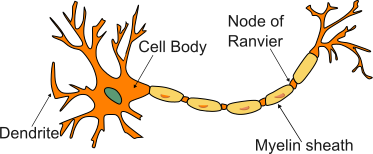
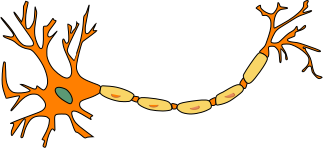
The diagram shows a neuron.

Which structure allows for rapid transmission of nerve impulses?

  1. Cell body
  2. Dendrites
  3. Myelin sheath
  4. Node of Ranvier
Show Answers Only

\(C\)

Show Worked Solution
  • C is correct: The myelin sheath insulates the axon and allows for saltatory conduction, enabling rapid transmission of nerve impulses.

Other Options:

  • A is incorrect: Processes information but doesn’t speed transmission
  • B is incorrect: Receive signals but don’t speed transmission
  • D is incorrect: Gaps in myelin, don’t provide insulation

Filed Under: Nervous System Tagged With: Band 5, smc-5525-10-Structure-function

HMS, BM EQ-Bank 90 MC

A netball player lands awkwardly and twists their ankle. Which immediate response helps protect from further injury?

  1. Withdrawal reflex action
  2. Conscious decision to stop moving
  3. Balanced muscle contraction
  4. Reciprocal inhibition
Show Answers Only

\(A\)

Show Worked Solution
  • A is correct: The withdrawal reflex is an immediate protective response that occurs before conscious thought, helping prevent further injury.

Other Options:

  • B is incorrect: Too slow to prevent injury
  • C is incorrect: A controlled response that occurs too slowly
  • D is incorrect: A normal movement process, not protective

Filed Under: Nervous System Tagged With: Band 4, smc-5525-10-Structure-function

HMS, BM EQ-Bank 89 MC

During a tennis serve, what is the correct sequence of nervous system processes?

  1. Motor response → Processing → Sensory input
  2. Processing → Sensory input → Motor response
  3. Sensory input → Processing → Motor response
  4. Sensory input → Motor response → Processing
Show Answers Only

\(C\)

Show Worked Solution
  • C is correct: This sequence involves receiving sensory information (seeing the ball), processing in the central nervous system, then sending motor signals to muscles.

Other Options:

  • A is incorrect: Incorrect sequence – Output cannot occur before processing.
  • B is incorrect: Processing cannot occur before receiving sensory input.
  • D is incorrect: Processing must occur between input and output for coordinated movement.

Filed Under: Nervous System Tagged With: Band 3, smc-5525-10-Structure-function

HMS, BM EQ-Bank 88 MC

Which part of the nervous system is primarily responsible for controlling voluntary muscle movement?

  1. Peripheral nervous system
  2. Somatic nervous system
  3. Autonomic nervous system
  4. Sympathetic nervous system
Show Answers Only

\(B\)

Show Worked Solution
  • B is correct: The somatic nervous system controls voluntary muscle movements through motor neurons that innervate skeletal muscles.

Other Options:

  • A is incorrect: Too broad, includes both somatic and autonomic systems
  • C is incorrect: Controls involuntary functions like heart rate 
  • D is incorrect: Part of autonomic system, fight/flight response only

Filed Under: Nervous System Tagged With: Band 4, smc-5525-10-Structure-function

HMS, BM EQ-Bank 87

Describe how the endocrine system's release of cortisol affects an athlete's movement efficiency during periods of prolonged stress.   (3 marks)

--- 7 WORK AREA LINES (style=lined) ---

Show Answers Only

Sample Answer

  • Cortisol released by the adrenal glands increases blood glucose levels to provide energy for movement during stress.
  • Prolonged high cortisol levels can break down muscle protein for energy, potentially reducing movement efficiency and strength.
  • Extended periods of elevated cortisol can lead to fatigue and decreased performance as energy systems become depleted.
  • Chronic cortisol elevation also suppresses growth hormone, impairing muscle recovery and adaptation to training.
Show Worked Solution

Sample Answer

  • Cortisol released by the adrenal glands increases blood glucose levels to provide energy for movement during stress.
  • Prolonged high cortisol levels can break down muscle protein for energy, potentially reducing movement efficiency and strength.
  • Extended periods of elevated cortisol can lead to fatigue and decreased performance as energy systems become depleted.
  • Chronic cortisol elevation also suppresses growth hormone, impairing muscle recovery and adaptation to training.

Filed Under: Digestive and endocrine systems Tagged With: Band 3, smc-5524-10-Stress

HMS, BM EQ-Bank 86

Outline how the digestive system responds to acute stress during participation in a competitive sports event.  (3 marks)

--- 7 WORK AREA LINES (style=lined) ---

Show Answers Only

Sample Answer

  • Slowed/stopped digestion: The digestive system slows down or stops digestion as blood is diverted to muscles and vital organs during the stress response.
  • Decreased saliva production: The mouth becomes dry as saliva production decreases, making it harder to digest food during competition.
  • Nausea/stomach discomfort: Stress hormones can cause nausea or “butterflies” in the stomach as the digestive system responds to the fight or flight response.
Show Worked Solution

Sample Answer

  • Slowed/stopped digestion: The digestive system slows down or stops digestion as blood is diverted to muscles and vital organs during the stress response.
  • Decreased saliva production: The mouth becomes dry as saliva production decreases, making it harder to digest food during competition.
  • Nausea/stomach discomfort: Stress hormones can cause nausea or “butterflies” in the stomach as the digestive system responds to the fight or flight response.

Filed Under: Digestive and endocrine systems Tagged With: Band 3, smc-5524-10-Stress

HMS, BM EQ-Bank 85 MC

Which statement best describes how protein intake affects the endocrine system's ability to support movement?

  1. The thyroid gland increases metabolism to break down protein for immediate energy
  2. The adrenal glands produce adrenaline to convert protein into glucose during exercise
  3. The pituitary gland releases growth hormone to store protein as fat for later use
  4. The pancreas releases insulin to help transport amino acids to muscles for repair
Show Answers Only

\(D\)

Show Worked Solution
  • D is correct: Insulin from the pancreas facilitates amino acid transport to muscles for repair and growth.

Other Options:

  • A is incorrect: Protein isn’t used for immediate energy; this is primarily carbohydrates’ role.
  • B is incorrect: Adrenaline mobilises glucose from glycogen, not from protein conversion.
  • C is incorrect: Growth hormone aids protein synthesis, not storage as fat.

Filed Under: Digestive and endocrine systems Tagged With: Band 3, smc-5524-20-Micro/Macro nutrients

HMS, BM EQ-Bank 84

Describe how the interaction between fat-soluble vitamins and dietary fats impacts movement efficiency. In your response, refer to specific examples.   (5 marks)

--- 15 WORK AREA LINES (style=lined) ---

Show Answers Only

Sample Answer

Fat-dependent absorption:

  • The digestive system requires dietary fats to effectively absorb fat-soluble vitamins (A, D, E, K), showing the critical interrelationship between nutrient absorption and movement.
  • Without adequate dietary fat, these vitamins remain unabsorbed in the intestine, regardless of intake levels.

Vitamin D example:

  • Vitamin D absorbed through this fat-dependent process enables calcium absorption for bone health and muscle contraction.
  • Athletes consuming vitamin D with fatty meals show 30% better absorption than with low-fat meals, directly improving movement quality.

Hormonal function:

  • The endocrine system uses vitamin D as a hormone influencing muscle strength and neuromuscular coordination.
  • Optimal levels enhance muscle protein synthesis and power output, while deficiency causes weakness and increased injury risk.

Vitamin E example:

  • Vitamin E acts as an antioxidant protecting muscle cell membranes from exercise-induced damage.
  • Its absorption through the digestive system requires dietary fats, particularly from nuts, seeds and oils consumed with meals.

Performance impact:

  • Antioxidant protection maintains muscle integrity during intense movement, supporting sustained performance and faster recovery between training sessions.
Show Worked Solution

Sample Answer

Fat-dependent absorption:

  • The digestive system requires dietary fats to effectively absorb fat-soluble vitamins (A, D, E, K), showing the critical interrelationship between nutrient absorption and movement.
  • Without adequate dietary fat, these vitamins remain unabsorbed in the intestine, regardless of intake levels.

Vitamin D example:

  • Vitamin D absorbed through this fat-dependent process enables calcium absorption for bone health and muscle contraction.
  • Athletes consuming vitamin D with fatty meals show 30% better absorption than with low-fat meals, directly improving movement quality.

Hormonal function:

  • The endocrine system uses vitamin D as a hormone influencing muscle strength and neuromuscular coordination.
  • Optimal levels enhance muscle protein synthesis and power output, while deficiency causes weakness and increased injury risk.

Vitamin E example:

  • Vitamin E acts as an antioxidant protecting muscle cell membranes from exercise-induced damage.
  • Its absorption through the digestive system requires dietary fats, particularly from nuts, seeds and oils consumed with meals.

Performance impact:

  • Antioxidant protection maintains muscle integrity during intense movement, supporting sustained performance and faster recovery between training sessions.

Filed Under: Digestive and endocrine systems Tagged With: Band 4, Band 5, smc-5524-20-Micro/Macro nutrients

HMS, BM EQ-Bank 83

Discuss how protein intake affects muscle function and movement efficiency. Include reference to timing of intake in your response.   (5 marks)

--- 15 WORK AREA LINES (style=lined) ---

Show Answers Only

*PEEL – Structure solution using separate PEEL methods for each side of the argument; [P] Identify the point, [E] expand on the point with a link to question asked, [Ev] apply evidence/examples, [L] linking sentence back to question.

Sample Answer

Benefits of adequate protein intake:

  • [P] On one hand, protein provides essential amino acids for muscle repair and growth.
  • [E] These building blocks rebuild muscle fibres damaged during exercise, enhancing strength.
  • [Ev] Consuming 20-30g protein within 30 minutes post-exercise maximises muscle protein synthesis.
  • [L] This demonstrates how proper timing optimises movement efficiency through faster recovery.
      
  •  [P] A key advantage is pre-exercise protein consumption maintains nitrogen balance during activity.
  • [E] This prevents muscle breakdown and preserves movement quality throughout training.
  • [Ev] Athletes consuming protein 2-3 hours before exercise show better endurance and power output.
  • [L] This timing strategy supports sustained movement efficiency.

Challenges of inadequate protein intake:

  • [P] From another angle, insufficient protein leads to incomplete muscle recovery between sessions.
  • [E] This results in progressive muscle loss and decreased movement capacity.
  • [Ev] Athletes consuming less than 1.2g/kg bodyweight show reduced strength gains and slower adaptation.
  • [L] Nevertheless, this reveals how protein deficiency directly impairs movement efficiency over time.
Show Worked Solution

*PEEL – Structure solution using separate PEEL methods for each side of the argument; [P] Identify the point, [E] expand on the point with a link to question asked, [Ev] apply evidence/examples, [L] linking sentence back to question.

Sample Answer

Benefits of adequate protein intake:

  • [P] On one hand, protein provides essential amino acids for muscle repair and growth.
  • [E] These building blocks rebuild muscle fibres damaged during exercise, enhancing strength.
  • [Ev] Consuming 20-30g protein within 30 minutes post-exercise maximises muscle protein synthesis.
  • [L] This demonstrates how proper timing optimises movement efficiency through faster recovery.
      
  •  [P] A key advantage is pre-exercise protein consumption maintains nitrogen balance during activity.
  • [E] This prevents muscle breakdown and preserves movement quality throughout training.
  • [Ev] Athletes consuming protein 2-3 hours before exercise show better endurance and power output.
  • [L] This timing strategy supports sustained movement efficiency.

Challenges of inadequate protein intake:

  • [P] From another angle, insufficient protein leads to incomplete muscle recovery between sessions.
  • [E] This results in progressive muscle loss and decreased movement capacity.
  • [Ev] Athletes consuming less than 1.2g/kg bodyweight show reduced strength gains and slower adaptation.
  • [L] Nevertheless, this reveals how protein deficiency directly impairs movement efficiency over time.

Filed Under: Digestive and endocrine systems Tagged With: Band 4, Band 5, smc-5524-20-Micro/Macro nutrients

HMS, BM EQ-Bank 82

Explain how carbohydrates as a macronutrient support efficient movement during both aerobic and anaerobic activities.   (4 marks)

--- 10 WORK AREA LINES (style=lined) ---

Show Answers Only

Sample Answer

  • Carbohydrates are the most versatile fuel because they can provide energy with or without oxygen present. 
  • During aerobic activities, stored carbohydrates break down slowly which allows steady energy production for long-distance running and sustained movement.
  • For anaerobic activities, carbohydrates provide quick energy without needing oxygen, thus enabling explosive power for sprinting and jumping.
  • This flexibility occurs because carbohydrates can be used by different energy systems, therefore supporting both endurance and power activities effectively.
Show Worked Solution

Sample Answer

  • Carbohydrates are the most versatile fuel because they can provide energy with or without oxygen present. 
  • During aerobic activities, stored carbohydrates break down slowly which allows steady energy production for long-distance running and sustained movement.
  • For anaerobic activities, carbohydrates provide quick energy without needing oxygen, thus enabling explosive power for sprinting and jumping.
  • This flexibility occurs because carbohydrates can be used by different energy systems, therefore supporting both endurance and power activities effectively.

Filed Under: Nutrition and energy systems Tagged With: Band 4, smc-5524-20-Micro/Macro nutrients

HMS, BM EQ-Bank 81 MC

A netball player has been diagnosed with low iron levels.
Which macronutrient combination would best support iron absorption to improve their movement efficiency?

  1. Lean red meat with leafy green vegetables
  2. Brown rice with kidney beans
  3. Yoghurt with fresh fruit
  4. Pasta with cheese sauce
Show Answers Only

\(A\)

Show Worked Solution
  • A is correct: Red meat provides haem iron; vitamin C from vegetables enhances iron absorption.

Other Options:

  • B is incorrect: Contains only non-haem iron which is less readily absorbed; lacks vitamin C.
  • C is incorrect: Dairy calcium can inhibit iron absorption despite vitamin C from fruit.
  • D is incorrect: Minimal iron content; calcium in cheese inhibits iron absorption.

Filed Under: Digestive and endocrine systems Tagged With: Band 5, smc-5524-20-Micro/Macro nutrients

HMS, BM EQ-Bank 80 MC

Which of the following correctly identifies the role of micronutrients in supporting an athlete's movement efficiency?

  1. Providing immediate energy for muscle contractions
  2. Supporting enzyme production and oxygen transport
  3. Storing energy for prolonged exercise sessions
  4. Building and repairing damaged muscle tissue
Show Answers Only

\(B\)

Show Worked Solution
  • B is correct: Micronutrients like B vitamins and iron support enzyme function and oxygen transport for movement.

Other Options:

  • A is incorrect: Energy provision is the role of macronutrients (carbohydrates, fats).
  • C is incorrect: Energy storage is a macronutrient function (fats, carbohydrates).
  • D is incorrect: Muscle building is primarily protein’s role, a macronutrient.

Filed Under: Digestive and endocrine systems Tagged With: Band 4, smc-5524-20-Micro/Macro nutrients

HMS, BM EQ-Bank 79

Evaluate how vitamin D status affects the interrelationship between endocrine function and calcium absorption during resistance training.   (8 marks)

--- 24 WORK AREA LINES (style=lined) ---

Show Answers Only

Sample Answer

Evaluation Statement:

  • Vitamin D status significantly affects the endocrine-calcium relationship during resistance training.
  • This evaluation examines hormonal effects and absorption efficiency.

Hormonal Effects:

  • Vitamin D acts as a hormone in the endocrine system controlling calcium regulation.
  • It triggers release of parathyroid hormone when blood calcium is low.
  • This hormone increases calcium release from bones for muscle contraction.
  • During resistance training, adequate vitamin D ensures proper hormone signalling.
  • Evidence shows athletes with optimal vitamin D have 25% better muscle strength.
  • This strongly meets the criterion of supporting hormonal function for performance.

Absorption Efficiency:

  • The digestive system requires vitamin D to absorb calcium from food.
  • Vitamin D enables special transport proteins in the intestine to capture calcium.
  • Without adequate vitamin D, only 10-15% of dietary calcium absorbs.
  • With sufficient vitamin D, absorption increases to 30-40%.
  • Resistance training increases calcium needs for bone strengthening and muscle function.
  • This partially fulfils efficiency needs as absorption still has limits.

Final Evaluation:

  • Vitamin D status proves highly effective in connecting endocrine and digestive functions.
  • Adequate levels optimise both hormone signalling and calcium absorption essential for resistance training.
  • However, even optimal vitamin D cannot overcome very low dietary calcium intake.
  • Athletes must maintain both sufficient vitamin D and calcium consumption for maximum training benefits.
Show Worked Solution

Sample Answer

Evaluation Statement:

  • Vitamin D status significantly affects the endocrine-calcium relationship during resistance training.
  • This evaluation examines hormonal effects and absorption efficiency.

Hormonal Effects:

  • Vitamin D acts as a hormone in the endocrine system controlling calcium regulation.
  • It triggers release of parathyroid hormone when blood calcium is low.
  • This hormone increases calcium release from bones for muscle contraction.
  • During resistance training, adequate vitamin D ensures proper hormone signalling.
  • Evidence shows athletes with optimal vitamin D have 25% better muscle strength.
  • This strongly meets the criterion of supporting hormonal function for performance.

Absorption Efficiency:

  • The digestive system requires vitamin D to absorb calcium from food.
  • Vitamin D enables special transport proteins in the intestine to capture calcium.
  • Without adequate vitamin D, only 10-15% of dietary calcium absorbs.
  • With sufficient vitamin D, absorption increases to 30-40%.
  • Resistance training increases calcium needs for bone strengthening and muscle function.
  • This partially fulfils efficiency needs as absorption still has limits.

Final Evaluation:

  • Vitamin D status proves highly effective in connecting endocrine and digestive functions.
  • Adequate levels optimise both hormone signalling and calcium absorption essential for resistance training.
  • However, even optimal vitamin D cannot overcome very low dietary calcium intake.
  • Athletes must maintain both sufficient vitamin D and calcium consumption for maximum training benefits.

Filed Under: Digestive and endocrine systems Tagged With: Band 5, Band 6, smc-5524-15-Structure and function

HMS, BM EQ-Bank 78

Discuss the relationship between dehydration, digestive function and hormonal balance during a 400 m sprint race.   (8 marks)

--- 24 WORK AREA LINES (style=lined) ---

Show Answers Only

*PEEL – Structure solution using separate PEEL methods for each side of the argument; [P] Identify the point, [E] expand on the point with a link to question asked, [Ev] apply evidence/examples, [L] linking sentence back to question.

Sample Answer

Benefits of system responses:

  • [P] On one hand, stress hormones optimise performance by redirecting blood flow away from digestion.
  • [E] This ensures maximum oxygen and nutrient delivery to working muscles during the sprint.
  • [Ev] Adrenaline and cortisol shut down digestive processes, prioritising muscle function for explosive power.
  • [L] This demonstrates how hormonal changes support sprint performance through resource allocation.
      
  • [P] A key advantage is ADH (antidiuretic hormone) release helps preserve fluid balance during intense effort.
  • [E] This hormone reduces urine production to maintain blood volume despite sweating.
  • [Ev] Even in a short 400m race, ADH prevents excessive fluid loss that could impair performance.
  • [L] This shows how hormonal adaptations protect against dehydration’s negative effects.

Challenges of system responses:

  • [P] Turning to the opposing view, suppressed digestive function can cause gastrointestinal distress during sprinting.
  • [E] Reduced blood flow and halted digestion may trigger nausea or cramping.
  • [Ev] Athletes often experience “butterflies” or stomach discomfort that can affect focus and technique.
  • [L] This reveals how digestive shutdown, while necessary, creates performance challenges.
      
  • [P] From another angle, rapid dehydration and electrolyte loss disrupt hormonal signalling pathways.
  • [E] This interference affects muscle contraction efficiency and energy metabolism.
  • [Ev] Even 2% dehydration can impair sprint times through compromised neuromuscular function.
  • [L] Nevertheless, this demonstrates the delicate balance required between fluid status and hormonal control.
Show Worked Solution

*PEEL – Structure solution using separate PEEL methods for each side of the argument; [P] Identify the point, [E] expand on the point with a link to question asked, [Ev] apply evidence/examples, [L] linking sentence back to question.

Sample Answer

Benefits of system responses:

  • [P] On one hand, stress hormones optimise performance by redirecting blood flow away from digestion.
  • [E] This ensures maximum oxygen and nutrient delivery to working muscles during the sprint.
  • [Ev] Adrenaline and cortisol shut down digestive processes, prioritising muscle function for explosive power.
  • [L] This demonstrates how hormonal changes support sprint performance through resource allocation.
      
  • [P] A key advantage is ADH (antidiuretic hormone) release helps preserve fluid balance during intense effort.
  • [E] This hormone reduces urine production to maintain blood volume despite sweating.
  • [Ev] Even in a short 400m race, ADH prevents excessive fluid loss that could impair performance.
  • [L] This shows how hormonal adaptations protect against dehydration’s negative effects.

Challenges of system responses:

  • [P] Turning to the opposing view, suppressed digestive function can cause gastrointestinal distress during sprinting.
  • [E] Reduced blood flow and halted digestion may trigger nausea or cramping.
  • [Ev] Athletes often experience “butterflies” or stomach discomfort that can affect focus and technique.
  • [L] This reveals how digestive shutdown, while necessary, creates performance challenges.
      
  • [P] From another angle, rapid dehydration and electrolyte loss disrupt hormonal signalling pathways.
  • [E] This interference affects muscle contraction efficiency and energy metabolism.
  • [Ev] Even 2% dehydration can impair sprint times through compromised neuromuscular function.
  • [L] Nevertheless, this demonstrates the delicate balance required between fluid status and hormonal control.

Filed Under: Digestive and endocrine systems Tagged With: Band 4, Band 5, smc-5524-15-Structure and function

HMS, BM EQ-Bank 77

Analyse how iron deficiency could affect both the endocrine and digestive systems during endurance training.   (8 marks)

--- 26 WORK AREA LINES (style=lined) ---

Show Answers Only

Sample Answer

  • Iron deficiency affects thyroid hormone production in the endocrine system, which directly influences metabolic rate and energy production during endurance activities.
  • Athletes with low iron show decreased T3 and T4 levels, slowing cellular metabolism.
  • The relationship demonstrates how iron impacts hormonal control of energy systems essential for endurance performance.
      
  • The digestive system’s enzyme production depends on adequate iron levels.
  • Iron deficiency reduces the breakdown and absorption of nutrients from food.
  • Iron-deficient athletes often experience poor protein digestion and vitamin absorption despite adequate intake.
  • These patterns show how iron deficiency creates a cycle of poor nutrient availability.
      
  • Iron deficiency impairs the endocrine system’s stress response during training.
  • The relationship between iron and cortisol production influences adaptation to exercise stress.
  • Insufficient iron leads to abnormal cortisol patterns, hindering recovery between sessions.
  • Such connections reveal how micronutrient status affects hormonal adaptation pathways.
      
  • Both systems interact to compound the effects on endurance performance.
  • Poor digestion limits iron absorption while hormonal imbalances increase iron requirements.
  • A negative feedback loop develops where deficiency worsens despite dietary interventions.
  • The interrelationship indicates why iron deficiency severely impacts endurance athletes through multiple pathways.
  • Therefore, addressing iron status requires supporting both digestive and endocrine function simultaneously.
Show Worked Solution

Sample Answer

  • Iron deficiency affects thyroid hormone production in the endocrine system, which directly influences metabolic rate and energy production during endurance activities.
  • Athletes with low iron show decreased T3 and T4 levels, slowing cellular metabolism.
  • The relationship demonstrates how iron impacts hormonal control of energy systems essential for endurance performance.
      
  • The digestive system’s enzyme production depends on adequate iron levels.
  • Iron deficiency reduces the breakdown and absorption of nutrients from food.
  • Iron-deficient athletes often experience poor protein digestion and vitamin absorption despite adequate intake.
  • These patterns show how iron deficiency creates a cycle of poor nutrient availability.
      
  • Iron deficiency impairs the endocrine system’s stress response during training.
  • The relationship between iron and cortisol production influences adaptation to exercise stress.
  • Insufficient iron leads to abnormal cortisol patterns, hindering recovery between sessions.
  • Such connections reveal how micronutrient status affects hormonal adaptation pathways.
      
  • Both systems interact to compound the effects on endurance performance.
  • Poor digestion limits iron absorption while hormonal imbalances increase iron requirements.
  • A negative feedback loop develops where deficiency worsens despite dietary interventions.
  • The interrelationship indicates why iron deficiency severely impacts endurance athletes through multiple pathways.
  • Therefore, addressing iron status requires supporting both digestive and endocrine function simultaneously.

Filed Under: Digestive and endocrine systems Tagged With: Band 4, Band 5, smc-5524-15-Structure and function

HMS, BM EQ-Bank 76

Explain how growth hormone and cortisol interact during a high-intensity interval training session.  (5 marks)

--- 15 WORK AREA LINES (style=lined) ---

Show Answers Only

Sample Answer

  • During HIIT, the pituitary gland releases growth hormone while the adrenal glands secrete cortisol.
  • This dual hormone release creates competing effects on protein metabolism in muscle tissue.
  • Growth hormone stimulates muscle protein synthesis for repair and growth, while cortisol breaks down muscle protein for energy.
  • Therefore, the endocrine system balances anabolic and catabolic processes during intense exercise.
      
  • Both hormones work together to maintain energy availability during high-intensity intervals.
  • Growth hormone promotes fat breakdown for fuel while cortisol increases glucose production through gluconeogenesis.
  • As a result, muscles receive both fatty acids and glucose to meet extreme energy demands.
  • The interaction demonstrates how multiple hormones coordinate to support intense movement.
      
  • Timing and balance of these hormones affects training outcomes.
  • Excessive cortisol can override growth hormone’s benefits if stress is prolonged.
  • Short HIIT sessions optimise growth hormone release while minimising excessive cortisol elevation.
  • Consequently, HIIT duration and recovery prove critical for positive adaptations.
Show Worked Solution

Sample Answer

  • During HIIT, the pituitary gland releases growth hormone while the adrenal glands secrete cortisol.
  • This dual hormone release creates competing effects on protein metabolism in muscle tissue.
  • Growth hormone stimulates muscle protein synthesis for repair and growth, while cortisol breaks down muscle protein for energy.
  • Therefore, the endocrine system balances anabolic and catabolic processes during intense exercise.
      
  • Both hormones work together to maintain energy availability during high-intensity intervals.
  • Growth hormone promotes fat breakdown for fuel while cortisol increases glucose production through gluconeogenesis.
  • As a result, muscles receive both fatty acids and glucose to meet extreme energy demands.
  • The interaction demonstrates how multiple hormones coordinate to support intense movement.
      
  • Timing and balance of these hormones affects training outcomes.
  • Excessive cortisol can override growth hormone’s benefits if stress is prolonged.
  • Short HIIT sessions optimise growth hormone release while minimising excessive cortisol elevation.
  • Consequently, HIIT duration and recovery prove critical for positive adaptations.

Filed Under: Digestive and endocrine systems Tagged With: Band 3, Band 4, smc-5524-15-Structure and function

HMS, BM EQ-Bank 75

Describe the impact of exercise-induced thermal stress on digestive enzyme production.   (3 marks)

--- 7 WORK AREA LINES (style=lined) ---

Show Answers Only

Sample Answer

Exercise-induced thermal stress affects digestive enzyme production by:

  • Reducing pancreatic secretion: Because blood flow diverts to working muscles, reduced secretion of digestive enzymes by the pancreas occurs.
  • Decreasing salivary amylase: Initial carbohydrate breakdown is less efficient due to decreased salivary amylase.
  • Impairing enzyme efficiency: Existing enzyme efficiency becomes impaired due to altered temperature conditions.
  • Slowing overall digestive processes: As the body prioritises cooling and muscle function overall digestive processes are slowed.

These changes can affect nutrient breakdown during and after exercise, potentially leading to digestive discomfort.

Show Worked Solution

Sample Answer

Exercise-induced thermal stress affects digestive enzyme production by:

  • Reducing pancreatic secretion: Because blood flow diverts to working muscles, reduced secretion of digestive enzymes by the pancreas occurs.
  • Decreasing salivary amylase: Initial carbohydrate breakdown is less efficient due to decreased salivary amylase.
  • Impairing enzyme efficiency: Existing enzyme efficiency becomes impaired due to altered temperature conditions.
  • Slowing overall digestive processes: As the body prioritises cooling and muscle function overall digestive processes are slowed.

These changes can affect nutrient breakdown during and after exercise, potentially leading to digestive discomfort.

Filed Under: Digestive and endocrine systems Tagged With: Band 3, smc-5524-10-Stress

HMS, BM EQ-Bank 74 MC

A badminton player in a five-set match shows declining performance. Which combination of factors most likely explains this?

  1. Increased insulin, reduced glucose uptake
  2. Elevated cortisol, impaired digestion
  3. Enhanced adrenaline, improved absorption
  4. Decreased glucagon, enhanced nutrient storage
Show Answers Only

\(B\)

Show Worked Solution
  • B is correct: Prolonged stress hormones (cortisol) impair digestive function and energy availability.

Other Options:

  • A is incorrect: Insulin decreases during exercise to maintain glucose availability.
  • C is incorrect: Absorption decreases, not improves, during intense exercise.
  • D is incorrect: Glucagon increases during exercise; nutrient storage doesn’t occur during activity.

Filed Under: Digestive and endocrine systems Tagged With: Band 6, smc-5524-15-Structure and function

HMS, BM EQ-Bank 73 MC

Which statement best explains how chronic stress affects zinc absorption?

  1. Increases intestinal permeability
  2. Reduces absorption efficiency
  3. Enhances enzyme production
  4. Improves nutrient transport
Show Answers Only

\(B\)

Show Worked Solution
  • B is correct: Chronic stress impairs digestive function, reducing nutrient absorption efficiency.

Other Options:

  • A is incorrect: While stress can affect gut permeability, this doesn’t improve zinc absorption.
  • C is incorrect: Stress decreases, not enhances, digestive enzyme production.
  • D is incorrect: Stress impairs rather than improves nutrient transport.

Filed Under: Digestive and endocrine systems Tagged With: Band 5, smc-5524-10-Stress

HMS, BM EQ-Bank 72 MC

During a two-hour mountain bike ride, which process would support sustained energy release?

  1. Enhanced glucagon production
  2. Decreased liver glycogen breakdown
  3. Increased insulin secretion
  4. Reduced cortisol release
Show Answers Only

\(A\)

Show Worked Solution
  • A is correct: Glucagon promotes glycogen breakdown to maintain blood glucose during prolonged exercise.

Other Options:

  • B is incorrect: Glycogen breakdown must increase, not decrease, for energy supply.
  • C is incorrect: Insulin decreases during exercise to allow glucose mobilisation.
  • D is incorrect: Cortisol increases during prolonged exercise to support energy metabolism.

Filed Under: Digestive and endocrine systems Tagged With: Band 4, smc-5524-15-Structure and function

HMS, BM EQ-Bank 71 MC

A triathlete experiences stomach cramps in the final leg of their race. This is most likely due to:

  1. Excess enzyme production
  2. Reduced digestive activity
  3. Increased blood flow to the gut
  4. Enhanced nutrient absorption
Show Answers Only

\(B\)

Show Worked Solution
  • B is correct. Blood diverts from digestive system to muscles during exercise, reducing digestive function.

Other Options:

  • A is incorrect: Enzyme production decreases, not increases, during intense exercise.
  • C is incorrect: Blood flow diverts away from gut to muscles during exercise.
  • D is incorrect: Absorption decreases due to reduced blood flow to digestive organs.

Filed Under: Digestive and endocrine systems Tagged With: Band 4, smc-5524-15-Structure and function

HMS, BM EQ-Bank 70 MC

An archer notices their hands shaking before competition. This response is primarily caused by which hormone?

  1. Insulin
  2. Thyroxine
  3. Epinephrine
  4. Growth hormone
Show Answers Only

\(C\)

Show Worked Solution
  • C is correct: Epinephrine causes trembling during stress through sympathetic nervous system activation.

Other Options:

  • A is incorrect: Insulin lowers blood glucose, not involved in stress response.
  • B is incorrect: Thyroxine affects metabolism, not acute stress symptoms.
  • D is incorrect: Growth hormone aids tissue repair, not stress responses.

Filed Under: Digestive and endocrine systems Tagged With: Band 3, smc-5524-10-Stress

HMS, BM EQ-Bank 69

Compare and contrast the effects of peripheral arterial disease and deep vein thrombosis on movement performance, and outline appropriate exercise modifications for each condition.   (5 marks)

--- 16 WORK AREA LINES (style=lined) ---

Show Answers Only

Sample Answer

Similarities:

  • Both conditions affect blood vessels and impair circulation to the legs.
  • Both cause leg pain that limits movement performance.
  • Both require medical clearance before exercise participation.
  • Both need careful monitoring during physical activity.

Differences:

  • PAD affects arteries (oxygen delivery) while DVT affects veins (blood return).
  • PAD pain is predictable during exertion; DVT pain is constant with swelling.
  • PAD allows intermittent exercise; DVT initially restricts all leg movement.
  • PAD pain resolves with rest; DVT poses clot migration risk during activity.

Exercise Modifications for PAD:

  • Use interval training with rest when claudication pain occurs.
  • Maintain moderate intensity (40-60% HRmax).
  • Progress walking duration gradually as tolerance improves.

Exercise Modifications for DVT:

  • Begin with upper body exercises only until medically cleared.
  • Start with very low intensity (20-30% HRmax).
  • Progress slowly from seated to standing to walking activities.
  • Avoid high-impact activities that could dislodge clots.
Show Worked Solution

Sample Answer

Similarities:

  • Both conditions affect blood vessels and impair circulation to the legs.
  • Both cause leg pain that limits movement performance.
  • Both require medical clearance before exercise participation.
  • Both need careful monitoring during physical activity.

Differences:

  • PAD affects arteries (oxygen delivery) while DVT affects veins (blood return).
  • PAD pain is predictable during exertion; DVT pain is constant with swelling.
  • PAD allows intermittent exercise; DVT initially restricts all leg movement.
  • PAD pain resolves with rest; DVT poses clot migration risk during activity.

Exercise Modifications for PAD:

  • Use interval training with rest when claudication pain occurs.
  • Maintain moderate intensity (40-60% HRmax).
  • Progress walking duration gradually as tolerance improves.

Exercise Modifications for DVT:

  • Begin with upper body exercises only until medically cleared.
  • Start with very low intensity (20-30% HRmax).
  • Progress slowly from seated to standing to walking activities.
  • Avoid high-impact activities that could dislodge clots.

Filed Under: Respiratory and circulatory systems Tagged With: Band 4, smc-5523-20-Efficiency

HMS, BM EQ-Bank 68

Analyse how iron deficiency anemia impacts both submaximal and maximal exercise performance, and explain two strategies that could be implemented to minimise these effects.   (8 marks)

--- 22 WORK AREA LINES (style=lined) ---

Show Answers Only

Sample Answer

Overview Statement

  • Iron deficiency anaemia significantly impairs exercise performance by reducing oxygen transport capacity.
  • Key components include haemoglobin levels, oxygen delivery, and exercise intensity.
  • The implications differ between submaximal and maximal exercise.

Submaximal Exercise Impact

  • Iron deficiency reduces haemoglobin production, which decreases oxygen-carrying capacity.
  • The cardiovascular system compensates by increasing heart rate at lower exercise intensities.
  • Athletes experience higher heart rates for the same workload compared to healthy individuals.
  • Such compensation reveals how reduced oxygen transport forces the body to work harder.

Maximal Exercise Impact

  • Peak performance depends on maximum oxygen uptake, which directly relates to haemoglobin levels.
  • Lower haemoglobin results in reduced VO₂ max and earlier onset of fatigue.
  • The aerobic system cannot compensate, forcing reliance on anaerobic metabolism.
  • These limitations demonstrate that oxygen transport is the limiting factor in maximal performance.

Strategy 1: Iron Supplementation

  • Daily iron supplements address the root cause by rebuilding haemoglobin stores.
  • Combining iron with vitamin C enhances absorption and recovery speed.
  • This interaction optimises the restoration of oxygen-carrying capacity.

Strategy 2: Training Modification

  • Reducing exercise intensity prevents excessive cardiovascular strain during recovery.
  • Gradual progression allows haemoglobin levels to restore while maintaining fitness.
  • Together, these nutrients optimise the restoration of oxygen-carrying capacity.
Show Worked Solution

Overview Statement

  • Iron deficiency anaemia significantly impairs exercise performance by reducing oxygen transport capacity.
  • Key components include haemoglobin levels, oxygen delivery, and exercise intensity.
  • The implications differ between submaximal and maximal exercise.

Submaximal Exercise Impact

  • Iron deficiency reduces haemoglobin production, which decreases oxygen-carrying capacity.
  • The cardiovascular system compensates by increasing heart rate at lower exercise intensities.
  • Athletes experience higher heart rates for the same workload compared to healthy individuals.
  • Such compensation reveals how reduced oxygen transport forces the body to work harder.

Maximal Exercise Impact

  • Peak performance depends on maximum oxygen uptake, which directly relates to haemoglobin levels.
  • Lower haemoglobin results in reduced VO₂ max and earlier onset of fatigue.
  • The aerobic system cannot compensate, forcing reliance on anaerobic metabolism.
  • These limitations demonstrate that oxygen transport is the limiting factor in maximal performance.

Strategy 1: Iron Supplementation

  • Daily iron supplements address the root cause by rebuilding haemoglobin stores.
  • Combining iron with vitamin C enhances absorption and recovery speed.
  • This interaction optimises the restoration of oxygen-carrying capacity.

Strategy 2: Training Modification

  • Reducing exercise intensity prevents excessive cardiovascular strain during recovery.
  • Gradual progression allows haemoglobin levels to restore while maintaining fitness.
  • Together, these nutrients optimise the restoration of oxygen-carrying capacity.

Filed Under: Respiratory and circulatory systems Tagged With: Band 4, Band 5, smc-5523-20-Efficiency

HMS, BM EQ-Bank 67

Explain how the cardiovascular system adapts to exercise at altitude (2500 metres) over both short-term (24 - 48 hours) and long-term (3+ weeks) periods.   (5 marks)

--- 16 WORK AREA LINES (style=lined) ---

Show Answers Only

Sample Answer

  • Reduced oxygen pressure at altitude triggers immediate cardiovascular responses within 24-48 hours.
  • Heart rate increases because the body needs to circulate blood faster to compensate for lower oxygen content.
  • Cardiac output also rises through increased stroke volume, ensuring tissues receive adequate oxygen supply.
  • These short-term changes maintain oxygen delivery to vital organs despite the thinner air.
  • Breathing rate accelerates in response to chemoreceptors detecting lower blood oxygen levels.
  • After several days, low oxygen levels stimulate the kidneys to produce EPO (erythropoietin).
  • EPO signals bone marrow to increase red blood cell production, which begins the long-term adaptation process.
  • Over 3-4 weeks, red blood cell count rises significantly, enhancing the blood’s oxygen-carrying capacity.
  • Increased haemoglobin concentration results from these higher red blood cell numbers.
  • More haemoglobin molecules enable better oxygen binding from each breath of thin air.
  • Blood vessels in tissues also increase through capillarisation, improving oxygen delivery at the cellular level.
  • Long-term adaptations therefore compensate for reduced atmospheric oxygen, allowing sustained performance at altitude.
Show Worked Solution

Sample Answer

  • Reduced oxygen pressure at altitude triggers immediate cardiovascular responses within 24-48 hours.
  • Heart rate increases because the body needs to circulate blood faster to compensate for lower oxygen content.
  • Cardiac output also rises through increased stroke volume, ensuring tissues receive adequate oxygen supply.
  • These short-term changes maintain oxygen delivery to vital organs despite the thinner air.
  • Breathing rate accelerates in response to chemoreceptors detecting lower blood oxygen levels.
  • After several days, low oxygen levels stimulate the kidneys to produce EPO (erythropoietin).
  • EPO signals bone marrow to increase red blood cell production, which begins the long-term adaptation process.
  • Over 3-4 weeks, red blood cell count rises significantly, enhancing the blood’s oxygen-carrying capacity.
  • Increased haemoglobin concentration results from these higher red blood cell numbers.
  • More haemoglobin molecules enable better oxygen binding from each breath of thin air.
  • Blood vessels in tissues also increase through capillarisation, improving oxygen delivery at the cellular level.
  • Long-term adaptations therefore compensate for reduced atmospheric oxygen, allowing sustained performance at altitude.

Filed Under: Respiratory and circulatory systems Tagged With: Band 5, Band 6, smc-5523-20-Efficiency

HMS, BM EQ-Bank 66 MC

Which vascular condition most directly impacts exercise performance through reduced blood flow to working muscles?

  1. Peripheral arterial disease
  2. Deep vein thrombosis
  3. Varicose veins
  4. High blood pressure
Show Answers Only

\(A\)

Show Worked Solution
  • A is correct: PAD directly reduces blood flow to muscles through arterial narrowing.

Other Options:

  • B is incorrect: DVT affects deep veins, not arterial supply to muscles.
  • C is incorrect: Affects superficial veins, minimal impact on muscle blood flow.
  • D is incorrect: While it affects circulation, doesn’t directly reduce blood flow.

Filed Under: Respiratory and circulatory systems Tagged With: Band 4, smc-5523-20-Efficiency

HMS, BM EQ-Bank 65 MC

An athlete with iron deficiency anemia would most likely experience: 

  1. Decreased stroke volume only
  2. Decreased ventilation rate only
  3. Increased blood pressure and decreased cardiac output
  4. Increased heart rate and decreased oxygen carrying capacity
Show Answers Only

\(D\)

Show Worked Solution
  • D is correct. Lower haemoglobin leads to reduced oxygen carrying capacity, heart rate increases to compensate.

Other Options:

  • A is incorrect: Stroke volume isn’t directly affected by iron deficiency.
  • B is incorrect: Capillarisation is a long-term adaptation.
  • C is incorrect: Blood pressure typically decreases in anemia.

Filed Under: Respiratory and circulatory systems Tagged With: Band 5, smc-5523-20-Efficiency

HMS, BM EQ-Bank 64 MC

During exercise at high altitude (3000 metres above sea level), which of the following adaptations occurs first in the body?

  1. Increased production of red blood cells
  2. Increased breathing rate and depth
  3. Increased cardiac output
  4. Increased capillarisation
Show Answers Only

\(B\)

Show Worked Solution
  • B is correct: The immediate response to high altitude is hyperventilation to compensate for lower oxygen partial pressure

Other Options:

  • A is incorrect: RBC production (erythropoiesis) takes several days to weeks
  • C is incorrect: While cardiac output increases, it’s secondary to respiratory changes
  • D is incorrect: Capillarisation is a long-term adaptation

Filed Under: Respiratory and circulatory systems Tagged With: Band 4, smc-5523-20-Efficiency

HMS, BM EQ-Bank 63

Analyse how the interrelationship between the respiratory and circulatory systems can contribute to improved endurance performance in athletes.   (8 marks)

--- 22 WORK AREA LINES (style=lined) ---

Show Answers Only

Sample Answer

Overview Statement

  • The respiratory and circulatory systems demonstrate interconnected adaptations that enhance endurance performance.
  • Key components include lung capacity, oxygen transport, gas exchange efficiency, and cellular adaptations.
  • Performance improvements result from the synergistic relationship between both systems.

Respiratory Adaptations and Oxygen Uptake

  • Training increases vital capacity and breathing efficiency, enhancing oxygen uptake at the alveolar level.
  • Stronger respiratory muscles enable sustained ventilation during prolonged exercise.
  • Greater lung volumes allow more air to be processed with each breath.
  • Enhanced respiratory function provides the foundation for improved oxygen availability.

Circulatory Adaptations and Delivery

  • Increased stroke volume and capillarisation improve oxygen transport to working muscles.
  • Higher stroke volume means more blood pumped per heartbeat.
  • Denser capillary networks create greater surface area for oxygen delivery.
  • Circulatory improvements directly interact with respiratory gains for compound benefits.

System Integration and Efficiency

  • Ventilation-perfusion matching becomes more precise through training, optimising gas exchange.
  • Blood flow aligns with alveolar ventilation at the lung level.
  • Trained athletes extract more oxygen from each breath due to improved matching.
  • Such synchronisation demonstrates true system integration for performance enhancement.

Implications for Endurance Performance

  • Mitochondrial density increases in response to improved oxygen delivery.
  • Both systems demonstrate reciprocal enhancement through training adaptations.
  • Respiratory improvements enable greater circulatory adaptations and vice versa.
  • Interdependence between systems multiplies individual gains for superior endurance capacity.
Show Worked Solution

Sample Answer

Overview Statement

  • The respiratory and circulatory systems demonstrate interconnected adaptations that enhance endurance performance.
  • Key components include lung capacity, oxygen transport, gas exchange efficiency, and cellular adaptations.
  • Performance improvements result from the synergistic relationship between both systems.

Respiratory Adaptations and Oxygen Uptake

  • Training increases vital capacity and breathing efficiency, enhancing oxygen uptake at the alveolar level.
  • Stronger respiratory muscles enable sustained ventilation during prolonged exercise.
  • Greater lung volumes allow more air to be processed with each breath.
  • Enhanced respiratory function provides the foundation for improved oxygen availability.

Circulatory Adaptations and Delivery

  • Increased stroke volume and capillarisation improve oxygen transport to working muscles.
  • Higher stroke volume means more blood pumped per heartbeat.
  • Denser capillary networks create greater surface area for oxygen delivery.
  • Circulatory improvements directly interact with respiratory gains for compound benefits.

System Integration and Efficiency

  • Ventilation-perfusion matching becomes more precise through training, optimising gas exchange.
  • Blood flow aligns with alveolar ventilation at the lung level.
  • Trained athletes extract more oxygen from each breath due to improved matching.
  • Such synchronisation demonstrates true system integration for performance enhancement.

Implications for Endurance Performance

  • Mitochondrial density increases in response to improved oxygen delivery.
  • Both systems demonstrate reciprocal enhancement through training adaptations.
  • Respiratory improvements enable greater circulatory adaptations and vice versa.
  • Interdependence between systems multiplies individual gains for superior endurance capacity.

Filed Under: Respiratory and circulatory systems Tagged With: Band 5, Band 6, smc-5523-15-Blood flow-gas exchange

HMS, BM EQ-Bank 62

Explain how the respiratory and circulatory systems work together to support an athlete during a 5 kilometre run.   (6 marks)

--- 18 WORK AREA LINES (style=lined) ---

Show Answers Only
  • During a 5km run, increased muscle activity creates higher oxygen demand, which triggers the respiratory system to increase breathing rate and depth.
  • This enhanced ventilation allows more oxygen to reach the alveoli for gas exchange.
  • Simultaneously, the circulatory system increases heart rate and stroke volume, resulting in greater cardiac output.
  • These cardiovascular changes facilitate more oxygenated blood to be delivered to working muscles.
  • Gas exchange intensifies at the alveoli, where oxygen diffuses from air to blood due to concentration gradients.
  • The increased blood flow creates optimal conditions for oxygen uptake in the lungs.
  • At muscle capillaries, oxygen diffuses from blood to tissues, while carbon dioxide moves in the opposite direction.
  • This continuous exchange cycle ensures sustained aerobic energy production throughout the run.
  • Both systems adjust breathing and heart rate proportionally to exercise intensity, maintaining adequate oxygen supply.
  • As a result, the coordinated response of both systems enables the athlete to sustain performance during the 5km run.
Show Worked Solution
  • During a 5km run, increased muscle activity creates higher oxygen demand, which triggers the respiratory system to increase breathing rate and depth.
  • This enhanced ventilation allows more oxygen to reach the alveoli for gas exchange.
  • Simultaneously, the circulatory system increases heart rate and stroke volume, resulting in greater cardiac output.
  • These cardiovascular changes facilitate more oxygenated blood to be delivered to working muscles.
  • Gas exchange intensifies at the alveoli, where oxygen diffuses from air to blood due to concentration gradients.
  • The increased blood flow creates optimal conditions for oxygen uptake in the lungs.
  • At muscle capillaries, oxygen diffuses from blood to tissues, while carbon dioxide moves in the opposite direction.
  • This continuous exchange cycle ensures sustained aerobic energy production throughout the run.
  • Both systems adjust breathing and heart rate proportionally to exercise intensity, maintaining adequate oxygen supply.
  • As a result, the coordinated response of both systems enables the athlete to sustain performance during the 5km run.

Filed Under: Respiratory and circulatory systems Tagged With: Band 4, Band 5, smc-5523-15-Blood flow-gas exchange

HMS, BM EQ-Bank 61

Outline how gaseous exchange occurs in the alveoli during submaximal exercise.   (3 marks)

--- 6 WORK AREA LINES (style=lined) ---

Show Answers Only

Sample Answer

During submaximal exercise:

  • Oxygen diffuses from high concentration in the alveoli to low concentration in the pulmonary capillaries.
  • Simultaneously, carbon dioxide diffuses from high concentration in the blood to low concentration in the alveoli.
  • This process is enhanced by the thin walls of both alveoli and capillaries, and the large surface area provided by millions of alveoli.
Show Worked Solution

Sample Answer

During submaximal exercise:

  • Oxygen diffuses from high concentration in the alveoli to low concentration in the pulmonary capillaries.
  • Simultaneously, carbon dioxide diffuses from high concentration in the blood to low concentration in the alveoli.
  • This process is enhanced by the thin walls of both alveoli and capillaries, and the large surface area provided by millions of alveoli.

Filed Under: Respiratory and circulatory systems Tagged With: Band 4, smc-5523-15-Blood flow-gas exchange

HMS, BM EQ-Bank 60 MC

During high-intensity exercise, what best explains why an athlete's breathing rate increases?

  1. To increase tidal volume in the pulmonary arteries
  2. To decrease carbon dioxide levels in the alveoli
  3. To meet increased oxygen demands of working muscles
  4. To reduce blood flow through the pulmonary circuit
Show Answers Only

\(C\)

Show Worked Solution
  • C is correct. Breathing rate increases primarily to meet the increased oxygen demands of working muscles during intense exercise.

Other Options:

  • A is incorrect: Tidal volume refers to air volume, not blood in pulmonary arteries.
  • B is incorrect: While CO2 removal increases, this is a result not the primary reason.
  • D is incorrect: Blood flow through pulmonary circuit actually increases during exercise.

Filed Under: Respiratory and circulatory systems Tagged With: Band 5, smc-5523-15-Blood flow-gas exchange

HMS, BM EQ-Bank 59 MC

Which statement correctly describes the exchange of gases during exercise?

  1. Carbon dioxide diffuses from high concentration in the blood to low concentration in the alveoli
  2. Oxygen diffuses from low concentration in the alveoli to high concentration in the blood
  3. Carbon dioxide moves from low concentration in the blood to high concentration in the alveoli
  4. Oxygen and carbon dioxide exchange occurs primarily in the bronchioles
Show Answers Only

\(A\)

Show Worked Solution
  • A is correct: Carbon dioxide diffuses from high concentration in blood to low concentration in alveoli following concentration gradient

Other Options:

  • B is incorrect: Oxygen diffuses from high concentration in alveoli to low concentration in blood
  • C is incorrect: Reverses the concentration gradient for carbon dioxide
  • D is incorrect: Gas exchange occurs primarily in the alveoli, not bronchioles

Filed Under: Respiratory and circulatory systems Tagged With: Band 4, smc-5523-15-Blood flow-gas exchange

HMS, BM EQ-Bank 58 MC

During a 400 metre sprint, an athlete's oxygen demand increases. Which sequence correctly shows the pathway of oxygen from inhalation to the working muscles?

  1. Alveoli → Pulmonary vein → Left atrium → Left ventricle → Systemic circulation
  2. Alveoli → Pulmonary artery → Left atrium → Left ventricle → Systemic circulation
  3. Bronchi → Pulmonary vein → Right atrium → Right ventricle → Systemic circulation
  4. Bronchi → Pulmonary artery → Right atrium → Right ventricle → Systemic circulation
Show Answers Only

\(A\)

Show Worked Solution
  • A is correct: Oxygen diffuses into alveoli, enters pulmonary veins (oxygenated blood), flows to left atrium then left ventricle, enters systemic circulation to muscles.

Other Options:

  • B is incorrect: Pulmonary arteries carry deoxygenated blood
  • C is incorrect: Right side of heart receives deoxygenated blood; bronchi are airways not blood vessels
  • D is incorrect: combines multiple errors (wrong vessels and wrong heart side)

Filed Under: Respiratory and circulatory systems Tagged With: Band 3, smc-5523-15-Blood flow-gas exchange

  • « Previous Page
  • 1
  • …
  • 11
  • 12
  • 13
  • 14
  • Next Page »

Copyright © 2014–2026 SmarterEd.com.au · Log in