SmarterEd

Aussie Maths & Science Teachers: Save your time with SmarterEd

  • Login
  • Get Help
  • About

Statistics, STD1 S1 2023 HSC 13

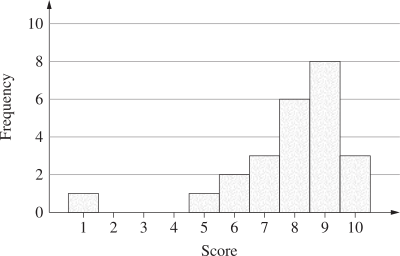
The graph shows the frequency of scores out of 10 awarded to a museum by visitors.
 

  1. What is the mode of these data?  (1 mark)

    --- 2 WORK AREA LINES (style=lined) ---

  2. Describe TWO features of this graph.  (2 marks)

    --- 5 WORK AREA LINES (style=lined) ---
Show Answers Only

a.    \(\text{Mode = Score with the highest frequency}=9\)
 

b.    \(\text{Features could include any 2 of the following:}\)

  • \(\text{Data is negatively skewed as the mean and median are to the left of the mode}\)
  • \(\text{23 of the 24 scores, or 95.8%, are 5 or above.}\)
  • \(Q_2\text{(Median)}=8\)
  • \(Q_1=7\text{ and }Q_3=9\)
  • \(IQR=Q_1-Q_3=9-7=2\)
  • \(Q_1-1.5\times IQR=7-1.5\times 2=4\ \ \Rightarrow \ \ \text{1 is an outlier}\)
  • \(\text{Mean}=\dfrac{189}{24}=7.875\)
  • \(\text{If the outlier (1) was removed, Mean}=\dfrac{188}{23}=8.174\text{ (2 d.p.)}\)

Show Worked Solution

a.    \(\text{Mode = Score with the highest frequency}=9\)
 

b.    \(\text{Features could include any 2 of the following:}\)

  • \(\text{Data is negatively skewed as the mean and median are to the left of the mode}\)
  • \(\text{23 of the 24 scores, or 95.8%, are 5 or above.}\)
  • \(Q_2\text{(Median)}=8\)
  • \(Q_1=7\text{ and }Q_3=9\)
  • \(IQR=Q_1-Q_3=9-7=2\)
  • \(Q_1-1.5\times IQR=7-1.5\times 2=4\ \ \Rightarrow \ \ \text{1 is an outlier}\)
  • \(\text{Mean}=\dfrac{189}{24}=7.875\)
  • \(\text{If the outlier (1) was removed, Mean}=\dfrac{188}{23}=8.174\text{ (2 d.p.)}\)

♦ Mean mark (a) 47%.
♦♦♦ Mean mark (b) 18%.

Filed Under: Bar Charts and Histograms, Bar Charts, Histograms and Other Graphs (Std 1), Measures of Centre and Spread, Summary Statistics (Std 1) Tagged With: Band 5, Band 6, smc-1128-10-Bar Charts, smc-1128-15-Histograms, smc-1131-10-Mean, smc-1131-20-Median and Mode, smc-6530-10-Bar Charts, smc-6530-20-Histograms, smc-6532-10-Mean, smc-6532-20-Median and Mode

Statistics, STD1 S1 2022 HSC 13

Kim wants to investigate what students think about the food that is sold at the school's canteen. Kim decides to use a survey to interview a sample group of students to find out their opinions on a number of different issues.

  1. As part of the survey, Kim is thinking about using one of the options listed below.
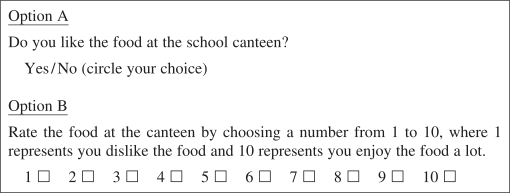


    Name ONE advantage for each option.  (2 marks)

    --- 4 WORK AREA LINES (style=lined) ---

  2. After collecting data, Kim drew the following graph to summarise the opinions related to the price of the food.
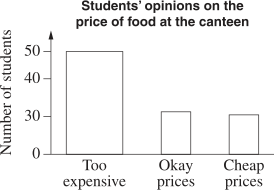


    What TWO features of the graph make it misleading?  (2 marks)

    --- 4 WORK AREA LINES (style=lined) ---

Show Answers Only

a.   Advantages

Option A → This option would be very easy to collate as there are only 2 choices.

Option B → This option gives a more detailed idea of the students’ thoughts about the food as they can grade their choice from 1 – 10.


b.   Misleading features:

→ The scale on the vertical axis is not equal. This makes the “Too Expensive” column (at 50) appear to have more than twice the number of responses as “Okay Prices” (~30) and “Cheap Prices” (~30) which is incorrect.

→ The varying column widths are also misleading as the wider column could be interpreted as being having more weight than the other 2.

Show Worked Solution

a.   Advantages

Option A → This option would be very easy to collate as there are only 2 choices.

Option B → This option gives a more detailed idea of the students’ thoughts about the food as they can grade their choice from 1 – 10.
 

b.   Misleading features:

    • The scale on the vertical axis is not equal. This makes the “Too Expensive” column (at 50) appear to have more than twice the number of responses as “Okay Prices” (~30) and “Cheap Prices” (~30) which is incorrect.
    • The varying column widths are also misleading as the wider column could be interpreted as being having more weight than the other 2.

♦♦ Mean mark 32%.

Filed Under: Bar Charts and Histograms, Bar Charts, Histograms and Other Graphs (Std 1), Classifying Data (Std 1), Data Classification, Investigation and Sampling Methods Tagged With: Band 4, Band 5, smc-1127-30-Other, smc-1128-10-Bar Charts, smc-6529-30-Other, smc-6530-10-Bar Charts

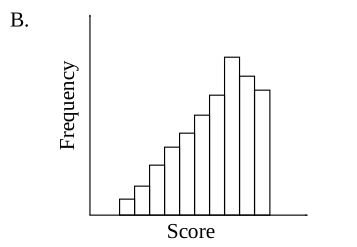
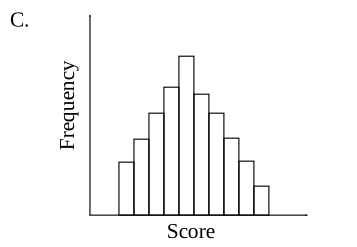
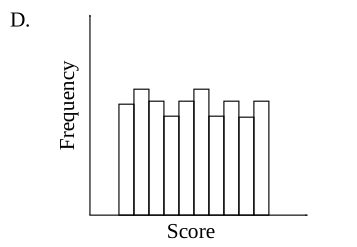
Statistics, STD2 S1 2020 HSC 7 MC

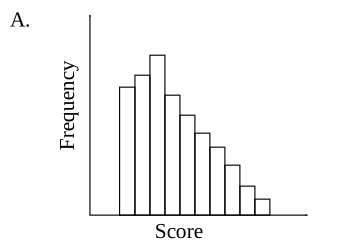
Which histogram best represents a dataset that is positively skewed?
 
 
Show Answers Only

`A`

Show Worked Solution

♦♦ Mean mark 32%.

`text(Positive skew occurs when the tail on the)`

`text{histogram is longer on the right-hand}`

`text{(positive) side.}`

`=> \ A`

Filed Under: Bar Charts and Histograms, Bar Charts and Histograms, Bar Charts and Histograms (Std 2), Bar Charts and Histograms (Y12), Bar Charts, Histograms and Other Graphs (Std 1), Data Analysis Tagged With: Band 5, common-content, num-title-ct-core, num-title-qs-hsc, smc-1128-15-Histograms, smc-4224-35-Describing datasets, smc-6310-20-Histograms, smc-6530-20-Histograms, smc-821-15-Histograms, smc-997-15-Histograms

Statistics, STD2 S1 2018 HSC 26d

The graph displays the mean monthly rainfall in Sydney and Perth.
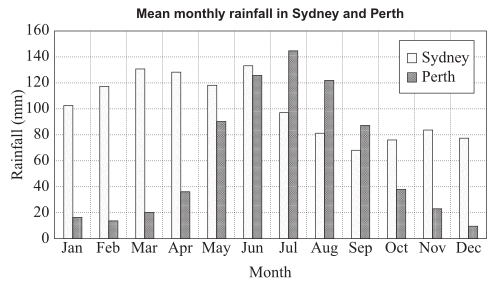


  1. For how many months is the mean monthly rainfall higher in Perth than in Sydney?  (1 mark)

    --- 1 WORK AREA LINES (style=lined) ---

  2. For which of the two cities is the standard deviation of the mean monthly rainfall smaller? Justify your answer WITHOUT calculations.  (1 mark)

    --- 2 WORK AREA LINES (style=lined) ---

Show Answers Only
  1. `3`
  2. `text(The mean monthly rainfall of Sydney is in a)`
    `text(much tighter range than Perth.)`
    `:.\ text(Sydney has a smaller standard deviation.)`
Show Worked Solution

a.   `text(3 months (Jul, Aug and Sep))`

♦ Mean mark part (ii) 38%.
COMMENT: Extremely volatile result between parts with part (i) producing a 91% mean mark.


b.    `text(The mean monthly rainfall of Sydney is in a)`

`text(much tighter range than Perth.)`

`:.\ text(Sydney has a smaller standard deviation.)`

Filed Under: Bar Charts and Histograms, Bar Charts and Histograms, Bar Charts and Histograms (Std 2), Bar Charts and Histograms (Y12), Bar Charts, Histograms and Other Graphs (Std 1) Tagged With: Band 2, Band 5, common-content, smc-1128-10-Bar Charts, smc-6310-10-Bar Charts, smc-6530-10-Bar Charts, smc-821-10-Bar Charts, smc-997-10-Bar Charts

Statistics, STD2 S1 2016 HSC 27c

The heights of 400 students were measured. The results are displayed in this cumulative frequency polygon.
 

2ug-2016-hsc-q27_2

 
Use the polygon to estimate the interquartile range.  (2 marks)

--- 4 WORK AREA LINES (style=lined) ---

Show Answers Only

`36\ text(cm)`

Show Worked Solution

`text(See graph for values:)`

♦ Mean mark 46%.

2ug-2016-hsc-q27c-answer

`IQR` `= Q_3 – Q_1`
  `= 172 – 136`
  `= 36\ text(cm)`

Filed Under: Bar Charts and Histograms, Bar Charts and Histograms, Bar Charts and Histograms, Bar Charts and Histograms (Std 2), Bar Charts and Histograms (Y12), Bar Charts, Histograms and Other Graphs (Std 1) Tagged With: Band 5, common-content, smc-1128-20-Cumulative Frequency Histograms, smc-1128-30-IQR, smc-6310-30-Cumulative Frequency Histograms, smc-6310-40-IQR, smc-6530-30-Cumulative Frequency Histograms, smc-6530-40-IQR, smc-821-20-Cumulative Frequency Histograms, smc-821-30-IQR, smc-997-20-Cumulative Frequency Histograms, smc-997-30-IQR

Statistics, STD2 S1 2006 HSC 24a

2UG-2006-24a

List TWO ways in which this graph is misleading.  (2 marks)

--- 4 WORK AREA LINES (style=lined) ---

Show Answers Only

`text(Reasons the graph is misleading include)`

`text(- the columns are a different widths/volumes)`

`text(- the vertical axis doesn’t start at zero)`

Show Worked Solution

`text(Reasons the graph is misleading include)`

`text(- the columns are a different widths/volumes)`

`text(- the vertical axis doesn’t start at zero)`

Filed Under: Bar Charts and Histograms, Bar Charts and Histograms, Bar Charts and Histograms, Bar Charts and Histograms (Std 2), Bar Charts and Histograms (Y12), Bar Charts, Histograms and Other Graphs (Std 1), Interpreting Data Tagged With: Band 4, common-content, num-title-ct-core, num-title-qs-hsc, smc-1128-10-Bar Charts, smc-5077-10-Misleading graphs, smc-6310-10-Bar Charts, smc-6530-10-Bar Charts, smc-821-10-Bar Charts, smc-997-10-Bar Charts

Statistics, STD2 S1 2005 HSC 24d

The sector graph shows the proportion of people, as a percentage, living in each region of Sumcity. There are 24 000 people living in the Eastern Suburbs.
 

2UG-2005-24d1
 

  1. Show that the total number of people living in Sumcity is  160 000.  (1 mark)

    --- 1 WORK AREA LINES (style=lined) ---

Jake used the information above to draw a column graph.
 

2UG-2005-24d2

  1. The column graph height is incorrect for one region.


    Identify this region and justify your answer.   (2 marks)

    --- 4 WORK AREA LINES (style=lined) ---

Show Answers Only
  1. `160\ 000`
  2. `text(Western Suburbs population)`
Show Worked Solution

a.   `text(Let the population of Sumcity =)\ P`

`text(15%)× P` `= 24\ 000`
`:.P`  `= (24\ 000)/0.15` 
  `= 160\ 000\ …\ text(as required)` 


b.  `text(Western Suburbs population)`

`= text(10%) × 160\ 000`

`= 16\ 000`

`text(The column graph has this population as)`

`text(12 000 people which is incorrect.)`

Filed Under: Bar Charts and Histograms, Bar Charts and Histograms, Bar Charts and Histograms, Bar Charts and Histograms (Std 2), Bar Charts and Histograms (Y12), Bar Charts, Histograms and Other Graphs (Std 1), Displaying Data, Other Chart Types (Y12), Other Charts, Other Charts, Other Charts (Std 2), Other Graphs Tagged With: Band 4, common-content, num-title-ct-core, num-title-qs-hsc, smc-1128-10-Bar Charts, smc-5076-15-Sector graphs and Divided Bar graphs, smc-5077-10-Misleading graphs, smc-6310-10-Bar Charts, smc-6311-30-Other Charts, smc-6530-10-Bar Charts, smc-6531-30-Other Charts, smc-6531-40-Outliers, smc-821-10-Bar Charts, smc-822-40-Other Charts, smc-997-10-Bar Charts, smc-998-40-Other Charts

Statistics, STD2 S1 2005 HSC 9 MC

A set of data is represented by the cumulative frequency histogram and ogive.
 

2UG-2005-9MC
 

What is the best approximation for the interquartile range for this set of data?

  1.    25
  2.    30
  3.    35
  4.    40
Show Answers Only

`C`

Show Worked Solution

2UG-2005-9MC Answer

`IQR` `= Q3 − Q1`
  `= 80 − 45`
  `= 35`

`=>  C`

Filed Under: Bar Charts and Histograms, Bar Charts and Histograms, Bar Charts and Histograms, Bar Charts and Histograms (Std 2), Bar Charts and Histograms (Y12), Bar Charts, Histograms and Other Graphs (Std 1) Tagged With: Band 5, common-content, smc-1128-20-Cumulative Frequency Histograms, smc-1128-30-IQR, smc-6310-30-Cumulative Frequency Histograms, smc-6310-40-IQR, smc-6530-30-Cumulative Frequency Histograms, smc-6530-40-IQR, smc-821-20-Cumulative Frequency Histograms, smc-821-30-IQR, smc-997-20-Cumulative Frequency Histograms, smc-997-30-IQR

Statistics, STD2 S1 2008 HSC 26d

The graph shows the predicted population age distribution in Australia in 2008.


  1. How many females are in the 0–4 age group?  (1 mark)

    --- 1 WORK AREA LINES (style=lined) ---

  2. What is the modal age group?   (1 mark)

    --- 1 WORK AREA LINES (style=lined) ---

  3. How many people are in the 15–19 age group?   (2 marks)

    --- 4 WORK AREA LINES (style=lined) ---

  4. Give ONE reason why there are more people in the 80+ age group than in the 75–79 age group.   (1 mark)

    --- 2 WORK AREA LINES (style=lined) ---

Show Answers Only
  1. `600\ 000`
  2. `35-39`
  3. `1\ 450\ 000`
  4. `text(The 80+ group includes all people over 80)`
  5.  

    `text(and is not restricted by a 5-year limit.)`

Show Worked Solution
a.    `text{# Females (0-4)}` `= 0.6 xx 1\ 000\ 000`
    `= 600\ 000`


b.    `text(Modal age group)\ =` `text(35 – 39)`


c.   `text{# Males (15-19)}` `= 0.75 xx 1\ 000\ 000`
    `= 750\ 000`


`text{# Females (15-19)}` `= 0.7 xx 1\ 000\ 000`
  `= 700\ 000`


`:.\ text{Total People (15-19)}` `= 750\ 000 + 700\ 000`
  `= 1\ 450\ 000`


d.   `text(The 80+ group includes all people over 80)`
  `text(and is not restricted by a 5-year limit.)`

Filed Under: Bar Charts and Histograms, Bar Charts and Histograms, Bar Charts and Histograms, Bar Charts and Histograms (Std 2), Bar Charts and Histograms (Y12), Bar Charts, Histograms and Other Graphs (Std 1), Data Analysis Tagged With: Band 3, Band 4, Band 5, common-content, num-title-ct-core, num-title-qs-hsc, smc-1128-15-Histograms, smc-4224-15-Mode, smc-4224-35-Describing datasets, smc-6310-20-Histograms, smc-6530-20-Histograms, smc-821-15-Histograms, smc-997-15-Histograms

Statistics, STD2 S1 2011 HSC 25b

The graph below displays data collected at a school on the number of students
in each Year group, who own a mobile phone.
 

2UG 2011 25b
 

  1. Which Year group has the highest percentage of students with mobile phones? (1 mark)

    --- 1 WORK AREA LINES (style=lined) ---

  2. Two students are chosen at random, one from Year 9 and one from Year 10.


    Which student is more likely to own a mobile phone?


    Justify your answer with suitable calculations. (2 marks)

    --- 4 WORK AREA LINES (style=lined) ---

  3. Identify a trend in the data shown in the graph. (1 mark)

    --- 2 WORK AREA LINES (style=lined) ---

Show Answers Only
  1. `text{Year 12 (100%)}`
  2. `text(Year 10)`
  3. `text(See Worked Solutions for detail)`
Show Worked Solution

a.   `text(Year 12 (100%))`

MARKER’S COMMENT: Many students ignore the instruction to use calculations and lose marks as a result.
 

b.     `text(% Ownership in Year 9)` `=55/70`
    `=\ text{78.6%  (1d.p.)}`
      `text(% Ownership in Year 10)` `=50/60`
    `=\ text{83.3%  (1d.p.)}`

  
`:.\ text(The Year 10 student is more likely to own a mobile phone.)`


c.   `text(% Ownership increases as students)`

 `text(progress from Year 7 to Year 12.)`

Filed Under: Bar Charts and Histograms, Bar Charts and Histograms, Bar Charts and Histograms, Bar Charts and Histograms (Std 2), Bar Charts and Histograms (Y12), Bar Charts, Histograms and Other Graphs (Std 1), Displaying Data, Relative Frequency Tagged With: Band 3, Band 4, common-content, num-title-ct-core, num-title-qs-hsc, smc-1128-10-Bar Charts, smc-5076-10-Column graphs and histograms, smc-6310-10-Bar Charts, smc-6530-10-Bar Charts, smc-821-10-Bar Charts, smc-997-10-Bar Charts

Statistics, STD2 S1 2011 HSC 11 MC

The sets of data, `X` and `Y`, are displayed in the histograms.

2UG 2011 11

Which of these statements is true?

  1.   `X` has a larger mode and `Y ` has a larger range.
  2.   `X` has a larger mode and the ranges are the same.
  3.   The modes are the same and `Y` has a larger range.
  4.   The modes are the same and the ranges are the same.
Show Answers Only

`B`

Show Worked Solution
♦ Mean mark 47%

`text(Mode of)\ X=9`

`text(Range of)\ X=9-3=6`

`text(Mode of)\ Y=8`

`text(Range of)\ Y=11-5=6`

`:. X\ text(has a larger mode and ranges are the same)`

`=>B`

Filed Under: Bar Charts and Histograms, Bar Charts and Histograms, Bar Charts and Histograms, Bar Charts and Histograms (Std 2), Bar Charts and Histograms (Y12), Bar Charts, Histograms and Other Graphs (Std 1), Data Analysis Tagged With: Band 4, common-content, num-title-ct-core, num-title-qs-hsc, smc-1128-15-Histograms, smc-4224-45-Mean/median/mode/range, smc-6310-20-Histograms, smc-6530-20-Histograms, smc-821-15-Histograms, smc-997-15-Histograms

Statistics, STD2 S1 2013 HSC 15 MC

The frequency histogram shows the number of goals scored by a football team in each game in a season.
 

2013 15 mc

 
What is the mean number of goals scored per game by this team?

  1.    4
  2.    4.5
  3.    5
  4.    5.5
Show Answers Only

`C`

Show Worked Solution

`text(Total number of goals scored)`

`=(3xx3)+(4xx7)+(5xx5)+(6xx1)+(7xx0)+(8xx4)`

`=9+28+25+6+0+32`

`=100`

`text(Number of games)=3+7+5+1+4=20`

`:.\ text(Mean goals per game)=100/20=5`

`=>\ C`

Filed Under: Bar Charts and Histograms, Bar Charts and Histograms, Bar Charts and Histograms, Bar Charts and Histograms (Std 2), Bar Charts and Histograms (Y12), Bar Charts, Histograms and Other Graphs (Std 1), Data Analysis Tagged With: Band 4, common-content, num-title-ct-core, num-title-qs-hsc, smc-1128-15-Histograms, smc-4224-25-Mean, smc-6310-20-Histograms, smc-6530-20-Histograms, smc-821-15-Histograms, smc-997-15-Histograms

Statistics, STD2 S1 2013 HSC 6 MC

A survey was conducted where people were asked which of two brands of smartphones they preferred. The results were:

  • 48% preferred Brand X
  • 52% preferred Brand Y

A graph displaying the data is to be included in a magazine article. The editor of the magazine wishes to ensure that the graph is not misleading in any way.

Which graph should the editor choose to include in the article?
 

2013 6 mc1

2013 6 mc2

Show Answers Only

`D`

Show Worked Solution

`D\ text(is the best as it starts at zero on the)\ y text(-axis)`

`text(and has the same column widths.)`

Filed Under: Bar Charts and Histograms, Bar Charts and Histograms, Bar Charts and Histograms, Bar Charts and Histograms (Std 2), Bar Charts and Histograms (Y12), Bar Charts, Histograms and Other Graphs (Std 1), Interpreting Data Tagged With: Band 4, common-content, num-title-ct-core, num-title-qs-hsc, smc-1128-10-Bar Charts, smc-6310-10-Bar Charts, smc-6530-10-Bar Charts, smc-821-10-Bar Charts, smc-997-10-Bar Charts

Copyright © 2014–2026 SmarterEd.com.au · Log in